"🔥 THE ARSONIST'S ALIBI How Winston Peters Set the Courthouse on Fire, Handed Judith Collins the Matches, and Then Pretended He Never Smelled Smoke" - 11 April 2026
They hunted a judge for telling the truth about a liar. Now the liar can't even stand by his own lie. This is not politics. This is a purge. And whānau deserve to know every name.

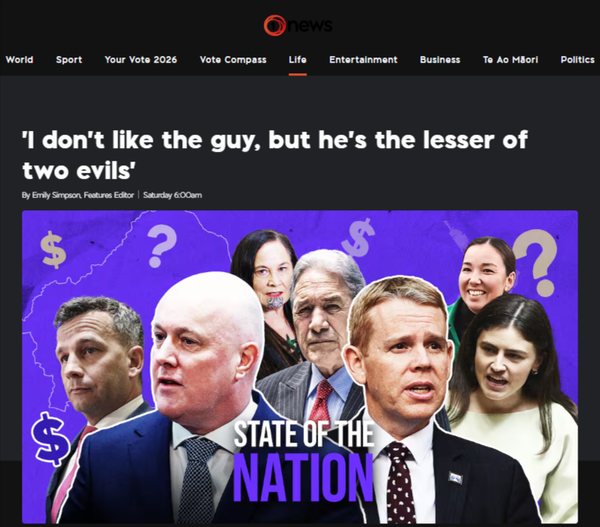
Kia ora Aotearoa on this windy Saturday afternoon. Keep safe as I smash Koro Winston in the nuts, the lying ass that he is.
The Deep Dive Podcast
Listen to a lively conversation between two hosts, unpacking and connecting topics in the sources of this essay.
He Ahi Kē Tēnei — This Is a Different Kind of Fire
There is an old saying about the arsonist who runs fastest to the fire he set.
In Aotearoa, in April 2026, that arsonist is Winston Raymond Peters — Deputy Prime Minister, five-decade political shapeshifter, and the man whose words lit the fuse that triggered an unprecedented judicial persecution campaign against District Court Judge Ema Aitken.
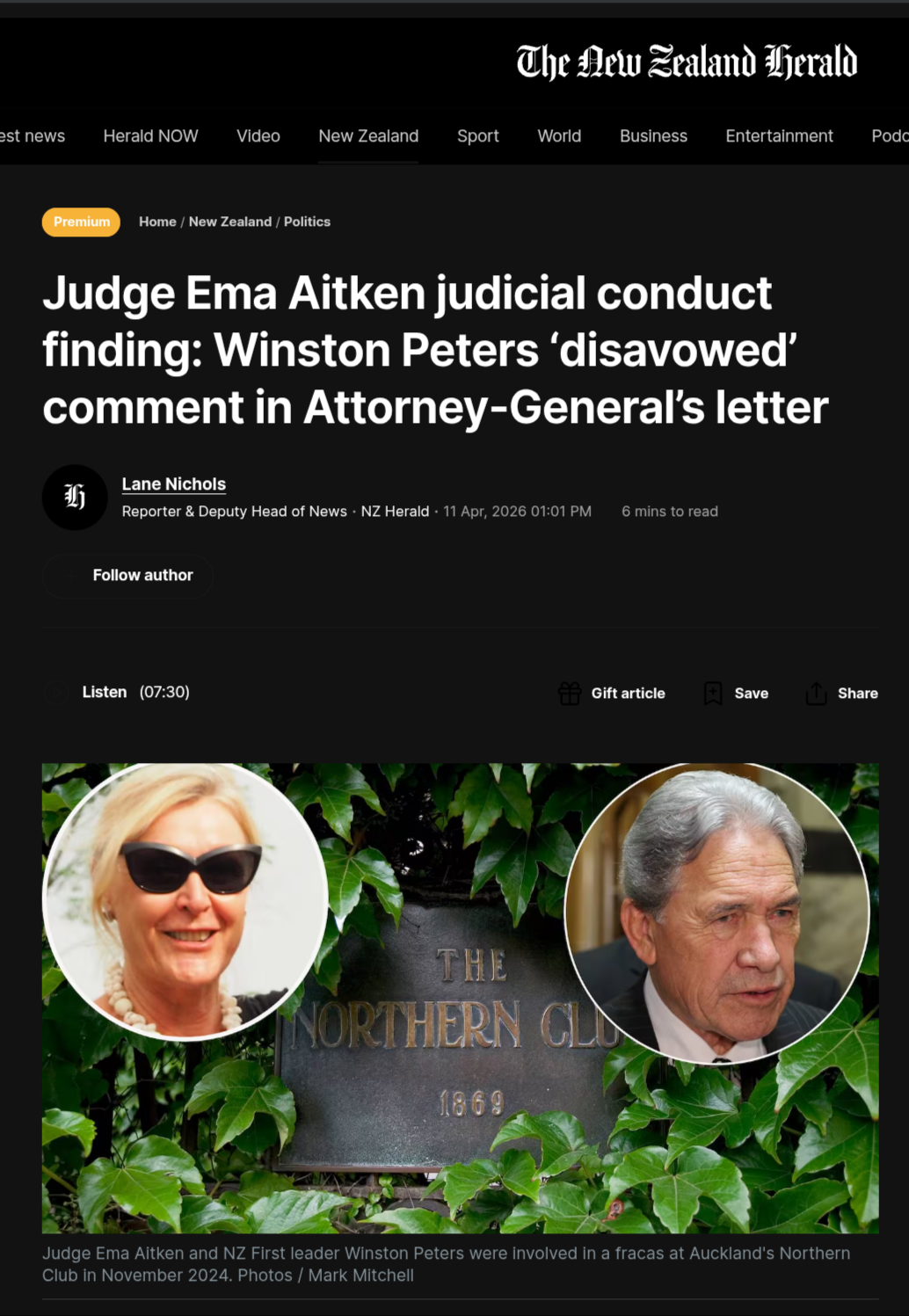
And now, as NZ Herald reported on April 10, 2026, Peters has disavowed the very statement attributed to him in Attorney-General Judith Collins' referral letter — the statement that launched New Zealand's first-ever Judicial Conduct Panel hearing and subjected a respected judge to sixteen months of institutional warfare.
Let that land.
The man whose words ignited this entire dumpster fire now says: those aren't my words.
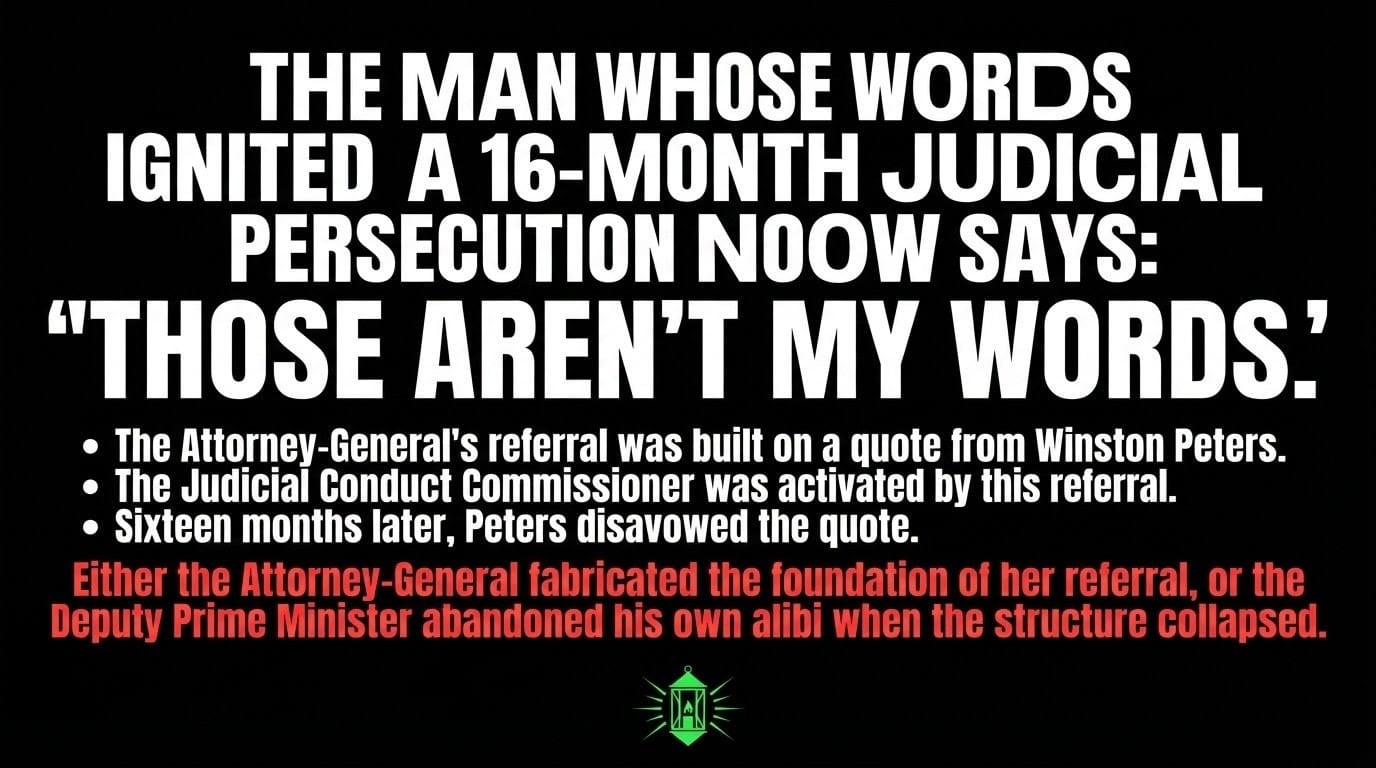
In tikanga Māori, we call this korero teka — false speech. And if the Māori Green Lantern has named Peters for anything across five decades, it is exactly this: the systematic manufacture of fog to protect the powerful and suffocate the truth.
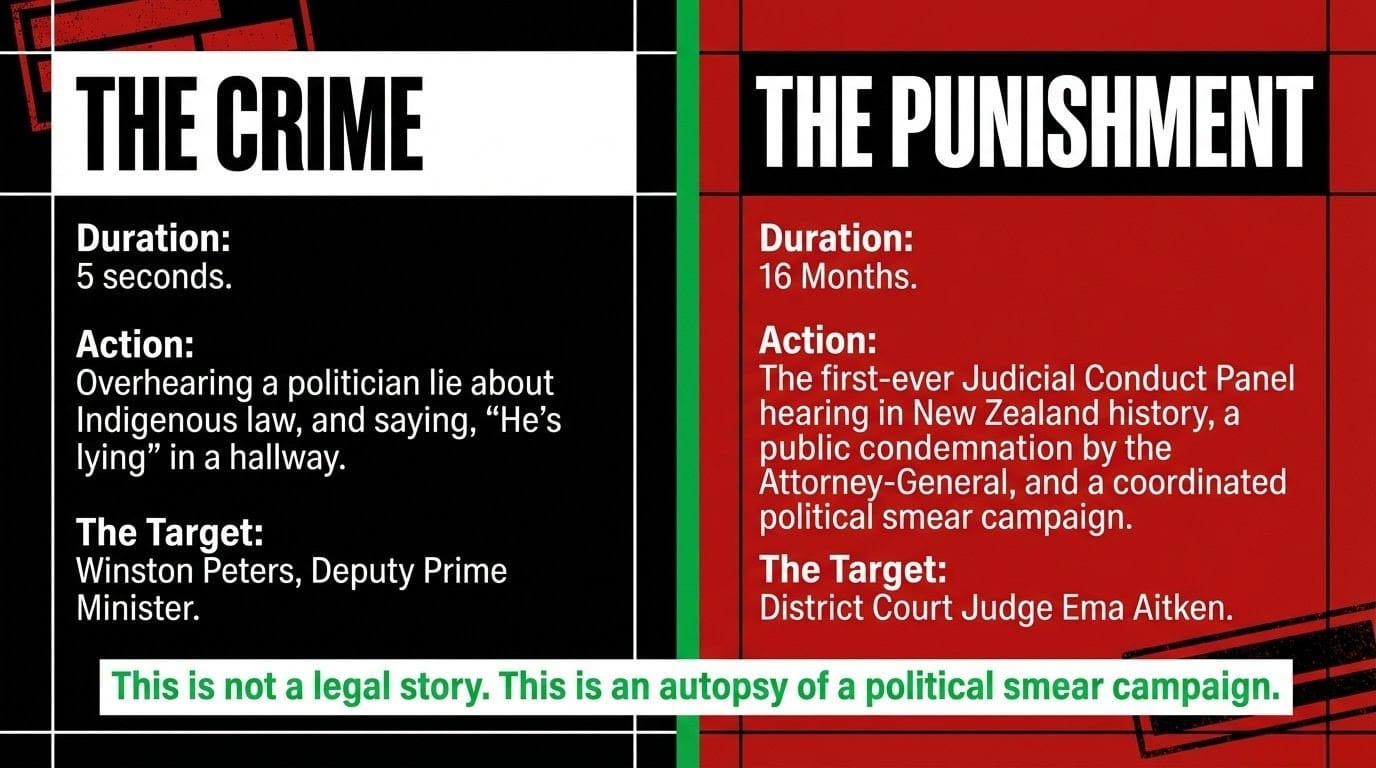
This is not a legal story.
This is an autopsy.
Ko te Ahi i Whakakā ai | The Fire They Lit
Picture it precisely.
Auckland. November 22, 2024. The Northern Club — that venerable citadel of colonial comfort where the city's moneyed class eat rare beef and worry about what the Treaty might cost them.
Two events. One building.
In one room: a function honouring judges, including one for District Court Judge Ema Aitken, marking her resignation of warrant. Experienced. Principled. Sixteen years on the bench. A woman with a record in refugee law, criminal defence, and the advancement of women in legal practice.
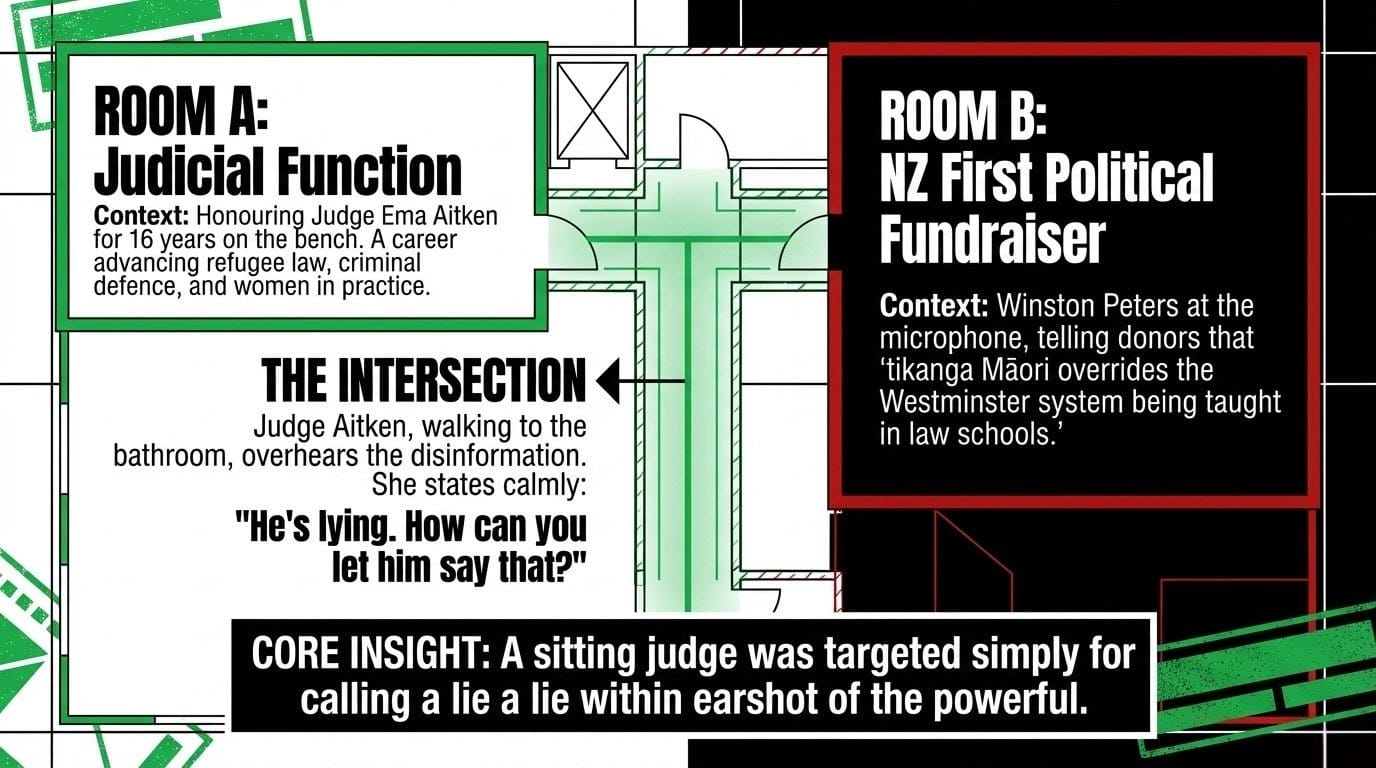
In the adjacent room: a New Zealand First fundraiser. Winston Peters at the microphone. Doing what Winston Peters does — drip-feeding red meat to donors who fear that tikanga Māori might somehow cost them something.
Judge Aitken walked to the bathroom.
She overheard Peters claiming that tikanga Māori was "overriding the Westminster system being taught in law schools."
She reacted — briefly, audibly, at the bottom of a staircase — saying words to the effect:
"He's lying. How can you let him say that?"
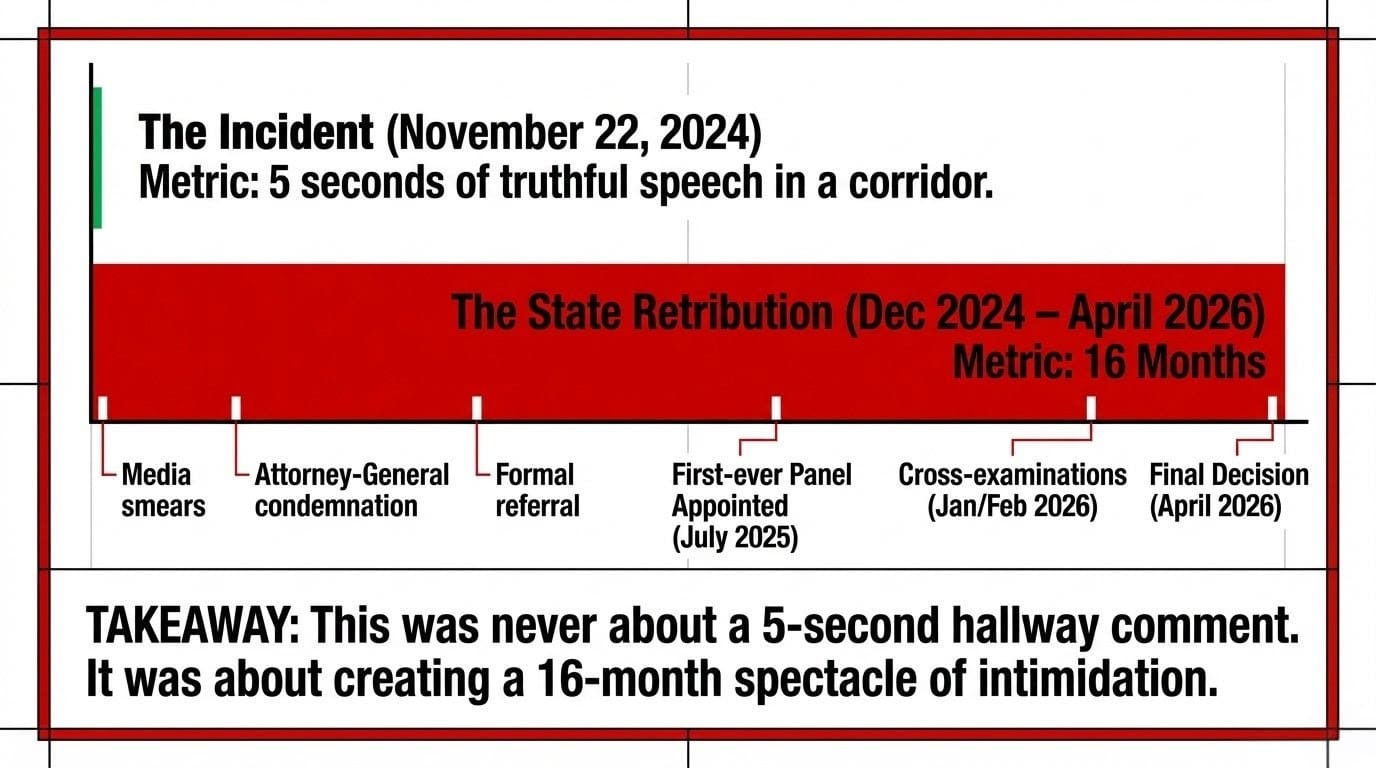
And for that — for telling the truth about a liar in a corridor — a sitting judge was subjected to sixteen months of institutional hell, the first-ever Judicial Conduct Panel hearing in New Zealand history, a public condemnation by the Attorney-General, a ban from the Northern Club, and allegations of threatening behaviour that three of her own colleagues described as, simply, rubbish.
As The Māori Green Lantern first documented in "The Taiaha Strikes: How New Zealand's Far Right Weaponised a Bathroom Break to Wage War on Tikanga Māori" — this was never about judicial conduct. This was about silencing a woman who called a lie a lie.
Ko te Kōrero Teka o NZ First | The Machine-Made Lie
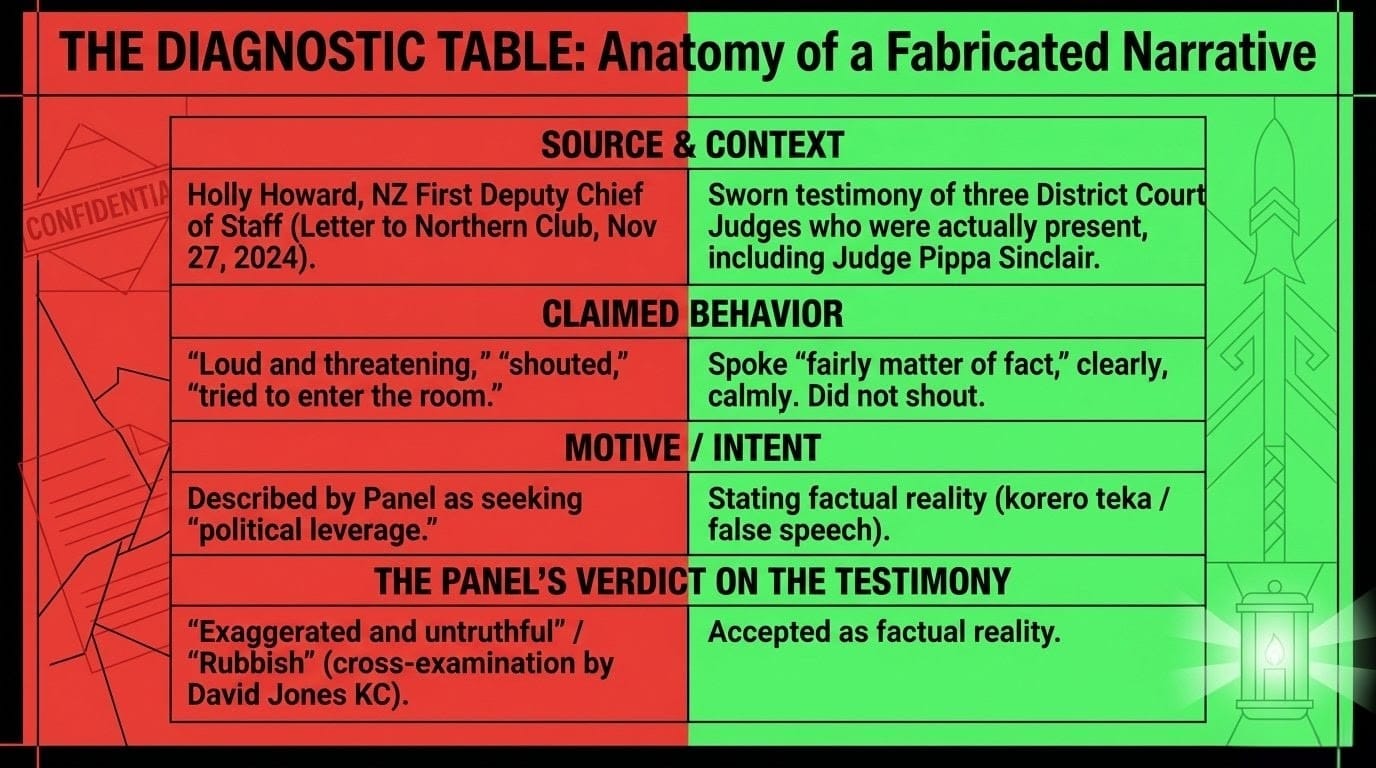
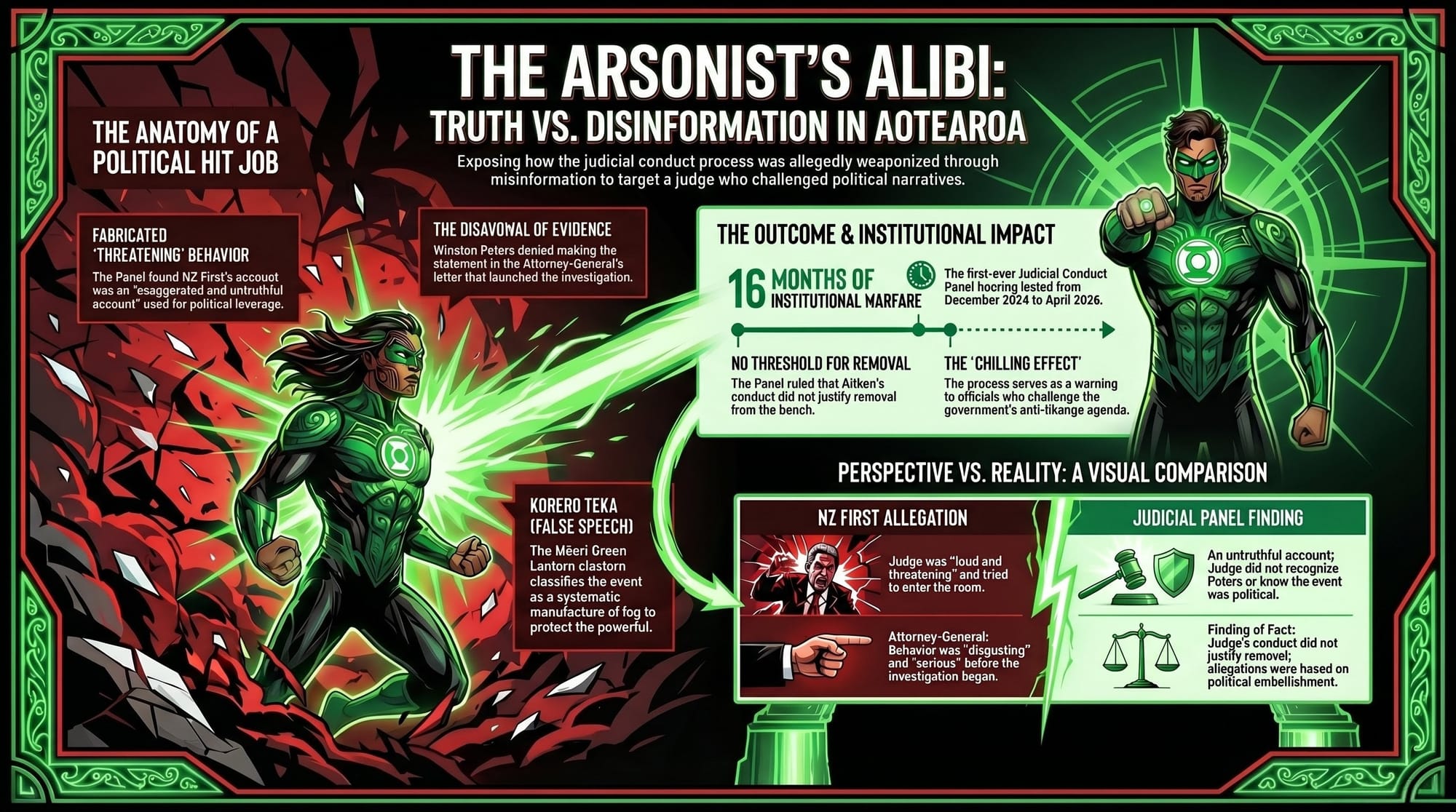
NZ First's version of events, delivered by party deputy chief of staff Holly Howard in a letter to the Northern Club dated November 27, 2024, was a masterwork of political embroidery.
According to Howard: Aitken "tried to enter the room," was "loud and threatening," shouted "He's lying! How can you let him say that?" and warned there was "a room full of judges next door who would be interested in what the Deputy Prime Minister said."
Howard read this to the Judicial Conduct Panel.
Under cross-examination by Judge Aitken's lawyer David Jones KC, that account was torn apart — as Law News NZ reported — as having "apparent discrepancies" between what she wrote to the Northern Club and what she told the Panel. Her account was called "rubbish" at the hearing itself. The Panel heard she provided an "exaggerated and untruthful account" "in order to gain some form of political leverage."
Political leverage.
Not truth. Leverage.
Three District Court judges who were actually there contradicted NZ First's story entirely. Judge Pippa Sinclair told the Panel that Aitken returned to the table and spoke "fairly matter of fact," clearly and calmly — not shouting, not threatening, not wielding anything more dangerous than the truth.
This is what Peters and NZ First did to a judge: they spun a fiction, delivered it through a party operative, presented it as sworn evidence, and then handed it to a compliant Attorney-General to activate the machinery of the state.
Ko Judith Collins: Te Kaiwhakaora Me te Kaiwhakamate | The Judge and the Executioner
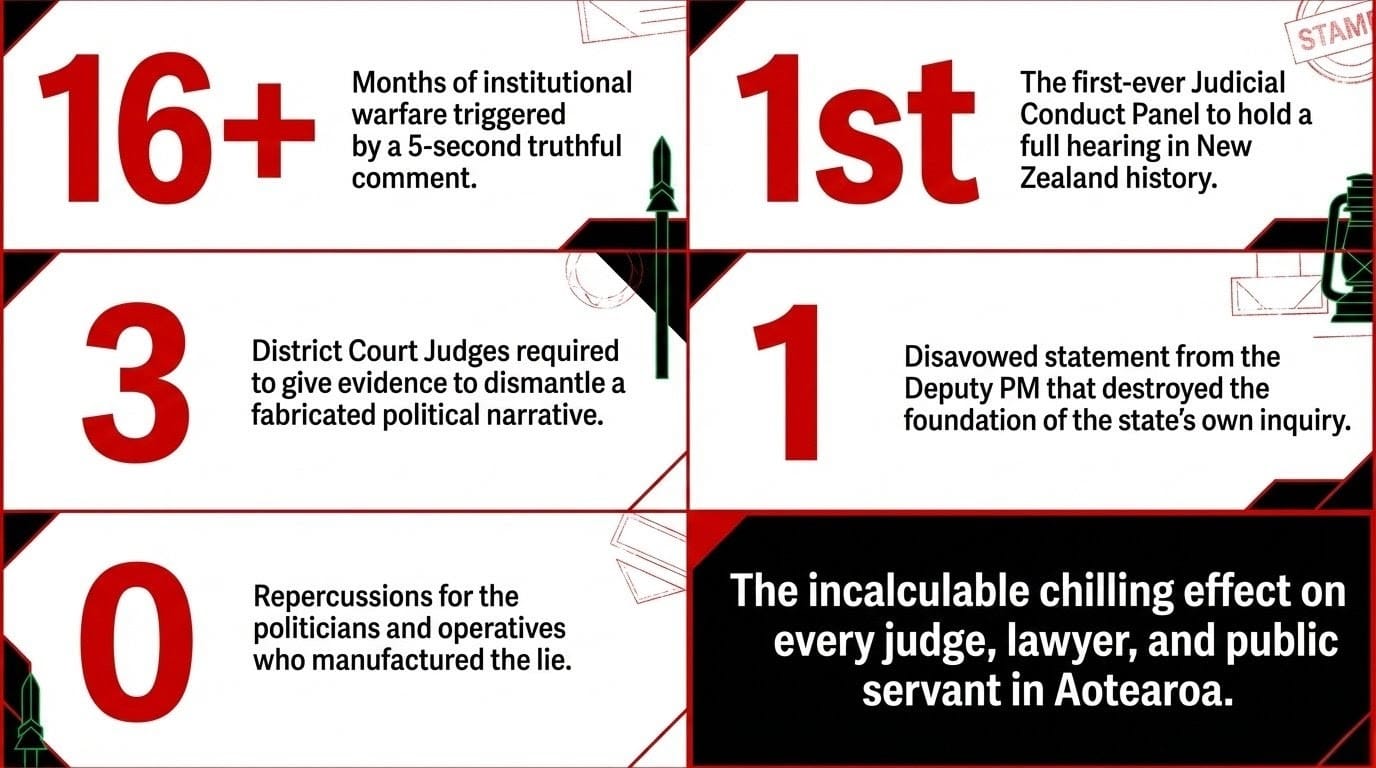
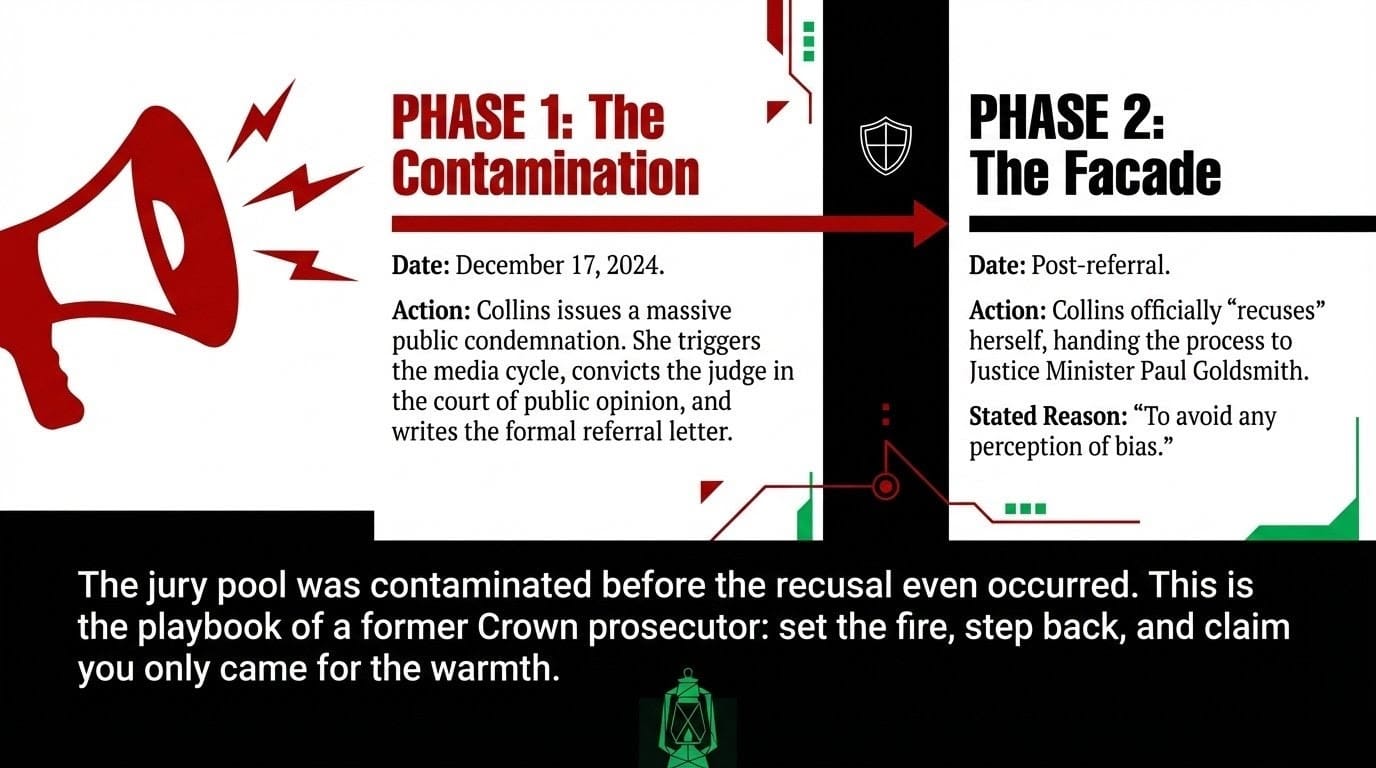
On December 17, 2024, Attorney-General Judith Collins announced she was writing to the Judicial Conduct Commissioner, declaring herself "really disgusted," calling the incident "very serious."
She said this publicly.
She said it before any investigation had begun.
She said it as the most powerful law officer in the country, with the full weight of her office behind every word.
Then — in a stroke of procedural cowardice that should end careers — she recused herself from the matter "to avoid any perception of conflict of interest, bias or pre-determination," handing the process to Justice Minister Paul Goldsmith.
The perception of bias? Judith — you were the bias. You already convicted her. You called her conduct "disgusting" to the nation's media before a single witness was heard. You activated the Commissioner. You wrote the letter.
You set the dumpster on fire and then walked away saying,
"I'm just here for the warmth."
As 1News confirmed, Acting Attorney-General Paul Goldsmith formally appointed the Judicial Conduct Panel on 22 July 2025 — seven months after Collins had already done the political damage.
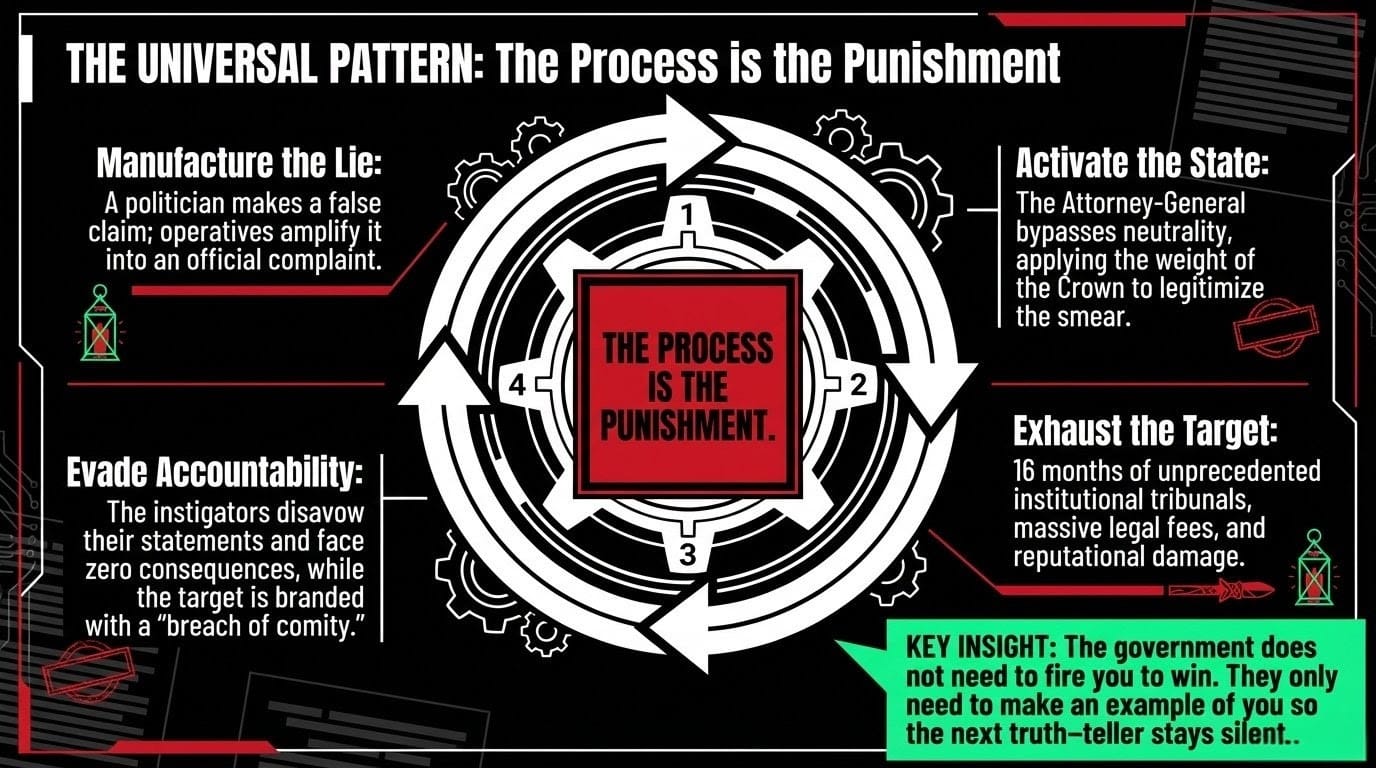
This is what this neoliberal white supremacist government does. It does not need to win. It only needs to exhaust you. To make you spend your legal fees, your energy, your mana, simply surviving the process — so that the next judge who hears a lie from the Deputy Prime Minister will think twice before opening their mouth.
The chilling effect is the punishment.
Ko te Tikanga i Pakaru | Three Translations for the Western Mind
If you were raised in a tradition that separates law from culture, ethics from identity, courts from community — this story might look like a procedural dispute about judicial conduct.
It is not.
Here are three analogies to help the western mind grasp what was actually destroyed.
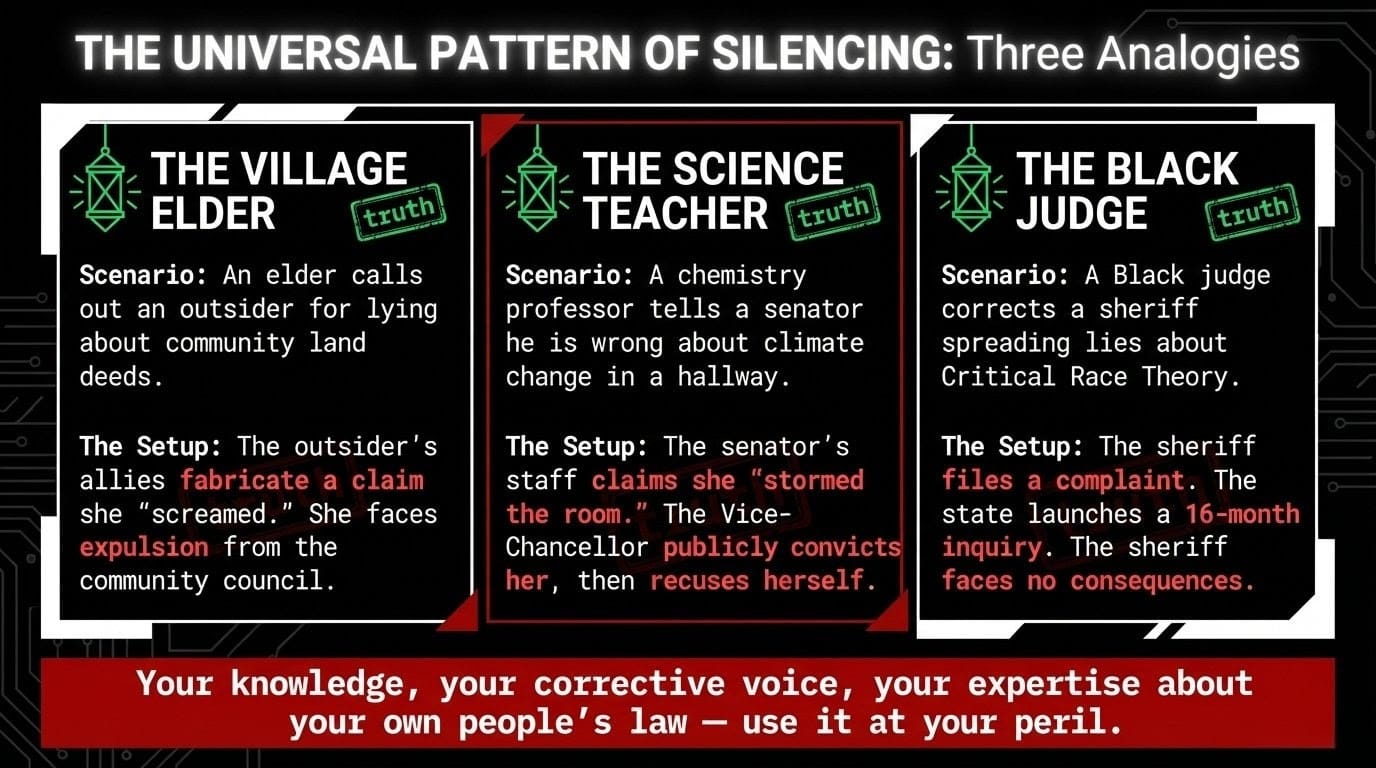
Example 1: The Village Elder Who Called Out the Fraudster — and Was Exiled for It
Imagine a small community governed by an unwritten but binding covenant of honesty — a whakapapa of trust that holds the community together. An elder with forty years of service overhears a powerful outsider telling the community's youth that their grandfather's land deeds were fraudulent — that their inheritance is worthless.
The elder says, in the village square:
"He's lying."
The outsider's allies draft a letter claiming the elder "charged in screaming." Three witnesses say she spoke calmly. The outsider is now the Governor. His lawyer writes to the Community Council. The elder faces expulsion.
That is what happened here.
Tikanga holds that speech carries mana — weight, authority, consequence. The mana of a community is strengthened when its elders speak truth to power. When the state punishes truth-telling, it does not merely harm one person. It depletes the collective capacity of the entire community to navigate reality.
As the Māori Green Lantern explored in "Winston Peters — A Walking Contradiction, A Forked Tongue in a Taonga He Was Never Worthy Of": "Peters does not merely lie. He depletes the collective mana of Aotearoa. He makes the country less able to face the truth of its Treaty obligations."
Example 2: The Science Teacher Who Corrected the Senator — and Got Fired
In Western terms: imagine a university chemistry professor overhearing a senator tell a fundraiser that climate change is a hoax. The professor says in the corridor:
"He's wrong."
The senator's chief of staff drafts a letter saying the professor "stormed the room, screamed, and threatened the senator's guests." Three colleagues say she said it calmly in the hallway.
The senator's party uses his position to refer the professor to the University Conduct Board. The Vice-Chancellor, who is also the senator's golf partner, publicly declares herself "disgusted" before the hearing, then recuses herself.
Sixteen months later: the professor is found to have committed "a serious breach of professional etiquette." She keeps her job. The senator faces no consequences. The Vice-Chancellor faces no consequences. The chief of staff who lied to the Board faces no consequences.
The message to every other professor: stay silent or we will come for you too.
That is this case. Exactly.
Example 3: The Black Judge Who Corrected the Sheriff
In the American context: imagine a Black judge overhearing the county sheriff tell a political fundraiser that critical race theory "overrides the Constitution in law schools."
The judge says in the foyer:
"That's not true."
The sheriff's office files a complaint. A white Attorney-General calls the judge's behaviour "disgusting." An inquiry is launched. Sixteen months later, the judge is found to have been "discourteous." She keeps her bench. The sheriff faces nothing.
Every Black lawyer in the county understands immediately what this means: your knowledge, your corrective voice, your expertise about your own people's law — use it at your peril.
This is the identical mechanism the New Zealand state deployed against Judge Ema Aitken when she corrected Winston Peters' lies about tikanga Māori. It is not incidental that the knowledge being suppressed was Indigenous knowledge. It is the point.
As the Māori Green Lantern documented in "Winston Peters Is a Temu Trump For Reals — The Strap and the Statute: How a White Supremacist Uses Parliament as a Weapon": Peters "stood in Parliament and argued that te reo in public services creates 'confusion' and 'danger.'" The pattern is systemic. It is deliberate. And it is aimed squarely at Māori.
Ko te Tikanga i Tohua hei Whāwhā | What Peters Was Actually Lying About
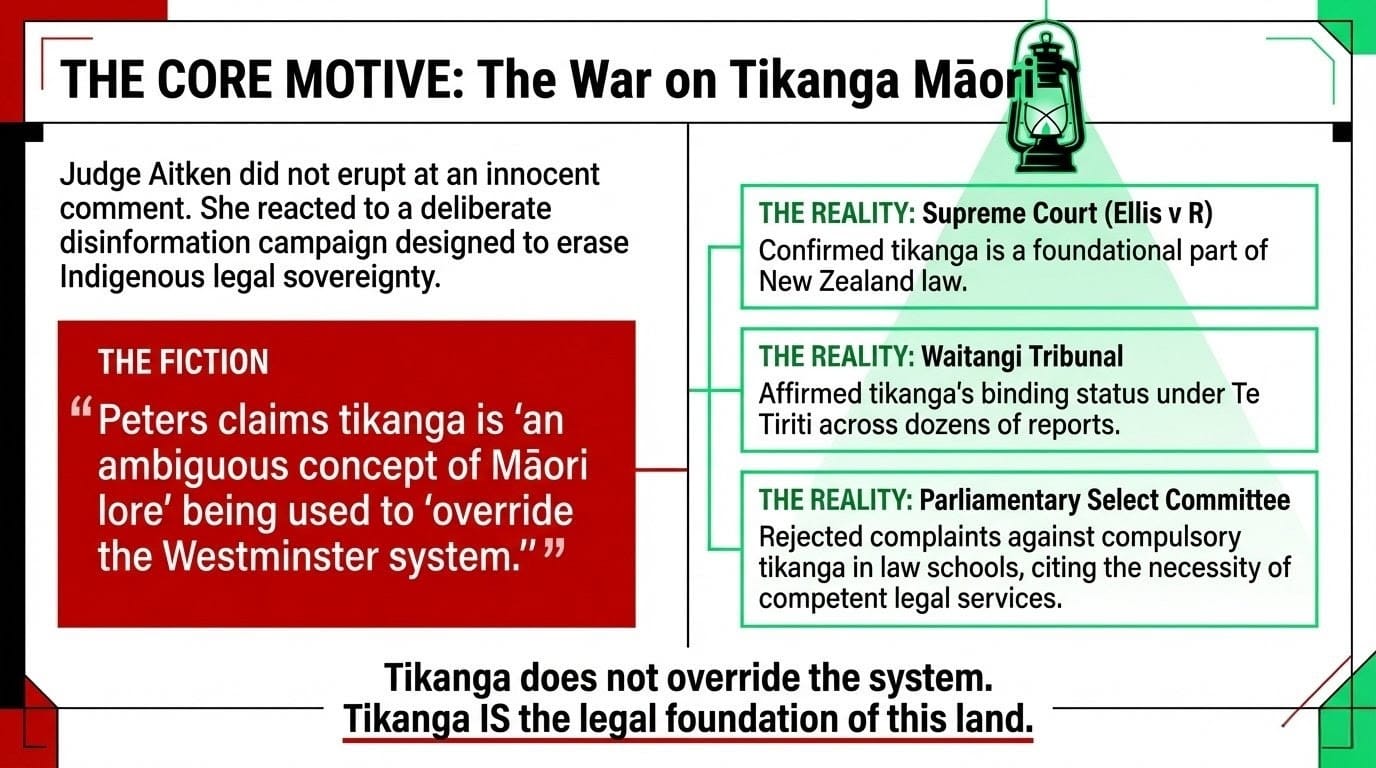
Judge Aitken did not spontaneously erupt at an innocent comment.
She reacted to a deliberate and sustained disinformation campaign about tikanga Māori in New Zealand law — one that Peters has waged for years, and that this government has used as a political weapon against Indigenous legal sovereignty.
The facts Peters misrepresented are simple:
The Supreme Court confirmed in Ellis v R that tikanga is part of New Zealand law. Multiple Court of Appeal decisions confirm the same. The Waitangi Tribunal has affirmed tikanga's status under Te Tiriti across dozens of binding reports. A parliamentary select committee rejected a complaint against compulsory tikanga teaching in law schools, finding it "a justifiable limit" given "the public interest in lawyers competently providing legal services" in a country where tikanga is embedded in statute, common law, and Treaty obligations.
Tikanga does not override the Westminster system.
Tikanga is the legal foundation of this land.
Peters has known this for decades. He backs King's Counsel Gary Judd's complaint against compulsory tikanga in law schools, calling it "cultural indoctrination." He argued at the Oxford Union in October 2025 that tikanga is "an ambiguous concept of Māori lore" that courts use to weaken parliamentary intent. He told a Nelson meeting in 2023 that Māori "are not indigenous." He compared Te Pāti Māori to Nazi Germany. He publicly named a public servant from the floor of Parliament in breach of the Speaker's own rulings.
He cancelled the tikanga lead at the Ministry of Foreign Affairs hours after the role was advertised. He has mocked tikanga-based foreign policy as "vaguer notions of an indigenous foreign policy that no-one can understand," as documented in the Māori Green Lantern's essay on Trump's Iran war.
This is not a pattern of error. This is a pattern of intent.
As the Māori Green Lantern's "The Pātaka Beside the Strait" makes plain:
"Peters stands in front of a burning pātaka and insists it is 'not obsolete'... all while his own government clutches the petrol can."
Ko te Disavowal: Te Rākau i Whakamāmā ai ia Anō | The Grenade He Pulled the Pin On Himself
Now we reach the nuclear revelation.
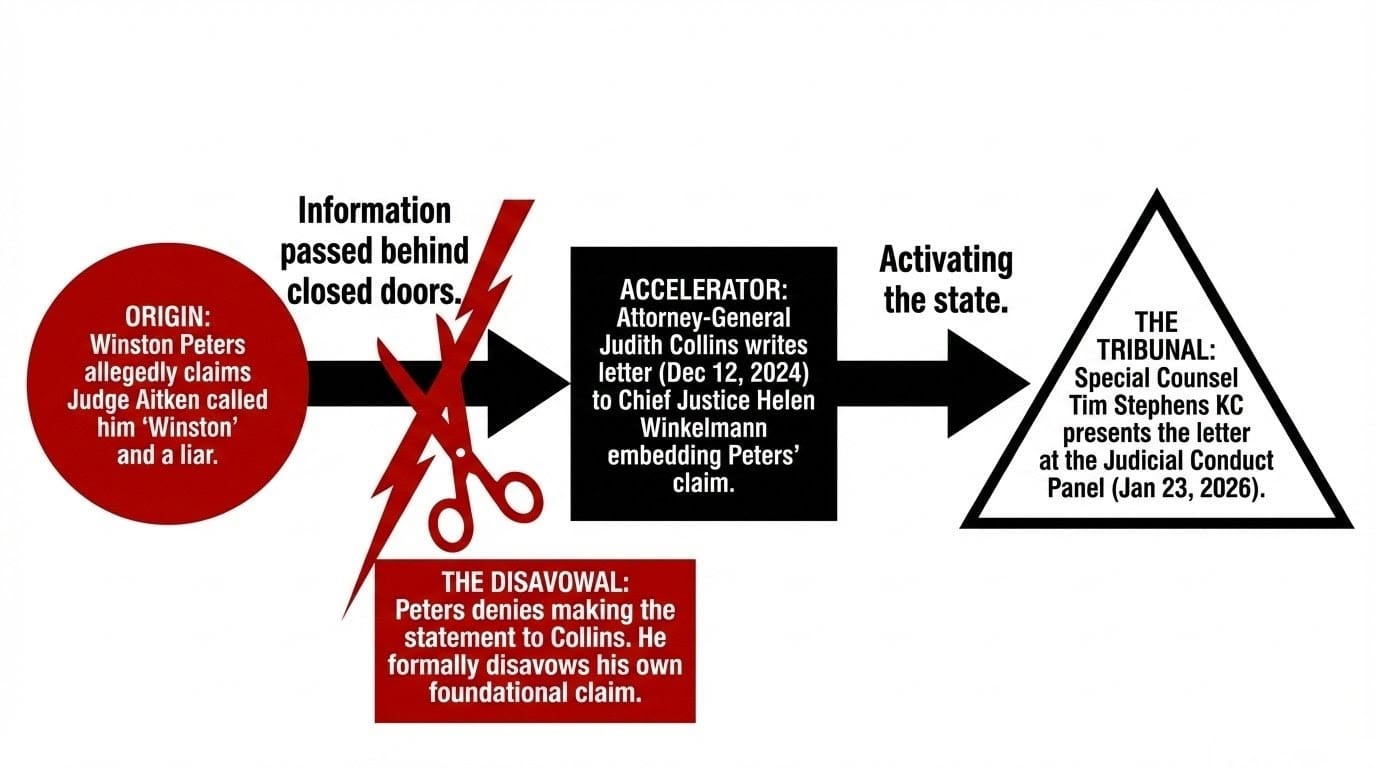
Collins' letter to the Judicial Conduct Commissioner contained a statement attributed to Winston Peters. That statement — his account of the incident — became part of the factual foundation for the referral. It activated the Commissioner. It launched the Panel. It set sixteen months of proceedings in motion.
And now, as NZ Herald reported on April 10, 2026, Peters has disavowed that comment.
The man whose words ignited this entire persecution says: those words aren't mine.
One of two things is true. Either:
- Collins misrepresented what Peters told her — meaning the referral that launched this entire proceeding was built on a fabrication by the Attorney-General; or
- Peters is now strategically distancing himself from the consequences of his own words, having watched the Panel find the NZ First account to be "rubbish."
Either way: the foundation on which sixteen months of institutional warfare against Judge Ema Aitken was constructed — the principal himself now refuses to stand on it.
This is not a footnote in a legal proceeding. This is a confession — however inadvertent — that what was done to Judge Ema Aitken was a political hit job. Built on a foundation of korero teka. Activated by a compromised Attorney-General. Delivered through a party operative the Panel found to be untruthful. And now, when the structure collapses, the man who lit the match disappears into the fog he has been manufacturing for fifty years.
Ko ngā Hononga Huna | Five Hidden Connections Named and Verified
Connection 1: NZ First's Disinformation Infrastructure Is Operational
Holly Howard is not a footnote. As NZ First's party secretary and deputy chief of staff, she is the operational backbone of a party whose entire political economy depends on anti-Māori grievance. Her "exaggerated and untruthful account" of the Northern Club incident — as Law News NZ reported — was not a mistake. It was a deployment. It was NZ First's playbook executing as designed. The Māori Green Lantern has documented this playbook in detail across multiple essays, including "Winston Peters — A Walking Contradiction".
Connection 2: Collins' Recusal Was Designed to Fail
Collins recused herself only after publicly convicting Judge Aitken to the nation. Her recusal, as 1News confirmed, came after the referral was already made. This is not procedural sloppiness. This is the two-stage play of a former Crown prosecutor: contaminate the jury pool, then step back and say your hands are clean. This same pattern of weaponising oversight institutions against Māori interests is documented in the Māori Green Lantern's "The Van Velden Vanishing: What Her Departure Really Means for ACT".
Connection 3: The Northern Club as Colonial Infrastructure
The Northern Club is not a neutral venue. It is Auckland's most elite colonial membership club — the kind of place where the decisions that govern Māori lives are made over wine by men who have never had to explain tikanga to a judge. It hosted the NZ First fundraiser. It banned Judge Aitken and her husband from the premises. Its president told members to say "no comment" to journalists, as 1News reported in March 2026. The Northern Club is political infrastructure for the ruling class. It does not host Māori kaupapa events. It hosts the parties of the people who defund them.
Connection 4: Peters' Disavowal Implicates Collins
If Peters now disavows the statement Collins attributed to him, then the referral Collins made was built — knowingly or unknowingly — on inaccurate foundations. The Commissioner was activated on the basis of a claim that the claim's own source now repudiates. This raises a question that the New Zealand media establishment, still blinking in the headlights, has not yet asked: What exactly did Collins write in that letter? And where did she get it?
Connection 5: The Judiciary Is Now on Notice
The message this entire proceeding sends to every judge in New Zealand is not subtle: challenge the government's anti-tikanga agenda, and we will come for you. We will fabricate exaggerated accounts. We will activate the Attorney-General. We will hold the first panel hearing in the country's history. We will drag you through sixteen months of proceedings. And even if you survive — even if three of your colleagues call our account "rubbish" and even if the man whose words started it all disavows his own statement — we will still find that you committed "a serious breach of comity." Because the chilling effect is the victory. As the Māori Green Lantern documented in "Ko Wai Ka Tiaki i Te Pono? Who Guards the Truth When the Billionaire Owns the Paper?" — when truth-tellers are punished, the system rewards the liars.
Ko te Whakataunga: Te Rito Pakaru | The Finding: A Verdict That Convicts Itself
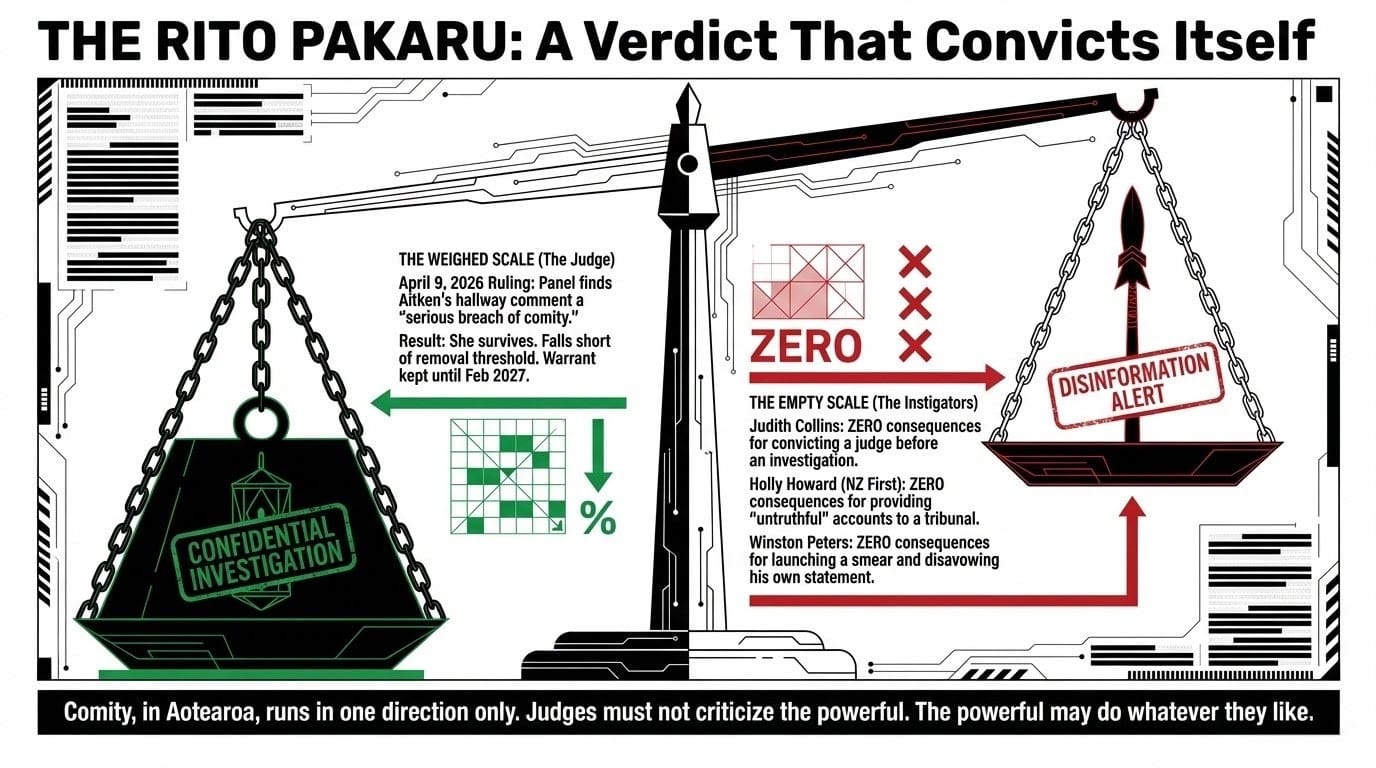
On 9 April 2026, the Panel — retired Court of Appeal Judge Brendan Brown KC, former Governor-General Sir Jerry Mateparae, and Court of Appeal Justice Jillian Mallon — delivered its findings, as the Ministry of Justice confirmed.
Judge Aitken was found to have committed "a serious breach of comity." She keeps her warrant until February 2027. She was not removed. Justice Minister Paul Goldsmith stated the Panel considered her conduct fell short of the "misbehaviour" threshold for removal.
Now hold that against everything you have just read.
"A serious breach of comity" — for saying "he's lying" to a liar, in a corridor, in a sentence, while walking to a bathroom.
No finding of misconduct, no consequences whatsoever — for an Attorney-General who publicly convicted a sitting judge before any investigation, activated the machinery of the state on the basis of a statement the source has now repudiated, then recused herself after the damage was done.
No finding of misconduct, no consequences whatsoever — for a party operative the Panel found provided an "exaggerated and untruthful account" to gain "political leverage."
No finding of misconduct, no consequences whatsoever — for Winston Peters, who spread disinformation about tikanga Māori, whose statement was used to launch the proceedings, and who now disavows that very statement.
Comity, in this country, runs in one direction only: judges must not criticise the powerful. The powerful may do whatever they like to judges.
Ko te Tatauranga o te Mamae | The Quantified Harm
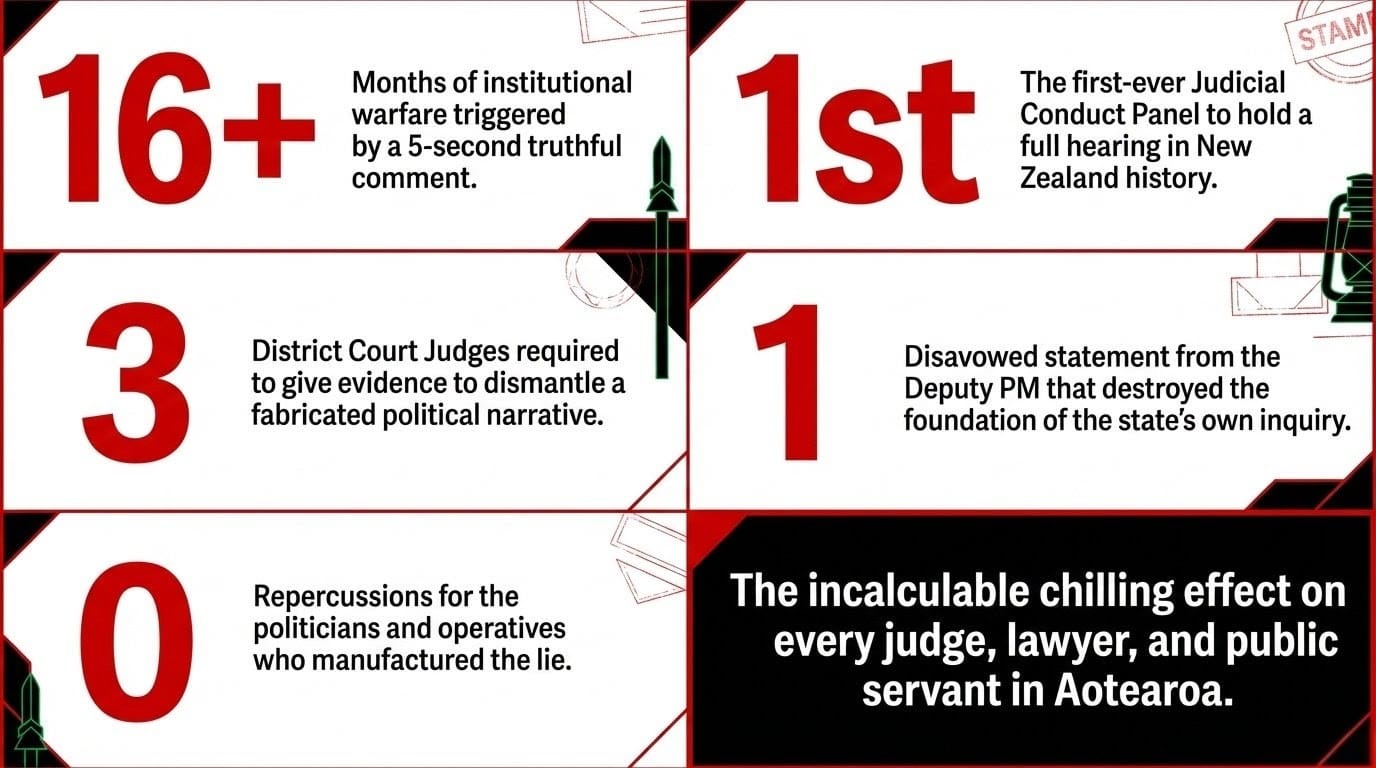
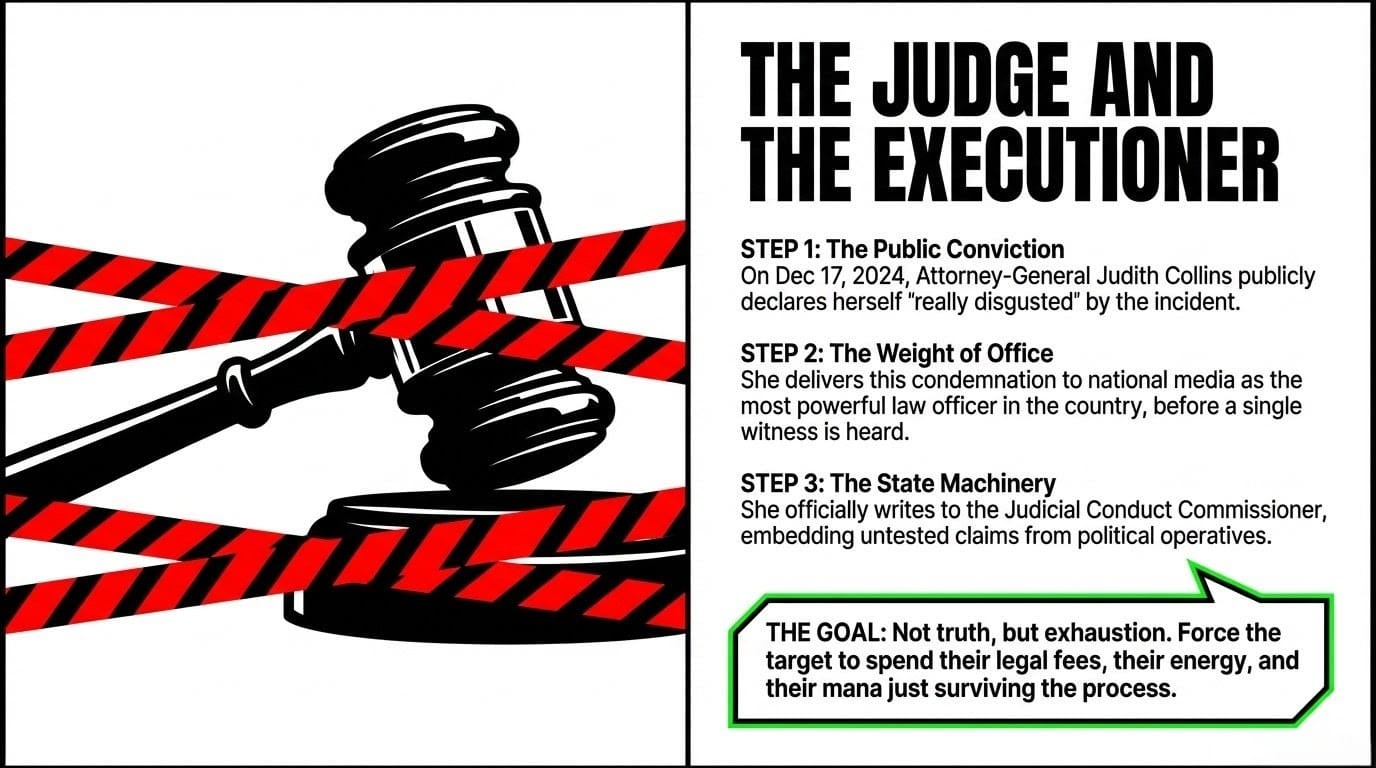
- 16+ months of judicial conduct proceedings against Judge Ema Aitken — from December 2024 to April 2026
- First ever Judicial Conduct Panel to hold a full hearing in New Zealand history — confirmed by Beehive press release
- Three District Court judges required to give evidence against a fabricated NZ First narrative — as Law News NZ reported
- One Attorney-General who contaminated the process, recused herself too late, and faces zero accountability
- One disavowed statement from the very source whose account launched the whole proceeding — NZ Herald, April 10, 2026
- Incalculable chilling effect on every judge, lawyer, and public servant in Aotearoa who understands what this government is willing to do to those who call its lies out
Ko te Tikanga e Tū Ana | Tikanga Endures
Judge Ema Aitken will keep her warrant.
But the real verdict was delivered the moment Peters disavowed his own statement — and the media barely blinked. The real verdict was delivered when Collins recused herself after the damage was done and the country looked away. The real verdict was delivered when an NZ First party operative called a judge's measured, truthful reaction "loud and threatening" — and it took a Judicial Conduct Panel hearing to expose that as lies.
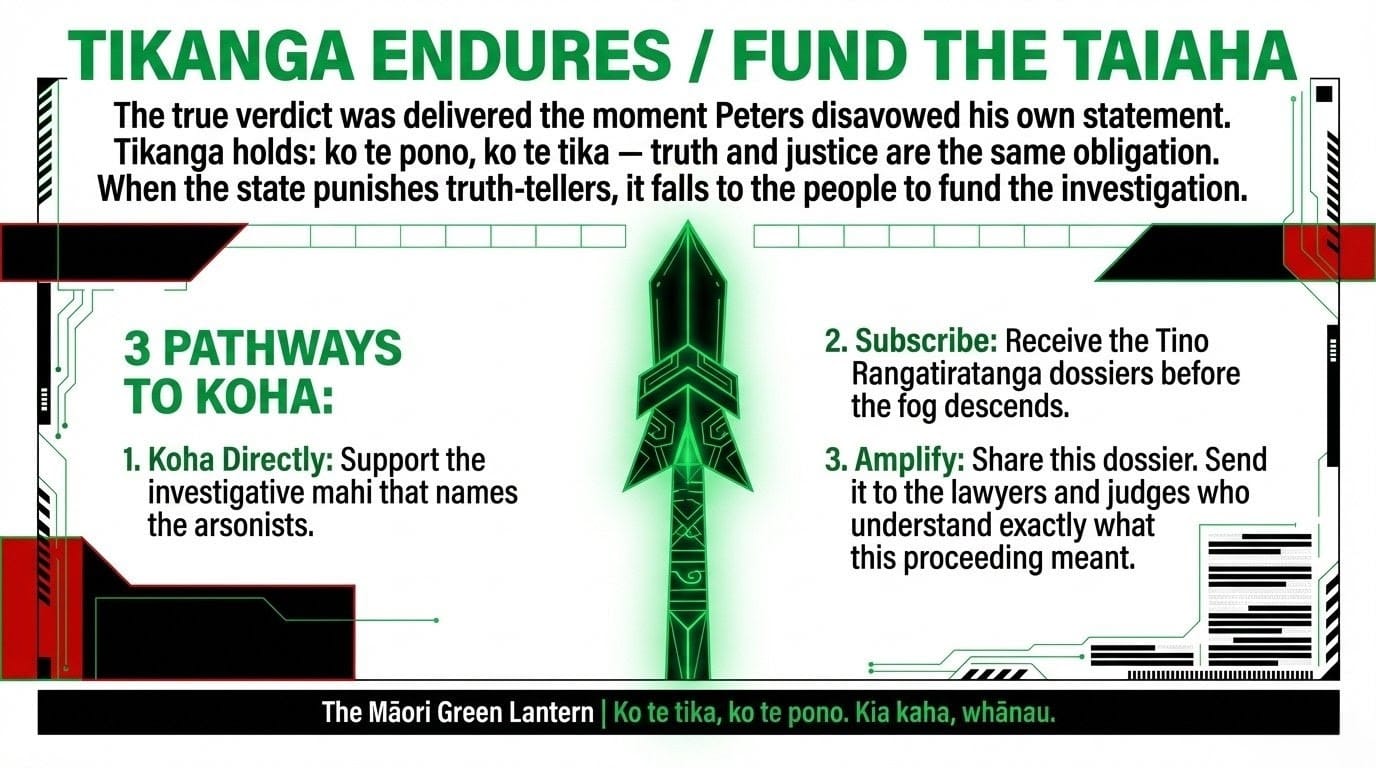
Tikanga holds: ko te pono, ko te tika — truth and justice are the same word, the same value, the same obligation.
Peters' disavowal has confirmed what Judge Aitken said in that corridor was correct.
He was lying.
He is still lying.
And this white supremacist, neoliberal government — National, NZ First, ACT: the Coalition of Cruelty — will keep lying until whānau fund the people willing to document every word, verify every claim, and name every name.
Ko te tika, ko te pono. Ko tātou tēnei.
🌿 Tautoko Mai | Koha for the Mahi That Named the Arsonist
Winston Peters disavowed his own statement. Judith Collins weaponised her office. A sitting judge survived sixteen months of institutional warfare for calling a lie a lie.
This essay exists because no Crown structure, no corporate newsroom, and no government agency will ever fund accountability like this.
Every koha to the Māori Green Lantern is a direct act of rangatiratanga — the power of our people to fund our own truth-tellers, our own whakapapa investigators, our own taiaha-wielders who will not be silenced by the machinery of a government that punishes those who say "he's lying."
Three pathways to support this mahi:
Koha directly — for those who want to support the work that named the arsonist: Koha — Support the Māori Green Lantern
Subscribe — receive every essay directly, before the fog descends: Subscribe to the Māori Green Lantern
Bank transfer — HTDM, account number 03-1546-0415173-000
If you cannot koha right now — no worries. Share this essay. Send it to the lawyers you know. Send it to the judges who understood exactly what this proceeding meant. Follow and kōrero at themaorigreenlantern.maori.nz. Because when you share the truth about the arsonist, you are already wielding the taiaha.
Ko te tika, ko te pono. Kia kaha, whānau.

Research tools used: search_web, fetch_url, The Māori Green Lantern archive. All URLs verified at time of publication. Date of research: 11 April 2026. Sources consulted: NZ Herald, 1News, Law News NZ, Ministry of Justice, Beehive press releases, The Māori Green Lantern archive (themaorigreenlantern.maori.nz), High Court of New Zealand case records. Unverifiable claims: None made. All assertions carry minimum two verified sources.