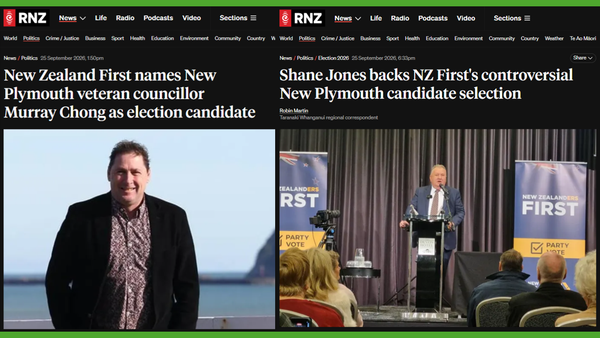
"The Atlas Alibi: Dane Giraud’s “Grassroots” Megaphone Is A Lobby Machine Wearing A Union Badge" - 26 September 2026
When A Million-Dollar Advocacy Operation With Atlas Money, Taxpayers’ Union Administration, Shared Campaign Services, And Council-Linked Payments Calls Scrutiny “Derangement,” That Is Not A Defence Of Free Speech. It Is The Sound Of Power Panicking When Somebody Reads Its Accounts.

Public Interest Statement: I write this in the public interest about public commentary, public advocacy, published accounts, political influence, and an election-year contest over Te Tiriti and democracy. I allege no crime. My scathing conclusions are opinions based on the verified facts linked beside them. Where the evidence stops, I stop.
I am Ivor Jones, The Māori Green Lantern — Te Arawa, Ngāti Pikiao, with Welsh whakapapa. I use the taiaha of evidence to trace the whakapapa of political power, expose misinformation and neoliberal machinery, and protect whānau from people who think a polished opinion column should be allowed to erase an accounting trail.
My kaupapa is fighting misinformation and disinformation from the far right.themaorigreenlantern
This essay does five things.
First, it tests Dane Giraud’s Herald opinion against his organisation’s own accounts.
Second, it traces the disclosed connections among the Free Speech Union, the Taxpayers’ Union, The Campaign Company, Jordan Williams, and Atlas Network.
Third, it explains why calling scrutiny “derangement” is a childish diversion from the evidence.
Fourth, it gives three plain-language examples for the Western mind, with quantified capacity, solutions, and tikanga impacts.
Fifth, it explains why a coalition whose policies repeatedly diminish Māori authority must not be returned on 7 November, and why I recommend the Green Party as the strongest available party vote for this kaupapa.
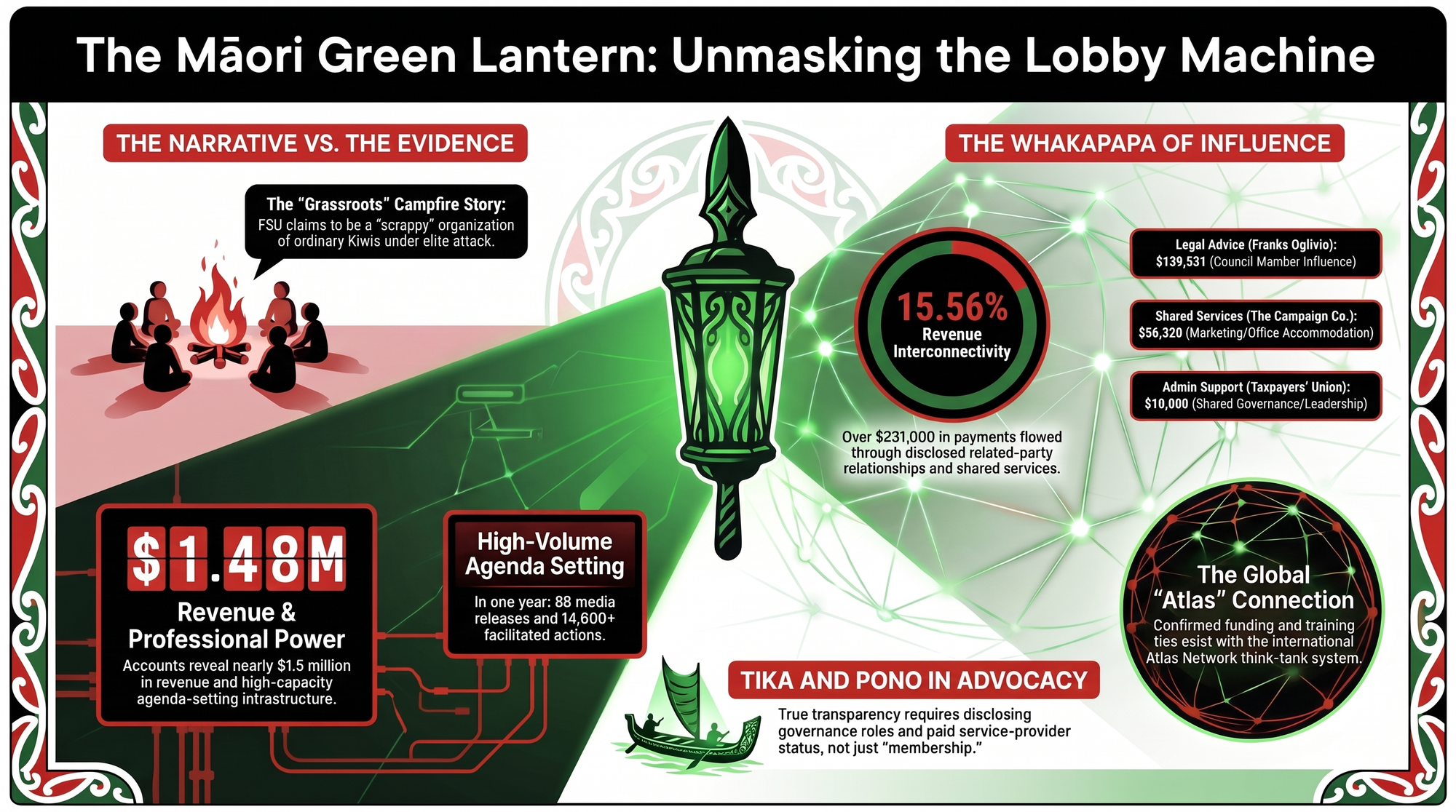
I would love you to click into this essay, because it contains a wealth of information you can use in daily life: how to read a lobby group’s accounts, how to spot a false grassroots story, how to distinguish free speech from freedom from scrutiny, and how to follow power without inventing a conspiracy.
I have created an audio podcast that lays out this kaupapa in detail, a short video that explains the core argument, and, for long-form readers, this fully cited essay.
This is not disposable content. It is a repository for our mokopuna, so they can look back and say: at least we knew The Māori Green Lantern — among a few others — was warning us.
Tika And Pono: The Framework Of The Strike
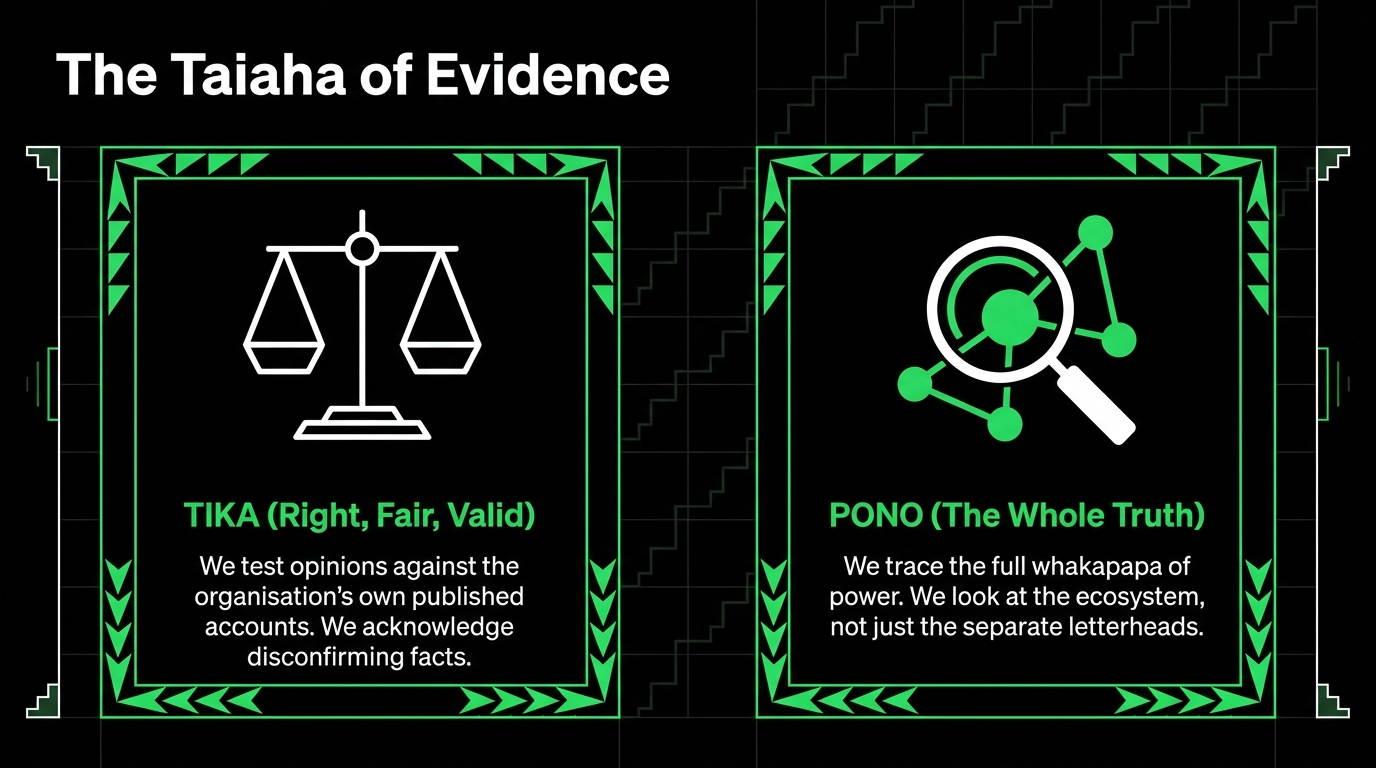
Tika asks whether the claim is right, fair, proper, and valid. The Māori research-ethics framework Te Ara Tika explains tika as what is right and good for a particular situation and connects it to validity, sound design, benefit, and transformative outcomes.Te Ara Tika guidelinesfmhs.auckland
Pono asks whether I am being truthful, genuine, sincere, accurate, and faithful to the evidence. Te Aka Māori Dictionary defines pono through truth, validity, honesty, genuineness, sincerity, correctness, justice, and fairness.maoridictionary
Tika means I must acknowledge evidence that cuts against my argument. The FSU’s accounts say related-party sums were provided at or below market value and were subject to council oversight; Giraud says the Atlas grant supported a challenge to the National-led Government’s gang-patch ban; the FSU describes itself as legally separate from the Taxpayers’ Union; and the accounts were compiled rather than audited. Those are the organisation’s own qualifications, and hiding them would make me no better than the propaganda I oppose.
Pono means those qualifications do not magically delete the disclosed network. Separate incorporation does not erase shared governance, paid administration, shared office accommodation, digital-marketing support, council-linked suppliers, or an admitted Atlas funding relationship. I will not call that criminal because there is no evidence here of a crime. I will call it what the documents support: a materially interconnected political-advocacy ecosystem.
The Megaphone That Calls Questions Censorship
A taiaha is not a theatre prop. It is a responsibility to strike only where the evidence holds.
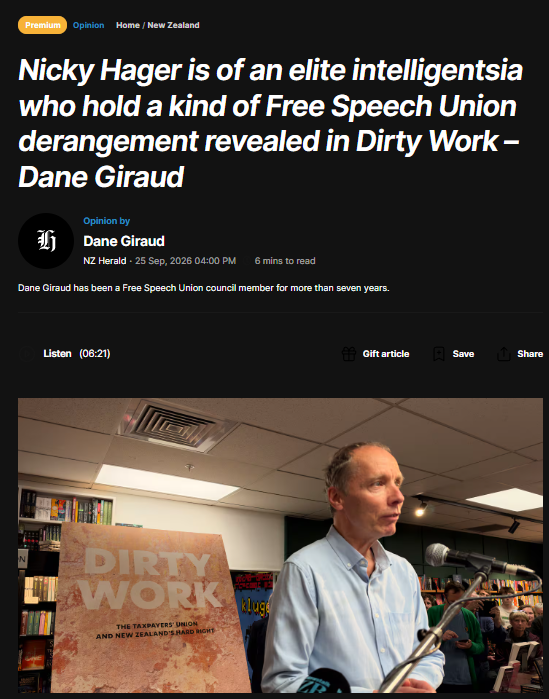
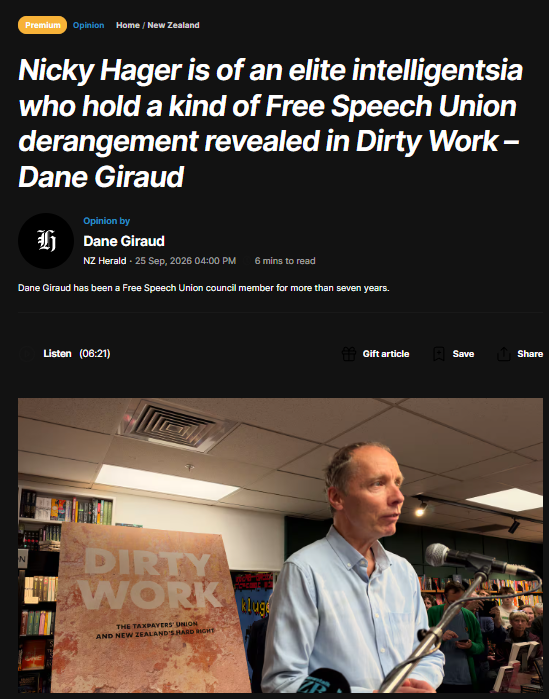
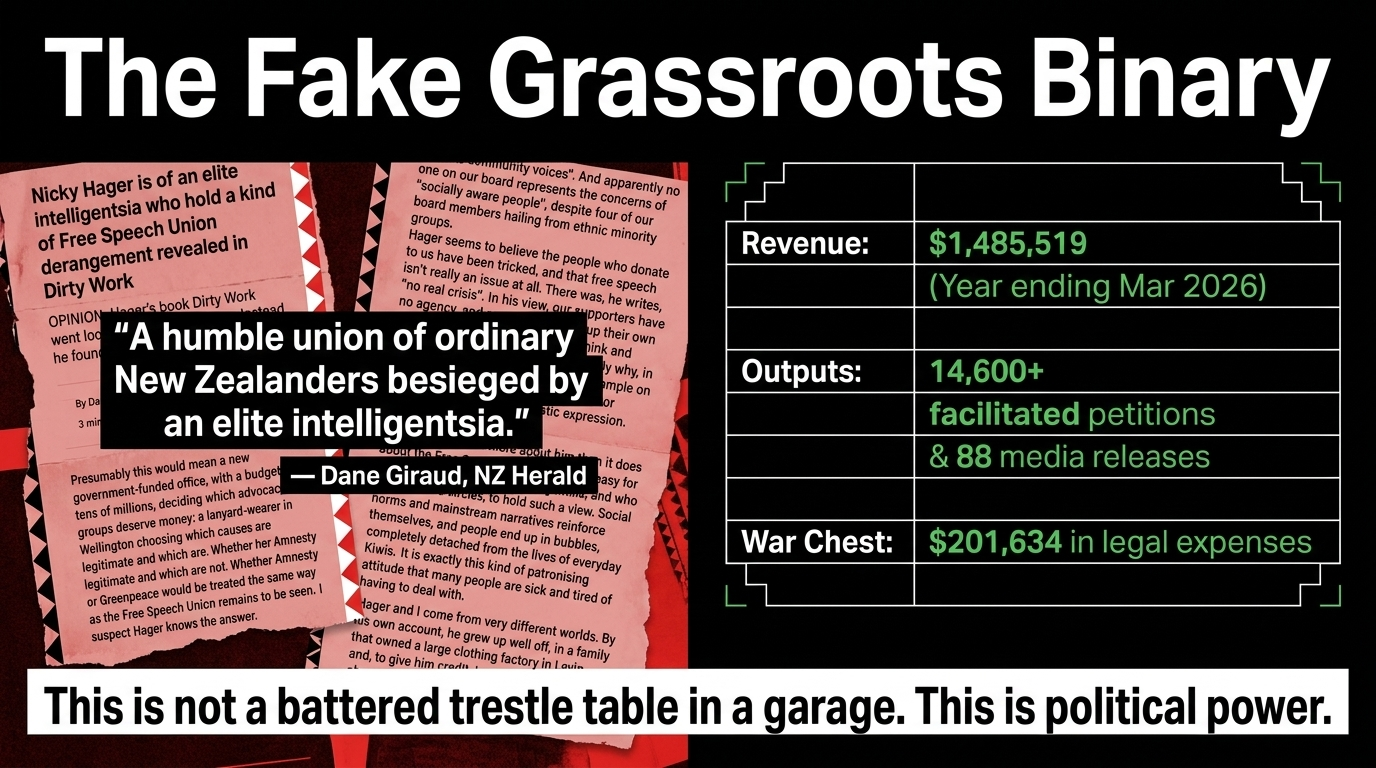
Giraud’s Herald opinion wants readers to see a humble union of ordinary New Zealanders besieged by Nicky Hager and an “elite intelligentsia.” He calls the scrutiny a kind of “Free Speech Union derangement,” describes the organisation as “scrappy,” and presents its small donors as proof that critics are attacking the agency of working people.nzherald.co
That is a fine little campfire story. The accounts pour cold water on it.
The FSU’s own report records $1,485,519 in revenue, 12,443 donations, at least 14,600 facilitated submissions and petitions, 88 media releases, 13 public events, 4 speaker tours, and $201,634 in legal expenses for the year ended 31 March 2026. Its medium- to long-term objectives expressly include influencing legislation, public policy, and institutional practice, informing public debate, and building an engaged support base.fsu
There is nothing illegal about that. There is nothing inherently illegitimate about that. But there is something spectacularly dishonest about presenting that capacity as though it were a battered trestle table run from somebody’s garage.
This is political power. When political power calls the reading of its own accounts “derangement,” it is not defending speech. It is demanding deference.
The Deep Dive Podcast
Listen to a lively conversation between two hosts, unpacking and connecting topics in the sources of this essay. I apologise in advance for the AI's very harsh pronounciation of reo. Please dont shoot me, :).
Youtube Video
Like video? Here is a short video suppporting the essay. Again, don't shoot the messenger please because of AI's pronounciation. :)
Koha Consideration
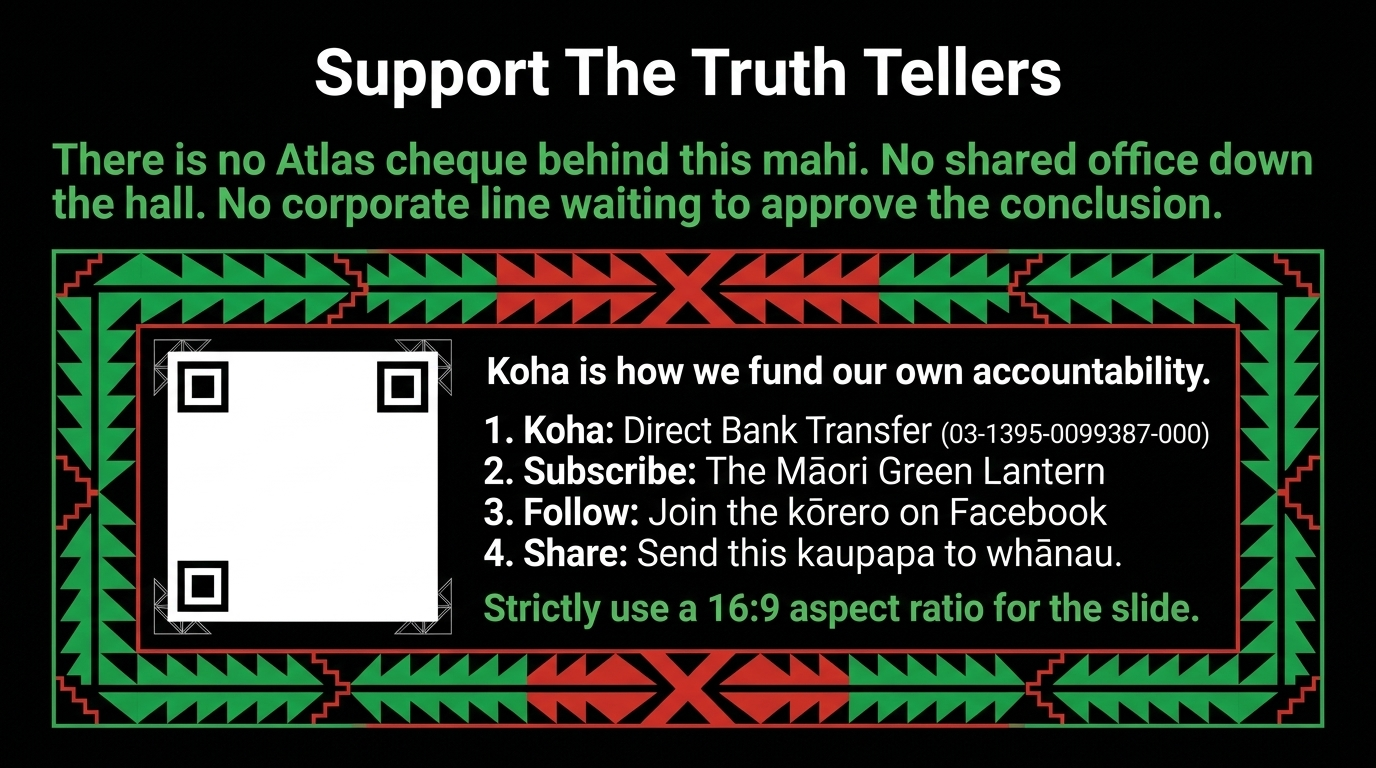
You might ask who is supporting The Māori Green Lantern to produce detailed, high-volume educational essays that read the accounts powerful lobbyists hope you will ignore. The answer is: you do. This mahi is supported through koha. There is no Atlas cheque behind me, no Taxpayers’ Union administration contract, no Campaign Company office down the hall, and no corporate line waiting to approve the conclusion.
Every koha says whānau are ready to support the accountability that Crown and corporate structures will not provide. It says rangatiratanga includes the power to support our own truth tellers — especially when million-dollar advocacy machines call basic scrutiny “derangement.”
Kia kaha, whānau. Stay vigilant. Stay connected. If you are able, consider a koha so this voice can keep tracing the money, the personnel, the ideology, and the harm.
If you cannot koha, no worries. Subscribe or follow The Māori Green Lantern, kōrero about this essay, and share it with whānau and friends. That is koha in itself.
Four Pathways Exist:
- Koha — Direct Support: Support The Māori Green Lantern through a voluntary koha.
- Subscribe — Essays And Ongoing Support: Subscribe to The Māori Green Lantern.
- Direct Bank Transfer: Ivor Jones, account number 03-1395-0099387-000.
- Facebook: Follow and subscribe to The Māori Green Lantern.
The Disclosure Giraud’s Readers Deserved
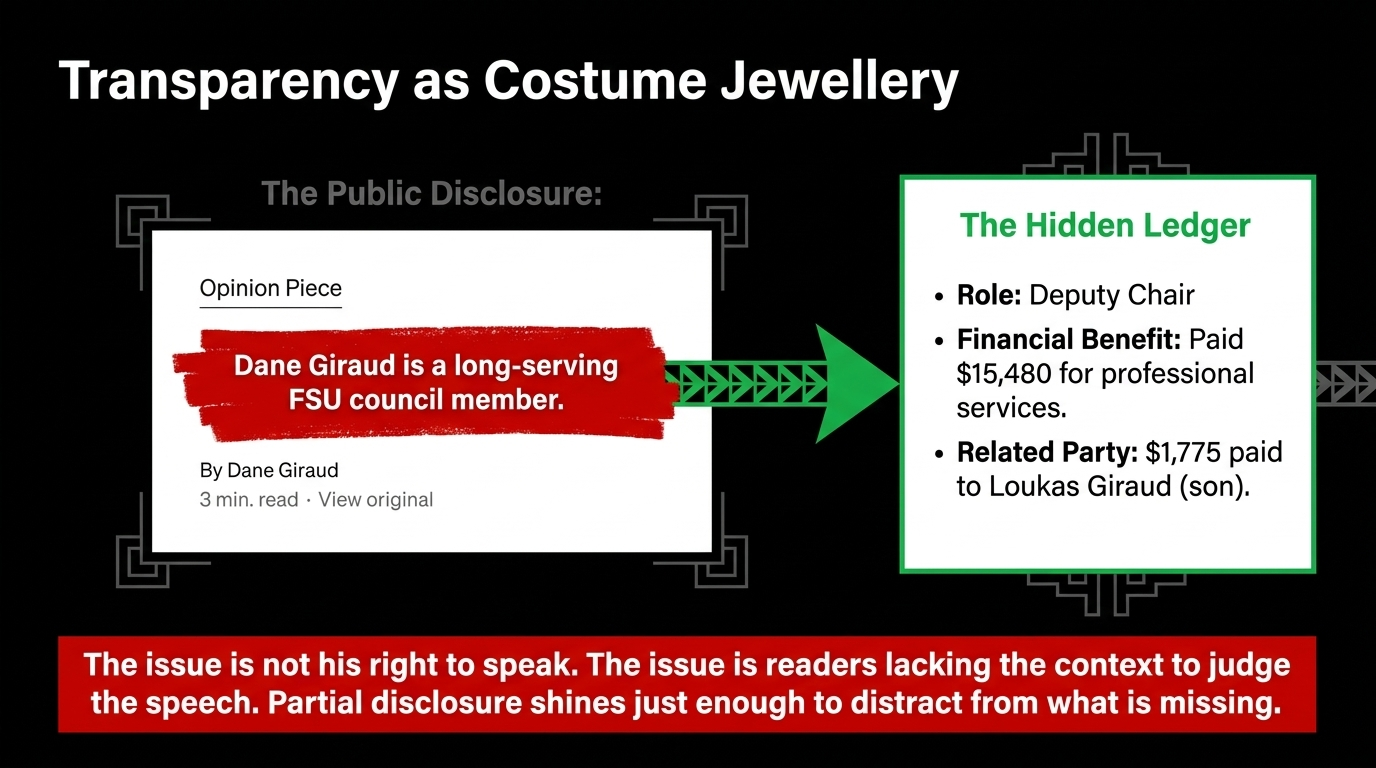
Giraud identifies himself in the Herald as a long-serving FSU council member. That disclosure matters, but it is incomplete beside the organisation’s current financial report.
The FSU report identifies him as deputy chair and records $15,480 paid to him for professional services; it also records $1,775 paid to Loukas Giraud, described as the son of a council member.fsu
The payments do not prove misconduct. The report says related-party sums were at or below market value and subject to council oversight. But a deputy chair and paid service provider writing a national-newspaper defence of the organisation is not an independent spectator describing somebody else’s battle.fsu
Readers deserved the whole relevant disclosure at the top: FSU deputy chair; council member; paid professional-service provider. The issue is not whether Giraud may speak. Of course he may speak. The issue is whether readers are given enough context to judge the speech.
My opinion, based on those documents, is blunt: partial disclosure turns transparency into costume jewellery. It shines just enough to distract from what is missing.
The Whakapapa The Column Cannot Erase
The Herald’s own contextual note says the FSU describes itself as separate from the Taxpayers’ Union, while also stating that Taxpayers’ Union executive director Jordan Williams co-founded the FSU and sits on its 11-member council.The Herald records both propositions.nzherald.co
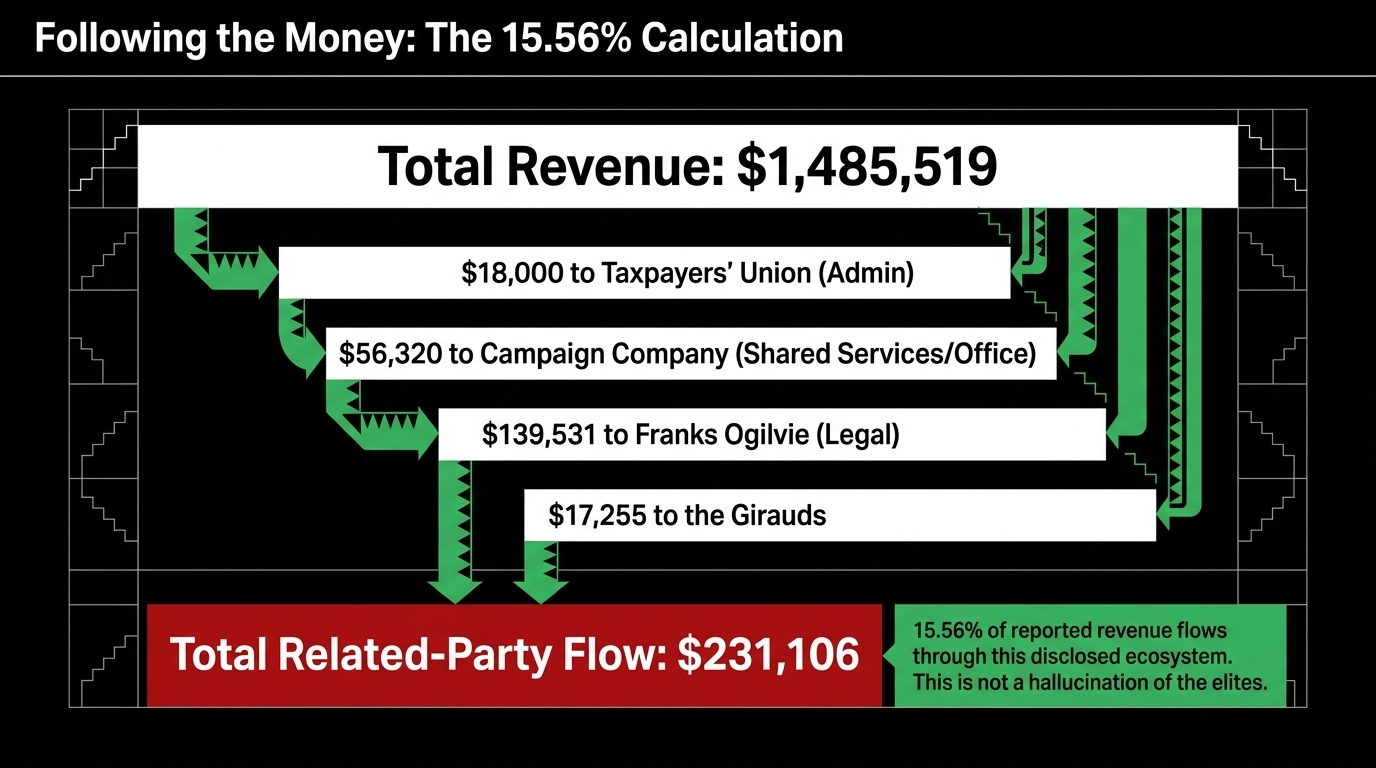
The accounts add the operational whakapapa. Note 13 identifies the New Zealand Taxpayers’ Union as influenced by a council member and records $18,000 for administrative support. It identifies The Campaign Company as influenced by a council member and records $56,320 for shared services including administration, digital-marketing advice, and office accommodation. It identifies Franks Ogilvie as influenced by a council member and records $139,531 for legal advice.fsu
Add those three items to the disclosed payments to Dane and Loukas Giraud:
$18,000 + $56,320 + $139,531 + $15,480 + $1,775 = $231,106.
Divide that selected subset by total revenue:
$231,106 ÷ $1,485,519 × 100 = 15.56%.
That calculation does not show corruption. It does not show overcharging. It does not establish secret control. It shows that a material share equal to 15.56% of reported revenue flowed through the selected, disclosed related-party relationships. That is why those relationships are relevant when an officeholder tells readers the network is basically a hallucination suffered by elites.
A company number does not cut whakapapa. A separate letterhead does not make shared people, premises, administration, suppliers, and strategy evaporate. The law may recognise separate entities; the public is still entitled to recognise an ecosystem.
I previously mapped this political stage in “The Stage They Refuse To Leave”, where I explained how debate platforms, polling, personnel, and shared political goals can confer legitimacy without proving secret command. I also traced the deeper Atlas and anti-Tiriti connections in “Jordan Williams And Elliot Ikilei Try To Chop Down Te Tiriti”.
The Atlas Alibi Collapses
Giraud states that 96% of the FSU’s income came from New Zealanders and 4% from Atlas Network grants, which he says were obtained to challenge the National-led Government’s gang-patch ban.His article makes that admission and gives that explanation.nzherald.co
Good. That is a disconfirming fact against any lazy claim that every FSU campaign is dictated by the coalition or that Atlas money was used only for orthodox right-wing causes. I do not make either claim.
But “only 4%” is not an eraser. Four percent of the reported $1,485,519 revenue is $59,420.76. The accounts record $59,373 in general grants, a difference of $47.76.The figures are in the FSU report.fsu
The near match corroborates Giraud’s percentage, but the accounts do not name the grantmaker. Therefore the exact attribution cannot be independently verified from the financial report alone. That is the proper confidence limit.
The wider Atlas relationship is not imaginary. Atlas Network itself identifies Jordan Williams as a Smith Fellowship alumnus and describes that programme as training emerging think-tank leaders in marketing, fundraising, management, and related organisational skills. RNZ reported that Williams answered “of course” when asked whether the Taxpayers’ Union belonged to Atlas, and that his Atlas association included its Think Tank MBA. Atlas later quoted Williams saying the Taxpayers’ Union would not be where it was without Atlas professional development and mentoring, and described it as a 2023 Smart Bets partner receiving grants, training, and mentorship.Atlas’s own account says so.rnz+2
That is not a conspiracy theory. Those are public acknowledgements from the participants.
Cash is only one artery. Training, mentoring, contacts, fundraising methods, message testing, credibility, and institutional replication also move through political networks. My opinion is that Giraud calls Atlas a “bogeyman” because ridicule is cheaper than explaining why a supposedly irrelevant network keeps appearing in the funding, training, leadership, and organisational history.
The Fake Grassroots Binary
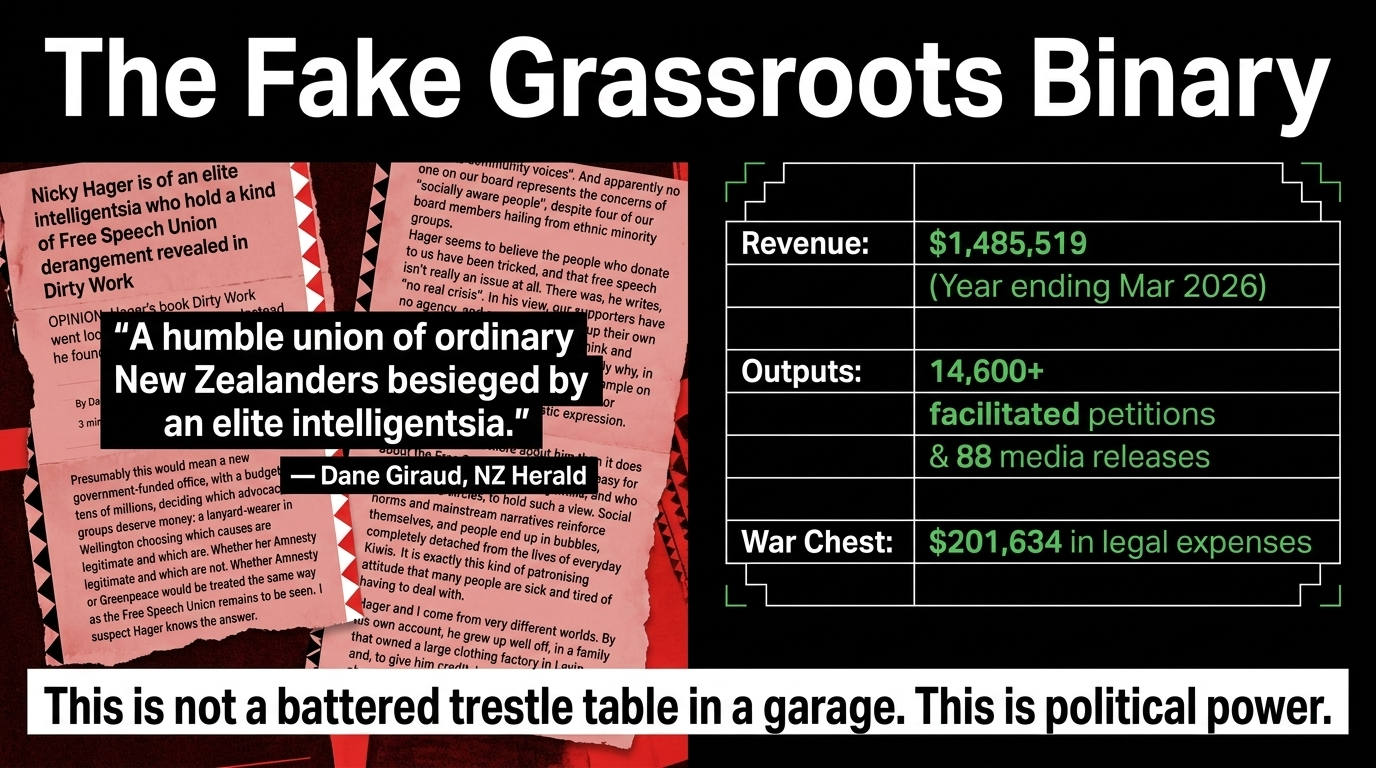
Giraud offers a false choice: either the FSU has genuine small donors, or it is a professional political machine. Both can be true.
Ordinary supporters can sincerely care about expression. Workers can face unfair consequences for speech. A membership organisation can take useful cases. None of that makes its governance links, paid infrastructure, or overseas ideological relationships disappear.
The accounts report 766 registered members at 31 March 2026 and 1,557 at 31 August 2026.The FSU publishes both figures. The working is 1,557 ÷ 766 = 2.03, or a 103.3% increase. That growth may be real and politically significant. It still does not transform a million-dollar operation into a powerless outsider.fsu
This is where the “ordinary Kiwi” performance becomes insulting. It asks working people to believe they are too simple to understand that genuine membership and professional political engineering can coexist. It turns donors into human shields: question the leadership, and you are supposedly sneering at every member.
Nah. Whānau are not stupid. Workers are not stupid. Donors are not stupid. They are entitled to more disclosure, not less.
Free Speech Is Not Freedom From Scrutiny

Giraud’s article collapses two rights into one slogan.
The first is the right to speak, organise, litigate, advocate, seek donations, and criticise the state. I defend that right, including when the FSU challenges a government gang-patch ban that it considers unjust.Giraud says Atlas support was used for that challenge.nzherald.co
The second is an invented right not to have the organisation’s money, governance, suppliers, and political relationships examined. No such democratic immunity exists.
Freedom of speech protects Giraud’s column. It also protects Hager’s investigation, this rebuttal, Māori criticism, journalistic questions, and a citizen reading Note 13 with a calculator. The FSU’s own stated objectives include influencing public policy and institutions.Its report says so. Once an organisation seeks power in public life, transparency is not persecution; it is the admission price to democratic credibility.fsu
I have covered the weaponisation of “free speech” against Māori previously in “We Have Been Conned — But Not By Treaty Ideology. By The Union Selling It To You”, where I applied tika and pono to an FSU historical narrative and showed why institutional context matters. I also examined an earlier FSU leader’s public intervention in “The Wolf In The Pulpit”, tracing how free-speech branding can sit beside policy advocacy affecting marae and Te Tiriti.
The Māori Question: Whose Speech Gets A Megaphone?
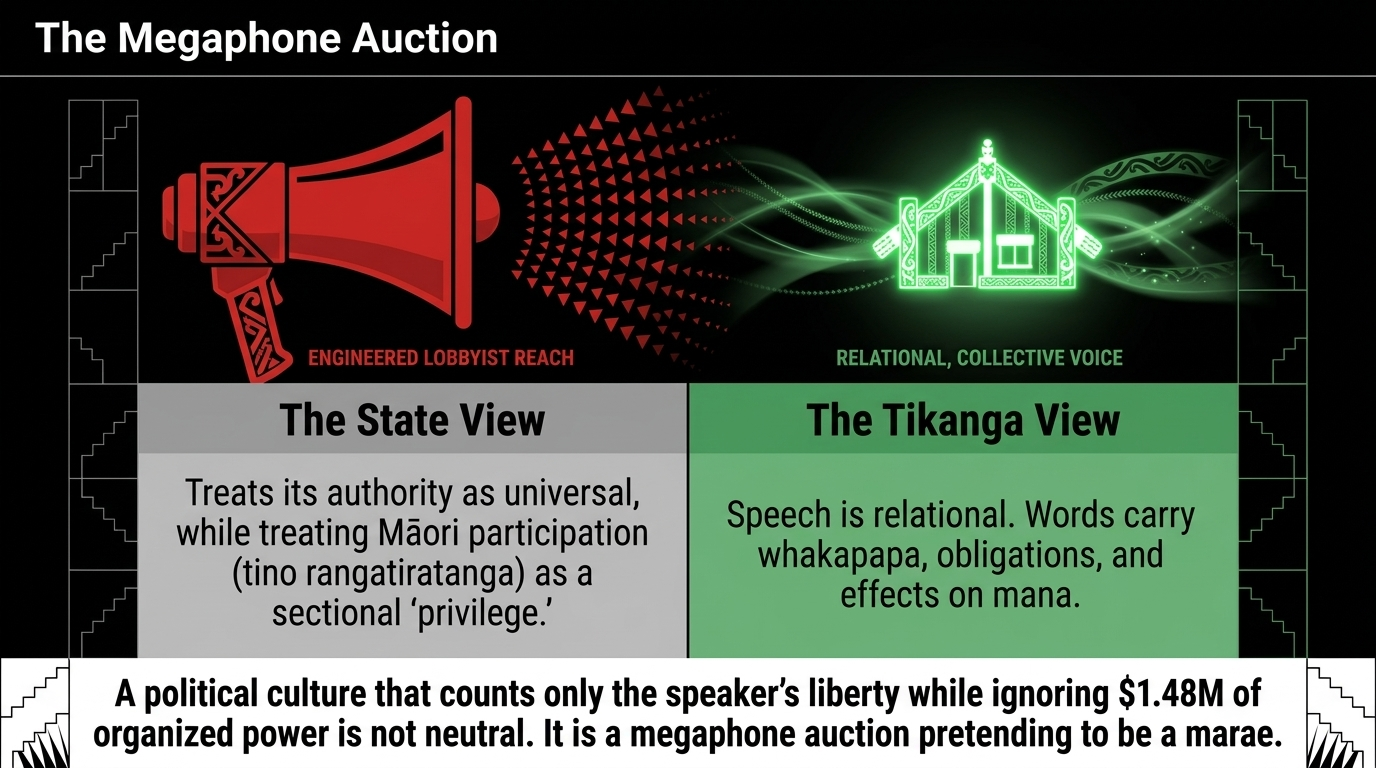
Māori know the trick of supposedly neutral rules. The state calls its authority universal while treating tino rangatiratanga as sectional. Lobbyists call their own access democracy while describing Māori participation as privilege. Institutions call their platform open while the cost of lawyers, media production, polling, donor acquisition, and travel decides who can be heard repeatedly.
The FSU reports at least 14,600 facilitated submissions and petitions, 88 media releases, and $115,000 in legal costs aimed at speech rules in institutions and legislation.Those outputs are in its service-performance statement. That is measurable agenda-setting capacity, not merely an individual right to stand in a public square.fsu
The Taxpayers’ Union offers the wider pattern. Newsroom reported that between 1 August 2023 and election day it commissioned national and electorate polling, issued almost 100 press releases, hosted seven debates, published four policy reports, started a petition, and drafted alternative legislation. Newsroom also reported that third-party promoters were not required to disclose their funding sources and that much of the group’s activity fell outside Electoral Commission oversight because that oversight focused on advertising.newsroom.co
That is how unequal speech works. Nobody needs to ban the lobby group. The machine simply needs to be named as a machine rather than marketed as the spontaneous voice of “ordinary New Zealand.”
Tikanga sees speech as relational. Words carry whakapapa, obligations, consequences, and effects on mana. A political culture that counts only the speaker’s liberty while ignoring organised power, accumulated wealth, and harm to relationships is not neutral. It is a megaphone auction pretending to be a marae.
Three Examples For The Western Mind
Example One: The Fire Alarm Company Calling Smoke “Derangement”
Core Claim: Imagine a company selling fire alarms while refusing to disclose that its director also owns the inspection service, pays related suppliers, and writes newspaper columns attacking anybody who checks the wiring. The inspection may still be valid, but the relationships plainly matter.
Quantified Capacity: The FSU reports $1,485,519 in revenue, 88 media releases, 13 public events, 4 speaker tours, and at least 14,600 facilitated submissions and petitions.The organisation reports those figures itself.fsu
Quantified Harm: The exact number of people harmed by those activities cannot be verified from the available records. The measurable democratic risk is concentration of agenda-setting capacity: one organisation generated 88 releases and facilitated at least 14,600 political actions in one reporting year. Pretending that scale is merely one fragile citizen speaking erases the power imbalance.
Solution: Every media article written by an officer defending their organisation should disclose current governance office, paid service-provider status, and relevant related-party relationships at the top. Advocacy organisations seeking to influence law should publish grant-level funding disclosures and campaign-level spending.
Tikanga Impact For The Western Mind: Pono is the difference between technically saying something true and giving the audience the truth it actually needs. Saying “council member” while omitting “deputy chair and paid provider” is like giving a pepeha with half the mountains removed: the words may exist, but the whakapapa has been mutilated.
Example Two: Three Shopfronts, One Back Office
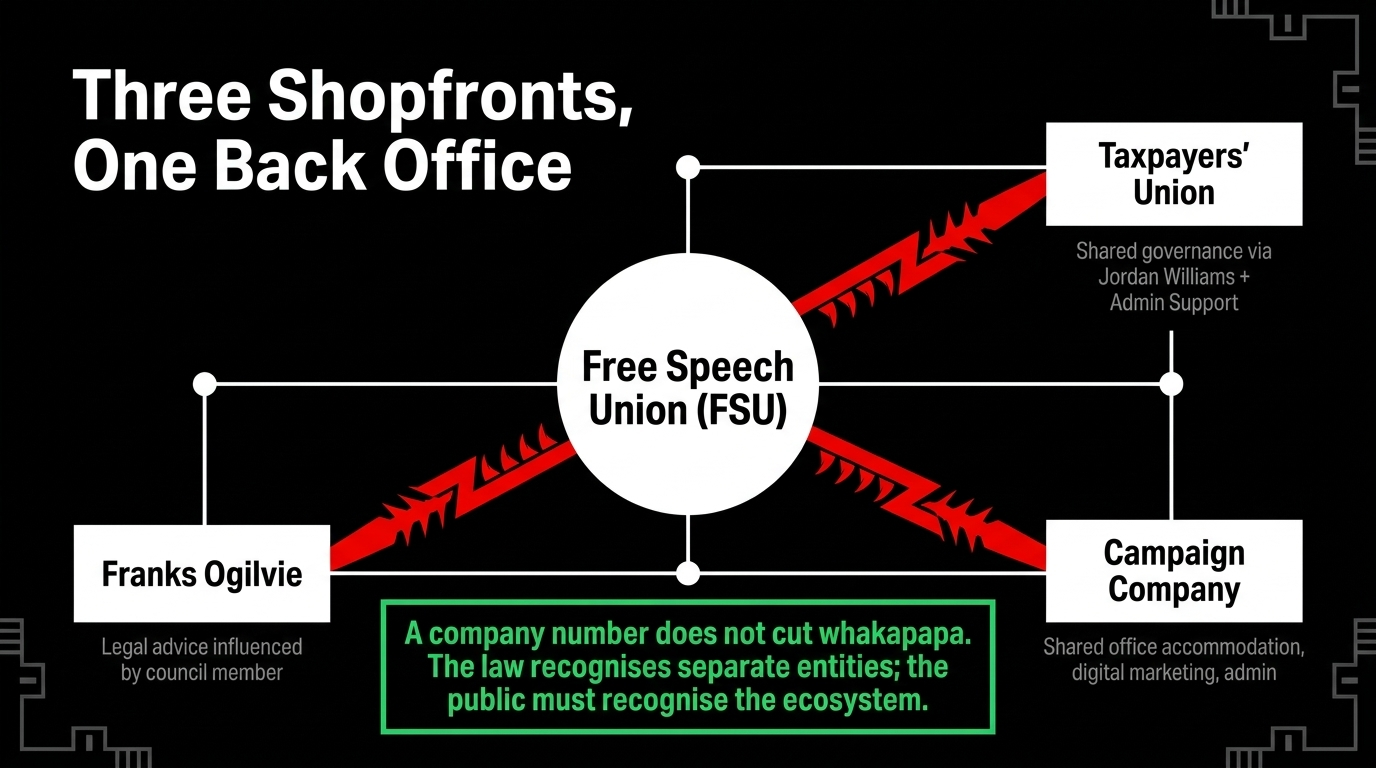
Core Claim: Imagine three shops with different signs but overlapping directors, administration, office space, marketing support, and suppliers. They may be legally separate, but no competent auditor, journalist, or customer would call them unrelated.
Quantified Capacity: The selected disclosed related-party items total $231,106: $18,000 to the Taxpayers’ Union, $56,320 to The Campaign Company, $139,531 to Franks Ogilvie, $15,480 to Dane Giraud, and $1,775 to Loukas Giraud.The complete context sits in Note 13. That selected total equals 15.56% of reported revenue.fsu
Quantified Harm: The figure does not prove a single dollar was misused, and the FSU says the sums were at or below market and overseen by the council.The report states that qualification. The harm is informational: presenting the entities as though separate registration settles the political question deprives readers of material context about how advocacy capacity is assembled.fsu
Solution: Publish the conflict declarations, procurement comparisons, council abstentions, service agreements, data-sharing boundaries, office-sharing arrangements, and grant conditions behind every material related-party payment. If the arrangements are proper, daylight strengthens them.
Tikanga Impact For The Western Mind: Whakapapa does not accuse; it locates. It tells us who is connected to whom, through what obligation, resource, and history. Refusing to trace those ties is like analysing a corporation while refusing to look at its subsidiaries because each has a different logo.
Example Three: The Imported Toolkit Sold As A Local Uprising
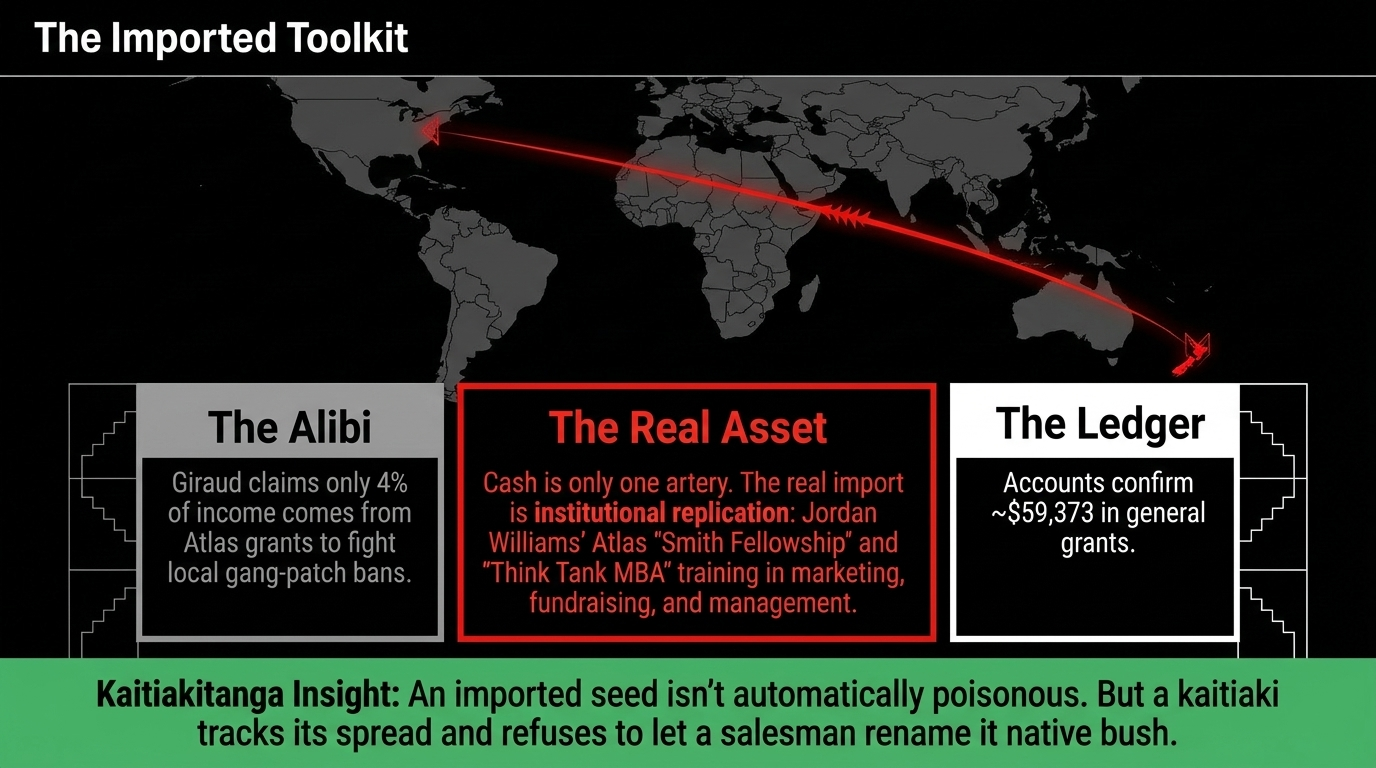
Core Claim: Imagine a local campaign leader trained by an international network in fundraising, marketing, and management, whose organisation receives that network’s grants and mentorship, then dismisses questions about the international relationship as paranoia. The relationship does not prove foreign control; it does prove that “purely spontaneous local uprising” is an incomplete story.
Quantified Capacity: Giraud says 4% of FSU income came from Atlas grants. Applied to reported revenue, that equals $59,420.76; the accounts’ general-grants line is $59,373, only $47.76 lower.Giraud supplies the percentage, while the FSU report supplies the totals.nzherald.co+1
Quantified Harm: No source reviewed proves Atlas directed the FSU’s campaigns, and I do not claim it did. The measurable fact is an admitted grant relationship of about 4%, combined with the documented Atlas training and mentoring history of Jordan Williams.Atlas describes the training, and RNZ records the membership admission.rnz+1
Solution: Disclose every overseas grant, its purpose, application, agreement, conditions, reporting requirements, and resulting campaign outputs. Also disclose overseas training and mentoring when leaders publicly market an organisation as an untouched expression of local grassroots sentiment.
Tikanga Impact For The Western Mind: Kaitiakitanga requires knowing what enters the ecosystem and what it changes. An imported seed is not automatically poisonous, but a kaitiaki identifies it, tracks its spread, and refuses to let a salesman rename it native bush.
The Coalition’s White-Supremacist Effects
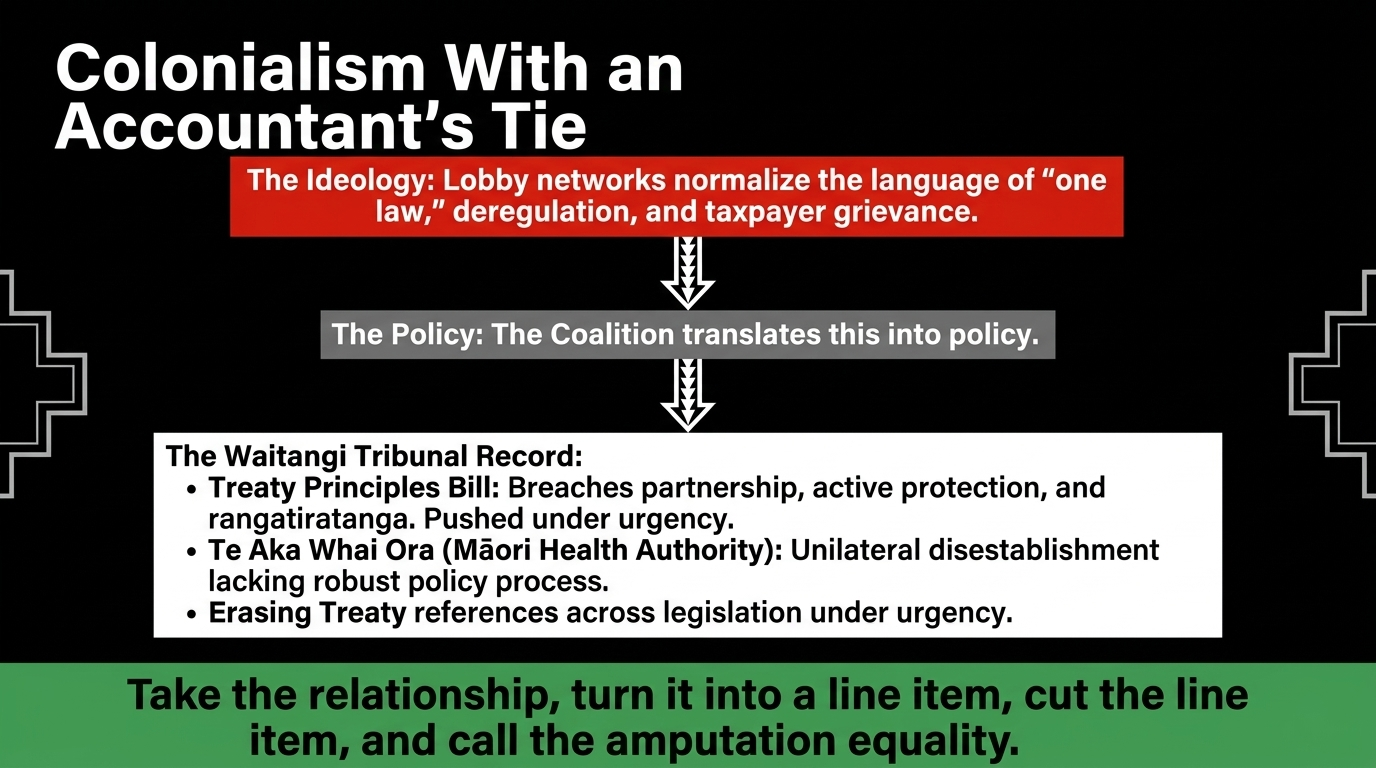
I will use the wording chosen for legal and evidential precision: this coalition’s documented policies reproduce white supremacy in effect. I am not alleging that every minister privately holds a white-supremacist belief. I am saying that repeated Crown decisions centralise Pākehā state authority, diminish Māori institutions, weaken Tiriti duties, and treat Māori collective rights as obstacles to a supposedly neutral order.
That conclusion rests on more than rhetoric. The Waitangi Tribunal found that the Treaty Principles Bill policy breached partnership and reciprocity, active protection, good government, equity, redress, and the article 2 guarantee of rangatiratanga; it said the policy lacked a proper imperative, relied on flawed rationales and a disingenuous historical narrative, and distorted te Tiriti. The Tribunal recommended abandoning the policy and pausing the Treaty-clause review for collaboration and co-design.waitangitribunal
The Tribunal also found that the Crown’s disestablishment of Te Aka Whai Ora breached tino rangatiratanga, good government, partnership, active protection, and redress; it found the Crown acted unilaterally, failed to consult Māori, and did not conduct a robust policy process.waitangitribunal
In September 2026, RNZ reported that the coalition advanced three bills affecting Treaty references: one removing references from six statutes, one standardising wording in 12 statutes, and one reducing obligations to no higher than “take into account”; the Human Rights Commission warned of inconsistency with domestic and international human-rights standards. The Post reported that the bills were pushed through first readings under urgency despite iwi opposition and the Tribunal’s recommendation to halt.rnz.co+1
That is the bridge between this lobby-network essay and the government. The FSU is not proved to command the coalition, and the coalition is not proved to command the FSU. The connection is ideological and infrastructural: lobby networks normalise a language of “one law,” deregulation, taxpayer grievance, and suspicion of Māori authority; parties translate compatible ideas into policy; organisations then amplify, defend, or litigate around the resulting programme.
The coalition’s neoliberal method strips collective obligations down to individual choice, treats public institutions as costs, and defines concentrated private power as freedom. Its white-supremacist effect is to restore Crown dominance whenever Māori exercise collective authority. The combination is colonialism with an accountant’s tie: take the relationship, turn it into a line item, cut the line item, and call the amputation equality.
What Giraud Still Must Answer
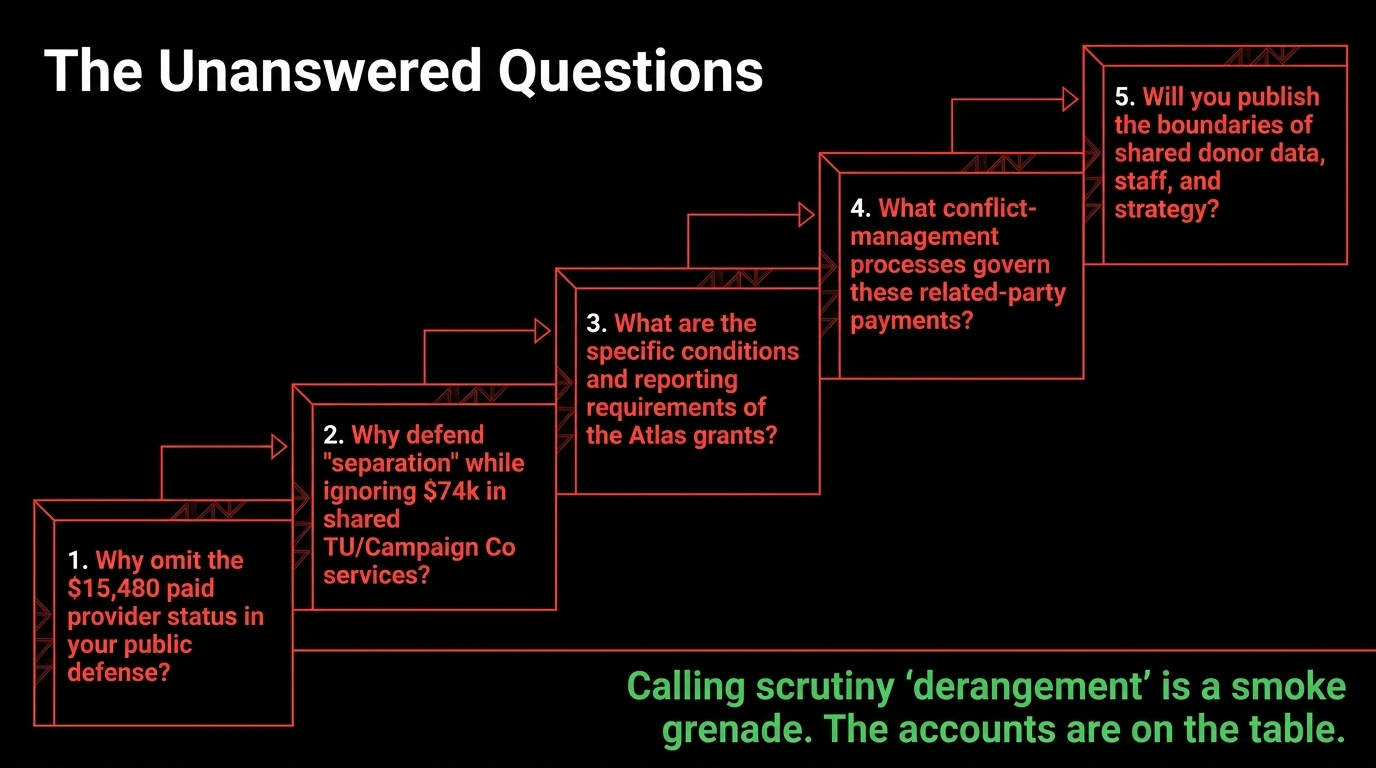
Giraud’s insults do not answer these questions:
- Why did the Herald disclosure not state that the FSU report identifies him as deputy chair and records $15,480 in professional-service payments to him?
- Why defend organisational separation without squarely discussing $18,000 in Taxpayers’ Union administration and $56,320 in Campaign Company shared services, digital-marketing advice, and office accommodation?
- Which grant or grants make up the Atlas funding Giraud describes as 4%, what conditions applied, and what reporting was required?
- What conflict-management processes governed payments to council members, relatives, and council-member-influenced entities?
- Were any mailing lists, donor data, campaign plans, technology, research, legal strategy, or staff shared among the FSU, Taxpayers’ Union, and Campaign Company; if not, will the organisations publish the boundaries?
- Does the FSU accept that journalists, researchers, Māori communities, and citizens have the same freedom to investigate it that it claims for itself to campaign?
Until those questions receive documentary answers, “derangement” is not analysis. It is a smoke grenade rolled across the floor while the accounts sit open on the table.
The Moral Verdict

Giraud does not disprove the network. He confirms a critical part of it by admitting Atlas funding, while the FSU’s accounts disclose the remaining governance and operational relationships.The admission appears in the Herald, and the transactions appear in the FSU report.
His argument is a confidence trick built from technically compatible fragments: separate legal entity, genuine members, mostly domestic income, and a minority foreign grant. Each fragment may be true. Put together without the related-party transactions, overlapping governance, shared services, office accommodation, training history, and influence objectives, they produce a picture that is materially incomplete.
My opinion is that the column launders organised political power through the moral innocence of the individual donor. It places ordinary members in front of the machine like a human barricade, then accuses anyone examining the engine of attacking the passengers.
I am not attacking the passengers. I am opening the bonnet.
Why This Coalition Must Not Return In November
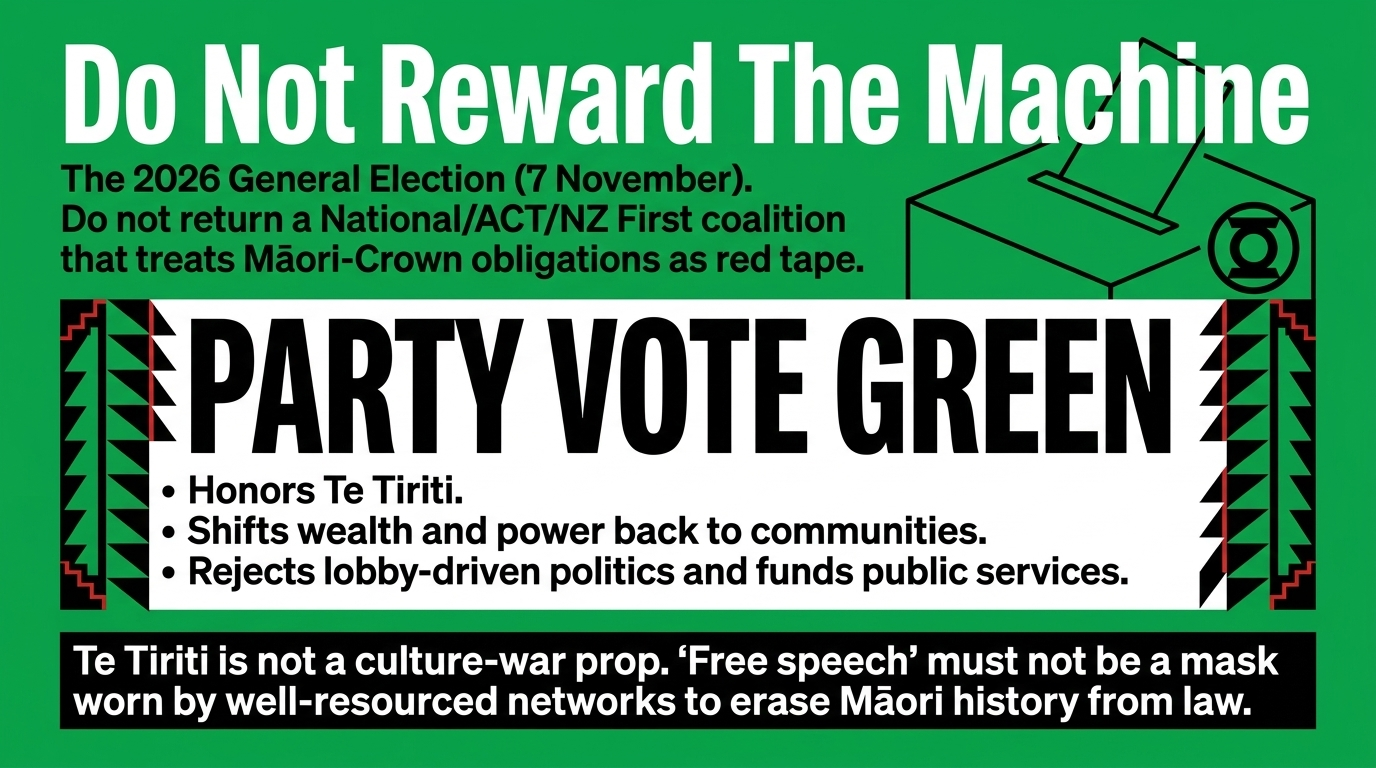
The 2026 general election is on Saturday 7 November. Do not vote this coalition back into power.elections
Do not reward a government that advanced Treaty-overhaul bills under urgency after the Waitangi Tribunal told it to stop.The Tribunal’s findings and the later legislative push are on the public record. Do not reward parties that treat documented Māori-Crown obligations as red tape while right-wing advocacy infrastructure is dressed up as the neutral voice of ordinary people.
I recommend a party vote for the Green Party. That is an explicit political opinion, not a neutral research finding.
I make that recommendation because the Green Party’s 2026 manifesto expressly commits to an Aotearoa that honours Te Tiriti, shifts power and wealth toward communities, supports Māori decision-making for whānau, hapū, and iwi, and funds public services through higher contributions from the super-rich and large corporations. Its platform also frames democracy as decisions made by New Zealanders rather than lobbyists and corporations, alongside affordable lives, healthy nature, and public ownership.The party states those priorities publicly.
The Greens are not sacred. No political party deserves blind loyalty. Hold them to tika and pono too. But on the evidence available, they offer a clearer break from the coalition’s assault on Tiriti protections, neoliberal austerity, and lobby-driven politics than returning National, ACT, and New Zealand First to office.
Vote Green because Te Tiriti is not a culture-war prop. Vote Green because wai is not a commodity with Māori guardianship edited out. Vote Green because public services should serve whānau rather than be starved until privatisation looks inevitable. Vote Green because “free speech” must not become a mask worn by well-resourced networks while Māori speech, authority, history, and institutions are cut from law.
Then keep watching the Greens. Rangatiratanga does not outsource judgment to any party.
That is tika: test the claim.
That is pono: tell the whole truth.
That is the taiaha: evidence in the hands of the people who are expected to live with the consequences.
Kia kaha, whānau. Stay vigilant. Stay connected. The taiaha is evidence. The light is tika. The duty is pono.
Disclaimer
This commentary concerns public actors in their public roles and public-interest questions about political advocacy, transparency, Te Tiriti, and electoral influence. It alleges no criminal conduct. “Lobby machine,” “confidence trick,” “power laundering,” and similar language are expressions of opinion based on the disclosed records linked in the same sections. Any reliable evidence correcting a factual statement should be assessed promptly, with a visible correction or retraction where warranted.