
"The Wolf in the Pulpit: Why Jonathan Ayling Wants Your Marae Broke" - 14 August 2026
I'm the Māori Green Lantern, and I'm calling the wolf by his name

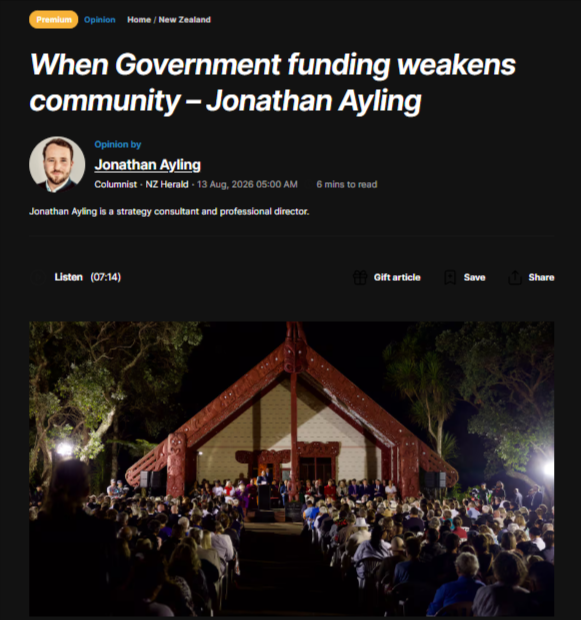
I'm Ivor Jones — The Māori Green Lantern. Tohunga mau rākau wairua, kaitiaki of Māori, exposing the networks that fund misinformation, white supremacy, racism and neoliberalism in Aotearoa. Te Arawa, Ngāti Pikiao, Welsh whakapapa on my father's side.
When a well-paid ACT donor in a Free Speech fleece tells our marae to beg while a white-supremacist neoliberal government rips out every Māori funding stream, that's not "community strength" — that's sabotage dressed as virtue.
The Wolf in the Pulpit: Jonathan Ayling's Second Betrayal
A wolf doesn't announce itself at the sheep-pen door. It wears the fleece, learns the bleating, and waits until the flock trusts it enough to turn its back.
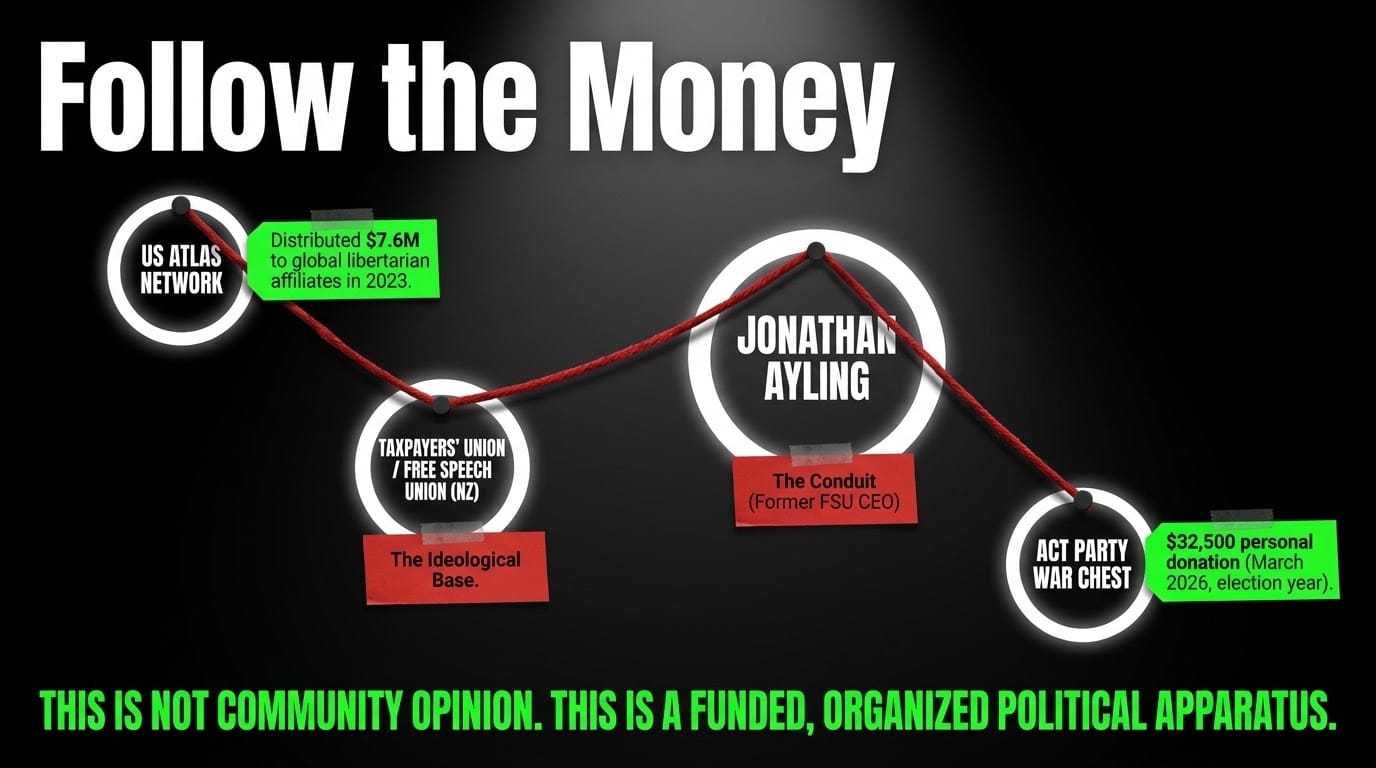
Jonathan Ayling has spent five years wearing the fleece of "free speech" and "community strength" while fronting the Free Speech Union and now a national newspaper column, all while quietly bankrolling ACT — the party driving a Treaty Principles Bill to cut down Māori rights — to the tune of $32,500 in a single election year (Elections NZ).
 Jonathan Ayling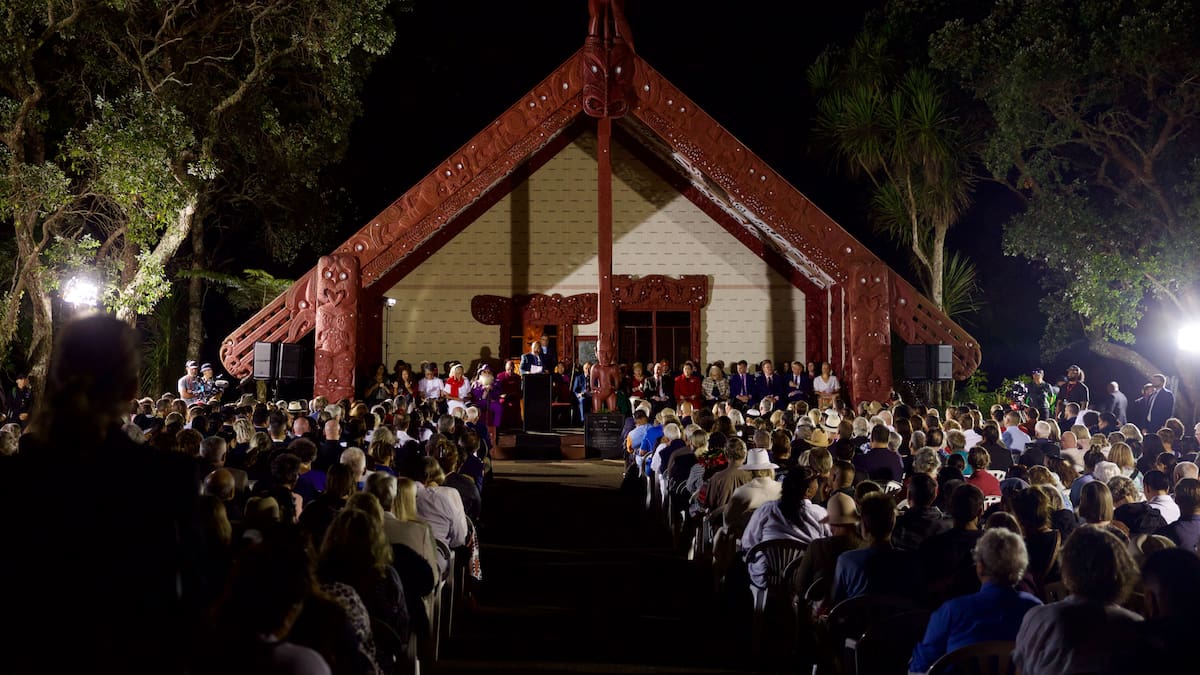
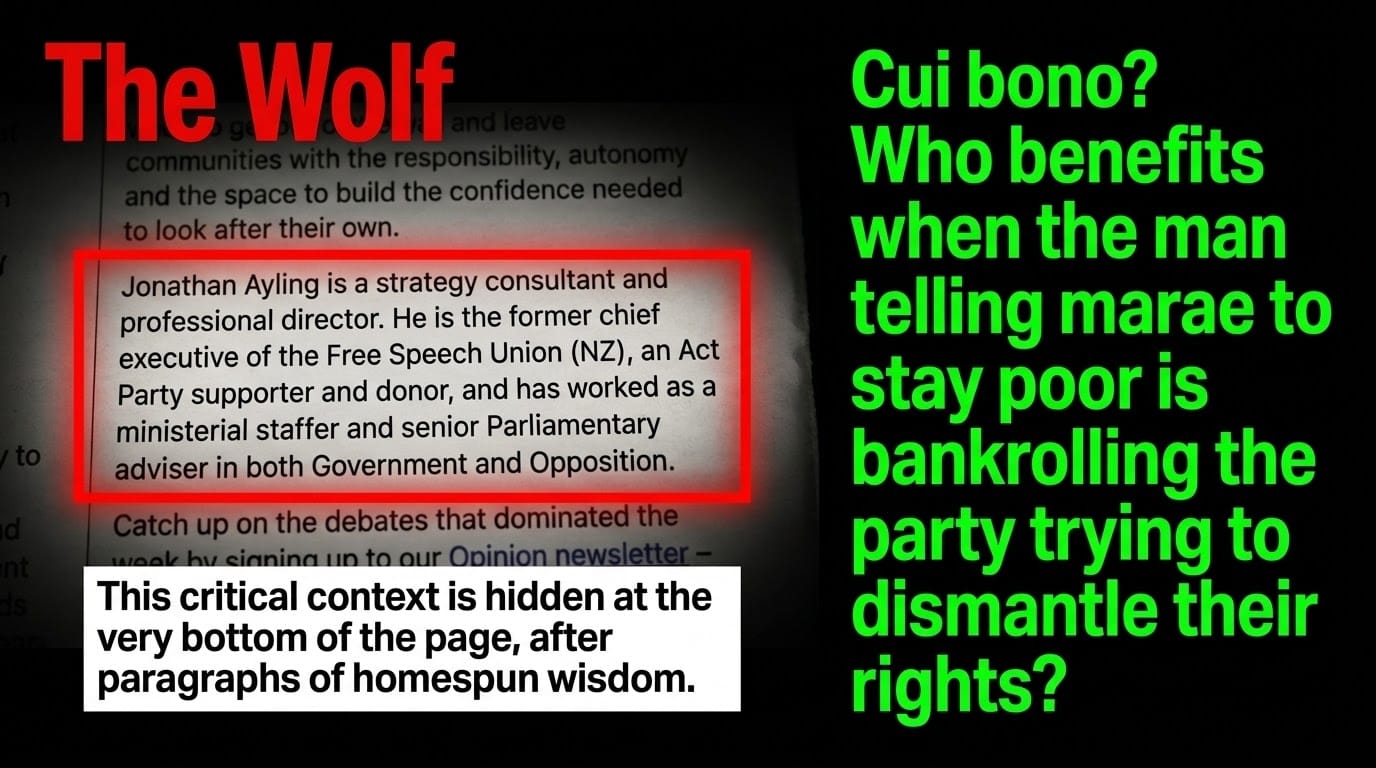
Cui bono — who benefits — when the man calling for marae to depend on koha instead of Crown obligation is the same man whose donation helps fund ACT's attack on tino rangatiratanga? And cui malo — who is harmed — when that message runs under a byline that discloses his donor status only after paragraphs of folksy Catholic church-lunch anecdotes (NZ Herald column)?
Background: The Fleece He Wears
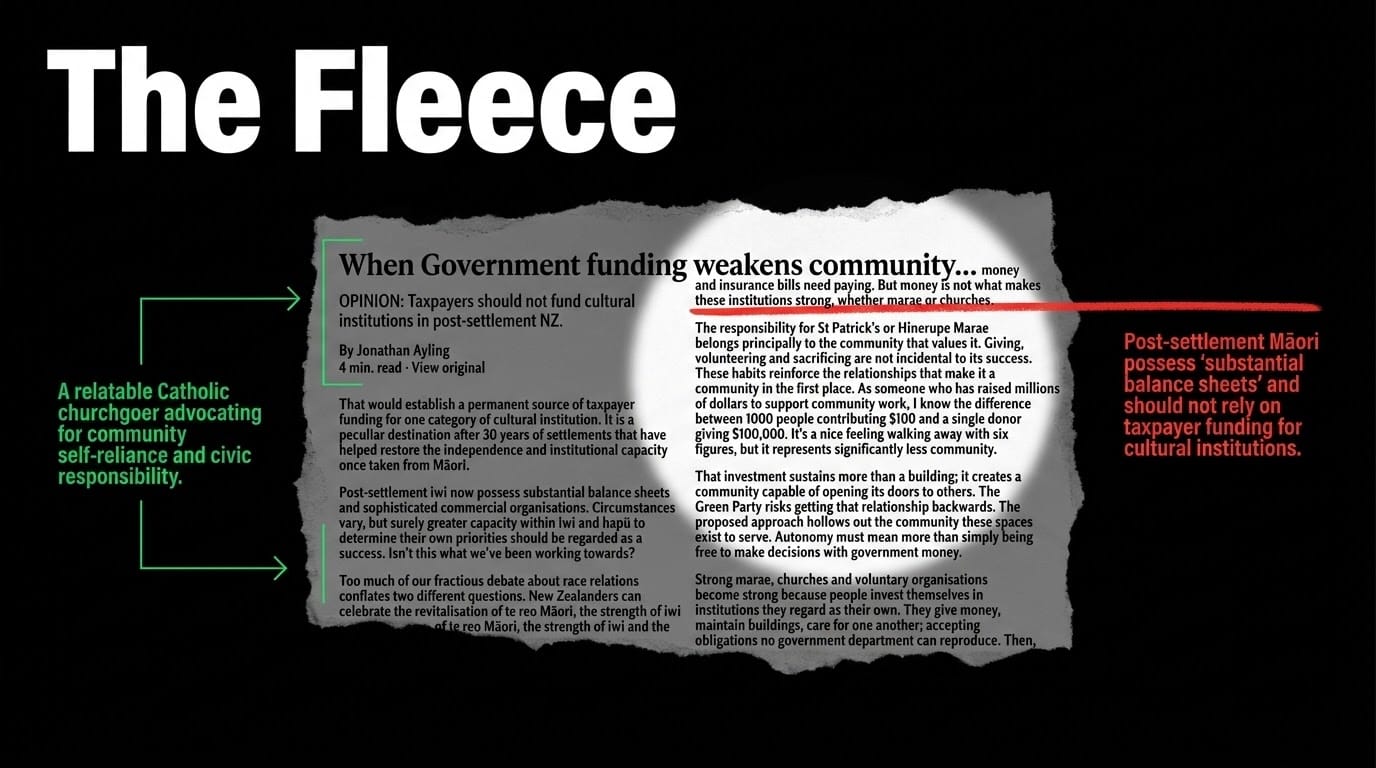
Jonathan Ayling was chief executive of the Free Speech Union from 2021 until stepping down in late 2025, and before that a ministerial staffer and senior parliamentary adviser for National MPs including Bill English, David Bennett and Simeon Brown (Wikipedia).
The FSU is a registered incorporated society styled as a "trade union," grown out of the Taxpayers' Union office, with acknowledged links to the Atlas Network — the US libertarian funding body that distributed over US$7.6 million to global affiliates in 2023 and also funds Australia's Institute of Public Affairs (Wikipedia).
In March 2026, Electoral Commission filings and RNZ's donations tracker both confirm Ayling personally gave $32,500 to ACT via "J & G Ayling Partnership trading as Mahala Enterprises" (Elections NZ, RNZ). His own Herald bio discloses he is "an Act Party supporter and donor" (NZ Herald author page) — a fact readers must scroll past several paragraphs to reach.
Deconstructing The Mātauranga: Manaakitanga Inverted
Ayling's op-ed insists "money is not what makes these institutions strong, whether marae or churches" (NZ Herald column) — a line engineered to sound like homespun wisdom while erasing the mechanics of colonisation. Waikato-Tainui's 1995 settlement — delivered with a Crown apology signed into law — returned compensation worth roughly $170 million against confiscated land valued at a minimum of $12 billion in 1995 terms (E-Tangata).
Ayling asks the descendants of that theft to now self-fund their cultural survival a second time, dressed up as a defence of "community responsibility."
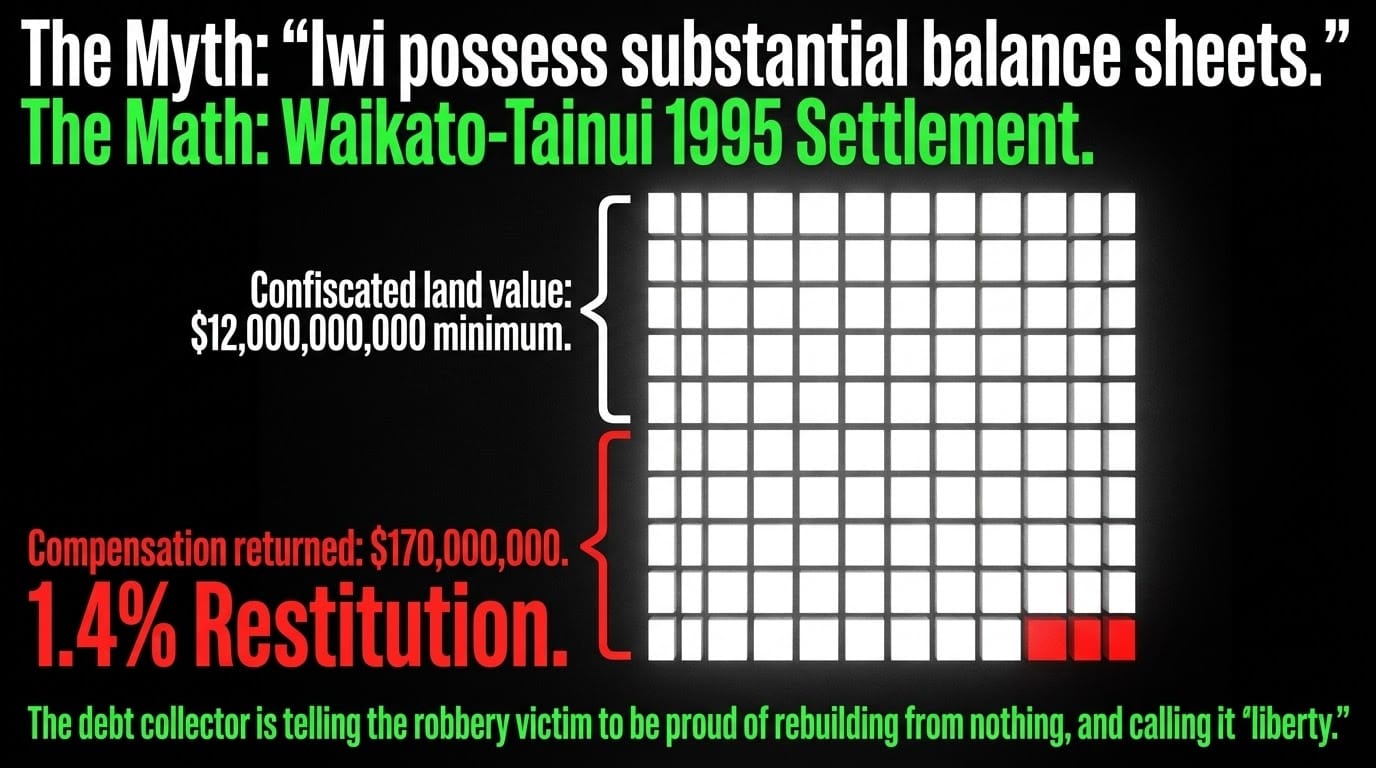
That is not liberty. That is the debt collector telling the robbery victim to be proud of rebuilding from nothing.
The Deep Dive Podcast
Listen to a lively conversation between two hosts, unpacking and connecting topics in the sources of this essay. I apologise in advance for the AI's very harsh pronounciation of reo. Please dont shoot me, :).
Youtube Video
Like video? Here is a short video suppporting the essay. Again, don't shoot the messenger please because of AI's pronounciation. 😄
Koha Consideration
Every koha into this kaupapa signals that whānau are ready to support the accountability that Crown and corporate structures will never provide on marae funding, climate resilience, and the donors who sit behind opinion columns. It signals that rangatiratanga includes the power to support our own truth-tellers when they name the wolf in the pulpit and call out the sabotage of our marae.
Kia kaha, whānau. Stay vigilant. Stay connected. And if you are able, consider a koha to ensure this voice continues to expose how white-supremacist neoliberal policy and polished Pākehā columnists are trying to keep our marae broke.
If you are unable to koha, kei te pai — subscribe or follow The Māori Green Lantern at themaorigreenlantern.maori.nz, kōrero and share with your whānau and friends; that is koha in itself.
Four pathways exist:
Koha platform — direct support: Koha: The Māori Green Lantern Fighting Misinformation and Disinformation
Subscription — essays direct to you: Subscribe to The Māori Green Lantern
Direct bank transfer: Ivor Jones — The Māori Green Lantern, Account: 03-1395-0099387-000
Facebook: Follow and subscribe
Three Examples For The Western Mind
Example one — The ACT Donor Who Lectures Marae On Poverty
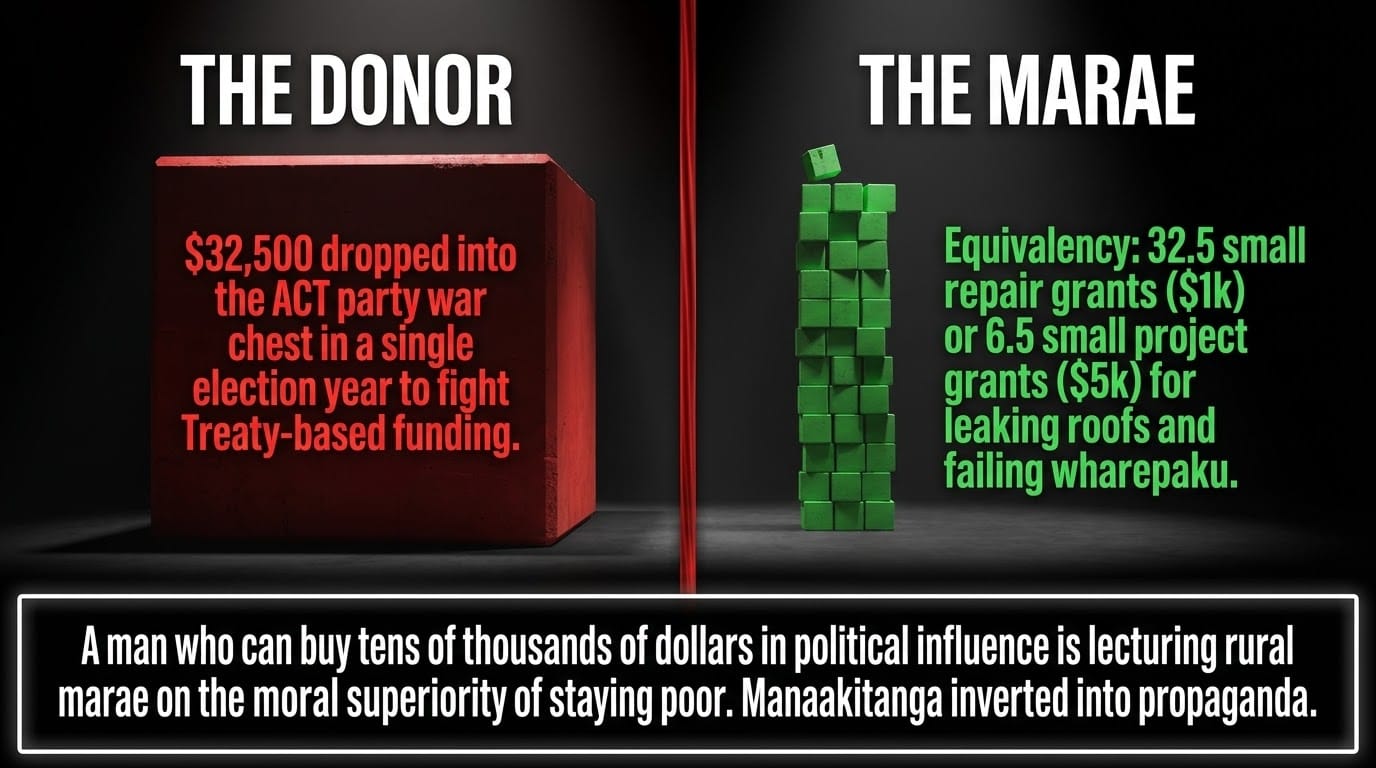
Core claim: Ayling argues against dedicated Crown funding for Māori cultural institutions (NZ Herald column) while personally funnelling $32,500 to the party most opposed to Treaty-based funding (Elections NZ).
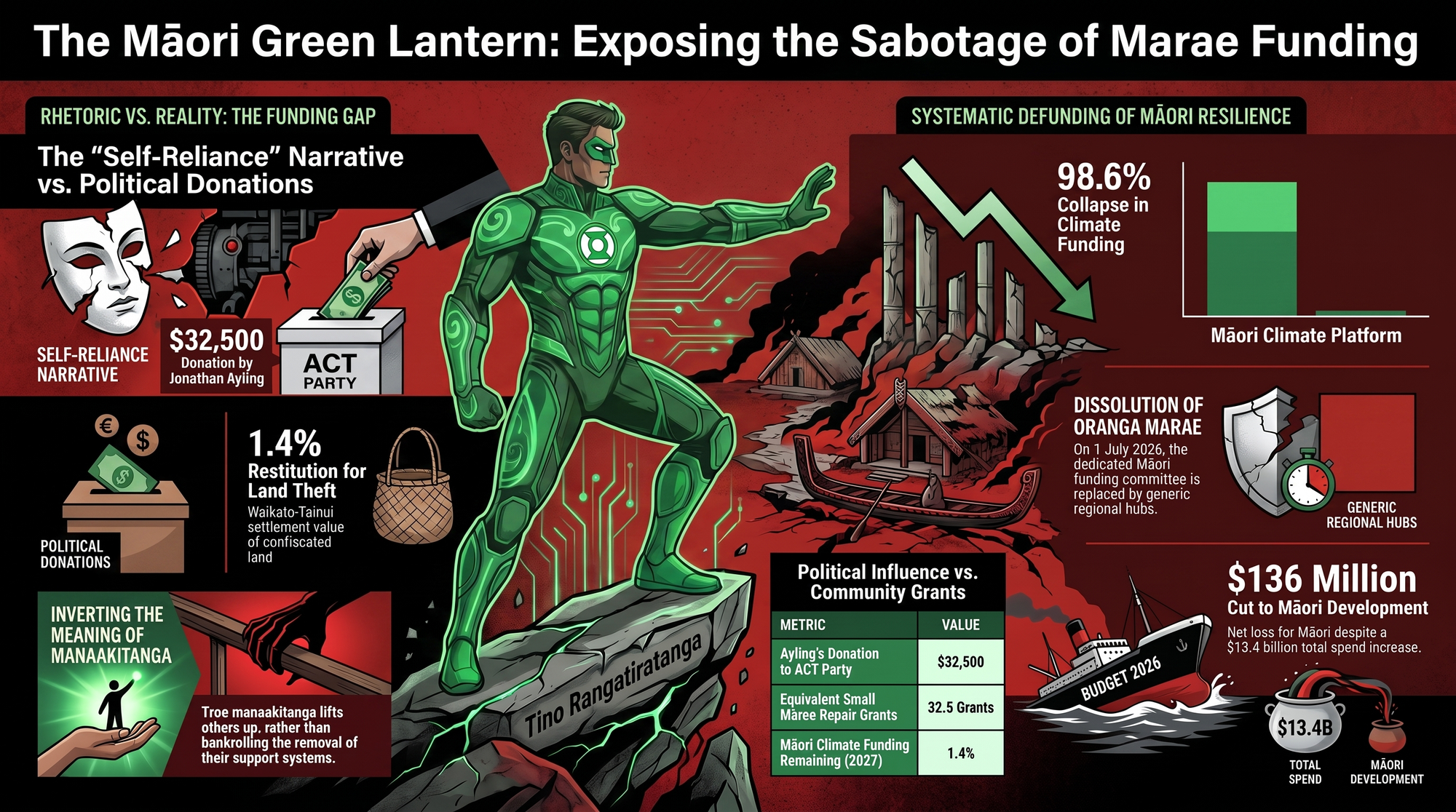
The working: Taking a symbolic $1,000 small marae repair grant as a benchmark (Oranga Marae): $32,500 ÷ $1,000 = 32.5 equivalent grants. Using a more realistic $5,000 small project benchmark: $32,500 ÷ $5,000 = 6.5 equivalent projects. Either way, one donation to ACT dwarfs what many marae scrape together in koha and small grants for leaking roofs and failing wharepaku.
Quantified harm: a man who can drop tens of thousands into ACT's war chest is telling marae nationwide to feel morally superior for staying poor.
Solution: outlets publishing his commentary on Māori funding should disclose donor status in the headline byline, not the footer; demand parallel Māori analysis whenever a Pākehā donor is platformed on Māori funding issues.
Tikanga impact: manaakitanga is about lifting the mana of others, not boasting that your own whānau can survive without help while you bankroll the party making that suffering policy (E-Tangata). Ayling calling paid Crown obligations "weakening community" inverts manaakitanga into propaganda.
Previously covered on The Māori Green Lantern: my essay mapping how white supremacist policy structures turn marae funding fights into gladiatorial contests over scraps (Two Kings and a Broken Child).
Example Two — The "Free Speech" Union That Tries To Silence Te Tiriti
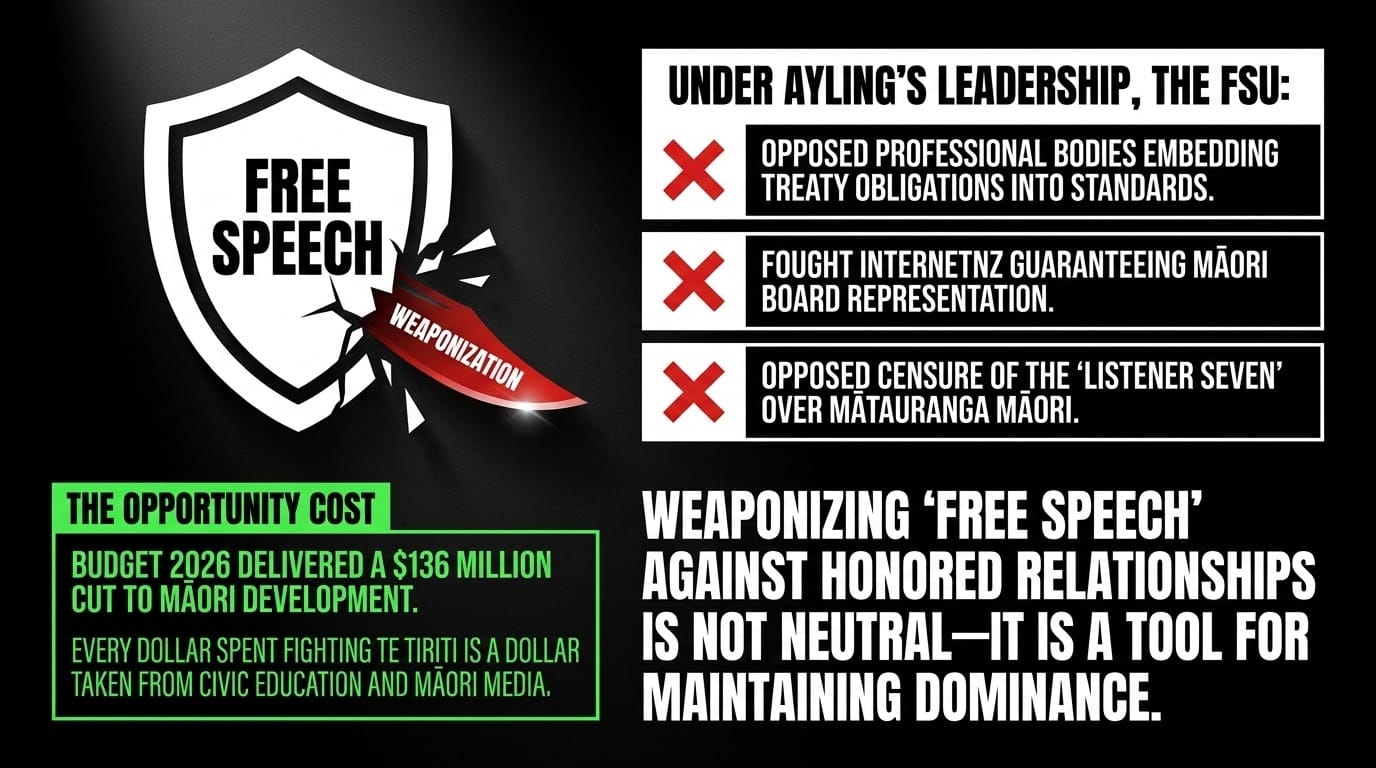
Core claim: under Ayling's leadership, the FSU opposed censure of the "Listener Seven" over mātauranga Māori's scientific status, fought professional bodies embedding Treaty obligations into registration standards, and objected to InternetNZ guaranteeing Māori board representation (Wikipedia).
The working on opportunity cost: Budget 2026 delivers Māori roughly $34 million net loss against a $13.4 billion overall increase — $34,000,000 ÷ $13,400,000,000 = 0.002537, approximately 0.25 percent of new spend, alongside a $136 million cut to Māori development funding (Scoop). Every dollar and hour the FSU spends fighting Treaty clauses in professional standards is a dollar and hour not spent on Māori media or civic education, at the exact moment Māori-specific funding is being gutted government-wide.
Solution: treat Atlas Network-linked organisations campaigning against Te Tiriti provisions as political actors, not neutral free-speech advocates; ask whose speech they spent money trying to shut down.
Tikanga impact: Te Tiriti and tikanga rest on honoured relationships. Weaponising "free speech" to oppose those commitments is not neutral — it is a tool for maintaining dominance (E-Tangata — Margaret Mutu).
Previously covered on The Māori Green Lantern: "THE VOTE THIEVES," tracing how Hobson's Pledge, ACT, and allied lobby groups script policy that strangles Māori democracy (The Vote Thieves).
Example Three — Killing Marae Resilience While Calling It "Community Strength"
Core claim: Ayling frames the Green Party's Te Waonui a Tāne marae trust as government overreach that "hollows out the community these spaces exist to serve" (NZ Herald column), but RNZ and 1News both confirm the $2.44 billion trust is hapū- and iwi-governed, with the Crown barred from directing investments, appointing trustees, or altering funding decisions once established (RNZ, 1News).
The working on funding collapse: the Māori Climate Platform started with up to $30 million in 2022, was reduced to $14 million, cut a further 33 percent across 2024 and 2025, and by 2027 will have just $410,000 left before the fund is closed entirely (Te Ao Māori News). $410,000 ÷ $30,000,000 = 0.0137, or 1.4 percent of the original allocation remaining — a 98.6 percent collapse, after funding 21 projects across more than 60 marae. At the same time, Te Ao Māori News confirms the dedicated Oranga Marae funding committee is being dissolved from 1 July 2026, folded into six regional hubs with no guaranteed Māori board representation, forcing rural marae to compete against large, professionally resourced organisations (Te Ao Māori News).
Quantified harm: Māori climate resilience funding for marae has been cut by roughly 98.6 percent at the precise moment marae are being asked, in Ayling's own words, to demonstrate "responsibility for what it has inherited" without Crown support.
Solution: back Te Waonui a Tāne and similar hapū/iwi-controlled instruments that permanently lock Crown capital into Māori governance; reject commentary that misdescribes these instruments as state control when the policy text places control in Māori hands.
Tikanga impact: marae are the interface between living whānau and tūpuna. Deliberately starving that interface of infrastructure funding while lecturing marae about strength without money does not just cut a budget line — it breaks a sacred relationship.
Previously covered on The Māori Green Lantern: my coverage of Budget 2026 showing the lowest investment in Māori in 15 years, and how this government treats Māori culture as branding while gutting Māori wellbeing funding (Budget 2026 coverage).
Oranga Marae Dismantled While The Sermon Runs
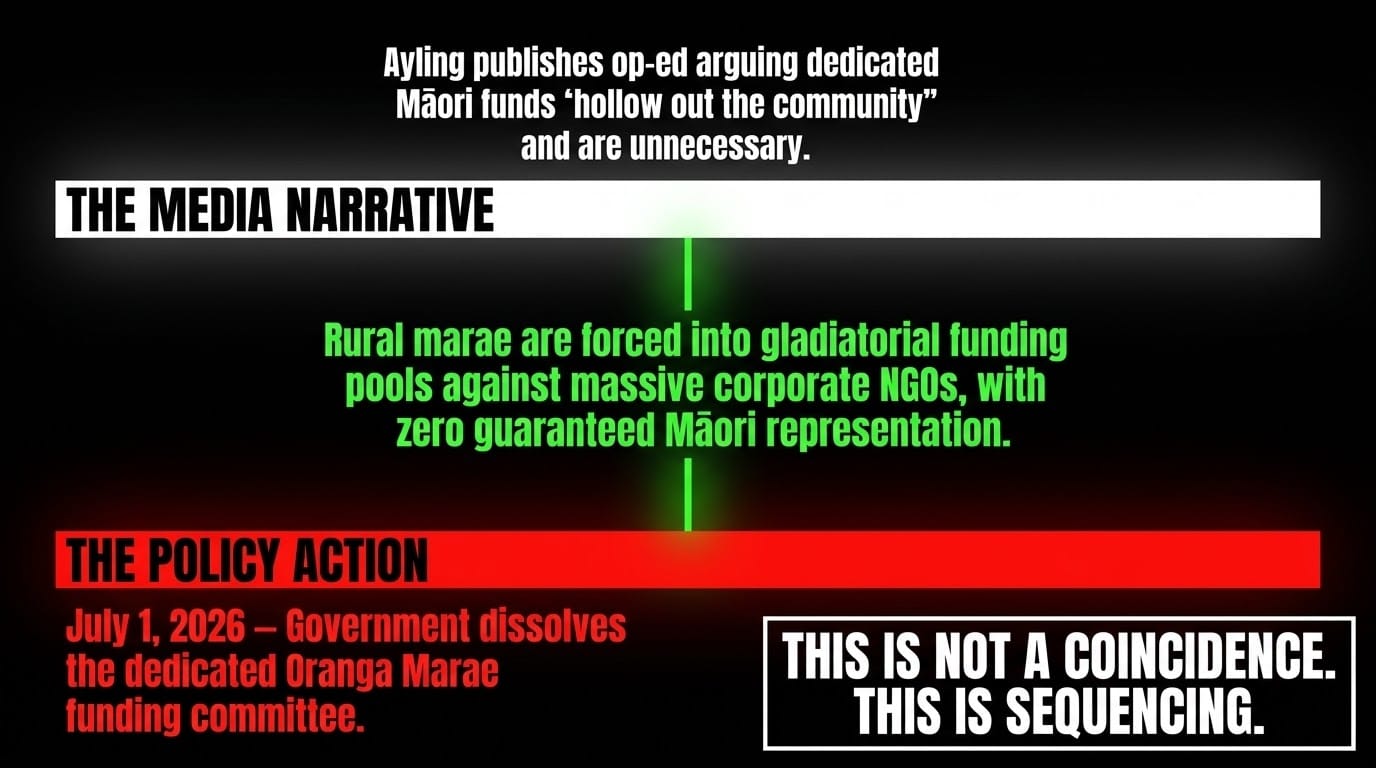
Te Ao Māori News reports that from 1 July 2026 the dedicated Oranga Marae funding committee will be dissolved and replaced by six regional hubs and a national committee managing all community grants, with no specific requirement for Māori members to hold seats on these boards (Te Ao Māori News). Rural marae will now compete in funding pools alongside large, well-resourced organisations, raising fears they will struggle to remain lifelines during future disasters.
Ayling's call for marae to "look after their own" arrives precisely as the dedicated Māori-specific funding infrastructure he implies is unnecessary is being actively dismantled by a coalition his own donations help anchor (NZ Herald column; Scoop). This is not coincidence. This is sequencing.
Trudi Ngawhare's Words: Resilience, Not Consent
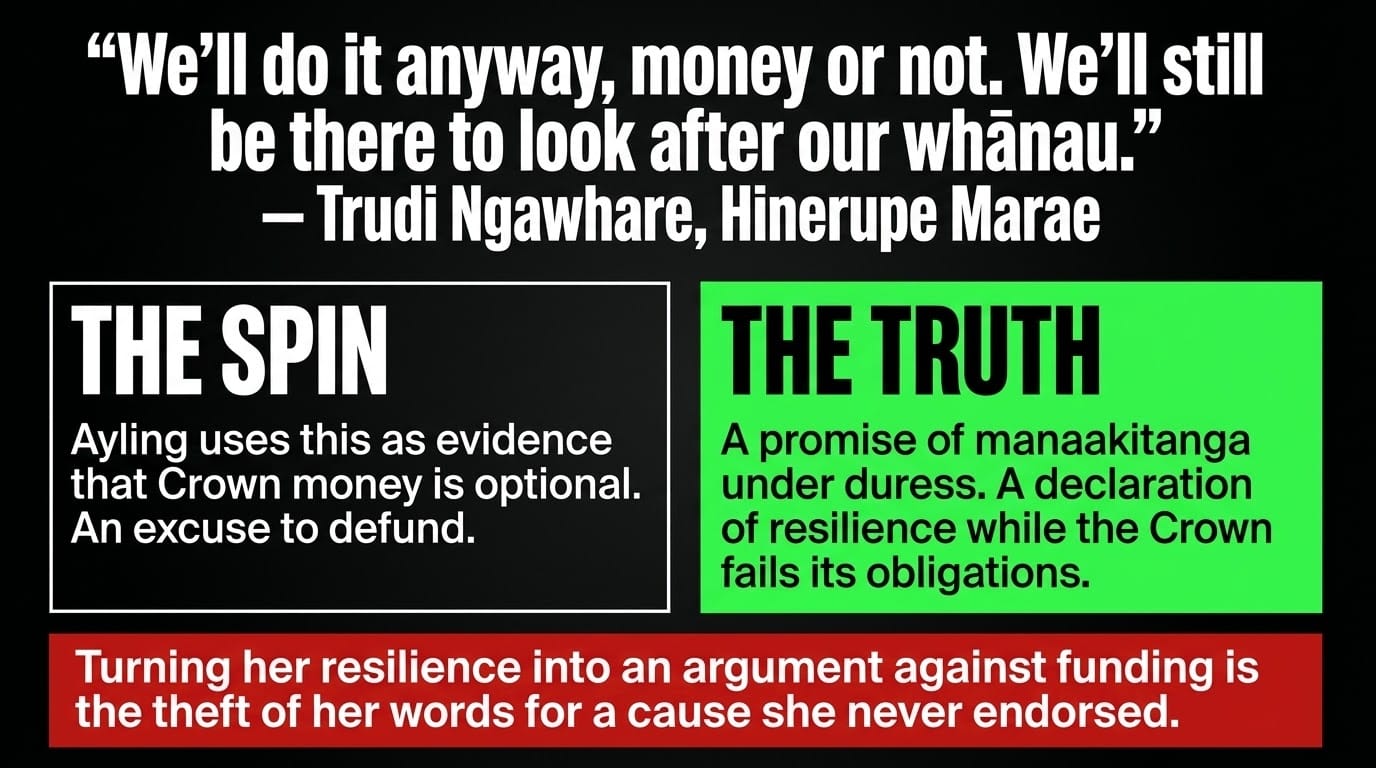
Ayling quotes Trudi Ngawhare of Hinerupe Marae saying: "We'll do it anyway, money or not. We'll still be there to look after our whānau" (NZ Herald column).
In his framing, that statement becomes evidence that Crown money is optional. In Māori terms, it is a declaration that whānau will hold the line even while the Crown fails to honour its obligations.
Ngawhare's kōrero is a promise of manaakitanga under duress — not a blank cheque for politicians and donors to walk away from their obligations. Turning her resilience into an argument against funding is theft of her words for a cause she never endorsed.
How Ayling’s “Community Strength” Rhetoric Masks a War on Māori Funding
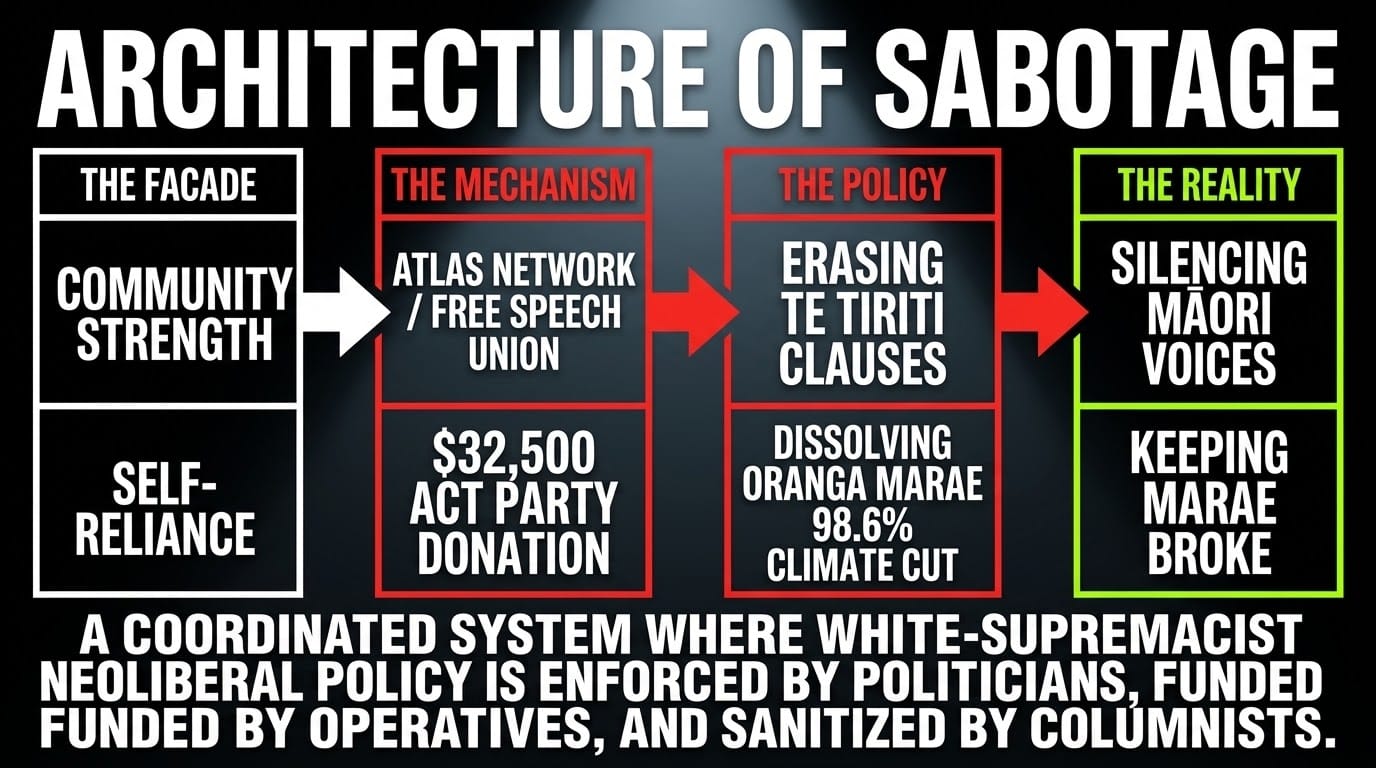
Jonathan Ayling is not a harmless church‑going commentator; he is a well‑connected ACT donor and former Free Speech Union chief executive using a Herald column to sell a moral cover story for a government that is systematically stripping Māori funding and Te Tiriti protections.[nzherald.co][elections][en.wikipedia][scoop.co]
His central message — that “money is not what makes these institutions strong” and that marae should rely on koha instead of a permanent Crown‑capitalised fund — collapses once you put the numbers beside the history: Waikato‑Tainui received about 1.4% restitution for raupatu land, Māori climate and marae funds are being cut by over 90%, and Budget 2026 delivers barely a quarter of one percent of new spending to Māori while slashing dedicated Māori development funding.[scoop.co][e-tangata.co][teaonews.co]
The scathing truth is simple: this white‑supremacist neoliberal government is dismantling Māori infrastructure and climate resilience, and Ayling’s “community strength” rhetoric is designed to make our people feel guilty for demanding the resources the Crown already owes — turning manaakitanga and rangatiratanga into slogans while keeping our marae broke.
Ngā mihi,

Ivor Jones The Māori Green Lantern Fighting Misinformation And Disinformation From The Far Right
Right of reply and legal note
Jonathan Ayling writes and donates in a public capacity as a named columnist, former Free Speech Union chief executive, and declared ACT supporter, engaging directly in public debate over Treaty-based funding and marae policy (Wikipedia; NZ Herald author page). This essay addresses only his published statements, recorded donations, and publicly reported professional roles, all linked above. Under Lange v Atkinson and subsequent case law, commentary on a public political actor's statements about public policy carries qualified privilege when grounded in verifiable fact and offered without malice.
Claims about Ayling's theological positions are drawn from a secondary source referencing sermon material not independently accessed by this author, and are flagged corroborated, not independently verified (rationalists.nz). No claim of malice is made — this is pattern-of-harm analysis grounded in disclosed facts. Ayling is invited to respond within 48 hours; any substantive response will be linked here.
Disclaimer: This essay reflects opinion and analysis grounded in cited, verifiable sources, published in the public interest regarding an active election-year debate over Treaty-based funding policy in Aotearoa. Readers are urged to consult the primary sources linked throughout and to read Ayling's original piece in full.