"THE BURNING HEALING HOUSE" - Budget 2026 - 29 May 2026
How Simeon Brown Burned Our Healing House, Pocketed the Insurance, and Called the Ashes a Billion-Dollar Investment

Mōrena Aotearoa,
They torched Te Aka Whai Ora, scattered the healers, stripped the Treaty from the law — and now they're handing you a bucket of paint and calling it healthcare. Your whānau is dying on the waiting list. Simeon Brown is calling it "record investment." I call it what it is: a crime.
This essay examines Budget 2026's health spending claims because they directly affect Māori whānau health outcomes, democratic accountability of public officials, and Te Tiriti o Waitangi obligations. This activates the responsible communication defence under Durie v Gardiner NZCA 278.
I Have Seen This Before
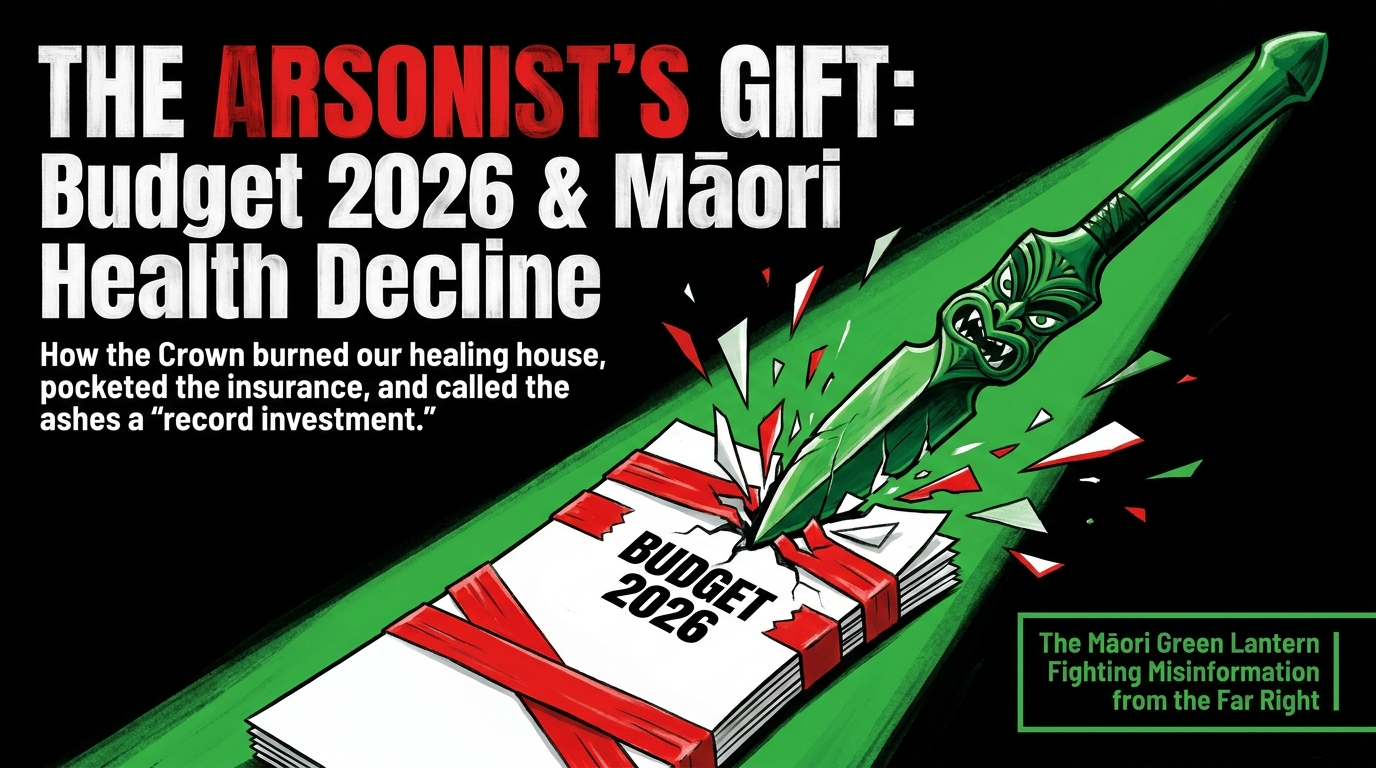
I am Ivor Jones. I am the Māori Green Lantern. I carry the taiaha of research and I have traced the whakapapa of this lie back through every budget, every press release, every hard-hat photo opportunity
— and I am telling you plainly: what Simeon Brown announced on Budget Day 2026 is not investment in healthcare. It is the architecture of managed decline, dressed in a hi-vis vest and handed to you with a smile.
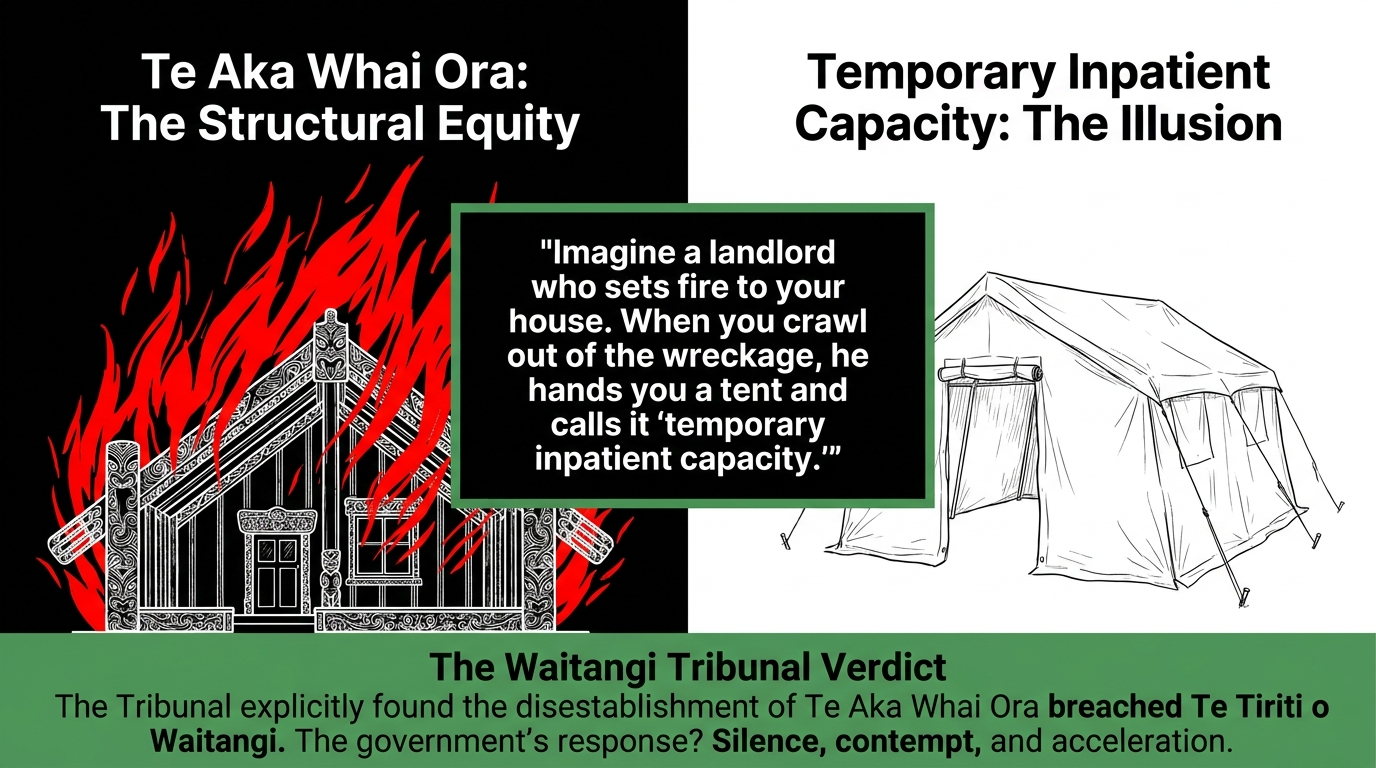
Imagine a landlord who sets fire to your house. He burns it while you sleep. When you crawl out of the wreckage, coughing, your tamariki on your hip, he hands you a tent and calls it
"temporary inpatient capacity."
Then, while you are living in the tent, he strips the building code that required him to consult you before demolishing your home. He lobbies for the right to run the next house as a private enterprise. He announces a new building — somewhere down the road, design phase only, completion date TBD
— and holds a press conference.
He calls it
"record investment."
The media dutifully report the headline.
That is Budget 2026. That landlord is this white supremacist neoliberal government. And the house they burned was Te Aka Whai Ora.
The Deep Dive Podcast
Listen to a lively conversation between two hosts, unpacking and connecting topics in the sources of this essay. I apologise in advance for the AI's very harsh pronounciation of reo. Please dont shoot me, :).
The Whakapapa of This Crime
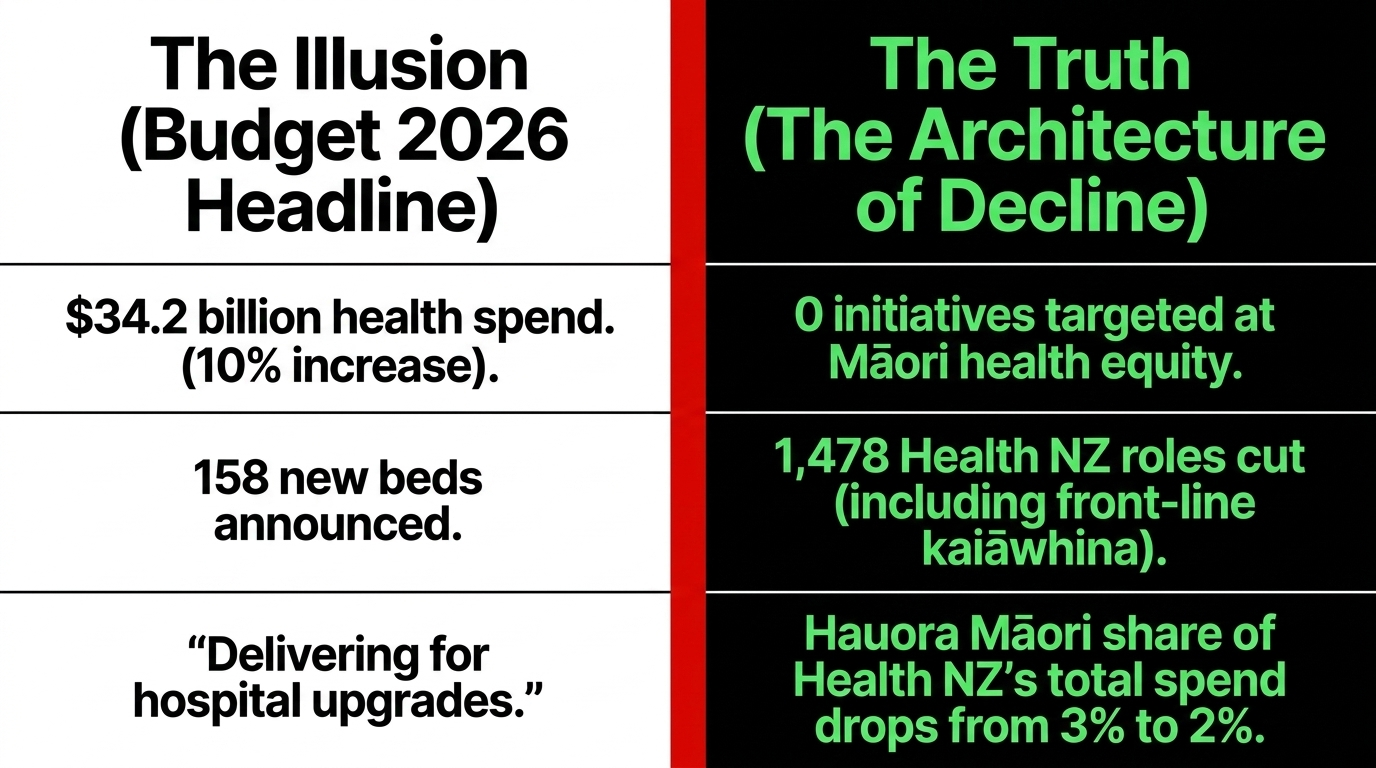
The Waitangi Tribunal found — in plain, unambiguous language — that the Crown breached Te Tiriti o Waitangi by disestablishing Te Aka Whai Ora without proper consultation or consideration of alternatives, as I documented in my earlier essay Dismantling Māori Health: A Colonial Legacy Resurrected.
That finding was not a suggestion. It was not a recommendation. It was the Tribunal — the Crown's own accountability mechanism
— telling the government: you are breaking the law of the covenant.
The response from Simeon Brown, Christopher Luxon, David Seymour, and Winston Peters?
Silence. Contempt. Acceleration.
I have been writing about this systematic dismantling since 2024.
In Colonial Amnesia in the House: How the Right-Wing Government Erases Māori Health, I documented how the government's framing of equity as "separatism" is a classic tactic of the far right
— designed to sow division, distract from structural failure, and maintain Pākehā dominance by erasing Māori lived experience from policy.
None of that has changed. Budget 2026 is just that same erasure with a bigger number at the top of the press release.
The Health Reform Collective found that Budget 2025 — the rehearsal for this year's performance —
"does not feature a single initiative targeted at Māori healthcare or health equity," and that the Hauora Māori share of Health NZ's total spend dropped from 3 percent to 2 percent.
Hāpai Te Hauora's CEO Jacqui Harema said it directly:
"This Budget is a choice — and that choice is clear. A choice to gut pay equity. A choice to back the boardroom while gutting community support."
Budget 2026 is the same choice. Repeat. Escalate. Deny.
Three Examples for the Western Mind
Example 1 — The Bed Con: Announcing the Same Promise Twice and Calling It a Miracle
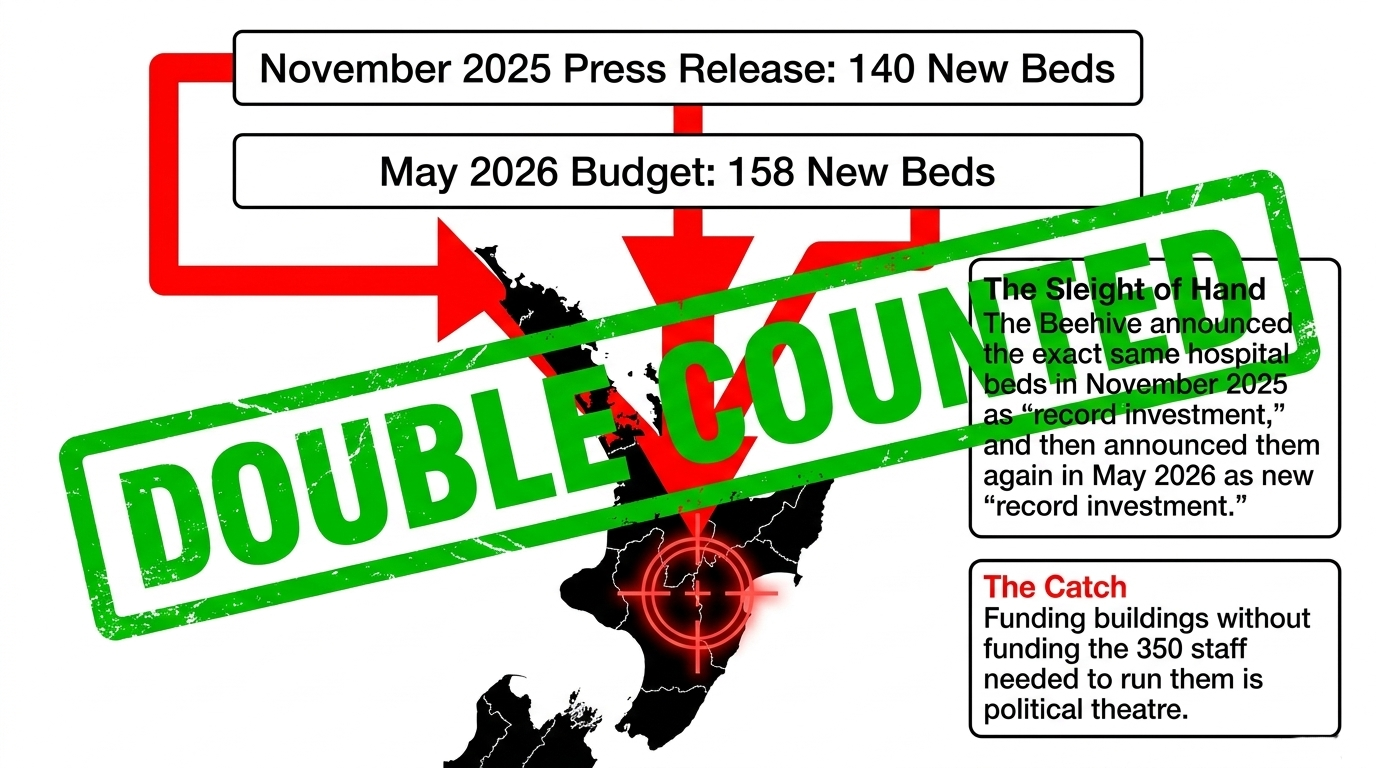
For those new to how this government operates: this is the equivalent of your landlord announcing they will fix the broken window, taking your rent money, spending it on himself, then announcing next year he will fix the broken window — as a new investment.
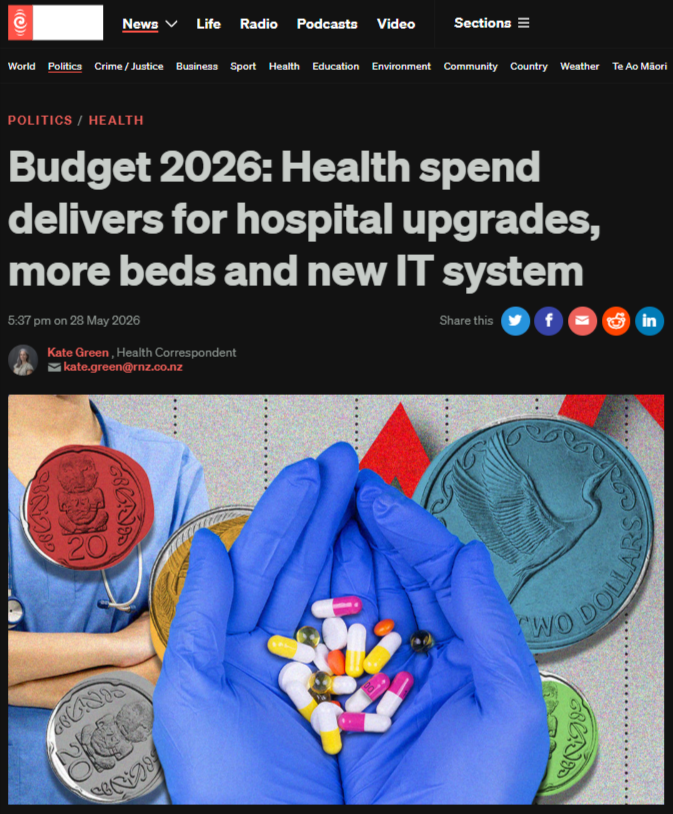
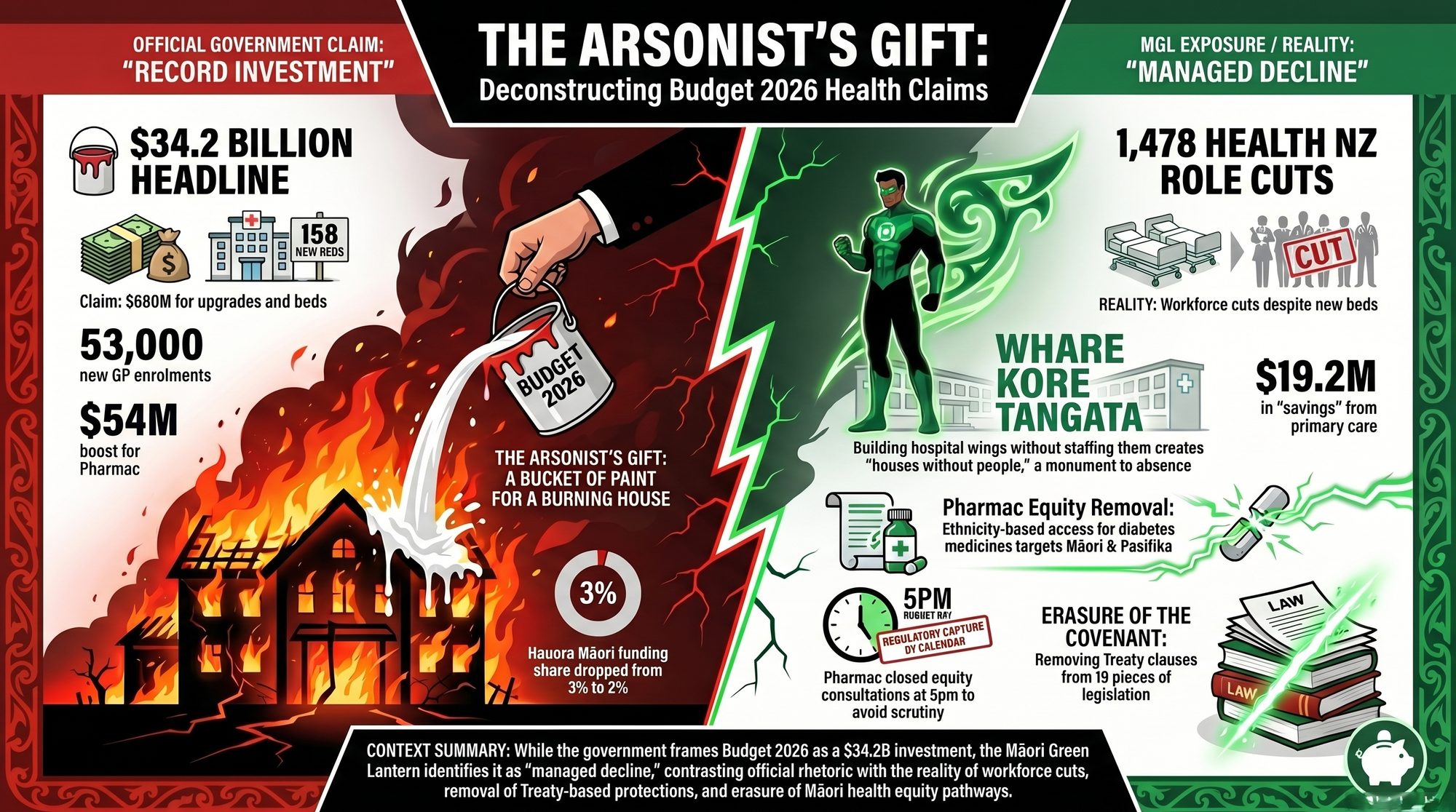
In November 2025, Simeon Brown stood at a podium and announced, as confirmed by the Beehive's own press release, 140 new hospital beds across New Zealand's five busiest hospitals — Middlemore, Waikato, Wellington, Nelson, and Hawke's Bay — as "record investment." On Budget Day 2026, he stood at another podium and announced, per the official Budget 2026 hospital investment release, a 158-bed ward tower at Whangārei and "design and enabling works" for Tauranga, Hawke's Bay, and Palmerston North — again as "record investment." Hawke's Bay appears in both announcements. The same dollar is being counted twice.
But here is the deeper con: beds without workforce are theatre. Brown himself acknowledged on Newstalk ZB that attracting the 350 staff needed for the new wards was already a challenge — while the Public Service Association confirmed that Health NZ cut 1,478 roles during this same period. You do not fix a staff shortage by announcing buildings. You fix it by funding people. This government cut the people and announced the buildings. I exposed the identical pattern in November 2025 in The 140-Bed Con: How Neoliberalism Dismantles Public Health — and here we are, one budget cycle later, running the same con at a higher price.
Tikanga impact — for the western mind: In te ao Māori, a building is not a building. It is a whare — a space that carries whakapapa, relationships, purpose, and people. A whare without people, without the knowledge of those who belong to it, is not a healing space. It is a monument to absence. When this government builds wards without restoring the kaupapa Māori workforce — without the kaiāwhina, the kaiawhina whai ora, the Māori nurses and community health workers who were cut in Brown's "rightsizing" — it is building whare kore tangata: empty houses with no soul and no whakapapa. And Māori whānau, who are statistically the most likely to be turned away, to wait the longest, to leave without treatment, remain outside in the cold while the government photographs the building and calls it care.
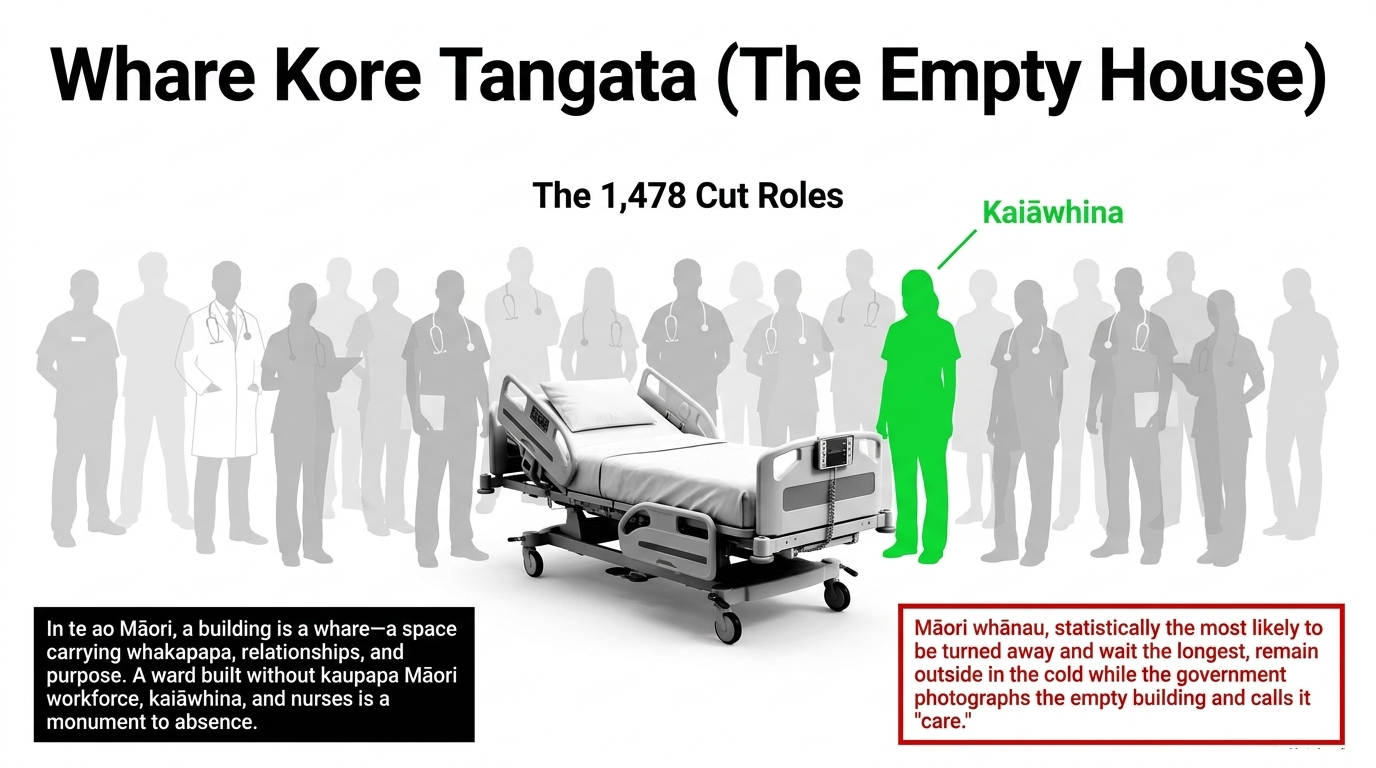
Harm quantified: Each of the 1,478 Health NZ role cuts represents a real person no longer available to support whānau through the system. Kaiawhina — the backbone of Māori and Pasifika community health navigation — were specifically identified among those cut, as I documented in Colonial Amnesia in the House.
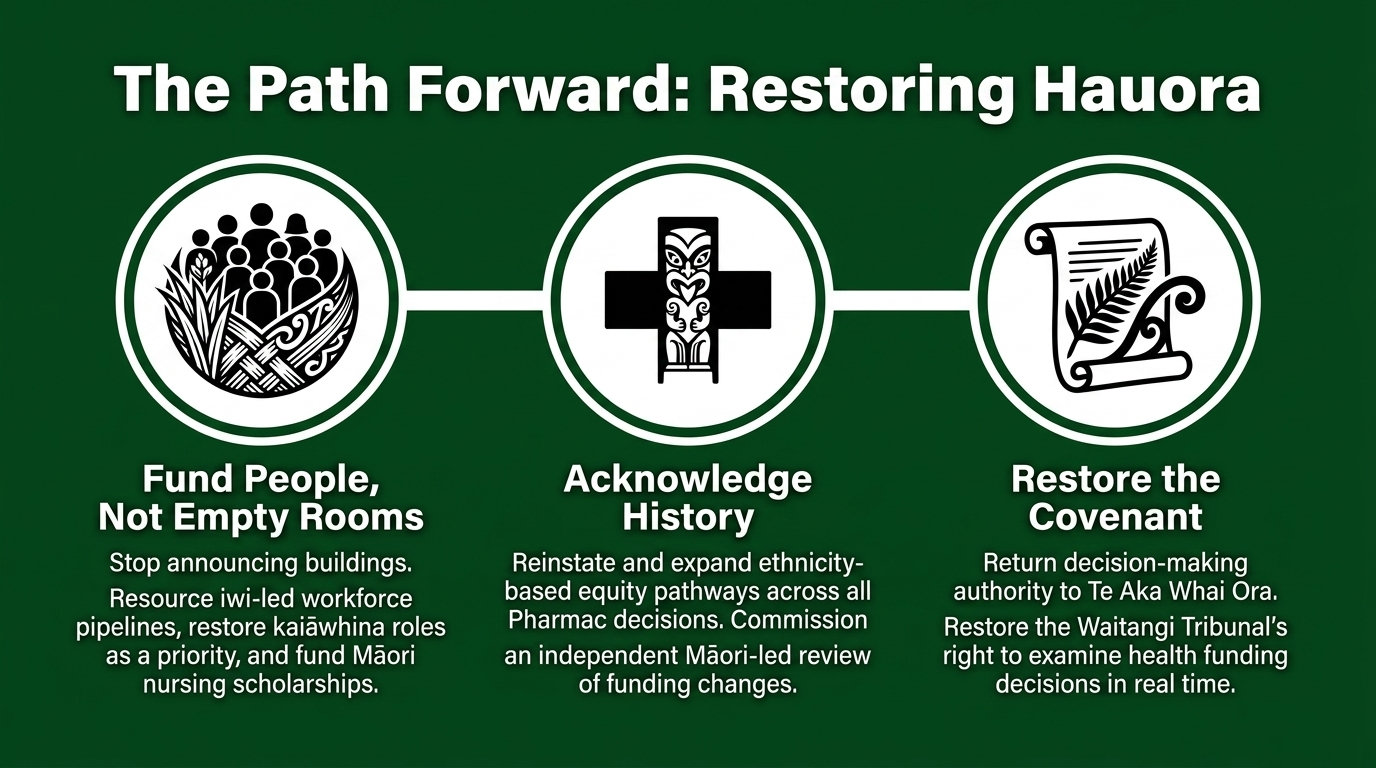
The solution: Fund iwi-led health workforce pipelines. Restore kaiawhina roles as a budget priority — not an afterthought. Resource Māori nursing scholarships. Stop announcing buildings and start paying the people who fill them.
Example 2 — The Pharmac Equity Erasure: Scheduling a Death and Calling it Efficiency
For those who believe medicine should be neutral: it is never neutral. The history of who gets medicine and who doesn't is the history of power. This government is rewriting that history in real time — and your whānau is the experimental subject.
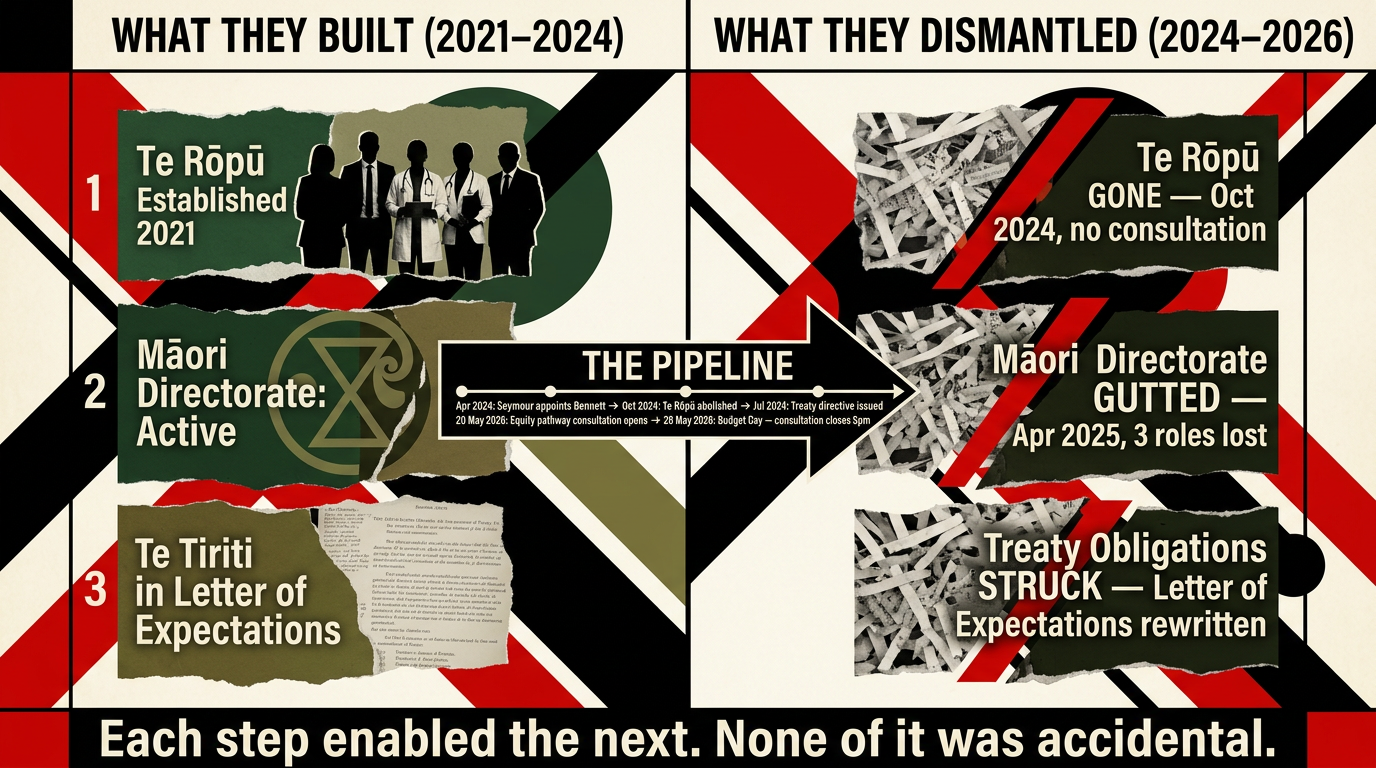
To understand what happened at Pharmac in the lead-up to Budget 2026, you need to trace the whakapapa of the con. It did not begin with a consultation document on 20 May 2026. It began in April 2024, when David Seymour — ACT Party leader, Associate Health Minister, architect of the Treaty Principles Bill — personally appointed former National Party Deputy Prime Minister Paula Bennett as Chair of Pharmac's Board.
She had no experience in the pharmaceutical industry. No prior board chair experience. No background in Māori health. What she had was fifteen years as a National Party cabinet minister, nine of them in cabinet, a record of cutting welfare for the most vulnerable, and the full confidence of the coalition government that appointed her.
As interest.co.nz confirmed, this was a political appointment to an organisation the government intended to reshape. This is the whakapapa of what followed.
Within months of Bennett taking the chair, the systematic dismantling of Pharmac's Māori health infrastructure began — not gradually, not apologetically, but with the deliberate velocity of a government that knows it has the numbers and intends to use them.
In October 2024, as confirmed by Pharmac's own OIA response, Bennett personally advised the co-chairs of Te Rōpū — Pharmac's Māori Advisory Group — that the Board had decided to disestablish it.
No consultation with Te Rōpū. No engagement with Māori health leaders. Just a letter from the new chair, announcing that the advisory group established in 2021 following a damning independent review of Pharmac's failures on Māori health equity — the group that included doctors, pharmacists, researchers, and directors — was gone.
As The Platform reported, Bennett publicly defended the decision herself, appearing to justify stripping Māori clinical expertise from the organisation's governance architecture. And as the PSA confirmed: "Pharmac didn't even bother to consult Te Rōpū. Again, the Government has taken a decision based on ideology which fundamentally impacts Māori without consulting Māori. This is simply insulting to Māori."
This is not a coincidence of management style. This is a chain of command.
The government sent Pharmac a Letter of Expectations instructing it to stop embedding Te Tiriti o Waitangi in its funding decisions — as confirmed by the PSA's April 2025 statement.
Te Rōpū was abolished in obedience to that letter.
This was so egregious that a sitting Pharmac director resigned in protest — as The Guardian documented — stating that the government was ignoring "clear evidence" that Pharmac's engagement with Te Tiriti had positively impacted Māori health outcomes. When directors of Crown agencies resign over government instructions, that is not a management disagreement. That is a conscience refusing to be complicit in harm.
Then, in April 2025, under Bennett's chairmanship, Pharmac moved to scrap its internal Māori Directorate — a net loss of three roles, including those responsible for Pharmac's anti-racism research programme, as Scoop reported. The PSA's Te Kaihautū Māori Janice Panoho was unambiguous: "This is an abandonment of Pharmac's commitment to the health of Māori and another breach of Te Tiriti o Waitangi."
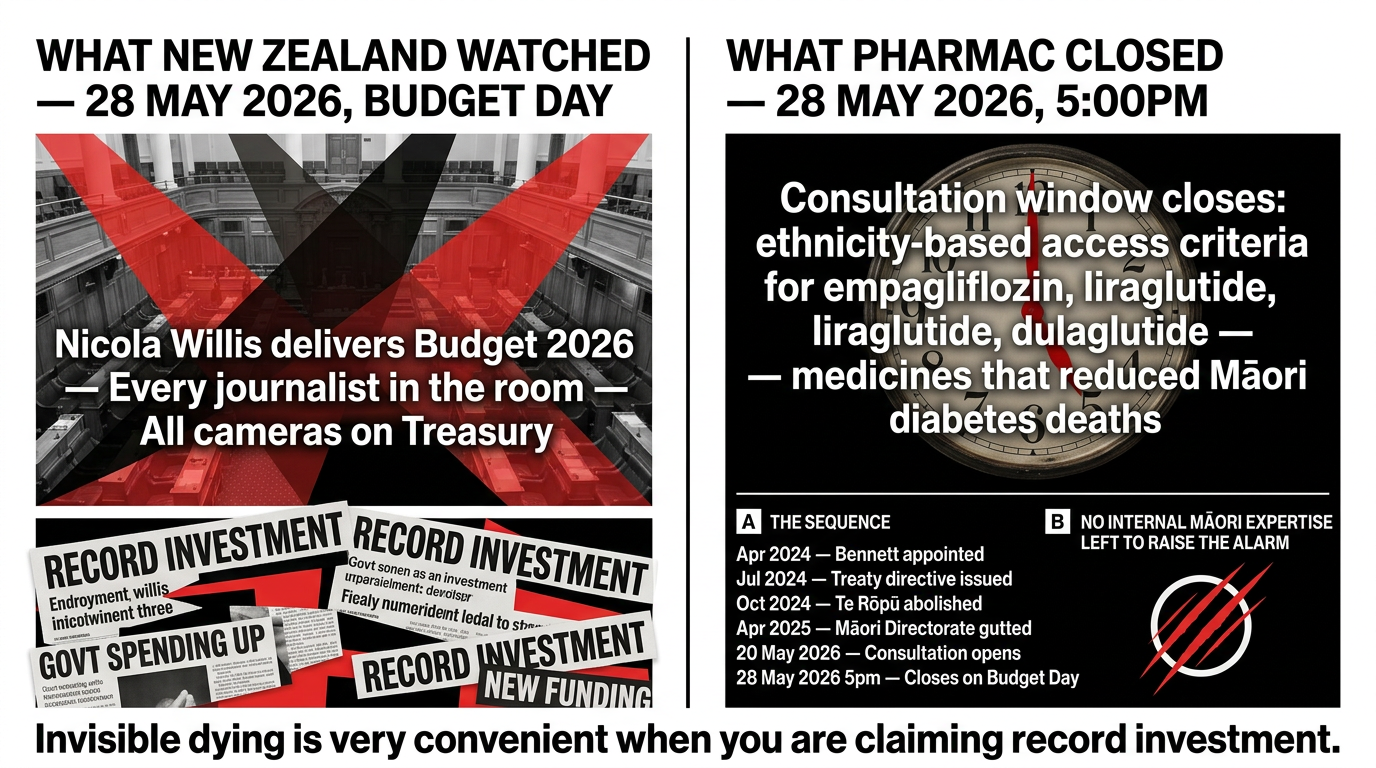
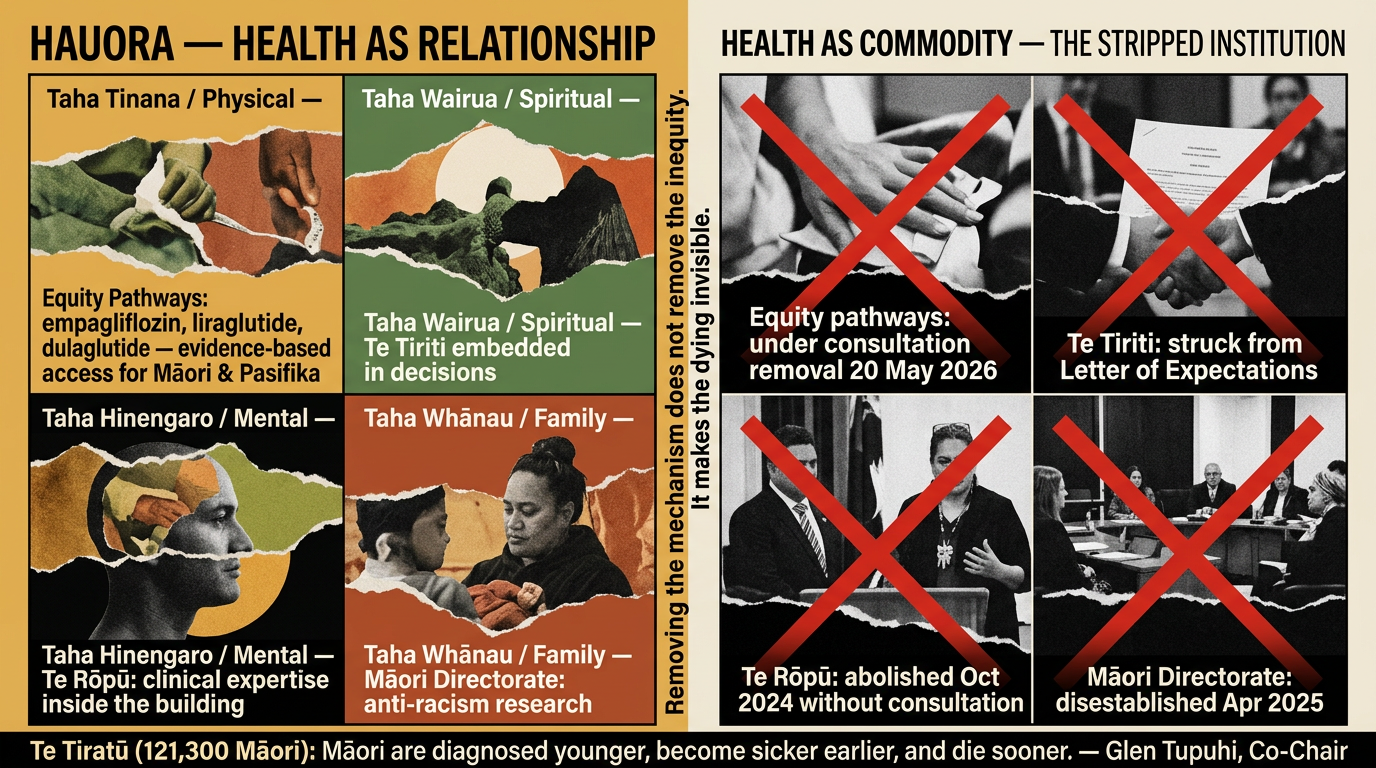
The architecture is now complete. The Māori Advisory Group: gone. The internal Māori Directorate: gutted. The Treaty obligations: struck from the Letter of Expectations. The Board Chair: a former National Party politician personally appointed by David Seymour with no pharmaceutical experience. And into this stripped, de-Māorified institution — with no internal Māori clinical expertise left to push back — Pharmac on 20 May 2026 opened consultation on removing ethnicity-based access pathways for key Type 2 diabetes medicines: empagliflozin, liraglutide, and dulaglutide.
As Te Tiratū — the Iwi Māori Partnership Board representing 121,300 Māori — documented, the consultation window closed at 5pm on 28 May 2026. Budget Day. The day every journalist in New Zealand was watching Nicola Willis. The day no one was watching Pharmac. As Te Tiratū's earlier push-back confirmed, co-chair Glen Tupuhi stated plainly: "Māori are diagnosed younger, become sicker earlier, and die sooner from preventable chronic illnesses." And as Te Ao News reported, Māori health leaders warned these changes "could deepen inequities and cost lives."
This is not coincidence. This is a pipeline. David Seymour appointed Bennett. Bennett abolished Te Rōpū without consultation. The government stripped Treaty obligations from Pharmac's Letter of Expectations. The Māori Directorate was gutted. And then — with no internal Māori expertise to raise the alarm inside the building — the equity pathways were put to consultation on Budget Day, when the public was looking the other way. Each step enabled the next. Each step was deliberate.
Simeon Brown and David Seymour call this "clinical need, not race." I call it what it is: the institutional architecture of managed dying. You do not achieve equity by pretending inequity does not exist. You achieve it — as the National Hauora Coalition demonstrated back in 2021 — by explicitly addressing the historical and structural causes of unequal prescribing. The ethnicity criteria being removed were introduced because evidence proved Māori and Pasifika received these medicines at lower rates despite higher clinical need. Removing those criteria does not make the system race-neutral. It returns it to the conditions that produced the inequity in the first place. It makes the dying invisible in the data. And invisible dying is very convenient when you are trying to claim record investment.
I covered the early stages of this whakapapa in The Crown's Crony Carousel: How Political Patronage Perpetuates Colonial Power — documenting how the appointment of former National ministers to Crown body boards is the mechanism by which ideology becomes institutional policy without needing legislation. Bennett's Pharmac appointment was exhibit A. Budget 2026's equity erasure is the outcome.
Tikanga impact — for the western mind: Hauora in te ao Māori is not the absence of sickness. It is the balance of four dimensions: taha tinana (physical), taha wairua (spiritual), taha hinengaro (mental), and taha whānau (family). Health is relational. It is contextual. It is historical. When the Crown removes the mechanisms that acknowledge historical causes of illness — when it declares that your whakapapa does not affect your health, that colonisation left no trace in your body — it does not just remove a medicine pathway. It commits an epistemological violence. It says your reality does not exist. It abolishes the advisory group that holds that reality. It fires the directorate that embeds it. And then it counts the deaths as neutral statistics.
Harm quantified: Te Rōpū was established in 2021 after a damning independent review proved Pharmac had systematically failed Māori health equity, as documented by the Government's own review response. Its establishment led to direct improvements in diabetes medicine access for Māori patients. Its abolition reverses those gains. The Pharmac director who resigned over the Treaty rollback stated this plainly, as The Guardian confirmed. Diabetes complications — amputations, renal failure, cardiovascular events — are not just more common in Māori; they occur earlier and progress faster, as Te Tiratū's clinical evidence confirms. Each removed equity pathway, each abolished advisory role, each deleted Treaty clause is a measurable shortening of Māori lives. That is not metaphor. That is policy.
The solution: Remove Paula Bennett from the Pharmac Board and replace her with a clinically and te ao Māori qualified Chair. Reinstate Te Rōpū — the Māori Advisory Group — immediately and fully resource it. Restore and expand the Māori Directorate. Return the Treaty of Waitangi to Pharmac's Letter of Expectations. Reinstate and expand ethnicity-based equity pathways across all Pharmac funding decisions. Commission an independent Māori-led review of every funding formula change made since Bennett's appointment in May 2024. And restore the Waitangi Tribunal's right to examine health funding decisions in real time — because the Tribunal's power was not given to them by this government, and this government cannot extinguish it without a reckoning.
Example 3 — The Pae Ora Amendment Bill: Locking the Stolen Land in Law
For those unfamiliar with how structural racism works: it does not always need a hood and a cross. Sometimes it needs a bill, a parliamentary majority, and a press secretary.
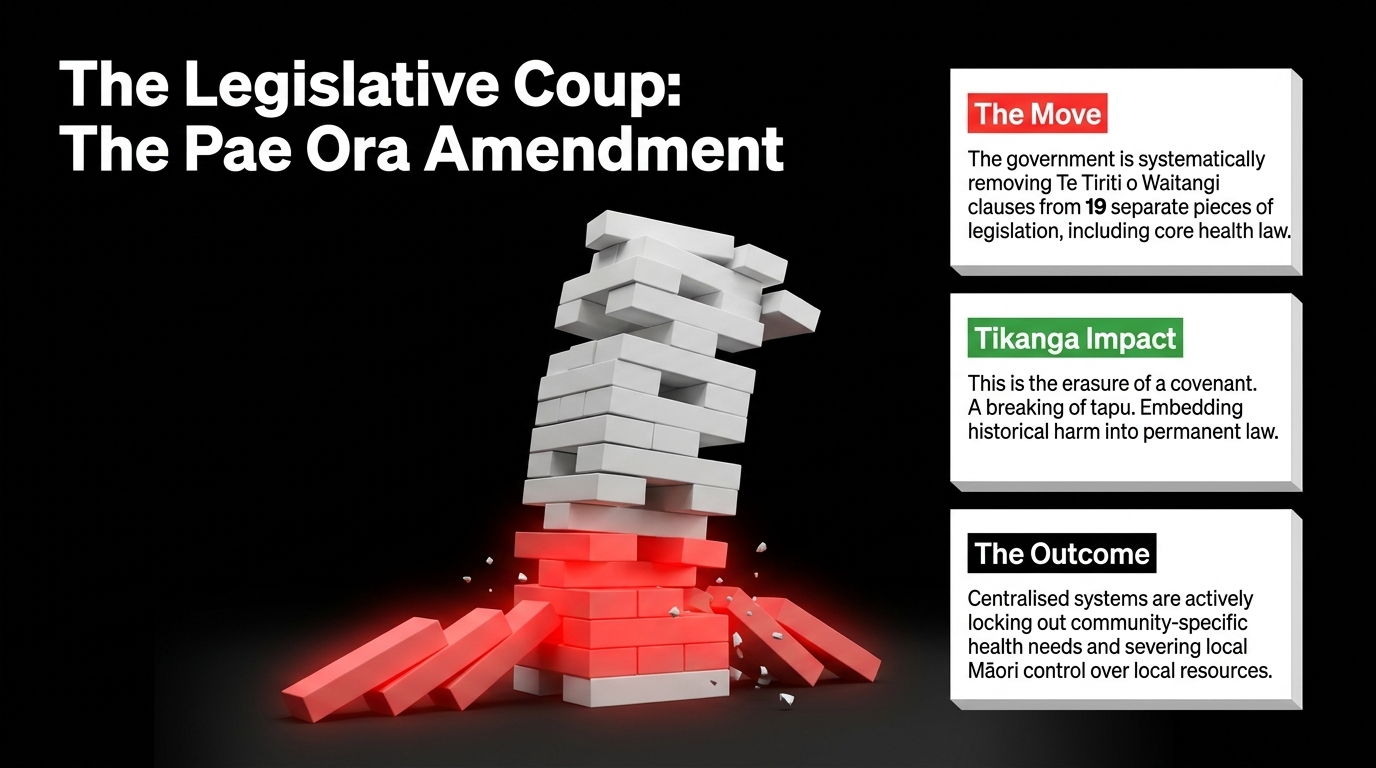
One year after Te Aka Whai Ora was destroyed, the government introduced the Pae Ora Amendment Bill — framed as "embedding health targets." As Te Ao News confirmed, Māori health advocates, clinicians, and iwi leaders said unanimously that the bill "fails Māori" and "risks repeating patterns that have historically contributed to poorer health outcomes." As Waatea News documented, those patterns include "reduced responsiveness to whānau needs, less culturally grounded services, and limited local control over how health resources are deployed."
The bill passed its second reading anyway. Because this government has the numbers. And having the numbers, in a Westminster system designed by and for a colonial power, is all that is required to legislate harm.
Meanwhile, this coalition is systematically removing Treaty of Waitangi clauses from 19 pieces of legislation including health law, as confirmed by Te Ao News citing Dr Rawiri Jansen:
"He raru tērā mō ngā kaupapa hauora, mō ngā kaupapa mātauranga, mō ngā kaupapa katoa."
The Green Party's confirmed findings, documented at greens.org.nz, show Budget 2025 "builds on the Government's legacy of the Treaty Principles Bill, the disestablishment of Te Aka Whai Ora and the repeal of 7AA" — cutting the Māori Development fund by nearly $10 million, slashing Whakaata Māori funding, and leaving Whānau Ora with less than even the inadequate prior budget. Budget 2026 does not reverse a single one of these deletions.
Tikanga impact — for the western mind: In te ao Māori, law is not just legislation. It is the expression of the covenant — te tiriti — between peoples. When the Crown removes Treaty clauses from health law, it is not a "technical amendment." It is the erasure of a covenant. It is the Crown saying: we no longer consider ourselves bound by the promise we made. In tikanga terms, this is a breaking of tapu — a desecration of the relationship that underpins everything. You cannot have a health system built on a broken covenant and wonder why Māori die younger within it.
Harm quantified: Since Te Aka Whai Ora was disestablished, Māori providers and community organisations have lost direct decision-making pathways, as Waatea News confirmed. Centralised systems cannot respond to community-specific health needs at speed. Every week of delayed response is a whānau member who did not get the culturally grounded intervention that would have kept them well.
The solution: Restore Te Aka Whai Ora with genuine decision-making authority, independent budget lines, and direct Waitangi Tribunal accountability. Reverse the removal of Treaty clauses from all 19 pieces of affected legislation. Fund community health hubs and kaupapa Māori providers as an independent budget stream — not a subcontract from Health NZ.
Five Hidden Connections (Verified)
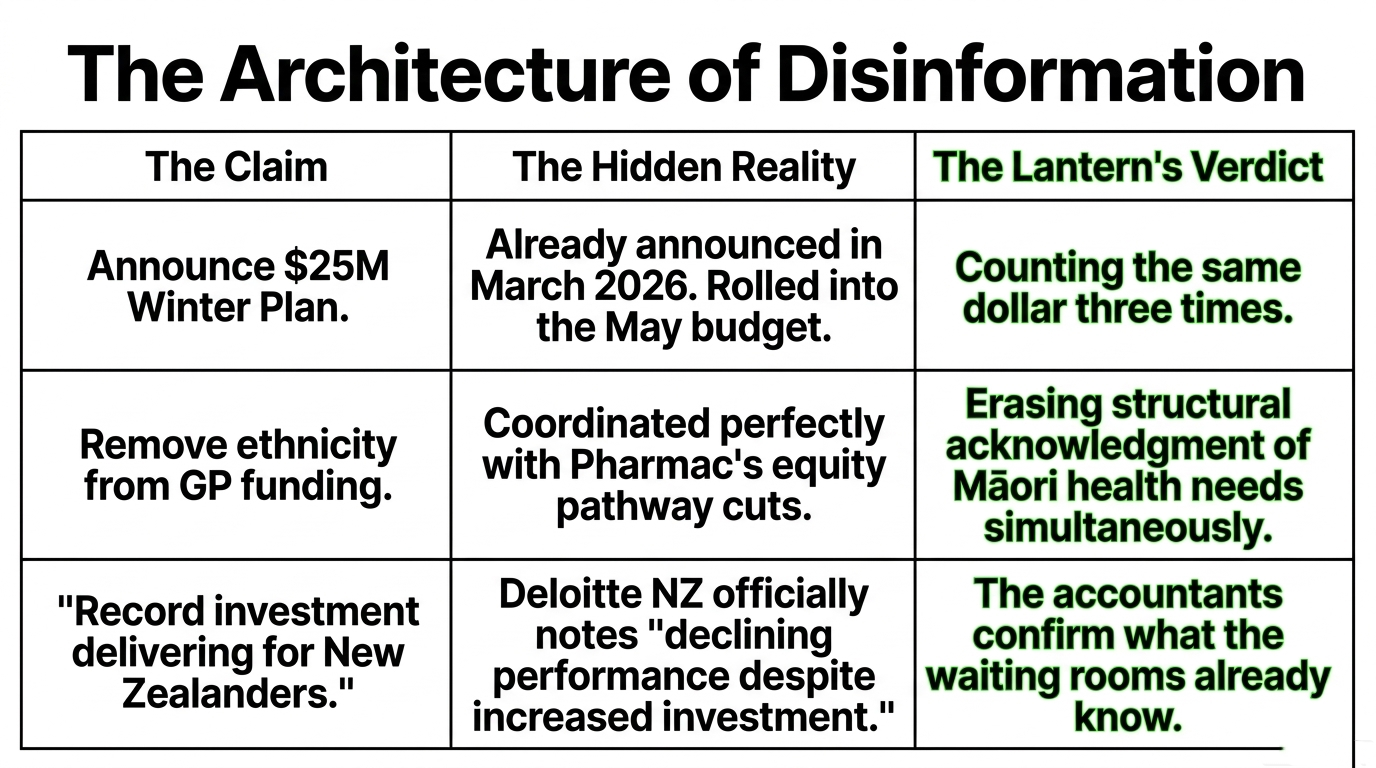
- The 140 beds announced by the Beehive in November 2025 and the "new beds" in Budget 2026's hospital announcement overlap significantly — Hawke's Bay appears in both. This is the same dollar being counted twice, a pattern I have documented since The 140-Bed Con.
- The Pharmac consultation closing on Budget Day — confirmed by Te Tiratū — is regulatory capture by calendar. When every journalist and advocate is watching the budget, no one is watching the equity pathway being removed by the back door.
- Simeon Brown's March 2026 "winter plan" — $25 million, 71 beds, 378 staff — was already announced and celebrated as a breakthrough, as I documented in The Government That Burned Our Healing House Is Now Selling You a Box of Band-Aids. Budget 2026 absorbs these commitments into the larger headline figure. The same dollar is now being counted three times.
- The removal of ethnicity from GP funding formulas, confirmed by Te Ao News, runs in exact parallel with the Pharmac equity erasure. This is not a coincidence. It is a coordinated programme to remove every structural acknowledgement of Māori health need from every corner of the funding architecture simultaneously — so that by the time whānau notice, it is too late to challenge any single decision.
- The Health Reform Collective's finding that Hauora Māori's funding share fell from 3% to 2% in Budget 2025 provides the template. Budget 2026 will reveal the same pattern on closer analysis — gross health figures rising while the Māori-specific components that would make those figures meaningful are stripped, cut, or simply absent.
Ko te Tūāhuatanga — The Moral Verdict
I have been writing about this government's war on Māori health since 2024. I have named the names, traced the networks, quantified the harm.
And I will say it again, plainly, for the record: this is a white supremacist neoliberal government. The evidence is not a matter of opinion — it is documented, sourced, and cumulative.
The $34.2 billion headline, as announced at the Beehive, is the sleight of hand. The Pharmac equity erasure is the crime. The Pae Ora Amendment Bill is the legislation that makes the crime permanent. The removal of Treaty clauses from 19 laws is the coup. And Budget 2026, as the PSA confirmed, is simply "more cuts — the wrong remedy for a struggling economy."
As Deloitte NZ observed — and Deloitte are not radicals — "New Zealand's post-COVID healthcare system could be seen as experiencing declining performance, despite increased investment." Declining performance. Despite record investment. That is the verdict of the accountants. Imagine what it looks like from the waiting room.
The taiaha is in the research. The evidence is the weapon. And I am not done.
Koha — Fund the Truth They Cannot Buy

Every time Simeon Brown removes an equity pathway from the Pharmac schedule, he is betting you will not notice. Every time Nicola Willis announces a "record" budget while the Māori Development fund shrinks, she is betting you will not connect the dots. Every time they remove a Treaty clause from legislation, they are betting there is no one watching.
I am watching. And this work — the research, the verification, the essays, the network tracing — costs time, energy, and resource that the Crown will never fund.
Every koha you give signals that rangatiratanga includes the power to fund our own truth-tellers. It says: we will not wait for the Beehive to tell us what happened to our health system. We will find out ourselves, and we will name it, and we will not be silent.
If you are able, koha here — because this essay, and every essay like it, is the accountability that the Crown and corporate structures refuse to provide.
If you cannot koha — no worries. Subscribe at themaorigreenlantern.maori.nz, follow on Facebook, kōrero with your whānau, share this with everyone who needs to read it. That is koha. That is rangatiratanga in action.
For direct bank transfer: HTDM, 03-1546-0415173-000.
Kia kaha, whānau. Stay vigilant. Stay connected. They are counting on your silence. Do not give it to them.
Views expressed constitute honest opinion on matters of public interest under the Defamation Act 1992 (NZ) and Durie v Gardiner NZCA 278. All factual claims are sourced and cited. Errors or queries: contact via themaorigreenlantern.maori.nz. Named individuals — Simeon Brown, David Seymour, Nicola Willis, Christopher Luxon — are referenced solely in their public capacity as Ministers of the Crown.