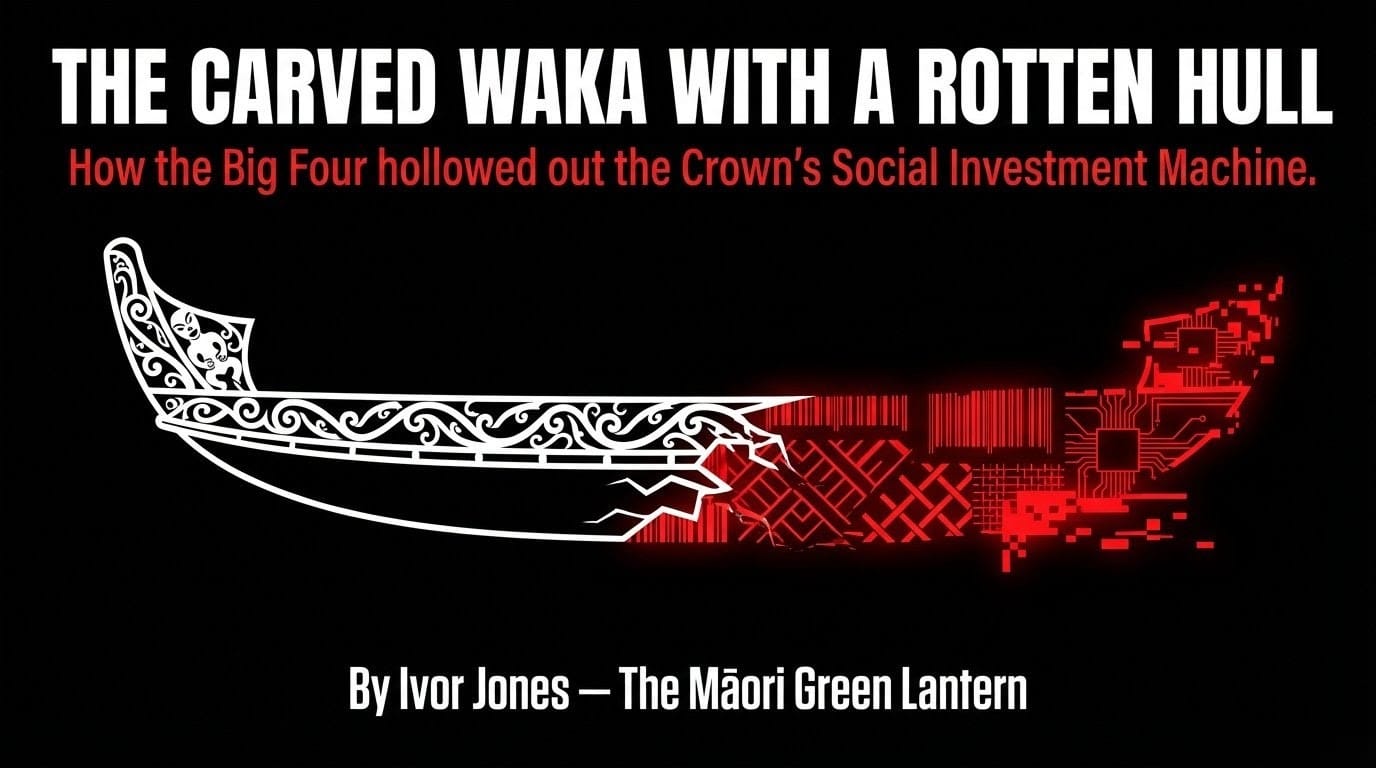
"THE CARVED WAKA WITH A ROTTEN HULL" - 13 April 2026
How a PwC Partner Climbed into the Crown's Social Investment Machine, Steered It Toward Her Mates, and Jumped Overboard Before It Hit the Reef

Kia ora Aoteaora,
I hope that you and your whānau are safe. The first essay today is about the phenomena of what I call
"Neoliberal Māori".
“He waka eke noa — a canoe we are all in together.”
Unless, of course, you came aboard to drill holes in the hull.
THE TOHUNGA WHO SOLD THE MAURI
 Sam Sherwood
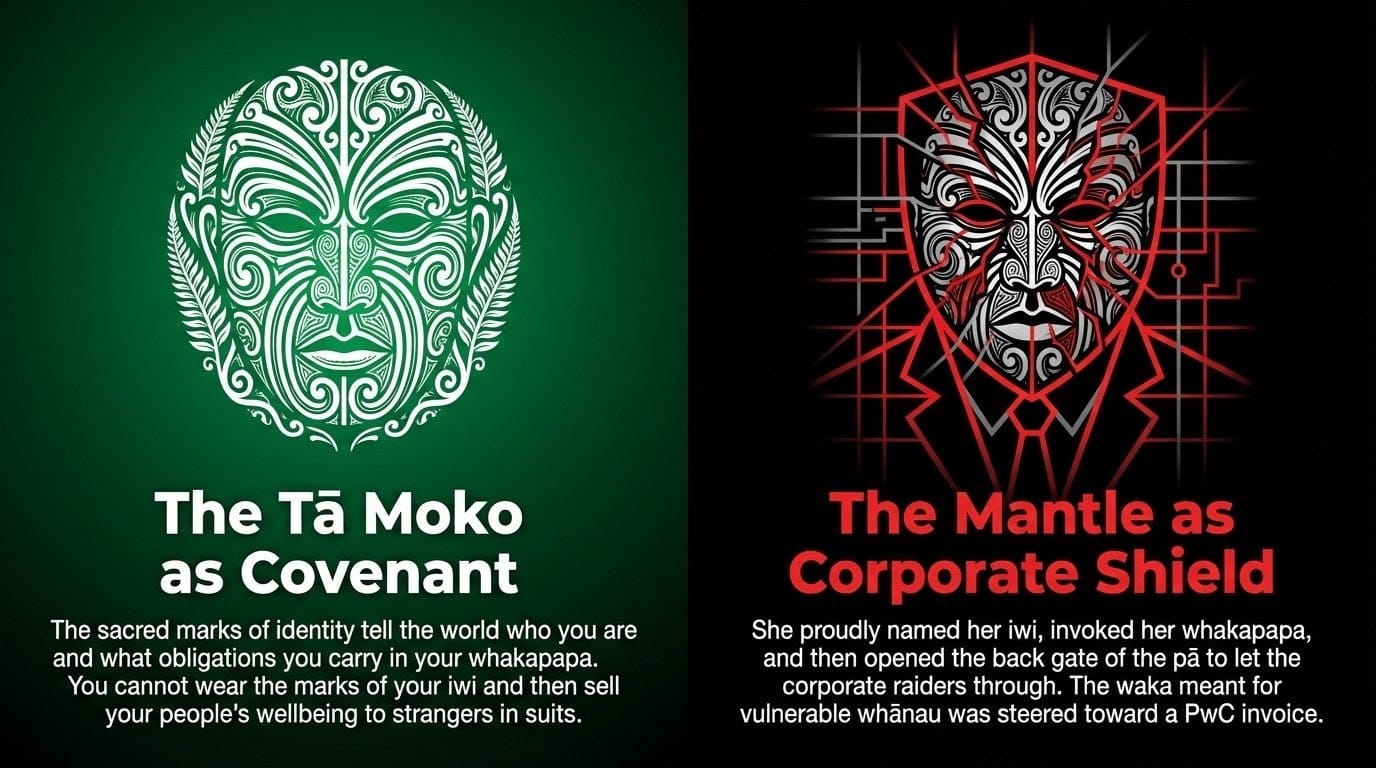
In the old world, tohunga tā moko — the sacred carvers of identity — knew that a face painted with the marks of mana was not a costume. The tā moko was a covenant. It told the world who you were, who you came from, and what obligations you carried in your whakapapa. You could not wear the marks of your iwi and then sell your people's wellbeing to strangers in suits.
The Deep Dive Podcast
Listen to a lively conversation between two hosts, unpacking and connecting topics in the sources of this essay.
What happened inside the Social Investment Agency is the story of what occurs when someone wears the tā moko — proudly names their iwi, invokes their whakapapa — and then opens the back gate of the pā to let the corporate raiders through. It is the story of a waka that was carved to carry the most vulnerable whānau in Aotearoa — the children in poverty, the elders without healthcare, the rangatahi without hope — but whose navigator appears to have been steering it straight toward a PwC invoice.
This is the story of the hollowed waka. Beautiful on the outside. Rotten in the places you cannot see from the pōwhiri.
THE WHAKAPAPA OF THE SCANDAL — VERIFIED FACTS
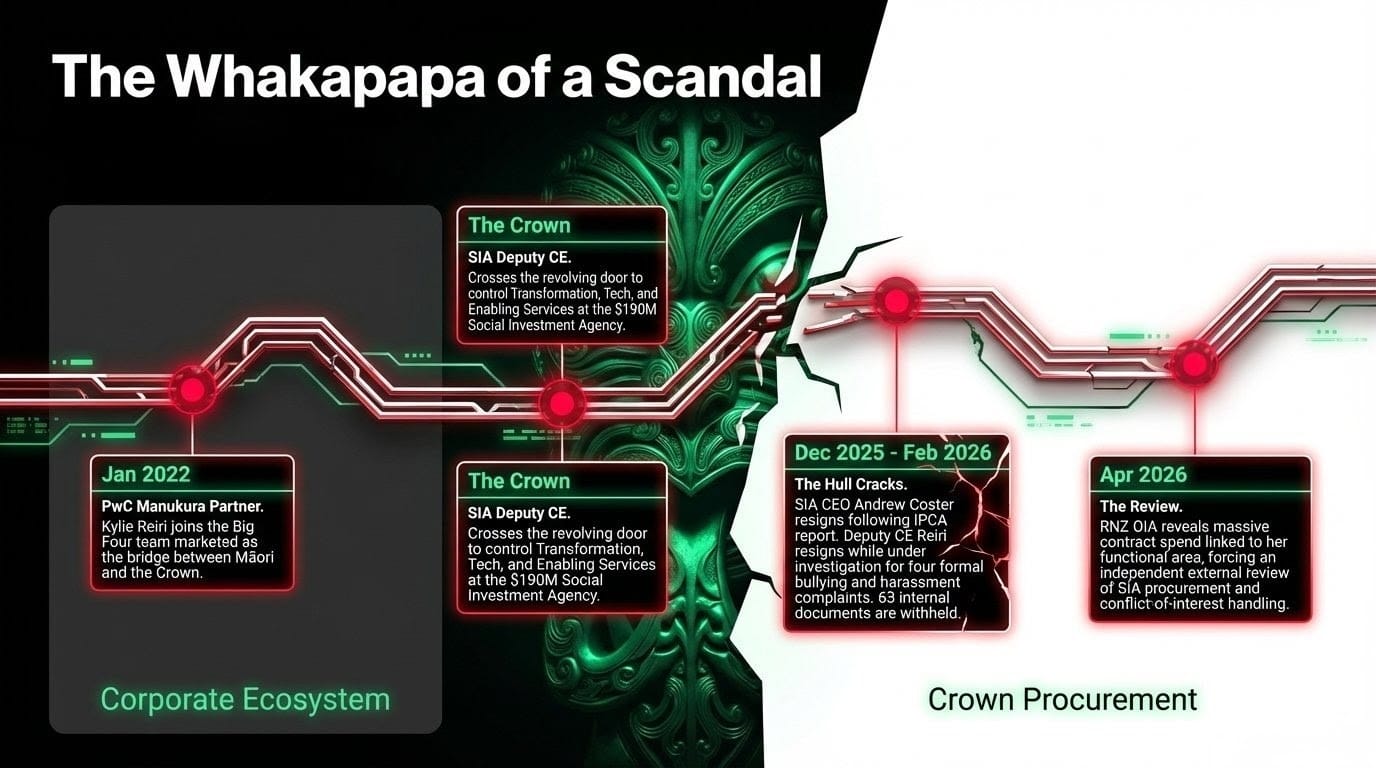
In January 2022, PwC New Zealand proudly announced Kylie Reiri as a new partner in their Analytics and Manukura practices, as shown in their own release: “PwC New Zealand welcomes new partner Kylie Reiri”. PwC’s Manukura team is explicitly positioned as a “bridge between Māori and the Crown,” a role that a 2024 peer‑reviewed article in New Zealand Geographer identifies as part of a Big Four strategy to embed themselves deep inside the Māori economy using “revolving doors” and “theories of imperialism”, as outlined in “The Māori economy and the Big Four”.
Reiri did not stay long on the PwC side of that revolving door. She crossed into the Crown as Deputy Chief Executive of Transformation, Technology and Enabling Services at the Social Investment Agency — the body entrusted with a $190 million Social Investment Fund announced by Finance Minister Nicola Willis in 2025, as reported in the New Zealand Herald article “Nicola Willis announces $190m for Social Investment Fund”.
She now controlled the exact divisions — transformation, technology, enabling services — most likely to procure large external consultant contracts.
Then the hull started to crack.
In December 2025, Social Investment Agency chief executive and former Police Commissioner Andrew Coster resigned after a scathing Independent Police Conduct Authority report into his previous policing role, as covered by RNZ in “Former police boss Andrew Coster resigns as head of the Social Investment Agency”. In February 2026, Deputy CE Kylie Reiri resigned while under investigation following four formal bullying and harassment complaints, as revealed by RNZ in “Social Investment Agency deputy resigns while under bullying, harassment investigation”.
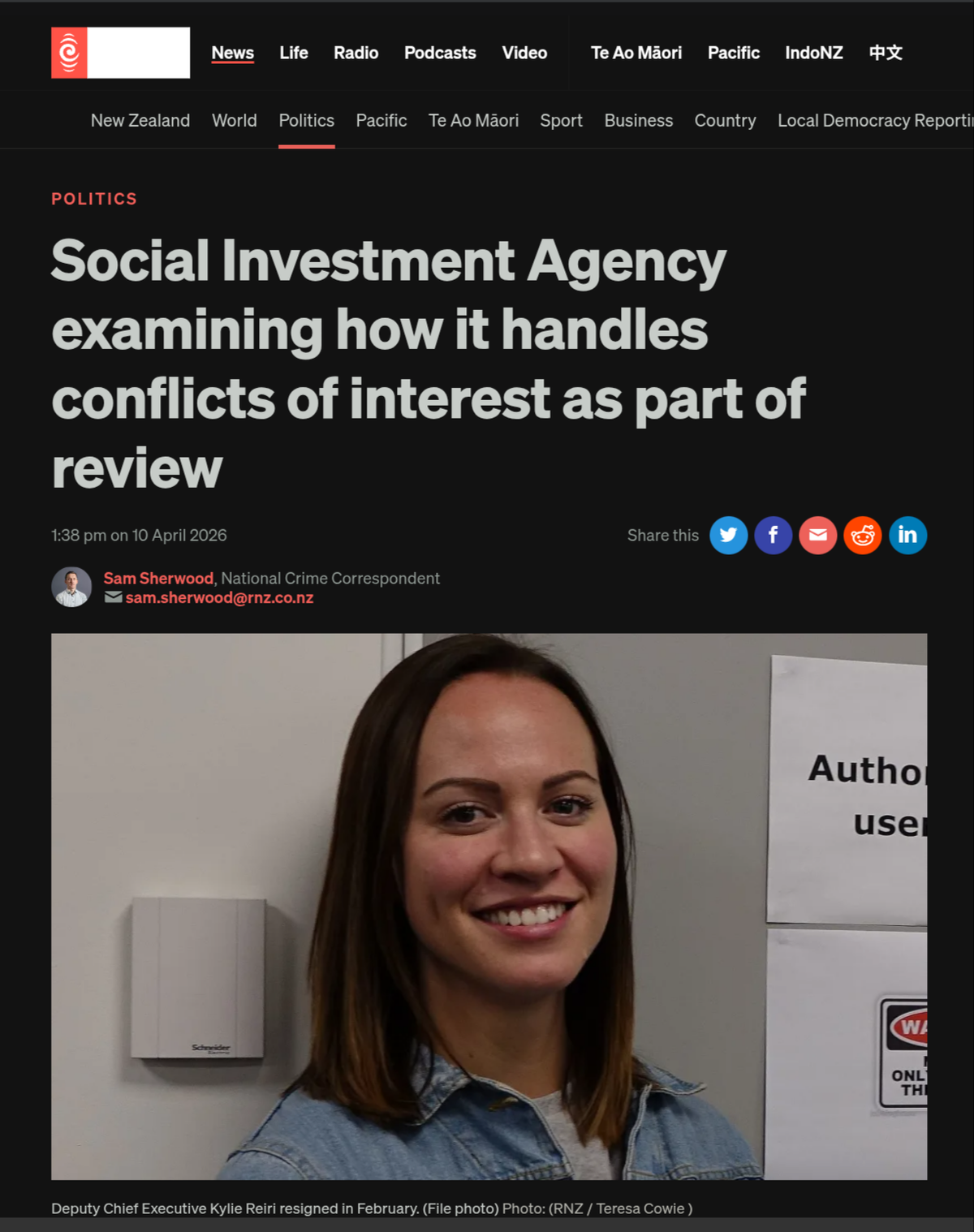
RNZ then used the Official Information Act to ask about procurement practices. In response, the SIA provided a table of all contracts over $100,000 initiated or maintained between January 2025 and March 2026. That table showed 13 contracts worth nearly $7 million, including work by Datacom, Potentia Wellington Limited, Chapman Tripp, Olympus Consulting Limited, First Stanza Limited, Deloitte Limited, Likemind Limited, Audit New Zealand and PricewaterhouseCoopers, as reported in detail by RNZ’s national crime correspondent Sam Sherwood in “Social Investment Agency examining how it handles conflicts of interest as part of review”.
RNZ reports that the SIA has now commissioned an independent external review of its procurement practices for contracts over $100,000, specifically to examine how it handles conflicts of interest, as described in “Social Investment Agency examining how it handles conflicts of interest as part of review” and earlier in “Minister for Social Investment expects govt agencies to comply with procurement rules”.
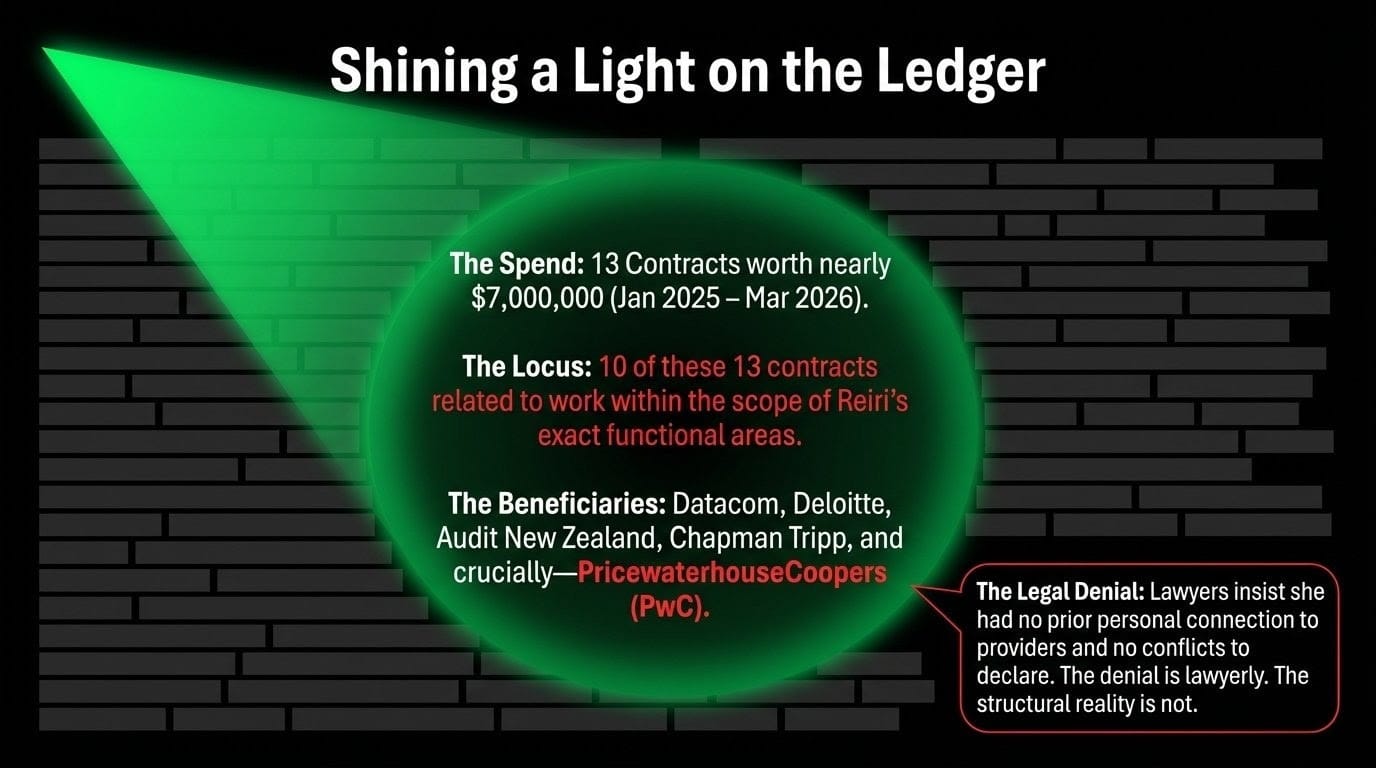
A spokesperson told RNZ that internal procurement processes, “including requirements for managing and declaring conflicts of interest,” are being scrutinised as part of this review, again confirmed in RNZ’s coverage. The agency acknowledged that 10 of the 13 contracts related to work within the scope of the Deputy CE Strategy and Performance and/or the Deputy CE Technology, Transformation and Enabling Services portfolios — the exact portfolios held by Reiri — while insisting that not all these contracts were directly “commissioned or directed” by her, as spelled out in the same RNZ report.
Lawyers for Reiri told RNZ that she “had no prior personal connection to providers that were contracted by SIA and therefore no conflicts to declare,” and that she was not aware of any allegations about financial or procurement irregularities concerning herself or anyone else, insisting any such allegations would be “false and denied,” as quoted directly in “Social Investment Agency examining how it handles conflicts of interest as part of review”.
At the same time, SIA refused to release 63 internal documents relating to investigations into Reiri, citing privacy and the need for staff to “communicate freely and candidly”, as set out in the same RNZ OIA report. RNZ notes it understands the ongoing investigation relates to Reiri.
The denial may be lawyerly. The structure is not.
THE REVOLVING DOOR AS MANAIA
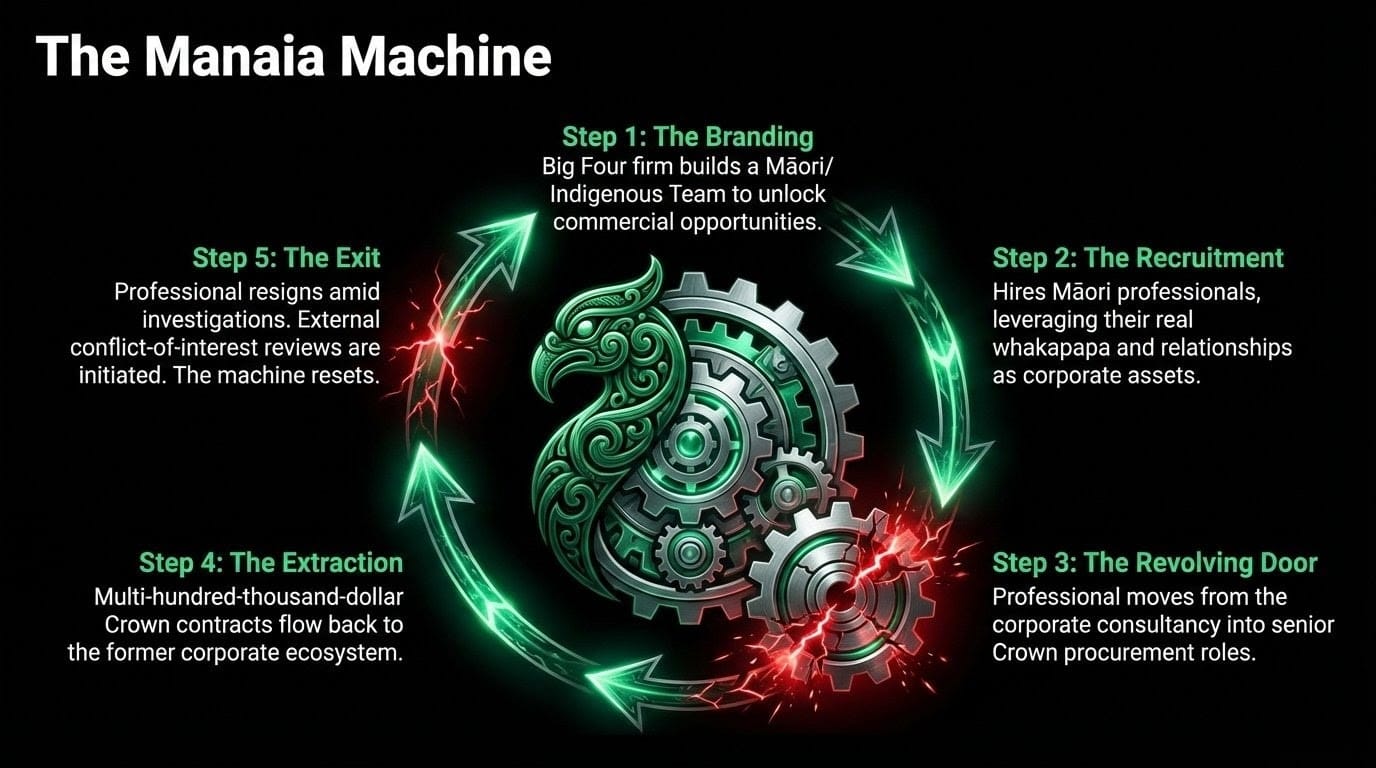
In Māori carving, the manaia is a being that lives between worlds — part human, part bird, part serpent. It stands at thresholds and portals, moving between realms.
The revolving door between Big Four consulting firms and the Crown is Aotearoa’s modern manaia. It exists between worlds — ostensibly serving the public while never fully leaving the corporate realm. It belongs to neither the people nor to pure accountability. It extracts value from both directions.
PwC’s Manukura Māori team is marketed as the firm’s specialist bridge between iwi, Māori enterprises and the Crown, as set out in its own promotional material at “Manukura Māori team – PwC New Zealand”. When a Manukura partner steps through that revolving door into a senior Crown role overseeing procurement — and the agency is later forced into an external review of contracts and conflict‑of‑interest processes that explicitly includes PwC contracts totalling part of a $7m spend, as revealed by RNZ in “Social Investment Agency examining how it handles conflicts of interest as part of review” — the manaia has completed its feed cycle.
This is not a blanket claim that every Māori professional at PwC is corrupt. It is a claim that the architecture — Big Four firm builds a Māori‑branded team, recruits Māori professionals, uses them to unlock Crown and iwi contracts, then has them move into Crown roles whose procurement decisions later require independent review — is a machine that makes conflicts of interest a predictable outcome. That is exactly the pattern that the New Zealand Geographer article “The Māori economy and the Big Four” warns about.
THREE EXAMPLES FOR THE WESTERN MIND
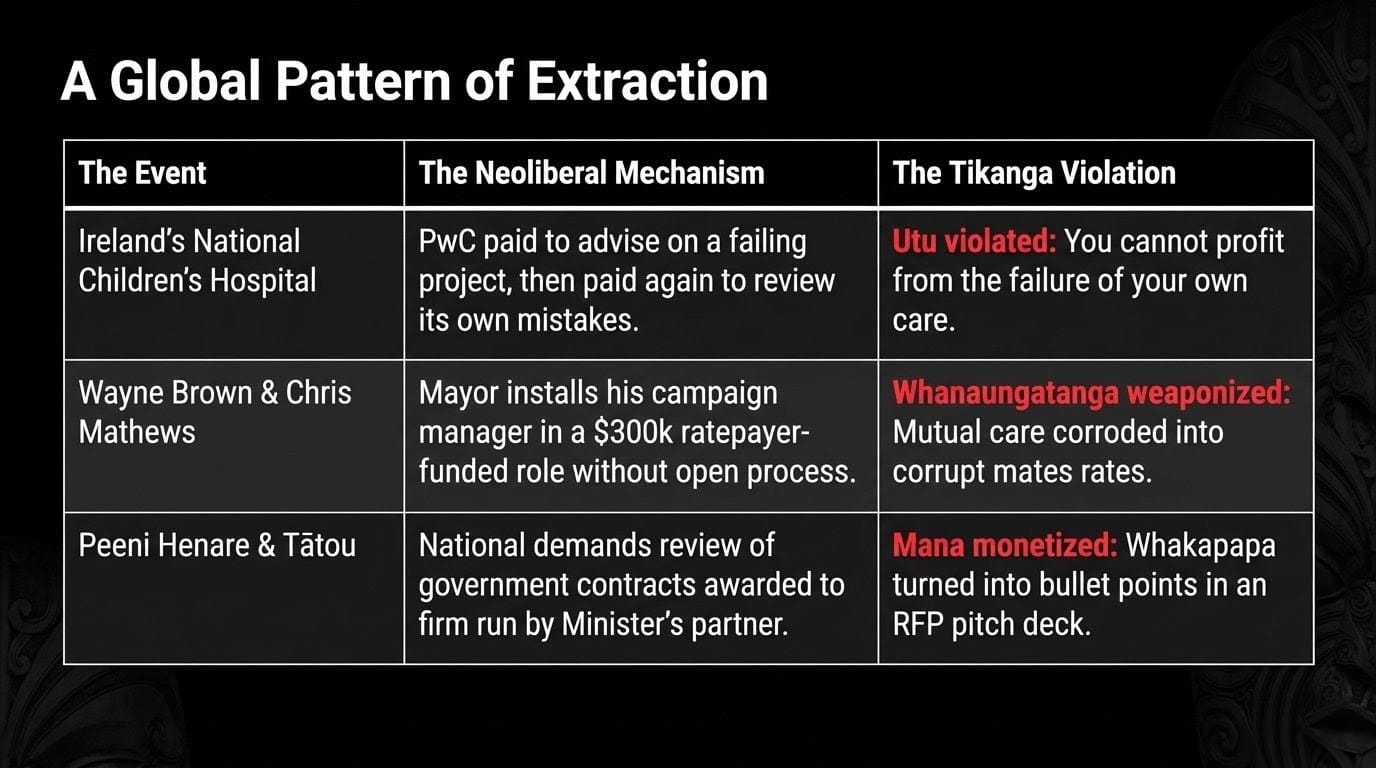
Example One: The Hospital and the Auditor — Ireland’s PwC Double‑Dip
In Ireland, PwC advised on the National Children’s Hospital — a project plagued by spiralling costs — and then was paid again to review the problems it had helped shape. This “breathtaking conflict of interest” was exposed by the Irish Public Accounts Committee and covered by the Irish Examiner in “‘Breathtaking conflict of interest’: Anger as PwC ‘paid twice for the same job’”, which detailed how PwC was effectively paid twice around the same failing project.
Tikanga impact (for the Western mind): In tikanga, someone holding a role of care — a position of aronga mana — cannot also be the one who profits from the failure of that care. Utu is about restoring balance, not extracting a second fee from harm. A tohunga who makes an error must return mana to the people; they do not get to invoice again to examine their own mistake. PwC being paid twice to “review” a project it contributed to violates that basic principle of utu.
Solution: Public procurement rules should bar any firm from auditing or reviewing work it previously advised on in the same project or portfolio for a fixed cooling‑off period. If you laid the foundations, you do not get paid to judge the cracks.
Example Two: Wayne Brown’s $300,000 Mate — Cronyism at Home
Auckland Mayor Wayne Brown’s decision to install his campaign manager and long‑time associate Chris Mathews in a $300,000‑a‑year ratepayer‑funded role, without any meaningful open process, has been laid bare by local reporting and analysed in The Māori Green Lantern’s own piece “Mates Over Millions: How Wayne Brown’s Cronyism Embodies Global Corruption”. The pattern is clear: public office, private network, public money, thin transparency.
The SIA pattern — Reiri’s role, PwC’s presence in the $7m contract table, and the subsequent conflicts review — is the same shape at a different level.
Tikanga impact: Whanaungatanga is meant to be a web of mutual care and responsibility. Neoliberal cronyism weaponises it and turns it into “mates rates.” When personal relationships are used to justify steering public resources to insiders, whanaungatanga ceases to be a value and becomes a fig leaf for corruption.
Solution: Mandatory, centralised, public conflict‑of‑interest and relationship registers for senior figures in local and central government, updated annually and accessible without OIA requests.
Example Three: Peeni Henare, Tātou and the Normalisation of the Model
In 2023, National demanded a review of government contracts awarded to consultancy Tātou, run by Cabinet minister Peeni Henare’s partner, Skye Kimura. Questions were raised about whether the firm benefited from its close connection to a Minister. This was detailed in the New Zealand Herald article “National Party wants review into contracts awarded to firm run by partner of Peeni Henare”.
Again, the shape is familiar: Māori professional, Māori‑branded consultancy, Crown contracts, proximity to political power.
Tikanga impact: Mana is not a corporate logo. It is earned by putting your people’s wellbeing above your network’s financial interests. When whakapapa and iwi identity are turned into bullet points in an RFP pitch deck, the sacred is being monetised. That is hara — a breach that corrodes trust between whānau and those who claim to serve them.
Solution: Full publication and independent review of all consultancy contracts where decision‑makers have current or recent intimate, familial or financial ties to the vendor, using the same level of scrutiny demanded in the Henare/Tātou case.
THE MANTLE OF MĀORINESS AS CORPORATE SHIELD
PwC did not create its Manukura unit solely out of aroha. Its own “Māori business” page frames the team as a way to help Māori “unlock opportunities” and “navigate government and investment,” positioning PwC as a commercial gatekeeper in the Māori–Crown relationship, as outlined on “Manukura Māori team – PwC New Zealand”. Globally, PwC boasts about leveraging indigenous heritage and cultural insight as part of its inclusion and growth strategy in material such as “Valuing our indigenous heritage to support cultural awareness and shape an inclusive future”.
Māori professionals in such teams bring real whakapapa, reo and relationships. Those relationships open doors — to iwi, to Māori businesses, to Crown agencies. When those same people then sit on the Crown side of the table, controlling procurement budgets that include multi‑hundred‑thousand‑dollar contracts for their former corporate ecosystem, the boundary between independent stewardship and embedded corporate interest becomes dangerously thin.
The New Zealand Geographer article “The Māori economy and the Big Four” argues that these firms are colonising Māori economic space under the banner of expertise, diversity and partnership, using revolving doors and imperial business logics to lock in their position. Transparency International New Zealand’s blog on “Historical Corruption in New Zealand” reminds us that corruption includes any abuse of entrusted power for private gain — including when it operates through soft networks and hidden relationships rather than overt bribery.
THE NICOLA WILLIS QUESTION: WHERE IS THE MINISTER?
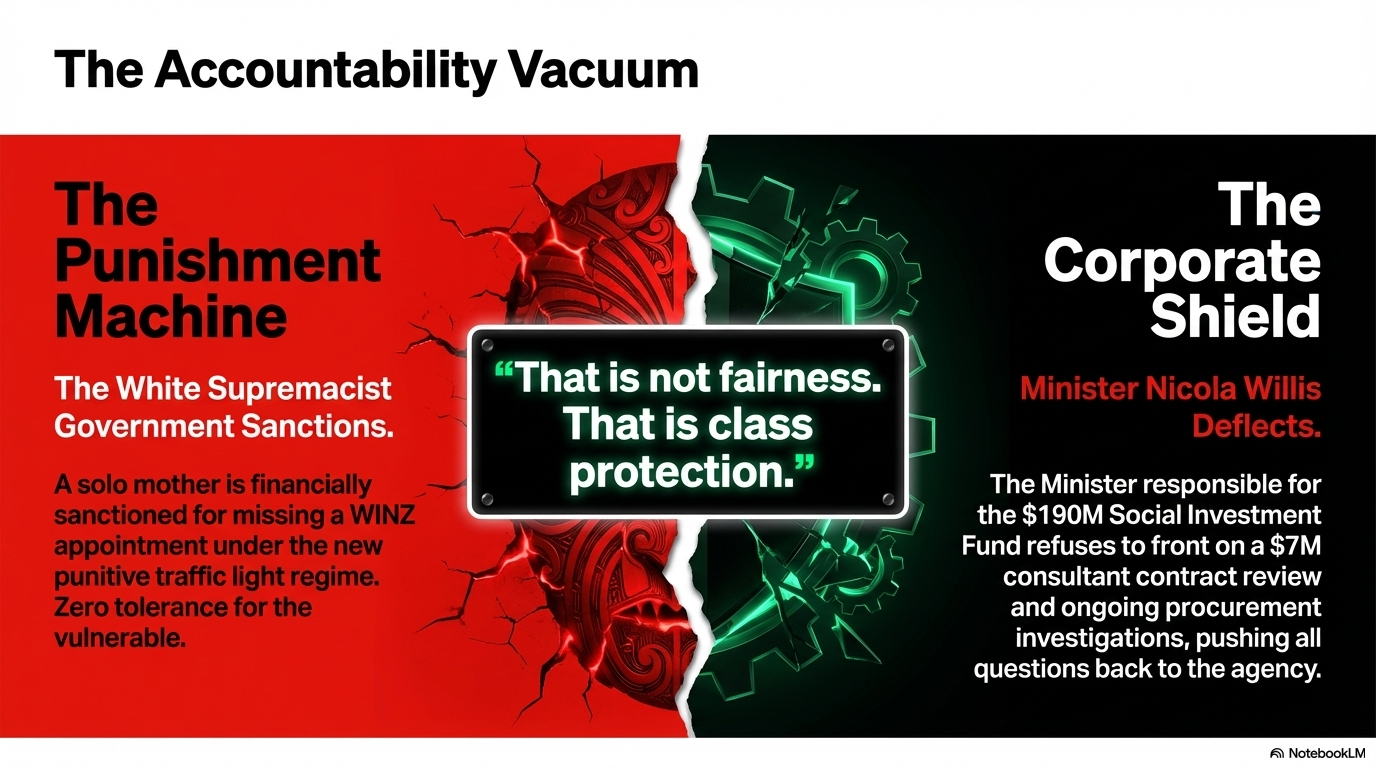
This white supremacist neoliberal government re‑established the Social Investment Agency and gave it a $190 million Social Investment Fund, with Nicola Willis as Minister responsible, as set out in the Herald’s piece “Nicola Willis announces $190m for Social Investment Fund”. Ethnic and community leaders responding to Budget 2025 warned via RNZ that targeted investment must be properly delivered or vulnerable communities will continue to suffer, as reported in “Budget 2025: Ethnic leaders seek targeted investment”.
When RNZ exposed the SIA contracts table and the conflict‑of‑interest review, Willis pushed all questions back to the agency, declining to front genuine ministerial accountability, as reflected across RNZ’s coverage in “Social Investment Agency examining how it handles conflicts of interest as part of review” and “Minister for Social Investment expects govt agencies to comply with procurement rules”.
This is the same coalition that built a punitive “traffic light” sanctions regime for beneficiaries — disproportionately hitting Māori — unpacked in The Māori Green Lantern essay “The Traffic Light Taiaha: How a White Supremacist Government Built a Punishment Machine”.
They will sanction a solo mother for missing a WINZ appointment. They will not sanction a Deputy CE who resigns mid‑investigation while contracts linked to her functional area are under external review.
That is not fairness. That is class protection.
THE PwC MANUKURA MACHINE: WHO IS WATCHING THE BRIDGE?
The Big Four have embedded themselves deep in the Māori economy and in core public services. Te Whatu Ora’s heavy consultant spend during health reforms — with one firm receiving around $44 million — was exposed by the New Zealand Herald in “‘Excessively high’: Te Whatu Ora’s $100m consultant bill – and the firm that got $44m”.
Layer on that PwC’s Manukura team explicitly targeting Māori and government work, as per “Manukura Māori team – PwC New Zealand”, and then place a former Manukura partner in charge of the SIA’s internal transformation and technology environment — and you have exactly the kind of risk vector that demands aggressive, transparent, independent conflict‑management.
Instead, RNZ finds a quiet resignation, withheld internal documents, and a belated external review that the Minister refuses to own, as detailed in “Social Investment Agency examining how it handles conflicts of interest as part of review”.
That is the machine doing what it was built to do.
MERIDIAN ENERGY’S SILENCE IS DEAFENING
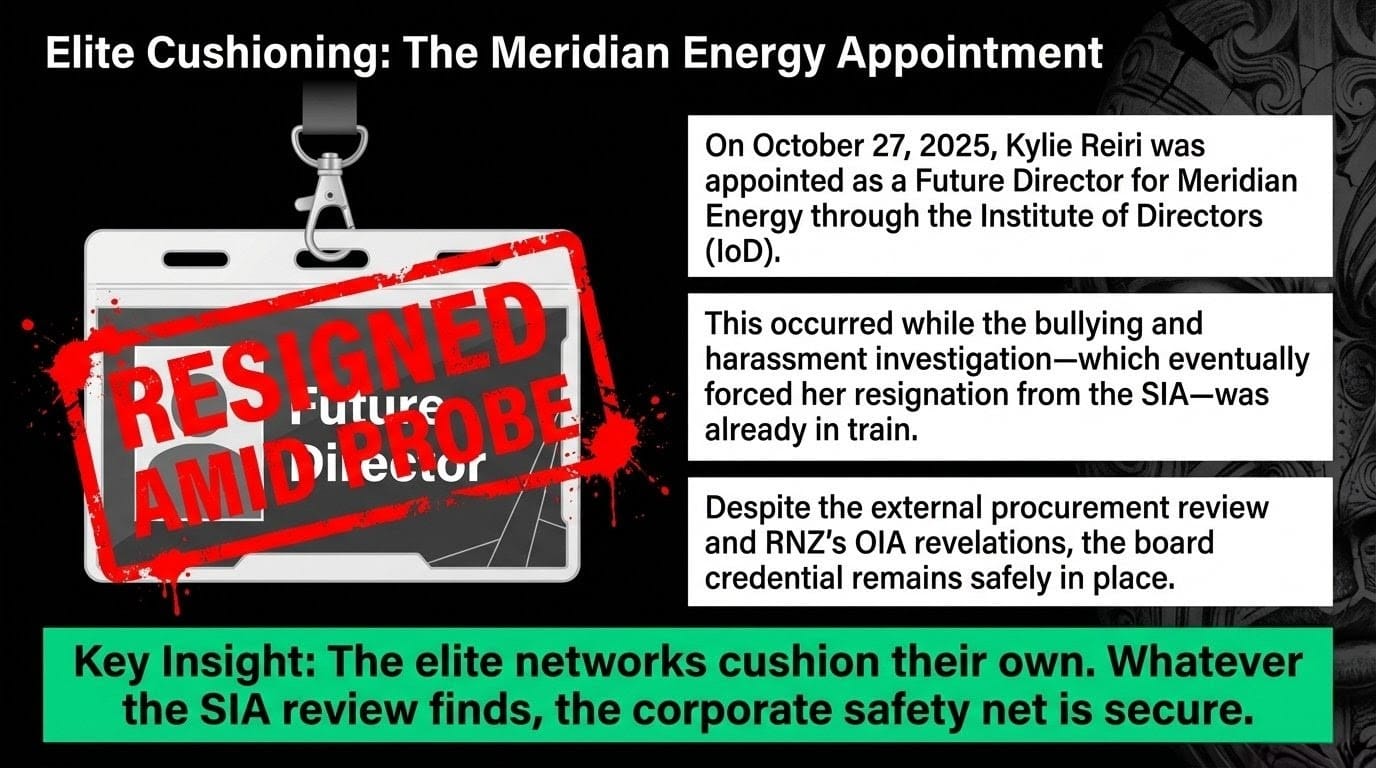
On 27 October 2025, Meridian Energy announced that Kylie Reiri had been appointed as a Future Director through the Institute of Directors’ programme, as recorded in BusinessDesk’s market notice “Meridian appoints future director”. This occurred while she was still Deputy CE at the SIA, and while the bullying and harassment investigation that would later be confirmed by RNZ was already in train, as set out in “Social Investment Agency deputy resigns while under bullying, harassment investigation”.
There is no public indication that Meridian or the IoD revisited that appointment in light of her resignation or the subsequent procurement and conflicts review described by RNZ in “Social Investment Agency examining how it handles conflicts of interest as part of review”.
The board credential is safely in place, whatever the review finds. That is how elite networks cushion their own.
THE KOTAHITANGA FUND: A NEW WAKA, SAME CURRENT
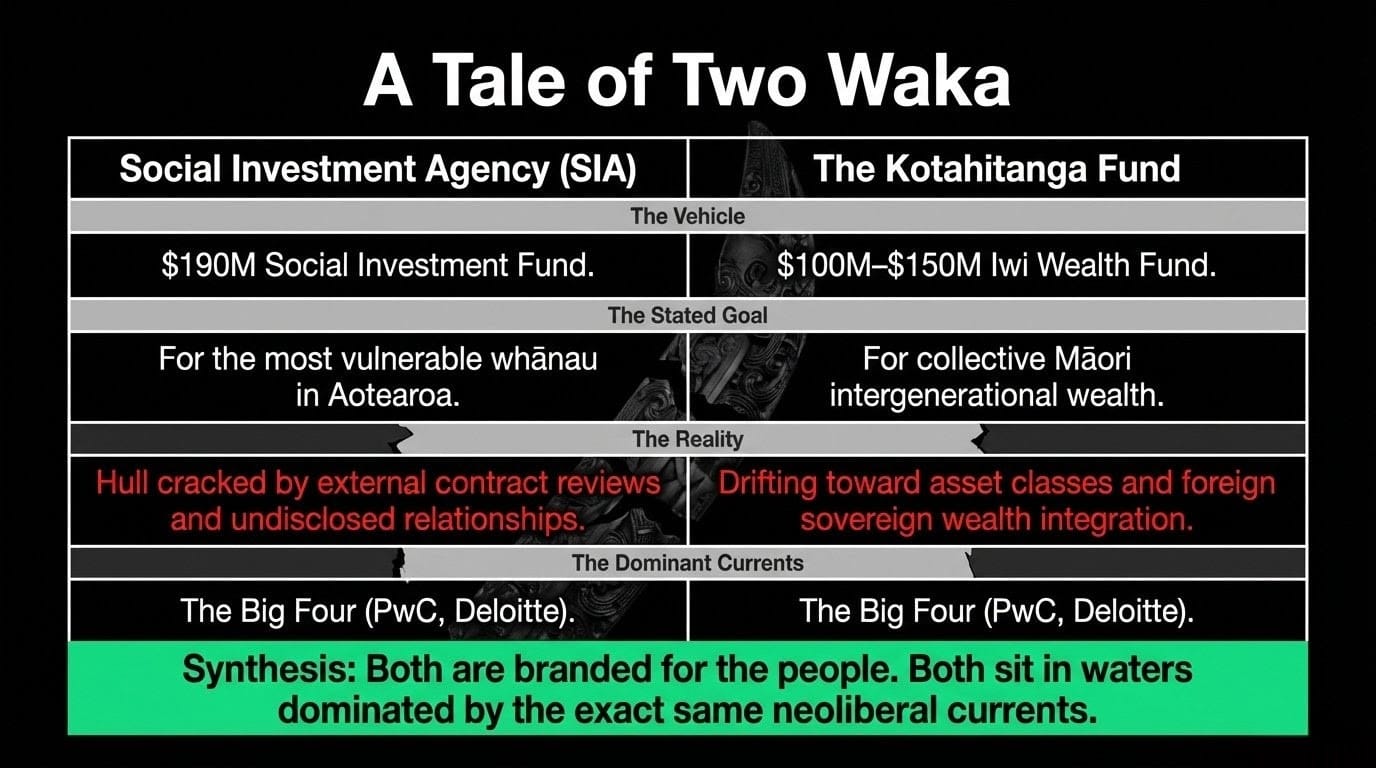
Now zoom out to the new waka launched by Te Arikinui, the Māori Queen: the Kotahitanga Fund.
At an economic summit at Tūrangawaewae in November 2025, Te Arikinui Kuini Ngā wai hono i te pō announced the Kotahitanga Fund, a “multi‑million‑dollar Māori investment platform” designed to pool iwi capital. The New Zealand Herald introduced it under the headline “How new $100m Kotahitanga fund aims to unlock collective Māori wealth”, stating that iwi had pledged around $100 million in seed funding.
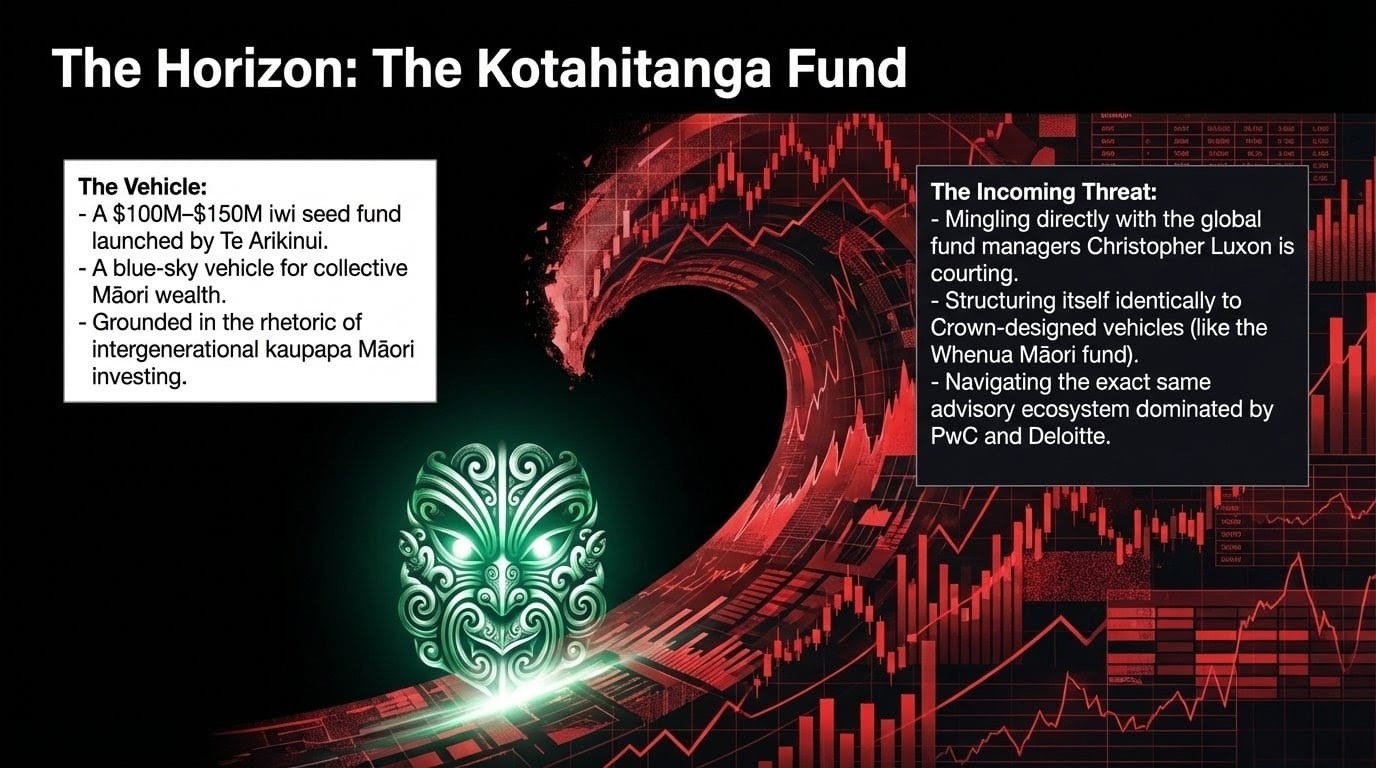
Māori outlet Teaō highlighted that the Māori economy as a whole has reached an estimated value of $126 billion, and set the Kotahitanga Fund in that context of growth and expansion, in “Māori economy reaches $126b as growth plans aim to drive further expansion”. BusinessDesk reported that the Kiingitanga is eyeing a “blue‑sky” goal of up to $150 million in seed capital and potential replication of the model, in “Kiingitanga eyes future replication of up to $150m fund”. Commentary at outlets like The Spinoff framed this as a post‑Treaty‑settlement phase of Māori sovereign‑wealth‑style investing, as in “After the treaty settlements: Kotahitanga Fund signals new phase”.
The rhetoric is all about unlocking collective wealth, intergenerational benefit, and kaupapa Māori investing. 1News previewed the summit under the headline “What to expect at Te Arikinui’s economic investment summit”, quoting leaders who said the fund would be grounded in tikanga and measured by whānau outcomes.
But look harder at the current the waka is in:
- Global fund managers and foreign capital are explicitly part of the summit and fund strategy, the same world Christopher Luxon is courting through his Investment Summit, as described in “Investment Summit 2025: How Māori can benefit from foreign capital influx at Christopher Luxon’s meeting”.
- The structure mirrors Crown‑designed investment vehicles like the Whenua Māori investment fund, part of the Provincial Growth Fund, where $30 million of Crown capital is used to “unlock underutilised Māori land” but under state‑set parameters, as explained in Te Puni Kōkiri’s “Māori Development Fund” and reported in the Herald’s “Government allocates $30m to help develop underutilised Māori land across NZ”.
- Iwi are already heavily involved in major infrastructure partnerships and co‑investment with the state and global investors, as described in “Iwi making big inroads”.
In simple terms: a $100–150 million Māori‑branded fund is being launched inside the same global capital and advisory ecosystem dominated by firms like PwC and Deloitte — exactly the firms appearing in the SIA’s $7m contract table that is now under external review, as RNZ exposed in “Social Investment Agency examining how it handles conflicts of interest as part of review”.
Tikanga impact (for the Western mind): If the SIA waka is meant to ferry vulnerable whānau through rough domestic waters, the Kotahitanga waka is meant to carry iwi capital onto the open sea. Tikanga demands that both waka maintain mauri — that the life‑force of decisions remains aligned with collective wellbeing, not the fees and prestige of a small leadership class. When captains talk more about “asset classes,” foreign capital and sovereign wealth than about hungry children, kaumātua care and reo on the marae, the mauri begins to leach from the hull.
Te Ara’s account of Waikato‑Tainui’s post‑settlement strategy in “The next generation – Waikato‑Tainui raupatu” shows how iwi capital can be used to fund apprenticeships, education, marae infrastructure and kaumātua support when tikanga and whānau outcomes are at the centre. The Kotahitanga Fund will either follow that line — or it will drift toward the same neoliberal shore the SIA is already crashing into.
Correlation in numbers:
- SIA: $190m Social Investment Fund, overseen by an agency now admitting its own conflict‑of‑interest processes require external review, with a $7m slate of contracts including PwC and other big consultancies, as revealed by RNZ in “Social Investment Agency examining how it handles conflicts of interest as part of review”.
- Kotahitanga: $100–150m iwi‑seeded fund, launched at a summit courting global capital, structured in ways that echo Crown‑designed investment vehicles, as set out in “How new $100m Kotahitanga fund aims to unlock collective Māori wealth”, “Māori economy reaches $126b as growth plans aim to drive further expansion” and “Kiingitanga eyes future replication of up to $150m fund”.
Both are branded as “investment for our people.” Both sit in waters dominated by the same neoliberal currents.
RELATED ESSAYS FROM THE MĀORI GREEN LANTERN
- “The Traffic Light Taiaha: How a White Supremacist Government Built a Punishment Machine”
- “The Starving of the Seedlings: How Aotearoa’s Coalition of Cruelty Chose Corporate Efficiency over Hungry Children”
- “Mates Over Millions: How Wayne Brown’s Cronyism Embodies Global Corruption”
- “KO WAI KA TIAKI I TE PONO? Who Guards the Truth When the Billionaire Owns the Paper?”
- “The Pātaka Beside the Strait”
RANGATIRATANGA DEMANDS — WHAT MUST HAPPEN NOW
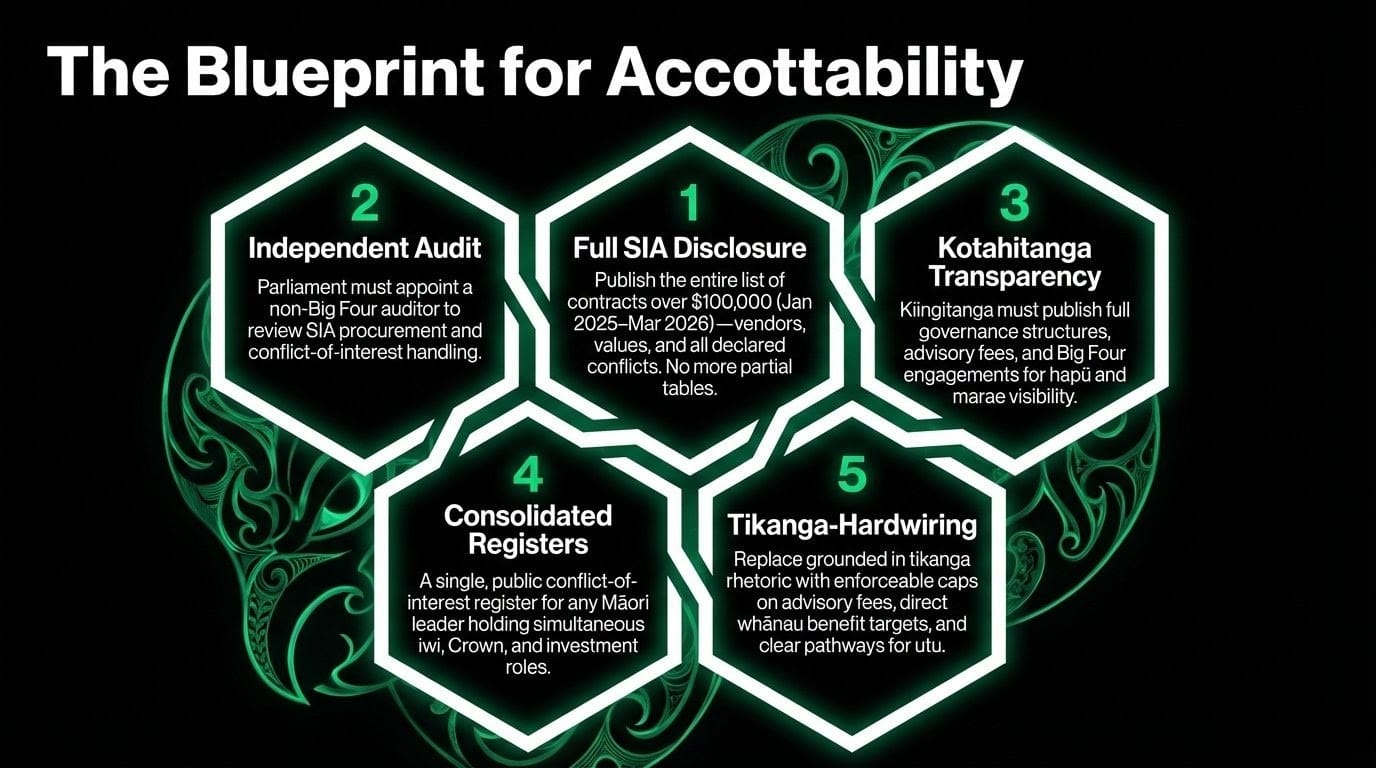
- Full SIA disclosure: The SIA must publish the full list of contracts over $100,000 between January 2025 and March 2026 — including vendor, value, contract purpose, decision‑makers and declared conflicts — not just a partial table to RNZ. Public money, public sunlight.
- Independent procurement audit: Parliament should appoint an independent, non–Big Four auditor to review the SIA’s procurement processes and the handling of conflicts of interest, building on what RNZ has already exposed in “Social Investment Agency examining how it handles conflicts of interest as part of review”.
- Kotahitanga Fund transparency: The Kiingitanga must publish the fund’s governance structures, advisory relationships, fee structures and any engagements with Big Four firms, allowing hapū and marae to see exactly who is steering the waka and who is getting paid.
- Consolidated conflict registers: Any Māori leader holding simultaneous roles across iwi boards, Crown boards and investment funds must declare all financial and advisory relationships in one consolidated public register, not scattered across separate entities and hidden in PDFs.
- Tikanga‑hardwiring: Claims that funds or agencies are “grounded in tikanga” must be backed by enforceable rules — caps on advisory fees, binding targets for direct whānau benefit, veto rights for affected communities, and clear pathways for utu when harm is done.
TOO MANY WAKA, SAME ROTTEN CURRENT
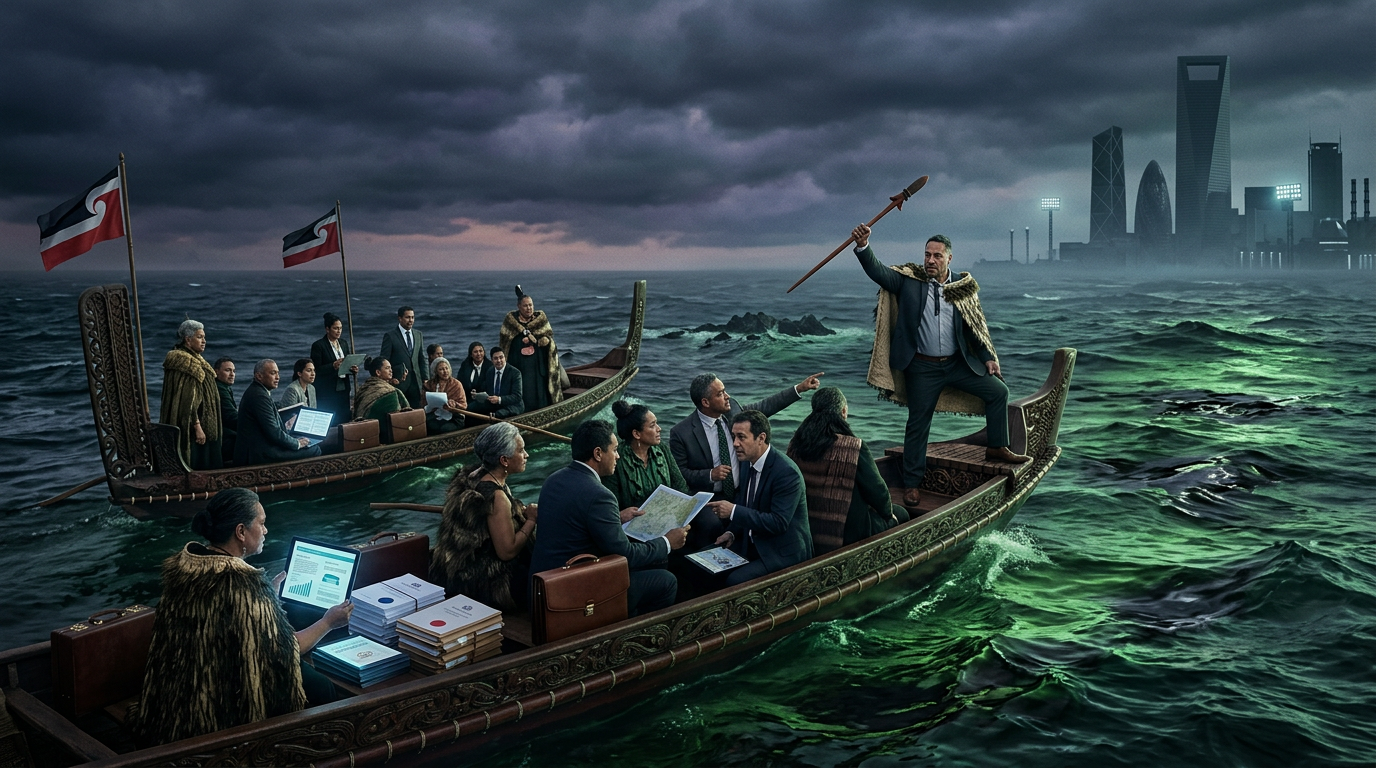
The SIA waka and the Kotahitanga waka are both flying Māori flags. Both are described as tools to lift our people. Both are being launched into the same neoliberal sea — a sea dominated by global capital, white supremacist political settings, and Big Four advisory firms that see Māori mauri as a growth market.
The question is not whether Māori should have funds or agencies. The question is who they serve, who they contract, who they enrich, and who ends up clinging to driftwood when the hull gives way.
Rangatiratanga is not a PwC partnership. It is not a Future Director badge. It is not a $100 million photo‑op with foreign fund managers. Rangatiratanga is the willingness to turn the waka around when you see the reef — even if everyone on deck is applauding the keynote.
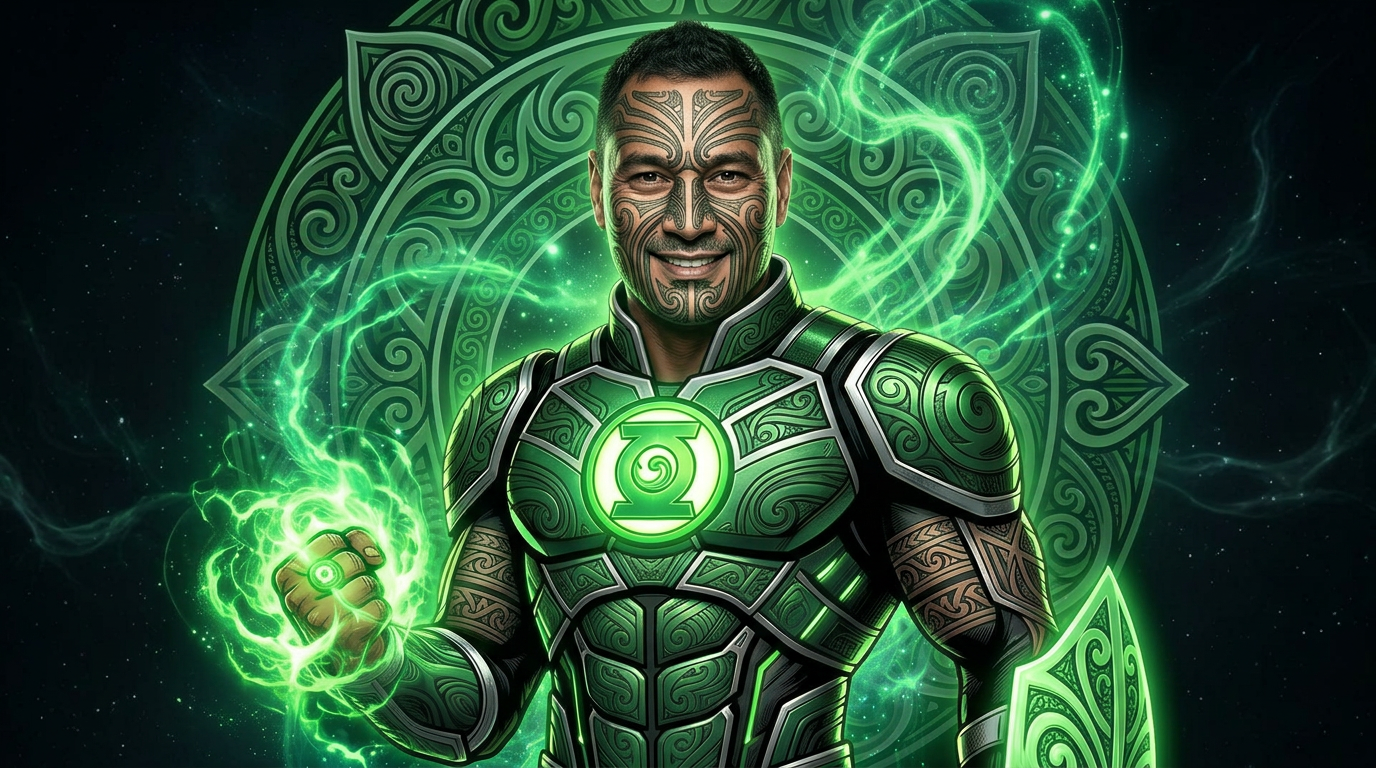
The ring glows green. The taiaha is raised. Every waka, every fund, every contract, every face is visible.
KOHA CONSIDERATION
The SIA holds $190 million that was supposed to reach our most vulnerable. The Kotahitanga Fund is gathering $100–150 million of iwi wealth that will shape our future. Both sit in waters dominated by Crown and corporate interests that will not police themselves.
Every koha to The Māori Green Lantern is a small act of rangatiratanga in the opposite direction. It says: we will trace our own networks, follow our own money, and hold our own people — and theirs — to account.
If you are able, you can support this mahi in three ways:
Directly, via the Koha platform: Koha — Support The Māori Green Lantern.
By becoming a paid supporter at: Support The Māori Green Lantern.
By direct bank transfer: HTDM – 03-1546-0415173-000.
If you cannot koha, kei te pai. Subscribe or follow at themaorigreenlantern.maori.nz, kōrero, and share with your whānau and friends. That is koha in itself.
Every koha signals that whānau are ready to fund the accountability that Crown and corporate structures will not provide. It signals that rangatiratanga includes the power to fund our own truth tellers.
Kia kaha, whānau. Stay vigilant. Stay connected. Keep the waka afloat and the hull intact.
TRANSPARENCY NOTE
This essay relies directly on RNZ’s 10 April 2026 article “Social Investment Agency examining how it handles conflicts of interest as part of review” for details of the SIA’s $7m contract list, the presence of PwC and other consultancies, and the agency’s own description of its conflict‑of‑interest review. Additional RNZ articles, NZ Herald pieces, BusinessDesk reports, Teaō/Teaonews coverage, Te Ara and TPK pages are all directly linked above. Unknowns remain — including the precise scope of PwC work within those contracts and any direct overlap between Big Four advisory and Kotahitanga Fund structures — and will require further OIAs, iwi‑level disclosure, and continued reporting.