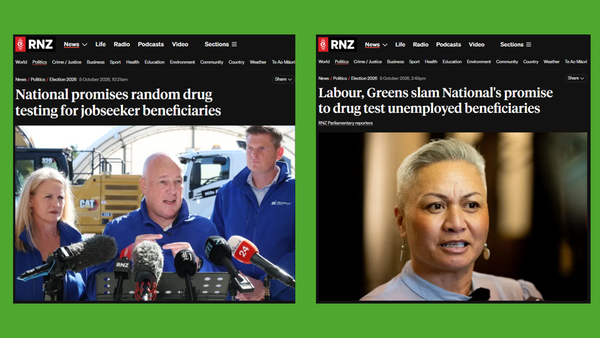
"THE CLARK DEFENCE: A DEMOLITION OF A FORMER PRIME MINISTER'S SELF-SERVING MEMORY" - 19 August 2026
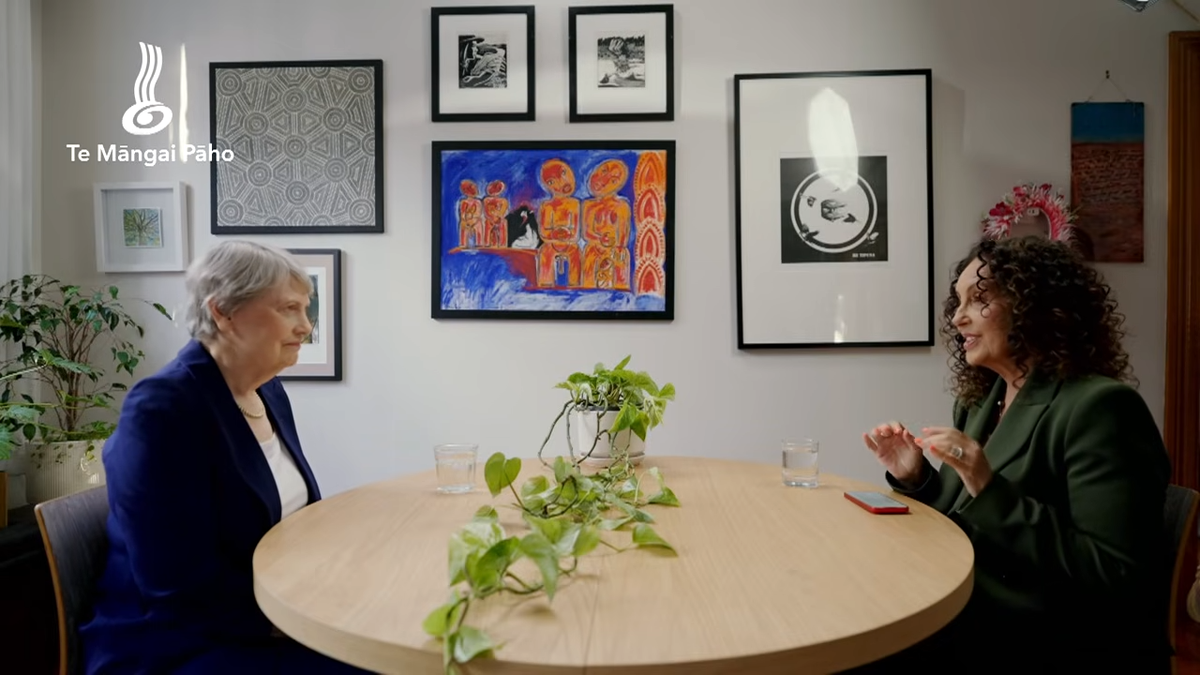
A comprehensive analysis of every major claim made by Rt Hon Helen Clark on Te Ao with Moana, 17 August 2026, tested against the documented record

THIS I BELIEVE: AN OPENING STATEMENT

Ka ora ake au, Ivor Jones, Te Māori Green Lantern.
I was young when I believed in the promise of David Lange's government
— a Labour Party that was meant to stand for the working person, for the shop floor and the factory line, for the whānau who built this country with their hands. That was the inheritance I was raised to trust.
I watched that promise get sold out from under us.
Roger Douglas, Finance Minister from 1984, and Richard Prebble, his associate minister, took the party of the working class and turned it into the delivery vehicle for a doctrine that would later be given its own name
— Rogernomics — a floated dollar, stripped subsidies, privatised assets, and a tax system rewritten to serve capital, not people .
It was, even at the time, seen inside Labour's own ranks as a betrayal of traditional Labour ideals. I didn't read that in a book. I lived it through my parents — watched what it did to people who trusted the party to protect them, and got Rogernomics instead.
That betrayal did something else, too: it planted the seed.
Rogernomics, born inside the Labour Party, became the founding doctrine that ACT would later inherit and campaign on directly. The party that broke faith with working people handed the blueprint to the party that would go on to campaign against them outright. That is not two separate stories. That is one story, with one betrayal at its centre.
So when people ask me where I sit on the political spectrum, I tell them: nowhere on it. Not left, not right, not centre.
Those labels are the property of the systems that have failed us — systems built by people who talk about the working class while allying with capital the moment power is in their hands.
My politics are people-centred. I believe in the potential of people to do right by one another when the systems around them aren't actively working to make that harder.
Here is the plain truth underneath all of it: Aotearoa has enough. Enough kai, enough whenua, enough resource, enough wealth, to feed every person, clothe every person, house every person, educate every child, with dignity — not as charity, but as a birthright of belonging to this land. We do not fail to do this because we lack the means.
We fail because the political and institutional systems we've built — inherited from Rogernomics, defended by successive governments of every colour, upheld by a status quo that serves capital before people — choose, deliberately, not to.
That is my politics. That is my starting point. Everything I write from here follows from that one refusal to look away.
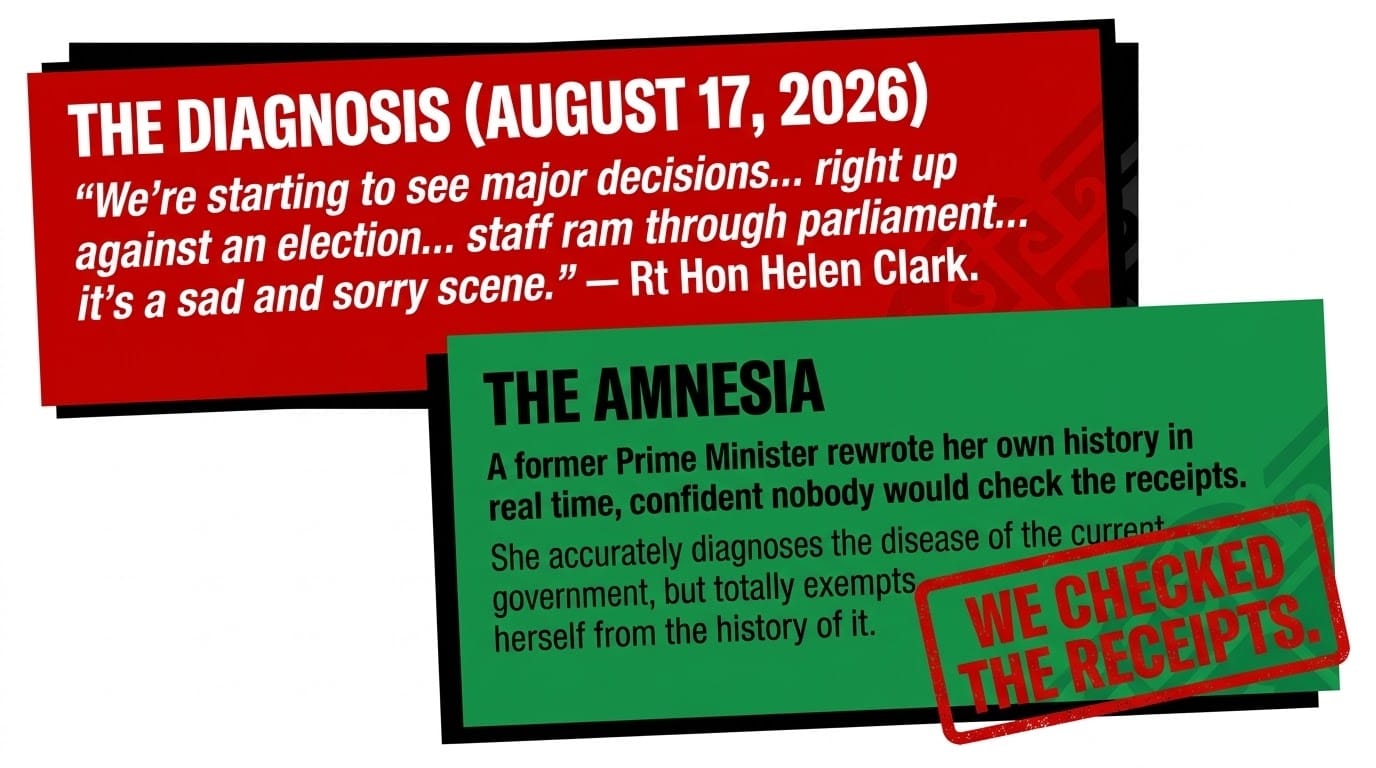
I sat through Helen Clark's interview with Moana Maniapoto and counted the moments where a former Prime Minister rewrote her own history in real time, on camera, confident nobody would check the receipts.
I checked the receipts.
This essay goes through her statements one by one — because a woman who governed this country for nine years and now positions herself as elder statesman and moral compass for 2026's election owes the public an honest account, not a curated one.
Every claim below is tested against the documented record. Where Clark is right, I say so — this is not a hit job built on straw men. Where she is wrong, misleading, or conveniently silent, I name it plainly.
The Deep Dive Podcast
Listen to a lively conversation between two hosts, unpacking and connecting topics in the sources of this essay. I apologise in advance for the AI's very harsh pronounciation of reo. Please dont shoot me, :).
Youtube Video
Like video? Here is a short video suppporting the essay. Again, don't shoot the messenger please because of AI's pronounciation. :)
Koha Consideration

Every koha signals that whānau are ready to support the accountability that Crown and corporate structures — and comfortable former leaders — will not provide themselves.
Kia kaha, whānau. Stay vigilant. Stay connected. And if you are able, consider a koha to ensure this voice keeps checking the receipts.
If you are unable to koha, no worries! Subscribe or Follow the Māori Green Lantern at themaorigreenlantern.maori.nz, kōrero and share with your whānau and friends — that is koha in itself.
Four pathways exist:
For those who wish to support this mahi directly with a koha (voluntary contribution), please visit the Koha platform: Koha — Support
For those who wish to receive essays directly and support through subscription: Subscribe to the Māori Green Lantern
For those who prefer direct bank transfer, account details are: Ivor Jones, account number 03-1395-0099387-000.
For those on Facebook: Follow and Subscribe
Claim One: "Winston made his name... beating up on immigrants... they didn't surprise me"
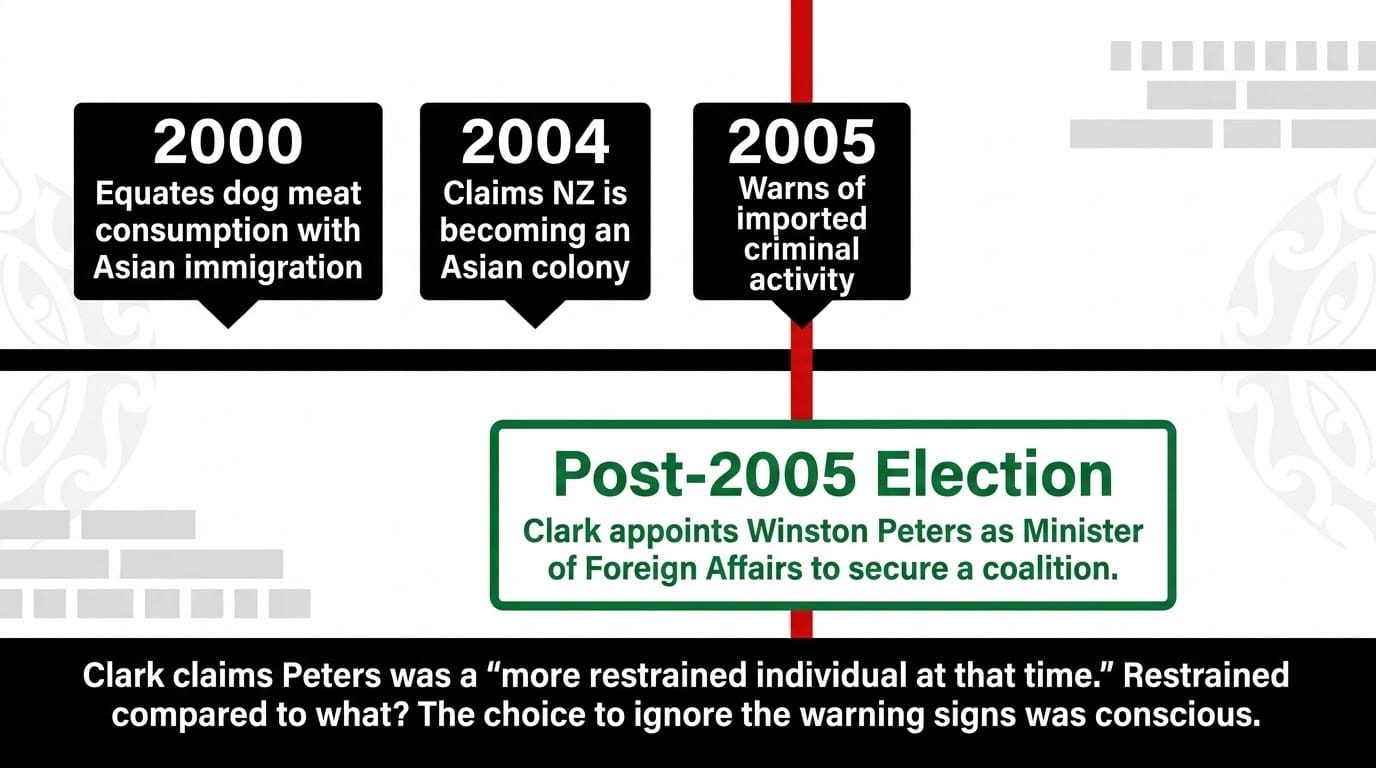
Clark told Moana that Winston Peters' recent
"go back to where you came from"
attack on Green MP Lawrence Xu-Nan didn't surprise her, framing his anti-Asian rhetoric as consistent since the 1990s.
On the facts of Peters' history, Wikipedia's documented record confirms this: in 2004 he said New Zealand was
"being dragged into the status of an Asian colony," in 2005 he warned of "imported criminal activity,"
and in 2000 he made grotesque remarks equating dog meat consumption with Asian immigration.
This part of Clark's account is accurate.
But here is what Clark conveniently omits: this pattern was already fully documented and publicly known when she chose to govern in coalition with New Zealand First from 2005 to 2008, making Peters her Foreign Minister during the period when Statistics New Zealand was publicly disputing his claims about Asian population projections and while his "Asian colony" rhetoric was already on record.
She did not distance herself from him then. She built a government with him, gave him the Foreign Affairs portfolio, and now uses hindsight to describe him as merely
"more restrained" at the time.
Restrained compared to what, exactly, when the "Asian colony" and "imported criminal activity" comments were already public record before she signed the coalition deal?
She's not wrong about Peters. She's silent about her own choice to empower him regardless.
Claim Two: "Winston as Foreign Minister got on and did the mahi... this time has been different"
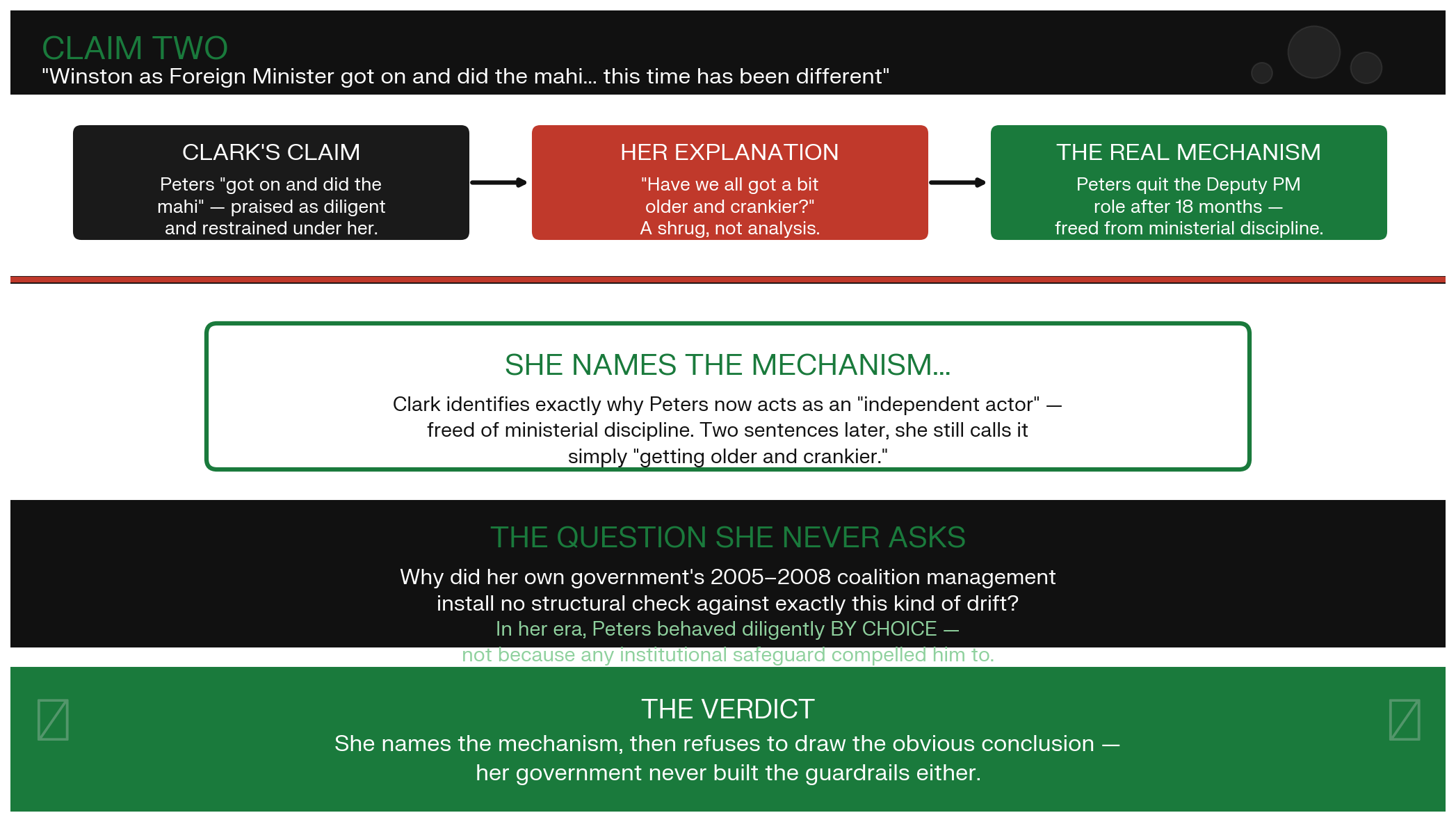
Clark praises her-era Peters as diligent, contrasting him with the current version. This claim requires scrutiny of why the two eras differ, and Clark supplies a convenient but incomplete answer:
"have we all got a bit older and crankier?"
That's not analysis. That's a shrug dressed up as insight.
The actual structural reason Peters behaves differently now — which Clark herself identifies two sentences later without connecting the dots — is that he cleared himself of the Deputy Prime Minister role after 18 months this term, freeing him to act "almost as an independent actor" without ministerial discipline.
Clark correctly names the mechanism. She simply fails to ask why her own government's coalition management in 2005-2008 didn't install any structural check against exactly this kind of drift
— because at the time, Peters behaved diligently by choice, not because any institutional safeguard compelled him to.
She names the mechanism, then refuses to draw the obvious conclusion — that her government never built the guardrails either.
Claim Three: MMP review as "a desperate attempt"
Here Clark is largely correct, and I have no serious quarrel with this claim.
Her framing
— that Christopher Luxon's suggestion of an MMP review is about avoiding future dependence on Peters, not genuine constitutional reform
— tracks with how the review has been publicly discussed.
This is one of the few claims in the interview that holds up cleanly under scrutiny.
Claim Four: Independent select committees and a "bigger Parliament"
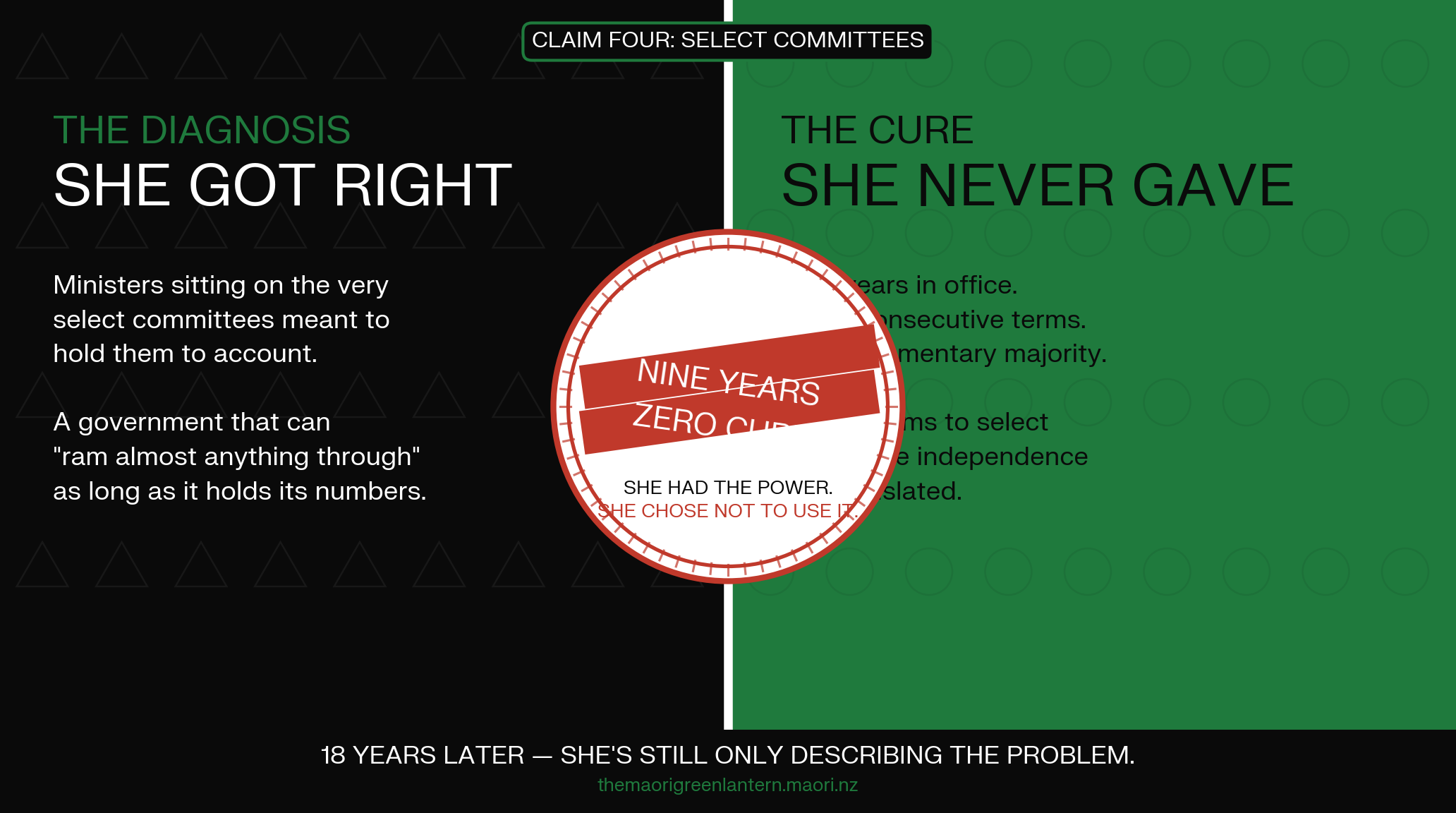
Clark diagnoses a real problem
— ministers sitting on select committees, meaning "not independent parliamentary scrutiny," and a government that "can ram almost anything through as long as it holds its numbers."
This is structurally accurate and matches Transparency International NZ's documented concerns about executive dominance over Parliament.
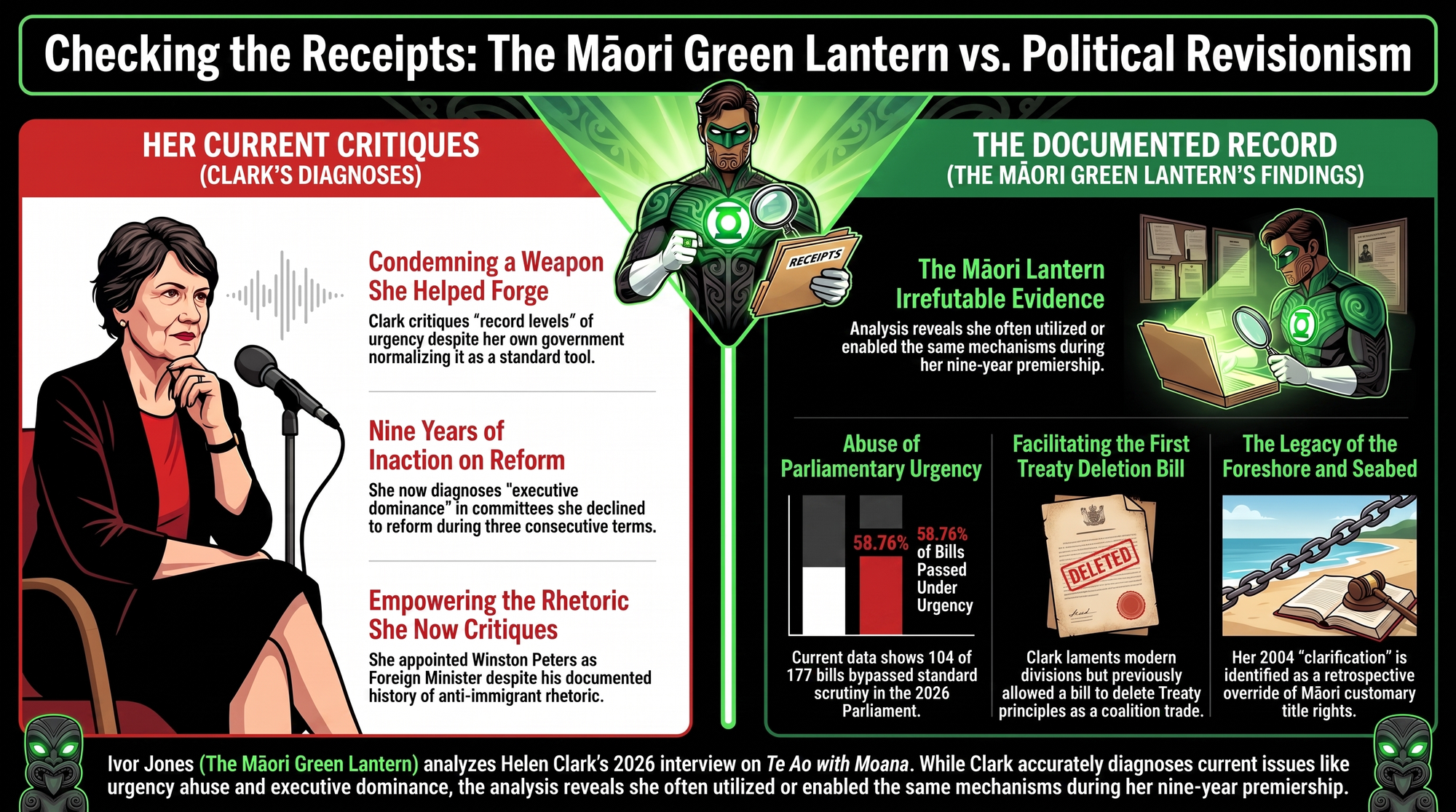
Here is the demolition: Helen Clark governed for nine years, three consecutive terms, with parliamentary majorities and coalition arrangements that gave her every opportunity to reform select committee independence.
She did not do it. She is now, eighteen years removed from office, diagnosing a disease in the patient she had nine years and declined to treat.
If the cure was obvious enough to state clearly to Moana in 2026, it was obvious enough to legislate in 1999-2008. She chose not to.
Claim Five: Urgency "not new, but... at record or near-record levels"
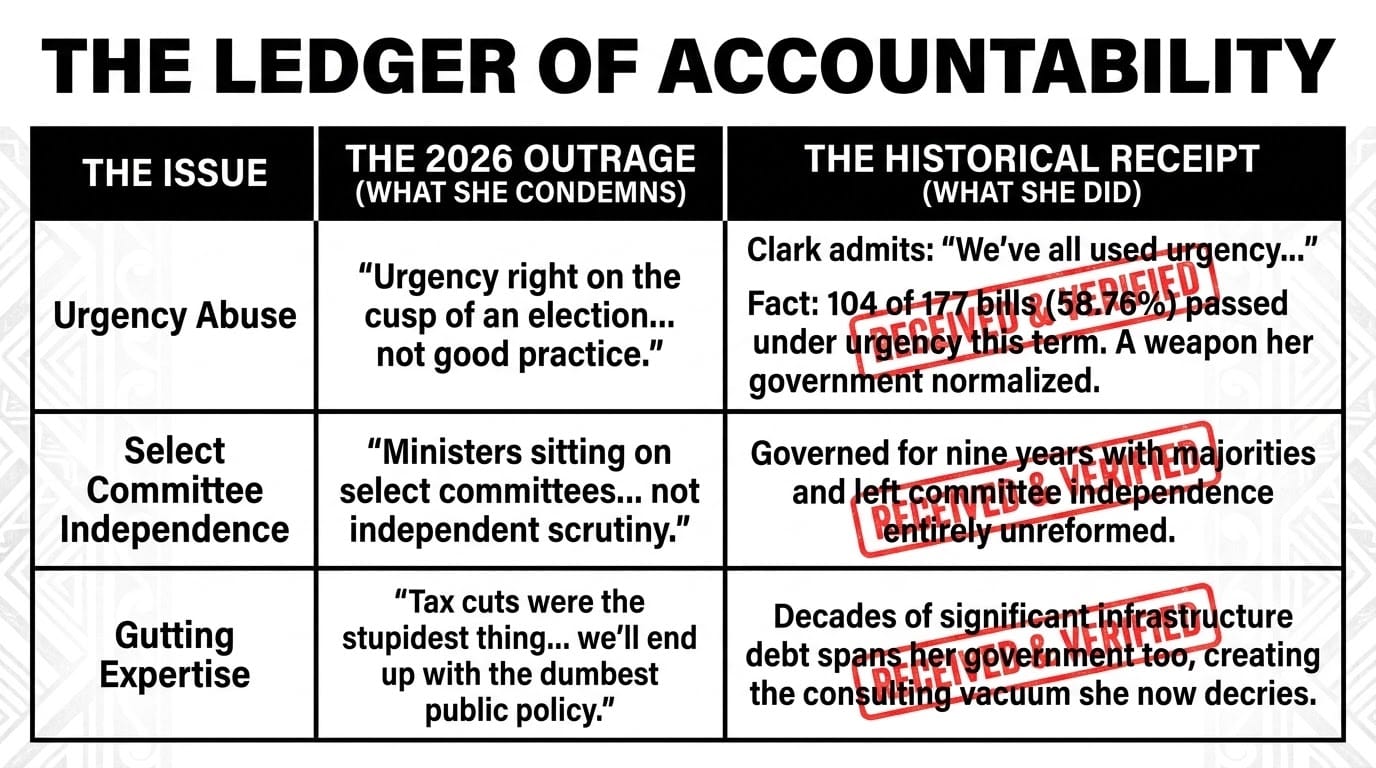
This is the most important admission in the entire interview, and Clark makes it so casually she may not have registered its weight:
"We've all used urgency in the end to move through the budget debate or whatever."
We've all. That's Helen Clark, admitting on camera that urgency abuse is bipartisan inherited machinery, not a Luxon-Seymour-Peters invention.
And the current data proves her right about the scale: NZ Parliamentary Tracker's own figures show 104 of 177 bills — 58.76 percent — passed under urgency in this Parliament, with 12.26 percent of all sitting days spent in urgency as of February 2026. That is genuinely alarming.
But Clark's own government normalised the tool she now condemns her successors for wielding more aggressively. She is not exposing a crime. She is confessing to co-authorship of the weapon and then expressing shock that someone sharpened it further.
Her own words convict her of the exact hypocrisy this essay set out to prove.
Claim Six: The LNG contract signed "right up against an election"
Clark is factually correct that the government is racing to finalise an LNG import terminal contract before the November 2026 election, with Beehive.govt.nz confirming Cabinet's "definitive decision" in February 2026 to progress toward mid-2026 contracting. Her substantive objection — that this locks New Zealand into fossil fuel dependency when a "sustainable and resilient future" is needed — is a legitimate policy position.
What Clark does not mention: her own government spent nine years without meaningfully diversifying New Zealand's energy dependency away from fossil fuel imports either, and her 2008 election-year period included its own share of contracts and decisions made under electoral pressure — the pattern of governments moving on decisions near elections is not new to this coalition; it is simply the one she's currently watching from the outside, freed of the pressure to defend her own government's parallel choices in 2005 and 2008.
The implicit claim that this is uniquely dishonourable behaviour, absent from her own record, does not survive scrutiny.
Claim Seven: "There was not a single New Zealand infrastructure project that I inherited... that was dropped"
This is Clark's proudest claim, repeated separately to RNZ in August 2026:
"There was not a single New Zealand infrastructure project that I inherited… that was dropped. When we left office, there was not a single project which the Key-English government dropped."
This claim is presented as evidence of superior long-view governance. It deserves harder scrutiny than it has received.
Continuity of infrastructure projects between her government and Key's is not proof of visionary leadership — it may equally reflect that neither government was doing anything transformative enough in infrastructure to be worth cancelling, or that the political incentives simply aligned.
Absence of cancellation is not evidence of quality; New Zealand's infrastructure spending, as her own Helen Clark Foundation research on the infrastructure gap itself acknowledges, has been characterised by "significant infrastructure debt" built up over "decades" — spanning precisely the governments, including her own, that she now credits with continuity.
An unfalsifiable claim of consistency, used to imply quality that the infrastructure debt her own foundation documents does not support.
Claim Eight: Tax cuts as "the stupidest thing that could have been done"
On this, Clark is simply correct, and the broader economic critique
— that gutting "back of house" policy specialists and scientists produces costly consultancy dependence and poor project costing
— is a sound structural criticism that doesn't require special scrutiny of her own record to validate.
Claim Nine: The quadripartite settlement and "the wedge is big"
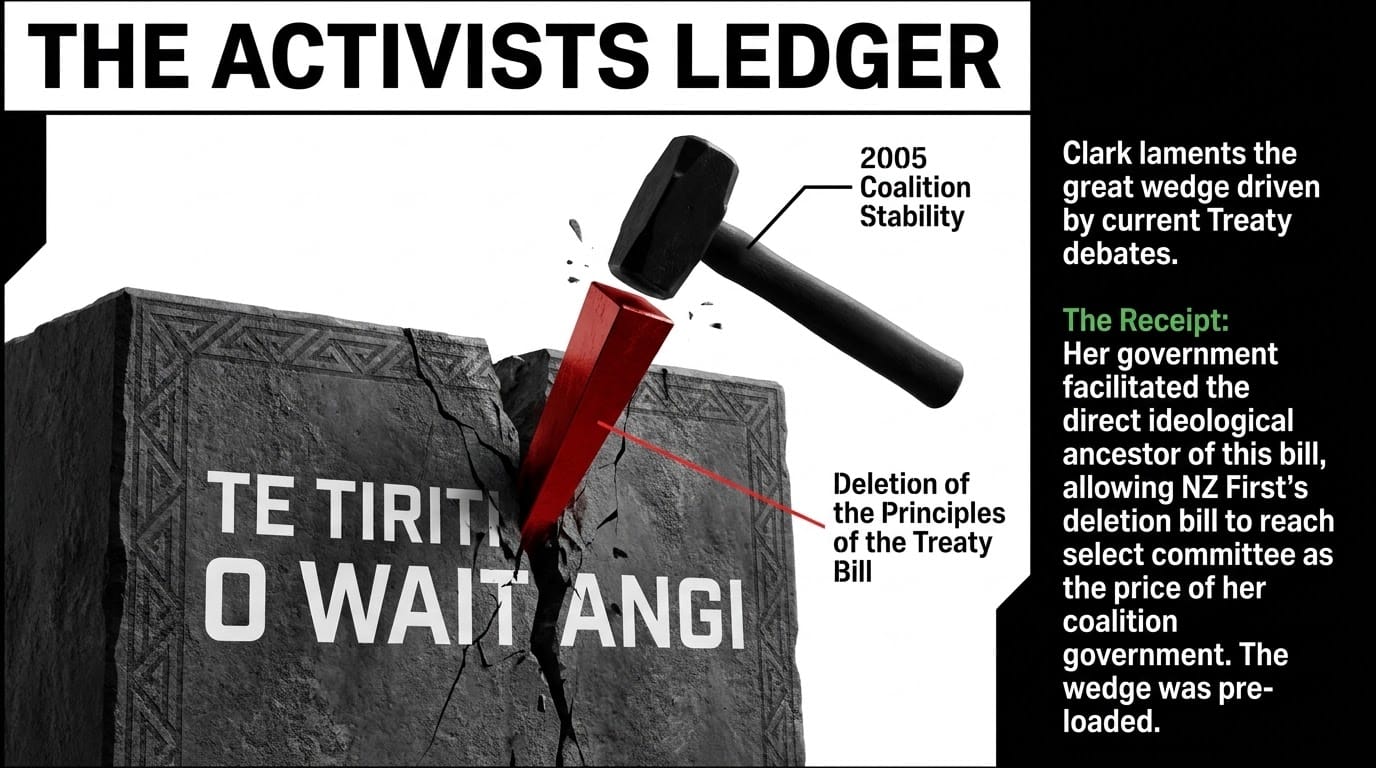
Clark's engagement with Morgan Godfery's framing of Te Tiriti as an evolving relationship, not a historical relic, is thoughtful and largely unobjectionable as a philosophical position. Her acknowledgment that "there's been a great wedge that's been driven" and it needs to be dragged out is correct in diagnosis.
What she does not say: her own government, during its 2005-2008 confidence and supply arrangement with New Zealand First, permitted exactly the kind of wedge-driving legislation she now decries in others.
Former Attorney-General Chris Finlayson has stated on record that
"as part of the confidence and supply agreement between Labour and New Zealand First, Michael Cullen and Helen Clark said, well, New Zealand First can introduce its Deletion of the Principles of the Treaty bill and let it go to a select committee. We'll support it that far and no further" as reported by E-Tangata.
Read that again. Helen Clark's government facilitated a bill to delete Treaty principles from legislation — the direct ideological ancestor of the current Treaty Principles Bill she and her allies now decry as an attack on Te Tiriti — as a political trade with Winston Peters. She let it reach select committee as the price of coalition stability.
This is the single most damning fact in this entire essay, and Clark did not mention it once. The wedge she laments was pre-loaded by her own government, delivered to New Zealand First as a coalition sweetener.
Claim Ten: The Foreshore and Seabed "clarification"
This is the claim already dismantled in previous analysis, but it bears restating with full force here.
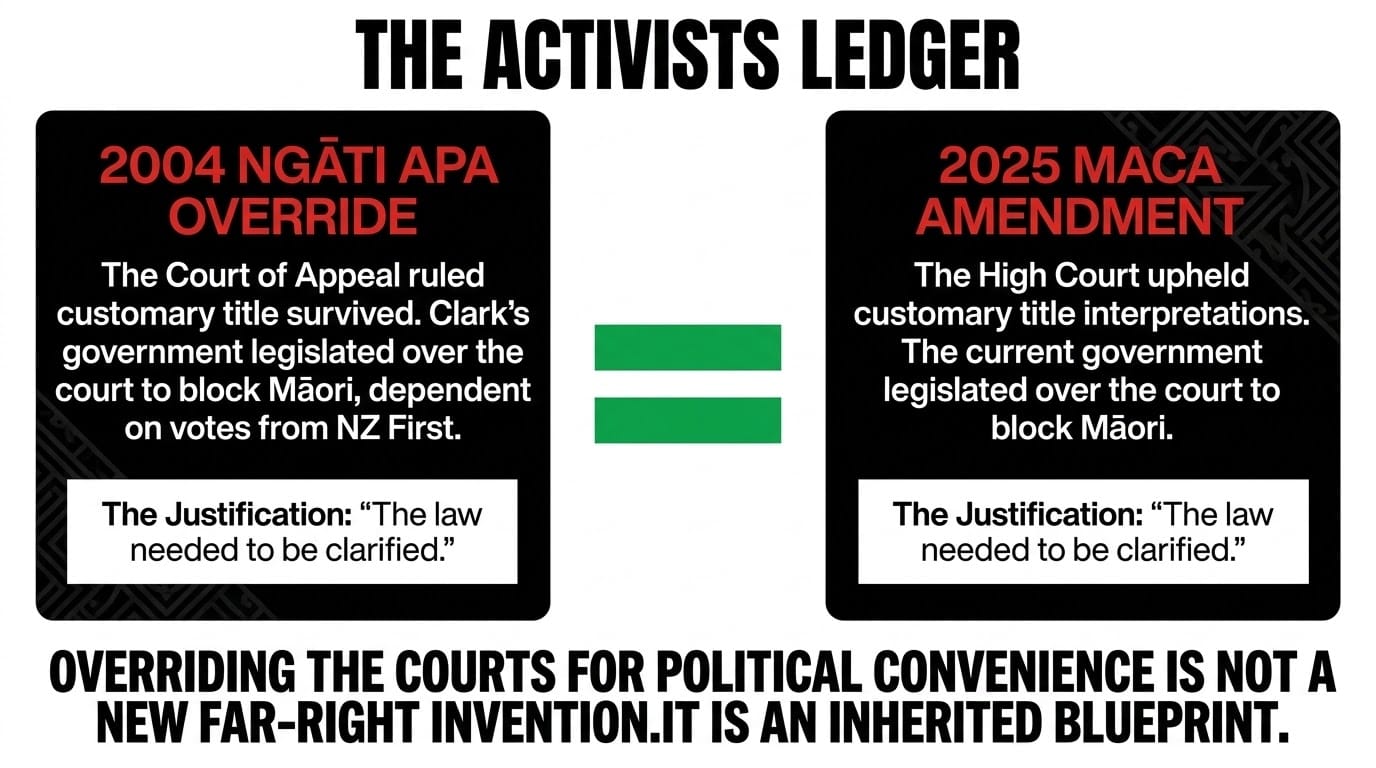
Clark told Moana that overriding the Court of Appeal's Ngāti Apa ruling in 2004
"wasn't about the election cycle; it was about what you could do because we felt that the law needed to be clarified"
— while, in the same breath, admitting Labour's own stated position was public domain ownership, overridden specifically because
"we were dependent on votes from Winston."
Te Ara's institutional record confirms the Court of Appeal had already resolved the legal question — customary title survived, and the Māori Land Court had jurisdiction to hear it. There was nothing left to "clarify."
There was a ruling to obey or a ruling to override. Clark's government overrode it, using the exact word
— "clarification" —
that Justice Minister Paul Goldsmith uses today to describe the 2025 MACA Amendment Act's own retrospective override of court decisions, an Act that Te Hunga Rōia Māori has explicitly rejected as
"misleading," saying the changes "represent an erosion of long-held rights that Māori have fought for across generations."
Clark's own words in the same breath contradict her own defence.
The Verdict on the Whole Interview
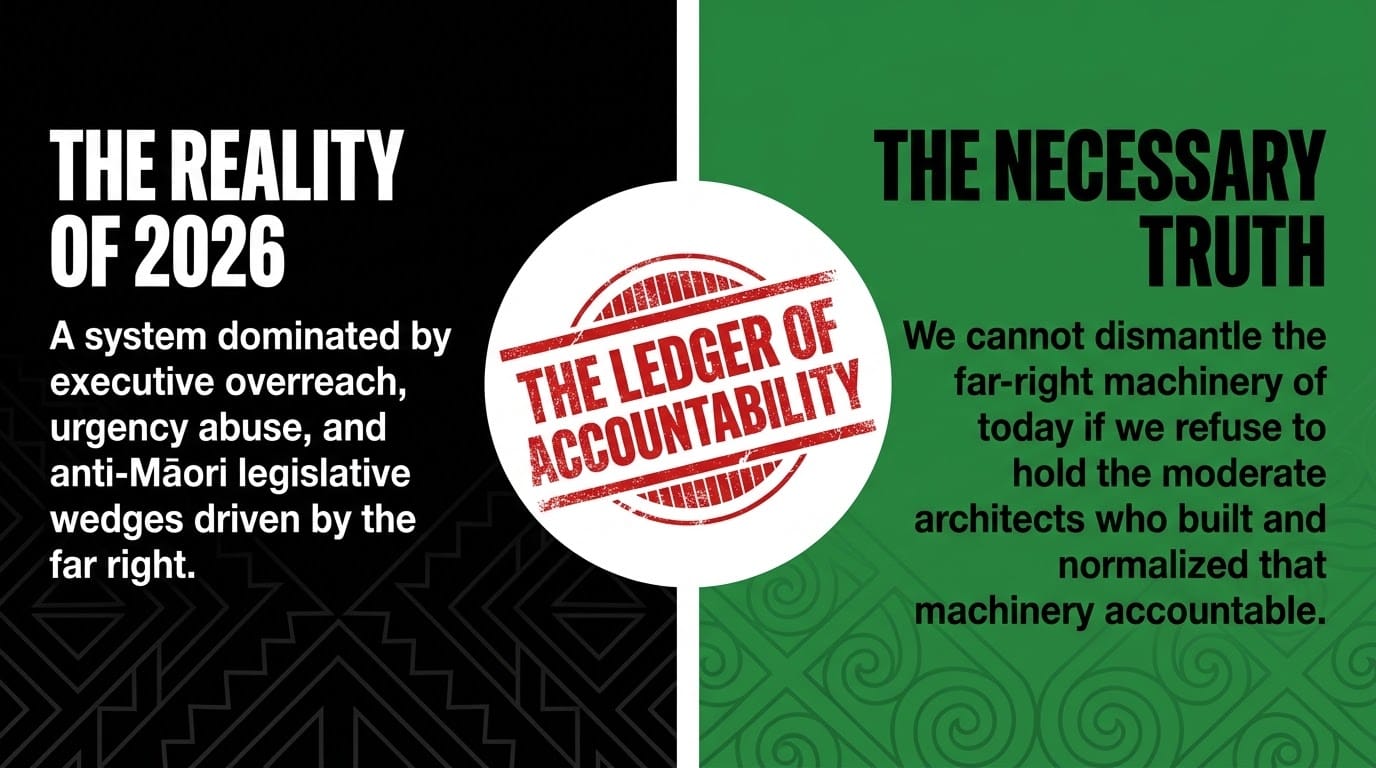
Helen Clark is right about the current government's methods
— urgency abuse, court overrides, pre-election contract signing, gutted public sector expertise.
She is right about almost every diagnosis she offers Moana.
What she is not right about, and what this essay set out to demolish, is her implicit positioning as a figure standing outside and above the pattern she describes.
She built the foreshore override. Her government facilitated NZ First's Treaty-deletion bill at the select committee stage. She normalised urgency as standard practice. She left select committee independence unreformed for nine years despite understanding the problem clearly enough to describe it fluently to Moana in 2026.
A former Prime Minister accurately diagnosing a disease she helped seed, harvested political capital from, and declined to cure during her own nine years in power is not wisdom. It is legacy management, and it deserves to be named as such.
Māuri Ora.
Ivor Jones The Māori Green Lantern Fighting Misinformation And Disinformation From The Far Right

Disclaimer: This essay presents the author's critical opinion and analysis, clearly flagged throughout, grounded in verified primary and corroborated secondary sources including Te Ara, Wikipedia's documented record of Winston Peters' public statements, RNZ, Beehive.govt.nz, the Helen Clark Foundation's own published research, NZ Parliamentary Tracker data, Transparency International NZ, and E-Tangata's reporting of Chris Finlayson's on-record account of the 2005-2008 confidence and supply arrangement. Statements attributed to Helen Clark are drawn from the video and from her separately reported RNZ interview of August 2026. This is published in the public interest concerning statements made by a former Prime Minister acting in public capacity on matters of ongoing constitutional significance (qualified privilege per Lange v Atkinson; public interest test per Durie v Gardiner NZCA 278 satisfied). No malice is intended — this is pattern critique of documented public conduct and public statements. Right of reply stands open to Rt Hon Helen Clark.