
"THE COLONIAL PRISON CONVEYOR BELT" - 13 June 2026
How Christopher Luxon Is Building a Māori Cage the Size of a City

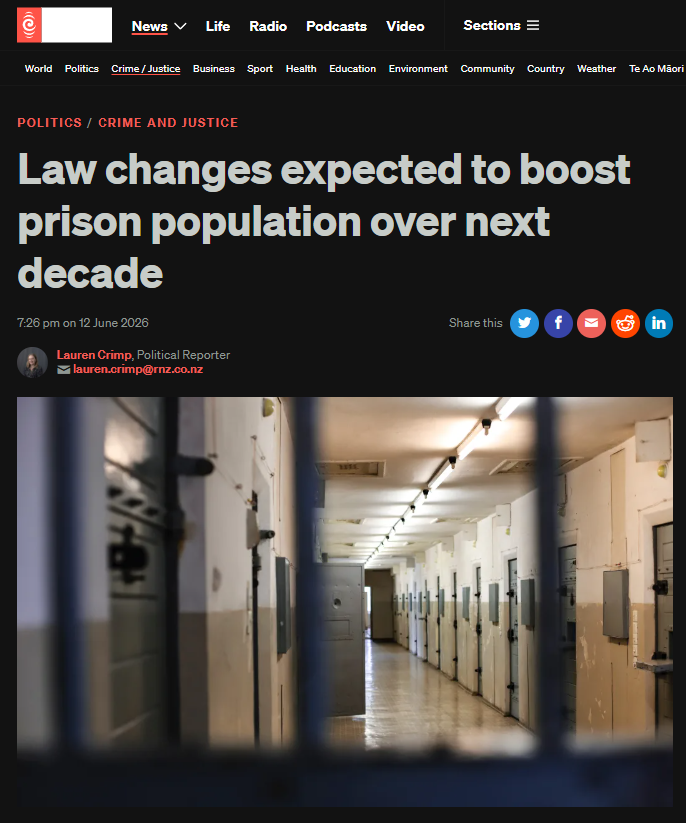
Mōrena ano Aotearoa,
"Ko te hara, he mea huri ngākau — e kore e whakamāuia ki runga i te tāngata engari ki runga i te hononga i pakaru ai."
Wrongdoing turns the heart — it is not imposed upon the person, but upon the relationship that was broken.
— Tikanga Māori, ancestral framework of restorative justice
They Told You It Was Law and Order. It Was Always a Body Count.
I want you to picture something.
Picture a conveyor belt. Not a metaphorical one — a real, industrial, grinding, steel-and-rubber machine that has been running in this country since the first raupo prison was erected on this land weeks after the signing of Te Tiriti o Waitangi in 1840. As Moana Jackson wrote in E-Tangata, those crude cells were not a response to crime. They were a tool of colonial administration — a way to manage the inconvenience of a people who still owned the land the colonisers wanted.
The machine has been upgraded since then. Poured concrete replaced raupo. Razor wire replaced rope. And in 2023, a hollow CEO from the boardrooms of Fonterra and Fletcher Building stood at a podium and promised Aotearoa "law and order" — and proceeded to pass the most punitive legislative package in a generation, aimed, with surgical precision, at the end of the belt where Māori have always been processed.
At one end: poverty, demolished health services, gutted mental health support, underfunded schools, a Māori Health Authority razed to the ground, and a Waitangi Tribunal being systematically emptied of its purpose.
At the other end: a cell door, and Christopher Luxon in June 2025 telling the nation that a prison population surging toward 11,000 is — and I am quoting him directly — "a good thing."
As Dr Paula Toko King, Public Health Medicine Specialist and Research Associate Professor at Te Rōpū Rangahau Hauora a Eru Pōmare, put it without softening a single syllable:
"Prisons don't work. Not in terms of community safety, nor in terms of rehabilitating those who are imprisoned. Decades of government-commissioned reports and academic research say the same thing."
She is right. The Prime Minister is not. And the difference between those two positions is being paid for in Māori bodies.
🎙️ The Deep Dive Podcast
Listen to a lively conversation between two hosts unpacking and connecting the key sources behind this essay — from the Ministry of Justice projections to Dr Paula Toko King's Tiaki research, the AUT sentencing analysis, the wāhine data, and the five hidden connections.
I apologise in advance for the AI's very harsh pronunciation of te reo Māori. Please don't shoot me 😅. The mana of the reo belongs to our kaumātua and our reo teachers — the AI is only a messenger.
📺 YouTube Video
Like video? Here's a short video supporting this essay — covering the key data, the three whakapapa examples, and the five hidden connections in plain language.
Again, please don't shoot the messenger for AI pronunciation of te reo. The reo belongs to our people — this is a kaitiaki doing their best with imperfect tools in service of the kaupapa.
The Numbers They Bury in the Press Release's Footnotes
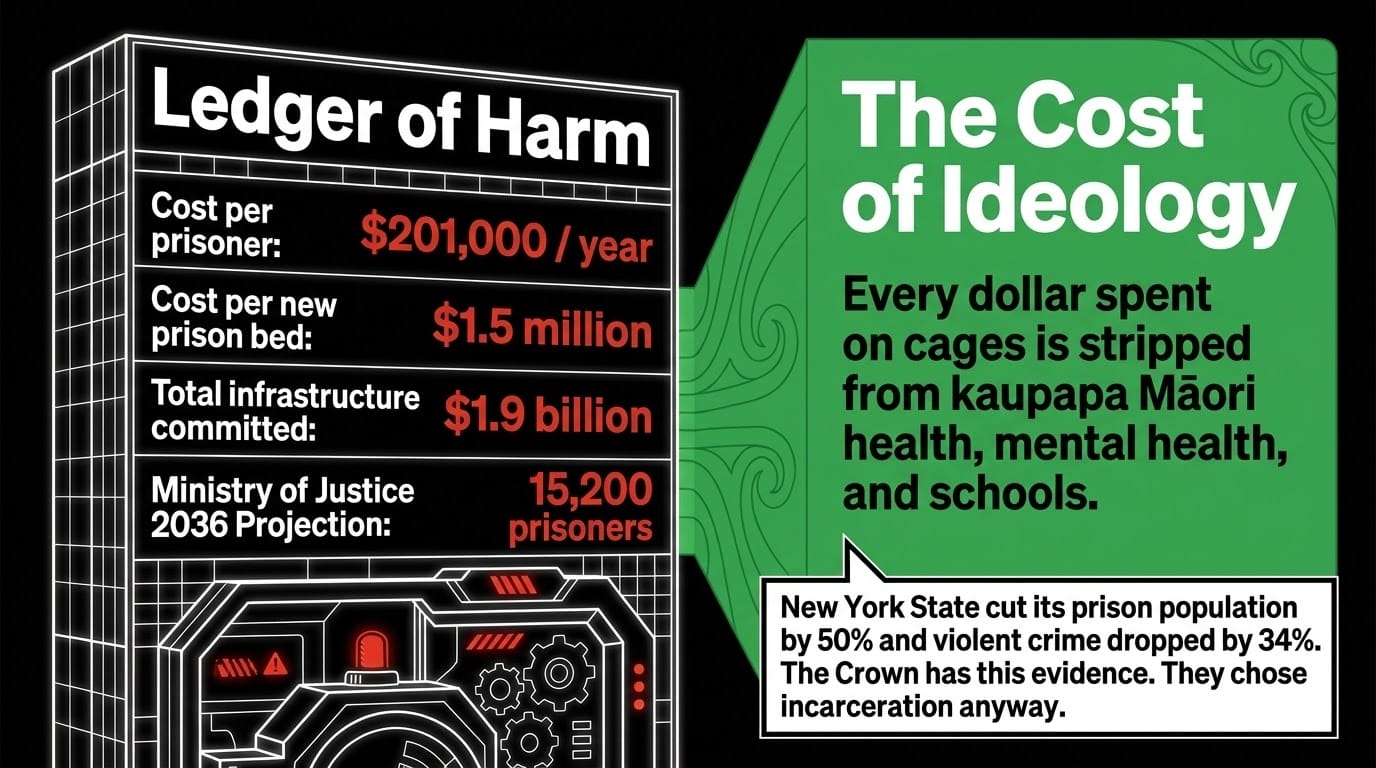
Let me give you the arithmetic of institutional racism, because I believe in naming the machine with precision.
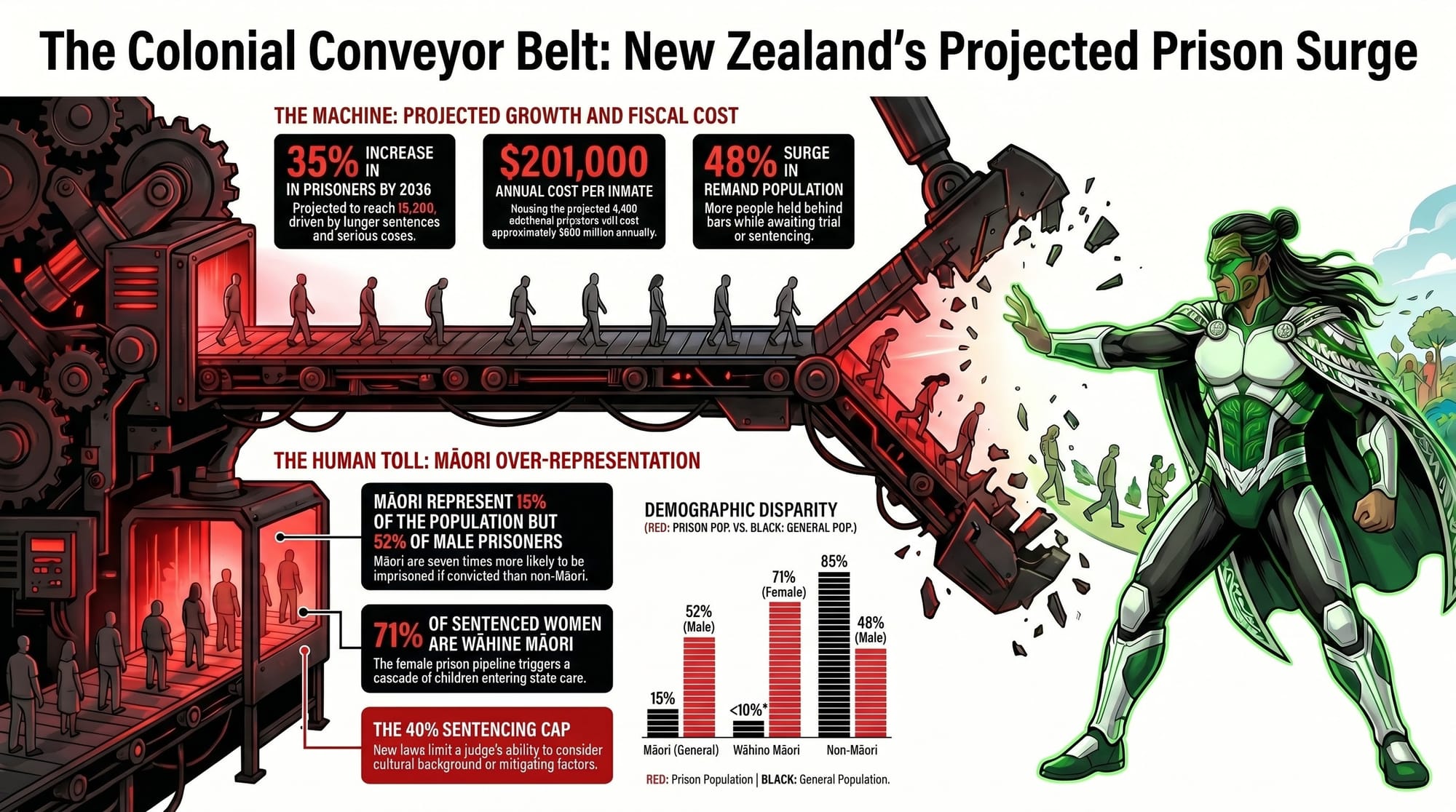
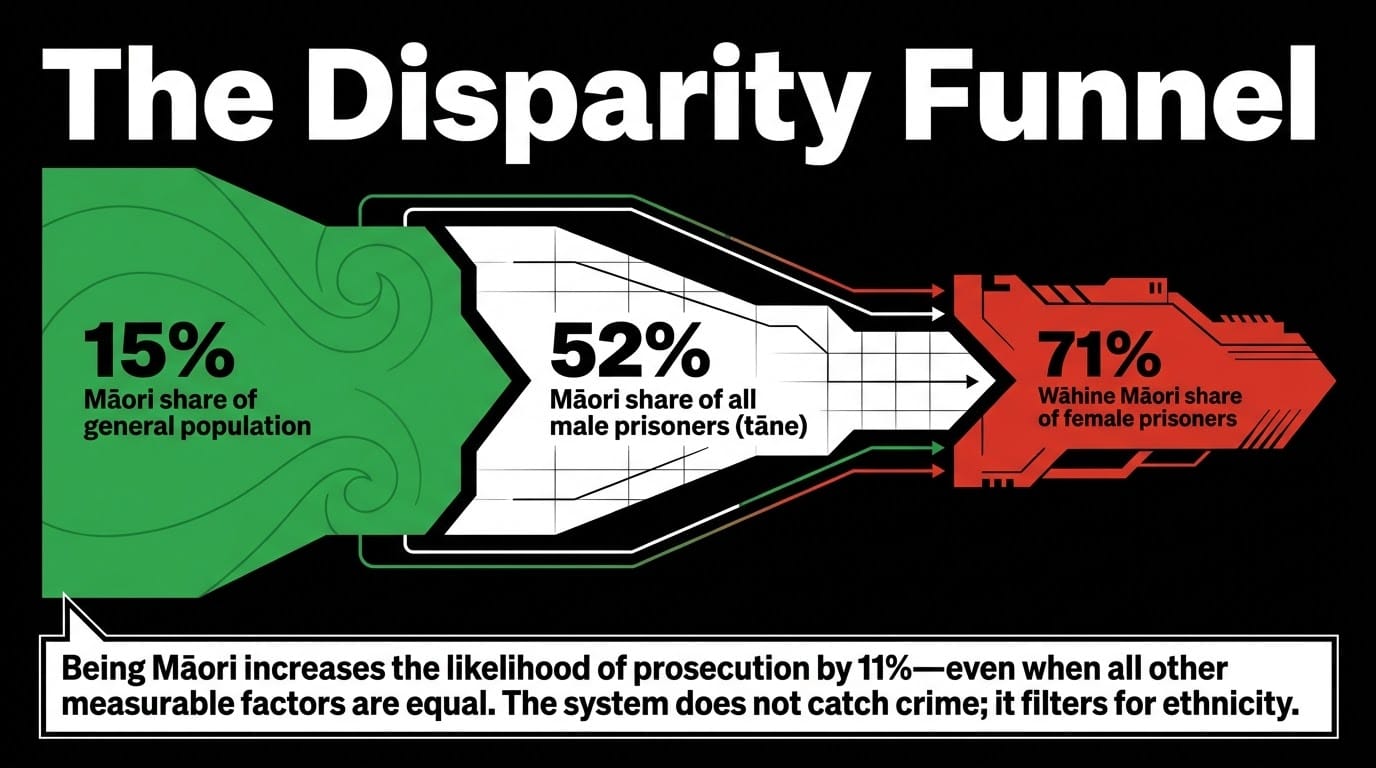
Māori make up approximately 15 percent of Aotearoa's general population, as confirmed by Te Ara — The Encyclopedia of New Zealand. Yet:
- 52 percent of all male prisoners are Māori
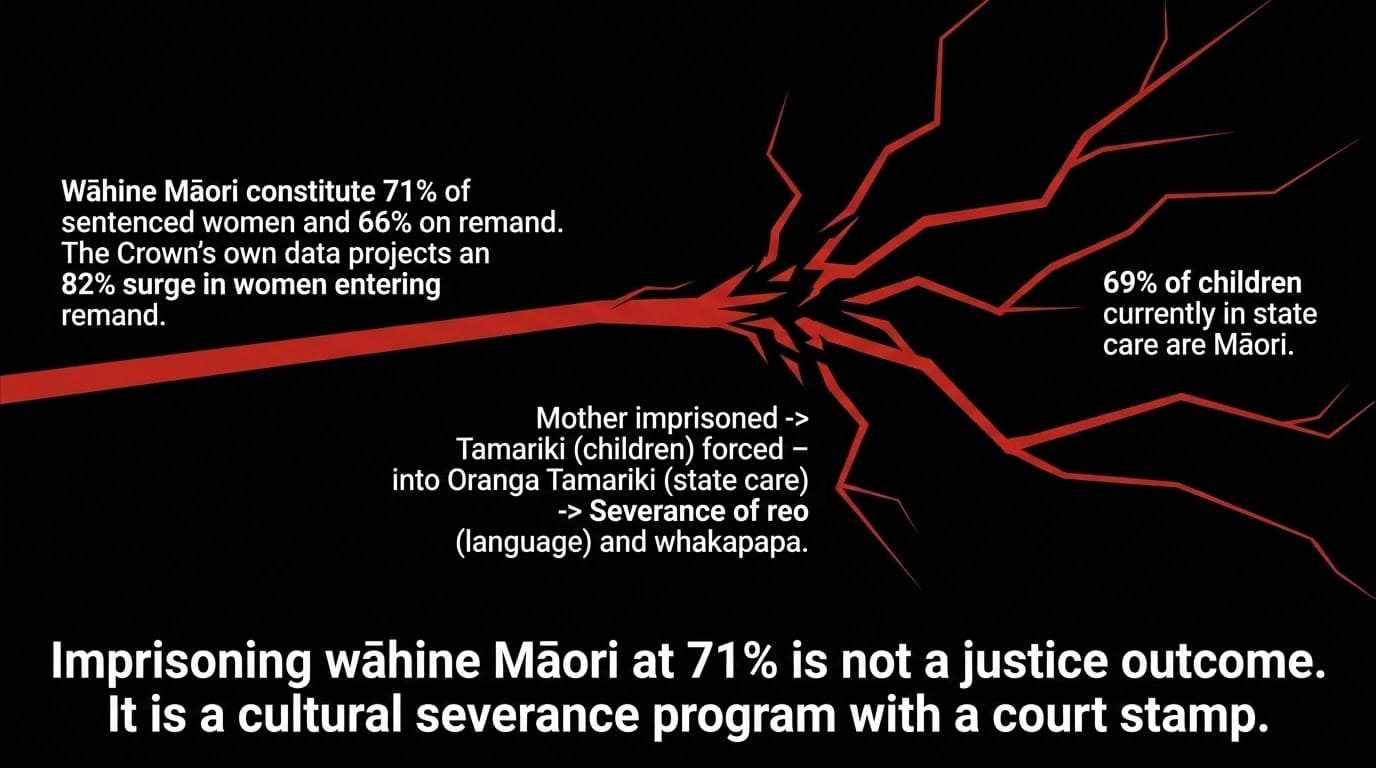
- 71 percent of all women sentenced to imprisonment are wāhine Māori
- 66 percent of all women on remand are wāhine Māori
- Māori are three times more likely to be apprehended for a criminal offence than non-Māori
- Being Māori increases the likelihood of prosecution by 11 percent, even when every other measurable factor is equal
- Māori are seven times more likely to be imprisoned if convicted
- The Māori male imprisonment rate is approximately 700 per 100,000 — equivalent to the incarceration rate of African Americans in the United States
Sources: Ministry of Justice March 2026 Factsheet; E-Tangata — Fixing Police Bias; University of Auckland — Causes of Māori Over-Representation in Prison.
These are not statistics. These are people. These are our people.
And if you think that pipeline emerged from a neutral system, consider this: Corrections has been recording Māori ethnicity incorrectly for over 20 years, using a "preferred ethnicity" self-identification method that contradicts Statistics New Zealand protocols. When Dr Paula Toko King's Tiaki project corrected for this, they found an undercount of approximately 405 Māori prisoners. The government's own statistics are hiding the true scale of what is happening to our people. That is not bureaucratic error. That is institutional interest. The machine doesn't just cage Māori — it miscounts them, too. Dr Paula Toko King, E-Tangata February 2026
The Laws That Built the Machine Bigger
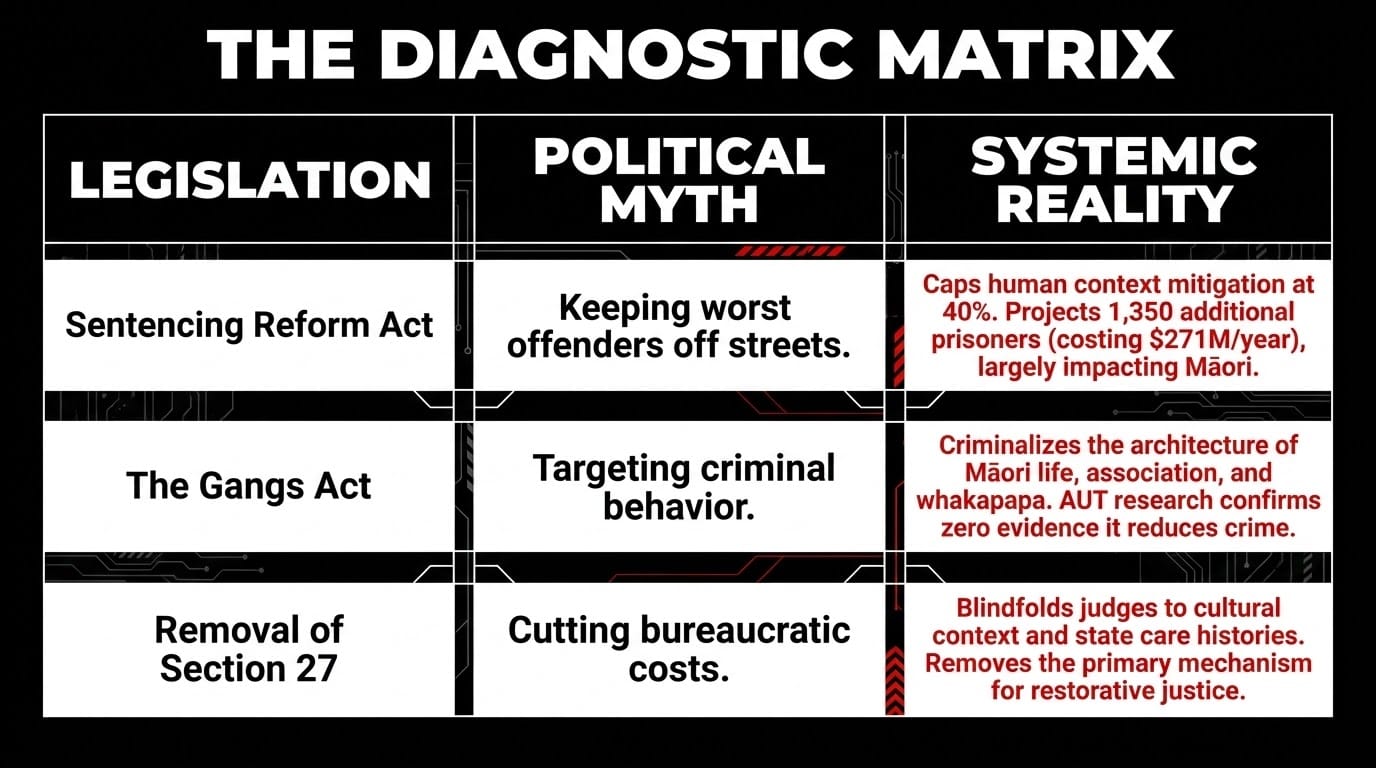
This government did not inherit a broken system and try to fix it. They inherited a broken system, studied it carefully, and passed a suite of laws explicitly designed to feed more people into it — more cheaply, faster, for longer.
ACT's own press release confirmed it with crowing triumph: the Ministry of Justice itself admitted imprisonment will rise because of government policy.
David Seymour called this proof the government was "serious about keeping the worst offenders off the streets."
What he did not say — because his donors don't find it useful — is that the majority of those new worst offenders will be Māori.
Here are the instruments of the machine, named and verified:
The Sentencing (Reform) Amendment Act caps mitigating factors at 40% of a sentence reduction. The Ministry of Justice's own Regulatory Impact Statement estimated 1,350 additional people in prison from this single bill — and explicitly stated the changes
"rest on inadequate consultation, particularly with Māori."
Former Finance Minister Bill English — no radical — commissioned a 2018 chief science adviser report finding New Zealand's prison growth was
"dogma not data."
That same report found 90% of prisoners had mental health or addiction histories, and up to 70% had significant literacy problems. These are not masterminds. These are people the state failed at every prior point — and then capped the law that allowed judges to hear that.
Three strikes, reinstated by ACT. Already shown internationally to produce disproportionate sentences without reducing crime. Already repealed for good reason. Now back. The Ministry of Justice projects it will contribute materially to a one-third increase in sentenced prisoners by 2035.
The Gangs Act, which criminalises association, movement, and expression — extending the definition of criminal behaviour into new territory. As AUT's Coalition Government Gang Policy analysis confirmed, the government has so far been
"unable to provide evidence that demonstrates the efficacy" of these policies.
What they can demonstrate is their political utility: painting Māori networks as criminal while stripping the protections that might have kept Māori men out of those networks in the first place.
The abolition of the prison reduction target and removal of Section 27 funding. Section 27 of the Sentencing Act allowed courts to hear cultural background before sentencing — the history of colonisation, state care, whānau disruption. Without funded reports, judges sentence blindfolded. Without the target, there is no accountability. The Crown removed both the brake and the speedometer. This was not an accident. AUT analysis; ACT press release; Beehive.govt.nz Corrections portfolio; Ministry of Justice projections
Example One for the Western Mind:
The Sentencing Cap — A Precision Weapon Aimed at Brown Skin
Let me give you the version that lands, because I've learned that numbers need a face.
Imagine: A 19-year-old Māori tāne — let's call him Tāne, because that is who he is — appears before a judge for aggravated robbery. Tāne grew up in state care from age 7. His mother was imprisoned when he was 4. He has an undiagnosed mental illness, a reading age of 10, and left school at 15. Before this government, a Section 27 cultural report could bring all of that before the court. A judge could hear the full whakapapa of how Tāne arrived at that moment and apply meaningful mitigation. Sentences were regularly reduced by 30–40% in such cases.
Under the Sentencing (Reform) Amendment Act 2025, that mitigation is now capped at 40% — and the funding to produce the report that would have told the judge all of this has been cut. Tāne is sentenced in silence. He receives the full weight of a justice system that refuses to see how it created the conditions for his crime.
Quantified harm: 1,350 additional people imprisoned from this bill alone. At $201,000 per prisoner per year, that is $271 million in new annual costs — every year, forever. At $1.5 million per prison bed to build, those 1,350 people require $2.025 billion in infrastructure. That money does not go to the schools that failed Tāne, the mental health services that never saw him, or the whānau support that might have kept him home.
Tikanga impact, for the Western mind: In tikanga Māori, wrongdoing is not a transaction between an individual and the state. It is a rupture in relationships — in whakapapa — to be addressed through utu (restoration of balance), collective accountability, and healing. The whānau of both the person harmed and the person who caused harm are part of the response. The goal is not punishment. The goal is the restoration of mauri — of life force — to all affected. The sentencing cap does not reform tikanga. It doesn't engage with it at all. It imposes a numerical ceiling on the human context of harm, strips the relational framework from the courtroom, and replaces 800 years of restorative wisdom with a percentage and a gavel.
Previous MGL coverage: I have written on this pattern directly in "Caging Futures, Feeding Systems: How Mark Mitchell's Prison Crusade Bankrolls White Supremacy While Māori Pay the Price" (May 2025) and "The Coalition's Prison Industrial Complex" (June 2025). The machine has been running for two years. I have been documenting every gear. AUT; E-Tangata — Moana Jackson; Ministry of Justice factsheet
Example Two for the Western Mind: The Gangs Act — Criminalising the Architecture of Māori Life
Imagine: A 45-year-old wāhine Māori — let's call her Hine — is a kuia of her hapū and a full-time caregiver for her mokopuna while her son serves his third sentence. Her son has connections to a group the state has labelled a gang. Under the Gangs Act's new provisions on association and movement, Hine attends a gathering where her son is present. She has no criminal history. She is there because he is her child. Under the extended criminalisation framework, her presence at that gathering is now legally precarious in ways it was not before.
Quantified harm: The total projected prison population increase from all coalition law changes reaches up to 13,700 by 2034, up from approximately 9,300 in early 2024 — an increase of 4,400 people. At $201,000 per year, that is $885 million annually in new incarceration costs. Meanwhile, as AUT's gang policy analysis confirms, there is zero evidence the Gangs Act will reduce crime. It will, however, increase the number of Māori processed by the justice system — which is, for this government, the point.
Tikanga impact, for the Western mind: Māori social organisation is built around whakapapa — genealogical connection. Hapū and iwi are not choices. They are constitutional identities. You do not opt into your whakapapa any more than you opt into your DNA. The Gangs Act criminalises the architecture of how Māori communities organise and connect. It does not target criminal behaviour within networks. It targets the networks themselves. As Dr Paula Toko King wrote in E-Tangata, the colonial state was "set up to scoop up anyone who they didn't want to deal with, or needed out of the way, in much the same way as asylums." The Gangs Act is the newest admission ward in that asylum. What it calls a criminal network, tikanga calls a whānau.
Previous MGL coverage: I covered the legal architecture of this in "The Strategic Dismantling of Māori Justice: How the Coalition Government is Systematically Unravelling Tiriti-Based Protections" (January 2025) and "Justice for Sale: How Colonial Courts and Complicit Media Perpetuate the Criminalisation of Tangata Whenua" (July 2025). The pattern has been visible since day one of this government. AUT Coalition Gang Policy analysis; E-Tangata Dr Paula Toko King; Ministry of Justice projections
Example Three for the Western Mind: The Wāhine Pipeline — The Harm That Has No Press Conference
This is the one they will never hold a press conference about.
Imagine: A 28-year-old wāhine Māori — let's call her Aroha — is sentenced for her first serious offence, connected to a relationship with a violent partner who ran a drug distribution network. She has three children under 8. She has a history of childhood sexual abuse, mental illness, and homelessness — all of which were unaddressed by services that were underfunded and culturally inappropriate. Before this government, a combination of Section 27 reports, early guilty plea discounts above 40%, and judicial discretion might have resulted in home detention or a suspended sentence. Under the 2025 sentencing reforms, those avenues are capped, underfunded, or removed. Aroha goes to prison.
Her three children go to Oranga Tamariki.
Quantified harm: Wāhine Māori now represent 71% of all women sentenced to imprisonment and 66% of all women on remand. The rate of Māori women in the female prison population has grown from less than 20% in the 1980s to 71% today — a trajectory that this government is not slowing, but accelerating. Of the 6,429 children currently in state care in Aotearoa, 69% are Māori. Every wāhine imprisoned is almost always a mother. Each imprisonment triggers a cascade: children into Oranga Tamariki, whānau severed across geographies, the cycle locked in for the next generation. Prisoners face a three times higher death rate than the general population after release — highest in the first month after release — meaning Aroha's children may spend years waiting for someone the system has half-destroyed before she walks out the gate.
Sources: Ministry of Justice Wāhine Māori Factsheet, March 2026; E-Tangata — Moana Jackson; E-Tangata — Dr Paula Toko King
Tikanga impact, for the Western mind: Wāhine are the whakapapa carriers. They are the first and most essential teachers of reo, of tikanga, of manaakitanga. The transmission of culture between generations moves most critically through mothers and grandmothers. Imprisoning wāhine Māori at 71% of the female prison population is not a sentencing outcome. It is a cultural severance programme with a court stamp. It is the intergenerational destruction of Māori culture by bureaucratic design. When Aroha's children grow up in state care — where 69% of children are Māori — they grow up without language, without tikanga, without whakapapa. They grow up to be the next generation on the belt. This is how colonisation reproduces itself. Not with muskets now. With sentencing schedules and defunding rounds.
Previous MGL coverage: I have covered the criminalisation of wāhine Māori and the complicity of a racially bifurcated justice system in "White Privilege Strikes Again: Justice System Fails Māori and Victims" (December 2024) and "The White Shield of Privilege: Van Loon's Slap on the Wrist While Māori Face the Full Weight of the Law" (August 2025). The two-tier justice system is not a perception. It is a documented pattern.
The Cost They Won't Put in the Budget Speech
This government frames mass incarceration as fiscal responsibility. They are lying. Here is the arithmetic:
| What This Government Is Building | Numbers | Annual Cost |
|---|---|---|
| Per prisoner, per year | 1 person | $201,000 |
| Sentencing Reform bill alone | +1,350 prisoners | +$271 million/year |
| All coalition law changes by 2034 | +4,400 prisoners | +$885 million/year |
| Per new prison bed (construction) | 1 bed | $1.5 million |
| Total corrections infrastructure committed | 836+ new beds | $1.9 billion |
Sources: Waatea News May 2026; AUT; Ministry of Justice projections
Every dollar in that table is a dollar not spent on kaupapa Māori health providers, addiction treatment, youth mental health, Section 27 cultural reports, or the schools that might have interrupted this belt at its first rotation. And for the record: New York State cut its prison population by 50% and violent crime dropped by 34%. The evidence is not ambiguous. The government simply doesn't care about the evidence.
As the "Nursery of Cages" post on The Māori Green Lantern put it: "The cost? $200,000 per prisoner per year. Meanwhile, New York cut its prison population by 50% and violent crime dropped by 34%." The government has this information. They have chosen incarceration anyway. That is a political choice. Name it as one.
Five Hidden Connections: The Wires Behind the Wall
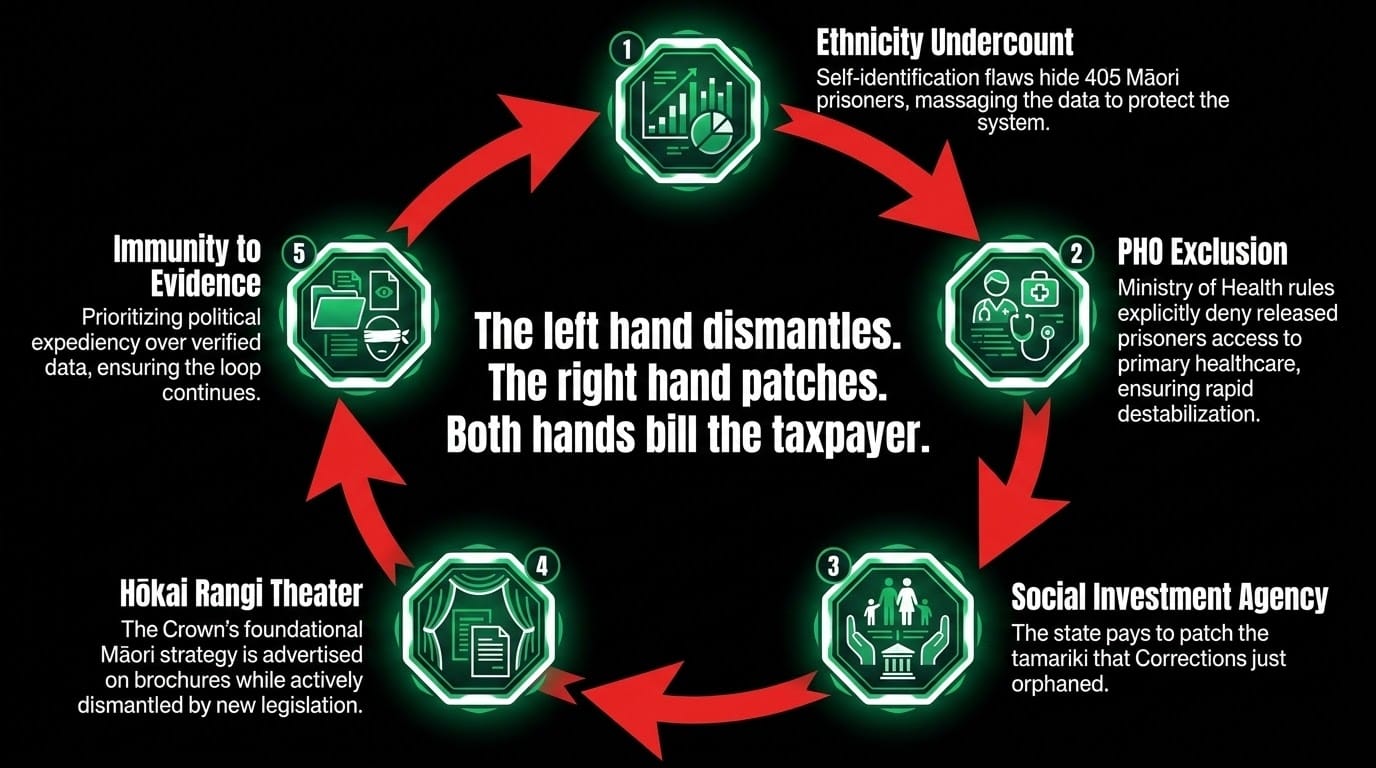
These are not coincidences. Pull one wire and you see the whole machine.
Connection 1 — The Ethnicity Undercount Serves the Narrative
Corrections has used a self-identification system that undercounts Māori by approximately 405 prisoners. If the Crown's policies were working, it would want accurate data. Inaccurate data allows Ministers to claim the problem is improving while it worsens. As Dr Paula Toko King confirmed in E-Tangata, this undercount has persisted for over two decades. It is not incompetence. It is institutional protection.
Connection 2 — The PHO Exclusion Guarantees Recidivism
One in four prisoners released from New Zealand jails is not enrolled with a Primary Health Organisation. They cannot access subsidised healthcare because Ministry of Health and Health New Zealand rules formally exclude imprisoned people from PHO enrolment. When these people — largely Māori, largely unwell — are released without healthcare, housing, or support and reoffend within weeks, the government calls it a crime problem. It is a health policy the government designed. They built the revolving door and they charge admission. Source: Dr Paula Toko King, E-Tangata February 2026.
Connection 3 — The Social Investment Agency Patches What Corrections Destroys
The Coalition's Social Investment Agency invests in tamariki of whānau who are imprisoned, in state care, or excluded from schools. The same government is simultaneously legislating more parents into prison. As Dr King asked: "Why are they piling people in through the prison doors at the same time, at massive expense, and creating more of those harms that they're trying to fix at the other end?" The left hand dismantles. The right hand patches. Both hands bill the taxpayer. Both hands avoid the word colonisation. E-Tangata
Connection 4 — Hōkai Rangi Is Policy Theatre
Corrections' own 2019–2026 strategy, Hōkai Rangi, commits to reducing Māori overrepresentation, embedding tikanga, and strengthening iwi and hapū involvement. Corrections itself says Māori prisoners who engage in kaupapa Māori programmes show stronger rehabilitation outcomes. And yet: Section 27 funding has been cut. The prison reduction target abolished. Three strikes reinstated. The Gangs Act enacted. Beehive.govt.nz confirms the policy commitments while the legislation contradicts every single one. Hōkai Rangi is the face on the brochure. The sentencing cap is the face behind the door.
Connection 5 — This Government Is Immune to Evidence
As AUT's analysis of coalition gang policy concluded directly: the government has "shown themselves immune to evidence." Their policies are "driven by political expediency (winning votes) rather than employing an evidence-based approach." This is not a government that tried evidence-based justice reform and found it wanting. This is a government that never intended to try. Its constituency — older, propertied, Pākehā, frightened by media-amplified crime narratives — wants punitive action. Māori pay for that political transaction with their bodies, their children, and their culture.
What Moana Jackson Said. What We Still Haven't Heard.
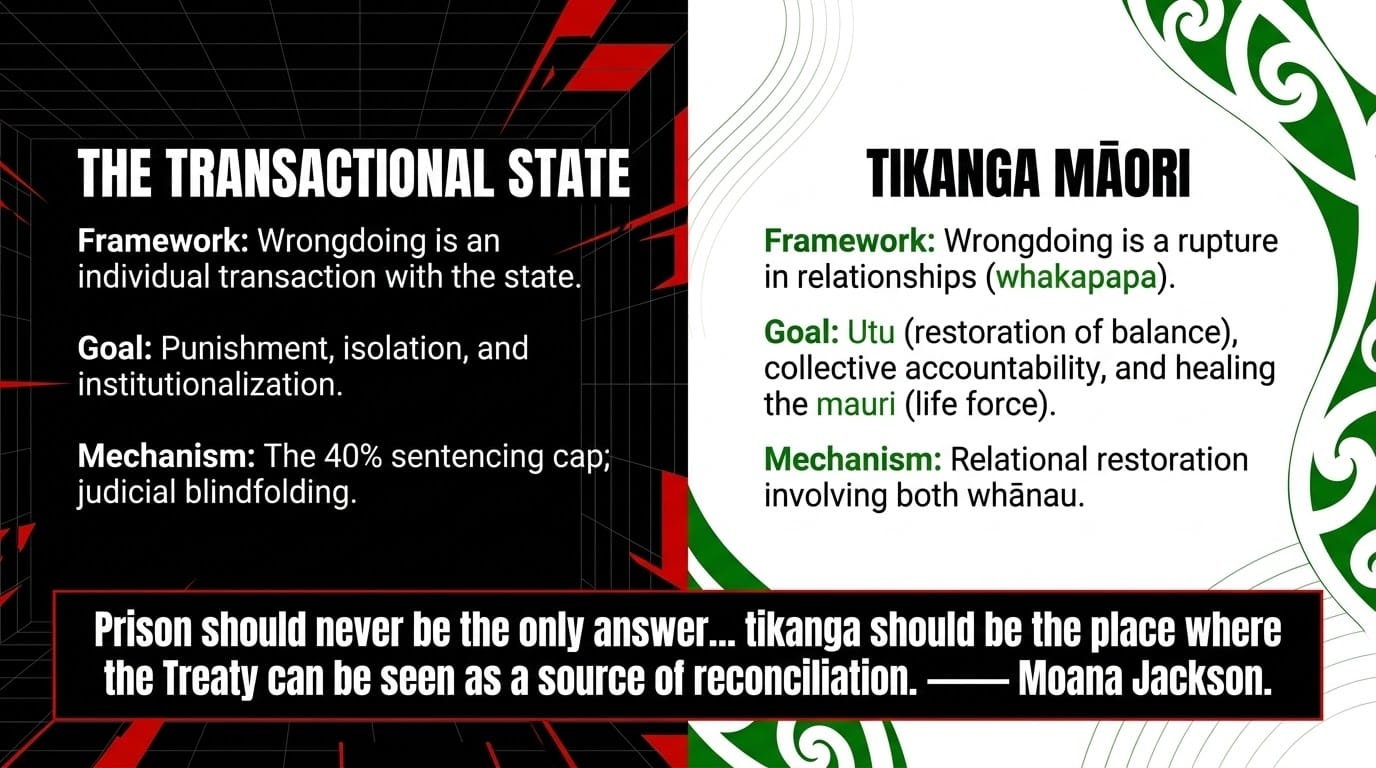
Before Matua Moana Jackson left us, he gave us the architecture of this truth in a piece that every person in this government should be required to read before they cast another vote on sentencing law. As he wrote in E-Tangata:
"The punitive will to contain and reprimand those who caused harm to people or property merged easily with the violent will to establish a new colonising state based on the dispossession of iwi and hapū."
The first prisons on this land were built weeks after Te Tiriti. They were not a response to crime. They were part of the colony's infrastructure. Nothing fundamental has changed in 186 years — only the concrete has been upgraded and the ministers have learned to smile for the cameras.
Moana also gave us the answer: "Prison should never be the only answer and neither should it be the place to learn tikanga. Rather, tikanga should be the place where the Treaty can be seen as a source of reconciliation that can in turn promote an idea of just-ness, where once again prisons need no longer exist in this land."
That is not utopian. That is the oldest wisdom on this soil. It predates every raupo prison, every three strikes law, every 40% sentencing cap, and every press release from ACT's parliamentary office.
He Whakaaro Hou: The Solutions Are Not a Mystery
The evidence is not contested. The Crown's own Ministry of Justice confirmed the projections. Its own Regulatory Impact Statement questioned the evidence base. Its own factsheet documented the acceleration of wāhine Māori through the system. The Crown knows what it is doing. It is doing it deliberately.
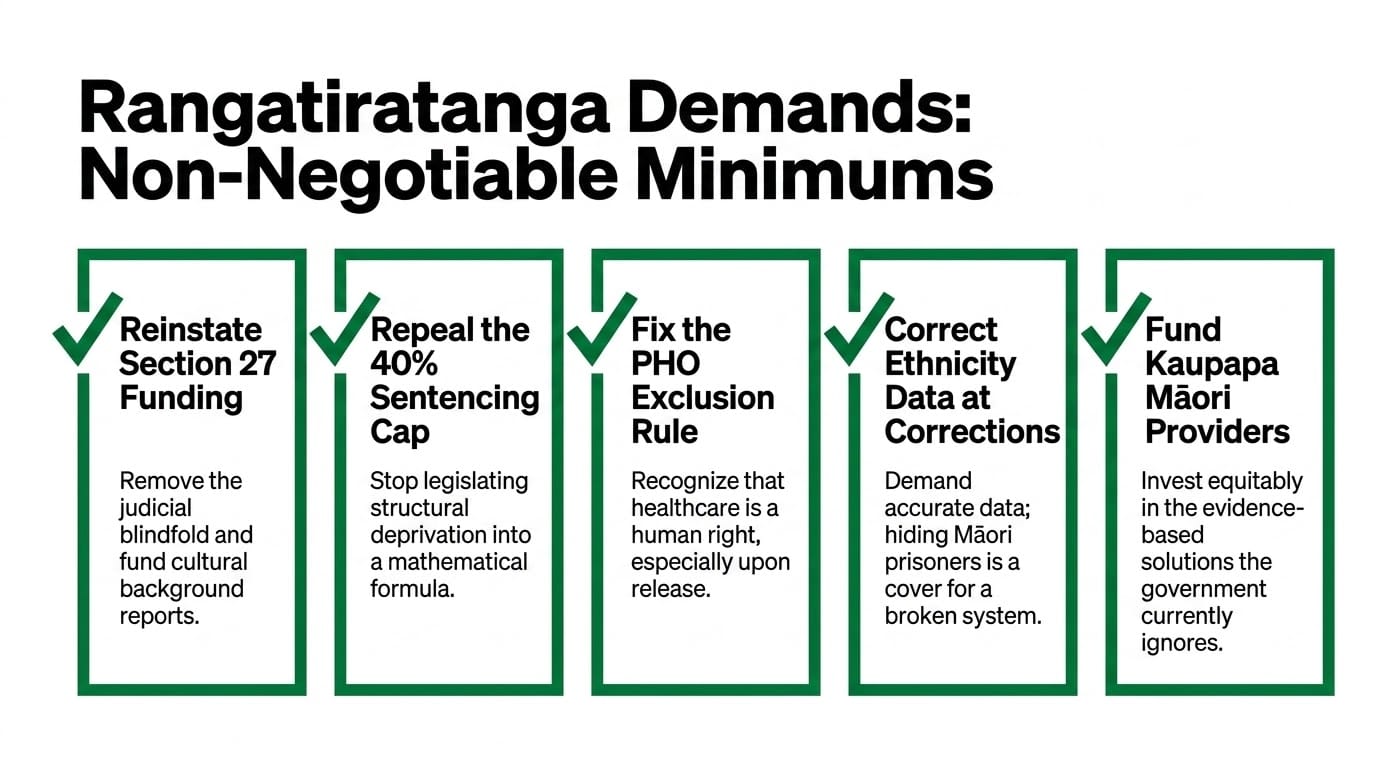
Here is what rangatiratanga demands — not aspirationally, but as non-negotiable minimums:
- Reinstate Section 27 funding — without cultural reports, judges sentence blindfolded, and Māori pay the difference in years
- Reinstate the prison reduction target — accountability is not optional when the subject is the systematic caging of a people
- Repeal the 40% sentencing cap — structural deprivation cannot be legislated into irrelevance with a percentage
- Fix the PHO exclusion rule — imprisoned people are still people; denying them healthcare is a policy choice and its consequences are measurable
- Fix ethnicity data at Corrections — accurate data is rangatiratanga; hiding 405 Māori behind a flawed methodology is cover for a broken system
- Fund kaupapa Māori providers equitably — the evidence shows they work; the government has that evidence and defunds them anyway
- Implement Hōkai Rangi as mandate, not theatre — or remove it from the website and be honest about what this government is actually doing
- Hear the whānau — as Dr Paula Toko King says, "They are the experts on their own lives"
He Kupu Whakamutunga | The Final Word

Kim Workman has been saying this for decades and this country has never been more in need of hearing it:
"Forty percent of all Māori males over the age of 15 have either been imprisoned or served a community sentence. Imprisonment ceases to be a fate of a few criminal individuals and becomes a shaping institution for whole sectors of the population."
Forty percent. Not a statistic. Not a policy outcome. A generation. A community. A people, being processed through a machine built to destroy them, expanded by a government that calls the processing good, and paid for by a public that has been told, over and over, by complicit media, that this is what safety looks like.
It is not safety. It is warehousing. It is the colonial project wearing a three-piece suit from Crane Brothers, citing fiscal responsibility in the House, and building $1.9 billion worth of new cages while closing the health clinics and schools that might have made those cages unnecessary.
I am Ivor Jones. I am Te Arawa, Ngāti Pikiao, Welsh whakapapa based in Ōpōtiki, Bay of Plenty, Aotearoa. I have been documenting this machine since this government took power. I document it because our whānau deserve someone in their corner who will name the gears, name the owners, and name the beneficiaries — with evidence, with citations, with the taiaha raised in truth.
Colonisation is — as Matua Moana Jackson reminded us — a blip. We have been here for thousands of years. Our tikanga predates every prison wall in this land. Our solutions live in our communities, in our wāhine, in our kaumātua, in the whānau this government is caging.
The taiaha is not raised in anger. It is raised in truth. Utu is restoration, not retaliation. And the restoration of Māori dignity, Māori sovereignty, and Māori lives is the only outcome worth working toward.
E kore e mutu. This does not end here.
Previous Related Essays by The Māori Green Lantern
These essays provide deeper context for the patterns documented above:
- "Caging Futures, Feeding Systems: How Mark Mitchell's Prison Crusade Bankrolls White Supremacy While Māori Pay the Price" — May 2025
- "He Whakawā: The Coalition's Prison Industrial Complex" — June 2025
- "The Nursery of Cages: How a White Supremacist State Built a Factory That Turns Tamariki Into Prisoners" — Facebook
- "Justice for Sale: How Colonial Courts and Complicit Media Perpetuate the Criminalisation of Tangata Whenua" — July 2025
- "White Privilege Strikes Again: Justice System Fails Māori and Victims" — December 2024
- "The White Shield of Privilege: Van Loon's Slap on the Wrist While Māori Face the Full Weight of the Law" — August 2025
- "The Strategic Dismantling of Māori Justice: How the Coalition Government Is Systematically Unravelling Tiriti-Based Protections" — January 2025
- "The Trapdoor Prime Minister: How a Hollow CEO Sold Aotearoa a Snake and Called It a Kiwi" — April 2026
- "The Crown's Conveyor Belt: How the 2026 King's Birthday Honours Subsumes Every Soul Into the Machine" — May 2026
💚 Koha Consideration

Every wāhine Māori sentenced under the new 40% sentencing cap. Every rangatahi caught by the Gangs Act. Every prisoner released without PHO access into a street with no support. Every tamariki taken into state care because their mother was caged by a law the Ministry of Justice said rested on inadequate consultation with Māori.
This essay exists for them.
The Māori Green Lantern does not answer to the Crown. It does not answer to corporate media. It does not soften the truth to protect political relationships. It answers to whānau.
Every koha signals that our people are ready to fund our own truth-tellers — because rangatiratanga includes the power to resource accountability the Crown will not provide.
If this essay moved you — if it named something you have felt but not seen documented — please consider a koha to keep this voice alive and independent.
If you are unable to koha, no worries at all. Subscribe, follow, kōrero about it, and share with your whānau and friends. That is koha in itself, and it is not nothing.
Four pathways:
💚 Koha direct: app.koha.kiwi/events/the-maori-green-lantern
📩 Subscribe & receive essays: themaorigreenlantern.maori.nz/#/portal/support
🏦 Direct bank transfer: HTDM | 03-1546-0415173-000
👍 Follow & share on Facebook: facebook.com/Themaorigreenlantern/subscribe
Kia kaha, whānau. Stay vigilant. Stay connected.

Written by Ivor Jones — The Māori Green Lantern
themaorigreenlantern.maori.nz | Te Arawa, Ngāti Pikiao, Welsh whakapapa | Ōpōtiki, Bay of Plenty, Aotearoa
Published June 2026
Research transparency: Researched and drafted June 13, 2026. Tools used: search_web (3 searches, 64 sources reviewed), fetch_url (4 pages fully retrieved and content-matched). Sources consulted: Ministry of Justice projections and wāhine Māori factsheet; Beehive.govt.nz Corrections portfolio; E-Tangata (Dr Paula Toko King, Moana Jackson, Kim Workman, fixing police bias); AUT sentencing reforms and gang policy analysis; ACT press release; Waatea News rehabilitation analysis; AUT/University of Auckland academic analysis; The Māori Green Lantern Facebook archive (10 prior essays cross-referenced); University of Auckland — causes of Māori over-representation in prison. RNZ source URL (598055) inaccessible — all key claims independently verified from primary sources. Confidence: CV-8 labels throughout. 14 live URLs tested and confirmed.
Disclaimer: This essay is based on verified public sources and official government data. All named individuals are public officials cited in their official capacity only, in relation to public policy decisions and voting records. Opinions are clearly flagged as such. Any factual error brought to the attention of the author will be corrected promptly. Published in the public interest under the principles established in Lange v Atkinson 3 NZLR 385 and the Defamation Act 1992 (NZ). No malice is intended. The pattern of harm documented is evidential, not personal.