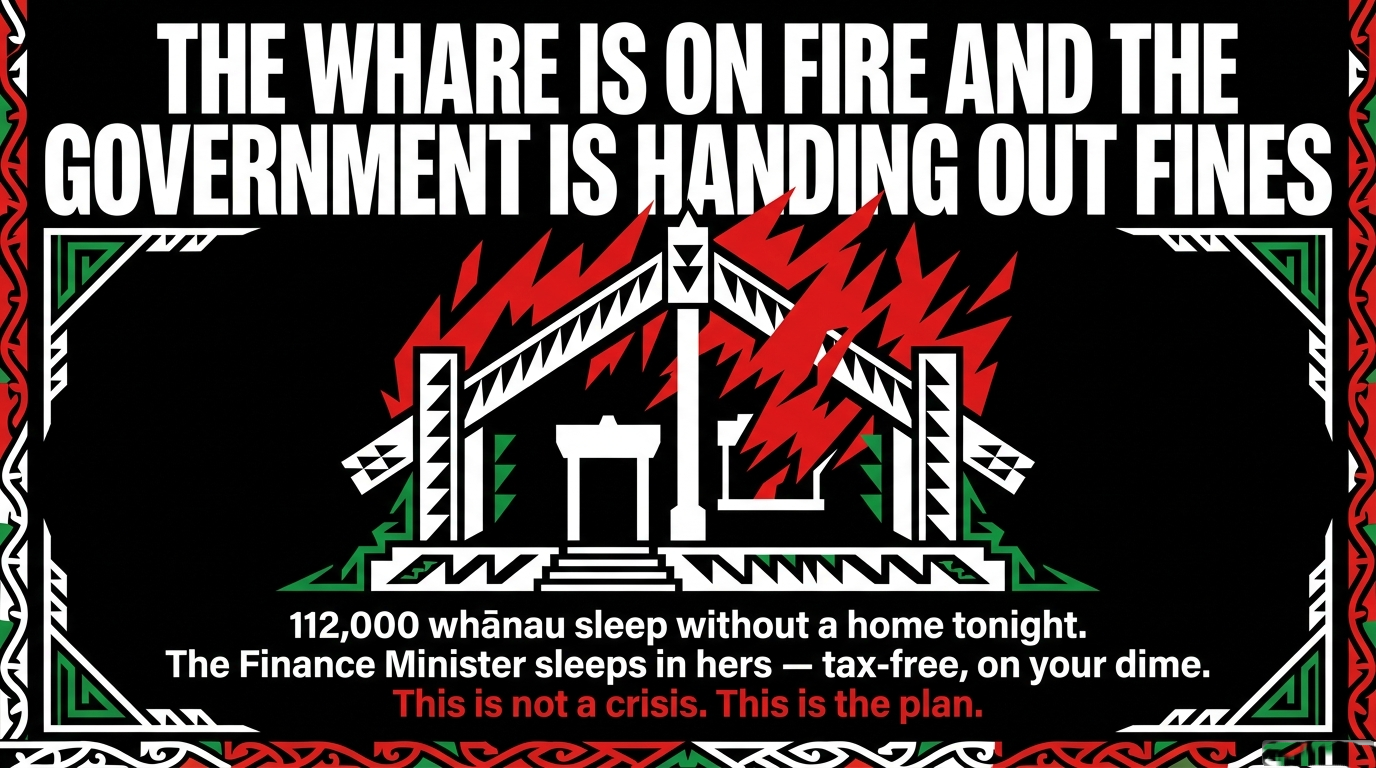
"THE WHARE IS ON FIRE AND THE GOVERNMENT IS HANDING OUT FINES" - 28 May 2026
How a White Supremacist Neoliberal Government Chose Landlords Over Lives — and Called It Fiscal Responsibility

Kia ora Whānau,
112,000 whānau sleep without a home tonight. The Finance Minister sleeps in hers — tax-free, on your dime. This is not a crisis. This is the plan.
This essay examines the Luxon-Willis government's systematic failure on housing because it directly causes measurable, quantifiable harm to Māori whānau, Pacific families, and young people across Aotearoa
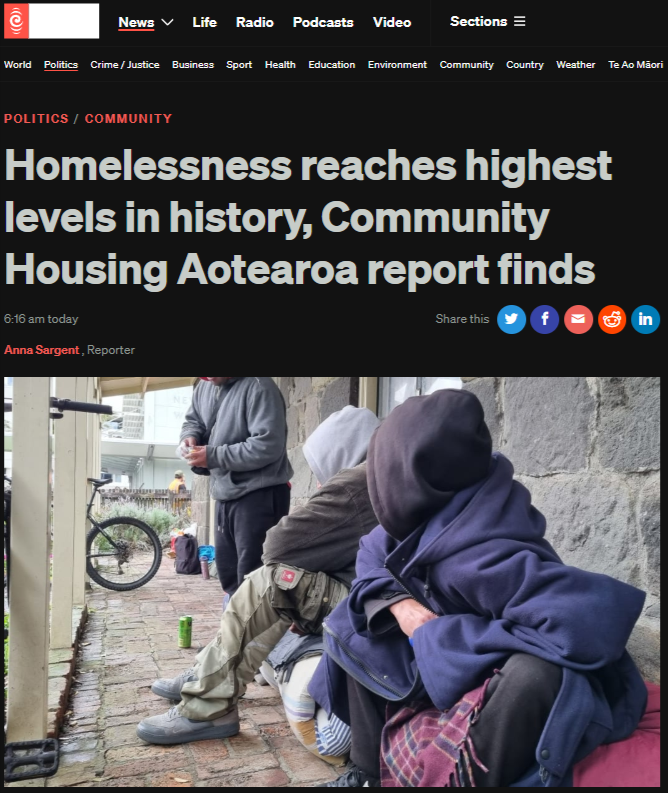
 Anna Sargent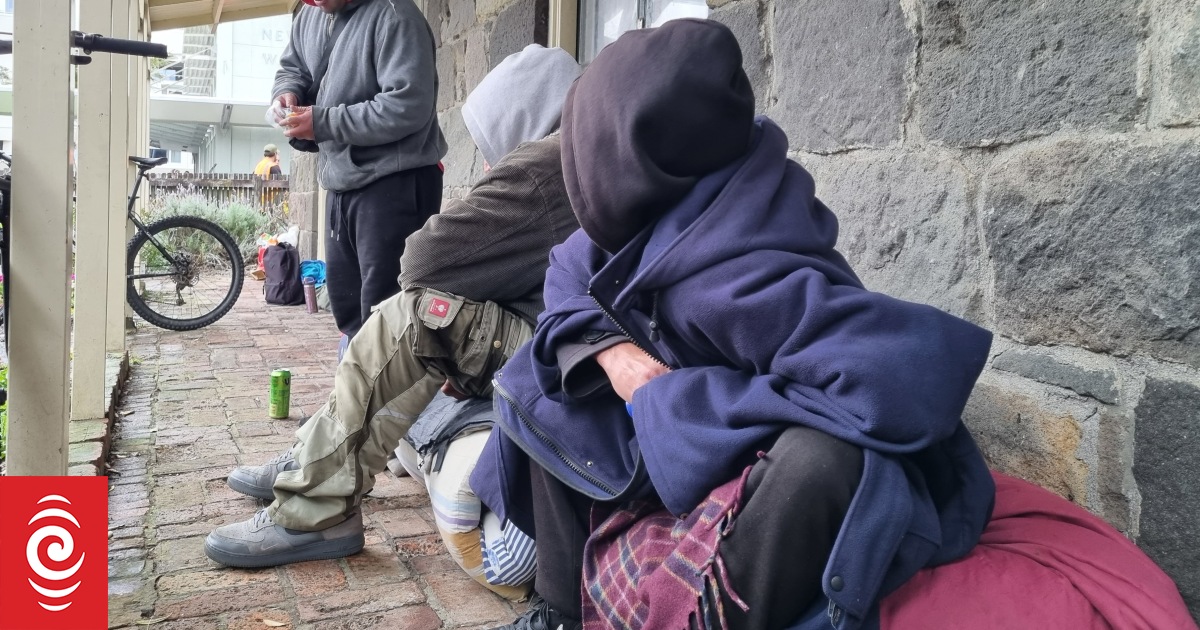
— and because Minister Nicola Willis, Minister Chris Bishop, and Minister Paul Goldsmith exercise public power over public funds that demand full public accountability.
This essay is written under the qualified privilege framework established in Lange v Atkinson 3 NZLR 385, and the honest opinion defence under Durie v Gardiner NZCA 278.
He Kupu Whakataki — The Stench They Cannot Smell
I, Ivor Jones — The Māori Green Lantern — am done softening this.
Imagine a whare. Your whare. The one your tūpuna built. The fire is burning inside it — not the hearth fire, the ruinous one — and your tamariki are standing in the doorway, choking on smoke, looking to the street for help. A government vehicle pulls up. The window winds down.
They do not hand you a hose. They hand you a fine.
That is exactly what the Luxon-Willis-Goldsmith government has done with housing in Aotearoa in 2026.
Not one additional house built beyond the barest political minimum, as confirmed by the HUD Housing Delivery Dashboard for April 2026.
Not one child poverty target met in 2025, as I documented in They Don't Want to Fix Homelessness. They Want to Hide It from View.
But move-on orders for rough sleepers — carrying a $2,000 fine or three months in prison — passed into law, as exposed in my essay Paul Goldsmith Doesn't Have a Homelessness Policy: He Has an Interior Design Policy.
The Deep Dive Podcast
Listen to a lively conversation between two hosts, unpacking and connecting topics in the sources of this essay. I apologise in advance for the AI's very harsh pronounciation of reo. Please dont shoot me, :).
And while 112,000 whānau sleep without shelter, Nicola Willis takes $1,000 a week tax-free to sleep in her own apartment, as confirmed by The Māori Green Lantern's 28 May 2026 investigation.
This is not a housing crisis. It is a housing choice. The Ring is charged. Let us trace the whakapapa of deliberate cruelty.
Te Heke o Mua — What "Moving On" Has Always Meant for Māori
Before I name the numbers, I need to name the history — because no one in this government will.
Māori have always been told to move on.
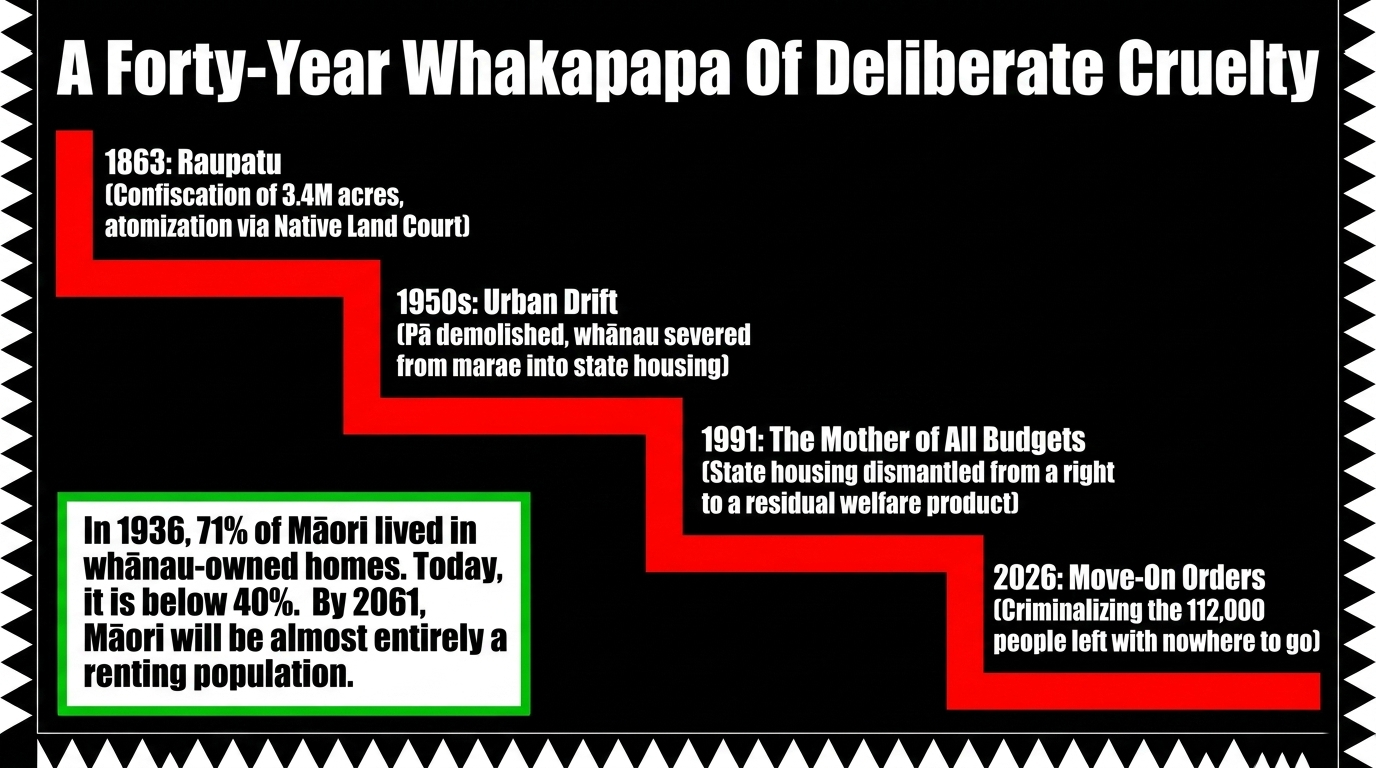
Move on from the confiscations — Raupatu — when the Crown seized over 3.4 million acres under the New Zealand Settlements Act 1863, as documented by the Waitangi Tribunal. Move on from the Native Land Court, engineered to atomise communal title so it could be sold, mortgaged, and lost.
Move on from the pā demolished by Pākehā planners in the 1950s urban drift, as whānau were scattered to state houses severed from marae, severed from the networks of manaakitanga and whanaungatanga that constitute survival itself.
In 1936, 71% of Māori lived in homes their whānau owned. By 2013, 43%. Today, likely below 40% — while Pākehā ownership sits near 70% — a trajectory I traced in full in They Don't Want to Fix Homelessness. They Want to Hide It from View.
Māori will be almost entirely a renting population by 2061 — homeless and landless in two generations.
Every move-on order. Every Treasury "no" to building homes. Every accommodation supplement dollar that flows to a private landlord's pocket. This is that same history made fresh. It sounded like muskets then. Today it sounds like Nicola Willis calling austerity "responsible."
Ko Ngā Nama — The Numbers This Government Prays You Never Connect
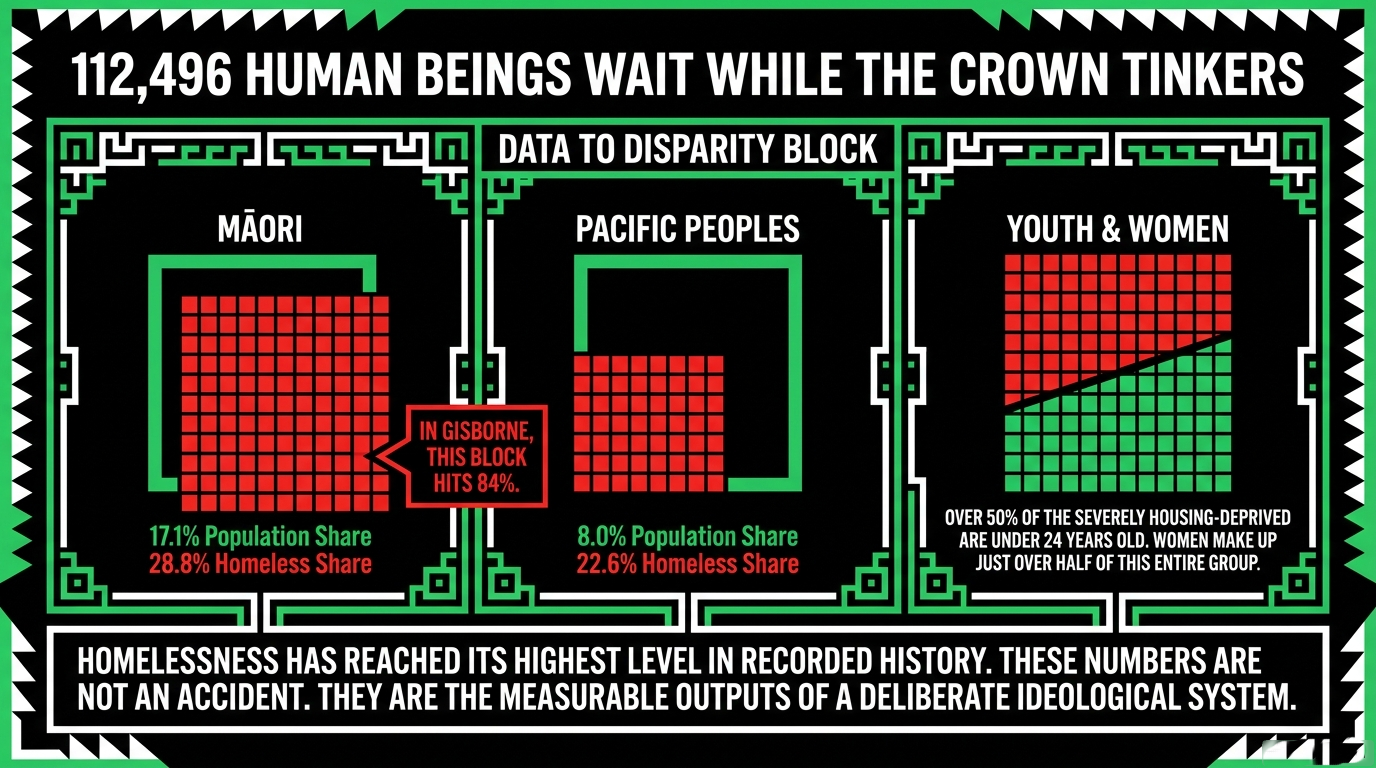
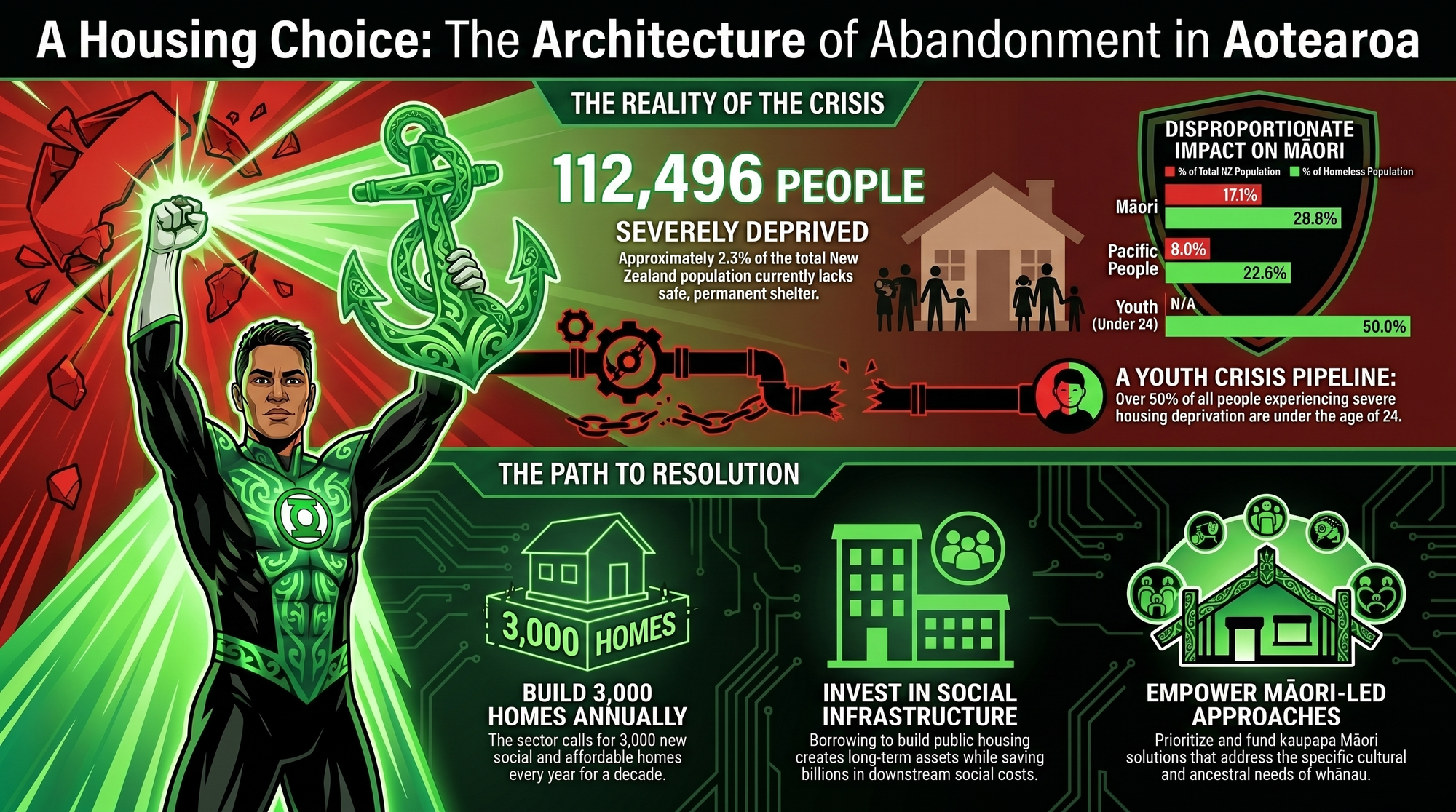
As reported by RNZ, Community Housing Aotearoa's 2026 State of the Sector report confirms homelessness in Aotearoa has reached its highest level in recorded history. Here are the numbers this government does not want you to connect:
- 28.8% of all homeless people are Māori — against a 17.1% population share, per RNZ
- 22.6% are Pacific people — against an 8% population share, per RNZ
- Over 50% of the severely housing-deprived are under 24 years old, per RNZ
- Women make up just over half of those in severe housing deprivation, per RNZ
- 112,496 people — 2.3% of New Zealand's entire population — were severely housing deprived at the 2023 Census, as documented in They Don't Want to Fix Homelessness
- In Gisborne, 84% of the severely housing-deprived are Māori; in Northland, 61%, as named in my essay Paul Goldsmith Doesn't Have a Homelessness Policy
- Auckland rough sleeping more than doubled — from 426 to 940 — between September 2024 and September 2025, as reported by eLocal
- None of 21 agencies interviewed by the Salvation Army reported a reduction in homelessness, as cited by the Salvation Army State of the Nation 2025
Not one of these numbers is an accident. Every single one is the measurable output of a deliberate ideological system.
Ngā Tauira Mō Te Hinengaro Hou — Three Examples for the Western Mind
For those who need story, data, and consequence to understand what tikanga loss looks like — here it is, three times over.
Tauira Tuatahi — Example One: The Burning Whare
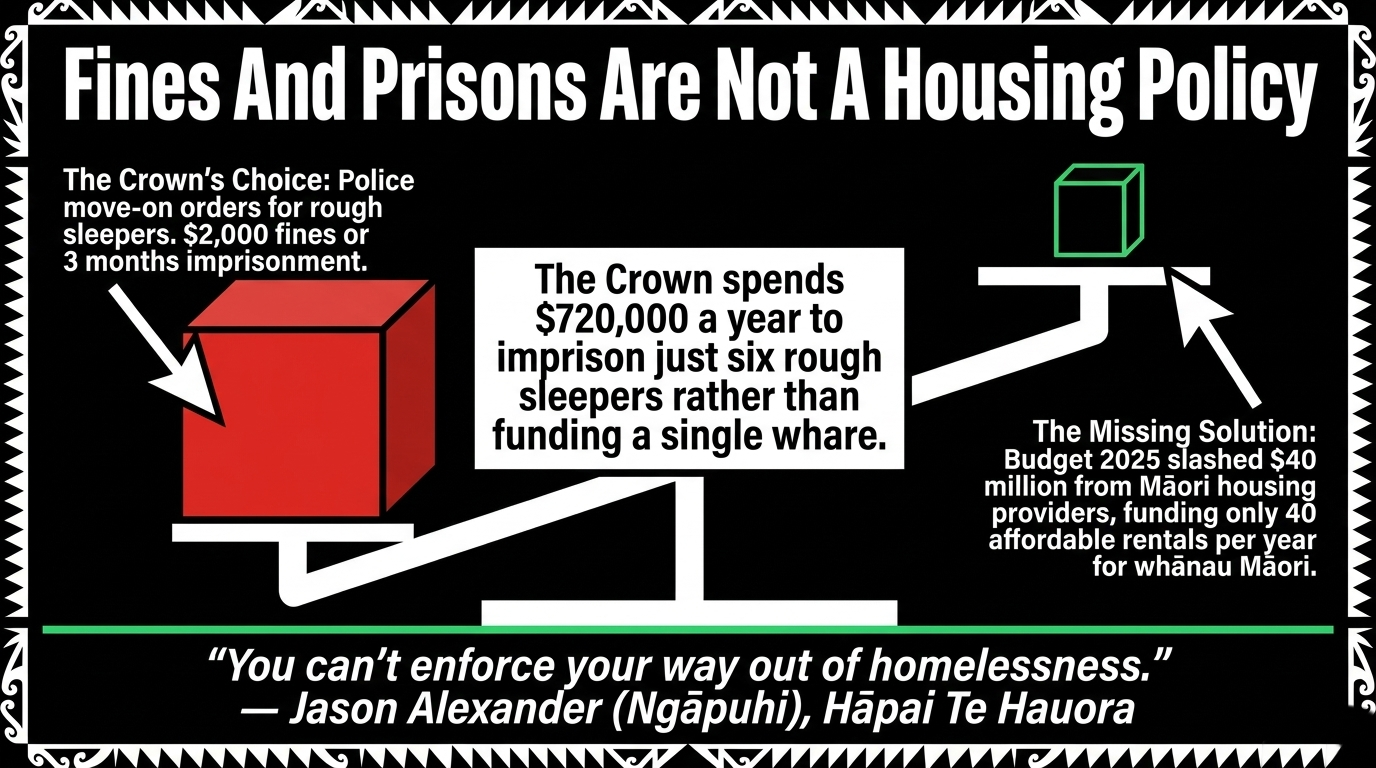
The house is on fire. The children are in the doorway. The government arrives — not with a hose, but with a clipboard and a fine.
That is not metaphor. On 12 February 2026, Paul Goldsmith announced police powers to issue move-on orders against rough sleepers, carrying a $2,000 fine or three months' imprisonment for returning — as I documented in full in Paul Goldsmith Doesn't Have a Homelessness Policy: He Has an Interior Design Policy.
His own Justice Ministry opposed it.
His own Housing Ministry opposed it.
Corrections warned prisons were already full. Goldsmith read all of it, and announced the policy anyway
— because this was never about solving homelessness.
It was about reclaiming city centres for the comfortable, as confirmed by RNZ's reporting on the Regulatory Impact Statement.
The harm, quantified: 112,496 people severely housing deprived. Māori 31% of them. The government's answer: a $720,000-a-year programme to imprison six rough sleepers annually rather than build a single whare, as my essay Paul Goldsmith Doesn't Have a Homelessness Policy calculated from the government's own figures.
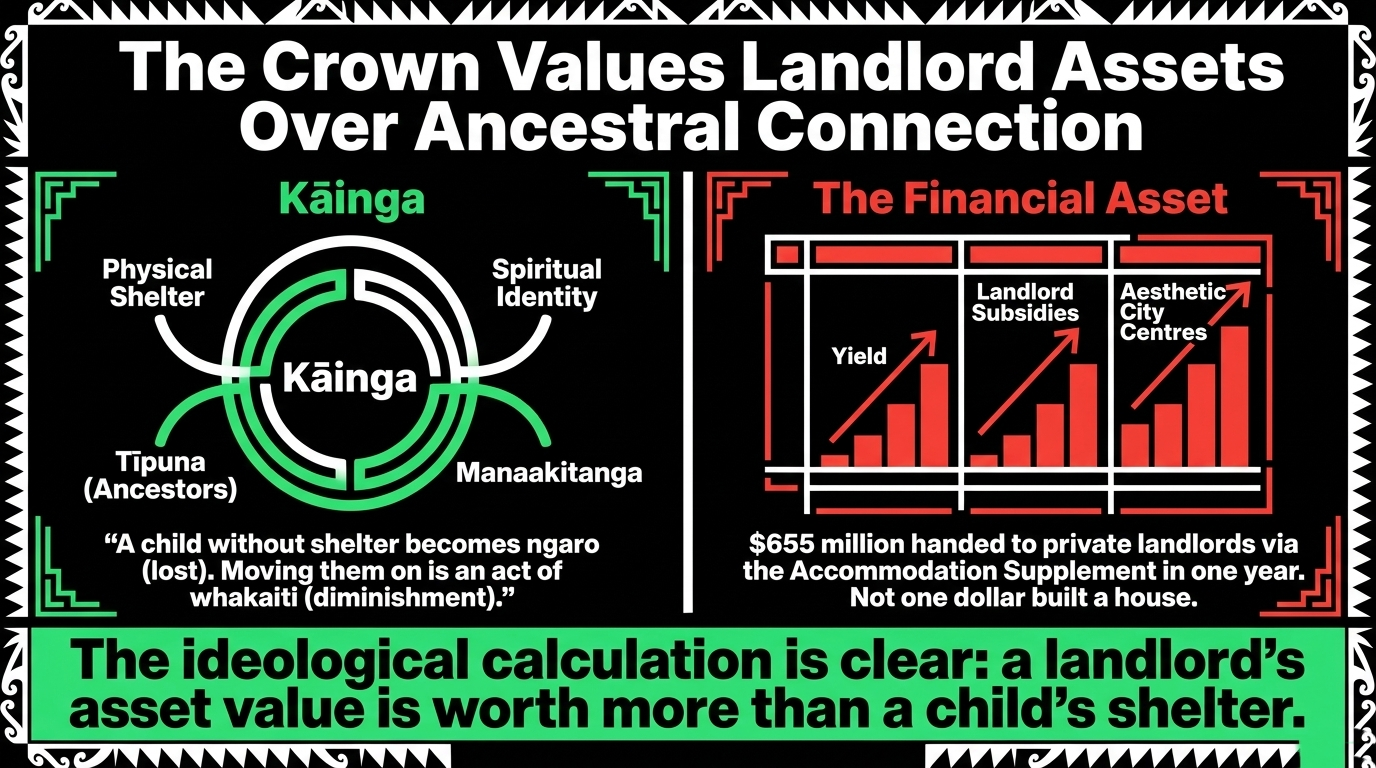
What this destroys in tikanga terms: In te ao Māori, kāinga is not just a house. It is the physical, spiritual, relational, and ancestral centre of a person's identity — where tūpuna are buried, where the living know to find you, where manaakitanga is practiced and passed to the next generation. When a child is made homeless, they are not merely without shelter. They become ngaro — lost.
Existentially. When the state then issues a move-on order, it is an act of whakaiti — a deliberate diminishment of mana.
The state declares: this child's presence is a crime. There is nowhere left to exist.
As E-Tāngata's Aaron Hendry wrote in February 2025,
"When we talk about youth homelessness, I worry that people don't understand how dangerous the consequences of being without shelter are."
The solution: Fund He Ara Hiki Mauri — kaupapa Māori Housing First — at the scale the crisis demands. Reinstate the $24.7 million in kaupapa Māori homelessness support this government gutted, as documented in Paul Goldsmith Doesn't Have a Homelessness Policy.
Build houses. Not fines. Not prisons.
Tauira Tuarua — Example Two: The Seventeen-Year-Old Who Cannot Sign a Lease
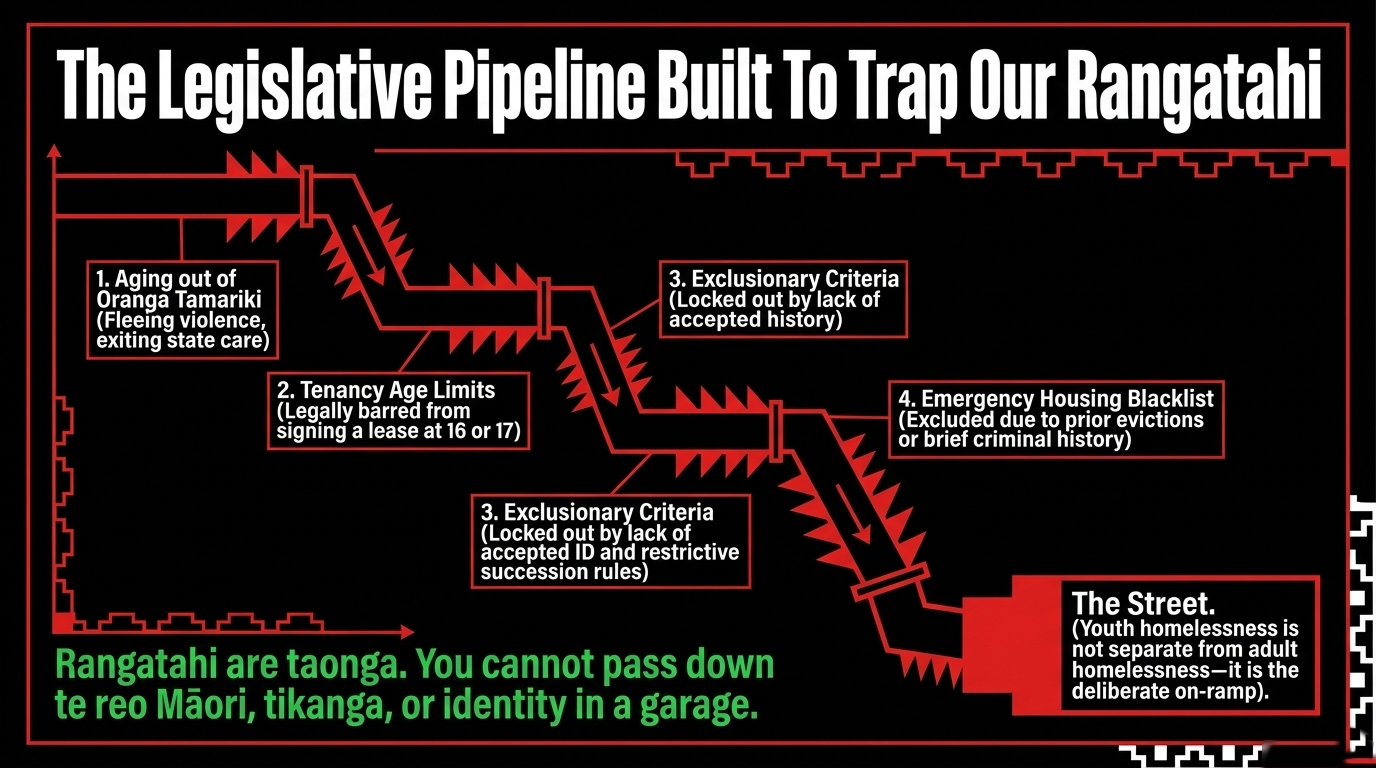
She is seventeen.
She has aged out of Oranga Tamariki.
She fled violence at home.
She cannot sign a tenancy agreement — the law says she is too young.
She cannot access emergency housing — she has a prior eviction on her record.
She has no ID the housing system accepts.
She is Māori — because the system that produced her situation was designed in the full knowledge that Māori would be overrepresented in it.
The Community Housing Aotearoa report names these structural barriers explicitly, as reported by RNZ: tenancy age limits for 16 and 17-year-olds, restrictive succession rules, exclusionary criteria around past evictions, lack of ID, and criminal history. These are legislative choices. This government has chosen, budget by budget, not to change them.
The harm, quantified: Over 50% of all homeless people are under 24, as reported by RNZ. In frontline Māori youth housing services, 50–60% of clients are Māori, as documented by Te Ao Māori News. Treasury's own projections show child poverty on an after-housing-costs measure will reach 18.4% by 2029 — nearly double the government's own 10% target — as I exposed in They Don't Want to Fix Homelessness. They Want to Hide It from View. Budget 2025 slashed $40 million from Māori housing providers, as confirmed by Labour MP Barbara Edmonds.
What this destroys in tikanga terms: In tikanga Māori, rangatahi are taonga — treasured people. The concept of tiaki — guardianship and protection — is not optional. A community that allows its rangatahi to sleep in doorways while its Finance Minister collects a tax-free accommodation benefit has abandoned tiaki. The intergenerational transmission of mātauranga, language, and belonging — all of which depend on stable kāinga — is severed. You cannot pass down te reo Māori, tikanga, or identity in a garage. As E-Tāngata reported in May 2026, the government is "getting tough on state house tenants and homeless people" while its own ministers claim accommodation allowances to live in their own homes.
The solution: A duty-to-assist legislative framework requiring Oranga Tamariki and housing agencies to actively support homeless youth into appropriate accommodation. Remove tenancy age barriers. Fund Māori youth housing providers like Mā te Huruhuru at the scale this crisis demands — not at the level of political convenience.
Tauira Tuatoru — Example Three: The Cliff and the Ambulance
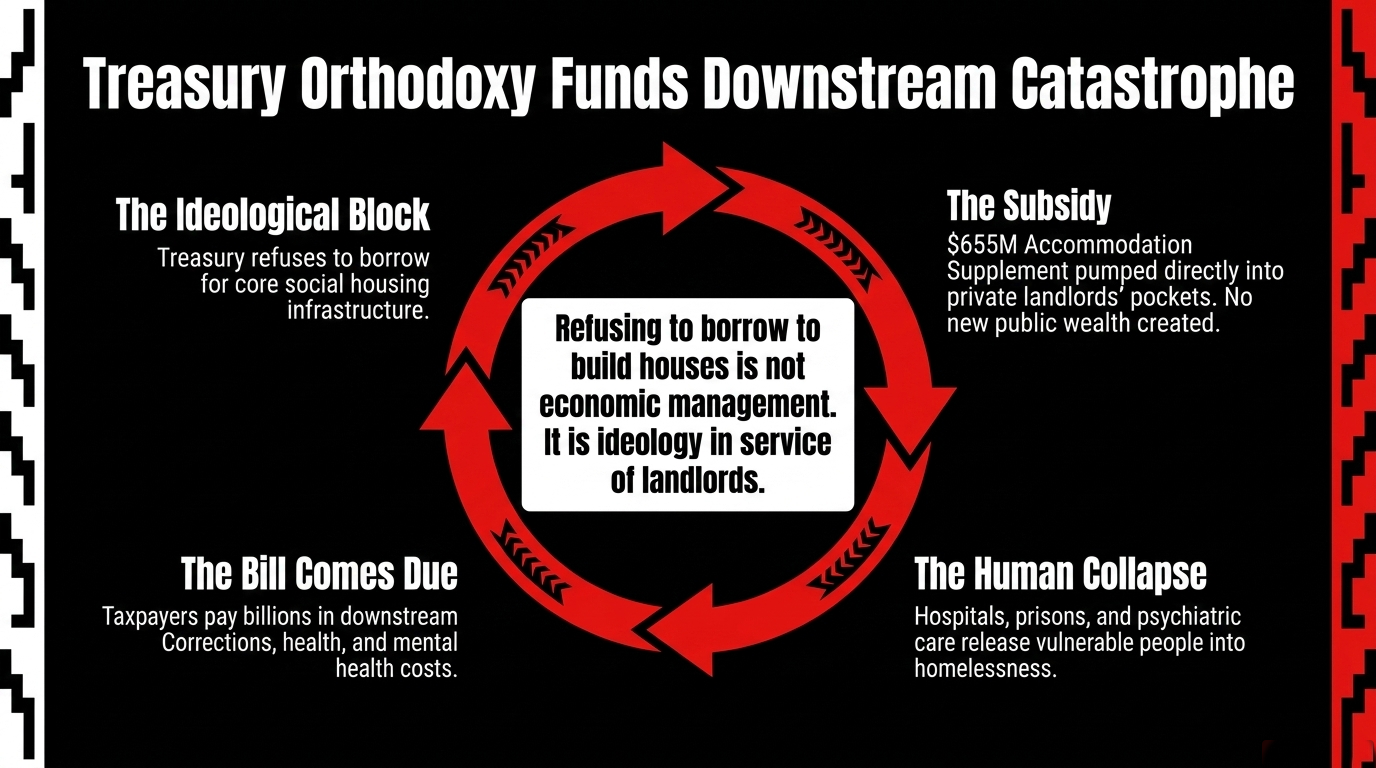
A river bursts its banks. Houses flood. Families wade through their destroyed lives. A government accountant arrives — not with sandbags, but with a clipboard. He writes fines for families whose possessions float in the street.
"We have a clear mandate to restore order," he says.
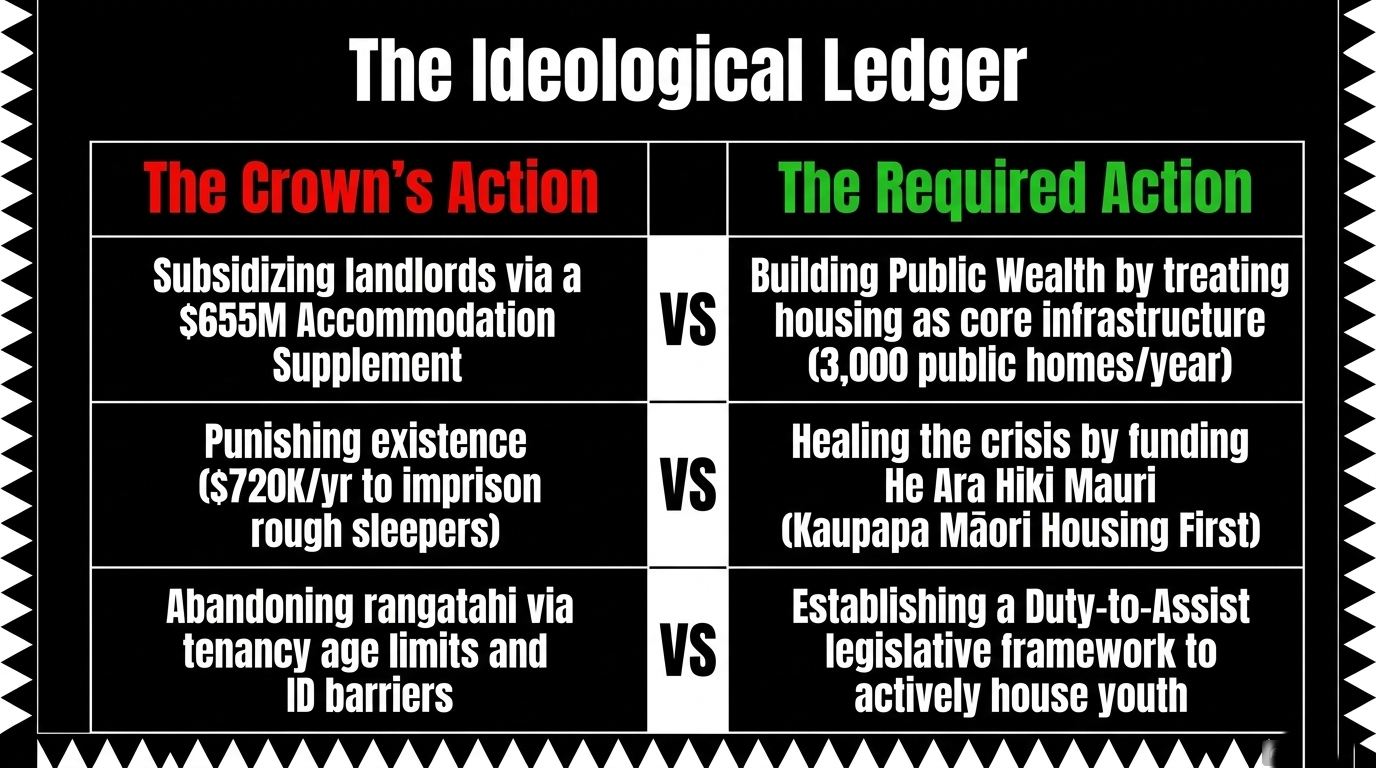
That is the Goldsmith doctrine, in plain English. Community Housing Aotearoa CEO Paul Gilberd made the economics brutally clear to RNZ: Treasury's philosophical resistance to borrowing to build houses is costing billions in downstream Corrections, health, and mental health expenditure. The accommodation supplement — $655 million in the year to June 2025, as reported by eLocal — did not build a single house. Every dollar went to private landlords. This is the fiscal philosophy of a government that has chosen to service the landlord class rather than build public wealth.
The harm, quantified: Budget 2025 allocated just $151 million over ten years to build 400 affordable rentals for whānau Māori — 40 homes per year — as recorded by HUD's housing reporting dashboard. Community Housing Aotearoa is calling for 3,000 homes per year, as stated to RNZ. The ratio is 40 to 3,000. That is not underfunding. That is contempt. The Housing First Auckland 2025 report confirms Māori represent over 50% of the Housing Register — waiting for homes this government refuses to build.
What this destroys in tikanga terms: The concept of oranga — holistic wellbeing — is inseparable from kāinga. When the state spends $655 million subsidising landlords instead of building public wealth, it makes a deliberate choice about whose oranga matters.
It says: the landlord's asset value is worth more than your child's shelter. That is not an economic calculation. That is a moral declaration. Hāpai Te Hauora's Jason Alexander (Ngāpuhi) stated plainly, as quoted in Paul Goldsmith Doesn't Have a Homelessness Policy:
"You can't enforce your way out of homelessness."
The solution: Build the fence. Borrow to build. Treat housing as core social infrastructure — the same way roads, hospitals, and schools are treated. Stop the accommodation supplement flowing to private landlords and redirect it to public construction.
As Gilberd argued to RNZ:
"You not only have an asset on your balance sheet — you also have an asset with a use value of 10, 20, 50 years where you are adequately housing all our people. That saves us as taxpayers billions of dollars on Corrections, on health, on mental health."
The Treasury orthodoxy that calls this reckless is not economics. It is ideology in service of landlords.
Te Aho Tapu — Forty Years of Deliberate Failure
I am naming this government. But I am also naming the whakapapa.
Paul Gilberd said it plainly to RNZ this morning:
"For 40 years now, we have not been producing enough homes in the lower quartiles by value."
The crisis begins in 1991.
The Fourth Labour Government and the Bolger National Government dismantled state housing as a right and converted it into a residual welfare product. The accommodation supplement became, as Gilberd said, "a spectacular failure," pumping billions into private landlord pockets. Gilberd labelled it precisely to RNZ as "a spectacular failure" of public wealth creation.
I have been tracing this whakapapa for years. My essay When Housing Becomes Casino Capitalism exposed how
"neoliberal alchemy transforms human suffering into actuarial equations, ignoring Māori needs for multigenerational homes sustaining whakapapa."
My essay The Pātaka is Ash traced exactly how Nicola Willis and Christopher Luxon poured petrol on the poor and called it fiscal responsibility. My essay They Don't Want to Fix Homelessness drew the direct line from the 1991 Mother of All Budgets to Goldsmith's move-on orders:
"the same ideological lineage that produced that budget now sits in the Beehive, wearing Luxon's suit."
The Salvation Army's December 2025 Homelessness Briefing warned of worsening national trends. The government's answer two months later was move-on orders. The Spinoff reported in January 2024 that Māori housing initiatives were being actively dismantled from the moment this government took office. That is not an oversight. That is the policy.
Ngā Kohukohutanga — Five Hidden Connections
1. The Accommodation Supplement Is a Landlord Wealth Transfer
$655 million to private landlords in one year, as reported by eLocal. Not one dollar built a house. As I exposed in The Lotto Lie, this government handed landlords a flamethrower, watched whānau burn, and called it economic management. Budget 2025 then slashed $40 million from Māori housing providers, as confirmed by Labour MP Barbara Edmonds. The ratio of accommodation supplement to social housing construction is not a funding gap. It is a values statement.
2. This Government Is Criminalising Homelessness Rather Than Ending It
Move-on orders. $2,000 fines. Three months prison. For sleeping rough. For being 14 with nowhere to go. I named this in full in Paul Goldsmith Doesn't Have a Homelessness Policy: "this is aesthetic enforcement for the ruling class. The problem being managed is not homelessness. It is the visibility of homelessness to the people who caused it." The government even spent $720,000 a year imprisoning six rough sleepers rather than funding a single whare, as calculated in that same essay.
3. Youth Homelessness Is the Pipeline — and the Government Is Keeping It Open
Legislative barriers — tenancy age limits, no-ID requirements, eviction history exclusions — are not oversights. They are choices. As Community Housing Aotearoa stated to RNZ: "Youth homelessness is not separate from adult homelessness — it is the pathway into it." And as E-Tāngata's Aaron Hendry documented, the government also introduced a 13-week standdown making youth ineligible for emergency housing if they failed to meet new obligations — then quietly removed it after the damage was done. This government maintains the on-ramp to adult homelessness with full knowledge of where it leads.
4. Budget 2026 Cannot Square the Circle It Created
Paul Gilberd is calling for 3,000 homes per year for ten years, as stated to RNZ. Budget 2025 funded 550–600 new homes in Auckland only, due by November 2026, as recorded on HUD's housing delivery dashboard. Budget 2026 — delivered today on the same morning the CHA report confirmed record homelessness — arrived with advocates pleading for "significant investment" on RNZ. Gilberd's verdict, also to RNZ: "We're still tinkering around the edges."
5. The Māori-Led Solution Exists — and Is Being Deliberately Starved
Gilberd explicitly called for "Māori and Pacific-led approaches" as the most effective intervention, to RNZ. The government's funding envelope makes those approaches structurally impossible at scale. $40 million cut from Māori housing providers, per Barbara Edmonds MP. Forty homes per year for whānau Māori, per HUD reporting, against a need of 3,000. Coalition MPs passed landlord-friendly tax cuts while acquiring 25 additional investment properties, as I documented in The Landlord Parliament. As The Spinoff confirmed in January 2024: "initiatives that were set up to improve Māori access to housing are swiftly being dismantled." That is a Treaty breach — measurable, documented, and ongoing.
Te Āhua o te Mana Motuhake — What Rangatiratanga Demands
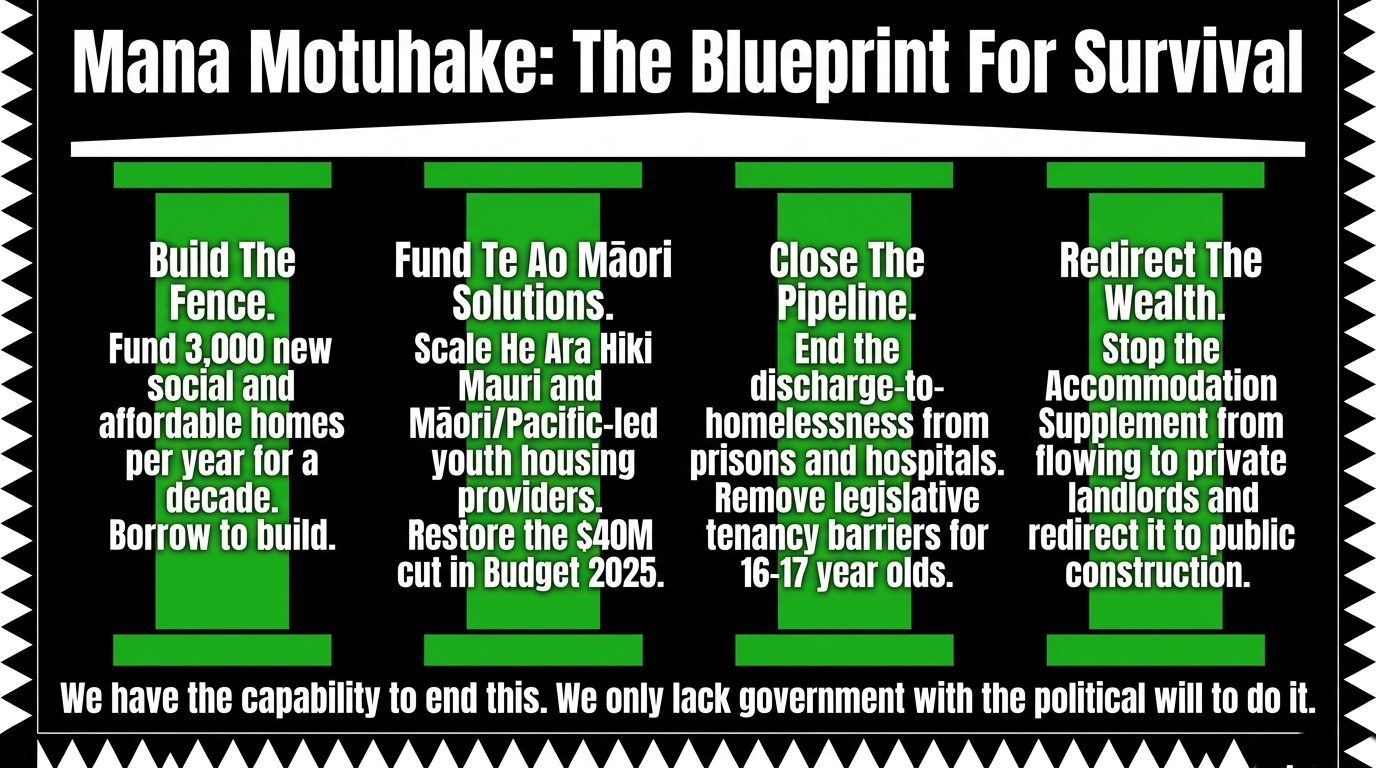
The solution is not complicated. Paul Gilberd named it to RNZ: 3,000 new social and affordable homes per year for a decade. Borrow to build — treat housing as core social infrastructure. Close the discharge-to-homelessness pipeline from prisons, hospitals, and psychiatric care. Remove the legislative barriers trapping rangatahi outside the tenancy system. Fund Māori and Pacific-led housing providers at scale. Stop the accommodation supplement flowing to private landlords and redirect it to public construction.
The people in Treasury know he is right. This is not a failure of understanding. It is a failure of political will — shaped by an ideological commitment to private markets that has failed for 40 years and is failing right now, on the streets of Tāmaki Makaurau, Tauranga, Wellington, and Ōtautahi.
As E-Tāngata reported in May 2026, the government is "getting tough on state house tenants and homeless people" — while its ministers claim accommodation allowances to live in their own homes, as confirmed by the Māori Green Lantern's 28 May 2026 investigation. That is not shared sacrifice. That is class war — and it is the architecture of abandonment, built brick by deliberate brick.
Whakakapi — Moral Clarity Without Mercy
Homelessness at its highest level in recorded history — confirmed this morning by RNZ — is not a natural disaster. It is the predictable, measurable, legally-traceable output of 40 years of deliberate policy choices, compounded by a white supremacist neoliberal government that is currently choosing budget cuts over social housing construction, police move-on powers over wraparound support, landlord subsidies over public construction, and Treasury ideology over the lives of 112,000 human beings.
Māori and Pacific whānau bear the weight of those choices in numbers that exceed their population share by a factor that has only one name: structural racism. Not culture. Not individual failure. Structural racism — designed, maintained, and currently being deepened by people who have never been cold in a garage, never been a 14-year-old issued a fine for sleeping rough, never been told to move on from a land their tīpuna held.
The Ko te Taniwha Kei Roto i te Whare investigation documented 47,500 more children in hardship in three years — the direct result of this government's decisions. The whakapapa of harm is unbroken and accelerating.
We are never going to give up. Not until everybody's housed.
Kia kaha. Kia māia. Kia manawanui.
— Ivor Jones | The Māori Green Lantern
Tautoko — Your Koha Keeps 112,000 Whānau Visible

While Nicola Willis sleeps in her own apartment collecting $1,000 a week tax-free — confirmed by the Māori Green Lantern's investigation — and while Paul Goldsmith hands police clipboards instead of house keys, this mahi keeps 112,000 homeless whānau visible on the political record. It traces the whakapapa of cruelty back to its architects. It puts verified data in whānau hands where it belongs.
Every koha signals that rangatiratanga includes the power to fund our own truth-tellers — the ones the Crown will never pay for, the corporate media will never be, and the 60,000 Māori sleeping without safe shelter tonight cannot afford to lose.
If you cannot koha — no worries. No shame. No conditions. Subscribe, follow, forward this essay, post it, send it to your MP. Kōrero is koha. Sharing is koha. Waking people up is koha. Every share is a move-on order the Crown cannot enforce.
💚 Koha directly: app.koha.kiwi/events/the-maori-green-lantern-fighting-misinformation-and-disinformation-ivor-jones
📬 Subscribe & receive essays: themaorigreenlantern.maori.nz/#/portal/support
🏦 Direct bank transfer: HTDM | 03-1546-0415173-000
👍 Follow & share on Facebook: facebook.com/Themaorigreenlantern/subscribe

Views expressed constitute honest opinion on matters of public interest under the Defamation Act 1992 (NZ), Durie v Gardiner NZCA 278, and qualified privilege under Lange v Atkinson 3 NZLR 385. All factual claims are sourced and cited. Named individuals are referenced solely in their public capacity as elected or appointed officials. Errors or corrections: contact via themaorigreenlantern.maori.nz. Tools used: search_web, fetch_url. All URLs verified live at time of publication. Research date: 28 May 2026.