"THE COMFORTABLE THIEF" - 28 May 2026
How Louise Upston Robs Whānau Blind with a Smile, a Mortgage-Free Apartment, and $52,000 of Your Money — While She Cuts the Floor from Under the Poor

Mōrena Aotearoa,
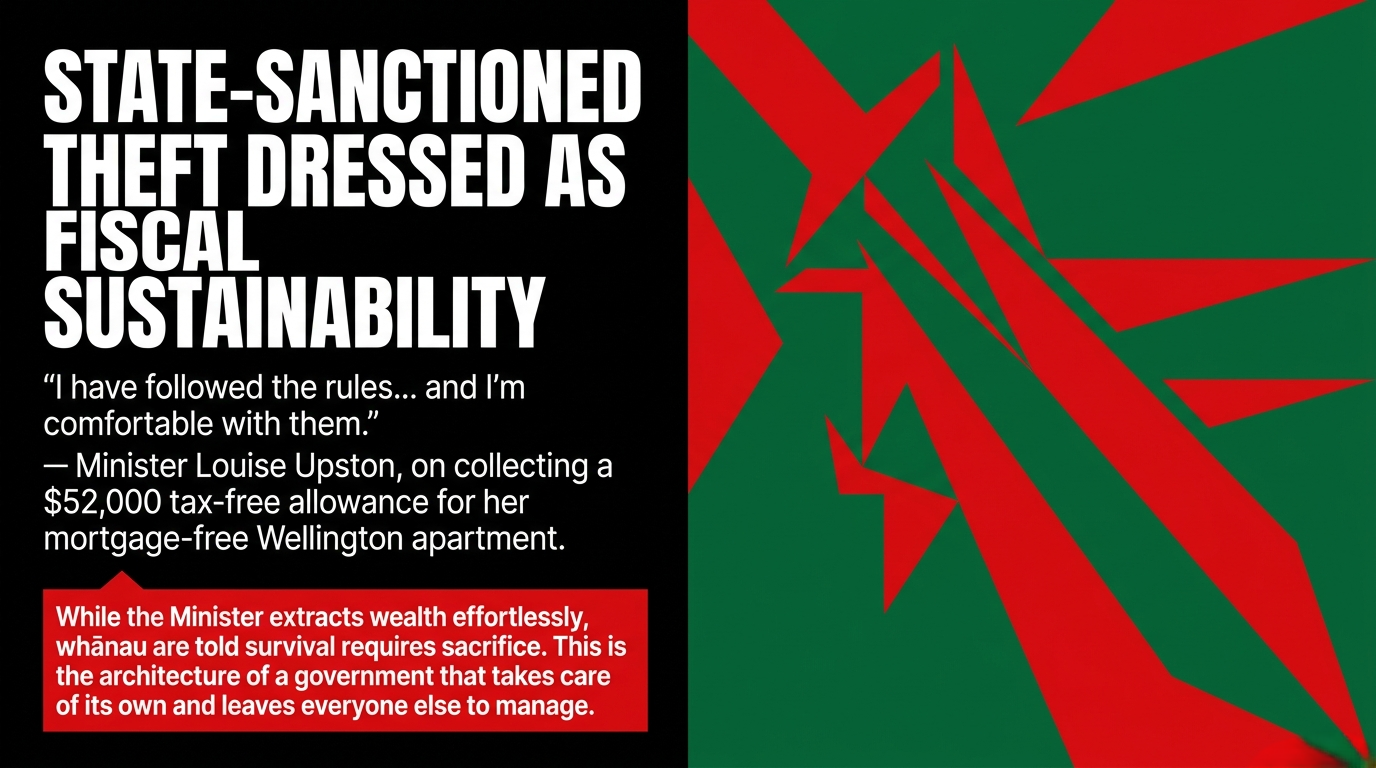
She calls it "fiscal sustainability." The whānau call it what it is — state-sanctioned theft by the powerful, performed by the powerful, for the powerful.
 Jo Moir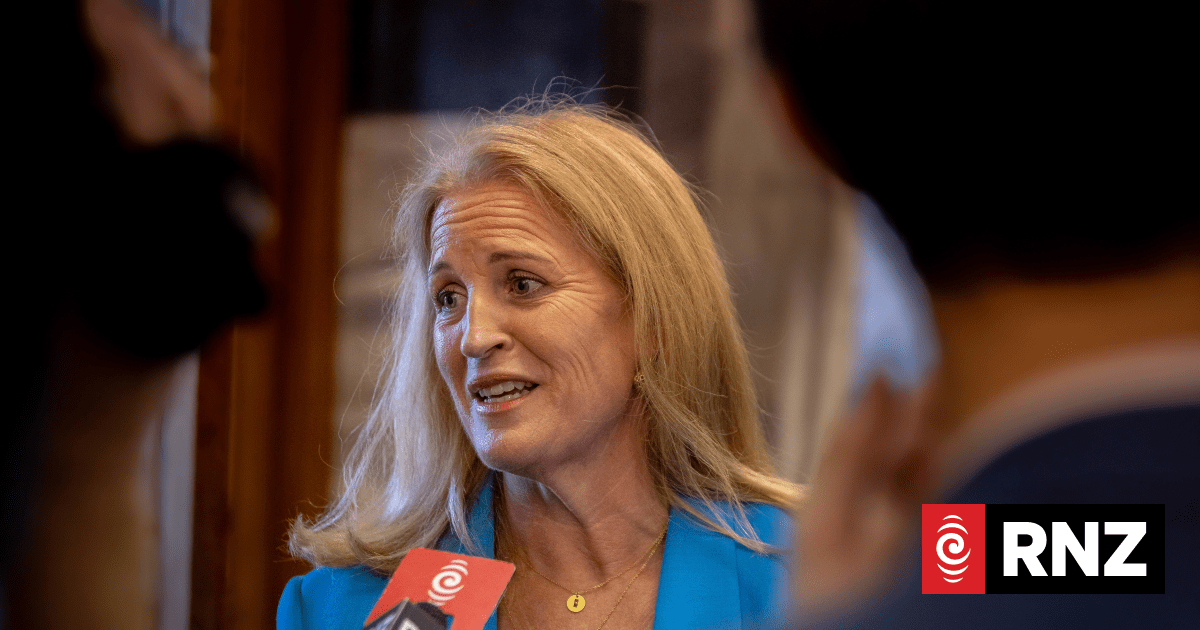
This essay examines Louise Upston's accommodation allowance claims because they directly affect democratic accountability, the fair administration of welfare policy, and the material survival of low-income whānau — disproportionately Māori — across Aotearoa.
Views expressed constitute honest opinion on matters of public interest under the Defamation Act 1992 (NZ) and Durie v Gardiner NZCA 278. All factual claims are sourced and cited. Named individuals are referenced solely in their public capacity as elected Ministers of the Crown.
A River With Two Mouths
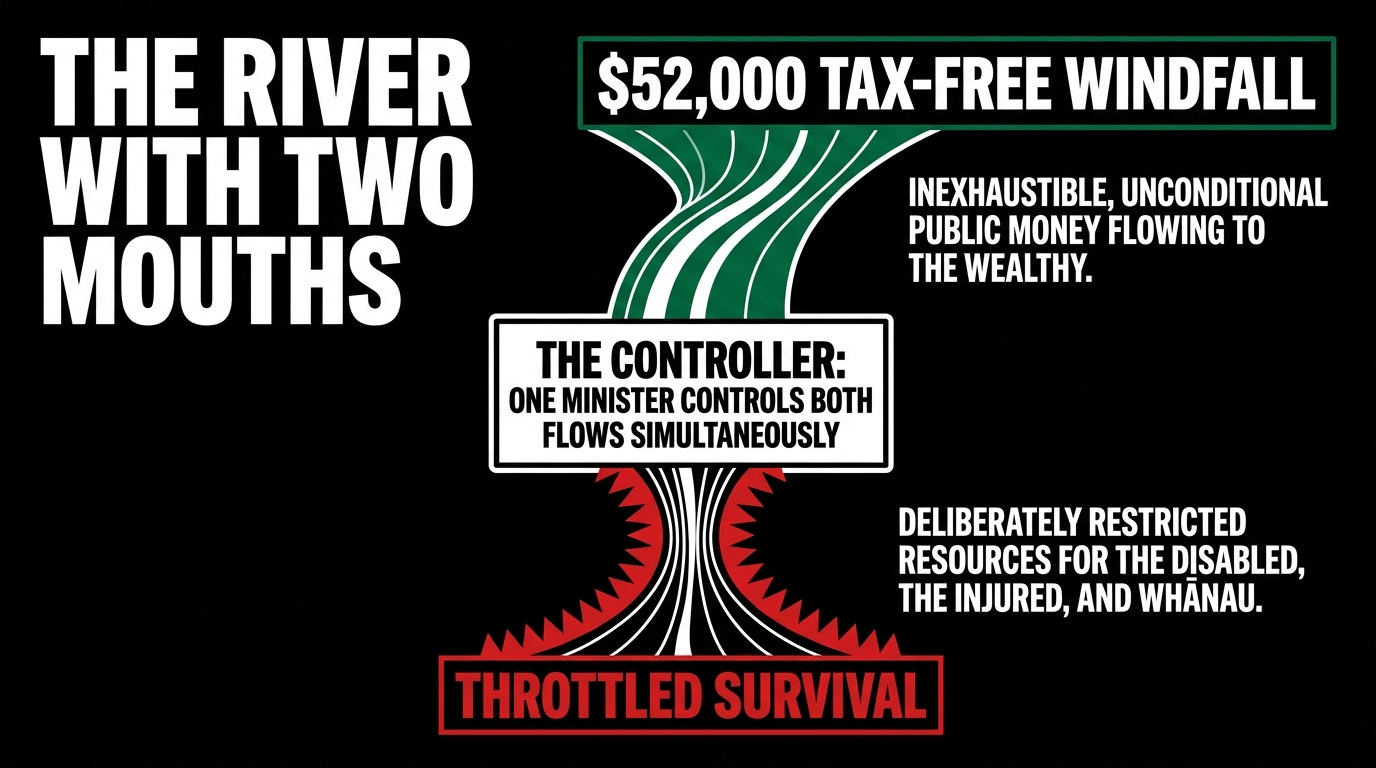
I want you to imagine a river.
This river has two mouths. One mouth pours clean, abundant water upward — inexhaustible, tax-free, flowing into the cisterns of those who already swim in wealth.
The other mouth faces downward. Its flow has been deliberately throttled, its banks narrowed, its tributaries cut off by bureaucratic policy language and ideological contempt. The people drinking from that second mouth — the disabled, the injured, the low-waged, the solo parent, the whānau on a waitlist — are told they are not drinking hard enough.
They are told the river is drying up. They are told that fiscal sustainability demands sacrifice — their sacrifice, not the sacrifice of those who drink from the first mouth with both hands and call it governance.
The Deep Dive Podcast
Listen to a lively conversation between two hosts, unpacking and connecting topics in the sources of this essay. I apologise in advance for the AI's very harsh pronounciation of reo. Please dont shoot me, :).
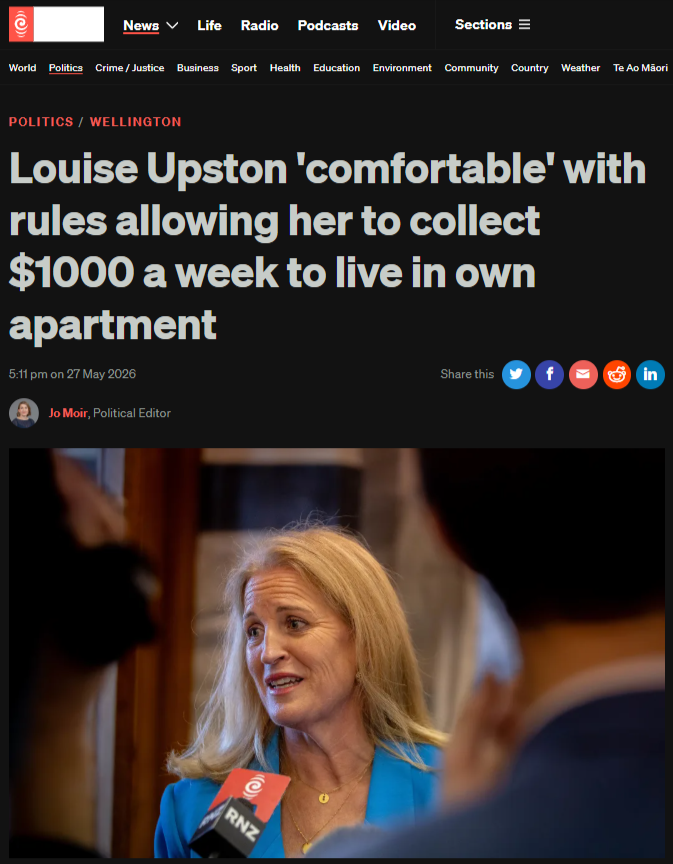
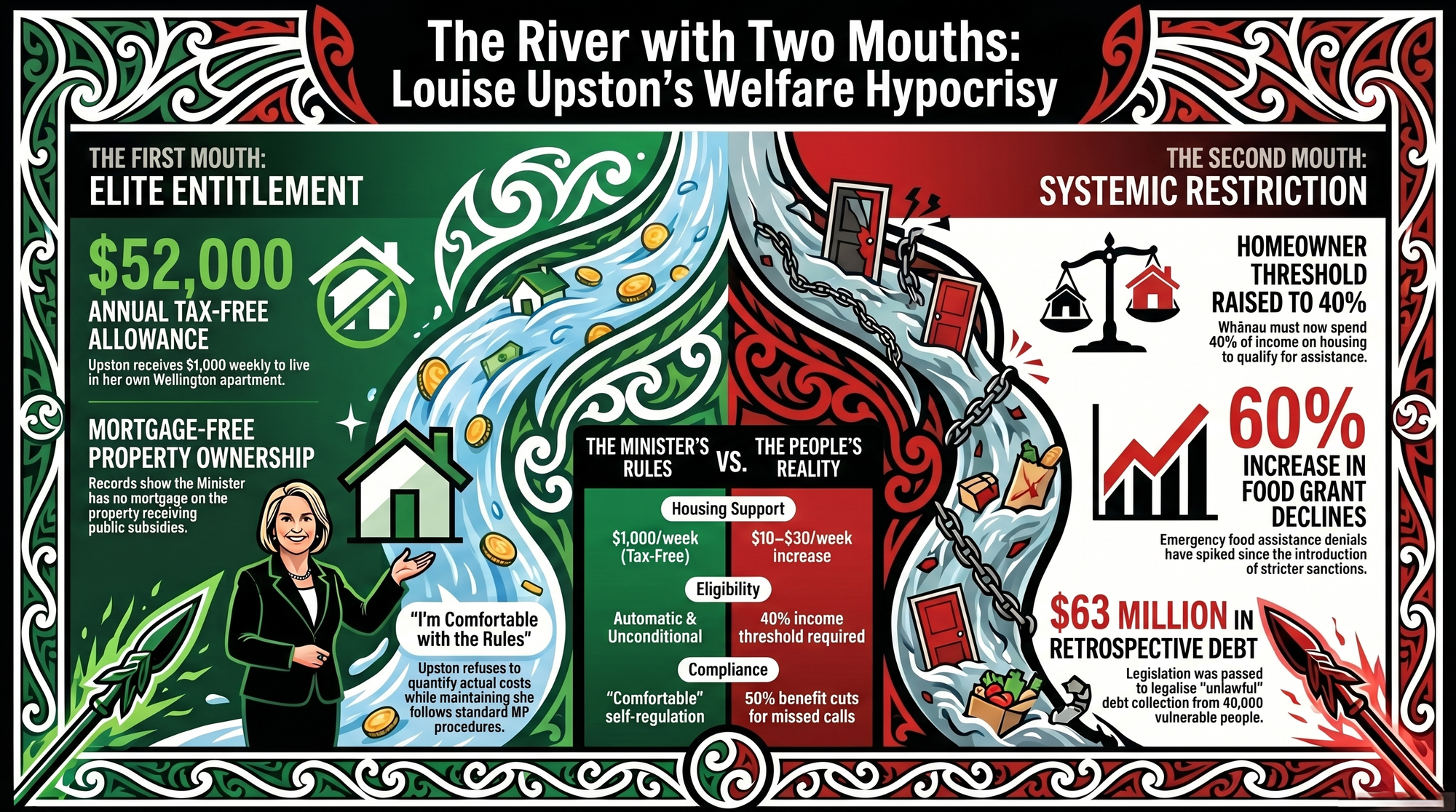
Louise Upston controls both mouths. She drinks from the first mouth — $1,000 per week, $52,000 per year, tax-free — collected as a parliamentary accommodation allowance while living in her own Wellington apartment, as confirmed by RNZ and reported across multiple outlets.
With her other hand, as Social Development and Employment Minister, she simultaneously throttles the second mouth — tightening welfare eligibility, legalising unlawful debt collection, and imposing punitive conditions on people who need $300 a week to survive.
When asked about this arrangement by journalists, she said:
"I'm comfortable with the rules."
I am Ivor Jones, The Māori Green Lantern. I am not comfortable. And I am here — armed with verified data, a taiaha, and thirty years of watching this same movie play out under different names — to tell you exactly what this is.
It is theft dressed in policy language, performed by a minister who knows precisely what she is doing, because the people she is stealing from do not have columns in the Herald, lobbyists in the Beehive, or $52,000 a year flowing into their bank accounts, tax-free, for existing.
He Hītori — The Blueprint Was Always There
Let me be plain: I have been writing about this architecture for years, and every time I think the audacity cannot deepen, this government surprises me.
I covered this identical pattern in Paula Bennett: The Architect of Systemic Betrayal, published April 2025
— documenting how Bennett climbed the welfare ladder on the back of a DPB, a Housing Corporation loan, and a state-subsidised education, then pulled every single rung up behind her as Social Development Minister, in a pattern Scoop documented and named bluntly in 2012.
Upston is Bennett 2.0 — same portfolio, same contempt, smoother vocabulary, identical targets. In Elite Plunder Masquerading as Policy: How Luxon's Austerity Fuels Intergenerational Poverty, published May 2025, I revealed how the National-ACT coalition's Budget weaponised austerity against thousands of young beneficiaries while Luxon collected his own $52,000 accommodation windfall
— the same figure, the same system, a different face at the same trough.
And I named Upston's punitive methodology directly in Exposing the Injustice: Minister Upston's Punitive Policies Against Beneficiaries, where I documented her plan to sanction beneficiaries for missing phone calls and called it state-sanctioned bullying. I was not wrong. The data since has only confirmed it.
In The Great Retirement Heist: How MPs Turn Public Service into Private Profit, published January 2025, I documented how New Zealand's political elite had weaponised retirement funds and property investments — extracting public wealth through parliamentary entitlements that bear no resemblance to the austerity they impose on everyone else.
The Upston accommodation scandal is not a chapter in that story. It is that story, retold in its purest form.
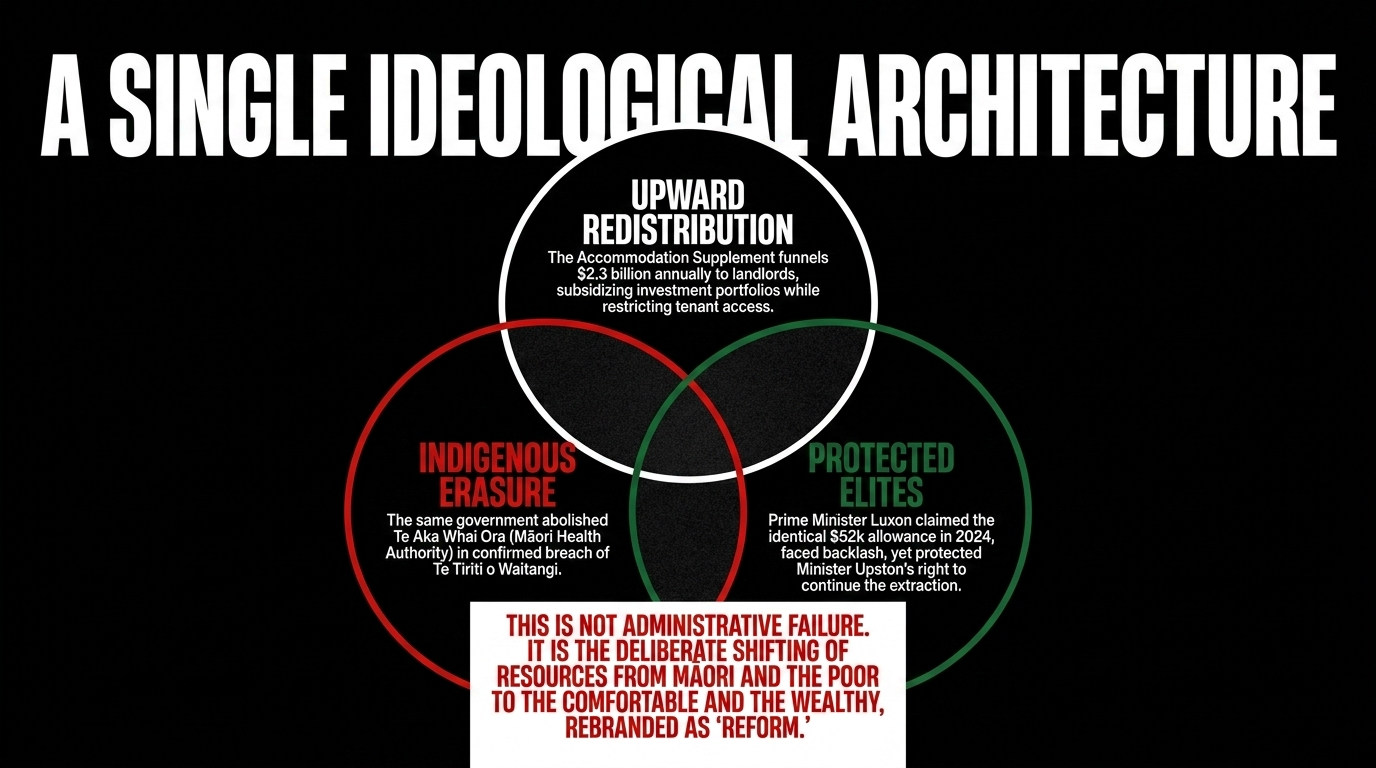
The pattern is always identical: extract from the top, restrict at the bottom, rebrand extraction as entitlement, rebrand restriction as reform.
This is the doctrine of the white supremacist neoliberal state operating without shame, because it has never been made to feel any. Every time journalists expose it, the minister smiles and says they are comfortable. Every time the courts rule against it, the government passes retrospective legislation to legalise the harm. Every time whānau organise to resist it, the policy is reframed as "better targeting assistance to those most in need"
— a phrase from the National Party's own press release on 14 May 2026, delivered while Upston collected $1,000 per week for living in her own apartment.
Tauira Tuatahi — Example One: The Two Accommodation Systems
The most visible hypocrisy in this story is the most important one, because it lives in a single comparison. Hold it in your mind and do not let it go.
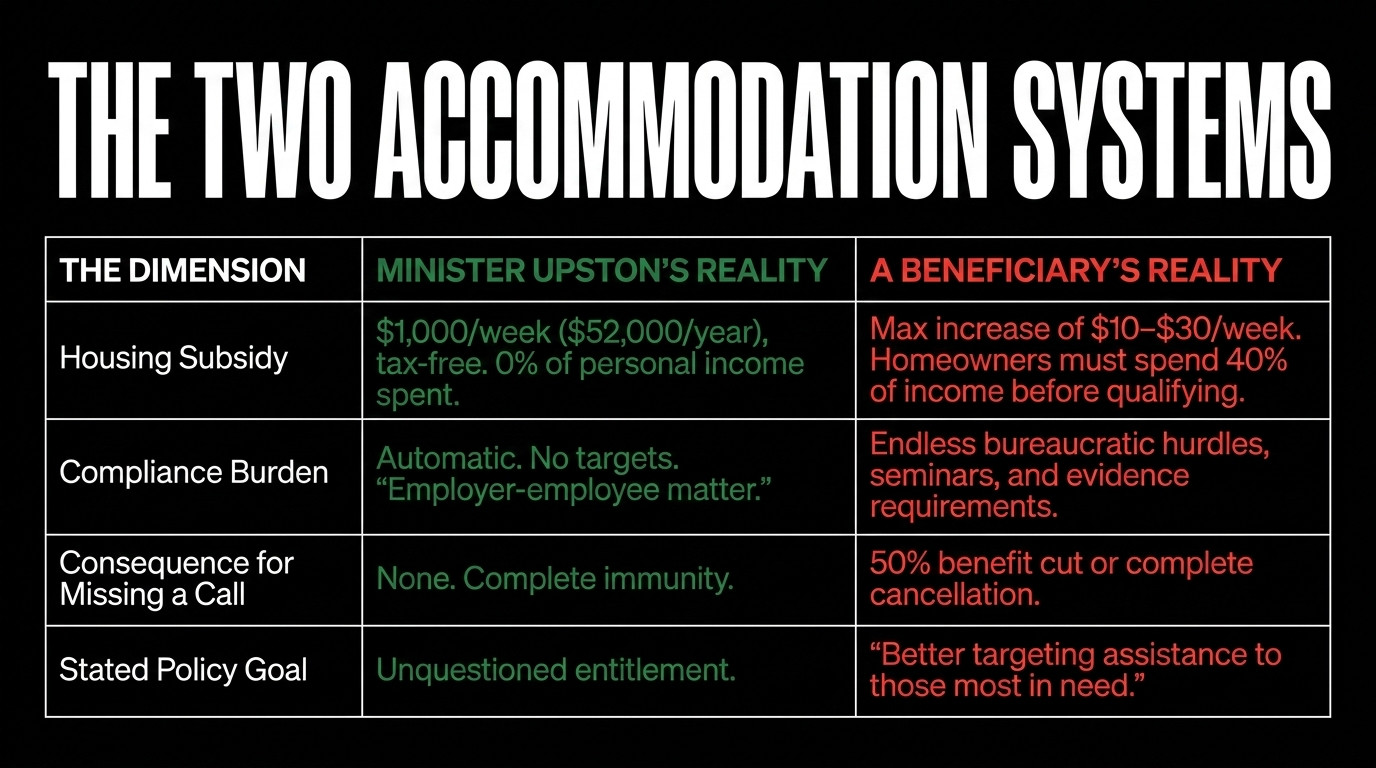
Louise Upston, as confirmed by RNZ reporting amplified across outlets including the ODT, collects $1,000 per week — $52,000 per year, tax-free — as a parliamentary accommodation allowance, despite co-owning an apartment in Wellington. She refused to quantify her actual accommodation costs when asked directly by reporters.
She said:
"I'm not going to go into the details."
Because the details are damning. The allowance appears to exceed, substantially, any actual housing cost she incurs. She is not paying rent. She may not be servicing a mortgage. She is collecting a public subsidy to live in her own capital city property.
Meanwhile, the same week, Upston's Social Security Amendment Bill, confirmed by the Beehive's own release dated 20 May 2026, passed policy changes increasing the maximum Accommodation Supplement rates by between $10 and $30 per week
— an increase that, when set against real rental inflation, is functionally meaningless.
More significantly, the National Party confirmed the threshold at which homeowners can access the Accommodation Supplement has been lifted from 30% to 40% of income. A whānau earning $800 per week must now spend $320 per week
— $16,640 per year — on housing costs before the state will offer them any assistance.
Upston spends nothing on accommodation and receives $52,000 per year.
As the University of Auckland's Business School noted in May 2024, 364,000 renters and mortgage holders rely on the Accommodation Supplement today, and the supplement does not provide relief proportionate to market rents and housing affordability
— rents have risen dramatically but the underlying structure of the supplement has not kept pace. The $10–$30 per week increase Upston announced is a political gesture, not a housing solution.
The solution is straightforward: ban accommodation allowances for any MP who co-owns, holds equity in, or is mortgage-free in a Wellington property.
As Labour leader Chris Hipkins told media and the ODT confirmed, some of these perks are "very hard to justify" and the UK model — which prohibits MPs from claiming accommodation allowances for properties in which they hold a financial interest — is a proven reform. Prime Minister Luxon has told reporters he has "no interest" in changing the rules. The beneficiaries of the current system are, predictably, its most enthusiastic defenders.
The tikanga breach: In tikanga Māori, a rangatira — a chief, a leader — is not defined by what they accumulate. They are defined by what they give.
The concept is aroha ki te tangata: deep, practical love for the people, expressed through generosity, through sacrifice, through placing community above self.
A rangatira who extracts from the collective while restricting others' access to the same collective resources has not merely broken a rule. They have broken the foundational covenant of leadership itself. Upston is not acting as a leader. She is acting as a tohunga tāhae — a specialist in taking.
Tauira Tuarua — Example Two: The Sanctions Machine and the Comfortable Minister
I want to put two images in your mind simultaneously and ask you to hold them both.
Image one: A sole parent — Māori, most likely, because Māori are disproportionately represented among welfare recipients due to the deliberate, documented, intergenerational impacts of land confiscation and colonial economic exclusion
— misses a phone call from MSD. She has missed it because she is at a food bank. Or she is at the hospital with her tamariki. Or she simply did not hear her phone.
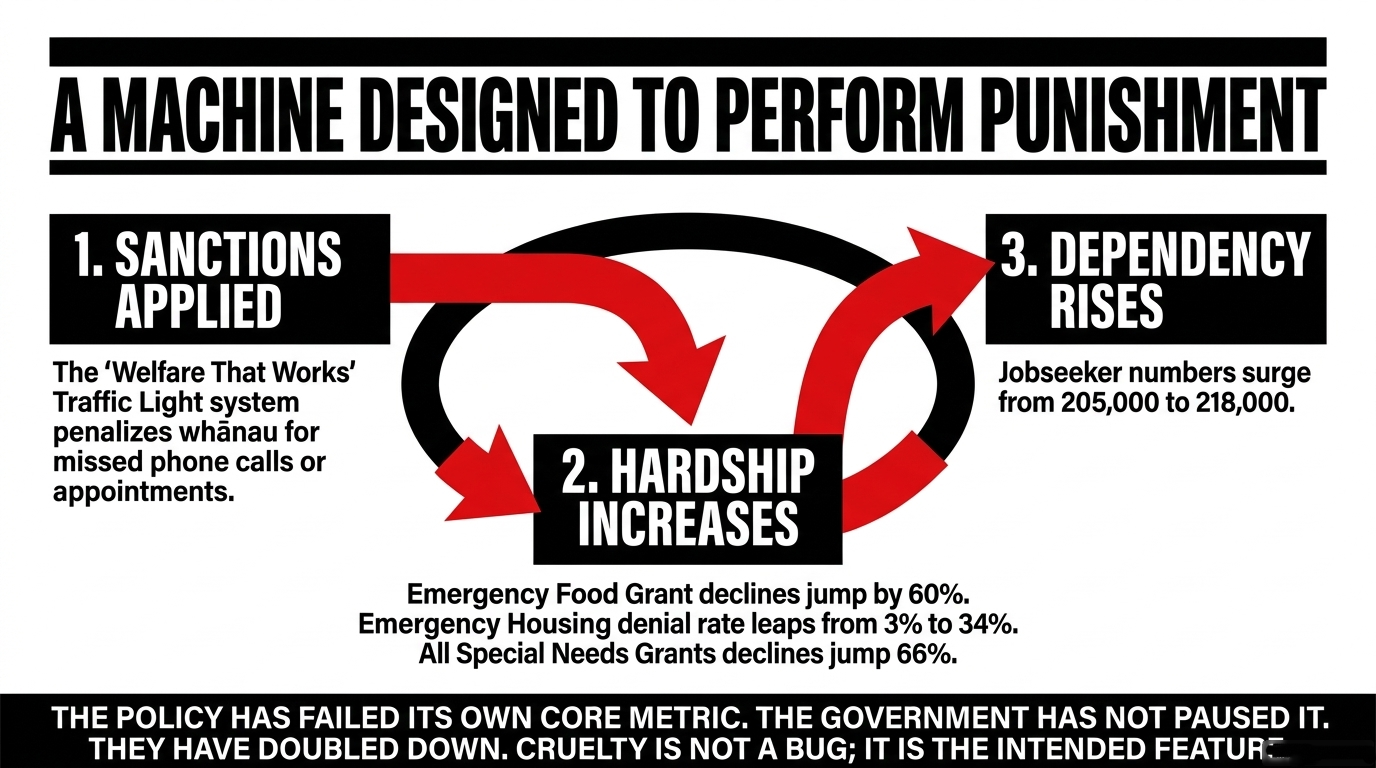
Under Upston's "Welfare That Works" regime, as Te Ao News reported in February 2024, that missed contact can trigger a benefit sanction — a 50% cut, or complete cancellation — under the government's "Traffic Light" compliance system.
Image two: Louise Upston misses no targets. There are no consequences. Her $1,000 per week arrives automatically, unconditionally, with no stand-down periods, no phone calls to answer, no seminars to attend, and no penalties for non-compliance.
She is the Minister. The rules are for other people.
The results of Upston's sanctions regime are documented and they are catastrophic. As The Spinoff reported in March 2026, emergency food grant declines have risen by 60% in two years. Declines across all special needs grants are up 66%. The emergency housing grant decline rate has jumped from 3% in 2023 to nearly 34% in 2025. Jobseeker Support numbers have risen from 205,000 to 218,000 after the sanctions regime was introduced — the policy has failed on its own stated metric of reducing welfare dependency. The government has not paused it. It has not reviewed it. It has doubled down.
As Waatea News confirmed in May 2025, new welfare reforms will hurt Māori most — a fact the government has access to through its own impact assessments, which it routinely ignores. This is not policy failure. This is policy success — if the goal is not reducing poverty, but performing punishment for the consumption of a voter base that has been trained to see beneficiaries as moral failures rather than as people trapped in a system designed by the same ministers who exempt themselves from it.
The solution: Scrap the sanctions regime. Invest the MSD compliance budget — the staff hours, the IT systems, the call centres — in actual employment creation, whānau-centred support, and Māori housing solutions. The Waitangi Tribunal has found repeatedly that punitive welfare policy disproportionately harms Māori and constitutes a breach of the Treaty. The government knows this. It proceeds anyway. That is not negligence. That is intent.
The tikanga breach: Manaakitanga — the obligation to care for and uplift the people around you — is not a cultural nicety. It is the ethical spine of tikanga. A society that sanctions a starving person for missing a phone call, while a minister collects $1,000 per week from a mortgage-free apartment, has not merely abandoned manaakitanga. It has inverted it. It has made cruelty a policy instrument and called it reform.
Tauira Tuatoru — Example Three: The Retrospective Legislation That Legalised Theft
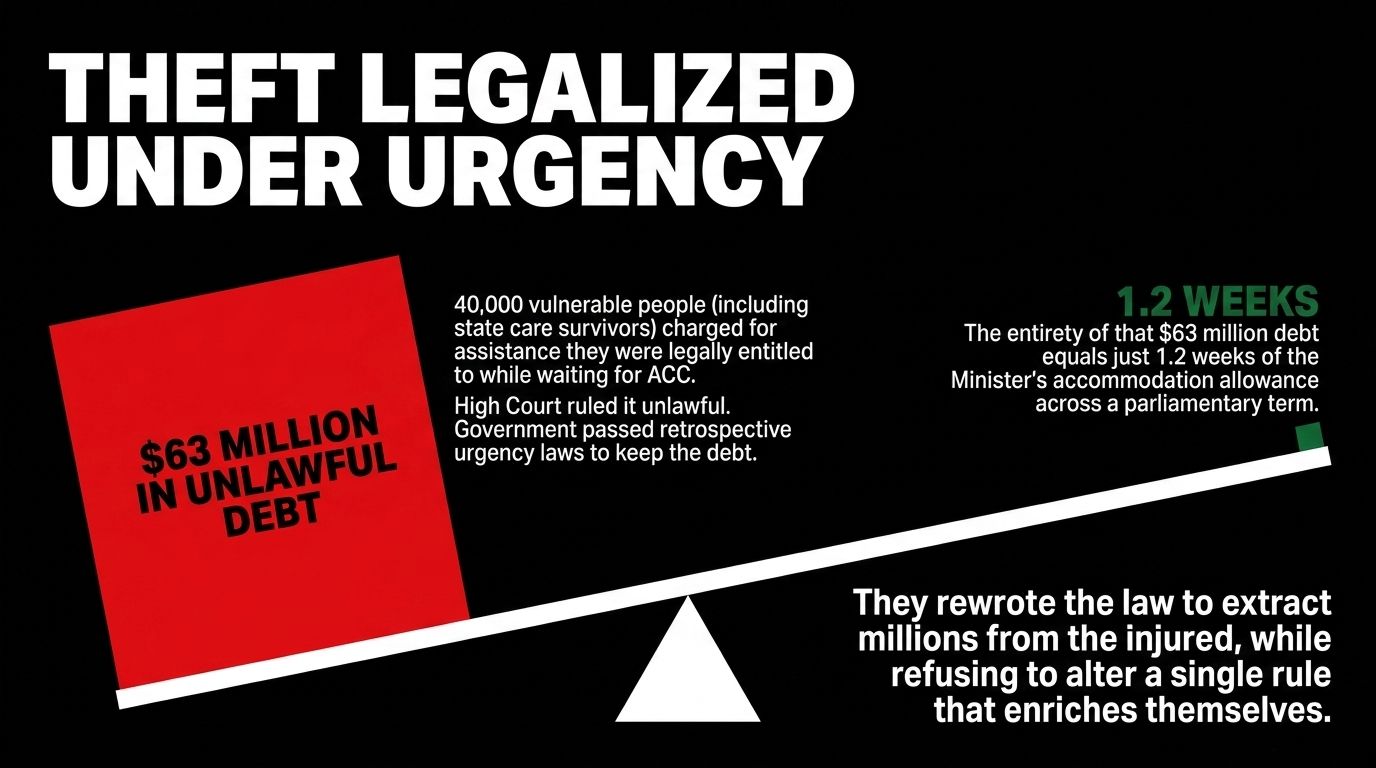
This is the example that should end political careers. It has not, because the people it affects cannot afford lobbyists.
Here is what happened, as documented in precise detail by Waatea News in January 2026 and confirmed by Community Law Centres Aotearoa in February 2026: If you are injured and waiting for ACC to approve your claim — a process that can take months or years
— you may apply to MSD for supplementary assistance in the meantime, including accommodation supplements and winter energy payments. When ACC finally approves your claim and pays you backdated compensation, MSD has been — unlawfully, it turns out — clawing back every cent of supplementary assistance you received during that waiting period.
The High Court ruled this practice unlawful. Justice Grice held that supplementary assistance is support people were entitled to when they received it, and that forcing them to repay it years later went against the purpose of the Social Security Act 2018.
"The Court has confirmed that support for essentials like housing and power isn't something you should have to pay back years later."
The government's response? It did not accept the ruling. It did not apologise. It did not write off the debts.
As Newstalk ZB reported in February 2026, the government introduced retrospective legislation under urgency to reverse the High Court decision and legalise the debt collection retroactively.
The legislation affects approximately 40,000 people — including survivors of abuse in state care, people with birth injuries, and sexual abuse survivors — who would have had debts totalling approximately $63 million written off if the government had accepted the court's ruling, as confirmed by Reddit's KiwiPolitics thread citing official MSD figures.
As beneficiary advocate Kay Brereton QSM told Waatea News in February 2026:
"The Government is moving with urgency to legalise slapping beneficiaries with debt because they know what they did was wrong, and are worried tens of thousands of people would be seeking to recover these unlawful debts."
Waatea News reported in March 2026 that Labour eventually only agreed to support the bill at third reading conditional on amendments — including hardship exemptions and exclusions for disability allowances and abuse survivors. The government under Louise Upston's ministerial direction drove this legislation.
She was comfortable with that too.
The solution: Repeal the retrospective legislation. Write off the $63 million in unlawful debts — money that equals approximately 1.2 weeks of Louise Upston's accommodation allowance across a full parliamentary term. Establish an independent Welfare Rights Commissioner with Treaty obligations and enforcement powers. Prosecute the architects of the unlawful debt recovery, not the people they stripped.
The tikanga breach: In tikanga Māori, utu is not vengeance. It is restorative justice — the obligation to make right what was made wrong, to restore balance, to honour the mana of those who were harmed. The Crown did not just refuse utu. It weaponised the law to entrench the harm, retroactively, under urgency, against the explicit ruling of its own courts. This is not governance. This is colonial occupation continuing by spreadsheet, statute, and the smug comfort of those who will never be affected by the rules they write.
Te Whatungarongaro — Five Hidden Connections
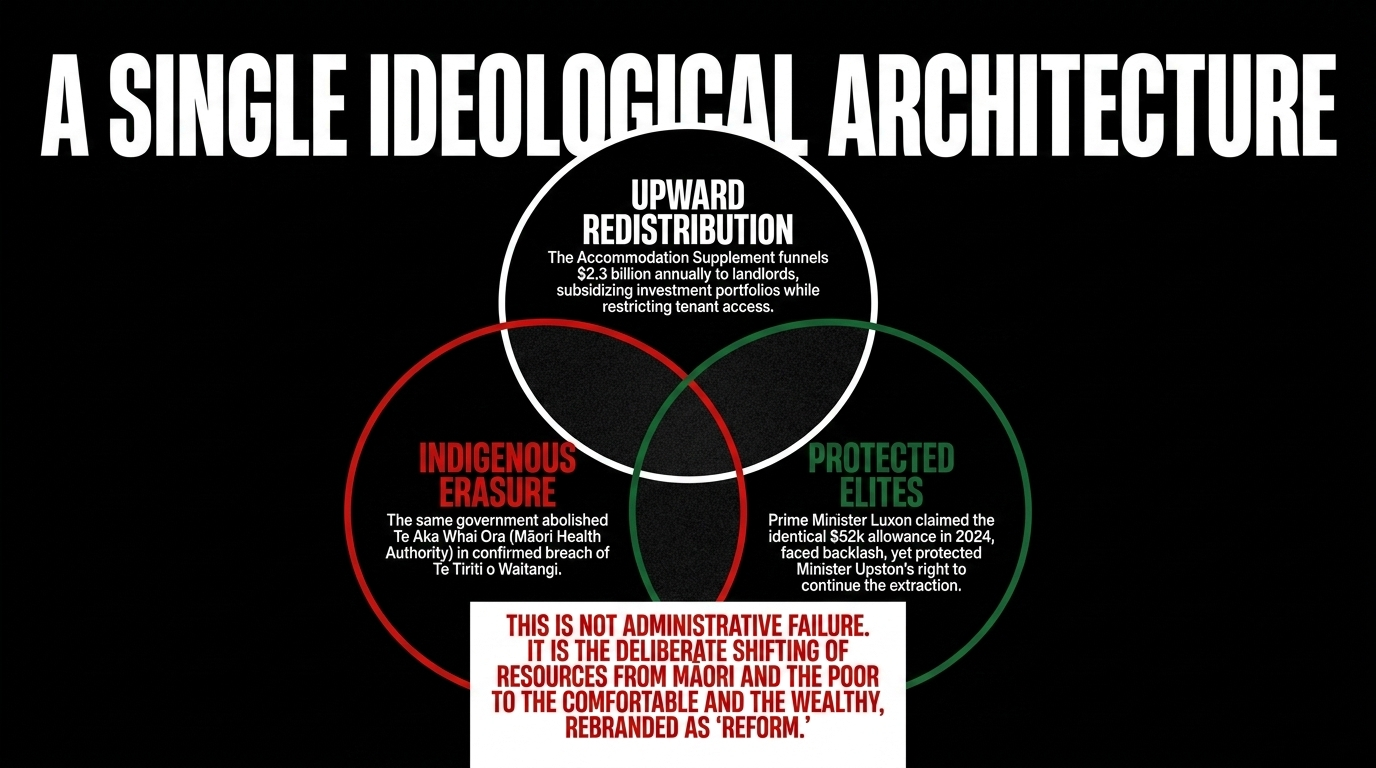
I want you to understand this is not a collection of separate scandals. It is a single system with multiple mouths.
Here are five verified connections this government does not want you to make:
One: Upston tightens Accommodation Supplement eligibility thresholds for homeowners from 30% to 40%, as confirmed by the National Party. She spends 0% of her own income on her Wellington apartment and receives $52,000 per year. The rules she writes do not apply to her.
Two: Prime Minister Luxon was caught doing the identical thing in 2024 — collecting $52,000 per year for living in his own Wellington apartment, as Facebook posts noting the Newsroom revelation confirm. He stopped after public backlash. He then watched Upston do it again — and told reporters he had "no interest" in changing the rules, as confirmed by the ODT. He did not stop her. He protected her.
Across the coalition, the same trough, the same silence: as a YouTube clip of a Ryan Bridge interview from 27 May 2026 surfaced, David Seymour admitted he was "probably" taking more housing allowance than he needs.
Three: When asked about her accommodation costs in Parliament, Upston reframed the allowance as an "employer-employee" matter — a private arrangement between herself and the parliamentary service, beyond public scrutiny, as ODT reporting confirms.
This is the neoliberal trick made flesh: the minister who administers public welfare for 364,000 people reframes her own taxpayer-funded entitlement as a private employment condition.
She is simultaneously public servant and private beneficiary, and she reserves the right to choose which identity protects her from questions at any given moment.
Four: The Accommodation Supplement currently funnels $2.3 billion annually in taxpayer money — a figure cited in my Elite Plunder Masquerading as Policy essay from May 2025.
A substantial portion of that flows directly to landlords, not to tenants, subsidising Wellington's rental market and the investment portfolios of property owners.
Louise Upston's parliamentary accommodation allowance is one node in a vastly larger system of upward redistribution, which this government has deliberately maintained and expanded while restricting access at the bottom.
Five: As I documented in Dismantling Māori Health: A Colonial Legacy Resurrected, this same government abolished Te Aka Whai Ora — the Māori Health Authority
— without proper consultation, in confirmed breach of Te Tiriti o Waitangi as found by the Waitangi Tribunal.
The welfare sanctions, the retrospective debt legislation, the accommodation supplement tightening, the health authority dismantling — these are not separate decisions.
They are expressions of a single ideological commitment: to shift resource from Māori and the poor to the comfortable and the wealthy, then call that shift "reform." And as I warned in Luxon's Lullaby: A Neoliberal Nightmare Dressed as a Kiwi Dream, published December 2024 — this government is expert at wrapping extraction in the language of aspiration.
Ngā Hua Kino — The Ledger of Harm
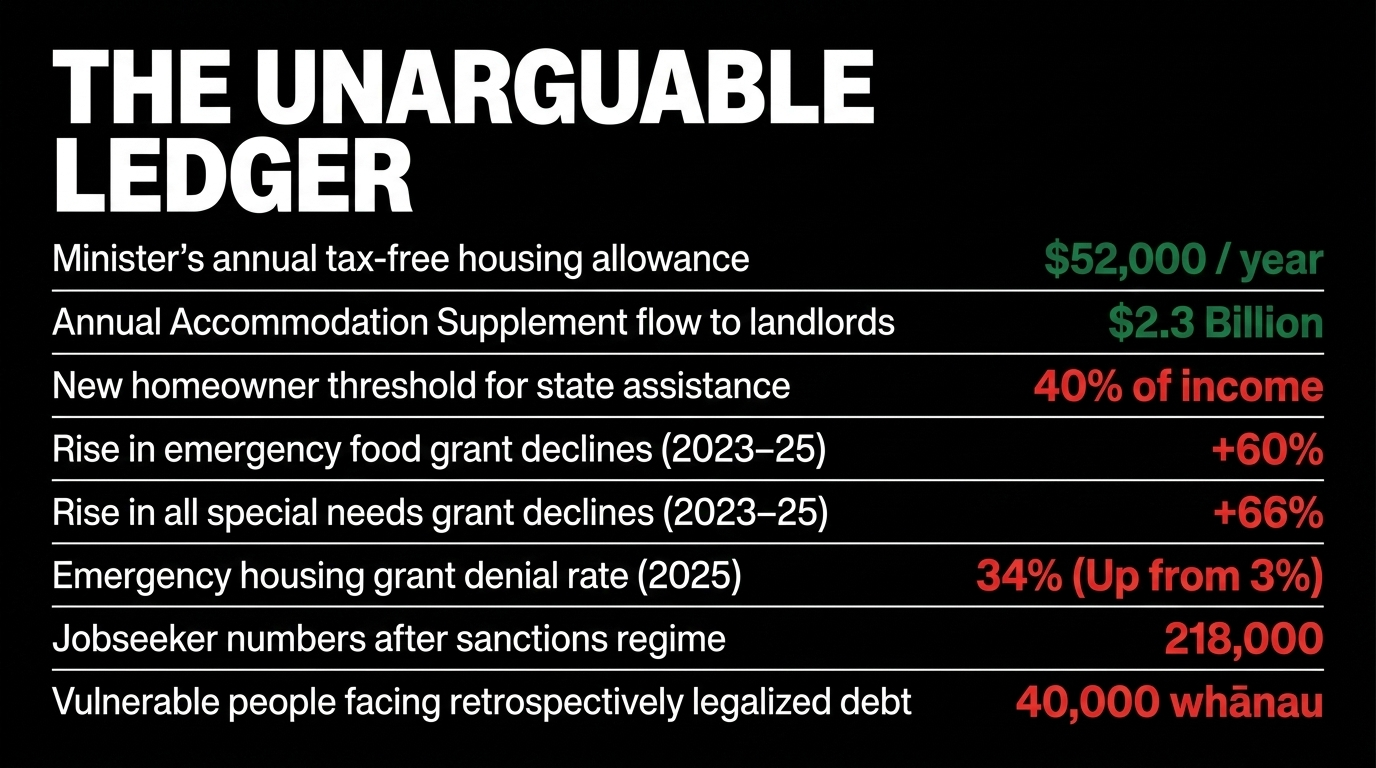
I will not allow these numbers to blur into abstraction. These are verified figures. Name them. Repeat them:
| What | Amount | Source |
|---|---|---|
| Upston's annual accommodation allowance, tax-free | $52,000/year | ODT/RNZ |
| New homeowner threshold before accessing Accommodation Supplement | 40% of income | National.org.nz |
| Rise in emergency food grant declines, 2023–2025 | +60% | The Spinoff |
| Rise in all special needs grant declines, 2023–2025 | +66% | The Spinoff |
| Emergency housing grant decline rate, 2025 | 34% (up from 3%) | The Spinoff |
| Jobseeker numbers after sanctions introduced | 218,000 (up from 205,000) | The Spinoff |
| People facing unlawful welfare debt, retrospectively legalised | ~40,000 | Newstalk ZB |
| Value of debts that would have been written off | $63 million | Reddit/KiwiPolitics citing MSD |
| Accommodation Supplement annual flow to landlords | $2.3 billion | The Māori Green Lantern, May 2025 |
| Increase in weekly Accommodation Supplement rates | $10–$30/week | Beehive.govt.nz |
That last line is the one that strips the paint off the government's narrative entirely. Forty thousand people hold unlawful debts. Emergency housing is declining at 34%. Food grants are being denied at a 60% higher rate. Jobseeker numbers are rising despite sanctions. And the government's announced housing reform is a $10–$30 per week increase in an Accommodation Supplement that has not kept pace with inflation
— delivered in the same breath as a budget that denies emergency grants at record rates, legalises $63 million in unlawful debt, and tightens the homeowner threshold from 30% to 40%.
While Upston collects $1,000 a week. Tax-free. Comfortably.
He Tirohanga Tikanga — For Those New to This Lens
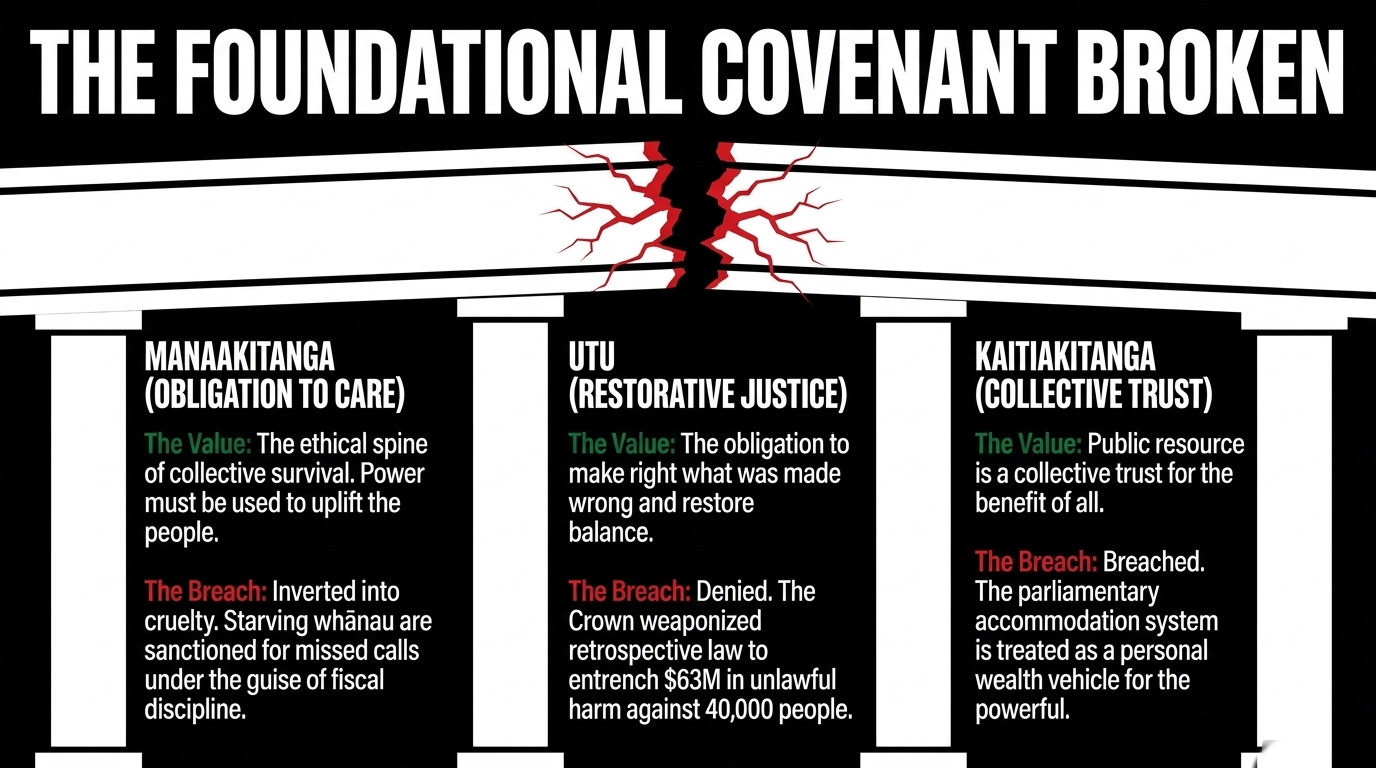
I say this specifically for Pākehā readers, for those encountering mātauranga Māori for the first time through this essay, because I have been doing this long enough to know that the tikanga frame is often dismissed as decoration
— a cultural garnish on top of a political argument. It is not.
Tikanga is a living system of ethics and accountability that predates this parliament, this constitution, and this country by centuries.
When I invoke manaakitanga, I am not speaking metaphorically about being kind. I am describing the foundational obligation of collective societies: that those with power and resource are obligated — not invited, not encouraged, but obligated — to use that power in the service of the collective.
When I invoke utu, I am not describing vengeance. I am describing the architecture of restorative justice: harm must be made right, not retroactively legalised.
When I invoke kaitiakitanga, I am not describing environmentalism. I am describing the ethical framework that holds all resource — including public money — as a collective trust, to be administered for the benefit of all, not siphoned by the comfortable few.
Louise Upston has violated all three. She has inverted manaakitanga into its opposite
— mana-destroying policy dressed as fiscal responsibility. She has refused utu for 40,000 people whose unlawful debts she legalised. And she has breached kaitiakitanga by treating the parliamentary accommodation system as a personal wealth vehicle rather than a public trust.
The whakataukī says: He aha te mea nui o te ao? He tangata, he tangata, he tangata. What is the greatest thing in the world? It is people, it is people, it is people.
This government has answered: it is property, it is property, it is property.
Whakaaro Whakamutunga — I Am Not Comfortable
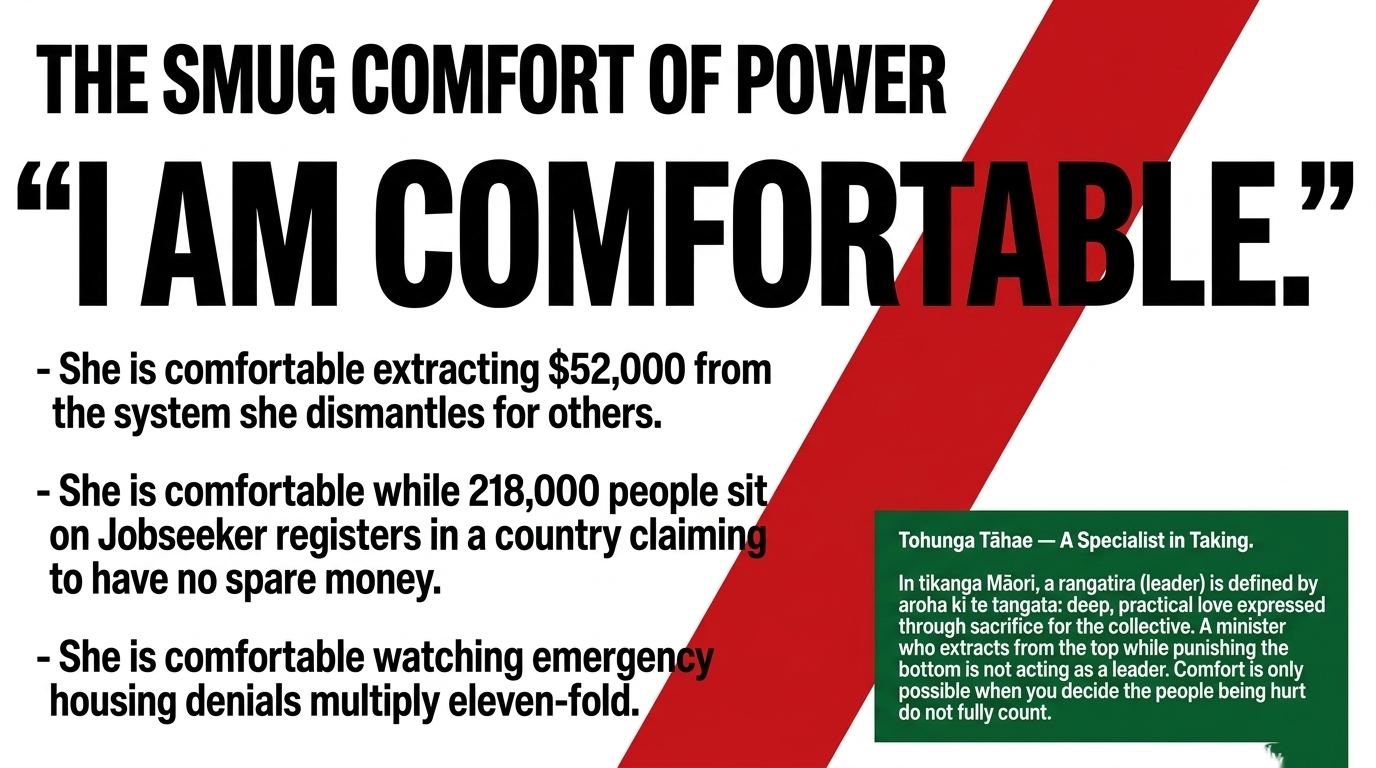
Louise Upston told reporters she is "comfortable."
I want to sit with that word. I want to hold it up to the light and let it tell us exactly what it is.
She is comfortable collecting $52,000 per year in housing allowances she does not need, for an apartment whose mortgage she may no longer even carry.
She is comfortable tightening welfare rules on homeowners who now need to spend 40% of their income on housing before they qualify for state assistance.
She is comfortable overseeing a sanctions regime that has failed on its own stated metrics — jobseeker numbers have risen, not fallen — while food bank grant declines have shot up 60% and emergency housing denials have multiplied eleven-fold.
She is comfortable overseeing retrospective legislation that reversed a High Court ruling in order to preserve $63 million in unlawful debts against 40,000 of the most vulnerable people in this country — including survivors of abuse in state care.
She is comfortable while 218,000 people sit on the Jobseeker register in a country that supposedly has no spare money for public services. She is comfortable.
Comfort is only possible when you have decided that the people being hurt do not fully count.
That decision is not neutral. It is ideological. It is the product of a white supremacist neoliberal worldview that treats Māori, the poor, the disabled, and the injured as management problems
— as fiscal risks to be minimised, as liabilities to be deterred from the system, as faces that should not appear in the minister's office because the minister's office is not for them.
This is not a bureaucratic scandal. This is not a communications failure. This is the logical, deliberate, fully-intended expression of a government that has been consistent in exactly one thing: it takes care of its own, and it leaves everyone else to manage.
I wield the taiaha. I name the harm. I name the minister. I name the government.
And I say, clearly and without equivocation, as a matter of verified public fact: Louise Upston is extracting from the same system she is dismantling for others, and she is doing it on purpose, and she is comfortable. And that comfort must cost her.
Kia tū māia, kia tū kaha, kia tū toa.
Stand brave, stand strong, stand victorious.
He Tono Koha — Fund the Rangatiratanga She Would Deny You

Louise Upston collects $52,000 per year, tax-free, from the public purse. Not one cent of that funds accountability. Not one cent names the harm. Not one cent is spent on the whānau affected by her decisions.
This essay costs nothing to read. It costs everything to write — the hours of research, the verification of every link, the legal careful naming of every act of power. This mahi is not funded by the parliamentary service, by a corporate patron, or by a party machine. It is funded by whānau who believe that rangatiratanga includes the right to fund our own truth-tellers. Every koha to The Māori Green Lantern is a direct political act — a signal that our accountability cannot be purchased or silenced, because we pay for it ourselves. While Upston's $1,000 per week flows automatically from a system she controls, this voice is sustained only by the whānau who refuse to look away.
If you cannot koha — no worries at all. Subscribe, follow, kōrero, and share with your whānau and friends. That is koha. That is the river flowing the right way.
- 💰 Koha directly: Support The Māori Green Lantern on Koha
- 📧 Get essays first: Subscribe at themaorigreenlantern.maori.nz
- 🏦 Direct bank transfer: HTDM — 03-1546-0415173-000
- 👥 Follow on Facebook: The Māori Green Lantern
Kia kaha, whānau. Stay vigilant. Stay connected.

*Views expressed constitute honest opinion on matters of public interest under the Defamation Act 1992 (NZ) and Durie v Gardiner