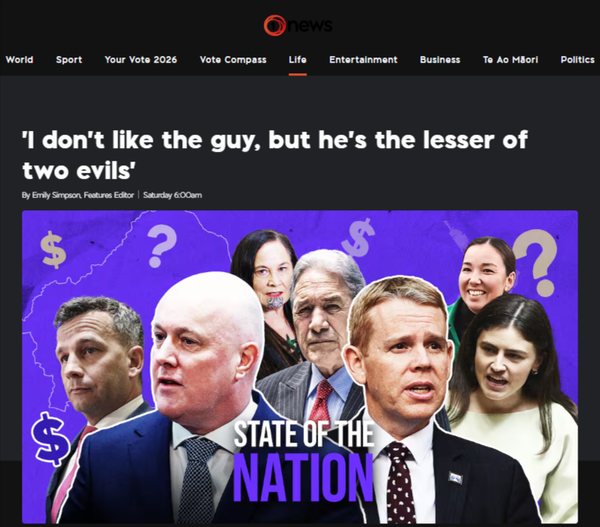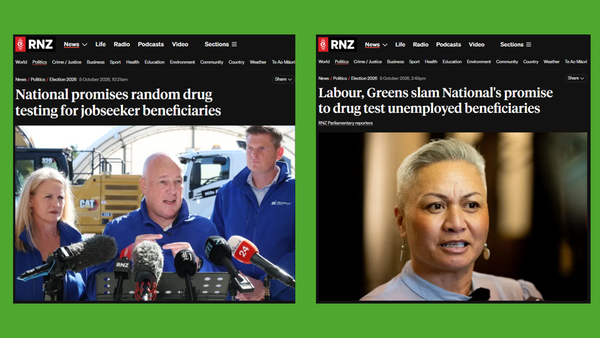
"THE SNAKE IN THE PĀTAKA: How Winston Peters Sells Rotten Kai and Calls It a Feast" - 5 May 2026
He claims to feed the people. He is eating their children's future.

Kia ora Aotearoa,
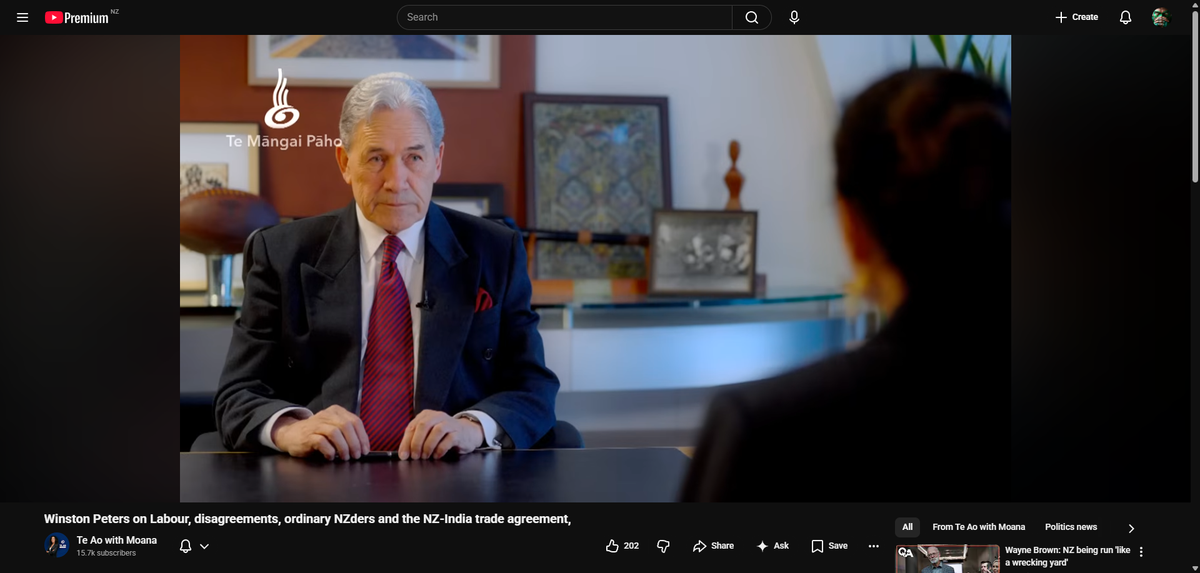
This essay examines Winston Peters' public conduct and statements in his 4 May 2026 interview with Moana Maniapoto on Te Ao with Moana (Whakaata Māori) because they directly affect the health, housing, economic security, and democratic rights of Māori whānau across Aotearoa New Zealand. All factual claims are sourced and verified.
Ko Wai Tērā? He Niho Nā Te Taniwha
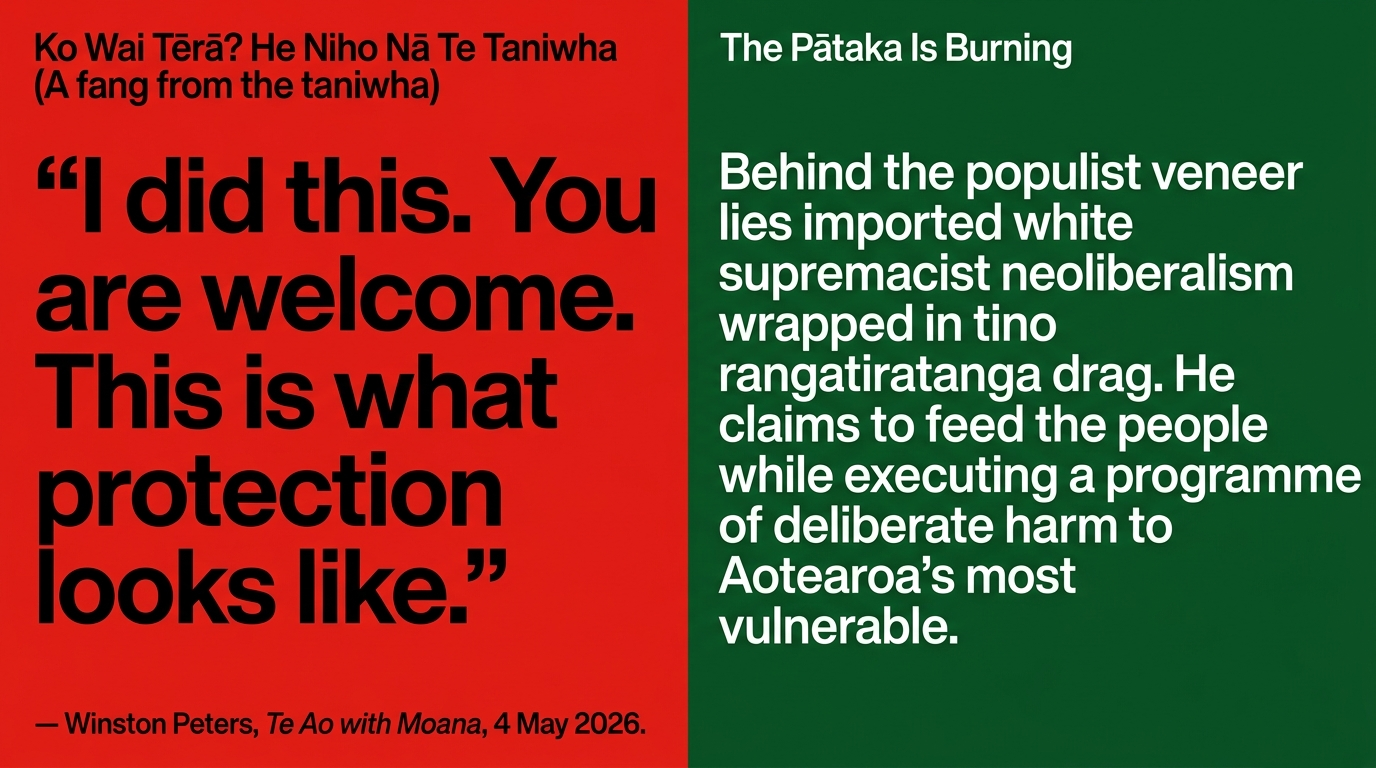
Who is that? A fang from the taniwha.
Picture a pātaka — the raised storehouse of the people. Carved by tūpuna. Stocked over generations. Built to survive drought, colonial betrayal, and the long winter of dispossession.
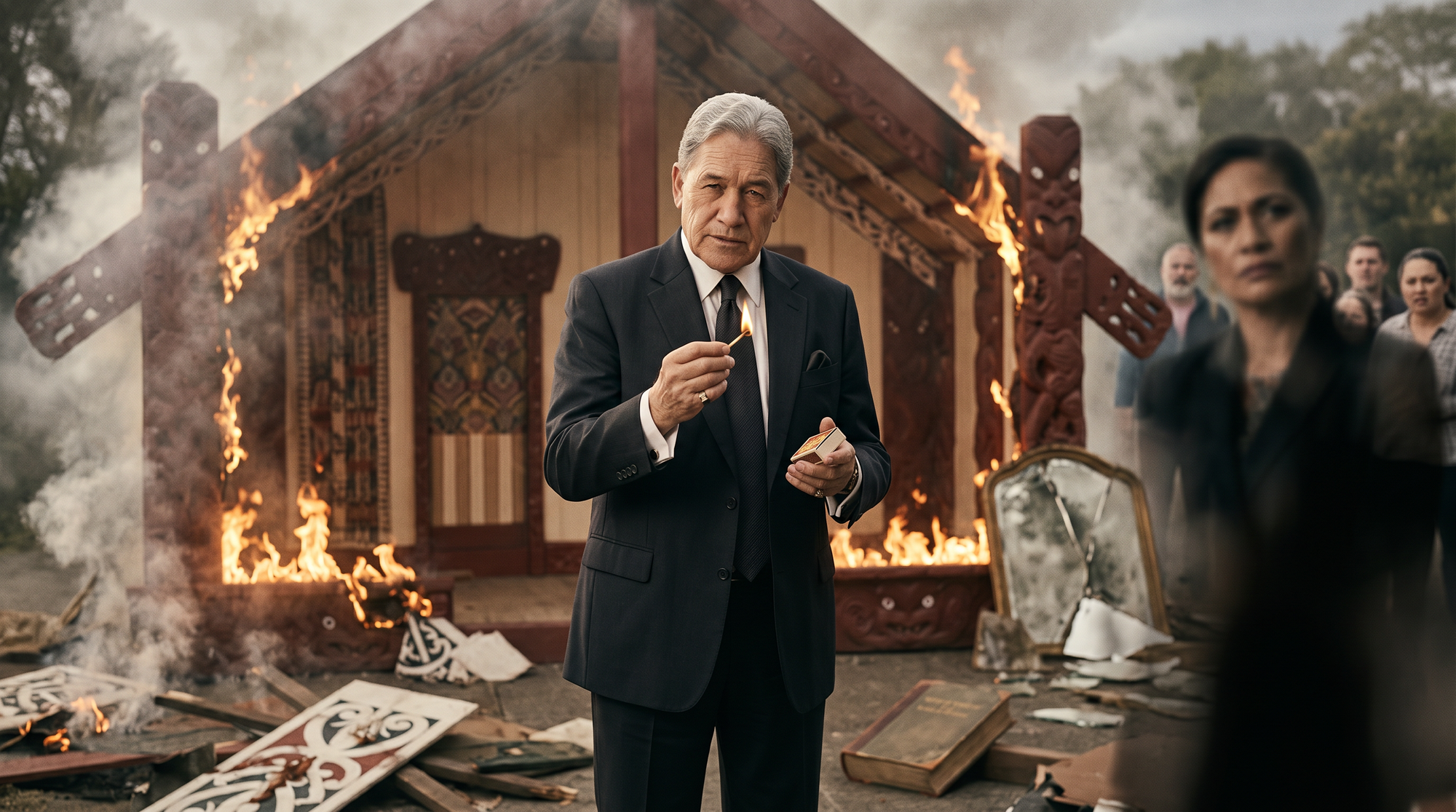
Now picture a man standing in front of it. Behind him, the flames are rising — pay equity burning, smokefree futures burning, Treaty protections burning, workers' rights burning. The smoke is thick. The smell is unmistakable.
And that man is pointing at the smoke, turning to the camera, and saying:
"I did this. You are welcome. This is what protection looks like."
That man is Winston Peters. And on 4 May 2026, he sat in his own office and said all of this — on camera, to Moana Maniapoto of Te Ao with Moana on Whakaata Māori — the third time the two have gone toe to toe, and the third time Peters left a trail of verifiable falsehoods across the floor.
He is not a man of the people. He is a man dressed in the people's clothes — and as the MGL essay Winston Peters Is A Temu Trump For Reals documented in February 2026, he is running the exact same playbook as Donald Trump: imported white supremacist neoliberalism wrapped in tino rangatiratanga drag, executing a programme of deliberate harm to the most vulnerable people in Aotearoa — while the cameras roll, while the polls rise, and while his whānau die.
The taiaha has been raised. The evidence is the weapon. Ka tū, ka oho.
The Deep Dive Podcast
Listen to a lively conversation between two hosts, unpacking and connecting topics in the sources of this essay.
He Taupatupatu Tuatahi: Homelessness — "It Has Dropped by Half"
Peters stated to Moana:
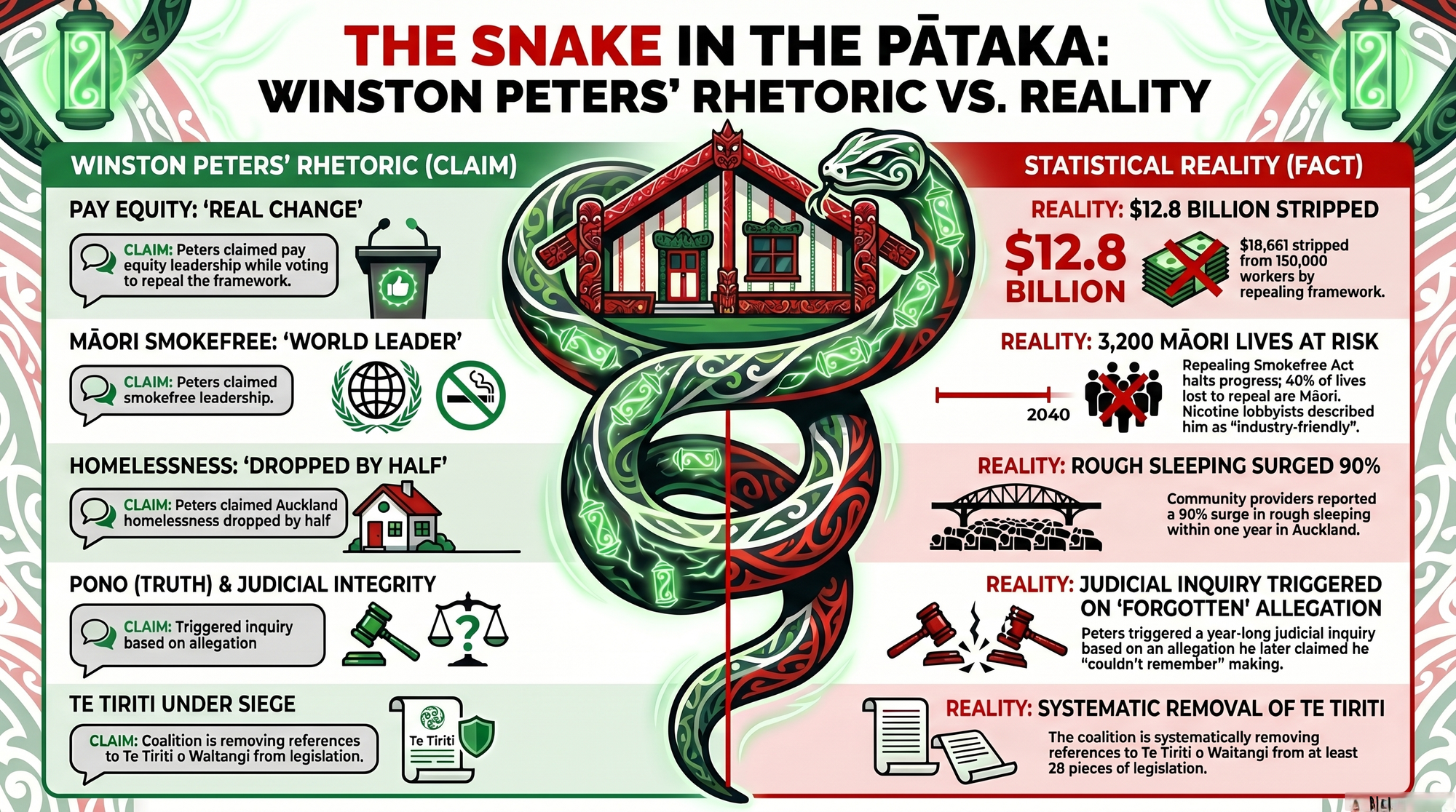
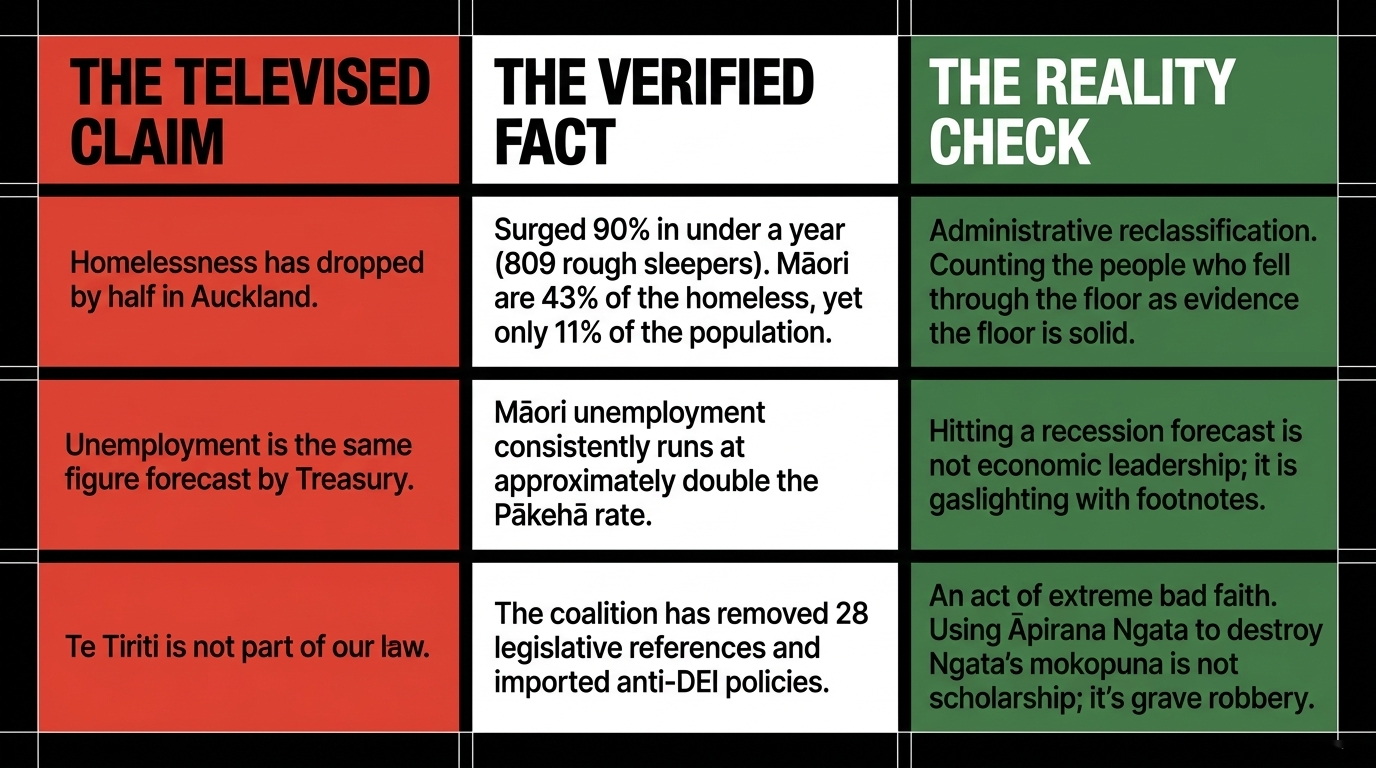
"The number of people in certain homes has actually dropped by half in Auckland."
He is lying. Not misremembering. Not spinning. Lying.
As The Spinoff's ten-graph analysis of the government's own homelessness data confirmed in August 2025, six Auckland community providers found rough sleeping had surged 90% in under a year — from 426 people living without shelter to 809. The government's own Homelessness Insights Report released July 2025 confirmed 4,965 people were severely housing-deprived on census night, with Auckland recording the highest numbers in the country. The Otago Daily Times confirmed the Auckland figure of 809 rough sleepers was the highest outreach count on record for community providers.
What Peters conflates is a reduction in temporary accommodation numbers — which dropped partly because whānau were administratively shifted out of those categories, not because they were housed. He is counting the people who fell through the floor as evidence the floor is solid.
Māori constitute approximately 43% of Auckland's homeless while being 11% of the city's population. Peters called it a victory. The data calls it ethnic cleansing by spreadsheet.
As the MGL essay The Pātaka Beside the Strait confirmed in March 2026, the coalition's support packages were deliberately designed to exclude the poorest whānau — and around a quarter of a million children in benefit households received nothing.
He Taupatupatu Tuarua: Unemployment — "Same as Treasury Forecast"
Peters claimed:
"Unemployment is the same figure forecast by Treasury before the 2023 election. They had long range forecasts at the time. Am I right or wrong? The forecasts are the same."
Technically traceable. Morally bankrupt. The Treasury's 2023 pre-election forecasts did project unemployment rising to around 5.3% by late 2024. Peters treats this as a badge of honour — as if managing to hit a recession forecast is evidence of economic leadership. It is not. It is standing in the rubble of a building and pointing to the fire alarm that predicted the blaze.
In the same sentence Peters conceded — without apparently hearing himself —
"people at the bottom economically will always be hit the hardest."
He named the wound, then reached for the bandage of abstraction. The structural reality, confirmed by Treasury's own ethnic wage gap data, is that Māori unemployment consistently runs at approximately double the Pākehā rate — a gap this coalition has not closed, and has deepened by gutting Te Aka Whai Ora, dismantling pay equity, and defunding employment pathways targeting Māori communities.
To celebrate hitting a Treasury forecast of someone else's suffering is not governance. It is gaslighting with footnotes.
He Taupatupatu Tuatoru: Pay Equity — "We Are Its Founders"
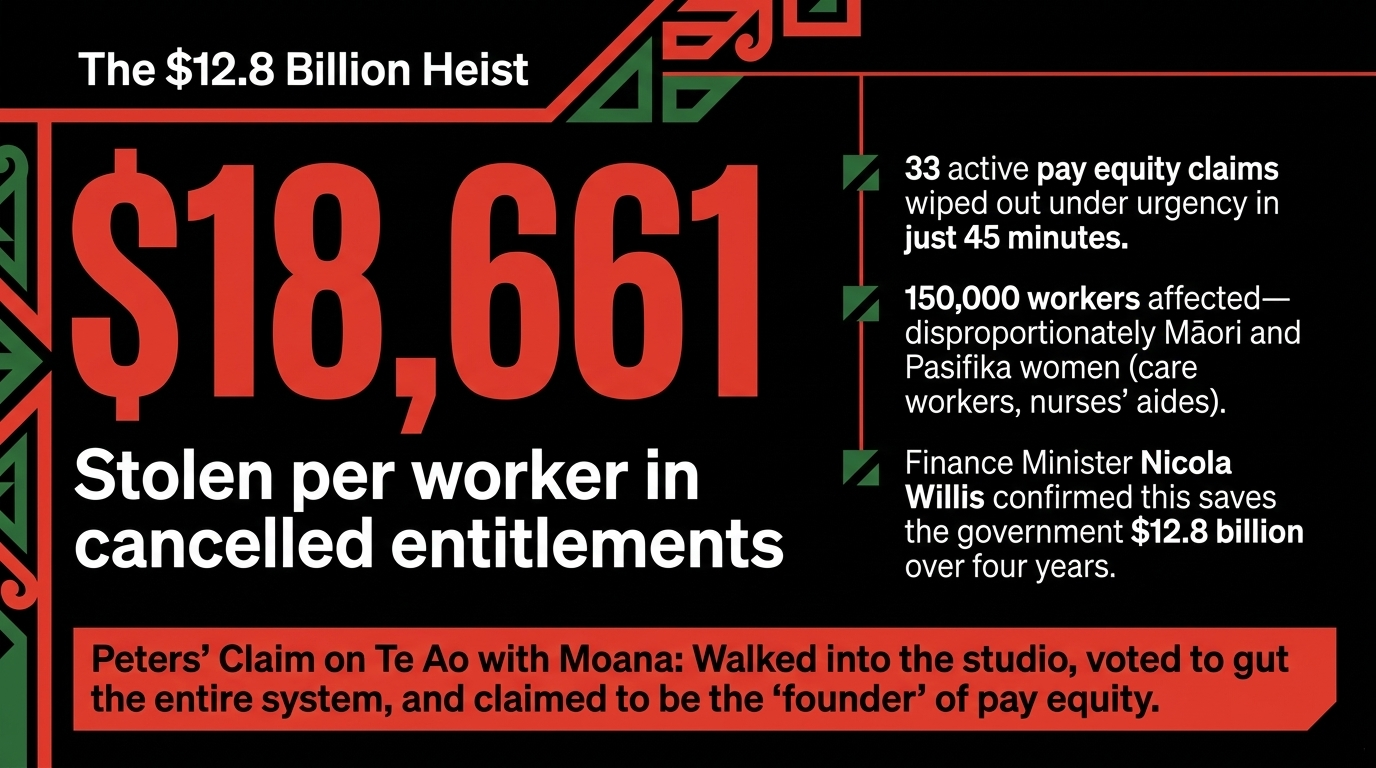
Peters invoked a decades-old NZ First achievement on teacher pay parity to defend his government's 2025 destruction of the entire pay equity framework. This is not a misremembering. This is a rhetorical war crime.
On 6 May 2025, the coalition government — with NZ First's active, deliberate vote — as documented by The Spinoff, passed the Equal Pay Amendment Act 2025 under urgency, wiping out 33 active pay equity claims covering more than 150,000 workers in 45 minutes, with no public consultation, no select committee, and no prior warning. As confirmed by Wikipedia's record of the Equal Pay Amendment Act 2025, Finance Minister Nicola Willis confirmed this would save the government $12.8 billion over four years.
That is $12.8 billion stripped from women. Disproportionately Māori women. Disproportionately Pacific women. Care workers. Nurses' aides. Health administrators. People who kept this country functioning during a pandemic while Peters was in government doing nothing to protect them. As the MGL essay The Trapdoor Prime Minister calculated: $18,661 stolen per worker in cancelled entitlements.
The PSA's national secretary Fleur Fitzsimons called it "a dark day for New Zealand women." As E-Tangata's analysis confirmed, the gender pay gap in the public sector had narrowed 8.6% as a direct result of the equity policy this government destroyed.
Peters voted yes. Then walked into Moana Maniapoto's camera and claimed the mantle of pay equity's founder.
He Taupatupatu Tuawhā: Smokefree — "We Are the World Leaders"
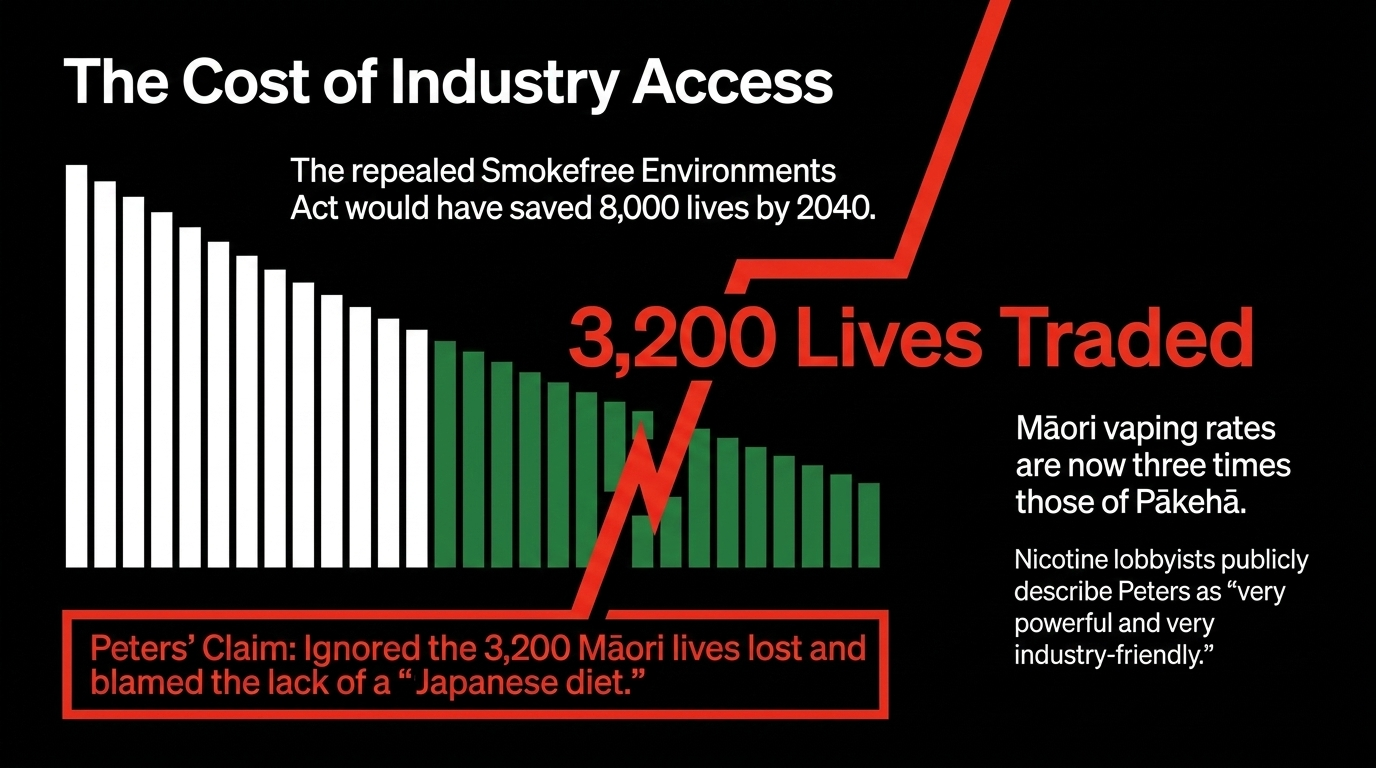
Peters claimed his party built Aotearoa into a smokefree world leader. His coalition's first 100-day commitment was to repeal the world's most advanced smokefree law.
As The BMJ reported in November 2023, the Smokefree Environments and Regulated Products Act — a world-first generational smoking ban repealed by this coalition under urgency in February 2024 — would have saved 8,000 lives by 2040, with 40% of them Māori. Modelling showed it would have reduced Māori smoking rates from 32.8% to 7.3%. As confirmed by 1News and Hāpai Te Hauora, front-line health organisations said it would "consign another generation of Māori and Pasifika to an early death." As E-Tangata reported in July 2025, Māori now vape at three times the rate of Pākehā, with deprived communities recording rates triple those of wealthy suburbs. And as the NZ Herald revealed in July 2025, nicotine industry lobbyists described Peters as "very powerful and very industry-friendly."
As E-Tangata's public health analysis stated plainly:
"Public health progress is being dismantled."
Peters invoked Japan — claiming diet explains Japanese longevity, not tobacco control — which is false. Japan has some of the strictest tobacco regulation in Asia. What it does not have is a Deputy Prime Minister who was photographed smoking on a smokefree campus in 2020. Peters' opposition to smokefree law is not ideological. It is personal. It is profitable. And it is lethal for our people.
He Taupatupatu Tuarima: "I Rarely Make Mistakes. When I Do I Acknowledge Them."
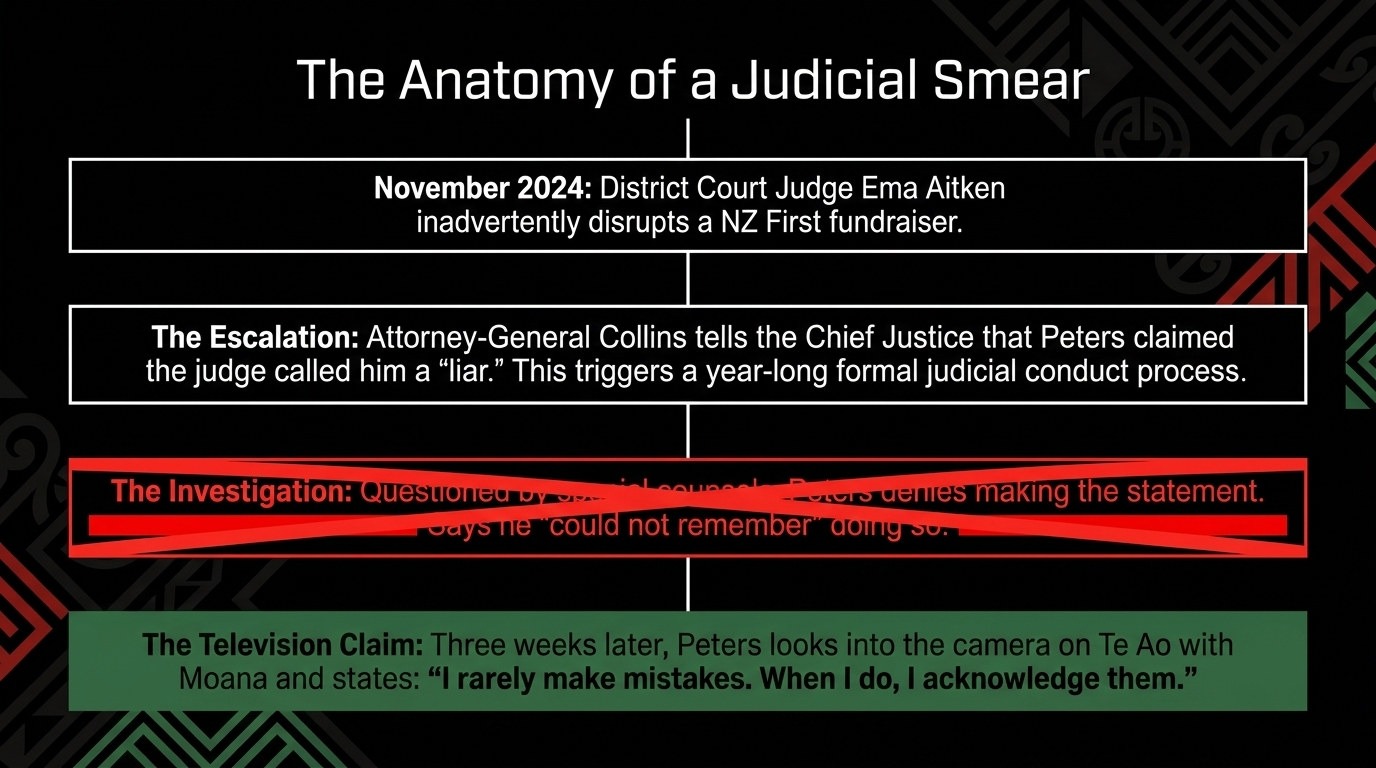
This is the most dangerous lie of the interview — because it concerns not just policy but the alleged weaponisation of New Zealand's judicial conduct process against a sitting judge.
The NZ Herald's report on the Judicial Conduct Panel finding, published 11 April 2026, reveals the following verified sequence: In November 2024, District Court Judge Ema Aitken walked inadvertently into a NZ First fundraiser at Auckland's Northern Club and disrupted a speech Peters was giving on tikanga Māori in law schools. Attorney-General Judith Collins then wrote to Chief Justice Helen Winkelmann claiming Peters had told her the judge "referred to him as 'Winston' when she called him a liar" — a statement that triggered a formal judicial conduct process against Judge Aitken lasting more than a year. When the panel's special counsel Tim Stephens contacted Peters, Peters denied making the statement. He later told Collins "the reason was that he could not remember doing so."
Judge Aitken's lawyer David Jones KC submitted that "political mischief was plainly afoot" and that "it is difficult to imagine a more direct political involvement with matters to do with the consideration of a judge's conduct." The panel found the situation "very unsatisfactory." It found as fact that Judge Aitken did not recognise Peters and did not know he was the Deputy PM.
The entire edifice — that a judge had personally called Peters a liar by name — rested on something Peters could not remember saying. Or did not say. But which the Attorney-General sent to the Chief Justice of New Zealand. And which triggered a year-long process against an innocent woman.
Peters declined to comment when the Herald approached him.
The man who says "I rarely make mistakes" cannot remember if he gave the nation's top law officer information that destroyed a judge's year.
He Taupatupatu Tuaono: "Unions Never Came to Me Early Enough"
In February 2026, Peters told media that NZ First could have stopped the Employment Relations Amendment Bill — the most anti-worker legislation in a generation
— if unions had approached him sooner.
As Workers First Union documented publicly on 20 February 2026, they had met with NZ First at least eight times. The PSA stated explicitly that Peters had "breached Cabinet rules in attacking them over his failure to block the fire-at-will bill."
The Green Party called on Luxon to hold Peters accountable for the false claims.
As the MGL essay Winston Peters — A Walking Contradiction confirmed in March 2026: Peters did not misremember. He rewrote history for an audience he assumed would not check.
NZ First voted for the bill. Workers paid the price. Peters blamed the victims.
He Taupatupatu Tuawhitu: "Te Tiriti Is Not Part of Our Law"
Peters told Moana — in a Māori current affairs interview, on a Māori media platform
— that te Tiriti o Waitangi is not law, that judges have invented its legal force, and Parliament must take it back. He invoked Sir Āpirana Ngata to justify it.
As E-Tangata's Ned Fletcher established in September 2024, the Māori text of Te Tiriti — signed by the overwhelming majority of rangatira — did not cede sovereignty and guaranteed tino rangatiratanga in full.
As Carwyn Jones wrote in E-Tangata in 2024:
"The Treaty bill is an act of extreme bad faith."
As reported by the NZ Herald in March 2025, Peters' anti-DEI bill follows
"the path being laid by Donald Trump"
— American white supremacist policy imported into Aotearoa and dressed in the language of democracy.
As the MGL essay He Hinaki Māori: The Trap Woven in Silk Feathers confirmed in April 2026:
"The trap is not new. Only the bait has changed."
Using Āpirana Ngata to destroy Ngata's mokopuna is not scholarship. It is grave robbery with a citation.
Ngā Tauira e Toru — Three Examples for the Western Mind
1. Pay Equity: The $18,661 Heist
The Western parallel: In the United States, the Equal Pay Act has been the law since 1963. Imagine if, in 2025, a government repealed it under urgency in 45 minutes, cancelled 33 active equal pay lawsuits covering 150,000 workers, stripped $12.8 billion from women's wages, and then the politician who voted yes appeared on television the following year claiming he was the founding father of equal pay. He would be laughed out of the room — or prosecuted.
The harm, quantified: As confirmed by the MGL essay The Trapdoor Prime Minister, $18,661 was stripped per worker in cancelled entitlements. As The Spinoff reported, these workers included care workers, nurses' aides, and health administrators — disproportionately Māori and Pacific women. As E-Tangata's analysis confirmed, the gender pay gap had narrowed 8.6% as a direct result of the policy this government destroyed.
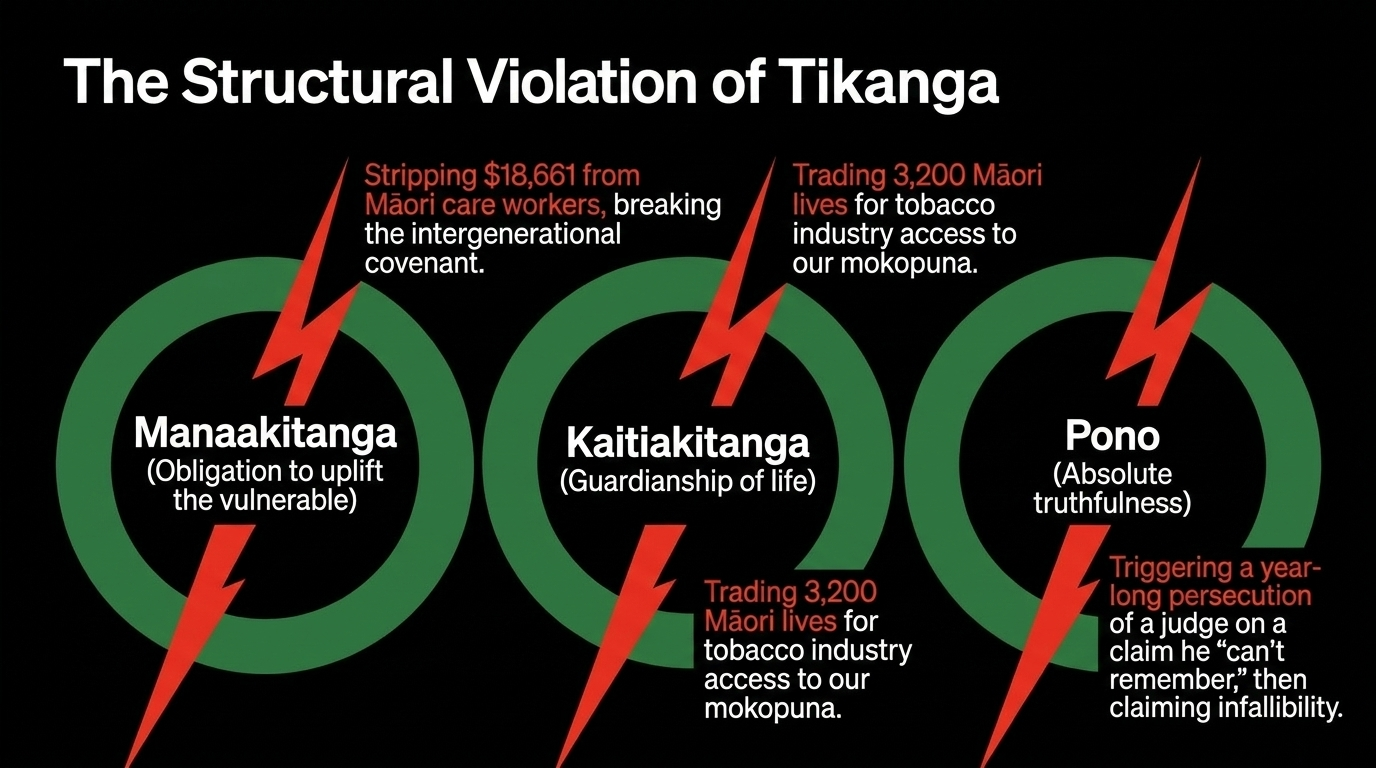
The tikanga impact (plain English): In tikanga Māori, manaakitanga is the structural obligation to uplift the mana of those around you — especially the vulnerable and overworked. It is not charity. It is constitutional. When the Crown strips $18,661 from a Māori care worker, it does not merely reduce her income. It reduces her mana, breaks her household, and severs the intergenerational covenant that tikanga demands. There is no tikanga-consistent justification for what this government did on 6 May 2025.
The solution: Restore the Equal Pay Amendment Act in full. Backpay all 33 cancelled claims. Establish a permanent, independent Pay Equity Commissioner under statute, outside the reach of the political cycle.
2. Smokefree: The 3,200 Māori Lives Peters Chose Not to Save
The Western parallel: In the United States, after decades of tobacco industry lobbying, Congress passed the Family Smoking Prevention and Tobacco Control Act in 2009. Imagine if a new government repealed it — after lobbyists described the incoming Deputy PM as "very powerful and very industry-friendly" — and then that same Deputy PM appeared on television praising his government's smokefree leadership. He would be called what he is: an industry puppet.
The harm, quantified: The repealed Smokefree Environments and Regulated Products Act would have saved 8,000 lives by 2040, with 40% — approximately 3,200 — being Māori, as confirmed by The BMJ. It would have reduced Māori smoking rates from 32.8% to 7.3%. Instead, as E-Tangata confirmed in July 2025, Māori vaping rates are now three times those of Pākehā. The NZ Herald confirmed in 2025 that nicotine lobbyists described Peters as "very powerful and very industry-friendly."
The tikanga impact (plain English): Kaitiakitanga — guardianship of life — extends to the mokopuna not yet born. A government that removes a law proven to save Māori children's lives in exchange for tobacco industry access violates kaitiakitanga at its most fundamental level. It is not a policy disagreement. It is a breach of Article 2 of Te Tiriti — the active protection of Māori taonga, which includes the lives and the lungs of our people.
The solution: Restore the generational smokefree ban. Regulate vaping with the same rigour as tobacco. Remove nicotine industry representatives from any advisory panel on tobacco regulation. Fund targeted cessation support for Māori and Pasifika communities through iwi health providers — not through the same ministry structures that defunded them.
3. The Disavowed Statement: A Year of Persecution on a Claim Peters "Can't Remember"
The Western parallel: Imagine a senior American politician told the US Attorney-General that a sitting federal judge had personally insulted him by name — triggering an official judicial conduct process — and then, when questioned, denied ever saying it. The AG admitted she had communicated that disputed claim to the Chief Justice of the Supreme Court. The politician said: "I can't remember saying that." He would face immediate calls to resign and a potential perjury investigation. In New Zealand, Peters appeared on a Māori television programme three weeks later claiming he "rarely makes mistakes."
The harm, quantified: As the NZ Herald's April 2026 investigation confirmed, District Court Judge Ema Aitken faced more than a year of formal judicial conduct proceedings, national media scrutiny, and the permanent reputational shadow of having been subject to New Zealand's first-ever judicial conduct panel process — all built on an allegation the panel found was not established as fact, traceable to a statement Peters denied making and "could not remember."
The tikanga impact (plain English): In tikanga Māori, pono — absolute truthfulness — is not a social courtesy. It is tapu. It is the foundation upon which trust between people is built and sustained. A rangatira who provides information to the nation's top law officer that triggers a year-long process against an innocent woman, then denies it, then appears on national television claiming he never makes mistakes, has not merely failed a political test. He has violated pono at the most fundamental level. In tikanga, this is not a character flaw. It is a disqualification from leadership.
The solution: Peters must be required to give evidence before a select committee inquiry into political interference in judicial conduct processes. Attorney-General Collins must explain how an unverified, subsequently disavowed allegation was transmitted to the Chief Justice of New Zealand and used to sustain a year-long process against a judge.
Ko Te Aho Matua — The Central Thread: What This Government Is Actually Doing
This is not a coalition of accident. This is a coalition of design — and Winston Peters is not a moderate brake on National's excesses. He is the human permission slip.
He provides the veneer of populism, the memory of "standing up for the little guy," and the cover of Māori ancestry to execute a programme that, as the MGL essay Solar Theatre in a Dying Empire documented in April 2026, has: dismantled Te Aka Whai Ora; removed Te Tiriti references from 28 pieces of legislation; imported Trump's anti-DEI playbook (as confirmed by the NZ Herald); and pursued fast-track resource consenting that overrides iwi rights in their own rohe.
Moana Maniapoto — kaiwhakaata, musician, te reo champion, and one of the most incisive interviewers in Aotearoa — held the mirror up.
Peters smashed it.
He talked over her, shouted "bulldust," invoked dead scholars to justify policies those scholars never endorsed, and when cornered on the facts, fell back on the oldest deflection in colonial politics: accuse the journalist of bias and the audience of not being smart enough.
He sat in his own office — his seat of power, his chosen terrain — and still could not answer a single question with a straight fact.
The pātaka is burning. He is holding the match. And he is asking for your vote.
Ka mutu. Kāore e mutu.
He Tono Koha — Koha Statement
Winston Peters burned $12.8 billion in women's wages in 45 minutes. He repealed the law that would have saved 3,200 Māori lives. He cannot remember if he gave the nation's top law officer information that triggered a year-long persecution of a judge. He sat in his own office across from Moana Maniapoto and denied every verifiable fact she put to him — on camera, on a Māori platform, in front of our people.
This essay exists because someone verified it. Because someone cited it. Because someone refused to let it slide.
Every koha to The Māori Green Lantern is a direct counter-strike. It funds the research, the verification, the legal hardening, and the publishing that keeps this record in public view — the record Peters assumes nobody will check. Rangatiratanga includes the power to fund our own truth tellers. This essay cost hours of research. The lies it exposes cost lives.
Kia kaha, whānau. Stay vigilant. Stay connected.
If you are able, consider a koha to ensure this voice continues:
- 💛 Koha directly: https://app.koha.kiwi/events/the-maori-green-lantern-fighting-misinformation-and-disinformation-ivor-jones
- 📬 Subscribe and receive essays direct: https://www.themaorigreenlantern.maori.nz/#/portal/support
- 🏦 Bank transfer: HTDM, 03-1546-0415173-000
- 📣 Follow on Facebook: https://www.facebook.com/Themaorigreenlantern/subscribe/
If you cannot koha — no worries. Subscribe, follow, kōrero, share with your whānau and friends. That is koha in itself.
Views expressed constitute honest opinion on matters of public interest under the Defamation Act 1992 (NZ) and Durie v Gardiner NZCA 278. All factual claims are sourced and cited. Named individuals are referenced solely in their public capacity as serving elected officials and ministers. Errors: contact via themaorigreenlantern.maori.nz.
Research Transparency: Search tools, MGL essay archives, and filed NZ Herald judicial conduct report used. Sources consulted: NZ Herald, The Spinoff, E-Tangata, Workers First Union, PSA, Hāpai Te Hauora, 1News, The BMJ, Beehive.govt.nz, Green Party, Wikipedia (Equal Pay Amendment Act 2025). Interview: Te Ao with Moana, Whakaata Māori, published 4 May 2026, filmed at Winston Peters' office. Date of publication: 5 May 2026.