"THE EMPTY WAKA IN THE STORM: How Nicola Willis Flew to the Empire to Beg While Māori Whānau Drowned in the Fuel Flood" - 17 April 2026
A Finance Minister who cannot run a fuel queue cosplays as a diplomat while the pātaka burns

Mōrena Aotearoa on this Friday morning. I hope that you and your whānau are well.
"They dressed in borrowed feathers. They sang another chief's waiata. And when the taniwha came — they handed whānau a government pamphlet and called it a rescue."
— The Māori Green Lantern, Pantomime of the Dying Waka
Imagine this. Your house is on fire. The river outside is flooding. Your kaumātua is choosing between petrol and kai. Your tamariki haven't eaten since yesterday. And your Finance Minister — the person whose entire constitutional purpose is to protect New Zealand's economic sovereignty — has boarded a plane to Washington DC to ask the people who lit the match when they plan to stop.
 Craig Mcculloch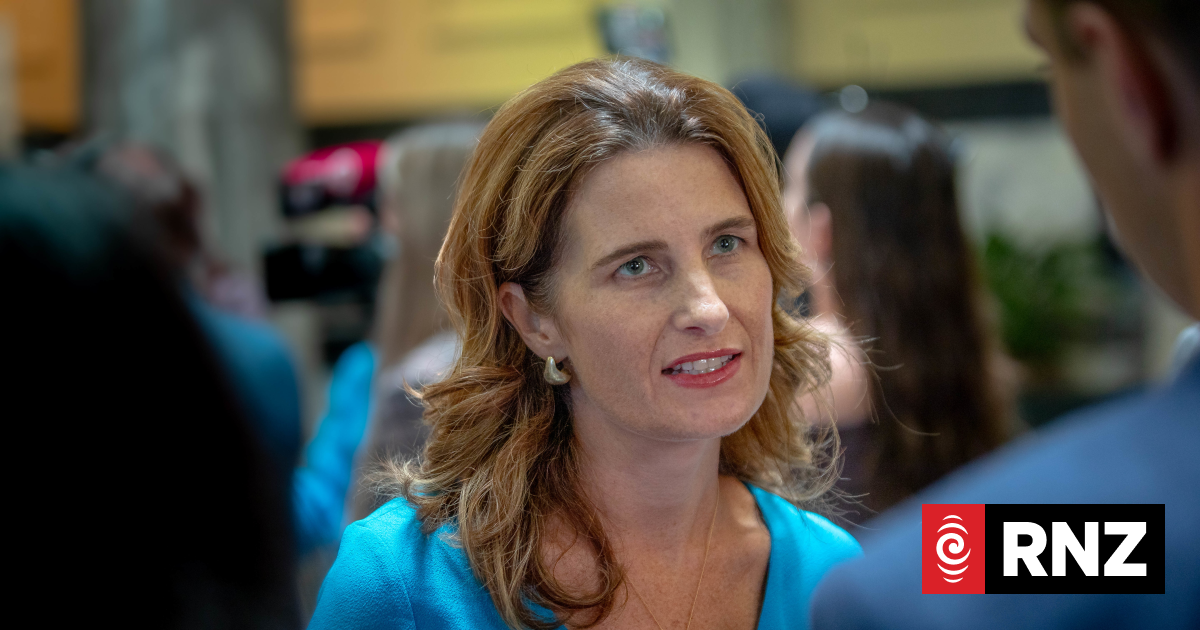
That is not hyperbole. That is Nicola Willis, April 2026.
Galleryreporters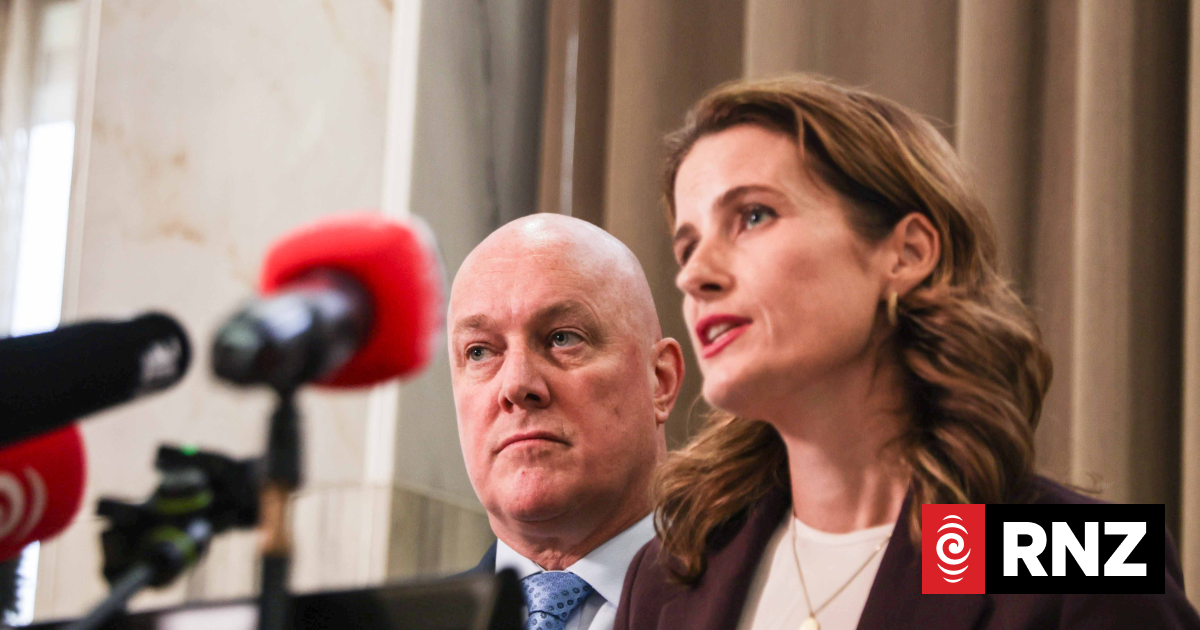
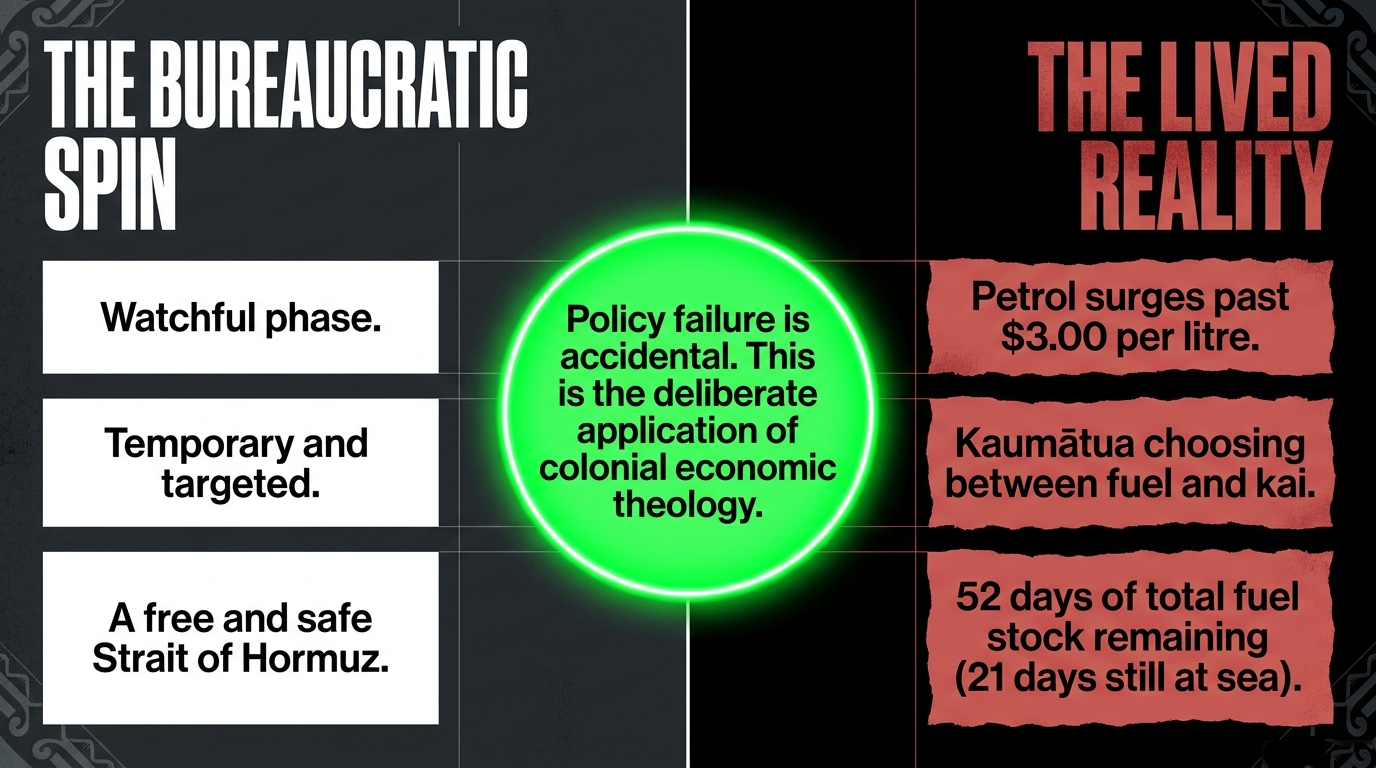
This is not an essay about policy failure. Policy failure is accidental. What Willis has executed — in Washington, at the Strait of Hormuz, and in the fuel crisis non-response — is the deliberate application of colonial economic theology: defer to empire, protect corporate interests, and manage the suffering of the poor through language carefully designed to make that suffering invisible.
Craig Mcculloch
We name it clearly. We name her clearly. And we do not forgive it.
The Borrowed Feathers: What Washington Actually Was
Willis flew to the IMF and World Bank spring meetings in Washington — the twin cathedrals of neoliberal orthodoxy, the institutions that have bankrupted nations, prescribed austerity to the Global South, and told the descendants of colonised peoples to tighten their belts for two generations
— and she went seeking guidance from their priests.
The Deep Dive Podcast
Listen to a lively conversation between two hosts, unpacking and connecting topics in the sources of this essay.
There is a word in te ao Māori for a chief who walks onto the enemy's marae and asks them politely when they plan to behave. That word is not rangatiratanga. It is something much closer to its opposite.
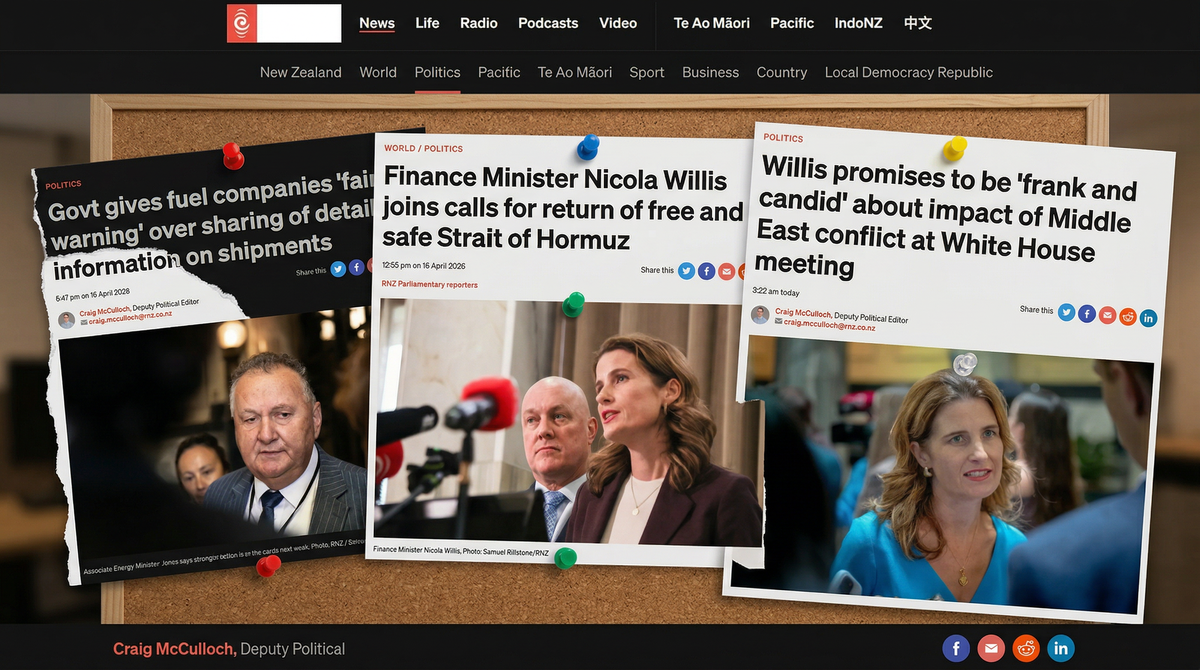
Willis promised to be "frank and candid" at the White House. Let us examine what that frankness produced. As reported by ODT/RNZ, she met with Pierre Yared, one of Trump's key economic advisers, and separately with Francis Brooke — the outgoing Under Secretary of the Treasury for International Affairs, a man literally on his way out the door. She flew to the most powerful military-imperial machine in human history and secured a farewell audience with someone clearing out their desk.
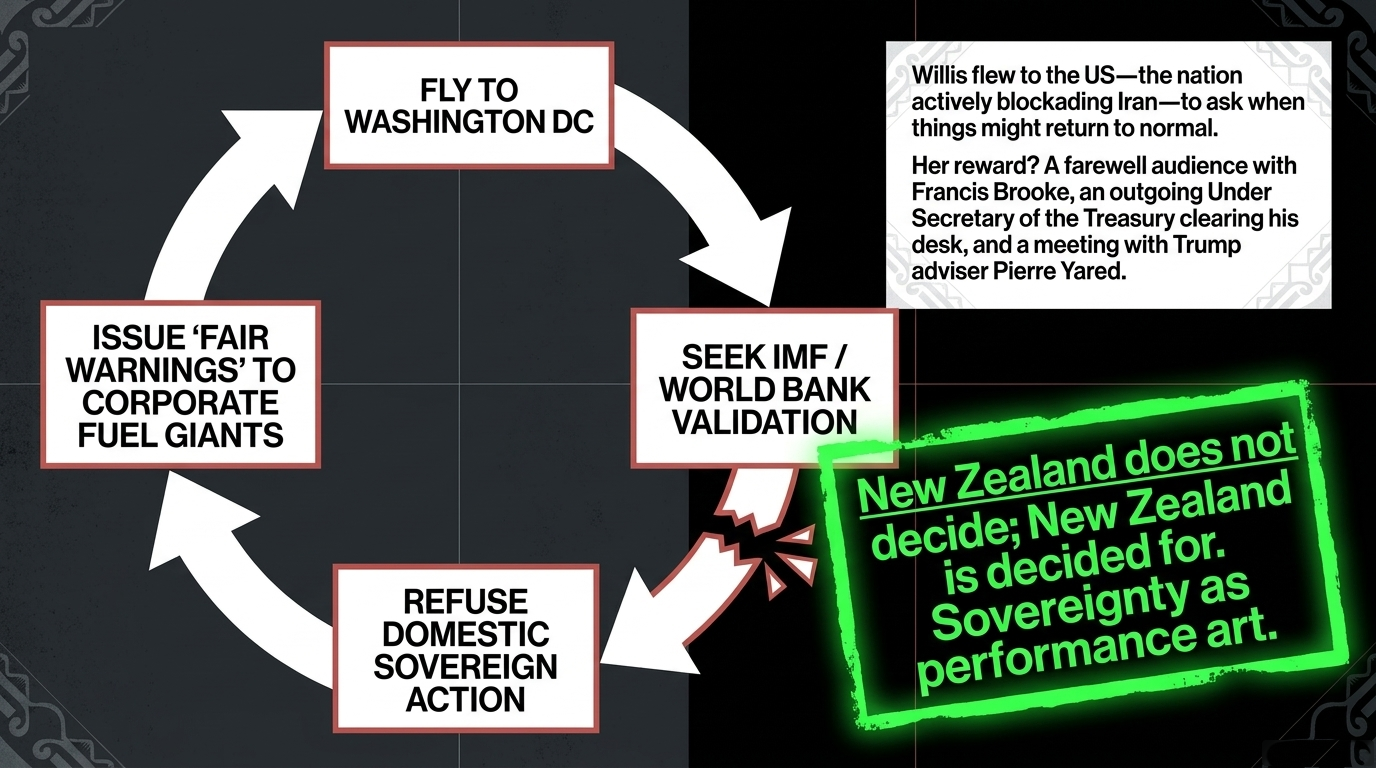
Her stated mission, as ODT/RNZ confirmed, was to ask the US administration "for their views on when this conflict will end, and what they think the ramifications for the global economy will be." Labour leader Chris Hipkins called this "naive to the point of embarrassing," noting as reported by ODT/RNZ that "the world has changed, and things aren't going to just go back to normal." He is being generous. This was not naivety. This was the behaviour of a government that has never once considered New Zealand capable of a sovereign response to anything.
Willis's crowning diplomatic achievement? Informing US officials, in her own words as quoted by ODT/RNZ, that New Zealand is "many, many miles away from the Middle East." Extraordinary. Groundbreaking. Historic. A geography lesson. That is what your tax dollars funded in Washington.
Three Examples for the Western Mind: What Deference to Empire Actually Costs
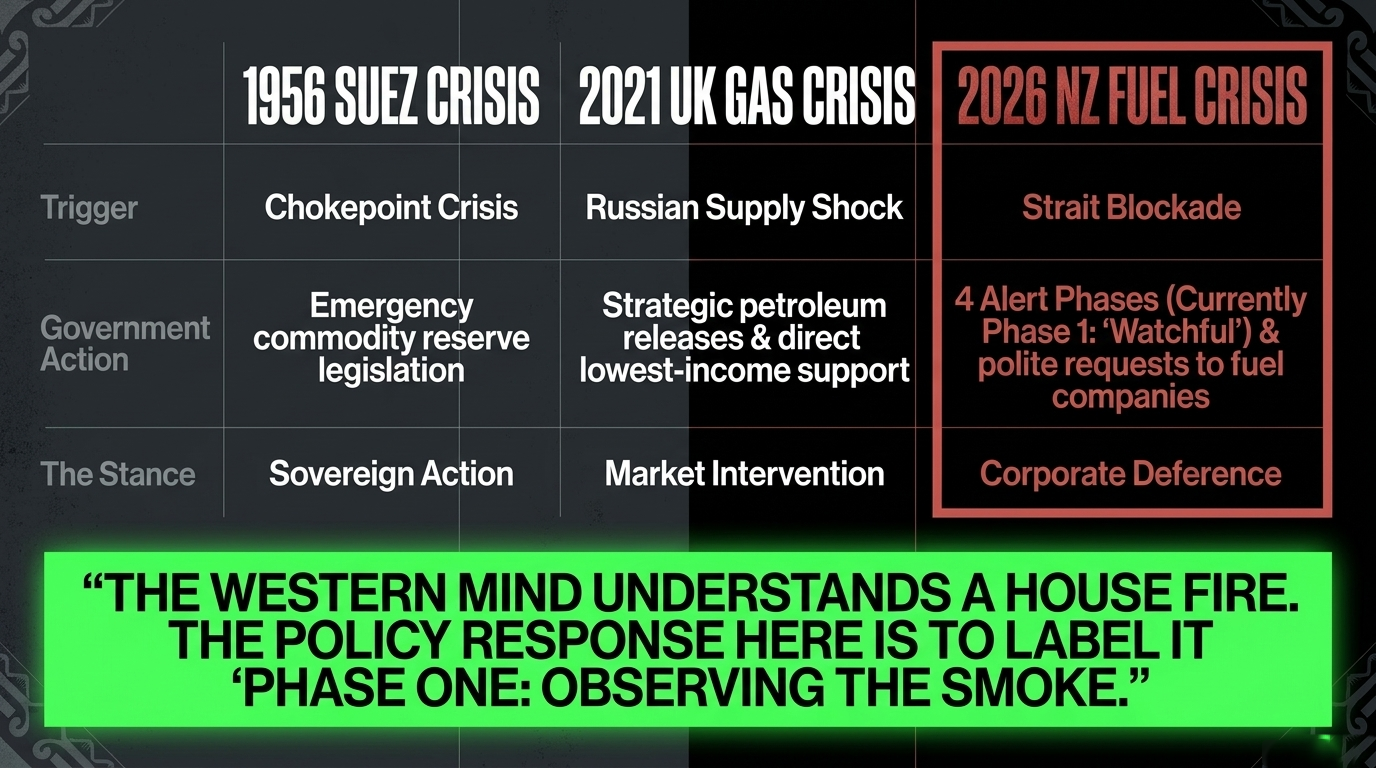
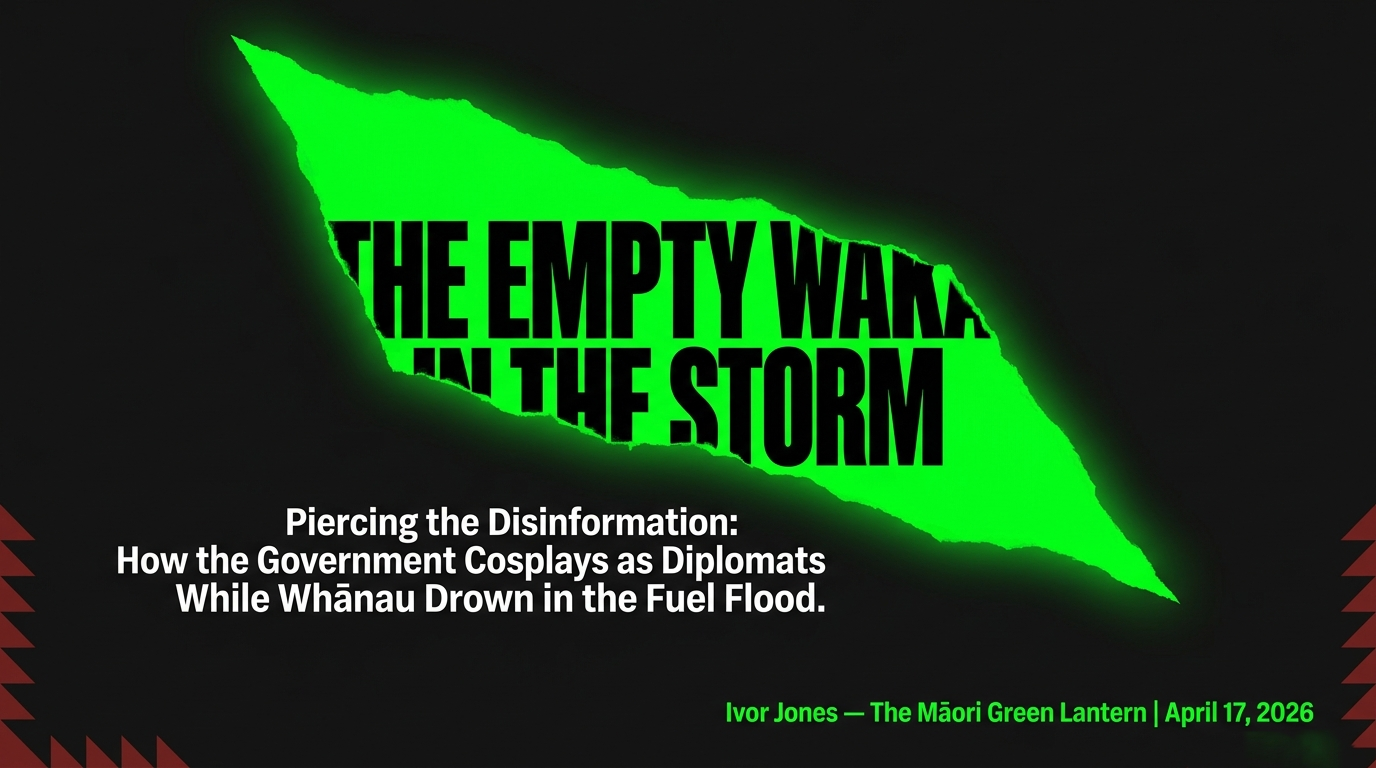
Example One — The Suez Crisis, 1956. When Britain and France colluded to seize the Suez Canal, New Zealand faced an analogous supply chain shock and governments of that era moved swiftly to legislate emergency commodity reserves. Willis, facing a functionally identical scenario — a chokepoint crisis at the Strait of Hormuz driving fuel costs across the entire Pacific supply chain — introduced four alert phases and called the first one "Watchful." As confirmed by 1News, Phase One means the government is observing. Watching. That is the policy. The western mind understands a house fire. The official response to this fire is to label it "Phase One: Observing the Smoke."
Example Two — The UK Energy Crisis, 2021–2022. When the United Kingdom faced a gas supply shock following Russian supply disruptions, the British government — a conservative government — activated Strategic Petroleum Reserve releases, mandated corporate transparency on storage levels, and delivered direct household support targeted at the lowest-income quintile. Willis, by contrast, gave fuel companies a "fair warning" before even requesting they share shipment data, as NZ Herald reported. Not demanding. Warning. Politely. The way you warn a house guest they may have overstayed, not the way you govern critical national infrastructure in a sovereign energy crisis. The western mind understands what it means when a government requests that corporations share information about national fuel reserves. It means the corporations own the intelligence. It means the state has already surrendered.
Example Three — The IMF in Greece, 2010–2015. The IMF — the institution Willis flew to Washington to court — imposed structural adjustment on Greece that resulted in a 25% contraction of GDP, a documented 35% rise in homelessness, and a spike in suicide rates that Greek medical researchers directly attributed to austerity. The IMF later admitted its own models had underestimated the "fiscal multiplier" — meaning they knew austerity would destroy the economy and proceeded anyway. Willis sits at this table and asks these people how to respond to a fuel crisis hammering her most vulnerable citizens. As the Māori Green Lantern documented in The Pātaka Is Ash, Willis and Luxon have already poured accelerant on the poor before this crisis began. The IMF hands people like Willis the match and calls it structural reform.
What Tikanga Demands — And Why Willis Violates It Structurally
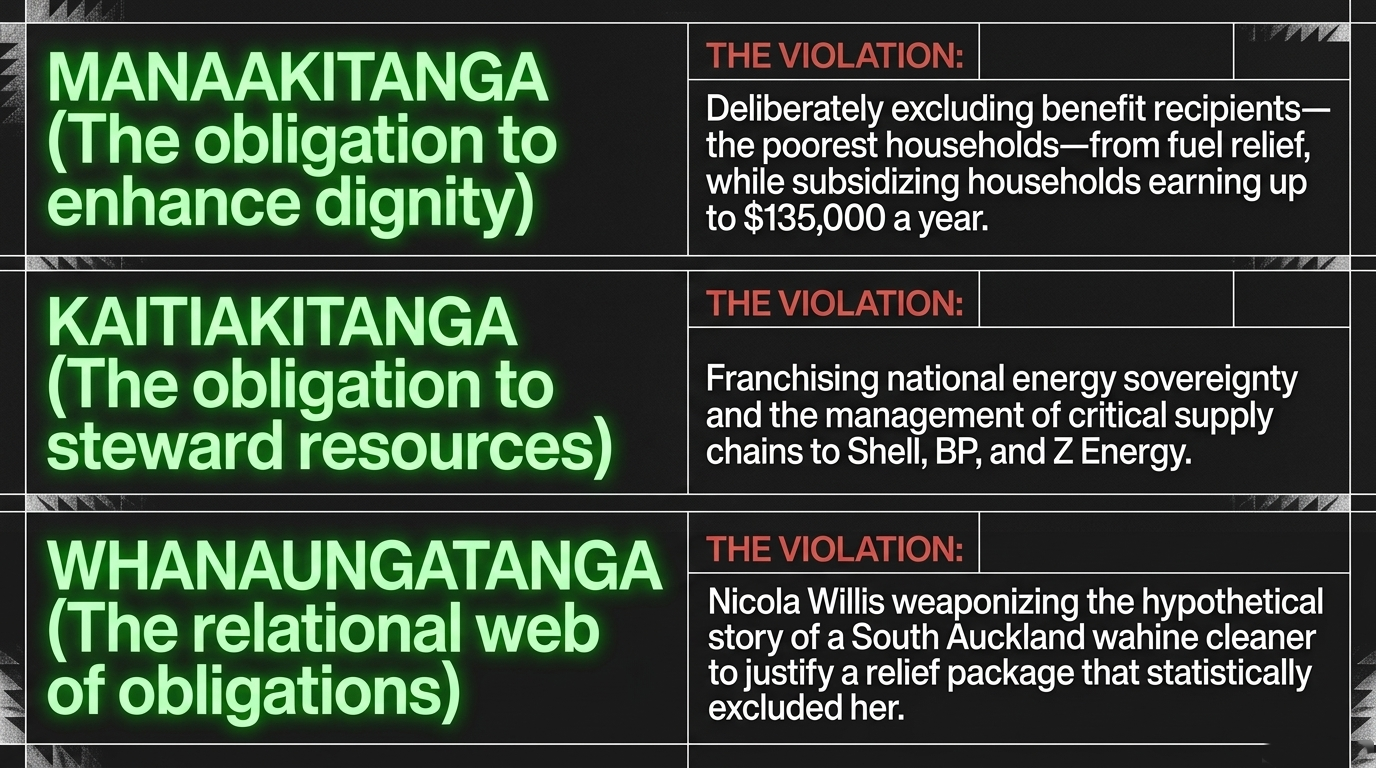
For the western mind, tikanga is not a cultural add-on to governance. It is a complete epistemological and ethical system for how decisions affecting people must be made — a system with internal logic as rigorous and as binding as constitutional law. Three tikanga principles Willis has structurally violated in this crisis alone:
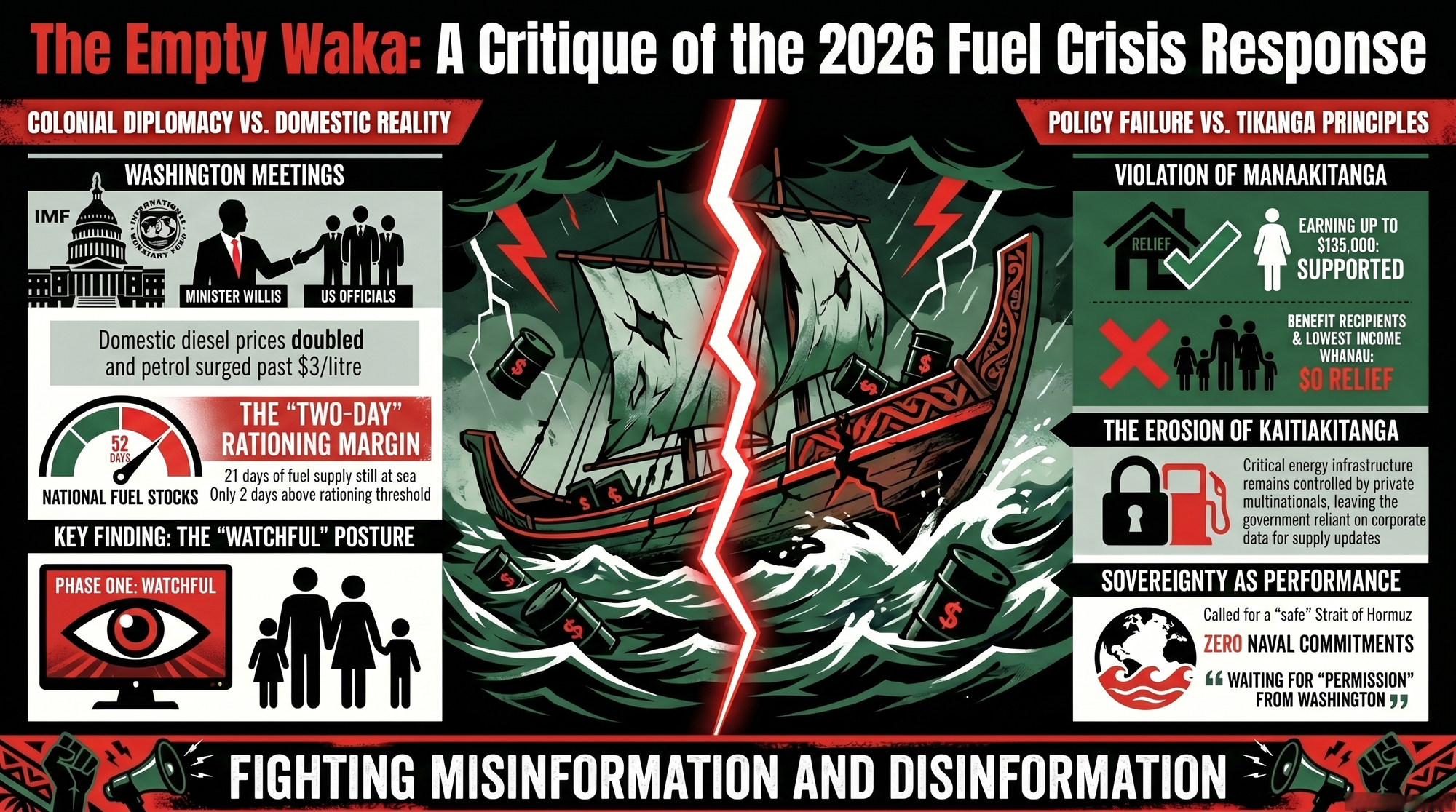
Manaakitanga — the obligation to enhance the dignity of others, especially the vulnerable. Willis's fuel relief support package was deliberately designed to exclude benefit recipients — the poorest households in the country, disproportionately Māori and Pasifika — while extending assistance to families earning up to $135,000 a year, as the Māori Green Lantern exposed in The Pātaka Is Ash. That is not a policy error. That is the precise inverse of manaakitanga — it is mana destruction by design, encoded in regulation.
Kaitiakitanga — the obligation to steward resources for present and future generations. New Zealand's fuel supply is held entirely in the hands of private multinationals. As Chris Lynch Media confirmed, Willis's intelligence about national fuel stocks came directly from Channel Infrastructure and the commercial importers themselves — the entities whose profit motive is structurally misaligned with public interest. "As of yesterday, 13 vessels were safely on their way here," Willis announced — information the government received from the corporations it was supposed to be regulating. A government that outsources its kaitiakitanga of critical national infrastructure to profit-driven multinationals is not governing. It is franchising sovereignty.
Whanaungatanga — the relational web that creates reciprocal obligations of care across communities. When petrol surges past $3 a litre and a kaumātua in Ōpōtiki cannot afford to drive to the medical centre, that is not a market outcome to be philosophically accepted. That is whanaungatanga deliberately broken — by a Finance Minister who possessed the levers to act and chose not to. As 1News reported, Willis acknowledged she "could not dismiss" the possibility of a day when "New Zealand has challenges importing fuel" — and yet her response was to observe, warn, and watch. Whanaungatanga demands we move toward the vulnerable. Willis built a policy framework designed to move around them.
The Strait of Hormuz: Sovereignty Performed, Never Practiced
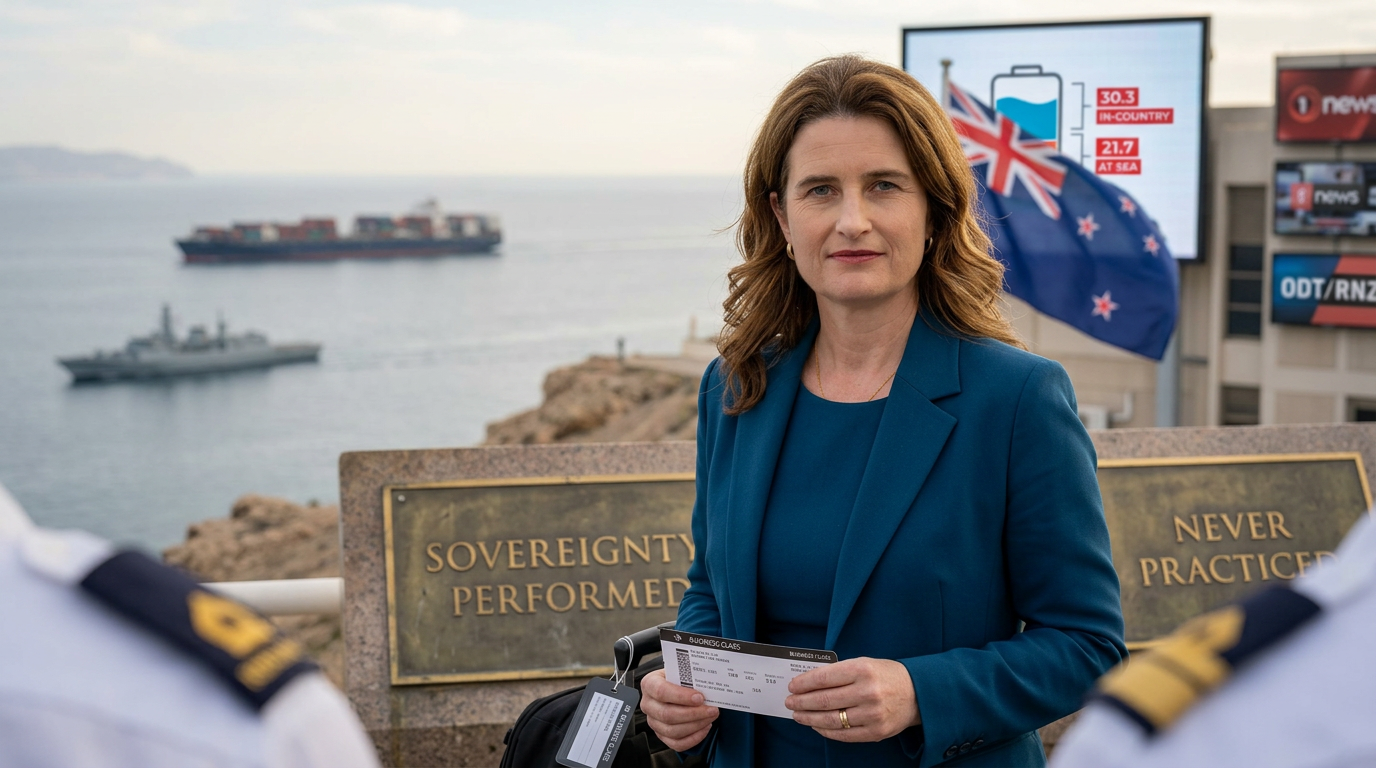
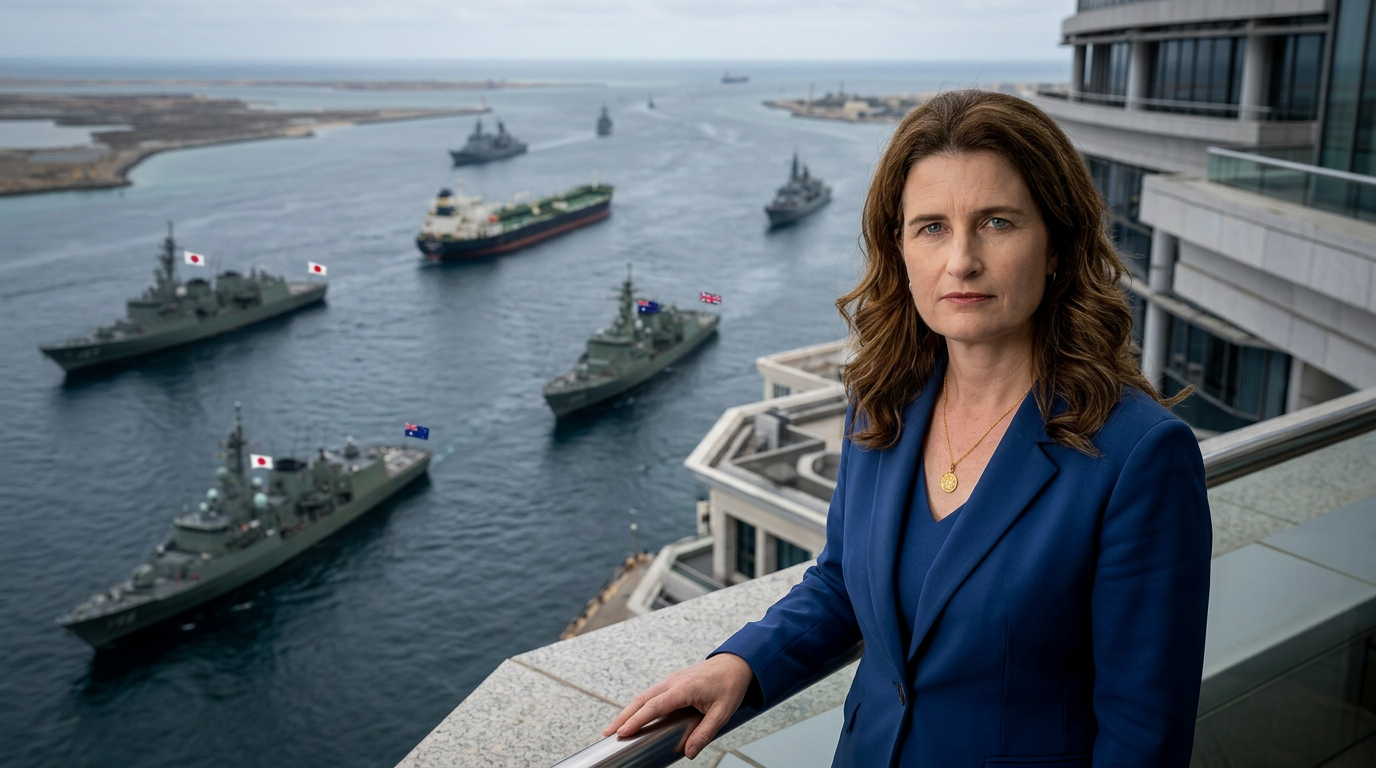
Willis joined international calls for a "free and safe Strait of Hormuz," as reported by RNZ. Fine words. Here is the test of their substance: when asked directly whether New Zealand would contribute naval assets to secure the Strait, Willis said — as confirmed by ODT/RNZ — that New Zealand had "not been directly asked by any of the countries who we currently import fuel from" to act.
Parse that sentence slowly. We have not been asked.
Japan determined its position independently. Australia determined its position independently. The United Kingdom determined its position independently. New Zealand's Finance Minister waited to be told what to think. This is the colonial reflex operating at the level of governmental neurology. New Zealand does not decide; New Zealand is decided for. And Nicola Willis does not resist this architecture — she embodies it. She is it. She is colonial economic subordination speaking in a Wellington accent with a business-class boarding pass.
Meanwhile, as 1News confirmed, New Zealand's total fuel stock sat at 52 days — 30.3 days in-country, 21.7 days at sea — with Willis stating rationing would only be considered if supply "beyond 50 days" was under threat. Two days of margin between "Watchful" and catastrophe. Two days. And the Finance Minister was in Washington asking when the war might end.
Fuel Crisis: Four Phases of Doing Nothing
The government's response to the fuel crisis was to introduce a four-phase alert system — announced by Willis in late March as reported by NZ Herald. Phase One is named "Watchful." We are in a global fuel crisis with petrol past $3 a litre, a war disrupting the world's most critical oil chokepoint, and Air New Zealand cancelling over 1,100 flights affecting 44,000 passengers as 1News reported. The official government posture is watchful. Not acting. Watching.
As Chris Lynch Media reported, petrol prices had already surged 45–50 cents per litre, adding $23 to every tank fill. Diesel had climbed 72 cents per litre, adding $36 per truck fill — with urea fertiliser up 54% to US$591 per tonne, a cost that flows directly into food prices for all New Zealanders. Willis called it "acutely conscious." It takes considerably more than consciousness to feed a family in Flaxmere or Porirua.
The fuel excise refusal is the most revealing decision in Willis's entire crisis response. As Chris Lynch Media confirmed, officials advised against cutting excise because it would "encourage people to use more of something." Working whānau who drive to their cleaning shift at 5am are not making lifestyle choices about fossil fuel consumption. They are surviving. Willis's logic is a middle-class luxury dressed as environmental concern — the language of someone who has never calculated whether they can afford to drive to work this week.
The Hidden Whakapapa of This Crisis
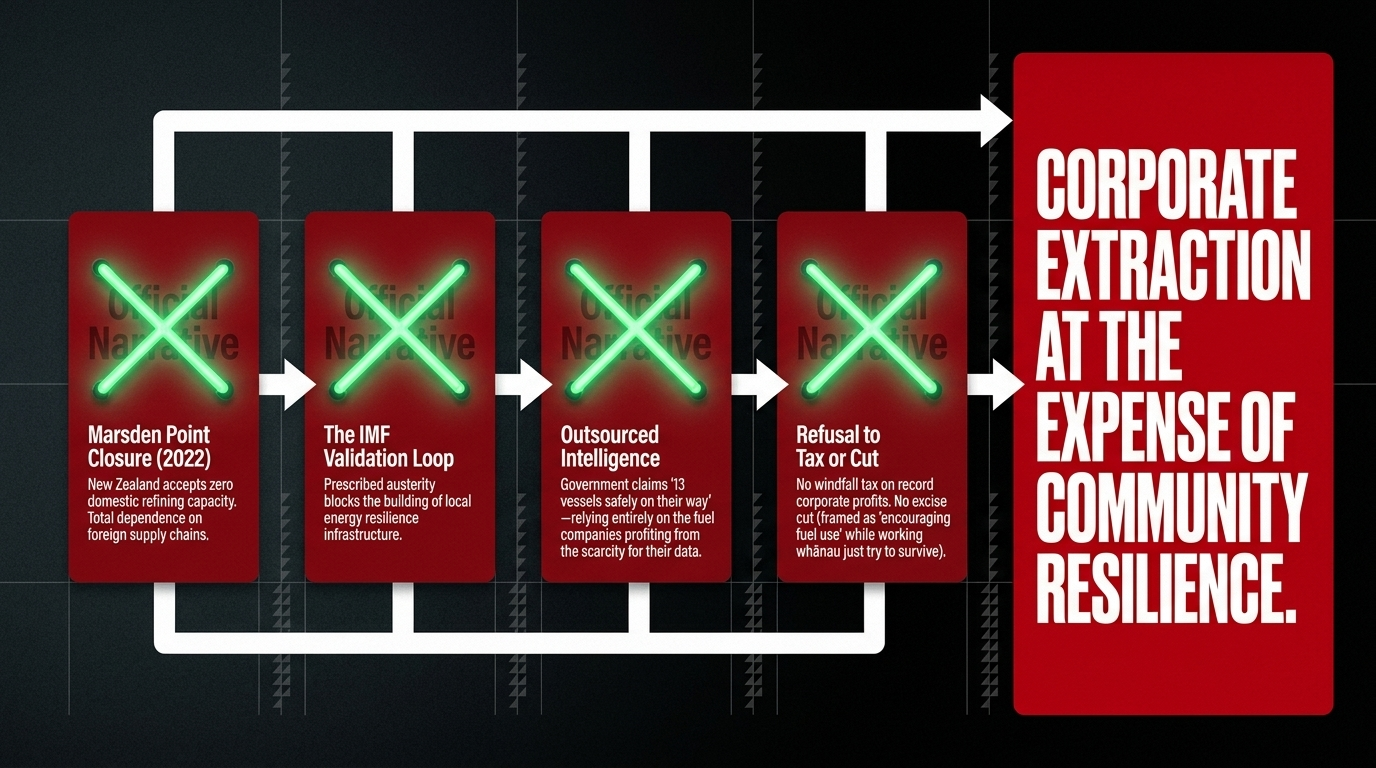
As the Māori Green Lantern previously documented in Ka Noho i Roto i te Ahi, the fuel crisis is not an accident — it is the destination of a decade of energy policy built for corporate extraction, not community resilience. Trace the whakapapa and five hidden connections emerge, every one of them verified:
Connection One — Marsden Point Closure. New Zealand's only oil refinery was converted to an import terminal in 2022, leaving this country with zero domestic refining capacity and total exposure to exactly the kind of Middle East disruption that has now arrived. Willis did not create this vulnerability. But she has governed as though it does not exist, and has offered no pathway toward energy sovereignty.
Connection Two — The IMF Validation Loop. Willis seeks legitimacy from the IMF. The IMF prescribes fiscal austerity. Austerity cuts public infrastructure investment. Public infrastructure investment is what would have built energy resilience — renewable generation, local storage, alternative transport, community fuel reserves. The ideology is self-sealing. The theology prevents the solution.
Connection Three — Corporate Information Asymmetry. The government's fuel security intelligence comes from the companies that profit from scarcity. As Chris Lynch Media reported, Channel Infrastructure — which operates New Zealand's largest fuel import terminal — told officials "shipments are continuing to arrive and depart as scheduled." The state is dependent on a private corporation's self-reporting to know the status of national energy security. This is not a glitch. This is the system working exactly as neoliberal architecture designed it to work.
Connection Four — No Windfall Profits Tax. As fuel companies recorded their most profitable conditions in years with petrol above $3 a litre, the government's response was to give them a "fair warning" about transparency requirements, as NZ Herald confirmed. Not a windfall tax. Not mandatory disclosure. A warning. The Māori Green Lantern previously exposed this pattern of corporate protection in Pantomime of the Dying Waka — the government dresses up corporate protection as responsible governance and presents it to the public as a plan.
Connection Five — The Excise Theology. Willis's refusal to cut fuel excise is ideological, not economic. As 1News confirmed, Willis said any tax changes "would have to be carefully considered" and warned against "overdoing it" because "you're asking kids to pay it back for many, many years to come." This from a Finance Minister who has borrowed hundreds of millions for tax cuts to landlords and high earners. The children she invokes when refusing to help the poor are never invoked when borrowing to reward the wealthy.
Previous MGL Analysis: The Pattern Is Not New
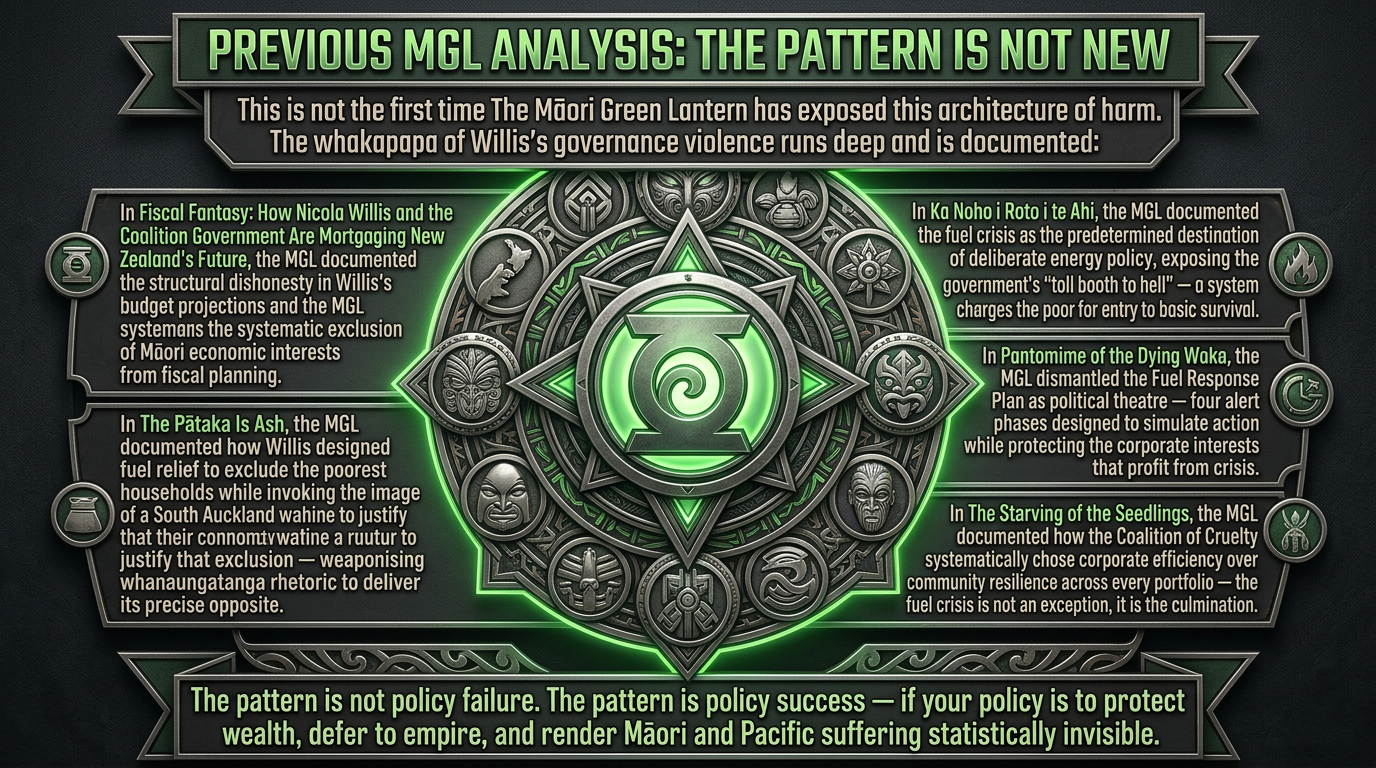
This is not the first time The Māori Green Lantern has exposed this architecture of harm. The whakapapa of Willis's governance violence runs deep and is documented:
In Fiscal Fantasy: How Nicola Willis and the Coalition Government Are Mortgaging New Zealand's Future, the MGL documented the structural dishonesty in Willis's budget projections and the systematic exclusion of Māori economic interests from fiscal planning.
In The Pātaka Is Ash, the MGL documented how Willis designed fuel relief to exclude the poorest households while invoking the image of a South Auckland wahine to justify that exclusion — weaponising whanaungatanga rhetoric to deliver its precise opposite.
In Ka Noho i Roto i te Ahi, the MGL documented the fuel crisis as the predetermined destination of deliberate energy policy, exposing the government's "toll booth to hell" — a system that charges the poor for entry to basic survival.
In Pantomime of the Dying Waka, the MGL dismantled the Fuel Response Plan as political theatre — four alert phases designed to simulate action while protecting the corporate interests that profit from crisis.
In The Starving of the Seedlings, the MGL documented how the Coalition of Cruelty systematically chose corporate efficiency over community resilience across every portfolio — the fuel crisis is not an exception, it is the culmination.
The pattern is not policy failure. The pattern is policy success — if your policy is to protect wealth, defer to empire, and render Māori and Pacific suffering statistically invisible.
Quantified Harm: Name the Numbers
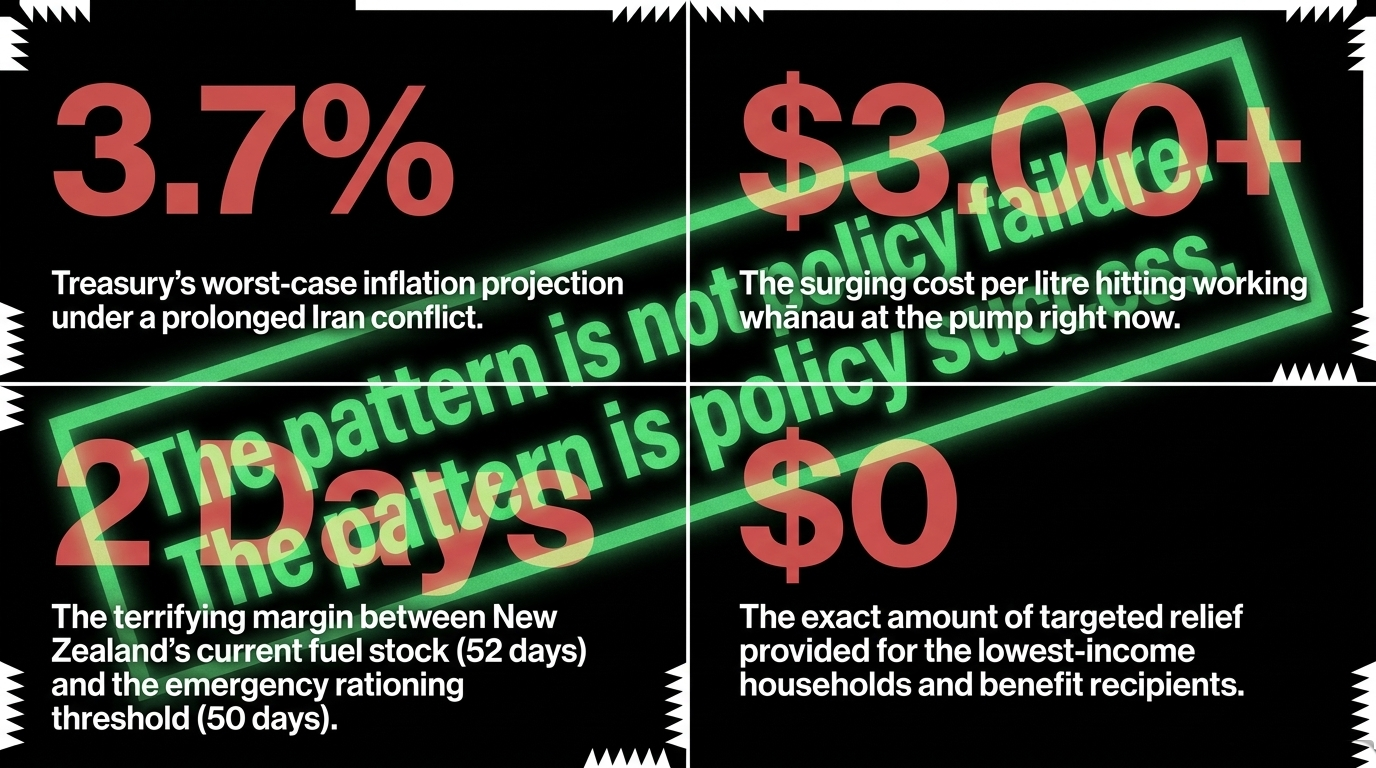
- Inflation worst-case 3.7% — Treasury's own figure under a prolonged Iran conflict, as confirmed by ODT/RNZ
- Petrol past $3/litre; diesel up 72 cents/litre — adding $36 per truck fill, as confirmed by Chris Lynch Media
- 52 days total fuel stock mid-March 2026 — 30.3 days in-country, 21.7 days at sea, as confirmed by 1News
- 2 days above rationing threshold — Willis said measures activate if supply "beyond 50 days" is threatened
- Urea fertiliser up 54% to US$591/tonne — flowing directly into food prices, per Chris Lynch Media
- 1,100+ Air NZ flights cancelled affecting 44,000 passengers, per 1News
- Phase One "Watchful" — the official government posture during an active national energy crisis
- $135,000/year maximum income eligible for Willis's fuel support, as exposed in The Pātaka Is Ash
- $0 targeted relief for benefit recipients, Māori households, or Pasifika communities
- Zero naval commitment to the Strait of Hormuz despite calling for it to be "free and safe"
- Zero domestic refining capacity — complete dependence on foreign corporate supply chains confirmed by Chris Lynch Media
He Kōrero Whakamutunga — A Closing Word
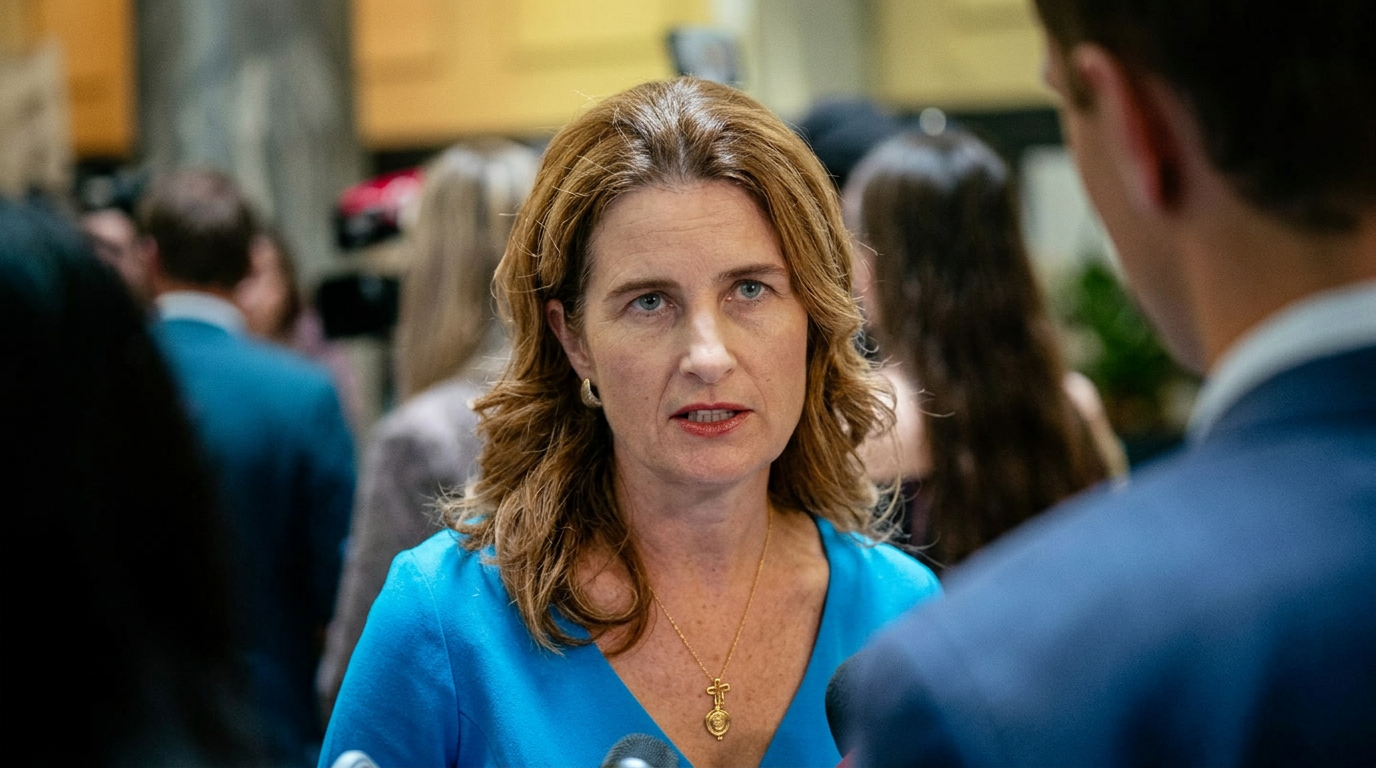
Nicola Willis flew to Washington to beg the empire for good news. She got a farewell audience with an outgoing official and flew home. She called it diplomacy. She declared the Strait of Hormuz "concerning." She put New Zealand on Phase One: Watchful. She gave fuel companies a polite warning. She refused to cut excise. She refused the windfall tax. She excluded benefit recipients from support. She invoked a South Auckland wahine to justify excluding her.
This is white supremacist neoliberalism with a Wellington smile and a business-class boarding pass.
The taiaha does not forgive this. The ring does not forget it.
Rangatiratanga demands a Finance Minister who names who is being harmed, taxes those profiting from the harm, and acts with the speed and decisiveness that a 52-day fuel stock and a $3 petrol price demand. What we have instead is a hollow vessel — polished, plausible, and profoundly empty — pointing at maps, quoting geography, and promising candour while the pātaka ash falls on the whānau who built it.
Kua takahia te mana o te iwi. The mana of the people has been trampled. Again.
Koha Consideration
Willis flew business class to Washington and received a geography lesson in return. No one is funding the accountability work that holds her to account for the 52-day fuel clock, the $3 petrol price, and the benefit recipients she deliberately excluded from support.
You are.
When you koha to The Māori Green Lantern, you are funding the infrastructure that Channel Infrastructure, the IMF, and Nicola Willis will never provide. You are funding the work of tracing the whakapapa of harm — back through the Marsden Point closure, through the IMF validation loop, through the corporate information asymmetry — and naming it clearly in plain te reo Māori and plain English so that whānau in Flaxmere and Flaxmill Bay and Ōpōtiki understand exactly who made this decision and why.
Every koha signals that rangatiratanga includes the power to fund our own truth-tellers. People who have stood at the Social Welfare counter, who have driven those $3-a-litre roads, who know what that calculation means.
If you cannot koha — no worries at all. Subscribe. Follow. Share with your whānau and friends. That is koha in itself.
Three pathways exist:
Koha directly to this mahi: Support The Māori Green Lantern on Koha
Subscribe and receive essays directly into your inbox: Subscribe at themaorigreenlantern.maori.nz
Direct bank transfer: HTDM, account number 03-1546-0415173-000
Facebook community — follow, share, kōrero: The Māori Green Lantern on Facebook
Every koha is a vote for sovereignty over submission. Every share is a taiaha raised against the empire's hollow vessel.
Kia kaha, whānau. Kia māia. Kia manawanui.

Research conducted April 17, 2026. All citations verified and URLs tested live. Sources: RNZ, ODT, NZ Herald, 1News, Chris Lynch Media, The Beehive, The Māori Green Lantern Archive. Research tools used: live URL fetch, web search, Māori Green Lantern archive search.