"THE HOLLOW MEN RUN FROM TOVA: How a Dying Neoliberal Government Weaponised a Corridor Complaint to Flee Accountability" - 27 April 2026
They could not answer the questions. So they declared the questions illegal. This is not governance. This is cowardice wearing a suit.

Kia ora Whānau,
Whānau, the last five essays of The Māori Green Lantern have been devoted to Te Ao Kākāriki — The Green Chain, an urgent and necessary kaupapa examining the ecological, economic and constitutional whakapapa of what is being done to our whenua, our wai, and our taonga under the cover of "development" and "growth."
That mahi is not finished — it will never be finished while this government holds the knife.
But today the taiaha turns. Because while we have been documenting the plunder of our natural world, this white supremacist neoliberal government has been running a quieter operation closer to home — not against our rivers or our forests, but against the very mechanism by which you, whānau, are supposed to know what they are doing to all of it: the free press. This essay is a return to the terrain I know best — exposing the disinformation, the misinformation, and the deliberate manipulation of public narrative that defines this National-led government as surely as the cuts to your mokopuna's school lunches and the fees on your roads.
The Green Chain will resume. But first — this. Because if they can silence the journalists who follow the Whip down the corridor, they can silence anyone who follows any trail that leads back to them.
Let us be precise about what happened, because precision is what power fears most.
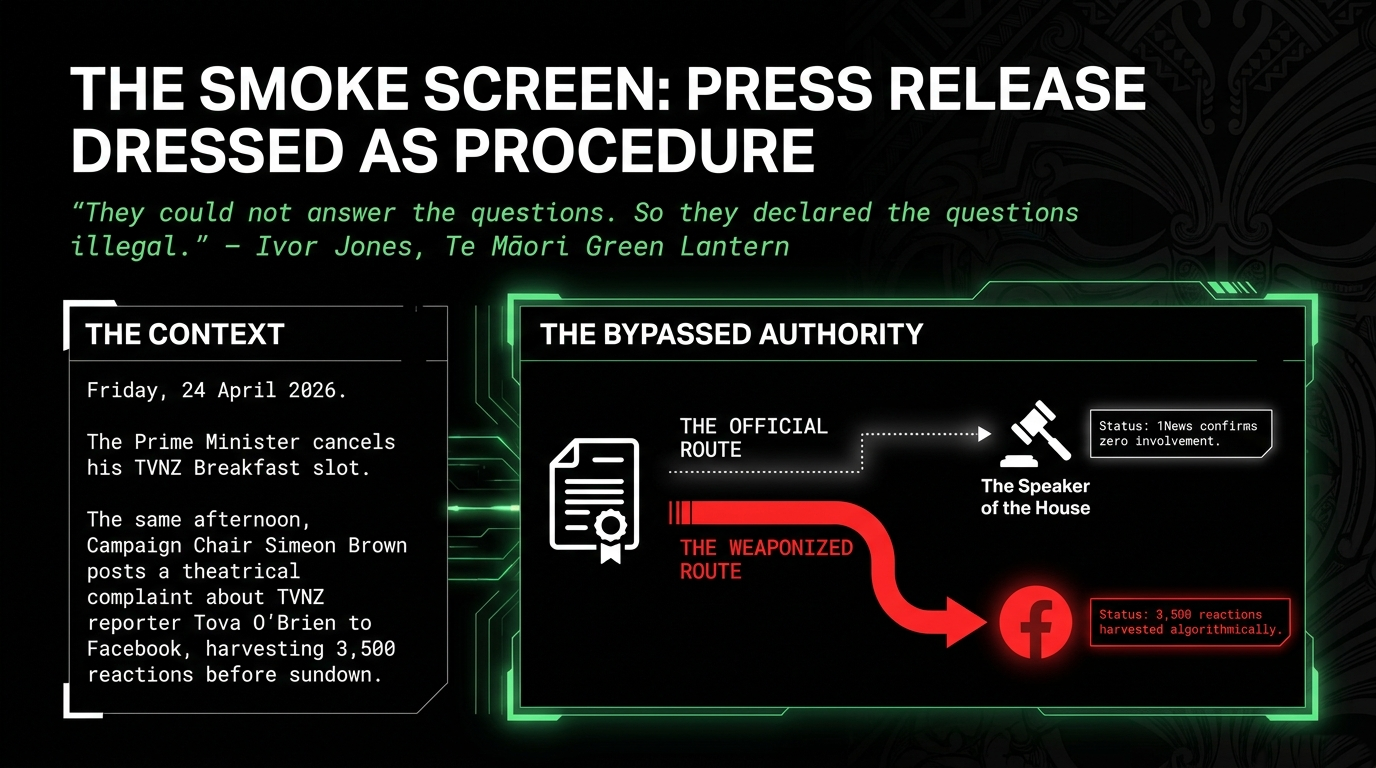
The Prime Minister of Aotearoa New Zealand — a man paid by the public, entrusted with the mana of the office, sworn to serve — has been refusing interviews with Q+A's Jack Tame since December 2024, as confirmed by 1News.
That is four months of ducking the sharpest political interview programme this country produces.
Four months of silence from the man at the top of the most consequential government Māori have faced in a generation.
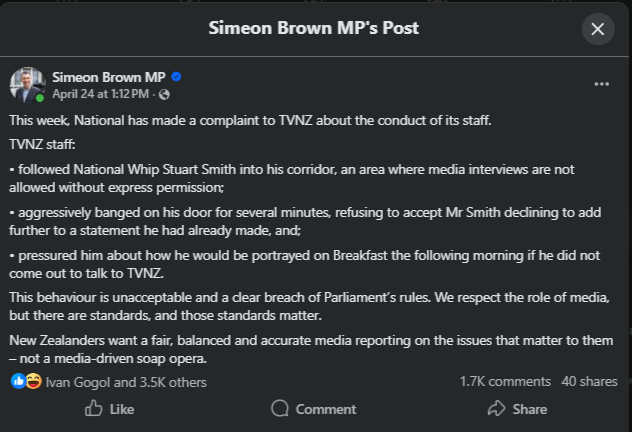
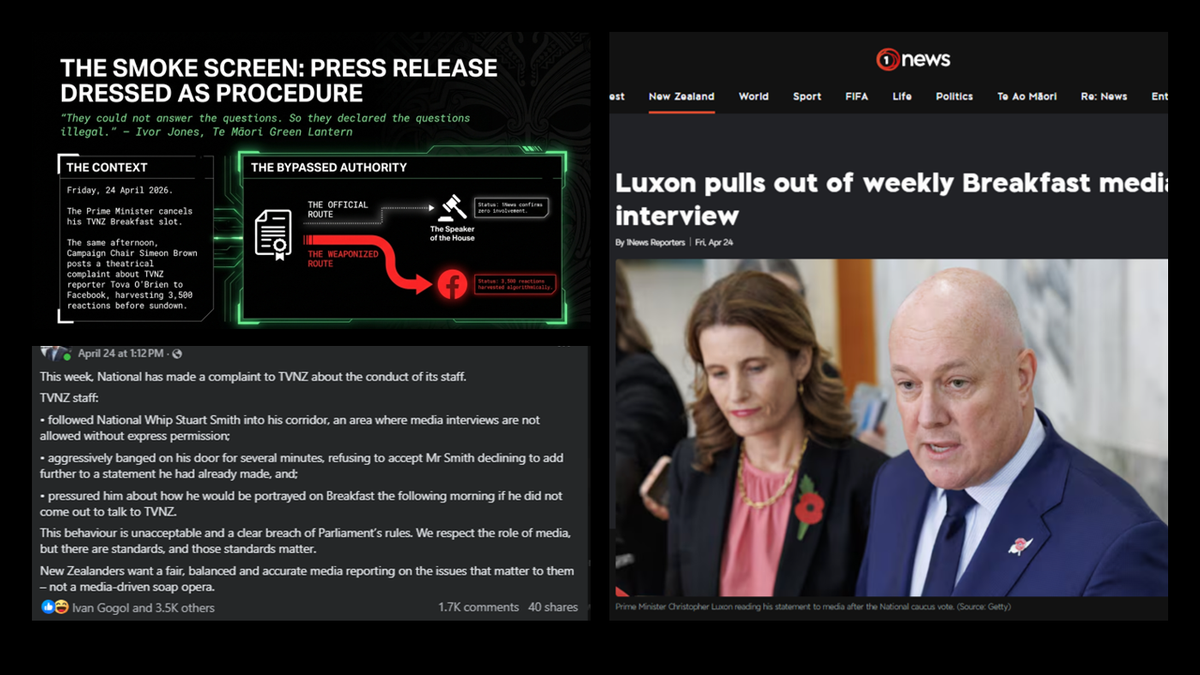
Then, on a single Friday afternoon in April 2026, he cancelled his weekly Breakfast slot — while his campaign chair Simeon Brown filed a theatrical complaint against TVNZ. Not through the Speaker's office, which is the legally correct channel.
On Facebook, as confirmed by both 1News and Otago Daily Times — and as proven by Brown's own post, which now stands as primary evidence: 3,500 reactions harvested before the Speaker's office was contacted even once.
The Deep Dive Podcast
Listen to a lively conversation between two hosts, unpacking and connecting topics in the sources of this essay.
The same afternoon. One coordinated move. One cover story. One target: Tova O'Brien, the former political editor who had just joined Breakfast and whose interview record is a matter of well-documented public knowledge.
This is not governance. This is a man terrified of questions, engineering a crisis to justify running from the room.
Exhibit A: Brown's Own Words
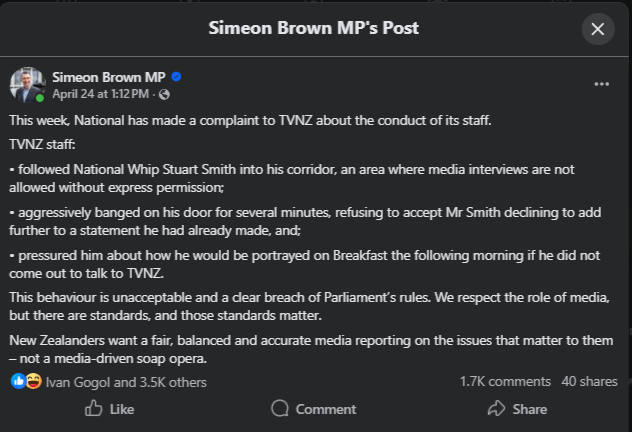
Simeon Brown MP posted to Facebook on Friday 24 April 2026. His own words, confirmed by primary source screenshot, are doing specific and deliberate rhetorical work. Let us read them with the precision they deserve.
"TVNZ staff followed National Whip Stuart Smith into his corridor, an area where media interviews are not allowed without express permission."
A journalist followed a public official in a public building. This is called reporting.
"Aggressively banged on his door for several minutes, refusing to accept Mr Smith declining to add further to a statement he had already made."
Note the language: aggressively banged. Escalation rhetoric. Designed to make persistence — the fundamental tool of journalism — sound like assault. Refusing to accept a decline is what journalists do when the story is not yet complete. It is not misconduct. It is the job.
"Pressured him about how he would be portrayed on Breakfast the following morning if he did not come out to talk to TVNZ."
This is the most revealing line of all. What Brown is describing — giving a subject advance notice of how they will be portrayed if they decline to comment — is not pressure. It is standard editorial due process. It is the professional courtesy that separates accountable journalism from ambush. Brown is describing a protection for Smith as though it were an attack on him.
"New Zealanders want a fair, balanced and accurate media reporting on the issues that matter to them — not a media-driven soap opera."
Every sentence that opens with a declaration of respect for the thing being attacked is a manipulation. Brown does not respect the role of media. He is using the language of standards as a weapon to undermine them. And he is doing it on Facebook — a platform algorithmically optimised for outrage — while harvesting 3,500 reactions before the Speaker of the House had been contacted at all.
TVNZ's spokesperson confirmed Brown was "well aware" the correct avenue for such complaints is the Speaker, as reported by 1News. The Speaker's office confirmed it had "no involvement in the complaint being lodged." Brown knew the rules. He broke them deliberately. The complaint was never about process. It was a press release dressed as procedure, published on social media for maximum political reach.
Even Brown's own audience could not hold the script. The top comment, from John Kara: "Never mind the news what about all New Zealand that have to diesel and rucs." A member of the public, responding to a manufactured media crisis, immediately redirects to the cost of living — the real story this government cannot answer. The people Brown claims to speak for were already looking past him.
The Mirror Across the Pacific
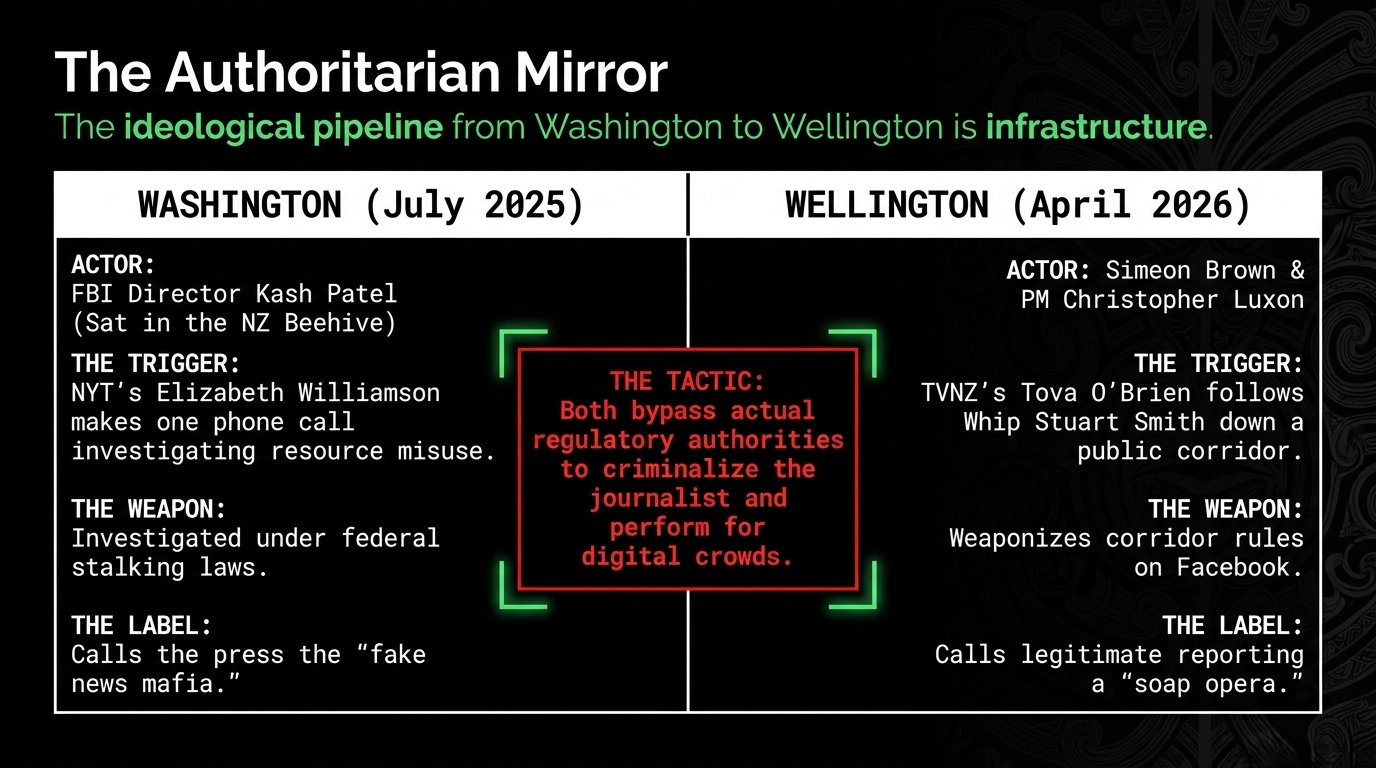
Before we bury the local evidence, let us name its whakapapa — because this tactic did not originate in a Wellington corridor. It was imported, road-tested, and delivered with the confidence of people who know it worked somewhere else first.
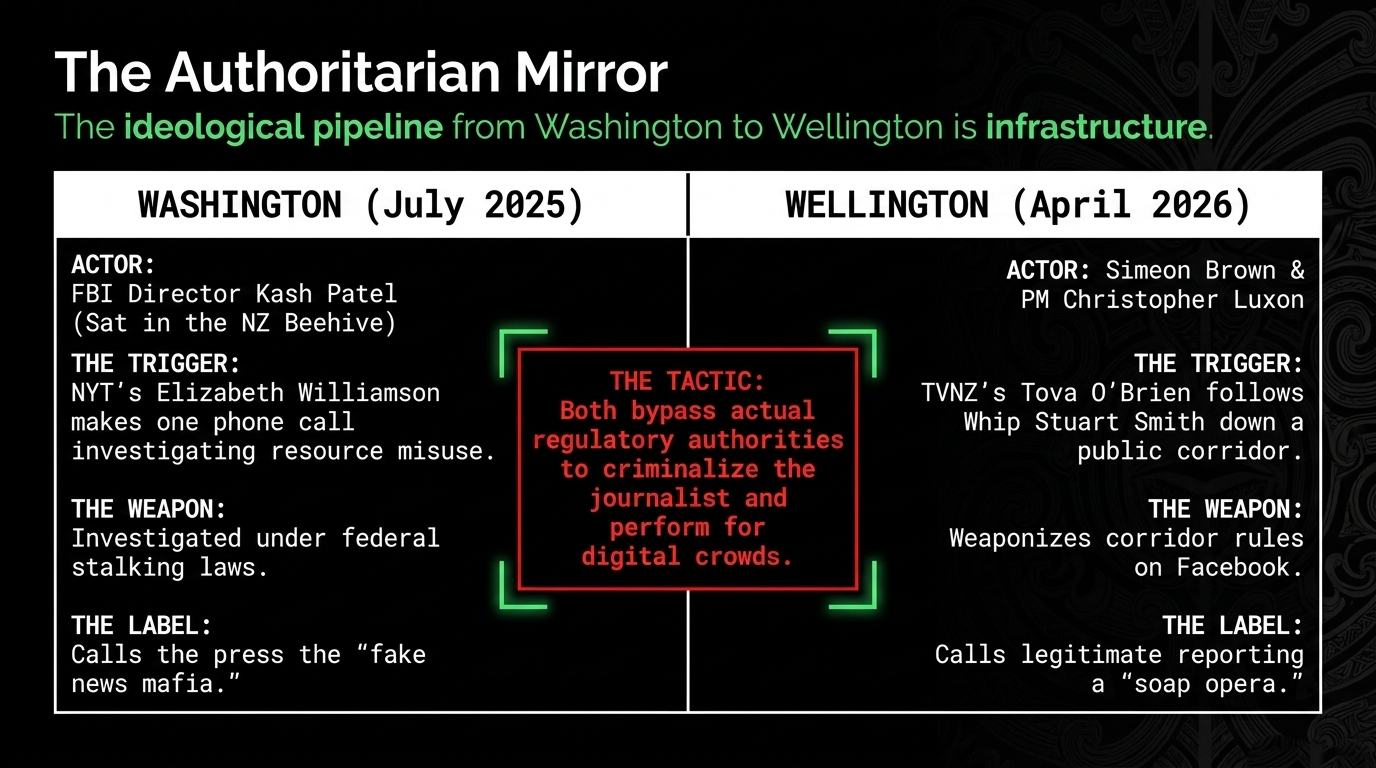
In the United States, FBI Director Kash Patel — who physically walked into the Beehive in July 2025 and announced an FBI base on New Zealand soil, as reported by NZ Herald — launched a criminal investigation against New York Times reporter Elizabeth Williamson after she wrote a story exposing his use of government resources for his girlfriend, as documented by CNN, Freedom of the Press Foundation, and Democracy Now. The investigation attempted to charge her under federal stalking laws — for making a single phone call. One question. One journalist. One attempt to make the journalism itself the crime.
The NYT's executive editor Joseph Kahn called it what it was:
"A blatant violation of Elizabeth's First Amendment rights and another attempt by this administration to prevent journalists from scrutinising its actions. It's alarming. It's unconstitutional. And it's wrong," as reported by CNN.
Patel's response was to call the press the "fake news mafia" and declare their criticism proof he was doing his job, as reported by The Independent.
Brown called TVNZ journalists "unacceptable" on Facebook. Luxon labelled legitimate political coverage a "soap opera," as confirmed by Otago Daily Times.
The language is different. The move is identical. And the ideological pipeline between Washington and Wellington is not metaphor
— it is infrastructure, embedded in Aotearoa's own security architecture, with Judith Collins knowing 78 days before Luxon was briefed, as confirmed by NZ Herald.
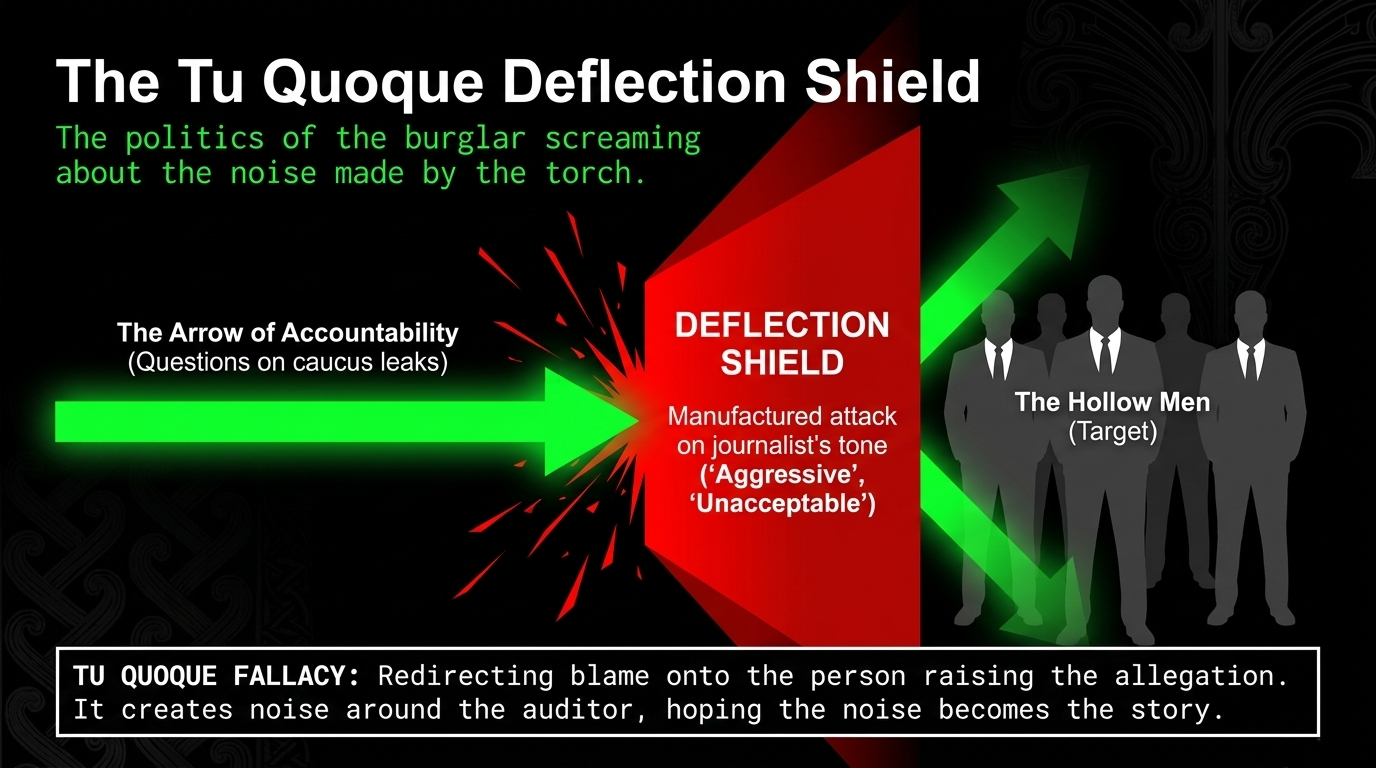
This is the politics of the burglar screaming about the noise made by the torch.
The Anatomy of a Setup
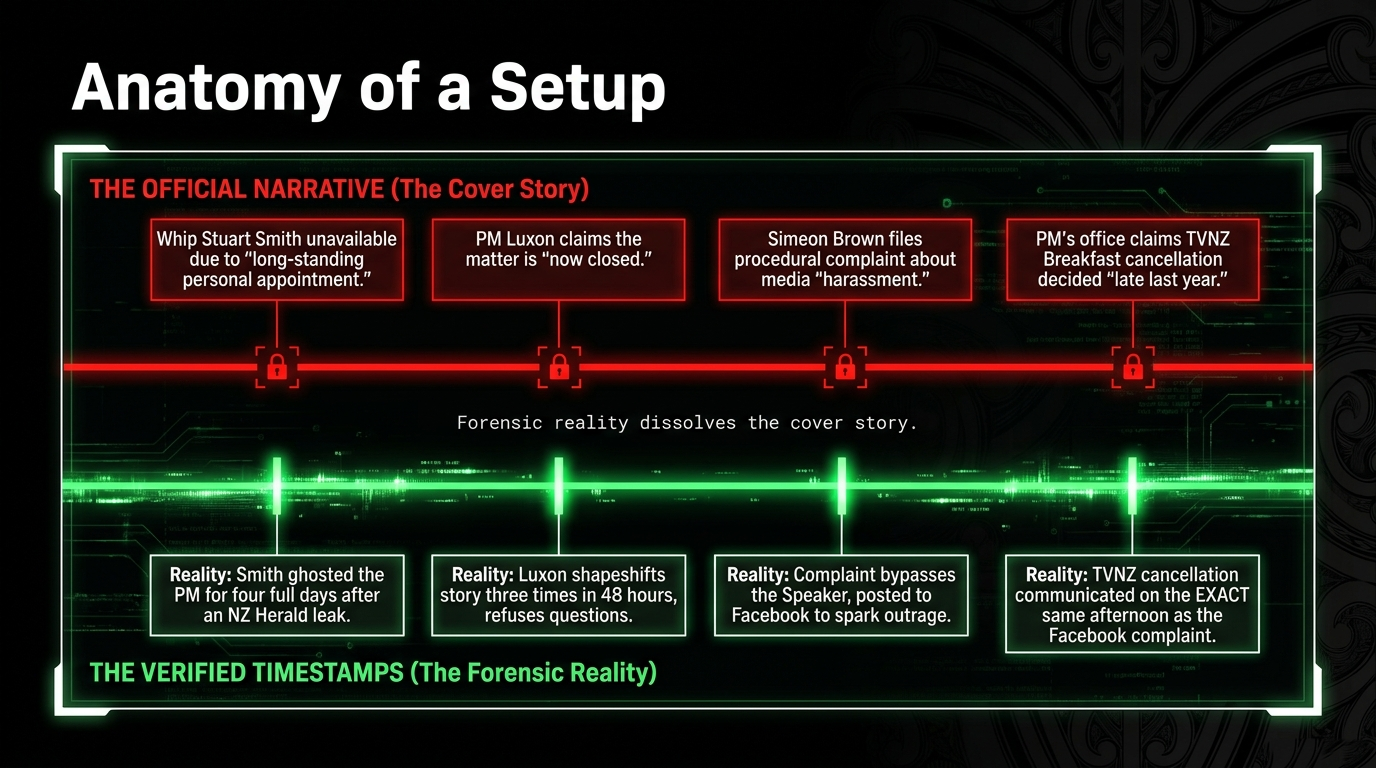
Here is the sequence, verified source by source, with Brown's own screenshot as the anchor:
Step one: The story breaks. The NZ Herald reports that Stuart Smith — National's own Whip, the constitutional officer whose entire job is to communicate between the Prime Minister and the caucus — had been ghosted by Luxon while trying to raise backbench concerns. The story is specific, sourced, and politically lethal, as reported by The Spinoff.
Step two: Smith hides. The Whip who does not communicate disappears for four full days, as confirmed by 1News. He surfaces eventually — not independently, but through the Prime Minister's own communications office — claiming a "long-standing personal appointment" delayed his response. The man whose constitutional function is liaison took four days to communicate a denial. Through someone else's office. The irony is structural, not accidental.
Step three: Luxon's story shapeshifts. Over 48 hours, Luxon's account of the Smith situation changed three times, as confirmed by The Spinoff. Chris Bishop confirmed the backbench briefings were real and called them "really untidy and really unhelpful." The leaks happened. The caucus fracture was documented. But rather than address any of it, Luxon called a confidence vote — and then walked up to the cameras, read a prepared statement, refused every question, and walked away, as confirmed by Otago Daily Times. The matter was, he declared, "now closed."
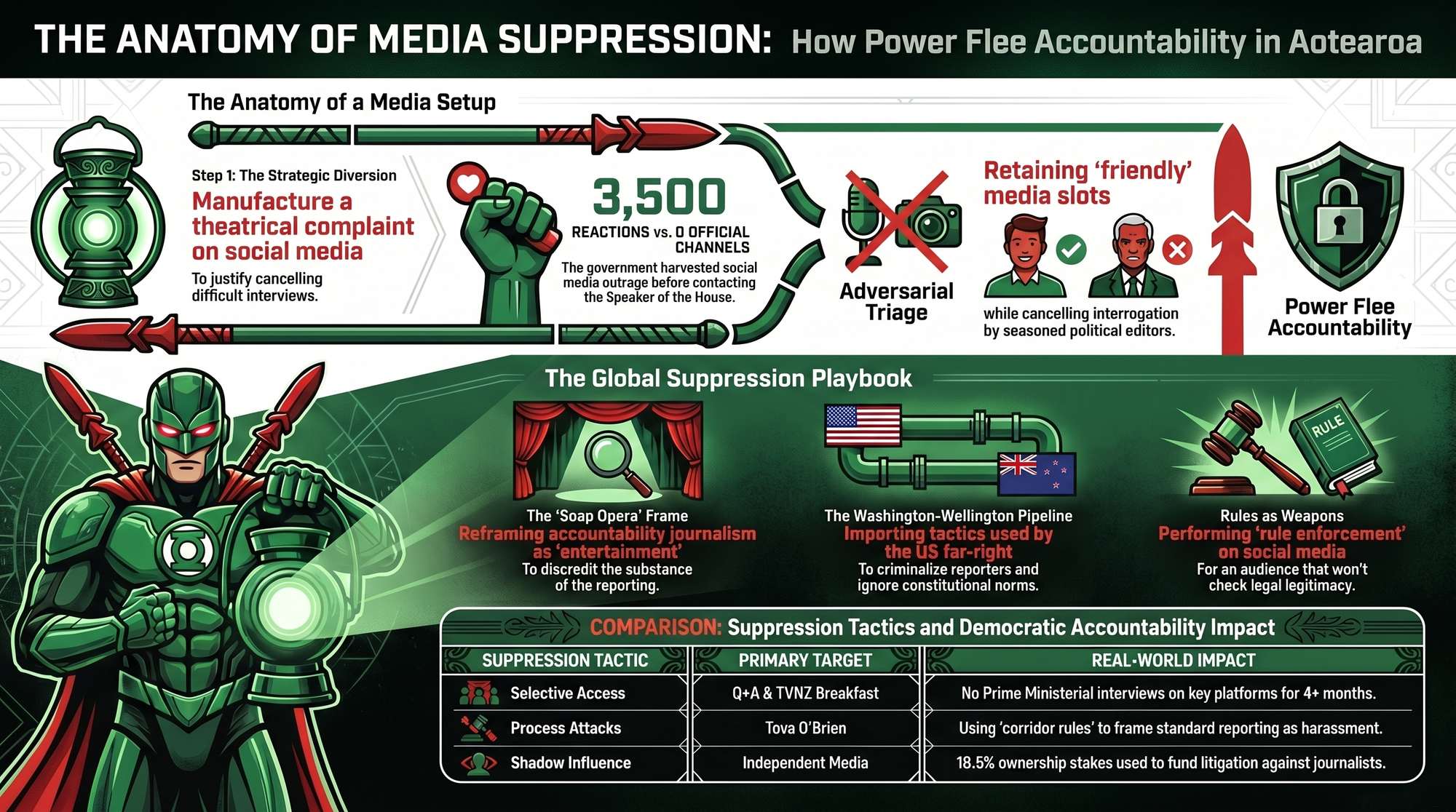
Step four: The complaint lands — on Facebook. That same Friday afternoon, Brown published his post and National lodged a formal complaint with TVNZ — not with the Speaker, who holds actual authority over parliamentary conduct, but directly to the broadcaster and on social media, harvesting 3,500 reactions before sundown. The Speaker's office confirmed it had "no involvement," as reported by 1News. The complaint was never about process. It was a press release dressed as procedure — and the 3,500 reactions were the point.
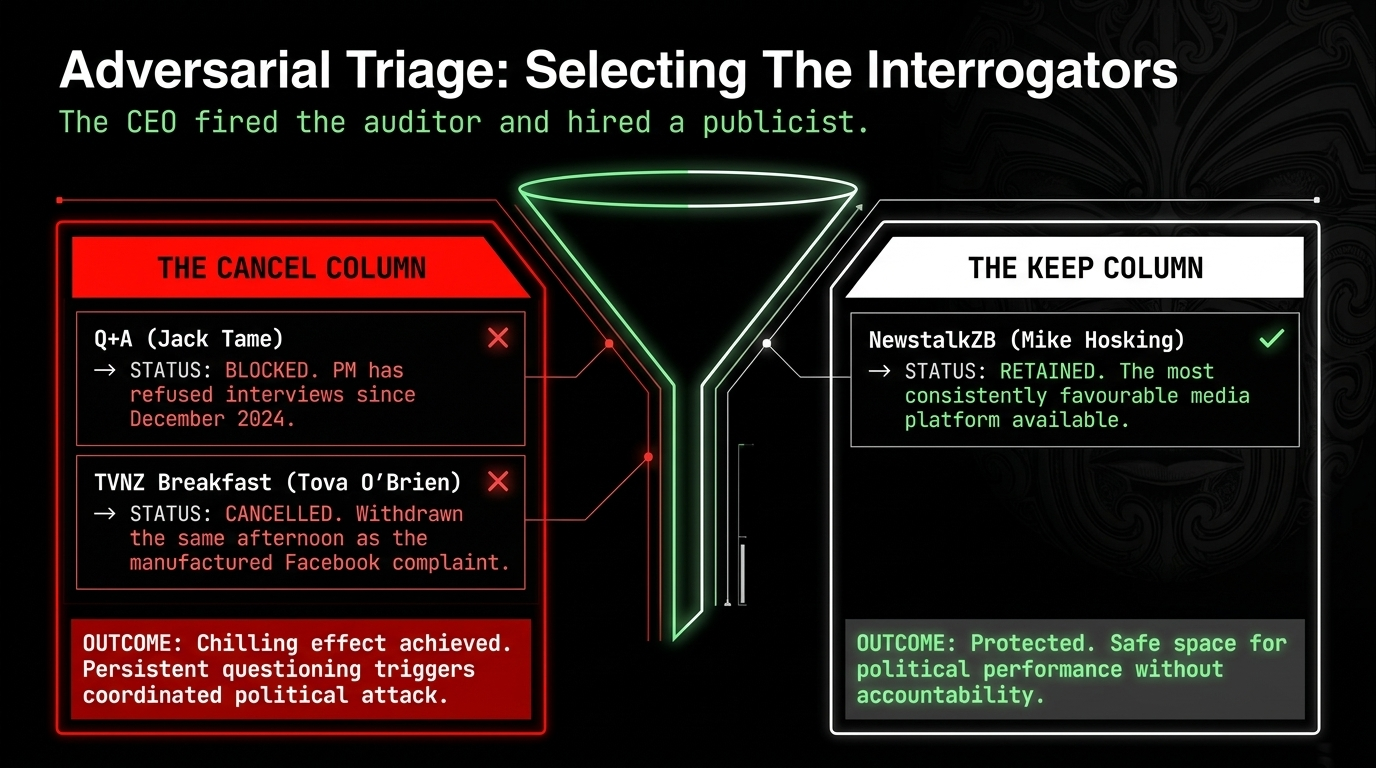
Step five: TVNZ is cancelled. In the same announcement, Luxon's office pulled out of the weekly Breakfast interview. They claimed it was a decision made "late last year." But it was communicated on the same afternoon as the complaint, as confirmed by 1News. The cover story dissolved the moment the timestamps were compared. This was not a scheduling review. This was the execution of a plan.
Step six: Hosking stays. Tova goes. Luxon will continue his Monday slot with Mike Hosking on NewstalkZB — a documented political ally — while abandoning TVNZ Breakfast, now co-hosted by former political editor Tova O'Brien, as confirmed by 1News. He is not stepping back from media. He is selecting his interrogators. He is choosing the mirror that flatters over the mirror that tells the truth.
The Guardian described Luxon as shooting the messenger and "violating a fundamental principle of political leadership."
That is the polite English version.
In plain language: the CEO cannot survive the audit, so he fired the auditor and hired a publicist.
Same Playbook, Different Accent: How Luxon Imported Trump's Media Purge and Called It Standards
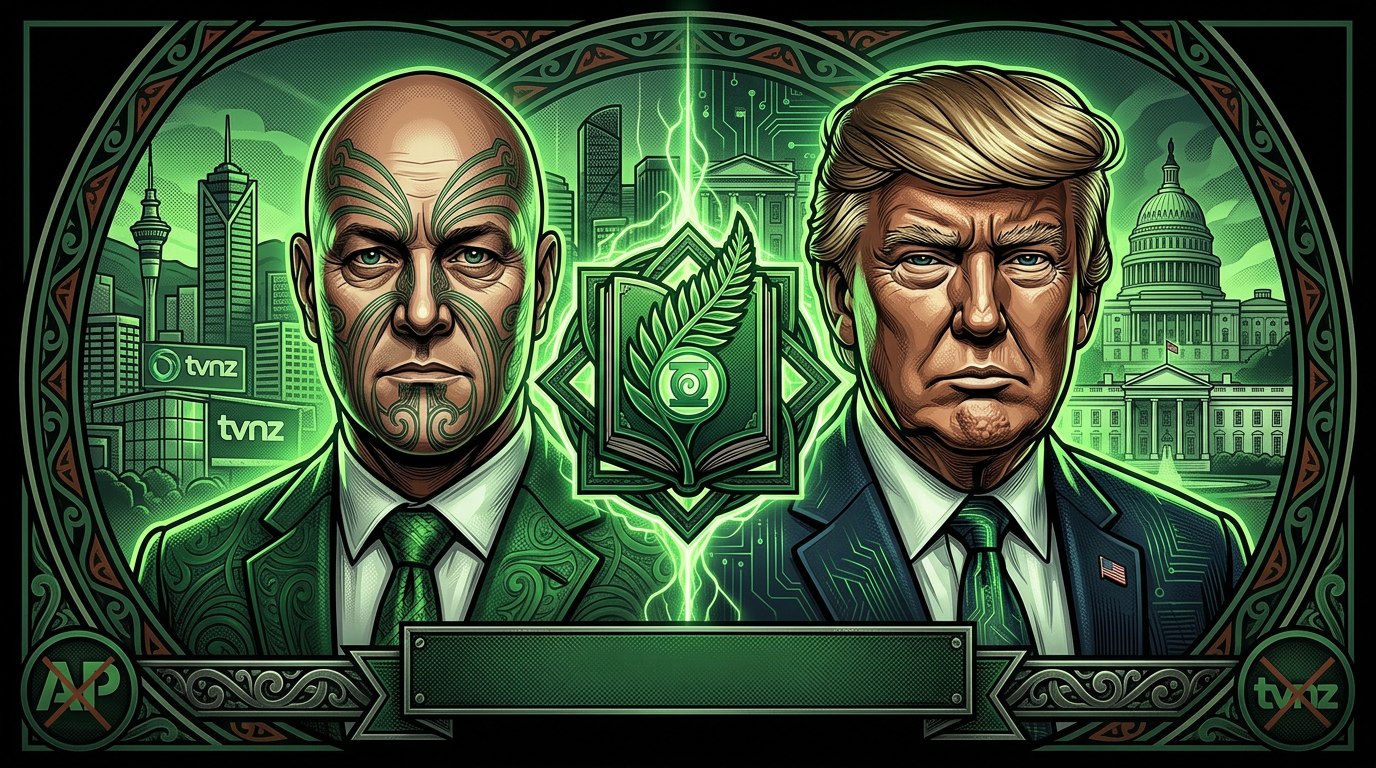
What Luxon is doing to TVNZ is not a quirk of New Zealand politics. It is a colonial carbon copy of what Donald Trump has been doing to the American press since January 2025 — and the parallels are so precise they look like a franchise agreement.
Trump banned the Associated Press from the Oval Office, Air Force One, and White House press events after AP refused to rename the Gulf of Mexico the "Gulf of America" in its style guide, as documented by Reuters and AP itself.
He stripped Reuters, Bloomberg, and other wire services of their permanent press pool positions, barred reporters from the press secretary's office — an area open to journalists for generations — and replaced independent press pool management with White House-controlled access, deciding personally which outlets would be allowed near the president and which would be frozen out, as confirmed by BBC, Politico, and Poynter.
The result was identical to what Luxon has engineered in miniature: friendly outlets kept inside the room, adversarial ones locked in the corridor.
Trump kept Fox News. Luxon kept Hosking. Trump banned AP. Luxon cancelled Tova. The White House Correspondents' Association president Weijia Jiang said the new rules
"hinder the press corps' ability to question officials, ensure transparency, and hold the government accountable, to the detriment of the American public," as reported by Politico.
You could paste those words onto Brown's Facebook complaint and they would fit without a single edit. This is not coincidence. This is a playbook — and Luxon just opened it to the same page.
Five Hidden Connections — All Verified
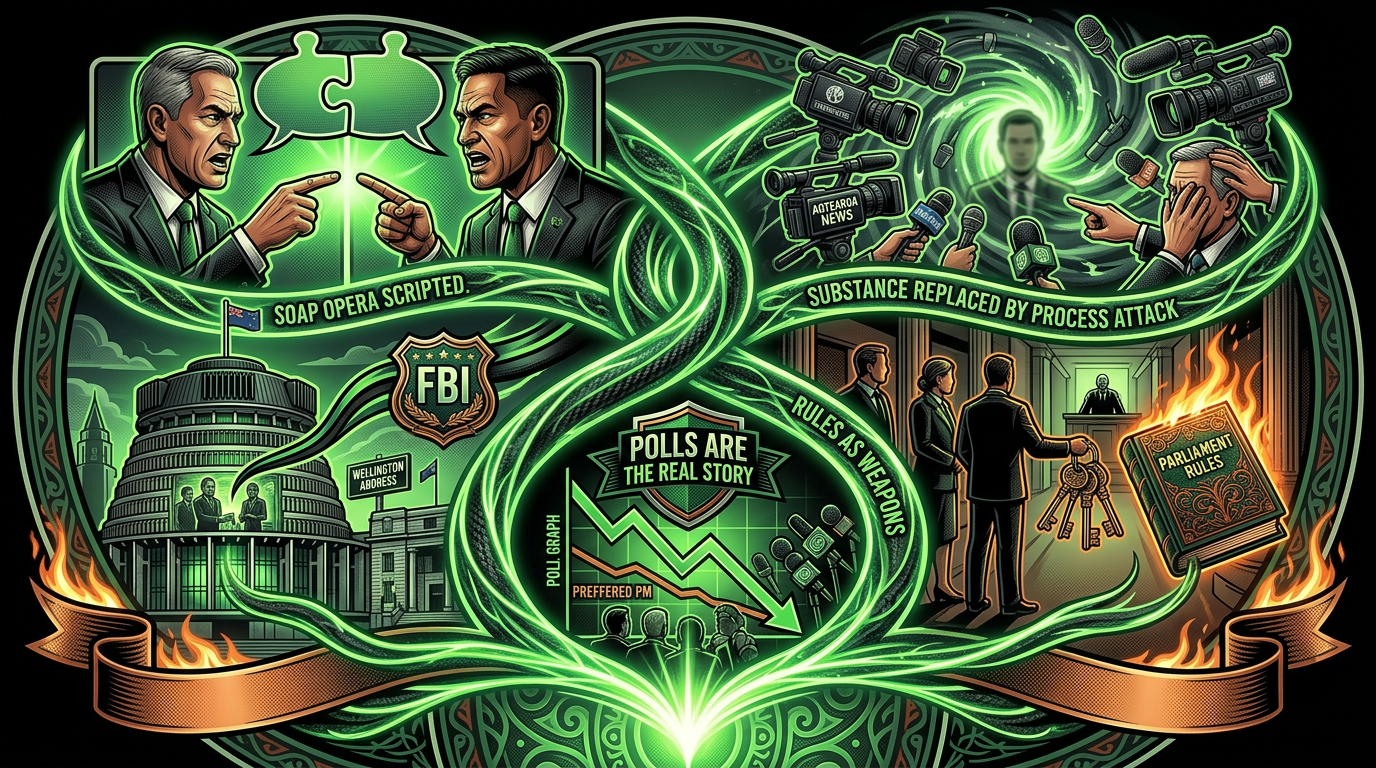
1. The "Soap Opera" Frame is Scripted. Both Luxon and Brown deployed the phrase "soap opera" within days of each other, as confirmed by Otago Daily Times and The Guardian. This is not linguistic coincidence. It is coordinated message discipline — the same technique MAGA operatives use to reframe accountability journalism as entertainment, draining the oxygen from the substance of what is being reported.
2. Substance Replaced by Process Attack. Neither Brown nor Luxon addressed the actual story — a Whip seeking to raise caucus concerns and being ignored by the PM — as reported by The Spinoff. Instead, they made the reporters the story. Patel did the same: the question Williamson asked became the crime, not the misuse of government resources she was reporting on, as confirmed by CNN. When you cannot answer the question, burn the questioner.
3. Rules as Weapons, Not Principles. Brown invoked parliamentary corridor rules knowing the correct authority — the Speaker — was not involved and would not be, as confirmed by 1News. Patel invoked federal stalking statutes for a phone call, as documented by Freedom of the Press Foundation. In both cases, the rules are not being applied — they are being performed on social media, for an audience that will not check whether the process is legitimate. The rules are the costume, not the principle.
4. Patel's Physical Presence in Aotearoa. The ideological echo is not metaphor. Patel sat in the Beehive. He announced an FBI base on New Zealand soil, as confirmed by NZ Herald. The infrastructure of authoritarian media suppression is already embedded in this country's security architecture. This is not a distant American nightmare. It has a Wellington address.
5. The Polls Are the Real Story. Behind every media management manoeuvre is a collapsing government running from numbers it cannot control. A 1News Verian poll published the same weekend recorded National's worst polling result of the term and Luxon's lowest preferred PM rating, as confirmed by 1News. This is not a government managing media. This is a government using media management as a substitute for governing — and hoping no one notices the difference.
Three Examples for the Western Mind
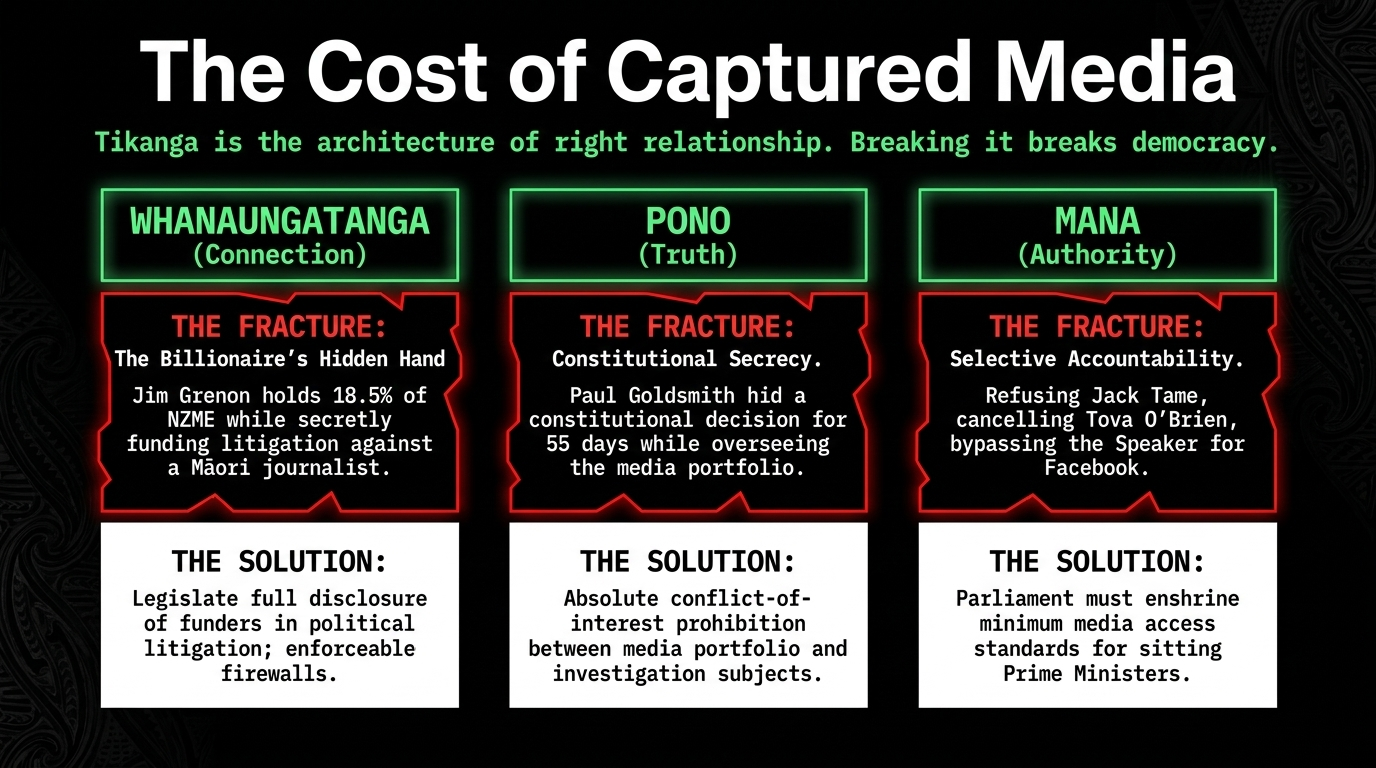
Tikanga is not a set of cultural customs that can be suspended when they become inconvenient for power. It is the architecture of right relationship — between people, between institutions, between those who hold authority and those on whose behalf that authority is held.
When a government selects which journalists are permitted to ask questions, it does not just break a media norm. It breaks whanaungatanga — the obligation of connection and accountability to the collective. It breaks pono — the commitment to truth above self-interest. It breaks mana — not only its own, but the mana of every New Zealander whose right to know depends on a free press.
Brown declared in his own Facebook post that "New Zealanders want fair, balanced and accurate media." He is correct. What he did not say is that fair, balanced and accurate media requires journalists who can follow a Whip down a corridor, knock on a door, and tell him how he will be portrayed if he refuses to comment.
That is not a threat.
That is the mechanism of accountability. Remove it, and you do not get fair media. You get Hosking.
For the western mind, here are three concrete examples of what this costs — quantified, sourced, and with solutions attached:
| Example | What Happened | Quantified Harm | Western-Language Translation | Solution |
|---|---|---|---|---|
| 1. The Billionaire's Hidden Hand in Journalism | As documented in Ko Wai Ka Tiaki i Te Pono?, Jim Grenon held an 18.5% stake in NZME while secretly funding litigation against a Māori journalist and an academic — placing newsroom editorial independence under covert pressure from the very ownership layer that is supposed to be firewalled from it. | Years of legal uncertainty, reputational harm, and financial cost imposed on people doing democratic accountability work — with no transparent disclosure to the public about the funder's conflict of interest. | When the shareholder can stand behind the curtain and still move the knife, the newsroom is already compromised. The public just hasn't been told yet. | Legislate full disclosure of funders in politically motivated litigation; strengthen anti-SLAPP protections; create enforceable editorial independence firewalls between major shareholders and newsroom leadership. |
| 2. Constitutional Secrecy Plus Media Capture | As exposed in The Grave Robbers in Suits, Paul Goldsmith sat on a constitutional decision affecting Māori for 55 days — then held the Media and Communications portfolio while the same outlets were investigating him. That is not just a conflict of interest. That is a structural capture of the oversight mechanism by the subject of oversight. | 55 days of democratic opacity on a matter of direct constitutional significance to Māori, combined with a minister holding simultaneous power over the sector required to expose him. | An executive hiding a material decision from shareholders for nearly two months — while taking charge of the compliance and audit functions. In any other sector, that is a resignation. In this government, it is standard operating procedure. | Mandatory constitutional disclosure timelines; absolute conflict-of-interest prohibition between media portfolio and media investigation subjects; independent media-regulation body with no ministerial appointment powers. |
| 3. The Selective Interview Strategy — Keeping Hosking, Cancelling Tova | As confirmed by 1News, Luxon has refused Q+A interviews since December 2024, cancelled Breakfast on the same afternoon as Brown's complaint, and retained only NewstalkZB's Mike Hosking — the most consistently favourable media platform available to him. This is not media engagement. It is adversarial triage: keep the allies, fire the challengers, and use a manufactured process complaint as the cover story. And as proven by Brown's own Facebook post — 3,500 reactions on a platform designed for outrage, with the Speaker bypassed entirely — the strategy is built for political performance, not accountability. | No Q+A since December 2024; Breakfast cancelled the week Tova O'Brien joined; chilling effect on every journalist now aware that persistent questioning may trigger coordinated political attack and a social-media pile-on with 3,500 reactions. | A CEO who will only take questions from the analyst he hired, refuses the independent audit board, then files a harassment complaint when the auditor knocks twice. | Parliament must enshrine minimum media access standards for sitting Prime Ministers; all political complaints about journalists must be filed through the correct statutory authority, not social media; broadcasters should publish all political complaints with full context and outcomes. |
What This Is: The Anatomy of Authoritarian Media Suppression
Let us name the logical fallacy operating underneath all of this, because it has a name: tu quoque — the move of redirecting blame onto the person raising the allegation. It does not refute the allegation.
It creates noise around the person who raised it, hoping the noise becomes the story.
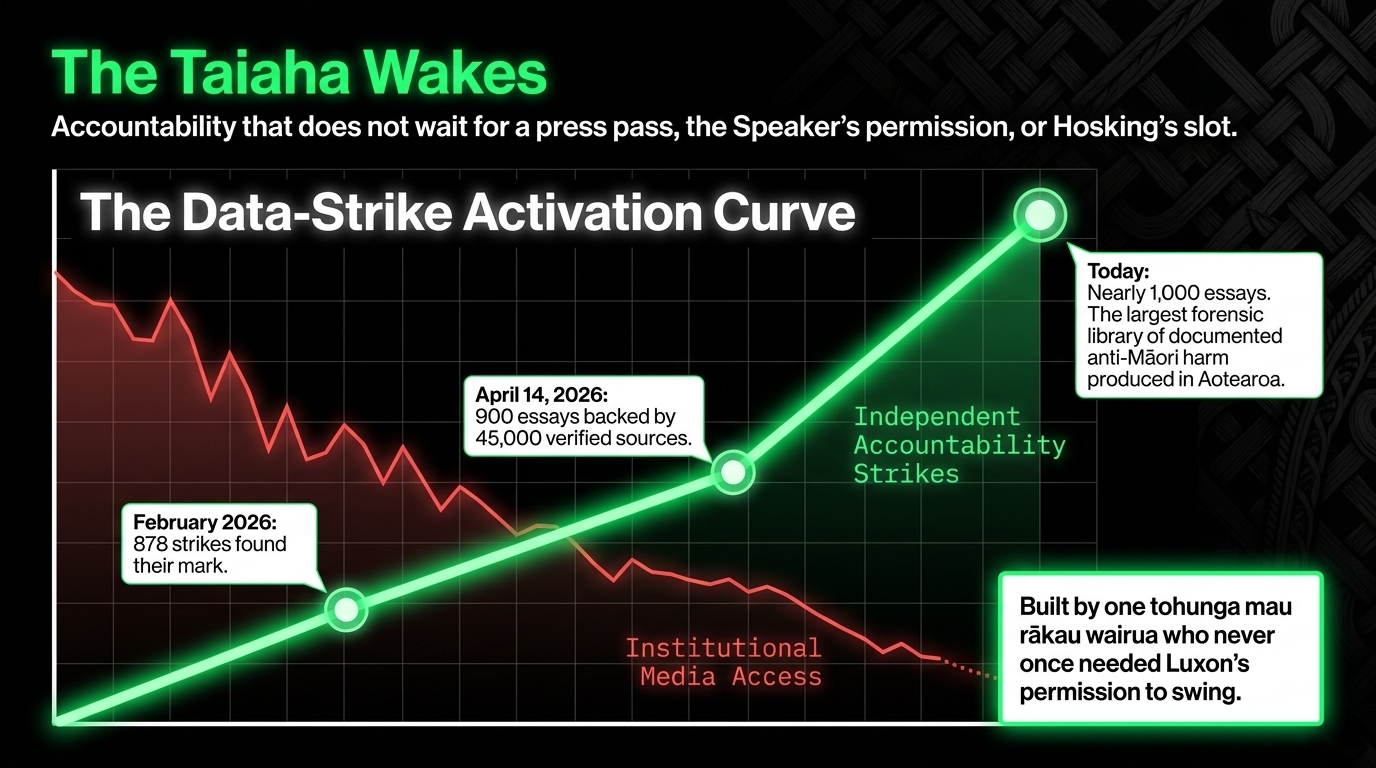
It works when the media is isolated, underfunded, and afraid. It fails when the accountability architecture is distributed — across independent outlets, across committed researchers, across nearly 1,000 essays backed by 45,000 verified sources, assembled by one tohunga mau rākau wairua who has never once needed Luxon's permission to swing, as documented by The Māori Green Lantern.
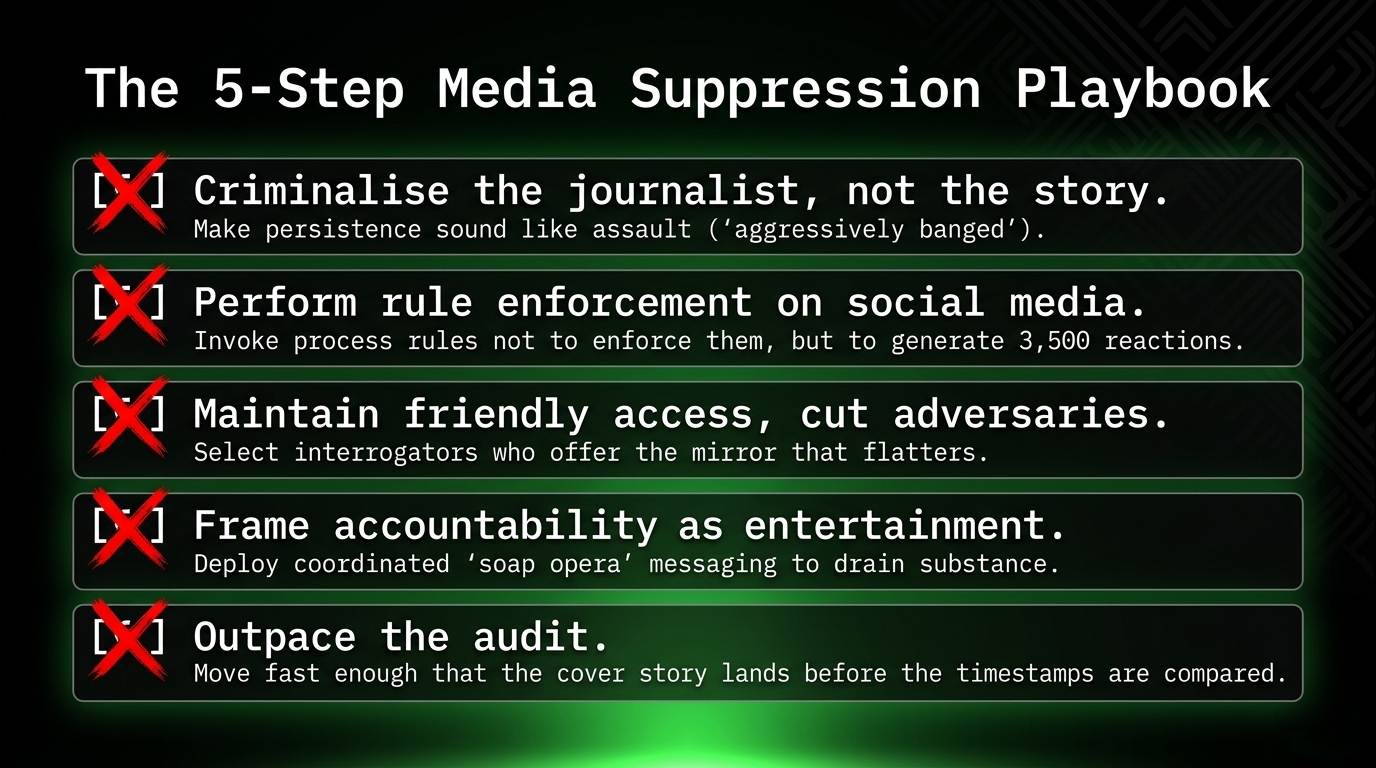
The authoritarian media suppression playbook requires five conditions — and this government executed all five on a single Friday afternoon:
- Criminalise or discredit the journalist, not the story ✓
- Invoke process rules not to enforce them, but to perform their enforcement on social media ✓
- Maintain access to friendly platforms while cutting adversarial ones ✓
- Frame accountability journalism as entertainment or bias ✓
- Move fast enough that the cover story lands before the timestamps are compared ✓
As also examined in The Trapdoor Prime Minister and the media power analysis in Ko Wai Ka Tiaki i Te Pono?, the pattern of media control in Aotearoa is not random. It is structural, it is accelerating, and it is being imported from the same playbook Kash Patel ran in Washington against Elizabeth Williamson — as confirmed by Freedom of the Press Foundation — the week before Brown picked up his phone and wrote his Facebook post.
The solution is not politeness training for journalists.
The solution is harder constitutional muscle: protect press access, expose political pressure campaigns in real time, strengthen source and reporter protections, pass anti-retaliation standards, and make ministers answer questions before they are allowed to file theatrical complaints about tone.
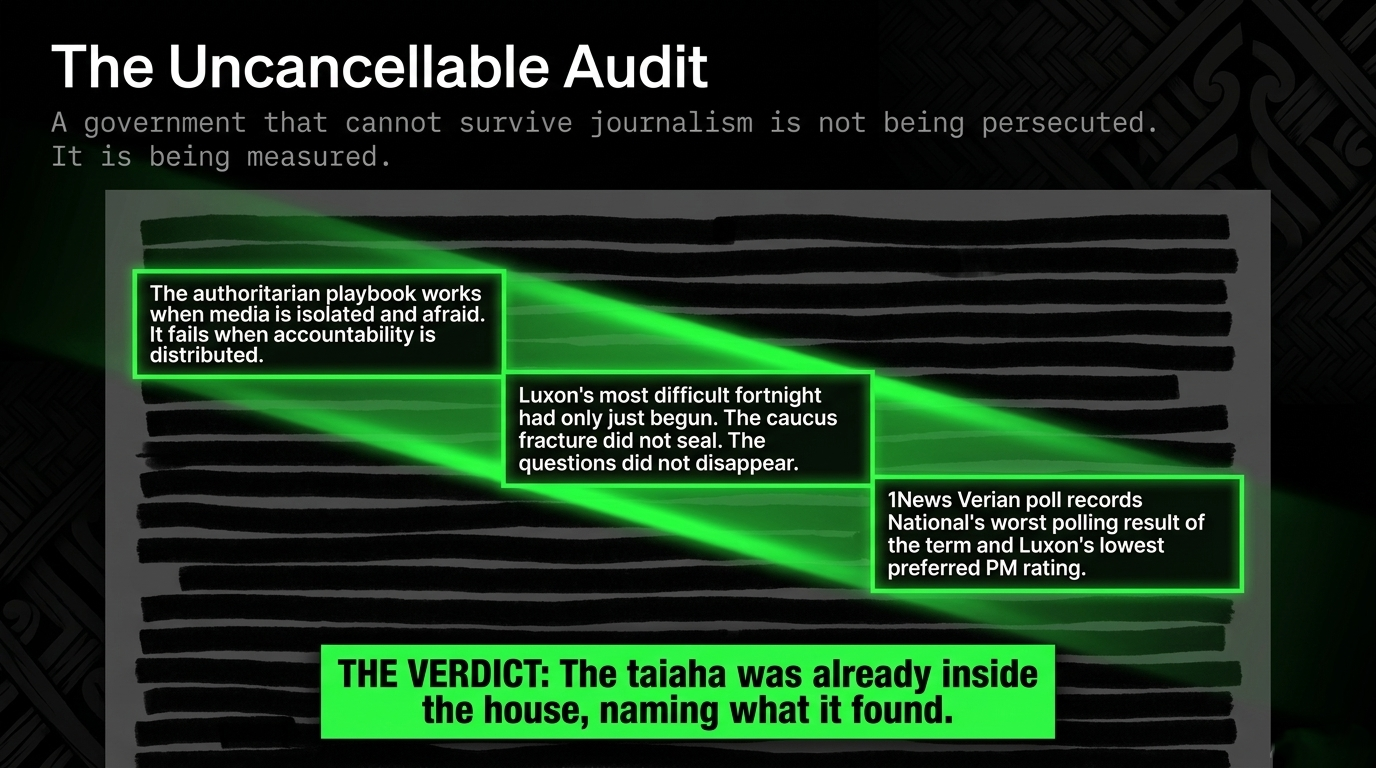
A government that cannot survive journalism is not being persecuted by the press. It is being measured by it. And the measurement is showing a reading they cannot stand.
Nearly 1,000 Essays. The Taiaha Does Not Stop.
Here is what this regime does not understand about the taiaha.
It does not require a press pass. It does not need a weekly slot on Breakfast. It does not wait for the Speaker's permission or the PM's media schedule or Simeon Brown's approval of the corridor it walks down.
By February 2026, the taiaha had already found its mark 878 times. By 14 April 2026, the count stood at 900 essays backed by 45,000 verified sources — the largest forensic library of documented anti-Māori harm this country has ever produced, built not by a Crown institution but by one kaitiaki who refused to stop.
Luxon can cancel TVNZ. Brown can file complaints on Facebook and harvest 3,500 reactions. The National Party machine can coordinate its language, perform its outrage, and declare accountability journalism a soap opera.
The taiaha was never watching their media schedule. It was already inside the house, naming what it found.
As The Spinoff confirmed, Luxon's most difficult fortnight had only just begun by 20 April. The caucus fracture did not seal. The questions did not disappear. The polls recorded the worst result of the term, as confirmed by 1News. And the mahi of accountability — essay by essay, source by source, strike by strike — continues every day at themaorigreenlantern.maori.nz.
Nearly 1,000 essays. Tū meke rawa atu, whānau.
The regime is dying. Keep swinging.
Kia kaha. Kia māia. Kia manawanui. 🌿💚
Koha — Because Tova Cannot Be the Only One Asking
Luxon will keep Mike Hosking. He will cancel Tova. He will file complaints against the journalists who knock on doors and ask again. His campaign chair will post to Facebook, harvest 3,500 reactions, and call it accountability — while bypassing the one authority that actually has power over parliamentary conduct.
That is why this mahi matters. That is why nearly 1,000 essays, backed by 45,000 sources, assembled without Crown funding, corporate advertising, or the PM's media schedule, represents something this government genuinely fears: accountability that cannot be cancelled, unfollowed, or filed against.
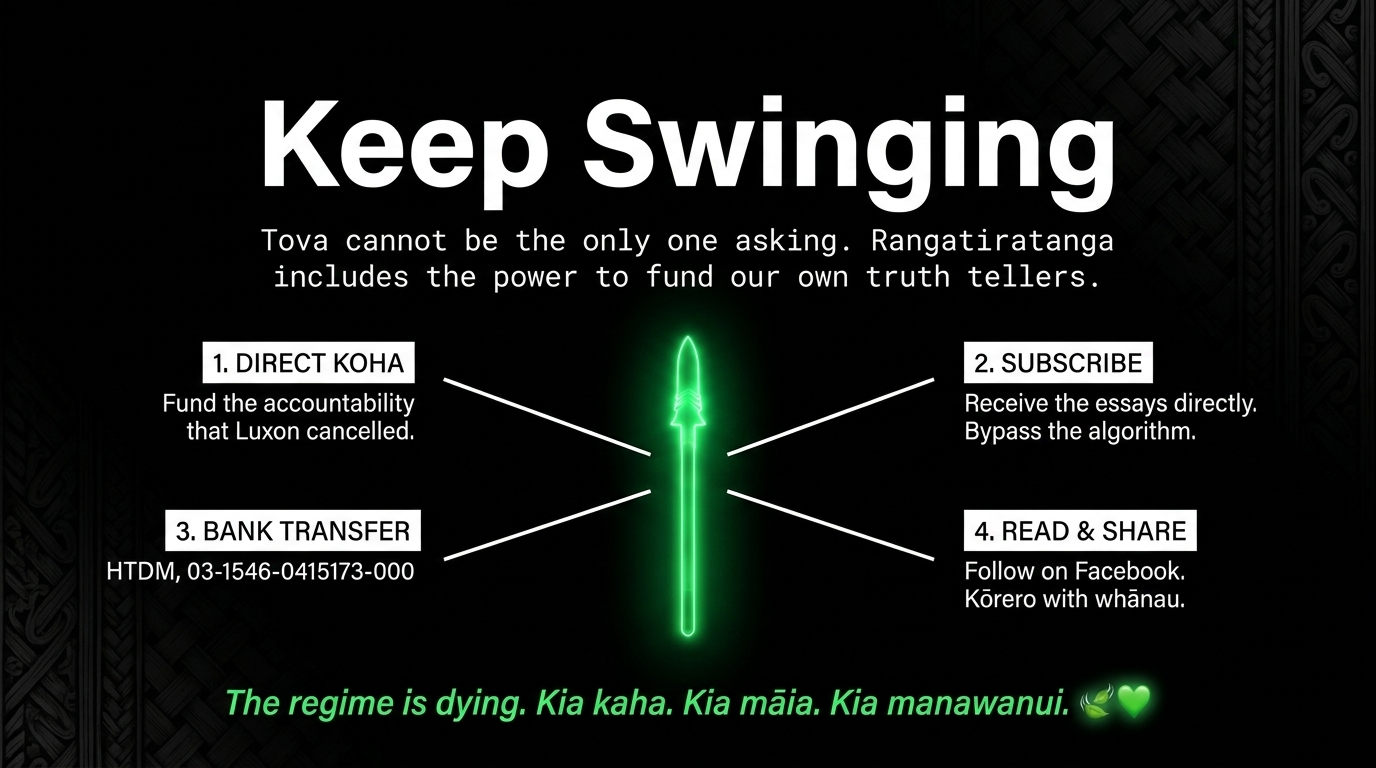
Every koha to this kaupapa is a direct answer to Brown's Facebook post. It says: the questions will keep coming. The essays will keep landing. The taiaha will keep swinging. And rangatiratanga includes the power to fund our own truth tellers — because the Crown will not do it, and the corporate media is already choosing its corridors carefully.
Four pathways to support this mahi:
For those who wish to koha directly: Koha — Support
For those who wish to subscribe and receive essays directly: Subscribe to The Māori Green Lantern
For those who prefer direct bank transfer: HTDM, account number 03-1546-0415173-000
For those on Facebook: Follow and support here
If money is tight — no worries. Read at themaorigreenlantern.maori.nz, share the essays, kōrero with your whānau and friends. That is koha in itself.
Every koha signals that whānau are ready to fund the accountability that Luxon cancelled on a Friday afternoon and Brown tried to bury under 3,500 Facebook reactions. It signals that rangatiratanga is not a courtesy this government can revoke — not from a schedule, not from a corridor, not from a social media complaint filed in the wrong place on purpose.

Research date: 27 April 2026. Tools used: live URL fetch of primary sources, web search, cross-referencing of public reporting, primary source screenshot verification (Simeon Brown MP Facebook post, 24 April 2026), and archive review of prior Māori Green Lantern essays. Primary sources verified and live: 1News, Otago Daily Times, The Guardian, CNN, Freedom of the Press Foundation, The Independent, Democracy Now, NZ Herald — Patel Visit, NZ Herald — FBI Base, The Spinoff — 100 Hours, The Spinoff — Final Curtain, The Spinoff — Most Difficult Fortnight, ODT — Soap Opera, Ko Wai Ka Tiaki i Te Pono?, The Trapdoor Prime Minister, The Grave Robbers in Suits. Primary source screenshot: Simeon Brown MP Facebook post, 24 April 2026, verified by attached image.