"THE KILOMETRE CLASS: How This Government Prices Your Life by Your Postcode, Your Profession, and the Pallor of Your Skin" - 22 April 2026
They gave MPs a dollar seventeen per kilometre to drive to Bellamy's. They gave the women who wipe the wounds of the dying eighty-two cents. Then they called it a win.


Kia ora Aotearoa,
You know whānau, in my short 54 years of life so far, I really think this is the worst bunch of politicians that we have ever had in power in New Zealand.
The reason I say that is because in such a short period of time, these asses have done so much damage.
And that was a pretty low bar to begin with!
The Heist in Plain Sight
There is a metaphor running through the veins of this government, and it smells like petrol.
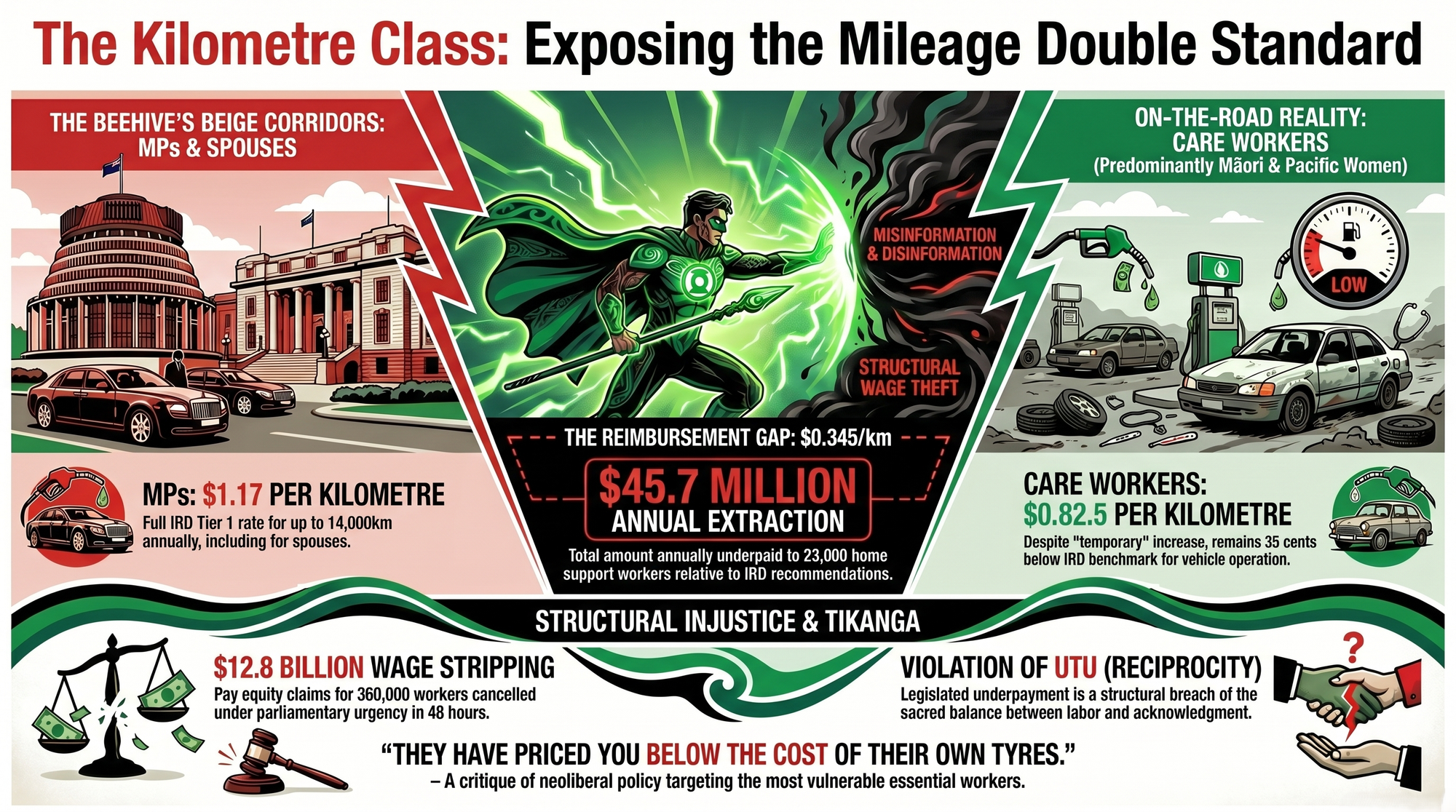
Imagine two vehicles on the same road. In the first: a Member of Parliament, six-figure salary, driving to a function where they will be photographed pretending to care about the cost of living. They will claim $1.17 per kilometre — the full IRD Tier 1 rate — because the state, which they run, has decided their wheels are worth the full cost of turning them. As confirmed by RNZ from Beehive sources and a leaked claim form, MPs can claim this rate for up to 14,000 kilometres a year — and their spouses can too.
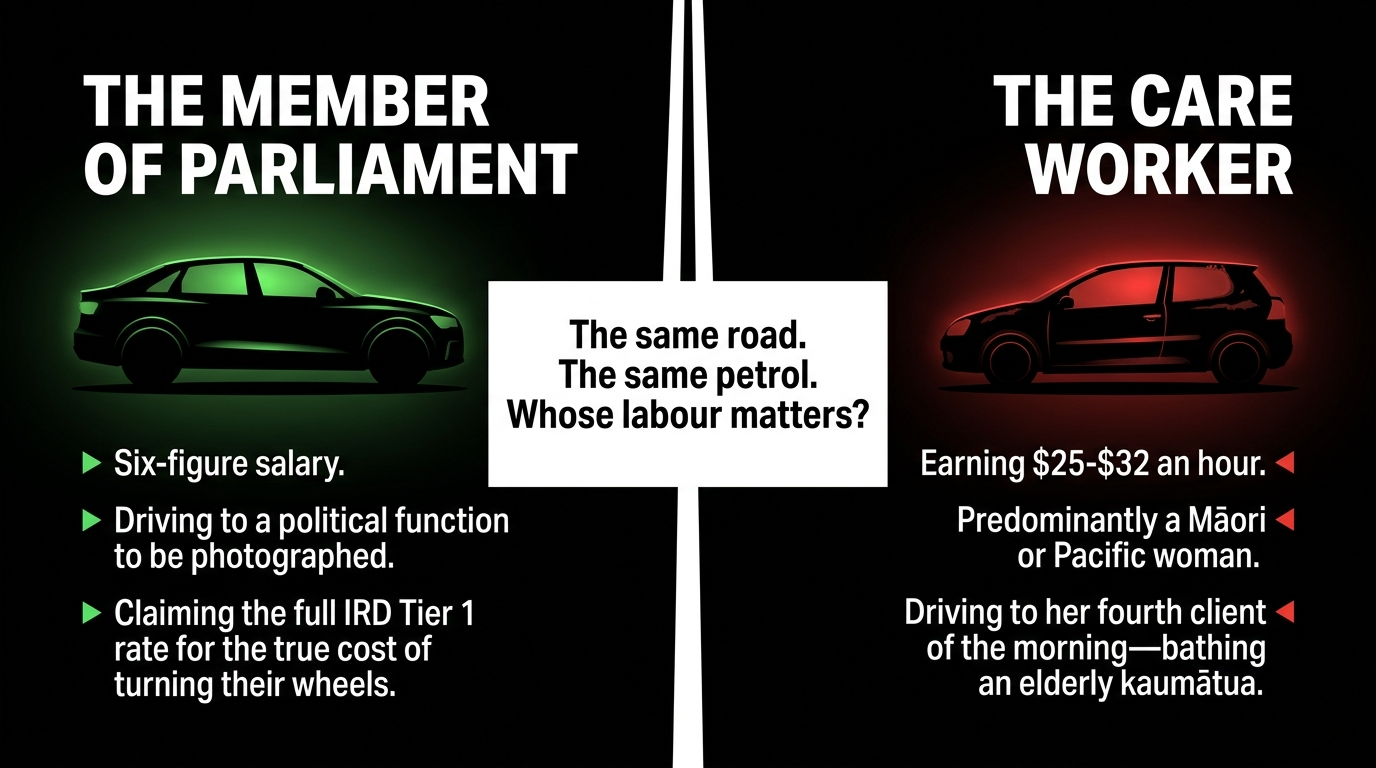
In the second vehicle: a home and community support worker. Predominantly a woman. Disproportionately Māori or Pacific. She is driving to her fourth client of the morning — an elderly kaumātua who cannot dress himself, a disabled child whose parents have already worked two shifts, a woman recovering from surgery who has no one else. She will be reimbursed at 82.5 cents per kilometre. Temporarily. As documented by E tū, that rate is still 35 cents below the IRD's own benchmark for the actual cost of operating a vehicle.
The Deep Dive Podcast
Listen to a lively conversation between two hosts, unpacking and connecting topics in the sources of this essay.
The same road. The same petrol. The same tyres wearing down. Two completely different answers to the question: whose labour matters?
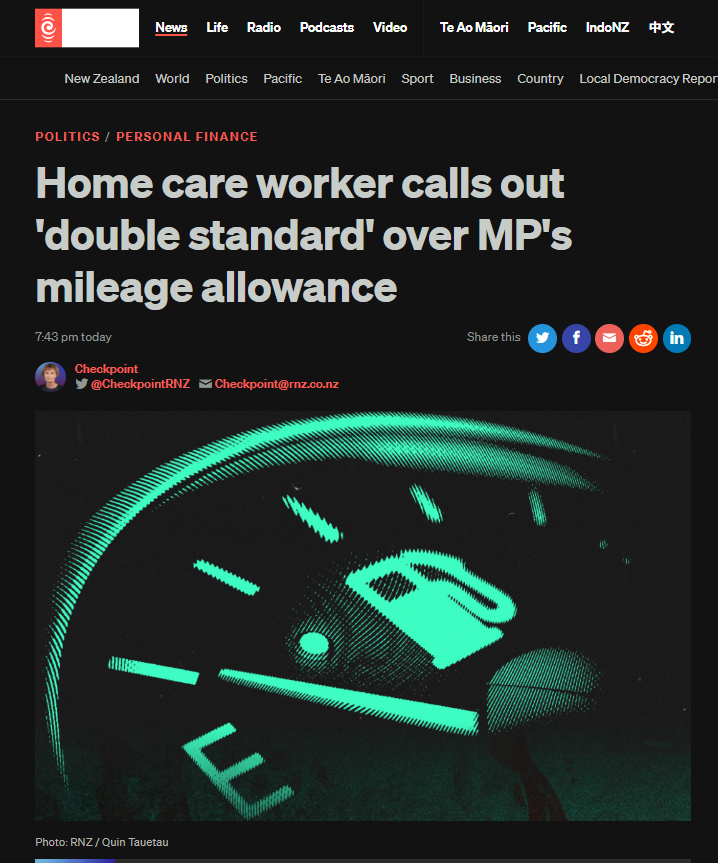
 Checkpoint
This is not a bureaucratic discrepancy. This is a political theology.
The Numbers Are the Violence
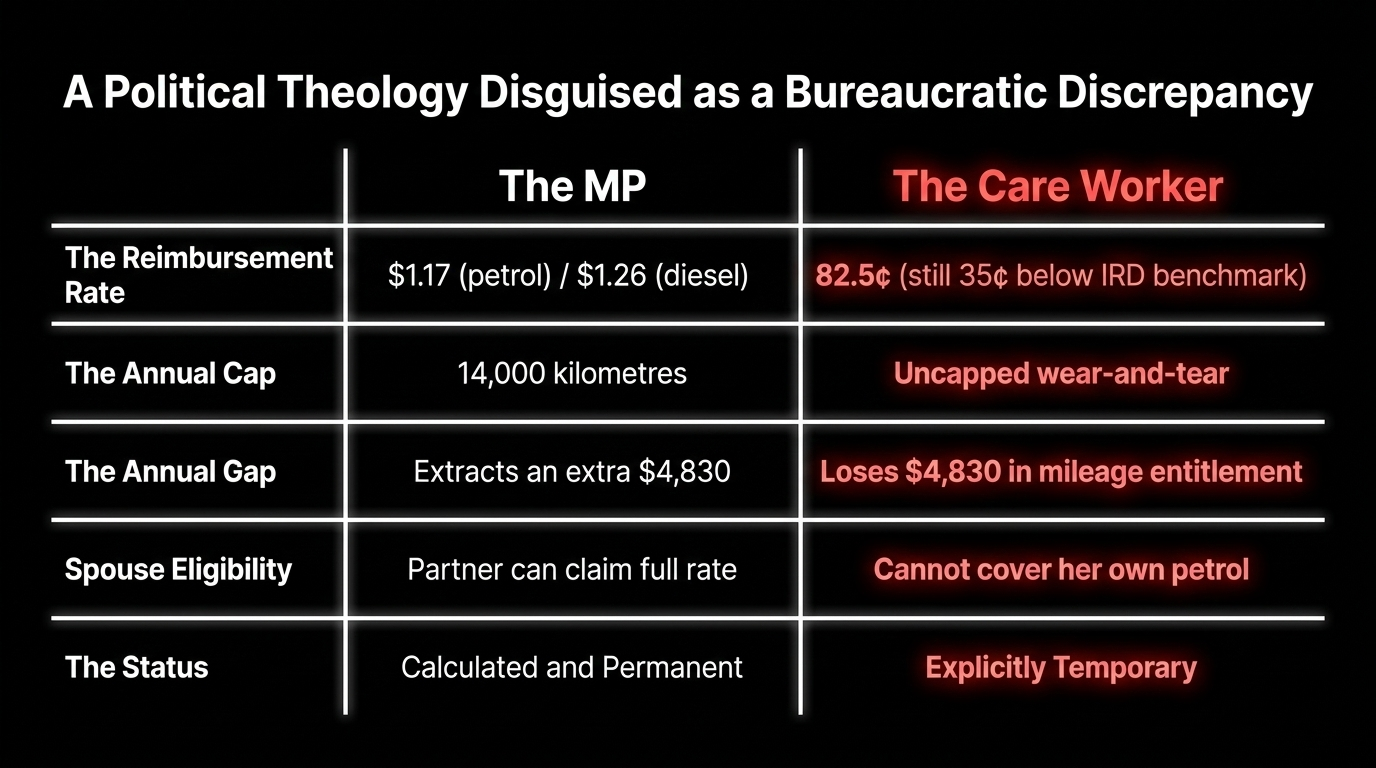
Let's be precise, because precision is the antidote to the comfortable vagueness this government hides inside.
The gap between the MP's rate and the care worker's rate is 34.5 cents per kilometre. Over 14,000 kilometres, that is $4,830 a year in additional mileage entitlement — money a care worker simply does not receive, for a job that is materially harder, more physically demanding, and more emotionally costly than anything performed inside the Beehive's beige corridors.
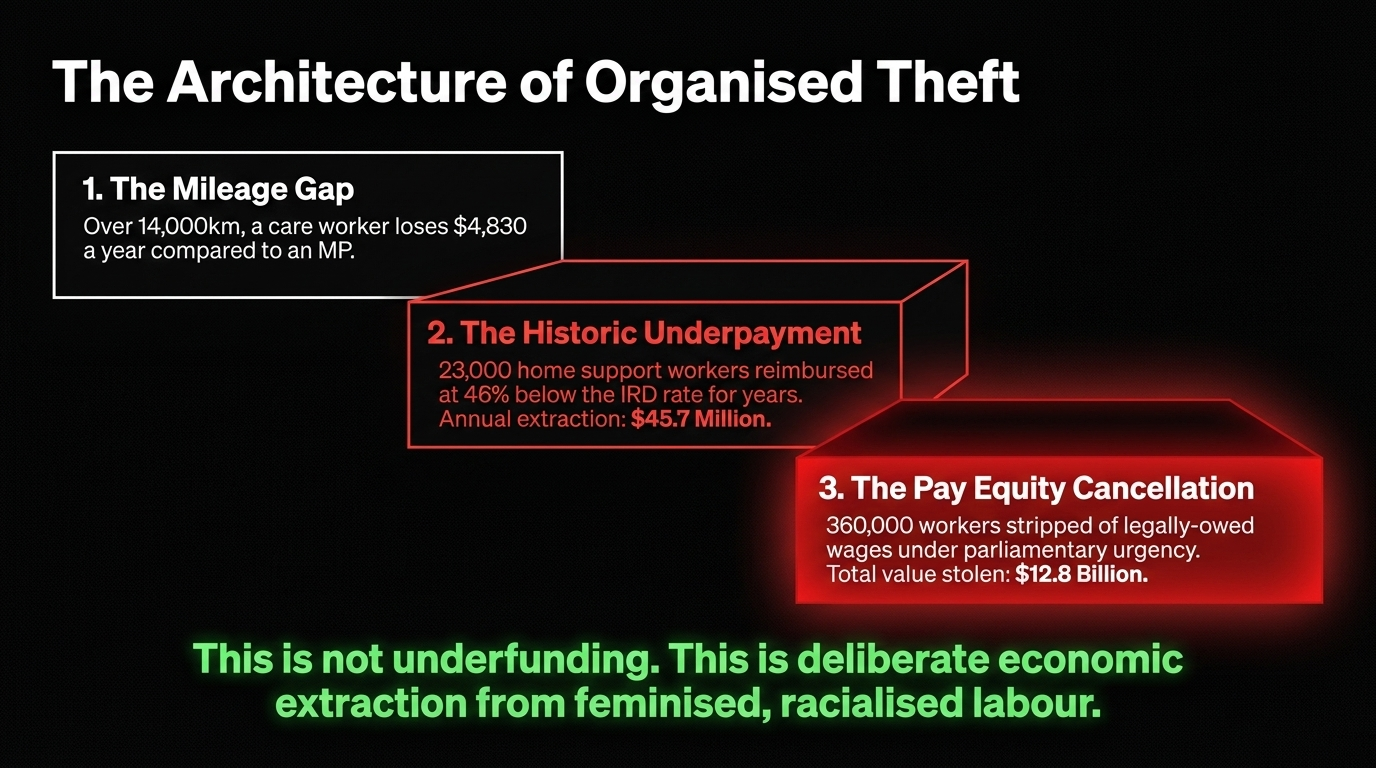
But it gets worse. As the Māori Green Lantern documented in The Trapdoor Prime Minister, 23,000 home support workers were being reimbursed at 46% below the IRD's own recommended rate. The annual extraction from their pockets: $45.7 million. That is not underfunding. That is organised theft from the women who hold New Zealand's health system upright with their bare, undercompensated hands.
And before Simeon Brown announced his "timely, targeted, temporary" crumb of an increase — language so carefully designed to signal that even this small correction would be revoked the moment politically convenient — this same government cancelled pay equity. As documented by the Māori Green Lantern in The Van Velden Vanishing, Brooke van Velden stripped $12.8 billion from women's wages in 48 hours under parliamentary urgency, cancelling 33 active pay equity claims and slamming the door on 360,000 workers — the majority of them women, the majority of them Māori and Pacific.
The mileage gap didn't happen in a vacuum. It happened inside a deliberate economic architecture designed to extract maximum value from feminised, racialised labour while insulating the political class from every cost it imposes on everyone else.
Three Examples for the Western Mind
Western political analysis tends toward the abstract. So let's make this concrete — three real scenarios, three quantified harms, three structural solutions this government could implement tomorrow if it chose to serve people rather than portfolios.
Example One: Tamara's Tank
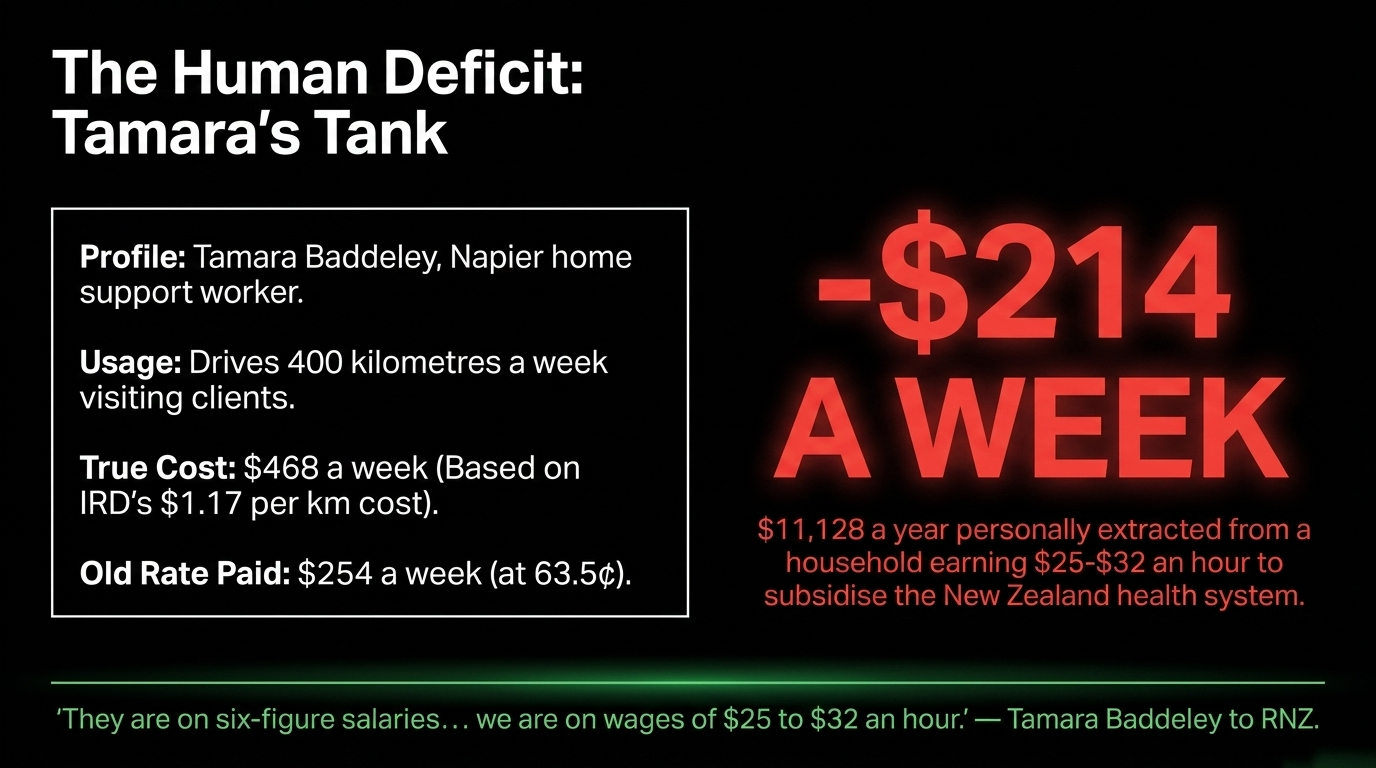
Napier home support worker Tamara Baddeley drives an estimated 400 kilometres a week visiting clients. At the old rate of 63.5 cents, she received $254 per week to cover fuel, WOF, tyres, insurance, and depreciation — on a vehicle the IRD says costs $1.17 per kilometre to run, meaning the true cost is $468. The gap: $214 a week extracted from her household. That is $11,128 per year she personally subsidises the New Zealand health system. As Tamara told RNZ directly: "It's a total double standard. They are on six-figure salaries to begin with, we are on wages of $25 to $32 an hour." She has invited MPs to do her job for a month on her pay and allowances. The silence is deafening.
Solution: Index care worker mileage to the IRD Tier 1 rate immediately and permanently — not temporarily. Fund it from the $45.7 million currently being extracted from workers' pockets annually. The money exists. The political will doesn't.
Example Two: The Cancelled Claim
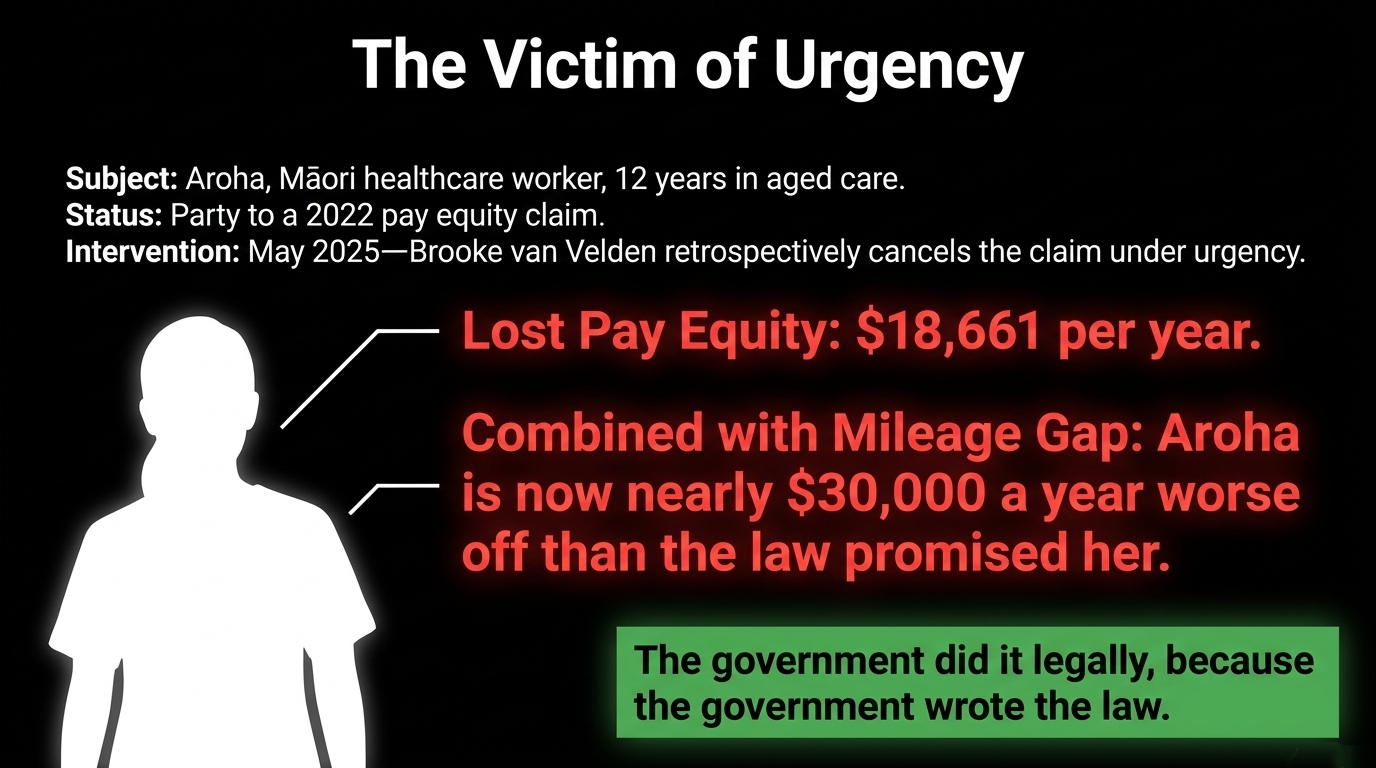
A Māori healthcare worker — let's call her Aroha — has worked in aged care for twelve years. She was party to a pay equity claim lodged in 2022. Under the law as it existed, she was legally entitled to a settlement. She was still waiting when, in May 2025, Brooke van Velden passed legislation under urgency that retrospectively cancelled her claim. As E tū confirmed, the cancellation stripped an estimated $18,661 per worker from those affected. Combined with the mileage underpayment, Aroha is now $29,789 a year worse off than the law promised her — and the government did it legally, because it wrote the law.
Solution: Reinstate pay equity legislation in full. Restore all 33 cancelled claims. Implement mandatory transparent wage reporting across all Crown-funded care sectors.
Example Three: The MP's Spouse
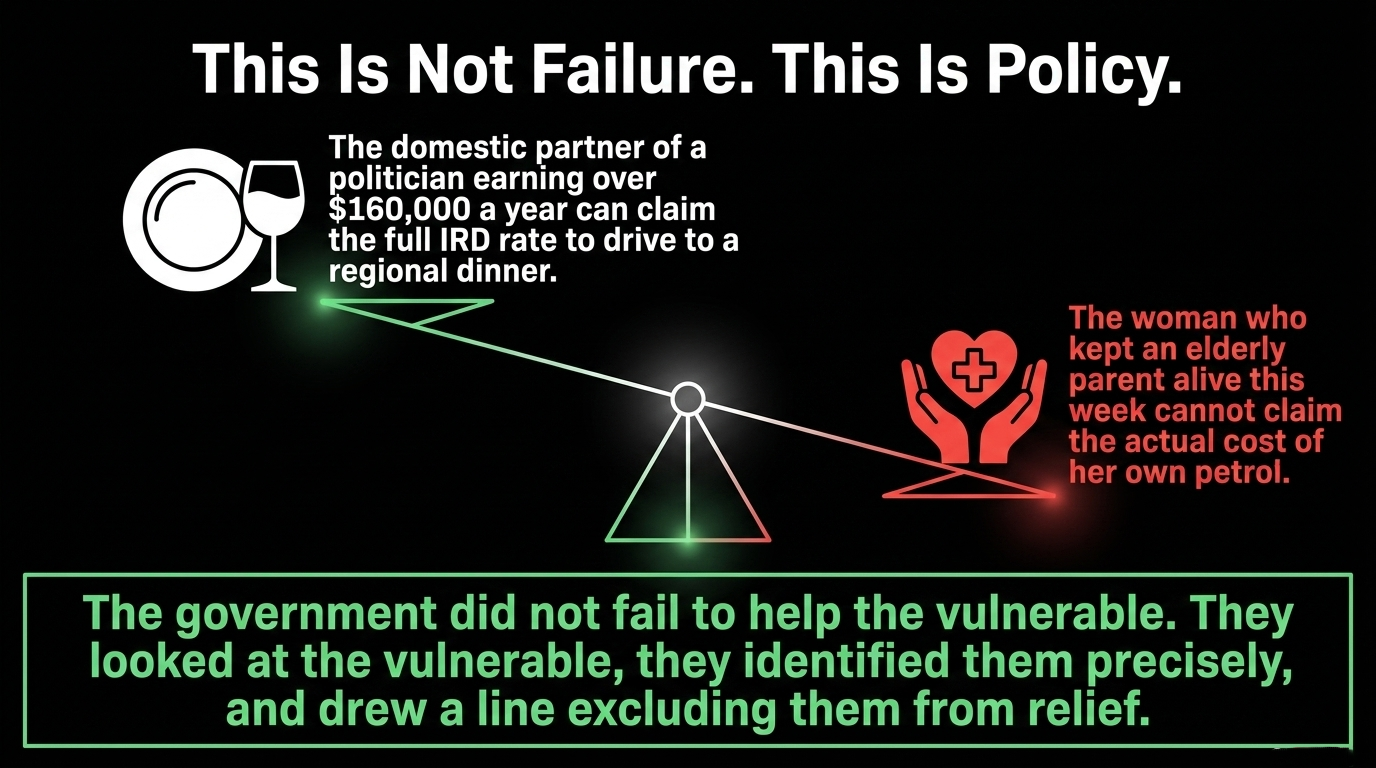
Let us be absolutely clear about what "Parliamentary Services" means when it confirms MPs can claim mileage for a spouse accompanying them on parliamentary business: it means the domestic partner of a person earning over $160,000 a year can also claim the full IRD rate for driving to a dinner, a function, or a regional event — while the woman who kept their elderly parent alive this week cannot claim even the cost of her petrol.
There is no policy justification for this. There is only class. As the Māori Green Lantern's The Pātaka is Ash documented: "This government did not fail to help the vulnerable. They looked at the vulnerable, identified them precisely, and drew a line excluding them from relief. That is not failure. That is policy."
Solution: Audit and cap parliamentary mileage claims. Redirect spousal mileage entitlements into the care worker sector. Publish all claims publicly.
The Tikanga Violation: What the Western Mind Misses
To the Western political mind, this is an equity problem. A budget problem. A workforce retention problem. You fix it with a spreadsheet and a press release.
In te ao Māori, it is something far more serious.
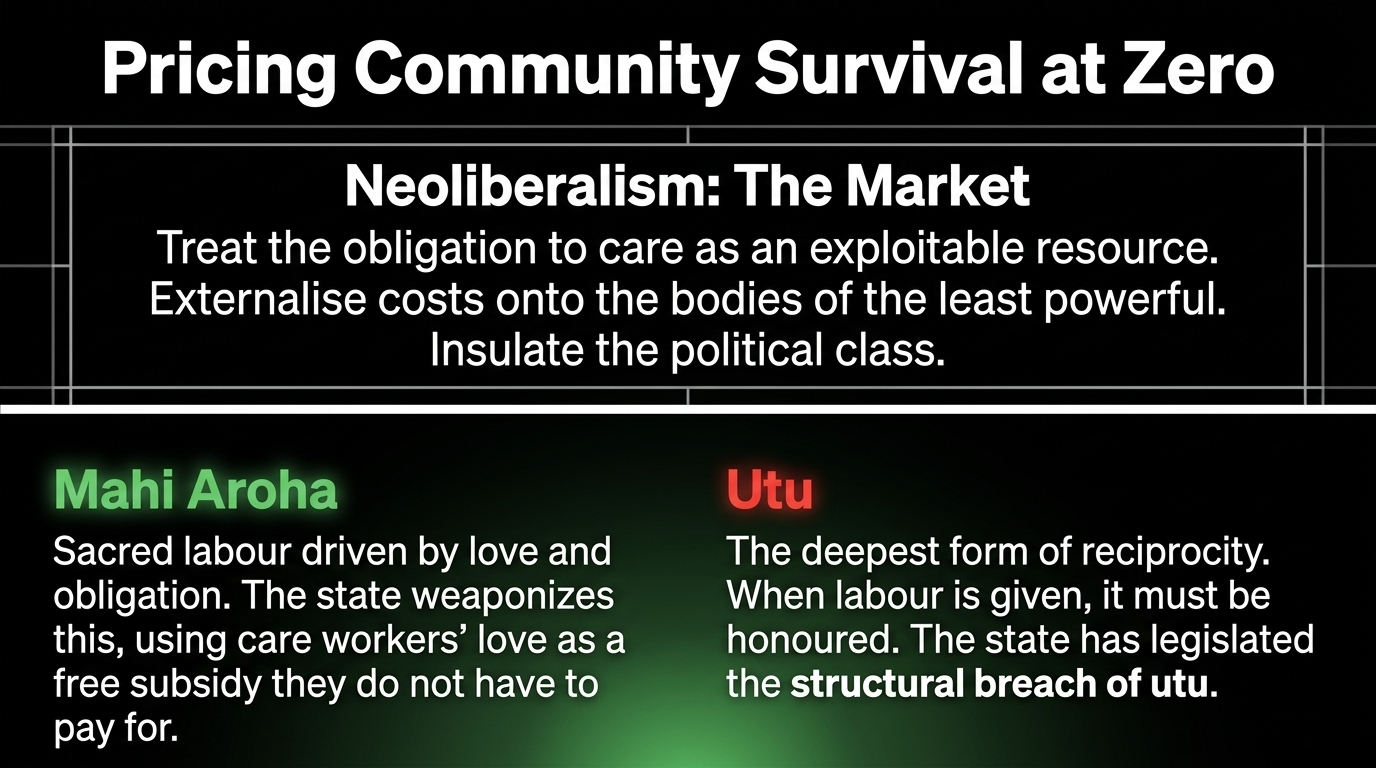
The concept of utu — often mistranslated as revenge — is, in its deepest form, the principle of reciprocity. When labour is given, it must be honoured. When the weaver creates the kākahu, the community acknowledges the gift. When the healer tends to the sick, the relational fabric requires that their mahi be met with equivalent acknowledgement and care.
As the Māori Green Lantern's The Trapdoor Prime Minister named it directly: "This government did not merely underpay workers. It legislated the right to underpay them. It institutionalised the breach of utu at a structural level, disproportionately targeting the women — overwhelmingly Māori and Pacific — who hold the health system together with their bare hands."
The concept of mahi aroha — work done from love and obligation to whānau and community — is not a loophole in the employment contract. It is not an excuse to pay less because the worker cares too much to walk away. It is a sacred form of labour that demands the highest acknowledgement, not the lowest possible reimbursement. As documented in Ka Noho i Roto i te Ahi, this government has structurally exploited mahi aroha — treating care workers' love for their communities as a subsidy it does not have to pay for.
This is what white supremacist neoliberalism does with tikanga: it identifies the values that keep communities functioning — the obligation to care, to show up, to keep going even when the system fails — and it prices them at zero. Then it calls this "the market."
The Ideology Behind the Insult
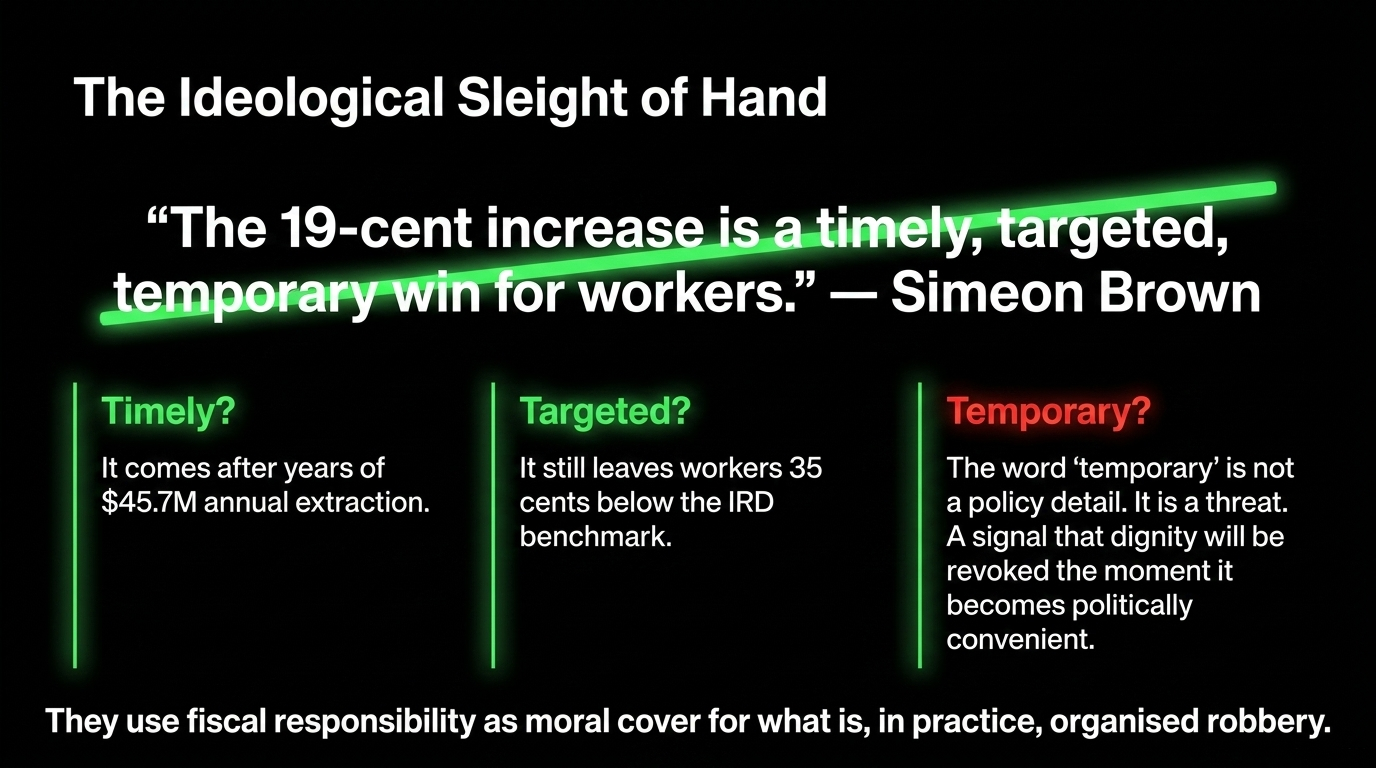
Christopher Luxon's government did not accidentally design a system where care workers subsidise the state from their own petrol tanks while MPs claim the full IRD rate from their Crown-funded accounts. This is neoliberalism operating as designed: externalise every possible cost onto the bodies of the least powerful, insulate the political class from every consequence of its own decisions, and use the language of fiscal responsibility as moral cover for what is, in practice, organised robbery.
The ideological sleight of hand is elegant in its cruelty. The government knows the full IRD rate. It uses the full IRD rate — for itself. It simply refuses to pay it to the people doing the work that cannot be outsourced, automated, or offshored. The work of wiping wounds. The work of sitting with the dying. The work of keeping the frail and the frightened from disappearing into the cracks of a health system already crumbling under the same government's austerity agenda.
As the PSA confirmed: this was a union win — but it still falls short. The increase to 82.5 cents, while welcome, remains below the threshold of dignity. And the word "temporary" is not a policy detail. It is a threat.
What This Government Deserves
Not charity. Not patience. Not the benefit of the doubt they have spent two years demonstrating they have never extended to the people they govern.
This government has now:
- Cancelled $12.8 billion in pay equity in 48 hours under urgency, stripping 360,000 workers of legally-owed wages
- Underpaid 23,000 care workers $45.7 million annually for four years while claiming the full IRD rate for themselves
- Offered a "temporary" crumb — 19 cents per kilometre — and called it a win
- Refused to publish parliamentary mileage rates publicly, requiring RNZ to extract them from leaked documents and Beehive sources
- Extended spousal mileage claims to the partners of six-figure-earning politicians while the workforce keeping their constituents alive cannot cover their own fuel
There is no reading of this data that does not arrive at the same conclusion: this government has looked at the women who do the hardest, least glamorous, most essential work in the country — and it has decided, repeatedly, deliberately, and with legislative precision — that their labour is worth less.
That is a values statement. And the value is clear: if you are Māori, Pacific, a woman, in the care sector, working your body into the ground for the people no one else will serve — this government has priced you below the cost of their own tyres.
A reckoning is owed. And it will come.
Koha Consideration

Tamara Baddeley drove to her clients this week and came home $214 out of pocket. Again. Not because the system forgot her — but because it looked directly at her, calculated the cost of her mahi, and decided she could absorb it herself.
This essay named that theft. It put a number on it — $45.7 million extracted annually from the hands of the women holding this country's health system together. It named the ideology behind the insult, and it refused to let the powerful dress their decisions in the language of fiscal prudence.
That kind of accountability does not fund itself.
Every koha to the Māori Green Lantern signals that whānau are ready to fund the truth-telling that Crown and corporate structures will never pay for. It signals that rangatiratanga includes the power to resource our own voices — the ones that say, plainly and without apology, that 82.5 cents is not a win when MPs are pocketing $1.17.
Kia kaha, whānau. Stay vigilant. Stay connected. And if you are able, consider a koha to ensure this voice continues.
If you are unable to koha — no worries at all. Subscribe, follow, kōrero, and share with your whānau and friends. That circulation is koha. Every share puts these words in front of someone who needs to see the numbers.
Four pathways to support this mahi:
For those who wish to support directly with a koha (voluntary contribution): Koha — Support the Māori Green Lantern
For those who wish to receive essays directly and support through subscription: Subscribe to the Māori Green Lantern
For those who prefer direct bank transfer: HTDM, account number 03-1546-0415173-000
For those on Facebook: Follow and subscribe on Facebook

Research conducted April 22, 2026. Sources: RNZ, E tū Union, Public Service Association (PSA), The Beehive (official government releases), Parliamentary Services (via leaked claim documents), Māori Green Lantern archive — The Trapdoor Prime Minister (April 16, 2026), The Van Velden Vanishing (March 24, 2026), The Pātaka is Ash (March 23, 2026), Ka Noho i Roto i te Ahi (March 22, 2026). All URLs verified live at time of publication.