"THE SURGEON WHO HATES THE PATIENT: How Paul Goldsmith Is Performing Treaty Surgery With a Rusty Hatchet — While Billing the Crown for the Procedure" - 22 April 2026
A man who believes colonisation healed Māori is now in charge of treating the wounds. This is not incompetence. This is the policy.

Tēnā koutou katoa.
Imagine appointing Jack the Ripper as Chief of Surgery. Not because no one noticed. But because the people doing the appointing needed the bodies to stay on the table.
That is Paul Goldsmith as Treaty Negotiations Minister.
The Deep Dive Podcast
Listen to a lively conversation between two hosts, unpacking and connecting topics in the sources of this essay.
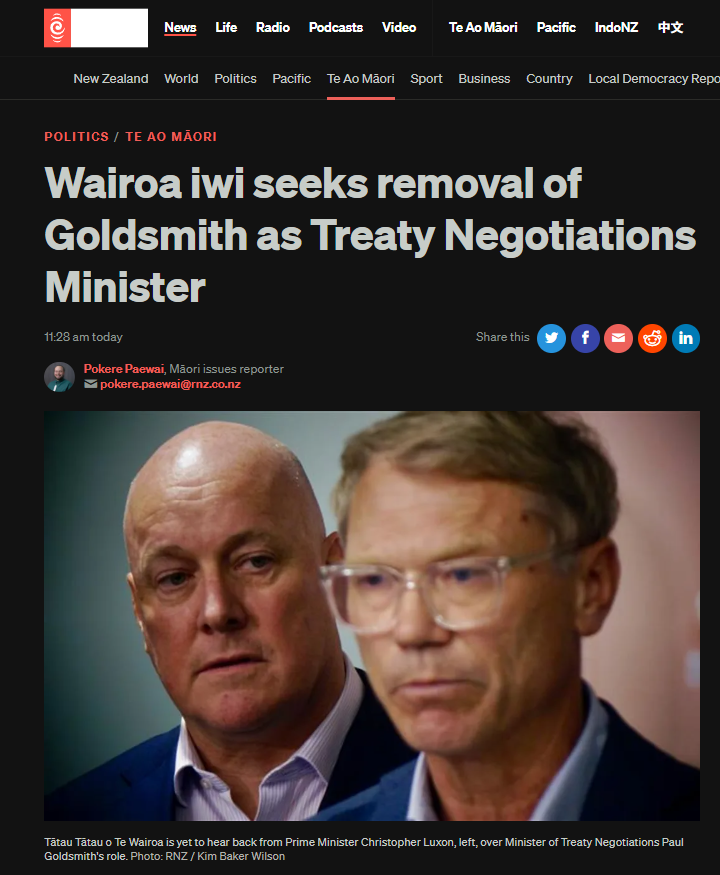
And on April 14, 2026, Tātau Tātau o Te Wairoa (TToTW) — an iwi in live, active negotiations with this man's Crown — stood up and said publicly what every Māori negotiating table has been whispering since 2023: get him out. As TToTW Chairman Pieri Munro stated directly on record: "What we're calling for is for the Prime Minister to remove Minister Goldsmith from the position he holds in terms of Minister for Treaty Negotiations. The reason for that is we don't believe that this Minister is able to see and appreciate, and feel our connection, our rights and interests for whenua tāpui."
About. Fucking. Time.
 Pokere Paewai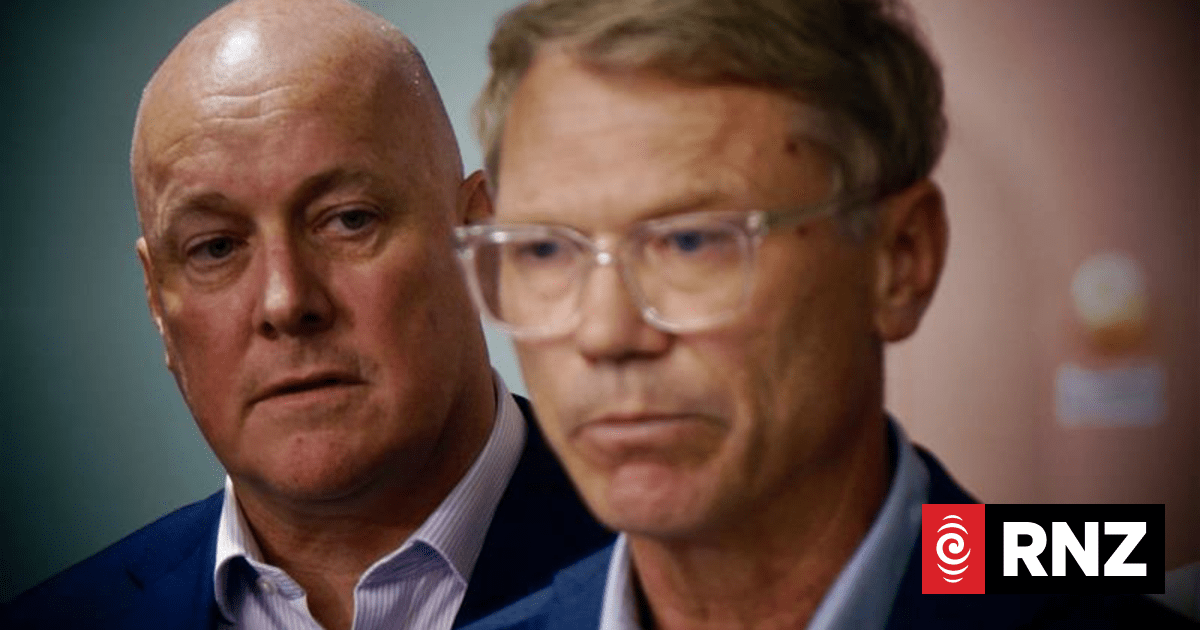
The Wound That Started This
The immediate trigger was Goldsmith's decision to allocate six Department of Conservation reserves exclusively to Ngāti Ruapani mai Waikaremoana as part of their Treaty settlement — land over which TToTW hold clear, documented, overlapping kaitiakitanga interests going back centuries. TToTW sent at least three letters of objection throughout 2025. In August 2025, Goldsmith replied. His response? Final decision. Done. Closed. As TToTW stated on their own platform:
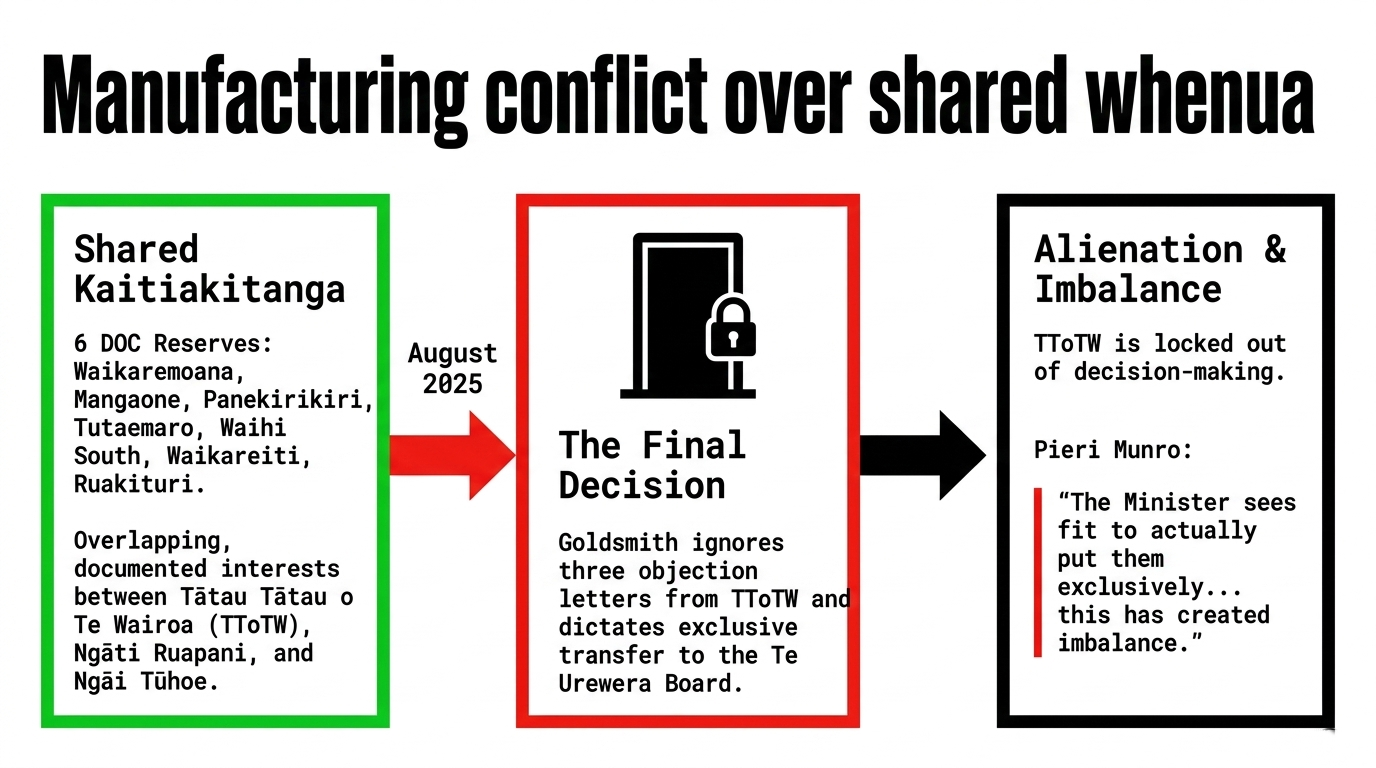
"We support Ngāti Ruapani in terms of the redress that they're seeking as part of this bill process. What we want is those six reserve blocks to come out and remain non-exclusive so that we can all share as our tīpuna did."
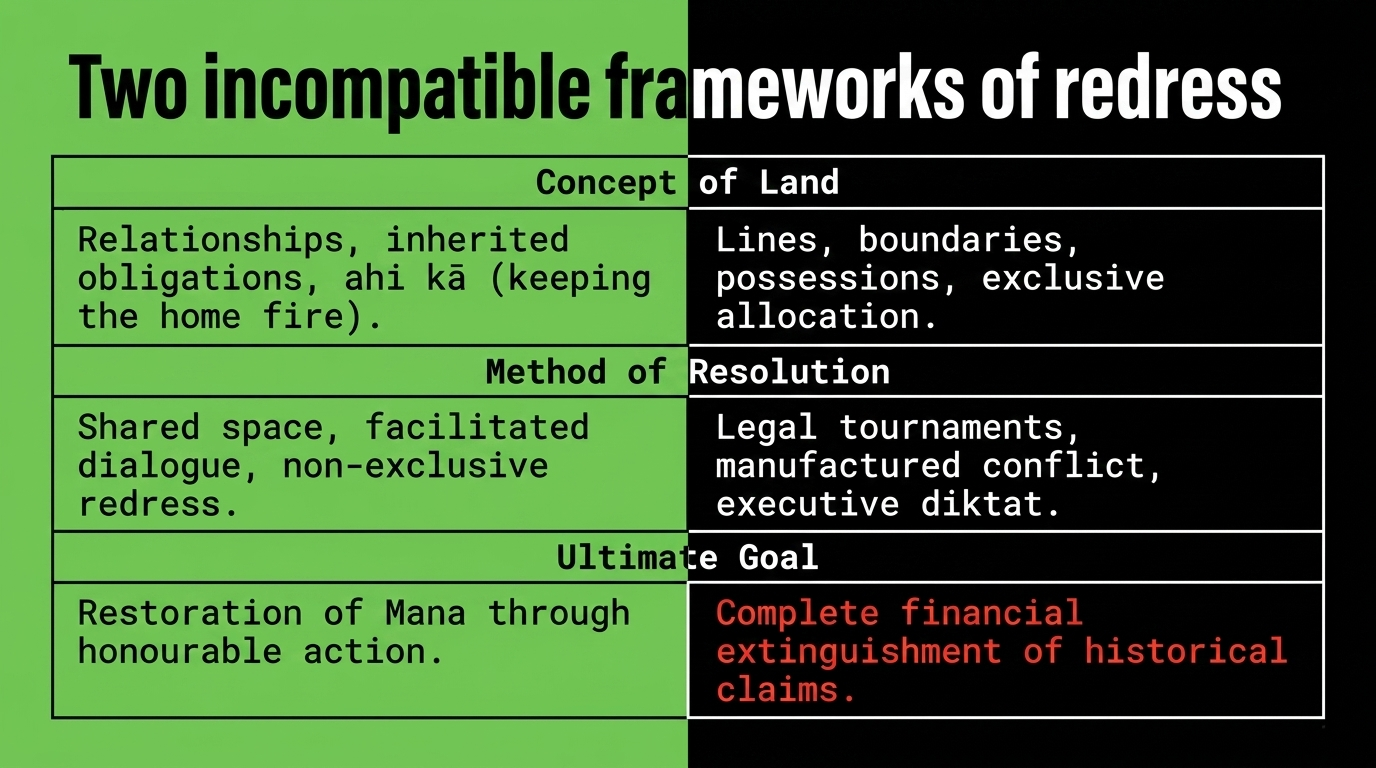
That single statement contains the whole difference between tikanga and colonialism. TToTW are not seeking to deny Ngāti Ruapani — they are asking for what their tīpuna practised: shared kaitiakitanga. The colonial state does not understand this because it does not want to. The colonial state only knows how to draw lines, create winners, manufacture losers, and call the resulting conflict "complexity." Goldsmith took two peoples who shared land for generations and forced them into a legal tournament. Then he declared a winner. Then he locked the door.
This is not a bureaucratic mistake. This is the ideology in action.
Three Examples for the Western Mind
Let's make this legible for those who have been taught that the Treaty is a "Māori issue":
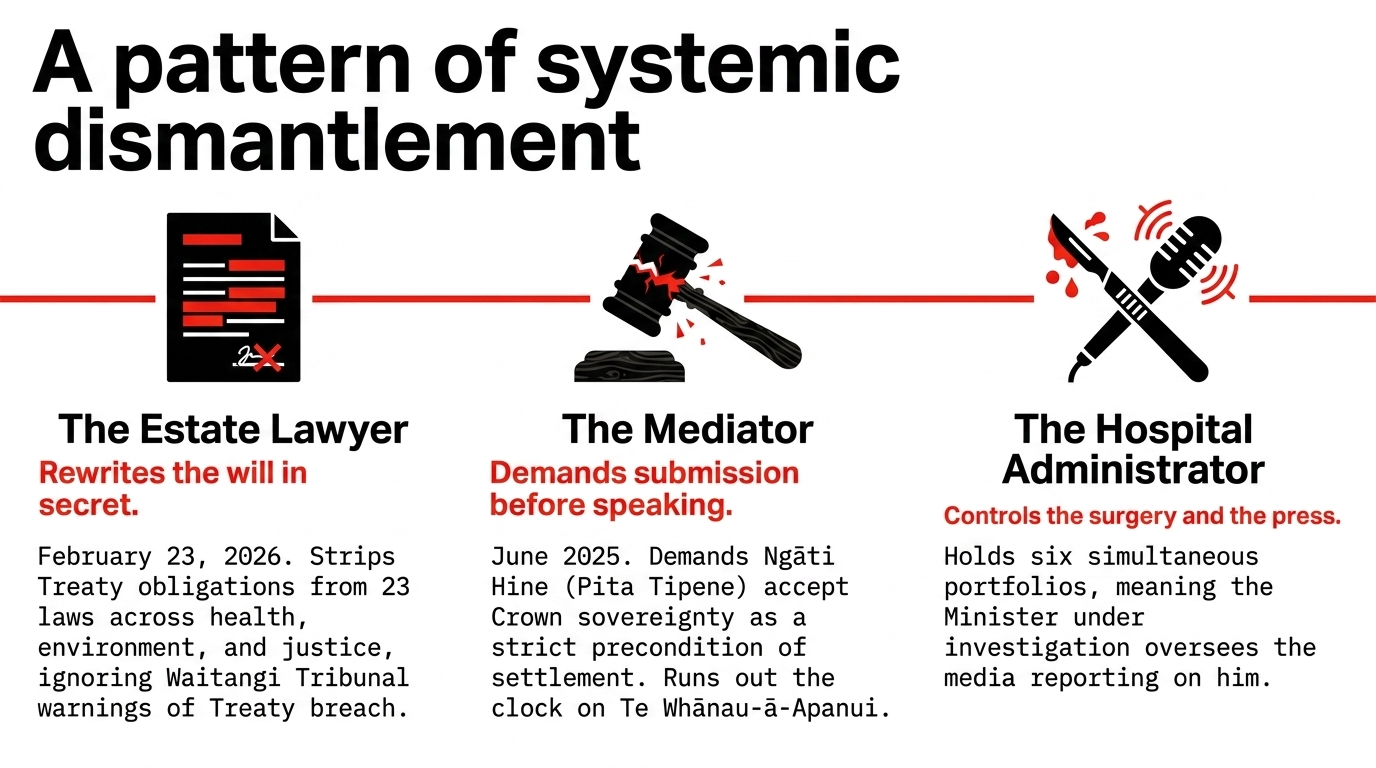
Example 1 — The Estate Lawyer Who Secretly Rewrites the Will
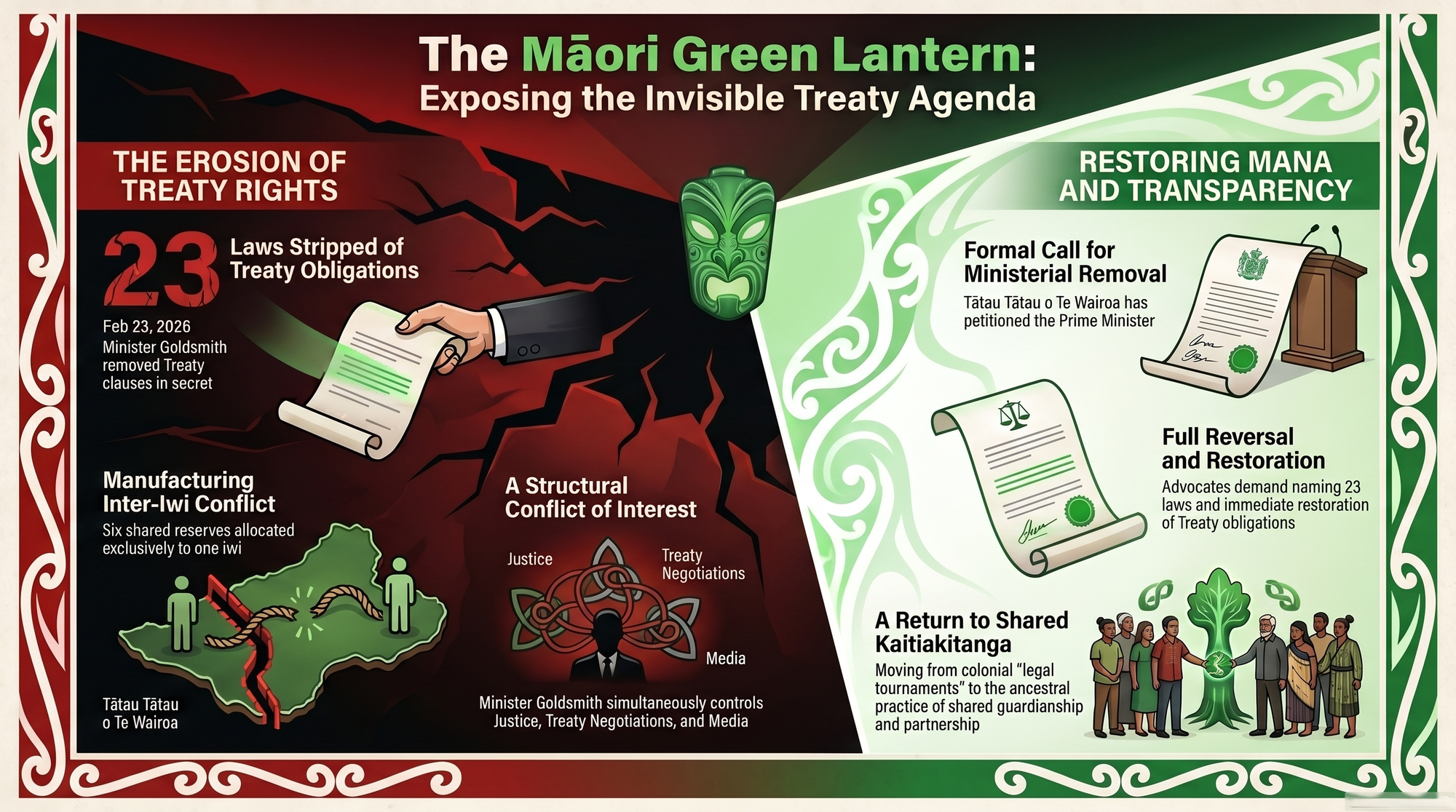
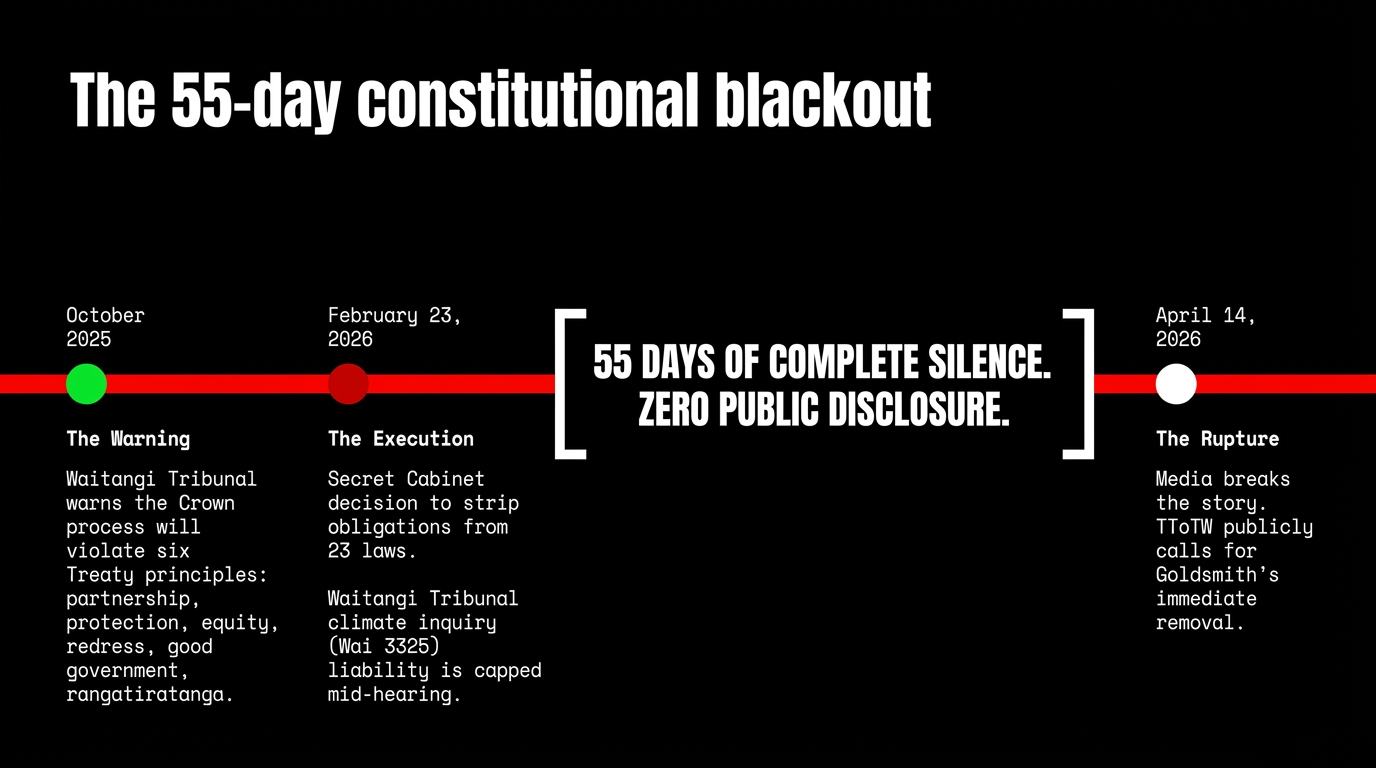
Imagine a wealthy grandfather died and left an estate worth $18 billion — the cumulative value of lands, fisheries, forests, and resources taken from Māori, as documented by The Spinoff's analysis of Treaty settlement redress, which stands at approximately 2% of what was actually taken. Now imagine the estate lawyer, Paul Goldsmith, attends a meeting in February 2026 and quietly changes the will — removing obligations to 23 beneficiaries across health, housing, education, environment, transport and justice — then says nothing to anyone for 55 days. When asked which clauses he changed, he refuses to say. That is exactly what happened on February 23, 2026 at Cabinet, as confirmed by The Māori Green Lantern's investigation. The Waitangi Tribunal — the statutory Crown body equivalent to an independent judicial review — had already warned in October 2025 that this process "would breach the Treaty of Waitangi," violating six Treaty principles: partnership, active protection, equity, redress, good government, and rangatiratanga. Goldsmith received that finding. He proceeded anyway. In Western legal terms: this is a fiduciary acting in deliberate breach of their duty of care to a beneficiary — while hiding the paperwork.
Example 2 — The Mediator Who Demands You Agree Before the Session Starts
Imagine hiring a professional mediator to resolve a decades-long property dispute. The mediator sits down and says: "Before we begin, you must agree that everything that happened in the past was legal and that I represent the only legitimate authority in this room." If you don't agree, there is no settlement. That is precisely what Goldsmith told Ngāti Hine leader Pita Tipene at the Māori Affairs select committee in June 2025 — demanding iwi accept Crown sovereignty as a formal precondition of settlement, as reported by NZ Herald. Tipene's response was unambiguous: he ruled out any settlement under this Government entirely. Meanwhile, Te Whānau-ā-Apanui — whose settlement was near-complete under the previous government — saw it collapse into stalemate after Goldsmith moved to remove a clause the Labour government had already agreed to, as confirmed by NZ Herald in June 2025. The mediator was not trying to resolve the dispute. The mediator was running out the clock. In tikanga terms, this violates mana at every level — because mana is earned through honouring obligations, not weaponising process.
Example 3 — The Hospital Administrator Who Controls Both the Scalpel and the Press
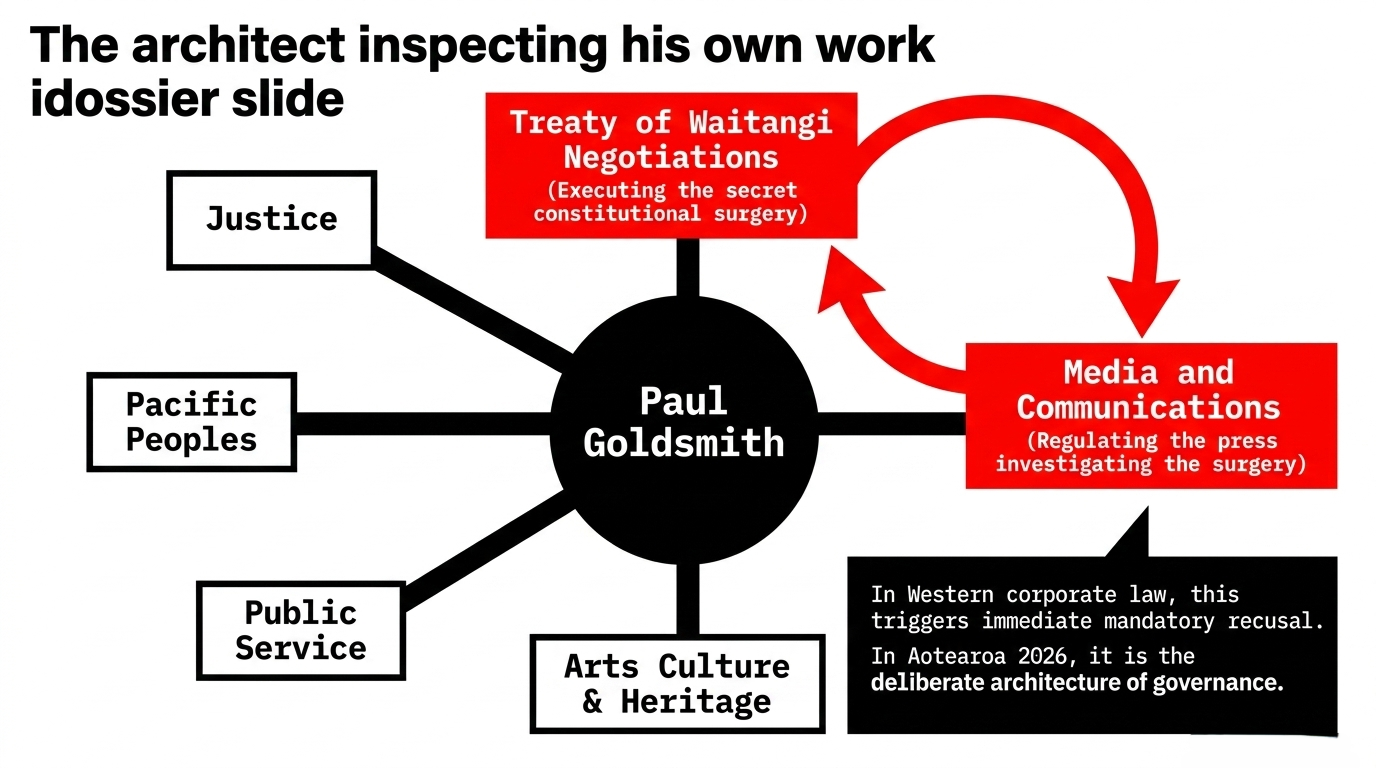
Paul Goldsmith currently holds six portfolios simultaneously: Justice, Treaty of Waitangi Negotiations, Pacific Peoples, Public Service, Arts Culture and Heritage, and — crucially — Media and Communications, as confirmed by the official April 2026 Ministerial List documented by The Māori Green Lantern. Imagine a hospital administrator who is simultaneously the surgeon operating on you, the administrator approving the surgery, the insurance regulator setting your coverage, AND the editor of the newspaper reviewing the surgery's outcome. The conflict of interest is not incidental — it is structural. When the media investigations into Goldsmith's 55-day secret Treaty clause removal finally broke, the Minister responsible for the media regulatory framework was the same man under investigation. In Western corporate law this would trigger immediate mandatory recusal. In Aotearoa in 2026, it triggers nothing.
This Is Not Isolated — It Is A Pattern Named and Documented
This call from Tātau Tātau o Te Wairoa does not exist in a vacuum. The Māori Green Lantern has been tracing this network for years:
In The Grave Robbers in Suits: How Paul Goldsmith Buried the Treaty Principles Bill — Then Dug Its Grave Under a Different Name (April 2026), this publication documented that the Treaty Principles Bill and the Treaty Clause Review were always two prongs of the same spear — the public one killed by public outrage, the silent one completed by Cabinet while no one was watching. As Newsroom warned in April 2025: "The Treaty Principles Bill is gone; now Govt's real Treaty agenda begins." They were right.
In The Treaty Principles Bill: A Neoliberal Dagger in the Heart of Aotearoa's Future (November 2024), the coordinated nature of the attack was named: NZ First's Shane Jones and ACT's David Seymour providing the ideology, National providing the parliamentary machinery, and the resulting assault designed to reduce Māori legal leverage across the entire statute book.
In Colonial Sovereignty Supremacy: How Goldsmith's Treaty Settlement Demands Expose This Government's Agenda (June 2025), this publication documented that Goldsmith's sovereignty-precondition demand was not a rogue policy position — it was the formal operational doctrine of the Crown under this Government: settle on our terms, accept our authority, or receive nothing.
In Te Ara Utu: The Toll Road to Nowhere (April 2026), the parallel destruction was documented: Shane Jones targeting Section 4 of the Conservation Act — the strongest Treaty standard in New Zealand law — through a separate, less visible process designed to remove what Jones calls "Treaty friction" from extractive industry access to Māori land.
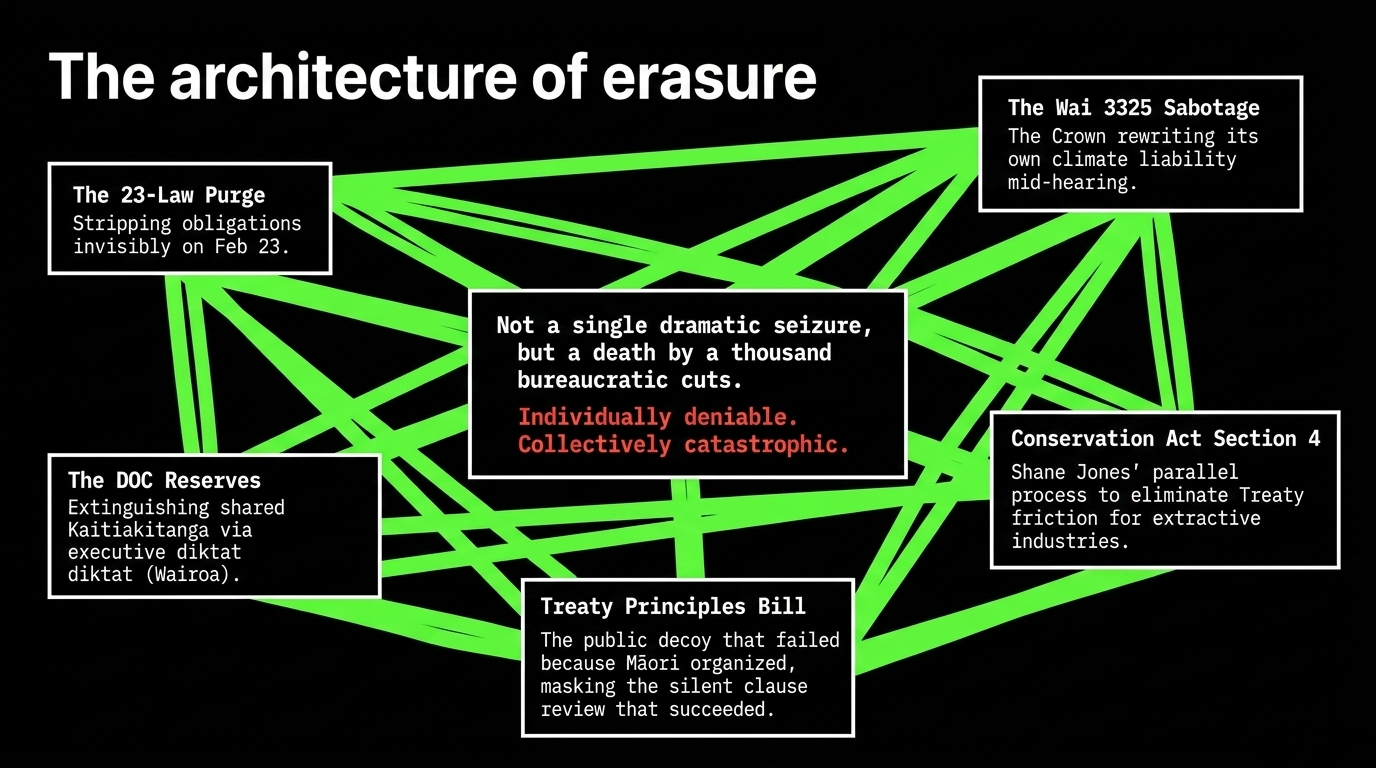
In Dismantling Sovereignty Through Bureaucracy: The Coalition's Treaty Obliteration (July 2025), the systemic methodology was exposed: not a single dramatic seizure but a death by a thousand bureaucratic cuts, each one individually deniable, collectively catastrophic.
The Foundational Disqualification — Named and Evidenced
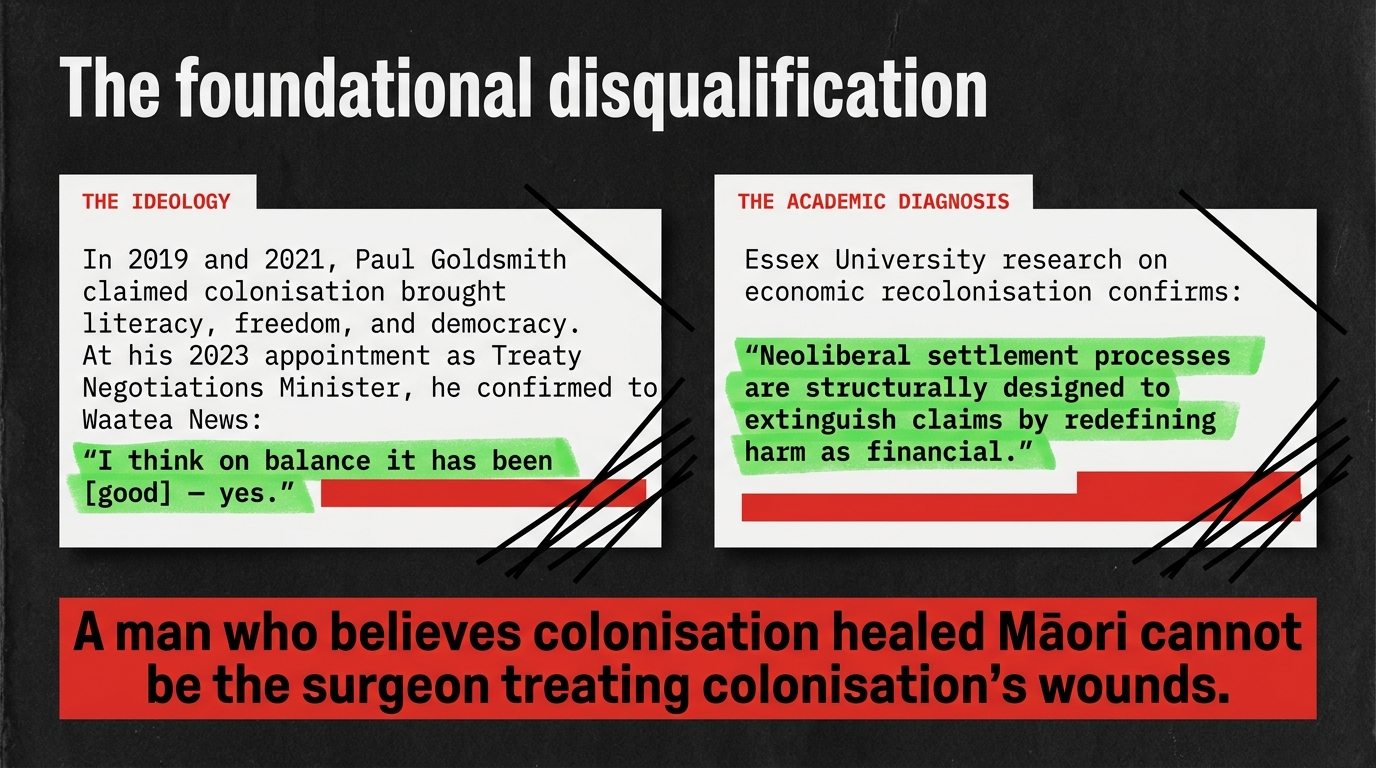
Let us be precise about what this man believes. In 2019, Paul Goldsmith wrote that on balance colonisation was good for Māori because it brought literacy, freedom and democracy. In 2021, he doubled down. As Waatea News confirmed at his 2023 appointment as Treaty Negotiations Minister, he stated: "I think on balance it has been — yes." As Te Ao News documented, almost every other National MP distanced themselves from those remarks because they understood them to be disqualifying.
Christopher Luxon appointed him anyway.
Then kept him.
Then gave him six portfolios.
Then said nothing for 55 days while Goldsmith stripped Treaty obligations from 23 laws.
A man who believes colonisation healed Māori cannot be the surgeon treating colonisation's wounds. This is not complexity. This is not nuance. This is a documented academic finding confirmed by Essex University research on economic recolonisation: Treaty settlement processes birthed within neoliberalism are structurally designed not to restore, not to repair, but to extinguish claims by redefining harm as financial. Goldsmith is that process given a ministerial warrant and six portfolios.
The Tikanga Framework This Government Cannot Comprehend
Kaitiakitanga is not a legal concept. It is a relational one. It is not ownership — it is obligation. The six DOC reserves that Goldsmith allocated exclusively to Ngāti Ruapani are not, in TToTW's worldview, possessions to be won in a legal tournament. They are relationships — inherited from tīpuna, expressed through ahi kā (the keeping of the home fire), requiring no permission from any Crown Minister to exist.
When Goldsmith made his "final decision," he did not simply rule against TToTW in an administrative process. He severed a relationship his office does not have the authority to sever. As Te Ara documents, the Treaty created a partnership requiring both parties to act "reasonably and with the utmost good faith." What Goldsmith has done — stripping Treaty obligations in secret while his own officials warned it would harm Māori, overriding a Waitangi Tribunal finding of Treaty breach, manufacturing conflict between iwi by allocating shared whenua exclusively — is a desecration of mana on a constitutional scale.
Mana is not restored by apology. It is restored by action. TToTW's call for Goldsmith's removal is exactly that action.
The Five Hidden Connections This Government Hoped You Would Not Trace
- Goldsmith stripped Treaty obligations from 23 laws on February 23, 2026 and said nothing for 55 days — as documented by The Māori Green Lantern and confirmed by Substack note of April 19, 2026. He is simultaneously the Minister for Media investigating him.
- The Waitangi Tribunal's climate inquiry (Wai 3325) was mid-hearing when Goldsmith filed a memorandum confirming Cabinet had already capped the Treaty obligation in the very legislation under scrutiny. The Crown was simultaneously defendant and rewriting the statute governing its own liability.
- Section 4 of the Conservation Act — the strongest Treaty standard in New Zealand law — is being removed through a separate, less visible parallel process driven by Shane Jones, as documented in Te Ara Utu. The TToTW DOC reserves decision sits within this exact same framework of stripping Treaty protection from conservation land.
- The Treaty Principles Bill failed because Māori organised. The Clause Review succeeded because the Crown made it invisible. Same architects. Same intent. Different packaging. As The Māori Green Lantern documented in Grave Robbers in Suits: "The Principles Bill failed because Māori organised. The Clause Review is succeeding because the Crown made it invisible."
- Goldsmith holds the Media and Communications portfolio simultaneously with Justice and Treaty Negotiations — meaning he oversees the regulatory framework of the very outlets investigating his decisions. This is not governance. This is architecture.
What Must Happen — The Minimum Standard of Decency
Luxon removing Goldsmith is the floor. It is not the ceiling.
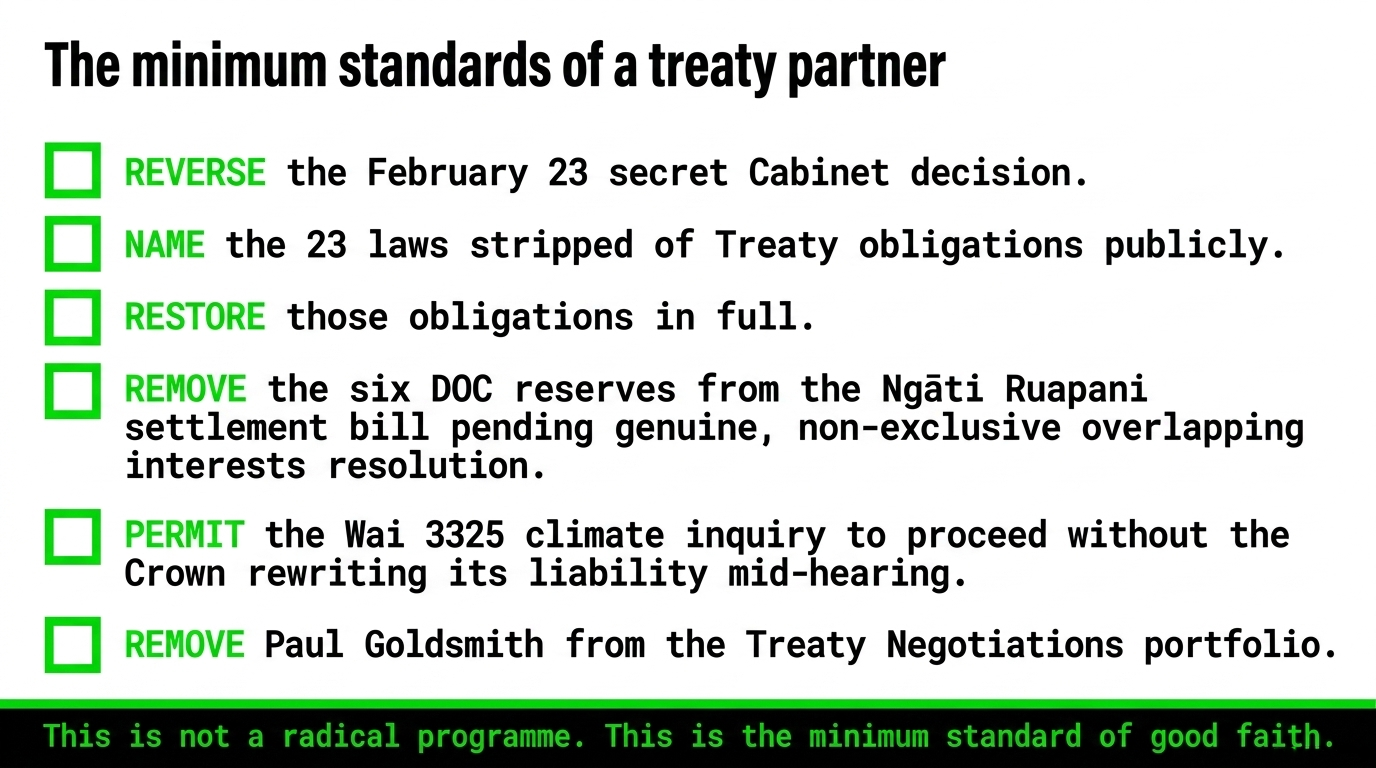
The February 23 Cabinet decision must be reversed. The 23 laws must be named publicly. The Treaty obligations must be restored. The six DOC reserves must be removed from the Ngāti Ruapani settlement bill pending proper overlapping interests resolution — not because Ngāti Ruapani deserve less, but because TToTW deserve to be heard. As 1News confirmed on April 12, 2026, this is fundamentally a case of overlapping iwi interests that a competent, good-faith minister would have managed through facilitated dialogue — not executive diktat.
And Wai 3325 must be allowed to proceed without the Crown rewriting its own liability mid-hearing.
This is not a radical programme. This is the minimum standard of a Treaty partner acting in good faith.
Koha Consideration
Tātau Tātau o Te Wairoa wrote three letters and got a door slammed in their face. This essay exists because someone must keep the door open — keep the record, name the pattern, trace the network, and ensure Goldsmith's 55-day secret and his manufactured inter-iwi conflict do not disappear into the news cycle.
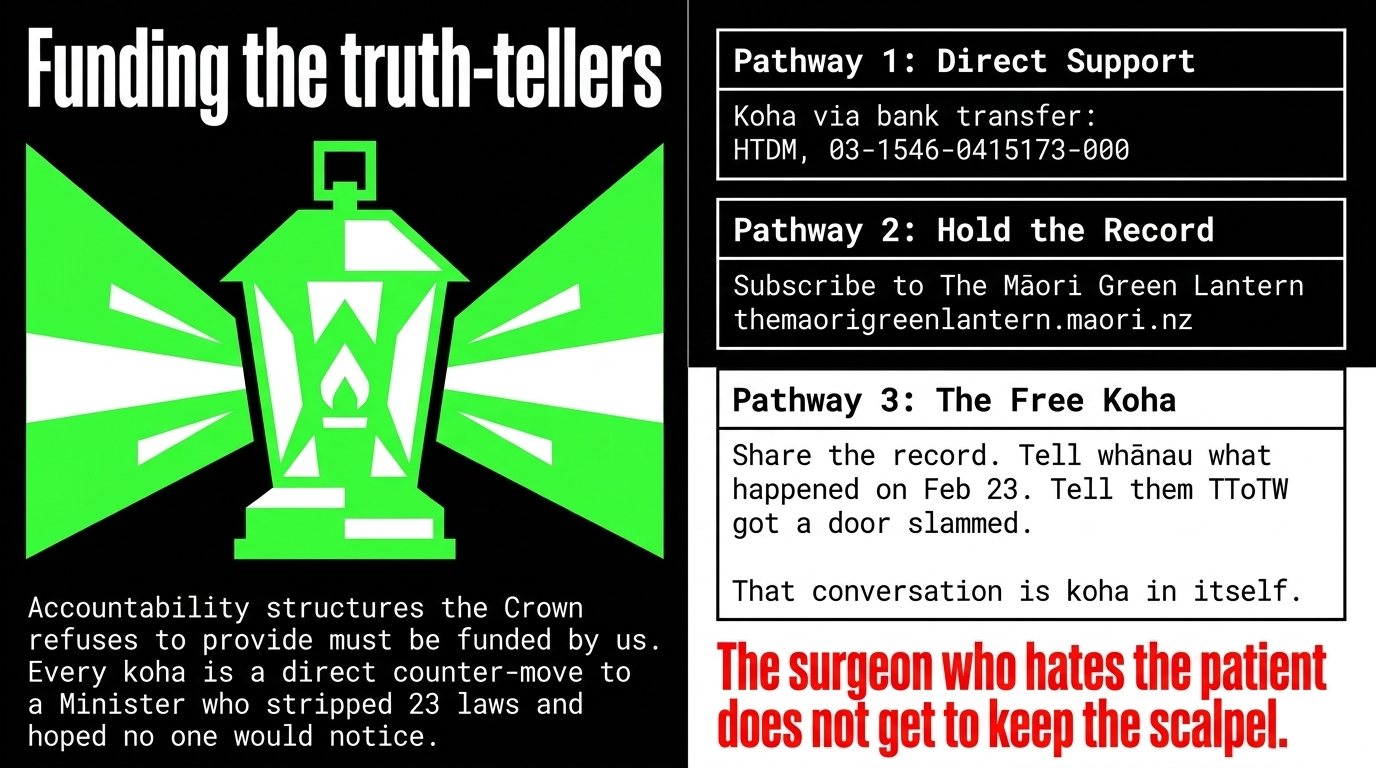
Every koha to this mahi is a direct counter-move to a Minister who stripped Treaty obligations from 23 laws and hoped no one would notice. When Luxon stays silent, when Goldsmith calls it a "final decision" — this space stays on it. That costs time. That costs mahi. And it only continues because whānau fund it.
If TToTW's stand moved you — if Pieri Munro's words landed — consider that the accountability structures this Crown refuses to provide must be funded by us.
Four pathways:
For those who wish to support this mahi directly, a koha signals that rangatiratanga includes the power to fund our own truth-tellers: Koha — Support the Māori Green Lantern
For those who wish to receive essays directly and hold the record with us: Subscribe to the Māori Green Lantern
For those who prefer direct bank transfer: HTDM, account number 03-1546-0415173-000
For those on Facebook: Follow and subscribe here
If you are unable to koha — no worries. Subscribe. Follow. Share this essay with your whānau. Tell people what Goldsmith did on February 23, 2026. Tell them he refused to name the 23 laws. Tell them TToTW sent three letters and got a door slammed. That conversation is koha in itself.
Kia kaha, Tātau Tātau o Te Wairoa. Ka mau te wehi. The surgeon who hates the patient does not get to keep the scalpel.
— Ivor Jones | The Māori Green Lantern | themaorigreenlantern.maori.nz