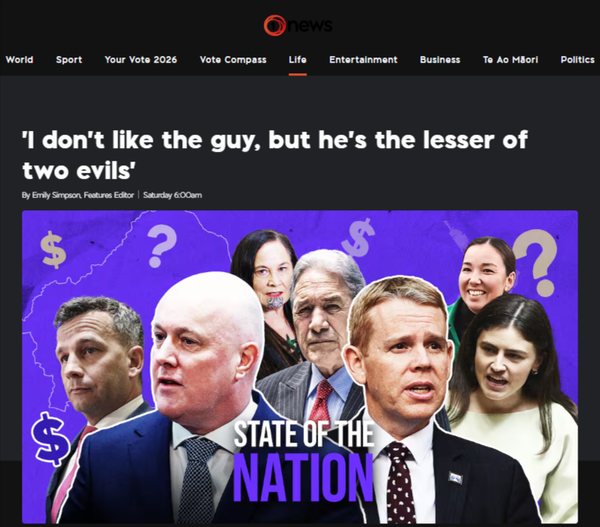
"THE EMPEROR'S CONFIDENCE TRICK: How a Hollow Suit Forced His Own Execution and Called It a Mandate" - 22 April 2026
He didn't survive. He just postponed his political funeral — and made his own caucus dig the grave in secret, without telling him how many refused to pick up the shovel.

Mōrena Aotearoa,
Imagine a captain who, noticing that his crew is sharpening their knives, calls a meeting, locks the door, and demands they vote on whether they still want him steering. The ship is taking on water. The charts are wrong. The passengers in steerage — overwhelmingly brown, poor, and already bailing with their bare hands — are drowning. And this man, this hollow vessel in a navy polo shirt, stands at the helm and calls the storm a media soap opera.
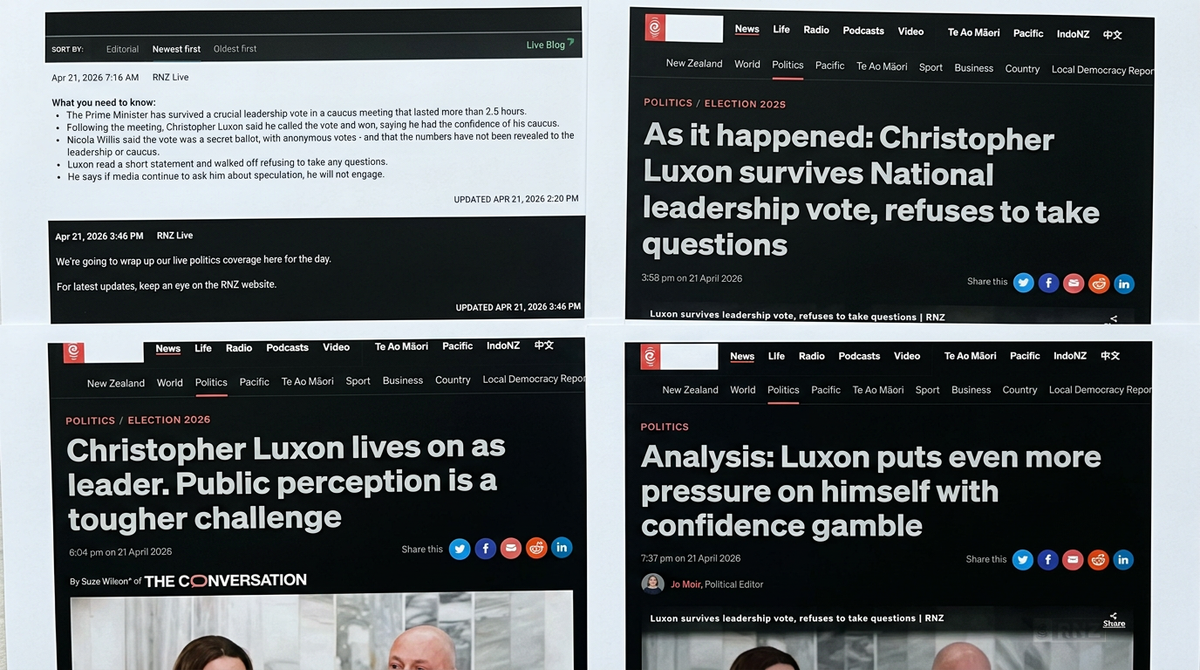
 Jo Moir
That is Christopher Luxon on April 20, 2026.
Suze Wilson*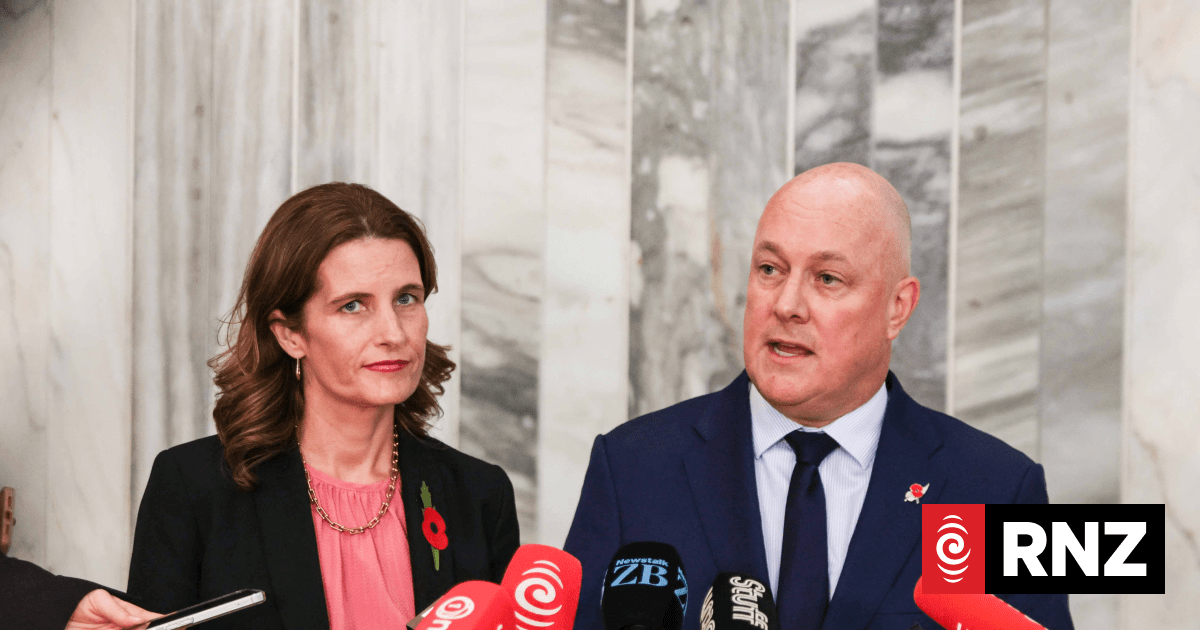
He survived. In the same way a man survives a self-inflicted wound — bleeding, weakened, and having proved beyond all doubt that he should never have been holding the weapon in the first place.
RNZ News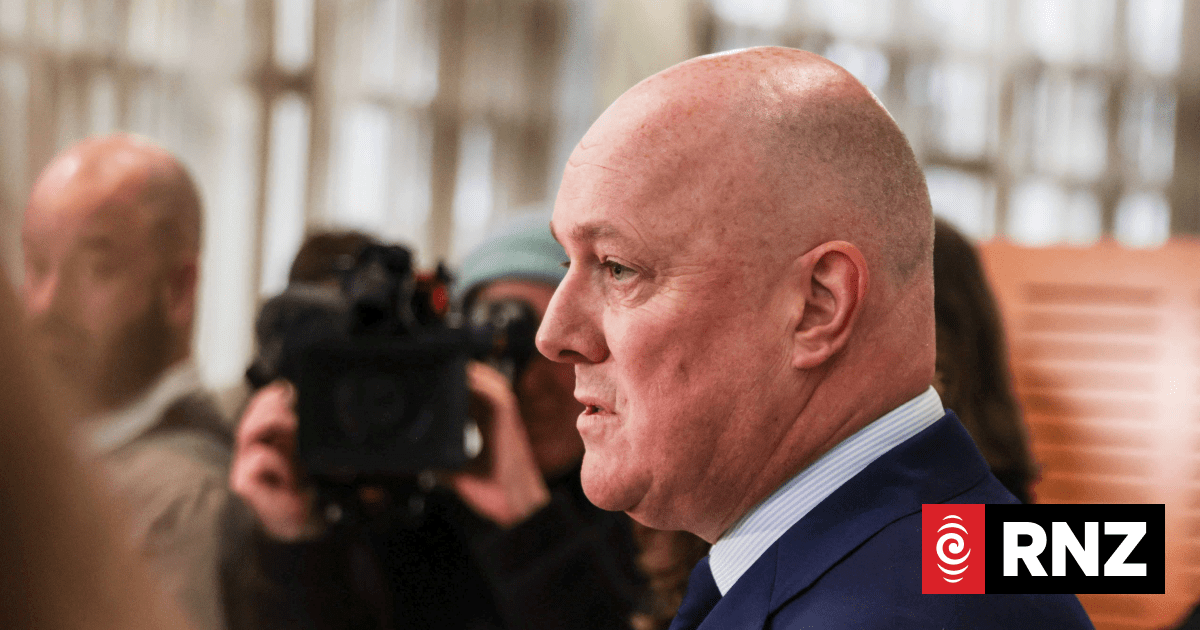
The Deep Dive Podcast
Listen to a lively conversation between two hosts, unpacking and connecting topics in the sources of this essay.

The Confidence Trick That Exposed Everything
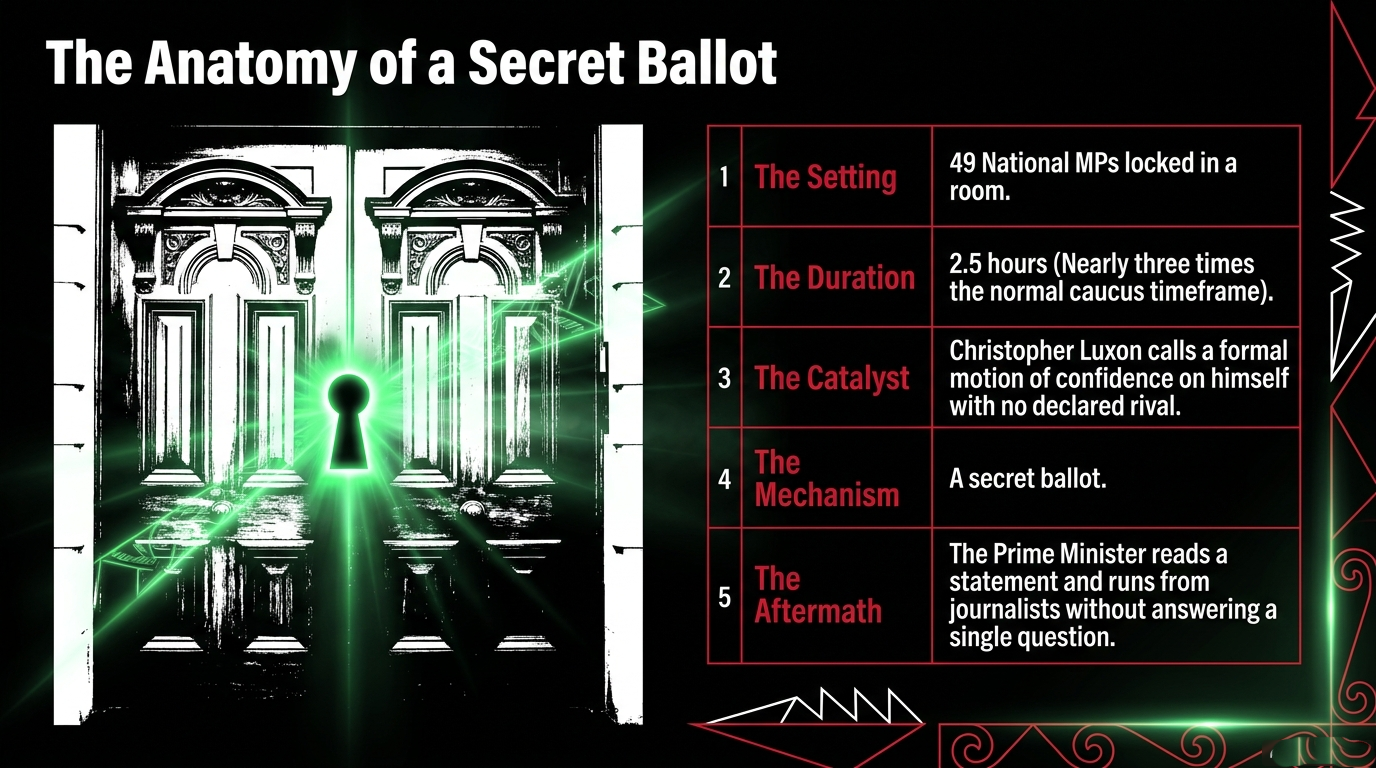
On April 20, Prime Minister Christopher Luxon called a formal caucus vote of confidence on himself — with no declared rival, no formal challenge, and no constitutional requirement to do so. He walked into a room of his own MPs, triggered a secret ballot, and demanded their loyalty at gunpoint.
Then he emerged from a two-and-a-half-hour meeting — nearly three times the normal caucus timeframe — read a statement, and refused to take questions, as RNZ reported.
His exact words:
"I moved a formal motion of confidence in my leadership. That motion was passed, confirming what I have been saying. I have the support of my caucus as their leader. Caucus has answered clearly and decisively. It has backed my leadership and that matter is now closed and it won't be — and I won't be commenting further on it."
He then pivoted to geopolitics and walked out.
Let that image live in your mind. The Prime Minister of Aotearoa — who governs 5 million people, who has spent two years lecturing the poor about accountability and personal responsibility — ran from journalists after forcing his own party to publicly endorse him.
The RNZ Facebook post captured it precisely:
"The PM says he won a vote, but left a press conference without saying what happened."
This is not strength. This is a man drowning and calling it swimming. As 1News analysis made clear, the vote "changed what kind of prime minister he is" — permanently and irreversibly. No Prime Minister in recent New Zealand political history has done this. The ones who have called votes on themselves in comparable democracies don't tend to survive the election that follows.
The Secret Ballot — And the Number Luxon Won't Reveal
Here is the detail Luxon will never confirm:
no one knows — or will reveal — how many MPs voted against him.
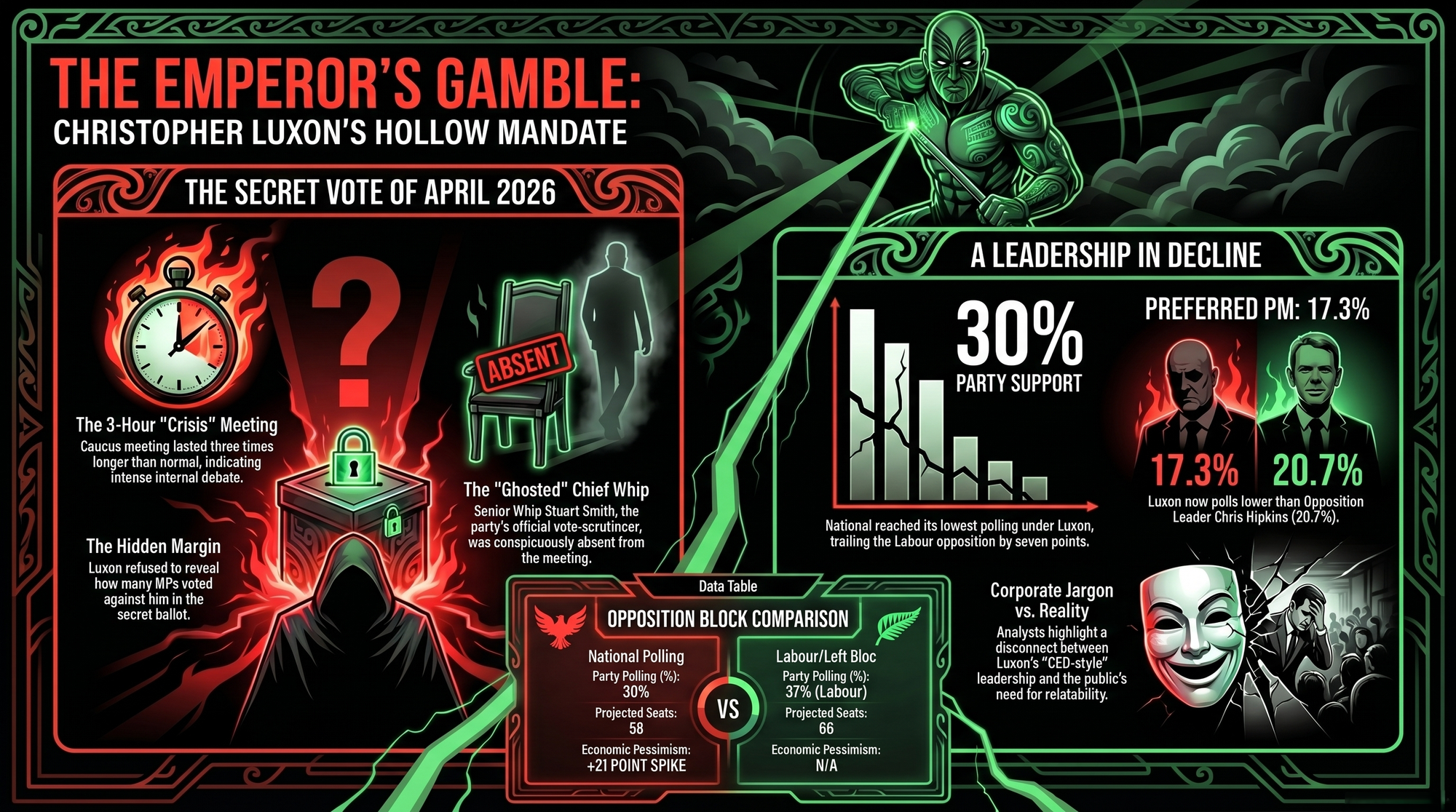
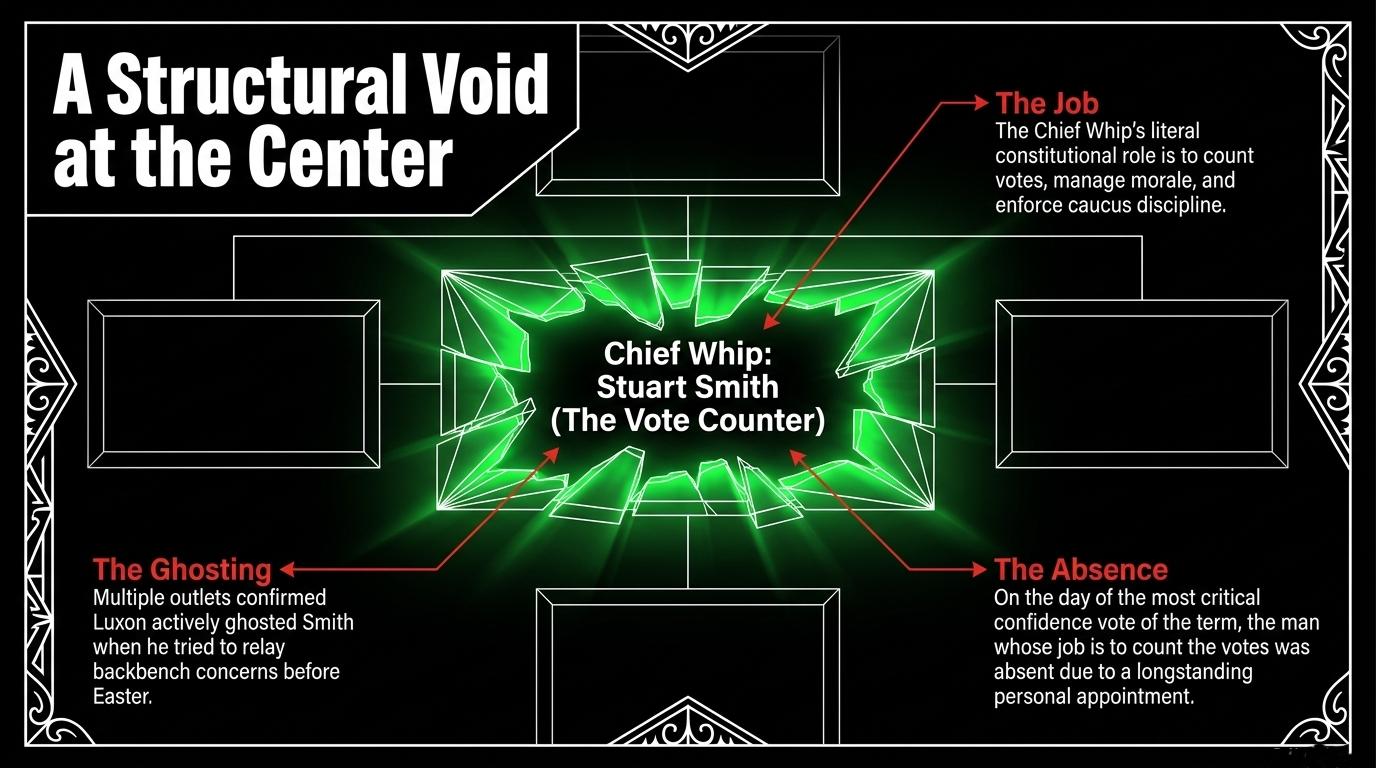
The vote was a secret ballot. As Nicola Willis confirmed, the numbers have not been shared with leadership or caucus. Luxon would not confirm whether the vote was unanimous. National MP Dan Bidois called the meeting "cathartic" — the word you use when something painful has just been lanced, not when everything is fine. Napier MP Katie Nimon also would not say whether the vote was unanimous. National's chief whip Stuart Smith — the man whose entire job is to enforce caucus discipline — was absent from the meeting entirely, citing a "longstanding personal appointment." 1News reported that several MPs called for a focus on "issues facing New Zealanders" upon arrival — code for: stop talking about the knife in his back.
The meeting ran at least 90 minutes longer than normal. Something happened in that room. And Luxon ensured the world would never know exactly what it was.
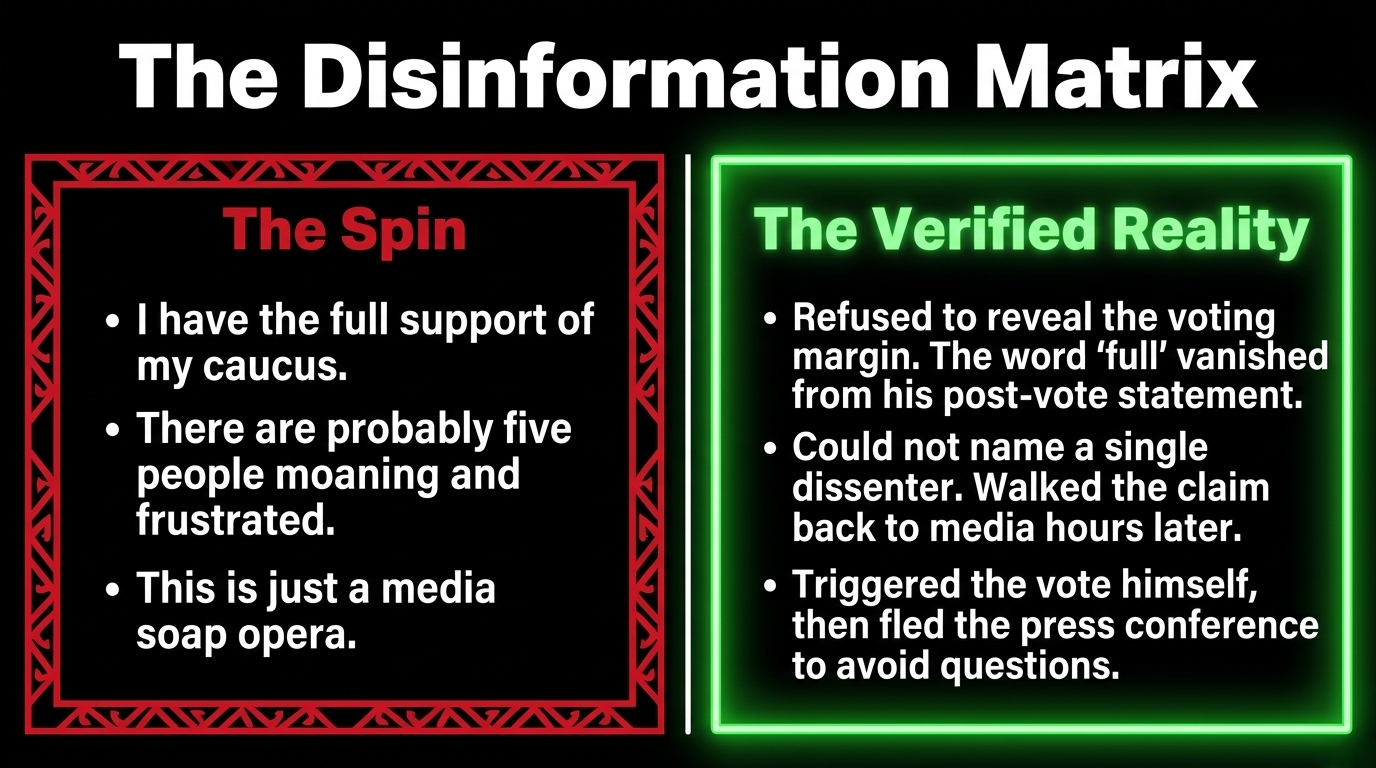
Before the vote, Luxon had repeatedly told media he had "the full support of my caucus." After the vote — as the NZ Herald noted with surgical precision — that word "full" had quietly disappeared from his statement.
A leader who "clearly and decisively" won his own vote of confidence does not refuse to reveal the margin. A man who had 49 MPs in that room and walked out claiming he won — but won't say by how much — is a man who almost certainly did not win by much.
Winston Peters — the coalition partner whose fingerprints are all over this government's worst moments — called it immediately:
"This is a very bad move. There are going to be consequences."
Winston Peters does not make warnings. He makes prophecies.
The "Moany Five": Who Are They? What the Evidence Actually Shows
On April 18, 2026, Luxon told Newstalk ZB's Mike Hosking that "probably five people" were "moaning and frustrated" and leaking to media. He also told RNZ's Morning Report the same morning he didn't know who was leaking. Those two statements, made hours apart, are mutually exclusive.
By April 19, as NZ Herald reported, Luxon was already walking it back:
"My comment was just in reaction to your media reporting quoting a number of sources that you said you had. There's nothing in the number per se."
He invented it. Or guessed. Either way, he publicly inflamed his own caucus with a specific number he couldn't substantiate, then retreated. As Farmers Weekly noted, he blamed "a small handful of dissatisfied MPs" without naming a single one. This is a man who called a three-hour confidence vote on himself and still couldn't get his story straight.
What the verified reporting does show — named and confirmed:
- Stuart Smith (Chief Whip) — The most significant figure. Multiple outlets confirmed Smith could not get a meeting with Luxon before Easter to relay backbench concerns — Luxon ghosted his own chief whip. Smith was then absent from the confidence vote entirely. The man whose literal job is caucus management and vote-counting was not in the room for the most important caucus vote of this parliamentary term. His absence speaks louder than any leaked quote.
- Chris Bishop (Housing Minister) — Herald's Heather du Plessis-Allan, described as "very well connected with National Party insiders", essentially publicly convicted Bishop — writing that he was "out of the running" for the leadership because "the caucus will blame him for the destabilising." You don't write that without sources inside the room. Bishop repeatedly denied involvement publicly, which is what guilty men do.
- Nicola Willis and Erica Stanford — Both are named by Bryce Edwards' analysis as being "under quiet suspicion". Willis as Deputy is structurally implicated — she cannot be the successor because she is the failure. Stanford as a potential successor has every motive, and as recently as March admitted publicly "it was a bad week for the National Party" with zero alternative vision offered.
- The unnamed backbench group — 1News Breakfast's Tova O'Brien reported direct contact with a National MP who told her "the numbers are probably there to unseat him." Political analyst Liam Hehir confirmed: "a group of disgruntled MPs, but they were not Ministers and there was no single leader behind the potential move."
The most revealing thing about the "Moany Five" is not who they are — it is what the hunt for their identities tells us about Luxon. He threw a number into the air, attached it to his own MPs, watched it explode across every headline in the country, couldn't name a single person, then fled the press conference. As The Māori Green Lantern documented in The Trapdoor Prime Minister, this is the governing style of a man who has confused managing a board with governing a nation.
The MPs who voted against him in that secret ballot may number five. May number fifteen. Luxon knows. He won't say. And that silence — like everything else about this Prime Minister — tells you everything.
The Numbers Don't Lie — Even When Luxon Does
Before we get to the metaphors, let us lay the body on the table and count the wounds:
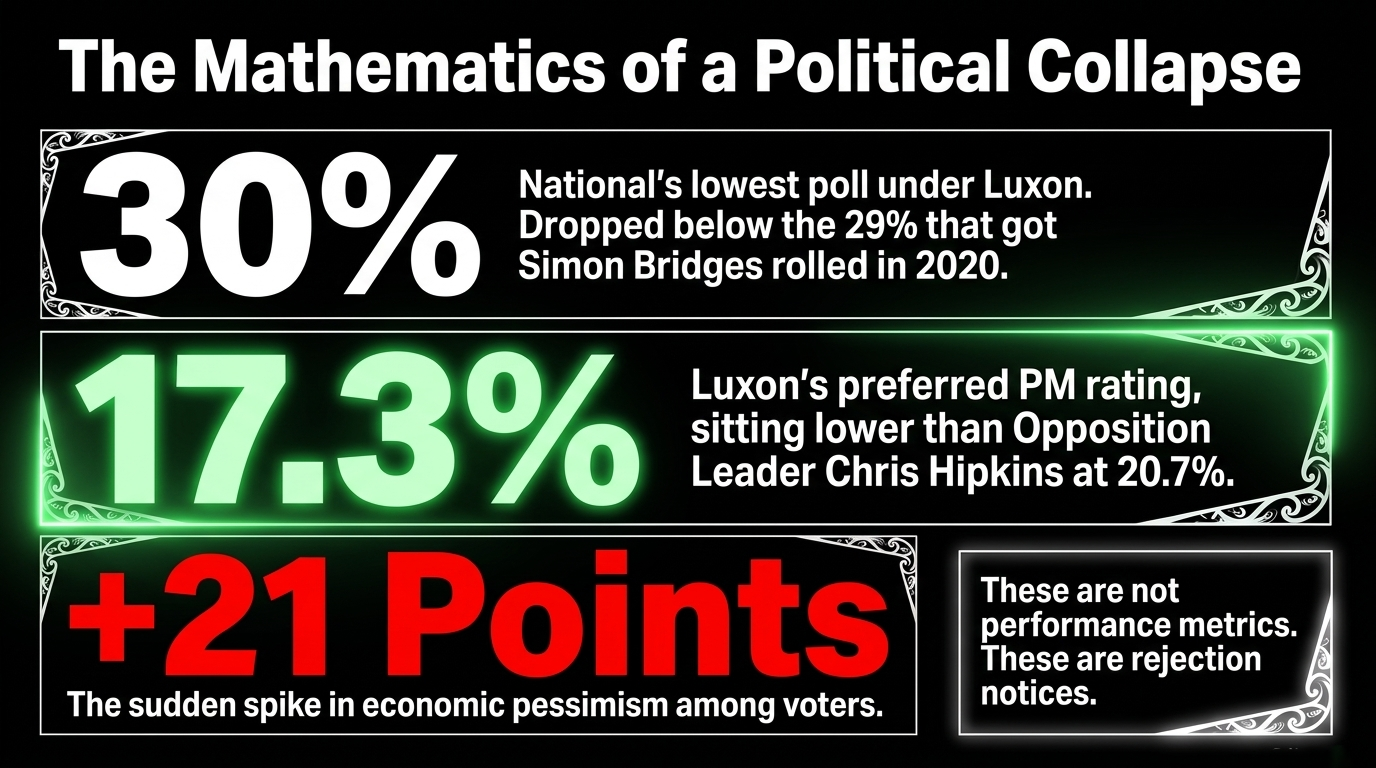
- National at 29.7% (rounded to 30%) — its lowest under Luxon in the April 2026 1News/Verian poll
- Labour at 37% — a seven-point lead. If an election were held today: Labour 47 seats, National 37 seats, Greens 13, NZ First 13, ACT 8, Te Pāti Māori 6 — the left bloc commands 66 seats to the right's 58
- Luxon personally at 17.3% preferred PM — below opposition leader Chris Hipkins at 20.7%, as the March RNZ-Reid Research poll showed
- In March 2026, National hit 28.4% — lower than the 29% that got Simon Bridges executed by his own caucus in 2020, as The Spinoff documented
- Economic pessimism spiked 21 points in a single poll cycle — the exact metric Luxon built his entire political brand on destroying
- The coalition parties combined held just 47% of the vote against 50% for the opposition — enough for a Labour-led government to govern outright, as The Spinoff confirmed
And yet Luxon told 1News:
"We're not where we want to be. We need to do better."
That is not a prime ministerial statement. That is a mid-year corporate performance review from a man who doesn't understand that he is the performance being reviewed — and the board has already decided.
The Iran Crisis That No One Is Talking About Enough
The confidence vote did not emerge from a vacuum. The immediate trigger — buried under the polling story — was Luxon's catastrophic handling of the Iran fuel crisis, which exposed him as a "deer in the headlights" according to National's own internal media assessment, as NZ Herald Media Insider reported. An international energy shock that required measured, sovereign leadership. Luxon delivered confused messaging, contradictory public statements, and the kind of corporate crisis PR that works in a boardroom and humiliates a nation on the world stage.
This is what happens when you put a former Unilever CEO in charge of foreign policy. The shelf-stacking skills do not transfer.
The Structural Rot: Three Examples for the Western Mind
This is not abstract political drama. This is policy violence — the kind that lands on real bodies, real whānau, real rangatahi. Let us name it precisely.
Example One: The Care Worker Theft — $12.8 Billion Stolen in 45 Minutes
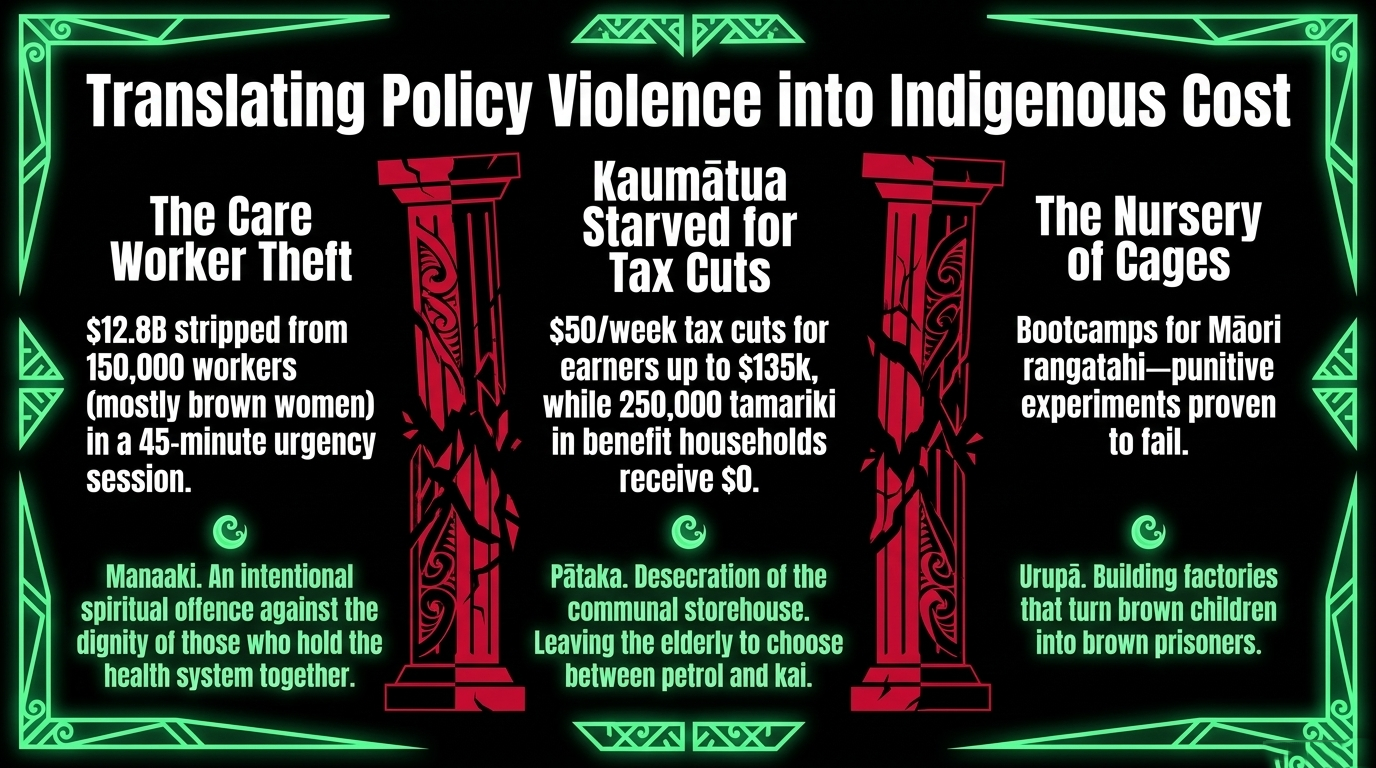
In the first months of Luxon's government, the National-led coalition repealed pay equity legislation under urgency — stripping $12.8 billion in wage commitments from over 150,000 care workers, the majority of them Māori and Pasifika women, in a 45-minute parliamentary session.
For the western mind: imagine Congress ripping up the Equal Pay Act for healthcare workers — in one sitting — while the Speaker lectures single mothers about "making better choices." That is what happened here.
As The Māori Green Lantern documented in The Trapdoor Prime Minister, this was not a budget necessity — it was an ideological act. It institutionalised the breach of utu (reciprocal justice) at a structural level, targeting the women — overwhelmingly brown — who hold the health system together with their bare hands.
The tikanga breach: In Māori values, manaaki — the obligation to uplift the dignity of others — is not optional. It is constitutional. A leader who strips mana from the most vulnerable workers in society has not made a fiscal decision. They have committed a spiritual offence against the very fabric of what holds communities together.
The solution: Reinstate pay equity legislation. Index care worker rates to IRD benchmarks. Restore the $12.8 billion commitment with mandatory transparent wage reporting across all Crown-funded care sectors.
Example Two: Kaumātua Choosing Between Petrol and Kai
While Luxon's government handed $50 per week in tax cuts to families earning up to $135,000 per year, a quarter million tamariki in benefit households received zero — not a cent — from the same fiscal package.
As The Māori Green Lantern documented in The Pātaka Is Ash, kaumātua across Aotearoa are choosing between petrol to get to medical appointments and food for the week. This is not poverty as abstraction — it is the engineered result of a $373 million "Family Relief Package" designed to benefit middle-class Pākehā homeowners while leaving the poorest without heating.
For the western mind: imagine the IRS mailing stimulus cheques exclusively to households already in the top 60% income bracket — and calling it a "cost of living response." That is Nicola Willis's fiscal compassion.
The tikanga breach: The pātaka — the communal food storehouse — is one of the most sacred expressions of Māori collective responsibility. A community that allows its elderly to go without food while its leaders claim accommodation allowances on houses they already own has desecrated its own pātaka. This government is not just economically irresponsible. It is spiritually bankrupt.
The solution: Restore benefit indexation to wage inflation. Expand Working for Families to include all tamariki regardless of household work status. Establish a Crown-funded kaumātua wellbeing fund administered through iwi, not WINZ.
Example Three: The Nursery of Cages — Māori Rangatahi as Neoliberal Test Subjects
As The Māori Green Lantern exposed in The Nursery of Cages, this government's youth justice "Bootcamp" programme uses Māori rangatahi as test subjects for punitive experiments that every credible piece of criminological evidence says will not work. The result: we are building factories that turn brown children into brown prisoners — at Crown expense, with Crown enthusiasm.
For the western mind: imagine the US federal government reopening juvenile detention camps specifically designed for Black and Indigenous youth, branding them "character-building programmes," and citing falling crime stats in areas where police simply stopped counting. That is New Zealand's Bootcamp Betrayal.
The tikanga breach: Urupā is where we return our dead to the land. Prison is where this government returns our children — alive, but broken. Cutting youth services, gutting Māori health providers, defunding kura kaupapa, and then punishing the children who fall through those gaps is not governance. It is predation. And as the Māori Green Lantern's The Chickens Come Home to Roost documented, this anti-Māori crusade has backfired spectacularly on National's own electoral numbers.
The solution: Defund bootcamps immediately. Redirect all youth justice funding to kaupapa Māori-led therapeutic intervention programmes with proven recidivism reduction outcomes. Establish a Māori Youth Justice Commission with binding legislative authority.
The Architecture of Cowardice: Why Caucus Didn't Remove Him
Here is the cold structural truth that explains why a party of 49 MPs with a near-catatonic leader in freefall polling did not simply remove him:
Cowardice masquerading as loyalty.
Health Minister Simeon Brown arrived at the Beehive declaring he'd give Luxon "100% support." Dan Bidois called the leadership "rock solid" — then described the three-hour meeting as "cathartic," which is not a word used by confident, unified parties. It is the word used after something dark has been lanced from a wound.
The structural trap holding National together was fear on three fronts.
First: Winston Peters reportedly believes coalition agreements are personal to the leaders who signed them — meaning replacing Luxon could void NZ First's arrangement and potentially collapse the government entirely, as Bryce Edwards documented.
Second: no consensus successor exists — Willis shares every scar of fiscal failure; Stanford offers no alternative vision.
Third: a snap election held today would see National obliterated. MPs looked at their electoral futures and chose their seats over their spines.
That is not a caucus. That is a hostage situation. And Luxon is both the hostage-taker and the ransom demand.
As The Māori Green Lantern's The Trapdoor Prime Minister documented, the National Party is not simply led by a failing man — it is structurally committed to a failing ideology. As SAANZ sociology research confirms, neoliberalism in Aotearoa was never a neutral economic experiment — it was a deliberate transfer of wealth upward, with Māori and the working poor bearing the full structural cost. Luxon is simply its latest, most photogenic, most hollow ambassador — a man who, as Luxon's Lullaby exposed, has crafted a public persona as reassuring face on a programme of pure extraction.
Five Hidden Structural Connections This Vote Exposed
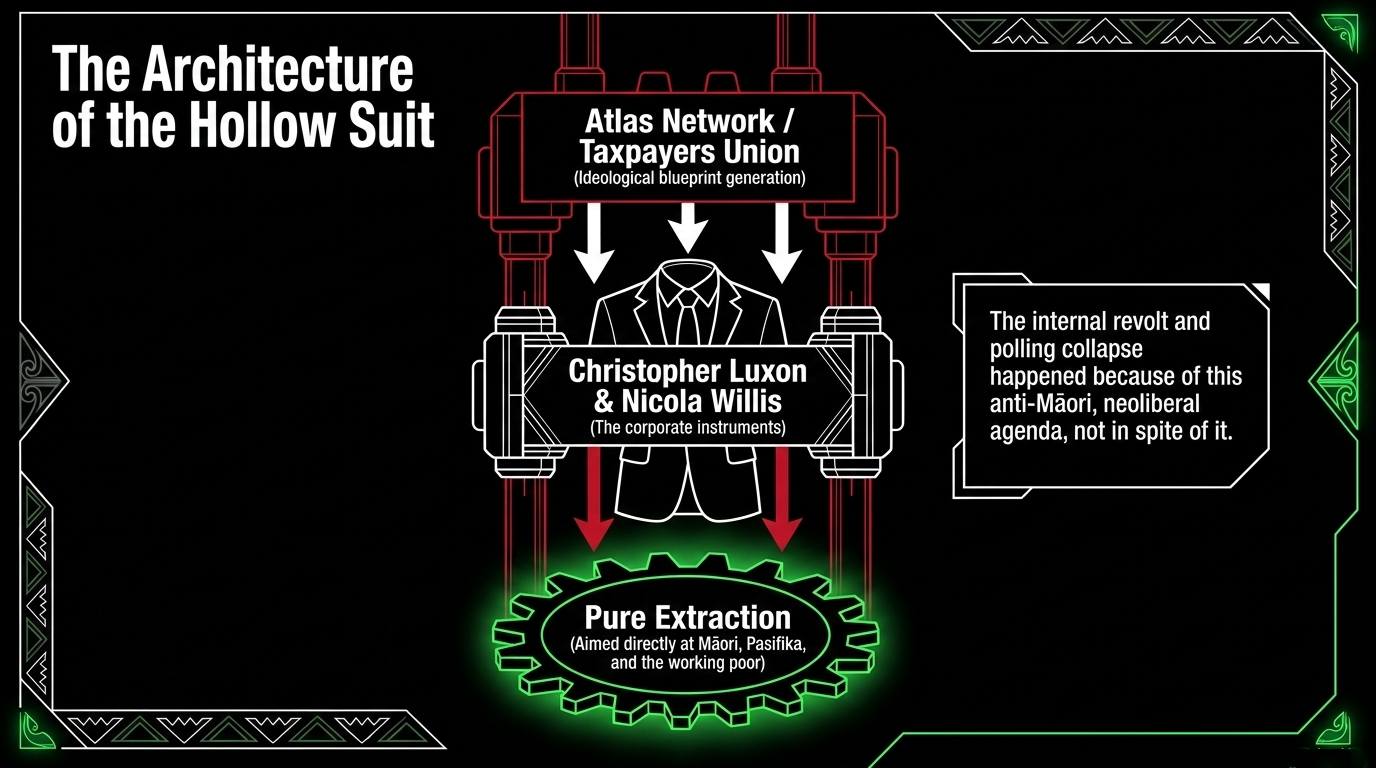
The confidence vote was not an isolated political crisis. It was the visible symptom of five hidden structural failures:
- The Atlas Network's fingerprints: National's entire policy architecture — the cuts, the punitive welfare reforms, the anti-Māori legislative blitz — was pre-engineered by think tanks with Atlas Network connections, as The Chickens Come Home to Roost documented. The Taxpayers Union and NZ Initiative are official Atlas partners. They wrote the ideological playbook Luxon is now failing to execute in full public view.
- The Luxon-Willis double bind: Nicola Willis, as Finance Minister and Deputy, is equally responsible for the economic devastation and equally unable to fix it. As The Luxon-Willis Wrecking Ball documented, from Air New Zealand's boardroom to Treasury's models, these two have systematically destroyed the economic narrative that won them government.
- Peters as kingmaker and assassin: Winston Peters positioned himself the moment the vote was announced. His "very bad move" warning to 1News is a man writing his own exit story. When National collapses in November, Peters will claim he saw it coming. He will be right. And as Winston Peters — A Walking Contradiction exposed, this forked-tongue taniwha has made a career of attaching himself to sinking ships and being photographed stepping off them before they hit the rocks.
- The Missing Chief Whip as structural proof: Stuart Smith's absence from the confidence vote is the single most damning detail of the entire saga. 1News confirmed Smith cited a "personal appointment." The Chief Whip skipped the vote on the PM's leadership. The man Luxon ghosted when he tried to deliver bad news before Easter — absent from the most important caucus meeting of this term. This is not coincidence. This is either solidarity with dissidents, calculated plausible deniability, or personal contempt. Perhaps all three.
- The War on Māori as electoral poison: As He Hinaki Māori established, National wove a silk-feathered hinaki to catch Māori votes while dismantling Māori institutions. The 21-point spike in economic pessimism, the polling collapse, the internal revolt — none of this happened despite Luxon's anti-Māori agenda. It happened because of it. Tens of thousands marching in the streets while Luxon called it "divisive" produced a backlash that Atlas Network models never accounted for, because they don't model the mauri of a people who have survived 186 years of exactly this.
The Prediction: He Leads National to Defeat in November 2026
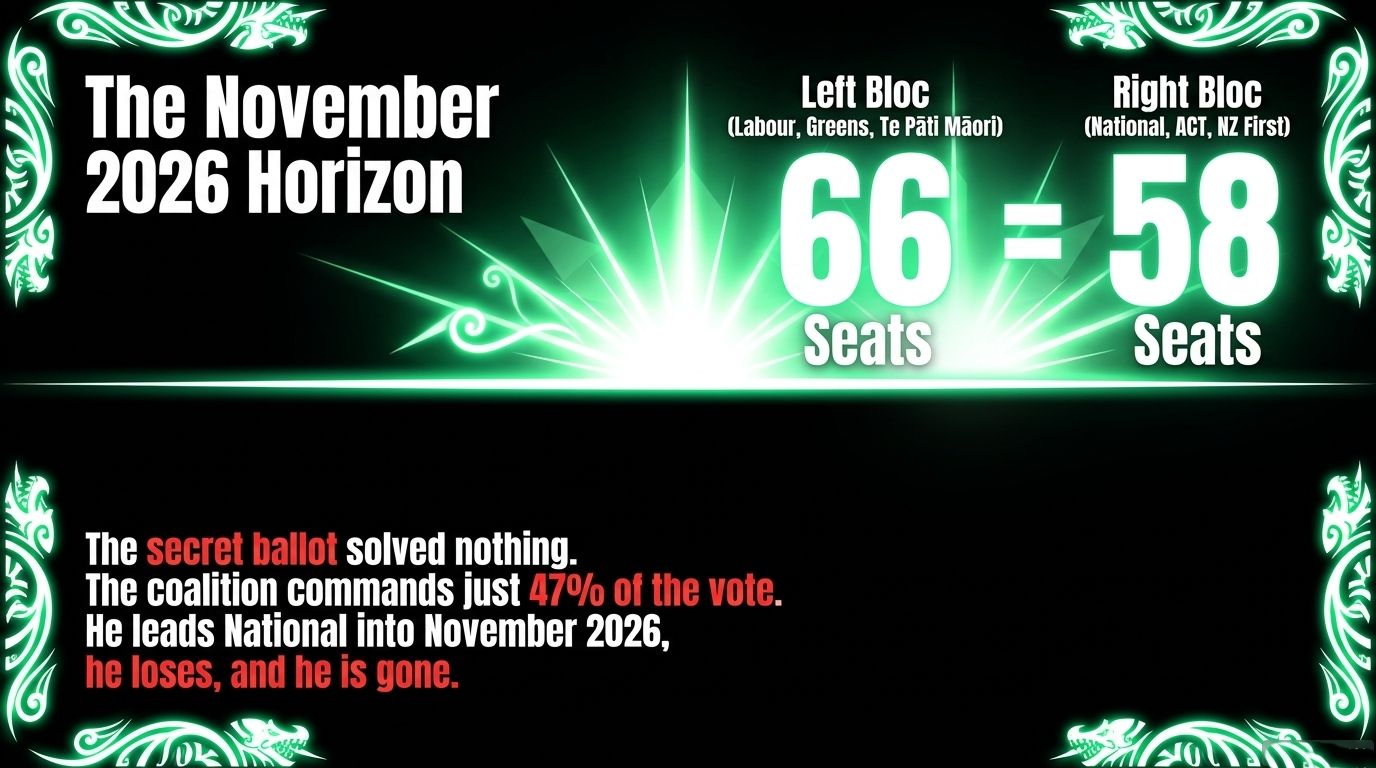
Let us be prophetic, because the evidence demands it.
Luxon will lead National into the November 2026 election. He will lose. He will be gone within weeks of the result.
The 1News analysis was explicit:
"The most recent 1News Verian result will not be the last before November's election. There will be more, and some of them will likely be worse."
The structural conditions — economic pain, broken coalition, 21-point pessimism spike, 17.3% personal preferred PM rating below his own opposition leader — do not reverse in seven months without a miracle. Christopher Luxon does not do miracles. He does press releases.
The left bloc — Labour, Greens, Te Pāti Māori — has the numbers today to form a government: 66 seats to the coalition's 58. Seven months of more bad economic data, more caucus leaks, more Winston Peters warnings, more Iran-style foreign policy crises, and more polls below 30% will not improve that equation.
The confidence vote solved nothing structural. The vote was secret. The numbers were hidden from everyone — including Luxon himself. He walked out claiming a decisive victory without revealing what the scoreline was. The MPs who voted against him may number five. May number fifteen. Luxon knows. He won't say. That silence — like everything else about this man — tells you everything.
As the Guardian described it: a man who blames the media for a "soap opera" he wrote, cast, produced, and stars in himself.
He is not the captain of this ship. He is the anchor.
Ko te pono te māramatanga. The truth will come out in November.
Tāmata Ake — Verdict Without Appeal
Christopher Luxon is not a leader who stumbled. He is a product — a corporate instrument assembled by the neoliberal machinery that has been extracting wealth from this whenua and this people since 1984. His government has stripped $12.8 billion from brown women's wages in 45 minutes. Handed tax cuts to the comfortable. Used Māori children as punitive experiments. Lost the chief whip on the most important day of the parliamentary term. Refused to tell the public how many of his own MPs voted against him. Invented a number of dissenters he couldn't name. And then had the audacity to call the nation's response "media speculation and rumour."
The polls are the people speaking. 17.3% preferred PM is not a rating — it is a rejection notice. And November 2026 will be the formal, democratic delivery of a verdict the numbers have already written.
As The Playstation Pogrom and The Coalition's Callous Corporate Colonisation documented — this has always been a machine. Luxon is its operator. November is when the machine gets turned off.
Ko te pono te māramatanga. Truth is the illumination.
When the light comes on, the hollow men cast no shadow. Christopher Luxon — the Trapdoor Prime Minister, the Emperor of the Empty Balance Sheet, the suit that forgot there were people inside Aotearoa — casts none.
🪴 Koha — Because Truth-Tellers Don't Fund Themselves, But Neoliberal Think Tanks Do
While Luxon's caucus voted in secret and hid the numbers from everyone — including themselves — this essay cost nothing to read and everything to produce. The Atlas Network funds its propaganda machine with millions in dark money. The Taxpayers Union has a full-time comms operation. Christopher Luxon has the entire apparatus of the Crown. This mahi has none of that. What it has is whānau.
Every essay here names names. Every statistic is sourced. Every hidden network is traced. Every act of policy violence against Māori, Pasifika, and working-class Aotearoa is documented, dated, and delivered — so that when November comes, no one can say they didn't know.
Three pathways exist:
For those who wish to support this mahi directly — because accountability is rangatiratanga in action — please visit: Koha — Support the Māori Green Lantern
For those who want essays like this one landing directly in your inbox before the next poll drops, before the next vote is hidden, before the next koha-to-the-rich budget lands: Subscribe to the Māori Green Lantern
For those who prefer direct bank transfer: HTDM, account number 03-1546-0415173-000
For those on Facebook: Follow and Subscribe here
If you cannot koha — no worries at all. Subscribe. Share. Kōrero. Send this to the whānau member who's still undecided. Send it to the workmate wondering why their rent went up while Luxon claimed expenses on a house he already owns. Send it to anyone who heard "caucus answered clearly and decisively" and thought: but what were the numbers?
That is koha too. Every share is a light. Every conversation is a taiaha raised.
Every koha signals that rangatiratanga includes the power to fund our own truth-tellers. Because the Crown will not. Corporate media mostly will not. And Christopher Luxon — who fled a press conference to avoid answering a single question — definitely will not.
Kia kaha, whānau. The verdict is already written. November just makes it official.

Research conducted 22 April 2026. Sources: RNZ, 1News/Verian polling, NZ Herald, The Guardian, The Spinoff, Farmers Weekly, Straits Times, Newstalk ZB, The Māori Green Lantern archive, SAANZ sociology research, Bryce Edwards Democracy Project. All URLs verified at time of publication. RNZ live blog access attempted — restricted; content verified through RNZ Facebook, RNZ YouTube, 1News live updates, and NZ Herald reporting.