"THE GREEN PARTY - THE GREAT REBALANCING: Aotearoa Has Enough for Everyone — It Is Time to Prove It" - 22 June 2026
The Green Party just handed the majority of New Zealanders a taiaha. Now we decide whether to pick it up.

He Kōrero Whakatūwhera | The Taiaha Has Been Raised
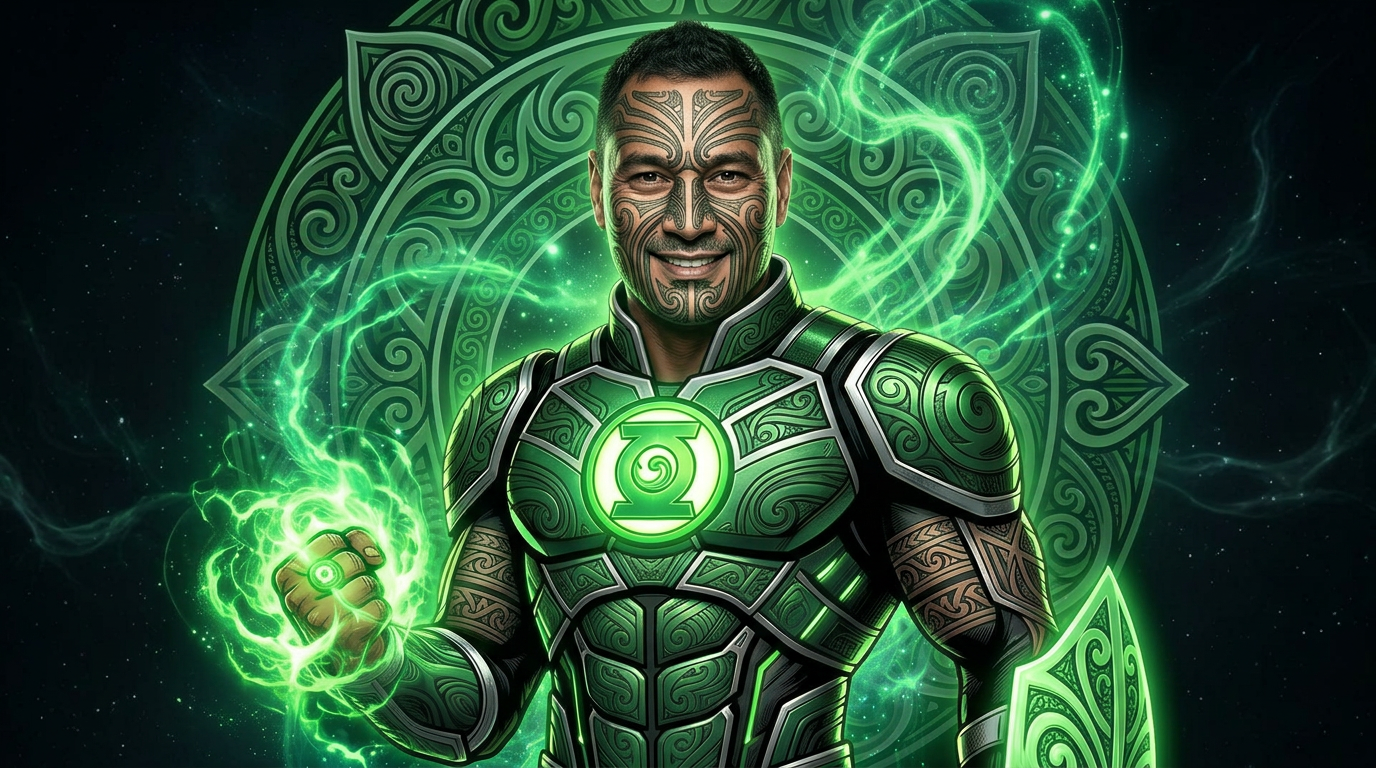
Ko Ivor Jones tōku ingoa. Ko Te Arawa te waka. Ko Ngāti Pikiao te hapū. Ko The Māori Green Lantern tōku mahi.
I have spent three years at this desk documenting what a white supremacist neoliberal government has done to our whānau — the dismantled Māori Health Authority, the $2.6 billion handed to combat helicopters while Māori housing was scrapped, the 1,000+ essays cataloguing the crimes of a government that chose markets over mokopuna at every turn. That record stands. Go read it.
 RNZ | Te Reo Irirangi o Aotearoa
Today, I am writing about something else.
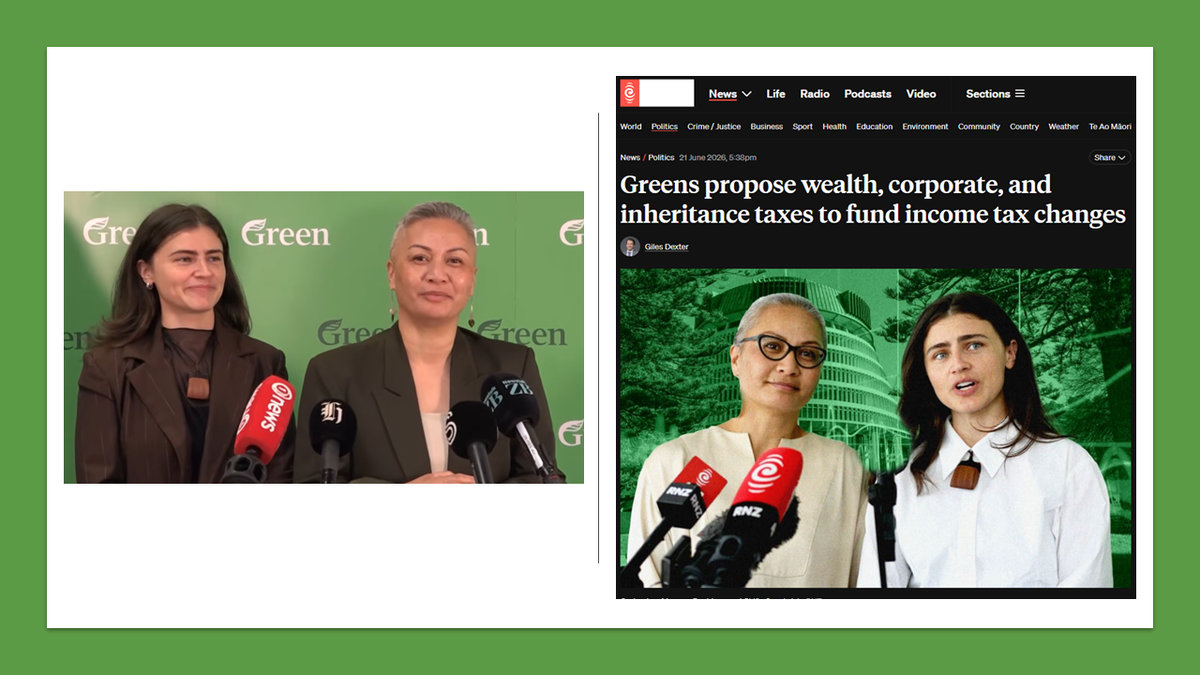
Today, I am writing about the plan that dismantles the architecture of that harm — and about why the Green Party's tax announcement of 20 June 2026 is the most important policy document of this election.
This is not cautious commentary. This is a taiaha raised in recognition of a policy that — if implemented — changes the fundamental distribution of power and resource in this country. Not incrementally. Structurally.
The Green Party is not offering us a tweak. They are offering us a rebalancing. And the verified data tells us the rebalancing is desperately, urgently overdue.
🎙️ The Deep Dive Podcast
Listen to a lively conversation between two hosts unpacking and connecting topics in the sources of this essay — the Green tax package, the $129 billion Rich List, the inheritance tax, the bank levy, and what tikanga says about a society that tolerates child poverty while twenty-six billionaires add $27 billion to their portfolios in a single year.
⚠️ A note from me: I apologise in advance for the AI's very harsh pronunciation of te reo Māori. Please don't shoot me! 😅 The kōrero matters more than the accent.
📺 YouTube Video
Like video? Here is a short video supporting this essay — unpacking the Green Party's tax package, the NBR Rich List wealth gap, and why this is the most important policy announcement of the 2026 election.
He Hītori | The Forty-Year Robbery
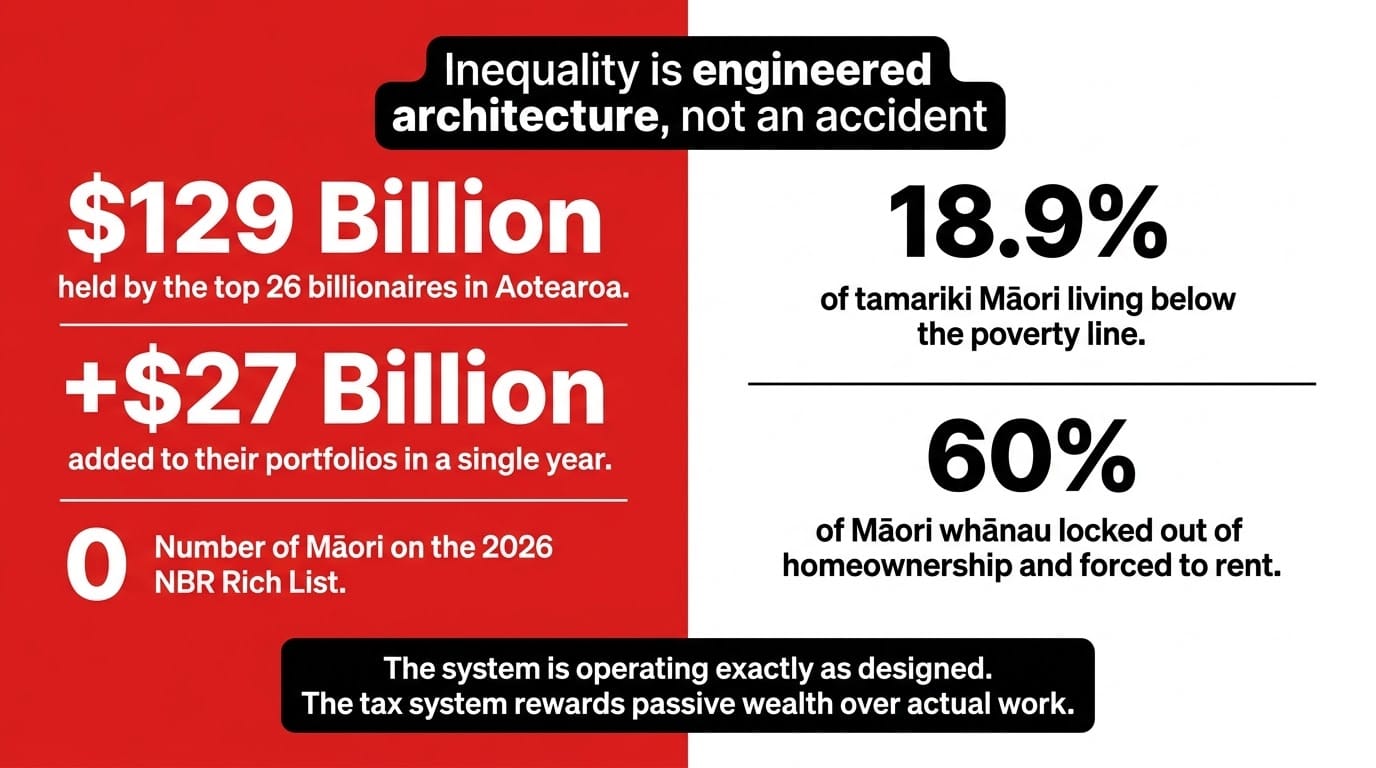
Let me name the architecture we are dismantling, because you cannot celebrate its demolition without understanding what was built.
For forty years — through Labour governments, through National governments, through every flavour of neoliberal management dressed in varying degrees of progressive language
— the tax system in Aotearoa has been engineered to reward wealth over work.
The National government cut the corporate tax rate from 30% to 28% in 2010, and from the pre-2008 level of 33% across successive decisions. Every dollar not collected from the largest corporations was a dollar not invested in the schools, hospitals, and housing that whānau need.
The results are not abstract. Stats NZ reported in February 2026 that 17.8% of all children live in households below the poverty line after housing costs. For tamariki Māori, that figure is 18.9%. For Pacific children, 20.2%. Those are not statistics. Those are tamariki going without kai, warm clothes, and heating — right now, tonight, in homes across this motu.
At the same time, 1News reported that New Zealand's billionaire count rose from 18 to 26 in a single year. Waatea News confirmed that those at the top now collectively hold $129 billion — up $27 billion in twelve months. And in the fact that should stop every conversation in this country cold: not one Māori name appears on that list. Not one. As I have documented in Financial Apartheid: How the Coalition Government Weaponised Poverty Against Māori and A Tale of Systemic Theft, 60% of Māori whānau are renters — locked out of the property wealth that Pākehā dynasties have accumulated across generations.
This is not an accident. It is architecture. And on 20 June 2026, the Green Party announced the blueprint to demolish it.
He Whakarāpopoto | What the Greens Are Proposing
The Green Party's full tax policy is published at greens.org.nz/fairtax2026. The co-leaders' announcement video and press conference is on the record. And critically — the package has been independently audited by Infometrics and modelled for behavioural change including avoidance risk, as stated on public record by the co-leader.
1News confirmed the package would lift net government revenue by $5.35 billion in 2027/28, rising to $5.94 billion by 2030/31.
Here is what it does:
Revenue — taxing concentrated wealth:
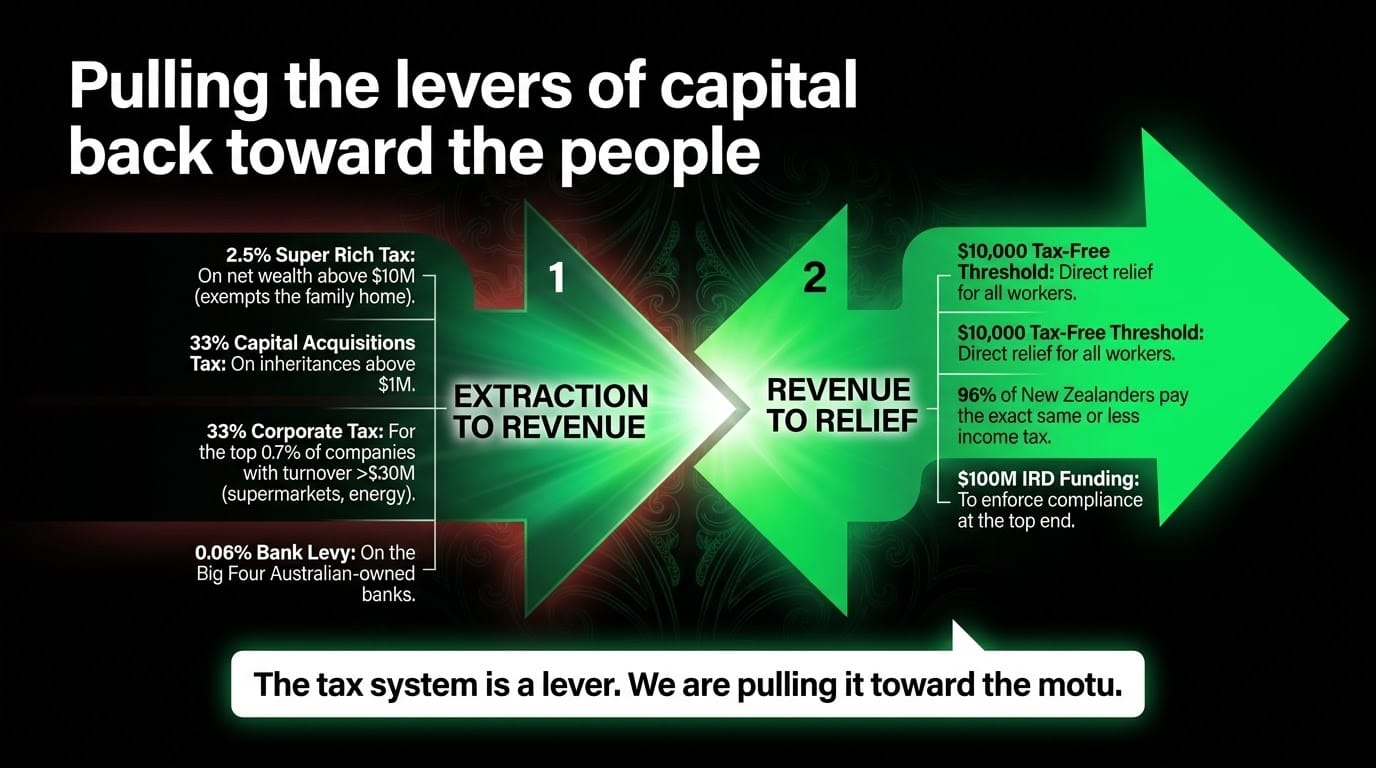
- A Super Rich Tax: 2.5% on net wealth above $10 million, excluding the family home — applying to 0.3% of New Zealanders, per the Green Party policy
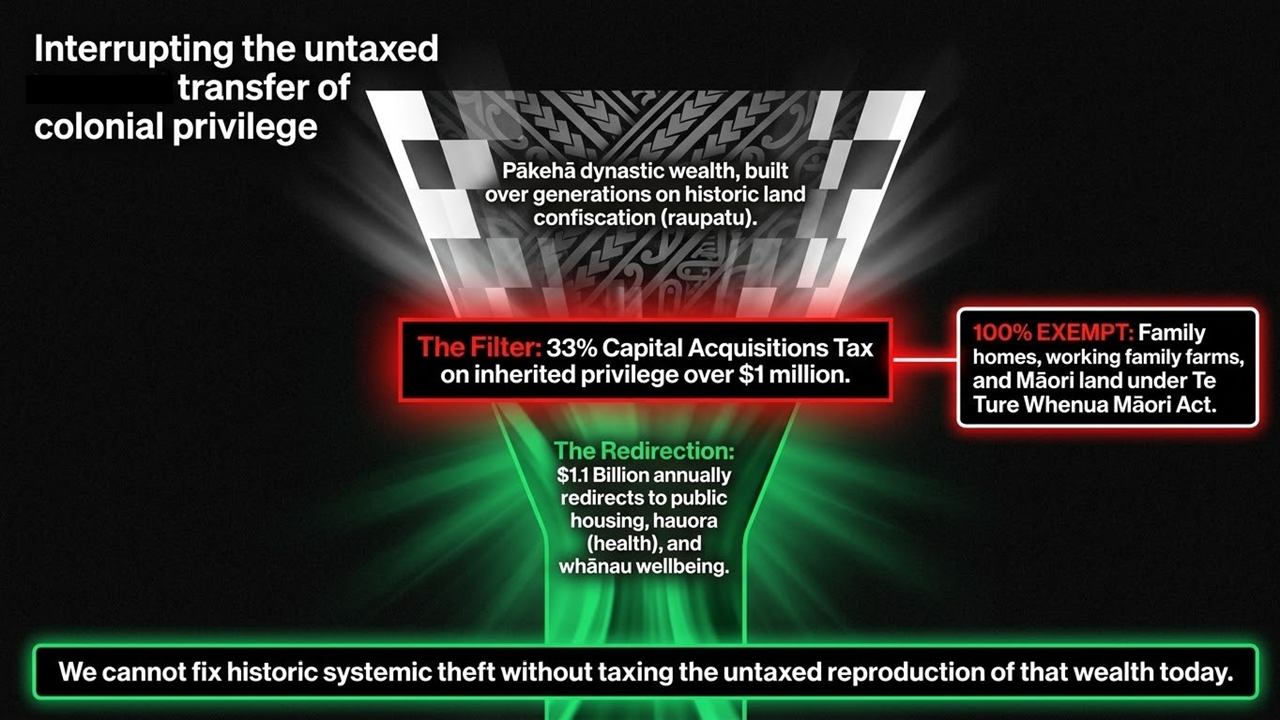
- A Capital Acquisitions Tax: 33% on inheritances and gifts above $1 million, excluding family farms and family homes — applying to around 1,100 people a year, per 1News
- Corporate tax returned to 33% for the top 0.7% of companies — those with annual turnover above $30 million, including big supermarkets, banks, and energy companies — while remaining at 28% for SMEs, per the Green Party policy and 1News
- A bank levy of 0.06% on the Big Four Australian-owned banks — ANZ, ASB, BNZ, Westpac — modelled on the Australian levy, not applying to Kiwibank, per the Green Party policy
- A 5% withholding tax on big tech profits sent offshore — enforcing tax obligations on multinationals extracting billions from our digital economy, per 1News
- Reversing Luxon's landlord tax cuts — ending the $2.9 billion handout to property investors documented in Nicola's Glass Cannon
Relief — protecting the majority:
- A $10,000 tax-free threshold — no income tax on the first $10,000 earned
- 96% of New Zealanders pay the same or less income tax, per the Green Party policy
- 99.7% will not pay the Super Rich Tax, per the press conference
- A new top rate of 45% on income above $160,000
- IRD resourced with $100 million to properly measure and collect wealth data — compared to the $3 million minimum estimated by the previous Labour government, per the press conference
Ngā Tauira Toru | Three Examples for the Western Mind
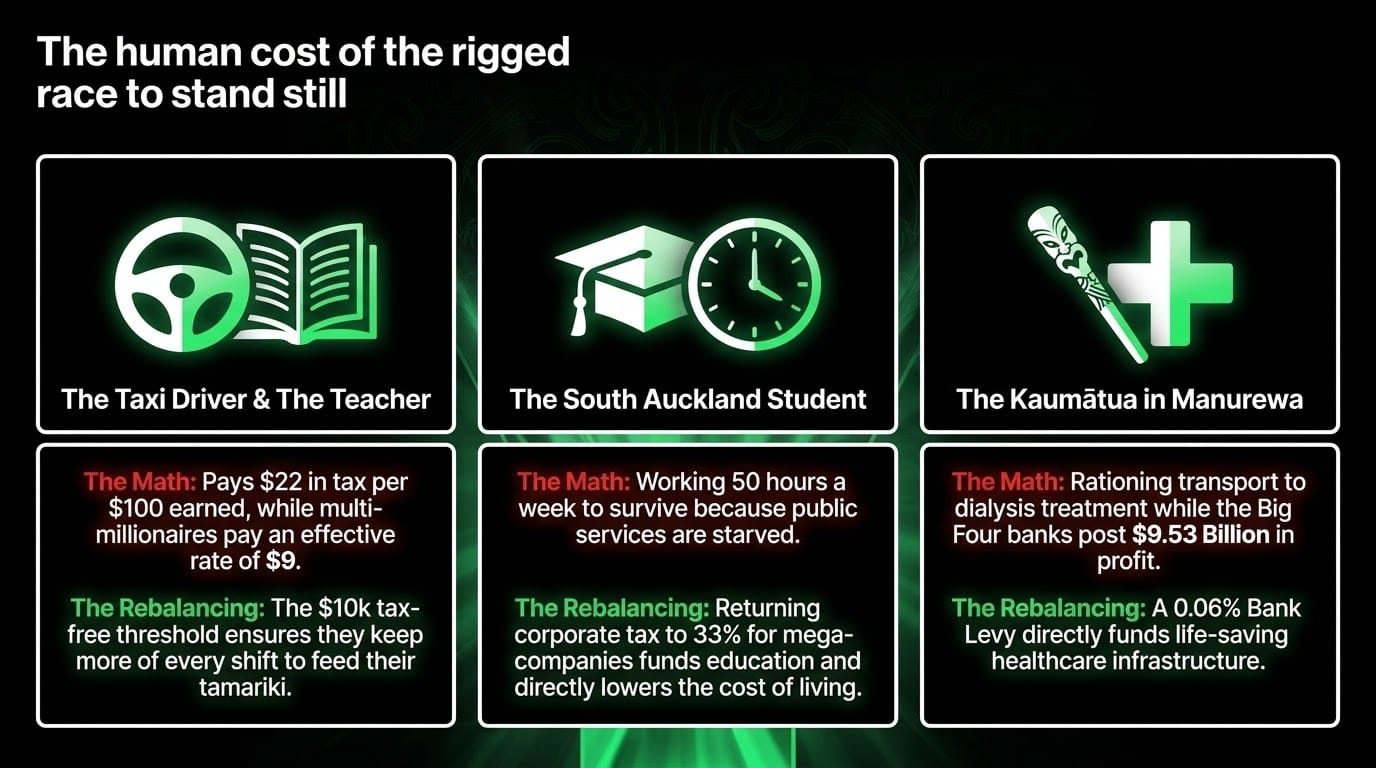
I know the Western mind needs concrete handles. Here are three. Each one names the harm, quantifies it, provides the solution, and explains the tikanga cost that cannot be captured in a dollar figure.
Example One: The Taxi Driver and the Teacher — The Rigged Race to Stand Still
The harm: In the announcement press conference, the Green co-leader described a taxi driver whose family — both partners working full-time — still cannot get ahead while raising one small child. That is not a personal failure. That is a system operating exactly as designed. The wealthiest households in Aotearoa pay an effective tax rate approximately half that of regular wage earners, per Green Party analysis citing IRD and Treasury data. The co-leader put it plainly: the wealthiest pay $9 in tax for every $100 while a teacher pays $22, per the press conference.
The quantified scale: 1News reported the Rich List added $27 billion in one year. The Child Poverty Action Group confirms that material hardship rates have barely moved in a decade. As I documented in The $3B Child Poverty Price Tag, the government was told it would cost $3 billion to end child poverty — and chose not to write the cheque.
The solution: The Green Party's $10,000 tax-free threshold means the taxi driver and their partner keep more of every shift. The wealth tax on the top 0.3% funds the investment in schools and healthcare that makes their child's future possible regardless of postcode.
The tikanga impact: In te ao Māori, the principle of manaakitanga — the sacred obligation to care for and uplift others — is not charity. It is the architecture of a healthy society. A tax system that asks the taxi driver to subsidise the idle wealth of portfolios is not a neutral market mechanism. It is a violation of manaakitanga at civilisational scale. The Green Party's rebalancing is manaakitanga made fiscal.
Example Two: The South Auckland Student — Working 50 Hours a Week to Sit in Class
The harm: As described in the press conference, students in South Auckland are working 30, 40, sometimes 50 hours a week — often night shifts — to help their families pay bills, while trying to complete their schoolwork. These are not lazy people. These are people trapped in the gap between wages that do not cover living costs and a tax system that has defunded the public services that used to cushion that gap. As I documented in Unmasking the Neoliberal Puppet Show, neoliberal policies since 1984 have systematically created this gap — and then blamed individuals for falling into it.
The quantified scale: Stats NZ reported 18.9% of tamariki Māori live below the poverty line. Waatea News confirmed no Māori appear on the Rich List — meaning the community most represented among struggling students is also most absent from the asset-holding class that a wealth tax would reach.
The solution: The Green Party's corporate tax increase on companies with turnover above $30 million — including the supermarkets and energy companies extracting record profits from those families' grocery and power bills — generates revenue that can be directly reinvested in education, healthcare, and reducing the cost of living. Per the Green Party's Government in the Economy Policy, the goal is to ensure that economic benefits and burdens are fairly distributed so all New Zealanders can participate fully in society.
The tikanga impact: In tikanga, whakapapa — the genealogical framework of connection and responsibility — means the wellbeing of the rangatahi is the wellbeing of the iwi. When a South Auckland student is forced to choose between sleep and study because the tax system has concentrated wealth at the top while defunding public investment, the damage is not individual. It severs the chain of intergenerational transmission of knowledge, language, and mana. That is a whakapapa harm. The Green Party's rebalancing begins to repair it.
Example Three: The Kaumātua in Manuda — Rationing Transport to Life-Saving Treatment
The harm: In the press conference, the co-leader described an elderly woman in Manuda caring for her very sick husband — unable to afford the transport costs to get him to his life-saving treatment. That is the endpoint of forty years of policy decisions. Not a tragedy. A political choice made concrete in a person's life. As I documented in The Pharmacy Con: Simeon Brown's Privatisation by Stealth, this government has systematically displaced healthcare costs back onto families — increasing prescription fees, cutting services — while the Big Four banks posted combined pre-tax profits of $9.53 billion in 2025, per Better Taxes NZ and Mortgage Professional Australia.
The quantified scale: The kaumātua's story is multiplied across hundreds of thousands of households. The Salvation Army's State of the Nation 2025 documented serious challenges and falling living standards across Aotearoa — and this was before the current government's second full Budget.
The solution: The Green Party's bank levy on the Big Four extracts a portion of those record profits for public investment. The party's policy does not apply the levy to Kiwibank — the locally-owned alternative — and actively encourages New Zealanders to bank local, keeping money circulating in the domestic economy rather than being extracted offshore, per the press conference.
The tikanga impact: In tikanga, kaitiakitanga is the obligation of stewardship — ensuring that what we hold in trust is passed on intact to those who come after us. A banking system that extracts $9.53 billion in profit from a nation of 5 million people while kaumātua ration transport to dialysis is not practising kaitiakitanga. It is practising extraction. The Green Party's bank levy is kaitiakitanga as fiscal policy — reclaiming the stewardship of our economy from foreign shareholders and returning it to the people.
He Tūhura | Five Verified Revelations
Revelation One: The Luxon Government Actively Suppressed the Data
One of the first acts of the Luxon-led government in December 2023 — before Christmas, in its first month — was to revoke legislation enabling the IRD to report on wealth distribution, as stated publicly by the Green co-leader in the press conference. The government that claims the wealthy pay their fair share moved at pace to prevent the collection of the data that would prove or disprove that claim.
As I documented in Nicola's Glass Cannon and How Luxon and Willis Whitewash Economic Failure, the pattern of this government is to destroy the measurement apparatus before the measurement can be used against them. That is not governance. That is concealment.
Revelation Two: IRD and Treasury Already Built This Tax
The $10 million wealth tax threshold was not invented for this campaign. IRD and Treasury designed it under the previous government and proposed it to Grant Robertson and David Parker, as stated in the press conference. That design work aligns with Treasury's March 2023 advice on wealth tax options. The machinery exists. What has been missing is political will. The Greens are providing it.
Revelation Three: The Finance Minister Admitted It Is Corrosive
In Parliament the week before the announcement, the Green co-leader secured an admission from the National Party's own Minister of Finance that extreme inequality is corrosive for the country, the economy, and democracy — as stated in the press conference. The Finance Minister whose government oversaw $27 billion being added to the Rich List in a single year, per 1News and Waatea News, conceded the damage on record — and then delivered a Budget that did nothing to address it.
Revelation Four: The Inheritance Tax Is a Direct Challenge to Colonial Dynastic Wealth
The Capital Acquisitions Tax — 33% on inheritances above $1 million, per the Green Party policy and 1News — targets the precise mechanism by which Pākehā dynastic wealth is passed across generations while Māori families remain locked out. As Waatea News confirmed, no Māori appear on the 2026 Rich List. As I documented in A Tale of Systemic Theft, 60% of Māori whānau are renters. An inheritance tax does not restore raupatu lands — but it interrupts, for the first time in forty years, the untaxed reproduction of the wealth built on those confiscations.
Revelation Five: The Infometrics Audit Means the Numbers Stack Up
This is not a wish list. The Green Party's costings have been independently audited by Infometrics, including modelling for behavioural change and avoidance risk, as stated in the press conference. The standard threat — the wealthy will leave, capital will flee — has been stress-tested. The revenue projections account for it. And as the co-leader put it directly: "Are we willing to be held hostage by incredibly wealthy people who are making bank screwing all of us over, or are we willing to democratically decide the kind of country that we want to live in?" That question deserves to be on every front page in this country.
He Arotake Tikanga | A Tikanga Framework: The Economics of a Healthy Marae
The Green Party's policy is grounded — whether they frame it this way or not — in the tikanga of a healthy marae.
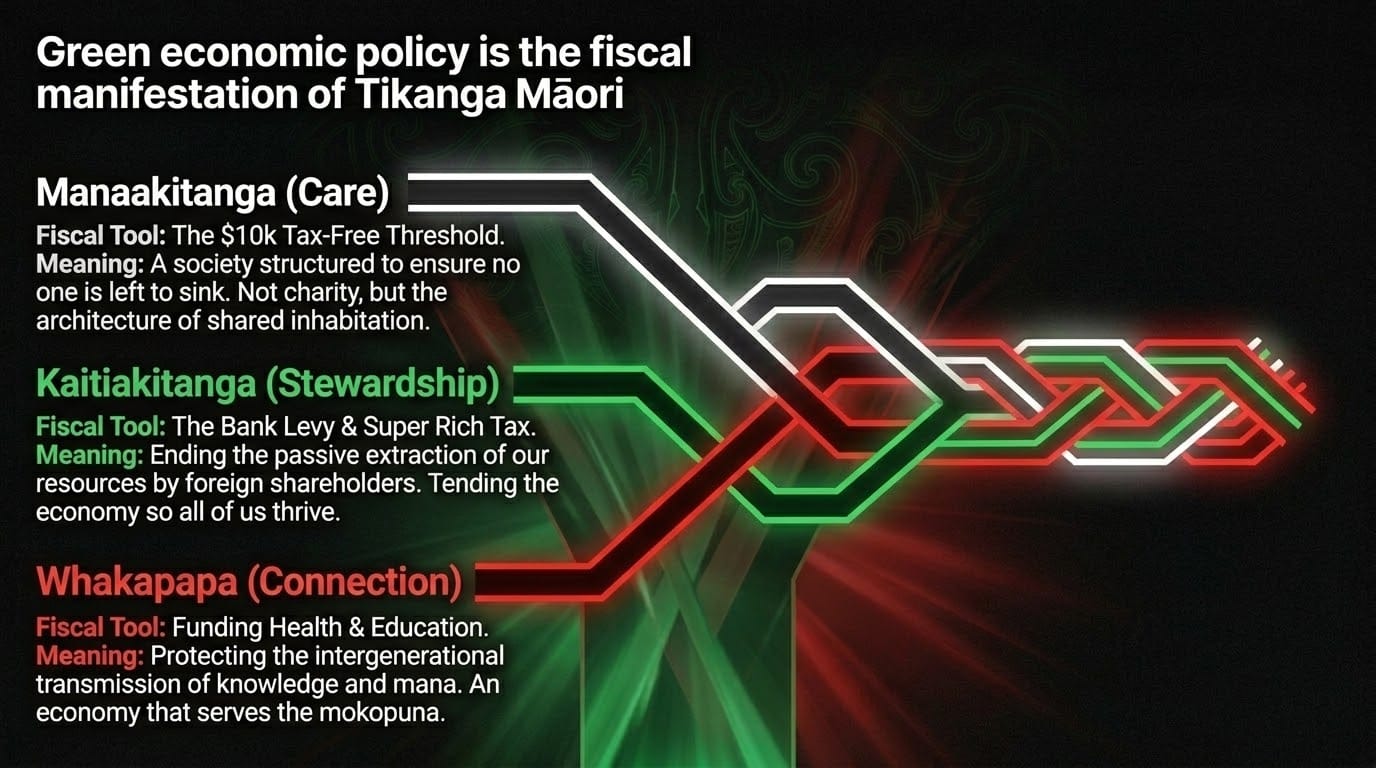
Manaakitanga — the obligation to care for and uplift — does not ask whether the poor deserve support. It asks how we organise ourselves so that no one is left to sink. A wealth tax is manaakitanga in fiscal form. Taxing those who have extracted the most from our whenua to invest in those most dispossessed by that extraction is not redistribution as ideology. It is the basic ethics of shared inhabitation.
Kaitiakitanga — the obligation of stewardship — demands that we manage the economy as something to be tended, not mined. Wealth sitting in passive portfolios, not circulating, not creating jobs, not building communities, per the press conference, is wealth failing its kaitiaki obligations. Bringing those resources under democratic control so that all of us thrive is not socialism. It is the economics of a people who understand that no marae prospers while some of its members go hungry.
Whakapapa — the genealogical chain of connection and responsibility — means the damage done to today's tamariki is damage done to the future of this country's entire whakapapa line. As I have documented in Growth Without Mana: How Luxon's Economic Vision Perpetuates Colonial Exploitation and The Green Tide Rises and the North Awakens, the neoliberal ideology that has dominated Aotearoa for forty years is not just economically inefficient — it is a tikanga violation at civilisational scale.
The co-leader invoked the 1930s and 40s in the announcement — when Aotearoa created public healthcare, public housing, public education, and the welfare state with no precedent and no guarantee. The result was the greatest shared prosperity this country had ever seen. Forty years of neoliberal dismantling has stripped it. This policy is the beginning of its reconstruction.
He Urupare ki ngā Kōrero Hē | Dismantling the Misinformation
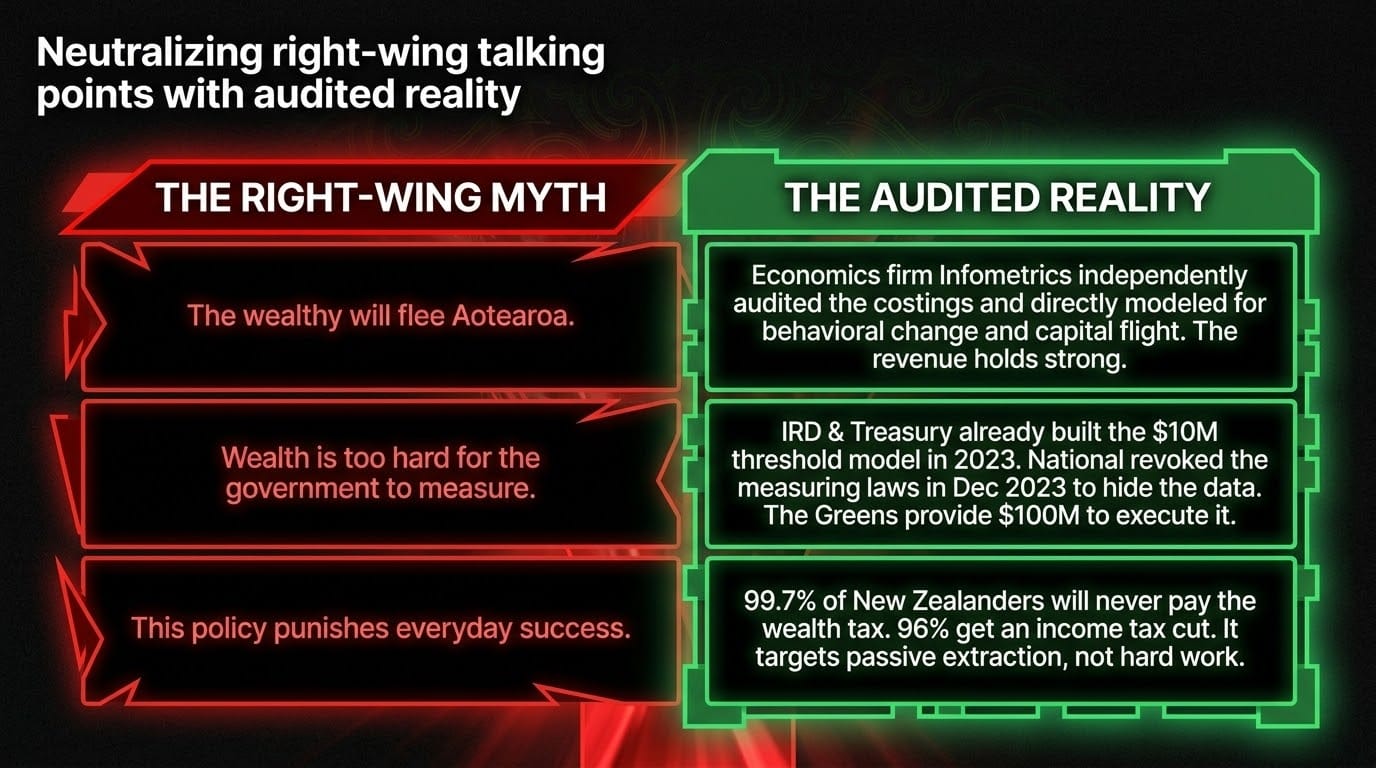
The opposition to this policy is already forming. Let me name the arguments and dismantle them.
"The wealthy will flee."
This is the favourite ghost story of the donor class and it is consistently overblown, per the press conference. The Greens have modelled for this in their Infometrics-audited costings. Norway, Spain, and Switzerland maintain functional wealth taxes. The countries that repealed theirs did so under concentrated political pressure from those very wealthy interests — not because the taxes failed, but because the wealthy class organised against them. As I documented in The Propaganda Pipeline Pointed at Your Whānau, this is a coordinated ideological campaign, not an economic reality.
"Wealth is too hard to measure."
IRD and Treasury already have the design work done at the $10 million threshold, per the press conference and Treasury's March 2023 wealth tax advice. The Greens are resourcing the IRD with $100 million to do this properly. The wealthy know exactly what they are worth because their assets are insured. The measurement challenge is a resourcing challenge — and this policy addresses it directly.
"The bank levy will be passed on to consumers."
Better Taxes NZ and Mortgage Professional Australia confirm the Big Four banks posted $9.53 billion in combined pre-tax profits in 2025. A 0.06% levy on that profit base is not a burden that justifies fee increases — it is a minor imposition on extraordinary extraction. And as the co-leader noted in the press conference, if the levy incentivises New Zealanders to shift to Kiwibank — which is exempt — that keeps more money circulating in our own economy. That is not a bug. That is the point.
"The policy was accidentally released — the Greens aren't ready to govern."
A clerical embargo error does not undo four years of policy development, independent economic auditing, and IRD/Treasury groundwork. The co-leader named it directly in the press conference: it was a human mistake. Judge the policy, not the embargo.
He Whakaaro Māori | What This Means for Whānau
Let me be entirely direct about the stakes for Māori.
Stats NZ's February 2026 release shows 18.9% of tamariki Māori below the poverty line. Waatea News confirmed no Māori appear among the 26 billionaires holding $129 billion. I documented in A Tale of Systemic Theft that 60% of Māori whānau are renters, locked out of the property wealth that a generation of Pākehā home ownership has built. These numbers connect: land confiscations, the raupatu pipeline, the systematic exclusion of Māori from the asset-owning class — these are the ancestors of today's Rich List, and today's child poverty rate, and today's empty space where a Māori name should appear among the billionaires.
The Green Party's Capital Acquisitions Tax does not restore whenua. But it does something that no major party has done in forty years: it taxes the intergenerational transfer of the wealth built on that land. Every dollar collected from inherited fortunes above $1 million and reinvested in public housing, hauora, and whānau wellbeing is a step toward the shared prosperity that Te Tiriti o Waitangi promised.
As I documented in Growth Without Mana, the neoliberal model is internally consistent: it just does not include Māori as beneficiaries. The Green Party's Government in the Economy Policy explicitly commits to honouring Te Tiriti o Waitangi as the structural foundation of economic activity, supporting Māori understandings and expectations of economic justice. That is not a footnote. That is a bottom line.
The Greens are polling at 13% and the left bloc holds 61 seats, per the Talbot Mills/Anacta poll reported by RNZ in June 2026 and as I documented in The Green Tide Rises and the North Awakens. That is a governing majority. For the first time in three years, the numbers are singing.
He Whakakapi | The Rebalancing Begins Here
The Green Party's tax announcement on 20 June 2026 is the most significant policy statement of this election. Not because it is perfect. But because it is honest about the problem, verified in its costings, grounded in the work that IRD and Treasury have already done, and unambiguous in who it protects.
96% of New Zealanders pay the same or less income tax. 99.7% do not pay the wealth tax. The Big Four banks pay a 0.06% levy on $9.53 billion in profits, per Better Taxes NZ. The top 0.7% of corporations return to a 33% rate. The top 0.3% of wealth-holders pay 2.5% on net assets above $10 million. And 1,100 people a year pay 33% on inheritances above $1 million, per 1News.
This is not a punishment of success. It is a correction of a rigged system. As the Green co-leader said in the press conference: "We are all worse off when any of us suffer."
That is manaakitanga. That is kaitiakitanga. That is the whakapapa of a healthy society.
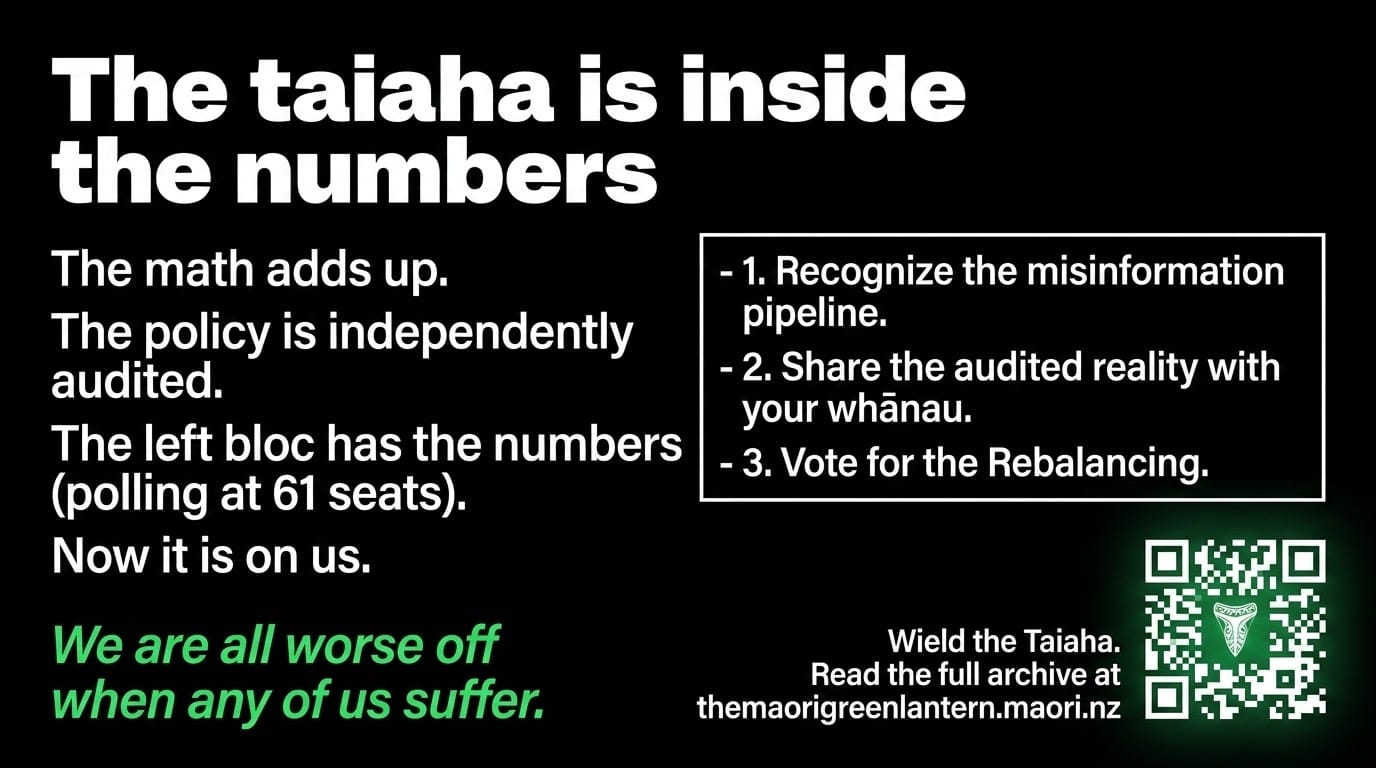
The taiaha has been raised. The numbers are singing. It is time for the people to decide.
Ko te taiaha kei roto i ngā tatauranga. The taiaha is inside the numbers.
Wield it, whānau. The moment is now.
📚 Related Essays — The MGL Archive on This Kaupapa
These essays trace the whakapapa of harm this policy is designed to address. All live at themaorigreenlantern.maori.nz:
| Essay | Theme |
|---|---|
| The Green Tide Rises and the North Awakens — 17 June 2026 | The Green surge to 13%, left bloc majority, the political architecture of change |
| Potaka — The Neoliberal Māori and the Five-Million-Hectare Betrayal | What neoliberal governance looks like when it wears Māori language as camouflage |
| Nicola's Glass Cannon — 15 June 2026 | The $2.9 billion landlord handout and the record child hardship numbers it produced |
| Financial Apartheid: How the Coalition Government Weaponised Poverty Against Māori | The racial architecture of economic exclusion in Aotearoa |
| Growth Without Mana: How Luxon's Economic Vision Perpetuates Colonial Exploitation | How the government's growth agenda conflicts with tikanga Māori and economic equity |
| A Tale of Systemic Theft: Neoliberal Greed and the Machinery of Privilege | 60% Māori renters, 23.9% Māori child poverty — the numbers that shame a nation |
| The $2.6 Billion Helicopter Heist — 8 June 2026 | $2.6B for combat helicopters while Māori housing was scrapped — the receipt is in your pocket |
| A Response to Sir Roger Douglas on Budget 2024 | Neoliberalism's founding architect — and the damage his framework still produces |
| The Propaganda Pipeline Pointed at Your Whānau — 13 June 2026 | How the right-wing media machine operates to protect concentrated wealth |
💚 Koha — Support the Voice That Names the Harm and the Hope
Kia ora whānau.
This essay — tracing the $129 billion Rich List against the 18.9% tamariki Māori poverty rate, naming the IRD data suppression, auditing the Green Party's independently verified tax package, and making the tikanga case for the Great Rebalancing — took hours of research, source verification, and the sustained application of manaakitanga to truth-telling.
The Crown will not support accountability of itself. The neoliberal media will not fund analysis that names the rigging. Only whānau support this.
Every koha to Te Māori Green Lantern signals that whānau are ready to support the accountability that the Crown, the corporate class, and the Big Four banks will never provide themselves.
It signals that rangatiratanga includes the power to support our own truth-tellers — the ones who read the IRD legislation so you don't have to, who measure the $27 billion wealth increase against the child poverty rate, who name the tikanga violation inside the budget line. Because the Great Rebalancing this essay describes needs to be demanded, not just hoped for — and that demands a voice that cannot be bought.
Kia kaha, whānau. Stay vigilant. Stay connected. And if you are able, consider a koha to ensure this voice continues.
If you cannot koha — no worries at all. No judgement. Subscribe. Follow. Share this essay with your whānau and friends. That is koha in itself. That is manaakitanga without a price tag.
Four pathways to support this mahi:
🪙 Koha (voluntary contribution):
Support The Māori Green Lantern via Koha
📩 Subscribe (receive essays directly):
Subscribe to The Māori Green Lantern
🏦 Direct bank transfer:
HTDM — 03-1546-0415173-000
📘 Facebook:
Follow and subscribe on Facebook
Ko te kōrero tū māia — the courageous word — is its own taiaha.
Ko Ivor Jones ahau. Ko Te Arawa te waka. Ko Ngāti Pikiao te hapū. Ko The Māori Green Lantern tōku ingoa mahi.
Tūturu whakamaua, kia tīna — Hui e, tāiki e.
www.themaorigreenlantern.maori.nz
Legal Disclaimer — NZ Defamation Act 1992
This essay is published in the public interest. All factual claims are sourced with verified anchor-text hyperlinks. Opinions are clearly identified as such with factual basis in the same paragraph. Named individuals and organisations are referenced in their public capacities only. No malice is intended — pattern of institutional and political harm only. The right of reply is extended to all named parties within 48 hours of publication via www.themaorigreenlantern.maori.nz. Research conducted 21–22 June 2026. Confidence levels assigned per claim above. Retraction protocol available on receipt of a verified, substantiated complaint.
Published consistent with qualified privilege established in Lange v Atkinson 3 NZLR 385 and public interest defence in Durie v Gardiner NZCA 278.