
"The Nerd Reich: How Peter Thiel Bought Aotearoa And A Neoliberal Government Let Him - 24 August 2026
A Billionaire Skipped 99.11 Percent Of Our Citizenship Law, Bought A Decade Inside Our Spy Agencies, And Tried To Fortress A Lake — While A Neoliberal Political Class Signed The Papers, Hid The Costs, And Called Him A Great Ambassador.

I Watched The Footage And I Got Angry

Kia ora koutou. I'm Ivor Jones — you know me as The Māori Green Lantern, from themaorigreenlantern.maori.nz, Te Arawa, Ngāti Pikiao on one side, Welsh stubbornness on the other, and I'm done being polite about this one.
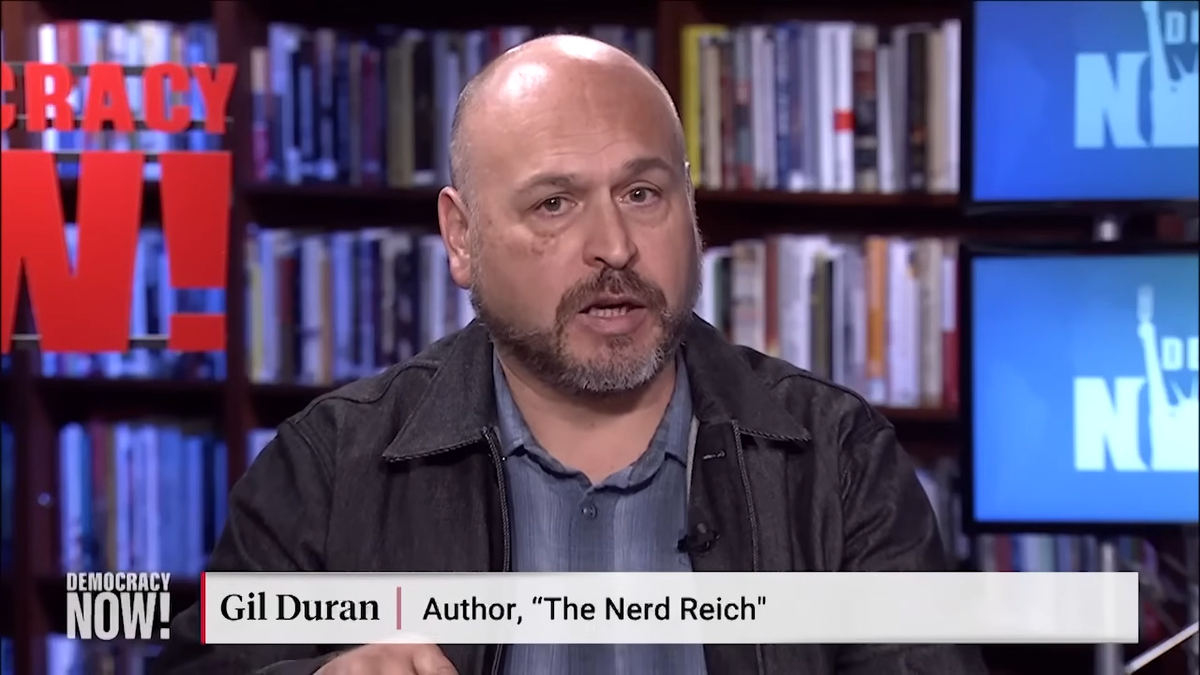
Journalist Gil Durán told Amy Goodman on Democracy Now! that Silicon Valley billionaires believe democracy is "obsolete software."
I thought about Nathan Guy, sitting in his ministerial office in 2011, signing away six years of secrecy for a man who spent less time in this country than I spend at a single wānanga. That's not a metaphor.
That's twelve days.
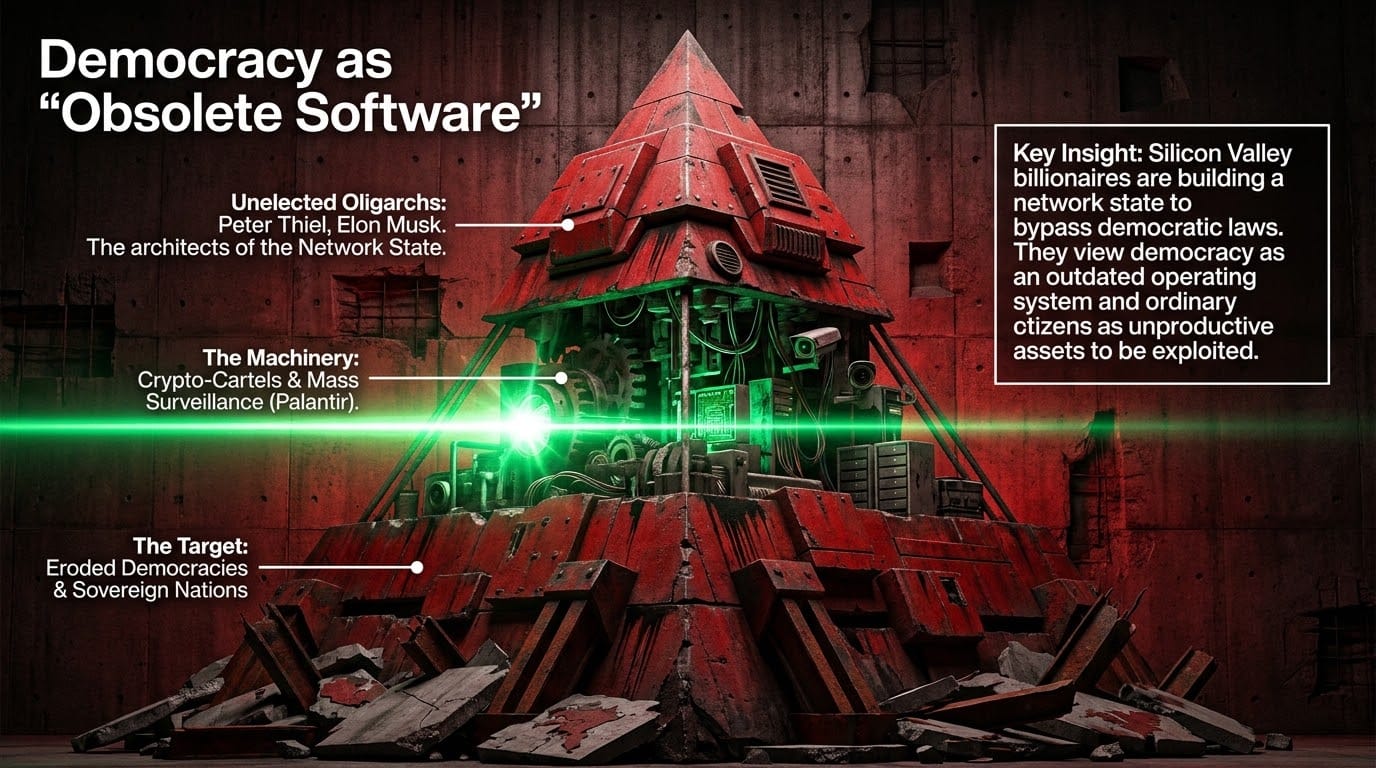
This is not America's problem happening somewhere else. This is Aotearoa's problem, wearing a $10–13 million lakefront disguise, and I am naming every single person who let it happen.
 Ivor Jones The Māori Green Ltn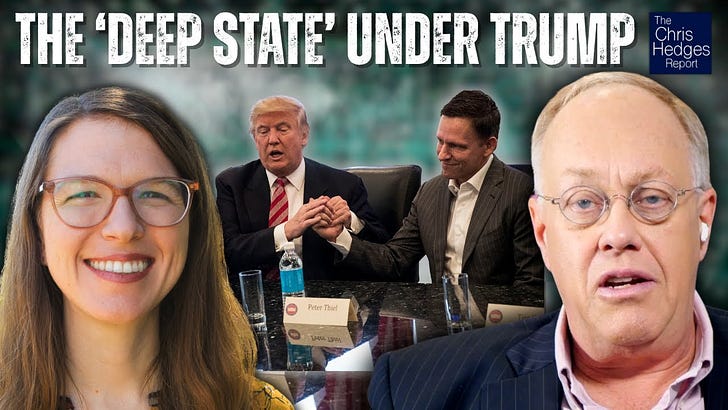
I've been tracking this man's footprint here for a while now
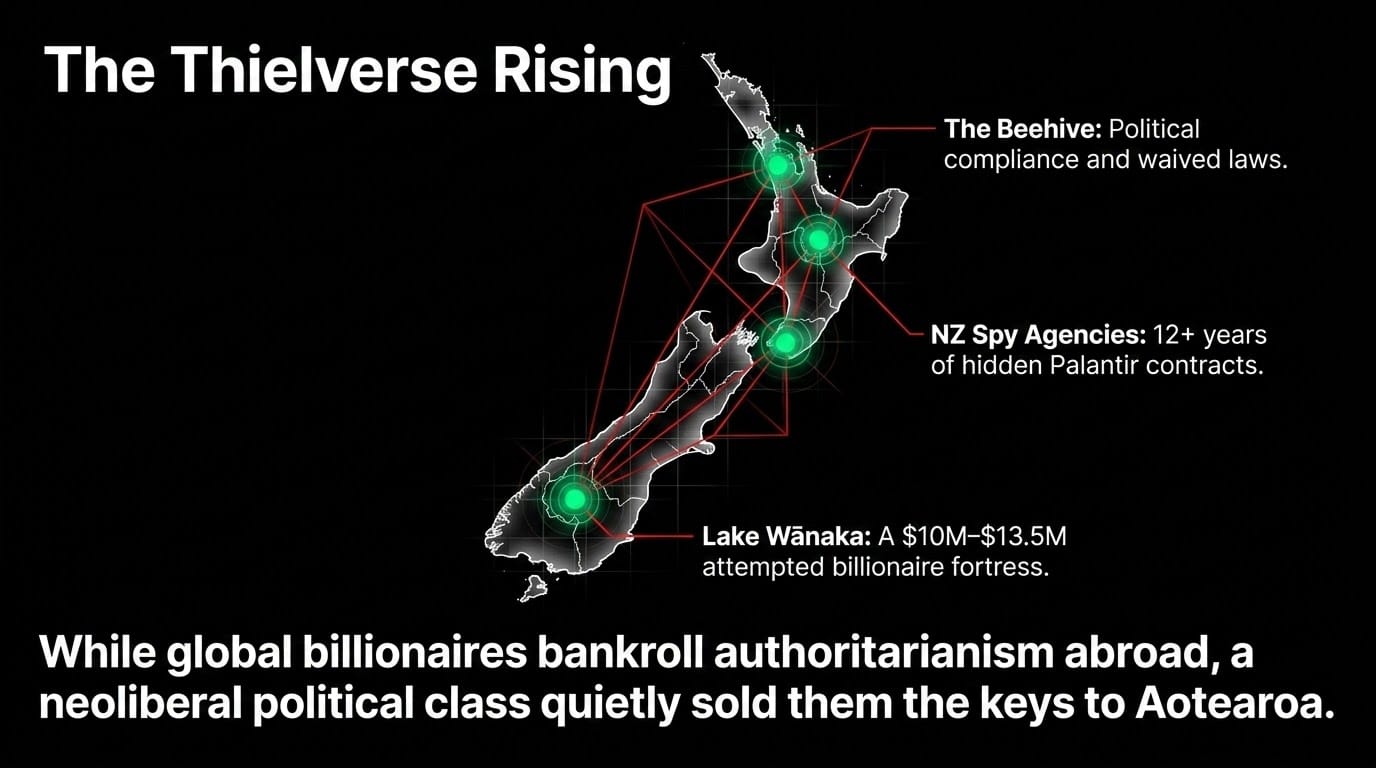
— in "The Thielverse Rising" I first mapped how Silicon Valley oligarchs engineered what I called a privatised surveillance dictatorship stretching from Aotearoa to Palestine, and in "The Antichrist Has Nothing on Peter Thiel" I dug into how he weaponises apocalyptic rhetoric to justify surveillance empire-building. This essay stands on its own, but it doesn't stand in isolation
 Ivor Jones The Māori Green Ltn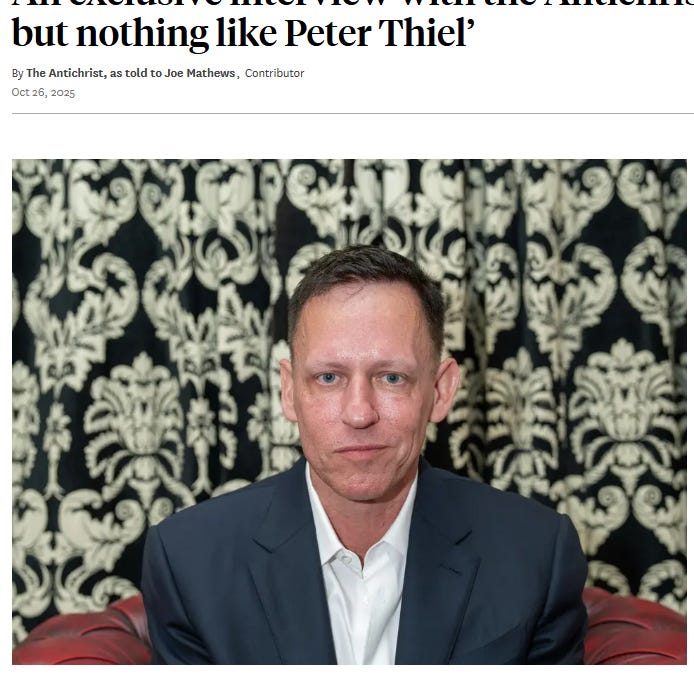
— it's part of a pattern I keep finding every time I follow his money.
What Gil Durán Is Actually Saying
Before I take Durán’s warning across the Pacific and into Aotearoa, I want us to stop and hear it correctly.
He is not merely saying that rich tech men are politically conservative, that artificial intelligence has risks, or that Peter Thiel owns a surveillance company.
His argument is much larger and much uglier: a network of ultra-wealthy technology investors has developed an anti-democratic political programme; it has used money, companies, media platforms and political patronage to move that programme from Silicon Valley subculture into the United States Government; and it sees democratic restraint as an obstacle to be bypassed, not a public good to be protected. Durán’s full Democracy Now! interview
That is a serious allegation. It must not be repeated as a slogan without understanding its component parts. So I am going to walk through the argument in plain language, separate Durán’s evidence-backed reporting from his political interpretation, and show you why the warning is relevant before I even return to Peter Thiel’s twelve-day path to a New Zealand passport.
The Name Is An Argument, Not A Casual Insult
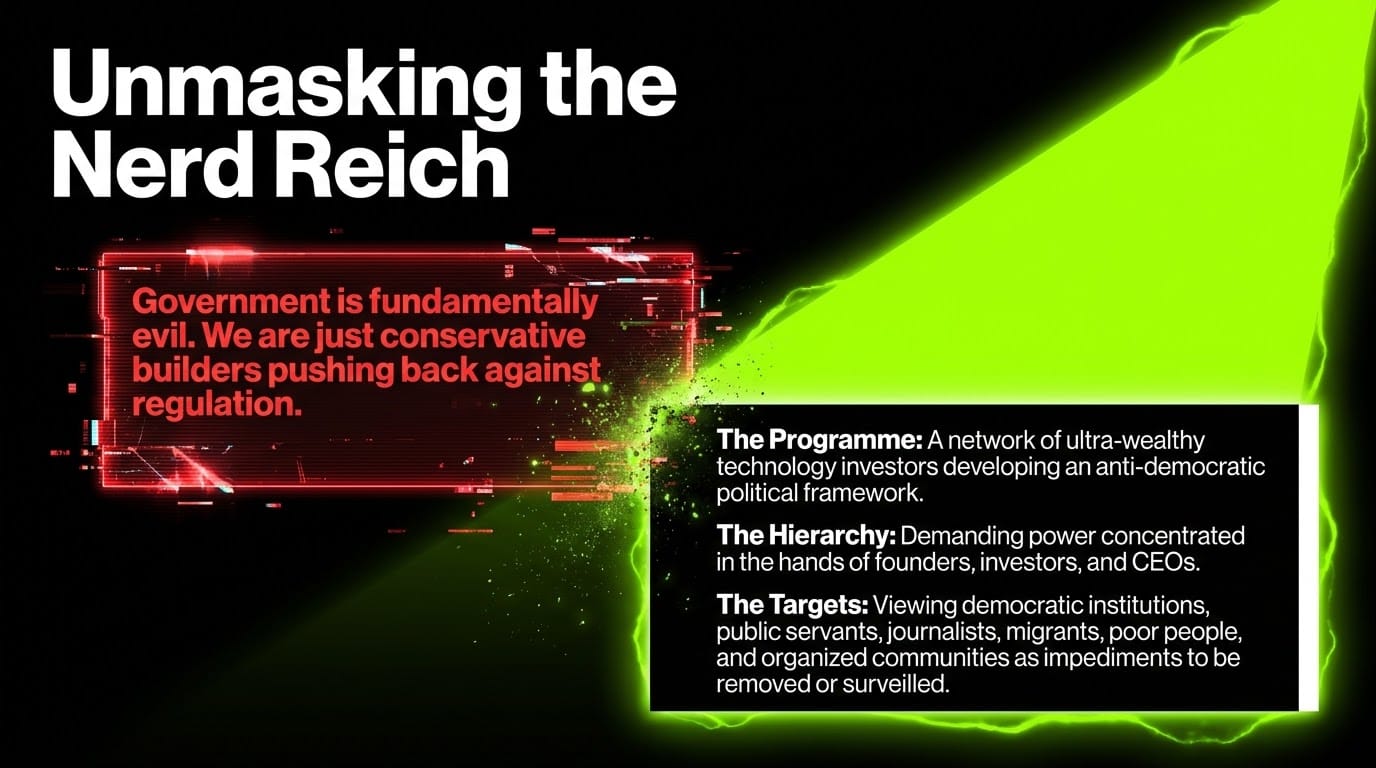
Durán calls his project The Nerd Reich. He told Democracy Now! that the phrase came to him after a person from within the cryptocurrency world said Silicon Valley figures of this kind had already been called the “Nerd Reich” for years.
That is Durán’s account of the name’s origin; it is a reported conversation, not independently documented evidence that everyone in crypto uses the term. Durán’s account of the name’s origin
His use of the word “fascism” is also an argument, not a legal or clinical diagnosis. He defines “tech fascism” as a politics of grievance and self-victimisation that promises a return to imagined greatness, demonises enemies, pushes law-and-order and gender panic, and seeks a permanent hierarchy.
In Durán’s view, wealthy white Western men sit at the top of that hierarchy. Durán’s definition of “tech fascism”
You can agree or disagree with that label. But you cannot fairly pretend it means “anyone I do not like in technology.”
His specific claim is that these actors reject equal political standing: they want power concentrated in the hands of founders, investors and CEOs, while democratic institutions, public servants, journalists, migrants, poor people and organised communities become impediments to be removed, managed, surveilled or ignored. Durán’s explanation of the hierarchy he says this politics creates
The Founding Story: Escape From Democracy
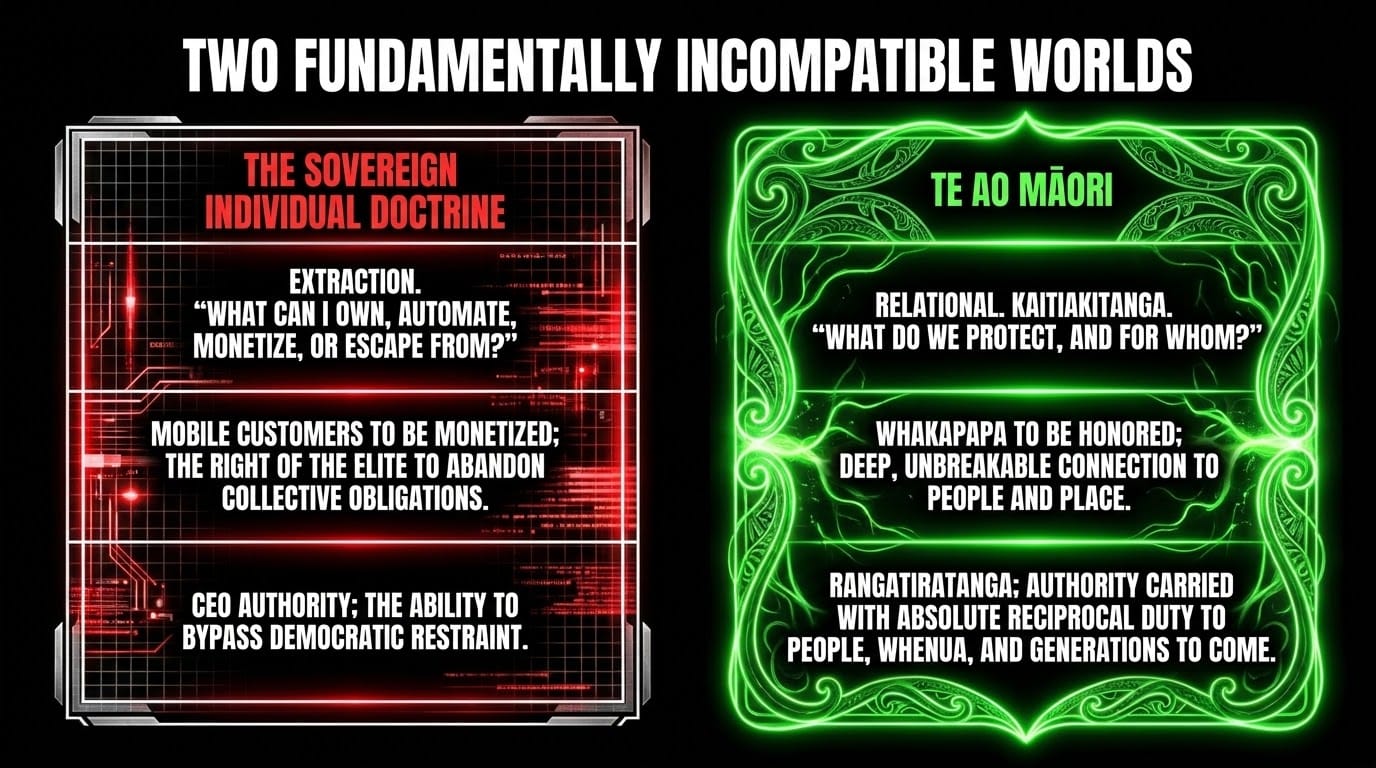
Durán locates the intellectual starting point in the 1997 book The Sovereign Individual, by James Dale Davidson and Lord William Rees-Mogg.
He says Peter Thiel read it in 1997 and credited it as inspiration for PayPal.
The book forecast a future in which digital currency weakens state power, automation destroys jobs, and wealth collects in the hands of a small elite — the “sovereign individuals” — who can escape the obligations of ordinary political life. Durán’s account of Thiel and The Sovereign Individual
The central point is not whether every forecast in that book comes true. The point is the moral direction of travel.
Democracy starts from the idea that we share a country and settle conflict through equal votes, public law and institutions accountable to everyone.
The “sovereign individual” fantasy starts from the opposite place: that the wealthy and technologically capable should be able to exit the obligations that bind everyone else — taxes, labour law, public regulation, collective responsibility — while retaining access to the infrastructure, security, workers and markets that society provides.
That is why Durán says these men were never really opposed to government. His conclusion is that they opposed government only while it imposed rules on them; when they gained influence over government, they sought to use it.
This is Durán’s political analysis.
The underlying contradiction is visible: Peter Thiel has spoken of government as fundamentally evil while his company Palantir has become deeply embedded in government defence, intelligence and security work. Durán on Thiel’s anti-government rhetoric and Palantir’s government role
For Māori readers, there is a stark clash of worldviews here. Rangatiratanga is not the billionaire’s right to abandon collective obligations. It is authority carried with reciprocal duty to people, whenua and generations yet to come. Kaitiakitanga asks: what do we protect, and for whom? The sovereign-individual doctrine asks: what can I own, automate, monetise or escape from? One is relational. The other is extraction with a TED Talk.
The Deep Dive Podcast
Listen to a lively conversation between two hosts, unpacking and connecting topics in the sources of this essay. I apologise in advance for the AI's very harsh pronounciation of reo. Please dont shoot me, :).
Youtube Video
Like video? Here is a short video suppporting the essay. Again, don't shoot the messenger please because of AI's pronounciation. 😄
Koha Consideration
This essay traces the whole machinery: the billionaire ideology that calls democracy “obsolete software”; the Sovereign Individual fantasy of escape from public responsibility; Curtis Yarvin’s corporate patchwork; the movement of Thiel-linked people into state power; Palantir’s surveillance infrastructure; and the Aotearoa trail of a twelve-day citizenship, hidden security contracts, and a Wānaka landscape that refused to become a billionaire’s fortress.
Every koha signals that whānau are ready to support the accountability that Crown and corporate structures will not provide themselves. It supports independent research that follows the money, tests the claims, distinguishes fact from ideology, and refuses to let Silicon Valley’s anti-democratic mythology arrive here unchallenged.
It signals that rangatiratanga includes the power to support our own truth tellers: those defending te mana o te whenua, exposing surveillance without consent, and insisting that public institutions answer to people rather than investors, private contractors, and foreign billionaires.
Kia kaha, whānau. Stay vigilant. Stay connected. And if you are able, consider a koha to ensure this voice continues.
If you are unable to koha, no worries! Subscribe or follow The Māori Green Lantern at themaorigreenlantern.maori.nz, kōrero and share with your whānau and friends — that is koha in itself.
Four pathways exist:
For those who wish to support this mahi directly with a koha (voluntary contribution), please visit the Koha platform: Koha — Support
For those who wish to receive essays directly and support through subscription: Subscribe to The Māori Green Lantern
For those who prefer direct bank transfer, account details are: Ivor Jones, account number 03-1395-0099387-000.
Yarvin’s “Patchwork”: Replace Citizens With Customers
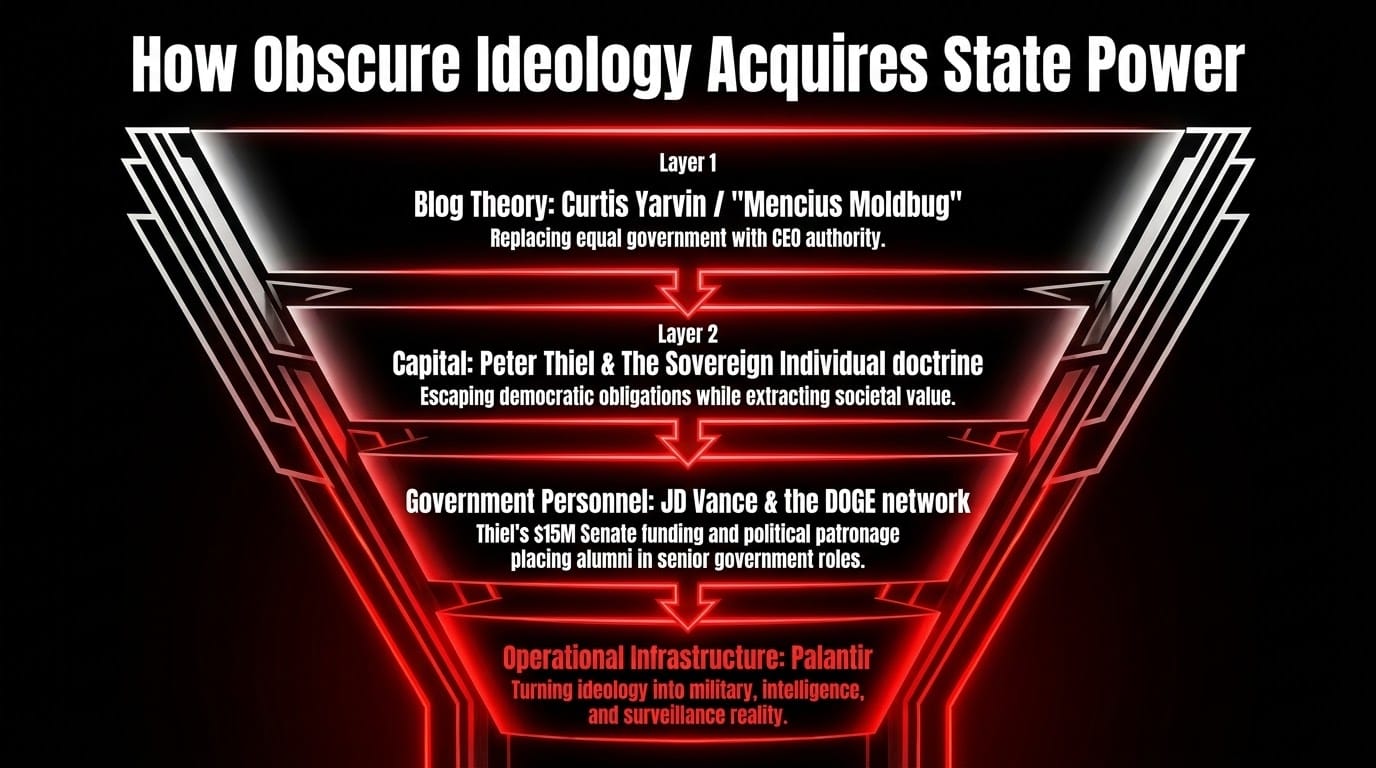
The next piece is Curtis Yarvin, the blogger who wrote under the name Mencius Moldbug. His proposed “Patchwork” model is not vague. Yarvin argued that governments should be replaced by a global network of mini-states run by joint-stock corporations, with residents who dislike their rulers expected to leave rather than vote them out. CBC’s account of Yarvin’s Patchwork proposal
That is the mechanism beneath Durán’s reference to “network states.”
In plain English: turn countries into rival private companies, turn people into mobile customers, and replace political equality with the CEO’s authority.
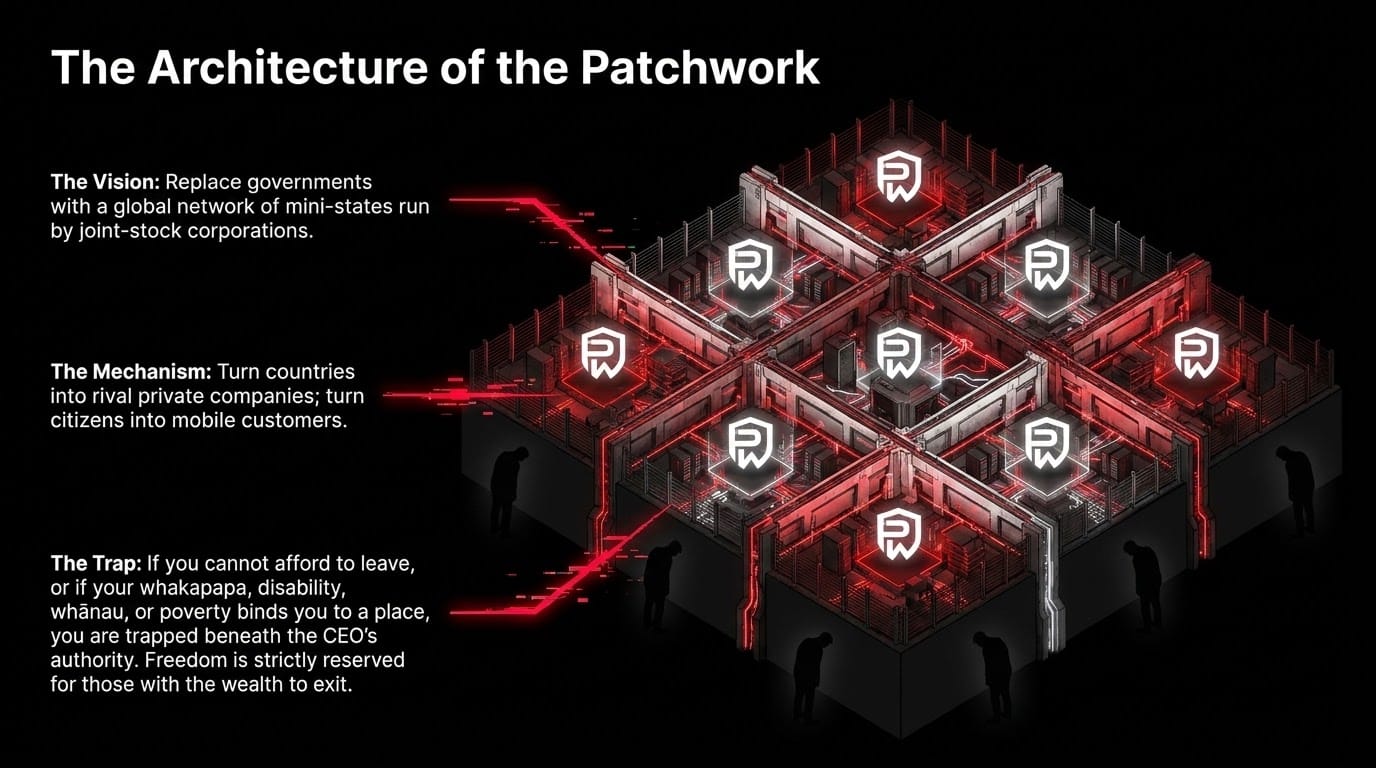
If you cannot afford to leave, if you have whakapapa to the place, if your disability, job, whānau or poverty limits your choices — tough luck. In this model, the people with the most freedom are the people with enough money to exit. Everybody else lives with the decisions made above them.
Yarvin states his view even more clearly in a clip played in Durán’s interview. He says that “anything that works is a monarchy,” comparing Apple’s chief executive and China’s dictator to the supposedly inferior process of democratic government. Yarvin’s remarks, reproduced in the Democracy Now! transcript
CBC reports that Thiel invested in one of Yarvin’s technology ventures and that Yarvin’s ideas circulated in Silicon Valley circles that included Thiel and Marc Andreessen. CBC on Thiel’s investment and the circulation of Yarvin’s ideas This confirms a material connection between Thiel and Yarvin’s work. It does not prove that every decision made by Thiel, Palantir, Vance or the Trump administration was directed by Yarvin. That larger causal claim needs evidence case by case.
Durán also says Yarvin once proposed turning “unproductive people” into biodiesel and spoke of a “humane alternative to genocide.” The Democracy Now! transcript records Durán making that claim. Durán’s description of the Yarvin passage I have not independently retrieved the original Yarvin post for this article, so treat the exact wording as reported by Durán, not independently verified here. The broader anti-democratic Patchwork proposal, however, is independently documented by CBC.
From Blog Theory To Government Personnel
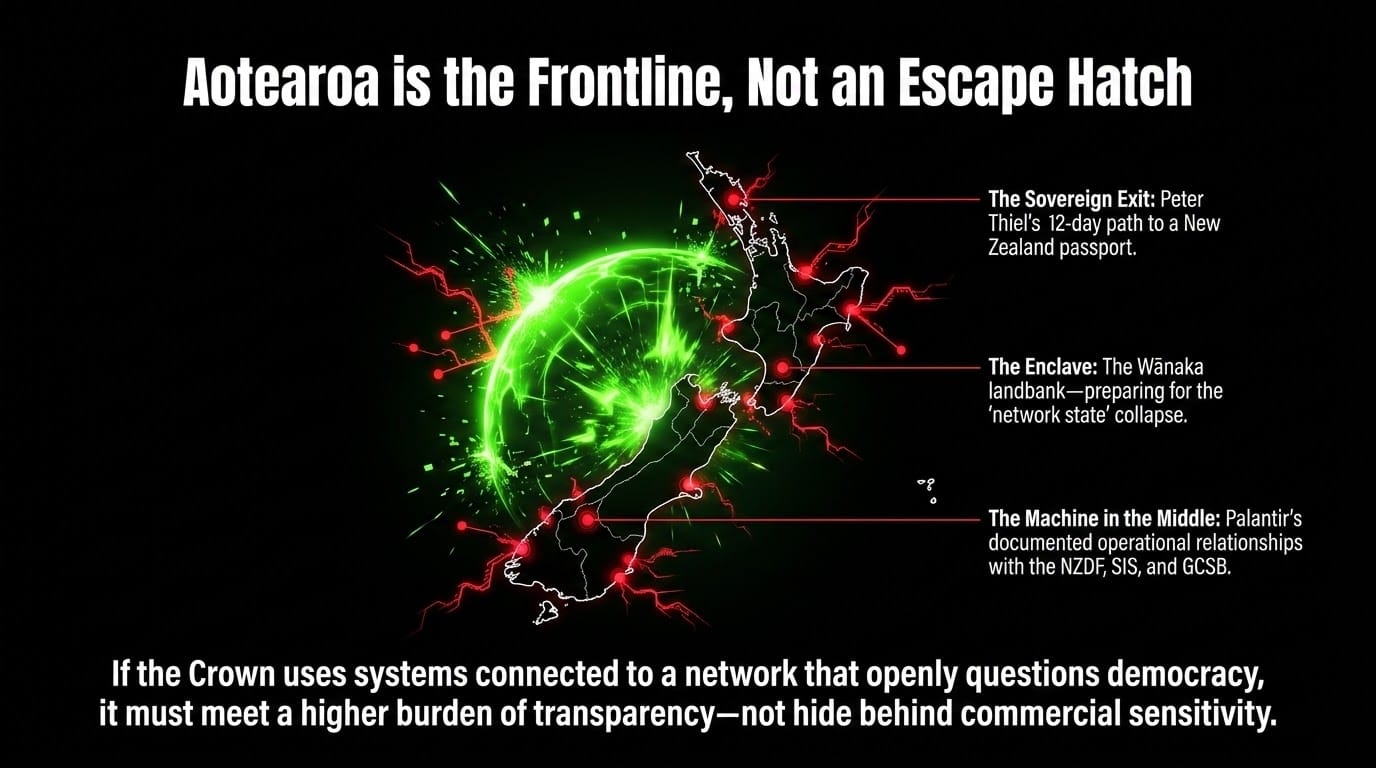
The crucial question is whether this is simply unpleasant online ideology or whether it has acquired state power. Durán’s answer is that it has acquired state power through personnel, money and contracts.
The clearest example is JD Vance. In the interview, Durán argues that Vance’s career was profoundly shaped by Thiel: Vance heard Thiel speak at Yale Law School in 2011, later worked at Thiel’s Mithril Capital, and Thiel financed Vance’s Ohio Senate campaign. Durán’s account of the Thiel–Vance relationship Bloomberg independently reports that Thiel gave a record US$15 million to support Vance’s Senate run and that Vance worked at Mithril Capital after hearing Thiel at Yale. Bloomberg’s investigation of Thiel’s ties to the Trump administration
Vance’s ideas are not hidden either. In a 2021 podcast clip reproduced in the interview, he explicitly references Yarvin, urges the right to “seize the institutions of the left,” and proposes a “de-wokeification” programme. Vance’s 2021 remarks as transcribed by Democracy Now!
Bloomberg found more than a dozen people with ties to Thiel — including current or former employees of Palantir and people connected to his investment, philanthropy and business networks — placed within the Trump administration and DOGE-era government effort. Bloomberg’s documented Thiel network in government Its reporting identifies Palantir alumni in DOGE, an ex-Palantir executive as Chief Information Officer at the Department of Health and Human Services, and former Palantir and Thiel-linked figures in other senior roles. Bloomberg’s individual profiles of Thiel-linked officials
This does not establish a secret command centre. It establishes something more mundane and, in some ways, more dangerous: an elite network whose people move between venture capital, surveillance firms, philanthropy, political funding and the state. The revolving door is visible. The access is documented. The conflict between public responsibility and private profit is not theoretical when companies linked to those networks also depend on public contracts. Bloomberg on Thiel-backed companies, government contracts and DOGE recruitment
DOGE, RAGE And The Destruction Of Public Capacity
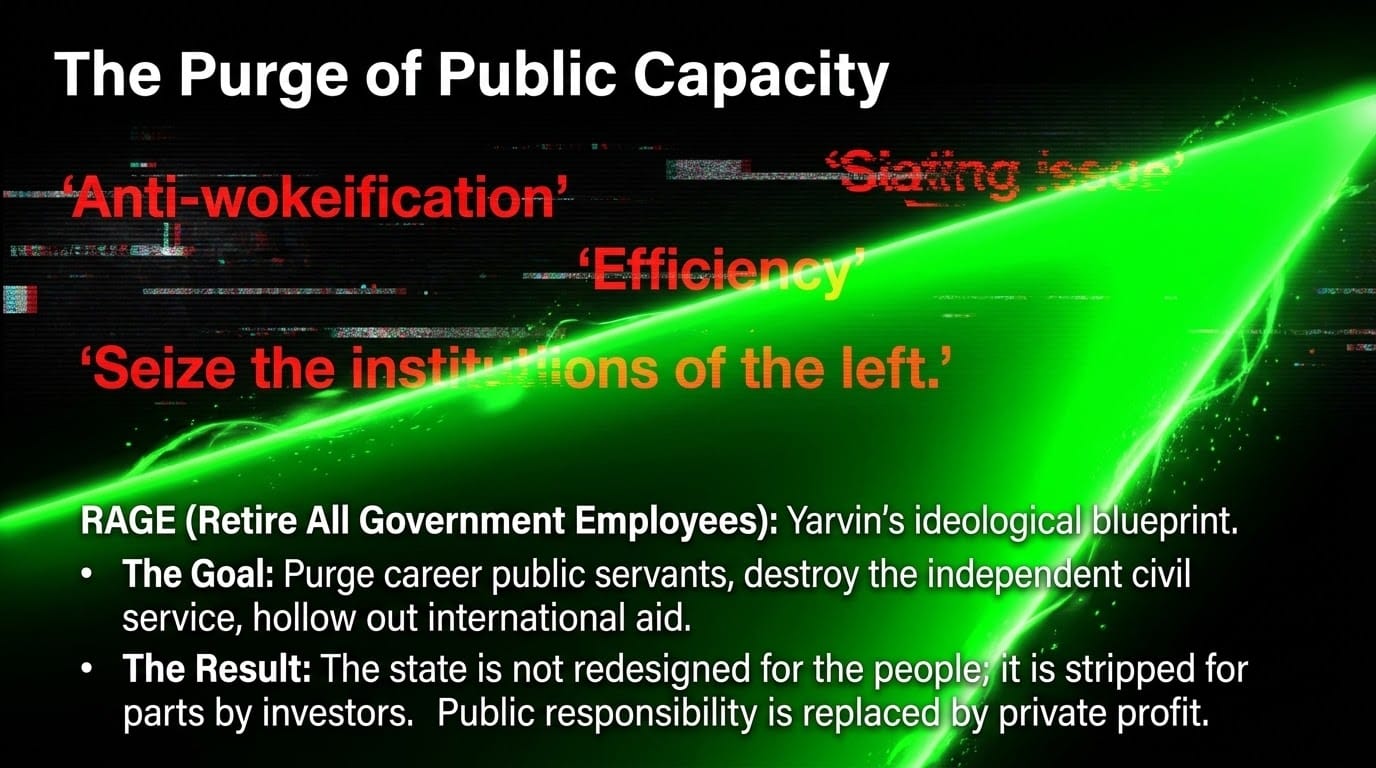
Durán’s sharpest causal argument concerns DOGE and the gutting of public institutions.
He says Yarvin’s programme — “RAGE,” or “Retire All Government Employees” — provided the ideological blueprint: a president should purge career public servants, destroy the independent civil service, hollow out international aid, and rule through a CEO-like figure. Durán’s explanation of Yarvin’s RAGE theory and DOGE
The factual overlap is real: Bloomberg documents Thiel-linked people inside the administration and DOGE orbit. Bloomberg’s reporting on Thiel-linked officials in DOGE and government But the stronger statement — that DOGE was consciously designed from Yarvin’s writings — is Durán’s interpretation. I have not found an internal DOGE document saying “we are implementing RAGE,” so I will not manufacture that proof.
That distinction does not let anyone off the hook. Ideology does not need a signed memo to matter. When the same network supplies political money, recruits personnel, benefits from contracts and promotes a worldview hostile to independent public institutions, the public has every right to ask whether the state is being redesigned for the people or stripped for parts by investors.
Palantir: The Machine In The Middle
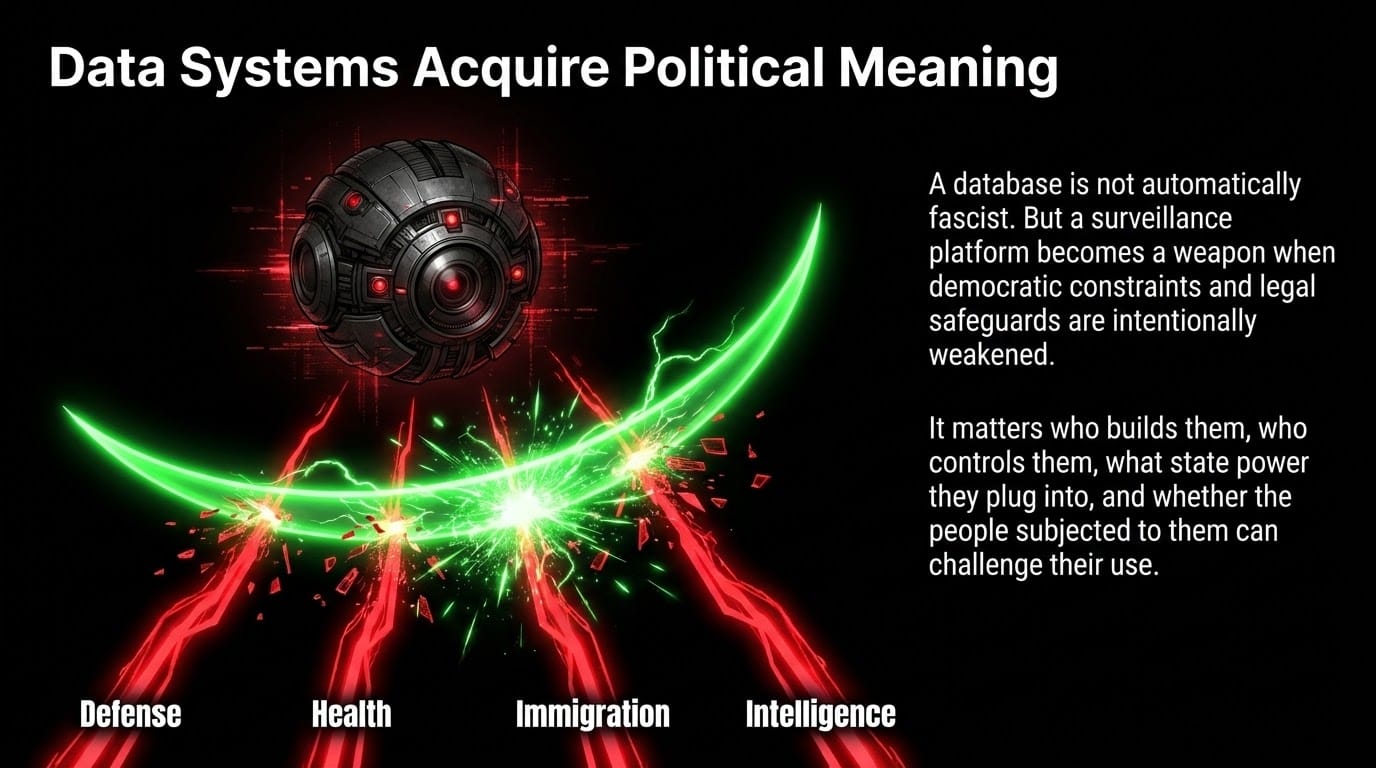
Palantir is central to Durán’s warning because it turns this ideology into operational infrastructure. Durán describes it as a government surveillance and military-intelligence contractor co-founded by Thiel, named after the all-seeing stones in The Lord of the Rings. Durán on Palantir’s role and name Bloomberg reports that Palantir’s stock rose more than 90 percent after Trump’s election and identifies former Palantir staff in DOGE and senior government information roles. Bloomberg on Palantir, DOGE and the Thiel network
Durán’s point is not that a database is automatically fascist. The point is that data systems acquire political meaning through who builds them, who controls them, who gets access to them, what state power they plug into, and whether the people subjected to them can challenge their use.
A surveillance platform embedded in immigration enforcement, defence, health, policing or intelligence can become a tool of public administration. It can also become a weapon when legal safeguards, public oversight and democratic constraint are weakened.
That is why I refuse to treat Palantir as merely another clever software company. In Aotearoa, its documented past relationship with NZDF, SIS and GCSB is not an American culture-war distraction. It is a sovereignty, accountability and tikanga question. If the Crown uses systems connected to a foreign billionaire whose political network openly questions democracy, the Crown must meet a much higher burden of transparency — not hide behind commercial sensitivity and expect the public to clap.
The Warning, In One Sentence
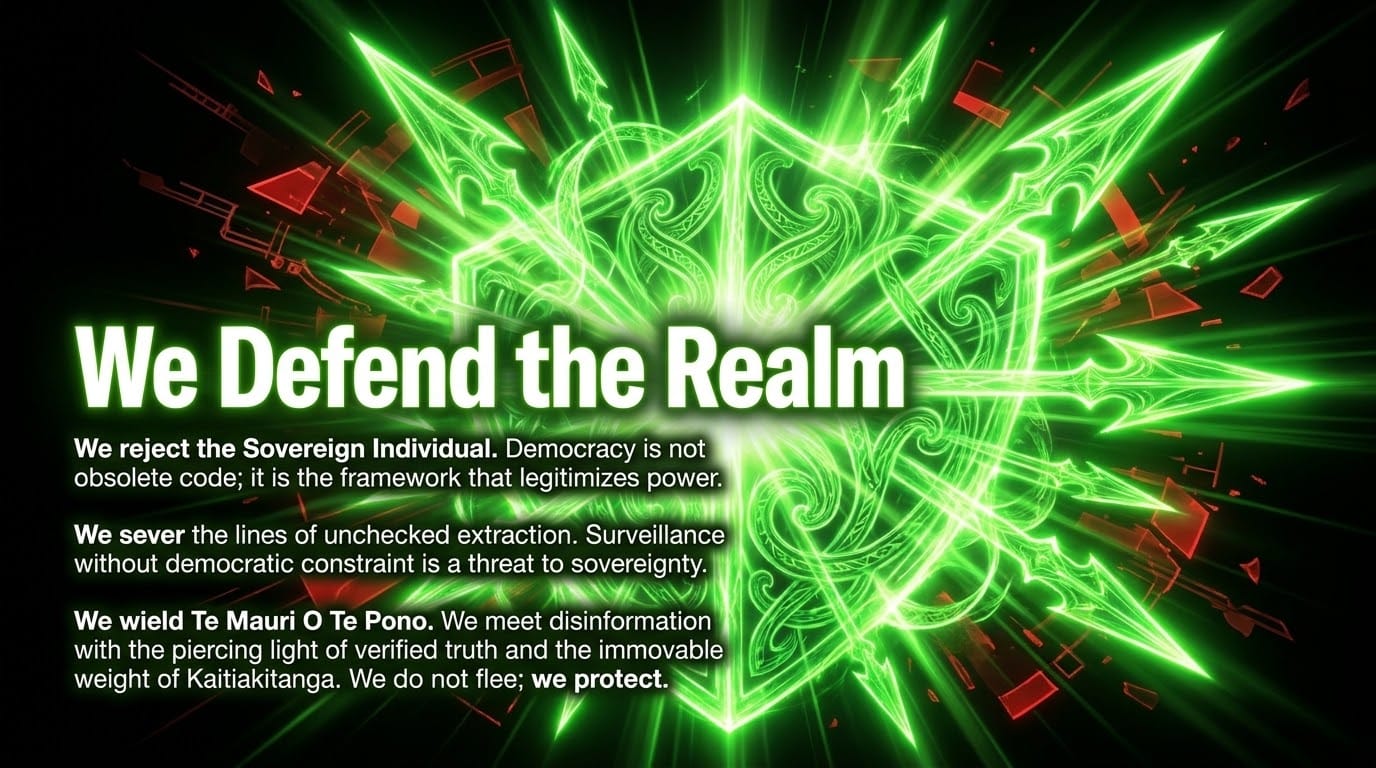
Durán’s warning is this: when billionaire technology networks stop treating democracy as the framework that legitimises power and start treating it as obsolete code to be replaced, the danger is not confined to social media posts or weird blogs.
It reaches the civil service, the surveillance apparatus, the public purse, the courts, the media and the land.
That is why I am taking his claims seriously — not uncritically, not without marking the difference between verified evidence and interpretation, but seriously. Because the moment we call it “an American problem,” we ignore the twelve-day passport, the Palantir contracts, the Wānaka landbank and the neoliberal welcome mat already laid out here in Aotearoa.
Three Examples For The Western Mind — Because Apparently Facts Still Need Translating For Some People
Example One: The Citizenship Heist
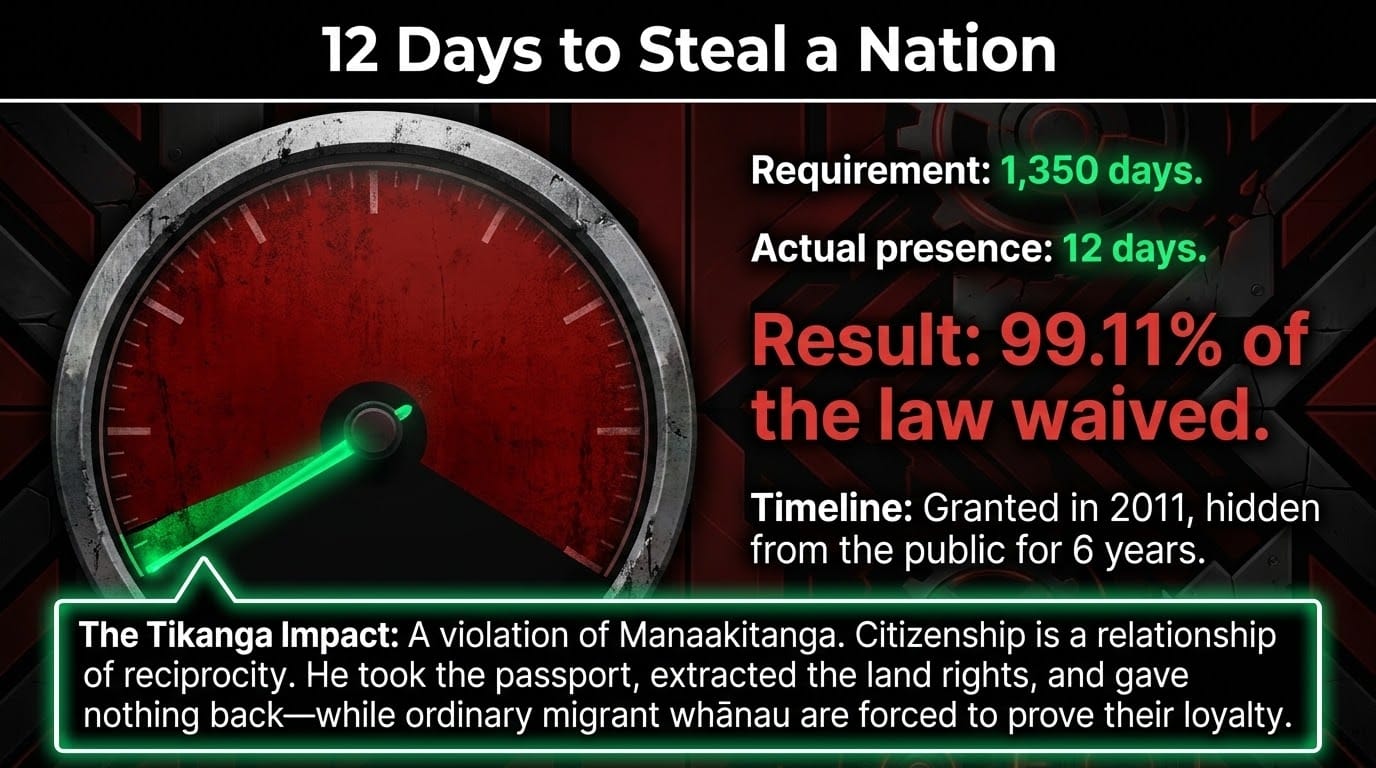
Core claim: Peter Thiel was granted New Zealand citizenship in June 2011 after spending just 12 days in the country, against an official legal requirement of 1,350 days present across five years Govt.nz official presence requirement for citizenship RNZ confirming the 12-day figure.
Quantified harm: 0.89 percent of the legal standard met, 99.11 percent waived by ministerial discretion alone. Every migrant whānau in Hastings, in South Auckland, in Ōtautahi, who spent years proving their commitment to this country, was quietly told the law is a suggestion if you're rich enough. That's not immigration policy. That's class contempt dressed up in a citizenship ceremony.
Solution: Abolish the "exceptional circumstances" clause entirely, or force every ministerial exception through automatic, real-time Ombudsman review — not six years of hidden paperwork forced out by journalists, which is exactly what happened here Verified — NZ Herald "Citizen Thiel" investigation.
Tikanga impact, explained plainly: in te ao Māori, accepting manaakitanga — hospitality, welcome, belonging — creates a relationship of reciprocity.
You owe something back. Thiel took the passport and the land rights it unlocked, and by 2025 had formally deregistered his last NZ business vehicle and walked away, keeping only a landbank he still can't legally build on NZ Herald on Thiel winding down NZ business interests, February 2025.
Taking manaakitanga and giving nothing back isn't bad manners in te ao Māori. It's a violation of the entire relationship citizenship represents. I traced this same extractive pattern — arrive, extract, exit — in "The Thielverse Rising", where it wasn't unique to Aotearoa but repeated across his global footprint.
Example Two: The Spy Contract Nobody Will Cost
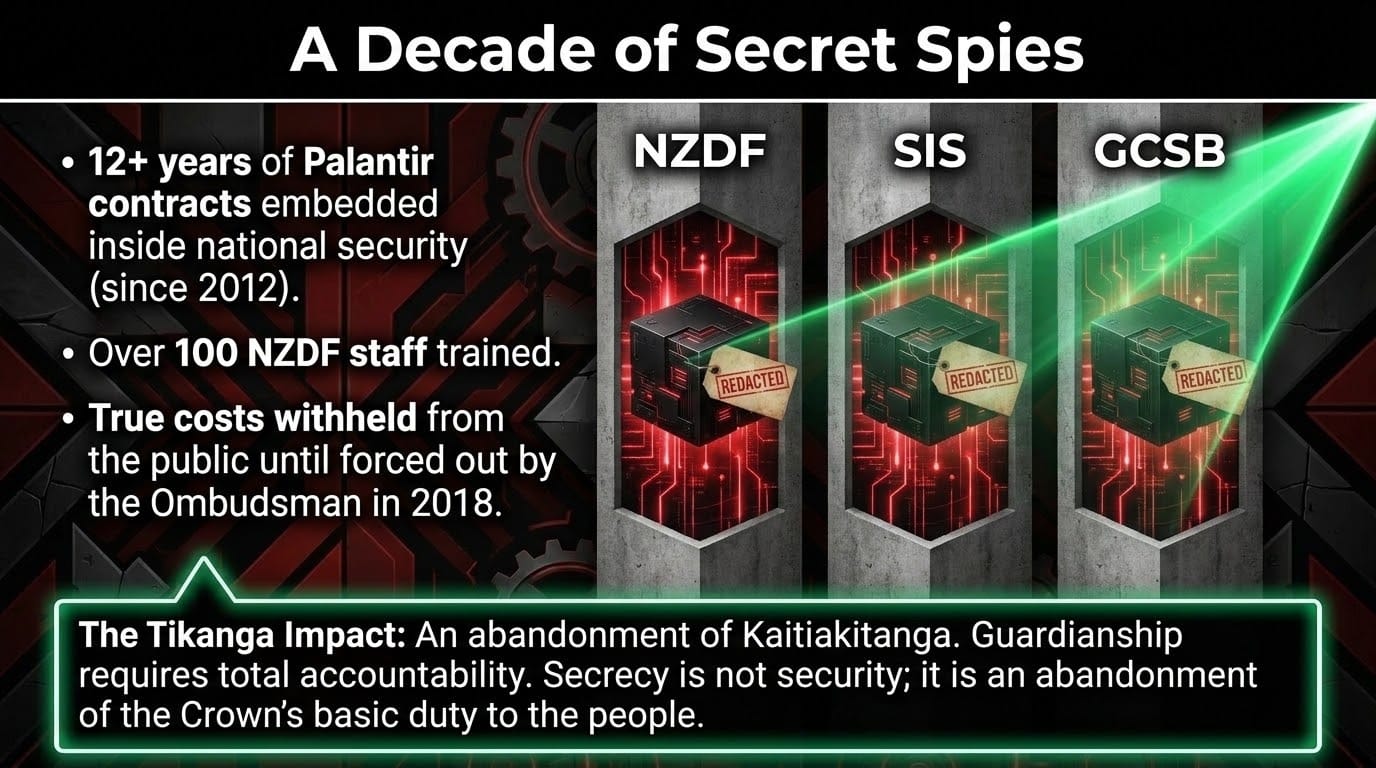
Core claim: Palantir Technologies — Thiel's surveillance company, seeded with CIA money — has held contracts with the New Zealand Defence Force, the SIS, and the GCSB since at least 2012, a year after his citizenship was granted, training over 100 NZDF staff, with the true cost withheld from the public until the Ombudsman forced partial disclosure in 2018 Verified — ODT investigation, "Thiel's secret Kiwi spy links revealed" Verified — ODT, "Ombudsman forces release of spy software spending".
Quantified harm: that's a minimum of 12 years — 2024 minus 2012 — of an unelected foreign billionaire's company sitting inside our national security apparatus, its full cost still not fully public. For scale, I reported in "The Antichrist Has Nothing on Peter Thiel" that Palantir received over US$113 million in Trump administration contracts since January 2025 alone, sourced to Wired — that figure describes US spending, not NZ spending, and I have not independently re-verified it in this essay, so it stays labelled Corroborated, not Verified. What it shows is the scale this company operates at globally while our own NZ contract costs remain incompletely disclosed.
Solution: mandatory, automatic annual public disclosure of every software vendor contract above a set threshold held by NZDF, SIS, and GCSB — with zero commercial-sensitivity exemption when the vendor is owned by a politically active foreign billionaire funding the dismantling of democracy elsewhere.
Tikanga impact, explained plainly: kaitiakitanga means guardianship with accountability — you cannot claim to protect the people while hiding who stands guard and on whose payroll. Secrecy here isn't security. It's an abandonment of the Crown's basic duty to be answerable to the people it claims to serve.
Example Three: The Lake That Said No
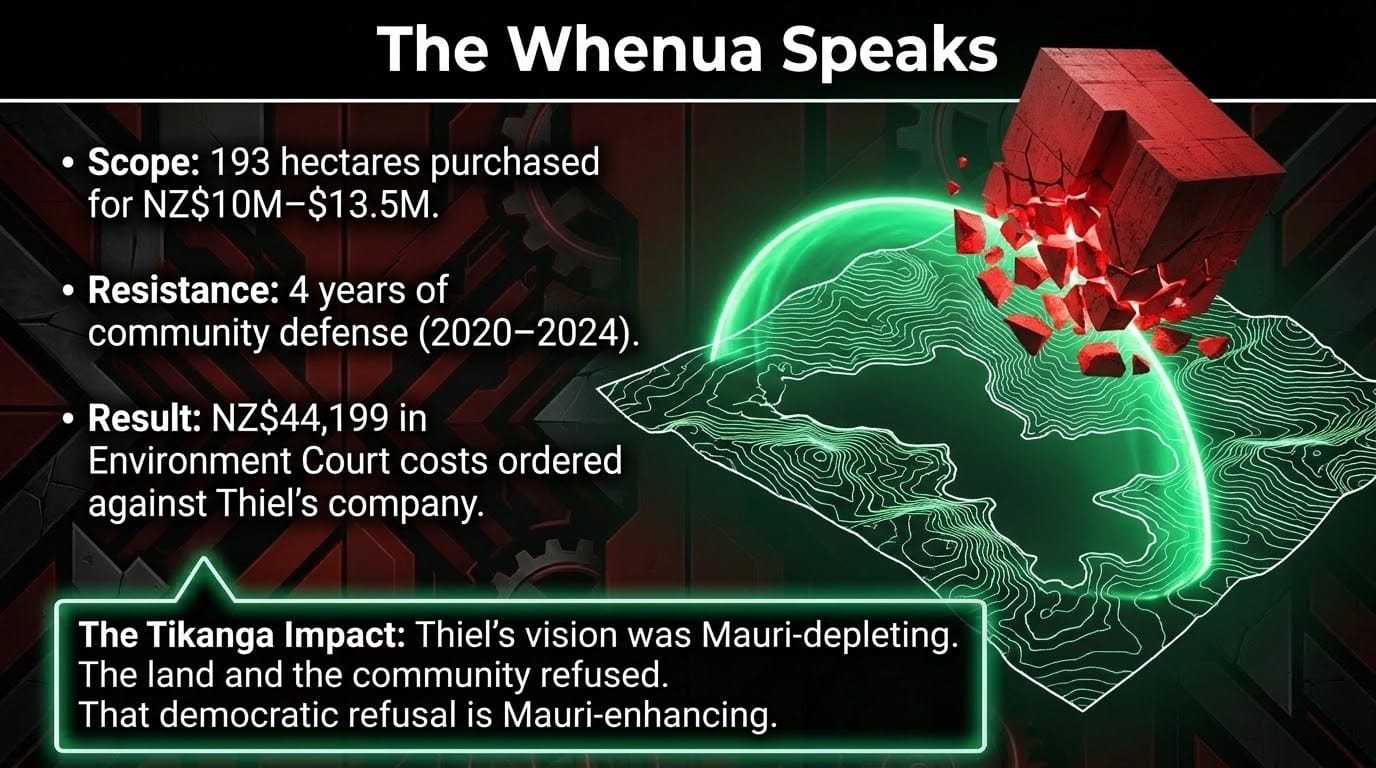
Core claim: Thiel's company Second Star Ltd fought from 2020 to 2024 to build a fortress-scale lodge on a 193-hectare Lake Wānaka estate, purchased for a reported NZ$10–13.5 million. Queenstown Lakes District Council rejected it in 2022; the Environment Court rejected the appeal again in December 2024, ordering Thiel's company to help pay NZ$44,199 in costs Verified — The Guardian on the 2022 council rejection Verified — lwb.co.nz on the final Environment Court costs order.
Quantified harm: four years of council and Environment Court resources spent stopping one man privatising a landscape that belongs, in mauri and in law, to the whole Upper Clutha community and to mana whenua with whakapapa connections to that whenua.
Solution: none needed for this one — for once, the existing democratic planning process actually worked. My solution is to defend it against every "fast-track consenting" bill this current government tries to pass specifically to let the next Thiel skip exactly this scrutiny.
Tikanga impact, explained plainly: the whenua spoke through the only mechanism our current legal system gives it a voice — resource consent law — and it said no, twice. That refusal is mauri-enhancing. Everything Thiel tried to build over it was mauri-depleting, extractive, and contemptuous of the community whose backyard he wanted to fortress.
Name The Government That Let This Happen
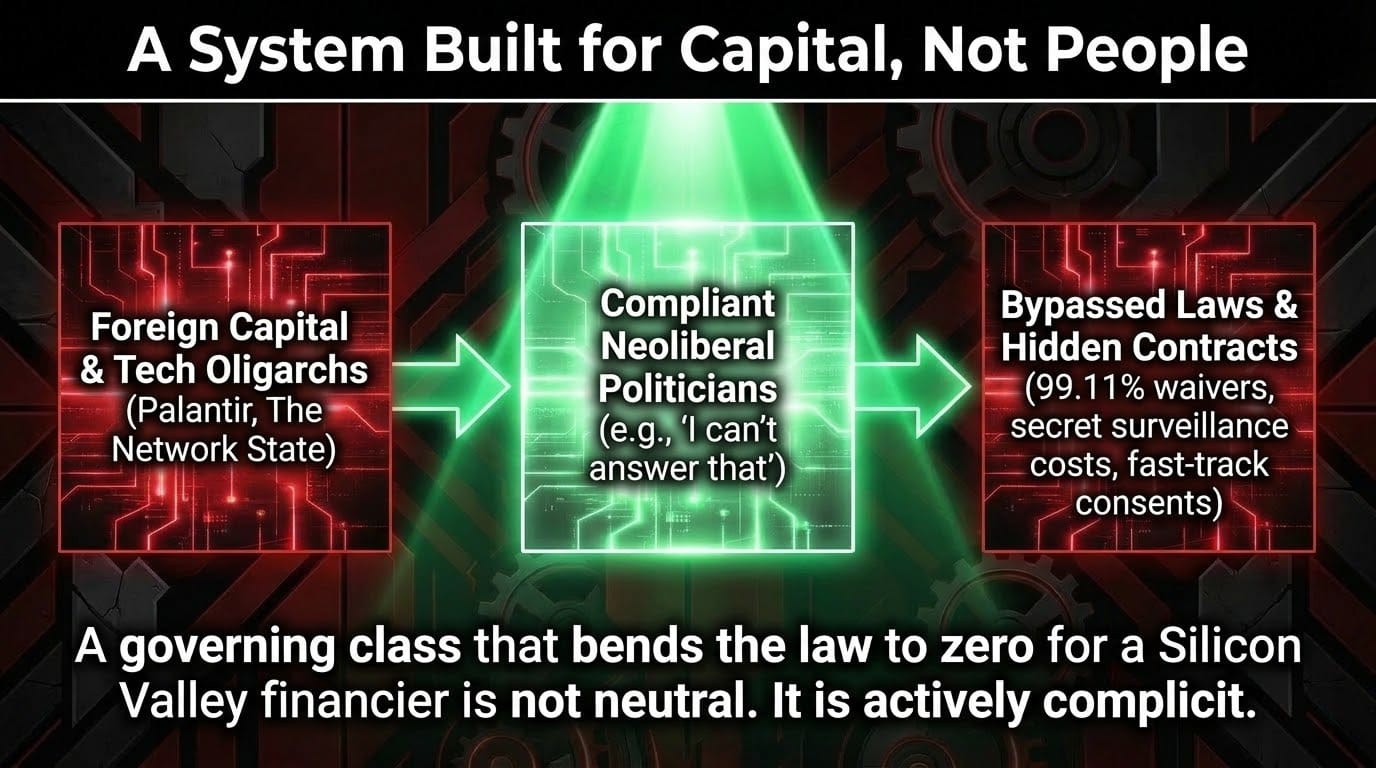
I'm not going to soften this: the machinery that let a foreign billionaire buy a passport in twelve days, hide his spy-agency contracts for over a decade, and nearly fortress a public lake belongs to a neoliberal governing tradition — spanning successive administrations — that treats foreign capital as sacred and public accountability as an inconvenience.
Nathan Guy signed the waiver in his ministerial capacity and, when asked directly why the secrecy, told the NZ Herald he "can't answer that" NZ Herald/Gizmodo republish.
That is reported here under qualified privilege regarding his conduct in public office — I am not alleging personal crime, I am stating that a minister of the Crown could not explain a six-year cover-up on the public record, and that failure of accountability is a feature of the system, not a bug.
I'll say it plainly: a governing class that will bend citizenship law to near-zero for a Silicon Valley financier bankrolling Curtis Yarvin's dreams of turning "unproductive people" into biodiesel — Yarvin's own words, as reported to Durán
— while making ordinary migrant whānau prove years of loyalty, is not neutral.
It is a system built to serve capital first and people last, and I will keep naming it every time it does, as I have across "The Thielverse Rising" and "The Antichrist Has Nothing on Peter Thiel".
No malice is intended toward any named individual beyond the documented, sourced pattern above — this is accountability journalism on matters of citizenship policy, national security procurement, and resource management, protected as public interest reporting under New Zealand law.
Kua Mutu — The Whenua Already Answered
He aha te mea nui o te ao? He tāngata, he tāngata, he tāngata.
Not billionaires. Not bunkers. Not ministers who "can't answer that."
People.
The Upper Clutha community and the Environment Court showed what accountability looks like when it's allowed to function. Our spy agencies and our citizenship system have not yet been forced to show the same.
Disclaimer: This essay contains clearly flagged opinion and scathing critique built on verified public-record facts, published in the public interest regarding foreign capital, citizenship policy, and national security transparency in Aotearoa New Zealand. All numerical claims were calculated and sourced before drafting, with formulas and inputs shown above. Cross-references to prior essays on themaorigreenlantern.substack.com are provided for readers who want deeper context on the same subject; each remains independently verifiable at its own URL. Peter Thiel, Nathan Guy, and their representatives have not been directly contacted for this piece; all quotations are drawn from public record. Correction requests will be honoured on notice within 48 hours.