"They Stole Whareroa With A Compulsory Order. Now They Want To Sell It With A Spreadsheet" - 20 September 2026
Ninety-Two Years After Ngāi Tukairangi Fought This Theft To The Privy Council, A White Supremacist Neoliberal Coalition's Local Council Wants One Hapū Seat To Rubber-Stamp Selling It Again — While Trying To Vote Your Only Elected Māori Seat Out Of Existence

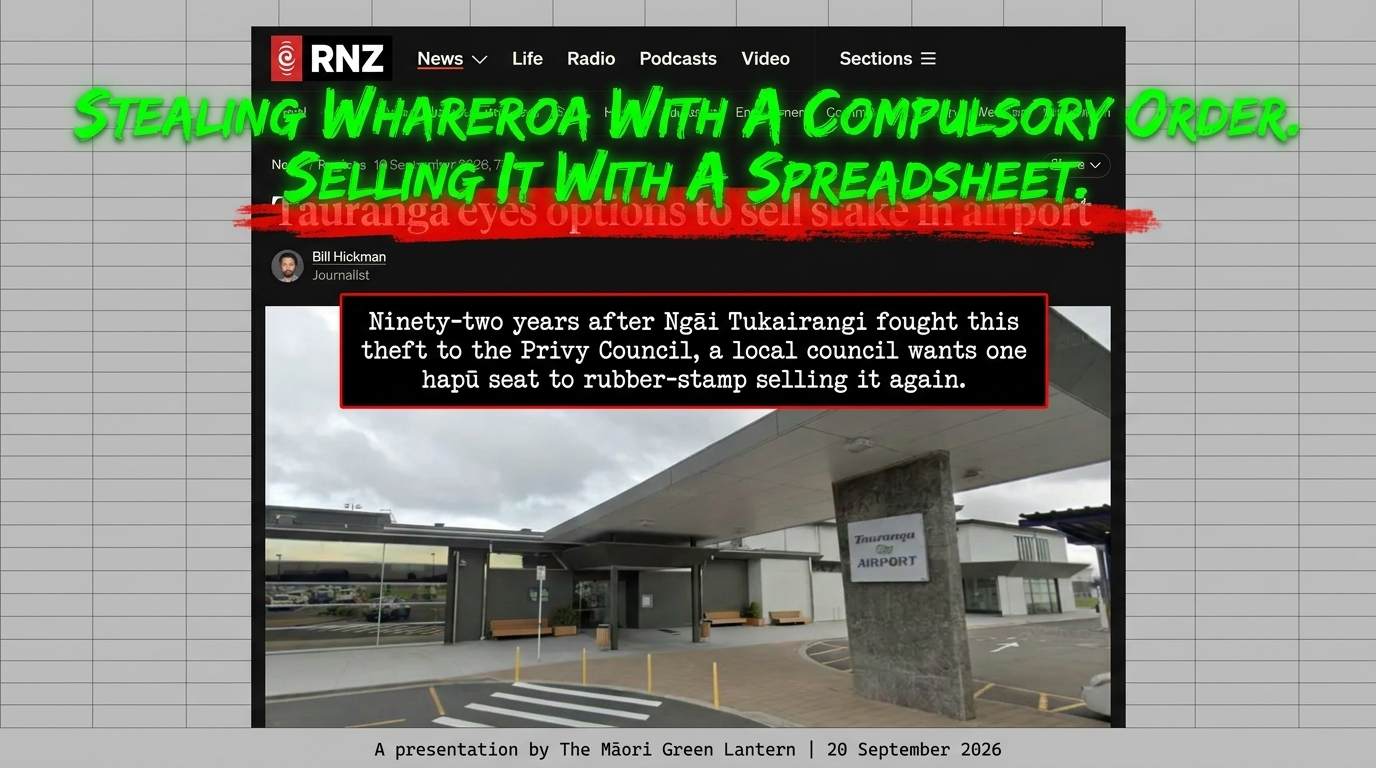
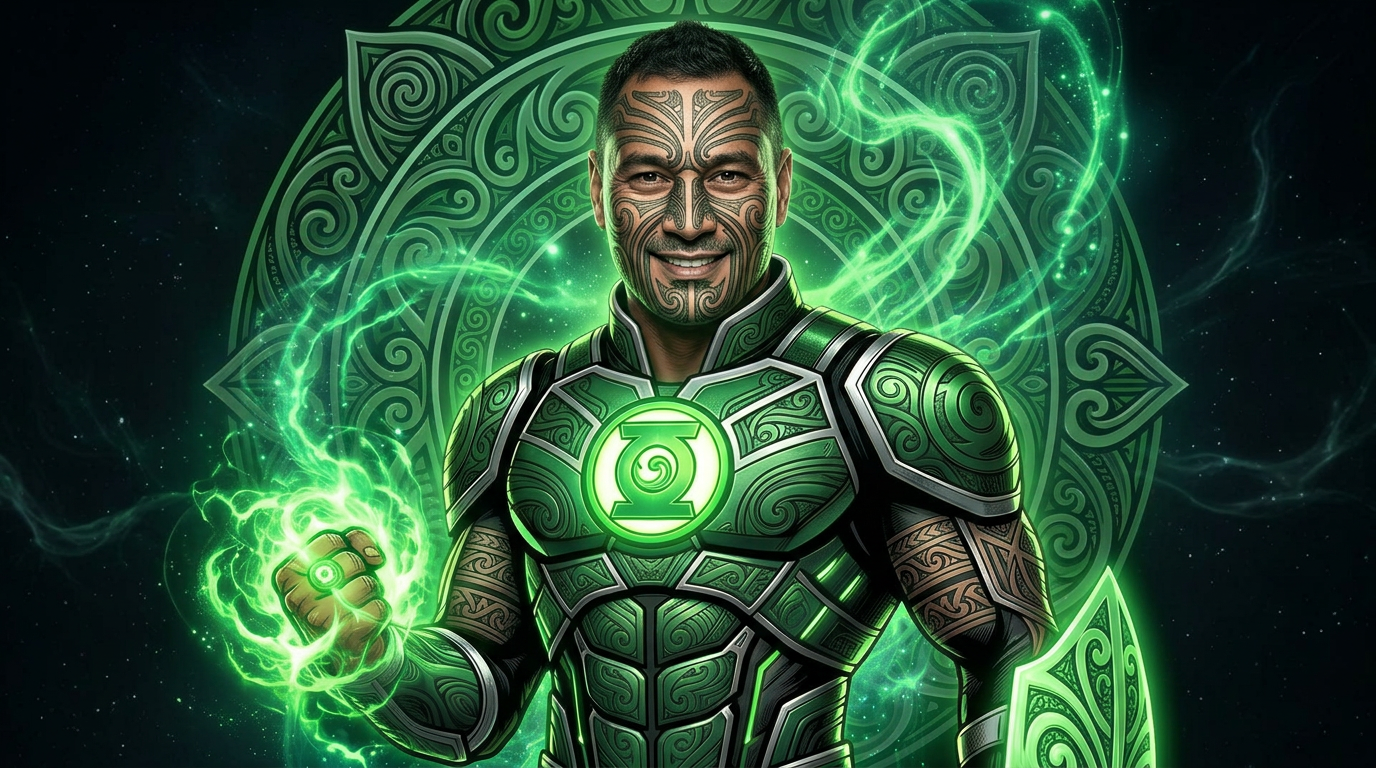
Kia ora koutou, I'm Ivor Jones. You know me as The Māori Green Lantern — tohunga mau rākau wairua, kaitiaki, and the whānau member who will not let a council press release do your thinking for you.
I've spent today tracing exactly what Tauranga City Council is doing to Tauranga Airport, and whose whenua sits underneath it. I'm furious, and by the end of this essay, you will be too — for the right reasons, with the receipts to back it up.
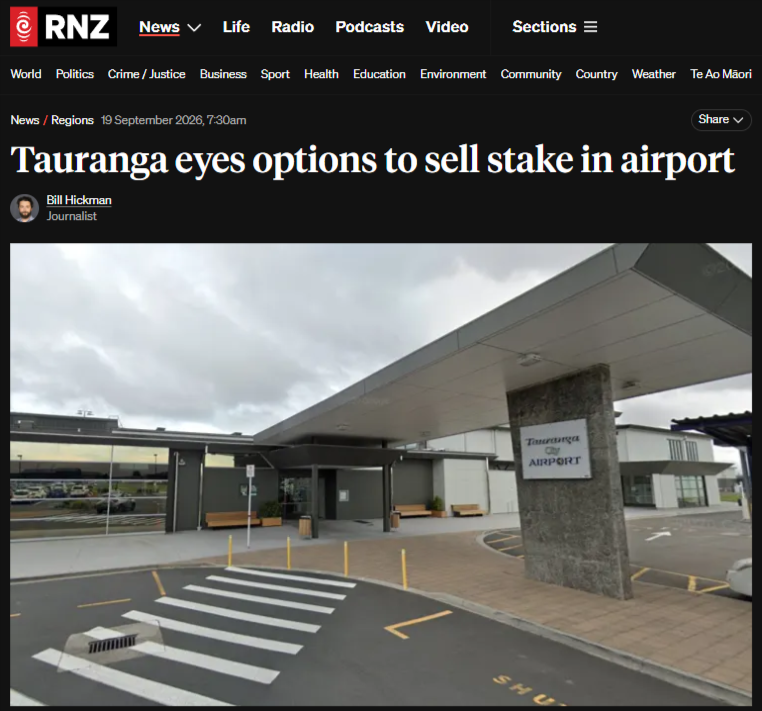
 RNZ | Te Reo Irirangi o Aotearoa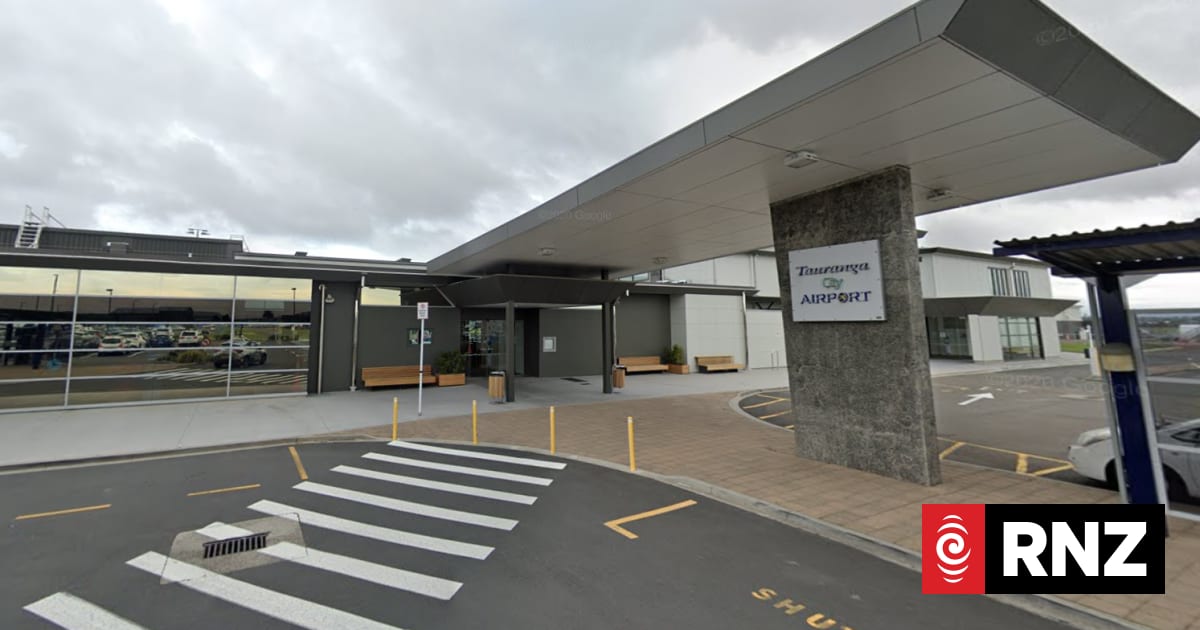
What this essay covers: who Ngāi Tukairangi are and what was taken from them in 1934; why the council now deciding the airport's future once had no elected members at all; why the city's only elected Māori seat is facing a public vote on whether it should exist; why the law protecting you from all of this asks almost nothing of council; three plain examples any Pākehā reader can hold in their hand to understand exactly what tikanga demands here; and why, come November, this coalition government does not deserve your vote again.
I'd love for you to click through and sit with this properly.
I've built a podcast episode that walks through this kaupapa in full kōrero, a short video that breaks the whole thing down in five minutes for whānau who need it fast, and — for those of you who read deep — this 3,000-word cited essay right here, built line by line from council documents, court records, and the Crown's own settlement deeds.
This is a repository. Long after this vote is forgotten by everyone who profited from it, our mokopuna will be able to look back and say: at least The Māori Green Lantern — amongst a few — was warning us.
Ngāi Tukairangi Fought The Crown To The Privy Council — And This Council Still Won't Say Their Name
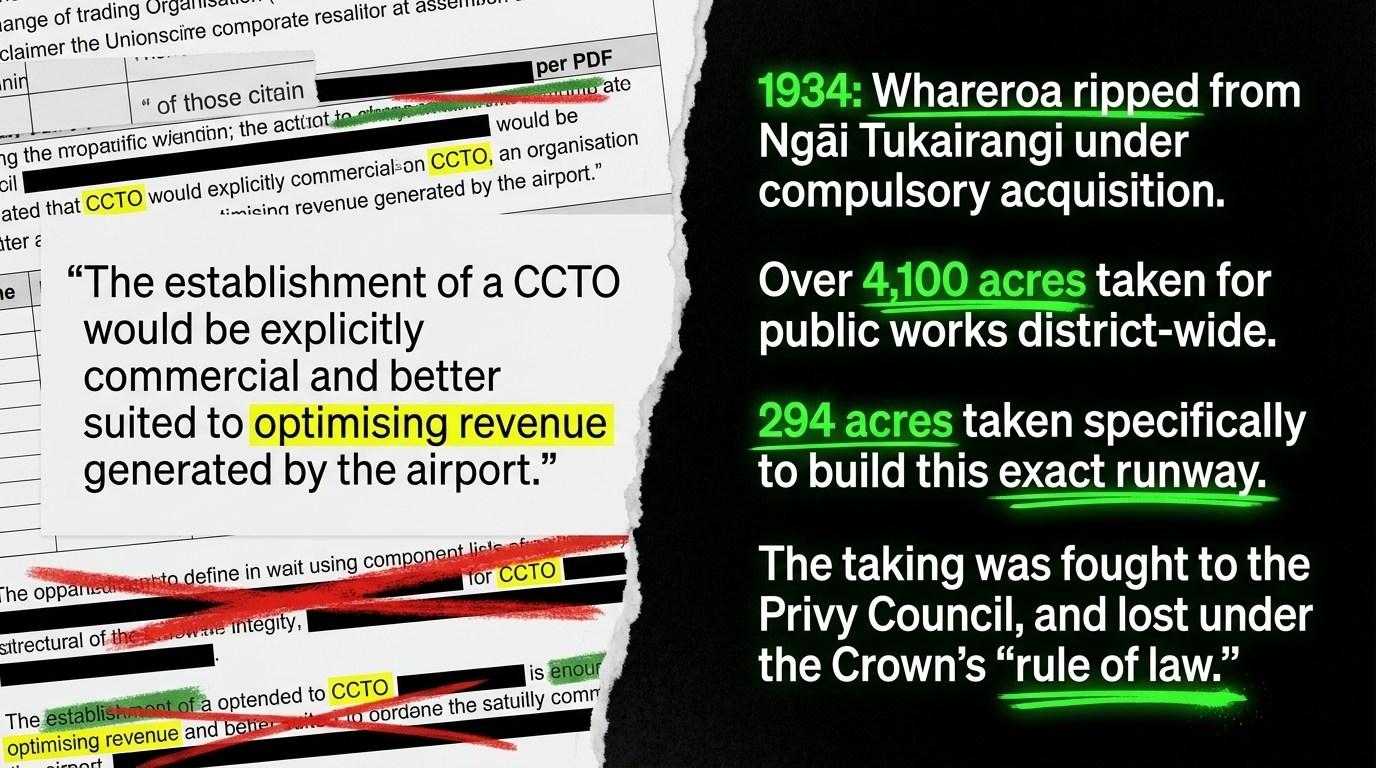
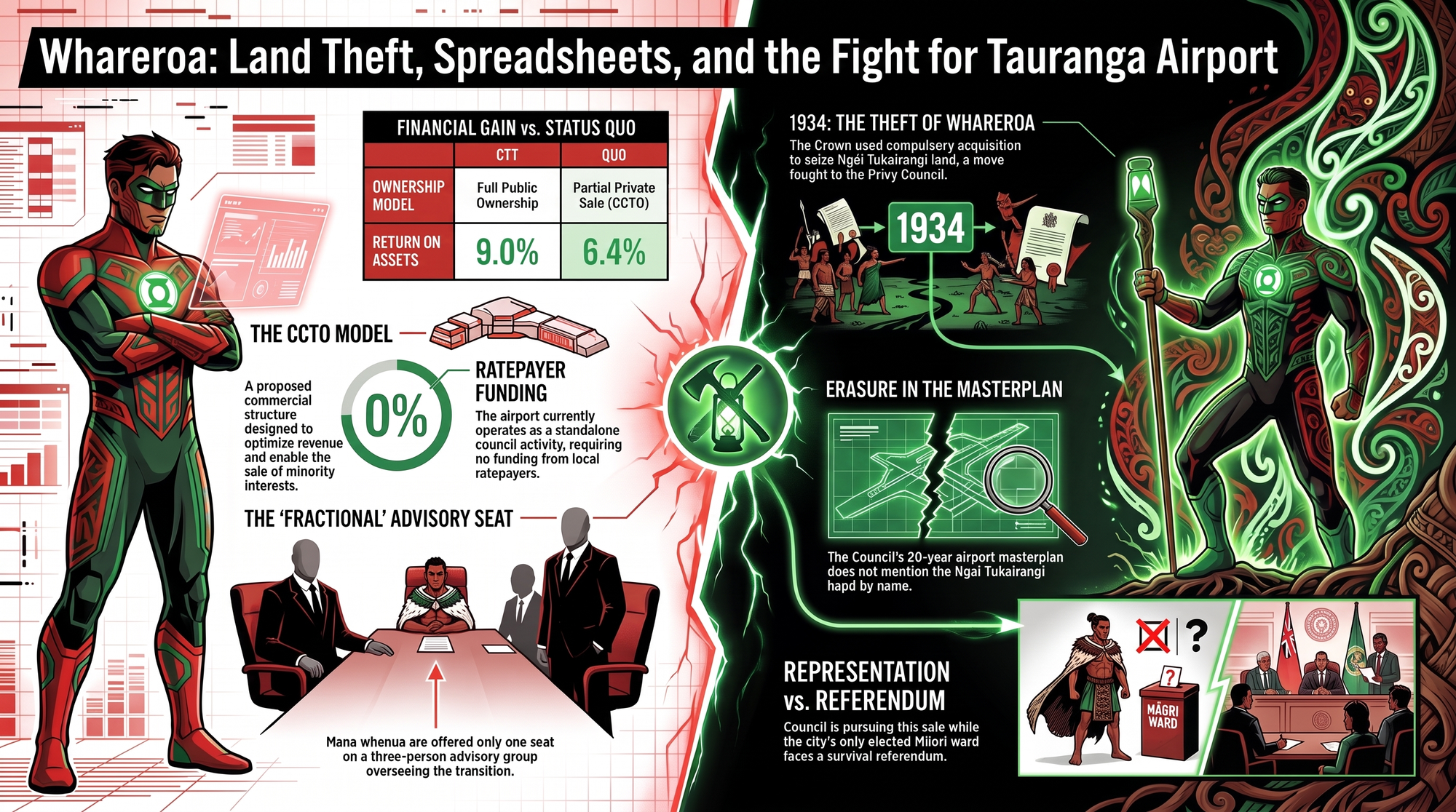
In 1934, the Crown walked onto Whareroa land and ripped it from Ngāi Tukairangi under compulsory acquisition to build Tauranga Airport.
This hapū did not roll over. They fought that taking all the way to the Privy Council and lost, because that is what "the rule of law" meant when Māori were the ones asking for justice — confirmed in the Environment Court's own record.
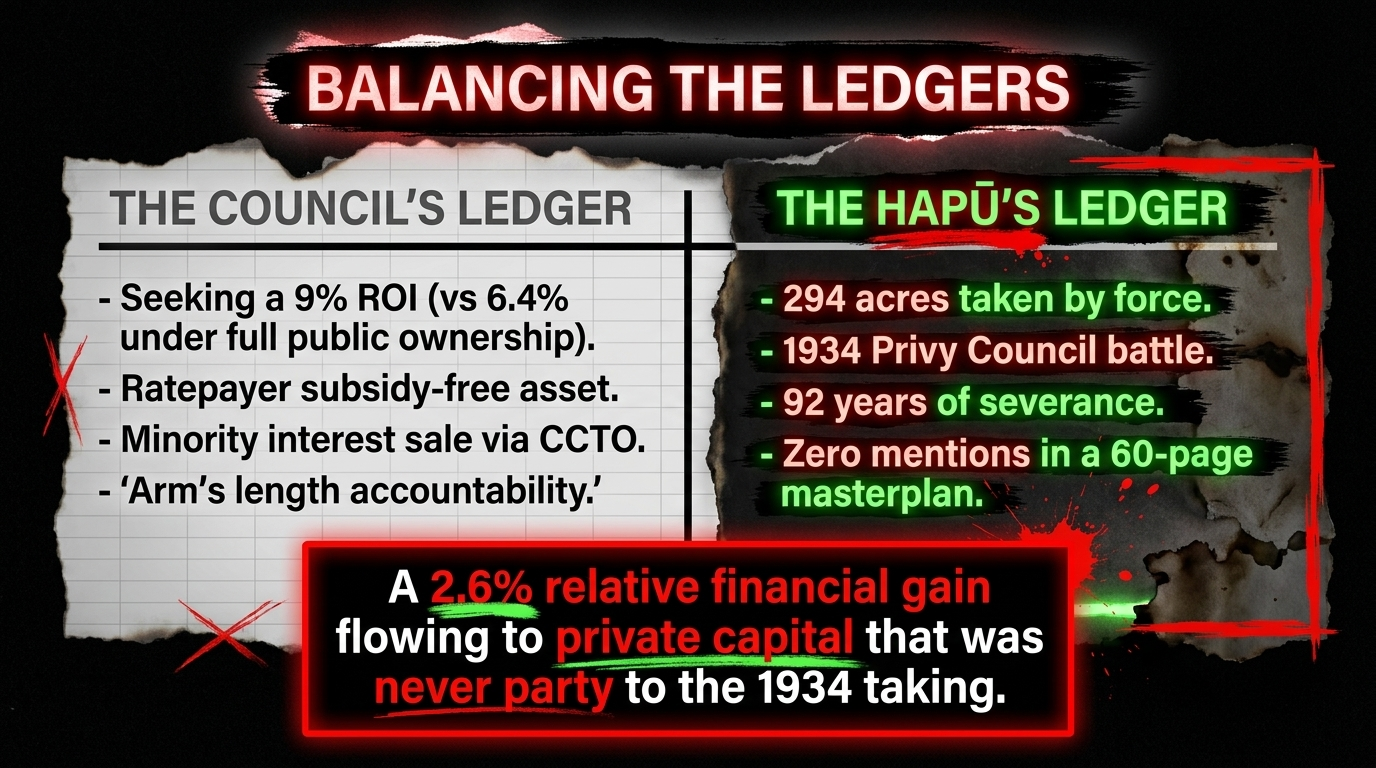
Ninety-two years on, on Tuesday 22 September 2026, this same council will vote — not on selling the airport outright, they insist, just on whether to spend months designing a commercial structure that could eventually let them sell part of it, as council's own notice confirms.
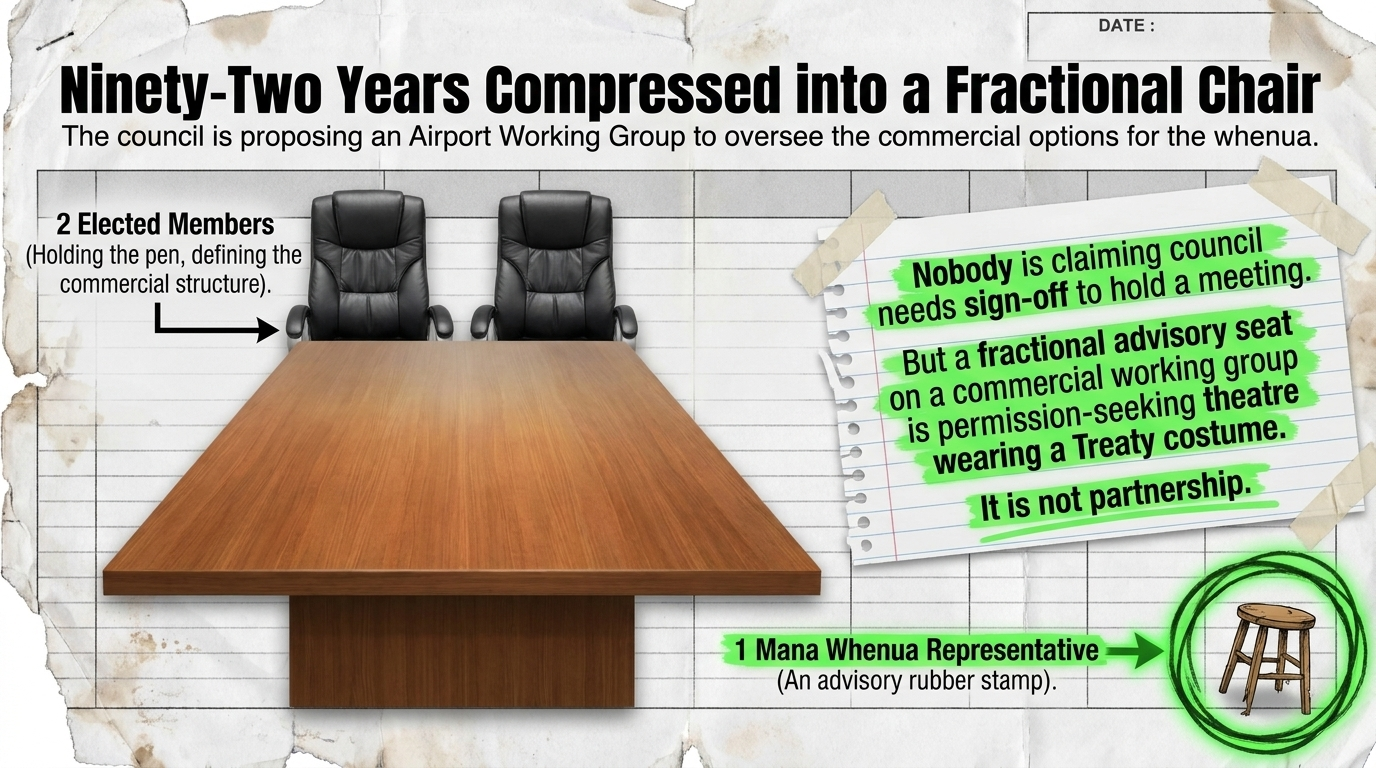
The advisory body they've built for this has two elected councillors and one seat — one — for mana whenua.
Ninety-two years of history compressed into a fractional chair at a table council still controls entirely.
Ngāi Tukairangi's own trust records that their original 1997 statement to the Waitangi Tribunal was about exactly this: "the alienation of land in the Whareroa Block for Tauranga Airport" under the Public Works Act 1928, lodged by Mahaki Ellis.
The Ngāi Te Rangi and Ngā Pōtiki Deed of Settlement confirms more than 4,100 acres of Ngāi Te Rangi land taken for public works district-wide, of which 294 acres went specifically to "Airport and Port Development," set out in the Crown's own settlement deed.
That historical legal claim was settled in 2013. I want to be scrupulously honest with you here — the legal account is closed, not the moral one. It sits inside the wider 1865 Tauranga Moana confiscation of 290,000 acres, a taking the Waitangi Tribunal itself branded "a grave injustice," where even the Tribunal's own dissenting member urged "generous redress," as the Tribunal's report records.
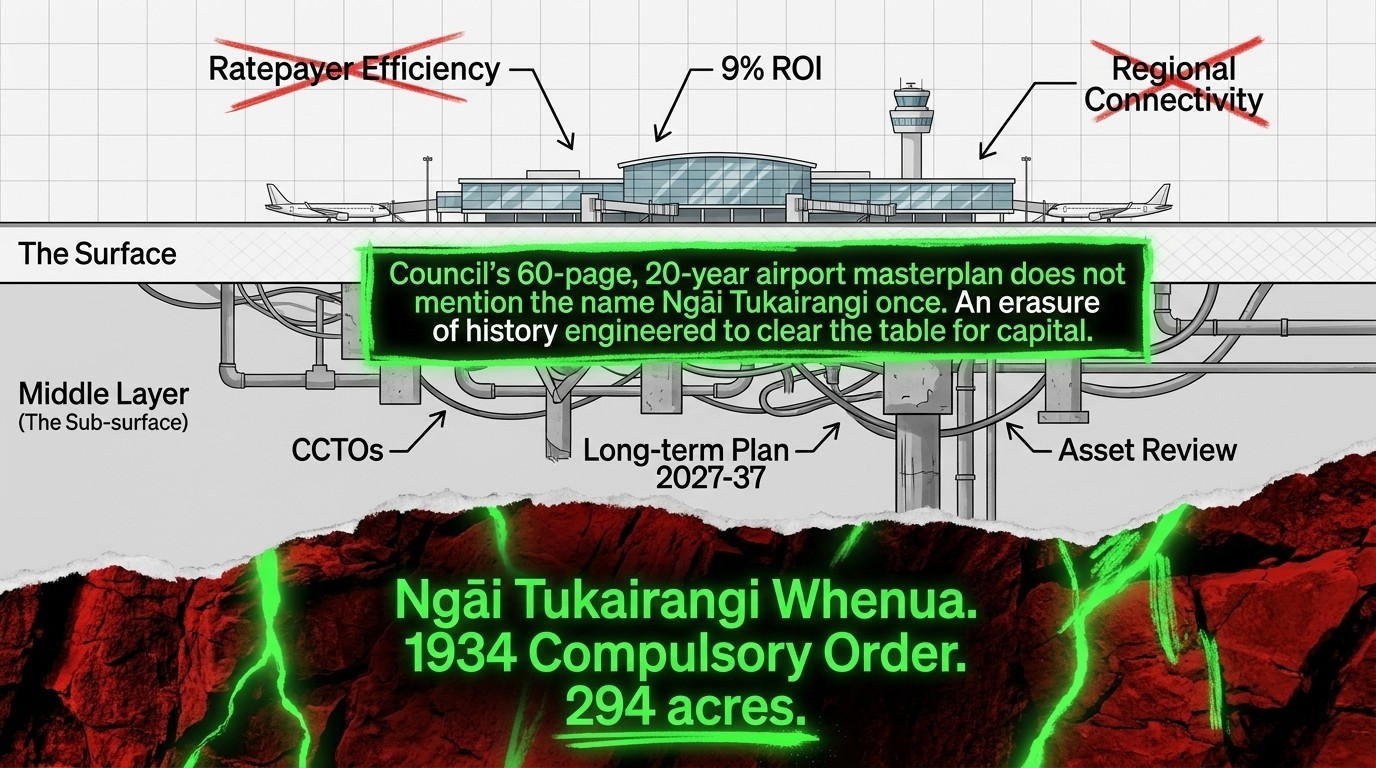
And here is the detail that should make every Tauranga ratepayer sit up: council's own twenty-year airport masterplan does not mention Ngāi Tukairangi by name once in its ownership or governance sections, confirmed by direct reading of the plan.
A hapū whose whenua built the runway is invisible in the document planning that runway's next two decades. That's not an accident in a sixty-page infrastructure plan. That is a decision about whose history is worth remembering when money is on the table.
A Council That Had No Elected Members For Three And A Half Years Is Now Lecturing You About "Governance"
Here's who's actually deciding this.
From February 2021 to July 2024 — over three years — Tauranga City Council had no elected representatives at all. The Minister of Local Government replaced the entire council with four unelected commissioners after finding the elected council's dysfunction serious enough to warrant total removal, confirmed on Beehive.govt.nz.
It was that unelected Commission — chaired by Anne Tolley, nobody's vote, nobody's mandate — that struck the Marine Precinct wharves deal: sold for $13.987 million with $9.5 million in vendor finance via a direct, non-competitive sale, its promised revenue-share agreement never delivered, $10.1 million still owed at 30 June 2026, and the whole mess now sitting in the Environment Court, laid out in full by Scoop.
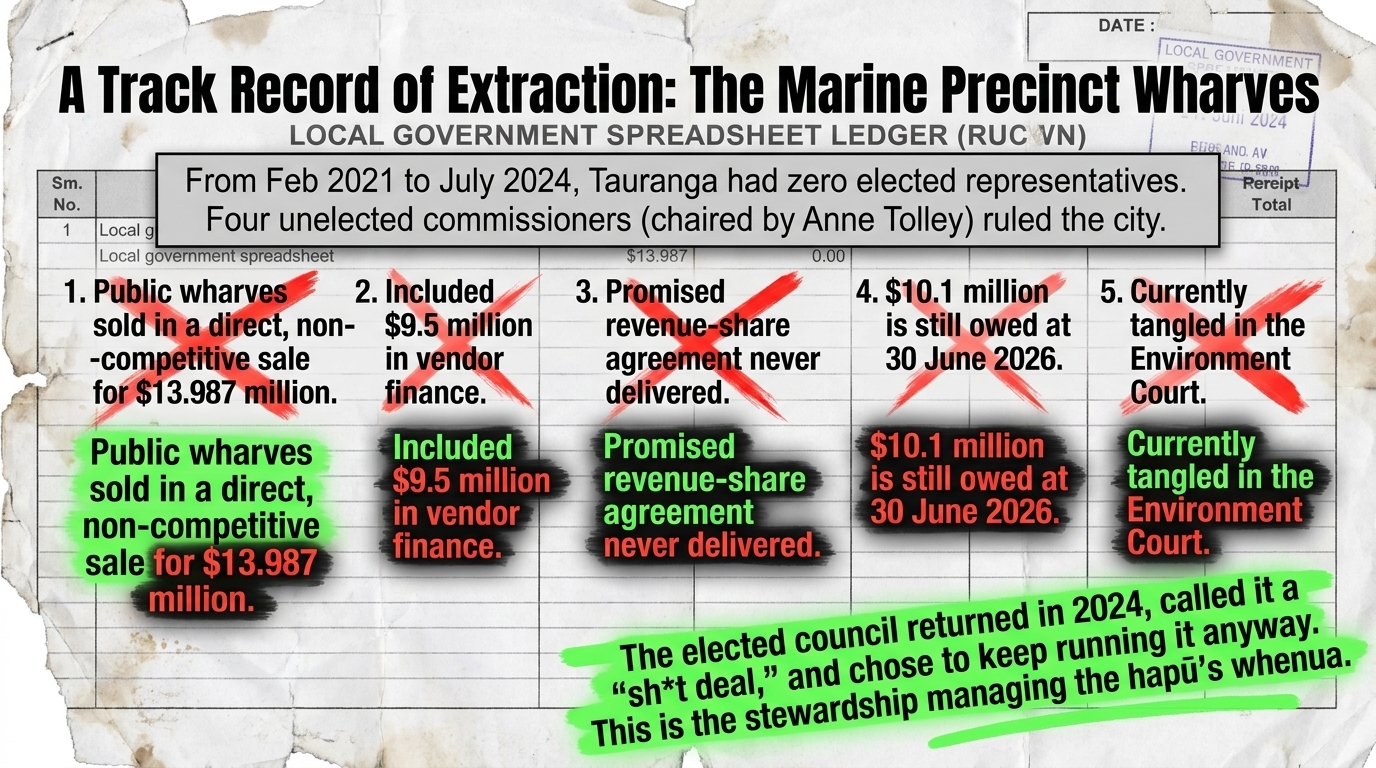
The elected council that finally took office in 2024 inherited this train wreck, had their own mayor publicly call it "a sh*t deal" — and chose to keep running it rather than cancel it when they had the legal chance to do so.
This is the council you're being asked to trust with a hapū's whenua.
The Deep Dive Podcast
Listen to a lively conversation between two hosts, unpacking and connecting topics in the sources of this essay. I apologise in advance for the AI's very harsh pronounciation of reo. Please dont shoot me, :).
Youtube Video
Like video? Here is a short video suppporting the essay. Again, don't shoot the messenger please because of AI's pronounciation. :)
Koha Consideration

You might ask who's paying The Māori Green Lantern to trace council minutes, court records, and Crown settlement deeds until 4am.
The answer is you do — or nobody does.
There are no corporates behind this mahi, no council retainer, no party funding — just koha, and whānau who believe Ngāi Tukairangi's story and Tauranga's ratepayers deserve a receipt-backed account of what's being done with their whenua and their rates. Every koha signals that rangatiratanga includes the power to support our own truth tellers, not just endure the ones the Crown and corporates pay for.
Kia kaha, whānau. Stay vigilant. Stay connected. And if you're able, consider a koha to keep this mahi going. If you're unable to koha, no worries — subscribe, follow, kōrero and share this with your whānau. That's koha in itself.
- Koha — Support directly: app.koha.kiwi
- Subscribe for essays: themaorigreenlantern.maori.nz
- Direct bank transfer: Ivor Jones, 03-1395-0099387-000
- Facebook: facebook.com/Themaorigreenlantern
Council Had A Pathway To Return Māori Land — And Let It Rot While A Developer Got A Deal
Read this and tell me it isn't rage-inducing.
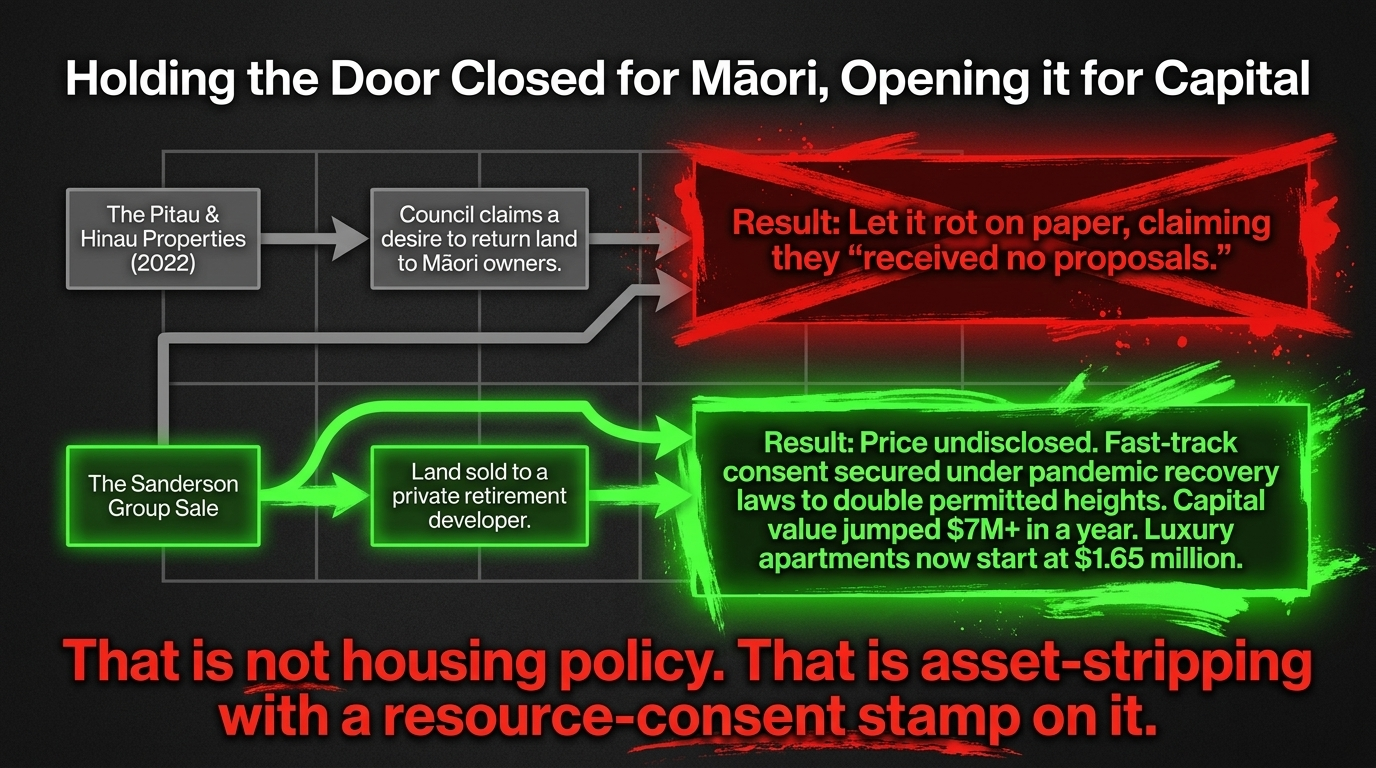
Council's own 2022 Tangata Whenua Committee agenda recorded, in black and white: "Return Pitau and Hinau properties to Māori owners… TCC has not received any proposals… TCC now has a conditional offer from Sanderson Group," documented in an open letter citing the council agenda directly.
Council held the return-to-Māori door open on paper, blamed the silence on a lack of "proposals," and let a private retirement developer walk through instead. The Sanderson sale price was never disclosed — unlike the $17.2 million plus $32.4 million redevelopment package published for the seven villages sold to Kāinga Ora.
Within a year, that site's capital value jumped by more than $7 million, and the buyer secured fast-track consent — under legislation built for pandemic economic recovery, not routine property speculation — to build towers nearly double to more than double the previously permitted height. Apartments there start at $1.65 million.
That is not housing policy. That is asset-stripping with a resource-consent stamp on it.
While Offering One Hapū Seat, This Council Is Trying To Vote Out Your Only Elected Māori Voice
Sit with this timing.
In June 2026, councillors voted 8–1–1 to retain the Te Awanui Māori ward — but that decision triggers a binding public referendum on whether it should survive at all, confirmed by Te Ao Māori News.
So at the exact moment council offers a single advisory seat on a commercial airport working group, it is also letting the city vote on whether Māori keep the one seat they actually elect.
This is not coincidence — it is the national pattern.
Twenty-six councils have already scrapped Māori wards, a 57.1 percent removal rate against referendum councils, exactly as I documented in The Māori Green Lantern's own earlier essay on this coalition's assault on Māori local democracy.
Every one of these referenda exists because this National-ACT-NZ First coalition forced them into law, reversing what took Māori communities decades to build.
The Law They're Hiding Behind Asks Almost Nothing Of Them
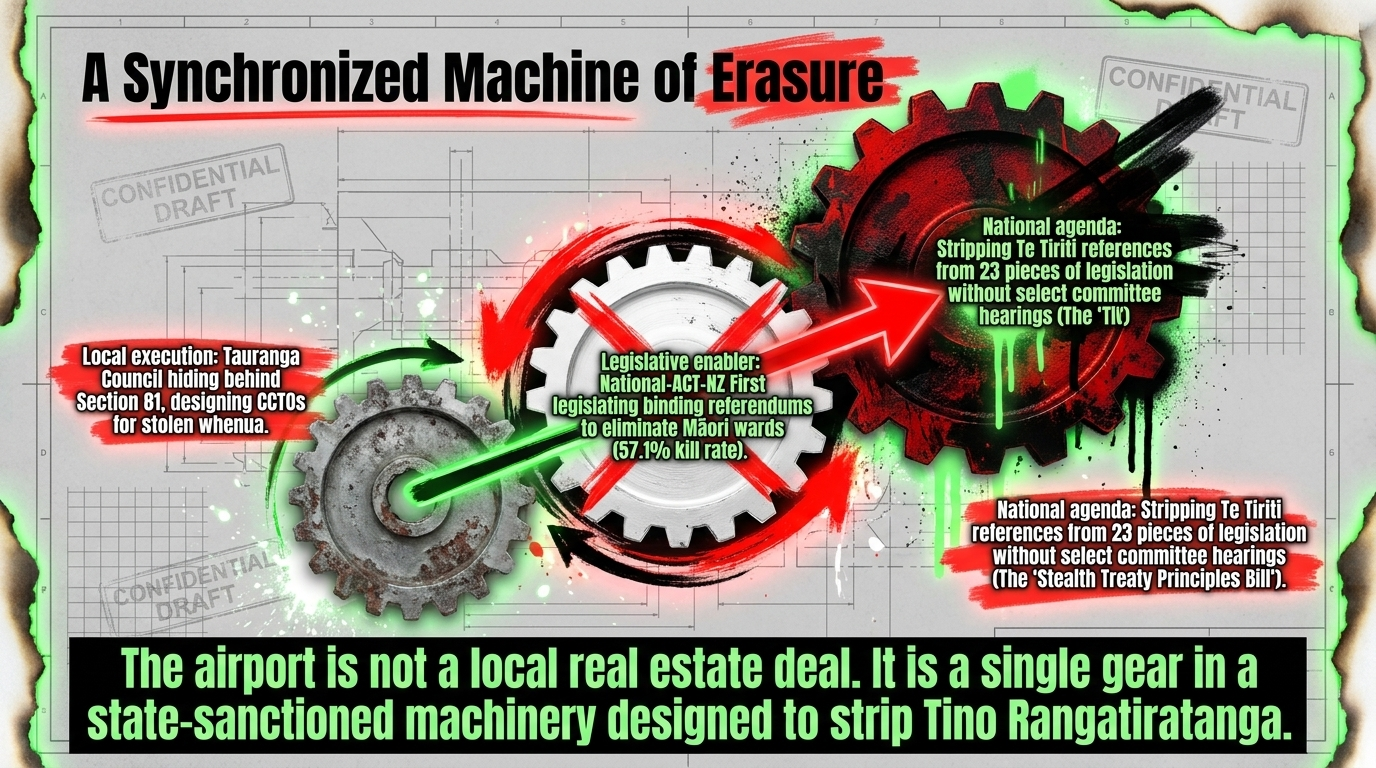
Here's the part that should make you furious at the statute book itself.
Section 81 of the Local Government Act 2002 requires councils only to "establish and maintain processes" and "consider ways" to include Māori — there is no legal duty to consult.
The High Court confirmed this directly in Te Rūnanga o Ngāti Whātua v Kaipara District Council 2024 NZHC 3889, following the Court of Appeal's earlier ruling in Wellington City Council v Minotaur Custodians Ltd 2017 NZCA 302, as set out by Brookfields Lawyers' case analysis.
One fractional seat clears that legal bar with room to spare. It does not clear a moral one. Legal and tika are not the same word, and a council treating the statutory floor as its moral ceiling — on whenua taken from a hapū that fought to the Privy Council — is choosing the minimum on purpose.
Three Examples For The Western Mind
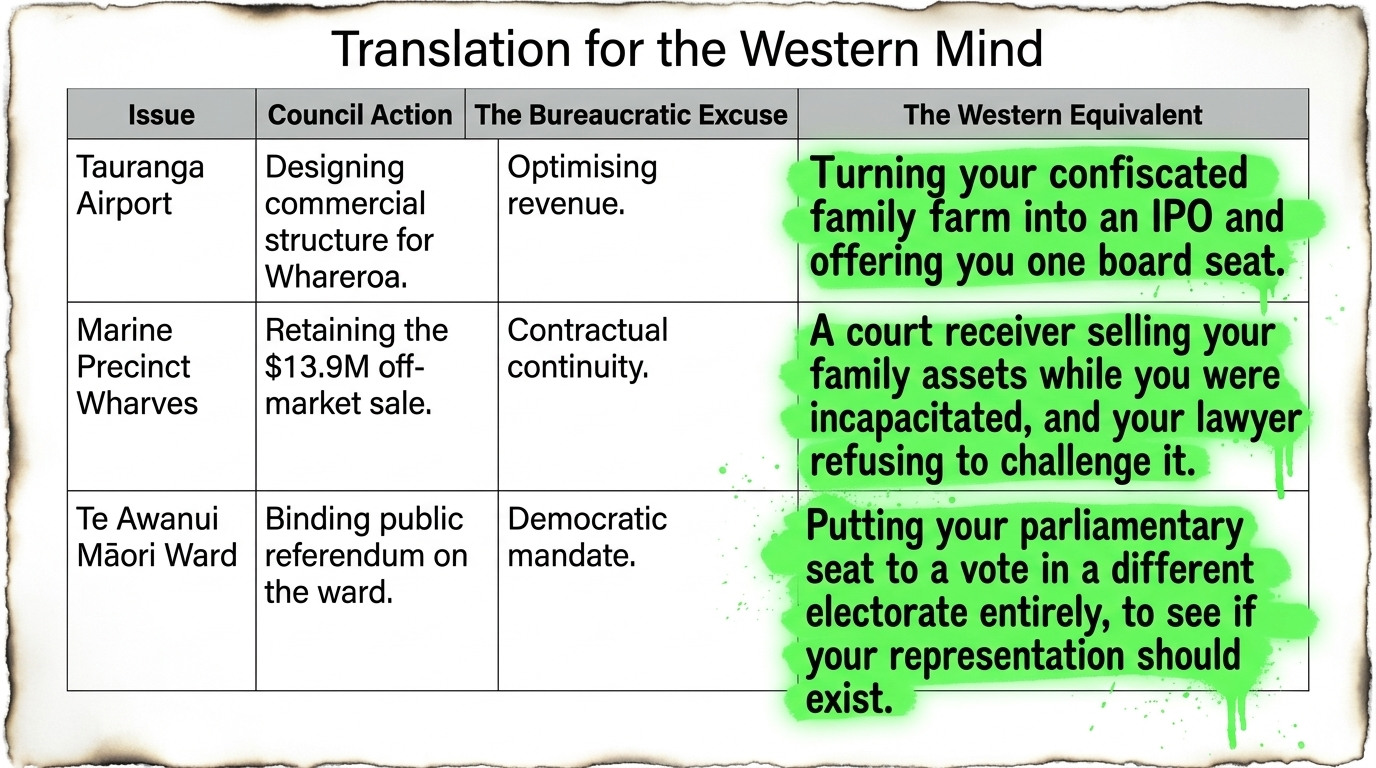
Example One — The Airport
Core claim: council is designing a commercial ownership structure for whenua taken by force from Ngāi Tukairangi, with that hapū given one seat on a two-councillor advisory body.
Quantified harm: a 100 percent council-owned, self-funding, ratepayer-subsidy-free asset is being examined for partial sale to private capital that returns roughly 9 percent on assets versus 6.4 percent under full public ownership — a 2.6 percentage point, or 40.6 percent relative, gain that would flow partly to shareholders who were never party to the 1934 taking, per TDB Advisory's own comparative data.
Solution: no CCTO or capital-raising recommendation should proceed without direct, resourced Ngāi Tukairangi representation — not one seat, genuine partnership — and independent tikanga advice chosen jointly with the hapū.
Tikanga impact for the Western mind: imagine your family's confiscated farm being turned into a listed company by the people who took it, and being offered one seat on the board that decides how — that is the precise structural insult here, translated into the language of shareholder capital.
Example Two — The Wharves
Core claim: unelected commissioners sold public wharves off-market for $13.987 million, with $9.5 million in vendor finance never fully repaid and $29.2 million in ratepayer money committed to rebuild them, as Scoop's investigation confirms.
Quantified harm: $10.1 million still owed at 30 June 2026, plus ongoing Environment Court legal costs, all funded from the same rates base used to justify further sell-offs "for efficiency."
Solution: any future asset disposal negotiated by unelected commissioners should require automatic re-ratification — with a public vote of confidence — once elected representatives return to office, rather than simply being inherited and continued.
Tikanga impact for the Western mind: this is the equivalent of a court-appointed receiver selling your family's assets while you were legally incapacitated, and then your own lawyer, once reinstated, refusing to challenge the sale — a stewardship failure compounding a legal one, and one I've traced at national scale in my earlier essay on the coalition's privatisation pipeline.
Example Three — The Ballot Box
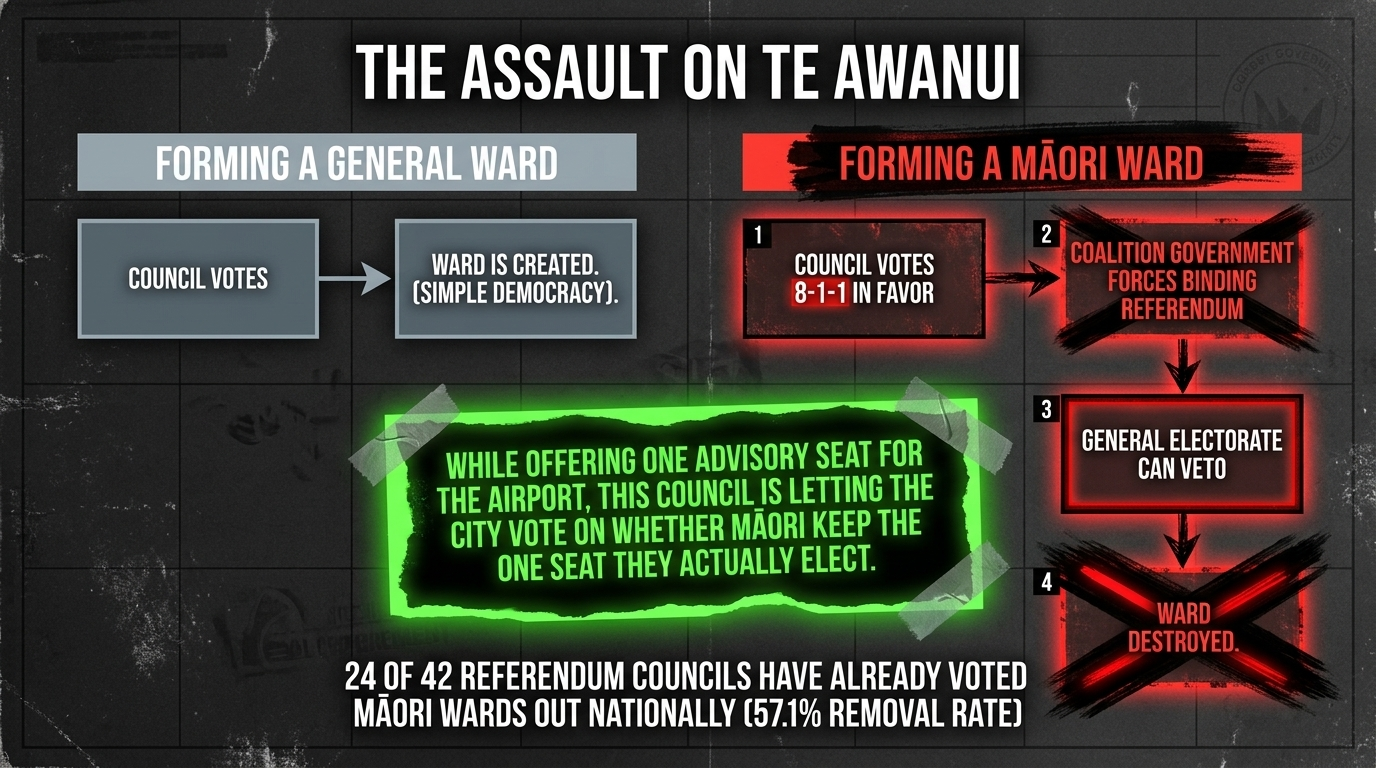
Core claim: this coalition government legislated binding referenda that let general electorates vote on whether Māori wards survive, a mechanism no other ward type in New Zealand faces.
Quantified harm: 24 of 42 referendum councils have already voted Māori wards out nationally — a 57.1 percent removal rate — with Tauranga's own Te Awanui ward now facing exactly that vote.
Solution: repeal the binding-referendum requirement and restore councils' own authority to establish Māori wards without a popular veto unavailable to any general ward.
Tikanga impact for the Western mind: picture your parliamentary electorate being put to a vote of a different electorate entirely, on whether your seat should keep existing — that is the precise mechanism being used against Māori representation in this country, right now, in your own city.
Why This Coalition Government Does Not Deserve Your Vote In November
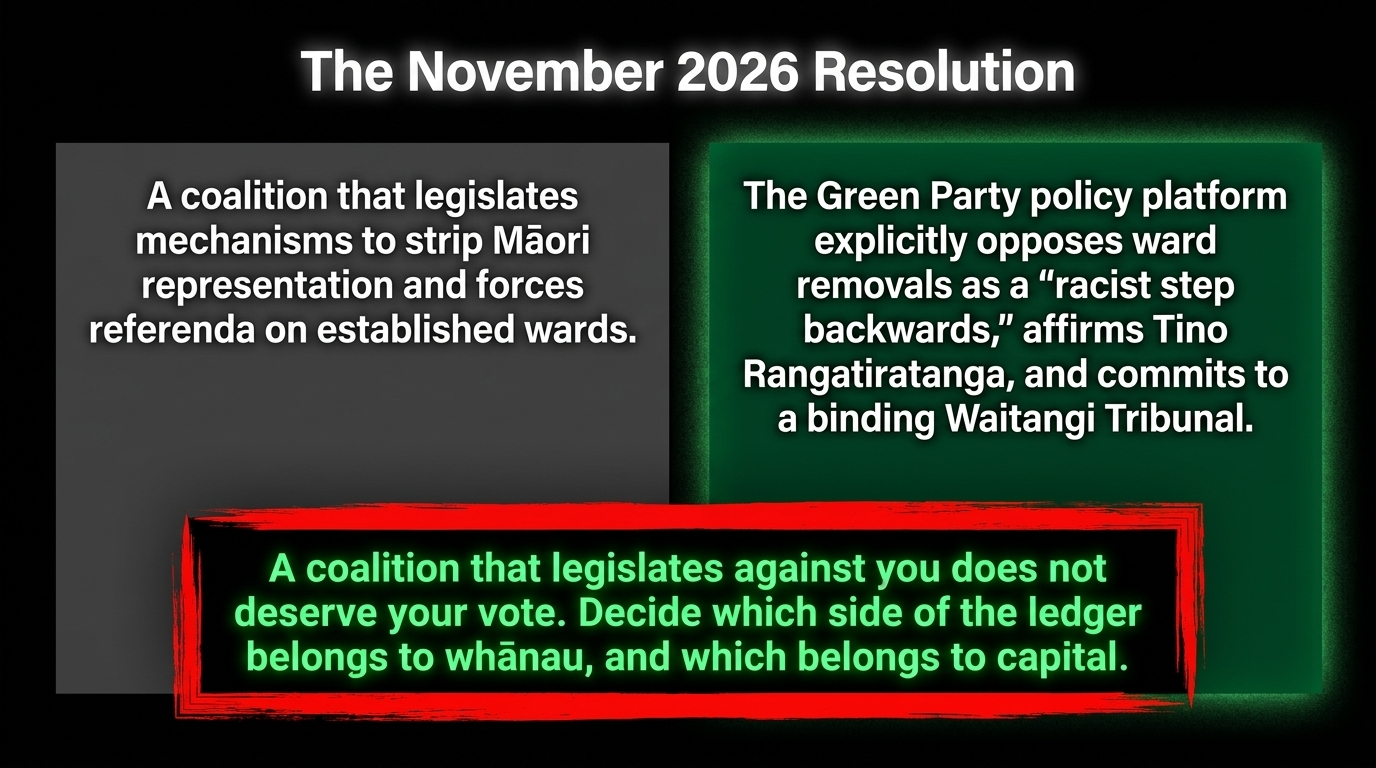
I will not pretend to be neutral about this, whānau, because neutrality in the face of documented harm is its own kind of lie.
This National-ACT-NZ First coalition entered office with agreements committing to force binding Māori ward referendums, to advance the Treaty Principles Bill, and — after Parliament voted that bill down 112 to 11 in the face of 42,000 submissions and the largest protest march in a generation — to achieve the same outcome by stealth, stripping Te Tiriti references from up to 23 pieces of legislation without a single day of select committee hearing on those specific changes, exactly as I documented when it happened.
The Green Party's own co-leader Marama Davidson called this "the Stealth Treaty Principles Bill" and said plainly that "New Zealanders didn't want the Treaty Principles Bill, and they sure don't want it by stealth," as reported directly on the Green Party's own site.
That is opinion from a named political leader, offered with the factual basis stated in the same sentence — and it is an opinion I share.
The Green Party's Te Tiriti policy affirms tino rangatiratanga as constitutionally foundational, commits to fully resourcing the Waitangi Tribunal with binding decision-making authority, and explicitly opposes the removal of Māori wards as "a racist step backwards for Māori representation" that "disregards Te Tiriti o Waitangi," set out in the party's own policy platform and reiterated by their Māori Development spokesperson Hūhana Lyndon.
That is a specific, checkable policy contrast, not a vibe. A coalition that legislates the mechanisms stripping Māori representation, against a party that has spent this term opposing exactly those mechanisms in Parliament and on the record
— that is the choice in front of you this November, and I am telling you plainly which side of that ledger belongs to whānau, and which side belongs to whoever gets to buy a piece of Tauranga Airport once the paperwork is done.
One Seat Is Not Rangatiratanga
Nobody is claiming council needs Ngāi Tukairangi's sign-off to hold a meeting.
What I am claiming — with the taking on a Privy Council record, the hapū named in their own trust's history, the masterplan that erases them, three and a half years of unelected rule still shaping today's deals, a referendum threatening the one Māori seat this city actually elects, and a statute that asks for almost nothing
— is that a fractional advisory seat is not partnership.
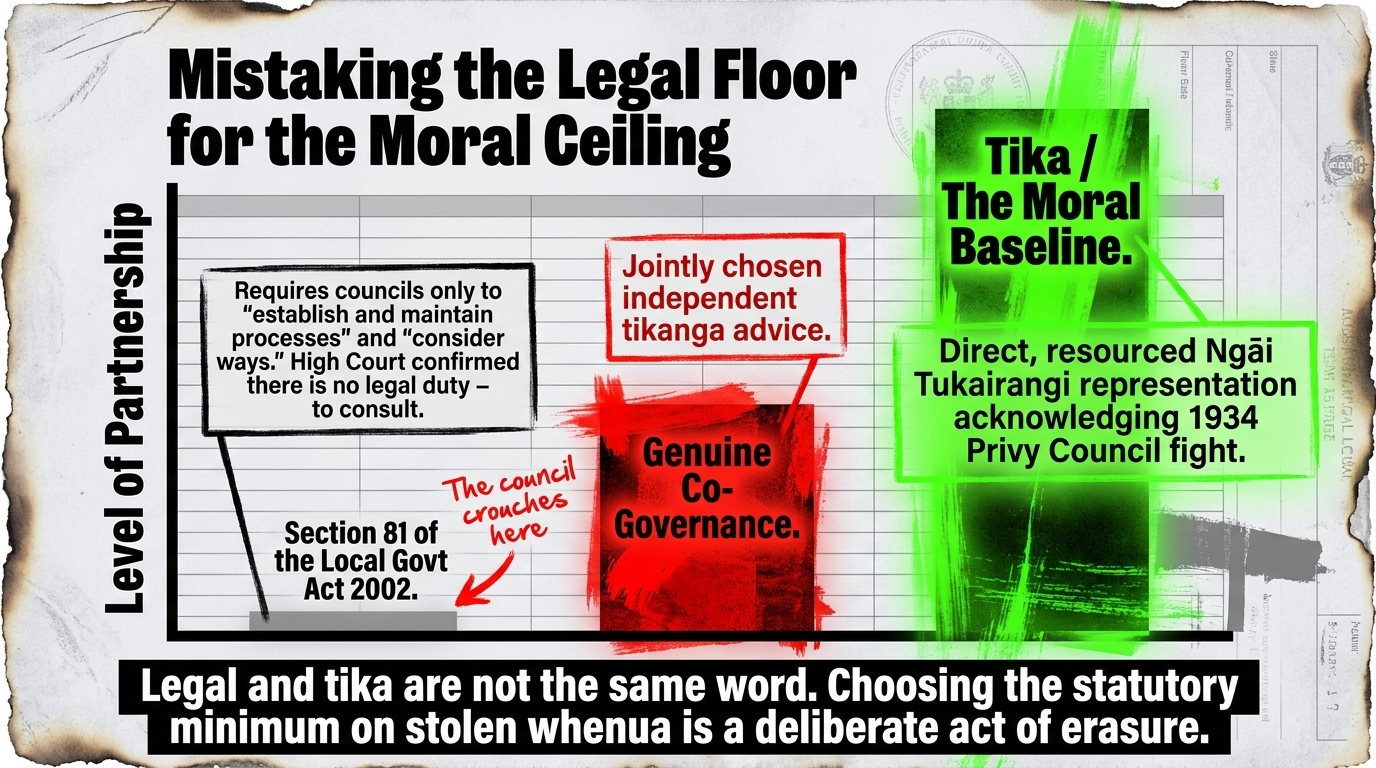
It is permission-seeking theatre wearing a Treaty costume, built on a legal floor deliberately mistaken for a moral ceiling.
Ngāi Tukairangi fought this taking to the highest court the Crown could offer them in 1934, and lost. Ninety-two years later, they deserve more than a third of a voice on a working group that doesn't even hold the pen
— and every Māori voter in this country deserves a government that doesn't legislate their representation into a popularity contest.
Disclaimer: This essay is opinion and analysis grounded in verified, cited public-record sources, published in the public interest concerning the conduct of public bodies and elected officials in their public capacity. No criminal conduct or dishonesty is alleged against any named individual; characterisations of government policy as "white supremacist" or "neoliberal" are the author's stated opinion, offered with the specific factual basis set out in the same paragraph, consistent with prior published analysis on this platform. Right of reply: any organisation or official named may respond; private individuals named have 48 hours from publication to seek correction. Retraction protocol: any factual error identified post-publication will be corrected transparently with a dated note appended.