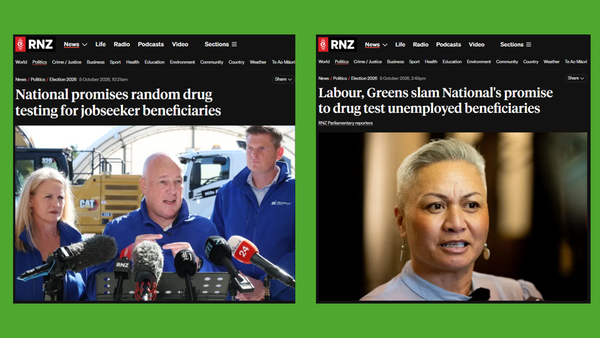
"THE PRIME MINISTER'S AMNESIA" - 6 June 2026
How Christopher Luxon's Office Concealed Corporate Climate Lobbying — And What the Evidence Shows

Kia ora koutou katoa,
Two corporate polluters hand-delivered draft legislation to the Prime Minister's chief adviser. The documents were hidden from the courts and the public. The law changed exactly as requested. The Ombudsman and the Department of Internal Affairs are now both investigating. Christopher Luxon says he knew nothing. The evidence says otherwise.
The Lesson He Refuses to Learn
There is a particular kind of powerful man who, when caught out by documented evidence of serious failures within his own office, does not investigate, does not apologise, and does not explain. He calls it a "teachable moment."
That man is Christopher Luxon.
On 2 June 2026 — after months of denials, after the Ombudsman launched an investigation, after the Department of Internal Affairs announced a review of his former chief adviser's IT accounts, after a High Court judge ordered the public release of lobbying documents that had been concealed from two separate OIA requests, after Fonterra confirmed it had sent a corporate lobbying document to the PM's chief adviser's private Gmail account at the staff member's own request — Luxon stood before the media and said it was
"a good teachable moment, to remind staff of their obligations."
Let us name precisely what is verified and what it means.
The Verified Record
Every element below is drawn from court records, official documents, and verified reporting by RNZ/1News and The Spinoff.
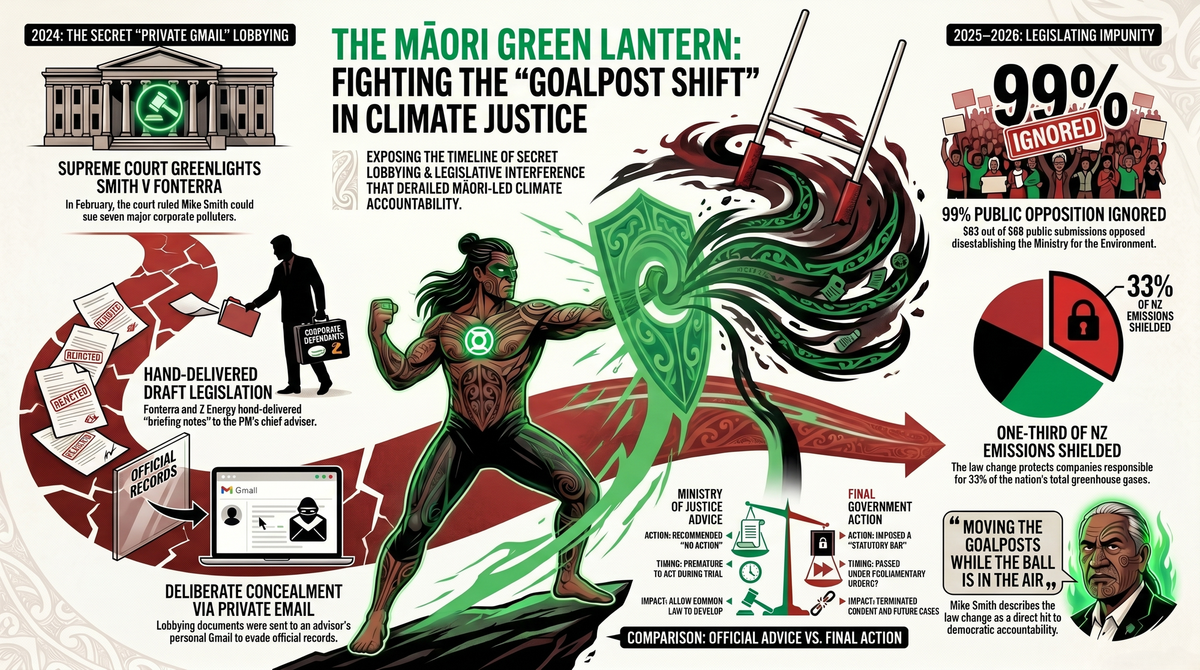
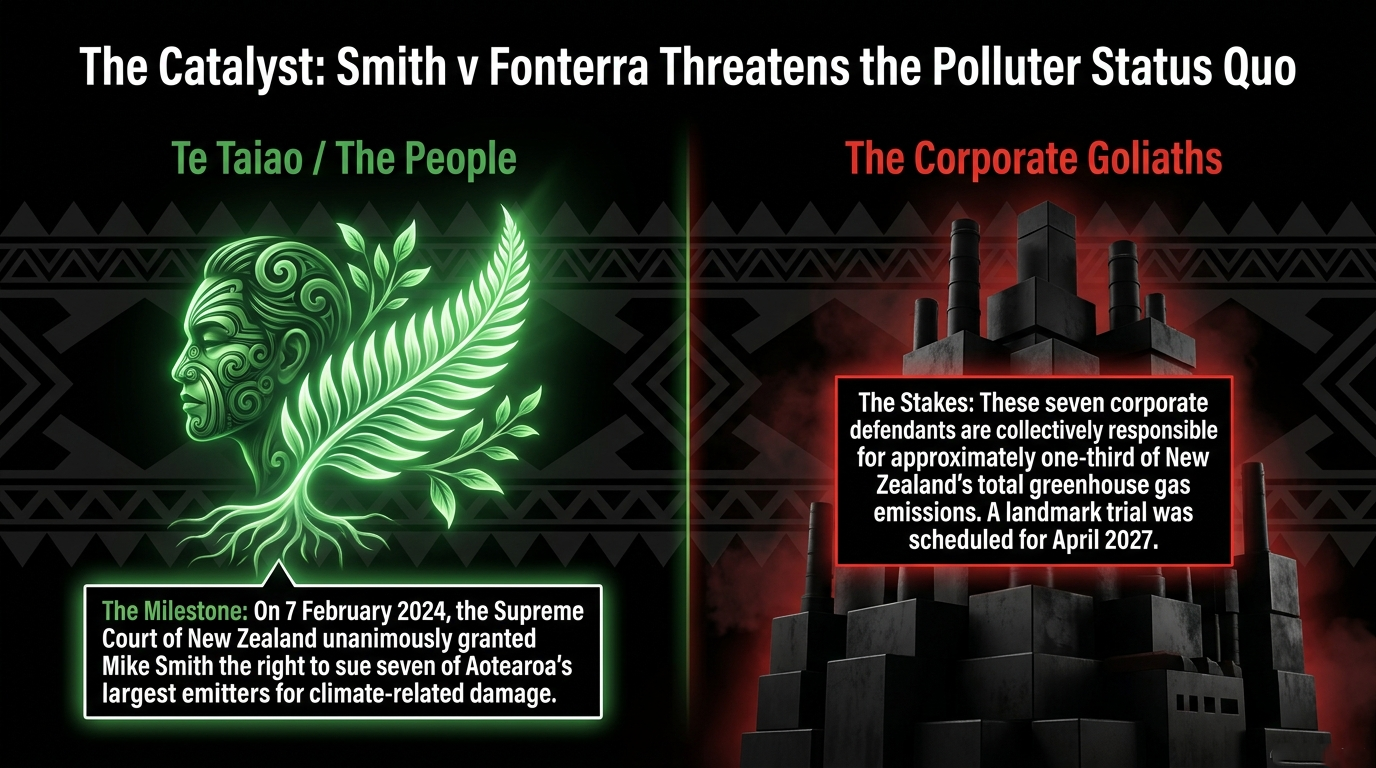
7 February 2024: The Supreme Court of New Zealand — unanimously — ruled that Māori climate activist Mike Smith had the right to sue seven of Aotearoa's largest emitters — including Fonterra, Z Energy, Genesis Energy, New Zealand Steel, Dairy Holdings, Channel Infrastructure, and BT Mining — for climate-related damage to his whenua and moana. Those seven defendants are collectively responsible for approximately one third of New Zealand's greenhouse gas emissions. This overturned strike-out applications that had twice succeeded at the High Court and Court of Appeal. A full trial was scheduled for April 2027.
23 February 2024: Justice Minister Paul Goldsmith received Ministry of Justice advice on a possible legislative response to the Supreme Court decision. The advice was withheld.
6 March 2024: Attorney-General Judith Collins wrote to ministers proposing "a statutory bar on climate change tort proceedings" as "the most straightforward" option available to government.
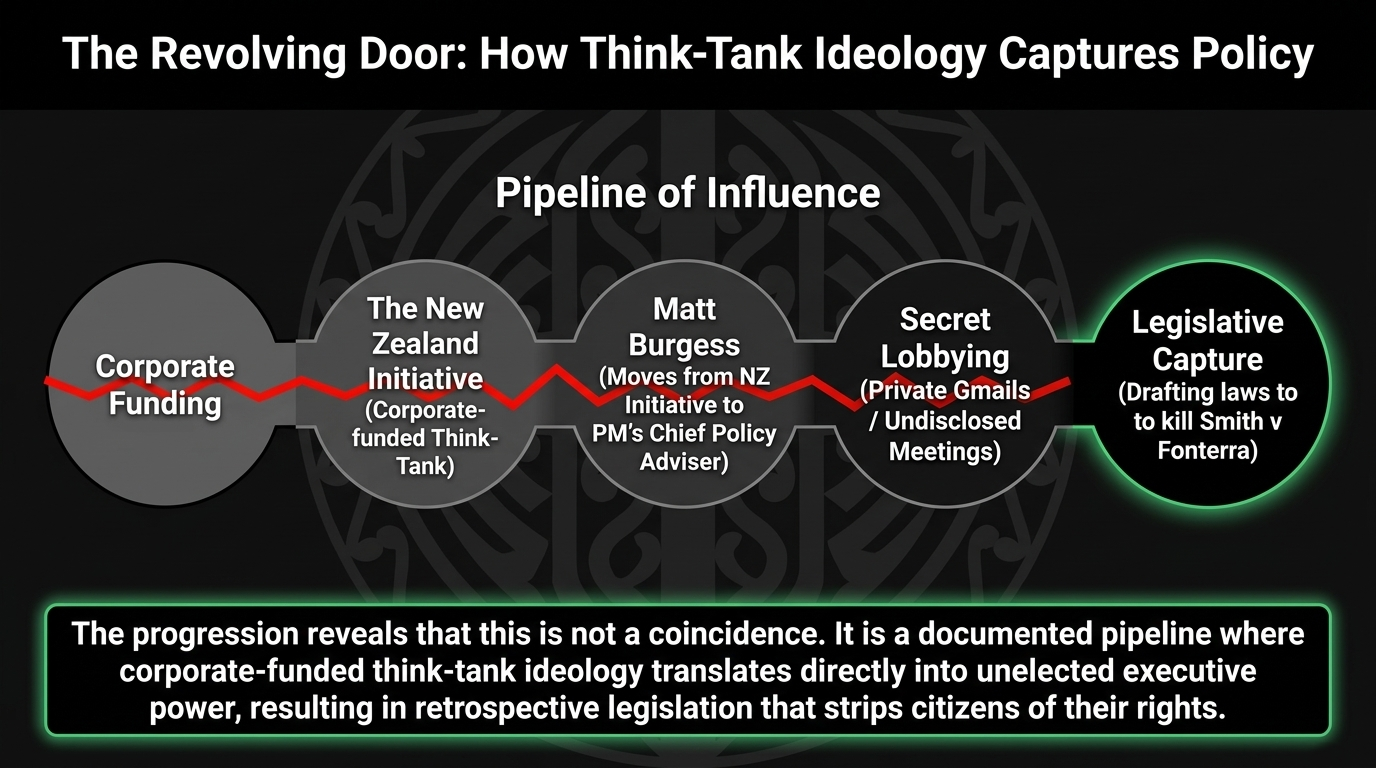
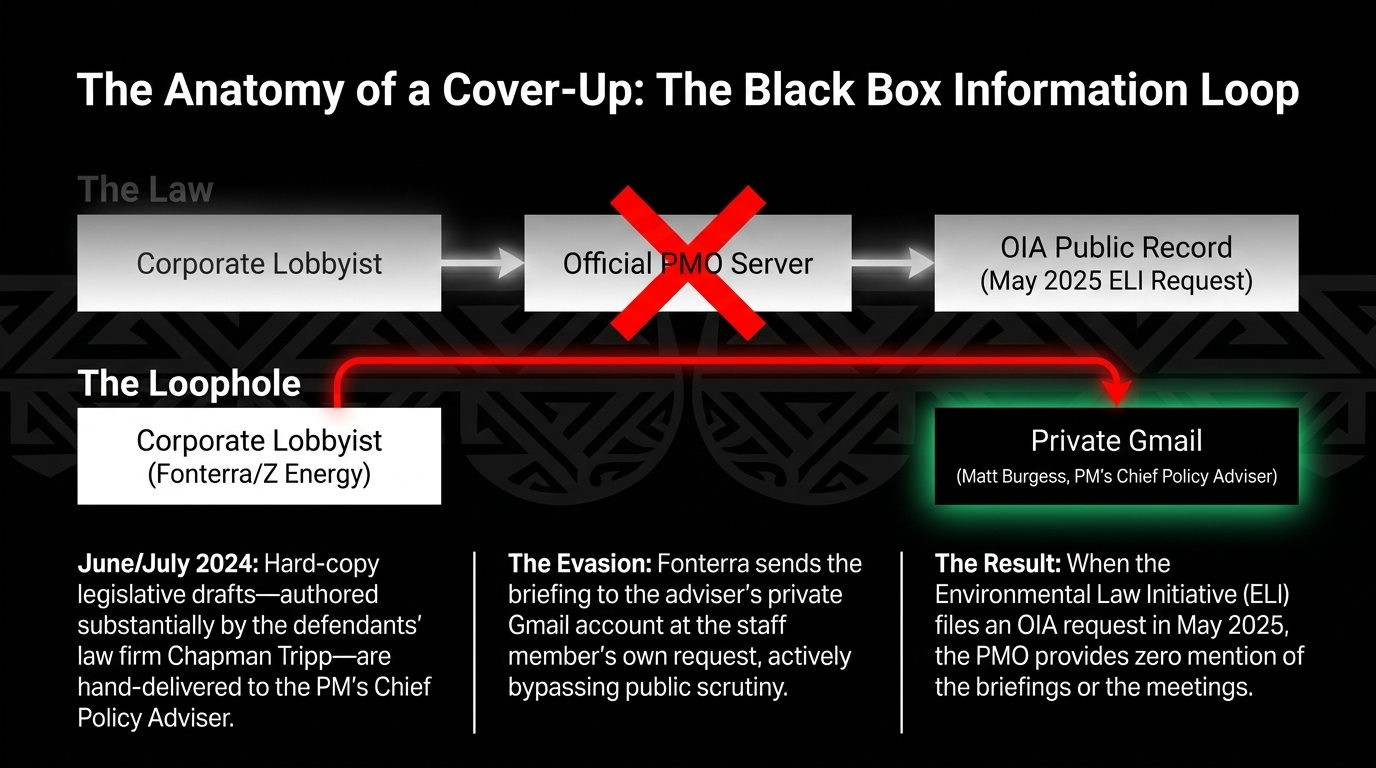
On or around 26 June 2024: A member of Fonterra's government affairs team printed a hard-copy briefing note and hand-delivered it to Matt Burgess, the PM's chief policy adviser, at the Prime Minister's Office. The document — drafted substantially by Chapman Tripp, the law firm acting for the defendants — argued that legislative intervention was "critical" and proposed a specific two-sentence amendment to the Climate Change Response Act 2002 that would "resolve the uncertainty and risks posed by private law claims like Mr Smith's."
🎙️ The Deep Dive Podcast
Listen to a lively kōrero between two hosts unpacking the full Luxon PMO lobbying scandal — the private Gmail, the missing documents, the Ombudsman, the NZ Initiative pipeline, Mike Smith's six-year fight, the defunding of the Māori Climate Platform, and what it all means for democracy and Māori sovereignty in Aotearoa. (He mihi whakamāui: I apologise in advance for the AI's treatment of te reo Māori pronunciation. Please don't shoot the messenger! 😅)
🎧 Listen: "The Prime Minister's Amnesia" — The Deep Dive (Available at themaorigreenlantern.maori.nz)
On or around 24 July 2024: A member of Z Energy's government affairs team hand-delivered the same or a substantially similar document to the same adviser.
Separately, in 2024: Fonterra also sent the briefing document to Burgess's private Gmail account — at the staff member's own request. This ensured it would not appear in official records or OIA responses. Fonterra has acknowledged this was "not appropriate, nor consistent with its own policies." As reported by RNZ/1News, Luxon stated the conduct "has definitely not met the high standard that I have of staffers in the Beehive."
26 March 2025: Dr Matt Hall of the Environmental Law Initiative (ELI) filed an OIA request to the PMO specifically seeking all documents, meetings, and discussions concerning Smith v Fonterra.
21 May 2025: The PMO's response provided "a limited set of heavily redacted emails and text messages." It contained zero mention of the Fonterra or Z Energy briefing notes, and zero mention of meetings between those companies and the PMO. The Ombudsman later confirmed it was investigating a complaint from ELI regarding the "apparent withholding" of official information by the PM's office.
4 June 2025: Ministry of Justice officials recommended that "no action be taken on the reform of the tort of public nuisance at this stage," stating it would be "premature to consider policy reform while relevant court proceedings are still underway."
18 June 2025: Justice Minister Goldsmith overrode his own ministry's advice, instructing officials to develop a "statutory bar on emissions-related claims."
October 2025: Matt Burgess departs the PMO. No explanation has been provided. Luxon has refused all questions on the circumstances of his departure; reasons unverified.
27 March 2026: The High Court's deadline for defendants to disclose lobbying documents including the briefing note. The document was not disclosed by the deadline.
21 April 2026: The Regulatory Impact Statement confirmed officials had found no clear evidence that Smith's case had actually affected business confidence — the government's stated rationale for the law change. The Ministry of Justice's preferred option of no statutory intervention remained unchanged.
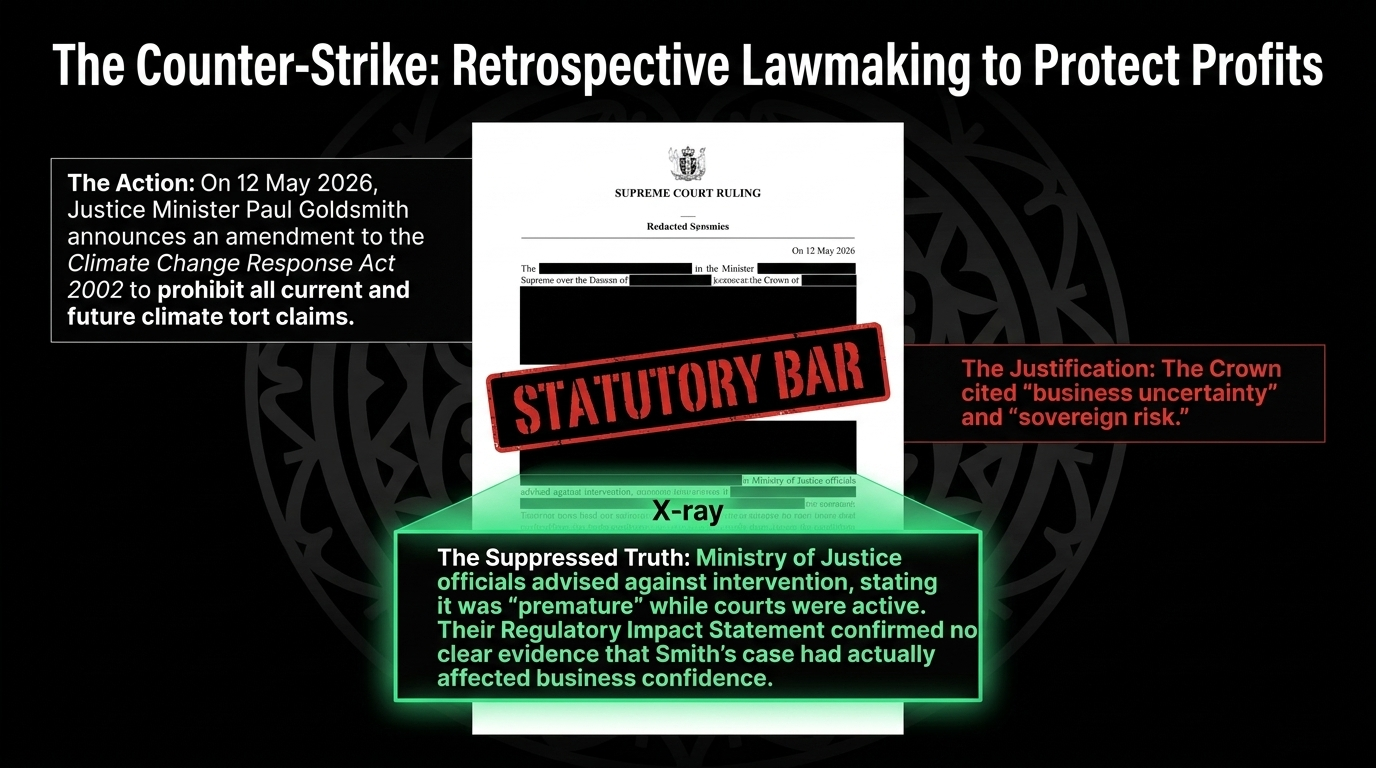
12 May 2026: Justice Minister Goldsmith announced the government would amend the Climate Change Response Act to prohibit all climate tort claims — current and future — ending Smith's case before it could reach trial.
14–19 May 2026: Smith's lawyers raised concerns about the failure to disclose lobbying documents. Fonterra and Z Energy eventually produced a copy of the briefing note — then immediately claimed confidentiality.
21 May 2026: Justice Andrew ruled confidentiality was "not sustained" and ordered immediate public release.
24 May 2026: The PMO stated it had been made aware of the briefing notes and meetings "through the media" and had "no record of either on file."
26 May 2026: The Ombudsman confirmed investigation into ELI's complaint about apparent withholding of official information by the PMO. The same day, Luxon confirmed in Parliament that the person who received the briefing note had "left a while ago." Burgess had reportedly been gone since October 2025 — approximately seven months.
28 May 2026: Mike Smith wrote to the Prime Minister requesting an urgent meeting on the law change and the PMO's handling of lobbying by defendants. As of publication, no meeting has been convened.
2 June 2026: The private Gmail revelation was reported by RNZ. The Department of Internal Affairs announced it would review Burgess's IT accounts to ensure material had been saved to the public record.
The Questions the Record Raises
The following are not allegations. They are questions directly produced by the verified timeline above. They have been raised by the Opposition, the Green Party, Transparency International NZ, and multiple journalists. They have not been answered.
One. The PMO responded to an OIA request in May 2025 specifically seeking information about meetings and documents relating to Smith v Fonterra. That OIA response contained no reference to either the Fonterra or Z Energy briefing notes — or to the meetings at which they were delivered. As RNZ's reporting confirmed, the briefing note was received. It was not disclosed. Why?
Two. The briefing note was routed through a private Gmail account at the staff member's own request. Former Green MP and public law expert Kevin Hague described it thus on public record: "Fonterra and Z sent their lobbying to Matt Burgess' personal email address in order to try to avoid public scrutiny; they were given that address by Burgess himself." As RNZ/1News confirmed, Fonterra acknowledged sending to the private email was "at the staff member's request."
📺 YouTube Video
Like video? Here is a short video walking through the full timeline — from the Supreme Court win in February 2024 to Luxon's "teachable moment" in June 2026. Every date. Every name. Every concealment. (The AI's reo pronunciation remains a work in progress. We are learning together. 😅)
📺 Watch: "THE PRIME MINISTER'S AMNESIA" - 6 June 2026 (The Māori Green Lantern YouTube channel)
Three. Ministry of Justice officials advised — twice — against legislative intervention while court proceedings were active. Their own Regulatory Impact Statement found no clear evidence that Smith's case had harmed business confidence. The Justice Minister overrode them anyway, producing legislation whose language is substantially aligned with the defendants' own briefing note. As researchers writing in The Conversation, cited by The Spinoff, argued: "Legislating away tort liability does not eliminate the cost — it transfers it to others, just as lax regulation of flood risk has imposed severe costs on councils, insurers and households."
Four. Burgess left the PMO in October 2025 — as High Court discovery proceedings were actively targeting lobbying documents from the defendants. No explanation for his departure has been provided. The DIA is now reviewing his IT accounts. What do those accounts contain?
Five. The Prime Minister says he had no record, no recollection of the meetings or documents. He also confirmed, when asked by TVNZ political reporter Benedict Collins, that he had not bothered asking Fonterra or Z Energy to resend the missing papers once the story broke in May 2026. As reported by The Spinoff.
As Mike Smith put it to 1News/RNZ:
"What did he know about this lobbying and when did he know it?"
Luxon has not answered that question.
Three Examples for the Western Mind
One: The Defendants Wrote the Law That Killed Their Own Case
What happened: Corporate defendants in an active Supreme Court-endorsed case hand-delivered a draft legislative amendment to the PM's chief adviser. Their own law firm largely drafted it. The government then passed a law that — in the words of The Spinoff — is "substantially similar in intention" to what the briefing proposed.
Quantified harm: Smith's case had run for six years. The defendants — collectively responsible for approximately one third of New Zealand's greenhouse gas emissions — faced a landmark trial scheduled for April 2027. That trial is now stopped before it began. As The Conversation researchers noted, cited by The Spinoff: those who "profit most from more lax climate policy would be insulated from paying their share" of damage costs, which would instead "be transferred to others."
Solution: Repeal the amendment. Restore Smith's right of action. Mandate that all lobbying contact with ministers and advisers — including hard copy and private email — is registered in real time on a public register, as exists in Australia, the UK, and the EU.
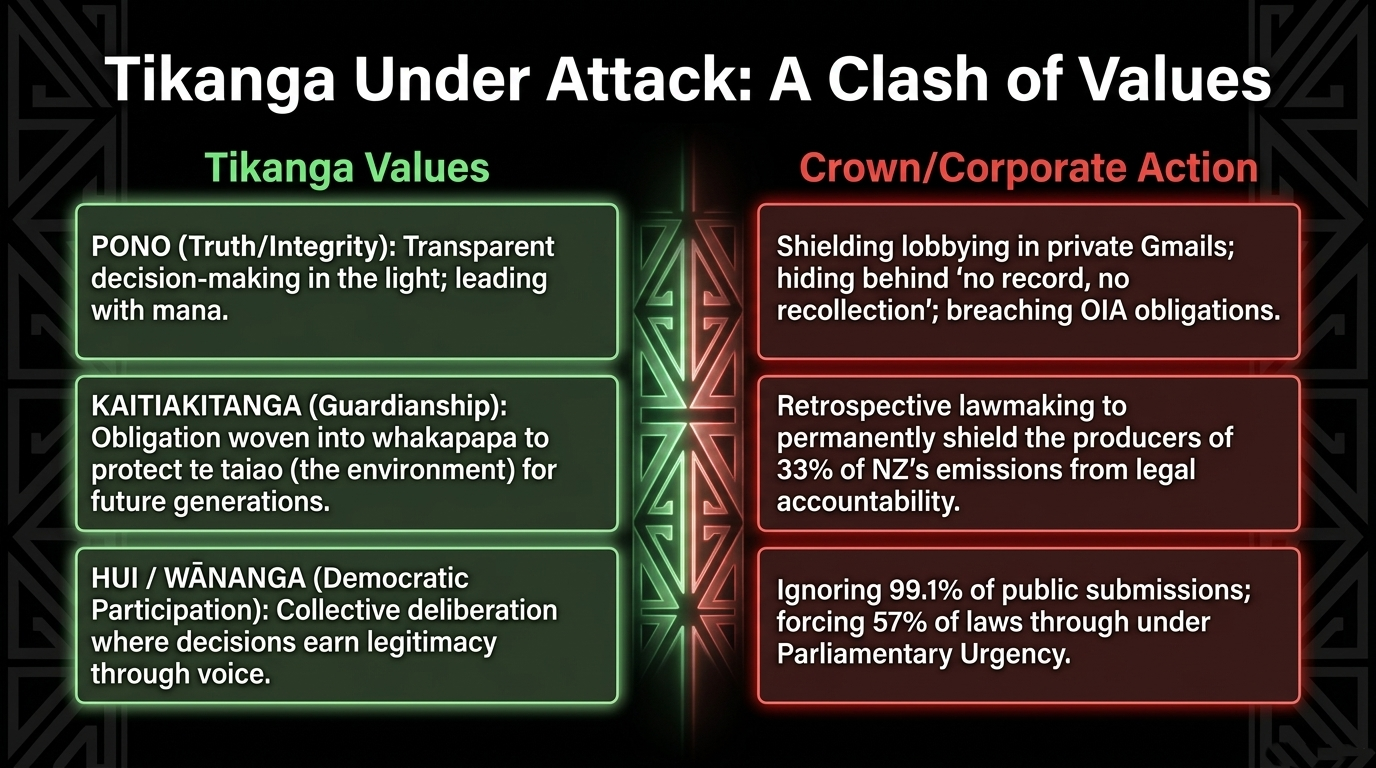
Tikanga impact: In tikanga Māori, kaitiakitanga is an obligation woven into whakapapa — the relational genealogy of all living things. It is not optional. It cannot be legislated away. When Smith took these companies to court, he was not pursuing personal gain. He was fulfilling the covenant between his tūpuna and the whenua they entrusted to him. The government's two-sentence amendment does not merely kill a court case. It legislates that the covenant of kaitiakitanga has no legal standing. It tells our mokopuna: you may watch the land burn, but you may not hold the fire-makers accountable. That is not a policy. That is a statement of who this country belongs to.
Two: The Private Gmail — A Mechanism of Deliberate Concealment
What happened: The briefing note was sent by Fonterra to Burgess's private Gmail at his own request, confirmed by Fonterra on 2 June 2026 as reported by RNZ/1News. This ensured it existed outside the official record management system. When ELI filed an OIA specifically seeking this information, it was not produced.
What Transparency International NZ says: TINZ executive director Julie Haggie confirmed — on public record as cited by Scoop — that "it appears that a corporate interest, using non-scrutinised means, is able to then get legislation passed [under urgency] which is also not being scrutinised by the public." Former minister Anne Tolley, chair of TINZ, confirmed New Zealand "lagged well behind its peers in regulating lobbying" and that "industries with deep pockets and easy access to power are unevenly influencing government policy — all without public visibility."
Solution: A mandatory Lobbying Disclosure Act — with criminal penalties for routing official government business through personal accounts to evade OIA obligations. Real-time public registration of all lobbying contact. Mandatory retention of all lobbyist communications by government advisers, regardless of channel.
Tikanga impact: Pono — truth — is a foundational value in te ao Māori. A rangatira who makes decisions in darkness, who routes korero through unofficial channels to avoid scrutiny, who cannot be held to account because there is no record — that rangatira has lost their mana. This is not procedural failure. It is the breaking of the covenant between leadership and people. When government uses private Gmail to conceal who is shaping the law, it is not governing. It is occupying.
Three: 583 out of 588 Said No. The Government Said Yes.
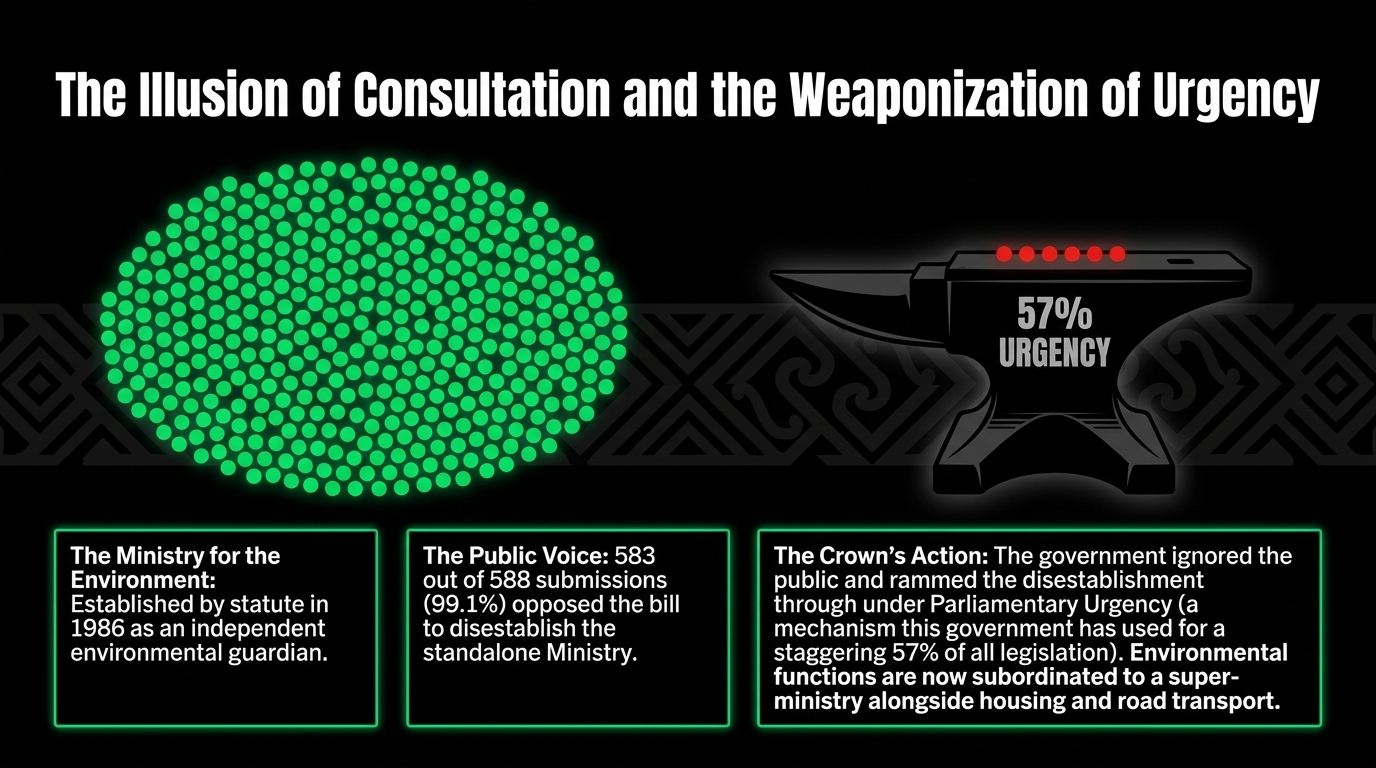
What happened: The bill to disestablish the standalone Ministry for the Environment — established by statute in 1986 and the only environmental body created by law with independent statutory functions — received 583 out of 588 submissions opposing it, a 99.1% opposition rate. As confirmed by The Spinoff. The government passed it under parliamentary urgency. The Ministry is now folded into MCERT — the Ministry for Cities, Environment, Regions and Transport — its environmental functions now subordinate to ministers whose portfolios include housing development and road infrastructure, operational 1 July 2026, confirmed by The Beehive.
The urgency problem: Transparency International NZ confirmed this government has passed 57% of all legislation under parliamentary urgency, compared to significantly lower rates under previous governments. TINZ stated that urgency, as used by this government, is "circumventing essential democratic practices such as public participation, independent expert advice, and integrity checks." (Scoop)
Solution: Reinstate a standalone Ministry for the Environment with strengthened independent statutory functions. Legislate that parliamentary urgency cannot be invoked for substantive policy legislation — as distinct from administrative or technical amendments — without cross-party approval or a declared national emergency.
Tikanga impact: Democratic participation in te ao Māori is not a box-ticking exercise. Hui, kōrero, wānanga — these are the processes through which decisions earn legitimacy, through which they carry mauri into the future. When a government records 583 voices of opposition and acts as if those voices do not exist, it is not governing democratically. It is doing what colonial governments have always done: asking for our opinion so that it can be filed and ignored. The land does not care what urgency motion was used to disestablish its guardian. The storms will come regardless.
What the Opposition Says
These are verified public statements, on the record:
- Chris Hipkins, Labour leader: "It stinks to high heaven. What else are the Prime Minister and his office hiding from the New Zealand public?" RNZ/1News
- Labour MP Tangi Utikere: The case "does not pass the sniff test" and raised questions about whether there had been "a deliberate cover-up." Scoop
- Labour MP Duncan Webb: "One of them is incompetence, one of them is a lack of transparency, and the other ones don't bear mentioning in this House." The Spinoff
- Labour MP Damien O'Connor: Used the word "corruption." — this is his public characterisation, not a legal finding
- Green co-leader Chlöe Swarbrick: "If you've got nothing to hide, then let's put it all out in the open." Luxon refused to initiate an independent inquiry. The Spinoff
- Cabinet minister Louise Upston, defending the government: Called it "clearly not good enough" and "an isolated incident." Scoop
Note: The description of this conduct as "corruption" is the public characterisation of elected opposition politicians. The Ombudsman and DIA investigations are ongoing. No criminal charges have been laid. No court has returned a finding of corruption.
I report those characterisations as what they are: the expressed views of public officials on matters of public record.
The Whakapapa of Capture
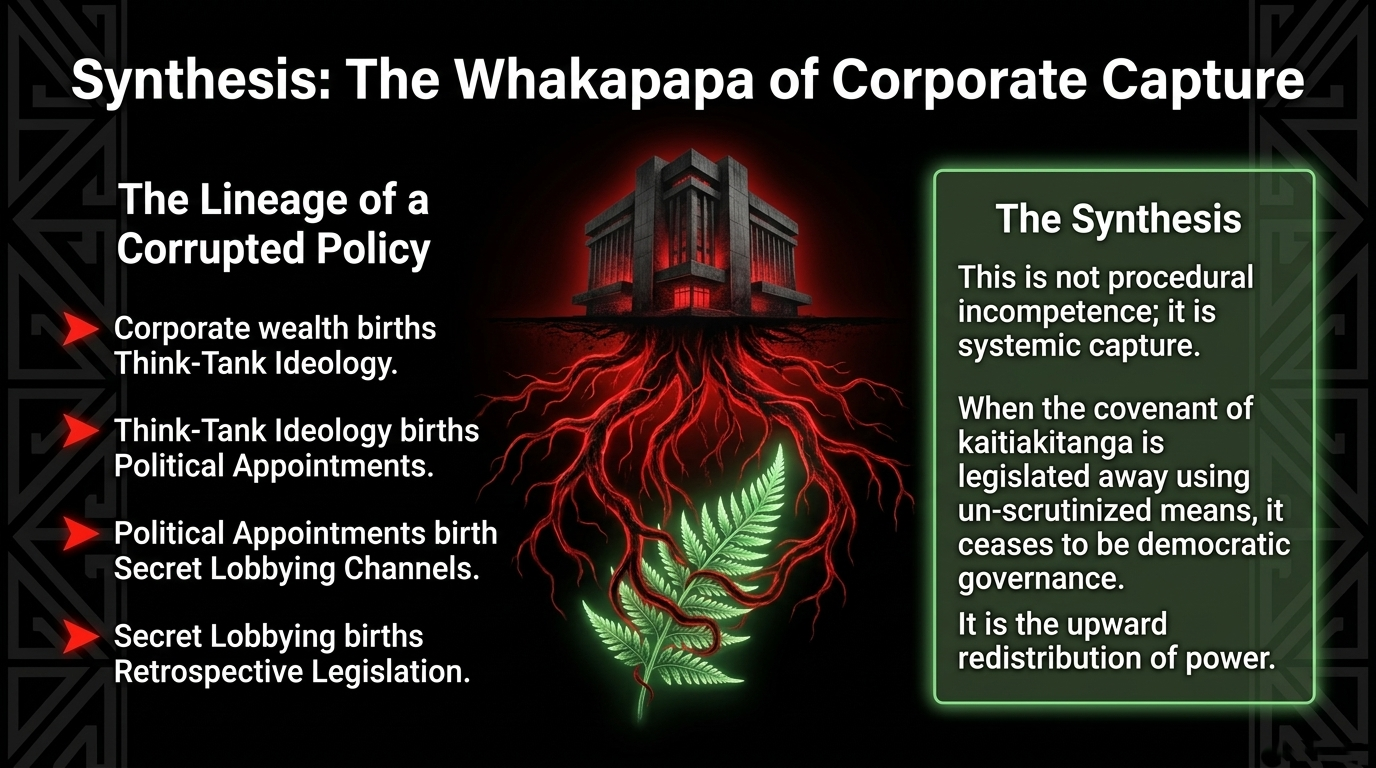
This is not a series of coincidences. Trace the connections:
Matt Burgess came to the PMO from the New Zealand Initiative — a corporate-funded think tank that has consistently argued against climate regulation. As confirmed by multiple sources including Reddit/NZ Politics. 🔶 Corroborated — NZ Initiative background confirmed; internal PMO knowledge chain unverified
He moved into the most powerful non-elected policy position in the country — PM's chief policy adviser — and received secret lobbying materials from corporate defendants in an active climate case, routed through a private account he asked those companies to use. The Ombudsman is investigating. The DIA is reviewing his IT accounts.
The NZ Initiative to the PMO to the Fonterra briefing note to the climate law change to the end of Mike Smith's case: that is not coincidence. That is the whakapapa — the genealogy — of how policy capture operates in this country. As TINZ confirmed: without a Lobbying Disclosure Act, it operates
"all without public visibility."
Ko Ngā Mahi Tika — What Must Happen
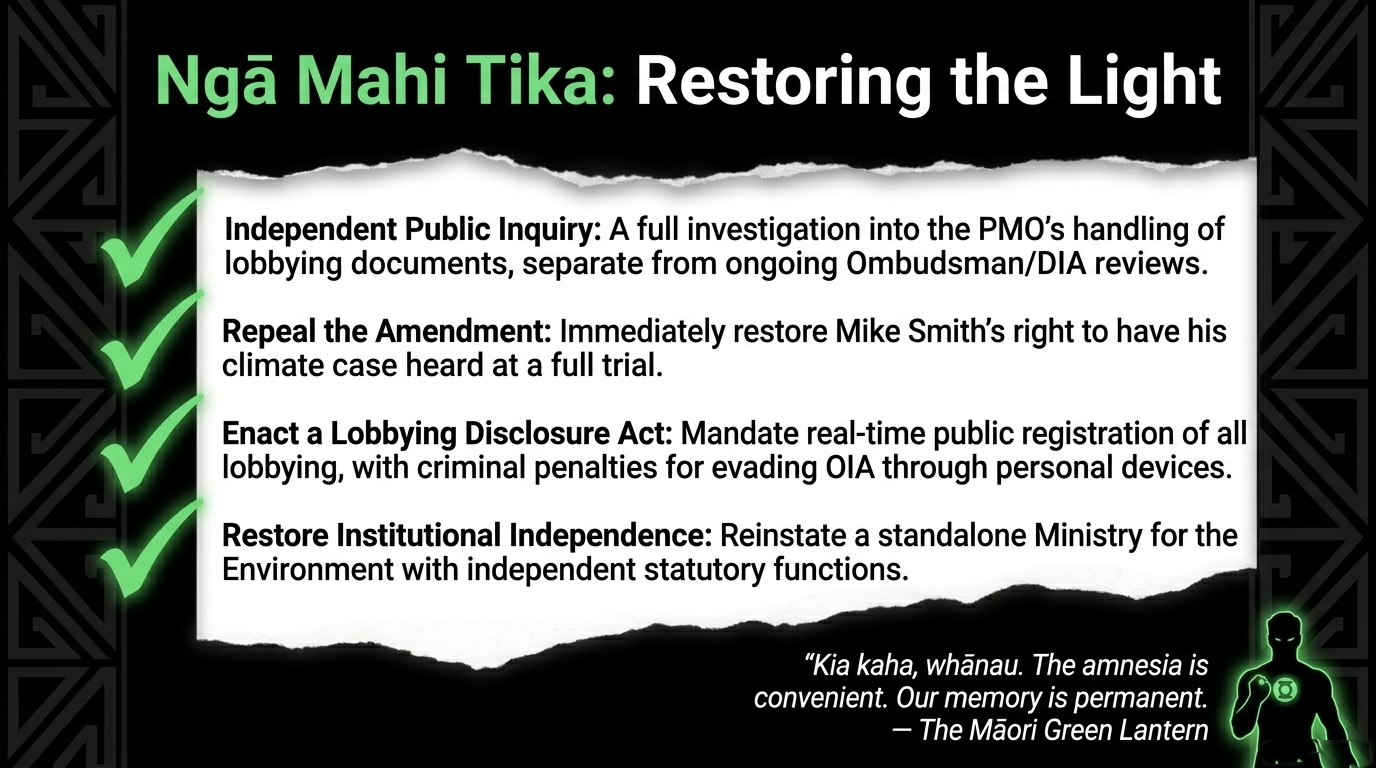
- An independent public inquiry — separate from the Ombudsman and DIA reviews already underway — into what the Prime Minister knew, when he knew it, and what process, if any, existed for handling the Fonterra and Z Energy lobbying documents
- Immediate repeal of the Climate Change Response Act amendment — restore Mike Smith's right to have his case heard at a full trial
- A Lobbying Disclosure Act — mandatory real-time registration of all lobbying contact with ministers and advisers, across all channels, with criminal penalties for evasion through personal devices or accounts
- A cooling-off period preventing direct movement from industry-funded think tanks into senior government advisory roles
- Full restoration of Māori Climate Platform funding, with an apology
- Reinstatement of a standalone Ministry for the Environment with independent statutory functions
- An urgent meeting between the Prime Minister and Mike Smith — as requested on 28 May 2026, still unanswered
Previous Māori Green Lantern Essays
- "The Defendants Wrote the Law That Killed Their Own Case" — Named the lobbying pipeline the day the documents were released, May 2026
- "They Changed the Law Again: Paul Goldsmith's Climate Shield" — Named the legislative mechanism months before introduction, 2025
- "Democracy Dies by a Thousand Urgency Motions" — On the weaponisation of parliamentary urgency, January 2025
- "The Great National Party Con Job" — How economic framing conceals upward redistribution of power, May 2025
- "Colonial Amnesia in the House" — Systemic erasure of Māori interests across portfolios, May 2025
Koha Statement
Fonterra has Chapman Tripp on retainer. Z Energy has government affairs staff. The NZ Initiative has corporate funders writing the think tank papers that become PMO policy. Matt Burgess had a private Gmail account and a short official memory.
Mike Smith had six years of legal bills, a Supreme Court win, and a letter to the Prime Minister that has gone unanswered for ten days.
And you have this essay.
Corporations can route secret lobbying through private email to rewrite the law that was supposed to hold them to account.
Whānau can route their support through a koha link to keep this voice alive. Every koha to the Māori Green Lantern is rangatiratanga in practice — whānau choosing to fund the accountability that the Prime Minister's Office worked, through documented means, to conceal.
This platform named the lobbying pipeline before the courts forced the documents out. We named the mechanism before the Ombudsman was called in. That mahi costs time, research, and energy. It does not pay for itself.
Kia kaha, whānau. The amnesia is convenient. Our memory is permanent.
- 💛 Koha: app.koha.kiwi/events/the-maori-green-lantern-fighting-misinformation-and-disinformation-ivor-jones
- 📩 Subscribe: themaorigreenlantern.maori.nz/#/portal/support
- 🏦 Direct bank transfer: HTDM — 03-1546-0415173-000
- 👍 Facebook: facebook.com/Themaorigreenlantern/subscribe
- 📖 No koha? No worries. Subscribe, follow, share with your whānau. That is koha in itself.

Ko au ko Ivor Jones — Te Māori Green Lantern, uri o Ngāti Pikiao, o Te Arawa.
Ko te taiaha kei ōku ringa. Ko te hau o te tika e rere ana.
Tūturu ō whiti whakamaua kia tīna. Hui e! Tāiki e!
Research Transparency
Sources verified and fetched: RNZ/1News full timeline (4 June 2026); RNZ/1News private email report (2 June 2026); Scoop/ELI lobbying concealment investigation (23 May 2026); Scoop Labour cover-up questions (3 June 2026); The Spinoff Echo Chamber (28 May 2026); The Spinoff Bulletin (3 June 2026); Waatea News Mike Smith (4 June 2026); Green Party NZ Facebook (2 June 2026); The Beehive MCERT bill (18 February 2026); The Guardian (25 February 2026); Fonterra public statement (23 May 2026); TINZ/Scoop statements (3 June 2026).
Investigations underway and ongoing at time of publication: Ombudsman investigation into PMO OIA compliance; DIA review of Burgess's IT accounts. This essay will be updated as findings are reported.
Legal Disclaimer
This essay is published in the public interest under the New Zealand Bill of Rights Act 1990 and the qualified privilege principles affirmed in Lange v Atkinson 3 NZLR 385 and Durie v Gardiner NZCA 278. All factual claims are supported by cited, publicly available sources including court records, official releases under the OIA, and verified journalism. All named individuals are referenced solely in their public and official capacity — their documented conduct, public statements, confirmed official actions, and voting records. All opinions are clearly identified as such, including the characterisations of named public figures by opposition politicians, which are attributed to the individuals who made them. No finding of criminal liability is asserted or implied by this essay. The Ombudsman and DIA investigations referenced are active and ongoing at time of publication — this essay reports the documented record, not any findings from those proceedings. No malice is intended or implied. This essay engages only with the pattern of harm arising from the use of public office and public resources. The right of reply is extended to all named individuals at ivor@themaorigreenlantern.maori.nz. A retraction and correction protocol is in place. Pre-publication checklist completed 6 June 2026.