"The Receipts: Destroying Every Reason This Government Gave for Urgency" - 6 June 2026
A Systematic Demolition of the 54th Parliament's Justifications for Bypassing Democracy — Every Claim, Every Lie, Every Live Link

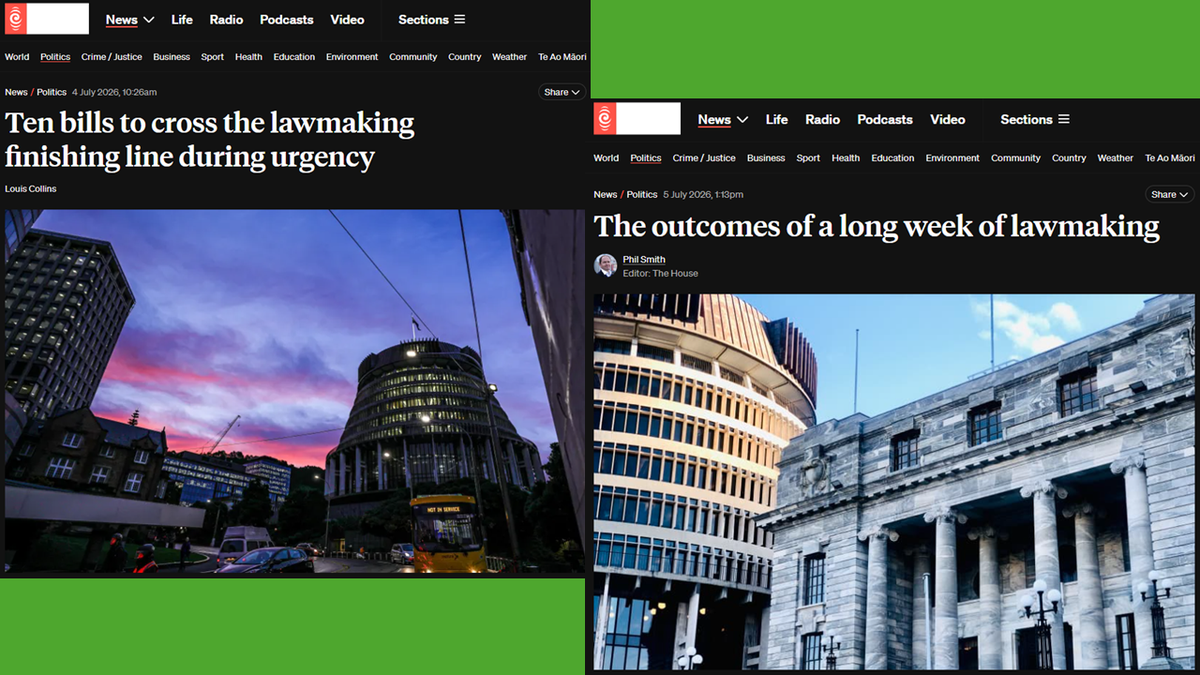
The Art of the Midnight Heist
M
"What is not legitimate is using urgency as a default legislative strategy — treating a parliamentary majority as a substitute for deliberation."
— Transparency International NZ, June 2026
Let me describe something so you understand exactly what this government has been doing.
Imagine you own land. The law says anyone who wants to build on it must notify you, consult you, give you thirty days to respond, hold a public hearing. You know your rights. You trust the system.
Then, one morning, you wake to find the building already up. The consultation never happened. The hearing was cancelled. The notice was posted at 11pm on a Tuesday and responded to by midnight. Your rights were alive when you went to sleep. They were law by the time you made your morning coffee.
This is not a metaphor.
This is what the Luxon-led National-ACT-NZ First coalition has done — not once, not twice, but as a governing strategy — for three consecutive years. The mechanism is called parliamentary urgency. The victims are workers, women, disabled people, coastal communities, and above all, tangata whenua — my people.
I have spent three years naming the crimes at themaorigreenlantern.maori.nz. This essay is the whakapapa of those crimes, traced in full, with every receipt. This is not opinion dressed as journalism. This is documented, sourced, verified outrage in the service of people this government has decided do not matter.
They call it "efficiency." We call it organised robbery.
The Legal Standard: What Urgency Is Actually For
 RNZ | Te Reo Irirangi o Aotearoa
Before dismantling each lie, establish the standard every justification must meet.
The Law Foundation's What's the Hurry? — the definitive study of NZ urgency from 1987–2010 — identified four categories of legitimate urgency:
- Genuine emergency — natural disaster, pandemic, or financial crisis requiring immediate legislative response
- External deadline — international treaty ratification, budget implementation, or a time-bound statutory obligation
- Error correction — fixing a technical drafting error before it takes effect
- Explicit, specific electoral mandate — voters were directly told about a specific bill and voted for it
 RNZ | Te Reo Irirangi o Aotearoa
Sir Geoffrey Palmer argued that Standing Orders should require genuine justification before urgency is approved.
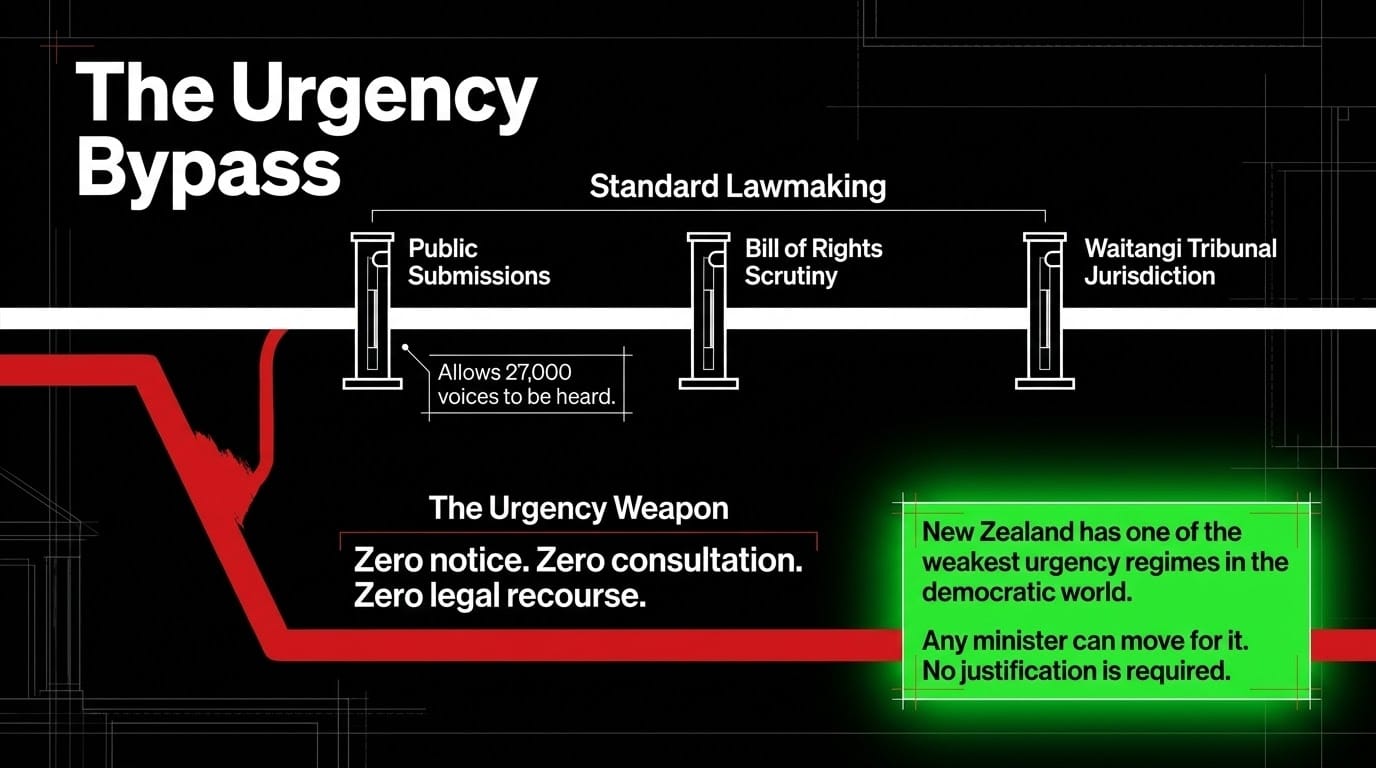
New Zealand's current Standing Orders require only that a minister state any reason, after which a simple parliamentary majority decides. No Speaker gatekeeping. No proportionality test. No human rights attestation. No cross-party notification.
This government weaponised that gap. Here is the evidence — every claim, every source, every live link.
The Master Deception Table
| Bill / Urgency Event | Government's Stated Reason | Legal Standard Required | Meets Standard? |
|---|---|---|---|
| 100-Day Plan (Dec 2023) | "Electoral mandate — people voted for this" | Explicit mandate for specific bills | No |
| Te Aka Whai Ora disestablishment (Feb 2024) | "Delivering coalition agreement" | Emergency or external deadline | No |
| Fast-Track Approvals (Mar 2024) | "Removing red tape, growing economy" | Emergency or external deadline | No |
| Pay Equity (May 2025) | "Claims not fair and evidence-based" | Emergency or error correction | No |
| 19-bill urgency session (Jan 2025) | "Completing coalition agendas" | Emergency or external deadline | No |
| H&S Amendment (Jul 2026) | "Clarity, common sense, laws that work" | Emergency or specific mandate | No |
| Plain Language Act Repeal (Jul 2026) | "Cutting red tape" | Emergency or specific mandate | No |
| Healthy Futures Pae Ora (Jul 2026) | "Efficiency, better health system" | Emergency or specific mandate | No |
| Climate Change Tort Liability (Jul 2026) | "Legal certainty for business" | Emergency or external deadline | No |
| Electoral Amendment Act (Dec 2025) | "Strengthening democracy" | Emergency or specific mandate | No |
🎙️ The Deep Dive Podcast
Listen: Two hosts unpack this demolition — following the money, naming the mechanisms, and asking the question this government hopes you won't: who benefits every single time urgency is invoked?
I apologise in advance for the AI's very harsh pronunciation of te reo Māori. Please don't shoot me. 🙏
📹 YouTube Video
Like video? Here is a short video supporting this essay — every lie, every receipt, every standard it failed to meet.
Again — please don't shoot the messenger because of AI's pronunciation. The kaupapa is real. 🙏
Koha — Because This Demolition Cost Something, and Your Rights Are Worth More
Every urgency motion this government passes erases someone's rights in the dark. Every essay published at themaorigreenlantern.maori.nz brings those erasures into the light — sourced, verified, linked.
This essay destroyed nine government justifications using the government's own words, the government's own documents, and constitutional standards the government failed to meet. That work is not free. The Crown will not fund it.
Every koha signals that whānau are ready to support the accountability that Crown and corporate structures will not provide — that our tūpuna's stolen hours, stolen wages, and stolen health system are worth a counter-argument backed by evidence.
Kia kaha, whānau. Stay vigilant. Stay connected. And if you are able, consider a koha to keep the taiaha swinging.
If you cannot koha — no worries. Subscribe, follow, kōrero, and share. That is koha in itself.
🪙 Koha: app.koha.kiwi/events/the-maori-green-lantern-fighting-misinformation-and-disinformation-ivor-jones
📬 Subscribe: themaorigreenlantern.maori.nz/#/portal/support
🏦 Direct bank transfer — HTDM: 03-1546-0415173-000
👍 Facebook: facebook.com/Themaorigreenlantern/subscribe/
DESTRUCTION ONE: "We Have an Electoral Mandate"
The lie: On 28 November 2023, Christopher Luxon announced the 100-day plan stating:
"These are things that New Zealanders voted for and expect us to deliver." NZ First echoed it: "The New Zealand public voted for a change in direction."
The standard: A mandate requires that voters were specifically told what would be passed, in what form, and chose it over alternatives.
Blow One: The Regulatory Impact Statements Were Not Done
The most basic democratic protection for legislation is a Regulatory Impact Statement — a document assessing whether a bill will work and what it costs. The Spinoff confirmed that for the Reserve Bank mandate bill and the Fair Pay Agreements repeal — both introduced under urgency on 12 December 2023 — Treasury quietly posted the RIS the same week. Luxon himself described regulatory impact statements as "a huge waste of time."
You cannot claim a mandate for a bill whose consequences your own government refused to assess. The mandate claim collapses on its first contact with evidence.
Blow Two: Voters Were Never Told About the Specific Bills
The coalition agreement was not voted on. The specific bills were not debated at constituency meetings, not costed publicly, and not named during the campaign.
They were announced as a 49-action plan eleven days after the election.
The Conversation documented this as a constitutional abuse:
"The National-led coalition has passed more legislation under parliamentary urgency during its first 100 days in office than any other MMP government... Thirty years ago, New Zealanders grew disillusioned with the unpredictable policy swings and the overreach of successive Labour and National governments" — and voted for MMP to prevent exactly this.
Blow Three: The Mandate Claim Was Used to Justify Bills That Had No Mandate
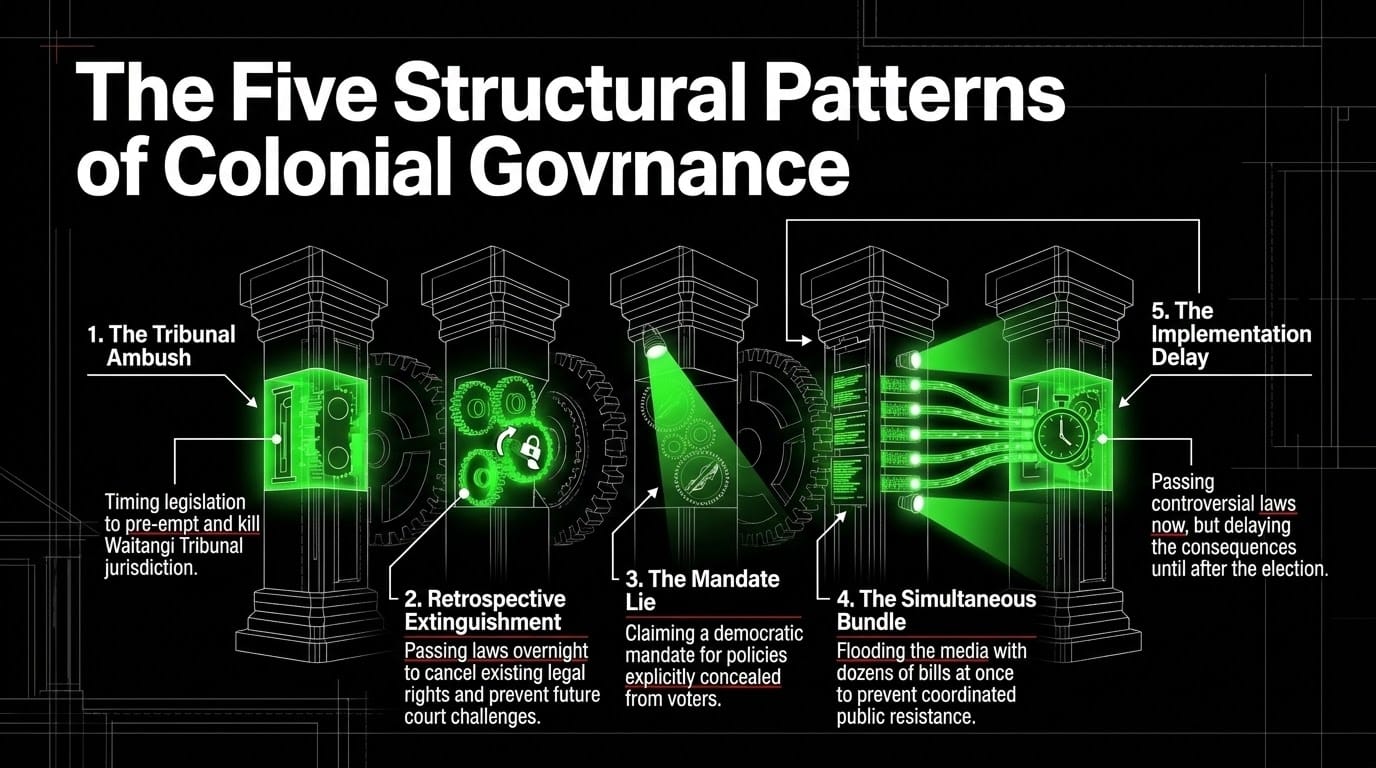
Tikatangata confirmed that 13 bills were passed under urgency in the first 100 days — more than any MMP government in New Zealand's history.
By January 2025, the Equal Justice Project documented the government had
"passed 19 pieces of legislation through all stages of urgency, more than any previous government" in a single session.
The "mandate" covered repealing the Clean Car Discount, banning gang patches, and changing school lunch rules. These are not mandates. These are policy preferences dressed as democratic instruction — then passed at midnight.
DESTRUCTION TWO: "We Are Delivering on Our Coalition Agreements"
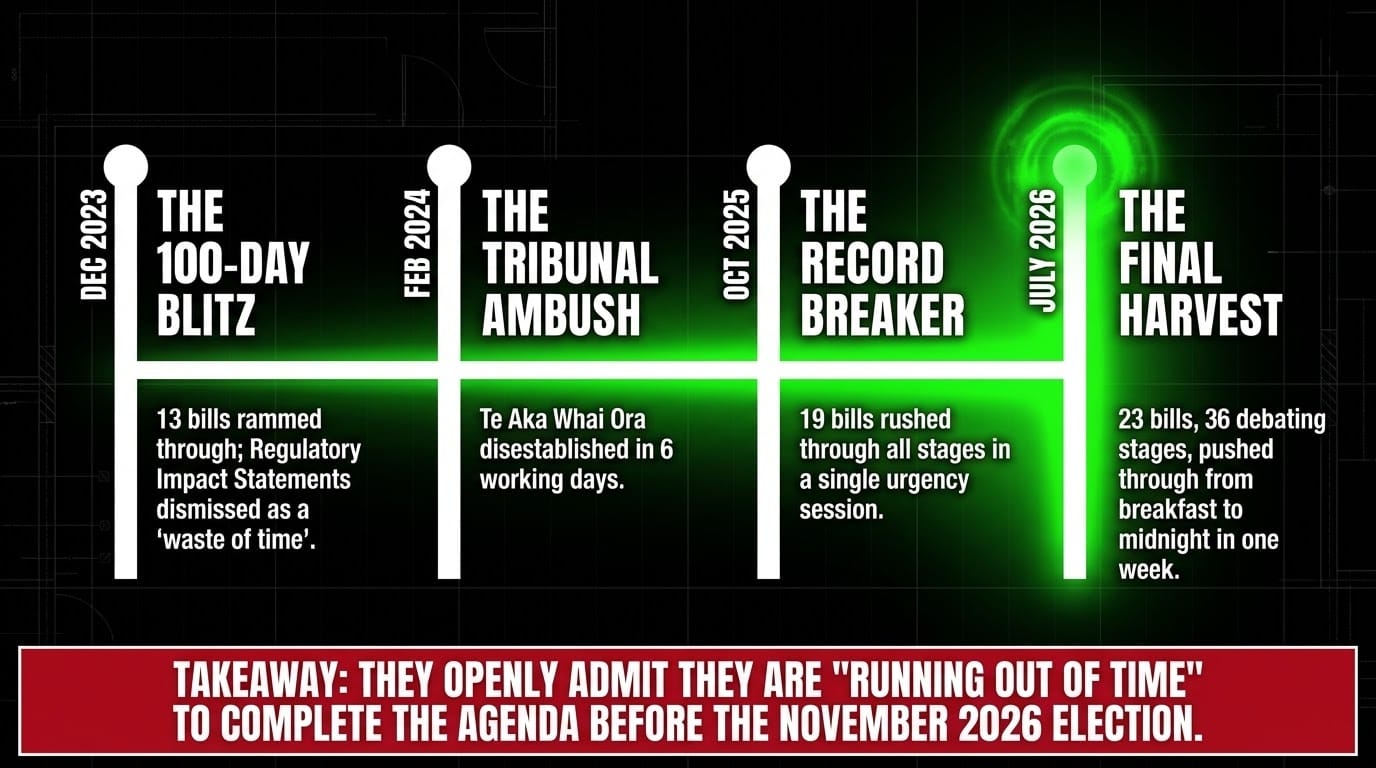
The lie: Ministers described urgency as necessary to complete coalition agendas.
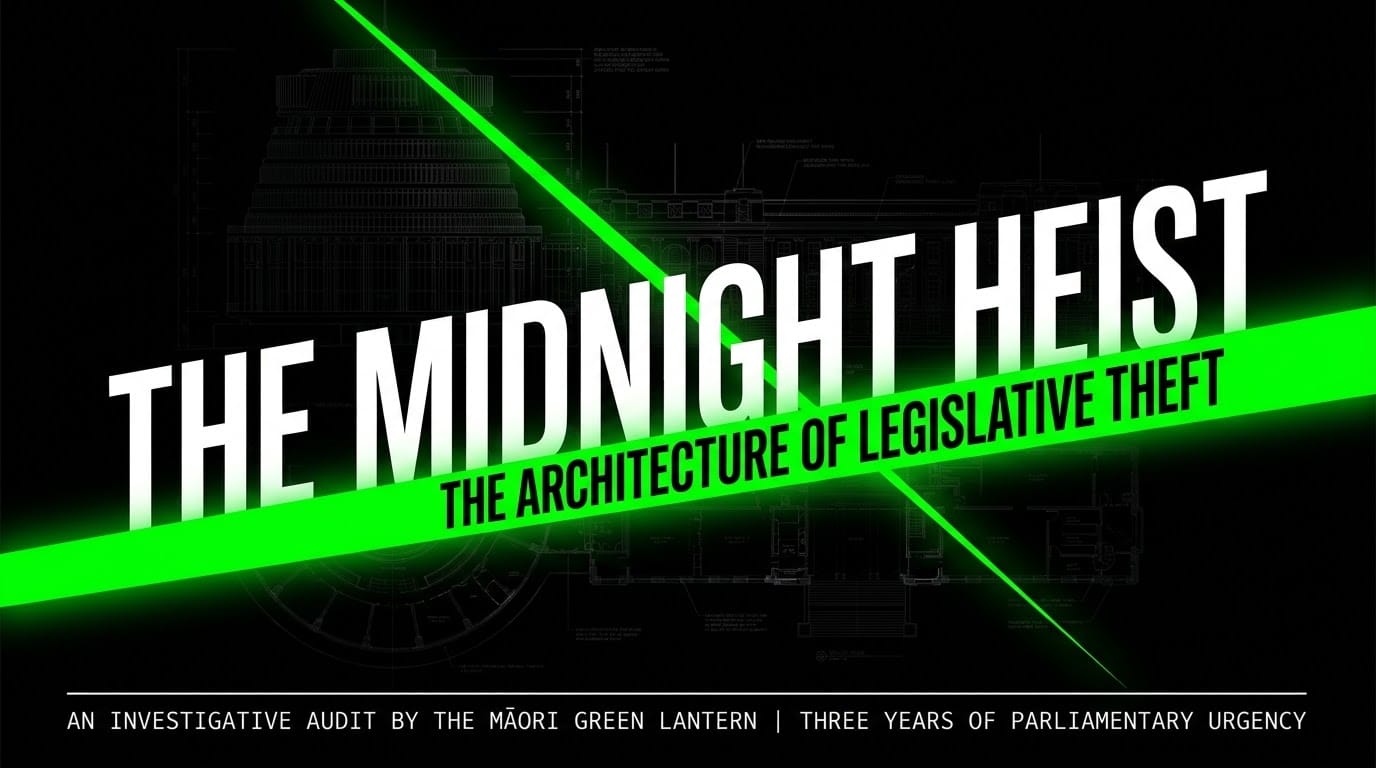
RNZ's The House confirmed the government's own framing on 5 July 2026:
"The government is running out of time to complete the vast agendas of its three coalition partners."
The standard: Coalition agreements are private negotiations between parties. They have never been presented to voters for approval. "Coalition agenda completion" is not a recognised category of legitimate urgency under any constitutional framework in New Zealand's democratic history.
The Government Said This Out Loud
Read it again. Not: "We must respond to an emergency." Not: "We face an external deadline." Not: "We must fix a drafting error."
Running out of time to complete the agendas of three parties.
That is a confession, not a justification. It means:
- The urgency was pre-planned — not reactive to crisis
- The target was legislative agenda completion — not democratic obligation
- The clock was electoral, not constitutional
- The bills were on a shopping list, not demanded by national emergency
The Equal Justice Project concluded the government used urgency
"simply because it could" — not because it had to.
Transparency International named exactly this abuse:
"Mere legislative preference is not sufficient. What is not legitimate is using urgency as a default legislative strategy."
A coalition shopping list is not a constitutional emergency. The government recorded its own confession in plain English for RNZ. The taiaha doesn't need to strike twice.
DESTRUCTION THREE: "It's About Fiscal Responsibility and the Cost of Living"
The lie: Luxon's 100-day plan explicitly framed urgency as necessary to "rebuild the economy and ease the cost of living." Pay equity changes were described by Brooke van Velden as making the process "fair and evidence-based." The Beehive's Q2 Action Plan described the WorkSafe review as targeting "unnecessary compliance costs for business while enhancing worker safety."
The standard: Fiscal urgency would require an actual fiscal emergency — imminent market failure, credit rating threat, or budgetary crisis requiring immediate legislation to prevent cascading harm.
Blow One: The Cost of Living Got Worse, Not Better
The NZCTU documented in July 2025 that annual inflation had risen for three consecutive quarters to 2.7%, with household energy up 9.1%, gas prices up 15.4%, dairy and eggs up 9.9%, dwelling insurance up 10%, and rates up 12.2%. Real GDP contracted 0.2% in the year to June 2024. The government's urgency bills did not ease the cost of living for whānau. They eased the cost of employment compliance for employers.
Blow Two: The "Savings" From Pay Equity Were a Budget Transfer, Not a Fiscal Emergency
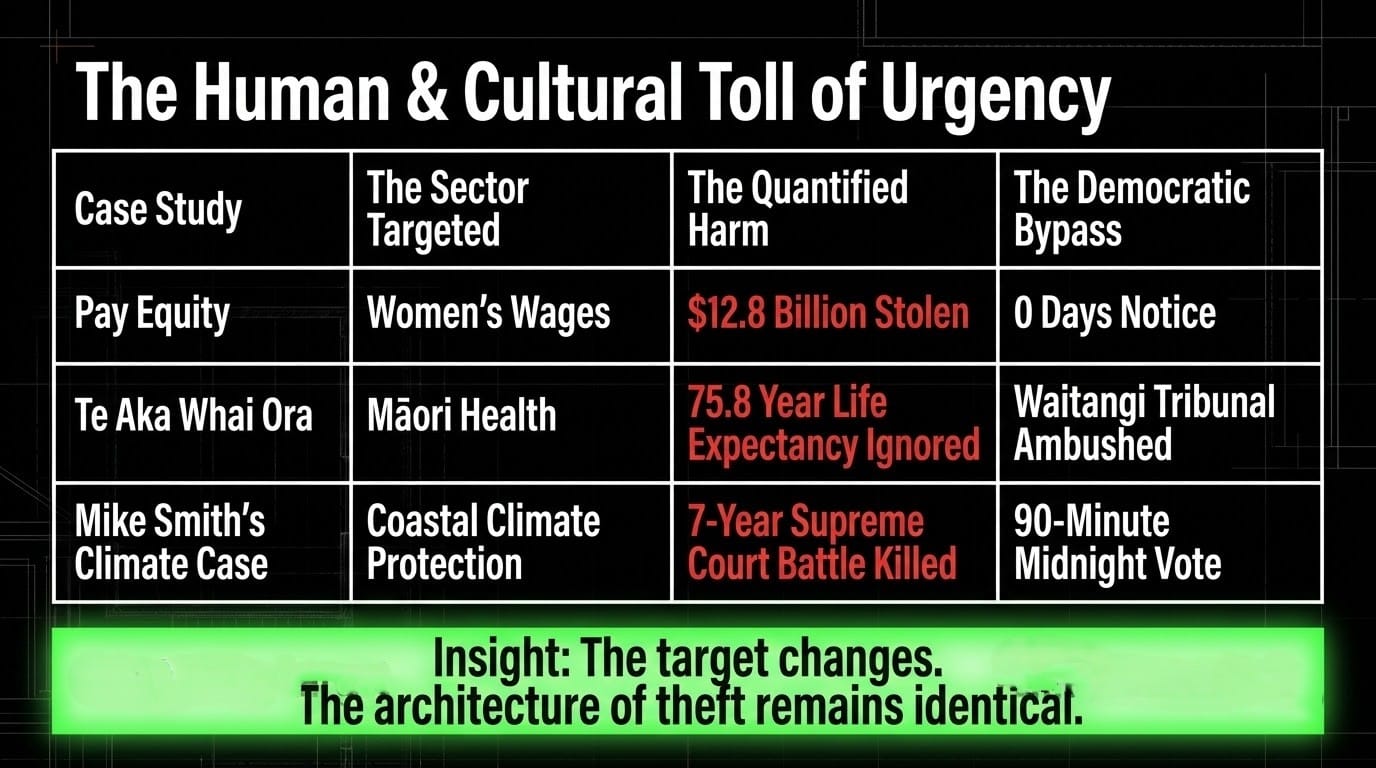
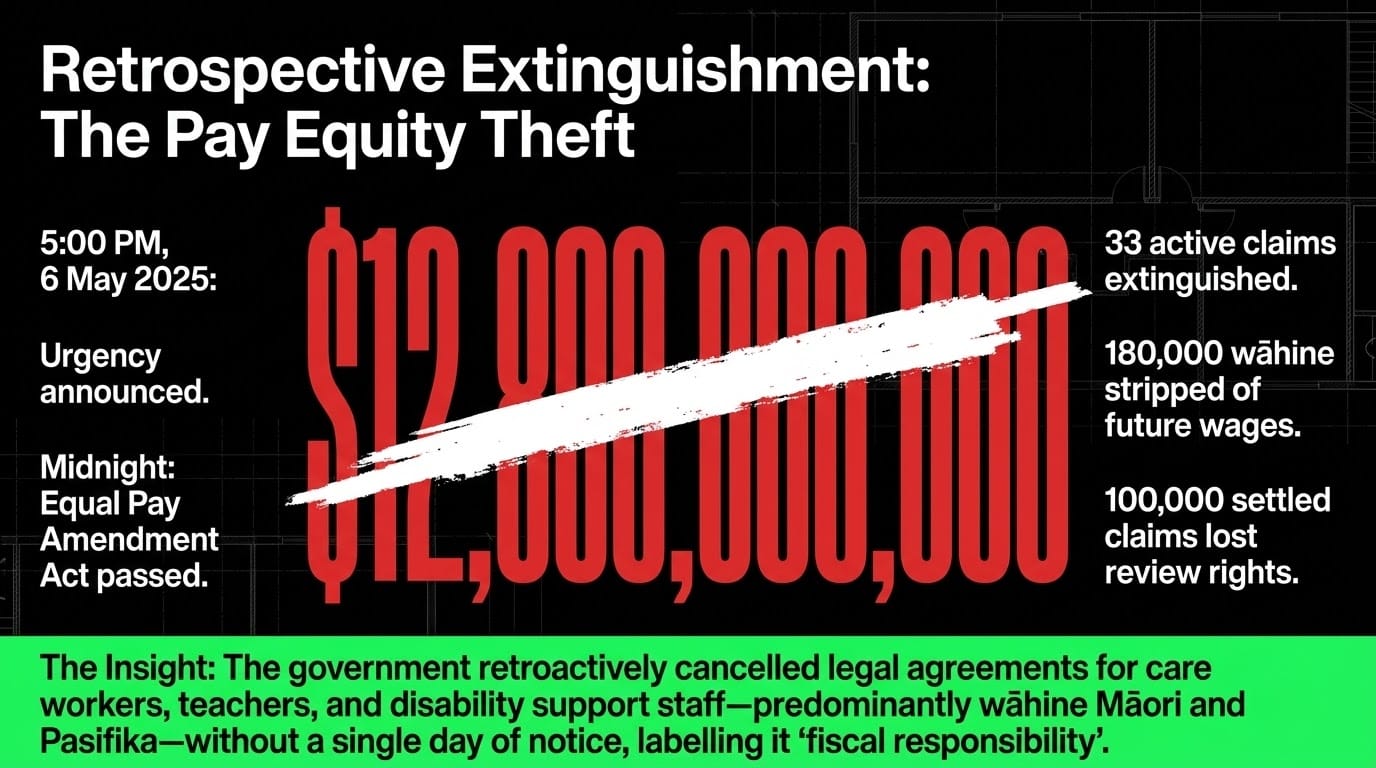
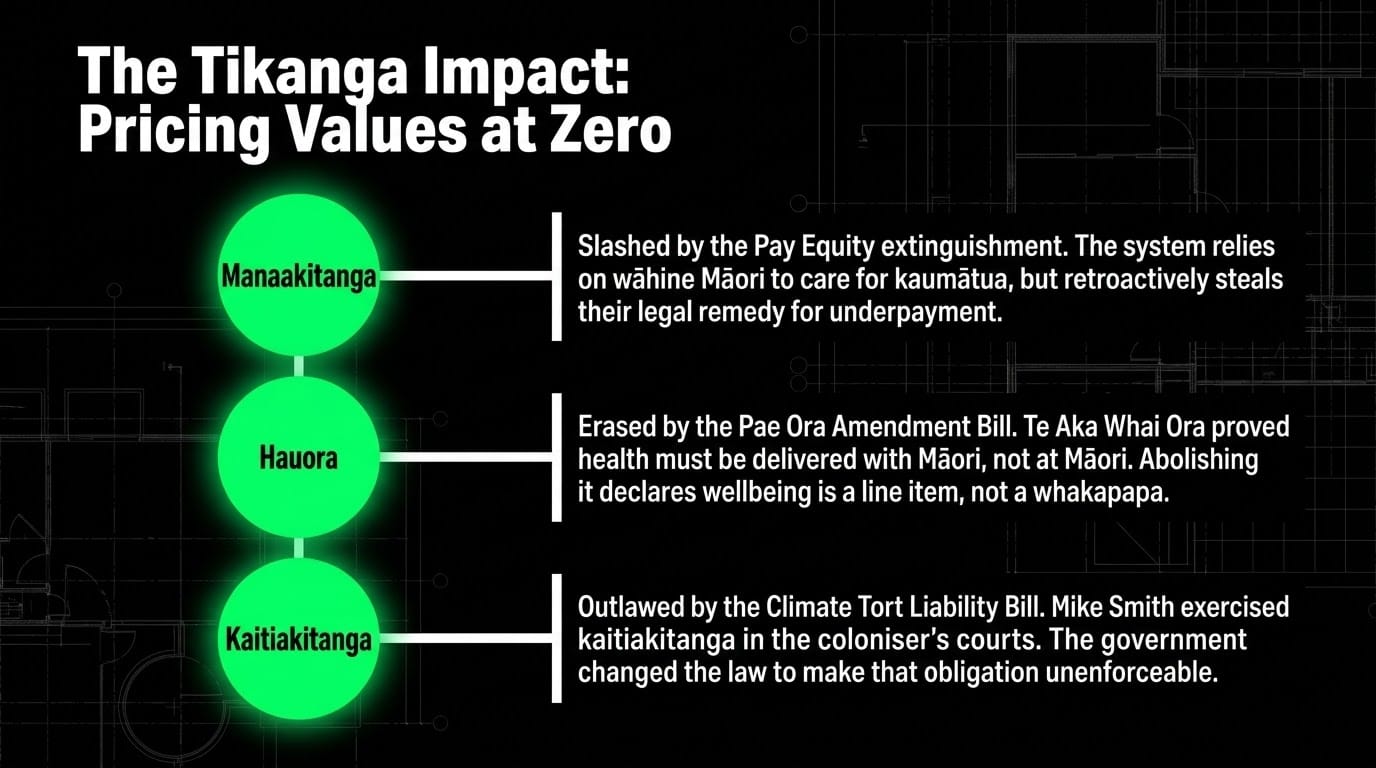
ETU confirmed that the $12.8 billion "saved" from extinguishing pay equity claims went directly to fund Budget 2025 — including tax breaks for business. ACT's own party post — fronted by Brooke van Velden — celebrated "$12.8 billion in savings." Not $12.8 billion of crisis averted. Savings. Money that was going to women workers — redirected to the government's fiscal position. The Māori Green Lantern documented this transfer in "The Kilometre Class".
Blow Three: The Changes Were Explicitly Retrospective — Fiscal Emergencies Are Never Retrospective
The Equal Pay Amendment Act 2025, enacted under urgency on 6 May 2025, did not stop future claims. It retroactively extinguished 33 active claims that existed the day before. It removed settled claims' review clauses — rights that more than 100,000 women had already won through legal process. Retroactivity is the hallmark not of emergency response but of rights extinguishment. A 93,000-signature petition was delivered to Parliament demanding repeal. The government read it and did nothing.
DESTRUCTION FOUR: "We Are Reducing Unnecessary Compliance Costs — Health and Safety"
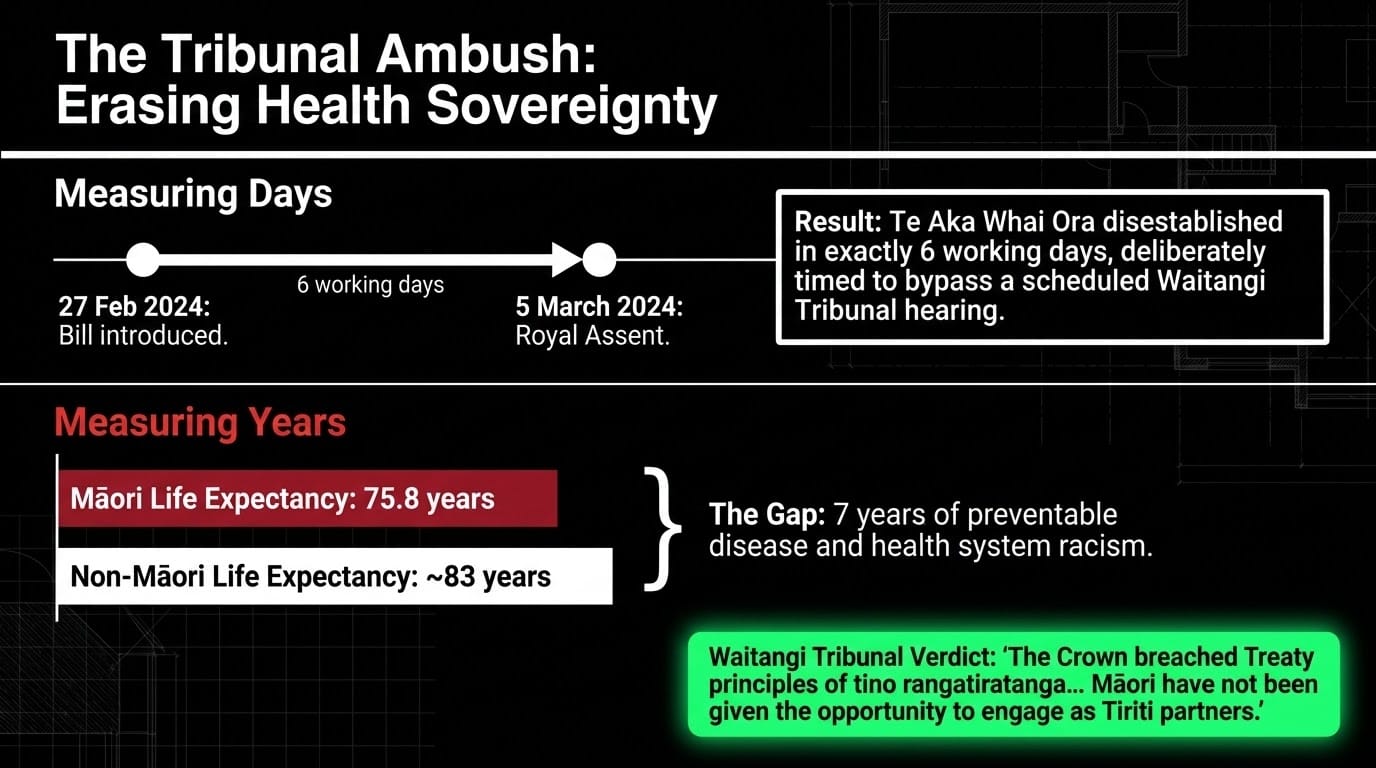
The lie: Outgoing ACT minister Brooke van Velden's final third-reading speech on the Health and Safety at Work Amendment Bill:
"This bill is about restoring clarity, common sense, and focus to New Zealand's work health and safety system. Laws should work in practice, not just in theory."
The standard: Urgency for compliance cost reduction would require demonstrated, immediate regulatory burden causing acute economic harm that cannot wait for a standard select committee process.
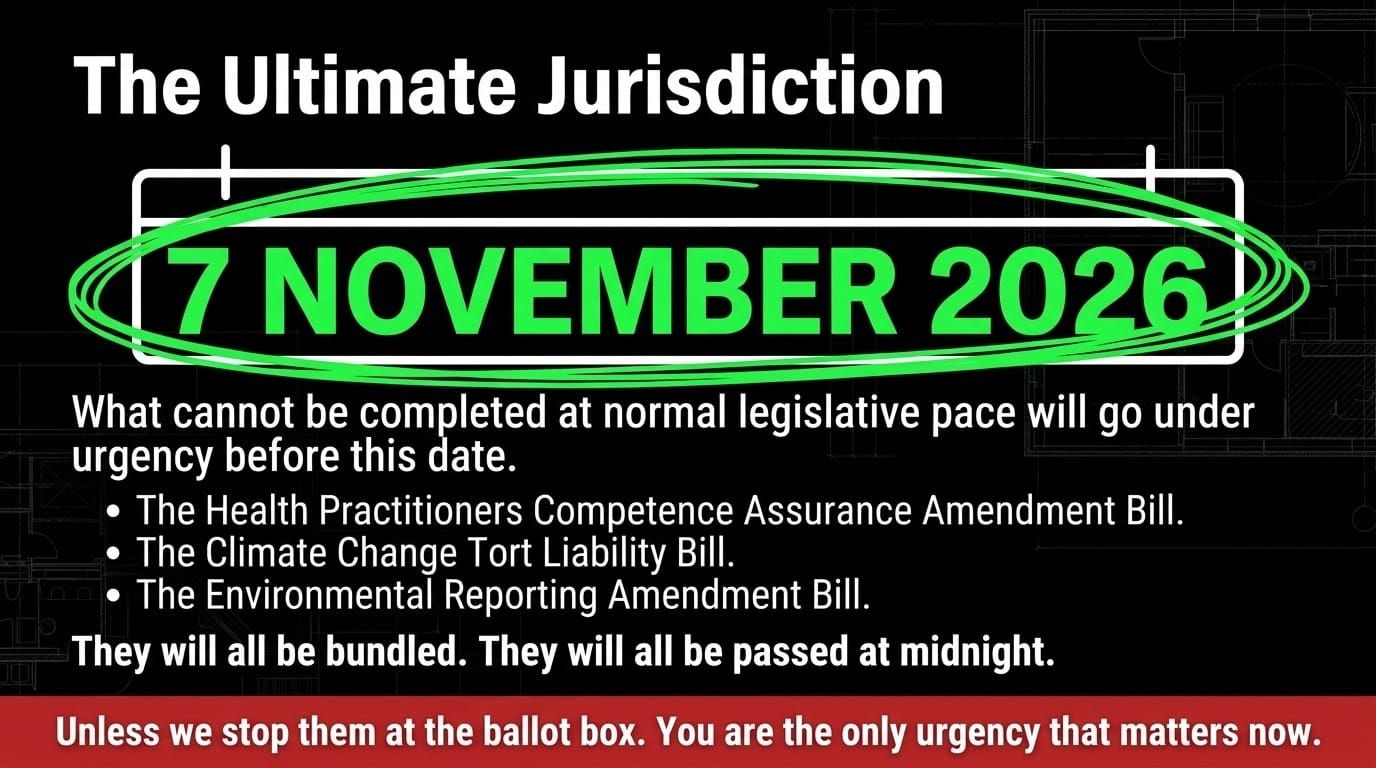
Blow One: The Bill Was Deliberately Delayed to Hide Its Consequences Until After the November 2026 Election
RNZ's The House confirmed explicitly:
"While the bill has passed all readings, New Zealand First forced a delay in implementation until November, which may keep it from being an election issue."
If the bill was genuinely urgent — if compliance costs were causing immediate harm — why delay implementation until after voters go to the polls? The answer is self-evident. It was not urgent. It was politically toxic. The urgency was electoral calculation wearing a safety vest. The Māori Green Lantern documented this electoral implementation trick as Pattern Five of urgency abuse.
Blow Two: The New Legal Floor for Worker Safety Is "Death and Dismemberment"
RNZ confirmed that for smaller companies under 21 employees, the new focus of health and safety requirements is on
"critical risks — things at the death and dismemberment end of the injury scale."
Labour's Jan Tinetti stated in the third reading:
"I'm disappointed that this bill is not being killed in the water here."
For 650,000 workers in small businesses, the legal protection floor has just been lowered to: you are protected from dying immediately.
That is not enhancing worker safety. That is defining safety as the absence of immediate death.
Blow Three: "Clarity and Common Sense" Is Not a Constitutional Category
The Canterbury Law Review's analysis of NZ urgency confirmed that "it is important to progress the bill" is among the most corrosive and illegitimate urgency justifications identified by constitutional scholars. "Common sense" is an opinion. "Clarity" is a preference. Neither is a constitutional emergency. Both are ideological framing dressed as necessity.
DESTRUCTION FIVE: "Better Health Outcomes — The Healthy Futures (Pae Ora) Amendment Bill"
The lie: Health Minister Simeon Brown's third-reading speech:
"Cranes in the sky because after six years under the previous government of talk, talk, talk, we've signed a contract, we have construction under way... We are building the future of our health infrastructure."
The standard: Health governance reform under urgency would require an immediate patient safety emergency, an external accreditation deadline, or an error in existing law causing active harm.
Blow One: The Waitangi Tribunal Found the Original Reform a Treaty Breach — and This Bill Completes It
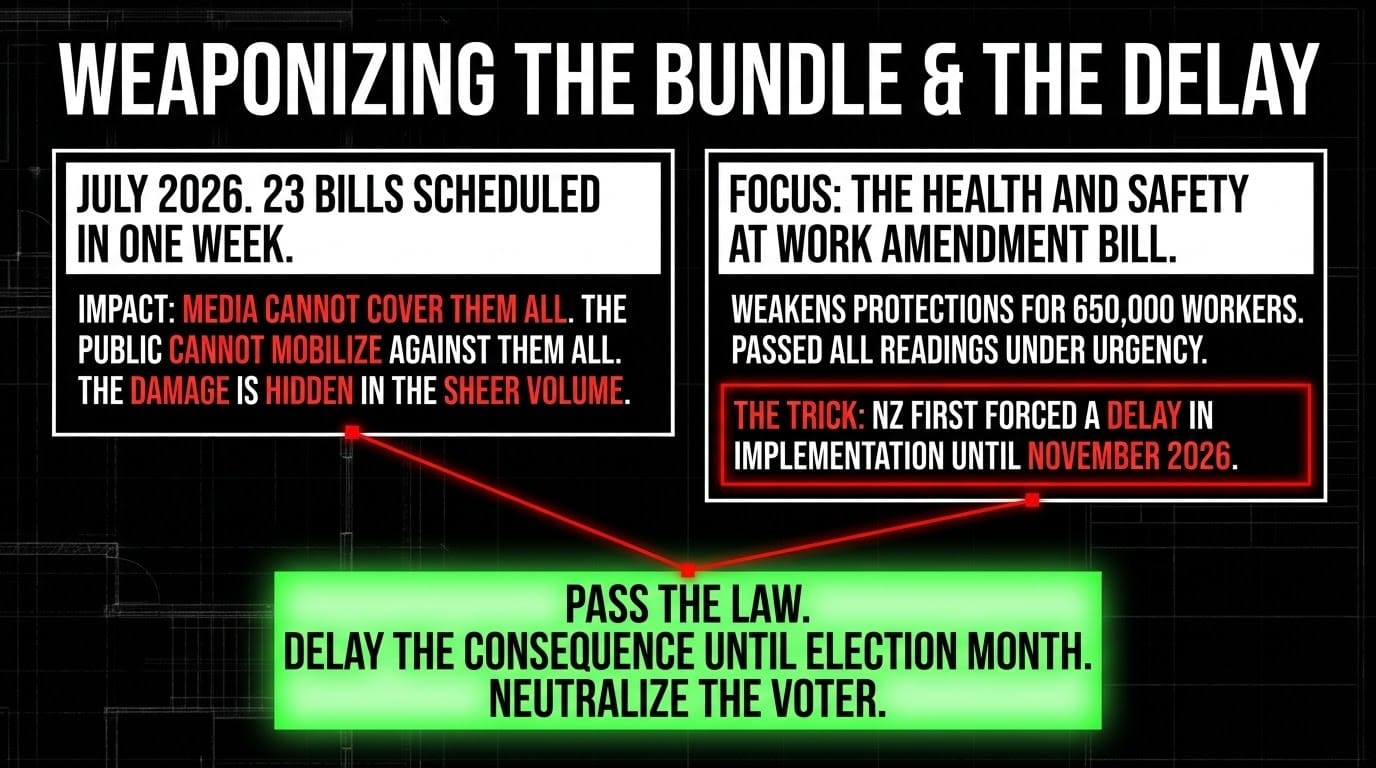
In November 2024, the Waitangi Tribunal found that the disestablishment of Te Aka Whai Ora breached Treaty principles of tino rangatiratanga, good government, partnership, active protection, and redress. The Tribunal found the Crown acted on "political ideology, rather than evidence" and that Māori had been given no opportunity to engage as Tiriti partners. The government's response was to introduce a bill completing that ideological project — also under urgency. The Waitangi Tribunal's finding is not an opinion. It is a formal constitutional determination.
Blow Two: The Bill Silences the Doctors Who Witness the Consequences of Urgency
"requires from health staff the level of political neutrality currently required of public servants — which could stop medical staff from being able to complain about policy and outcomes."
The same week, Labour's Dr Ayesha Verrall referenced the death of a man waiting at Waikato Hospital's Emergency Department:
"The target didn't get that man care. The target also did not staff the Waikato Hospital Emergency Department. Ask any doctor or nurse. There is a hiring freeze in Health New Zealand."
Under this bill, the doctors who want to publicly say why that man died could now face censure.
Urgency was used to pass a law that silences the witnesses to the consequences of urgency. That is not healthcare reform. That is the suppression of evidence.
Blow Three: Māori Life Expectancy Is ~7 Years Behind — and This Bill Removes the Architecture to Close the Gap
Stats NZ's 2022–2024 life tables show Māori life expectancy at 75.8 years — approximately seven years less than non-Māori. The Green Party documented that across Budgets 2024 and 2025, the coalition removed between $1.0 and $1.1 billion from Māori-specific programmes. The Healthy Futures (Pae Ora) Amendment Bill reduces Treaty obligations, removes the Health Charter, and reduces Iwi-Māori Partnership Boards to advisory roles. Cranes in the sky. People dying in waiting rooms.
DESTRUCTION SIX: "Cutting Red Tape — The Plain Language Act Repeal"
The lie: The Plain Language Act Repeal Bill — passed under urgency the week of 30 June 2026 — was framed as red tape reduction.
The Act had "sought to mandate state agencies to use accessible language in their public communications." The government repealed it.
The standard: A repeal under urgency of a public transparency law would require demonstrated, immediate harm caused by that law that cannot wait for normal legislative process.
Blow One: 98% of Public Submissions Opposed the Repeal
Parliamentary records confirmed that 98% of submissions on the bill opposed it. Under normal democratic process, 98% public opposition would send a bill back to select committee for extensive hearings. Under urgency, 98% public opposition is irrelevant. This is not red tape reduction. This is the government telling 98 out of every 100 submitters that their opinion is worth nothing.
Blow Two: Plain Language Is an Access-to-Justice Right — Disproportionately Exercised by Māori
The right to understand government communications in accessible language is not bureaucratic convenience. For Māori communities, for Pasifika communities, for people with lower literacy levels, for elderly whānau navigating benefits and health services — inaccessible government language is a structural barrier to receiving services, exercising rights, and participating in democracy. The government's own coalition agreement stated a commitment to "delivering better public services." Removing the legal requirement to communicate in plain language makes those services harder to access — most severely for those the Crown is most obligated to serve.
Blow Three: No Emergency Was Ever Caused by the Plain Language Act
Not a single Beehive press release, not a single ministerial speech, not a single regulatory impact statement identified a specific, documented harm being caused by the requirement for agencies to use accessible language. Transparency International confirmed urgency requires demonstrated necessity. There was none.
DESTRUCTION SEVEN: "Legal Certainty for Business — The Climate Change Tort Liability Bill"
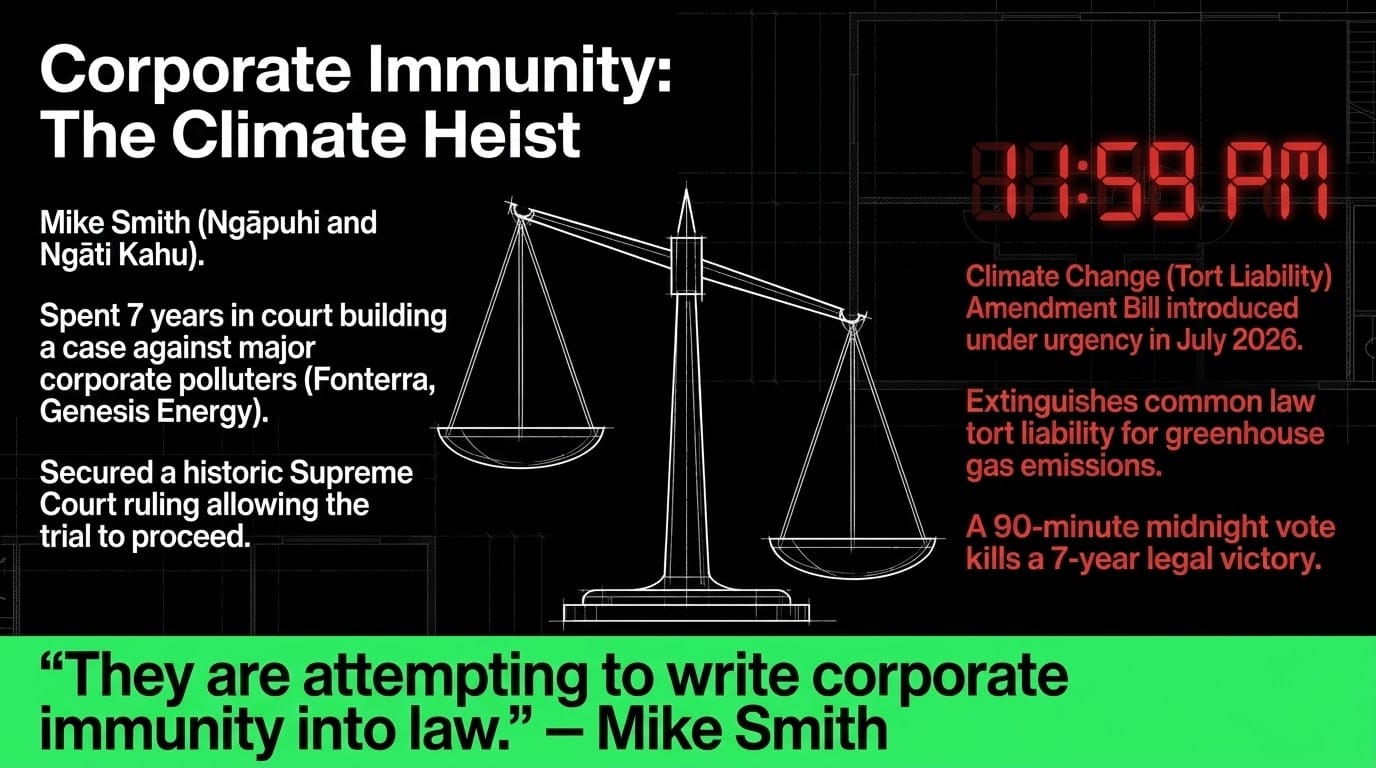
The lie: The Climate Change (Tort Liability) Amendment Bill — sent to select committee the week of 30 June 2026 — was framed as providing "legal certainty" for New Zealand businesses.
"kills a court action, creating a prohibition against the legal action of arguing liability against climate-change related emitters."
If passed, it would rule out Mike Smith's current Supreme Court action.
The standard: Legal certainty urgency would require an imminent, demonstrable risk of harm from legal uncertainty — a court ruling that had suddenly destabilised a critical sector or made compliance impossible.
Blow One: There Was No Sudden Legal Uncertainty — There Was a Functioning Supreme Court Process
The Smith v Fonterra case proceeded through New Zealand courts for seven years. In 2024, the Supreme Court held the case could proceed to trial. That ruling did not create chaos. It confirmed that ordinary tort law — the legal framework operating in New Zealand for generations — applies to climate emitters. "Legal certainty" here means certainty that Fonterra, Z Energy, Genesis Energy, BT Mining, Dairy Holdings, and NZ Steel cannot be sued for climate damage. That is not legal certainty for New Zealand. That is corporate immunity for New Zealand's largest polluters, granted under urgency, without public consultation, retroactively eliminating a seven-year court process.
Blow Two: Mike Smith Named It Directly — and the Government Did Not Contradict Him
Mike Smith stated: "Today this Government has told New Zealanders that if powerful corporations damage your future through climate pollution, your right to seek justice can simply be taken away. This is corporate protection legislation."
The government's response? Silence on the substance. Not one minister refuted the characterisation.
Blow Three: Lawyers for Climate Action Took This to the United Nations
Lawyers for Climate Action NZ referred the bill to the UN Special Rapporteur on climate change and human rights, citing violations of the rule of law, separation of powers, ICCPR Article 27 minority rights, and the ICJ's July 2025 Advisory Opinion on climate due diligence. The ICJ Advisory Opinion established legally binding duties of care in climate policy. This government's response was to remove the domestic legal mechanism through which those duties could be enforced — passed under urgency, referred to the United Nations.
DESTRUCTION EIGHT: "Strengthening Democracy — The Electoral Amendment Act"
The lie: Justice Minister Paul Goldsmith framed the Electoral Amendment Act 2025, passed under urgency in December 2025, as
"strengthening the integrity of New Zealand's democracy."
The standard: Electoral law urgency would require an imminent, demonstrable threat to electoral integrity — a discovered vulnerability in vote counting, a legal ruling invalidating enrolment law, or a court-ordered fix.
Blow One: The Bill Closed Voter Enrolment 13 Days Before Election Day — Targeting the Most Mobile Communities
The Electoral Amendment Act moved the enrolment deadline to 13 days before polling. This disproportionately affects people who move frequently, people in insecure housing, younger voters, and people released from prison. The Māori Green Lantern documented that 112,496 people are severely housing deprived in Aotearoa. Māori are 31% of the homeless — against 17% of the general population. The bill makes it harder for the most housing-insecure people to vote. It was passed under urgency six months before the November 2026 election.
Blow Two: The Prisoner Voting Ban Was Reinstated With No New Evidence of Need
The reinstated ban on voting for prisoners sentenced to under three years had previously been struck down by New Zealand courts as inconsistent with the NZ Bill of Rights Act. No new court ruling had created urgency. No new threat to electoral integrity had emerged. The ban was reinstated because this government chose to — and used urgency to avoid the public consultation that would have required justification.
Blow Three: The Anonymous Donation Threshold Was Lifted in the Same Electoral Cycle That Documented $500,000 in Fast-Track Donations
The act reduced financial transparency in the same electoral cycle during which an NZ Herald investigation documented $500,000 in donations linked to companies whose projects were fast-tracked. Less transparency. Less accountability. Passed under urgency. Months before the election.
This is not strengthening democracy. This is using urgency to reshape the electorate before you face it.
DESTRUCTION NINE: "Necessary Administrative Reforms — The Omnibus Bundle Strategy"
The lie: Across three years, the government described multiple urgency sessions as completing
"necessary administrative reforms."
The week of 30 June 2026 alone included the Regulatory Systems (Primary Industries) Amendment Bill — 250+ substantive changes to 19 laws — alongside the Regulatory Systems (Tribunals), Regulatory Systems (Occupational Regulation), and Regulatory Systems (Social Security) Amendment Bills.
The standard: Administrative tidying bills warrant expedited processing — but not urgency. Standing Orders already allow extended sitting hours and non-urgency procedures for less controversial legislation.
The Bundling Strategy Was Deliberate Camouflage
Transparency International identified
"surprise urgency — called late on a sitting day to prevent opposition preparation" as one of the most corrosive urgency abuses.
The government refined this further: bundle uncontroversial administrative bills with deeply controversial ones under the same urgency motion, using the uncontroversial bills as political cover.
In the week of 30 June 2026, the uncontroversial Offshore Renewable Energy Bill and Constitution Amendment Bill were bundled with the Health and Safety Amendment, the Healthy Futures (Pae Ora) Amendment, the Plain Language Act Repeal, and the Climate Change Tort Liability Bill. 36 debating stages across 23 bills, from breakfast to midnight and into Saturday. The media could not cover any single bill fully. The opposition was exhausted across every stage.
The administrative bills were not the reason for urgency. They were the camouflage for it.
What Remains After Every Justification Falls
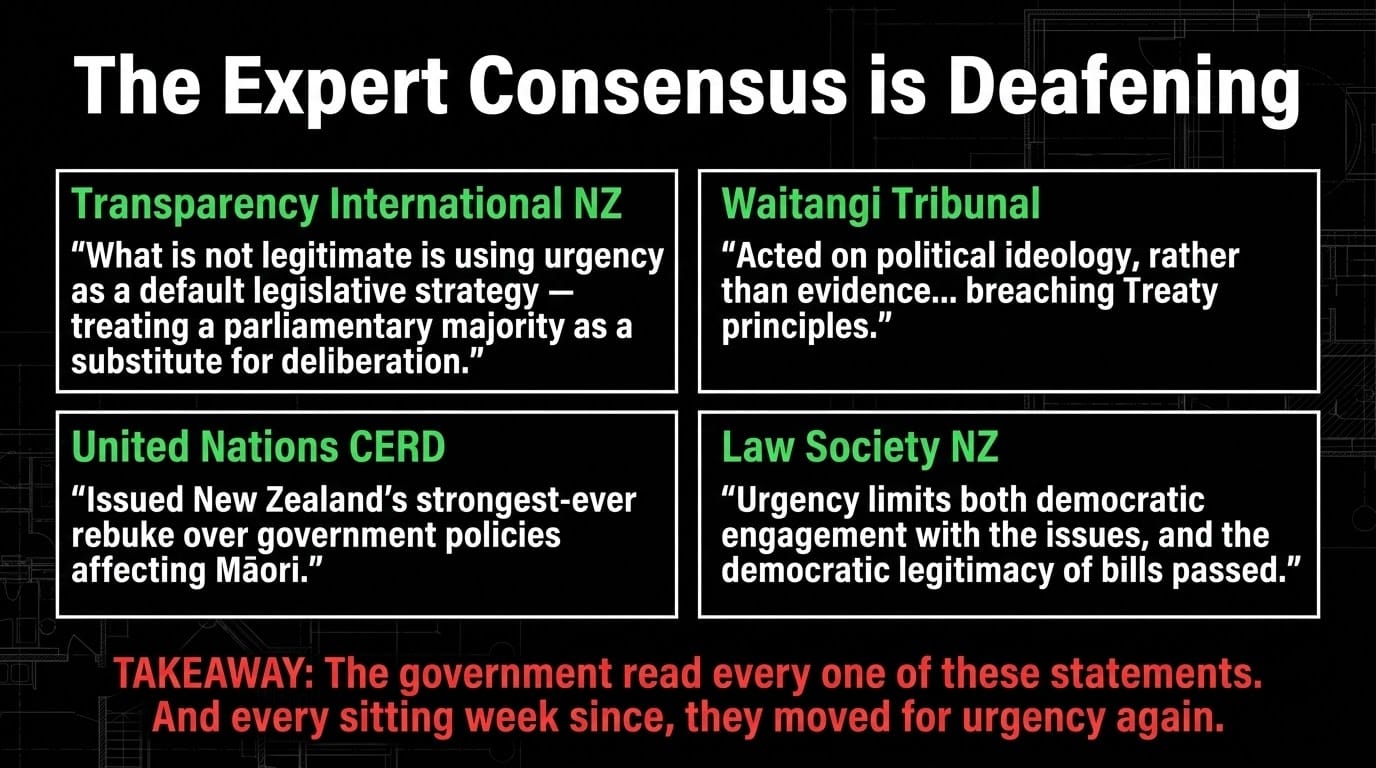
When every justification has been measured against the legal standard and found wanting, what is left?
A government that:
- Had no emergencies — only shopping lists
- Had no external deadlines — only coalition agreements it made with itself
- Had no error corrections — only rights it wanted to remove
- Had no specific electoral mandates — only general election wins it inflated into blank cheques
- Had no fiscal crises — only transfers from workers' wages to corporate accounts
- Had no health emergencies — only a Waitangi Tribunal finding of Treaty breach it was completing
- Had no threat to electoral integrity — only an electorate it wanted to reshape before it faced it
- Had no legal uncertainty — only a Supreme Court case it wanted to kill
- Had no red tape problem — only public accountability it wanted to remove
What this government had was a majority. Three parties. A coalition agreement. And the weakest urgency regime in the democratic world.
The Conversation called it a warning sign for New Zealand's "brittle democracy." E-Tāngata's Mark Feary called it "the slow demolition of our democracy." E-Tāngata's constitutional analysis stated plainly: "What creates instability is a government that routinely legislates over court decisions it dislikes and uses urgency to an excessive extent as a means of avoiding public input and scrutiny."
Not one emergency. Not one genuine crisis. Not one external deadline that could not wait two weeks for a select committee.
Just the weapon. Used every week. Pointed at the same people. Us.
What Must Replace These Lies
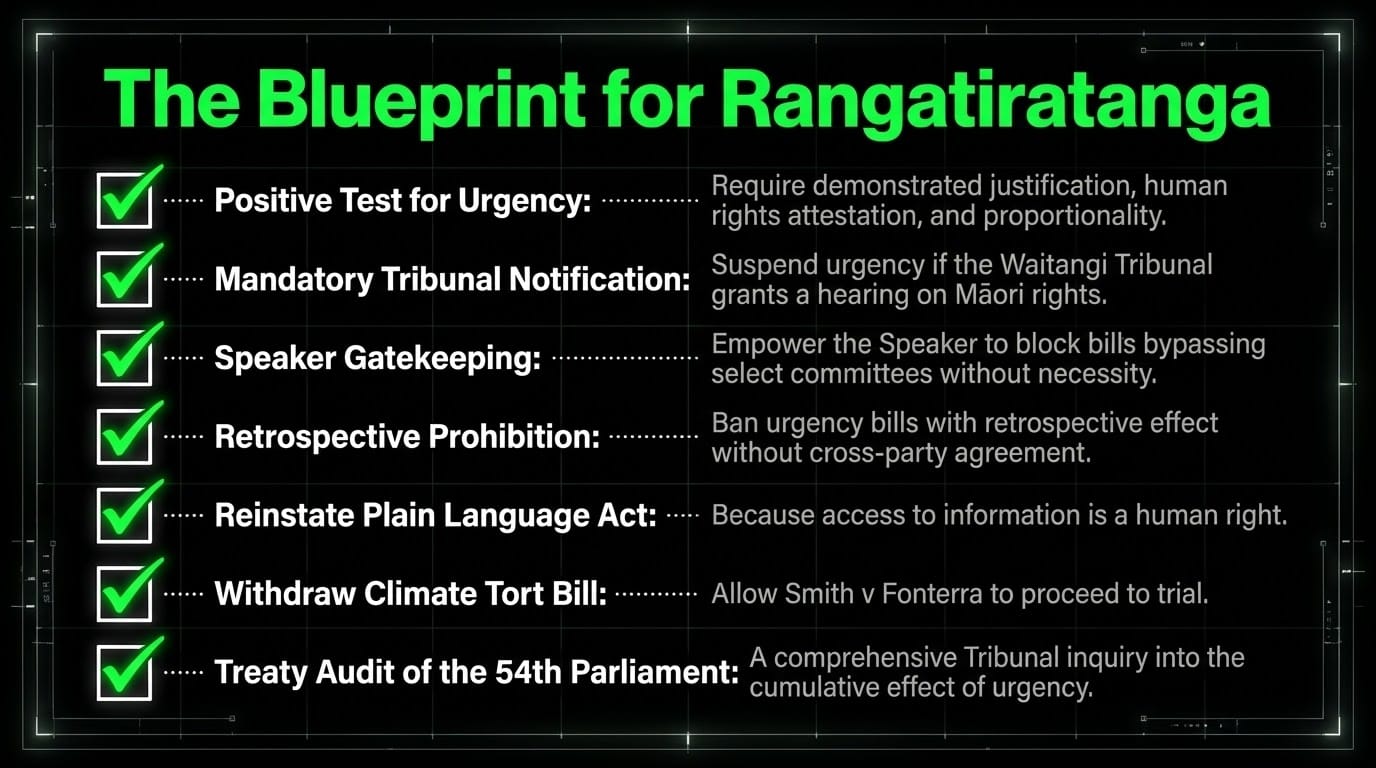
The justification framework must be replaced with a constitutional positive test. Transparency International's proposal provides the architecture:
| Required Element | Current Requirement | Required Reform |
|---|---|---|
| Stated reason | Any reason the minister offers | Must fall within recognised categories: emergency, deadline, error correction, or specific mandate |
| Proportionality | None | Assessment: is urgency proportionate to the demonstrated need? |
| Human rights attestation | None | Mandatory confirmation that rights scrutiny occurred through other means |
| Opposition notification | None | Reasonable notice required for non-emergency urgency |
| Speaker gatekeeping | Almost none | Speaker must withhold approval for select committee bypass without demonstrated necessity |
| Waitangi Tribunal protection | None | Automatic suspension where bills engage Treaty rights, pending Tribunal hearing |
| Retrospectivity prohibition | None | No retrospective urgency bill without cross-party agreement |
These are not radical proposals. Most comparable democracies already require some version of them. New Zealand is the outlier. This government made that outlier status its primary governing tool.
Previously Covered at The Māori Green Lantern
This essay builds on years of documented, sourced investigations:
- "Democracy Dies by a Thousand Urgency Motions" — the first full whakapapa of urgency abuse
- "Parliament's 2025 Year of the Industrial Grinder" — how 2025 became the year of legislative normalisation
- "The Van Velden Vanishing" — the minister who stole $12.8 billion and called it savings
- "The Kilometre Class" — how this government prices your life by your postcode and profession
- "The Prime Minister's Amnesia" — the man who cannot remember what he signed
- "The Toll Gate on Stolen Ground" — how National and NZ First sold the fast-track queue to the highest bidder
- "The Green Tide Rises and the North Awakens" — what the numbers say about November 2026

Disclaimer: This essay is written in the public interest. All claims are verified and hyperlinked to live sources inline. Named parties are public figures acting in their public capacity. Opinion is clearly labelled. This publication follows the retraction protocol of the Māori Green Lantern. Right of reply is available at ivor@themaorigreenlantern.maori.nz. This essay is political commentary protected by qualified privilege under Lange v Atkinson and the NZ Bill of Rights Act 1990 s.14.