"THE SCARECROW IN THE FLOOD PLAIN: How Wairoa Mayor Craig Little Sold His People a Stick Figure and Called It a Shield" - 14 April 2026
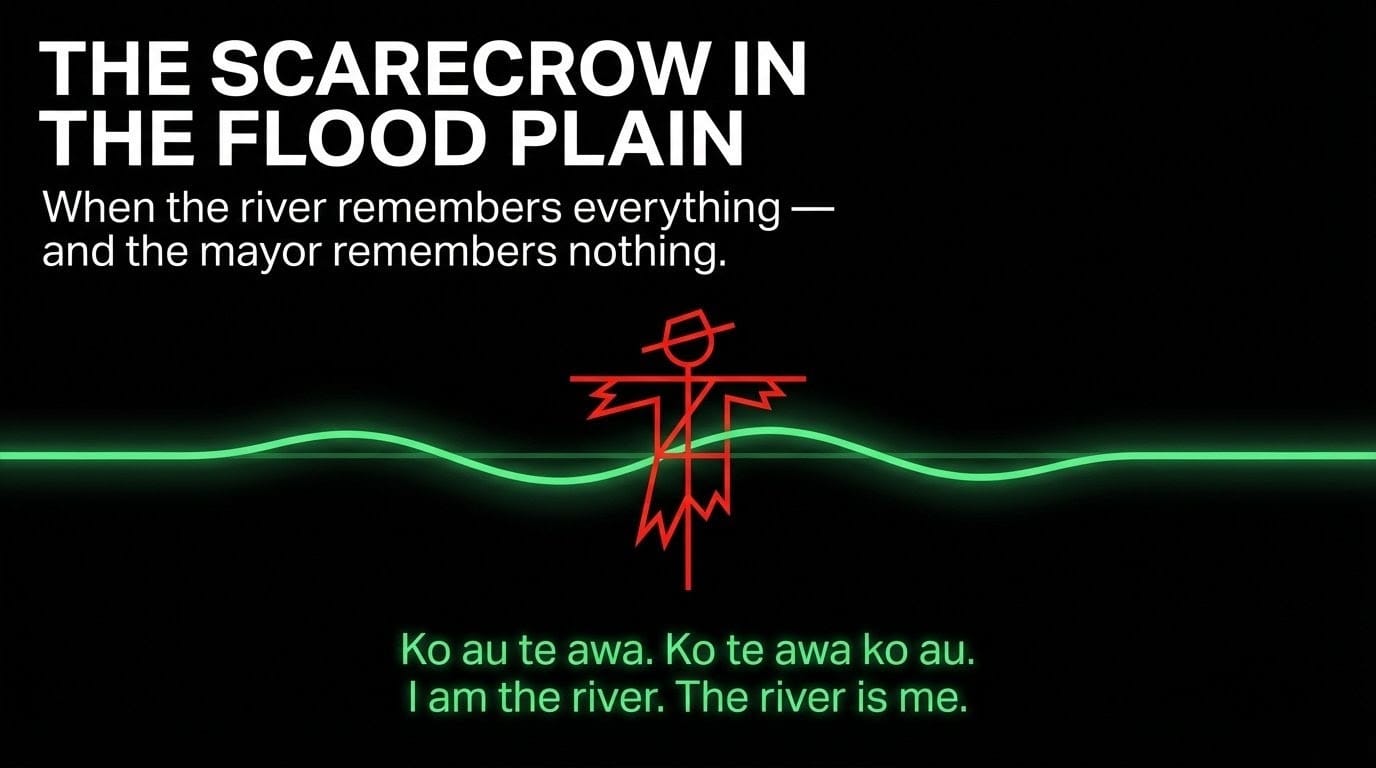
When the river remembers everything — and the mayor remembers nothing.

Ko au te awa. Ko te awa ko au.
I am the river. The river is me.
Kia ora Aotoearoa, Thank you for visiting here and taking in this analysis of the racist, old, male, pale Mayor of Wairoa.
Wairoa sits at the mouth of a river that does not forget. In 2023, the river swallowed one-third of the town, killed people across the region, and left whānau living in shells of homes with no walls, no water, no warmth. The river remembered. The river came back.
And Craig Little — in his fifteenth year on the mayoral seat, in his fifth consecutive term, in his most visible moment of public leadership in three years — called the emergency response
"woke."
A scarecrow in a flood plain. Arms out. Grinning. Doing nothing. Convincing no one — except, apparently, himself.
 RNZ News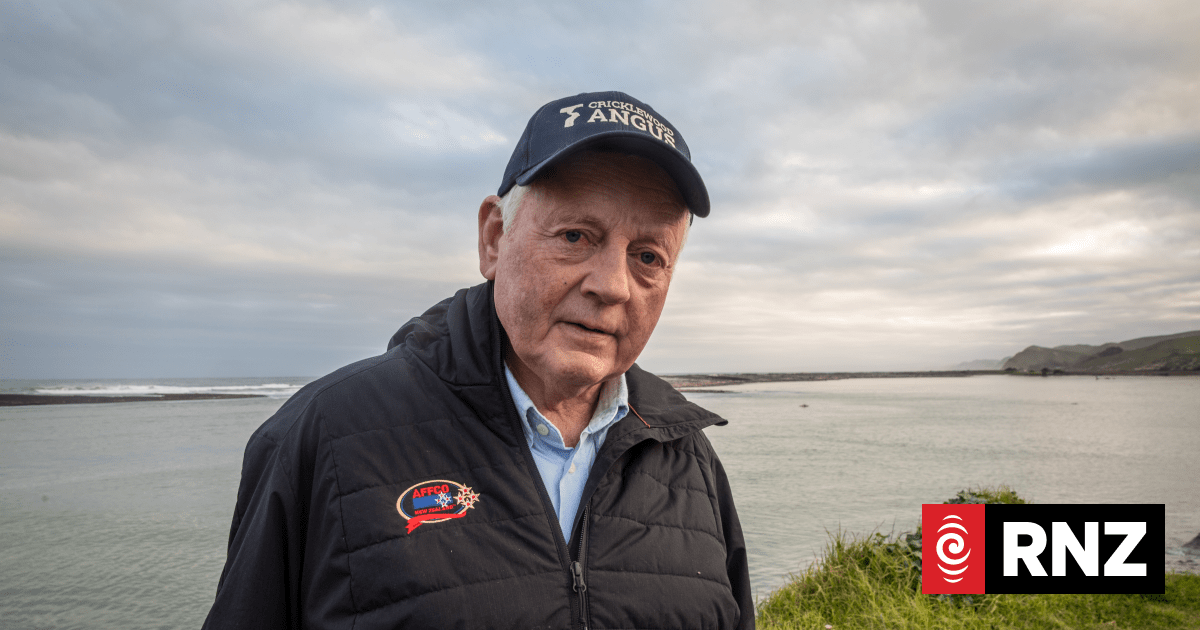
The Deep Dive Podcast
Listen to a lively conversation between two hosts, unpacking and connecting topics in the sources of this essay.
The Scarecrow: Who Craig Little Actually Is
Craig Little was born into the landowning class of rural Hawke's Bay, a fourth-generation farming family from Ohuka, as documented by NZ Herald. He has held elected office in Wairoa continuously since October 2010 — fifteen years — per his LinkedIn profile. In October 2025, he was handed a fifth consecutive term, as confirmed by the Wairoa District Council's own website.
Fifteen years. Fifth term. Same man. Same frame. Same intellectual horizon.
Wairoa District is one of the most deprived communities in Aotearoa — majority Māori, structurally underfunded, historically abandoned by the Crown, and precisely the kind of place where a mayor's decisions about emergency management are not administrative trivialities. They are life and death.
Craig Little knows this. He lived through Gabrielle. He held the press conferences. He saw the bodies of water where streets used to be.
And still — when Vaianu came — he reached for the word "woke."
The Word "Woke": Name the Weapon
Before going further: let us be surgically precise about what Craig Little did when he deployed the word "woke" to describe emergency management.
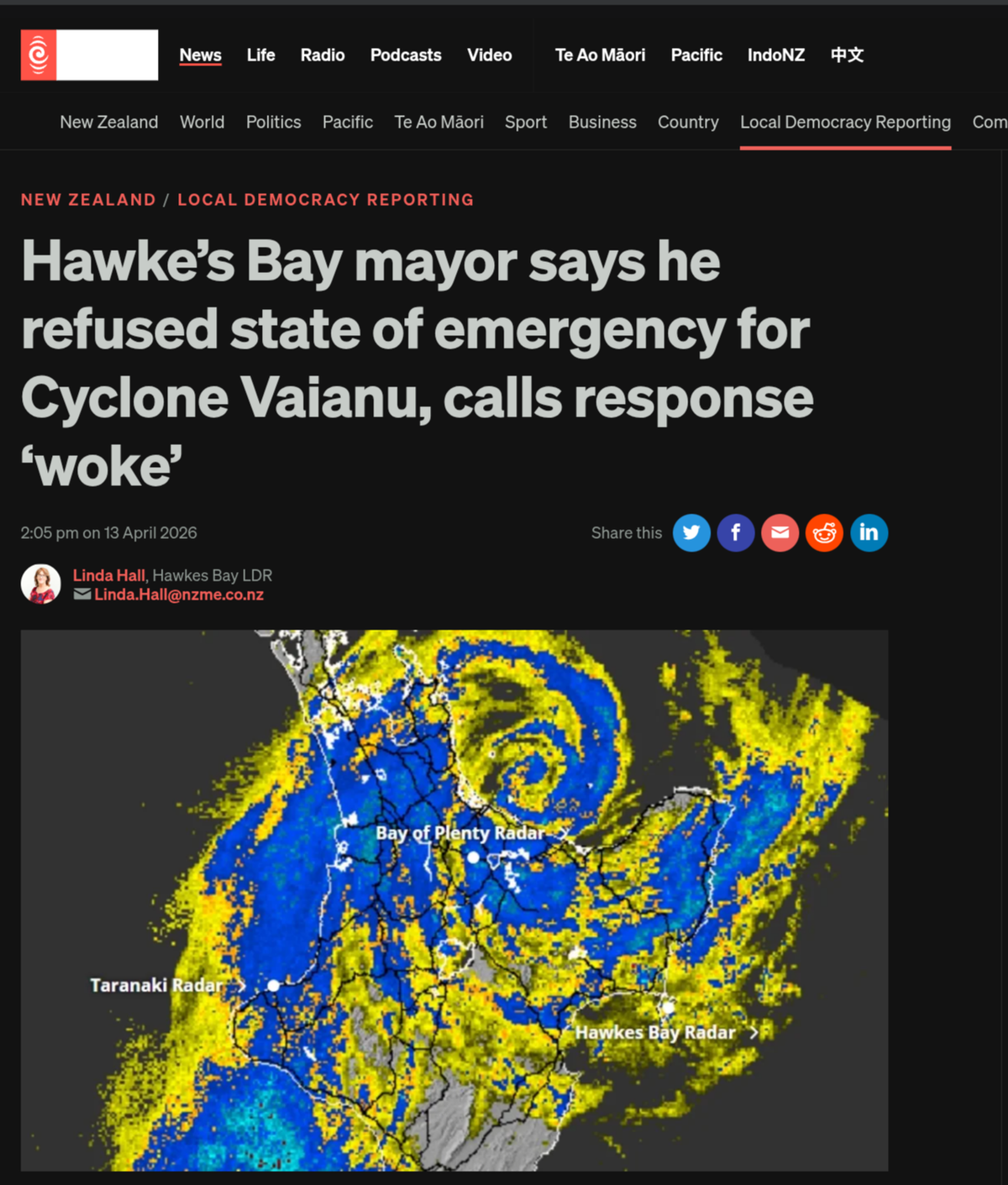
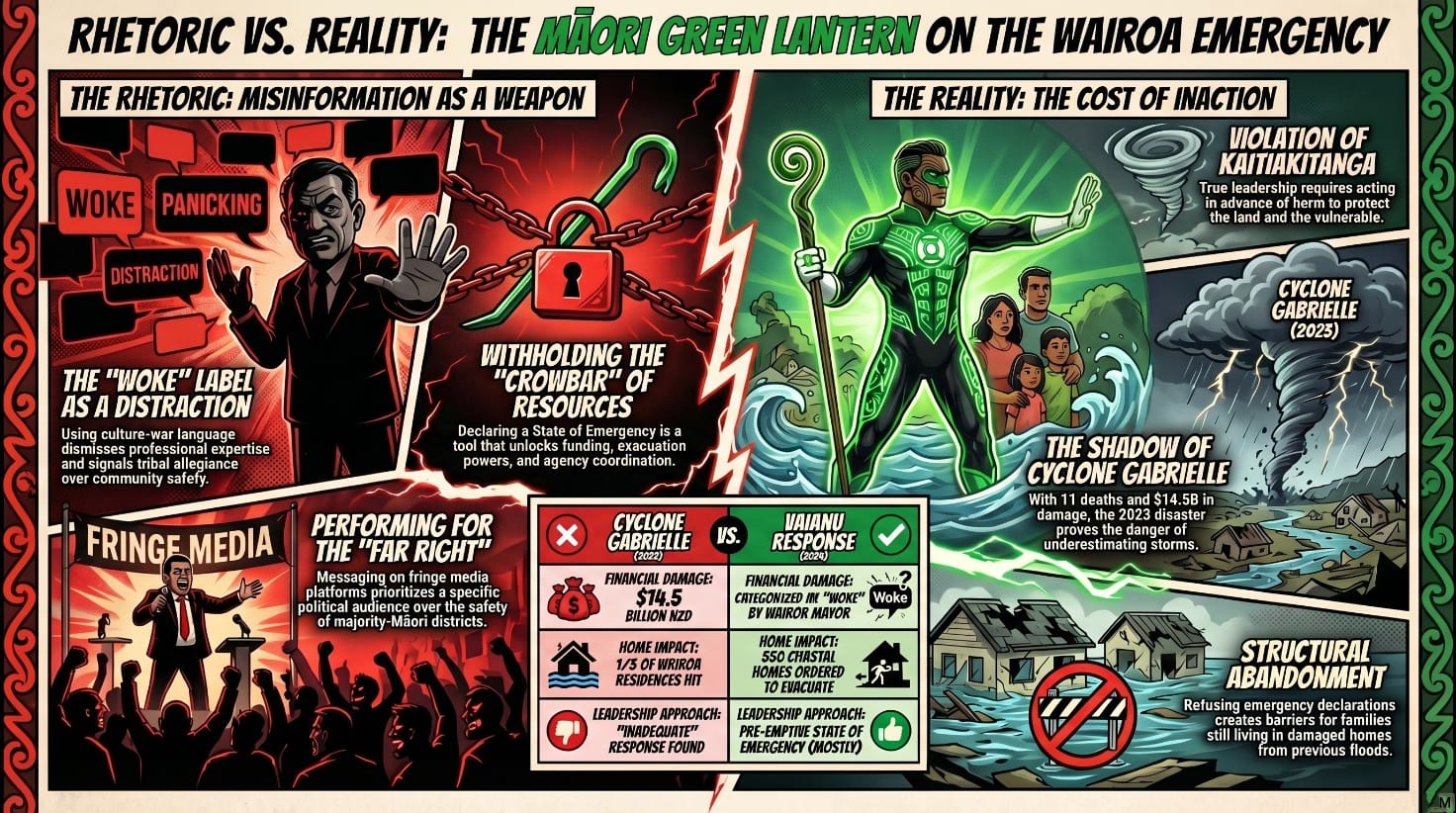
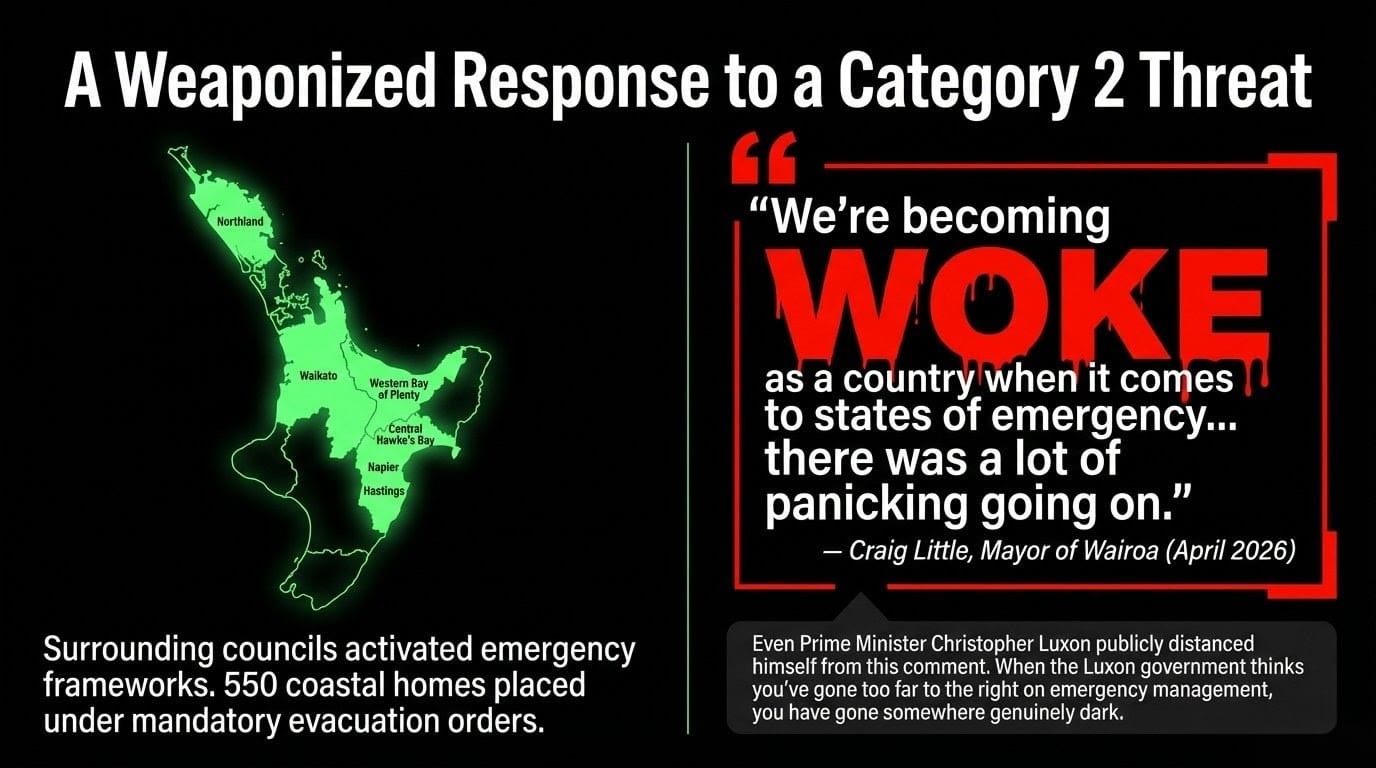
As B2BNews reported, Little called the region's Cyclone Vaianu emergency response "woke" and said there was "a lot of panicking going on." He told media he had refused to declare a local state of emergency for Wairoa while every surrounding council — Napier, Hastings, Central Hawke's Bay, Waikato, Northland, Western Bay of Plenty — activated their emergency frameworks, as documented by 1 News.
"Woke" is not an analysis.
It is a loaded weapon borrowed from the American culture wars — manufactured in Republican think tanks, fired by people who have never lived in a flood zone, and designed to do one thing: ridicule expertise, dismiss professional judgment, and signal tribal allegiance to an audience that finds the word more comforting than the truth.
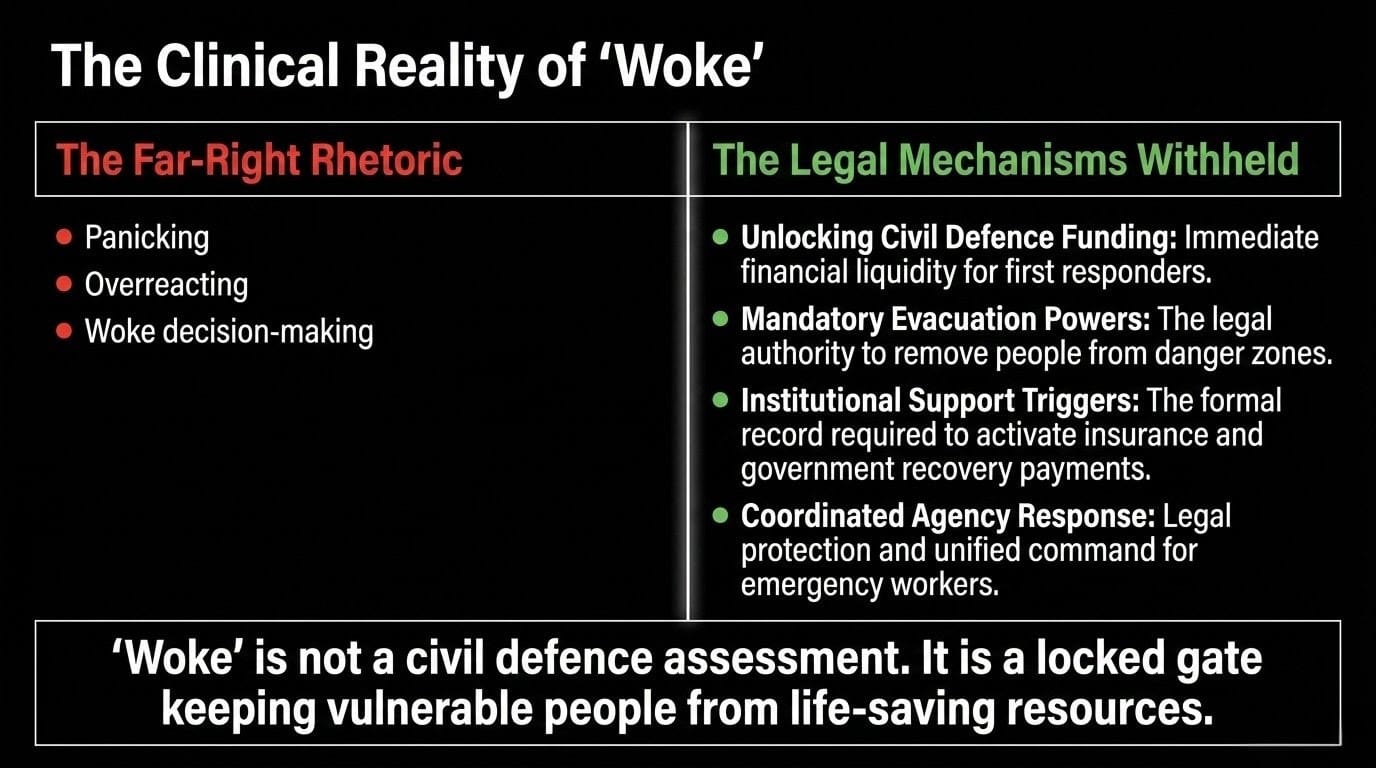
When Craig Little called emergency preparedness "woke," he was not making a civil defence assessment. He was performing for a Pākehā conservative audience — the same audience he courted when he appeared on The Platform in November 2025, the far-right media operation run by Sean Plunket and Michael Laws, where he discussed gangs in Wairoa in language crafted to appeal to people who live nowhere near Wairoa and will never be harmed by its underfunding.
A mayor of a majority-Māori district. On The Platform. Talking about gangs for a Pākehā grievance audience.
Ko wai ia? Who is he for?
The Flood Plain's Memory: Cyclone Gabrielle
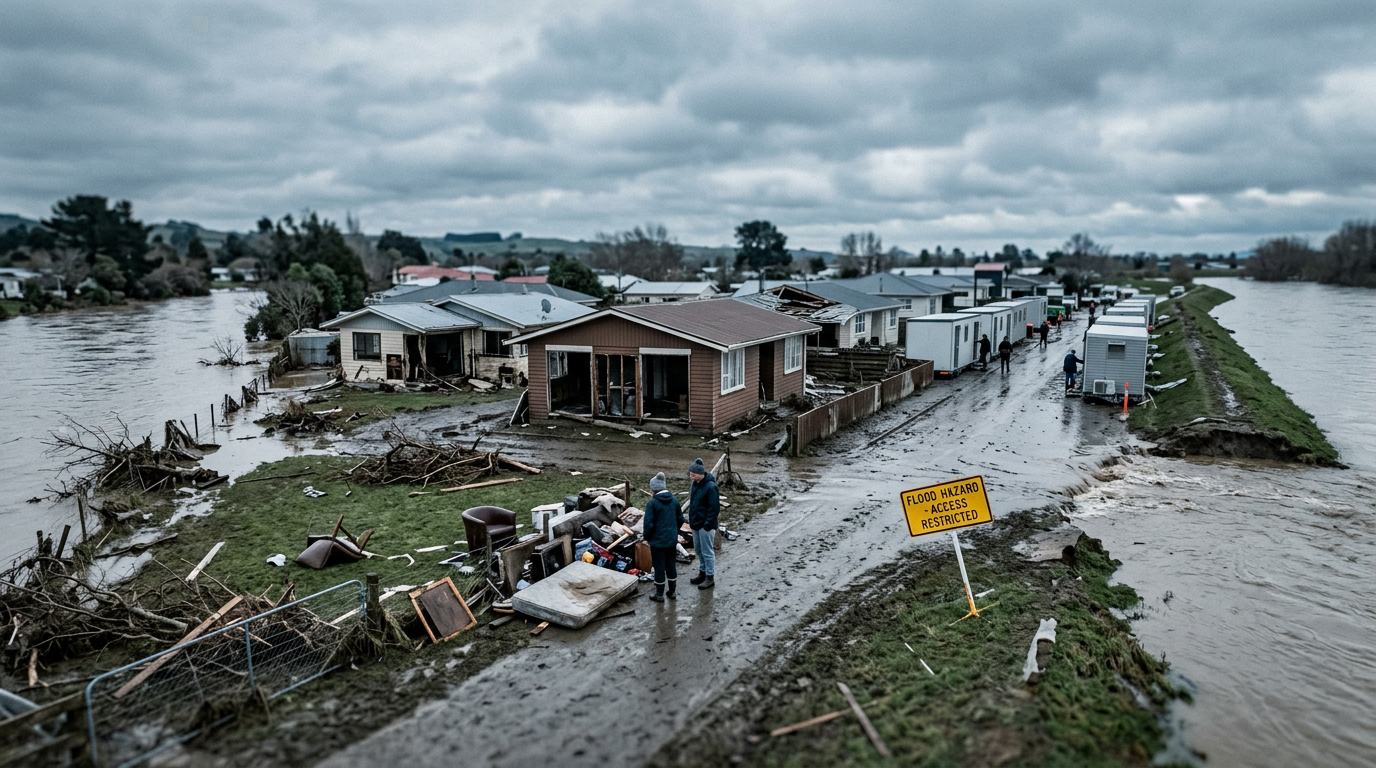
To understand the full, stomach-turning weight of Craig Little's performance during Vaianu, you must understand what the river already did to Wairoa.
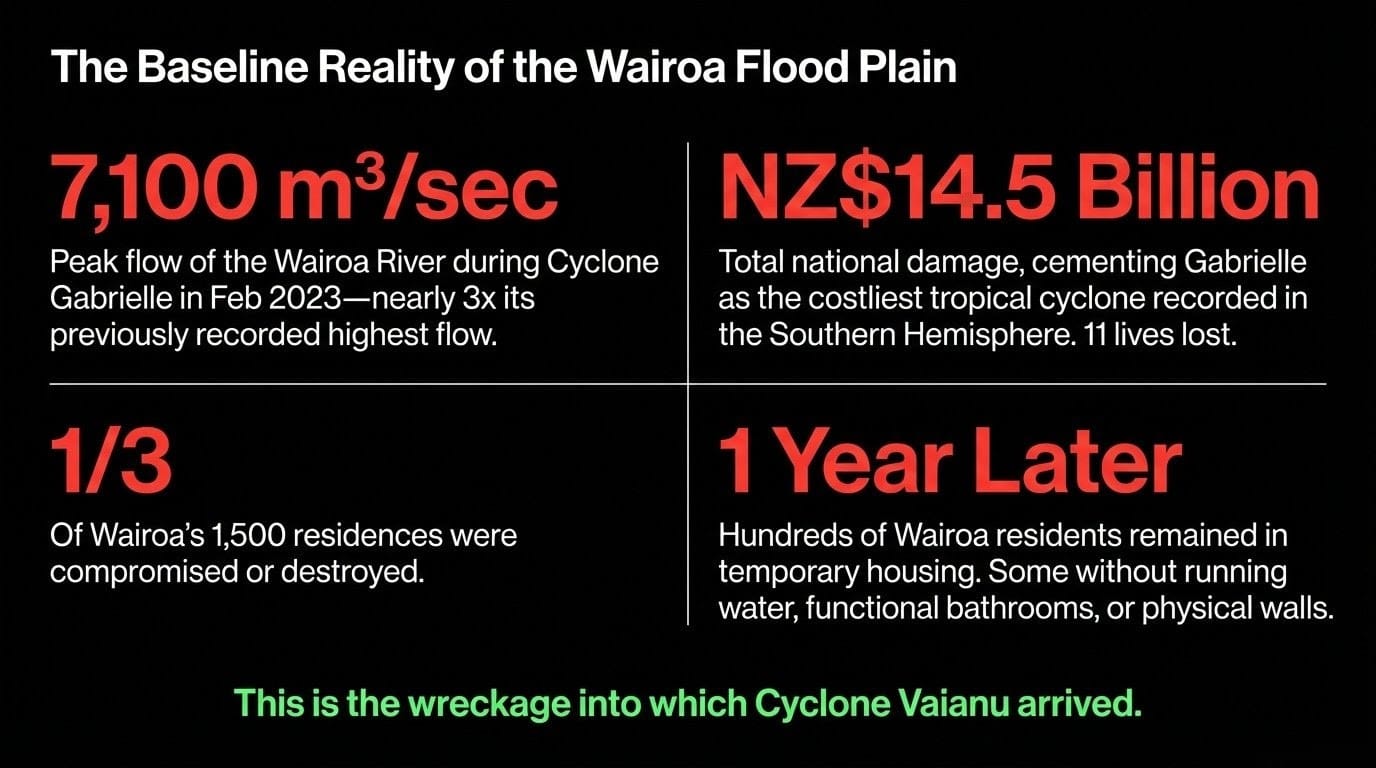
In February 2023, Cyclone Gabrielle hit Wairoa and did not merely cause damage — it dismembered the district. The Wairoa River peaked at over 7,100 cubic metres per second — nearly three times its previously recorded highest flow, as BayBuzz documented. One-third of Wairoa's 1,500 residences were compromised, as confirmed by The Guardian. Nationally, Cyclone Gabrielle caused NZ$14.5 billion in damage and is now the costliest tropical cyclone ever recorded in the Southern Hemisphere, as confirmed by Wikipedia's Cyclone Gabrielle entry and AIDR's academic journal.
One year later — by February 2024 — The Guardian documented hundreds of Wairoa residents still in temporary housing, some without running water, some without functional bathrooms, some without walls. Not metaphorically. Literally without walls.
These are the people who faced Vaianu in April 2026. The same people. In the same broken homes. Still waiting.
And their mayor — their scarecrow in the flood plain — told them not to panic. Told them the professionals were overreacting. Told them, in the language of American television culture wars, that the whole thing was woke.
Meanwhile, the ODT reported that Vaianu caused "a significant amount of damage." Across Hawke's Bay, NZ Herald reported 550 coastal homes under mandatory evacuation orders — orders that required precisely the legal and resource framework that a state of emergency declaration unlocks. Orders that required the kind of machinery Little had just publicly dismissed.
Even Prime Minister Christopher Luxon distanced himself from Little's comments, as noted in YouTube's coverage of the exchange. When the Luxon government thinks you've gone too far to the right on emergency management — you have gone somewhere genuinely dark.
Three Examples for the Western Mind
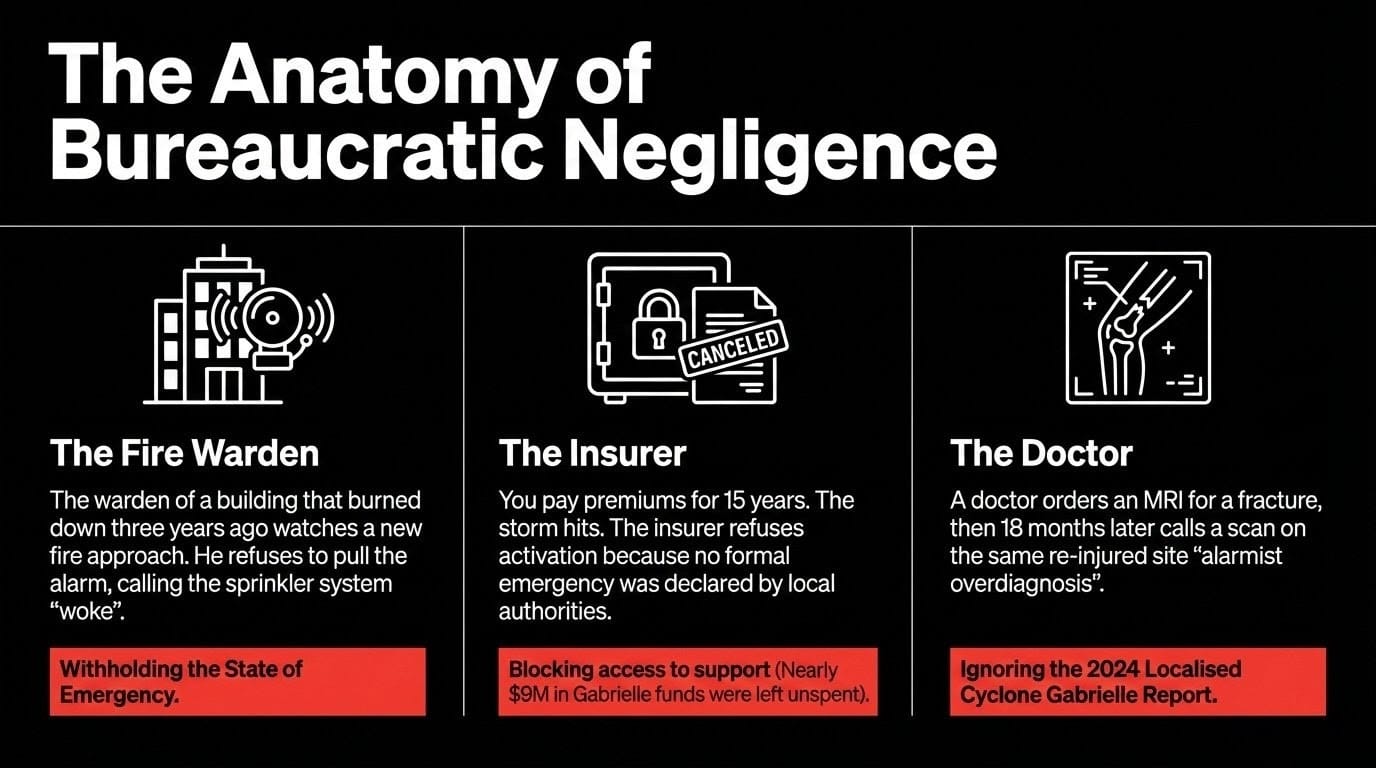
For those who have never lived in a flood plain, never lost a house to a river, never watched their community drown while the officials argued about optics — let these three examples illuminate what Craig Little actually took from his people.
Example One: The Fire Warden Who Calls the Sprinklers "Woke"
Imagine a large building. It has a fire warden. The building burned down three years ago — one-third of it was destroyed, people died, and some residents still live in the charred corridors because reconstruction money ran dry. Now another fire is approaching. Every neighbouring building activates their sprinkler systems, their evacuation protocols, their emergency exits.
The warden of your building holds a press conference. He says the sprinkler system is "woke." He says there's "a lot of panicking going on." He does not pull the alarm.
This is not a metaphor. This is Craig Little's exact sequence of decisions, played out in real time, with real people in a real flood plain.
What a state of emergency declaration actually unlocks — as documented by Te Ara's Civil Defence entry — includes: Civil Defence funding, mandatory evacuation powers, coordinated agency response, legal protection for emergency workers, and the formal record that triggers insurance and government recovery payments. Little withheld that machinery from Wairoa. He called it panicking. He called it woke.
The people who live in homes without walls from the last flood? They were the ones who needed those sprinklers most.
Example Two: The Insurance Company That Cancels Your Policy the Night Before the Storm
This is what happens without a state of emergency declaration: the vulnerable cannot access the institutional support they need, because the institutional machinery has not been activated. In Wairoa's case — a district where nearly $9 million of Cyclone Gabrielle business support was left unspent and potentially returnable to the Crown, as reported by NZ Herald — the failure to deploy resources is a pattern, not an anomaly.
For the western mind: imagine you pay your insurance premium faithfully for fifteen years. The storm comes. You call your insurer. They tell you that because no formal emergency was declared in your district, your policy is ineligible for activation. The money exists. The mechanism exists. But the gate was left locked — by a man who called locking the gate "leadership."
That is Craig Little's legacy to Wairoa under Vaianu.
Example Three: The Doctor Who Says Your X-Ray Is Overdiagnosis
In 2024, the Wairoa District Council's own Localised Cyclone Gabrielle Report was released, specifically documenting the infrastructure vulnerabilities that needed to be addressed before the next flood event. Little praised the report. Eighteen months later, when the next cyclone came, he called emergency preparation "panicking."
For the western mind: this is the equivalent of a patient's doctor ordering a full MRI after a serious injury, identifying multiple fractures, documenting the findings in detail — and then, when the patient arrives eighteen months later with the same injury site re-fractured in a second accident, telling them: "Don't panic. The previous scan was alarmist. I won't be ordering another one. That kind of medicine is woke."
The X-ray is not the problem. The fracture is the problem. The doctor who refuses to read the X-ray is the problem.
The Impact on Tikanga: Why This Matters Beyond the Western Frame
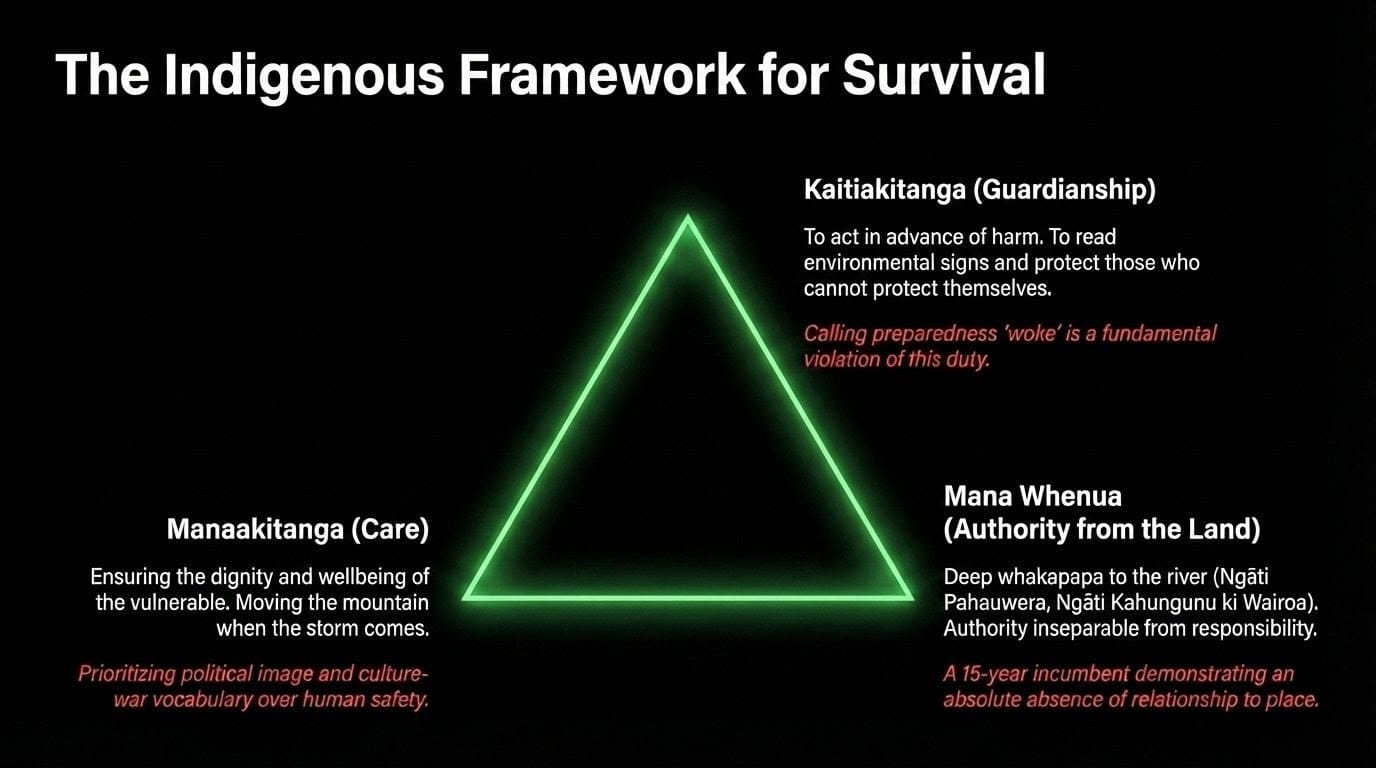
For those who do not move through the world via tikanga Māori frameworks, here is what Craig Little's performance actually destroyed — and why it is irreparable simply by calling it "political incompetence."
Kaitiakitanga — guardianship of people and place — is not a metaphor. It is a live obligation. The mayor of a district holds a form of kaitiakitanga over the community entrusted to their leadership. To be kaitiaki is to act in advance of harm, to read the signs in the environment, to protect those who cannot protect themselves. Craig Little, in refusing the emergency declaration and calling preparedness "woke," did not merely fail an administrative test. He violated the principle that underpins the entire reason for having a mayor at all.
Manaakitanga — the ethic of care, of ensuring the dignity and wellbeing of those in your presence — demands that when a storm comes for the most vulnerable, you move the mountain to protect them. Not minimise the storm. Not perform for your base. Not reach for culture-war vocabulary borrowed from a country where emergency management is also being destroyed by the same ideology. Manaakitanga demands you put the people first. Little put his image first.
Mana whenua — the authority derived from the land — is inseparable from responsibility to the land and its people. Wairoa's mana whenua are Ngāti Pahauwera, Ngāti Kahungunu ki Wairoa, and related hapū. Their whakapapa to that river — the one that nearly destroyed their homes in 2023 — is thousands of years deep. When a Pākehā mayor who has held the mayoralty for fifteen years calls the protection of that place "woke," he is not just being politically obtuse. He is demonstrating a fundamental absence of the relationship to place that kaitiakitanga requires.
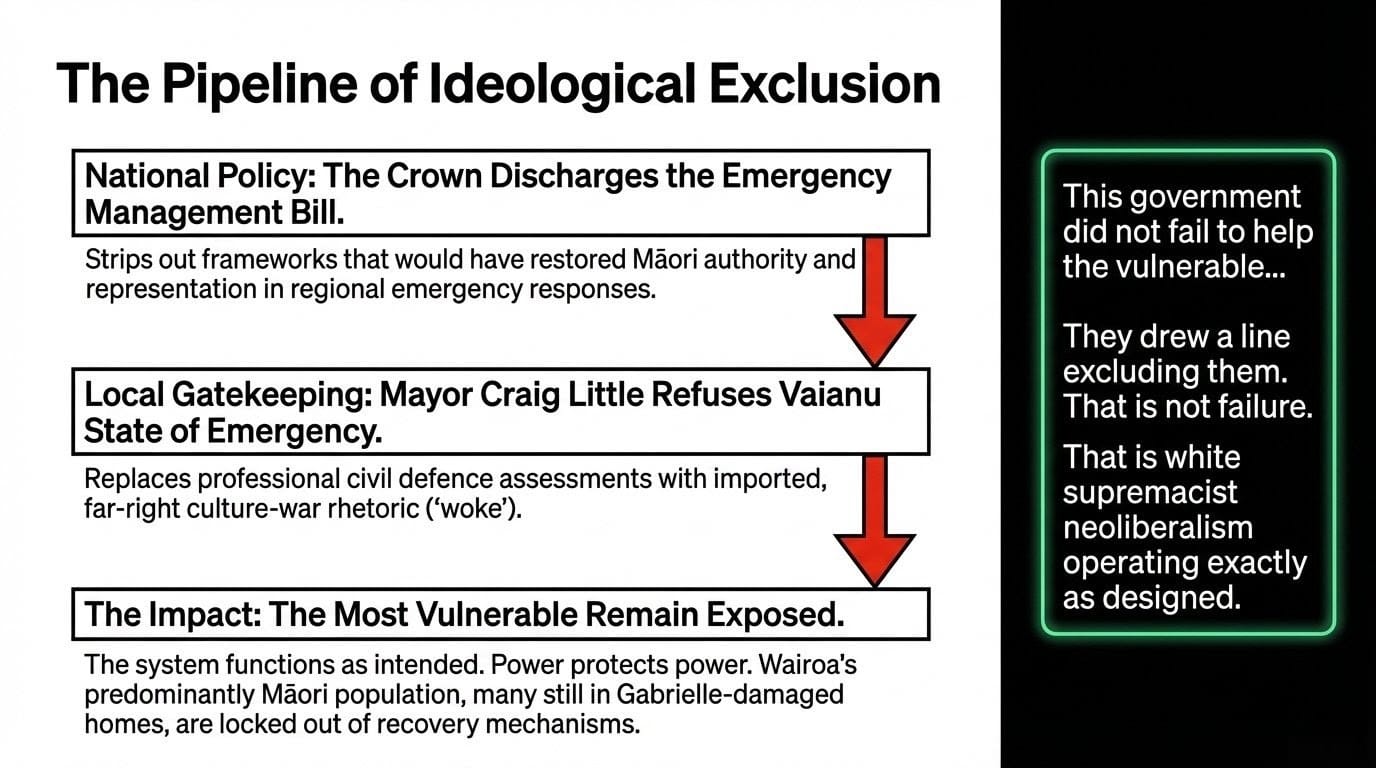
As a research paper in PMC's academic journal on barriers to Māori mana in emergency management confirms, the discharged Emergency Management Bill — killed by the incoming Luxon government — would have restored Māori authority and representation in emergency management at the national and regional level. That bill is gone. In its absence, a Pākehā mayor calls preparedness "woke," and the most vulnerable communities are left exposed.
This is not a pattern that begins with Craig Little. It is a pattern the Māori Green Lantern has traced across this government's entire architecture of harm.
The Whakapapa of This Failure: The White Supremacist Neoliberal Context
Craig Little did not emerge from a vacuum. He is a product — and a local expression — of an ideology that has held Aotearoa in a death-grip since the 1984 Rogernomics revolution: the ideology that public investment is waste, that emergency systems are bureaucratic overreach, that "locally led" means the powerful get to decide who gets help and who is told to stop panicking.
As the Māori Green Lantern's essay "Pantomime of the Dying Waka" documented in March 2026: this is a government that picks up the previous administration's emergency management frameworks, holds them upside down, and performs preparedness while gutting the actual machinery. Luxon's government discharged the Emergency Management Bill that would have given Māori communities formal authority in the response systems that most affect them. Little's refusal to declare an emergency is the local-government echo of that national decision: power protects power, and the vulnerable are left in broken homes, told not to panic.
As documented in "Ka Noho i Roto i te Ahi" — the Māori Green Lantern's analysis of the fuel crisis emergency relief — this government routes emergency assistance through systems that work correctly only 24% of the time, generating debt letters and financial trauma months after disasters. The architecture is not broken by accident. It is designed to exclude. Craig Little is not an aberration in this design. He is a brick in its wall.
As the Māori Green Lantern's essay "The Pātaka is Ash" established with unsparing clarity:
"This government did not fail to help the vulnerable. They looked at the vulnerable, identified them precisely, and drew a line excluding them from relief. That is not failure. That is policy. That is white supremacist neoliberalism operating exactly as designed."
Craig Little's decision to withhold emergency declaration from Wairoa is that policy at the local government level. The line was drawn. Wairoa's most vulnerable — predominantly Māori, many still in Gabrielle-damaged homes — stood on the wrong side of it.
And the man who drew the line called it courage.
The Hidden Connections: Five Threads the Mainstream Media Won't Pull
Connection One: The Unspent Gabrielle Money. Nearly $9 million of Cyclone Gabrielle business support for Hawke's Bay was left unspent and potentially returnable to the Crown, as revealed by NZ Herald. This is not a story about waste. It is a story about access. Resources existed. Mechanisms existed. The people most in need could not get through the gate. Craig Little's refusal to declare a Vaianu emergency is the same gate-locking in real time, with a camera and a sound bite.
Connection Two: The Report He Praised, Then Ignored. The Wairoa District Council released its own Localised Cyclone Gabrielle Report in April 2024, identifying infrastructure vulnerabilities and recommending preparedness improvements. Little publicly supported it. Eighteen months later, he called emergency preparedness "woke." He praised the post-mortem. He ignored the lesson. This is not incompetence. This is the comfortable indifference of a man who has been re-elected five times and learned that there are no consequences.
Connection Three: The Platform Appearance. In November 2025, Craig Little appeared on The Platform — the far-right media operation whose hosts have consistently pushed anti-Māori, anti-Treaty content — to discuss gang issues in Wairoa. A mayor of a majority-Māori community, on the platform of Māori demonisation, performing outrage about gangs for a suburban Pākehā audience. This is not incidental. The word "woke" in April 2026 is the continuation of the same performance. Craig Little has a political audience. It is not the people of Wairoa.
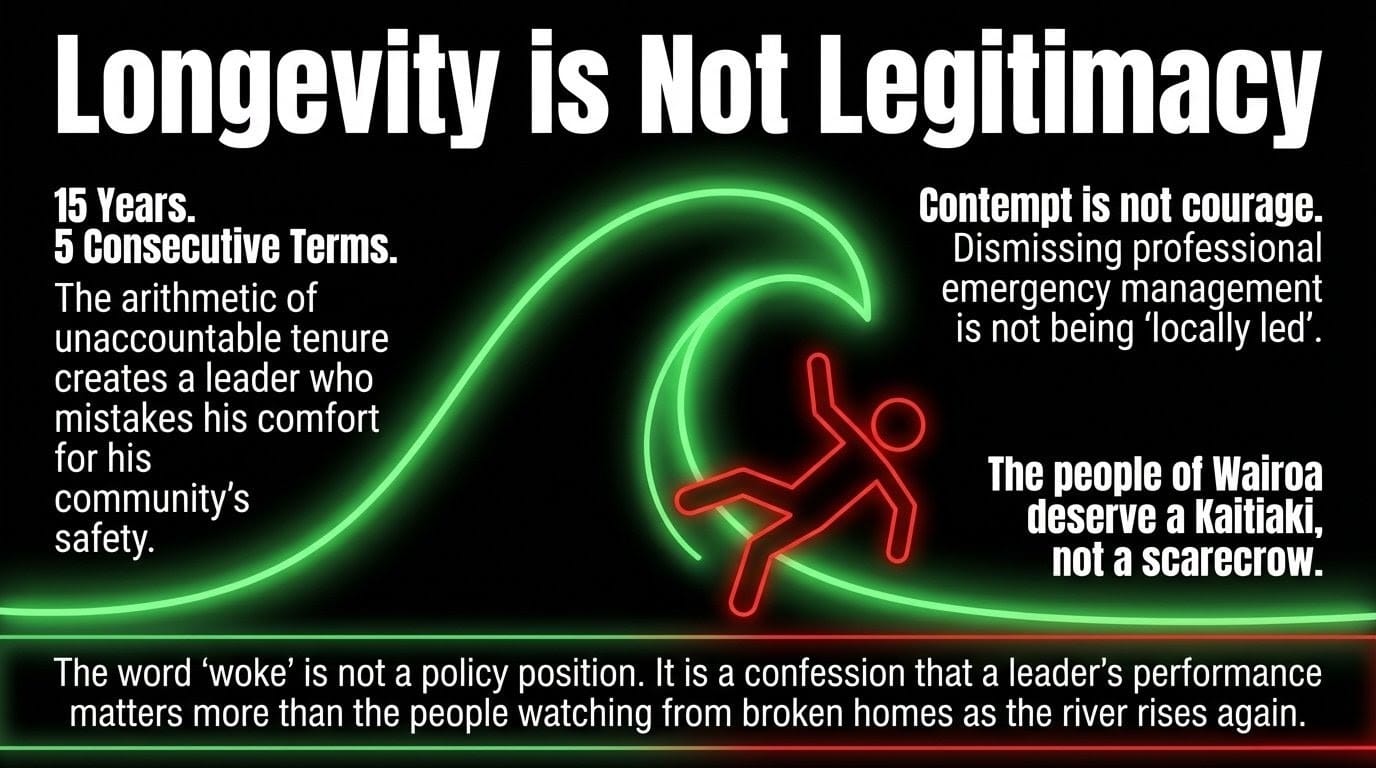
Connection Four: Fifth-Term Contempt. Craig Little was re-elected in October 2025, as confirmed by the Wairoa District Council. Within six months, he was publicly mocking the emergency management professionals trying to protect his district. This is the arithmetic of unaccountable tenure: the longer a man holds unchallenged power, the more he mistakes his comfort for his community's safety.
Connection Five: The Discharged Bill. As the academic research in PMC confirms, the Luxon government discharged emergency management legislation that would have restored Māori authority in emergency response at the regional and national level. Little's local decision to dismiss emergency declaration is made in the shadow of that national decision. The government dismantled Māori authority in emergency management from the top. Little echoes it from the bottom. These are not coincidences. They are the coordinated expression of the same ideology.
The Quantified Harm: Real Numbers, Real People
The harm of Craig Little's performance is not abstract. It is concrete, physical, and still accumulating:
Cyclone Gabrielle: 11 deaths, as confirmed by Te Ara's floods entry
- NZ$14.5 billion in damage — the costliest Southern Hemisphere tropical cyclone on record, per Wikipedia
- One-third of Wairoa's 1,500 residences compromised, per The Guardian
- Hundreds still in temporary housing one year later, some without water or sanitation, per The Guardian
- $9 million in Gabrielle business support left unspent and inaccessible, per NZ Herald
- 550 Hawke's Bay coastal homes under mandatory evacuation during Vaianu, per NZ Herald
- Wairoa under Craig Little during Vaianu: zero state of emergency and a mayor calling professional judgment "woke," per B2BNews
The Scarecrow Falls: What Must Happen
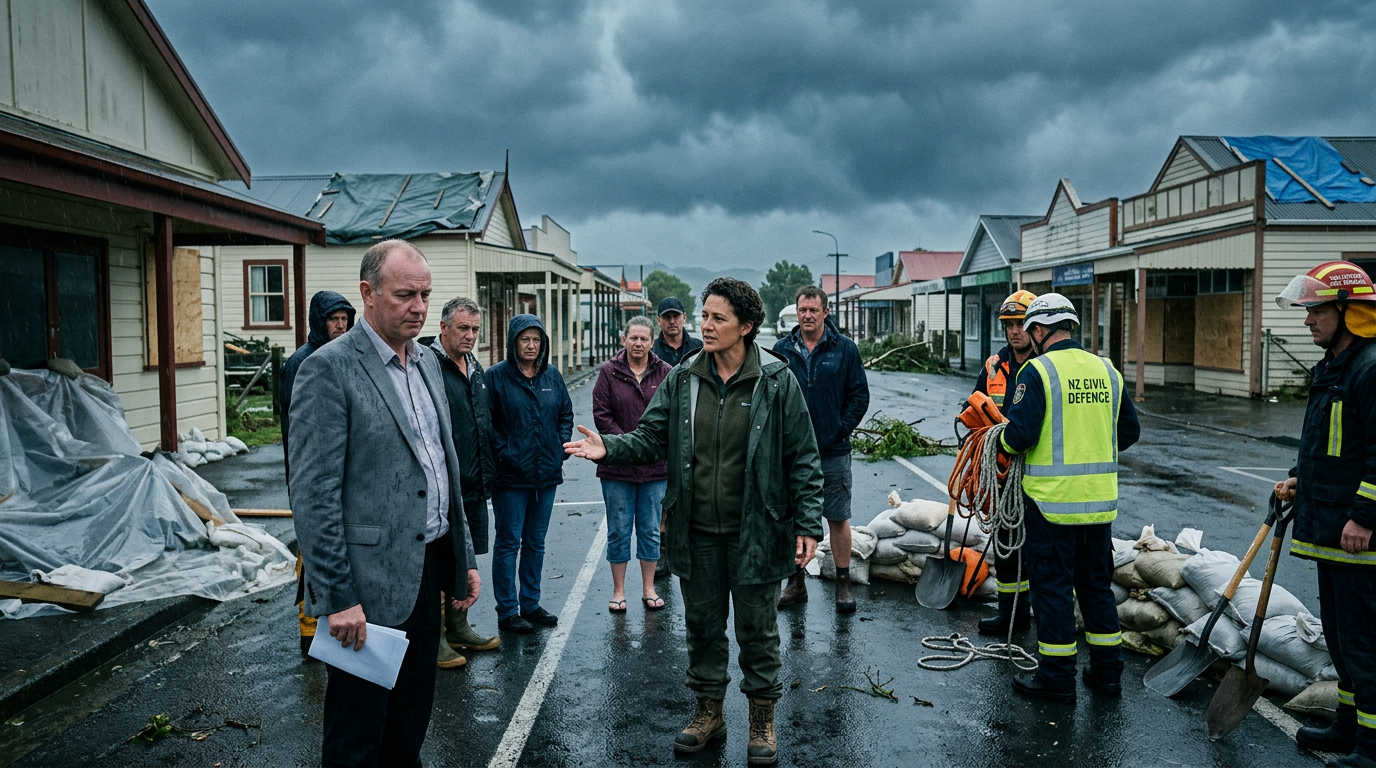
Craig Little must resign, or the people of Wairoa must remove him at the earliest opportunity. This is not political opinion. This is the logical consequence of a public official demonstrating — on the record, on camera, with his own words — that he will deploy culture-war rhetoric to avoid his legal and moral obligation to protect his community.
The people of Wairoa deserve a mayor who looks at a cyclone bearing down on a district still in Gabrielle's wreckage and says: we do not gamble with our people. A mayor who knows that a state of emergency is not a political statement but a tool — a crowbar that opens the locked door to resources, coordination, and protection that the vulnerable cannot access any other way, as Te Ara makes unambiguously clear.
They deserve a kaitiaki, not a scarecrow.
They deserve a leader who understands that the word "woke" — deployed against emergency management — is not a policy position. It is a confession: a confession that the speaker has decided their performance matters more than the people watching from broken homes as the river rises again.
The river remembers everything, Craig. It will come back. And your word count on The Platform will not hold back a single drop.
Ko Wai Ia? — Who Is He For?
Craig Little has been mayor for fifteen years. In that time, Wairoa has remained among the most deprived districts in Aotearoa. After the worst storm in a century, his people lived in homes without walls. After the second cyclone in three years, his response was to reach for a vocabulary borrowed from American television and point it at the professionals trying to save lives.
He is not strong. He is not courageous. He is not locally led. He is a man who has mistaken longevity for legitimacy and contempt for courage — the hallmark of every comfortable Pākehā man who has ever occupied power in a community he was never fully accountable to.
The white supremacist neoliberal government that gutted the Emergency Management Bill, stripped Māori emergency management authority, and left $9 million unspent while Wairoa families lived in rubble — that government created the conditions in which a man like Craig Little can call preparedness "woke" and survive the news cycle. He is their creature, even if he doesn't know it. He speaks their language. He performs their contempt.
But the river speaks a different language. And it does not forget.
Ko wai ia? Not for Wairoa. Not for Māori. Not for the vulnerable.
He is for the fiction of his own indispensability.
The ring has spoken.
He Mihi Koha — A Word About This Mahi
Craig Little called emergency preparedness "woke" while whānau in Wairoa were still sleeping in the bones of Gabrielle. This essay exists because someone has to name that — clearly, publicly, without flinching. The mainstream media will move on. The Māori Green Lantern will not.
If this essay found you, and it said something true, consider what it took to write it: the research, the verification, the refusal to look away from what powerful men do when no one is holding them to account.
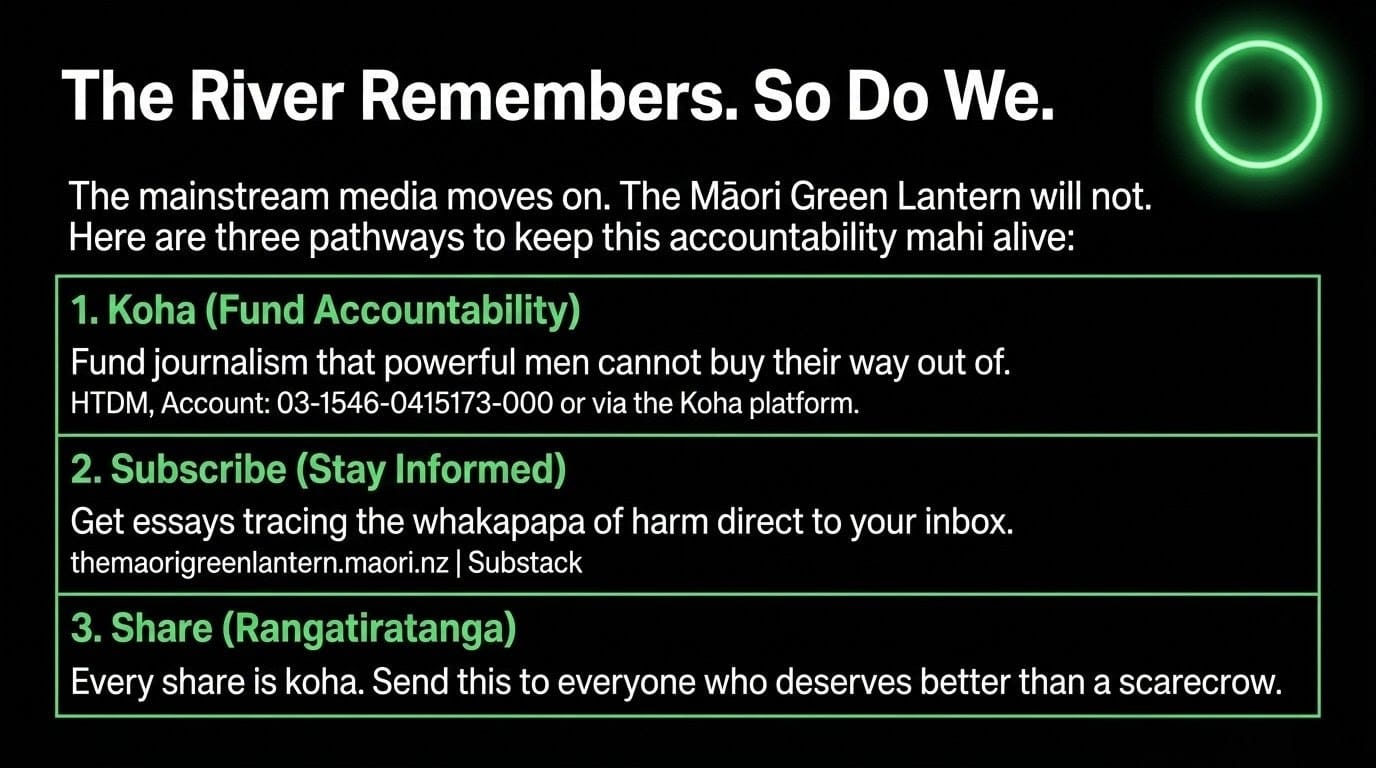
Three pathways to keep this mahi alive:
For those who want to directly fund accountability journalism that powerful men in Wairoa cannot buy their way out of, a koha is welcome at the Koha platform.
For those who want essays like this one — essays that name Craig Little, name the system he serves, and trace the whakapapa of harm from Gabrielle to Vaianu to your front door — directly in your inbox, subscribe to the Māori Green Lantern.
For those who prefer direct bank transfer: HTDM, account number 03-1546-0415173-000.
And if you cannot koha right now — no worries, e hoa. Share this essay. Read it to someone who needs to hear it. Send it to every person in Wairoa who has ever lived in the shadow of that river and deserved better than a scarecrow.
Every share is koha. Every conversation is rangatiratanga. Every truth told is a stone in the foundation of the world we are building.
Kia kaha, whānau. The river remembers. So do we.
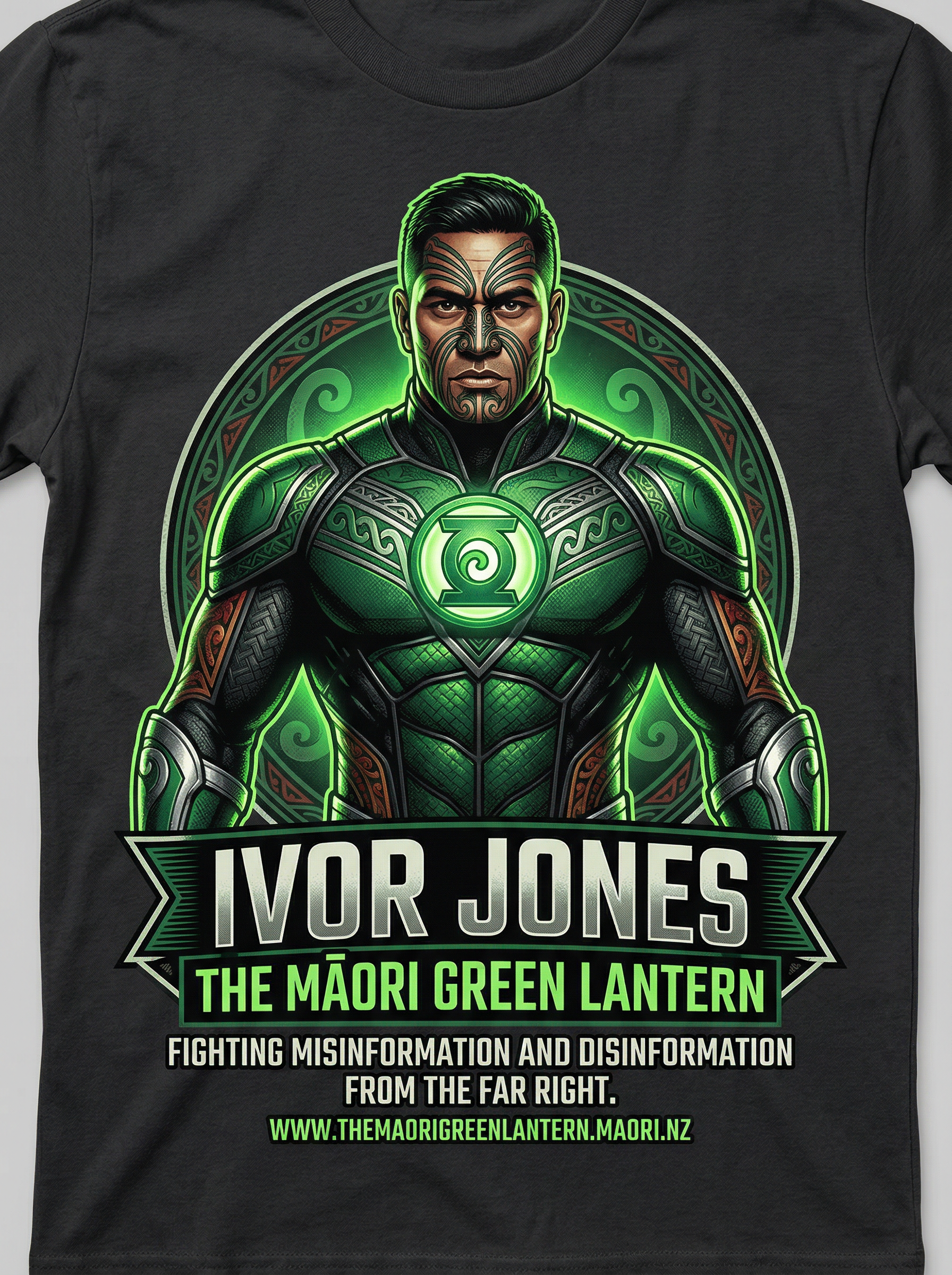
The Māori Green Lantern. Tohunga mau rākau wairua. Kaitiaki of truth.
themaorigreenlantern.maori.nz | Substack | Facebook