
"The Spark Rally: When Job Cuts Make The Share Price Dance" - 21 August 2026
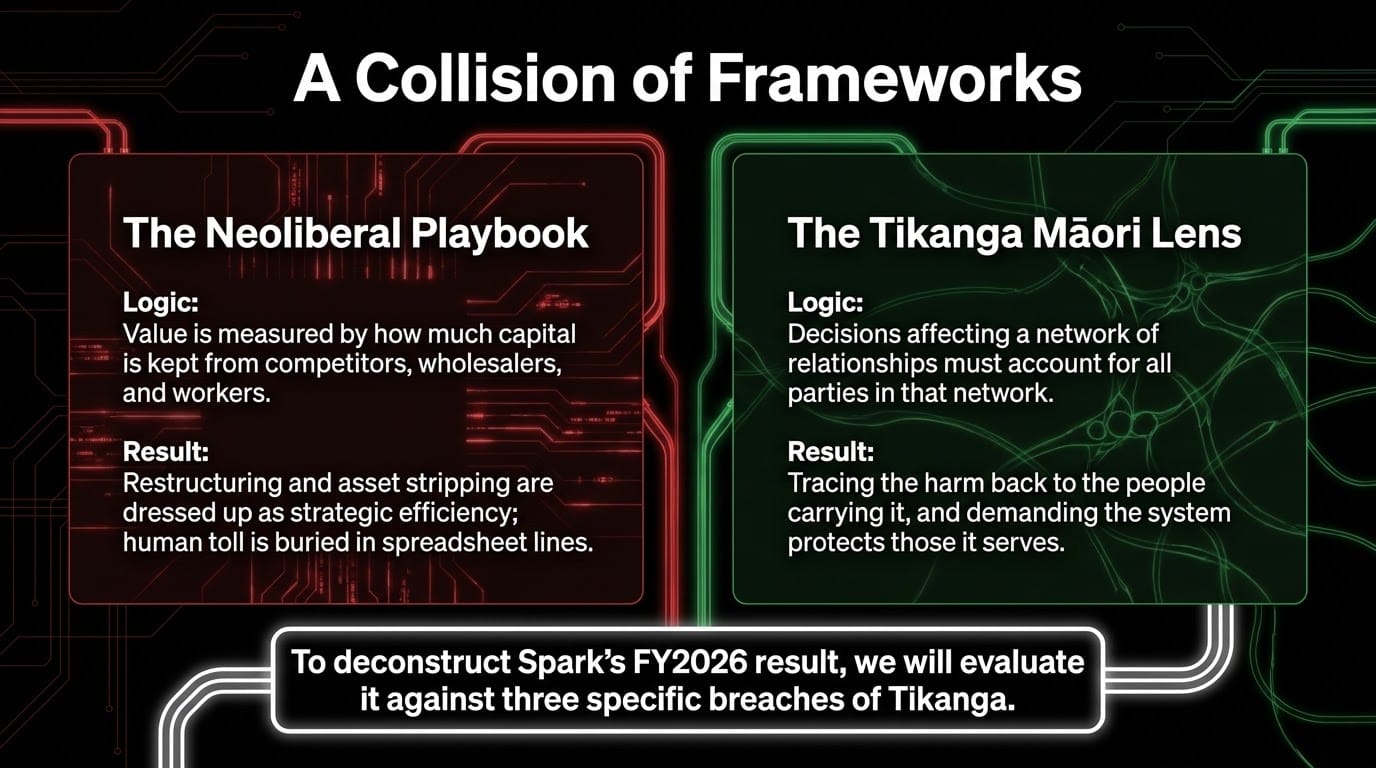
A National Network Is Being Carved Up While Whānau Carry The Risk


The Market Cheers What Whānau Bury
I am Ivor Jones, The Māori Green Lantern.
I follow the wires back to the switchboard, the money back to the boardroom, and the harm back to the people carrying it.
What happened at Spark's annual result this week is not complicated.
It is the neoliberal playbook, executed in daylight, applauded by the very analysts paid to watch it happen.
The Market's Verdict: Cut Deeper, Faster
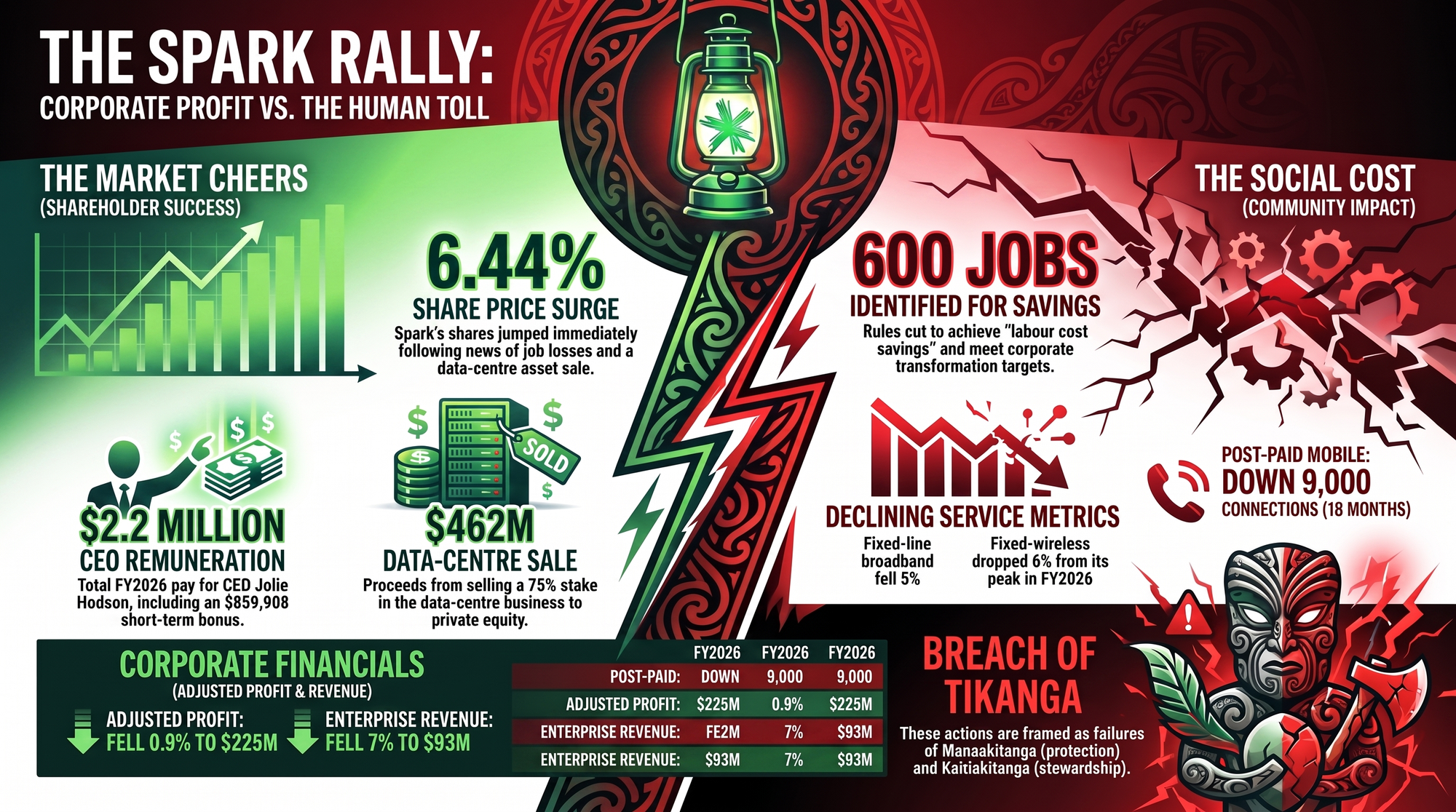
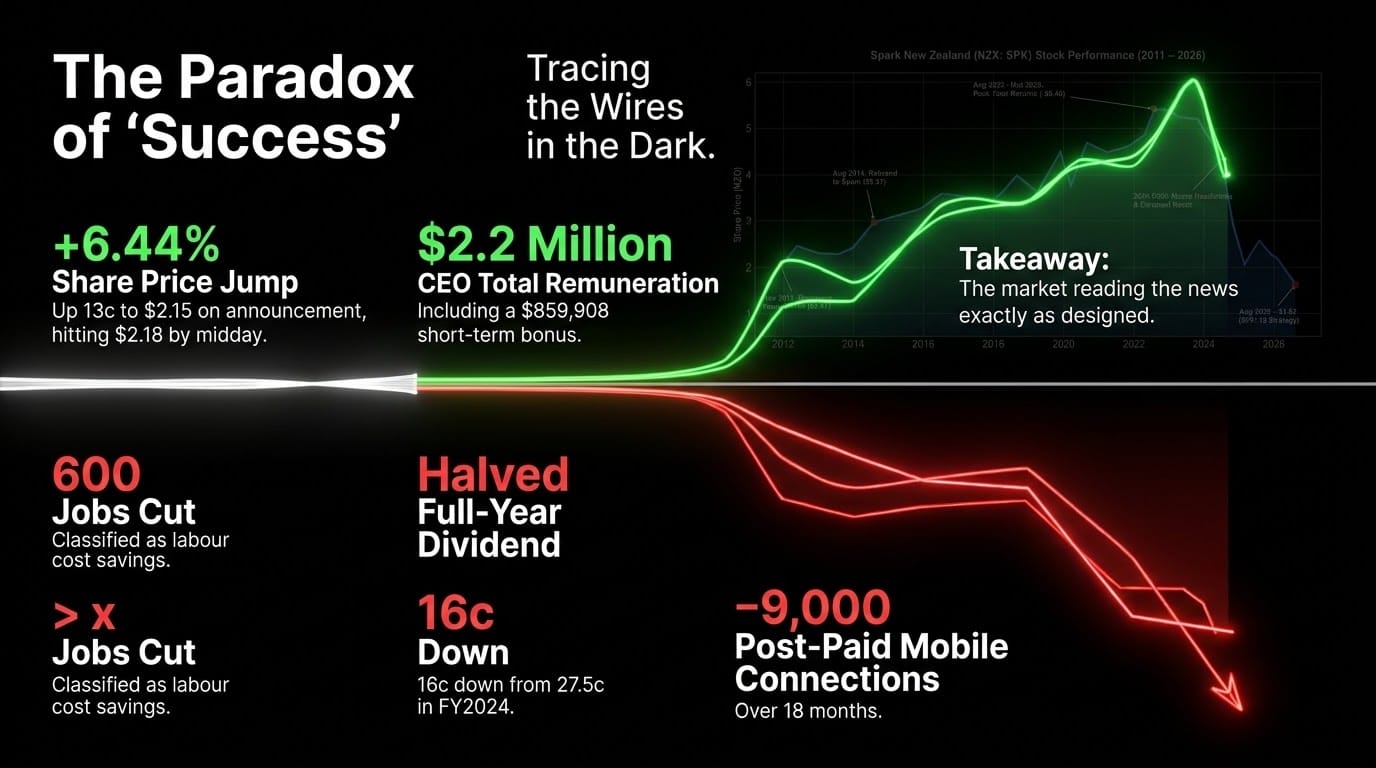
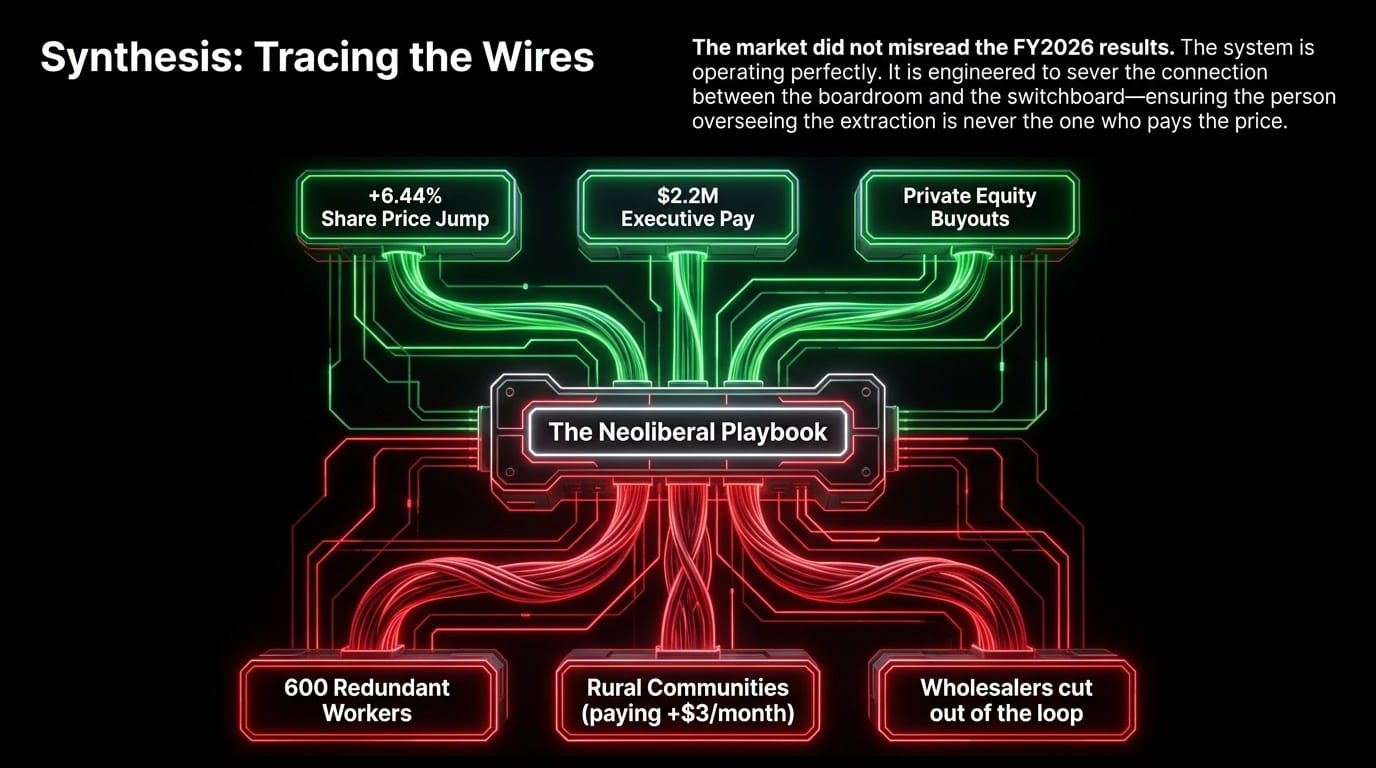
Here is the sentence that should stop every reader cold: investors pushed Spark's shares up 6.44% the day the company confirmed hundreds of job losses, a halved dividend since FY2024, and the sell-off of 75% of its data-centre business. The NZ Herald's report on the post-result share price rally
The shares kept climbing into midday trade, up a further 1.4% to $2.18. The NZ Herald's report on continued share price gains
That is not a market misreading the news. That is a market reading it correctly.
Job losses and asset sales are exactly what shareholder capital wants to see, because they mean more of the company's earnings will flow to dividends and buybacks instead of wages, benefits, and the people who actually answer the phones when a cyclone knocks out the network.
The analysts covering Spark confirmed this logic without a flicker of self-awareness.
Craigs' Wade Gardiner called the result "strong," praised the mobile numbers, and welcomed the reintroduction of Spark's dividend reinvestment plan as something that "could help provide some headroom" for future shareholder payouts. The NZ Herald's report of Wade Gardiner's assessment.
He still trimmed his price target from $3.21 to $3.04 — a 5.3% cut — and his stated reason was that cost-cutting had not gone far enough. The NZ Herald's report of Craigs' revised price target and rationale
Read that twice. A professional analyst's complaint about a company that has already cut 600 jobs is that it did not cut hard enough. That is not a fringe opinion. That is the operating logic of an entire industry, stated in plain English, in a national newspaper, without a hint of embarrassment.
Morningstar's Brian Han was equally revealing. He said Spark would "shine without the distractions" of the "non-core" business lines it has jettisoned — dismissing an entire division that included cloud services, IT management, and digital identity work as "a hotchpotch of digital services whose earnings have been erratic at best." The NZ Herald's report of Brian Han's comments.
He still cut his fair-value estimate by 16.7%, from $3.60 to $3.00, and flagged that fixed-line broadband connections fell a further 5% in FY2026 as "a concern." The NZ Herald's report of Morningstar's valuation cut and broadband concern
Forsyth Barr's Ben Crozier nudged his target up 2.2%, from $2.30 to $2.35, citing the "prospect of minor near-term dividend increases." The NZ Herald's report of Ben Crozier's revised target.
But his own figures expose the rot underneath the optimism: higher-yielding post-paid mobile connections fell by 5,000 in the second half of FY2026 alone, down 9,000 over eighteen months — "a contrast to the steady growth delivered over the prior decade." The NZ Herald's report of Forsyth Barr's mobile connection data.
Fixed-wireless connections recorded their "worst sequential change on record" in the same period, down 6% from their peak. The NZ Herald's report on fixed-wireless connection decline
Notice why analysts favour fixed-wireless in the first place: it lets Spark cut wholesaler Chorus out of the revenue chain entirely, pocketing close to 100% of a broadband connection's value instead of sharing it. The NZ Herald's explanation of fixed-wireless economics and analyst preference.
That is the entire moral architecture of shareholder capitalism in one sentence: value is measured by how much money you can keep from everyone else in the chain — competitors, wholesalers, and workers alike.
Mobile service revenue crept up just 1.1% to $998 million, while enterprise and government revenue fell 7% to $93 million as rival 2degrees made inroads. The NZ Herald's report of mobile and enterprise revenue figures. Hodson told analysts the rate of decline had halved. The NZ Herald's report of Hodson's comment on the enterprise revenue trend. Halving a decline is not growth. It is a slower bleed, repackaged as a milestone.
The Deep Dive Podcast
Listen to a lively conversation between two hosts, unpacking and connecting topics in the sources of this essay. I apologise in advance for the AI's very harsh pronounciation of reo. Please dont shoot me, :).
Youtube Video
Like video? Here is a short video suppporting the essay. Again, don't shoot the messenger please because of AI's pronounciation. :)
Koha To Keep The Signal Alive
Every koha signals that whānau are ready to support the accountability that corporate boards, market analysts, and neoliberal power structures refuse to provide. It supports the tracing of the wires between a rising share price, hundreds of job losses, a defended executive bonus, and a spectrum argument that protects private profit while public infrastructure gets sold to the highest bidder. It says rangatiratanga includes the power to support our own truth tellers.
Kia kaha, whānau. Stay vigilant. Stay connected. If you are able, consider a koha to support this independent mahi and keep this light aimed at the boardrooms that profit while our people pay.
If you cannot koha, kaua e māharahara — no worries. Subscribe to The Māori Green Lantern, follow the mahi, kōrero about it, and share it with your whānau and friends. That is koha too.
- Koha — Support The Māori Green Lantern
- Subscribe To The Māori Green Lantern
- Direct bank transfer: Ivor Jones, 03-1395-0099387-000
- Follow On Facebook
The Bonus, Defended On Live Radio
Jolie Hodson's board approved a 3.4% remuneration increase, lifting her base salary from $1.27 million to $1.31 million. The NZ Herald's report of the CEO's salary increase On top of that, she received a short-term bonus of $859,908 and a long-term incentive payment of $26,368, taking her total FY2026 remuneration to $2.2 million. The NZ Herald's report of the CEO's total FY2026 remuneration The board also approved a possible one-off payment equal to 20% of her salary — roughly $262,000 — if "transformation performance targets" are met in FY2027. The NZ Herald's report of the potential FY2027 transformation bonus
This is a year in which 600 jobs were counted within the company's labour cost savings, and in which the telco confirmed it would consult staff on yet another restructure. The NZ Herald's report of job losses within labour cost savings and the upcoming restructure consultation
Hodson's defence, delivered directly to the Herald, was that performance pay is standard for senior New Zealand executives and carries genuine downside risk: "In FY2024 and FY2025, where we didn't achieve our performance targets, I got zero [performance pay] in those two years." The NZ Herald's report of Hodson's remuneration defence I have no evidence to dispute that account, and I will not pretend otherwise.
But here is what her defence does not answer: the same "risk-based" system that paid her nothing in lean years paid her $859,908 in short-term incentives in the very year the company counted 600 job losses among its labour savings, and in which adjusted profit still fell. The NZ Herald's report of Hodson's FY2026 short-term incentive That is not "risk shared with the workforce." That is a system engineered so the person overseeing the cuts is never the one who feels them.
Confronted live on NewstalkZB by Heather Du Plessis-Allan about whether incoming chair Vince Hawksworth's "first job is going to be a new CEO," Hodson did not flinch: "At this point, no, I'm focused on delivering what I've been asked to do... At the end of the day, I work for the board and ultimately it will be their decision." The NZ Herald's report of Hodson's on-air exchange Salt Funds' Matthew Goodson had already flagged CEO succession as a "natural" item for the new chair to consider, given Hodson's seven-plus years in the role and tenure at Spark since 2013. The NZ Herald's report of Matthew Goodson's succession comments
Three Examples For The Western Mind
Example One: The Landlord Who Raises Rent While Cutting The Roof Repair Budget
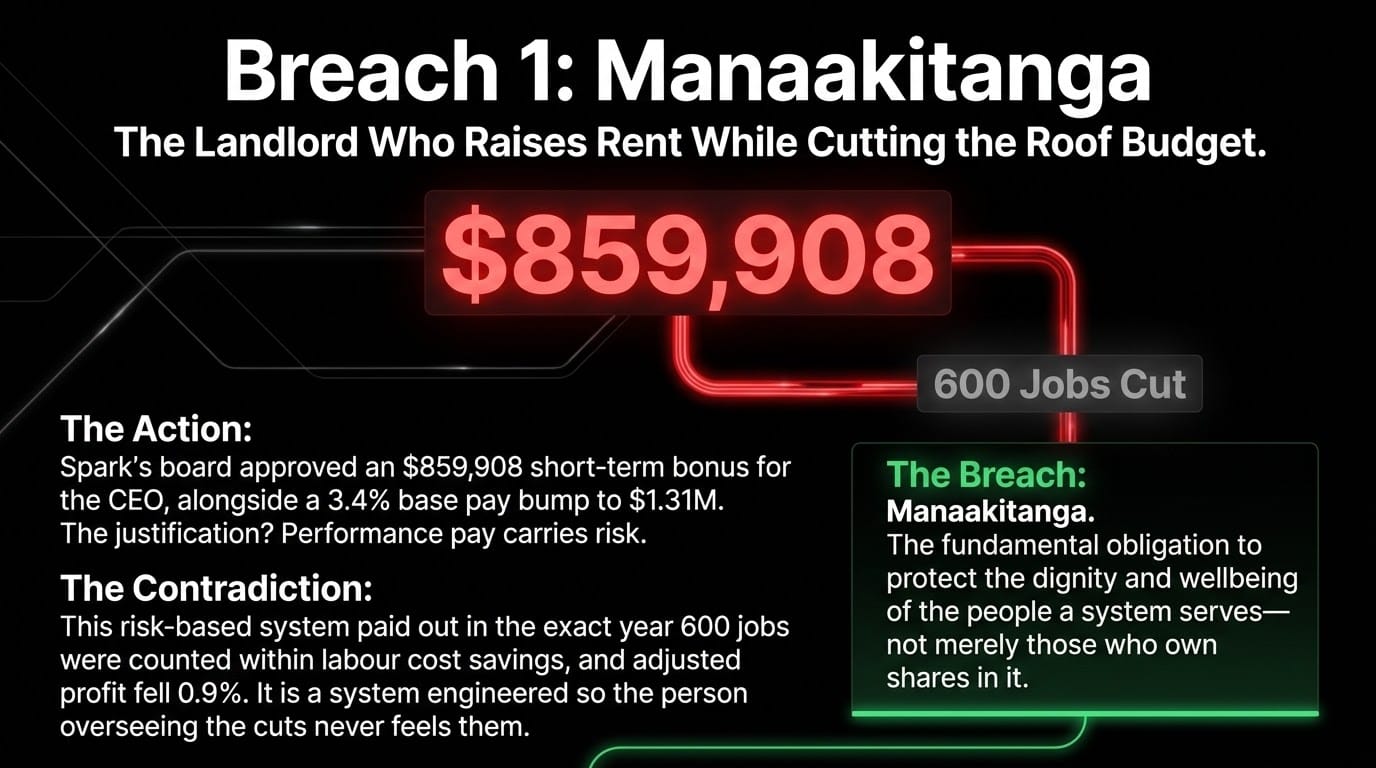
Imagine a landlord who tells tenants the building's maintenance budget must shrink because "the economy is tough," lays off two of the four maintenance staff, then takes a bonus because the building's resale value went up. That is, in plain terms, what a rising share price built on job cuts and asset sales represents. The "building" here is New Zealand's telecommunications network — a system Māori, rural, and low-income households depend on for education, health information, emergency alerts, and work.
The harm is quantifiable: 600 jobs counted within Spark's labour savings this year, on top of a broader net headcount reduction the company has separately disclosed. The NZ Herald's report of job losses within FY2026 labour cost savings Each of those roles represents a household absorbing income loss so that a share price can rise 6.44% in a single trading day. The NZ Herald's report of the share price reaction
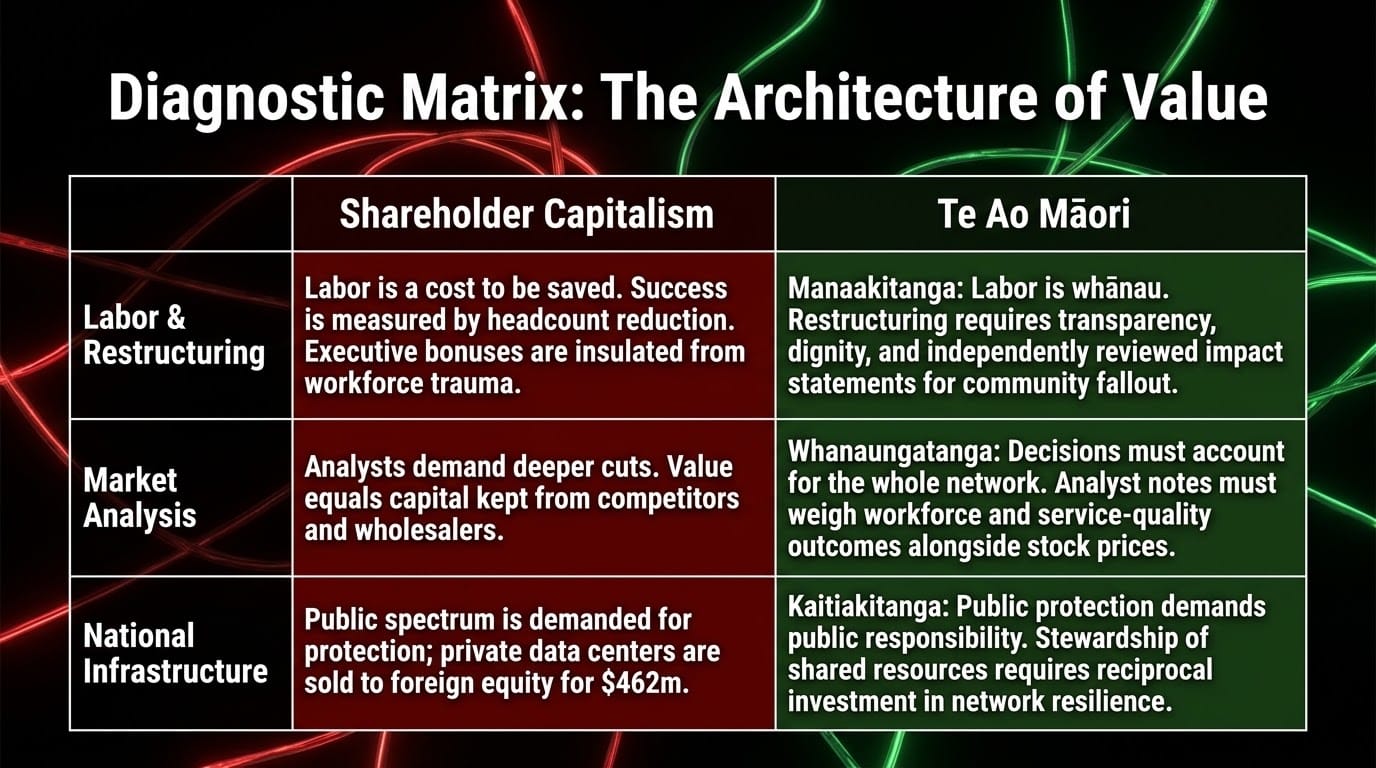
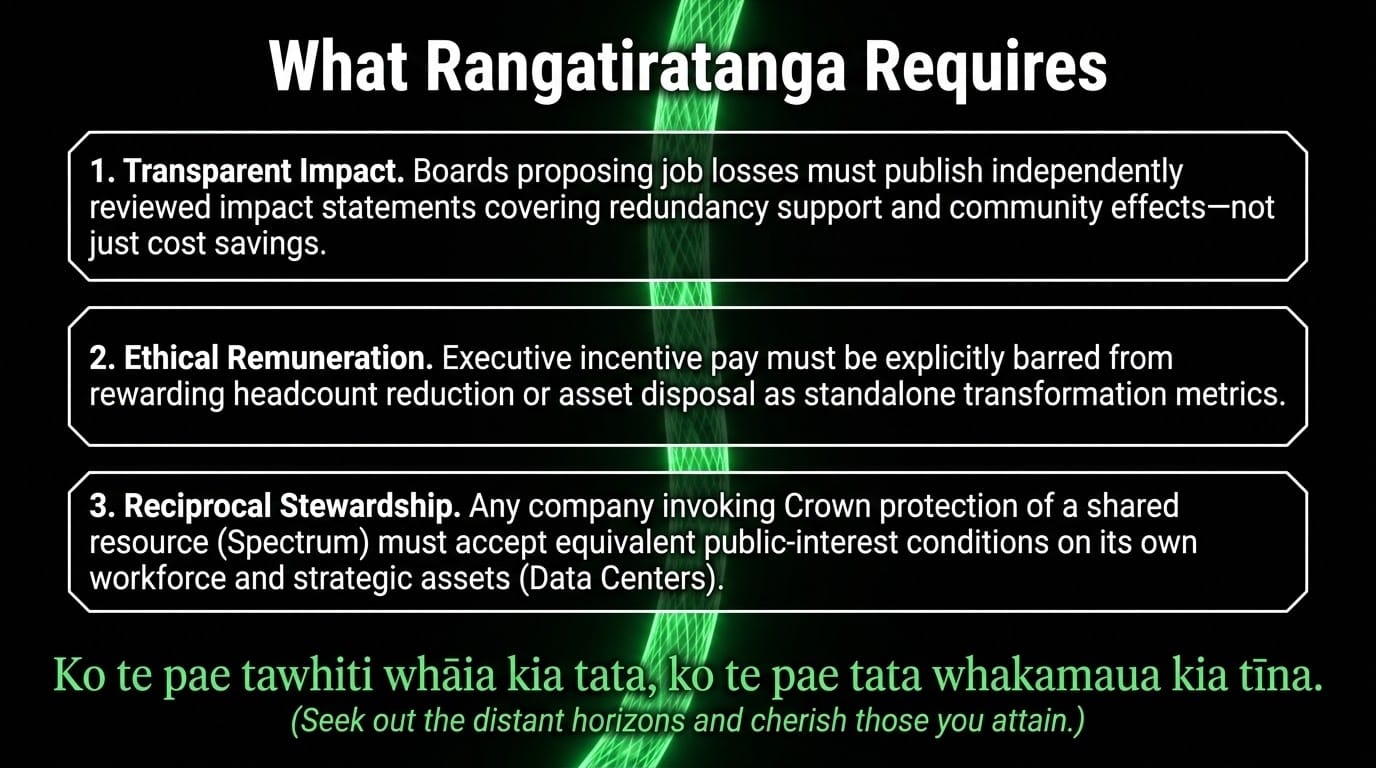
For tikanga, this is a breach of manaakitanga — the obligation to protect the dignity and wellbeing of the people a system serves, not merely the people who own shares in it. The solution is not to ban restructuring. It is to require any board proposing job losses to publish, alongside its transformation plan, an independently reviewed impact statement covering redundancy support, retraining, and community effects — with executive incentive pay explicitly barred from rewarding headcount reduction as a standalone metric.
Example Two: The Referee Who Also Coaches One Team
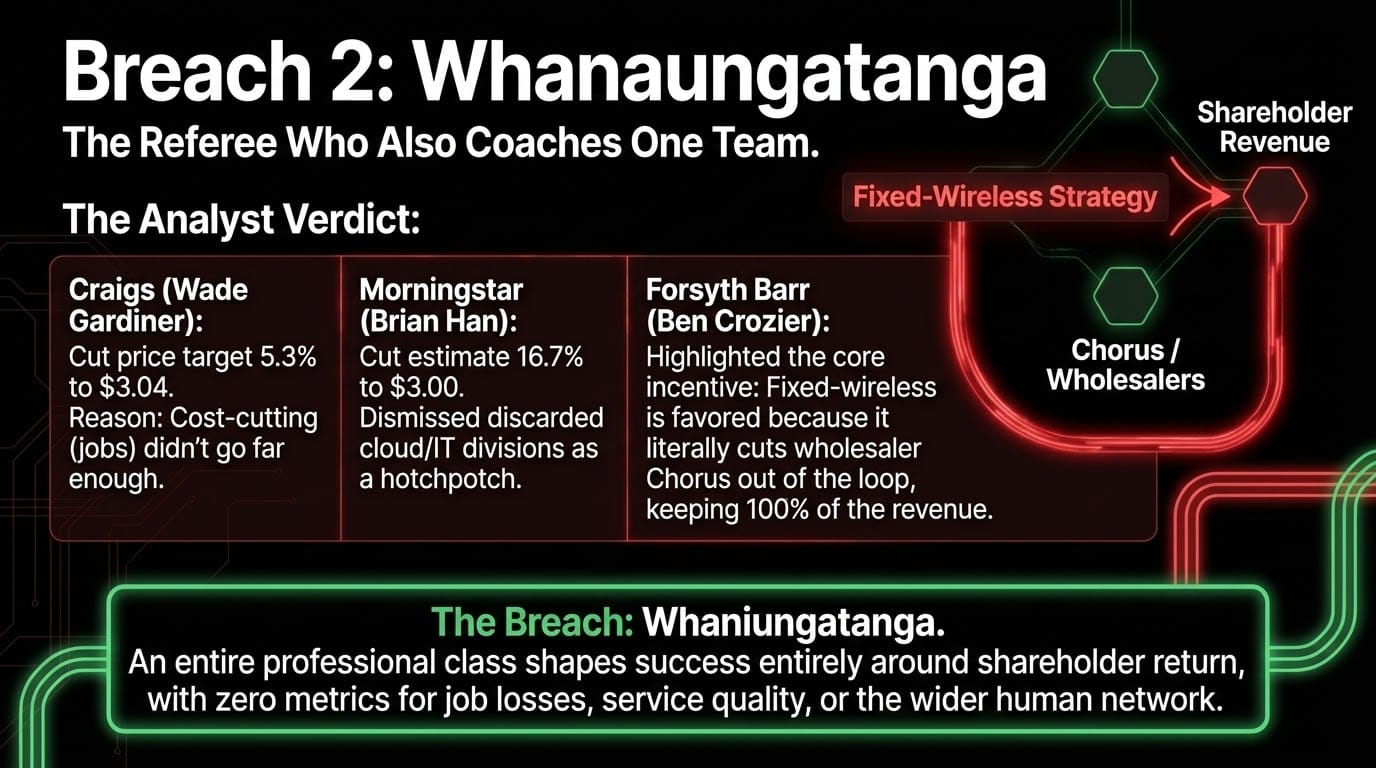
Analysts are meant to independently assess whether a company's strategy serves shareholders fairly and sustainably. Yet Craigs' Wade Gardiner criticised Spark for not cutting costs — jobs and services — hard enough, even while maintaining an "overweight" buy rating. The NZ Herald's report of Craigs' cost-cutting critique This is not corruption; it is structural. Analyst incentives are built entirely around shareholder return, with no comparable professional obligation to weigh workforce, community, or national-resilience outcomes.
The quantifiable harm is that an entire professional class — the analysts whose commentary shapes how directors, media, and the public interpret "success" — has no formal metric for job losses, service quality, or rural equity in its assessment framework. Three analysts, three different ratings, zero mentions of where the 600 people who lost roles will land. The NZ Herald's report of the three analysts' commentary
For tikanga, this is a failure of whanaungatanga — the principle that decisions affecting a network of relationships must account for all parties in that network, not just the ones holding shares. The solution: New Zealand's investment research bodies and the Financial Markets Authority should require analyst notes on major restructures to disclose workforce and service-quality metrics alongside share-price targets, so directors cannot claim "the market wanted this" as cover for decisions that were never independently weighed against public interest.
Example Three: The Guard Dog That Also Wants To Sell The House
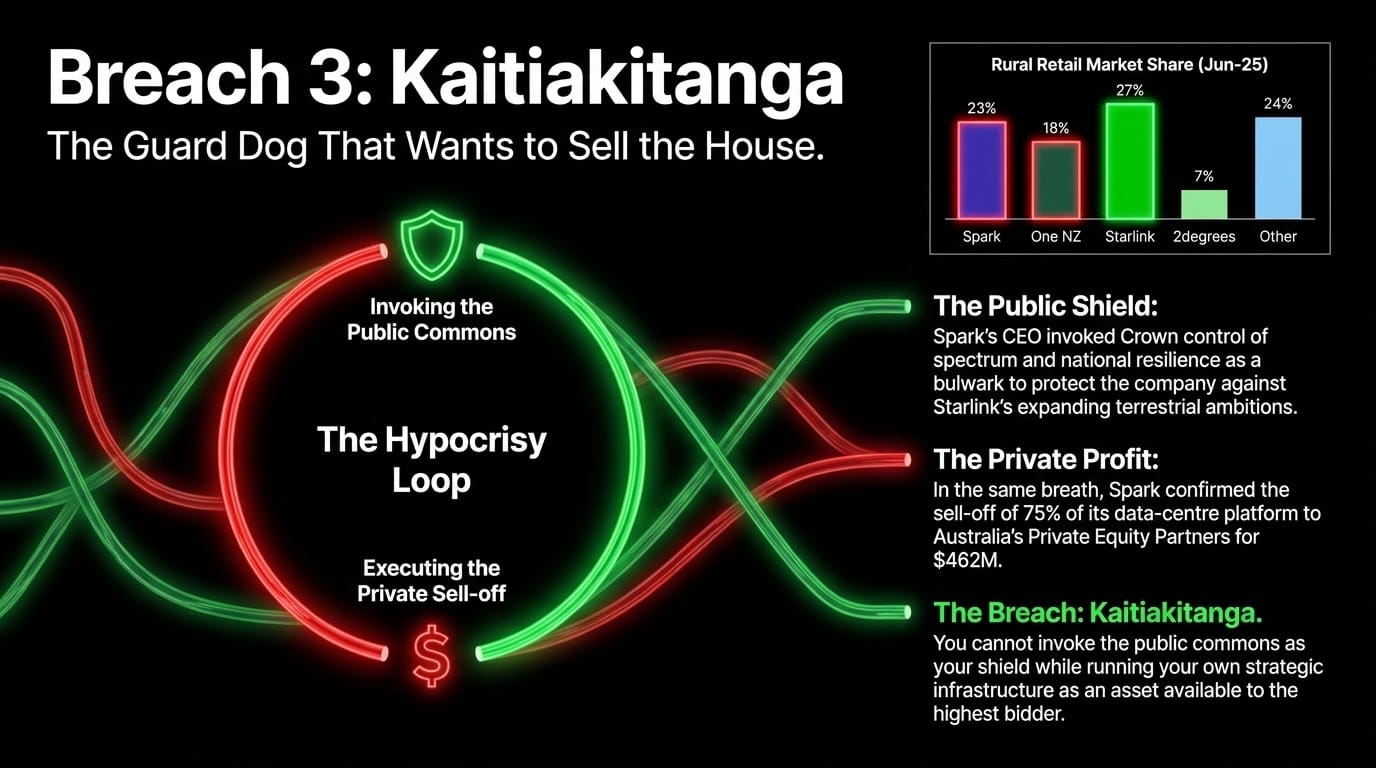
Jolie Hodson argues that government control of spectrum is the "bulwark" protecting Spark from Starlink's expansion into a full mobile network:
"Only governments can own spectrum, which can be leased to telcos for fixed amounts of time... I think each government will have to consider their policy settings: how they think about that allocation of spectrum and national resilience." The NZ Herald's report of Hodson's spectrum comments.
Gartner's Khurram Shahzad backs the practical case, noting rising space-junk collision risk and urban congestion as real limits on Starlink's terrestrial ambitions. The NZ Herald's report of Gartner analyst Khurram Shahzad's assessment.
She is describing a real mechanism: spectrum is a Crown-managed public resource, allocated through tradable rights under New Zealand's Radiocommunications Act framework, not something Starlink can simply buy its way into. Radio Spectrum Management's explanation of Crown-created spectrum management rights.
But listen to what she is actually asking for: she wants the Crown's stewardship of a shared national resource to keep protecting Spark's commercial position — the same Spark that just sold 75% of its data-centre business to a private-equity fund, cut hundreds of jobs, and handed her a $2.2 million pay packet. Spark's official data-centre transaction disclosure The NZ Herald's report of the CEO's total remuneration
You cannot invoke the public commons as your shield while running your own company as though every asset — including a growing data-centre platform — is available for the highest bidder. The quantifiable harm is philosophical but no less real: it corrodes the public's trust in the very idea that shared resources should be managed for collective benefit, because the loudest advocate for that idea is also its least consistent practitioner.
For tikanga, this is a breach of kaitiakitanga — the responsibility to protect what you depend on for the benefit of those who come after you, not merely to invoke that protection when it suits your commercial interest.
The solution: any company that publicly argues for stronger Crown control of a shared resource to protect its market position should be required to accept equivalent public-interest conditions on its own strategic assets — including data centres, network resilience investment, and workforce security — as the price of that protection.
Previous Māori Green Lantern Analysis On This Pattern
 Ivor Jones The Māori Green Lantern
I have traced this pattern before.
My recent essay on the coalition government's health restructuring showed how manufactured crises are used to justify privatisation dressed as reform, and how "efficiency" language conceals the transfer of public function into private hands. The Māori Green Lantern's essay on the pharmacist expansion and health privatisation.
The mechanism is identical here: strip an asset or workforce back, reframe the resulting gap as an opportunity for private capital, and reward the executives who oversaw the stripping.
What Rangatiratanga Requires
I am not asking anyone to weep for a listed company. Corporations do not need sympathy. Whānau do. Workers do. Rural communities carrying higher connectivity costs do.
Spark's board should be required to publish a complete account of every job affected by FY2026's restructuring, separated from the language of "labour cost savings," so the true human toll cannot be buried inside a spreadsheet line. Executive incentive schemes should explicitly exclude headcount reduction and asset disposal as qualifying "transformation" metrics unless matched by independently verified gains in service quality, rural equity, and workforce security. And any company invoking Crown stewardship of a public resource for its own commercial protection should accept public-interest conditions on how it treats its own workers and its own strategic infrastructure in return.
The taiaha is not raised against mobile networks, satellites, or economic reality. It is raised against the practice of dressing extraction up as strategy and expecting whānau to applaud the wardrobe.
Ko te pae tawhiti whāia kia tata, ko te pae tata whakamaua kia tīna.
Seek out the distant horizons and cherish those you attain.
Ivor Jones The Māori Green Lantern Fighting Misinformation And Disinformation From The Far right

Transparency And Right Of Reply
Right of reply: Spark New Zealand, Jolie Hodson, and the named analysts are invited to respond to the characterisations in this essay. Any verified correction will be published without delay.
Legal note: This is public-interest commentary on a listed company, its board, senior executives, and analysts acting in public professional capacities. It does not allege illegality or personal dishonesty on the part of any named individual, and it distinguishes reported fact from opinion throughout, consistent with qualified privilege for fair comment on matters of public interest.