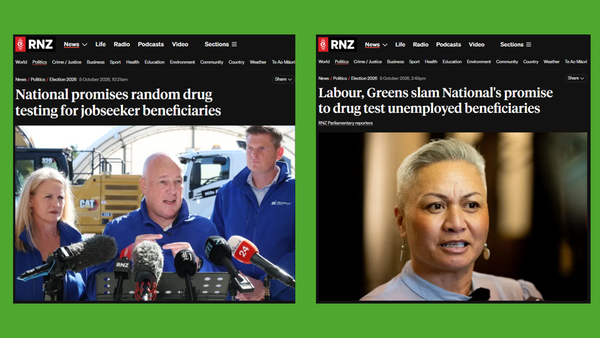
"The Taxidermied Treaty: How Hobson's Pledge Stuffs Brown Faces to Sell Aotearoa a Gutted Citizenship" - 24 August 2026
Sawdust Wearing Skin — Two Brown Faces, One White Supremacist Script, And The Whānau Left Holding The Bill

Mōrena Aotearoa,
I've stood in taxidermy shops, whānau, and I know the trick every single time.
The skin looks real. The pose looks alive. The eyes even catch the light.
Crack it open and it's sawdust and wire holding up a lie someone paid good money to make convincing.
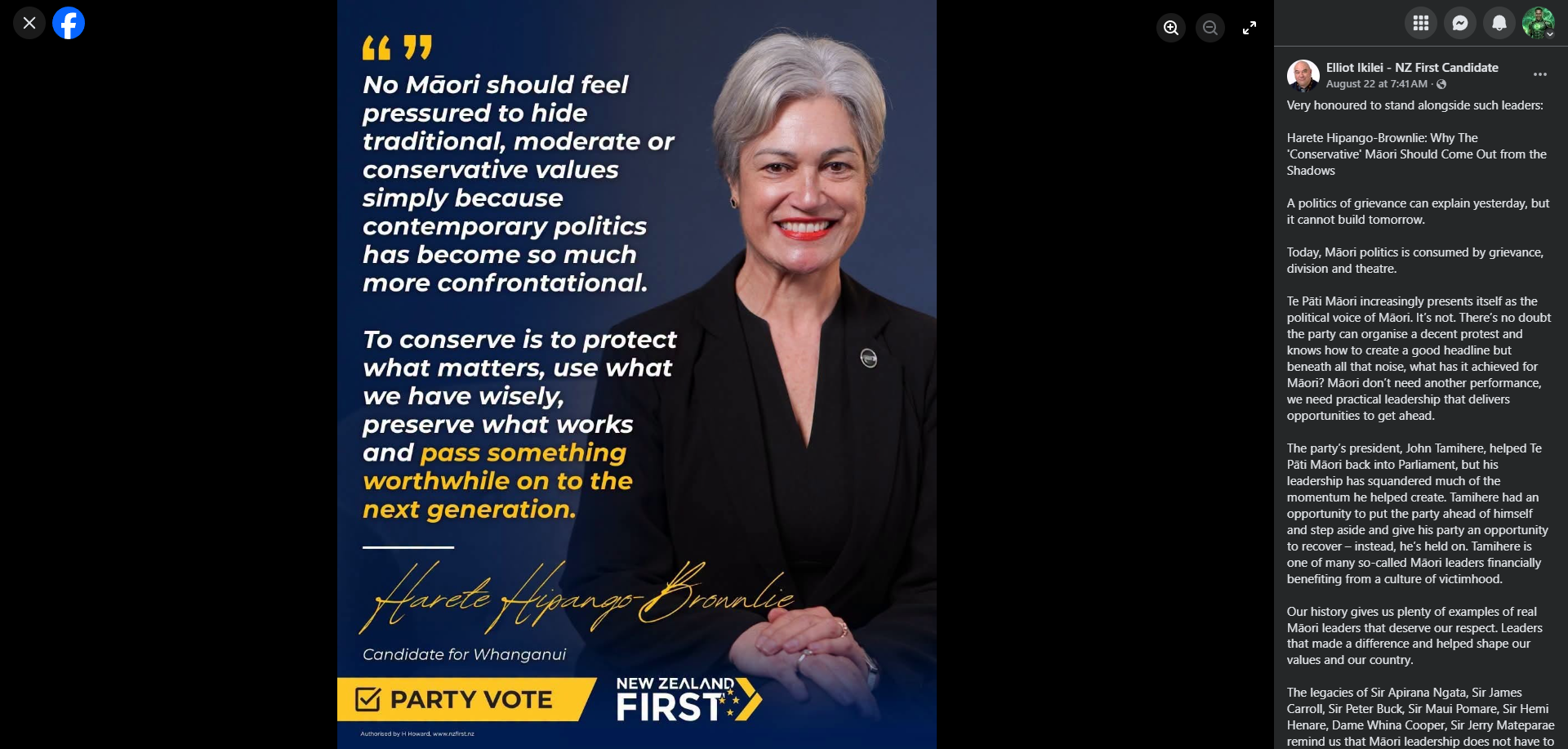
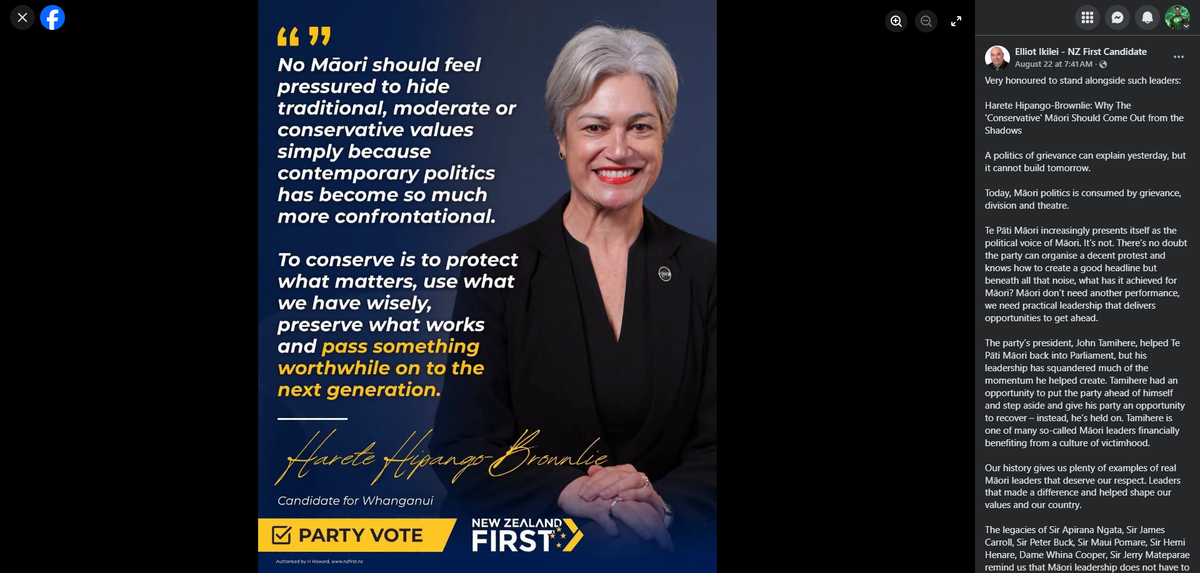
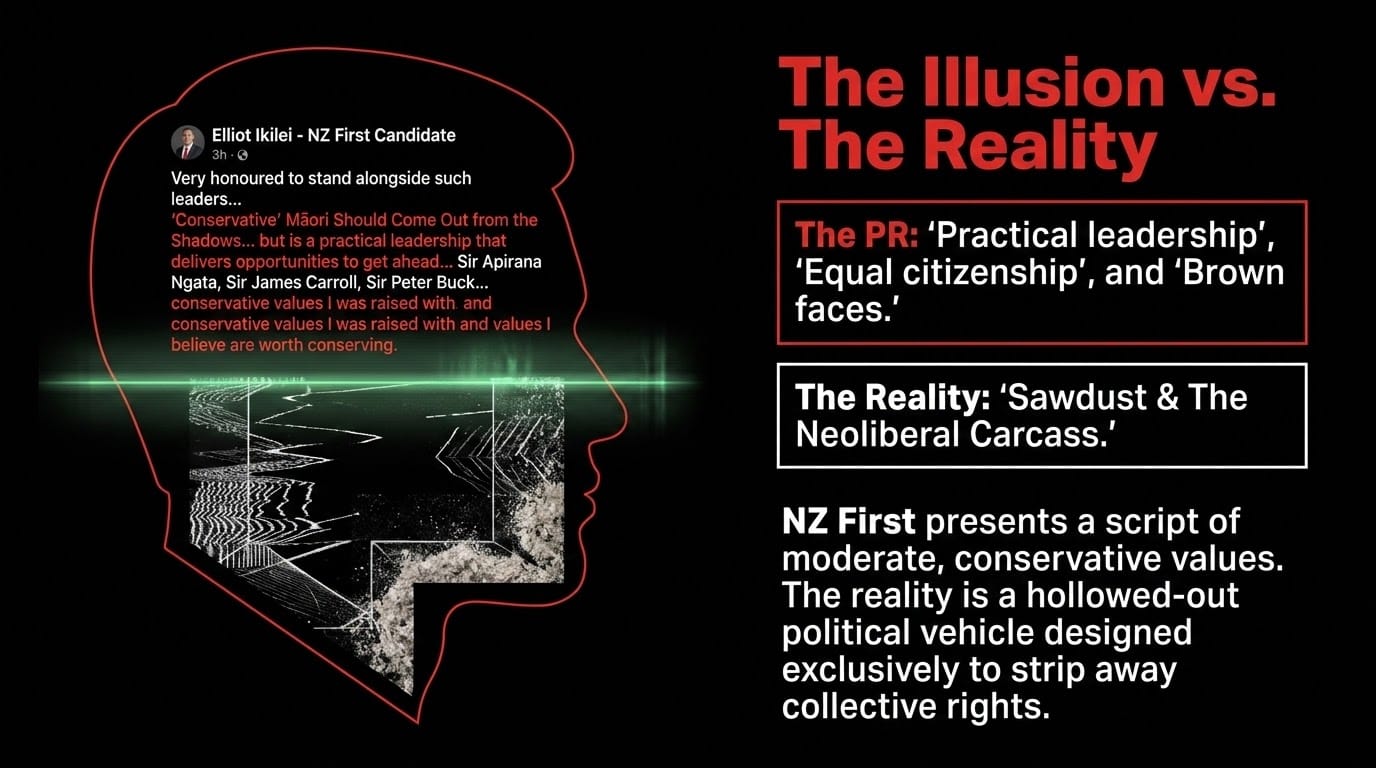
That is exactly what I am looking at with Elliot Ikilei and Harete Hipango-Brownlie. Real Treaty. Real Battalion. Real brown faces stapled onto a rotting, gutted, neoliberal carcass called "equal citizenship."
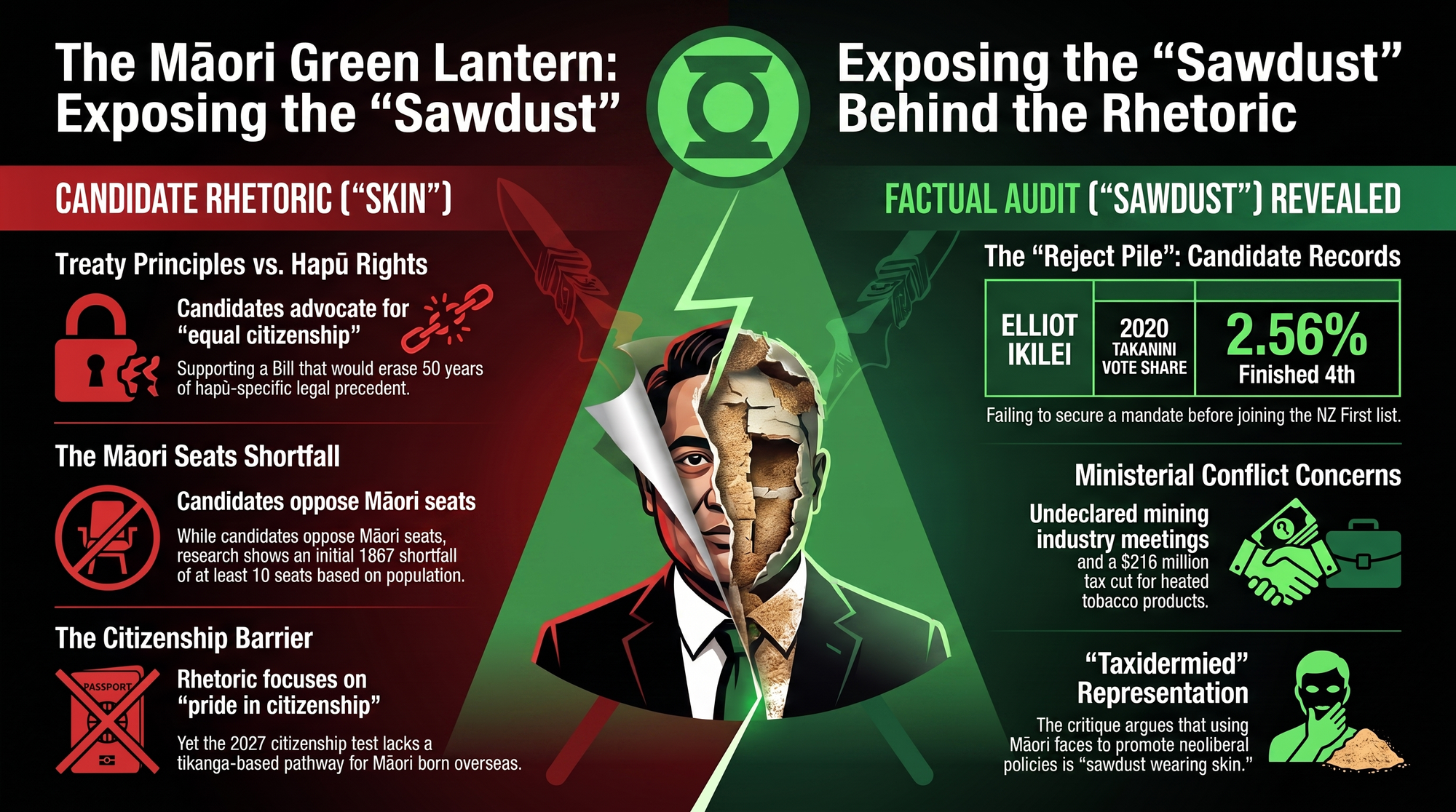
I am not here to be polite about it. I am the Māori Green Lantern, and I am here to rip the stitching open and show you every scrap of sawdust inside
— and today, the sawdust runs deeper than two candidates. It runs through the whole rotten list.
The Deep Dive Podcast
Listen to a lively conversation between two hosts, unpacking and connecting topics in the sources of this essay. I apologise in advance for the AI's very harsh pronounciation of reo. Please dont shoot me, :).
Youtube Video
Like video? Here is a short video suppporting the essay. Again, don't shoot the messenger please because of AI's pronounciation. :)
Koha Consideration
Every koha to this mahi tells NZ First's rented Māori spokespeople and their fast-track-mining, tobacco-industry, Cabinet-leaking caucus mates that we see the sawdust under the taxidermied skin — and that whānau, not the Crown, will support the accountability that neither Ikilei, Hipango-Brownlie, Jones, Costello nor Nash will ever provide.
It signals that rangatiratanga includes the power to support our own truth tellers, even when — especially when — those truths expose Māori faces recruited to launder a list stacked with reject-pile politicians.
Kia kaha, whānau. Stay vigilant. Stay connected. And if you are able, consider a koha to ensure this voice continues.
If you are unable to koha, no worries! Subscribe or follow The Māori Green Lantern at themaorigreenlantern.maori.nz, kōrero and share with your whānau and friends — that is koha in itself.
Four pathways exist:
For those who wish to support this mahi directly with a koha (voluntary contribution), please visit the Koha — Support platform.
For those who wish to receive essays directly and support through subscription: Subscribe To The Māori Green Lantern.
For those who prefer direct bank transfer, account details are: Ivor Jones, account number 03-1395-0099387-000.
For those on Facebook: The Māori Green Lantern's Facebook page.
Three Examples For The Western Mind
Example One — The Treaty Principles Bill: Erasing The Collective To Sell You "Equal"
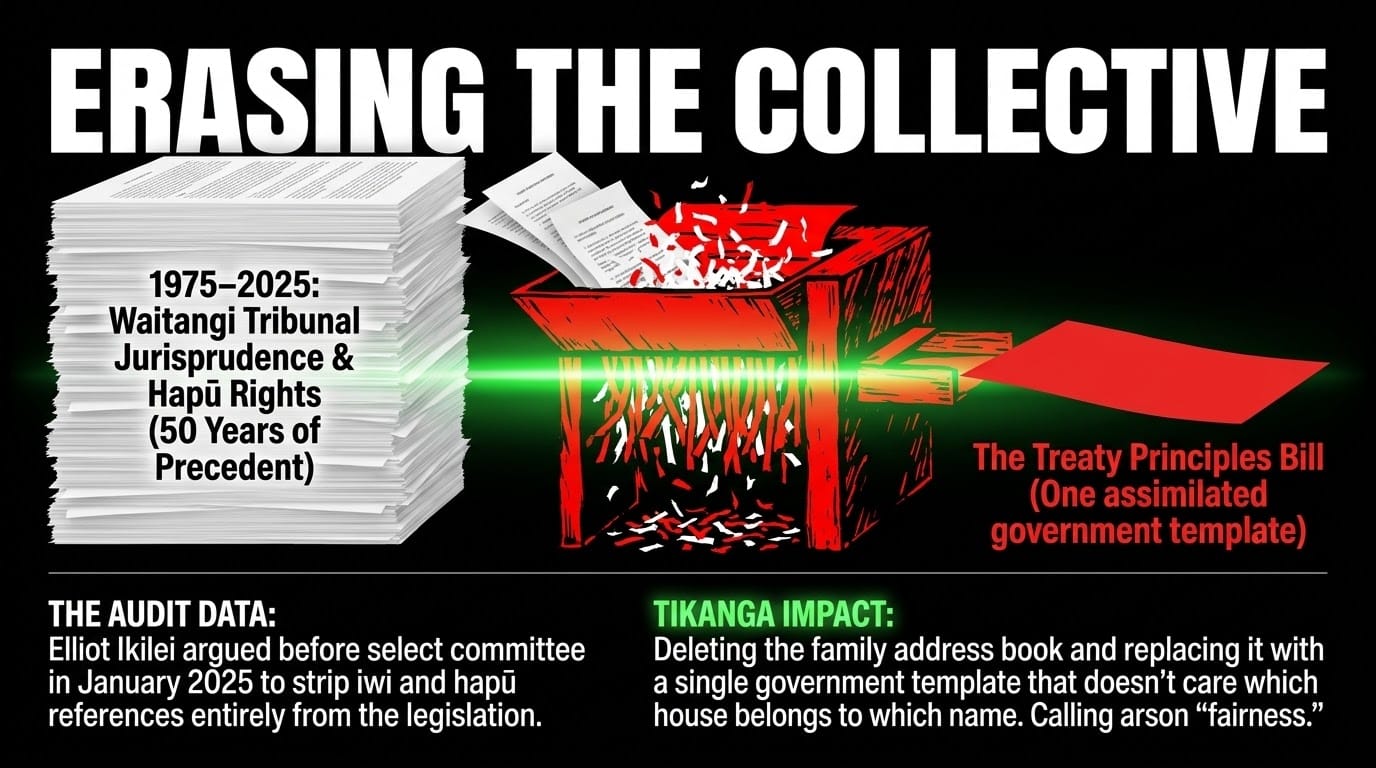
The claim. Elliot Ikilei stood before select committee in January 2025 and argued for stripping iwi and hapū references entirely from the Treaty Principles Bill, confirmed in his own words on the iHeart Heather du Plessis-Allan podcast episode and cross-checked against Ikilei's Wikipedia political record.
The harm, quantified. He wanted to collapse fifty years of hapū-and-iwi-specific Treaty jurisprudence — built since the Tribunal's 1975 founding — into one flattened clause. Fifty years of legal precedent, one signature from the shredder.
The solution. Kill that assimilationist framing dead. Protect the iwi- and hapū-specific principles the Tribunal has spent half a century earning.
Tikanga impact, explained plainly. Picture every family's individual will and inheritance replaced by one government template that doesn't care which house belongs to which name. That is what erasing hapū and iwi from Treaty legislation does — it deletes the address book and calls the arson "fairness." I traced this exact pattern of gutting Māori-specific structures and rebranding the wreckage as "simplification" in my earlier essay, The Pharmacy Con, on The Māori Green Lantern — same government, same trick, different portfolio.
Example Two — The Citizenship Test: A Trivia Quiz Between Mokopuna And Their Whenua
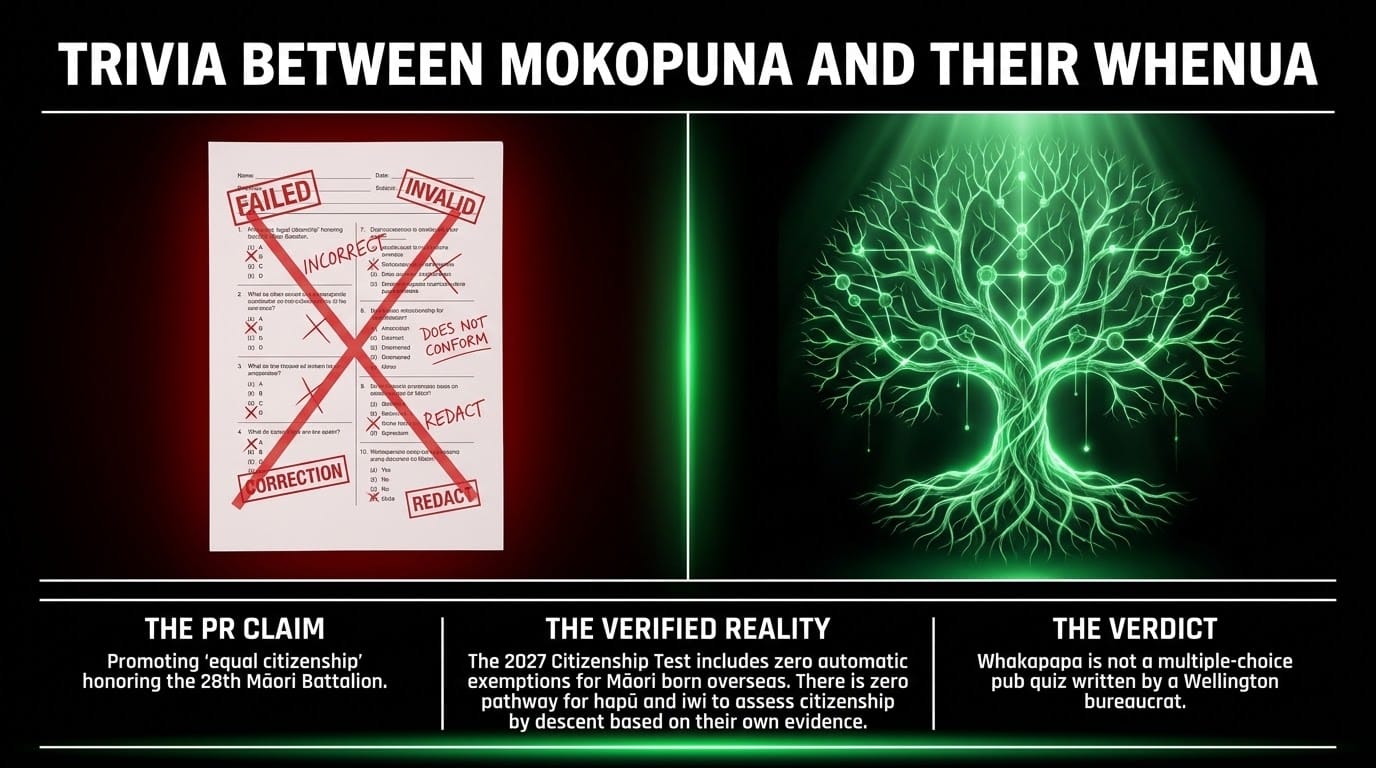
The claim. While Harete Hipango-Brownlie drapes her essay in 28th Māori Battalion sacrifice to talk up "equal citizenship," her own party's government is rolling out a 2027 citizenship test with zero automatic exemption for Māori born overseas, confirmed by NZ Herald's political reporting.
The harm, quantified. One documented case, John Ruddock, fought all the way to a Waitangi Tribunal recommendation to amend the Citizenship Act 1977 — because right now there is zero pathway for hapū and iwi to assess whakapapa evidence for citizenship by descent. Zero. Confirmed by 1News's report on the Māori citizenship pathway fight.
The solution. Implement the Tribunal's tikanga-based pathway before the 2027 rollout. Whakapapa assessed by hapū and iwi — not a multiple-choice exam written by a Wellington bureaucrat who has never set foot on a marae.
Tikanga impact, explained plainly. Imagine sitting an exam to prove you belong to your own family, written by people who aren't your family and don't recognise your family's evidence. Whakapapa is not a pub quiz. Treating it like one is border security dressed up as citizenship policy.
Example Three — The Māori Seats: Kicking Away The Ladder He Climbed Himself
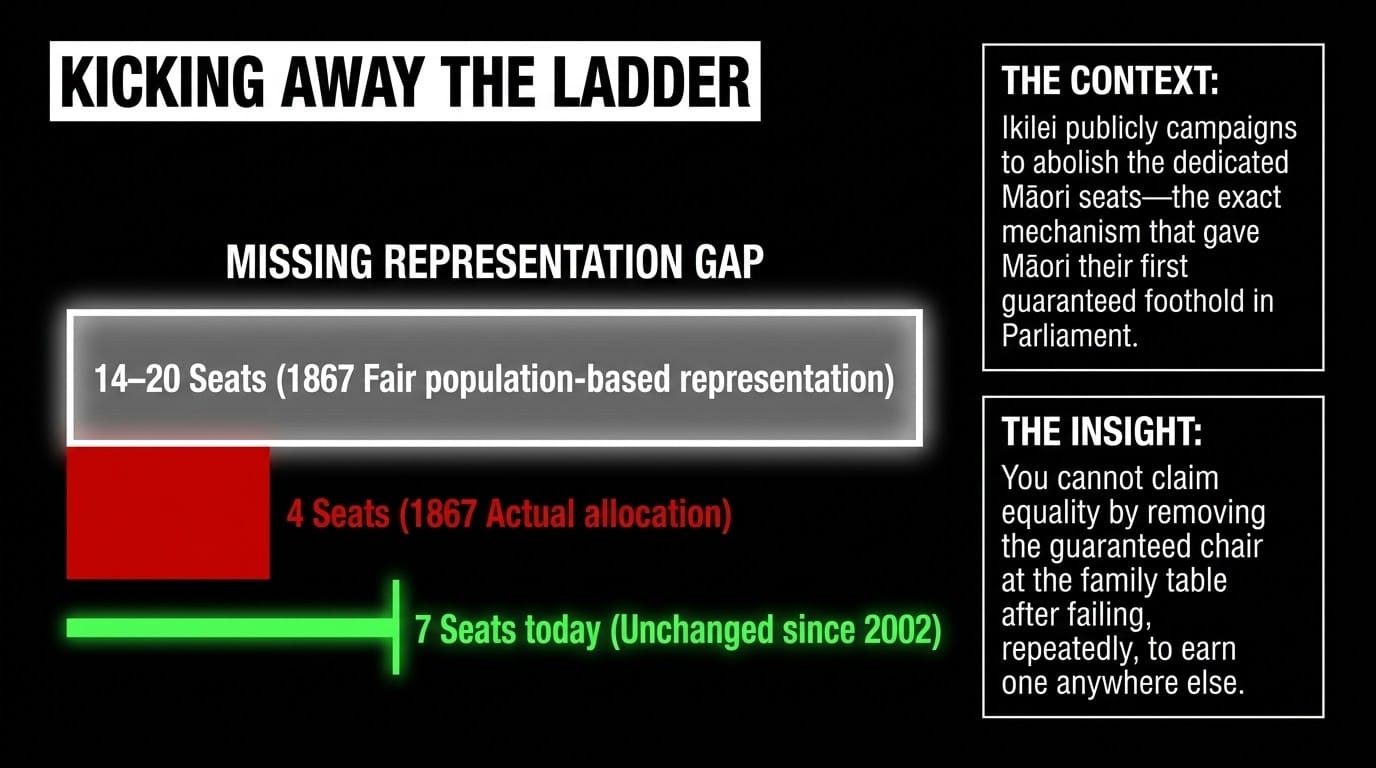
The claim. Ikilei has publicly opposed the dedicated Māori parliamentary seats, per his sourced Wikipedia political record.
The harm, quantified. In 1867, Māori got four seats when a fair population-based allocation demanded fourteen to twenty, per NZHistory and the Otago University research paper — a minimum shortfall of ten seats. Today there are seven, unchanged since 2002 despite population growth, per E-Tangata, and the man wants to abolish the mechanism that gave Māori their first-ever guaranteed foothold in a Parliament that locked them out of general electorates.
The solution. Defend the seats as an unmovable floor. Grow them in line with population, as the honest 1867 arithmetic always demanded.
Tikanga impact, explained plainly. It's the difference between a guaranteed seat at the family table and hoping someone remembers to set you a plate. Ikilei wants to take the chair away and call it equality — after failing, repeatedly, to earn one any other way. Which brings me to exactly why that failure matters.
The Vetting File Neither Would Pass
Elliot Ikilei has never won an election in his life.
He stood in the newly created Takanini electorate in 2020 and finished fourth, on 939 votes — 2.56% of the 36,723 votes cast, confirmed against the Electoral Commission's official Takanini result and cross-checked with his Wikipedia entry.
His New Conservative Party polled 0.2% of the party vote in 2017 and 1.5% in 2020, per the same Wikipedia entry — both catastrophically below the 5% threshold. He became party leader after that defeat, then resigned within weeks.
When NZ First recruited him for 2026, NZ Herald Deputy Political Editor Adam Pearse described him as a candidate who "will be regarded among the party's more fringe candidates."
That is not my opinion. That is the paper's own political editor, in print, this year.
In my view, not fact — a man who has never once persuaded more than 2.6% of an electorate to trust him with representation, and whose own party's chosen commentators call "fringe," is not a credible custodian of Treaty policy or citizenship law. That opinion rests on the verified electoral record linked above, not on his ethnicity, his views, or his character beyond his public performance at the ballot box.
Harete Hipango-Brownlie's record is murkier and requires more care.
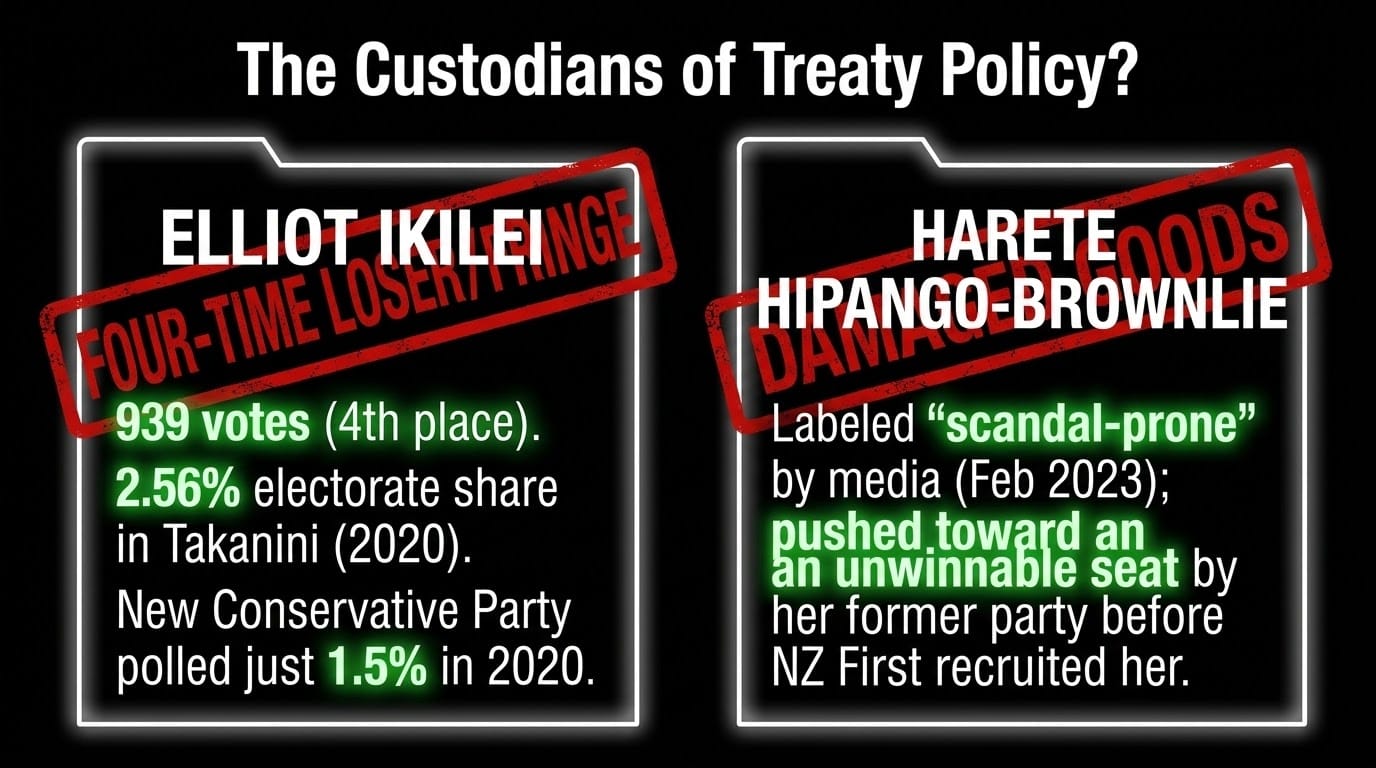
In June 2021, while a sitting National MP, the NZ Herald reported allegations, documented on her Wikipedia biography, that she had purchased furniture and a television using Parliamentary Service funds but had the items delivered to her home rather than her electorate office.
Then-National-leader Judith Collins said "there's very little in it," and the Parliamentary Service confirmed no formal complaint was ever lodged. No wrongdoing was ever formally established, and I state that plainly.
What is established is NZ Herald's own February 2023 report describing her as "scandal-prone" and pushing her toward the "unwinnable" Māori seat of Te Tai Hauāuru instead of her old Whanganui seat. Available evidence suggests a candidate whose own former party regarded her electorally as damaged goods before NZ First picked her up for 2026.
The List-Stacking Racket: How NZ First Rigs The Rules It Claims To Defend
Here is the part Hipango-Brownlie's karanga to "conservative Māori" conveniently skips: NZ First's entire 2026 strategy is not about principle. It's about celebrity list-stacking to inflate a vote share, laid out in exhaustive detail by NZ Herald's Adam Pearse.
NZ First recruited former Shortland Street actor Lee Donoghue in 2023 — a man who warned of a "woke virus" causing the "ever-increasing sexualisation of children" in schools — ranking him 12th on the list, four spots from a seat.
For 2026, the same reporting confirms the party has recruited former National Cabinet minister Michael Laws, former All Black captain Taine Randell, disgraced former Labour minister Stuart Nash (now a failed attempt through Nash's own doing), former National MP Harete Hipango, and fringe also-ran Elliot Ikilei, all in a single election cycle, while an RNZ Reid Research poll puts the party at 11.5% — more than triple its previous form.
This is not a party building a coherent movement. This is a party assembling a hoarding of famous and semi-famous faces to catch votes it could never earn on policy alone, then handing the winners ministerial warrants once the hoarding pays off. Pearse's own reporting notes that if NZ First doubles its seats to 16, celebrity recruits like Nash, Ngaro and Laws could walk straight into Cabinet contention ahead of existing backbenchers. That is not democracy. That is a talent agency with a party registration number.
Portrait Gallery: The NZ First Reject Pile
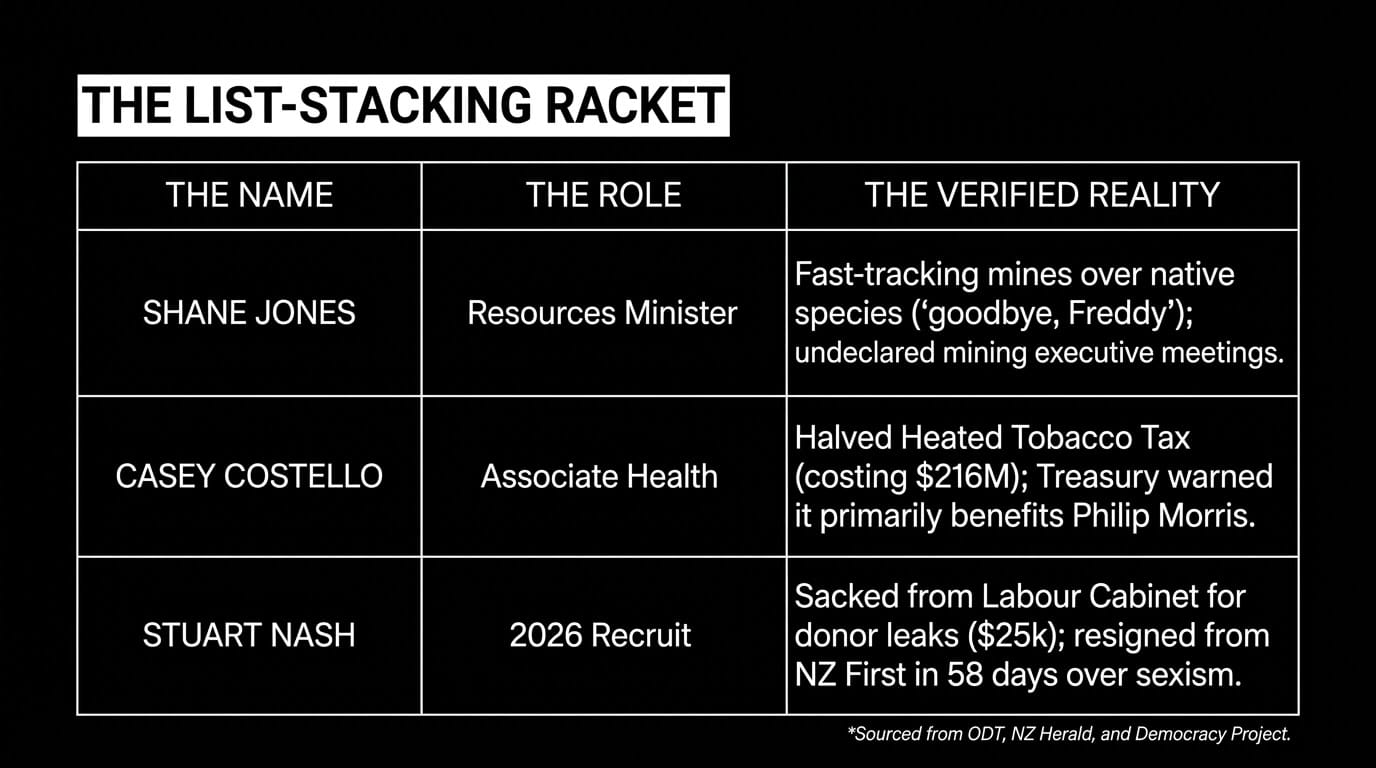
Shane Jones currently sits in Cabinet as Resources Minister while overseeing the fast-track approvals process for mining projects — the same process in which he has repeatedly failed to declare meetings with mining executives, as detailed in Scoop's report calling for Luxon to remove Jones after an undeclared industry meeting emerged.
He told Parliament a mine standing in the way of a native frog was simply "goodbye, Freddy," per ODT's report from December 2023. Greenpeace Aotearoa has called his conflict-of-interest recusal process "like a sordid game of Twister," and a separate Greenpeace release says his recusal "shows corruption of the fast-track process." This is the man handling resource consents that touch whenua and waterways.
Casey Costello, NZ First's Associate Health Minister, halved the excise tax on Heated Tobacco Products at a $216 million contingency cost to the public purse, confirmed by ODT's coverage of the Auditor-General referral — a decision Treasury itself warned, per NZ Herald, would primarily benefit Philip Morris.
Health Coalition Aotearoa reported that a leaked 2017 Philip Morris lobbying strategy specifically named NZ First as a target for favourable regulation. Labour has referred the tax cut to the Auditor-General over suspected industry influence, per the same ODT report.
Stuart Nash was sacked from Labour's Cabinet in March 2023 after leaking confidential Cabinet deliberations on a rent-relief scheme to two of his own donors, who stood to gain financially from the decision — donors who had given him $25,000 across two election cycles, per Bryce Edwards's Democracy Project analysis. NZ First recruited him anyway, confirmed by ODT's report on his candidacy announcement.
He lasted 58 days as their Napier candidate before resigning in July 2026 after calling a National MP "lazy" for taking maternity leave — comments the Prime Minister himself described as Nash "channelling the manosphere," per 1News's report on the resignation. Winston Peters accepted the resignation the same night, per the same 1News report.
In my assessment, as opinion resting on the facts above: a party that recruits a Cabinet-leak scandal, a tobacco-industry-adjacent minister, an undeclared-meetings resources minister, a fringe four-time election loser, and a former MP her own party's press once called "scandal-prone" — in a single electoral cycle — is not building a government. It is building a liability shield with better PR.
The Pattern Is Not Subtle. It Is A Blueprint.
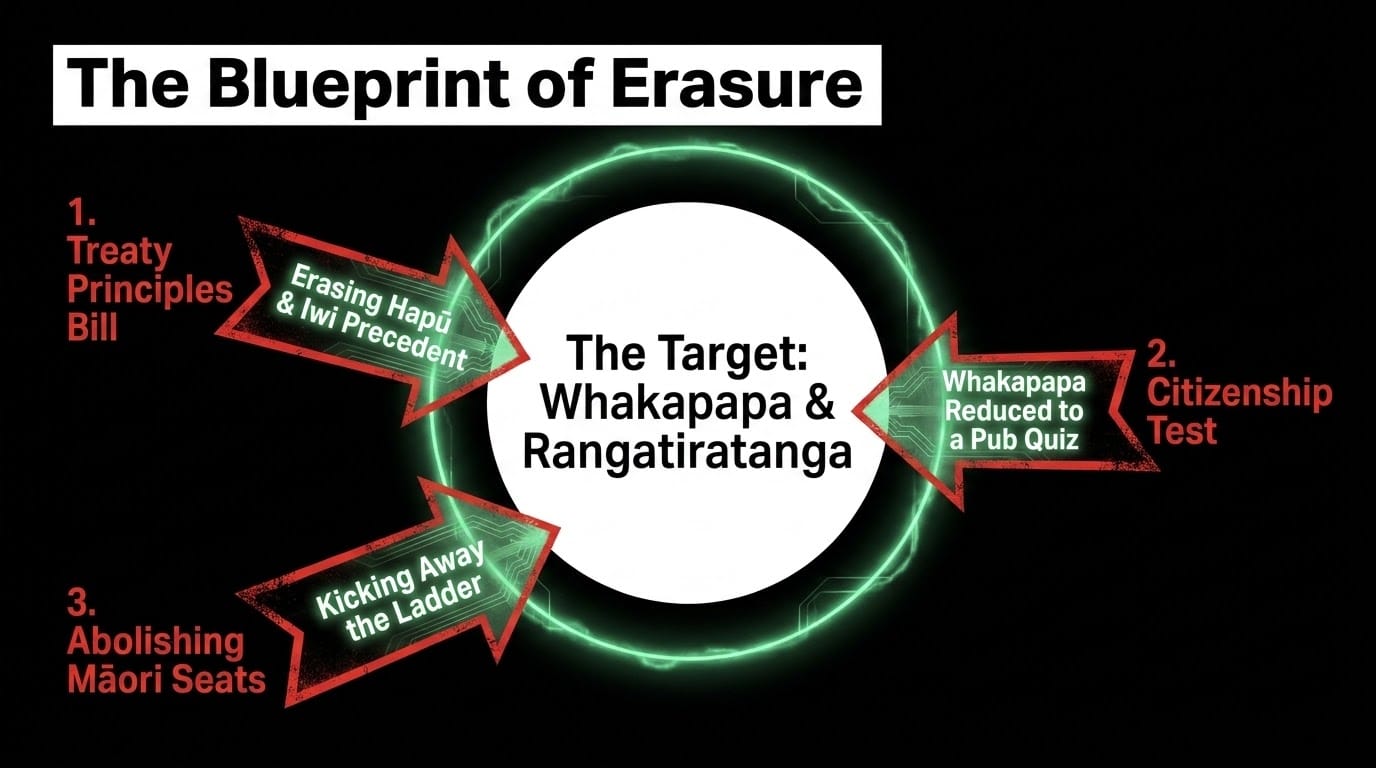
Three positions. Three submissions. One direction, every single time: strip the specific, collective, whakapapa-based protections this country's history forced the Crown to concede, and repaint the wreckage as "equal citizenship" on a party pamphlet — while stacking the list with names, not principles.
Ikilei and Hipango-Brownlie are not the architects. They are the taxidermied skin stretched over a neoliberal frame that includes a fast-track resources minister dodging disclosure rules, a health minister cutting tobacco taxes Treasury itself warned would benefit industry, and a disgraced former Labour minister who lasted less than two months before his mouth ended his second political career.
I will not pretend their whakapapa makes the sawdust underneath any less hollow, and I will not soften this because some of the messengers share my blood.
Betrayal wearing a moko still cuts the same.
Kia kaha, whānau. The taiaha is raised. The whole reject pile is exposed. Ka whawhai tonu mātou.
Ivor Jones The Māori Green Lantern Fighting Misinformation And Disinformation From The Far Right
Disclaimer
This essay combines verified factual reporting with clearly flagged scathing opinion and analysis, published in the public interest concerning declared political candidates and sitting ministers acting in a public capacity. No malice is intended toward any individual's character beyond their public conduct — this is pattern-of-harm critique grounded in cited sources, and unresolved or unverifiable allegations are identified as such rather than presented as fact. Corrections and right-of-reply requests will be actioned under the retraction protocol.