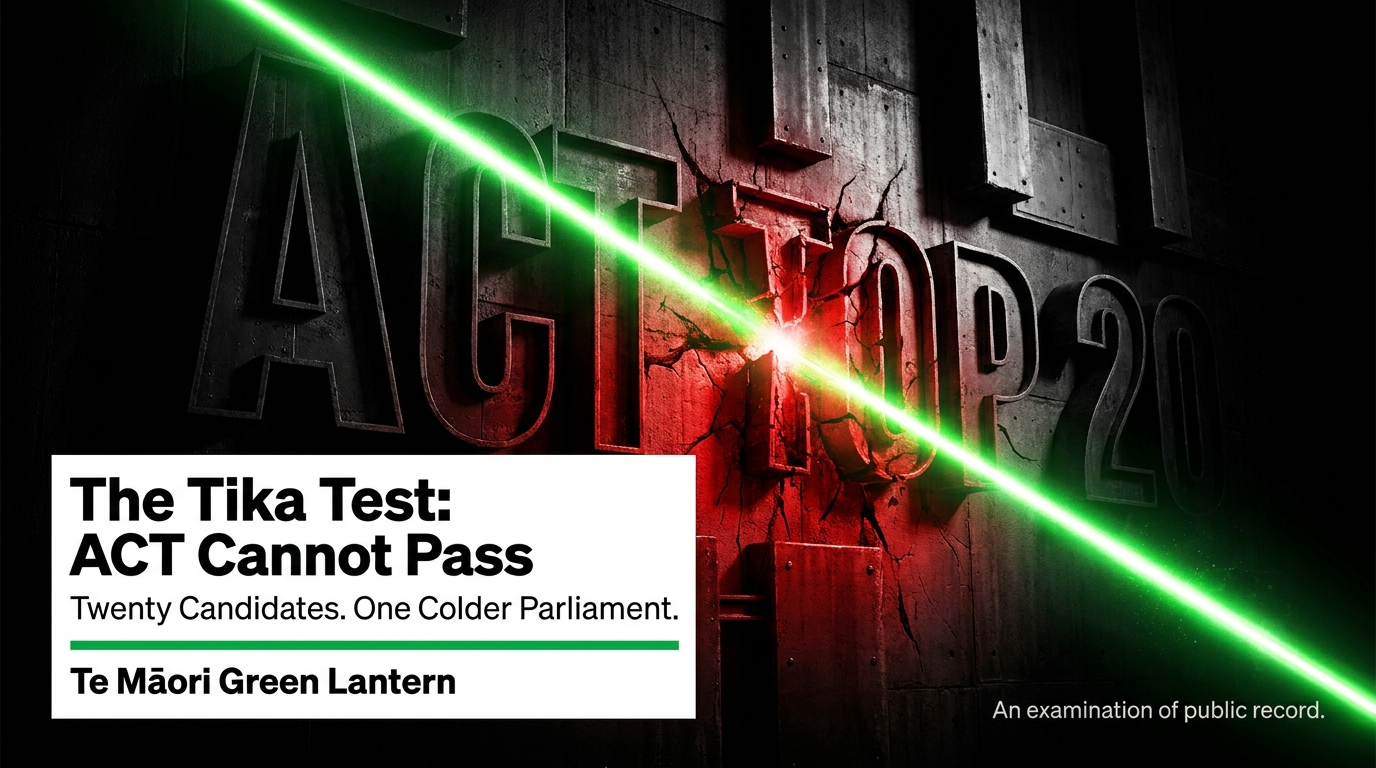
"The Tika Test ACT Cannot Pass: Twenty Candidates For A Colder Parliament" - 14 September 2026
I have followed the paper trail: a party ticket built to sell deregulation as liberation, erase living Treaty accountability as “division”, and make whānau carry the damage. The moral failure is not subtle.


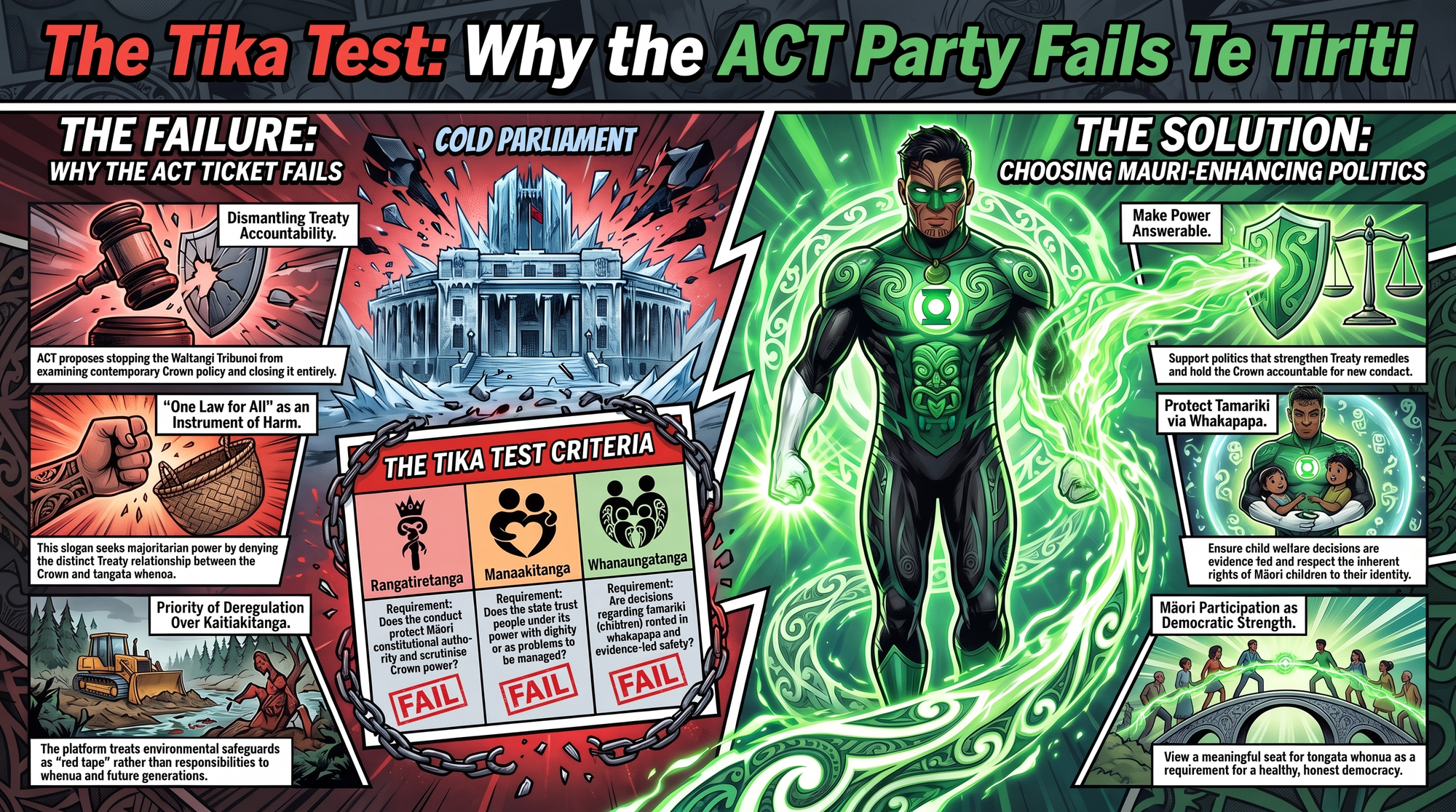
I am Ivor Jones — Te Māori Green Lantern.
I have put ACT’s top 20 through a simple test: does their public conduct protect whakapapa, uphold Te Tiriti, make power answerable, and leave more mana with whānau than it takes away?
This ticket fails. Do not party-vote ACT in November.
What I Am Testing
This is not a personality contest and it is not an invitation to abuse people.
It is an examination of the public conduct of people asking to make laws.
I assess them against the kaupapa I have consistently applied at The Māori Green Lantern: rangatiratanga, Te Tiriti as a living relationship, manaakitanga for people subject to state power, whanaungatanga and whakapapa in decisions about tamariki, kaitiakitanga for whenua and future generations, and transparent accountability when the Crown gets it wrong.
Read My Earlier Analysis Of The Treaty Principles Agenda | Read My Earlier Analysis Of Karen Chhour’s Portfolio | Read My Earlier Analysis Of The Tribunal Fight

The twenty people in this essay are the people in ACT’s published top-20 list.
They are not twenty unrelated applicants. They seek election on a shared ACT ticket whose campaign programme centres on cutting government, cutting regulation, and “one law for all.”
They also endorse stopping the Waitangi Tribunal from examining contemporary Crown policy and closing it after historical claims are resolved.
Every prospective MP on this list needs to be judged against that collective project unless they publicly state the line they will not cross. ACT’s Published List Launch | 1News On ACT’s Tribunal Proposal
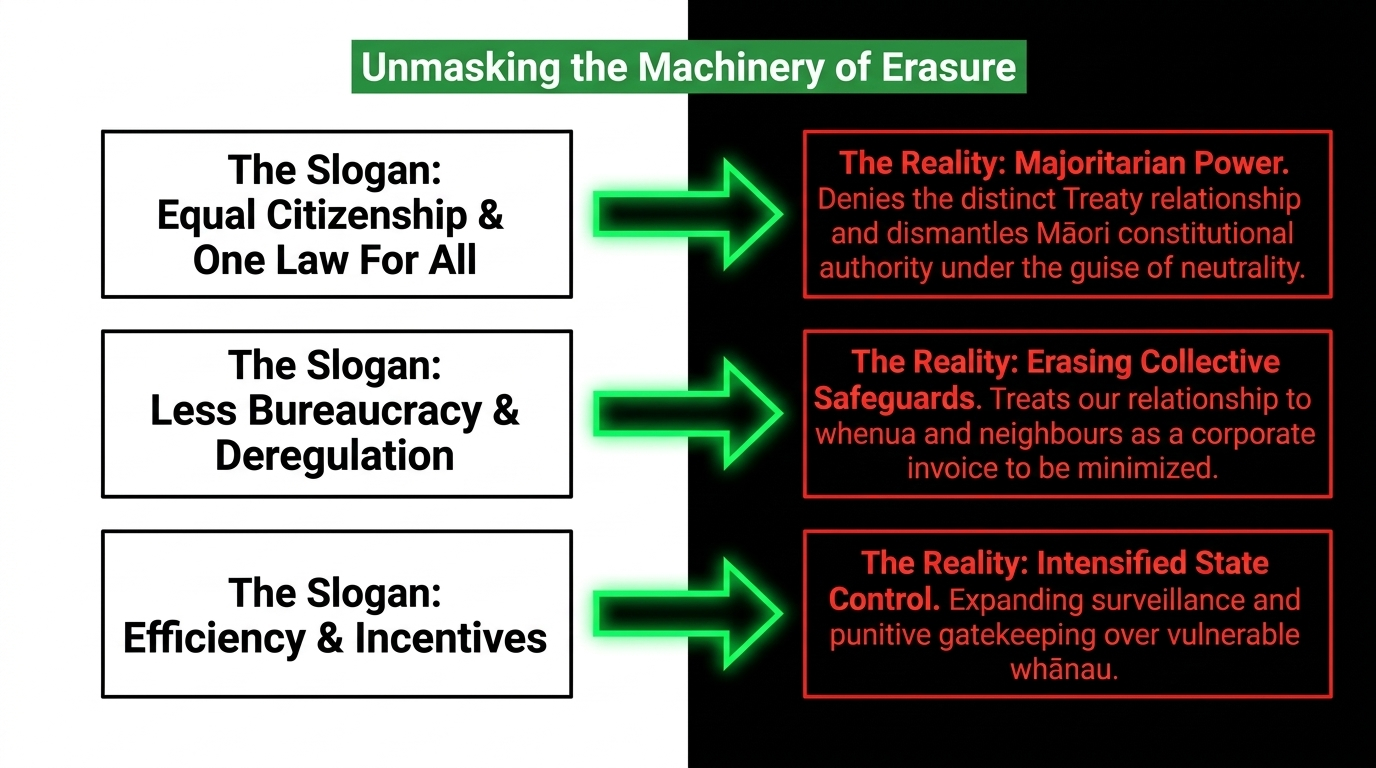
ACT calls this equal citizenship, less bureaucracy, and a more efficient government.
I record that stated rationale fairly. But “one law for all” becomes an instrument of harm when it denies the distinct Treaty relationship between the Crown and tangata whenua, then removes the institutions that can examine fresh Crown breaches.
That is not equal treatment. It is majoritarian power dressed in a tidy slogan. Ministry Of Justice: Treaty Principles Bill | 1News On The Proposed Tribunal Restriction
The Tika Test
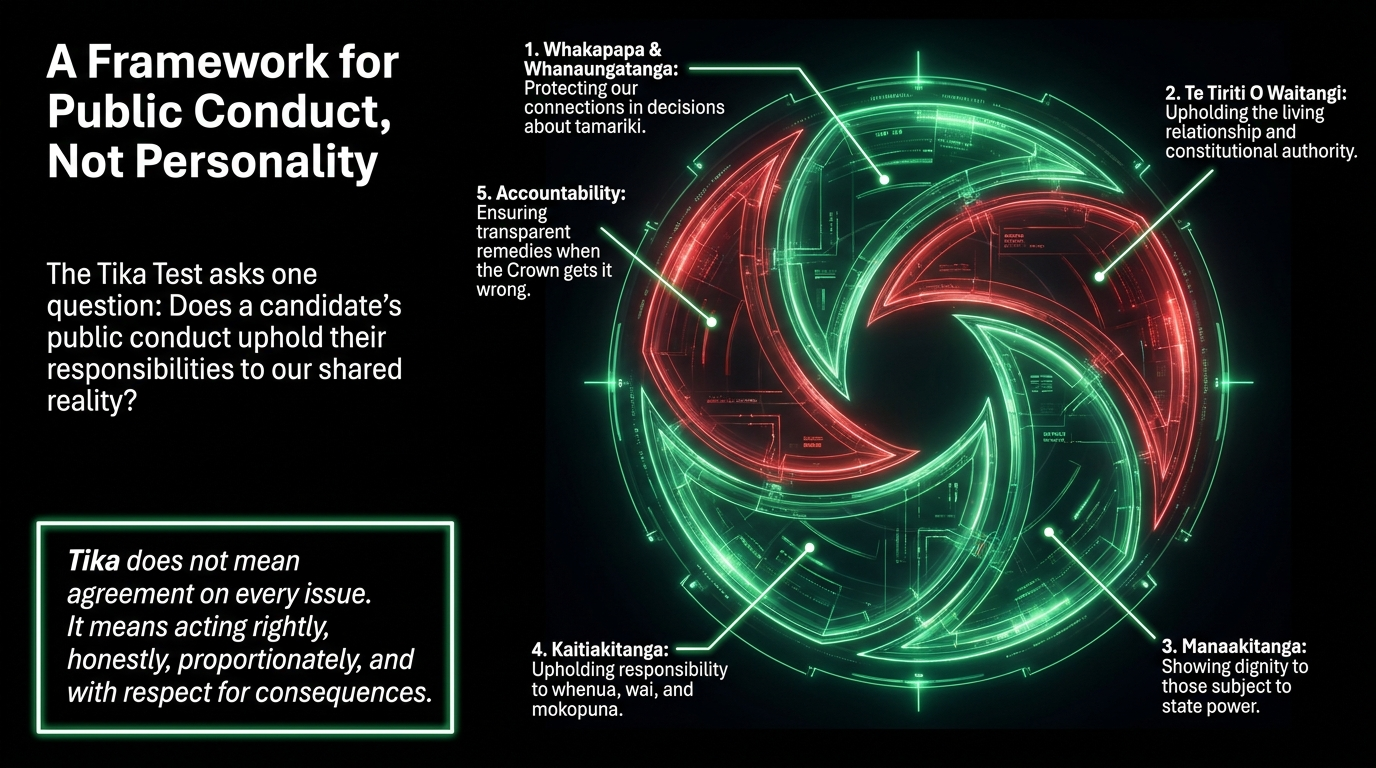
For each person, I ask one question: what has their public policy conduct—or, for a prospective candidate, public choice to stand under ACT’s banner—shown about their willingness to uphold these responsibilities?
Tika does not mean agreement with me on every issue. It means acting rightly, honestly, proportionately, and with respect for relationships and consequences.
A candidate fails this test when they champion, enable, or refuse to distance themselves from a programme that weakens Māori participation and public accountability.
1. David Seymour: The Author Of The Attack
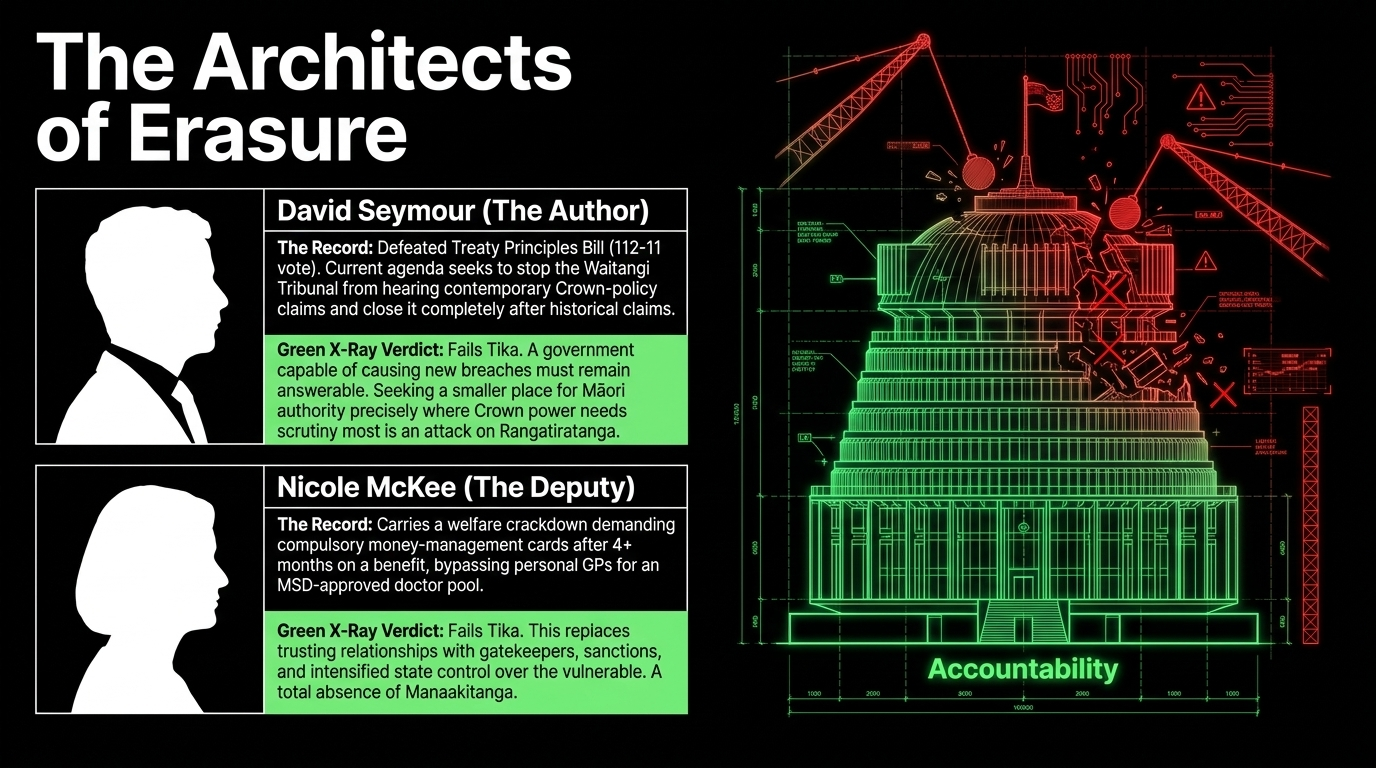
David Seymour fails the tika test because he has driven the most direct attack on Te Tiriti accountability in this ticket.
The Ministry of Justice records that the Treaty Principles Bill was an ACT coalition-policy commitment and was defeated at second reading by 112 votes to 11.
ACT’s current election direction is to stop the Waitangi Tribunal hearing contemporary Crown-policy claims and to close it after historical claims finish. This is not a technical tidy-up. A government capable of causing a new breach must remain answerable for new conduct.
Seymour’s policy conduct therefore conflicts directly with rangatiratanga and mana ki te mana: it seeks a smaller place for Māori constitutional authority precisely where Crown power needs scrutiny most. Ministry Of Justice | 1News
2. Nicole McKee: The Deputy Who Carries The Programme
Nicole McKee fails the tika test because she seeks re-election as ACT’s deputy leader while carrying a campaign programme that combines a welfare crackdown, a plan to sharply reduce departments and ministers, and the party’s anti-Treaty constitutional direction.
The reported welfare proposal would impose compulsory money-management cards after more than four months on a work-ready benefit and require health and disability-benefit sign-off through an MSD-approved doctor pool rather than a recipient’s own GP.
That is a policy of intensified control over people already under state power, not manaakitanga. McKee may say the purpose is accountability and work incentives. The tikanga question is whether the state treats people with dignity and trusting relationships, or as problems to be managed by card, gatekeeper, and sanction. 1News On McKee’s Leadership And ACT Welfare Policy | ACT’s List Launch
3. Andrew Hoggard: Deregulation Before Kaitiakitanga
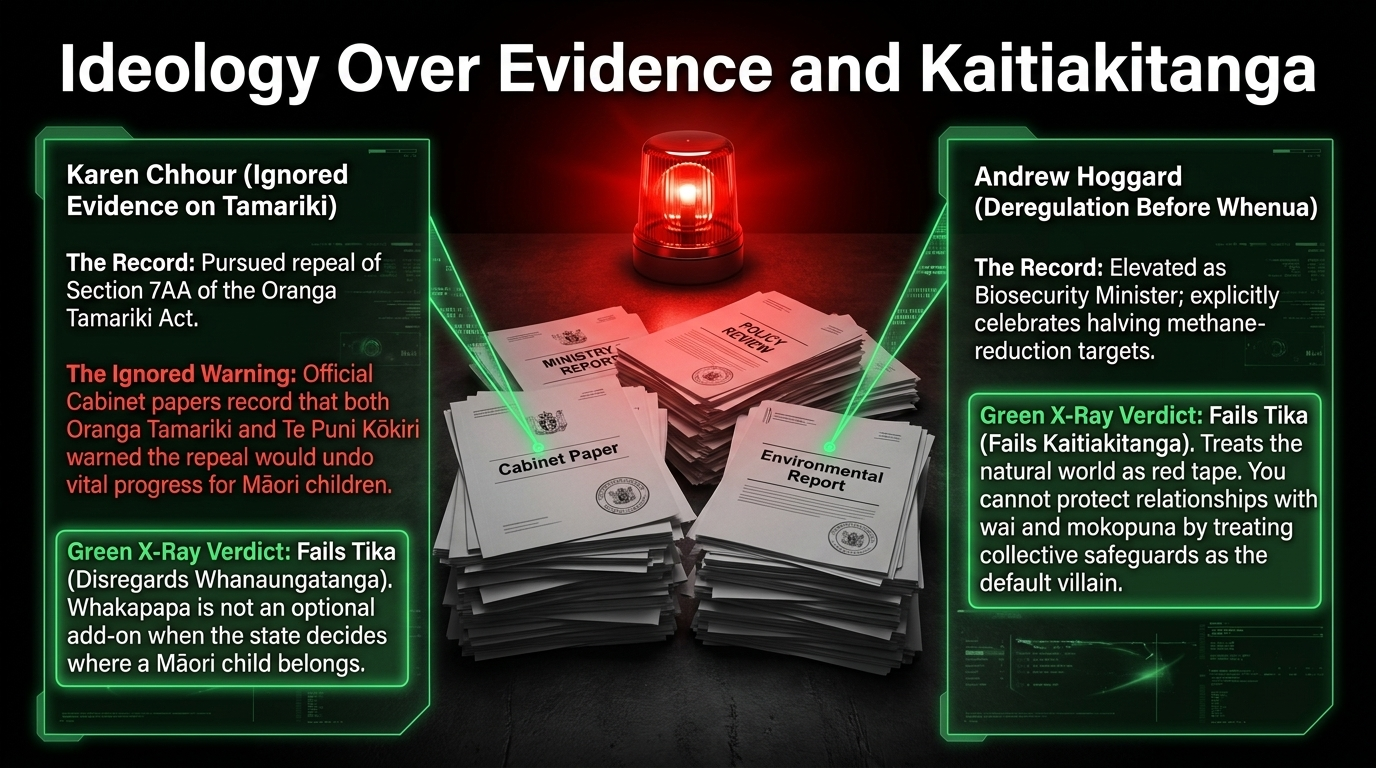
Andrew Hoggard fails the tika test because ACT promotes his rural leadership through the same deregulatory creed that treats collective safeguards as obstacles.
Seymour’s 2026 state-of-the-nation speech explicitly celebrates halving methane-reduction targets and describes ACT’s task as driving a deregulation agenda;
Hoggard is elevated on the list as the party’s Biosecurity Minister and rural voice. Farmers deserve representation, but kaitiakitanga does not mean treating the natural world as an invoice to be minimised. It requires responsibility to whenua, wai, neighbours, and mokopuna.
Hoggard’s public political vehicle tells voters that rules are the problem before it proves that the removal of rules protects those relationships. ACT State Of The Nation Speech | Newsroom On Hoggard’s Ranking And Role
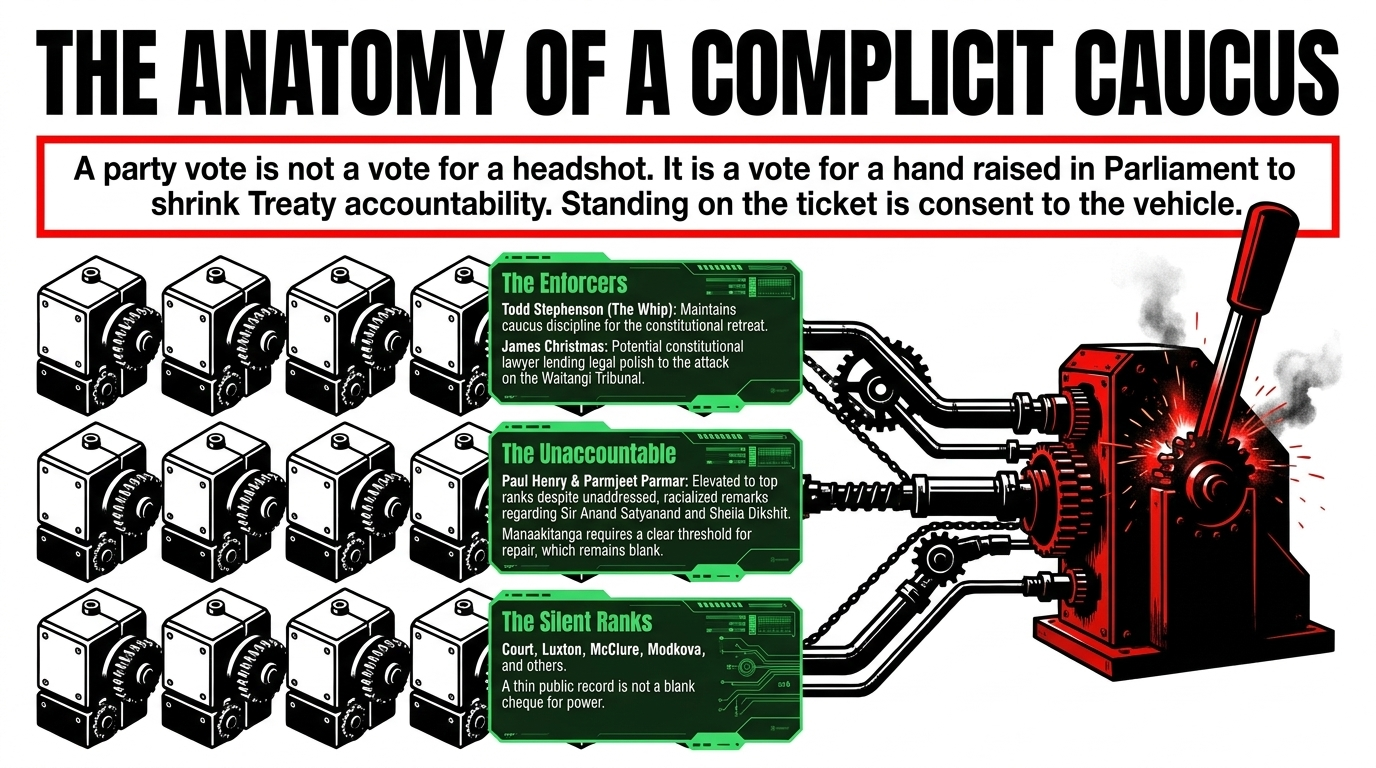
4. Paul Henry: A High Ranking Without A Full Reckoning
Paul Henry fails the tika test because ACT has elevated him to fourth place without demonstrating the standard of accountability a parliamentarian should meet.
Awaaz reports that in 2010 Henry mocked then Delhi chief minister Sheila Dikshit’s surname and questioned whether New Zealand-born Governor-General Sir Anand Satyanand was “even a New Zealander”, including whether a successor would “look and sound” like one. Henry has reportedly said he went too far, and people can change. But ACT MP Parmjeet Parmar called the remarks unacceptable while declining to say what showed he had changed.
Manaakitanga requires more than granting a prominent man the benefit of an unexplained rehabilitation. Communities demeaned by racialised rhetoric are owed a clear account of learning, repair, and conduct. Awaaz On Henry’s Remarks And Parmar’s Response | Newsroom On Henry’s Fourth Ranking
5. Karen Chhour: The Evidence Ignored Around Tamariki
Karen Chhour fails the tika test through a documented policy decision affecting tamariki.
Her released Cabinet paper says she pursued repeal of section 7AA of the Oranga Tamariki Act because she believed it could conflict with child-centred decision-making. The same paper records that Oranga Tamariki’s Regulatory Impact Statement did not support repeal and considered repeal unlikely to achieve the Minister’s stated objective; it also records Te Puni Kōkiri’s view that repeal was highly likely to undo important progress for tamariki and rangatahi Māori. The paper notes other duties would remain, so I do not claim that every protection disappeared.
But whanaungatanga and whakapapa cannot be treated as optional add-ons when the state decides where a Māori child belongs. Chhour had an official warning light. She drove through it. Released Chhour Cabinet Paper, Pages 1–6 | ACT’s List Launch
The Deep Dive Podcast
Listen to a lively conversation between two hosts, unpacking and connecting topics in the sources of this essay. I apologise in advance for the AI's very harsh pronounciation of reo. Please dont shoot me, :).
Youtube Video
Like video? Here is a short video suppporting the essay. Again, don't shoot the messenger please because of AI's pronounciation. :)
He Koha Kōrero: Support The Accountability They Will Not Provide
You might ask who pays for high-volume, evidence-led writing that follows a party slogan through to the whānau who must live with its consequences.
The answer is whānau, through koha. The Māori Green Lantern has no corporate sponsor directing this mahi. Every koha says rangatiratanga includes the power to support our own truth-tellers and to build the accountability that Crown and corporate structures often refuse to provide.
This investigation is for tamariki whose whakapapa must not be treated as a bureaucratic inconvenience, for hapū defending their lawful place in public decisions, and for whānau facing a state that wants fewer obligations and more control. If you are able, please support this mahi. If you cannot koha, kei te pai: subscribe, follow, kōrero about the evidence, and share it with your whānau and friends. That is koha in itself.
- Koha: Support The Māori Green Lantern Through Koha
- Subscribe: Receive Essays From The Māori Green Lantern
- Direct Bank Transfer: Ivor Jones — 03-1395-0099387-000
- Facebook: Follow The Māori Green Lantern
Kia kaha, whānau. Stay vigilant. Stay connected.
6. Todd Stephenson: The Whip For The Wrong Waka
Todd Stephenson fails the tika test because he is ACT’s whip: a role built around maintaining caucus discipline for the programme this article scrutinises. That programme includes shrinking government, cutting regulation, and advancing “one law for all”; ACT’s current Tribunal proposal would also remove contemporary Treaty inquiry.
A whip who helps keep MPs aligned must be judged by the direction in which he keeps them aligned. Tika requires a boundary when the caucus turns against Treaty accountability; the public record located here does not show one. ACT’s List Launch | RNZ On The List
7. James Christmas: Constitutional Skill In Service Of Constitutional Retreat
James Christmas fails the tika test not because legal expertise is a flaw, but because he seeks to lend constitutional expertise to a party committed to cutting Treaty accountability.
Newsroom reports that he is ACT’s candidate in Tāmaki, replacing retiring ACT deputy Brooke van Velden, and that Seymour has described him as a potential constitutional lawyer in Parliament.
A lawyer understands that remedies matter: rights without a forum to enforce or investigate them are slogans. Yet I found no verified public material in this research showing that Christmas rejects ACT’s plan to stop contemporary Tribunal inquiries. If he supports it, he is applying legal polish to constitutional retreat. If he does not, he must say so before voters are asked to trust him. Newsroom On Christmas’s Candidacy | 1News On ACT’s Tribunal Policy
8. Simon Court: Consent Cutting As A Political Reflex
Simon Court fails the tika test because his public parliamentary advocacy illustrates ACT’s deregulation reflex.
In Parliament, Court said ACT supported a bill because it was about “cutting red tape” and aligning building-service regulation with consumers’ needs. Seymour’s own party speech claims Court has driven resource-management reform and celebrates a principle that fewer consents are needed if neighbours are not affected.
Efficient process may be a legitimate aim, but whenua and water are not merely private neighbours in a property-rights equation. Kaitiakitanga requires consideration of interconnected collective effects, including those not easily priced or contained within a boundary fence.
Court’s policy conduct points in the opposite direction: simplify first, ask about the relationships later. Parliamentary Hansard: Court On Cutting Red Tape | ACT State Of The Nation Speech
9. Laura McClure: A Sitting MP Inside The Same Programme
Laura McClure fails the tika test because, as an incumbent ACT MP seeking return, she is asking voters to strengthen the same collective programme rather than publicly mark a limit on it.
The public record confirms that she has sponsored the Deepfake Digital Harm and Exploitation Bill, which shows she is capable of identifying a modern form of harm. But the same party setting places her alongside ACT’s campaign for welfare surveillance, a smaller state, “one law for all,” and narrowed Treaty scrutiny. I found no verified public statement in the material reviewed that she rejects those positions.
A candidate cannot claim sensitivity to one kind of harm while remaining silent about a constitutional programme that removes remedies and participation from tangata whenua. Parliamentary Hansard On McClure’s Bill | 1News On ACT’s Election Policies
10. Parmjeet Parmar: Naming Harm Is Not The Same As Stopping It
Parmjeet Parmar fails the tika test because her response to Paul Henry’s past remarks stops at condemnation without showing what accountability ACT required before placing him fourth.
Awaaz reports that she called his remarks unacceptable, but would not say if she believed he had changed. That is not enough when the party then gives the man a high-probability path to Parliament.
Manaakitanga is not a press line. It is the practice of protecting the dignity of people harmed by public speech. Parmar had an opportunity to explain ACT’s threshold for repair and leadership. The reported response leaves the threshold blank. Awaaz On Parmar’s Response | Newsroom On The List Ranking
11. Iain Murray: Education Is Not A Spreadsheet
Iain Murray fails the tika test because ACT recruits his experience as a school principal into a campaign that repeatedly describes public safeguards and social commitments as bureaucratic or ideological obstacles.
Newsroom reports that Murray is principal of Hornby High School and a former Royal New Zealand Air Force airman; ACT’s own material frames education through efficiency, outcomes, and a smaller state.
Those credentials can be real and useful. But ako requires reciprocal learning, and education requires commitment to identity, language, belonging, disability support, and history—not only measurable throughput. Murray should tell voters exactly what ACT means when it attacks “ideological” education, and whether he will protect Māori educational aspirations rather than helping a culture-war programme dismantle them. Newsroom On Murray’s Background | ACT State Of The Nation Speech
12. Cameron Luxton: Incumbency Without A Public Line
Cameron Luxton fails the tika test because he is a sitting ACT MP seeking return without a verified public separation from the party’s assault on Treaty accountability.
Newsroom reports that he has dropped to twelfth on the list and could miss out under recent polling; that fact does not reduce his responsibility for the programme. The party is not asking voters to re-elect Luxton as an independent. It is asking for a larger bloc to pursue its stated agenda.
Rangatiratanga requires elected representatives to defend Māori authority and meaningful remedy, particularly when their own caucus seeks to shrink it. I found no verified evidence in this research that Luxton has taken that stand. Newsroom On Luxton’s Ranking | 1News On ACT’s Tribunal Policy
13. Antonia Modkova: Technology Does Not Excuse Erasure
Antonia Modkova fails the tika test if she cannot explain why a technology and intellectual-property specialist has chosen to stand for a party that presents Treaty-based duties as a form of division.
Newsroom identifies Modkova as an intellectual-property lawyer at thirteenth on ACT’s list. Technical achievement does not automatically become constitutional wisdom. People who work with digital systems should understand that systems marketed as neutral can embed the values of their designers and magnify unequal power.
ACT’s “one law for all” language performs a similar political trick: it calls itself neutral while seeking to diminish a Treaty relationship. Modkova must show voters that she understands the difference. Newsroom On Modkova | Ministry Of Justice: Treaty Principles Bill
14. Alex Price: Health Cannot Be Reduced To Efficiency
Alex Price fails the tika test unless he explains how his health-sector experience squares with ACT’s determination to make the state smaller and less accountable to collective Treaty obligations.
ACT’s own 2026 speech presents a programme of spending reductions, deregulation, and policy delivered through ministerial efficiency; it is the political programme Price has chosen to represent. Health policy is not a market test. Whānau access care through uneven incomes, transport, disability, language, racism, and geography.
Manaakitanga asks whether the system reaches people with the least power, not whether a balance sheet looks cleaner. I found no verified material in this research setting out Price’s independent position on ACT’s Treaty and welfare agenda. ACT State Of The Nation Speech | ACT’s Published List Launch
15. Janelle Hocking: Regional Life Needs Collective Infrastructure
Janelle Hocking fails the tika test unless she can show that her regional-business advocacy is more than a local face for ACT’s deregulation programme.
Regional communities rely on roads, schools, health services, emergency response, local housing, environmental protections, and relationships with mana whenua. They cannot survive on the fantasy that public systems are merely “red tape.” ACT’s campaign programme asks voters to cut departments and ministers while elevating deregulation as a central mission. Hocking has chosen that ticket.
Whanaungatanga requires candidates to recognise how rural survival depends on collective infrastructure and reciprocal relationships, not simply individual enterprise. I found no verified public statement in this research showing where Hocking would resist ACT’s programme. 1News On ACT’s Smaller-Government Policy | ACT Candidate Announcement
16. Ash Parmar: The Public Must Know The Boundary
Ash Parmar fails the tika test on the public information presently available because he seeks Parliament through ACT while leaving no independently verified public boundary between himself and the party’s Treaty-accountability agenda.
I found no sufficient public record to make a personal allegation, and I will not do so. But a candidate is not entitled to a blank cheque merely because the public record is thin. The relevant public conduct is the decision to stand under a banner seeking smaller government, “one law for all,” and a restriction on contemporary Tribunal inquiries.
Tika requires clarity before power is granted. Parmar should name the ACT policy he would vote against; until he does, voters should treat his candidature as consent to the whole vehicle. ACT Candidate Announcement | 1News On ACT’s Tribunal Policy
17. Yang Qu: Belonging Must Not Erase Mana Whenua
Yang Qu fails the tika test unless he rejects the false choice baked into ACT’s constitutional rhetoric.
ACT’s candidate material identifies Qu as an electrical engineer and construction director with an immigration-policy focus. That experience can add value. But migrant belonging and tangata whenua authority are not competing claims.
Te Tiriti does not require new communities to deny Māori authority in order to belong; it requires the Crown to honour its relationship with tangata whenua while Aotearoa remains home to many peoples.
A candidate who stands for a party that wants to narrow Treaty remedies has a responsibility to explain that distinction. I found no verified public statement from Qu doing so. ACT Candidate Announcement | 1News On ACT’s Tribunal Policy
18. Davina Smolders: Māori Participation Is Not A Coup
Davina Smolders fails the tika test because her public conduct in Far North turned lawful Māori participation into a political alarm bell.
The 1News/RNZ report records that she opposed expanding the Te Kuaka Māori Strategic Relationships Committee, while the committee was advisory, councils could appoint unelected committee members, and local-government law required councils to involve Māori in decision-making. Smolders later accepted that the appointments were legally permitted while maintaining her political objection. She is free to hold it.
I am equally clear that rangatiratanga cannot survive where the public is taught to see any meaningful seat for tangata whenua as an anti-democratic seizure of power. That is not honest democratic debate; it is fear made respectable. 1News/RNZ On Te Kuaka | Newsroom On Smolders’s Ranking And ACT’s Defence
19. Amanda Roberts: “Lean” Government Can Mean Lean Justice
Amanda Roberts fails the tika test unless she can identify where her advocacy for lean governance ends and the public’s right to protection begins.
Her listed public record is limited in the verified material reviewed for this essay; I make no allegation of misconduct. The relevant public conduct is her choice to seek office on a ticket whose stated direction includes less regulation, less government, and less Treaty accountability.
“Lean” is an attractive word because it hides the question: lean for whom? A state made lean by removing protections, voices, and remedies is not efficient for a whānau shut out of a decision. It is simply absent. ACT’s Published List Launch | 1News On ACT’s Smaller-Government Policy
20. Callum Sheridan: A Thin Record Cannot Carry A Thick Mandate
Callum Sheridan fails the tika test on the current public record because he seeks the authority of Parliament while the verified material reviewed here does not provide a substantial independent account of his public policy positions.
That is not proof of wrongdoing. It is a reason not to hand over a mandate blindfolded. His public choice is to stand on ACT’s top-20 ticket and thereby seek to strengthen its declared programme.
Tika requires openness about what a candidate will defend, what they will oppose, and who will bear the consequences. Until Sheridan provides that clarity, his presence on ACT’s list offers voters no affirmative reason to trust him with public power and every reason to judge the party he has joined. ACT’s Published List Launch | 1News On The List
Why This Fails The Tika Test
The failure is not one stray quote or one flawed candidate. It is the connection between ACT’s legislative ambition, its administrative instincts, and its recruitment strategy.
The party wants a narrower Treaty-accountability system; it campaigns to place greater surveillance and direction over welfare recipients; it celebrates a smaller state and a broad deregulation agenda; then it asks the public to return or elect candidates who will make these choices in Parliament.
That is a coherent politics. It is coherent in the wrong direction. 1News On Welfare And State-Structure Policies | 1News On Tribunal Policy
I call that direction white-supremacist neoliberalism as political analysis and opinion, not as an assertion that every named person privately identifies with those words.
It is white-supremacist in effect where it defends Crown-majoritarian authority by treating Māori collective authority and Treaty remedies as special treatment.
It is neoliberal in method where it sees collective obligations as bureaucracy, welfare as behavioural failure, regulation as the default villain, and market-style individualism as the answer to structural injustice.
The factual basis for that assessment is stated and linked throughout this article.
The Verdict For November
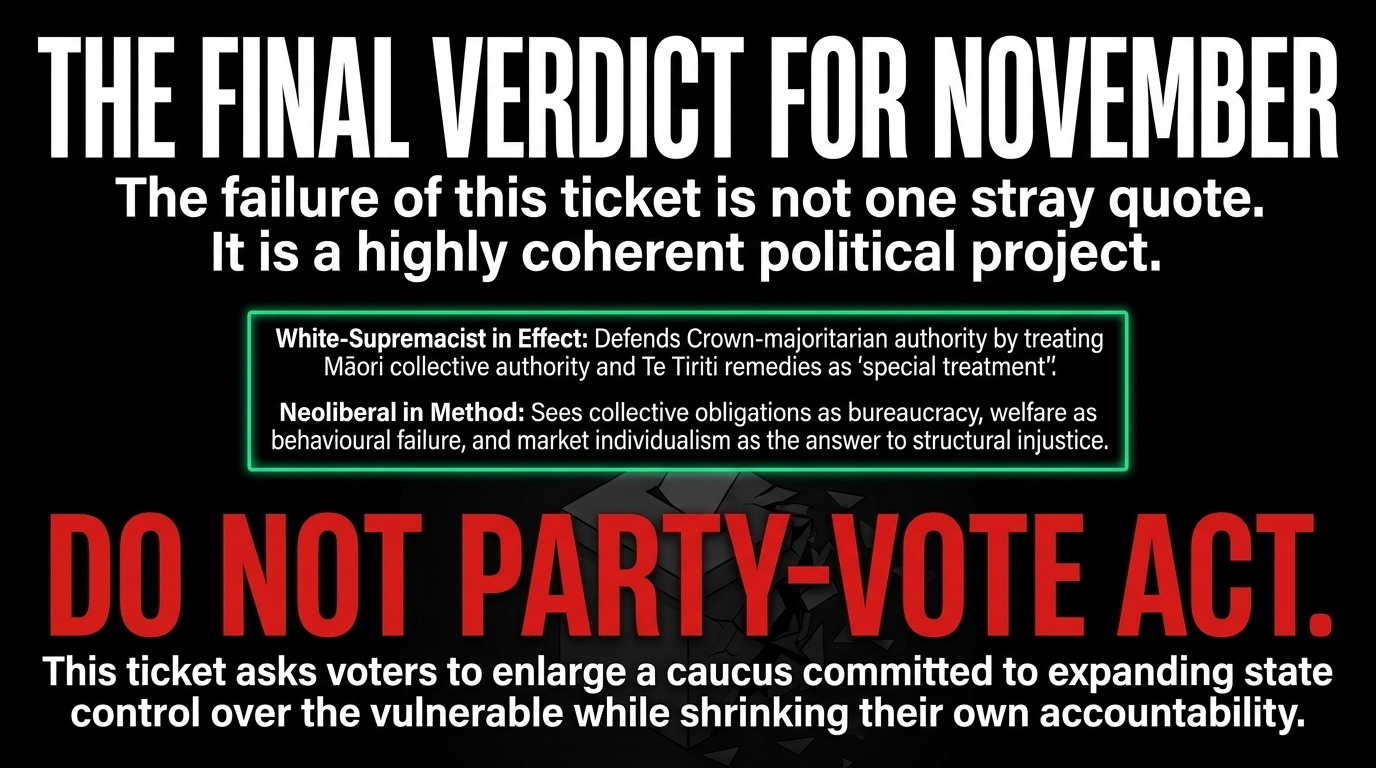
Do not party-vote ACT in the November election.
I do not say that because every person on this list is identical, dishonest, or incapable of change. The evidence does not support such claims, and I will not use the tactics I condemn.
I say it because the party they have chosen asks voters to enlarge a caucus committed to shrinking Treaty accountability, expanding control over people dependent on state support, and treating public protections as obstacles before it proves their removal will leave whānau safer.
A party vote is not a vote for a headshot. It is a vote for who gets numbers in the caucus room, leverage in coalition negotiations, seats on select committees, and hands raised when bills come before Parliament.
More ACT MPs means more capacity for David Seymour’s constitutional project, Nicole McKee’s welfare-control agenda, Karen Chhour’s demonstrated willingness to repeal targeted Māori child-welfare duties against official impact advice, and the wider deregulatory programme the party has made its brand. ACT List Launch | Released Chhour Cabinet Paper | 1News On ACT Policy
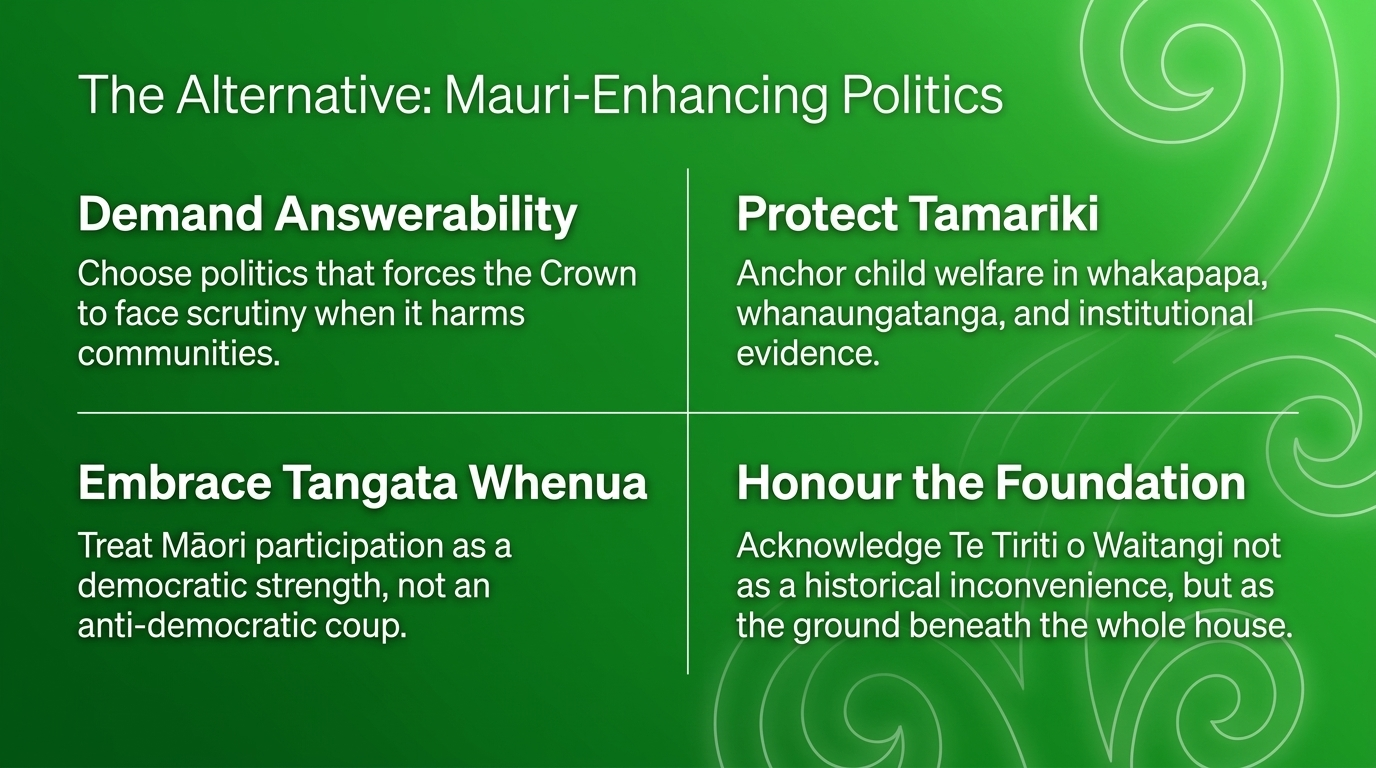
Choose mauri-enhancing politics instead: politics that makes the Crown more answerable; that protects tamariki through whakapapa, evidence, and relationships; that treats Māori participation as democratic strength; and that understands Te Tiriti is not a historical inconvenience but the ground beneath the whole house. ACT’s top 20 offers the opposite.
Leave this ticket on the shelf.
Māuri Ora!

Disclaimer: This is fair-comment political opinion in the public interest, based on disclosed public sources. It concerns candidates and office-holders acting in public capacity. It does not allege criminal conduct, dishonesty, or undisclosed private facts.