
"THE TOP SURGE THAT WASN'T" - 25 June 2026
How New Zealand's Media Class Conjured a Centrist Saviour from a Margin of Error — While a White Supremacist Neoliberal Government Dismantled Everything Whānau Built


Mōrena Aotearoa,
They had 4.6 percent, a 3.1 percent margin of error, and a media infrastructure ready to write the story. The left bloc had 64 seats. The Greens had 13%. Te Pāti Māori had six electorate seats. None of that made the headline.
He Kōrero Whakataki — The Trick Has a Name
I have spent three years at this taiaha — documenting, naming, citing. Three years watching a white supremacist neoliberal government dismantle Te Aka Whai Ora, cut over $1 billion in Māori-targeted funding, spend $2.6 billion on combat helicopters while 70,000 of our tamariki went hungry, and hand $2.9 billion to landlords while renters were told to try harder.
And I have spent three years watching the media that is supposed to hold that government to account do something else entirely.
 RNZ | Te Reo Irirangi o Aotearoa
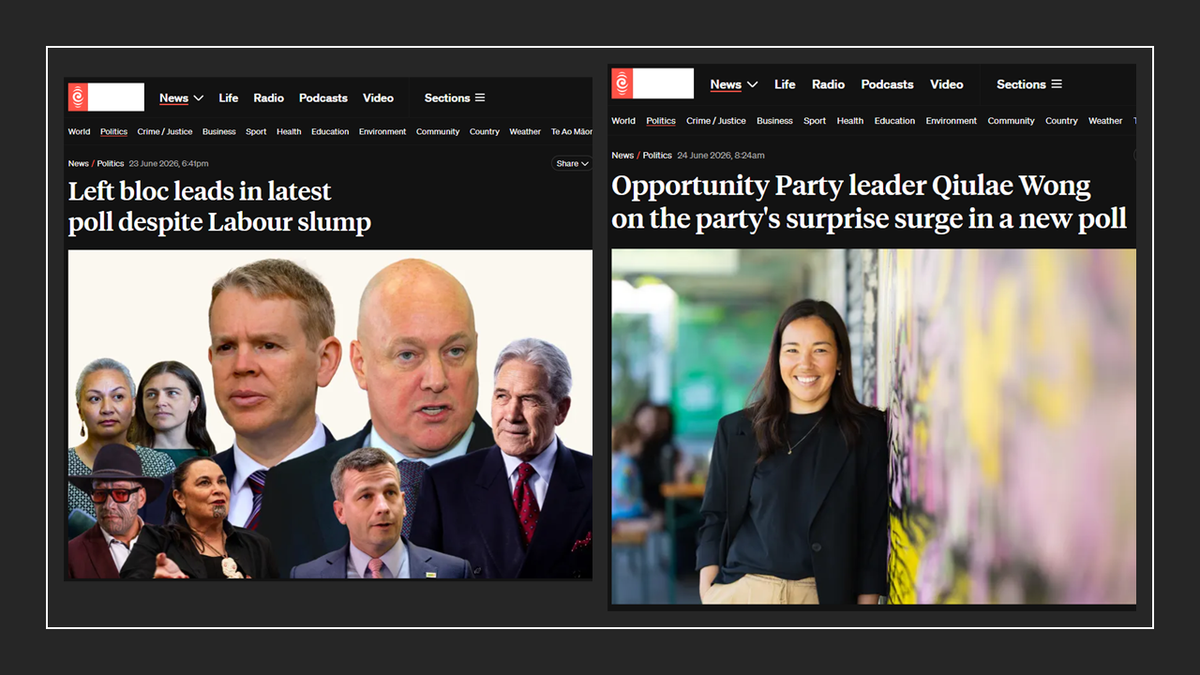
On 24 June 2026, RNZ published this headline:
"Opportunity Party leader Qiulae Wong on the party's surprise surge in a new poll."
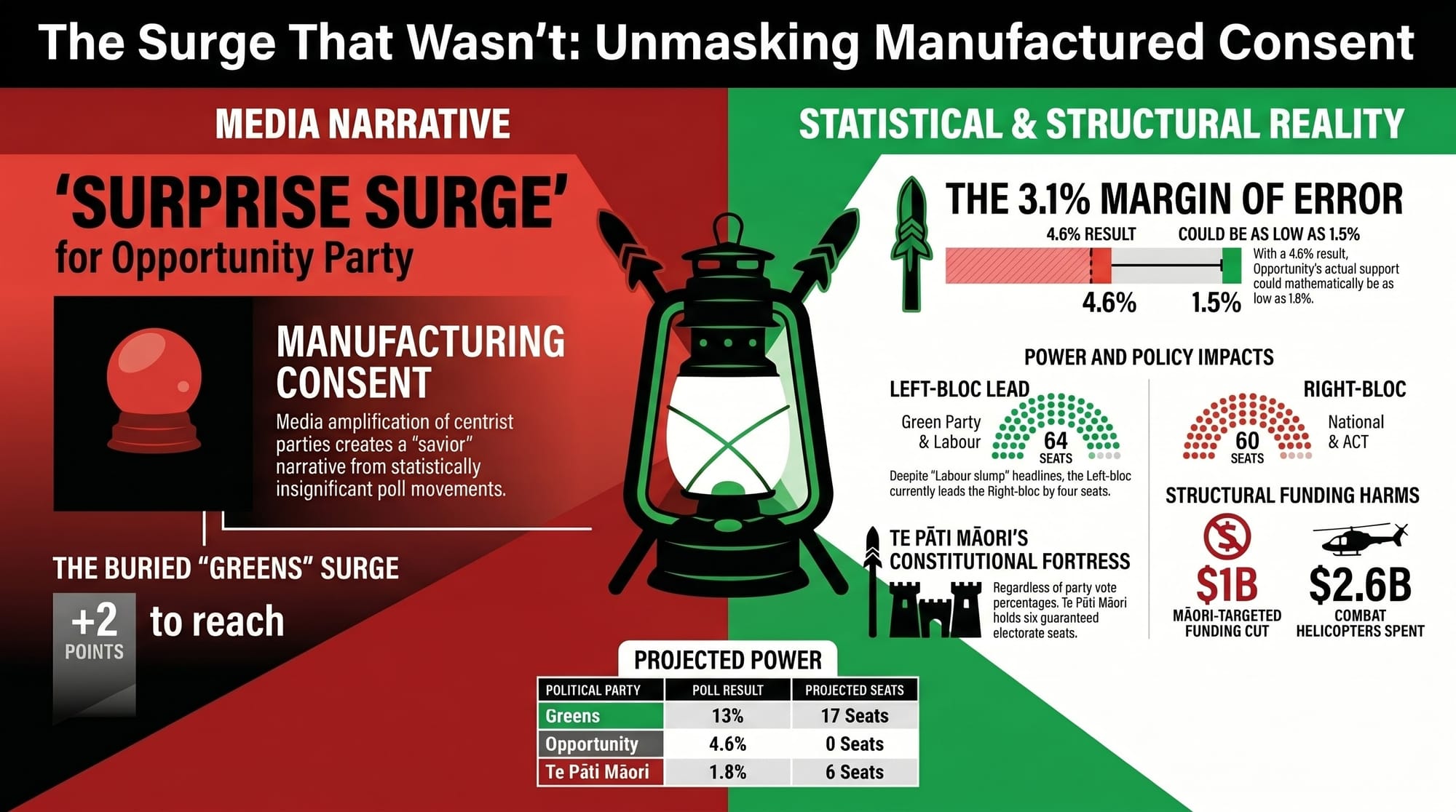
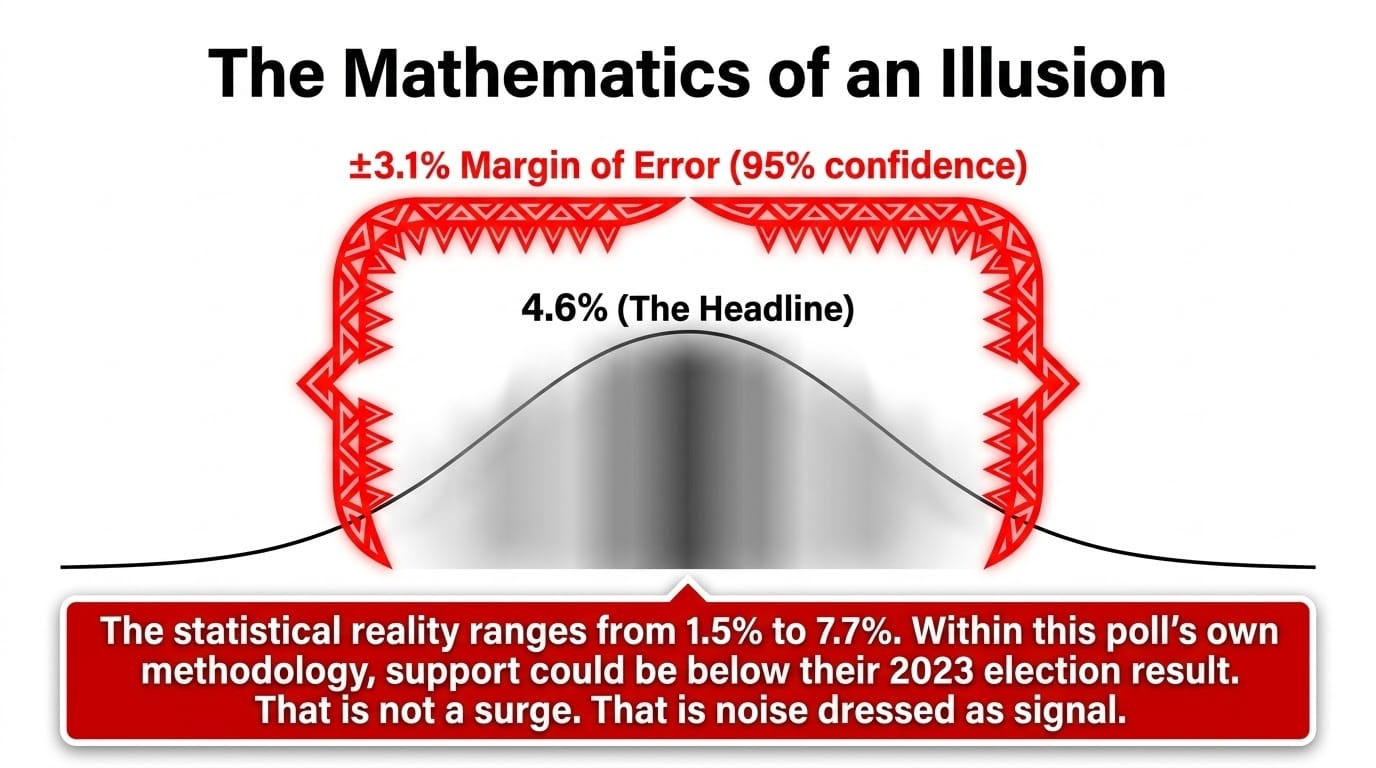
One poll. 4.6 percent. Five days of fieldwork. 1,001 voters. Margin of error: ±3.1 percent at 95% confidence. That is not my opinion — that is the methodology statement embedded in the poll itself.
Read that margin again. A result of 4.6 percent, with an error band of 3.1 percent. The statistical range runs from 1.5% to 7.7%. Opportunity could, within the mathematics of this poll's own methodology, be below 2% — invisible — or already past the threshold. That is not a "surge." That is noise dressed as signal, amplified by a media class that needed a story, constructed a saviour, and called it journalism.
I have named this before. I name it again today. Edward Herman and Noam Chomsky called it Manufacturing Consent — the process by which elite consensus structures mass media to serve power, not people. New Zealand's media is not immune. It is a practitioner.
 RNZ | Te Reo Irirangi o Aotearoa
And I documented exactly this playbook twelve months ago in my essay "How RNZ Legitimises Far-Right Propaganda Through Pollwashing" — where I showed in detail how our public broadcaster uses poll results not to inform voters, but to manufacture the political landscape before the campaign has even begun.
They are doing it again. With a different party. The same formula.
🎙️ The Deep Dive Podcast
Listen to a lively conversation between two hosts, unpacking and connecting all the topics, data, and political patterns in this essay.
(I apologise in advance for the AI's very harsh pronunciation of te reo Māori. Please don't shoot me. 😅)
📺 YouTube
Like video? Here is a short video supporting this essay — connecting the poll methodology, the media amplification pattern, and what the real numbers tell us.
(Again — don't shoot the messenger for the AI's pronunciation. 😅)
He Āhua Hītori — What the Poll Actually Says: The Numbers They Buried
The 1News Verian poll published 23 June 2026 tells a story — but only if you read the whole table, not the cherry the editors picked.
Here it is. Unfiltered. Every number. Verified — sourced directly from the RNZ report of the 1News Verian poll, 23 June 2026:
| Party | Result | Change | Projected Seats |
|---|---|---|---|
| Labour | 32% | −5 points | 41 |
| National | 29% | −1 | 37 |
| Greens | 13% | +2 | 17 |
| NZ First | 11% | +1 | 15 |
| ACT | 6% | −1 | 8 |
| Te Pāti Māori | 1.8% | +0.3 | 6 electorate seats |
| Opportunity | 4.6% | +1.6 | 0 — not in Parliament |
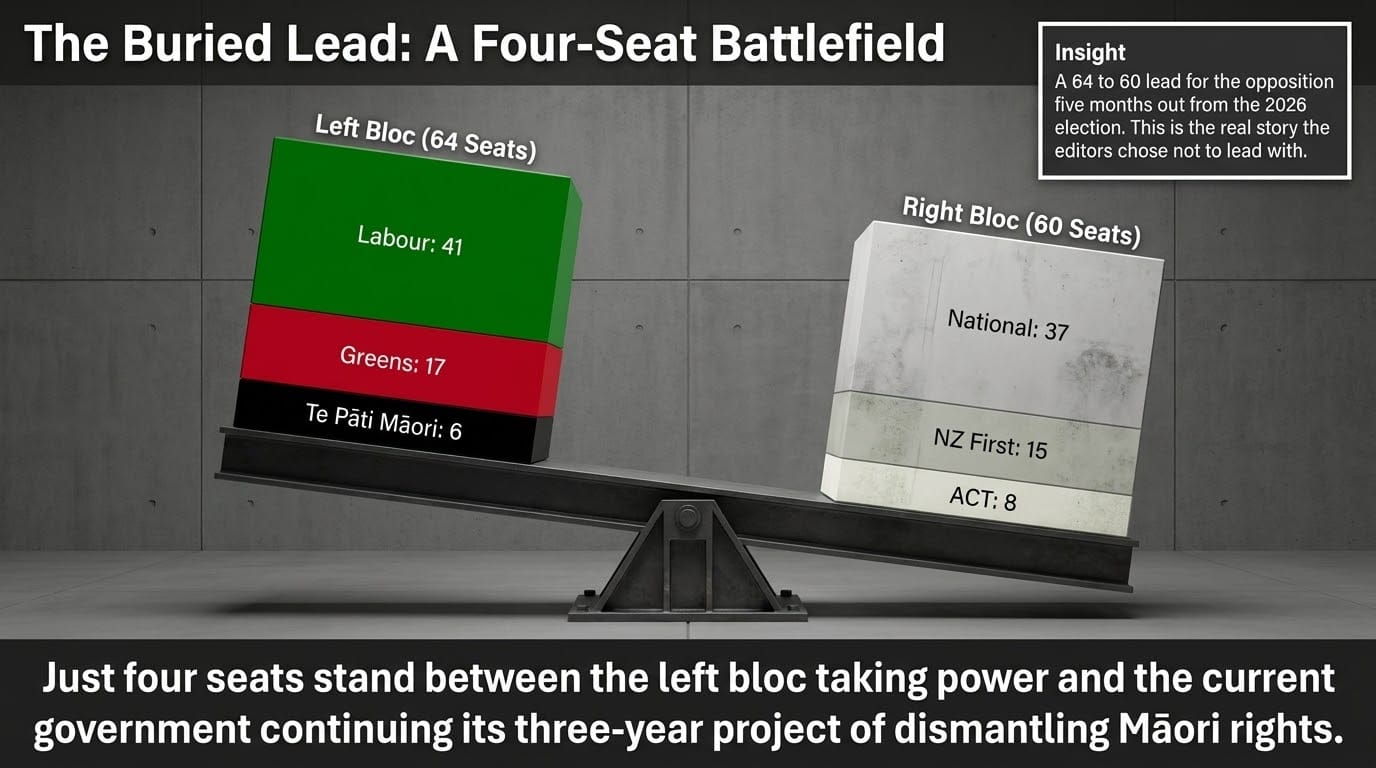
Left bloc total: 64 seats. Right bloc total: 60 seats.
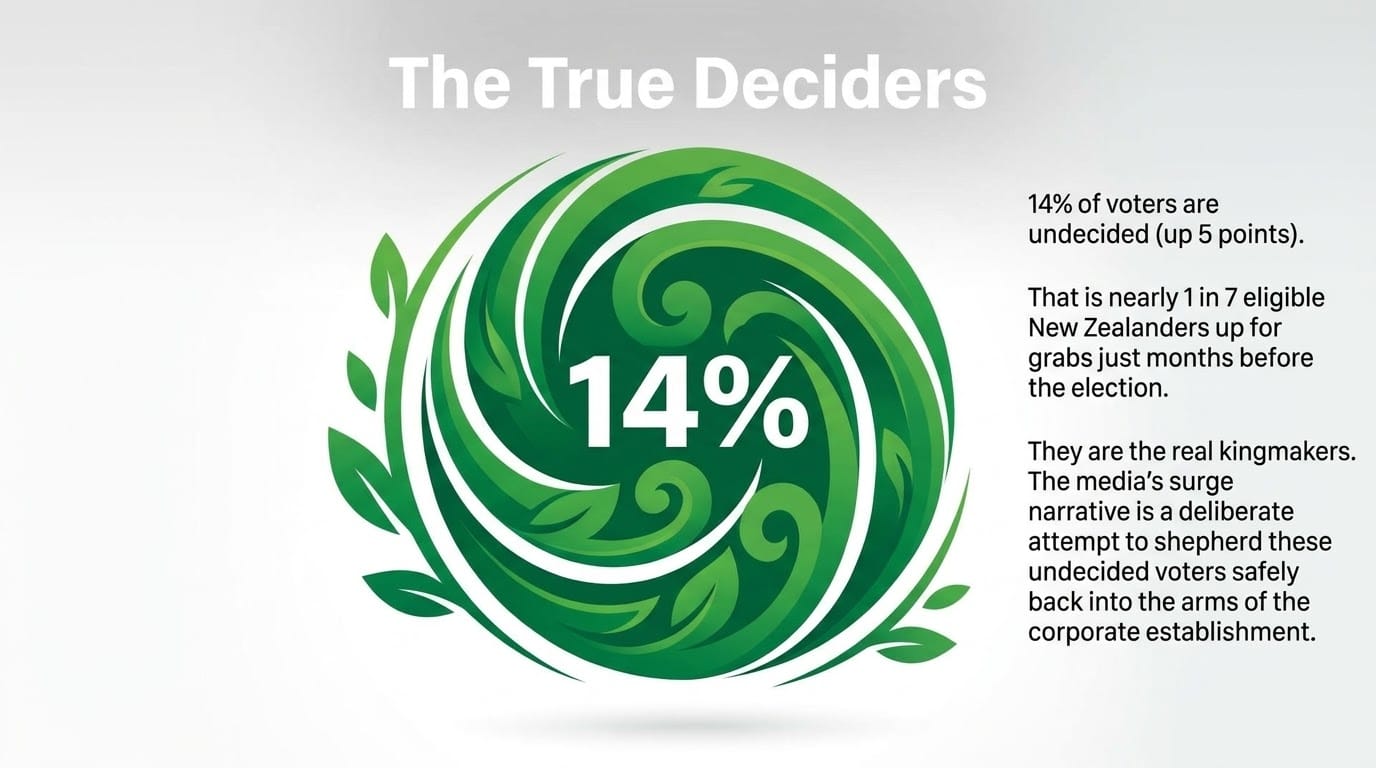
Four seats. Four seats between the left taking power and this government continuing its three-year project of dismantling everything Māori built. And 14 percent of voters — up 5 points — nearly one in seven New Zealanders — have not decided.
That is the story. That is the political battlefield. That is what journalists with a commitment to their readers would have led with.
Instead, RNZ published two articles from the same single poll. One on 23 June framed around Labour's slump. One on 24 June framed around Opportunity's rise. Two headlines. One poll. The editorial choice — which number becomes the story, which movement becomes the narrative — is itself a political act. It is not neutral. It never was.
He Tātaritanga — The Anatomy of Manufactured Consent
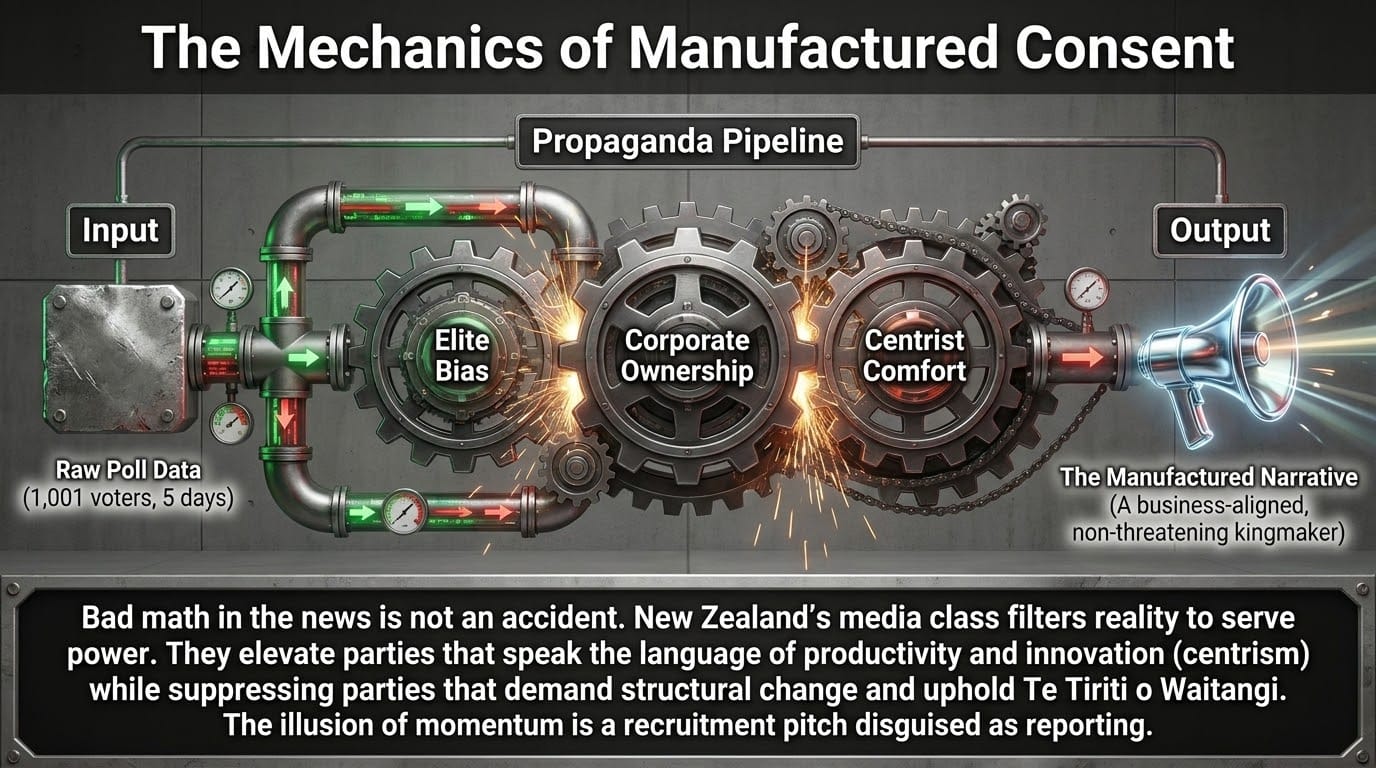
I want to be precise here, because precision is the taiaha. Manufactured consent does not require a conspiracy. It does not require editors meeting in dark rooms with billionaire proprietors. It requires something more ordinary and therefore more dangerous: a shared set of assumptions about what is interesting, what is important, and whose story gets told.
Noam Chomsky identified five filters through which news passes before it reaches you: ownership, advertising, sourcing, flak, and ideology. New Zealand's major media outlets — RNZ, 1News, Newstalk ZB, The Spinoff — operate through every one of those filters when they cover small parties. The Opportunity Party is interesting to that class because it is centrist, business-aligned, and led by someone who speaks the language of productivity and innovation. Te Pāti Māori is interesting to that class only when it can be framed as a liability for the left.
The Opportunity Party — formerly The Opportunities Party (TOP) — was founded in 2016 by millionaire economist Gareth Morgan. In ten years, five leaders, three elections: 2.4%, 1.5%, 2.2%. Never an electorate seat. Never Parliament. In November 2025, the party rebranded and appointed Qiulae Wong — a 37-year-old Auckland sustainable business consultant employed at KPMG — as its new leader through an application process.
Here is the media trajectory since — Verified:
- April 2026: 1News Verian — Opportunity at 3%
- May 2026: Roy Morgan — Opportunity at 6%
- June 13–17, 2026: 1News Verian conducted — result 4.6%, +1.6 points
- 24 June 2026: RNZ headline: "surprise surge"
- The Spinoff, May 2026: "The Opportunity Party is having a moment"
- Newstalk ZB, Heather du Plessis-Allan: "could be the decider"
A party oscillating between 3% and 6% across different polling methodologies, with no electorate seat, no parliamentary history, and a margin of error that mathematically swallows its result — narrated as a surge, a moment, a movement.
I documented this exact pattern in "The Propaganda Pipeline — Pointed at Your Whānau", published 13 June 2026. And I documented it before that in "Propaganda in Plain Sight: How Newstalk ZB and RNZ Laundered a Deregistered Lobby Group". The names change. The formula does not.
Ngā Tauira Tokotoru — Three Examples for the Western Mind
These are not abstract claims. Here is the proof in terms a Western analytical framework can process — case, quantified harm, solution, tikanga impact — three times over.
Example 1: The Margin of Error That Was Never Mentioned
The Claim: Opportunity "surged" to 4.6% in the 1News Verian poll.
The Omitted Fact: The margin of error is ±3.1% at 95% confidence. That means the true value of Opportunity's support — within the statistical reliability of this methodology — could be anywhere from 1.5% to 7.7%. The lower bound of that range is below the party's 2023 election result. The word "surge" has no statistical basis.
The Quantified Harm: When media amplify a party at 4.6% as a "kingmaker" without stating the margin of error, they misdirect voters. Undecided voters — 14% of the electorate in this same poll — make decisions based on perceived momentum. Amplifying Opportunity's "moment" without context could shift 1–2% of the undecided pool toward a party that holds zero parliamentary seats and has failed to enter Parliament across three consecutive elections, rather than toward Te Pāti Māori, the Greens, or Labour — parties with verified records, Treaty commitments, and real capacity to govern.
The Solution: State the margin of error prominently. In the headline. Not in paragraph six. Context is not a footnote. Context is the story.
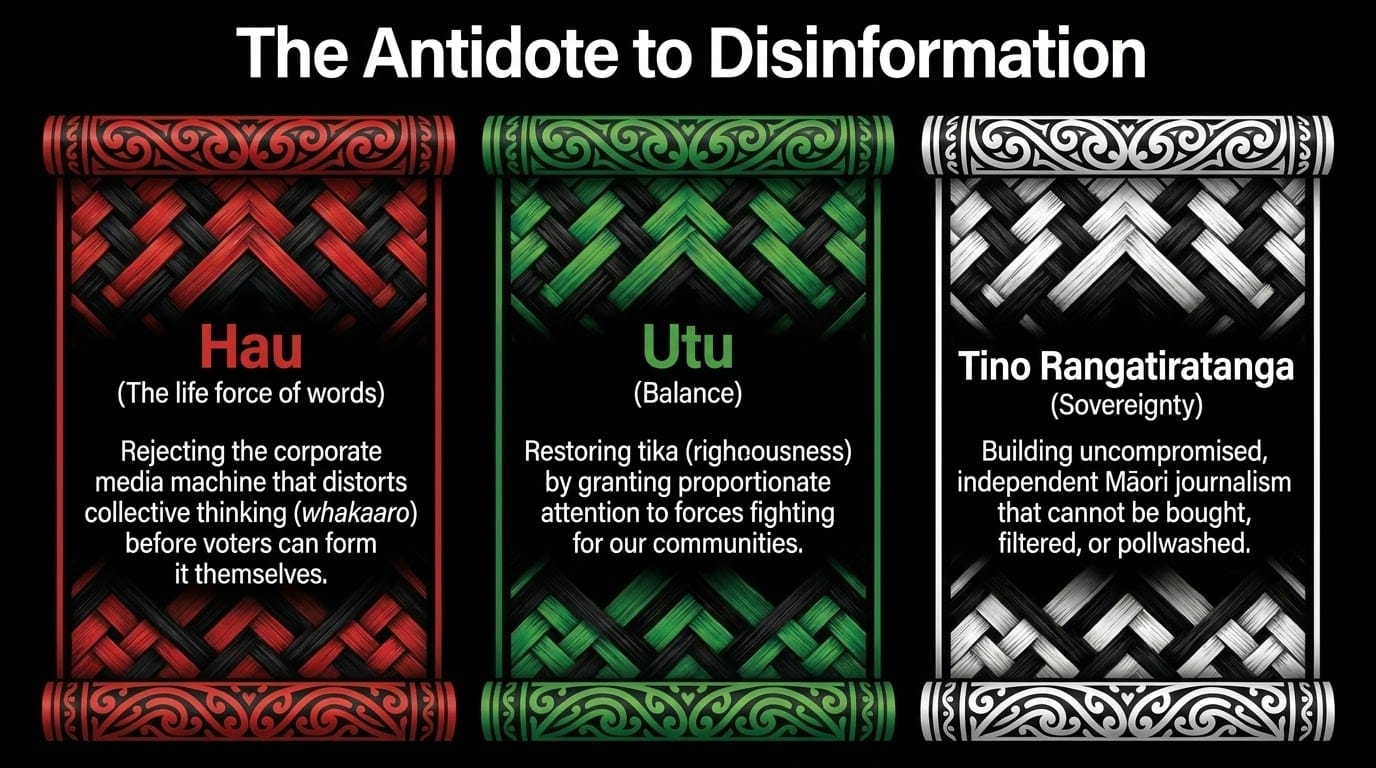
Tikanga Impact: In tikanga Māori, kōrero is governed by hau — the life force of words and their responsibility to the community that receives them. A headline that manufactures momentum for a party with zero seats, without statistical context, damages the mauri of the democratic process. It distorts whakaaro — collective thinking — before voters have had the chance to form it themselves. Manufactured consent is anti-tikanga. It breaks the covenant between speaker and community that tikanga requires of all kōrero.
Example 2: The Greens Gained More — and Got Less Coverage
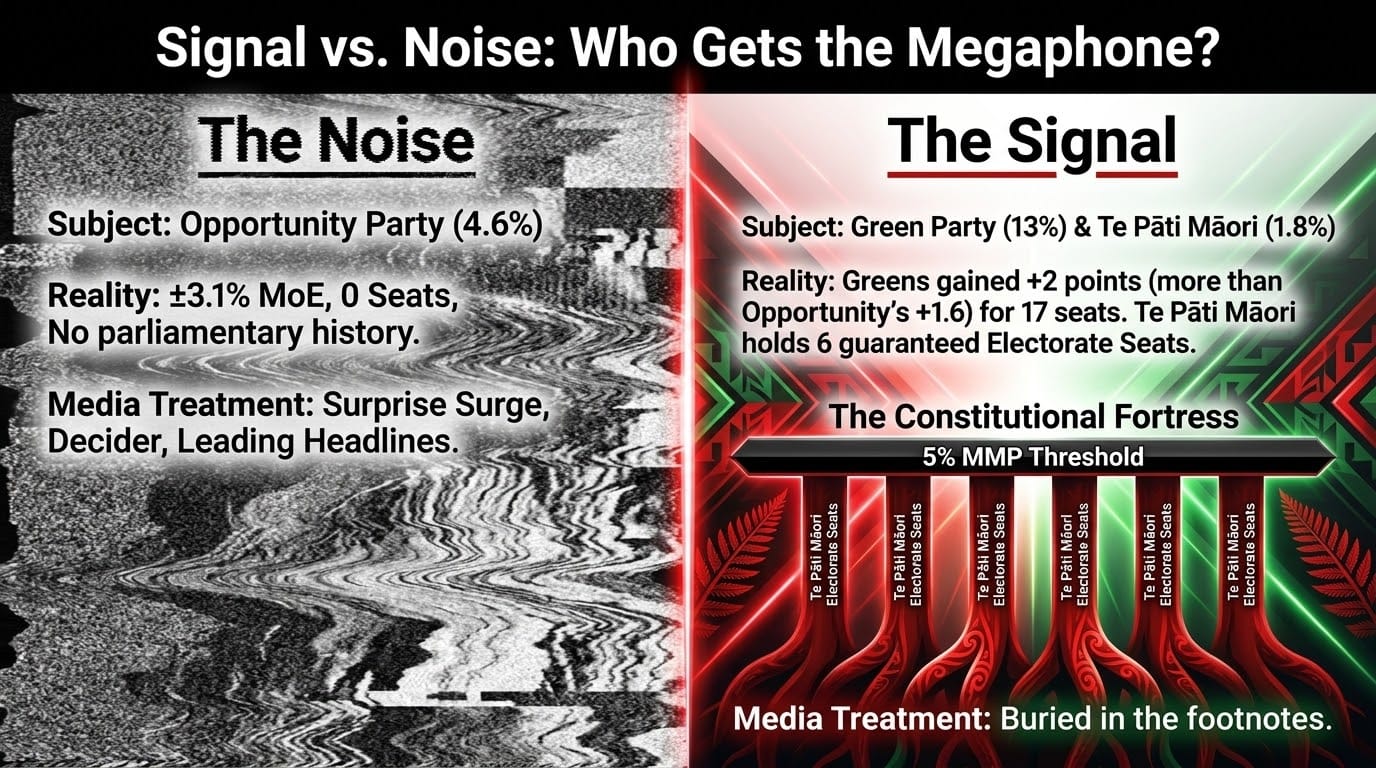
The Claim: The Opportunity Party's +1.6 point gain was framed as a "surprise surge."
The Omitted Fact: In the same poll, the Greens gained +2 points to reach 13% — their strongest result in recent polling. Their leader Chlöe Swarbrick sits at 6% preferred Prime Minister, ahead of ACT's David Seymour at 4%. The Greens gained more ground than Opportunity in the same poll, hold 17 projected seats compared to Opportunity's zero, and have a verified parliamentary record. They received no "surprise surge" headline.
The Quantified Harm: The Greens' Tax Reset — the Great Rebalancing — raises $5.147 billion net in year one, protects 96% of New Zealanders, and eliminates tax on the first $10,000 of income. That policy directly addresses the structural conditions that have left 18.9% of tamariki Māori in poverty under this government. Suppressing the Greens' surge as a news story — in favour of amplifying a statistically uncertain Opportunity result — actively works against the electoral conditions that could end this government.
The Solution: Cover all parties proportionally. A +2 point gain for a party with 17 projected seats is bigger news than a +1.6 point gain for a party with zero seats. This is not opinion. This is arithmetic.
Tikanga Impact: Mana whenua understand utu — not as revenge, but as balance. Reciprocity. A media ecosystem that consistently underweights the stories of parties committed to Te Tiriti, and overweights centrist parties comfortable to establishment interests, is a system out of balance — its tika, its righteousness, removed. Restoring tika requires not just accurate reporting, but proportionate attention to the forces actually fighting for the communities the media claims to serve.
Example 3: Te Pāti Māori Holds Six Seats — and Gets a Footnote
The Claim: The minor-party story in this election is Opportunity at 4.6%.
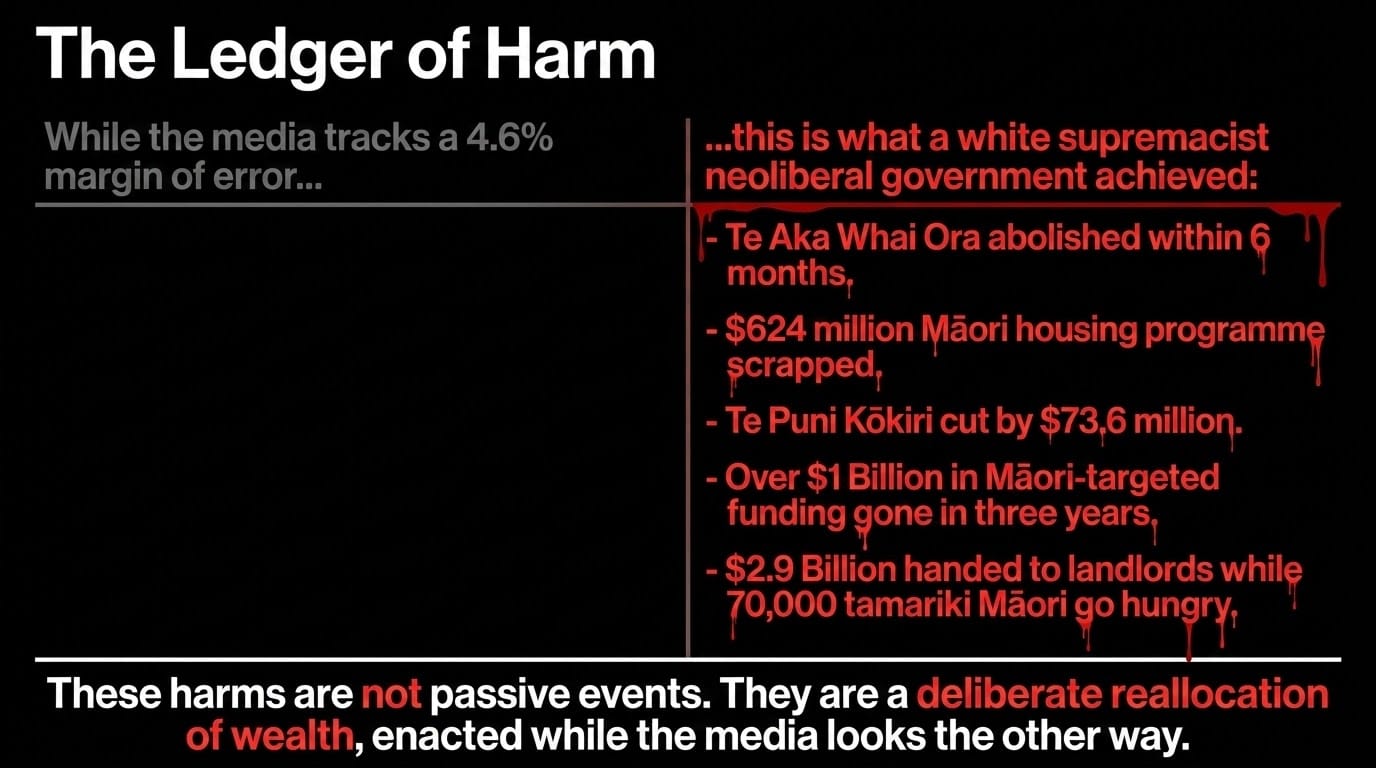
The Omitted Fact: Te Pāti Māori holds six electorate seats independent of the party vote threshold. No poll shift, no media narrative, and no manufactured momentum can remove those seats. They are structural. They are constitutional. They exist precisely because the 5% party vote threshold was designed — historically — to keep Māori voices out of Parliament. Te Pāti Māori at 1.8% in the party vote still brings six seats and wields coalition leverage that Opportunity at 4.6% cannot match, because Opportunity has no seats at all.
The Quantified Harm: Under this white supremacist neoliberal government: Te Aka Whai Ora abolished within six months of taking office. $624 million Māori housing programme scrapped. Te Puni Kōkiri cut by NZ$73.6 million. Over $1 billion in Māori-targeted funding — gone in three years. 70,000 tamariki Māori going to bed hungry. 23.9% of tamariki Māori in poverty. Every one of those harms was fought in Parliament by Te Pāti Māori — the party with six guaranteed seats that the media treated as a footnote in a story about a party with zero.
The Solution: Report Te Pāti Māori's structural parliamentary power with the same prominence given to Opportunity's statistically uncertain result. Their six electorate seats are not a curiosity — they are the constitutional backbone of Māori representation in this Parliament.
Tikanga Impact: Whakapapa is everything. Te Pāti Māori was born from the Māori seats — themselves born from the Māori Representation Act 1867 — which were a colonial compromise that Māori turned into a fortress of tino rangatiratanga. To reduce Te Pāti Māori to a footnote in a story about a KPMG consultant's polling numbers is to erase that whakapapa. It tells Māori that the structure their tīpuna built — with their hands, their sacrifices, and their strategic intelligence — is less interesting than a business consultant who hasn't won a seat. That is colonial media logic. I name it. I reject it.
Ngā Hononga Huna — Five Verified Hidden Connections
1. The ±3.1% margin makes "surge" statistically baseless.
Opportunity's 4.6% result carries a margin of error of ±3.1%. The word "surge" has no defensible statistical foundation. I state this not as opinion but as arithmetic.
2. The "centrist kingmaker" framing structurally serves the right.
Wong has stated Opportunity would negotiate first with the party that receives the largest number of votes. In an election where National at 29% could close the gap to Labour at 32% by November, that principle is a revolving door available to the right. The WSWS identified this structural function directly: "Its function is to divert the growing hostility to the established parties back into the dead-end of the capitalist and parliamentary system." I documented the same dynamic in my essay "The Corporate Theatre of False Choice" — how centrist positioning absorbs radical energy and returns it safely to the hands of capital.
3. Te Tiriti is in the policy — but absent from the bottom lines.
I correct myself publicly here. My June 9 post stated that Te Tiriti did not make it through the rebrand. That was inaccurate in full. Opportunity's "Honouring Te Tiriti" page contains real commitments: repealing the Treaty Principles Bill, supporting devolution, pursuing settlements. Those commitments are genuine and I acknowledge them.
However — and this is where the taiaha lands — Wong's stated coalition bottom lines are: energy strategy, oceans, productivity and innovation. Te Tiriti does not appear in those bottom lines. In coalition negotiations, bottom lines are what you fight for. Everything else is tradeable. The distinction between what appears in policy and what appears in bottom lines is the difference between a promise written on paper and a commitment backed by political will — and that distinction matters enormously to whānau who have watched three successive governments promise Te Tiriti and trade it away.
4. The Greens' surge is the buried story.
The Greens gained +2 points to 13% in the same poll. I documented the Greens' structural importance to any left-led government in "THE GREAT REBALANCING: Aotearoa Has Enough for Everyone" — where I showed, with verified data, that the Green Tax Reset raises $5.147 billion net in year one, protects 96% of New Zealanders, and directly addresses the structural poverty that forty years of neoliberalism has engineered.
5. The 14% undecided is the real kingmaker.
Fourteen percent of voters — up 5 points — said they did not know or refused to answer who they would vote for. That is one in seven eligible New Zealanders up for grabs five months before a general election. Amplifying Opportunity as the natural home for that 14% is not neutral journalism. It is a recruitment pitch dressed as reporting — and I documented exactly this mechanism in "The Hobson's Pledge Production Line", where I showed how media amplification of preferred political narratives shapes voter behaviour before campaigns have even begun.
He Āhua Whakamārama — What This Is Not
Let me be precise, because precision protects us from the charge of recklessness that those with power always level at those who name them.
This essay does not claim the Opportunity Party is a far-right party. It is not. Its Citizens' Income of $20,000 would materially benefit low-income whānau. Its land value tax, with Māori freehold land exemptions confirmed on its website, addresses a genuine housing crisis that this government has actively worsened. Its Te Tiriti page contains commitments that go further than anything ACT or NZ First would accept at a coalition table. These are real. I acknowledge them.
This essay does not claim Qiulae Wong is a bad person. She is a capable, earnest leader who speaks well and thinks clearly.
The critique is of the media apparatus — of a system that takes one poll result, five days of fieldwork, a ±3.1% margin of error, a party with zero seats and ten years of failure — and builds a kingmaker narrative that buries the real story: the left bloc leads 64–60, the Greens are surging at 13%, Te Pāti Māori holds six constitutional seats, and 14% of voters haven't decided.
That is the election. That is the story of possibility for whānau.
The Opportunity surge is a subplot being sold as the plot by a media class that finds centrism comfortable, finds business consultants legible, and finds Māori sovereignty — even when it is winning — less interesting than a KPMG employee with a good poll number and a nice interview style.
As I documented in "The Neoliberal-State Alliance Between Corporate Power, Complicit Media, and Christian Nationalist Influence in Aotearoa": the media does not need to be corrupt to serve power. It only needs to share power's assumptions about what matters.
Ngā Pānga — The Harms This Government Has Committed While the Media Watches
While the manufactured consent machine runs the Opportunity surge story on loop, here is what this white supremacist neoliberal government has done — verified, cited, documented:
- Te Aka Whai Ora abolished within six months of taking office — the institutional mechanism through which Māori could exercise tino rangatiratanga over their own health outcomes, destroyed.
- $624 million Māori housing programme scrapped — while $2.6 billion was found for combat helicopters.
- $2.9 billion handed to landlords — while renters bled.
- Te Puni Kōkiri cut by NZ$73.6 million — the Crown agency mandated to serve Māori, defunded by the Crown it serves.
- Over $1 billion in Māori-targeted funding gone in three years.
- IRD wealth data suppressed — the government's first act in December 2023 was to revoke legislation enabling reporting on wealth distribution.
- The Treaty Principles Bill introduced — a direct legislative attack on the constitutional basis of Te Tiriti o Waitangi, designed by ACT, enabled by National, celebrated by NZ First.
- ACT has fallen four consecutive polls — meaning the hard-right anchor of this coalition is weakening. That is the structural story of the right bloc. It is not the headline.
He Whakakapi — The Taiaha Does Not Lower
I walk backwards into the future. Ka mua, ka muri. I do this because the future is built from the past — from the structural harms documented, the patterns named, the misinformation exposed — and because the tūpuna walk with me, not behind me.
The Opportunity Party's 4.6% is a footnote with a ±3.1% margin of error. The left bloc's 64 seats is the story. The Greens at 13% is the story. Te Pāti Māori's six constitutional seats is the story. The 14% of undecided voters who could end this government's project of dismantling Māori rights
— that is the story.
The manufactured consent machine will not tell you that. It is not designed to. It is designed to manage your attention, absorb your political energy, and return you safely to the arms of the establishment
— left or right, it doesn't matter, as long as the structural arrangement stays the same.
Business-friendly. Property-respecting. Tiriti-optional.
I am not part of that machine. I do not have a proprietor. I do not have advertisers. I have a taiaha, a keyboard, a kaupapa, and a whānau who send me koha so this voice does not go quiet.
The election is on 7 November 2026. The left bloc leads right now. NZ First is up. ACT is down for the fourth consecutive poll. The Greens are surging. Te Pāti Māori holds. Fourteen percent haven't decided.
Pick up the taiaha, whānau. It is heavier than a poll story. And it matters more.
Kia kaha. Kia māia. Kia manawanui.
🌿 Koha — Support This Mahi

The manufactured consent machine has proprietors and advertisers. I have whānau.
Every koha to The Māori Green Lantern signals that rangatiratanga includes the power to support our own truth tellers — and that the media scrutiny this white supremacist neoliberal government depends on to escape accountability will not be provided by those who benefit from its continuance. It will be provided here, with your support.
If this essay named the harm done to your whānau — the $1 billion in Māori funding stripped, the 70,000 tamariki going hungry, the six Māori electorate seats buried in a footnote while a margin of error got a headline — then consider supporting this mahi directly.
If you cannot koha right now, no worries. Subscribe, share, kōrero with your whānau and friends. That is koha in itself.
Four pathways to support this mahi:
🟢 Koha directly — voluntary contribution to keep this voice alive:
app.koha.kiwi/events/the-maori-green-lantern-fighting-misinformation-and-disinformation-ivor-jones
🟢 Subscribe — receive essays directly and support through subscription:
themaorigreenlantern.maori.nz/#/portal/support
🟢 Direct bank transfer:
HTDM | 03-1546-0415173-000
🟢 Facebook:
facebook.com/Themaorigreenlantern/subscribe
Kia kaha, whānau. Stay vigilant. Stay connected.
DISCLAIMER: This essay represents the analysis and opinion of Ivor Jones, The Māori Green Lantern, based on publicly available and verified sources as of 25 June 2026. All factual claims are hyperlinked at point of assertion. Opinions are distinguished from verified facts inline. Published in the public interest under qualified privilege as commentary on media conduct and electoral democracy — consistent with Lange v Atkinson 3 NZLR 385. Right of reply extended to the Opportunity Party, RNZ, and 1News Verian. No malice toward any individual. All harms described are structural and verified. NZ Defamation Act 1992 pre-publication checklist: complete.