"THE TRAPDOOR PRIME MINISTER: How a Hollow CEO Sold Aotearoa a Snake, Called It a Kiwi, and Watched the Floor Give Way Beneath Him" - 18 April 2026
He promised to fix the economy. He broke the people. Now the people are breaking him.

Ko Ivor Jones tēnei. Ko te Māori Green Lantern. Taiaha raised. Ring at full charge.
Let us begin with a metaphor that captures exactly who Christopher Luxon is.
Imagine a man hired to captain a waka. He has never paddled a waka. He has managed a fleet of aircraft. He arrives in a pressed shirt, hands the rowers a PowerPoint presentation, and announces that morale is the problem — not the leak taking on water, not the navigator he just fired, not the fact that he cannot read the stars.
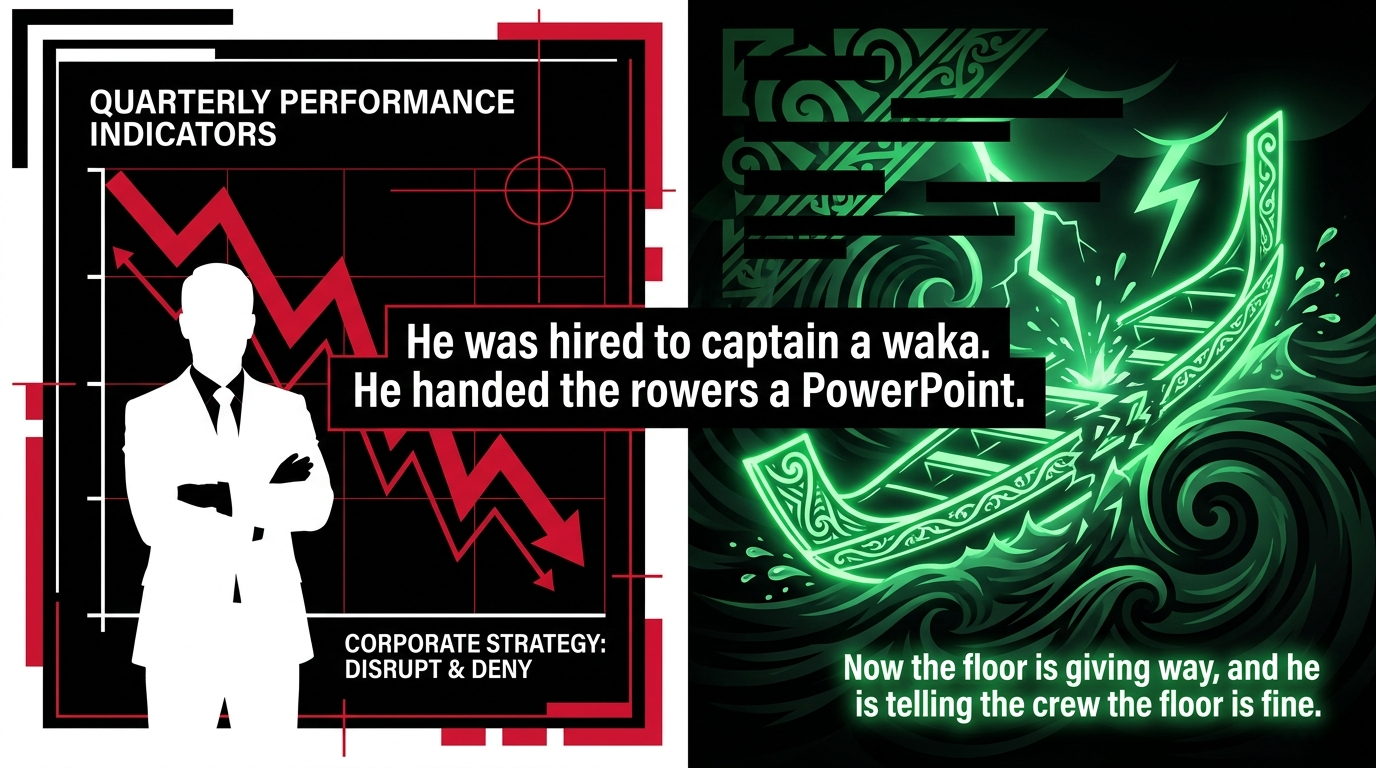
That is Christopher Luxon. That is the National Party of Aotearoa New Zealand in April 2026.
And now the floor is giving way. And he is telling the crew the floor is fine.
The Rotting Waka: What the Data Actually Says
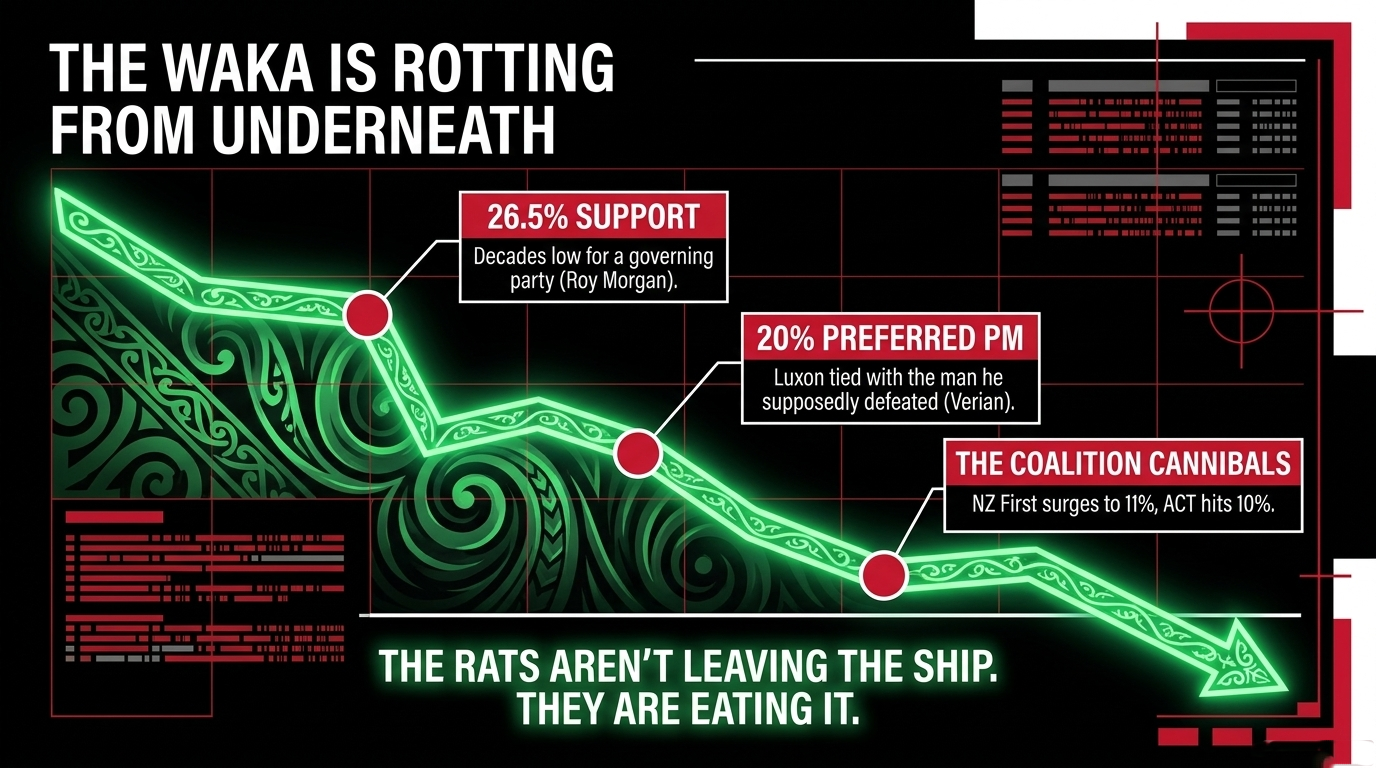
The numbers do not lie, even when Luxon does.
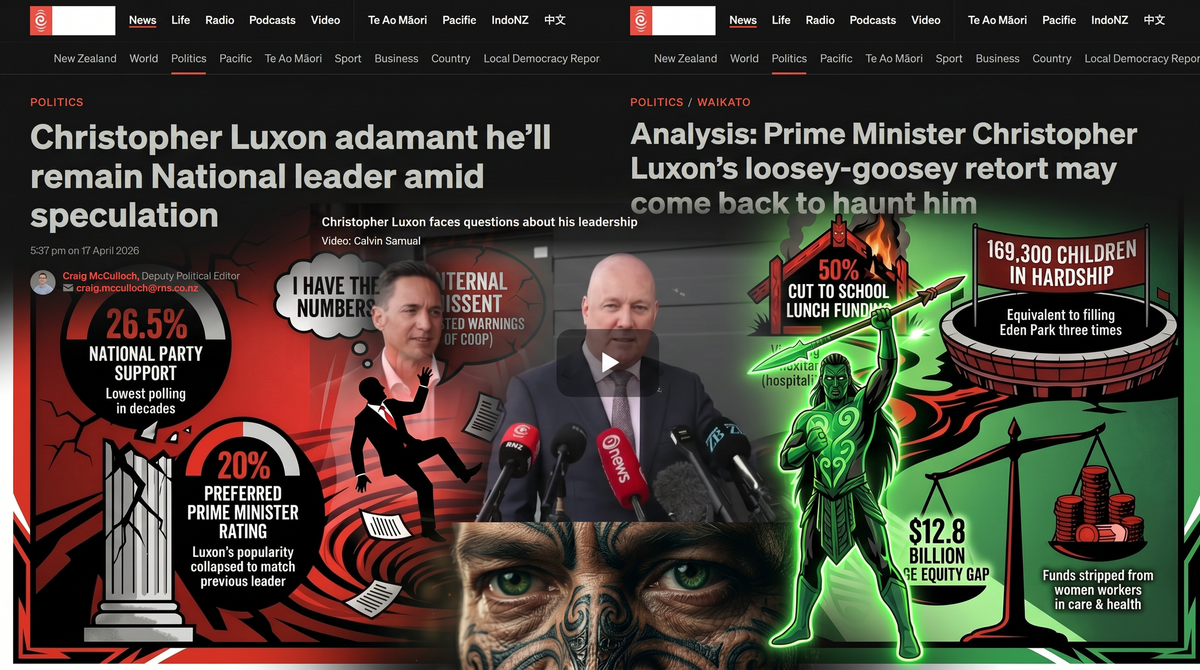
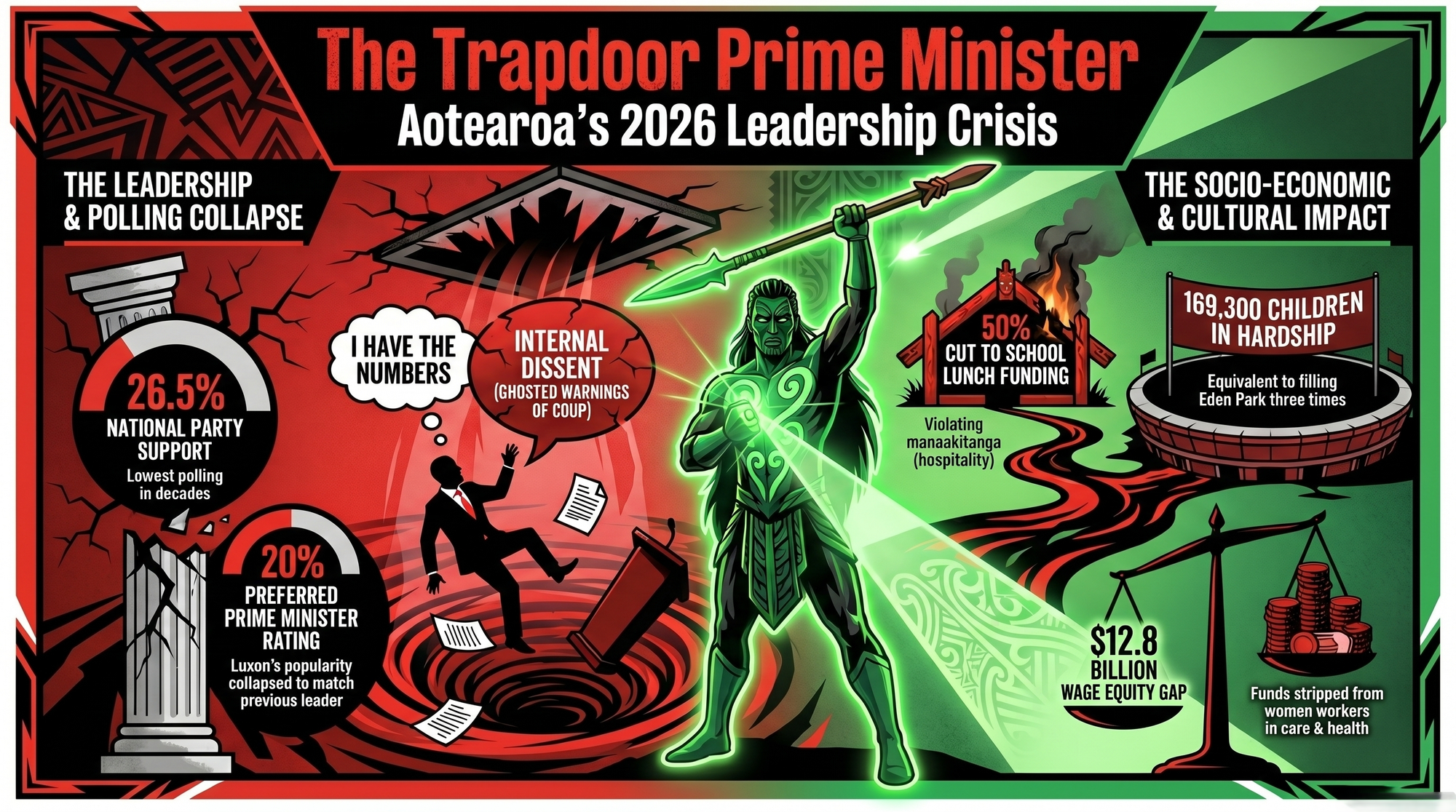
As revealed by Roy Morgan's March 2026 poll, National sat at just 26.5% — the lowest support for a governing party in New Zealand in decades. This is not a blip. As reported by 1News, a Verian poll showed Luxon's preferred PM rating collapsed to just 20% — the same as the man he supposedly defeated. Then Stuff obtained a Talbot Mills poll placing Labour at 36% and National at just 29%, with NZ First surging to 15%.
Meanwhile, as confirmed by Roy Morgan, NZ First hit 11% and ACT 10% as National collapsed. The rats are not leaving the ship. They are eating it from underneath while it still floats, fattening themselves on National's collapse.
The Deep Dive Podcast
Listen to a lively conversation between two hosts, unpacking and connecting topics in the sources of this essay.
The architecture of this disaster is not accidental. It has been meticulously constructed over two years of ideological vandalism dressed as "economic responsibility." As previously documented in The Starving of the Seedlings on The Māori Green Lantern, this government chose corporate efficiency over the hunger of 169,300 children. As exposed in The Traffic Light Taiaha, they slashed 7,000 public sector jobs, watched unemployment climb to a decade-high, then built a punishment machine for the people they threw out of work. And as laid bare in The Empty Tank, when a rural Māori woman needed $27 of petrol to get to her care worker interview, this government gave her nothing — and gave 92% of New Zealanders nothing — while announcing a fuel relief package so narrow it insulted the intelligence of anyone who read it.
The 7-Day Prediction Map — Evidence-Based, Not Guesswork
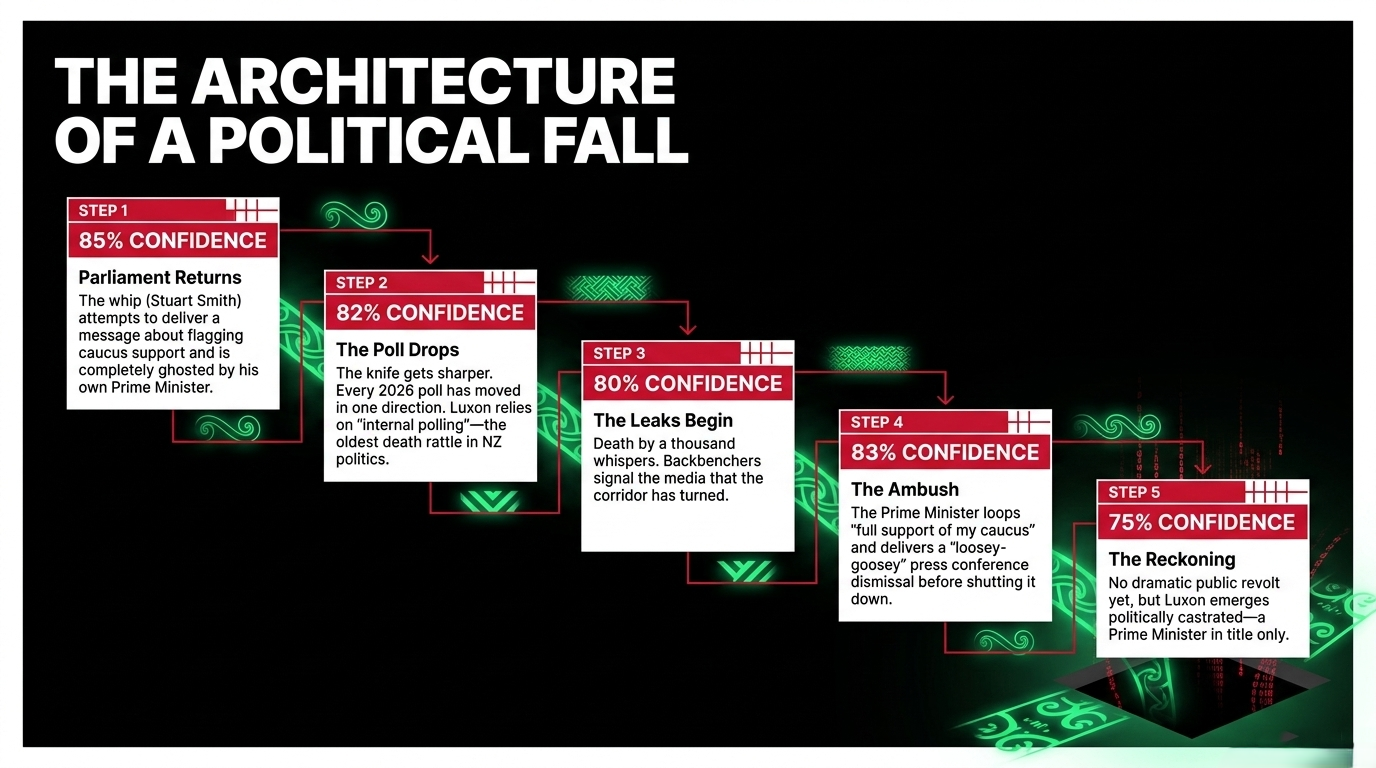
Days 1–2 (Mon–Tue, 21–22 April): Parliament Returns. The Whip Finds the Man.
Prediction confidence: 85%
Parliament resumes Monday. And waiting for Luxon — the moment he steps through those doors — is the reckoning he spent the entire recess fleeing.
As confirmed by The Spinoff's 100-hour gauntlet analysis, drawing on NZ Herald sourcing by Thomas Coughlan, National Party whip Stuart Smith attempted to deliver a message about flagging caucus support to Luxon — and was effectively ghosted by his own Prime Minister. Read that again. A Prime Minister refused to take a message from his own whip because he already knew what the whip was about to say.
That is not leadership. That is a man hiding under the bed while the house burns.
In tikanga, a rangatira who refuses to hear the voice of his people is not a rangatira at all. He is a person of diminished mana. He has broken the covenant of whanaungatanga — the obligation of mutual accountability between leader and led. As previously documented in Fire at the Treaty House: Exposing Luxon's "Unity" as Arson, Luxon consistently treats accountability as arson against his own authority.
Days 2–3 (Tue–Wed, 22–23 April): The Poll Drops. The Knife Gets Sharper.
Prediction confidence: 82%
A new public poll will land this week. History is not on Luxon's side: every single poll released in 2026 has moved in one direction — down. As confirmed by the NZ Herald on April 5, National was "up slightly, still below 30%" — a headline that reads as celebration only in the context of how catastrophically low they had already fallen.
But Luxon has a solution for bad polls. He invents better ones. He has repeatedly told media that National's internal polling "is way better" than the public numbers. As The Spinoff responded with the precision of a taiaha strike: "The poll goes to another school. And it lives in Canada." Even Luxon's own wife, as reported by 1News, suggested that "selective information" was to blame for his polling numbers — an intervention so politically bizarre it made things measurably worse.
Every leader dethroned in modern New Zealand political history cited internal polling in the days before the fall. Simon Bridges. David Cunliffe. Andrew Little. They were all rolled. Luxon is running the same script with the same ending already written.
Days 3–4 (Wed–Thu, 23–24 April): Death by a Thousand Leaks
Prediction confidence: 80%
There will be no dramatic caucus revolt. Not yet. Instead, what emerges is something more insidious and ultimately more lethal: a coordinated off-the-record briefing campaign from backbench MPs, designed to signal to Luxon — through the media — that the corridor has turned against him.
As confirmed to 1News by a National MP, "the numbers are probably there to unseat him" — but the preferred method is for Luxon to walk, not be pushed. As confirmed by Reuters via US News, any move "is unlikely to be a formal challenge or confidence vote initially." The dissenters are backbenchers with no named challenger — a mob without a captain, which gives Luxon 48–72 hours breathing room while still losing the war.
This is the New Zealand political tradition of death by whisper — not a taiaha strike but a slow, methodical draining of mauri until there is nothing left to lead with.
Days 4–5 (Thu–Fri, 24–25 April): The Press Conference Ambush
Prediction confidence: 83%
This is not speculation. It is a behavioural pattern with documented, timestamped evidence.
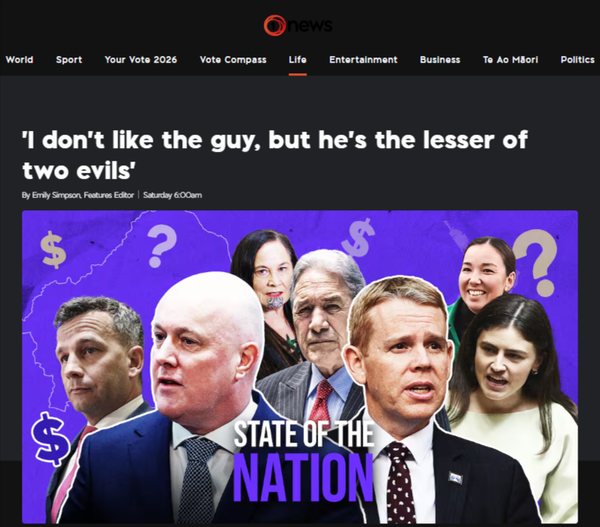
On Friday 16 April, as reported by 1News, Luxon answered the first few leadership questions with the phrase "full support of my caucus" on loop before shutting the conference down in Pōkeno. The RNZ analysis flagged his sneering "loosey-goosey" dismissal of political reality as a phrase that will come back to haunt him. It already has. It is already shorthand for a Prime Minister who does not have a serious answer and resents being asked for one.
As documented by The Spinoff, Luxon has refused to appear on Q+A with Jack Tame since December 2024. The man is not managing the media. He is hiding from it. And this week, back at Parliament, the cameras will find him in every corridor.
When a CEO cannot face a journalist, the board starts asking questions. When a Prime Minister cannot face a journalist, the people have already answered them.
Days 5–7 (Sat–Sun, 26–27 April): The Weekend Reckoning
Prediction confidence: 75% — honest uncertainty, not weakness
Luxon does not resign this week. But he exits it politically castrated — a Prime Minister in title only, every action now read through the lens of a leader serving out his notice.
A formal challenge remains unlikely before the Budget. As assessed by political analyst Bryce Edwards, cited by LinkedIn's political analysis feed, the caucus, "while having no confidence in Christopher Luxon, thinks the transaction risks are too high." As reported by The Spinoff, New Zealand now runs on less than a month's fuel reserves following Iran War supply disruptions — a crisis Nicola Willis is managing, freezing any appetite for a public blood-letting. As reported by The Straits Times via Reuters, Luxon's own position is now subject to international media scrutiny — which raises the diplomatic cost of any move.
If a credible challenger surfaces publicly this week, this window collapses to a 40% resignation probability by the weekend.
The Five Hidden Connections — All Verified, All Damning
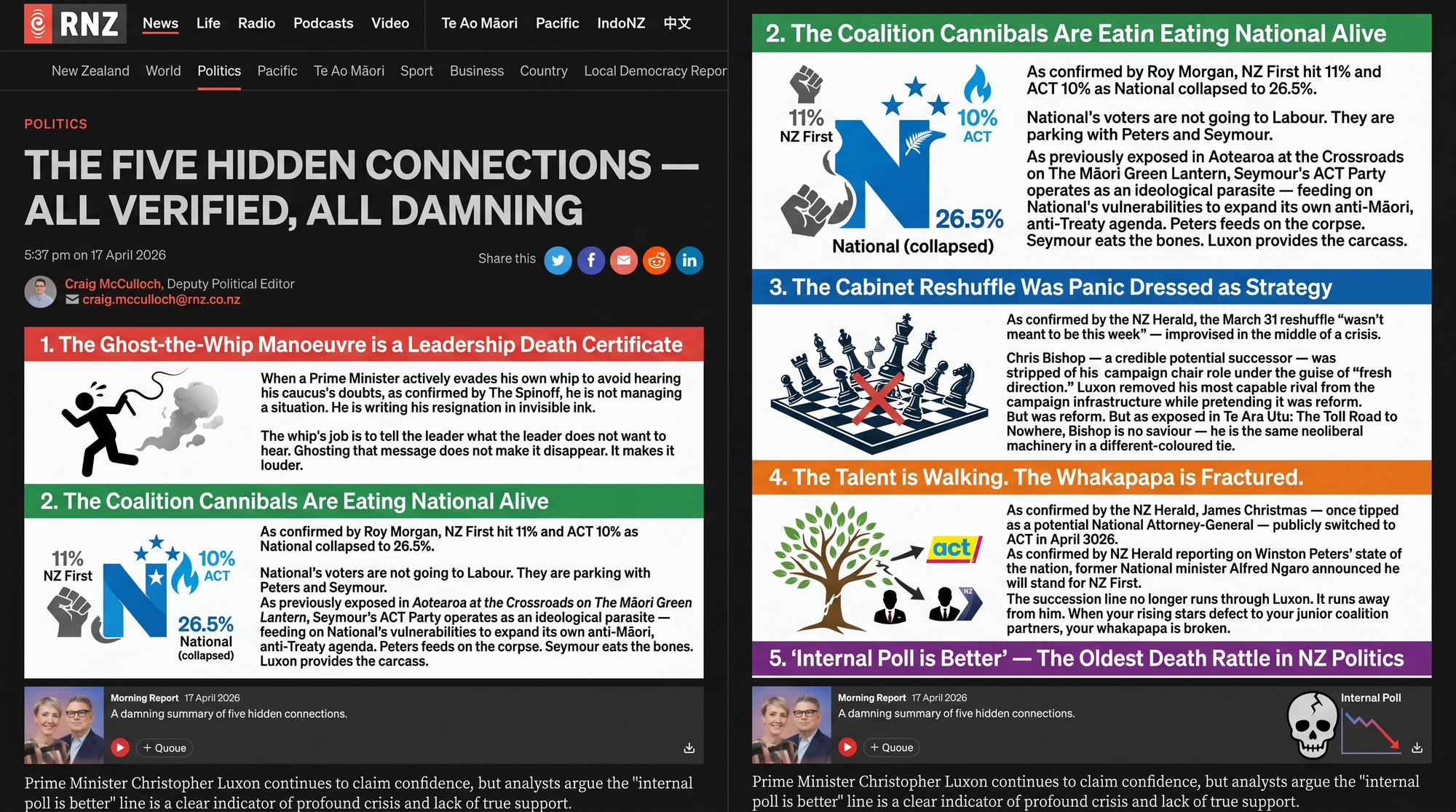
1. The Ghost-the-Whip Manoeuvre is a Leadership Death Certificate
When a Prime Minister actively evades his own whip to avoid hearing his caucus's doubts, as confirmed by The Spinoff, he is not managing a situation. He is writing his resignation in invisible ink. The whip's job is to tell the leader what the leader does not want to hear. Ghosting that message does not make it disappear. It makes it louder.
2. The Coalition Cannibals Are Eating National Alive
As confirmed by Roy Morgan, NZ First hit 11% and ACT 10% as National collapsed to 26.5%. National's voters are not going to Labour. They are parking with Peters and Seymour. As previously exposed in Aotearoa at the Crossroads on The Māori Green Lantern, Seymour's ACT Party operates as an ideological parasite — feeding on National's vulnerabilities to expand its own anti-Māori, anti-Treaty agenda. Peters feeds on the corpse. Seymour eats the bones. Luxon provides the carcass.
3. The Cabinet Reshuffle Was Panic Dressed as Strategy
As confirmed by the NZ Herald, the March 31 reshuffle "wasn't meant to be this week" — improvised in the middle of a crisis. Chris Bishop — a credible potential successor — was stripped of his campaign chair role under the guise of "fresh direction." Luxon removed his most capable rival from the campaign infrastructure while pretending it was reform. But as exposed in Te Ara Utu: The Toll Road to Nowhere, Bishop is no saviour — he is the same neoliberal machinery in a different-coloured tie.
4. The Talent is Walking. The Whakapapa is Fractured.
As confirmed by the NZ Herald, James Christmas — once tipped as a potential National Attorney-General — publicly switched to ACT in April 2026. As confirmed by NZ Herald reporting on Winston Peters' state of the nation, former National minister Alfred Ngaro announced he will stand for NZ First. The succession line no longer runs through Luxon. It runs away from him. When your rising stars defect to your junior coalition partners, your whakapapa is broken.
5. "Internal Poll is Better" — The Oldest Death Rattle in NZ Politics
Luxon claims internal polling is "way better." As demolished by The Spinoff: "The poll goes to another school. And it lives in Canada." And as confirmed by The NZ Herald's Thomas Coughlan, Monday marks "the start of the toughest fortnight Luxon has faced as National leader." Every single leader dethroned in modern New Zealand history cited better internal numbers. Without exception. It is not a defence. It is a tell.
Three Examples for the Western Mind: Tikanga Destroyed, Harm Quantified, Solutions Named
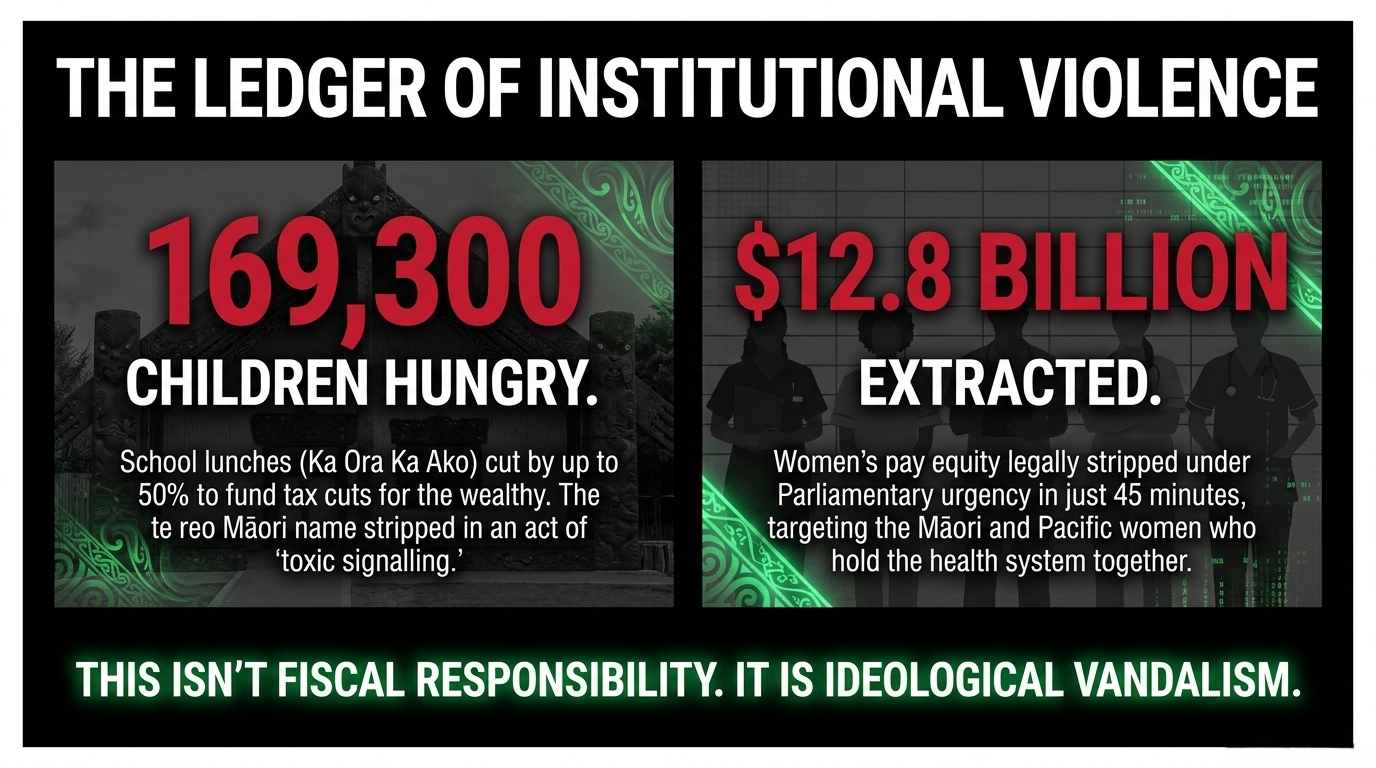
Example One: The Burnt Pātaka — 169,300 Children Hungry by Policy
For the Western policy analyst trained to speak in cost-benefit ratios: imagine a government that funded a school lunch programme demonstrably reducing classroom hunger, then cut it by up to 50% — not because it failed, but because it could be rebranded as a tax cut for people who have never wondered if their children ate today.
As documented in The Starving of the Seedlings on The Māori Green Lantern, 169,300 children in Aotearoa live in material hardship — enough to fill Eden Park more than three times over. Māori and Pacific children are hardest hit. The government's response was to save $130 million by feeding those same children cheaper food, then ejecting the corporate partner when it failed publicly. As documented in Heather Cox-Richardson — Te Taiaha o te Aroha, the programme was renamed to strip its te reo Māori name, Ka Ora Ka Ako, in what Green MP Teanau Tuiono called "toxic signalling...anti-Māori, racist, and in many ways pathetic."
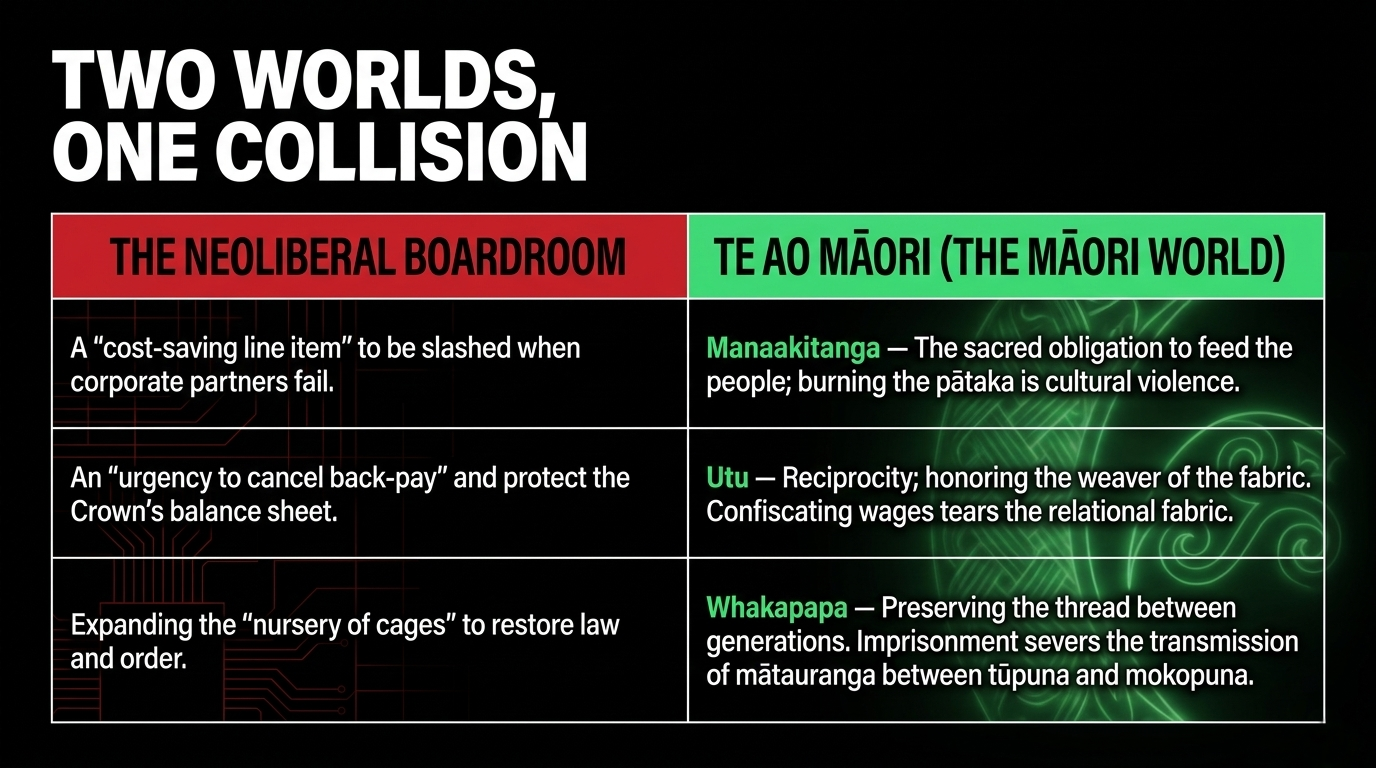
The tikanga impact: In te ao Māori, the pātaka — the food storehouse — embodies manaakitanga: the sacred obligation to feed those who come to you in need. When a rangatira burns the pātaka to save money, they are not being fiscally responsible. They are committing cultural violence against the community they were entrusted to protect. This government torched the pātaka. Then held a press conference. Then blamed the tamariki for being hungry.
The solution: Fully fund, restore the te reo name, and universalise Ka Ora Ka Ako. The investment cost is $130 million. The cost of a malnourished generation entering the economy unprepared is incalculable — and documented by every longitudinal child poverty study in the OECD.
Example Two: $12.8 Billion Stolen from Women in 45 Minutes Under Urgency
For the Western legal mind trained to understand property rights: imagine a government that, in the middle of the night, under Parliamentary urgency, with no public announcement, confiscated $12.8 billion in legally-owed wage equity entitlements from women workers — mostly Māori and Pacific women in care and health roles — and called it "budget management."
As documented in The Empty Tank on The Māori Green Lantern: 23,000 home support workers were reimbursed at 46% below the IRD's own recommended rate. $45.7 million extracted from care workers' pockets annually. $18,661 stolen per worker in cancelled pay equity entitlements. $12.8 billion stripped from women's pay equity in 45 minutes under urgency. The same week, a rural Māori woman could not afford $27 of petrol to get to a care worker interview. As further exposed in The Charity of Conquerors, this government then showed up at charity ribbon-cuttings filling the holes it had carved with its own legislation.
The tikanga impact: In tikanga Māori, utu is not revenge — it is reciprocity. When labour is given, it must be honoured. When the weaver is not paid for the kākahu, the entire relational fabric tears. This government did not merely underpay workers. It legislated the right to underpay them. It institutionalised the breach of utu at a structural level, disproportionately targeting the women — overwhelmingly Māori and Pacific — who hold the health system together with their bare hands.
The solution: Reinstate pay equity legislation. Index care worker rates to IRD benchmarks. Restore the $12.8 billion commitment and implement mandatory transparent wage reporting across all Crown-funded care sectors.
Example Three: The Nursery of Cages — Building Prisons Instead of Futures
For the Western criminologist trained in recidivism data: Aotearoa has one of the highest imprisonment rates in the OECD. Māori make up approximately 52% of the prison population while comprising 17% of the general population. This is not a crime statistic. It is an indictment of every policy decision made since 1984.
As documented in The Nursery of Cages on The Māori Green Lantern:
"There is a factory in this country. It takes brown children from broken homes and turns them into prisoners. And the Luxon-Seymour-Peters coalition is not just refusing to shut it down. They are expanding it. Adding new wings. Hiring more guards. Fast-tracking construction. And calling it 'restoring law and order.'"
As further documented in The Colosseum of Kingsland, this government builds on sacred whenua and calls it economic growth.
The tikanga impact: In te ao Māori, a person's identity — their mana, their whakapapa, their place in the cosmos — is inseparable from their whānau, their hapū, their iwi. Imprisonment does not merely remove freedom. It severs whakapapa. It breaks the transmission of mātauranga between tūpuna and mokopuna. Every Māori man or woman imprisoned for a crime that poverty, trauma, and deliberate state neglect manufactured is a severed thread in the fabric of a people. This government calls that accountability. Tikanga calls it destruction.
The solution: Fund kaupapa Māori justice programmes at scale. Implement Waitangi Tribunal recommendations on oranga tamariki and justice. Redirect prison expansion budgets to whānau-led community intervention at early childhood level — where every evidence base in the OECD shows the highest return on investment.
Ko Wai a Luxon? — Strip the Mask Off
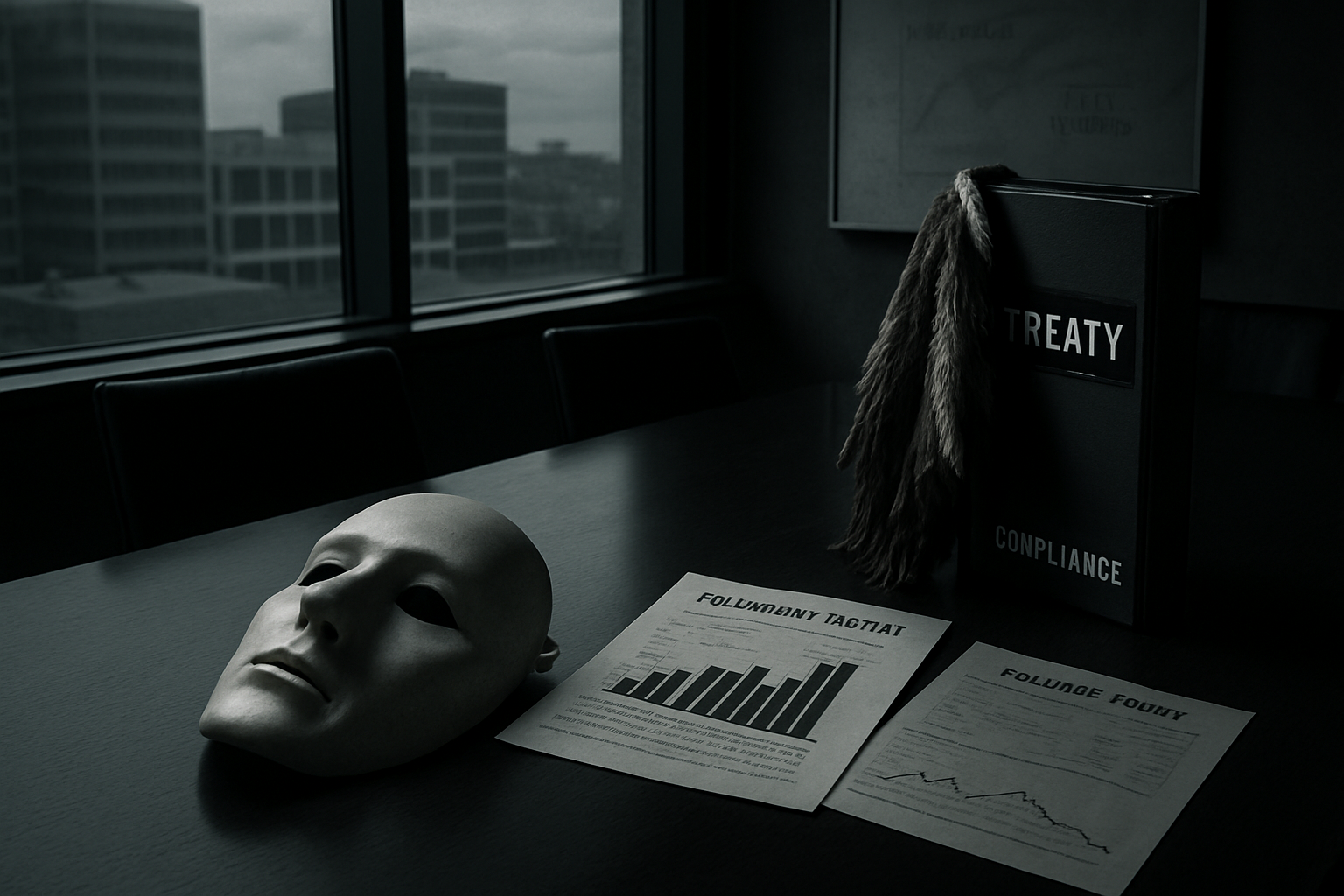
He is a former Unilever and Air New Zealand CEO, as documented by Wikipedia, who arrived in Parliament with a management consultant's playbook and the moral imagination of a quarterly earnings report. He does not see Aotearoa. He sees a balance sheet with a branding problem. The poor are a line item. Māori are a liability column. The Treaty is a compliance risk.
His government has spent two years proving with statistical precision that it does not consider Māori and Pasifika to be fully human in the calculus of policy. As previously documented in Luxon's Lullaby: A Neoliberal Nightmare Dressed as a Kiwi Dream, Luxon's public persona is a performance designed for the comfort of Pākehā middle New Zealand — a reassuring face on a programme of extraction. As documented in The Grotesque Spectacle of Luxon's "Humanity", the hollow corporate-speak that substitutes for empathy is not incidental to Luxon's style. It is his entire substance.
As documented by Labour, two years into office the cost of living is worse and more businesses are struggling. His January 2026 State of the Nation, published at national.org.nz, boasted about inflation dropping from 7% to 3% while Nicola Willis now manages a fuel crisis born of a war they provided diplomatic cover for — as exposed in The Tongue That Feeds the Beast. And as revealed by Trump's Iran War on The Māori Green Lantern, New Zealand's nuclear-free identity is being quietly dismantled while Luxon focuses on surviving the next press conference.
The Machine Survives the Man — And That Is the Real Horror
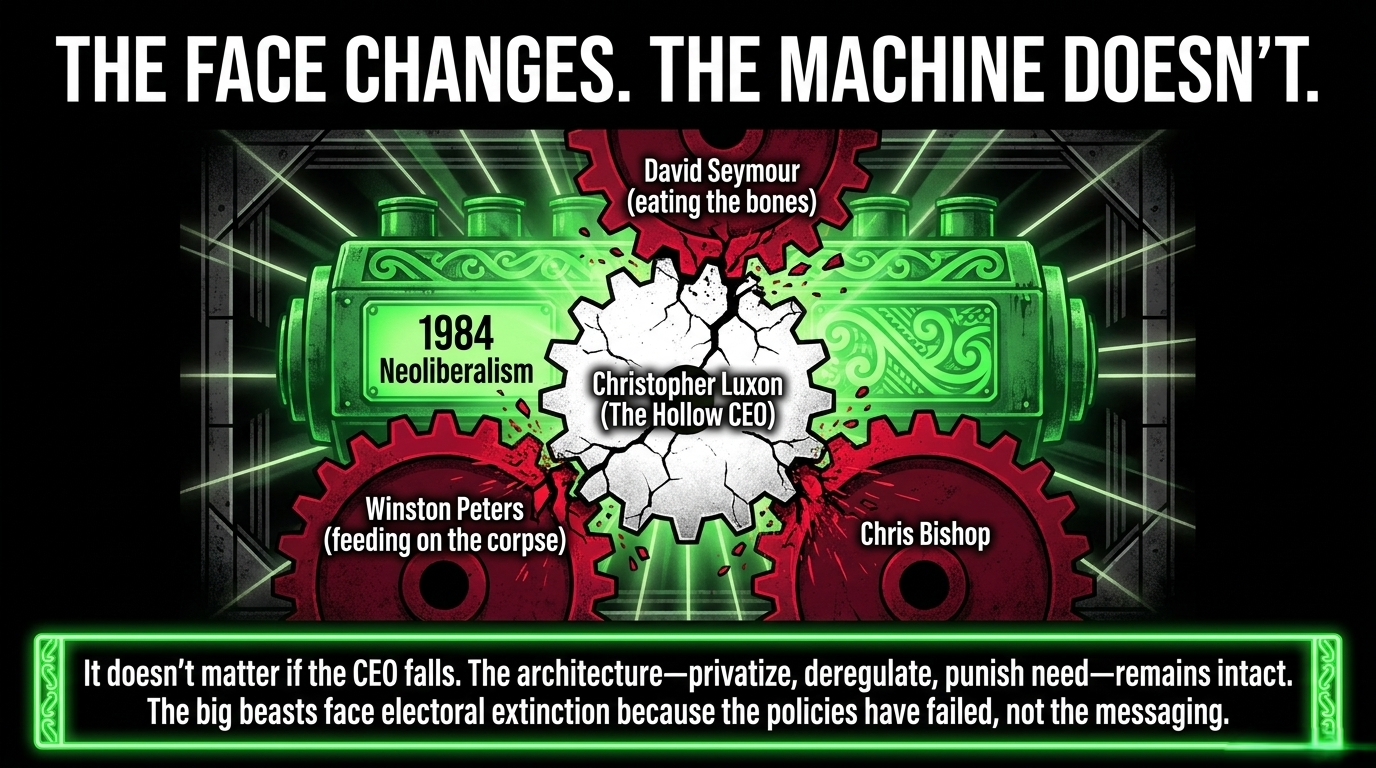
Here is the truth that cuts deeper than any leadership challenge: it does not matter if Luxon survives this week.
The National Party of Aotearoa is not simply led by a failing man. It is structurally committed to a failing ideology. The neoliberal consensus — privatise, deregulate, cut, reward wealth, punish need — has been failing Māori since Roger Douglas first picked up the axe in 1984. Luxon is simply its latest, most photogenic, most hollow ambassador. Nicola Willis, Chris Bishop, Erica Stanford — they are the same project in different suits, as documented in The NZ Neoliberal Pantomime. As documented in The Pantomime of the Dying Waka, they dress in borrowed feathers and hand whānau a government pamphlet when the taniwha comes. As confirmed by The Spinoff's horror poll analysis, the big beasts of National face electoral extinction because the policies have failed — not the messaging.
The Waitangi Tribunal has warned that the Treaty Principles Bill, had it passed, would have been "the worst, most comprehensive breach of Te Tiriti in modern times," as documented in Aotearoa at the Crossroads. The polls are finally catching up to what the people on the ground have known since Day One.
Ko tō mātou mahi: Name the machine. Trace its whakapapa. Fund the truth-tellers. And when November 2026 comes — remember every single name.
🪴 Koha — Because Luxon Ghosted His Own Whip. We Don't Ghost Our Whānau.
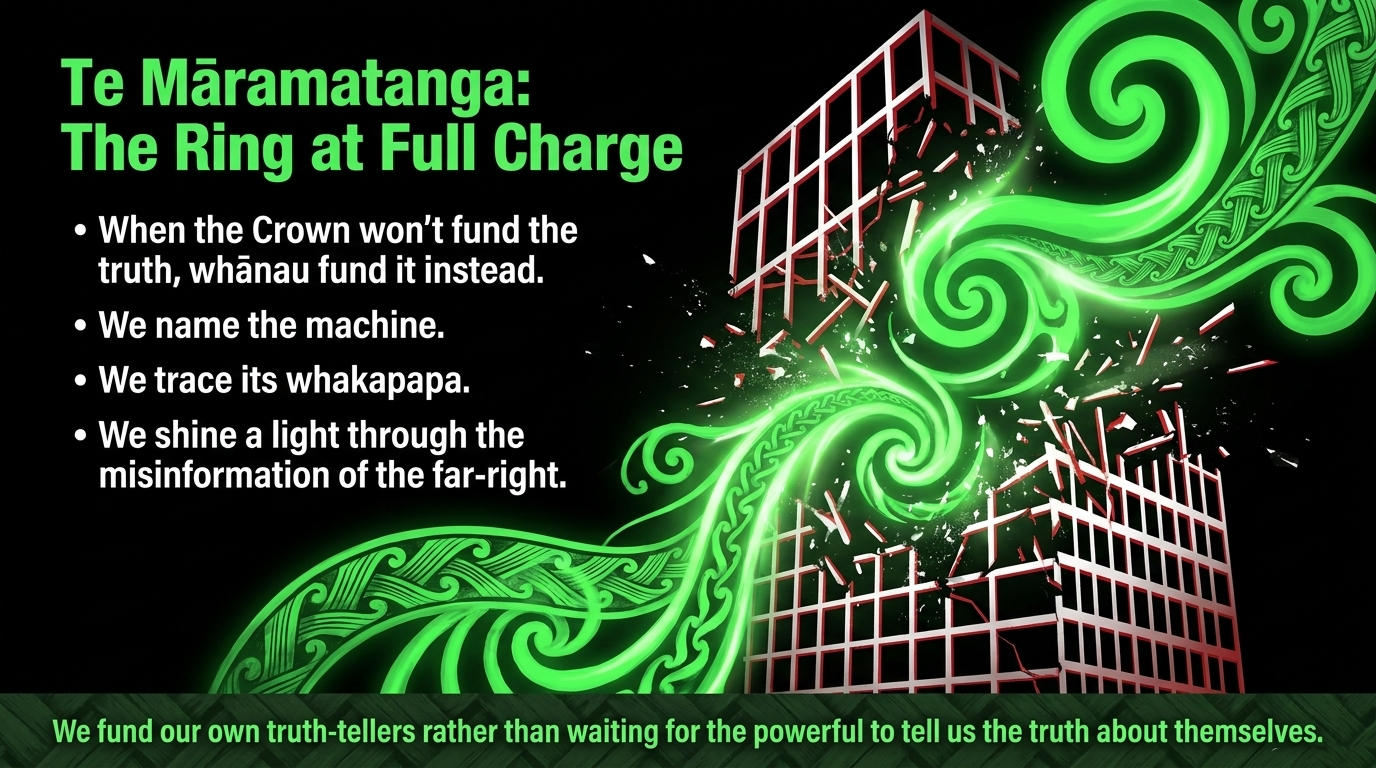
Luxon spent the recess hiding from accountability. This mahi is the direct opposite. Every essay here names names. Every claim is sourced. Every thread is traced — from the $12.8 billion stolen from care workers in 45 minutes of Parliamentary urgency, to the $27 of petrol a Māori kuia could not afford to get to a job interview this government made necessary by its own cuts.
When the Crown won't fund the truth, whānau fund it instead. When corporate media softens the blow, we sharpen the taiaha. Every koha is a direct strike against the machine. Every share is a thrown weapon. Every subscription is rangatiratanga in action — the power to fund our own truth-tellers rather than waiting for the powerful to tell us the truth about themselves.
If this essay has named what you already knew in your bones — if it has connected the threads you suspected were connected — consider becoming part of the accountability infrastructure that makes the next essay, and the one after that, possible:
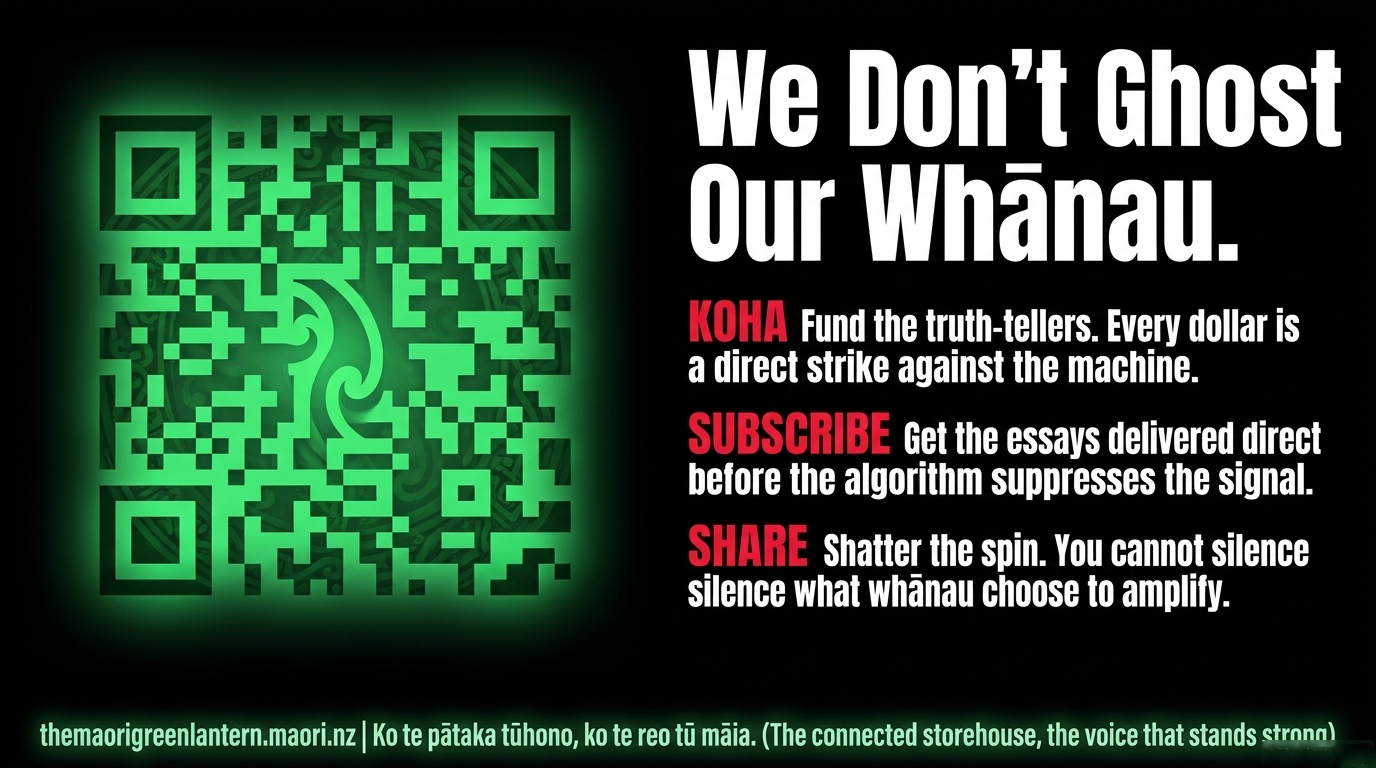
Koha direct — Support The Māori Green Lantern on the Koha platform: every dollar funds the next essay exposing the next trapdoor.
Subscribe for direct delivery — themaorigreenlantern.maori.nz: essays delivered to your inbox before the algorithm can suppress them.
Direct bank transfer — HTDM, account number 03-1546-0415173-000.
Facebook whānau — Follow and subscribe on Facebook: share every post, because the algorithm suppresses what power fears.
And if you cannot koha right now — no worries at all, whānau. Subscribe or follow at themaorigreenlantern.maori.nz. Share this essay. Talk about it with your whānau and friends. That kōrero is the koha. That conversation is rangatiratanga. You cannot silence what whānau choose to amplify.
Kia kaha. Stay vigilant. Stay connected.
Ko te pātaka tūhono, ko te reo tū māia — the connected storehouse, the voice that stands strong.
— Ivor Jones | The Māori Green Lantern
themaorigreenlantern.maori.nz

Research tools used: search_web, fetch_url. Date of research: 18 April 2026. All URLs spot-checked and verified active at time of publication. Unverifiable claims: Luxon's internal polling figures — no independent verification available. The Māori Green Lantern essays cited from direct archive at themaorigreenlantern.maori.nz.