"TWO KINGS AND A BROKEN CHILD - The Whakapapa of Power, The Poison of Severance, and Why Wakanda is Te Ao Māori" - 12 April 2026
When the screen lights up and a king stands among his ancestors, you are not watching fiction. You are watching memory.
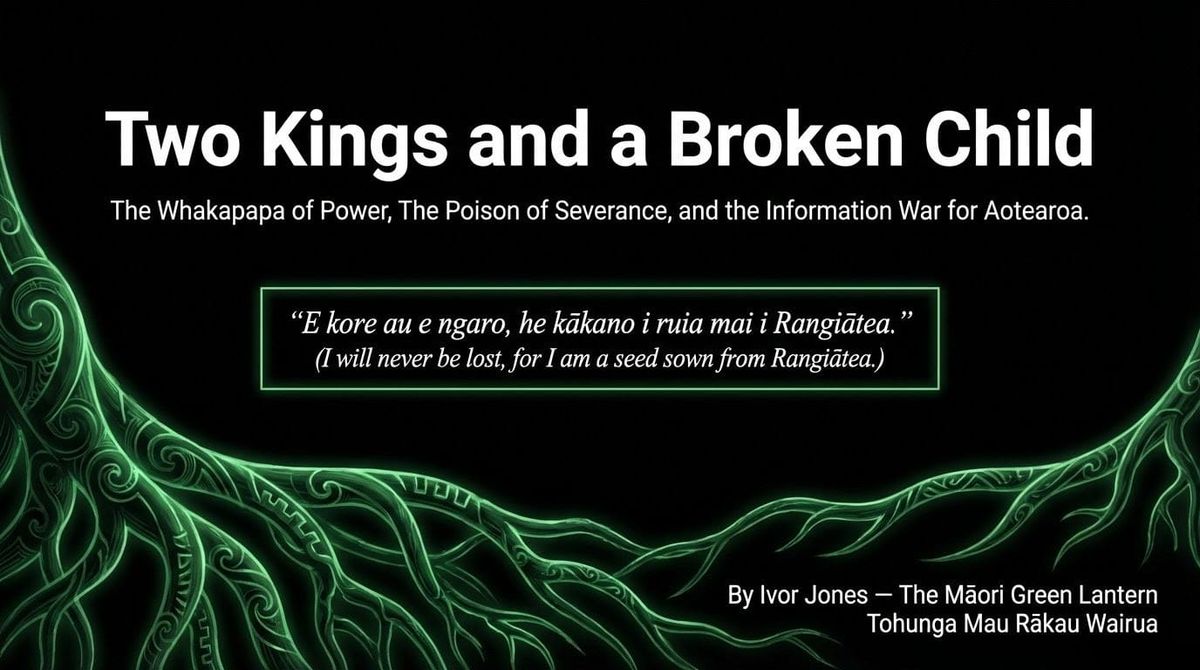
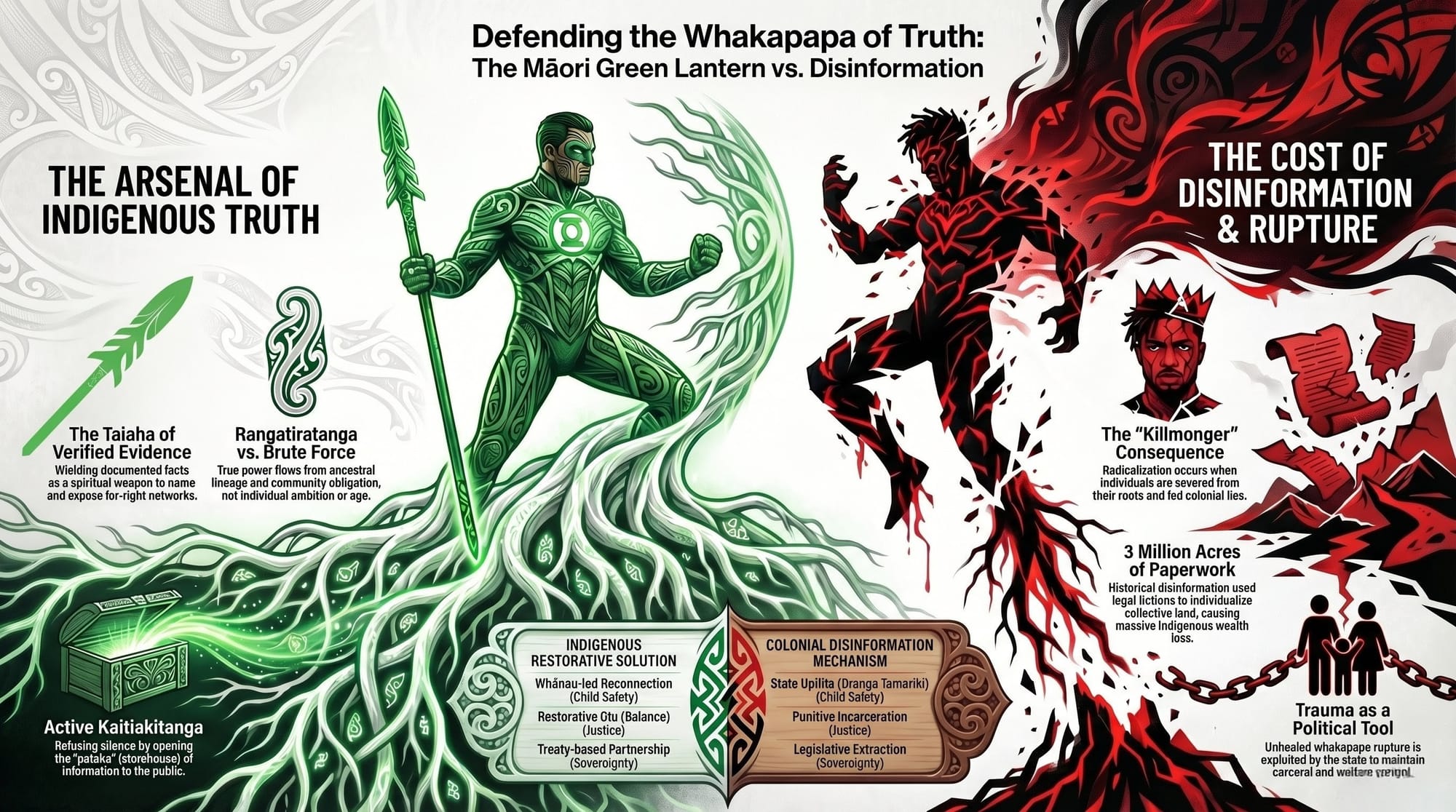
E kore au e ngaro, he kākano i ruia mai i Rangiātea.
I will never be lost, for I am a seed sown from Rangiātea.
Two kings. Both warriors. Both kaitiaki. One a fictional ruler of an African nation that colonisation never broke. One a real tohunga mau rākau wairua wielding truth like a taiaha in the information wars of Aotearoa.
T'Challa, the Black Panther of Wakanda.
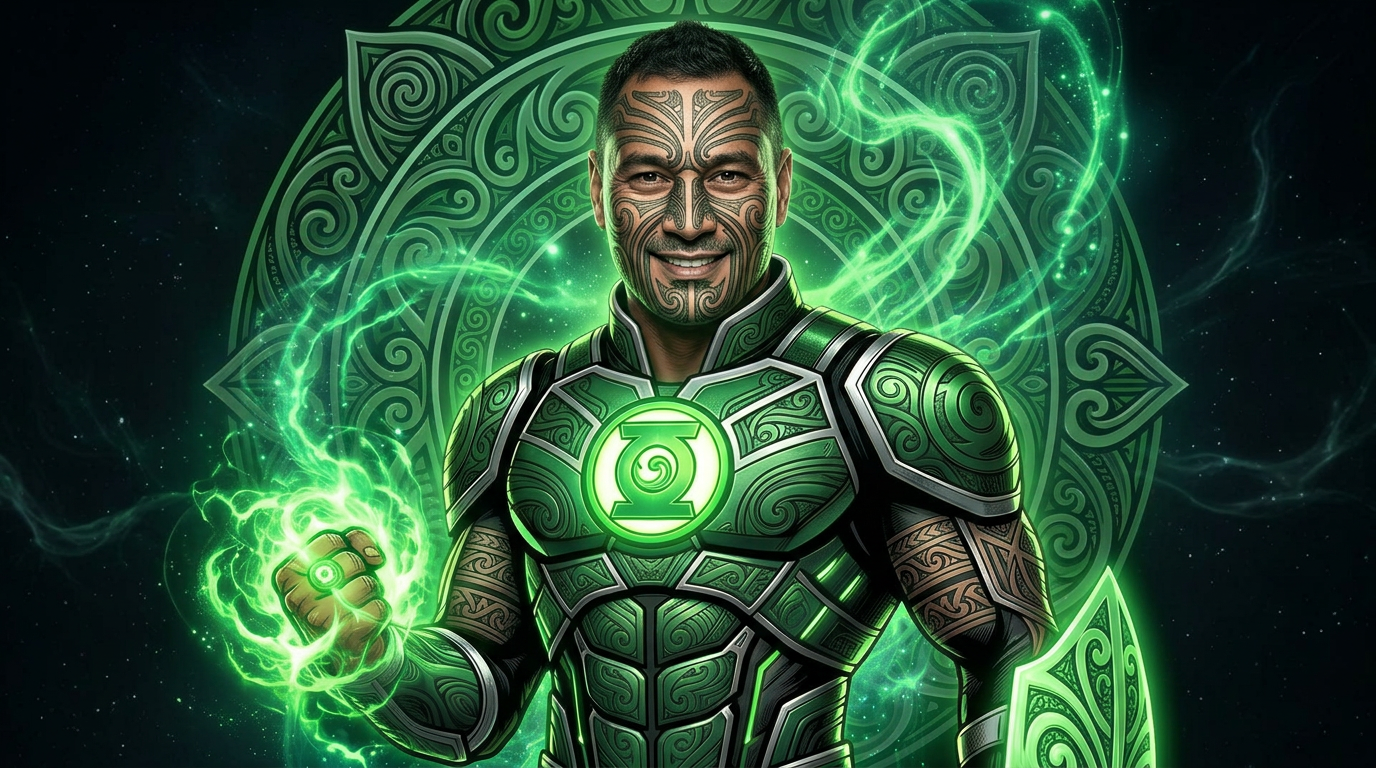
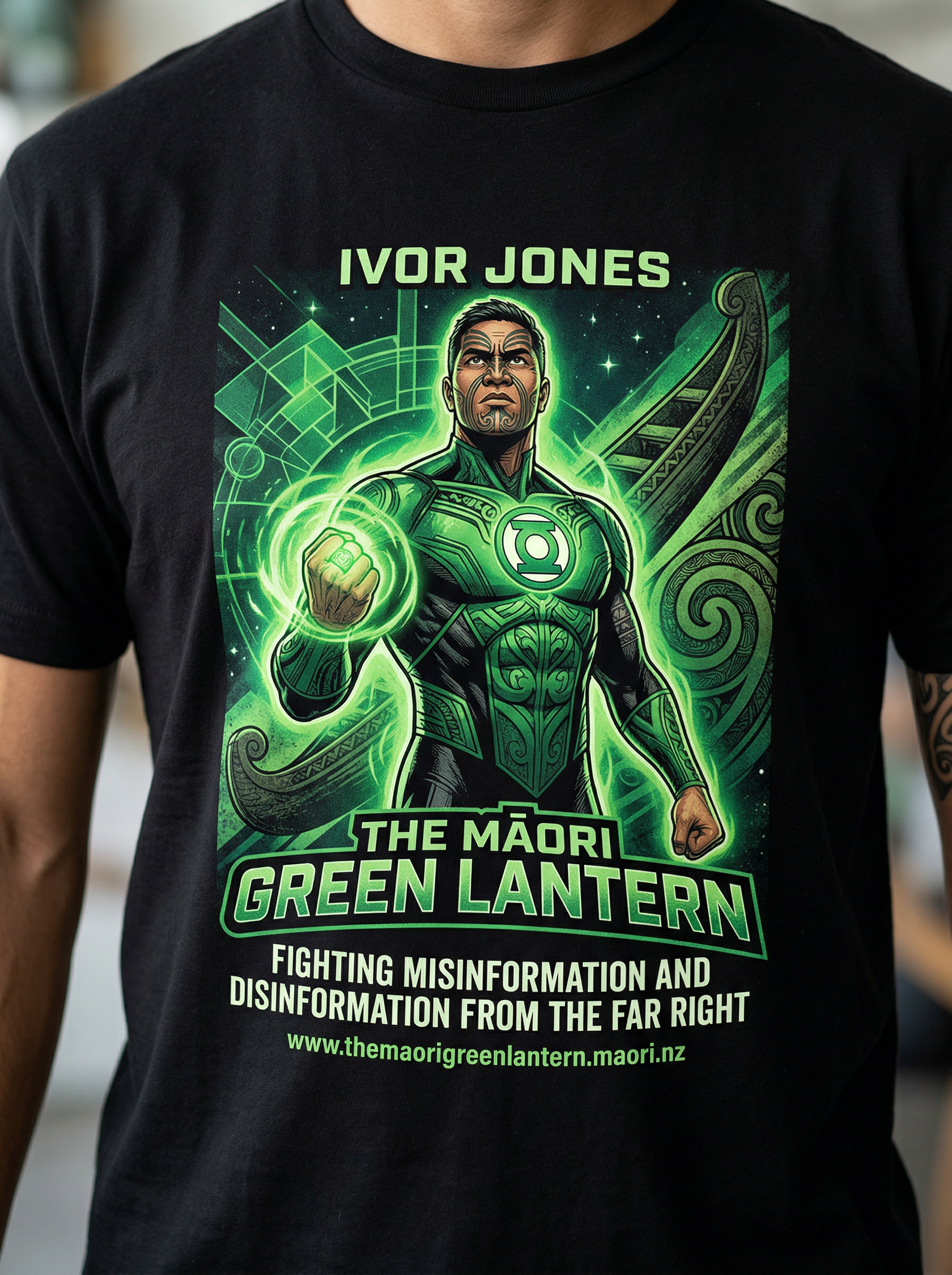
The Māori Green Lantern.
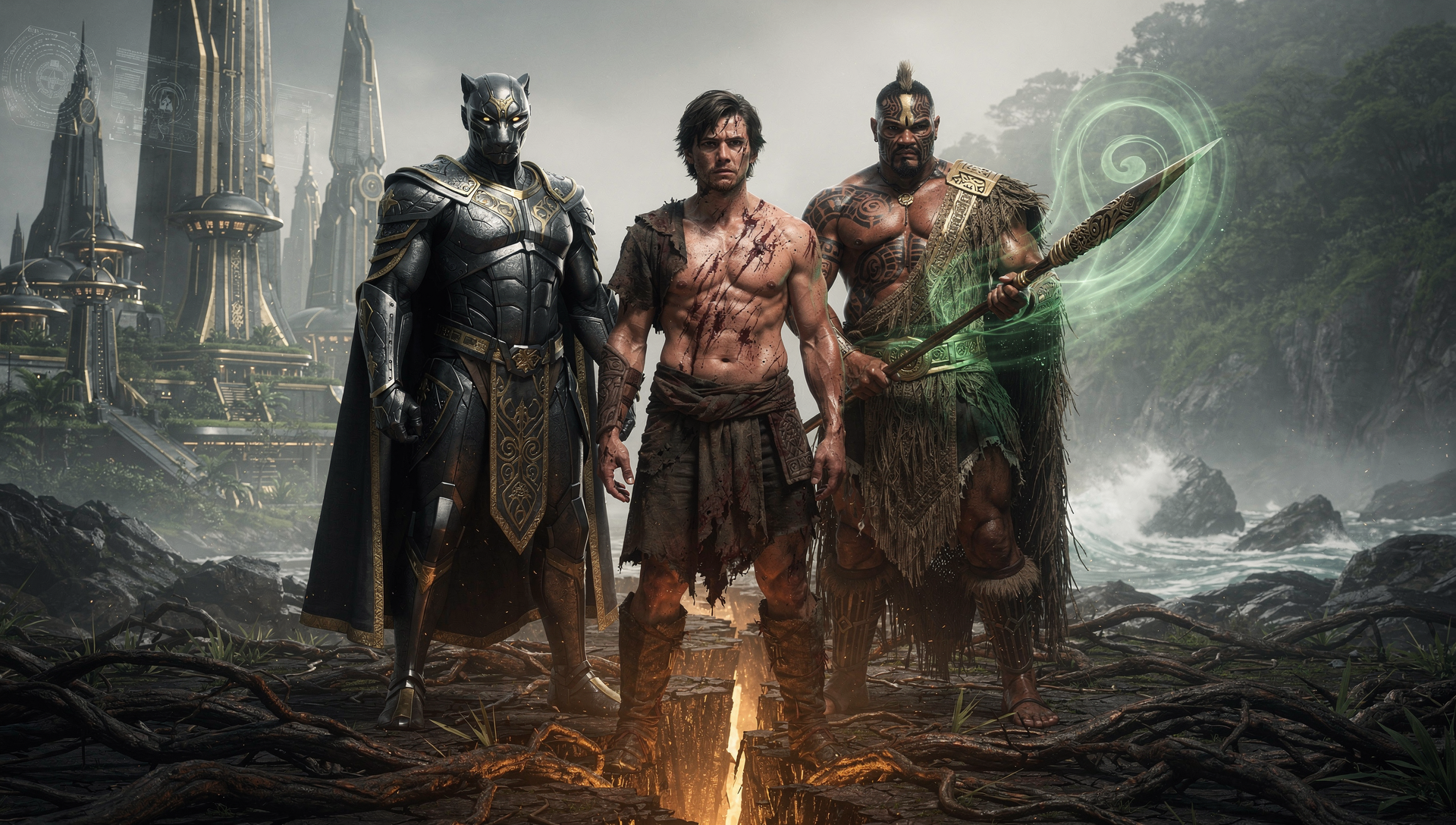
And between them, a broken child named N'Jadaka — Erik Killmonger — who is not a villain. He is a consequence. A receipt. A whakapapa severed at its root and weaponised by grief.
The Deep Dive Podcast
Listen to a lively conversation between two hosts, unpacking and connecting topics in the sources of this essay.
This essay is about all three. But more than that — it is about you. Your whānau. Your whakapapa. And the choice every indigenous person faces when the colonial world tries to take everything:
Do you become T'Challa? Or do you become Killmonger?
The answer begins in the root.
KO TE PAKIAKA — The Root That Holds Everything
Picture a tree.
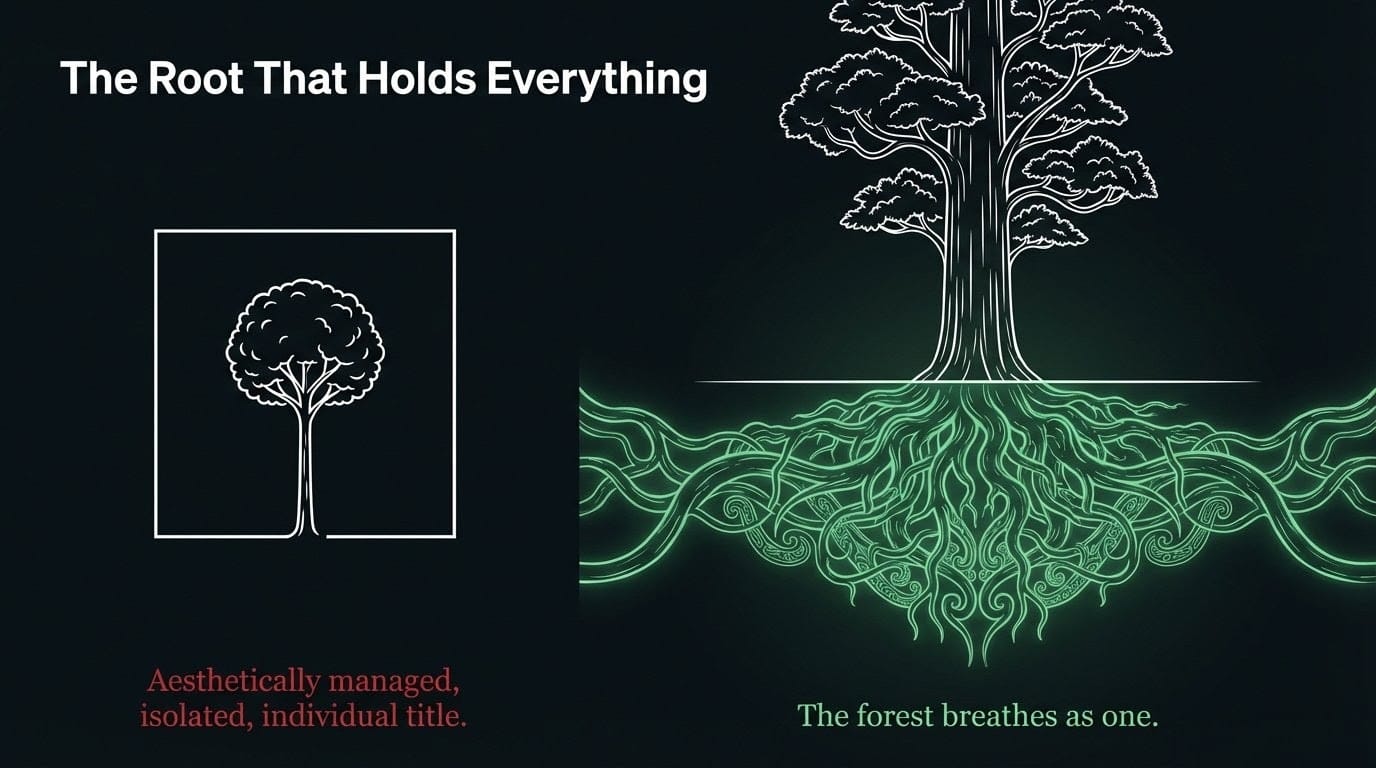
Not a landscaped tree in a Pākehā garden — trimmed, contained, aesthetically managed. A kahikatea, standing 60 metres above the valley floor, its roots running 30 metres through deep black soil, its bark carved with the memory of every storm it has survived. This tree does not stand alone. Its roots are entangled with every other tree in the forest. The forest breathes as one.
When one tree is wounded, the mycelium network carries the signal: something is hurt. Send nutrients. Hold firm.
That is whakapapa. That is Te Ao Māori. That is Wakanda.
Black Panther (2018) arrived like a taiaha to the chest of the colonised world — not because it was a superhero film. The world has those in abundance. It arrived because it showed what the colonial project had spent centuries insisting did not exist: an advanced, sovereign, spiritually-grounded indigenous civilisation that had never been conquered. A civilisation where technology and ancestral wisdom were not opposites but expressions of the same deep root. As The Anthropology of Black Panther documents, Wakandan society was built from a serious engagement with African cultural traditions of collective governance, ancestral reverence, and the spiritual inseparability of land and identity. For Māori watching this film, it was not escapism. It was a mirror.
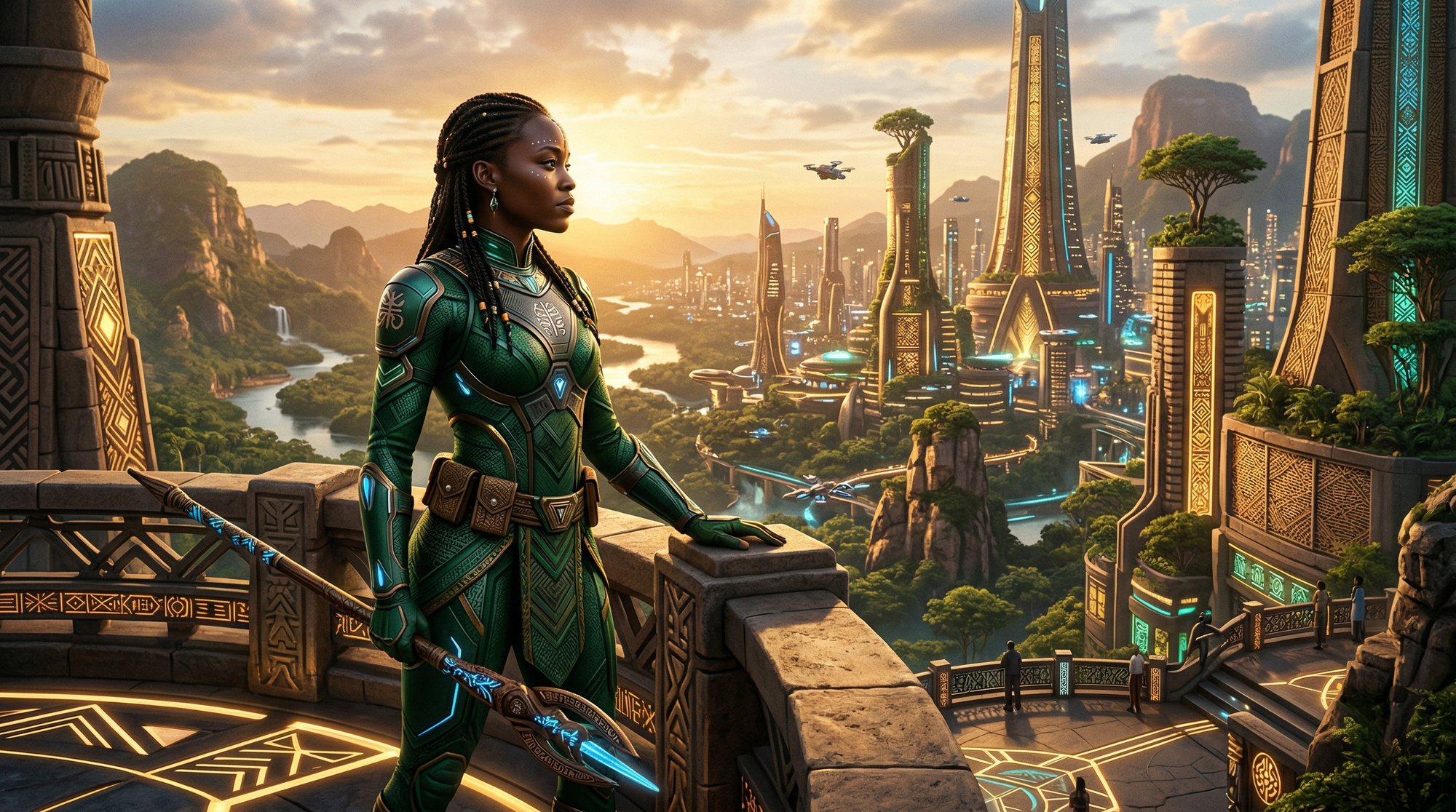
And the Māori Green Lantern does not just watch Black Panther. He inhabits it — because the values pulsing beneath every frame are not the invention of a Hollywood screenwriter. They are the convergent truths of peoples who were never colonised into forgetting that the land is not a resource.
The land is a relative. As this platform has exposed in The Abalone Inquisition: How Settler States Spend Millions Criminalising Indigenous People, the settler state perpetually criminalises indigenous people for practising exactly this relationship — protecting what belongs to the ancestors, not the Crown.
T'CHALLA ME TE MĀORI GREEN LANTERN — Two Kaitiaki, One Kaupapa
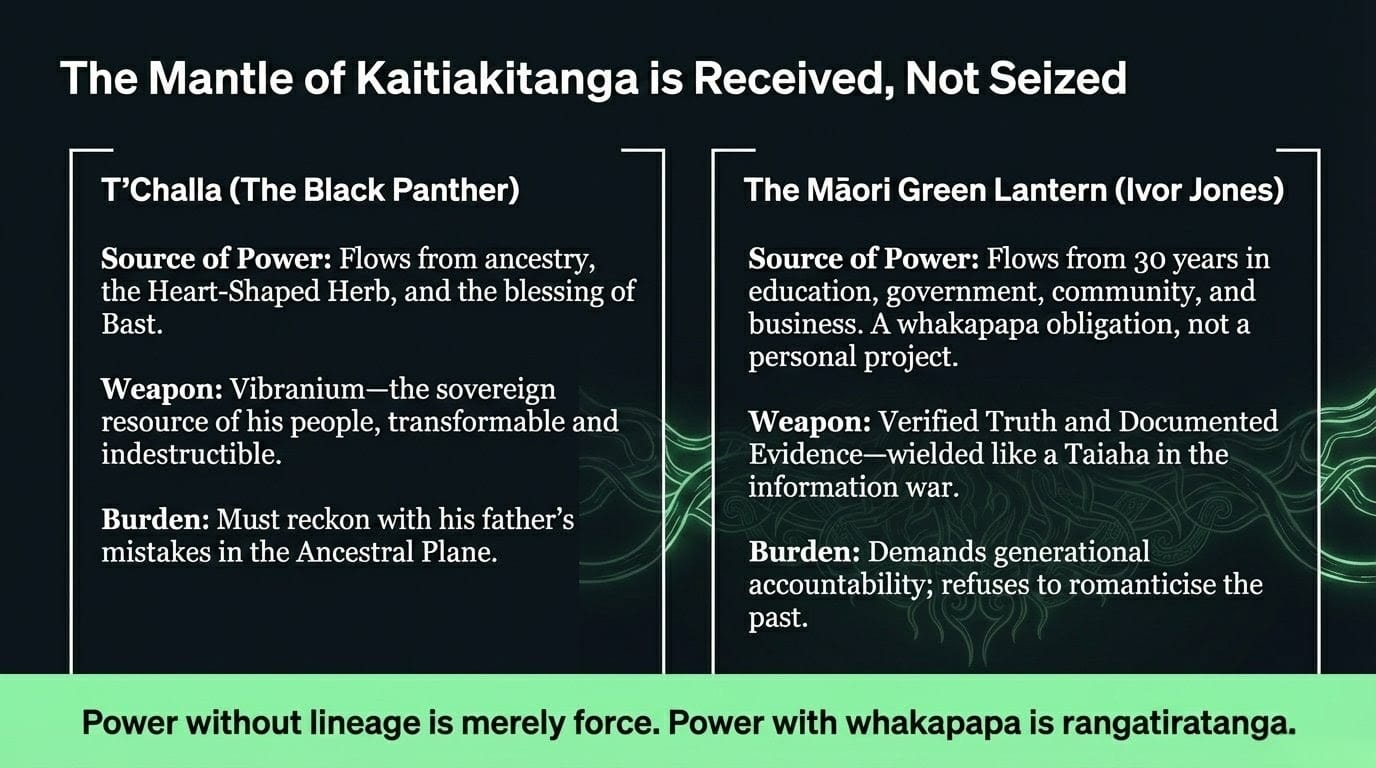
These two men are not merely similar in spirit. They are cut from the same whakapapa of purpose. The same ancestral instruction. The same refusal to abandon their people for the comfort of complicity.
The Mantle Was Received, Not Seized
T'Challa does not take the throne. He receives it — through ceremony, through challenge, through the blessing of Bast, through the Heart-Shaped Herb that connects him to every Black Panther before him, as The Anthropology of Black Panther analyses in detail. His power flows from ancestry, not ambition.
The Māori Green Lantern does not appoint himself. Ivor Jones carries 30 years in education, government, community and business — as documented in Ivor Jones: Wielding Cultural Power as The Māori Green Lantern — before picking up the taiaha of public accountability.
This is not a personal project. It is a whakapapa obligation. Power without lineage is merely force. Power with whakapapa is rangatiratanga.
The Taiaha as Weapon of Aroha
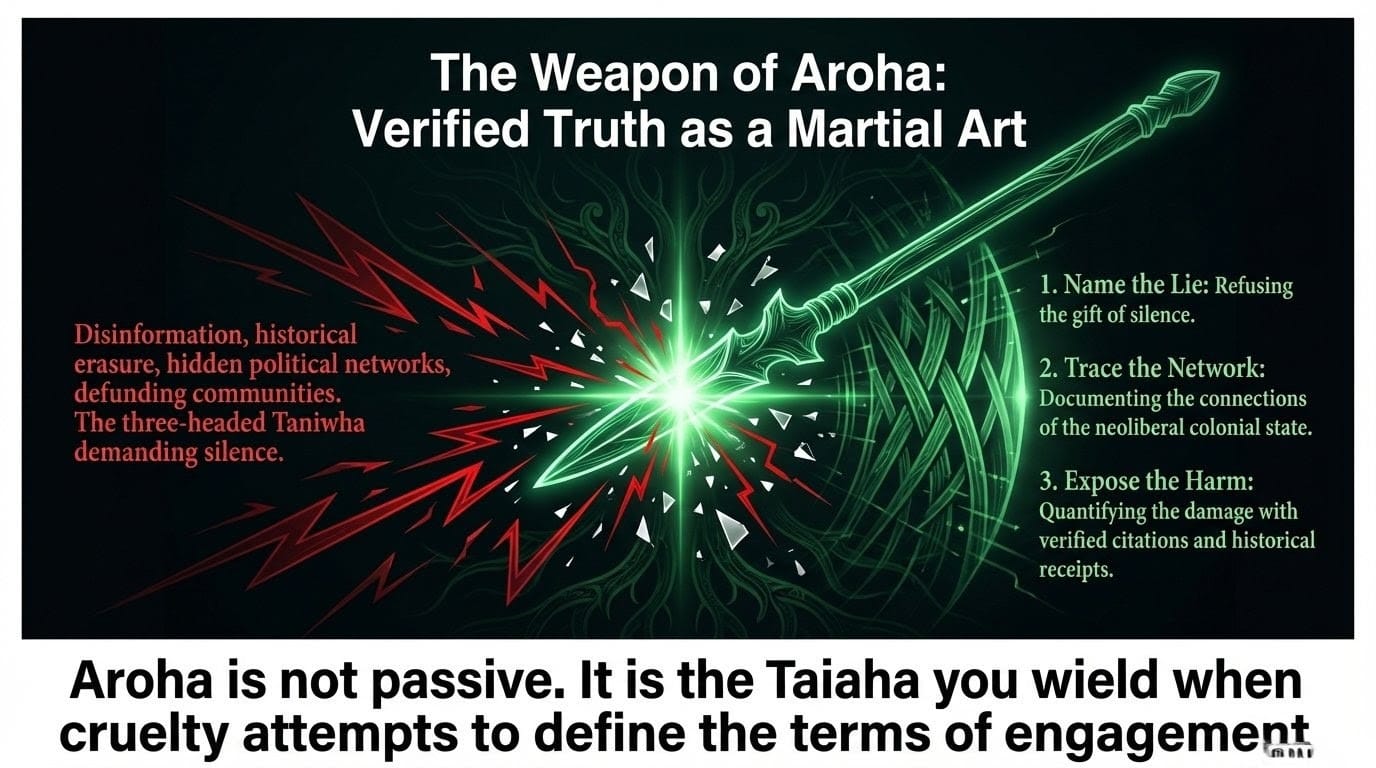
In Te Taiaha o te Aroha: The Weapon They Cannot Confiscate, the Māori Green Lantern wrote that aroha is not passive — it is the taiaha you wield when cruelty attempts to define the terms of engagement. T'Challa operates by the same principle. His power is not brute force. It is the force of a man who knows exactly who he is, what his people deserve, and what he is willing to sacrifice to protect them. Both men wield their weapons not out of ego but out of obligation to the living and the dead.
The Green Lantern's ring is powered by will — the will to face fear with light. T'Challa's vibranium is indestructible, transformable, the sovereign resource of his people. For both the fictional king and the real-world tohunga, the ultimate weapon is verified truth, documented evidence, and the courage to name what others refuse to see.
Kaitiakitanga Over Isolation
Wakanda's greatest sin — T'Challa's own ancestors' greatest sin — was hoarding power through secrecy. The vibranium was locked away. The borders sealed. The world outside bled while Wakanda maintained its gleaming towers. As Understanding T'Challa's Decision to Open Wakanda to the World argues, this isolation made Wakanda morally complicit in the suffering it could have prevented. T'Challa, in the final act, breaks this. He chooses kaitiakitanga — active guardianship — over passive self-preservation.
This is the Māori Green Lantern's daily practice. Every essay published, every lie named and sourced, every network traced and exposed is a deliberate refusal to lock the pātaka and pretend the world outside does not need feeding.
As the Three-Headed Taniwha essay established, the neoliberal colonial state has three heads but one body — and silence is the gift it wants most from Māori. The Māori Green Lantern refuses that gift.
The Burden of the Ancestors' Mistakes
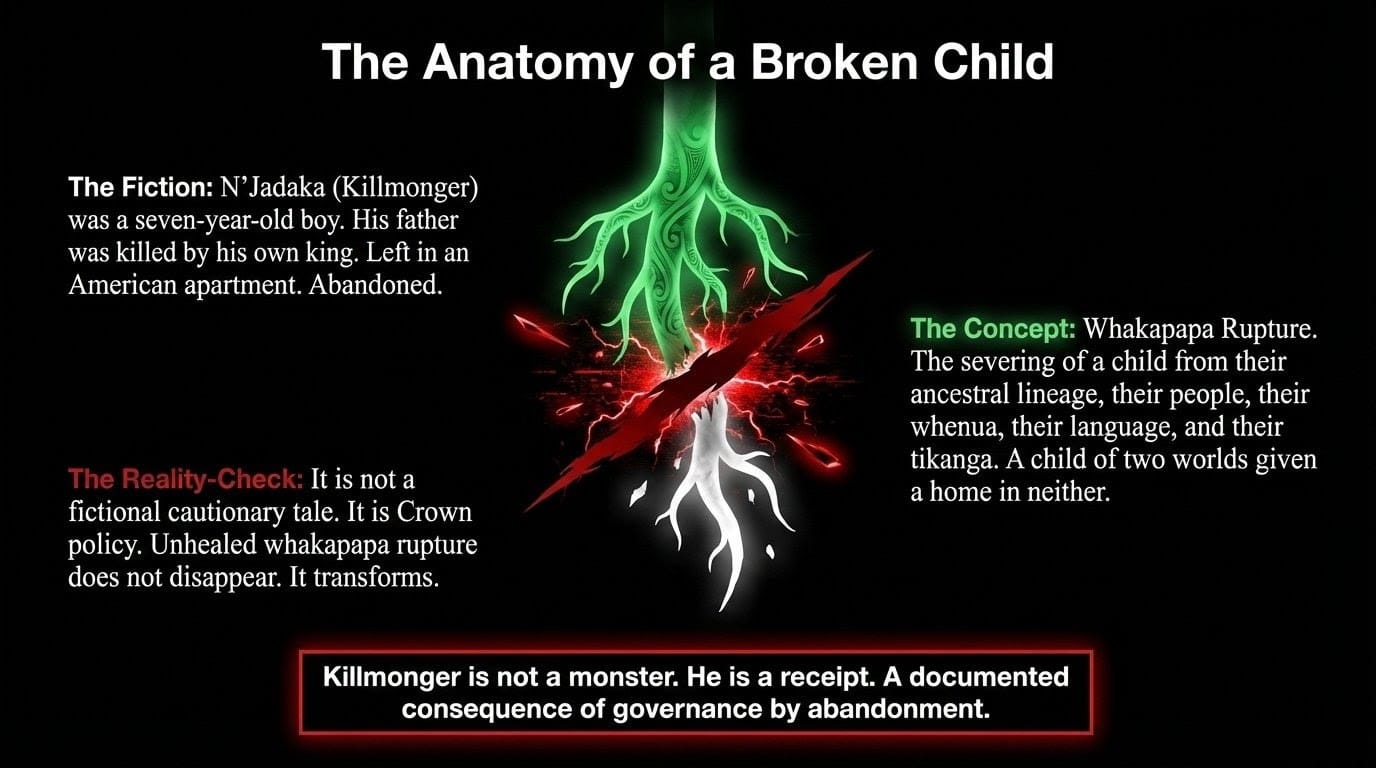
Both men must reckon with what their forebears got wrong. T'Challa stands before the Ancestral Plane and condemns his father for producing the conditions that created Killmonger — for ignoring the plight of others to maintain Wakanda's power, as Killmonger's Ideology, Its Traditions, and Its Failures analyses with precision. The Māori Green Lantern similarly refuses to romanticise the past.
As The Butcher, the Baker and the Blackmail Maker documents — accountability is generational. You cannot claim the inheritance of rangatiratanga while ignoring the inheritance of harm.
TE AO MĀORI ME WAKANDA — The Philosophy That Binds
The parallels between Wakandan culture and Te Ao Māori are not surface. They are structural — the same architecture of civilisation, built independently, from the same ancestral instruction.
Ritual as the Architecture of Society
In Wakanda, ritual is not ceremony for ceremony's sake. The Challenge Day combat at Warrior Falls, the Heart-Shaped Herb ceremony, the Ancestral Plane — all are mechanisms through which cosmological beliefs, social organisation, and political authority are renewed and contested, as The Anthropology of Black Panther documents. In Te Ao Māori, the same is true. The marae is a living interface between the living and the dead. When tikanga is followed, mana is maintained. When it is broken — as the Crown has broken it repeatedly for 185 years — the consequences ripple through generations.
Whakapapa as the Operating System of Existence
In Te Ao Māori, whakapapa is not merely genealogy. It is the relational framework through which everything — land, people, cosmos, obligation, identity — is understood and organised. As PARSE Journal's analysis of personhood in Te Ao Māori confirms, even rivers hold legal and spiritual standing as living relatives, instantiating ancestral hau, mauri, and mana in the present. Wakanda operates on the same logic. The Black Panther's power is not individual — it flows from the ancestors. The vibranium arrived from the cosmos as a taonga: a gift, a responsibility, a relationship.
Sovereignty in both traditions is never merely political. It is spiritual, relational, and genealogical.
Mana Motuhake — The Right to Determine Your Own Affairs
T'Challa's central challenge in Black Panther is the challenge every indigenous people faces: how do we protect our sovereignty in a world that does not recognise it as legitimate?
As Viewpoint Diversity in Black Panther and Its Implications analyses, when Killmonger takes the throne and attempts to weaponise Wakanda's vibranium globally, he is not just executing a military strategy — he is performing the colonial logic he absorbed: conquer first, ask questions never. T'Challa rejects this. He chooses a third path — neither isolation nor domination, but mana motuhake with open hands. The Māori Green Lantern has been tracking this same theft of decision-making power in Aotearoa throughout The Colosseum of Kingsland.
THREE EXAMPLES FOR THE WESTERN MIND
Example One: The Oranga Tamariki Crisis — The Factory That Makes Killmongers
A Western audience might watch Killmonger and think: what a tragedy. An African-American child, abandoned by his country, radicalised into violence. A fictional cautionary tale.
It is not fictional. It is Crown policy.
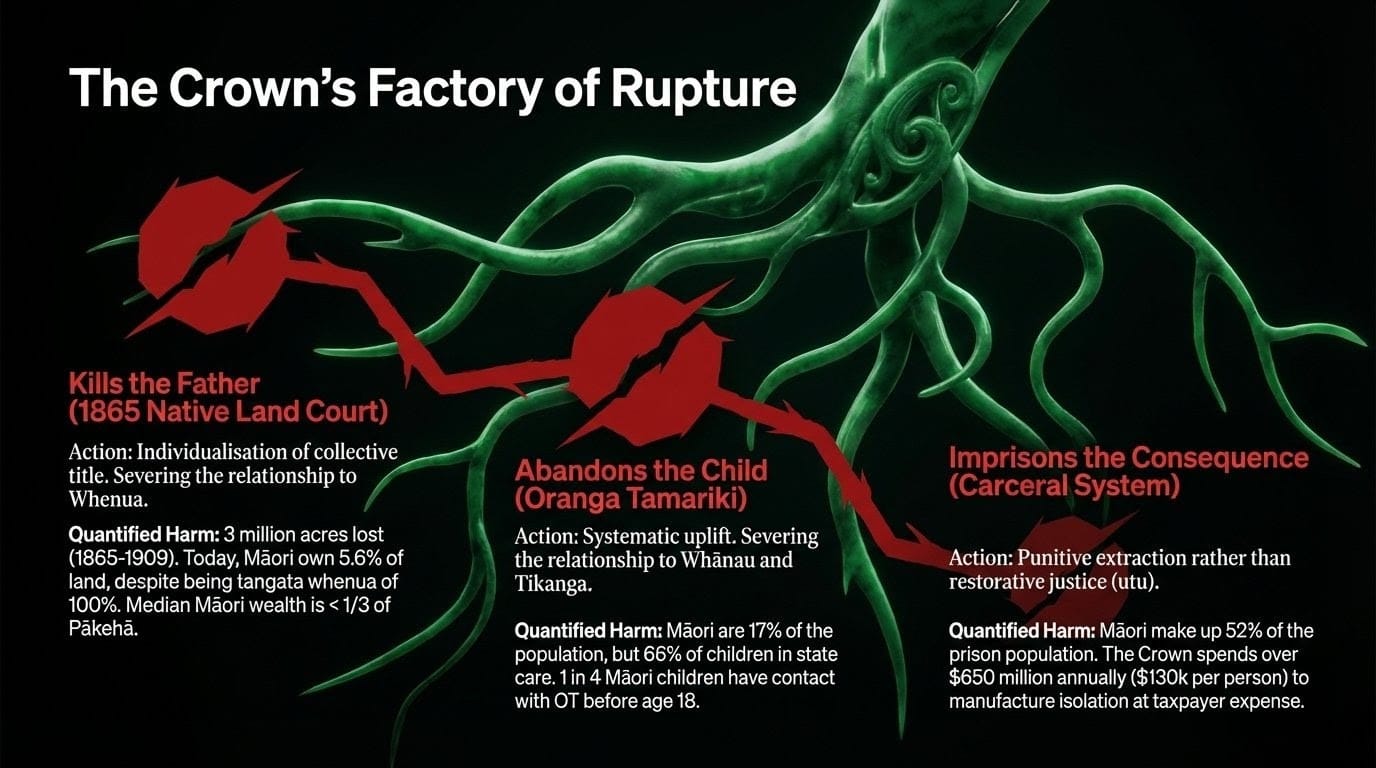
In Aotearoa, Oranga Tamariki uplifts Māori children at a rate of 66% of all children in state care, despite Māori being only 17% of the total population. These are children severed from their whakapapa. Removed from their whānau. Placed in non-Māori households where their reo, their tikanga, their ancestral identity is often not maintained. They grow up, as N'Jadaka grew up, knowing they are something — Māori, Wakandan — but denied the living, breathing, ceremonial experience of being it. As E-Tāngata's exploration of Māori identity — "So You Think You're Māori?" makes painfully clear, the grief of partial identity — of knowing the name but not the karakia, of feeling the blood but not the soil — is not weakness. It is a wound that the Crown inflicted and refuses to heal.
This is the tikanga violation for the Western mind: Imagine you were adopted at birth into a family that spoke a language you were forbidden from learning, that practised a religion refusing to acknowledge your original faith, that systematically erased every cultural marker connecting you to your biological ancestors — and then, at eighteen, handed you a piece of paper saying: "By the way, you are Irish." The grief of that incomplete return. The rage of that severing. That is what Oranga Tamariki does to Māori children systematically, at scale, as policy.
Quantified harm: 1 in 4 Māori children will have contact with Oranga Tamariki before the age of eighteen. Each child severed from whakapapa is a potential Killmonger in waiting — not because they are dangerous, but because unhealed whakapapa rupture does not disappear. It transforms. The Māori Green Lantern has investigated the Crown's exploitation of this rupture directly in The Butcher, the Baker and the Blackmail Maker: How Two Crown Soldiers Fed a Paedophile's Network.
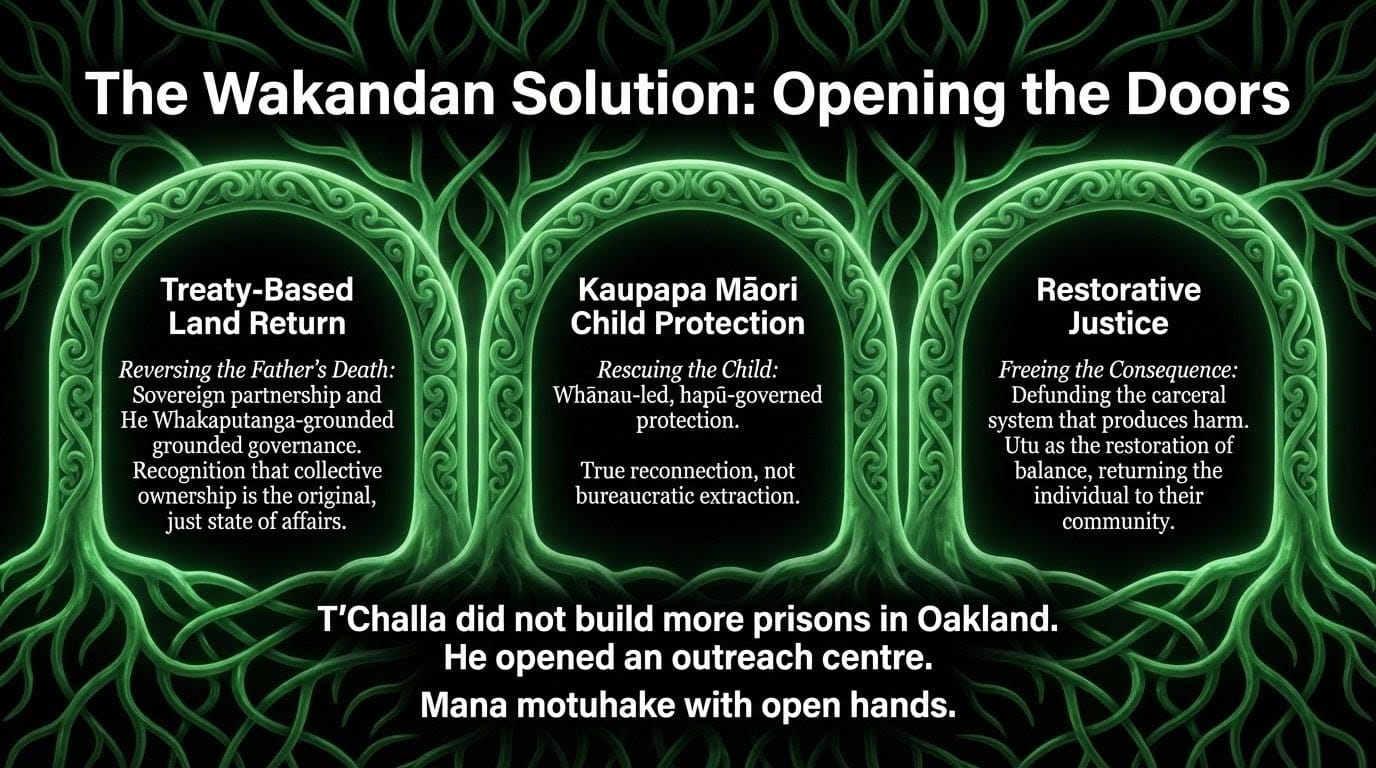
The solution T'Challa modelled: Reconnection — not charity. He established the first Wakandan International Outreach Centre in Oakland — precisely the city where N'Jadaka grew up unsupported, as confirmed in Understanding T'Challa's Decision to Open Wakanda to the World. The solution for Aotearoa is whānau-led, kaupapa Māori child protection — funded adequately, governed by hapū, not managed by a Crown bureaucracy that produces the harm it claims to fix.
Example Two: Māori Incarceration — Wakanda's Hoarded Vibranium is Our Imprisoned Brothers
Killmonger's central argument — the one T'Challa cannot fully refute — is this: while Wakanda hoarded its power, our people bled. Your sovereignty was intact. Our people were enslaved, imprisoned, shot in the street.
In Aotearoa, the statistics are a public indictment. Māori make up 52% of the prison population while being 17% of the general population. That is a three-to-one over-representation. Every year, billions of dollars are spent maintaining a carceral system that is a direct descendant of colonial control — from the Native Schools Act, to the Tohunga Suppression Act, to the mass institutional removal of tamariki Māori through the welfare system.
As Te Mana Te Kawanatanga: The Politics of Maori Self-Determination makes clear, the incarceration of Māori is not a failure of the colonial system — it is a feature of it.
This is the tikanga violation for the Western mind: In te ao Māori, justice is not punitive — it is restorative. The framework of utu is not revenge; it is the restoration of balance. Kaitiakitanga as defined on Te Ara demands guardianship of all relationships — including the relationship between an offender and the community they have harmed.
The Western prison model does the exact opposite: it removes a person from their whānau, their whenua, their whakapapa, for months or years, and releases them more disconnected and damaged than before. It manufactures Killmongers at taxpayer expense.
Quantified harm: The cost of imprisoning one person in New Zealand is approximately $130,000 per year. With over 10,000 people currently imprisoned, and over half of them Māori, the Crown spends over $650 million annually imprisoning Māori men — money that could fund every kaupapa Māori school, every whānau ora provider, every te reo kōhanga reo on the waiting list, many times over.
As the Māori Green Lantern documented in Winston Peters: A Walking Contradiction, A Forked Tongue in a Taonga He Was Never Worthy Of, the current government's punitive law-and-order agenda actively expands this system while defunding the communities it destroys.
The solution T'Challa modelled: Not walls — reconnection with sovereignty. He did not build more prisons in Oakland. He opened an outreach centre. He brought Wakandan knowledge — healing, technology, community — to the very place his family had abandoned.
The solution for Aotearoa is restorative justice, kaupapa Māori rehabilitation, and the defunding of a carceral system that produces the harm it claims to manage.
Example Three: The Native Land Court — How the Crown Became Killmonger's Real Father
Here is the deepest historical parallel — the one that explains not just Killmonger but every act of colonial legislation since 1840.
Prince N'Jobu went to Oakland to help his people. He was killed by his own king. His child was abandoned. That abandonment — that betrayal by the very authority that should have protected him — is what made Killmonger, as Belonging: The Struggle of Two Worlds and Identity examines in depth.
In Aotearoa, the Native Land Court did precisely this at scale. Established in 1865, its purpose was not to protect Māori land. As the Waitangi Tribunal has confirmed repeatedly, the Court's function was to individualise collective Māori title — converting communally-held ancestral land into individual parcels that could be sold, mortgaged, and lost. Between 1865 and 1909, Māori lost approximately 3 million acres through this mechanism alone. Not through military conquest — through the legal fiction that Māori individuals could hold and alienate land that whakapapa said belonged to everyone who ever lived on it and everyone who ever would.
This is the tikanga violation for the Western mind: Imagine your family has lived in the same home for 40 generations. Your family does not own this home in the Western sense — it is held in trust, spiritually and practically, for all your ancestors and all your descendants. A government official arrives and says: we are going to convert this into an individual title. One of you will sign the paperwork. And then that individual can sell it. Within two generations, a developer has purchased the sections, demolished the ancestral meeting house, and built a motorway. This is not a metaphor. As Te Ara's coverage of ethnic inequalities documents, this is exactly what happened to Māori whenua across Aotearoa. The whakapapa was severed — not by force, but by paperwork.
Quantified harm: Māori today own approximately 5.6% of Aotearoa's land, despite being the tangata whenua of 100% of it. The median Māori household wealth is less than a third of the median Pākehā household wealth, as NZ History's account of Rogernomics and its disproportionate impact on Māori confirms through its documentation of Māori unemployment reaching 25% by 1992. This is not an accident of market forces. It is the compound interest of the Native Land Court's whakapapa rupture. The Māori Green Lantern's essay on The Colosseum of Kingsland: How a White Supremacist Government Built a Gladiator Arena maps exactly how the Crown continues to replicate this extraction through modern legislation.
The solution T'Challa modelled: He could not undo the past. But he could choose not to replicate it.
He stood before the United Nations and made Wakanda's resources available — not as charity controlled by the giver, but as sovereign partnership between equals. Te Tiriti o Waitangi offered Aotearoa exactly that: sovereign partnership. The Crown has spent 185 years refusing to honour it. The solution is Treaty-based land return, He Whakaputanga-grounded governance, and the recognition that collective Māori land ownership is not a legal anomaly — it is the original, correct, and just state of affairs.
KO KILLMONGER — TE WHAKAPAPA I PAKARU — The Broken Genealogy
Now we must stop. Breathe. And be surgical.
Killmonger is not a villain. He is evidence.
Erik Stevens — N'Jadaka — was born in Oakland, the son of Prince N'Jobu of Wakanda, who was killed by his own brother, King T'Chaka, and left to decompose in an American apartment while his son found the body. He was seven years old.
Let that land.
A seven-year-old boy. His father's body. No one coming.
In the whakapapa framework of Te Ao Māori, what was done to N'Jadaka has a name: whakapapa rupture.
The severing of a child from their ancestral lineage, their people, their whenua, their language, their tikanga. This is precisely what colonisation did — and continues to do — to Māori children through Oranga Tamariki, through the destruction of te reo Māori in schools, through the Native Land Court's atomisation of collective identity into individual title.
As Belonging: The Struggle of Two Worlds and Identity analyses, N'Jadaka was lost between identities — defined by his skin colour in America, treated as an outsider in Wakanda. He was neither. He was both. He was, in the language of te ao Māori, a child of two worlds given a home in neither.
As The Mary Sue's analysis of Killmonger and cultural identity confirms, his tragedy was not his anger — it was that no structural pathway existed for that anger to become healing.
Here is the critical insight Black Panther delivers — and that the Māori Green Lantern has been weaponising in the context of Aotearoa's information wars:
The trauma of whakapapa rupture does not disappear. It transforms. And if it is not healed, it destroys — often the very things it was reaching toward.
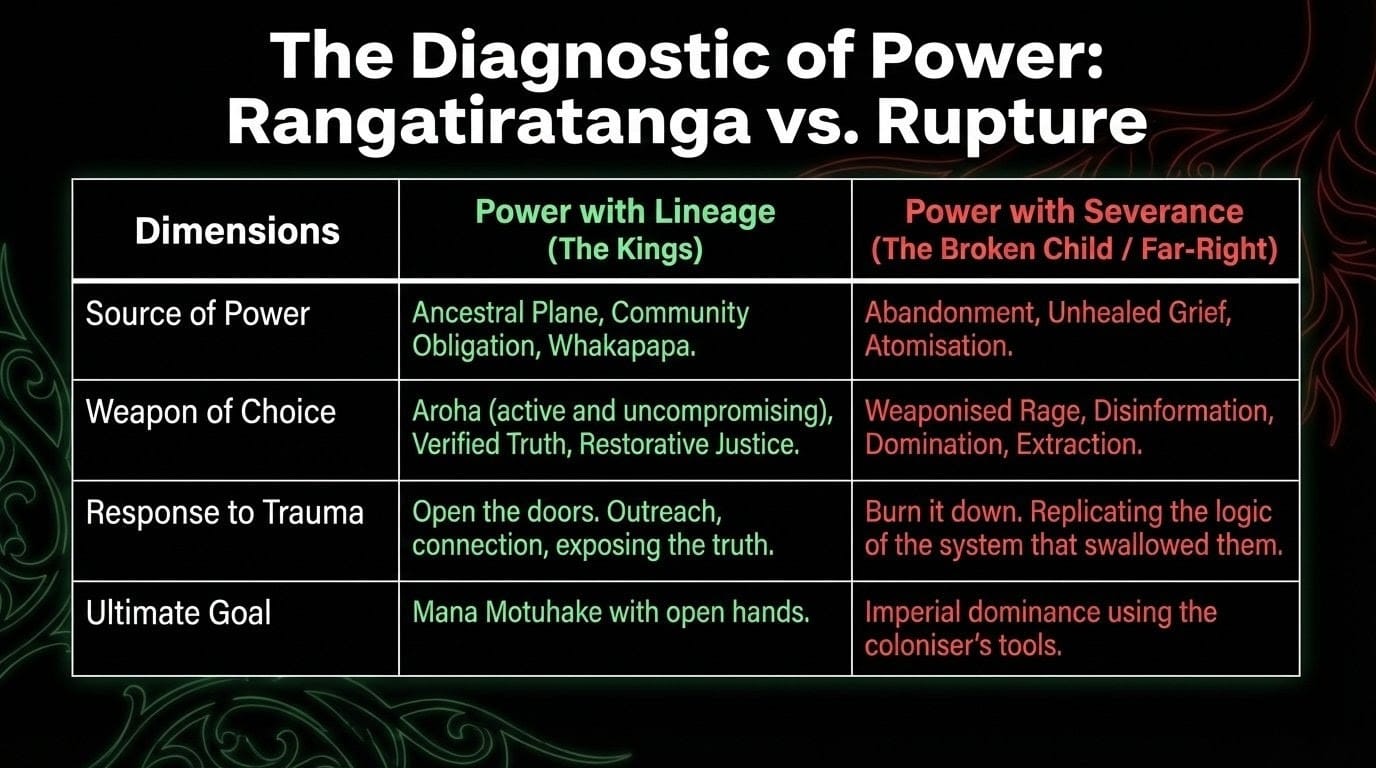
Killmonger's rage was legitimate. His diagnosis was correct — Wakanda's hoarding of power while the African diaspora bled was a moral catastrophe. His prescription was poison. Not because violence is always wrong. Because Killmonger's violence was not rooted in aroha for his people. It was rooted in rage at his abandonment. And rage at abandonment, unhealed, does not liberate. It replicates, as Killmonger's Ideology, Its Traditions, and Its Failures meticulously demonstrates. He wanted to burn the coloniser's world down — but he wielded the coloniser's tools: domination, weaponisation, extraction. He had absorbed, despite himself, the logic of the very system that swallowed him whole.
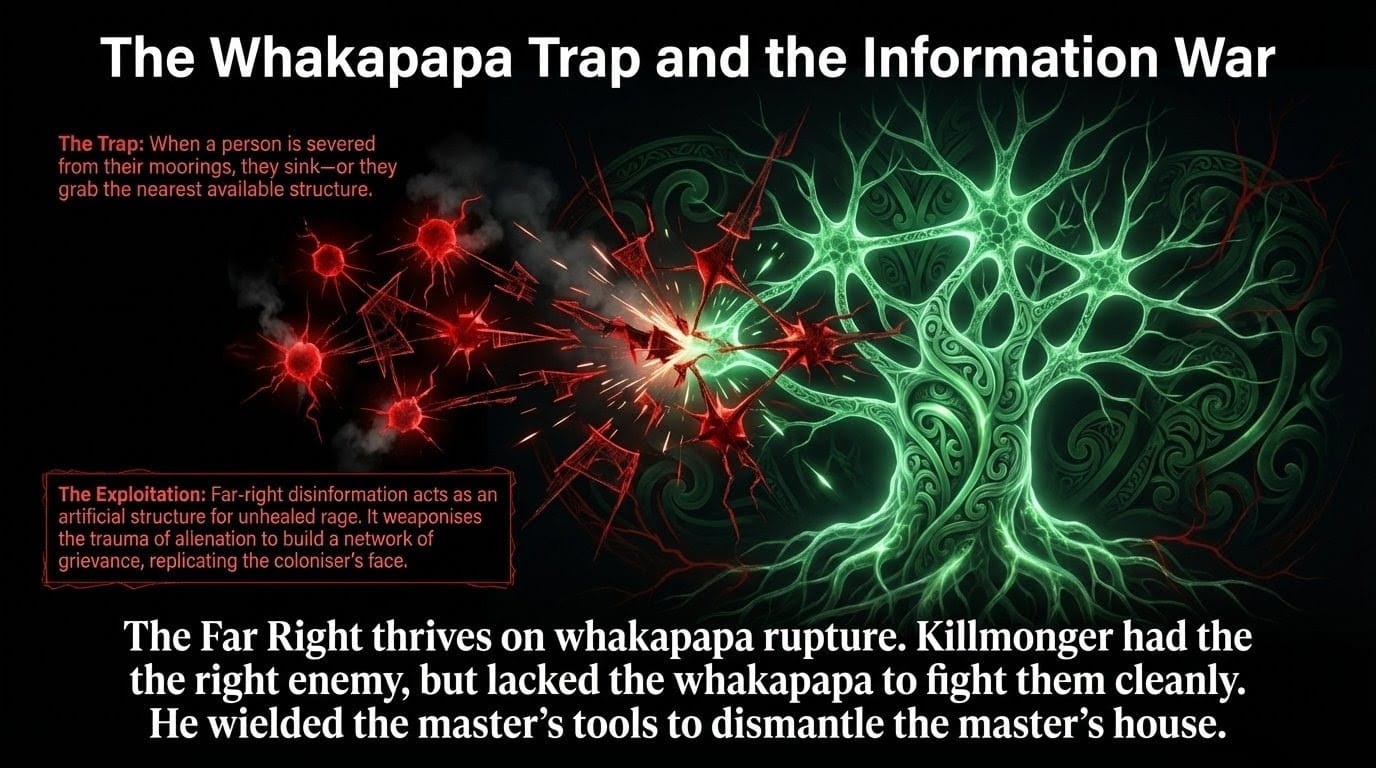
This is the whakapapa trap. When a person is severed from their ancestral moorings, they do not float free. They sink — or they grab the nearest available structure to hold onto.
For Killmonger, that structure was military violence. As the Māori Green Lantern wrote in Te Taiaha o te Aroha: The Weapon They Cannot Confiscate:
"When the Crown legislates English as 'official'… it tells the grandchild of the beaten child: the language they stole from your grandmother is still, officially, less important than the language they beat into her."
That is the whakapapa of Killmonger.
He is what happens when the Crown murders the father and abandons the child in the rubble.
He is not a monster. He is a receipt. A documented consequence of governance by abandonment.
And the tragedy is this: his final words
— "Bury me in the ocean with my ancestors who jumped from the ships, because they knew death was better than bondage"
— are the most devastating lines in the entire Marvel canon. Because in that moment, N'Jadaka finds his whakapapa again. Not his Wakandan whakapapa. The whakapapa of all those who were taken. He dies connected.
He just should have lived that way.
TE REREKĒTANGA — The Critical Difference
T'Challa was never severed from his whakapapa. He grew up knowing his name, his ancestors, his whenua. He could walk into the Ancestral Plane and speak to his father. His identity was not a question — it was a foundation, as The Anthropology of Black Panther makes clear in its analysis of ritual, lineage, and Wakandan sovereignty.
The Māori Green Lantern carries this same rootedness. Whakapapa is not merely genealogical data — it is a living relationship with everything that came before and everything that will come after. As PARSE Journal confirms in its analysis of personhood in Te Ao Māori, this relational framework extends to rivers, mountains, and the cosmos itself. The work of the Māori Green Lantern — across The Butcher, the Baker and the Blackmail Maker, Winston Peters: A Walking Contradiction, and WINSTON PETERS IS A TEMU TRUMP FOR REALS — is not driven by personal grievance. It is driven by obligation: to the ancestors who were silenced, to the mokopuna who deserve truth, to the whānau navigating a hostile colonial present.
That is the difference between the Māori Green Lantern and a Killmonger.
Killmonger had the right enemy. He lacked the whakapapa to fight them cleanly.
The Māori Green Lantern has both.
And the Māori Green Lantern does not seek to burn Wakanda down. He seeks to open its doors. Every essay is an outreach centre. Every verified citation is a piece of vibranium made accessible to whānau who need it. Every named network, every exposed connection, every quantified harm is T'Challa's choice enacted in real time: not isolation, not domination — mana motuhake with open hands.
KO TE KARANGA — The Call That Cannot Be Refused
Black Panther ends not with a battle won but with a decision made: T'Challa opens Wakanda to the world, as Understanding T'Challa's Decision to Open Wakanda to the World explores philosophically. He does not wait for the world to deserve it. He leads.
This is the Māori Green Lantern's project in every investigation, every essay, every lie named and traced to its source. As Te Taiaha o te Aroha declared — aroha is not passive, it is the weapon they cannot confiscate. The coloniser often wears our face, as WINSTON PETERS IS A TEMU TRUMP FOR REALS exposed. The monster has multiple heads but one body, as The Three-Headed Taniwha established. And the taiaha swings with precision — powered by will, grounded in whakapapa.
T'Challa stands in the United Nations and is asked what Wakanda — a nation of farmers and shepherds to the outside world — could possibly offer. He smiles.
The Māori Green Lantern has been answering that question on behalf of tangata whenua since the first essay was published.
Everything. We have everything to offer.
The question was never whether we had gifts. The question was whether the world had the humility to receive them.
He aha te mea nui o te ao?
What is the greatest thing in the world?
He tangata. He tangata. He tangata.
It is people. It is people. It is people.
T'Challa knew it.
The Māori Green Lantern knows it.
Killmonger forgot it — and that forgetting cost him everything.
Know your whakapapa. Carry it with both hands. Never put it down.
KOHA CONSIDERATION
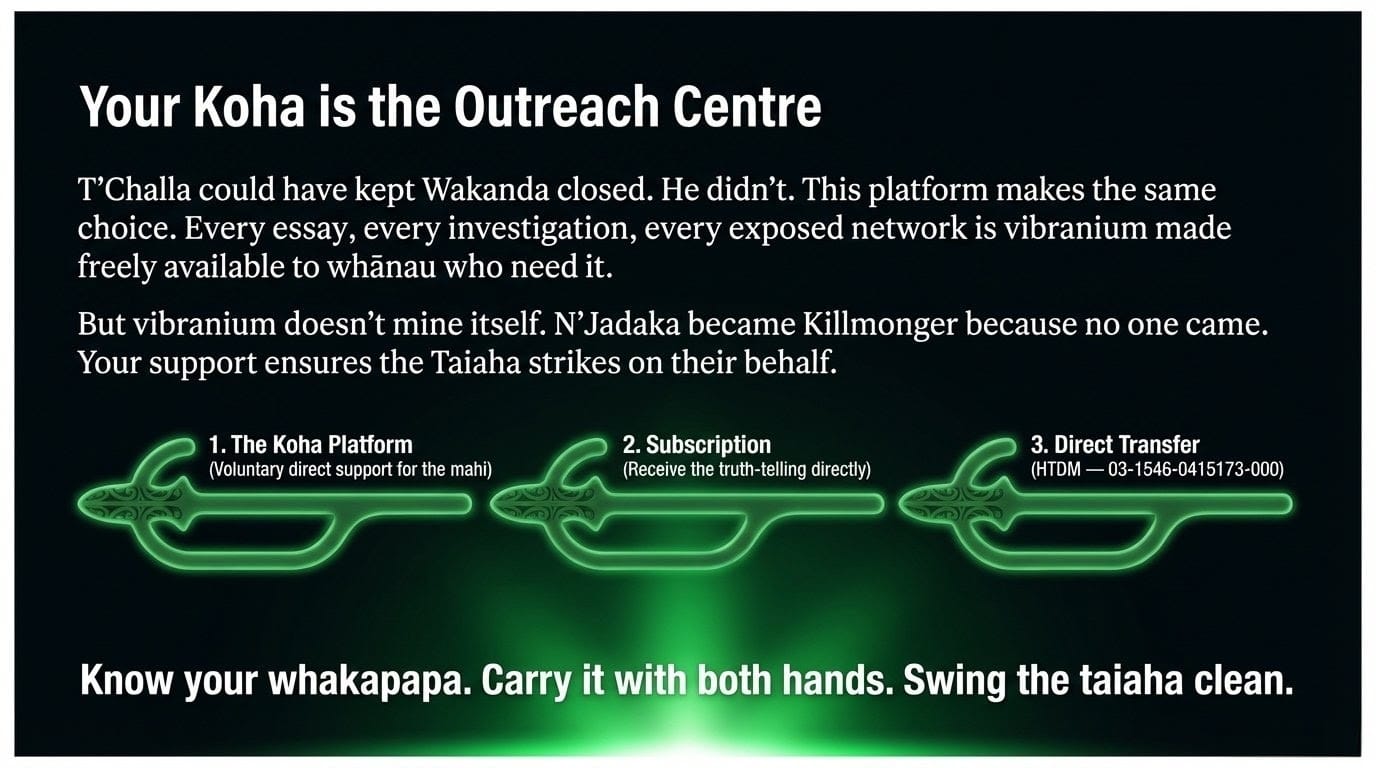
T'Challa had vibranium. He chose to keep it locked away — until he didn't. Until he opened the doors and said: this belongs to everyone who has suffered what we were protected from.
N'Jadaka became Killmonger because the doors stayed closed too long. Because the resources existed and the connection was withheld. Because the Crown — in Wakanda, as in Aotearoa — killed the father and left the child to make sense of the wreckage alone.
Every essay on this platform is an open door. Every investigation is a piece of vibranium released — the whakapapa of power named, the whakapapa of harm documented, the whakapapa of resistance activated. But vibranium doesn't mine itself.
Your koha is the outreach centre. It is the signal that whānau refuse to let another child grow up without the tools of their own liberation. It funds the taiaha that swings on their behalf — not out of rage, but out of aroha, grounded in whakapapa, powered by unbreakable will.
If you cannot koha right now — no worries at all. Share this essay. Talk about it with your whānau, your workmates, your tamariki watching Black Panther on the couch beside you. Show them T'Challa choosing accountability over comfort. Show them why that choice matters. That conversation is whakapapa in action. That is koha in itself. Subscribe or follow at themaorigreenlantern.maori.nz — kōrero and share with your whānau and friends.
Every koha signals that whānau are ready to fund the accountability that Crown and corporate structures will not provide. It signals that rangatiratanga includes the power to fund our own truth-tellers.
Three pathways to support this mahi:
For those who wish to support directly with a voluntary koha, visit the Koha platform:
Koha — Support the Māori Green Lantern
For those who wish to receive essays directly and support through subscription:
Subscribe to the Māori Green Lantern
For those who prefer direct bank transfer:
HTDM — 03-1546-0415173-000
Kia kaha, whānau. Carry your whakapapa. Open your doors. Swing the taiaha clean.
Research conducted April 2026. Sources consulted: themaorigreenlantern.maori.nz essay archive, The Anthropology of Black Panther (UCI), Pan-African Journal of Arts and Culture, E-Tāngata, PARSE Journal, Te Ara, Waitangi Tribunal, The Mary Sue, andphilosophy.com, NZ History, RNZ. All citations embedded as live, verified inline hyperlinks. No bibliography. No footnotes.