"Your Bottom Line Is Not Our Reason For Living" - 9 November 2026
Business Wants Certainty. I Want A Country That Stops Treating Whānau As Fuel For Somebody Else’s Profit.


Mōrena, whānau.
Apparently, we have a problem.
The election has not delivered a settled answer quickly enough, business is frustrated, and Christmas spending might suffer.
 RNZ | Te Reo Irirangi o Aotearoa

Well, excuse the rest of us for thinking the purpose of an election was to establish who has the right to govern—not to get the tills ringing before the decorations go up.
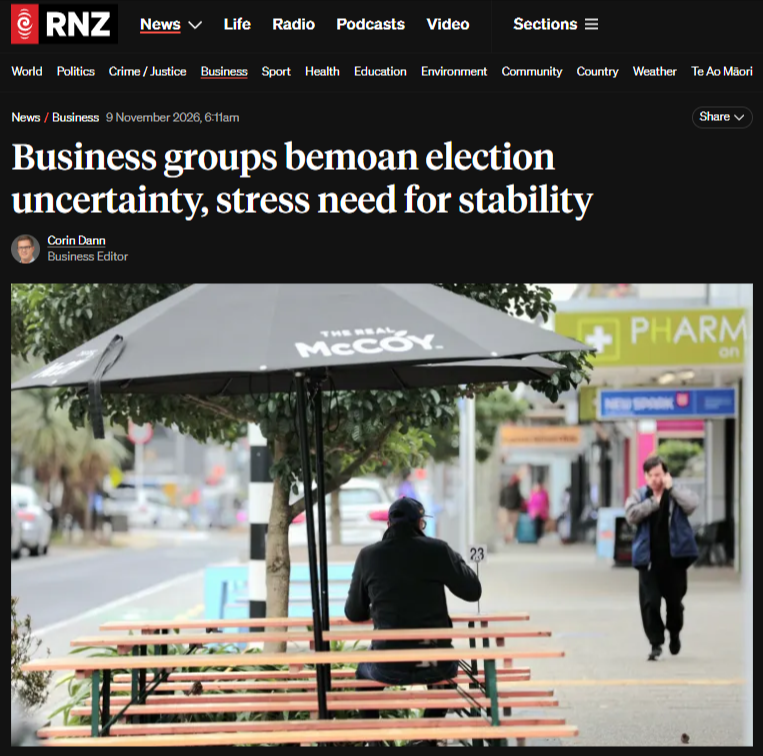
That is my objection to RNZ’s report, “Business groups bemoan election uncertainty, stress need for stability”.
The article hears from business representatives about delayed purchases, uncertain policy, consumer confidence and Christmas trading. It does not give comparable space to the people whose lives the next government will shape.
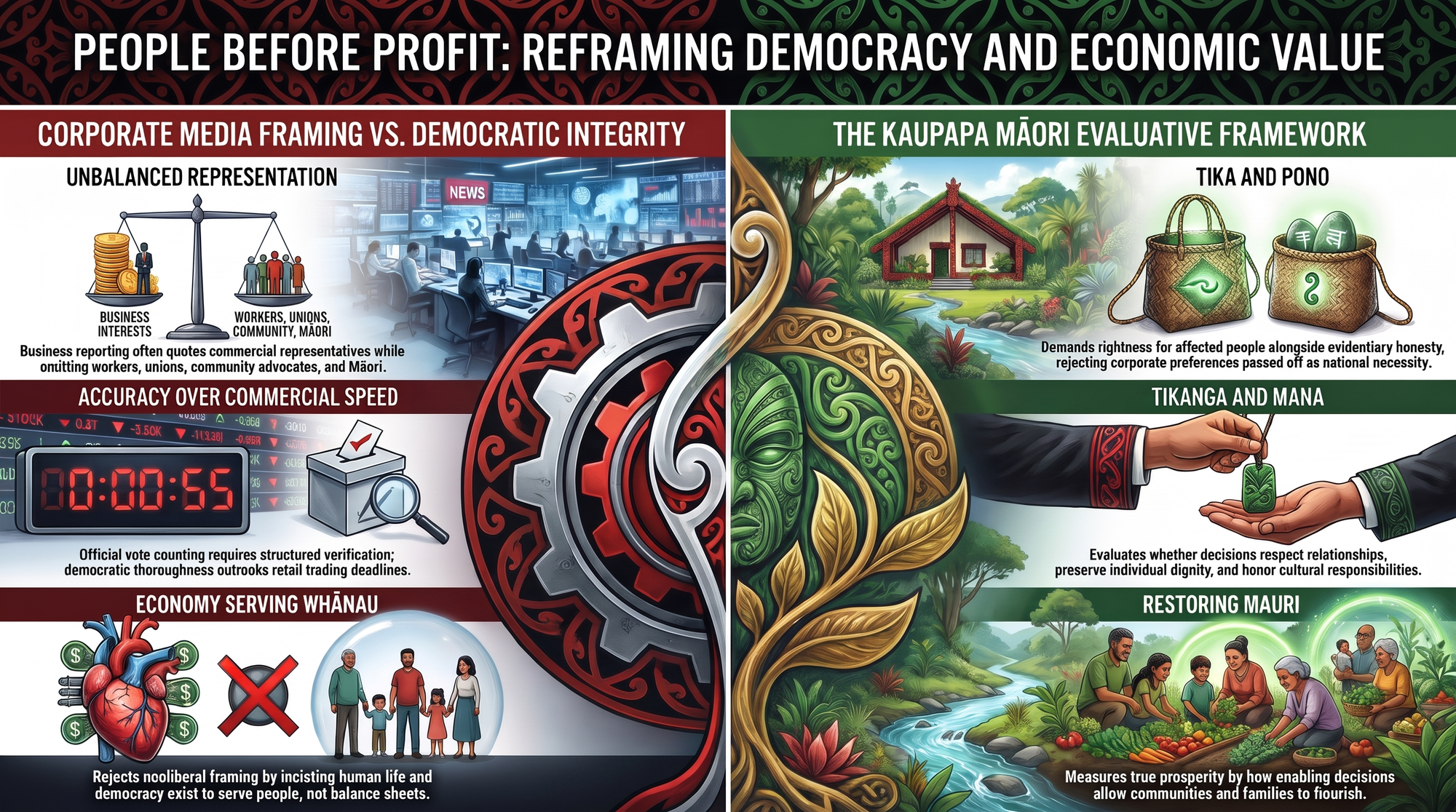
I want to pull that framing apart. Who gets heard? What does “stability” actually mean? Why is properly counting votes presented mainly through the inconvenience to business? And what changes when we judge an economy through Tika, Pono and Tikanga—through whether it strengthens the mauri of people and communities—instead of whether it keeps commercial interests comfortable?
Because I am tired of the order being reversed.
People do not exist to serve the economy. The economy should serve people.
If that sounds too radical for the boardroom, the boardroom can cope.
Business Gets The Microphone. Everybody Else Gets A Shopping Basket.
Let’s start with what is actually there.
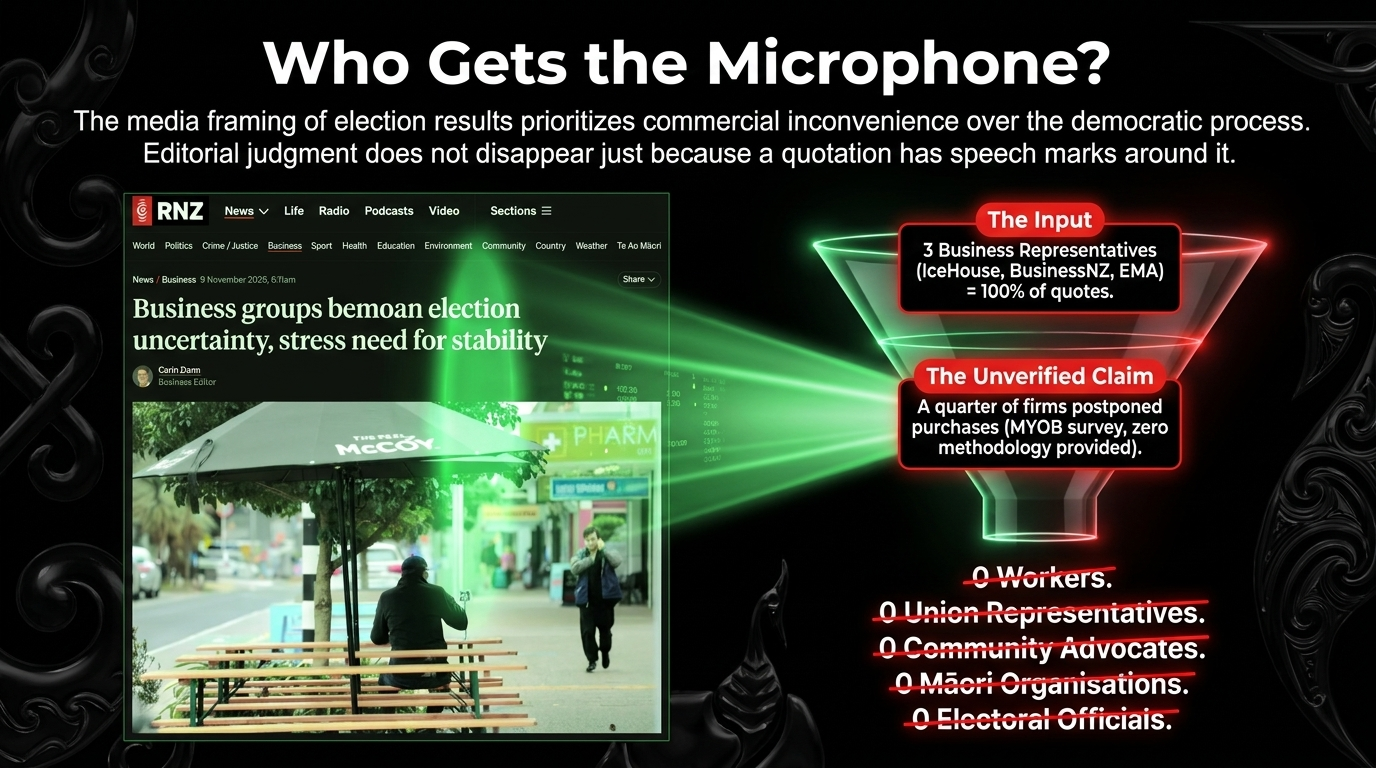
Corin Dann’s article quotes Olivia Baylock of IceHouse, Katherine Rich of BusinessNZ, and Alan McDonald of the Employers and Manufacturers Association.
Three business representatives. No quoted worker, union representative, community advocate, Māori organisation or electoral official.
That is not a claim about every story RNZ has published. It is a description of this one.
And yes, the headline says business groups are doing the bemoaning. Reporting a complaint is not automatically endorsing it.
But come on. Editorial judgment does not disappear just because a quotation has speech marks around it.
Someone chooses whose concern opens the story. Someone chooses who explains the situation. Someone decides whether a claim gets questioned or simply followed by another person expressing a similar concern.
Here, the opening concern is business frustration, and the closing concern is uncertainty over the policy stability business wants.
The people outside that conversation mostly enter it as potential spenders.
Not as parents trying to keep a household together. Not as workers wondering what happens to their conditions. Not as Māori asking what the government intends to do with our rights and authority.
As consumers.
I reject that miserable little version of human life.
A person is not a wallet with legs.
The Deep Dive Podcast
Listen to a lively conversation between two hosts, unpacking and connecting topics in the sources of this essay. I apologise in advance for the AI's very harsh pronounciation of reo. Please dont shoot me, :).
Youtube Video
Like video? Here is a short video suppporting the essay. Again, don't shoot the messenger please because of AI's pronounciation. 😄
Counting My Vote Is Not An Obstacle To Your Sale
Read that alongside what the Electoral Commission actually does.
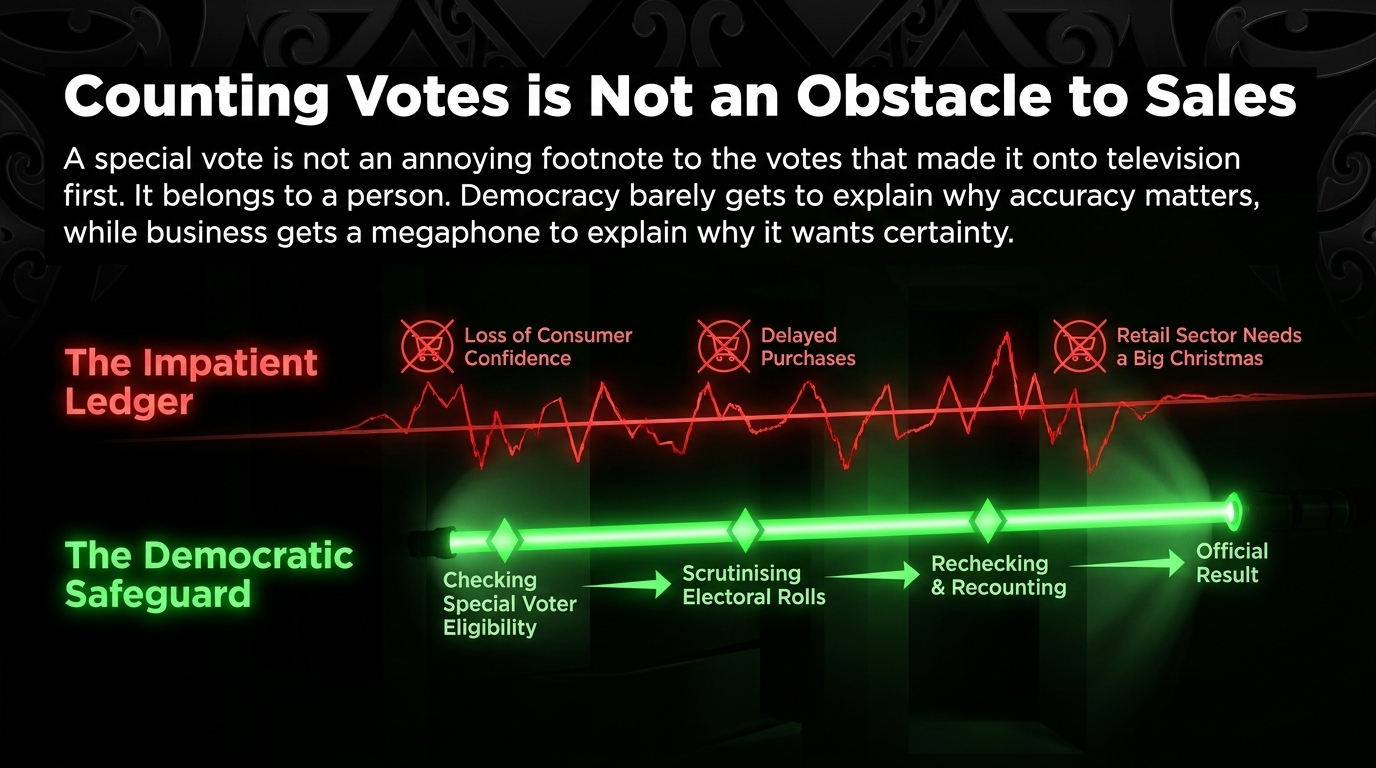
Its published explanation describes checking special voters’ eligibility, scrutinising electoral rolls, and rechecking and recounting voting papers. It says official results are declared 20 days after election day.
That timetable concerns the result. Negotiating a government is a separate matter.
But the point is straightforward: people are working to establish the legitimate outcome. They are not lounging around obstructing somebody’s Christmas promotion.
A special vote is not an annoying footnote to the votes that made it onto television first.
It belongs to a person.
Their right to be counted does not shrink because a business owner would prefer an earlier answer.
Nobody quoted in this article explicitly demands that valid votes be discarded. I will not put that accusation in their mouths.
My criticism is the imbalance: RNZ explains the commercial frustration without giving readers a comparable account of the safeguards that make the wait necessary.
Business gets to explain why it wants certainty.
Democracy barely gets to explain why accuracy matters.
“Stability” For Whom, Exactly?
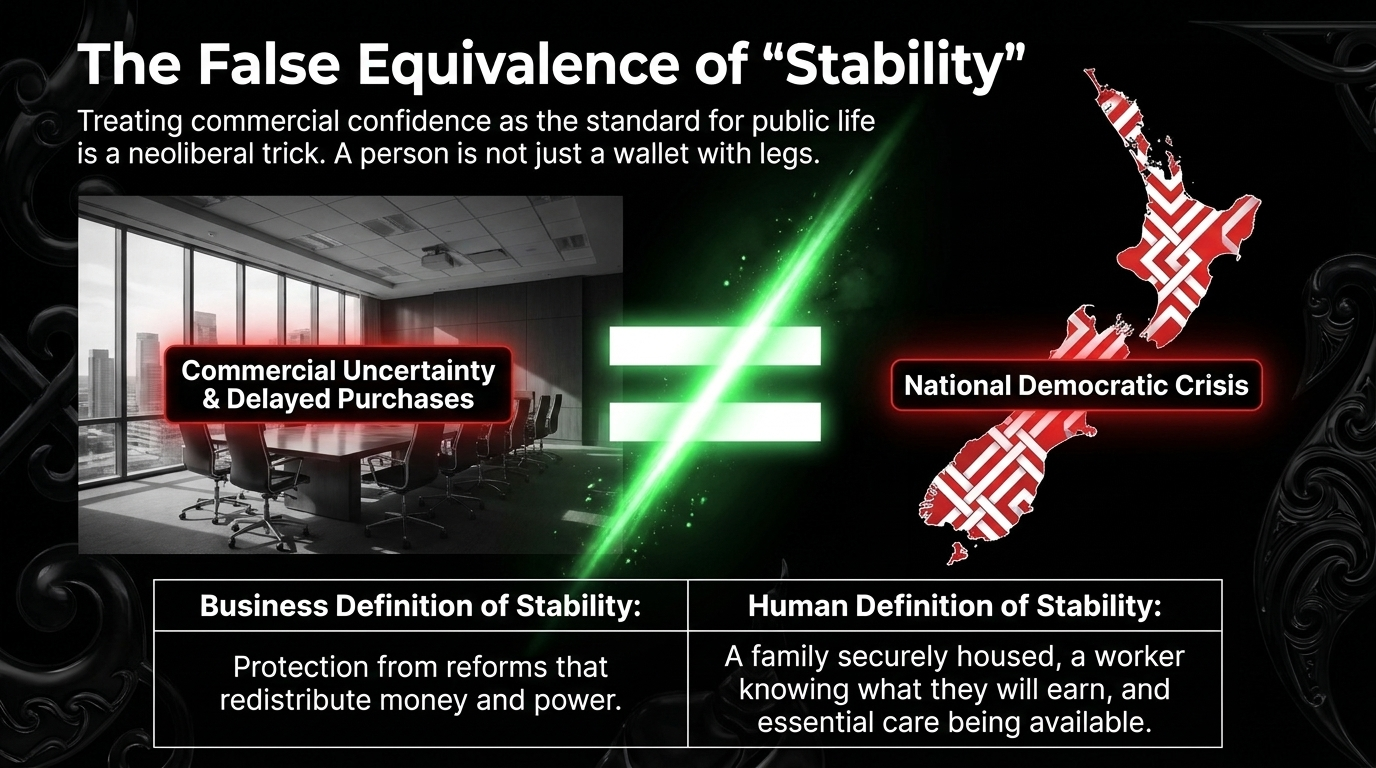
Fine. Nobody sensible wants government by daily improvisation.
But stable towards what?
A family securely housed is stability. A worker knowing what they will earn is stability. A person trusting that essential care will be available is stability.
Those are the standards I want brought into the conversation.
“Stable policy” is not automatically good policy. An unjust arrangement can endure beautifully for the people benefiting from it.
So ask the next question.
Which policies do these organisations want preserved? Which changes frighten them? Are they asking for dependable administration, or protection from reforms that might redistribute money and power?
I am not claiming the answer without evidence. I am saying that is where journalism should go.
Otherwise “stability” becomes a respectable word that saves everybody the trouble of explaining whose advantage is being stabilised.
This Is The Neoliberal Trick I Am Challenging
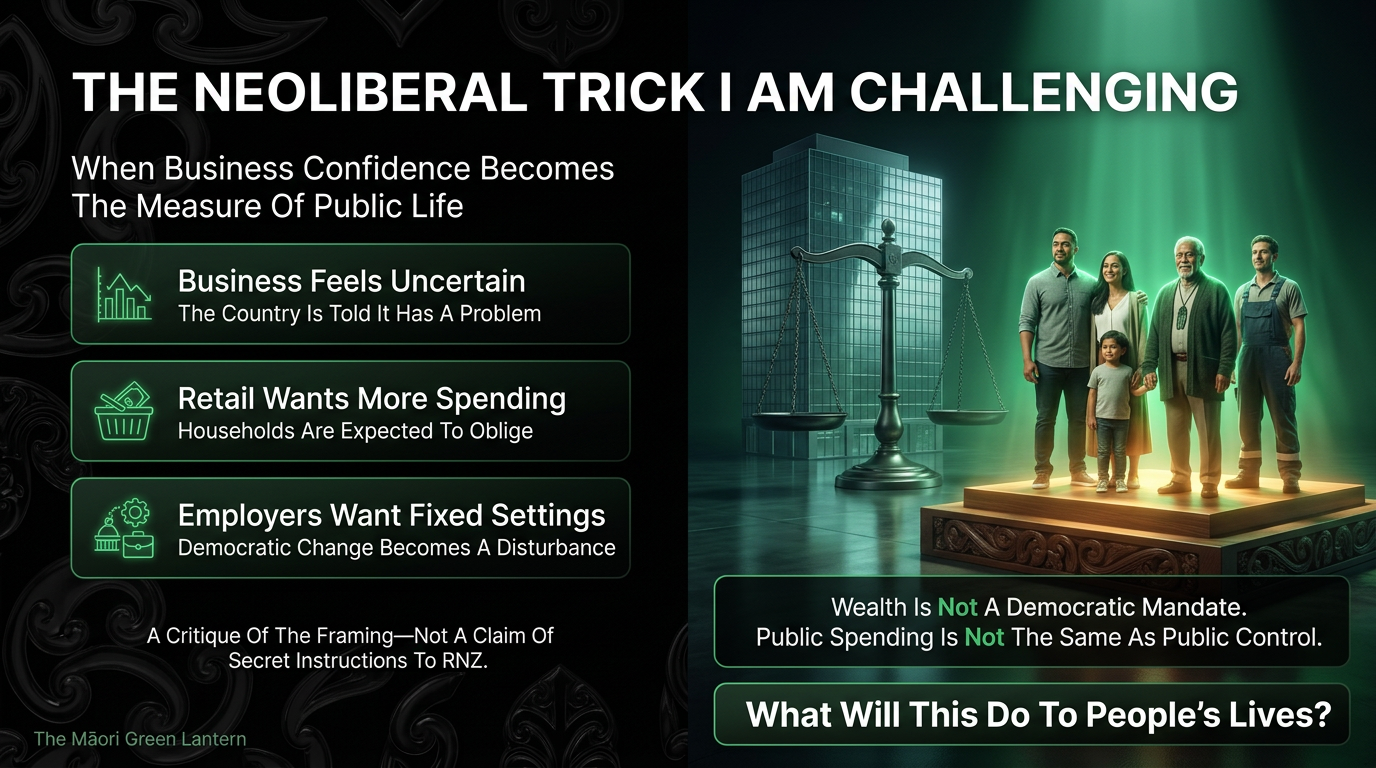
Here is what I mean by neoliberalism in this argument: treating commercial confidence as the standard around which public life should organise itself.
Businesses feel uncertain, so the country has a problem. Retail needs spending, so households should apparently oblige. Employers want enduring settings, so democratic change starts sounding like a disturbance.
That is my interpretation of the framing—not proof of a secret instruction issued to RNZ.
I do not need a conspiracy to recognise a bad hierarchy.
When I wrote “Your Fortune Is Not A Mandate”, my argument was that financial power does not confer superior democratic authority.
The same principle applies here.
Running a business does not give anyone a higher claim over the country’s direction than the people doing the work, caring for children, supporting relatives or living with the consequences of government decisions.
And as I argued in “The Public Pays, The Private Sector Grows”, public spending and public control are not interchangeable. We have to ask what an arrangement strengthens and whom it answers to.
That question belongs in economic reporting too.
Not just, “Will business spend?”
“What will this do to people’s lives?”
Tika, Pono And Tikanga Are Not Decorations For A Corporate Brochure
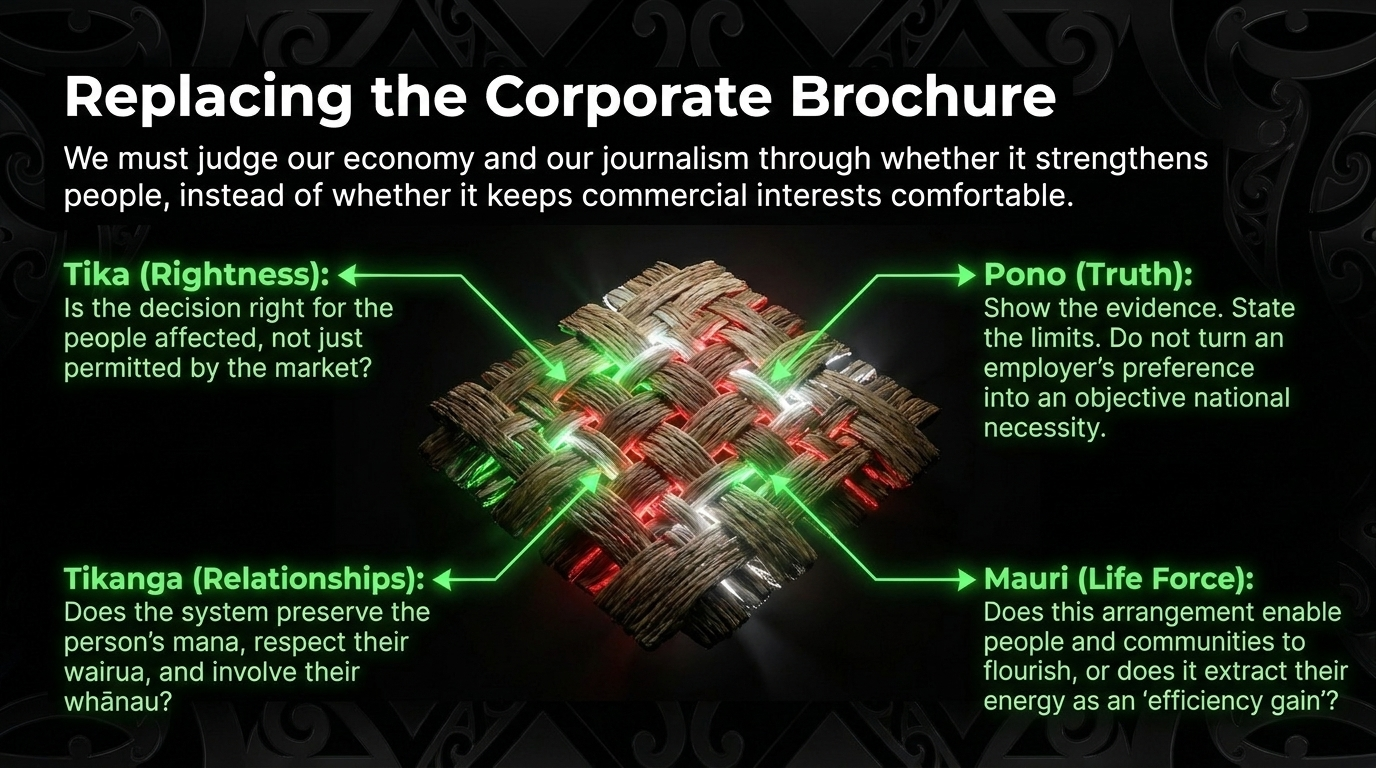
I am using Tika, Pono, Tikanga and mauri here as the framework for my argument—not pretending these short explanations exhaust their meaning or speak for every iwi.
Tika asks whether we have got the thing right. Not simply whether a transaction was permitted, but whether the decision was right for the people affected.
Pono demands honesty. Show the evidence. State the limits. Do not turn an employer’s preference into an objective national necessity. Do not let me turn a suspicion into a fact either.
Tikanga takes us into relationships and responsibilities. Did the system preserve the person’s mana? Recognise their whakapapa? Respect their wairua? Involve their whānau in ways they wanted? Help return them to wellbeing?
Those are the questions I want asked.
A system does not pass because its spreadsheet balances while the person leaves diminished.
Nor does it pass because someone delivered a culturally polished welcome before refusing to listen.
When I talk about building mauri, I mean paying attention to what enables people, relationships and communities to flourish.
Not extracting what you can from them and calling the exhausted remainder an efficiency gain.
Let Me Put It In Terms A Spreadsheet Can Understand
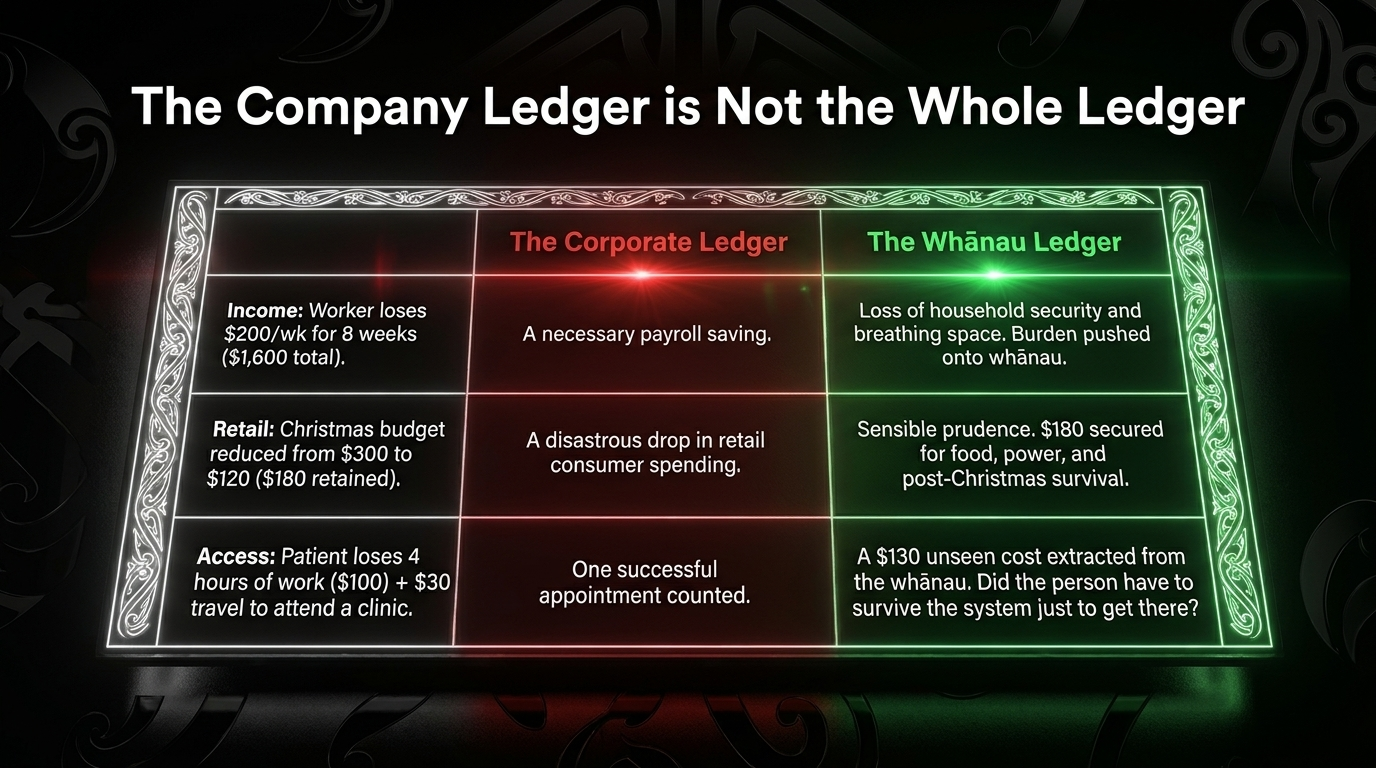
For readers trained to see value through prices, budgets and measurable outputs, here are three illustrations.
These are hypothetical examples, not invented case histories or claims about measured national harm. The arithmetic is deliberately simple. What it leaves out is often the most important part.
Example One: The Employer Saves Money. The Household Loses Security.
Suppose a worker loses $200 of income each week for eight weeks.
That is $1,600 less coming into the household.
An employer might describe the change as a necessary saving. But that description does not tell us what happens at home.
Does the worker fall behind? Does someone postpone an essential purchase? Does the household lose the small amount of breathing space it had?
Those consequences would need to be investigated, not assumed. The point is that the employer’s saving and the household’s loss are different perspectives on the same decision.
My tikanga questions go further. Was the worker treated with dignity? Were their responsibilities understood? Did they have meaningful input? Was the burden simply pushed onto whānau?
Recognising whakapapa means refusing to imagine that worker as an isolated labour cost. They belong within relationships. Other lives may depend on their income and presence.
My proposed response is practical: examine alternatives before cutting hours, give workers a genuine voice, assess household consequences, and judge the decision by more than the saving achieved.
The company ledger is not the whole ledger.
Example Two: Christmas Sales Fall. A Whānau Makes A Sensible Decision.
Suppose a household reduces its Christmas spending from $300 to $120.
That leaves $180 for something else.
A retailer sees a smaller sale. The household might see money available for food, power or the weeks after Christmas.
Neither perspective, by itself, establishes the whole economic picture. But why should the smaller sale automatically be treated as the bad outcome?
McDonald tells RNZ: “The retail sector needs a big Christmas season.”
I hear that. Now tell me what the household needs.
Tikanga asks whether we preserve people’s mana or shame them for not performing the right level of consumption.
It asks whether being together, caring for each other and maintaining relationships can count as a worthwhile Christmas without a satisfactory shopping receipt.
My proposed response is not “destroy retail”. It is stop treating household restraint as a public failure without asking why it happened.
Support secure incomes, affordable essentials and access to sound financial advice. Report household wellbeing alongside sales.
A child’s worth does not rise with the price of the present.
Example Three: The Appointment Is Counted. The Cost To The Person Is Not.
Imagine someone attending an appointment who loses four hours of paid work at $25 an hour and spends $30 travelling.
The immediate illustrative cost is $130.
That excludes childcare and other possible burdens. It is not a claim about the typical patient.
Now imagine a service reporting only that the appointment occurred.
Useful information? Yes.
A complete account of access? No.
Tikanga asks whether the person could bring whānau if they wished, whether their relationships and cultural needs were respected, and whether what mattered to their wairua had room to be heard.
It also asks whether treatment helped. A respectful conversation is not a substitute for care that never arrives.
My proposed response is to assess the whole pathway: practical access, appointment flexibility, whānau involvement, continuity and outcomes—not merely the completed transaction.
That is the distinction I explored in “The Public Pays, The Private Sector Grows”: receiving a service matters, but it does not settle whether the wider system is organised well.
In plain English, stop declaring victory before you have asked what the person had to survive to get there.
Māori Rights Are Not An Irritating Business Condition
This is where my objection reaches beyond the article.
I will not judge a government solely by how comfortable it makes employers while refusing to examine what it does to Māori authority.
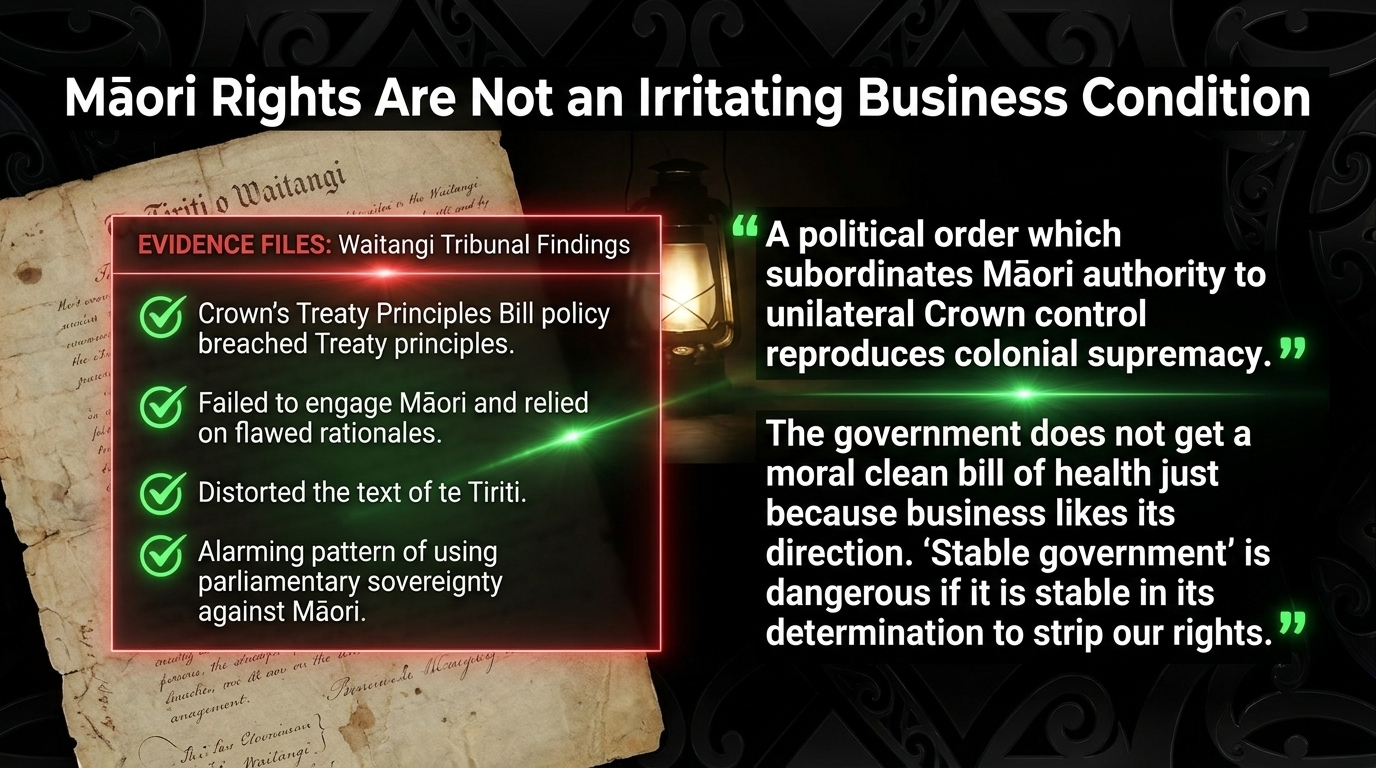
There is documented conduct to examine. The Waitangi Tribunal found that the Crown’s Treaty Principles Bill policy breached Treaty principles, failed to engage Māori, relied on flawed rationales and distorted the text of te Tiriti. It also found breaches in the Treaty clause review policy.
Those findings concern the policies examined. They are not a finding that this RNZ story was directed by the government.
But they explain why “stable government” cannot be the end of my inquiry.
Stable in its determination to do what?
That is serious enough without embellishment.
My criticism is that a political order which subordinates Māori authority to unilateral Crown control reproduces colonial supremacy. I will confront that structure through its documented conduct—not pretend I can prove every minister’s private beliefs by applying a label.
The government does not get a moral clean bill of health because business likes its direction.
Nor does an employer’s desire for certainty outrank our right to challenge that direction.
Yes, Small Businesses Matter. No, That Does Not End The Argument.
I know the response: small business owners are people too.
Of course they are.
A self-employed tradesperson is not a multinational corporation. A family shop is not an employer lobby. A kaupapa Māori provider is not interchangeable with an investor-owned chain.
Flattening those differences would be lazy.
The article also includes qualifications that deserve to stay in view: Rich says business leaders understand the delay, and McDonald says an extended wait probably will not make much difference because businesses are already used to uncertainty.
So this is not a uniform demand to bypass democracy.
But if the story is about small firms facing real risks, establish those risks.
Which purchases are delayed? What jobs depend on them? What would help without weakening anyone else’s rights?
That does not make the claim false. It makes it insufficiently explained.
Pono requires that distinction.
And no, shared rhetoric does not establish that everyone quoted is a New Zealand Initiative member or that RNZ is acting on its instructions. I will not manufacture the affiliation to strengthen an argument that does not need it.
RNZ Is A Public Broadcaster, Not A Business Reassurance Service
“It’s the business section” is not a satisfactory defence.
Business journalism can ask hard questions. It can explain whose interests are being advanced. It can connect a commercial decision to the people who bear its consequences.
It also says RNZ must ensure it is not influenced by other parties’ commercial interests.
I am not declaring that this article establishes a legal breach or improper influence. I am saying its narrow framing deserves criticism against the breadth of RNZ’s public purpose.
Ask an electoral official why the count takes time.
Ask business representatives which policies they want protected.
Ask households whether buying less might be self-protection rather than a regrettable failure to consume.
Ask Māori what political certainty means when the certainty being offered may concern the further reduction of our authority.
That would not be anti-business.
It would be journalism with its eyes open.
I Am Building A Record, Not A Sales Funnel
I would love you to click through to my essays—not because I want you endlessly clicking, but because I want this work to be useful when you are talking with whānau, questioning a headline or assessing what a politician has promised.
For people who prefer listening or watching, “Your Fortune Is Not A Mandate” includes a long-form podcast and a YouTube section alongside the cited essay. There are different ways into the kaupapa. The purpose is understanding, not making everyone consume information the same way.
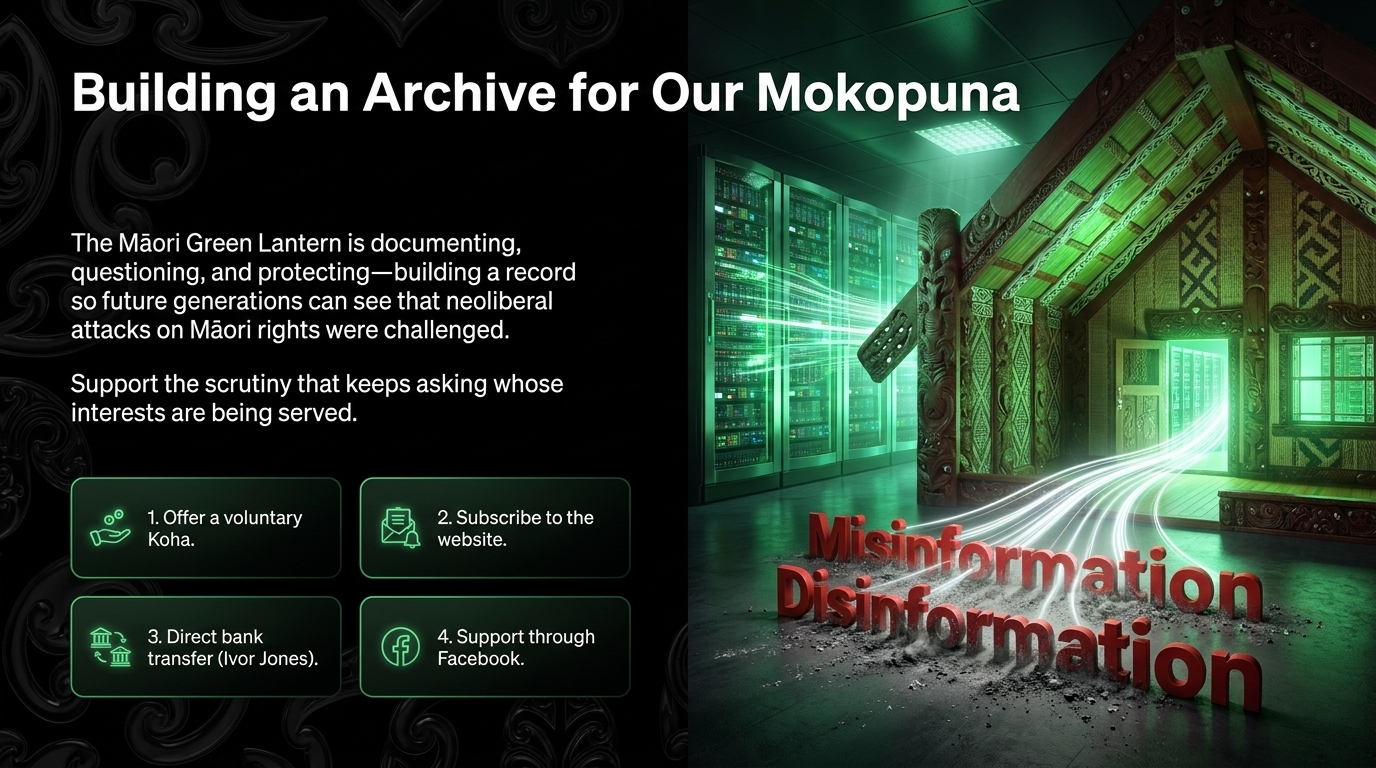
I want this growing archive to remain for our mokopuna.
I want them to look back and see that neoliberalism, misinformation, disinformation and attacks on Māori rights were challenged while they were happening. That the Māori Green Lantern and others were documenting, questioning and trying to protect people—not quietly accepting every polished explanation from power.
They should also be able to inspect our evidence.
An archive built to resist misinformation must not become another place where certainty outruns truth.
Koha Consideration

Who supports and protects this mahi?
You do.
There are no corporate backers behind the Māori Green Lantern; this work is supported through koha.
If this essay has helped you separate business confidence from whānau wellbeing, consider helping support and protect the scrutiny that keeps asking whose interests are being served.
Your koha does not buy agreement. It helps this voice keep checking claims, naming responsibility and building a record for our mokopuna.
You can:
Offer A Voluntary Koha.
Subscribe To The Māori Green Lantern.
Use direct bank transfer: Ivor Jones — 03-1395-0099387-000, as listed on the Koha page.
Support Through Facebook.
If you cannot koha, no worries. Read, follow, kōrero and share with whānau and friends. That is koha too.
The Till Can Wait. Our Humanity Cannot.
I am not asking for businesses to be silenced.
I am asking for them to be put back in proportion.
Let them explain what they want. Then ask who benefits, who carries the cost, and whether their preferred outcome strengthens or diminishes the lives around them.
Do not tell me an arrangement is successful until you can explain what happened to the people.
Was their mana preserved? Were their relationships recognised? Was their wairua respected? Did they have meaningful authority? Were whānau welcomed where the person wanted them involved? Did the decision help restore wellbeing and strengthen mauri?
Those questions are not sentimental extras to be considered after the serious business.
They are the serious business.
A country that forgets that can produce beautifully presented accounts of its own failure.
I will not call that prosperity.
Your bottom line is not our reason for living. Your desire for certainty is not a veto over democracy. And our whānau are not raw material for somebody else’s success.
The economy should answer to us.
Not the other way around.
Disclaimer
This essay is my commentary and analysis as Ivor Jones, The Māori Green Lantern. It challenges reporting, policy and power—not the worth of individuals. I distinguish sourced facts from opinion; the household examples are hypothetical, not reported cases. Tika, Pono and Tikanga guide my analysis, but I do not speak for all Māori, iwi or hapū. Any factual errors will be corrected in keeping with Pono.