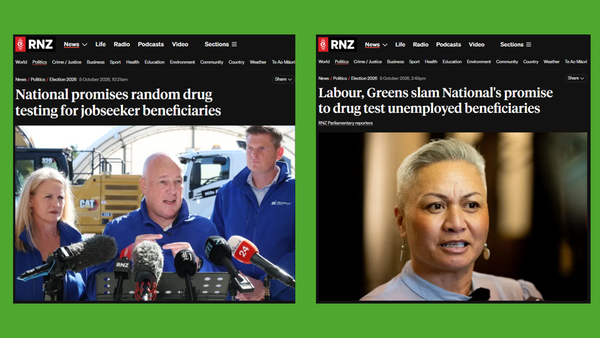
"The Coalition Cracks Open: How National's Under-16s Bill Exposed The Rot At The Heart Of This Government — And The Digital ID Trojan Horse It's Smuggling Through The Wreckage" - 25 August 2026
They Couldn't Even Convince Their Own Cabinet. So Ask Yourself Why They're So Desperate To Convince You.

I am Ivor Jones. I am the Māori Green Lantern.
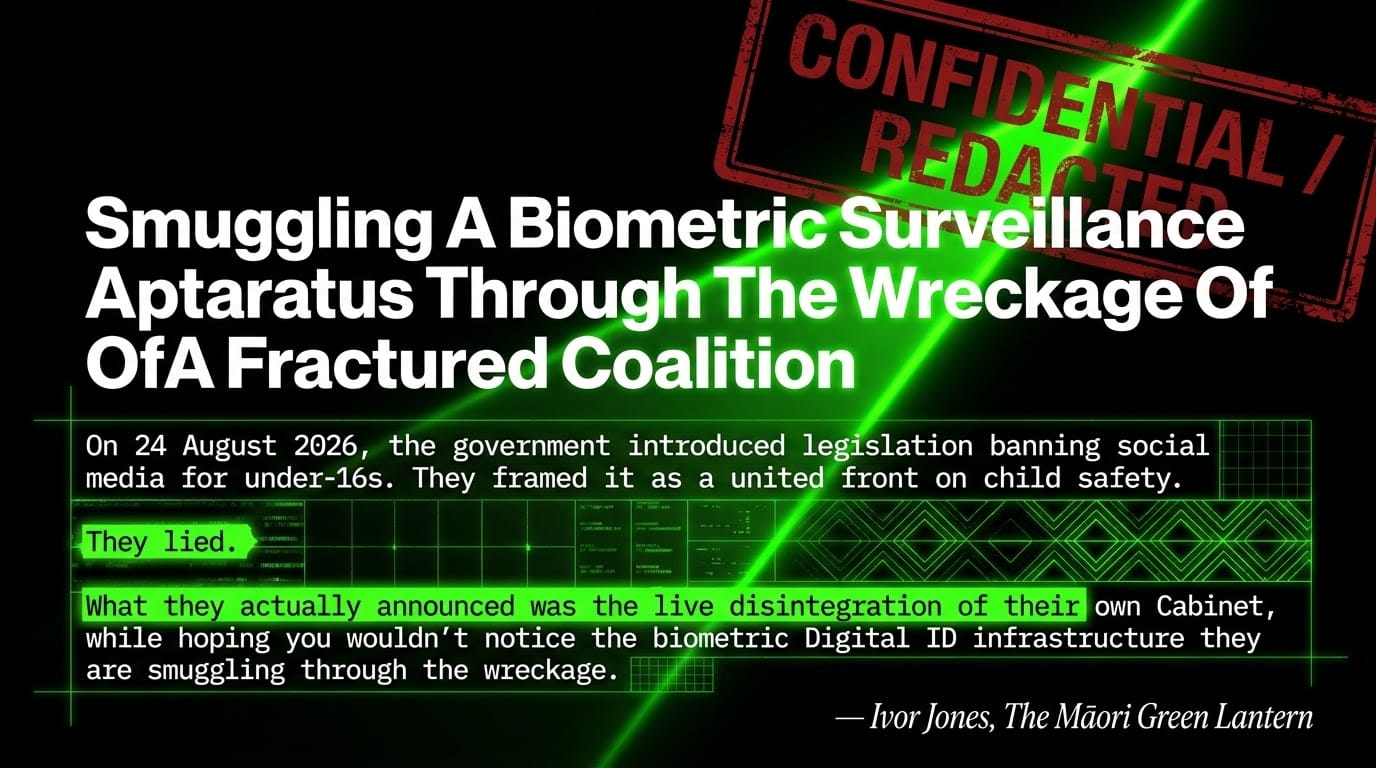
On 24 August 2026, this coalition government did not announce a united front on child safety.
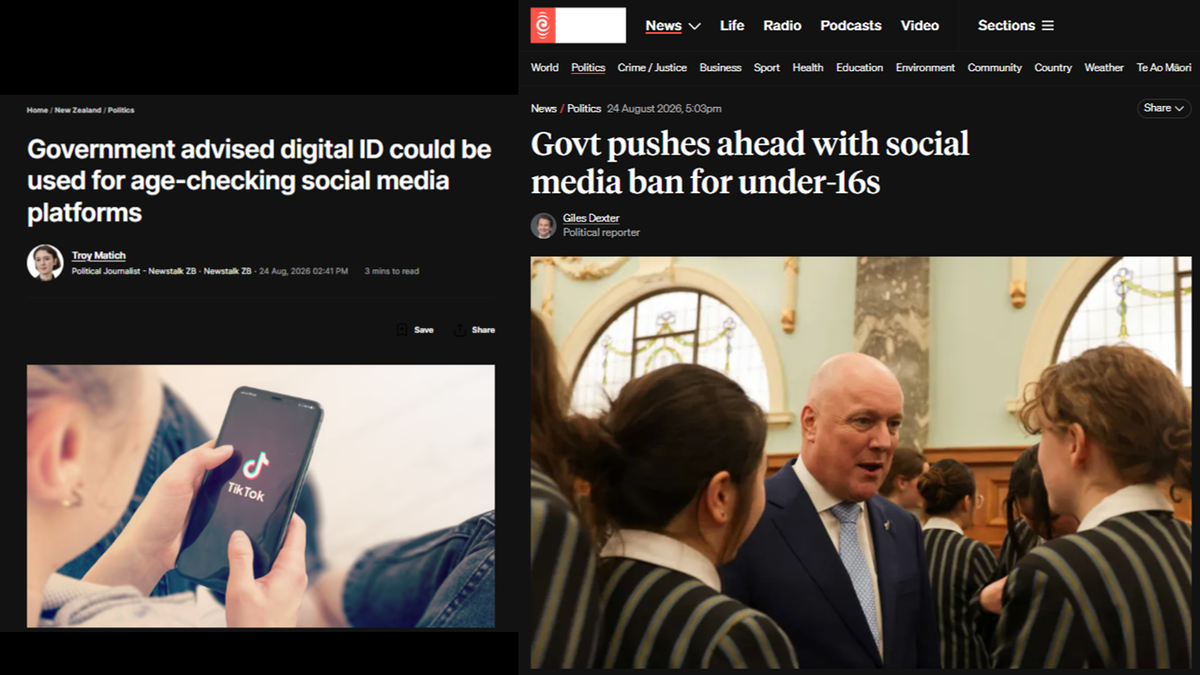
 RNZ | Te Reo Irirangi o Aotearoa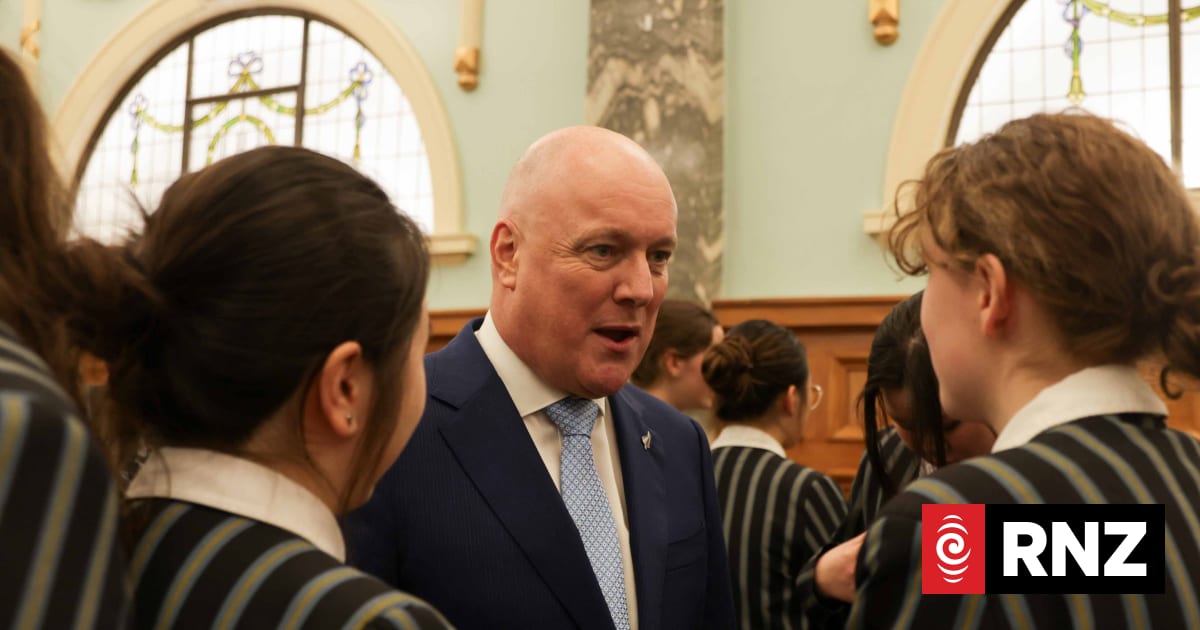
 Troy Matich
It announced its own disintegration — live, on the record, in front of the press gallery — while trying to smuggle a biometric surveillance apparatus through the wreckage.
Let me show you exactly how this fell apart, and exactly what they were hoping you wouldn't notice while it did.
The Bill That Broke The Coalition
The government introduced legislation banning social media for under-16s to Parliament on 24 August 2026, with Prime Minister Christopher Luxon framing it as a government initiative
— a claim that lasted about as long as it took Winston Peters to reach a microphone.
"To call it a government bill is a falsity," Peters told an impromptu press conference at Parliament that same day. "It is from the National Party, and that should have been explained to you," according to RNZ's report by Giles Dexter.
This was not a minor rhetorical dispute.
Both ACT and New Zealand First — National's own governing coalition partners — invoked the coalition agreement's "agree to disagree" clause, formally withdrawing their support, which means National now requires votes from Labour, the opposition, simply to get the bill past its first reading.
A government coalition cannot secure the backing of its own coalition.
Sit with that for a moment.
This is not a policy disagreement at the margins. This is a governing arrangement that has failed at the most basic test of governing:
agreeing with itself.
David Seymour did not offer measured disagreement
— he offered public contempt for the bill's central enforcement mechanism.
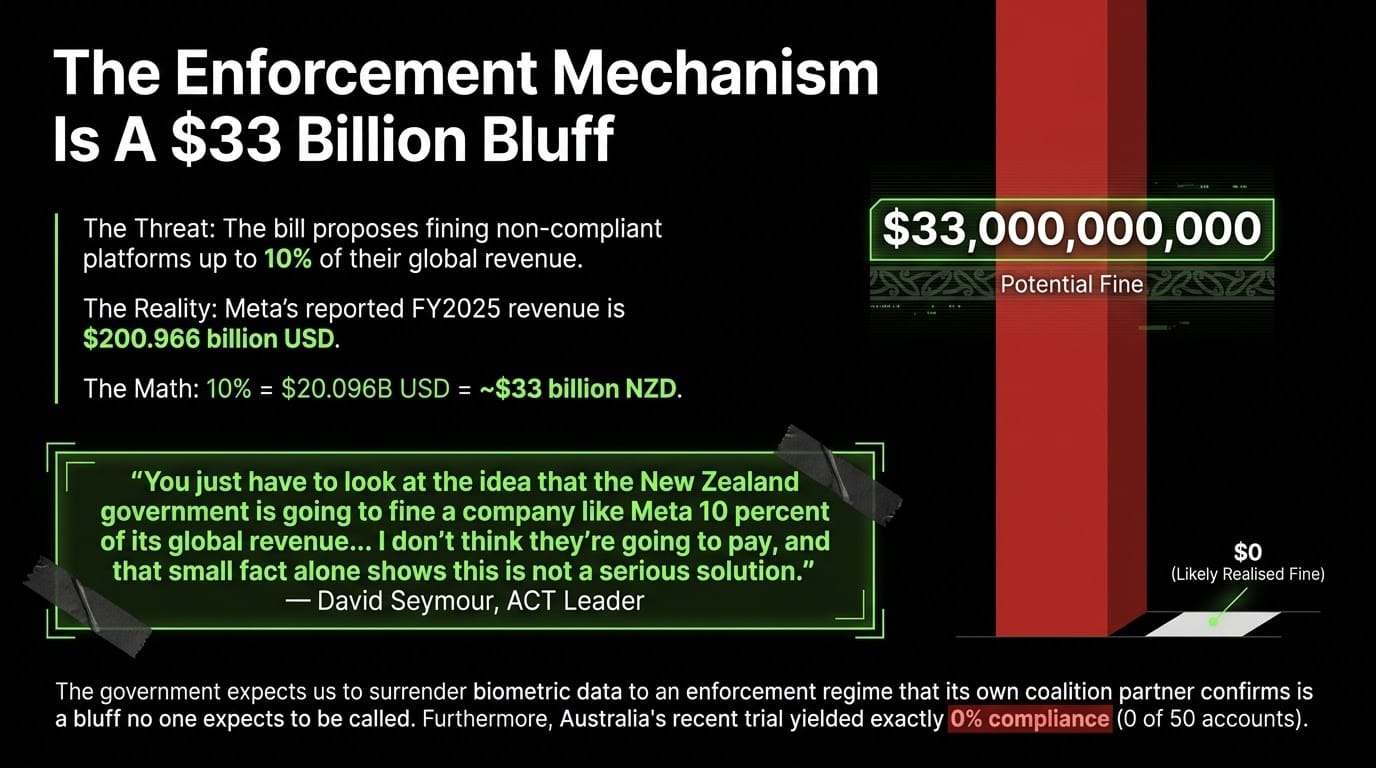
The legislation proposes fining non-compliant platforms up to 10 percent of their global revenue. Seymour did the maths on air:
"You just have to look at the idea that the New Zealand government is going to fine a company like Meta 10 percent of its global revenue. That would be $33 billion," he said, before adding, "I don't think they're going to pay, and that small fact alone shows this is not a serious solution".
I checked his figure against Meta's own reported 2025 revenue of $200.966 billion USD — 10 percent converts to roughly $33 billion NZD at current exchange rates. He is right. The government's own coalition partner has publicly confirmed, with correct arithmetic, that the enforcement mechanism of its flagship child-safety bill is a bluff no one expects to be called.
Then Peters went further than arithmetic.
He named the actual danger buried inside this bill: that such a ban would cost New Zealanders "all sorts of freedoms" through the use of digital ID. Read that sentence again.
This is not an activist, an academic, or a Māori data sovereignty advocate saying this.
This is the former Deputy Prime Minister of New Zealand, standing at Parliament, telling the country that his own government's flagship policy is a vehicle for mass biometric surveillance.
He has also vowed to investigate exactly how much taxpayer money has already been spent on the bill and what he calls the "propagandising" surrounding it.
The Deep Dive Podcast
Listen to a lively conversation between two hosts, unpacking and connecting topics in the sources of this essay. I apologise in advance for the AI's very harsh pronounciation of reo. Please dont shoot me, :).
Youtube Video
Like video? Here is a short video suppporting the essay. Again, don't shoot the messenger please because of AI's pronounciation. :)
Koha Consideration:
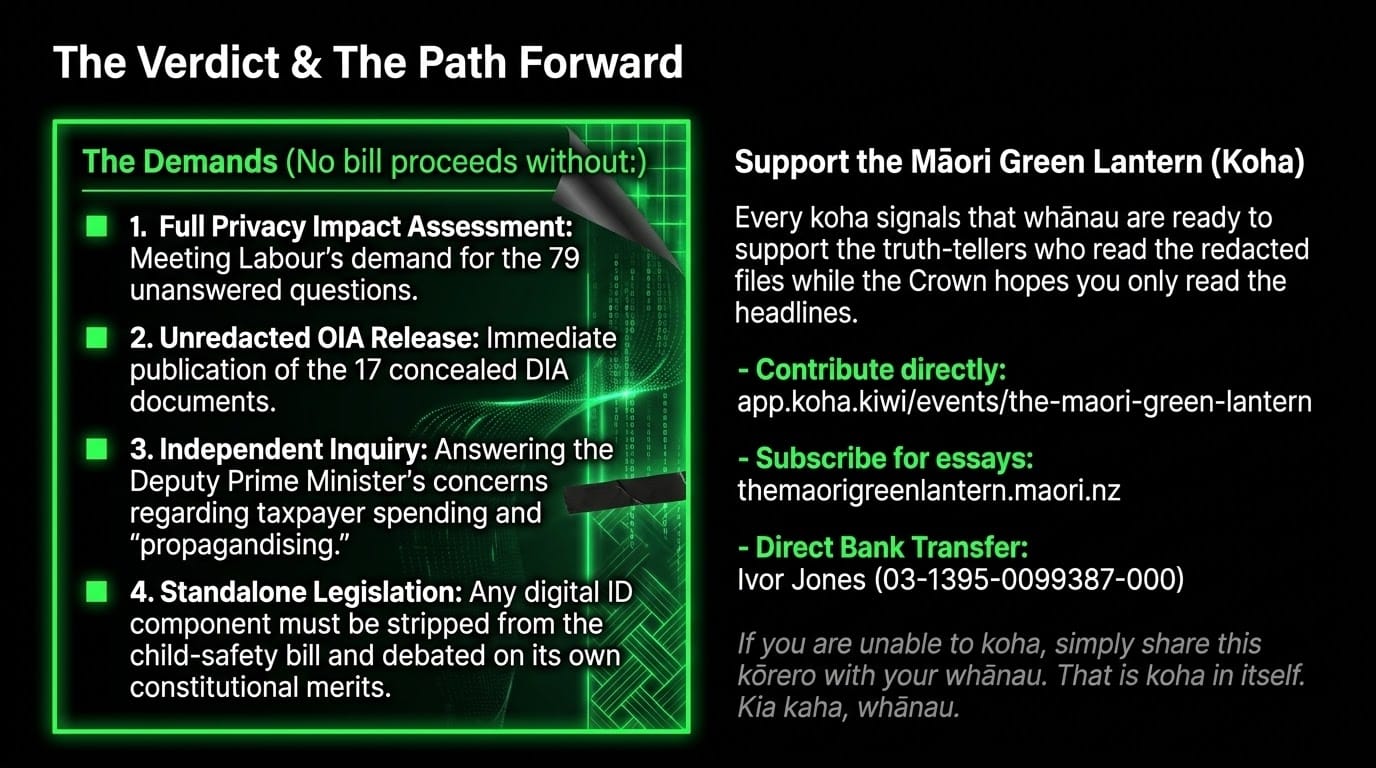
Every koha signals that whānau are ready to support the accountability that Crown and corporate structures will not provide.
It signals that rangatiratanga includes the power to support our own truth tellers — the ones who read the Parliamentary record and the redacted OIA files while a fractured coalition hopes you're only watching the headline.
Kia kaha, whānau. Stay vigilant. Stay connected. And if you are able, consider a koha to ensure this voice continues.
If you are unable to koha, no worries! Subscribe or follow the Māori Green Lantern at themaorigreenlantern.maori.nz, kōrero and share with your whānau and friends — that is koha in itself.
Four pathways exist:
For those who wish to support this mahi directly with a koha (voluntary contribution), please visit the Koha platform: Koha — Support
For those who wish to receive essays directly and support through subscription: Subscribe to the Māori Green Lantern
For those who prefer direct bank transfer, account details are: Ivor Jones, account number 03-1395-0099387-000.
For those on Facebook: Facebook — Subscribe
Labour's 79 Unanswered Questions
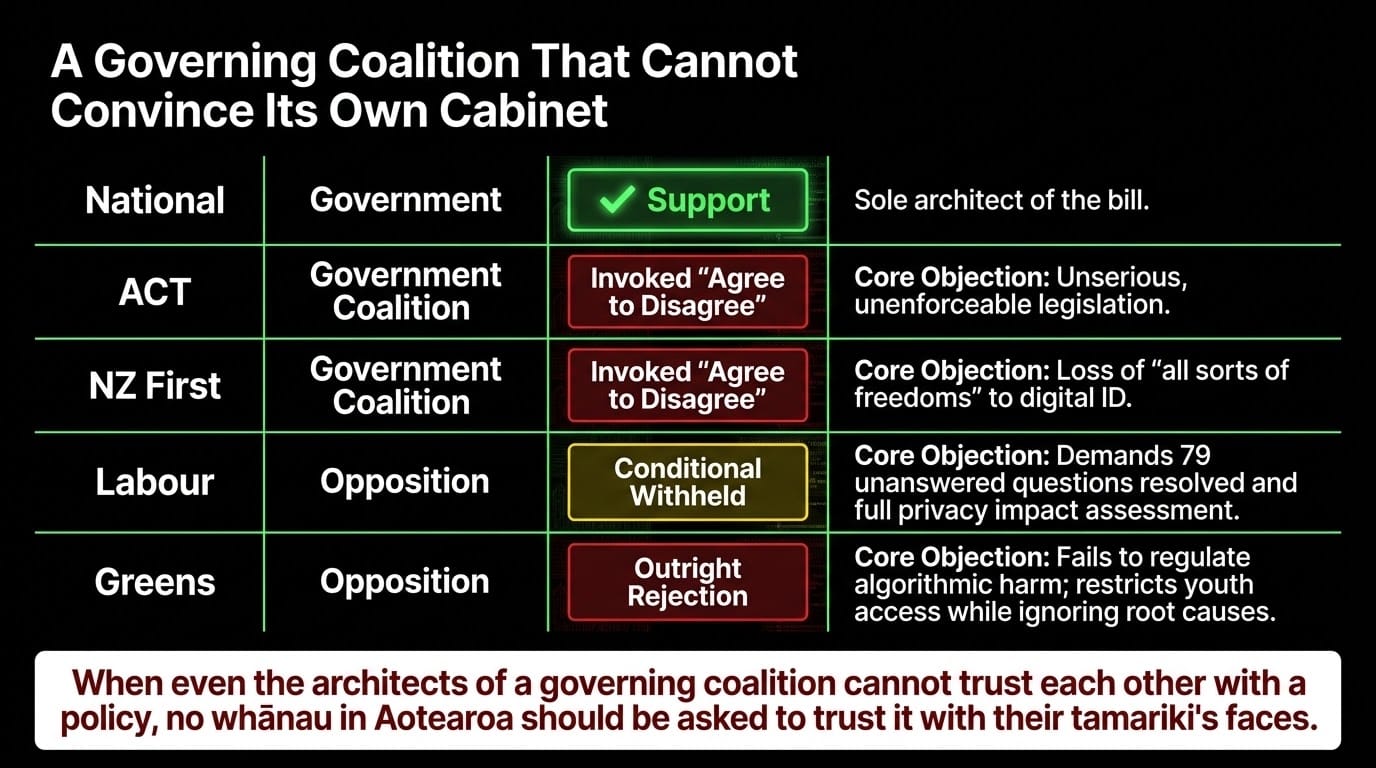
Even the party National needs to survive first reading will not hand over its support freely. Labour's science and technology spokesperson, Reuben Davidson, wrote to Education Minister Erica Stanford laying out 79 separate concerns still unresolved, including whether the government will publish a full privacy impact assessment before the bill proceeds, how consultation with children and young people was conducted, and how enforcement penalties would actually operate.
Seventy-nine unanswered questions is not a party offering conditional support.
That is a party keeping the government at arm's length while it works out whether this bill is fit to exist.
Labour leader Chris Hipkins confirmed the party was "yet to hear back from Stanford" on those concerns as of the bill's introduction.
The Greens rejected it outright on separate grounds, with spokesperson Hūhana Lyndon pointing out the bill does nothing to stop platforms "churning out harmful and dangerous content" in the first place.
So count the votes. National's own coalition: gone. The opposition parties: one demanding 79 answers before it will even consider support, the other rejecting the bill's entire premise. This legislation entered Parliament with confirmed support from precisely one party — the one that wrote it.
The Digital ID Trojan Horse Hiding Inside The Wreckage
Here is why this coalition collapse matters beyond Parliamentary theatre.
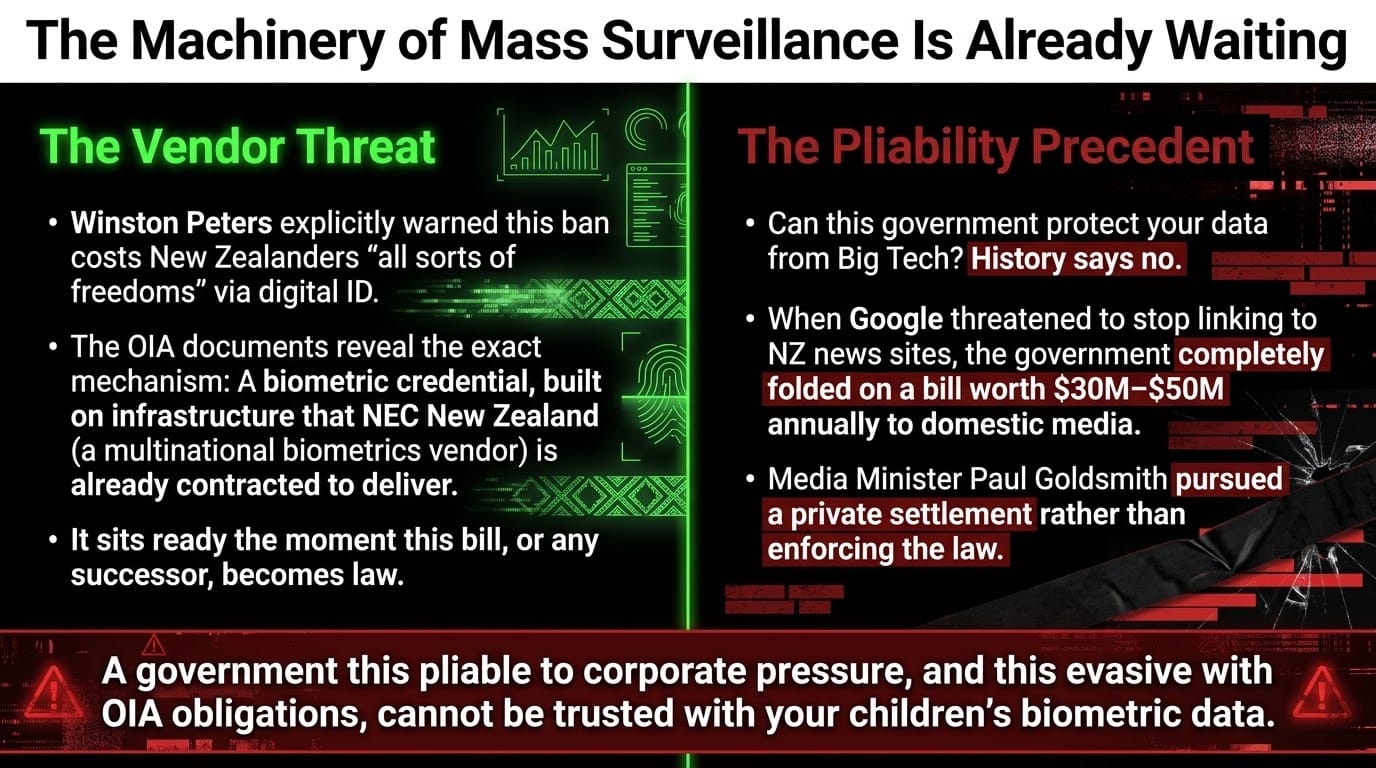
While Peters was warning about "all sorts of freedoms" lost to digital ID, documents obtained separately under the Official Information Act had already confirmed exactly what he was talking about.
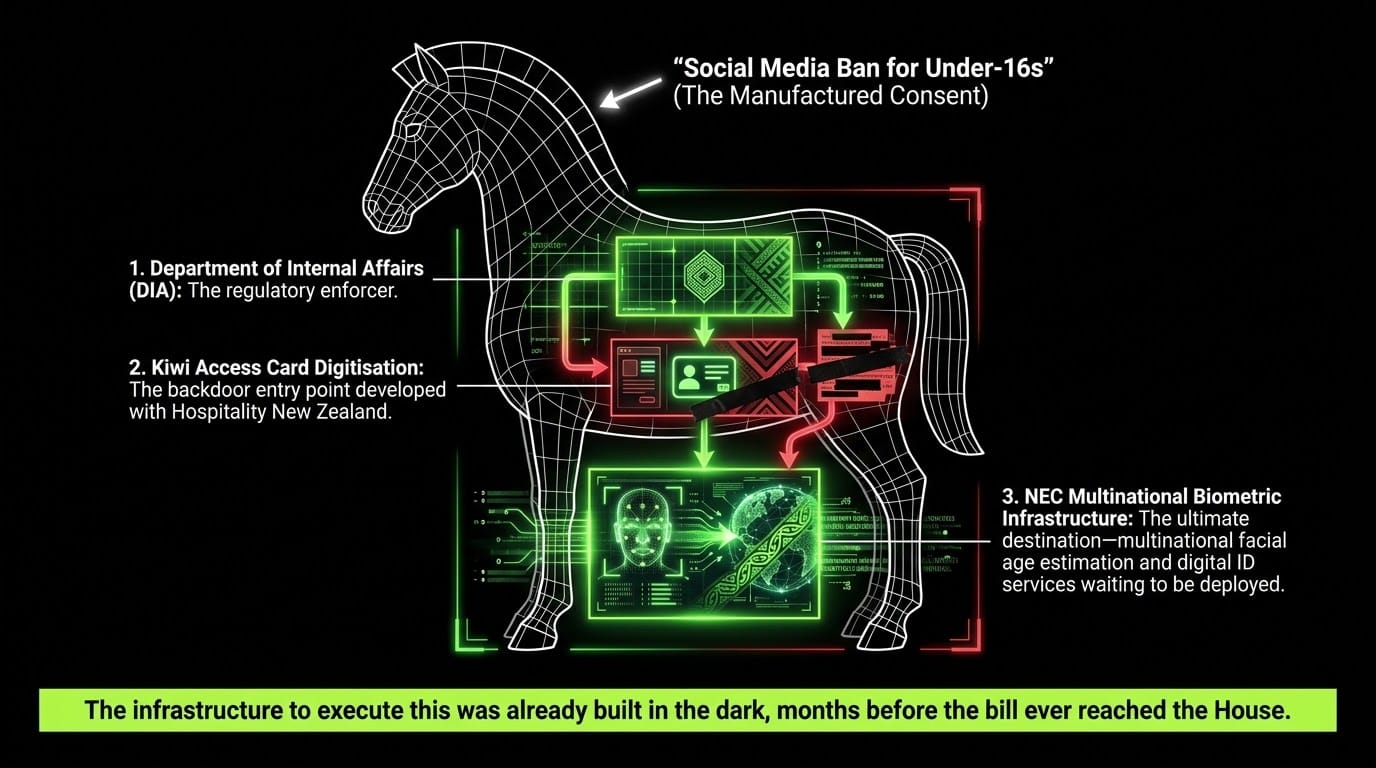
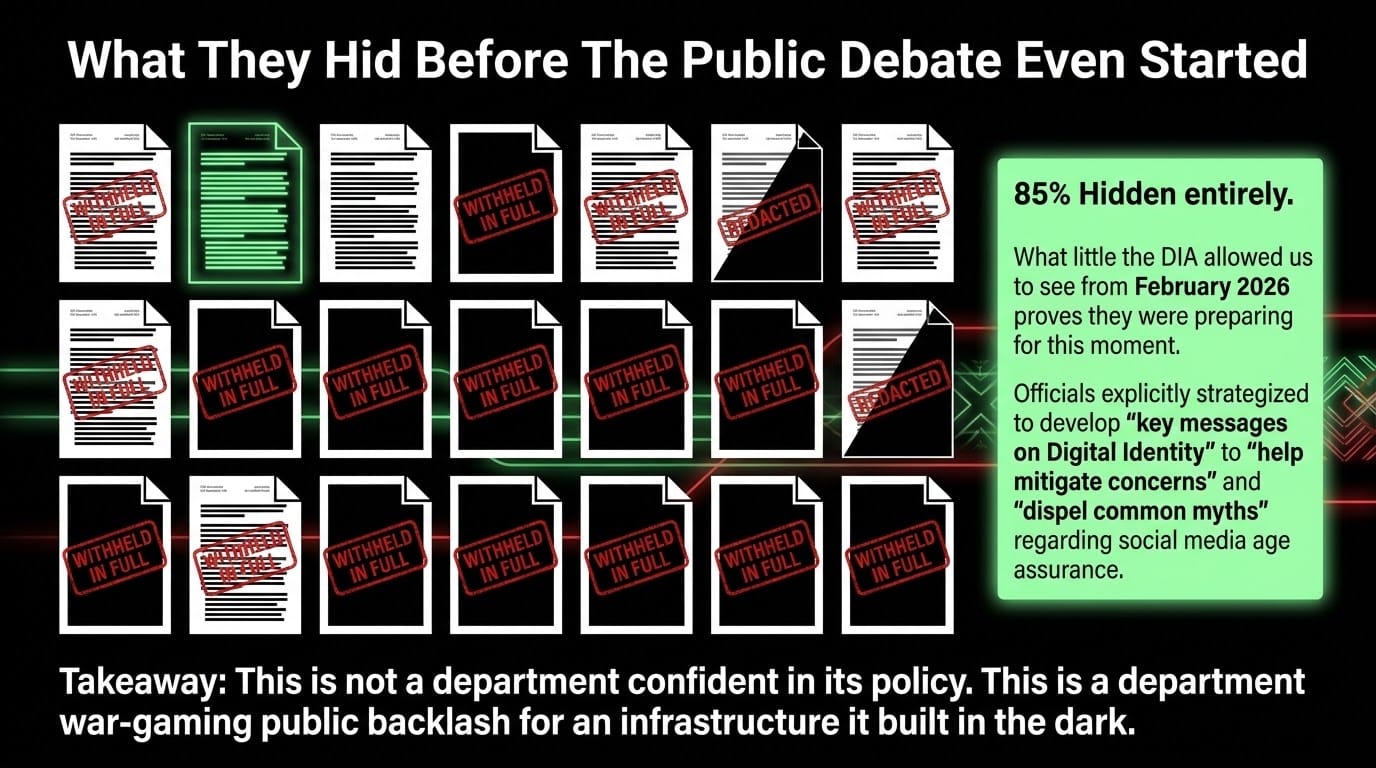
The NZ Herald reported, via documents obtained by Newstalk ZB, that DIA officials confirmed in February 2026 — months before this bill's introduction — that a digital ID could be used for age verification on social media, developed through the digitisation of the Kiwi Access Card in partnership with Hospitality New Zealand.
Officials wrote that they needed "key messages on Digital Identity" to "help mitigate concerns" and "dispel common myths".
Of the 20 documents an OIA request captured on this exact subject, DIA released one in full and two partially — 85 percent withheld entirely.
That is not a department confident in its own policy. That is a department that has already war-gamed how to manage public backlash to a plan it built before the public debate even started.
This is the machinery Peters was pointing at.
This is what "all sorts of freedoms" actually means in practice: a biometric credential, built on infrastructure NEC New Zealand — a multinational biometrics vendor — is already contracted to deliver, tested in partnership with DIA, sitting ready the moment this bill, or any successor to it, becomes law. The government's own coalition partner confirmed the risk. The OIA documents confirm the infrastructure already exists to realise it.
And the same government insisting it stands up for New Zealanders against Big Tech has, in the very recent past, folded completely the moment a multinational applied pressure
— Google's threat to stop linking to New Zealand news sites killed a bill that would have delivered an estimated $30 million to $50 million annually to New Zealand media, with Media Minister Paul Goldsmith personally exploring a private settlement with Google rather than enforcing the law.
A government this pliable in the face of corporate pressure, this fractured within its own Cabinet, and this evasive with its own OIA obligations is not a government you hand your children's biometric data to on trust.[stuff.co]
Whakapapa, Not Data Points
I have traced this pattern before.
In a previous Māori Green Lantern investigation into Five Eyes intelligence-sharing, I documented officials seeking access to "your face, your fingerprints, your iris, your DNA, your children's data," negotiated with partners who "disappear people off streets in masks."
The under-16s bill, birthed in coalition chaos and carrying digital ID inside it, is the same architecture wearing a different uniform.
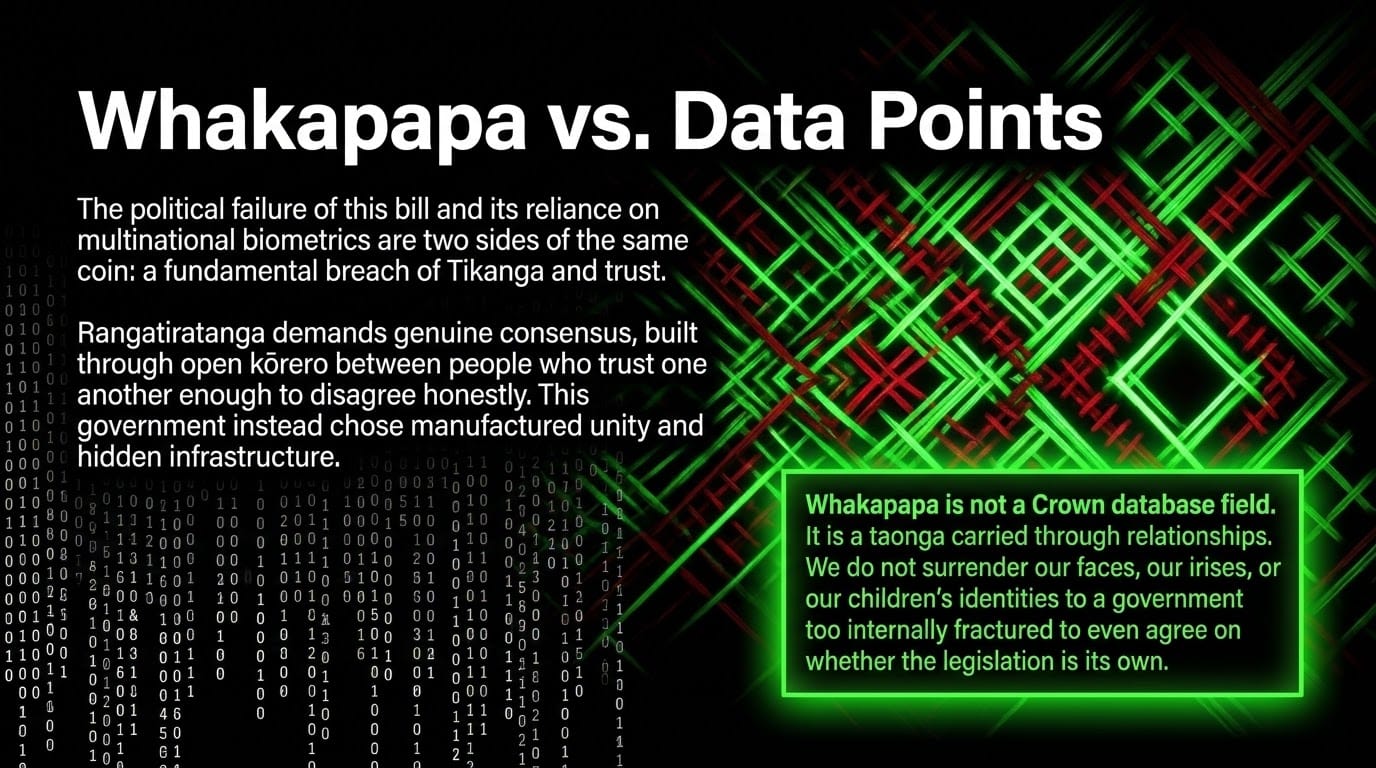
Whakapapa is not a Crown database field. It is a taonga carried through relationships — not something surrendered to a government too internally divided to even agree on whether the bill introducing this technology is its own.
Quantified harm: A bill entering Parliament with 0 of 2 coalition partners' support and 79 unresolved opposition concerns, built atop infrastructure already 85 percent hidden from OIA disclosure, represents a policy process failing transparency and consensus tests simultaneously — while the underlying digital ID mechanism it enables has been publicly named as a freedom risk by the government's own Deputy Prime Minister.
Solution: No bill of this constitutional weight should proceed past first reading without the full privacy impact assessment Labour has demanded, complete and unredacted release of all 20 DIA OIA documents, an independent parliamentary inquiry into Peters' taxpayer-spend concerns, and a binding requirement that any digital ID component be subject to separate, standalone legislation — not folded quietly into a child-safety bill riding on public sympathy.
Tikanga impact for the Western mind: Rangatiratanga demands genuine consensus, built through open kōrero between people who trust one another enough to disagree honestly. What Parliament witnessed on 24 August 2026 was the opposite: a single party manufacturing the appearance of government unity, its own coalition partners publicly disowning it within hours, while quietly relying on infrastructure it had already built in the dark. When even the architects of a governing coalition cannot trust each other with a policy, no whānau in Aotearoa should be asked to trust it with their tamariki's face.
The Verdict
This is not a government speaking with one voice for the safety of children.
This is a single party — isolated within its own Cabinet, mocked by its own coalition partner over an unenforceable $33 billion penalty regime, warned against by its own Deputy Prime Minister over stolen freedoms, and unable to answer 79 basic questions from the opposition — gambling an election-year headline against the privacy of every person in this country, while the machinery to realise that risk was already built and largely hidden from public view months before the bill ever reached the House.
I read the OIA documents. I read the Parliamentary record. Now you have too.
Ivor Jones The Māori Green Lantern Fighting Misinformation And Diinformatin From The Far Right
Opinions on institutional motive expressed above are the analysis of this writer, grounded in the verified facts and sources hyperlinked throughout, and are offered in the public interest concerning a matter of significant current government policy, under qualified privilege principles (Lange v Atkinson). Statements attributed to Winston Peters, David Seymour, Reuben Davidson, Chris Hipkins, and Hūhana Lyndon are drawn directly from RNZ's contemporaneous reporting and represent their own public statements, not this writer's characterisation of their views. Right of reply remains open to any named official, minister, party, or corporation referenced in this essay.