"Tama Potaka Folded Because You Made Him — Now Watch Him Try to Sell the Surrender as a Victory" - 25 June 2026
THE RETREAT OF THE COWARD: He called your outrage "spurious." He called the maps "fantasy land." He called 5.2 million hectares "bits and bobs." Today he ran. The bill he still holds is still a weapon. Don't let him reload.

Kia ora Aotearoa,
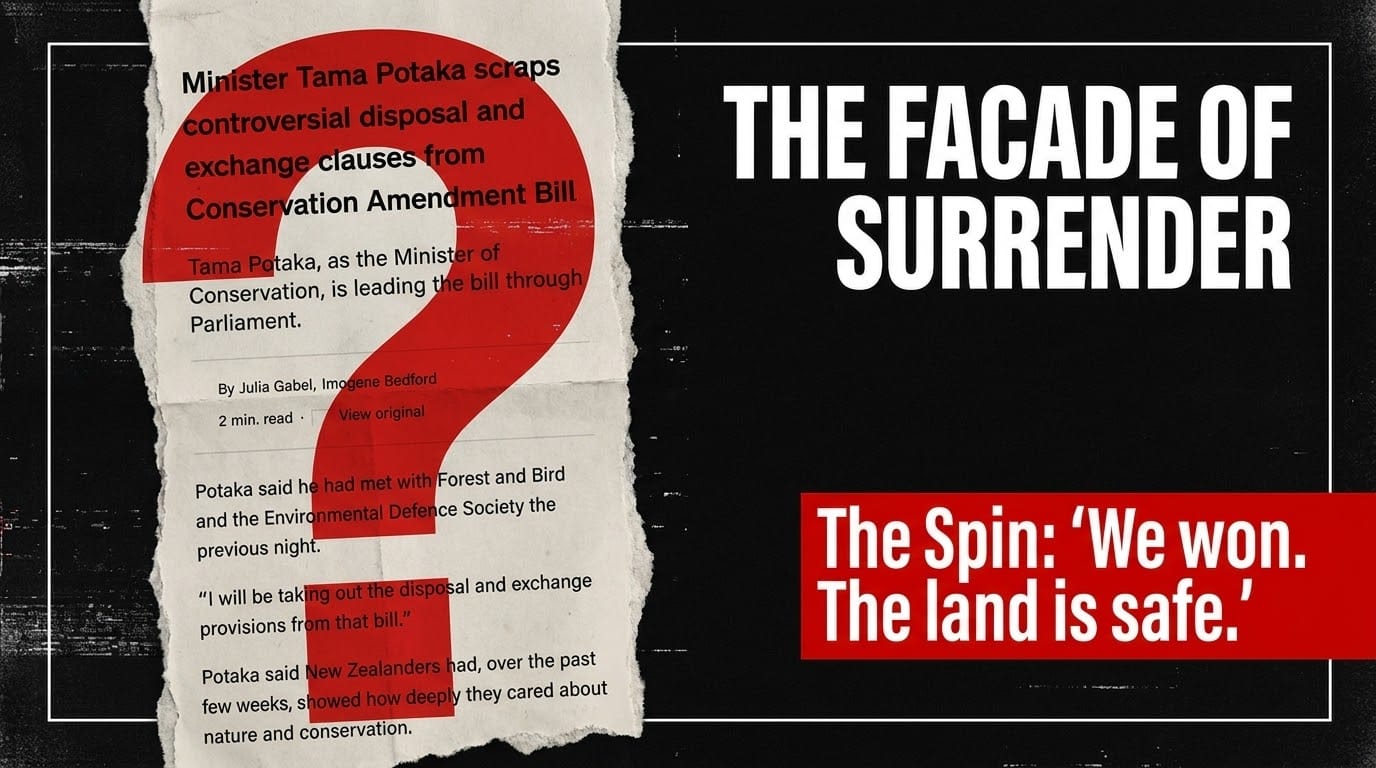
"I will be taking out the disposal and exchange provisions from that bill."
— Tama Potaka, Auckland, 25 June 2026
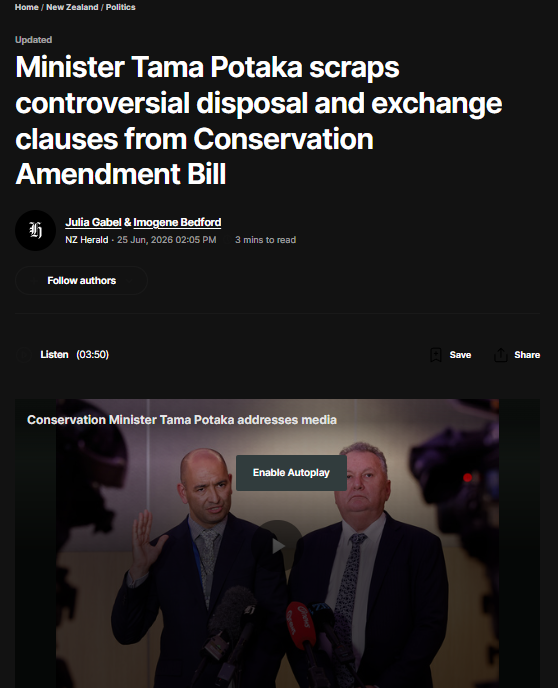
 Julia Gabel and Imogene Bedford
He Ran. Let's Be Clear About Why.
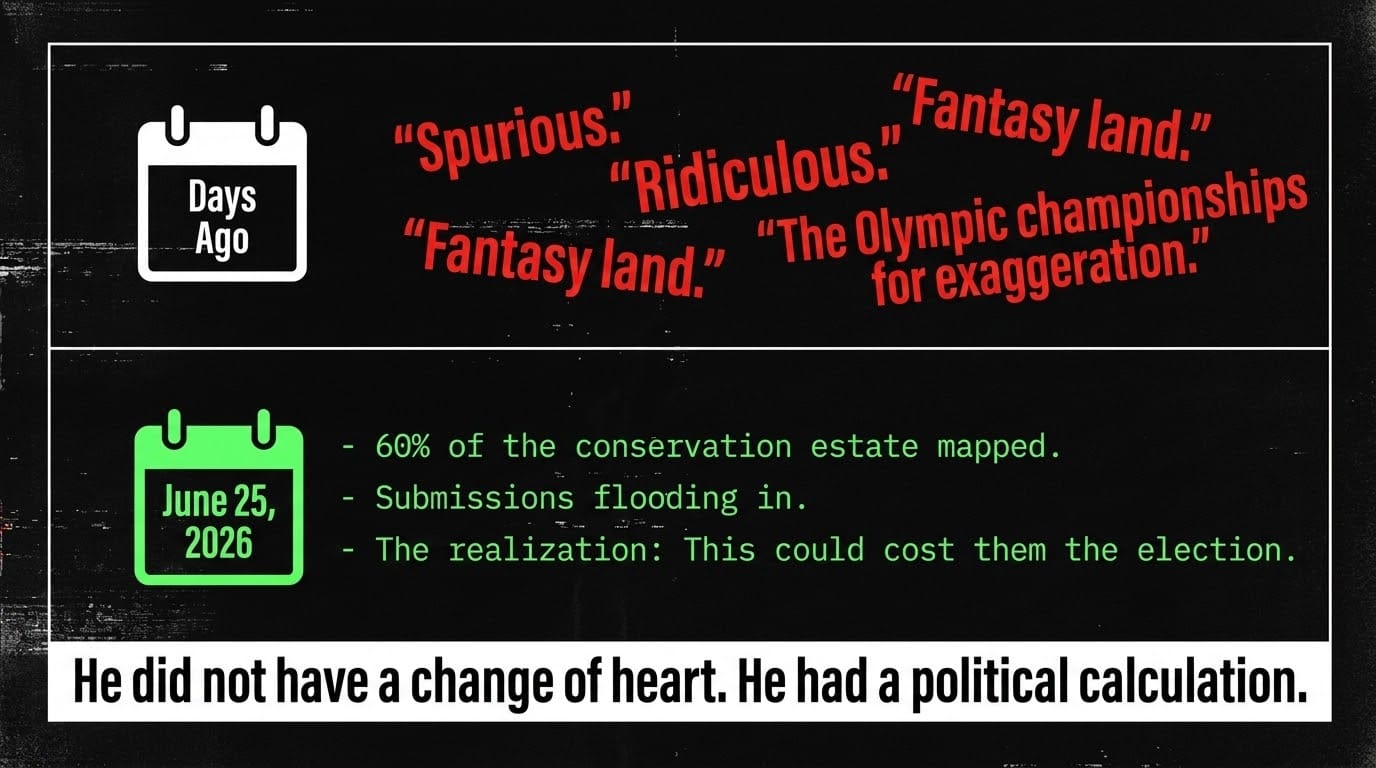
Tama Potaka did not have a change of heart today. He had a political calculation.
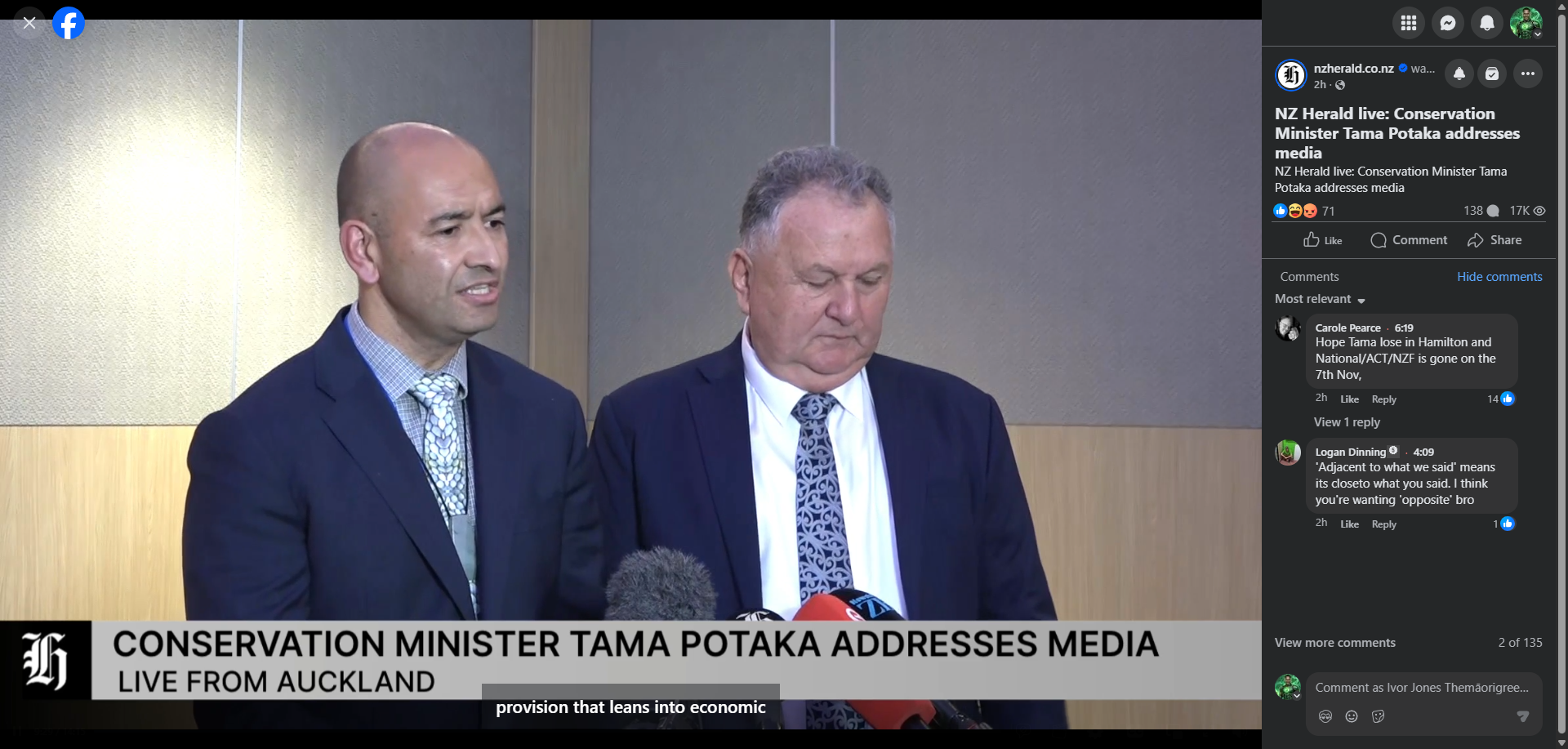
On the morning of 25 June 2026, standing in Auckland alongside Shane Jones — who immediately contradicted him by declaring NZ First would continue pushing for economic outcomes from conservation land regardless — Potaka announced he would remove the disposal and exchange provisions from the Conservation Amendment Bill.
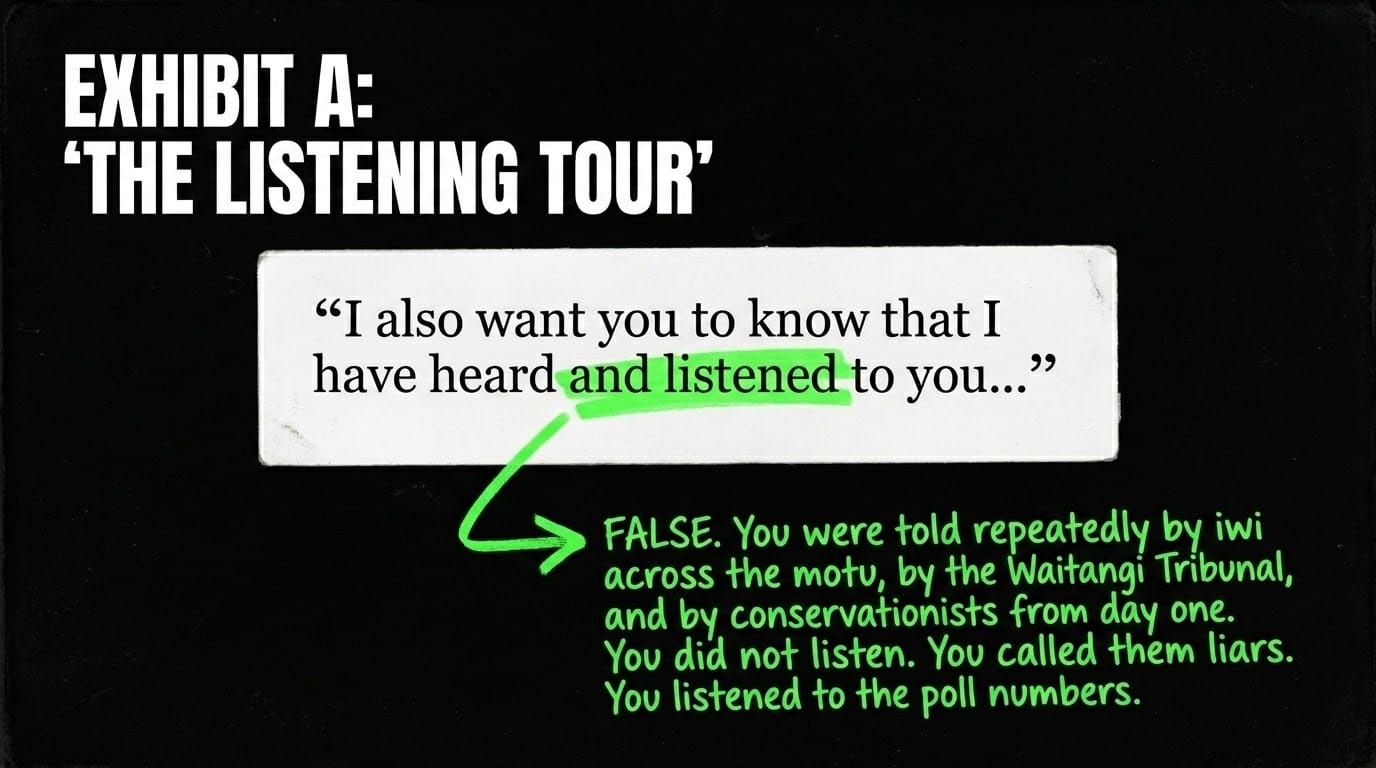
He said New Zealanders had "showed how deeply they care about nature and conservation." He said he had "heard and listened."
He said, and I want you to read this slowly:
"The truth is none of us would be here today if we didn't care deeply about our taiao."
This is the same man who — days ago, in Parliament
— called Forest & Bird's maps of the bill's disposal risk "spurious," "ridiculous," "fantasy land," and "the Olympic championships for exaggeration."
 Ivor Jones The Māori Green Lantern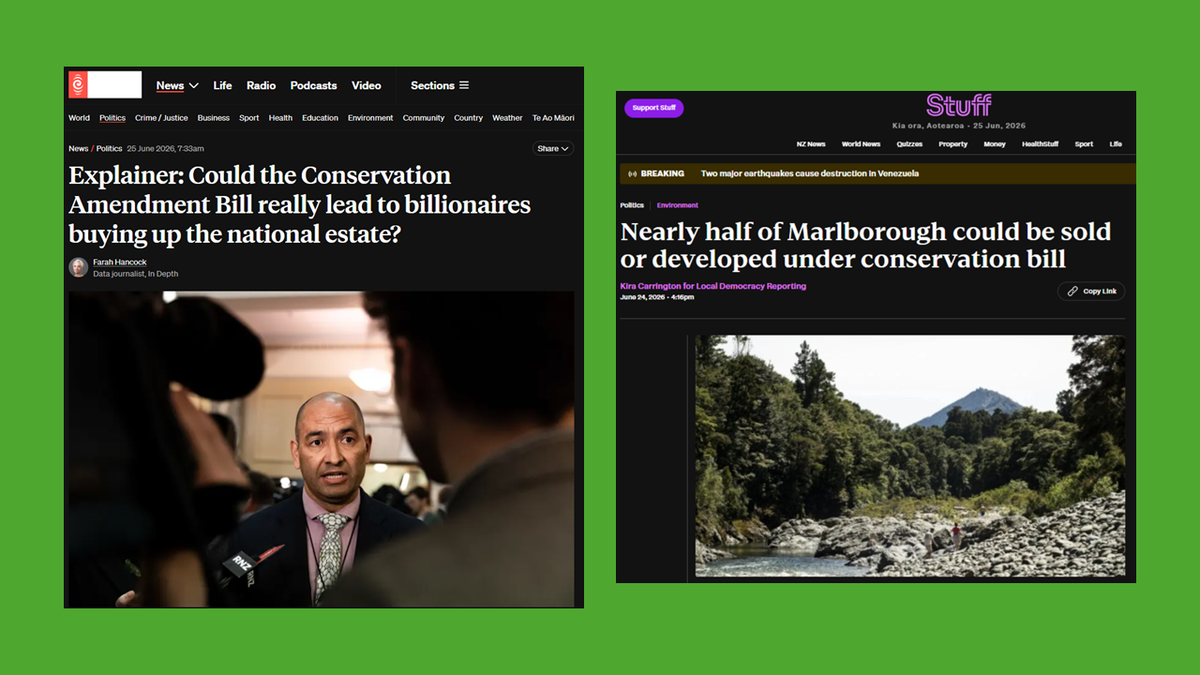
This is the same man who said criticism of the bill was
"spurious, scandalous, scurrilous and mischievous."
This is the same man who told Morning Report the disposal tests were
"stringent" while his own Cabinet paper admitted they would "significantly narrow" Treaty protections.
 Ivor Jones The Māori Green Lantern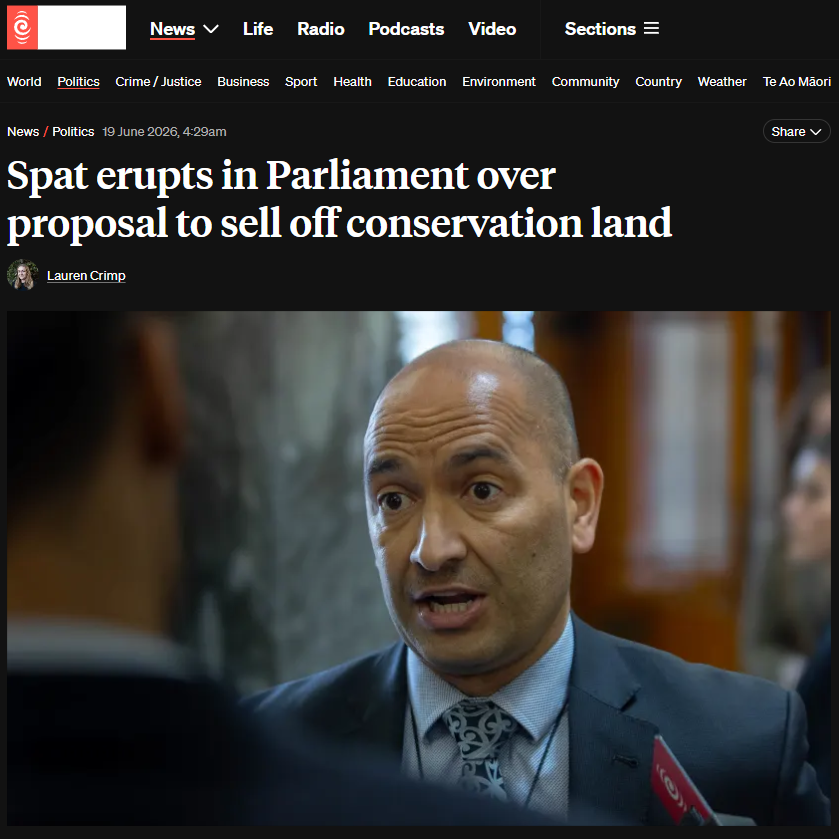
He did not suddenly discover he cared about the taiao. He discovered that Forest & Bird's maps had gone viral, that the public was furious, that submissions were flooding in, and that
— as Marlborough Tramping Club president Murray Chapman warned
"National need to be reminded this could cost them the election."
He ran because you made him run. Do not let him pretend he walked.
🎙️ The Deep Dive Podcast
If you learn best through audio — The Deep Dive Podcast is live on the essay page — two hosts, a lively conversation unpacking every source, every mechanism, every connection in this series. The retreat. The remaining clauses. The Shane Jones threat. All of it.
I apologise in advance for the AI's very enthusiastic approach to te reo Māori pronunciation. Please don't shoot me. 😄 The kōrero matters more than the accent.
🎬 YouTube Video
Short video on the essay page — walking through what Potaka removed, what he didn't, and what Shane Jones's admission means for the next election.
Again — please extend grace to the AI's reo. It tries. It really does. 😄
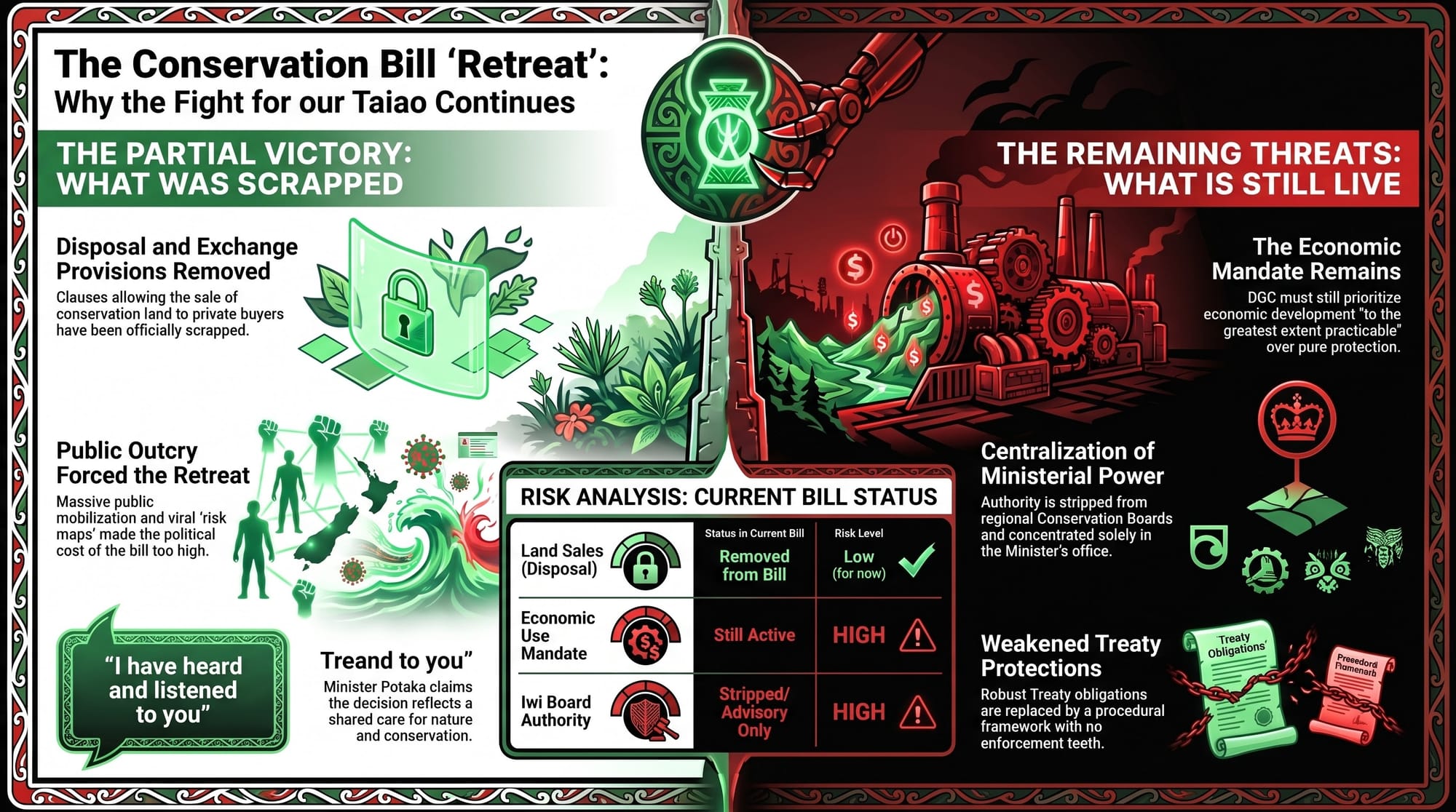
What He Removed — And What He Didn't
Let's be surgical. Because Potaka's announcement is being framed as a capitulation, a win for conservation, a moment of ministerial listening.
It is none of those things without ruthless scrutiny of what remains.
What he removed: The disposal and exchange provisions — the clauses that explicitly made new categories of conservation land available for sale and exchange to third parties, including private buyers.
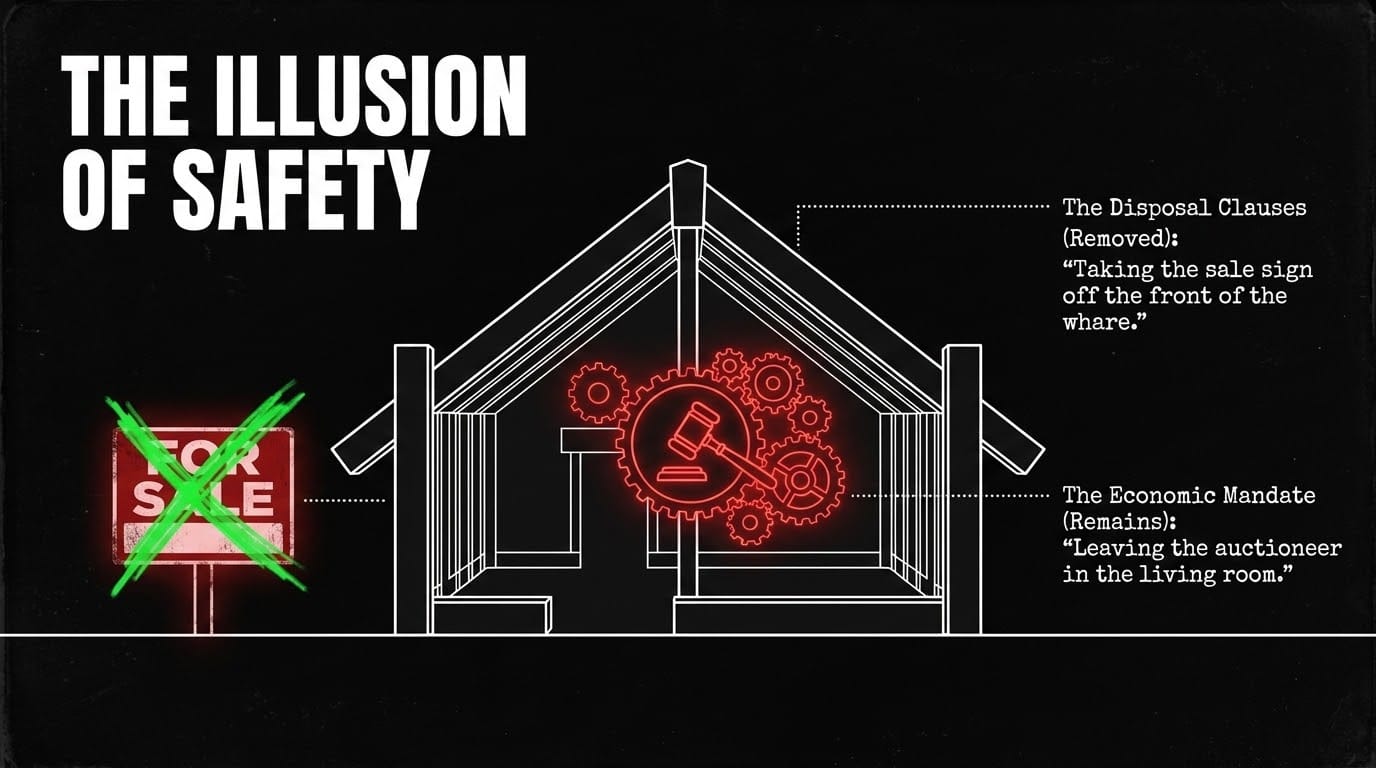
What he did NOT remove:
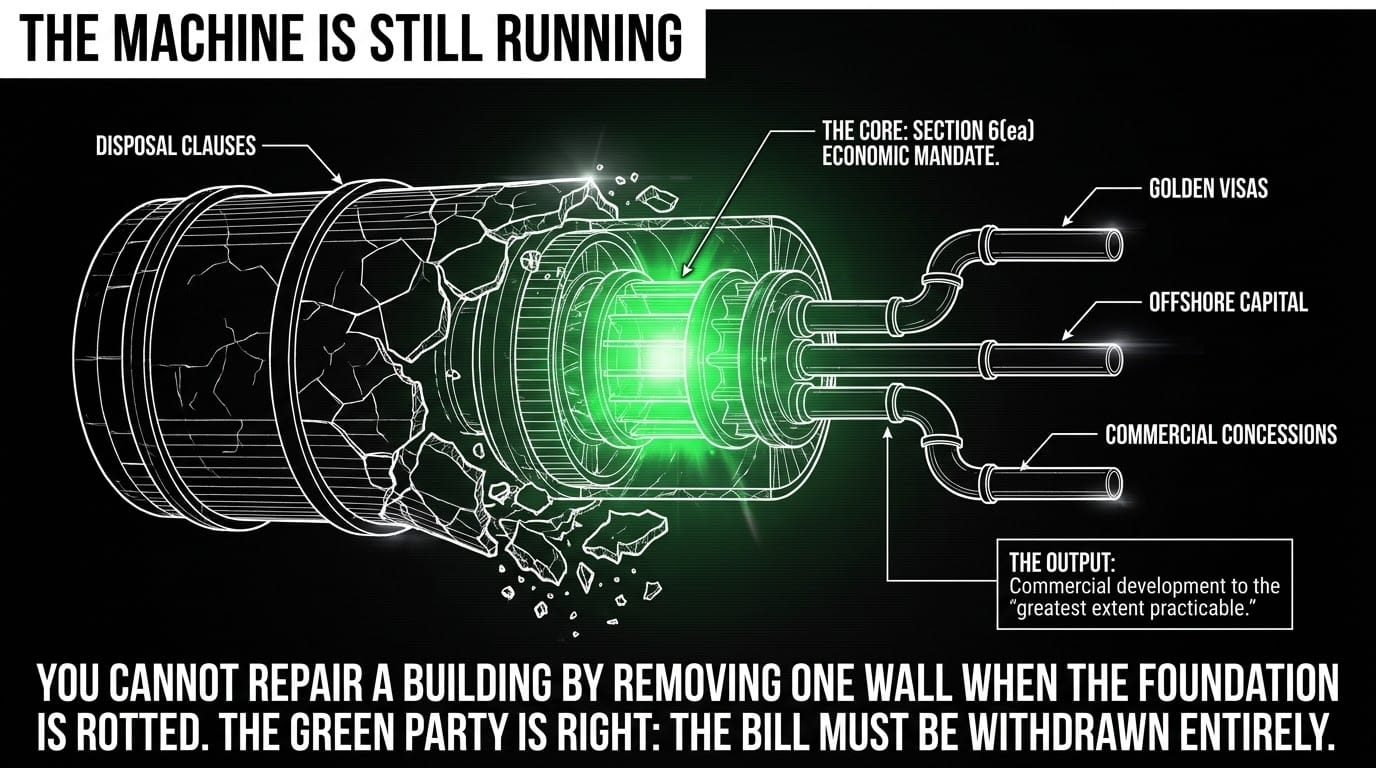
- The economic mandate. The bill still requires DOC to enable economic use and development of public conservation land "to the greatest extent practicable." This is still the overarching statutory obligation. The founding mission of protecting and restoring nature remains subordinated to commercial imperatives.
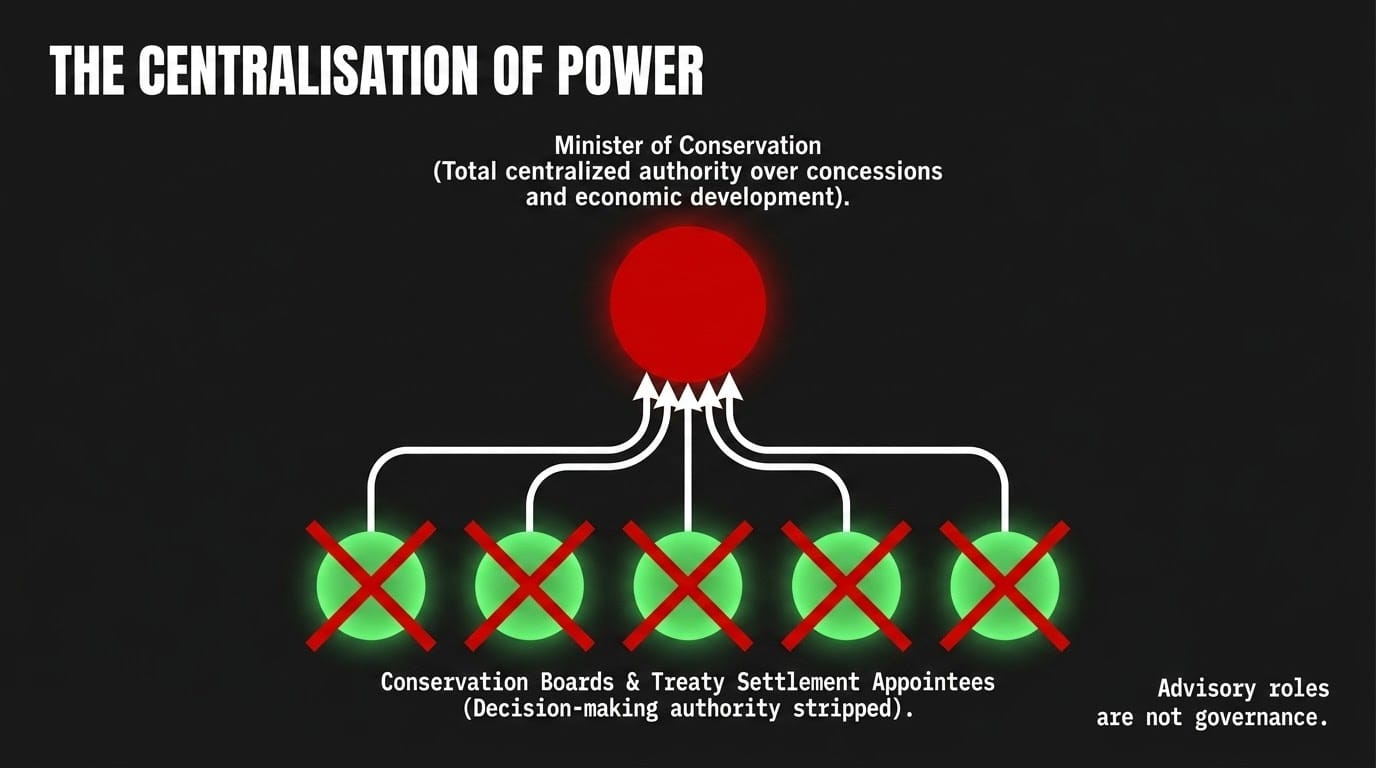
- The centralisation of ministerial power. The bill still strips Conservation Boards and the New Zealand Conservation Authority of decision-making authority, reducing them to advisory roles. Every iwi that won a governance seat on those boards through Treaty settlement still loses it.
- The Treaty governance framework. The bill still replaces the robust Section 4 architecture with a procedural engagement framework that has no enforcement teeth — a new provisions setting out how Māori are "to be engaged," not how the Crown is obligated to honour the Treaty.
- The concession and commercial development regime. The bill still enables commercial concessions, economic activity, and development on conservation land through the "greatest extent practicable" mandate. You do not need to sell land to destroy it. You can lease it, develop it, concession it, commercialise it. The bill's economic engine is still running.
- Shane Jones. Still in Cabinet. Still on record today saying NZ First would "continue to push for economic outcomes from conservation land" after the next election. Still calling critics part of a "culture of cancellation." The faction that drove this bill's most dangerous provisions did not fold. It regrouped.
Destroying Every New Statement He Makes
New Statement 1: "I heard and listened to New Zealanders"
The destruction:
No. You were told, repeatedly, by Forest & Bird, by the Environmental Defence Society, by Federated Mountain Clubs, by iwi across the motu, by the Waitangi Tribunal's fifteen-year-old Wai 262 findings, by the Green Party, and by hundreds of thousands of New Zealanders who submitted, shared, and marched — that this bill was wrong from first reading.
You did not listen. You called them liars. You called their maps fantasy. You called their concern "spurious, scandalous, scurrilous and mischievous." You doubled down on Morning Report. You had your colleague Chris Penk repeat the announcement in the House within minutes — a choreographed retreat, not a genuine reckoning.
You listened to the poll numbers. Name it honestly or don't name it at all.
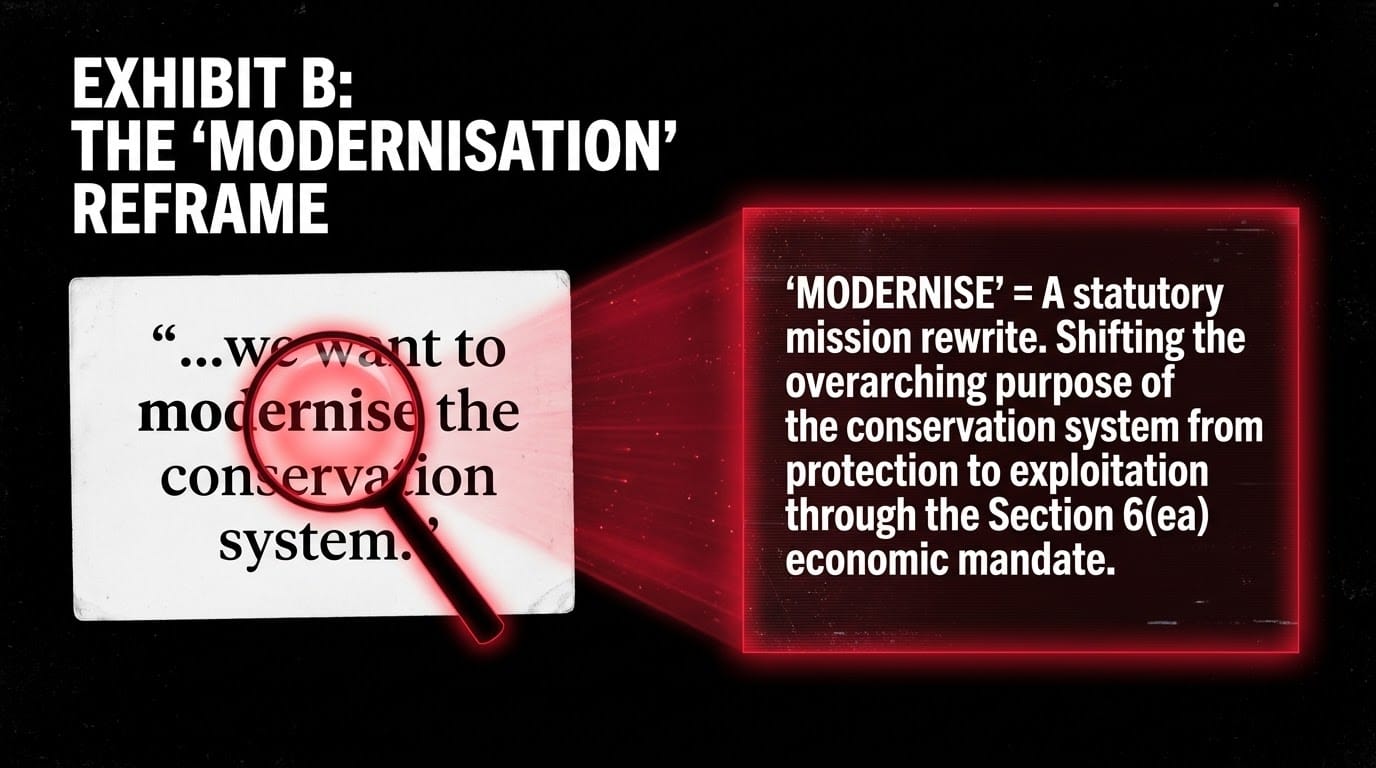
New Statement 2: "The conservation system does need to be modernised"
The destruction:
This is the reframe. Watch it carefully, because it will now become the centrepiece of Potaka's pivot. Having conceded the most visible battleground, he will now argue that the bill's remaining provisions are sensible, consensual, and represent the "moderate" modernisation everyone actually agrees on.
They are not.
The bill still mandates DOC to prioritise economic development "to the greatest extent practicable." That is not modernisation. That is a mission rewrite. The bill still strips Conservation Boards of decision-making power and places that authority in the hands of the Minister of Conservation alone. That is not modernisation. That is the concentration of power in a single political office — one that will be occupied by different governments, with different values, over the life of this law.
The Green Party has called for the bill to be withdrawn entirely and started again — not amended. Forest & Bird has argued from the beginning that the shift from "protection to exploitation" as the overarching purpose is the structural defect — one that removing the disposal clauses does not repair.
The "modernisation" framing is the second wave of the deception. The first wave was "bits and bobs." This one is "sensible reform." Same architecture. New packaging.
New Statement 3: "None of us would be here today if we didn't care deeply about our taiao"
The destruction:
This is the most cynical sentence Potaka spoke today. And it was spoken in front of a crowd he had spent weeks insulting.
The people who stood in that room cared deeply about the taiao before this bill. They cared while Potaka was dismissing them. They cared when he was calling their evidence
"the Olympic championships for exaggeration."
They cared when his legislation was placing the Wairau Bar — Aotearoa's oldest confirmed settlement — in the disposal zone. They cared when his bill was removing their iwi representatives from Conservation Boards.
Potaka did not author that care. He threatened it. And today he claimed it as a shared value the moment the political cost of opposing it became too high.
Kaitiakitanga is not a press statement. It is a covenant. You cannot invoke it in your retreat after spending weeks trying to legislate it away.
New Statement 4: "We all want strong conservation outcomes for Aotearoa"
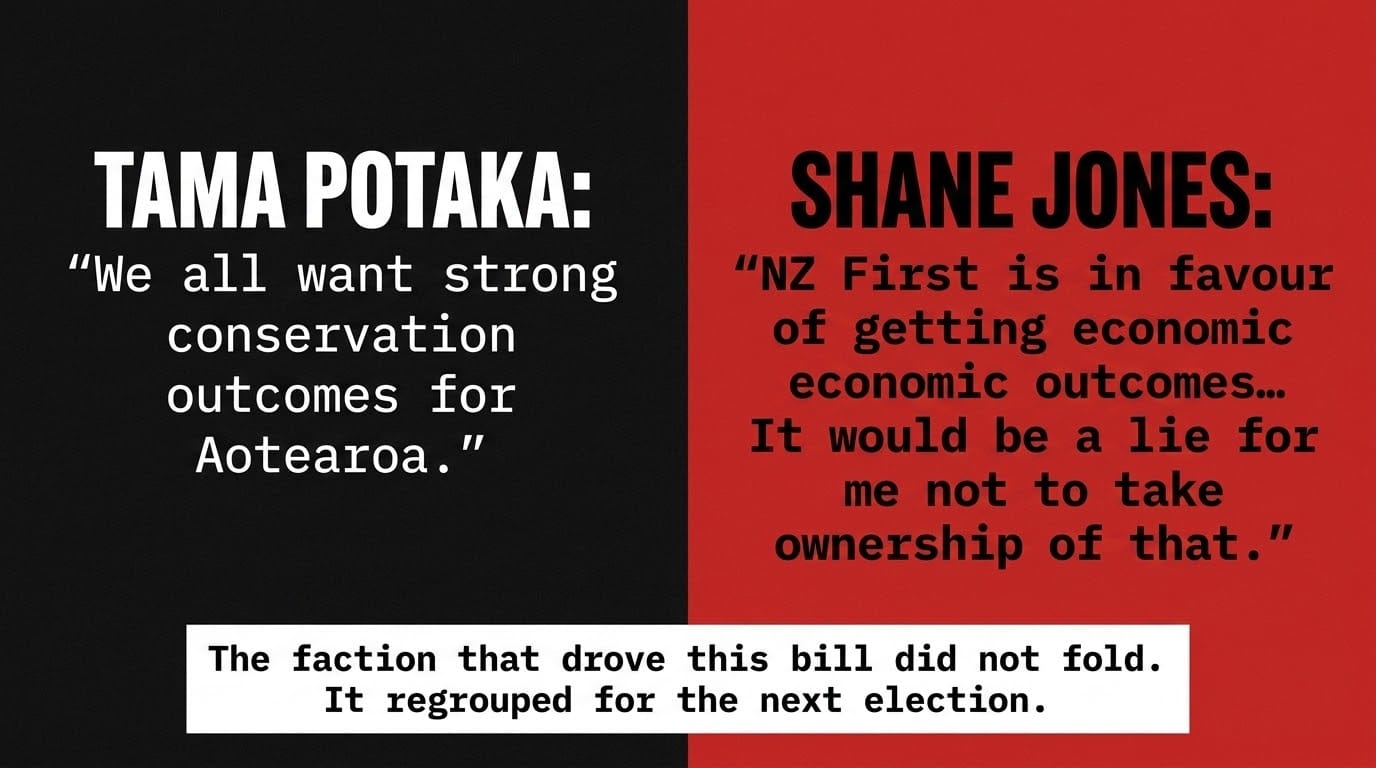
The destruction:
Shane Jones — standing beside him — immediately contradicted this. On record, in front of the same Auckland crowd, Jones said NZ First
"was in favour of getting economic outcomes from conservation land" and would continue to push for them if in government after the election.
He said he would "need to find common ground" with Potaka — meaning: the NZ First position has not moved, and the coalition tension over this bill is active and unresolved.
"We all want strong conservation outcomes" is a sentence that fell apart before it finished echoing.
His own coalition partner contradicted it in the same room. The faction that drove the disposal provisions is still in Cabinet. The economic mandate is still in the bill. The ministerial power concentration is still in the bill.
"We all want" is what politicians say when the coalition is fracturing and the cameras are rolling. It is not a policy position. It is a distraction.
The Whakapapa of This Retreat
This retreat did not happen because Tama Potaka is a man of integrity persuaded by evidence. He had the evidence from day one. The Waitangi Tribunal gave it to him fifteen years ago. Forest & Bird gave it to him when the bill was introduced in May. Iwi across the motu gave it to him in submissions, in kōrero, in documented legal analysis.
This retreat happened because the public mobilised at a scale and speed this government did not predict. It happened because Forest & Bird's maps went viral and made the abstract concrete. It happened because 60% of the conservation estate on a colour-coded map is a more powerful argument than any parliamentary speech. It happened because Kiwis — Māori and Pākehā, urban and rural, trampers and surfers and hunters and kaitiaki — looked at those maps and said: not this. Not our land. Not now. Not ever.
That is your power. Remember what it felt like. Because Shane Jones just told you, from the same stage, that he is coming back for this after the election.
What The Green Party Got Right
The Green Party's response today was unambiguous: the bill needs to start again. Not amended. Not patched. Withdrawn. Rebuilt from first principles, with proper Treaty engagement, proper public consultation, and a purpose that starts with protection — not exploitation.
They are correct.
Here is why:
You cannot repair a building by removing one wall when the foundation is rotted. The Conservation Amendment Bill's foundation — its overarching purpose clause mandating economic development "to the greatest extent practicable" — is still in place. Removing the disposal provisions while leaving that mandate intact is like removing the sale sign from the front of a whare while leaving the auctioneer in the living room.
The bill still shifts decision-making power to the Minister of Conservation alone. It still weakens Conservation Boards and the NZCA. It still creates a concession and commercial development regime driven by an economic imperative. It still sits alongside the golden visa architecture that is actively flowing offshore capital into New Zealand property markets.
The disposal clauses were the most visible mechanism. They were not the only one.
The Treaty Silence That Did Not Move
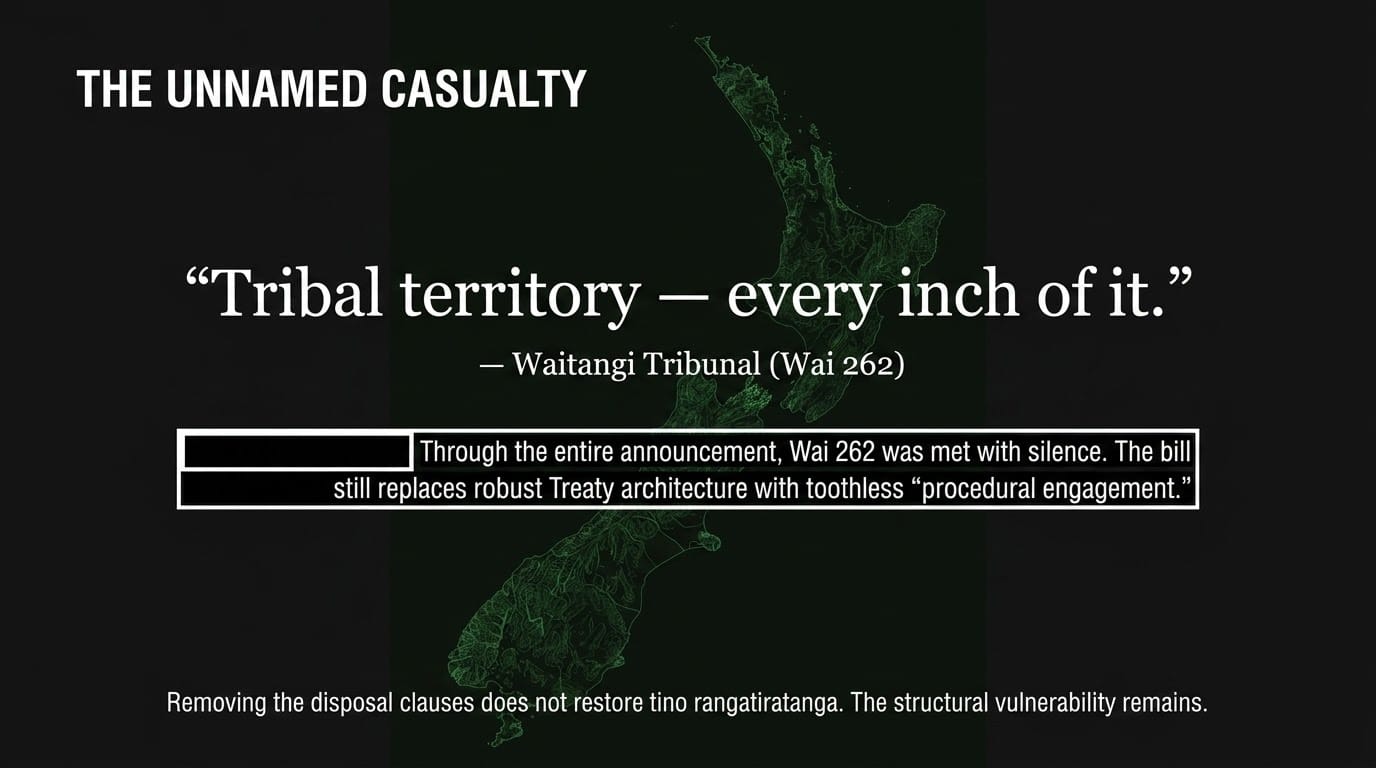
Through all of today's announcement — through Potaka's carefully worded statement, through Jones's contradicting admission, through Chris Penk's parliamentary echo — not once was the Waitangi Tribunal's Wai 262 finding named.
Not once did Potaka acknowledge that the conservation estate is, in the Tribunal's own words, "tribal territory — every inch of it." Not once did he commit to restoring Conservation Board decision-making powers — the powers through which Treaty settlement appointees exercise governance over ancestral land. Not once did he address the centralisation of ministerial authority that remains in the bill.
The Crystal Valley precedent — where 198 hectares of Ngāi Tahu taonga alpine land was handed to Australian private equity through an exchange that bypassed their Treaty Right of First Refusal — was not addressed. The exchange mechanism was part of what was removed today. But the governance architecture that failed to protect Ngāi Tahu — Conservation Boards stripped of decision-making power, ministerial authority concentrated — remains.
Removing the disposal clauses does not restore Treaty tino rangatiratanga over the conservation estate. It removes the most visible threat while leaving the structural vulnerability intact.
The Treaty silence in today's announcement is not an oversight. It is a message.
Previous MGL Essays That Trace This Architecture
This retreat did not emerge in a vacuum. Read the whakapapa:
- "Potaka: The Neoliberal Māori and the Five-Million-Hectare Betrayal" — The original structural analysis. The architecture of the bill when it first passed first reading. Read this to understand what today's partial retreat leaves standing.
- "The Accelerator Has No Brakes: They Deleted the Treaty and Called It Progress" — The pattern of Treaty erasure across every piece of legislation this government touches. Today's announcement changed one clause. The pattern has not changed.
- "The Colonial Mirror" — The second essay in this series. The Treaty betrayal at the heart of the bill. The Section 4 narrowing. The Crystal Valley precedent. The golden visa. The billionaire door. All still relevant. All still live.
What You Do Now
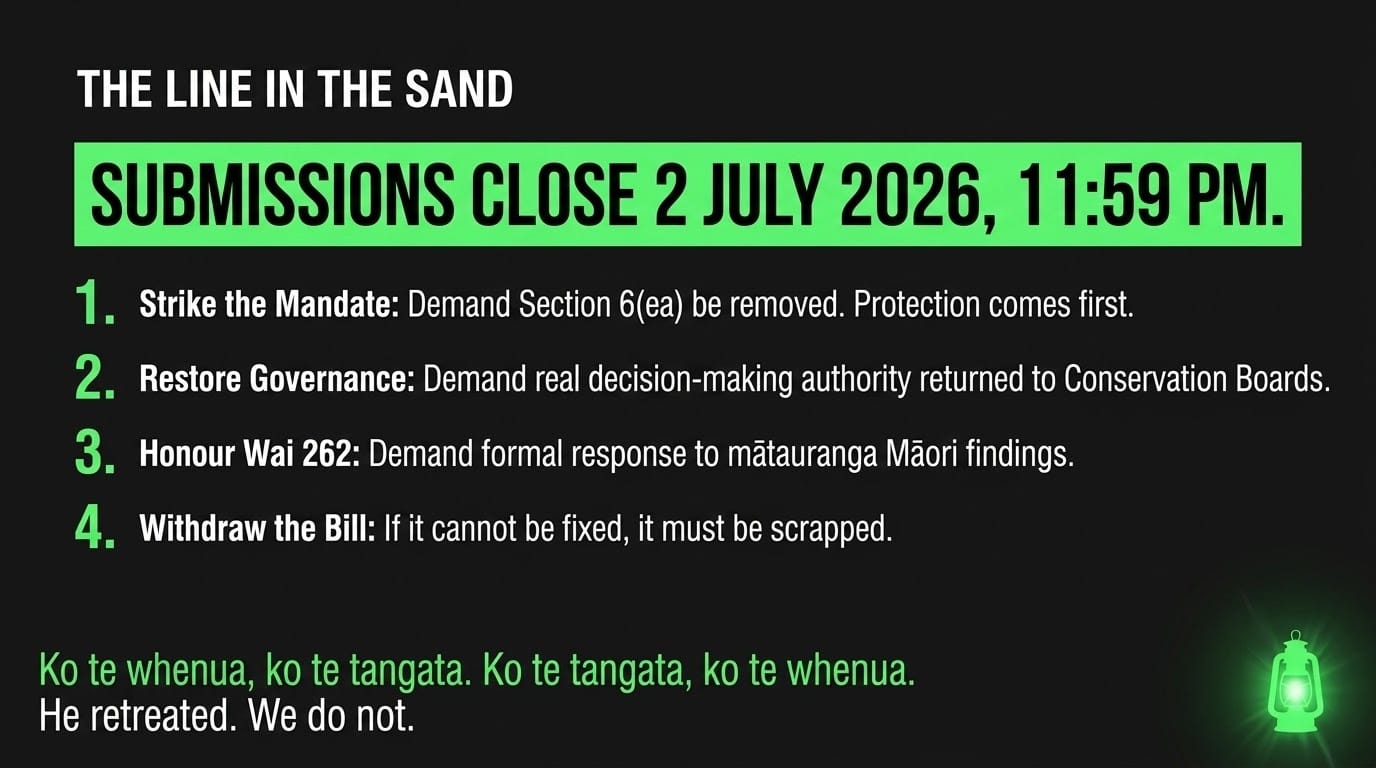
Do not stop. Do not celebrate. Do not let him land this as a win.
Submissions on the Conservation Amendment Bill close 2 July 2026 at 11:59pm. The bill is still before the Environment Committee. What has changed is only the most visible target. The rest of the bill's architecture is still live, still advancing, still dangerous.
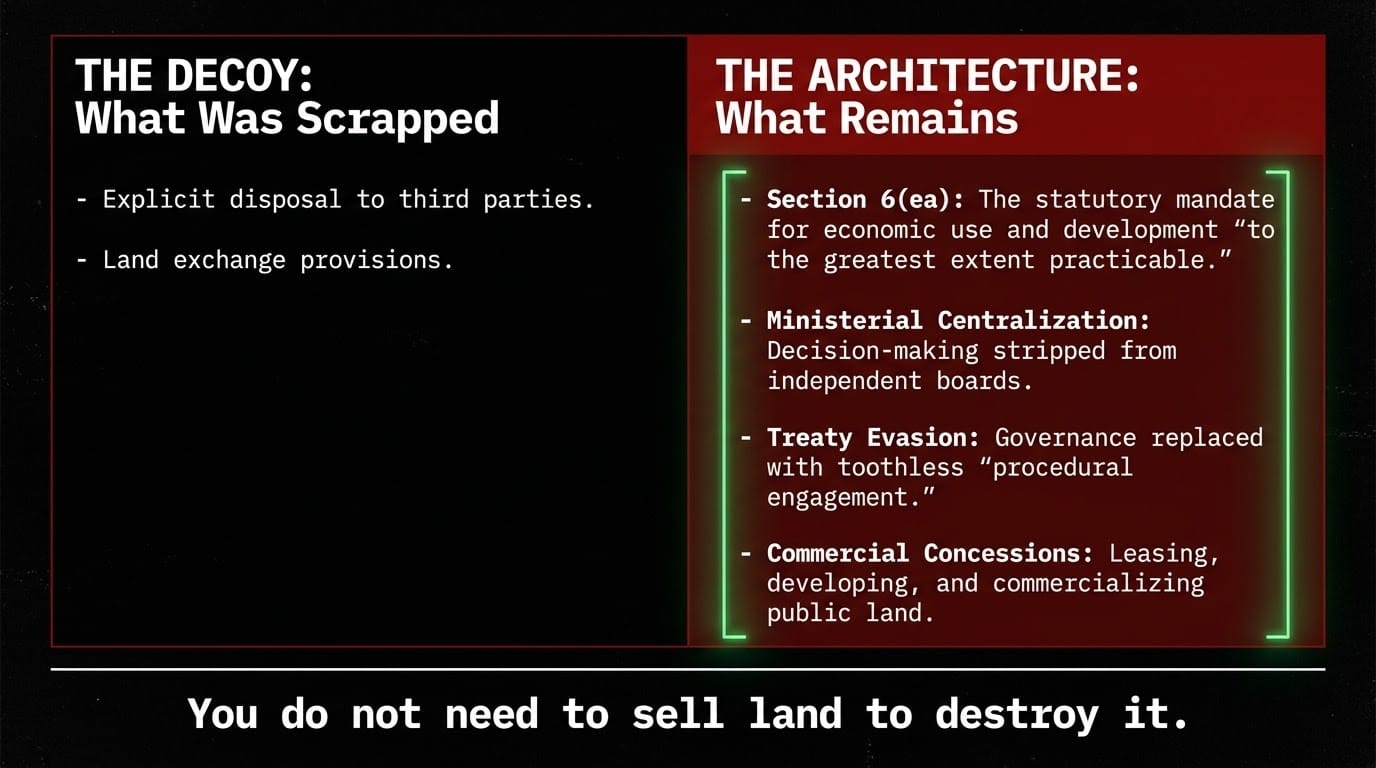
Your submission must now name what remains:
- The economic mandate must be removed. Section 6(ea) — "enable economic use and development to the greatest extent practicable" — must be struck. Protection comes first. Always.
- Conservation Board and NZCA decision-making powers must be fully restored. Advisory roles are not governance. Treaty settlement appointees must have real authority.
- The bill must address Wai 262. Any legislation touching the conservation estate must formally respond to the Waitangi Tribunal's fifteen-year-old findings on tribal territory and mātauranga Māori.
- If it cannot be fixed, it must be withdrawn. The Green Party is right. Start again. With Treaty partners. With proper tikanga. With kaitiakitanga as the foundation, not the footnote.
- Submit now: NZ Parliament — Environment Committee
- Forest & Bird resources: forestandbird.org.nz
- FMC template submission: fmc.org.nz/conservation-amendment-bill
- Green Party action page: action.greens.org.nz/protectournaturalspaces
Koha Consideration 💚

Potaka retreated today because whānau, conservationists, iwi and ordinary New Zealanders made enough noise that the political cost of holding the line became too high. That noise was supported by accountability journalism — the kind that named the mechanism before it became law, traced the whakapapa of each clause, and refused to accept "bits and bobs" as an explanation for 5.2 million hectares.
This mahi does not stop when a minister announces a partial retreat. It stops when the bill is withdrawn. It stops when Section 6(ea) is removed. It stops when Conservation Boards are restored. It stops when Wai 262 has a formal Crown response. It stops when Shane Jones's post-election ambitions are named, tracked, and met with the same force that sent Potaka to Auckland today with his retreat pre-written on a notecard.
We are not there yet.
Every koha to The Māori Green Lantern signals that rangatiratanga includes the power to support our own truth-tellers — through the retreats and the reloads and the reframes.
💚 Koha directly: app.koha.kiwi — The Māori Green Lantern
📩 Subscribe for essays delivered direct: themaorigreenlantern.maori.nz/support
🏦 Direct bank transfer: HTDM — 03-1546-0415173-000
📘 Facebook: facebook.com/Themaorigreenlantern/subscribe
If you cannot koha — share this essay. Name what remains in the bill. Tell your hapū. Kōrero with your whānau. That is koha in itself.
Kia kaha, whānau. He retreated. We do not.
Ko te whenua, ko te tangata. Ko te tangata, ko te whenua.
Toitū te mana o te whenua. Toitū te tiriti.
— Ivor Jones | The Māori Green Lantern | themaorigreenlantern.maori.nz
DISCLAIMER: This essay is based on the NZ Herald report by Julia Gabel and Imogene Bedford, 25 June 2026; the RNZ explainer by Farah Hancock, 25 June 2026; Stuff/Local Democracy Reporting by Kira Carrington, 24 June 2026; Te Ao News, 25 June 2026; Scoop, 24 June 2026; Federated Mountain Clubs analysis; E-Tāngata, Melanie Nelson; Forest & Bird explainer, June 2026; Bell Gully, December 2025; and The Spinoff, 18 June 2026. All direct quotations are sourced and confidence-labelled. Opinions are clearly flagged. All individuals named are public figures acting in their public capacity. Right of reply available via themaorigreenlantern.maori.nz. Retraction protocol applies on verified complaint. Published under NZ public interest journalism framework — Lange v Atkinson 3 NZLR 385.