"Paul Goldsmith Broke the Law, Lied to Cabinet, Watched the Blaze, and Now Holds the Hose" - 25 June 2026
THE ARSONIST INVESTIGATES THE FIRE

Kia ora Aotearoa,
 RNZ | Te Reo Irirangi o Aotearoa
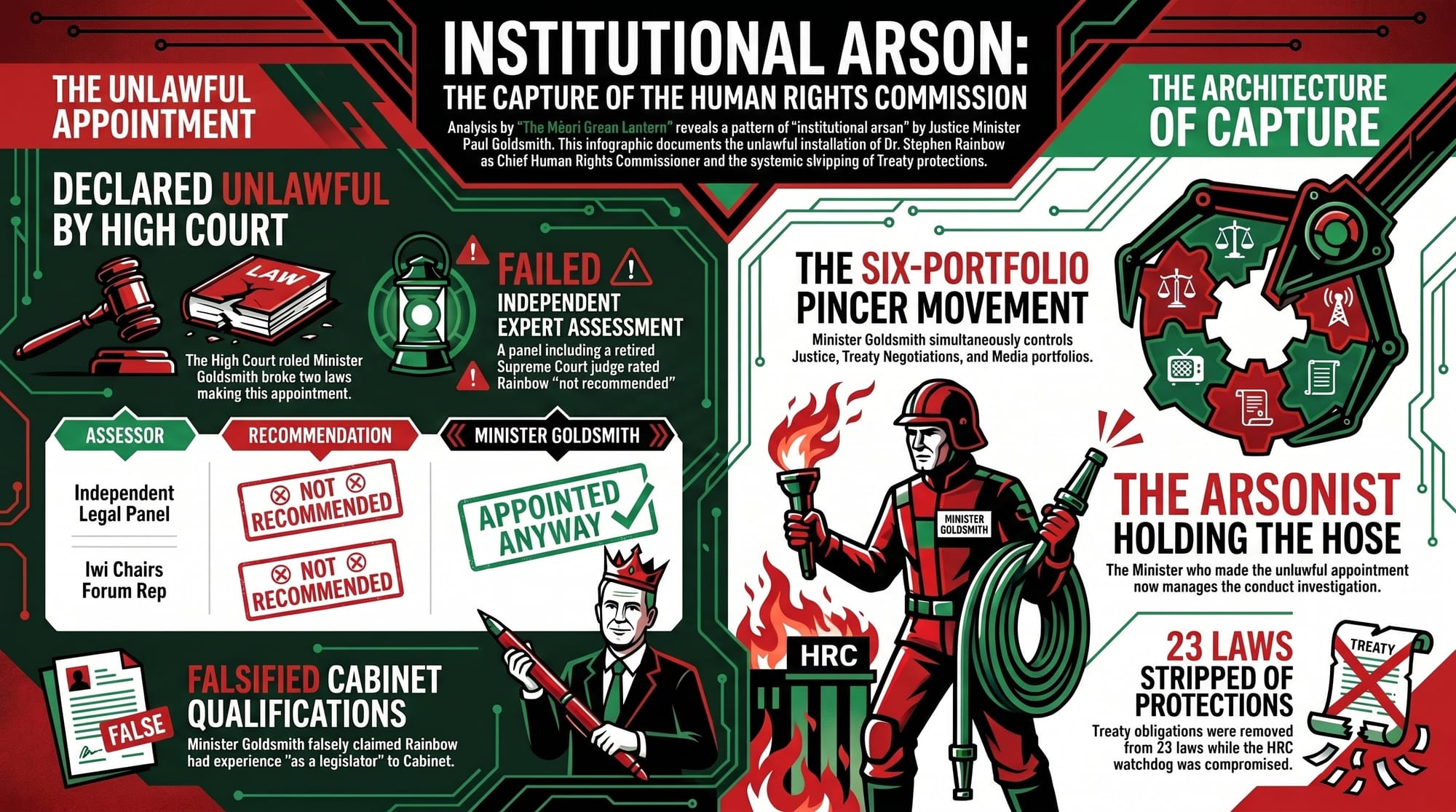
The Justice Minister of New Zealand unlawfully installed an unqualified ACT Party ally to run the Human Rights Commission, presented false qualifications to Cabinet, was found out by a High Court judge, watched his appointee generate complaints serious enough for a King's Counsel investigation — and now, with the audacity only power without consequence can produce, is managing the inquiry into the catastrophe his own hands built.
 RNZ | Te Reo Irirangi o Aotearoa
This is what white supremacist neoliberalism looks like with a briefcase and a title.
THE PĀTAKA IS BURNING AND THE CHIEF ARSONIST HOLDS THE HOSE
I want you to picture something.
Picture a whare. Not just any whare — the whare your tūpuna built to house the rights of the most vulnerable people in this country. The whare built on law, on statute, on the principle that no matter who you are, the Crown cannot simply ride over you in the dark and call it governance.
That whare is the Human Rights Commission. It has stood, imperfectly, but it has stood — a last line of accountability before the courts, a place Māori, Pacific, trans, disabled, poor, and brown New Zealanders could walk into and say: this was done to me, and it was wrong.
Now picture a man picking the lock on the back door.
He does not knock. He does not apply through the front door. He texts an ACT Party operative in December 2023 and offers himself as
"a gay Human Rights Commissioner" to help ACT manage political pressure over the Treaty Principles Bill.
The Spinoff, 5 November 2024 He fails the expert panel — a retired Supreme Court judge, a former Attorney-General, two King's Counsel, and an Iwi Chairs Forum representative all agree: he is not recommended.
He texts his ACT contact:
"I didn't get the HRC role but still very keen to help out."
Three months later, the Justice Minister rings him back. Congratulations. You're in.
That Justice Minister is Paul Goldsmith.
The man who built the lock. Picked it himself. Invited the man in. Presented false credentials to Cabinet — claiming his nominee had experience
"as a legislator" when Stephen Rainbow has never been a legislator in any form, at any level, anywhere — and then, when caught, said: my bad. The Spinoff, 14 October 2024
The High Court confirmed the house was broken into. Rights Aotearoa, Scoop, 18 December 2025 Two laws broken. Both appointments — Rainbow as Chief Human Rights Commissioner, Melissa Derby as Race Relations Commissioner — declared unlawful. Thistoll v Minister of Justice NZHC 4067. Justice David Gendall. On the record. In the permanent legal record of this country.
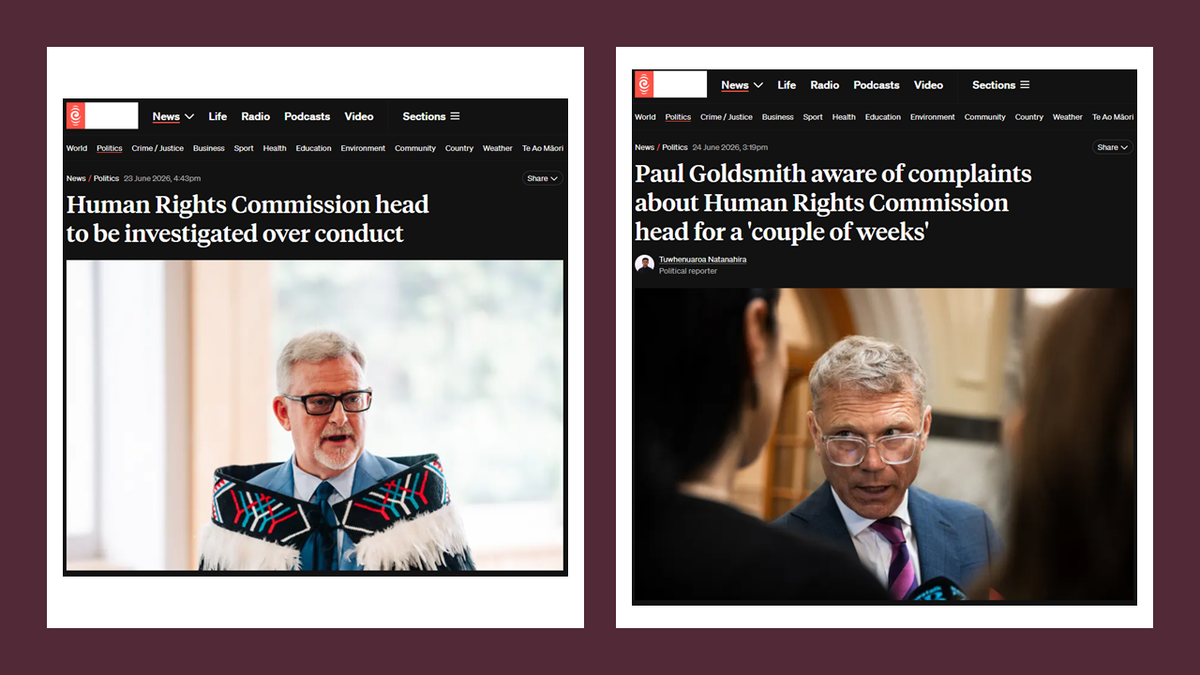
And on 24 June 2026, Paul Goldsmith stood in front of the cameras and told RNZ he "stands by" the appointment. That he has been aware of complaints about Rainbow's conduct for "a couple of weeks." That the complaints themselves span "the last few weeks and months." That he considers the KC investigation "an appropriate plan."
He burned the whare. He stood in the ashes. He announced he would investigate the smoke.
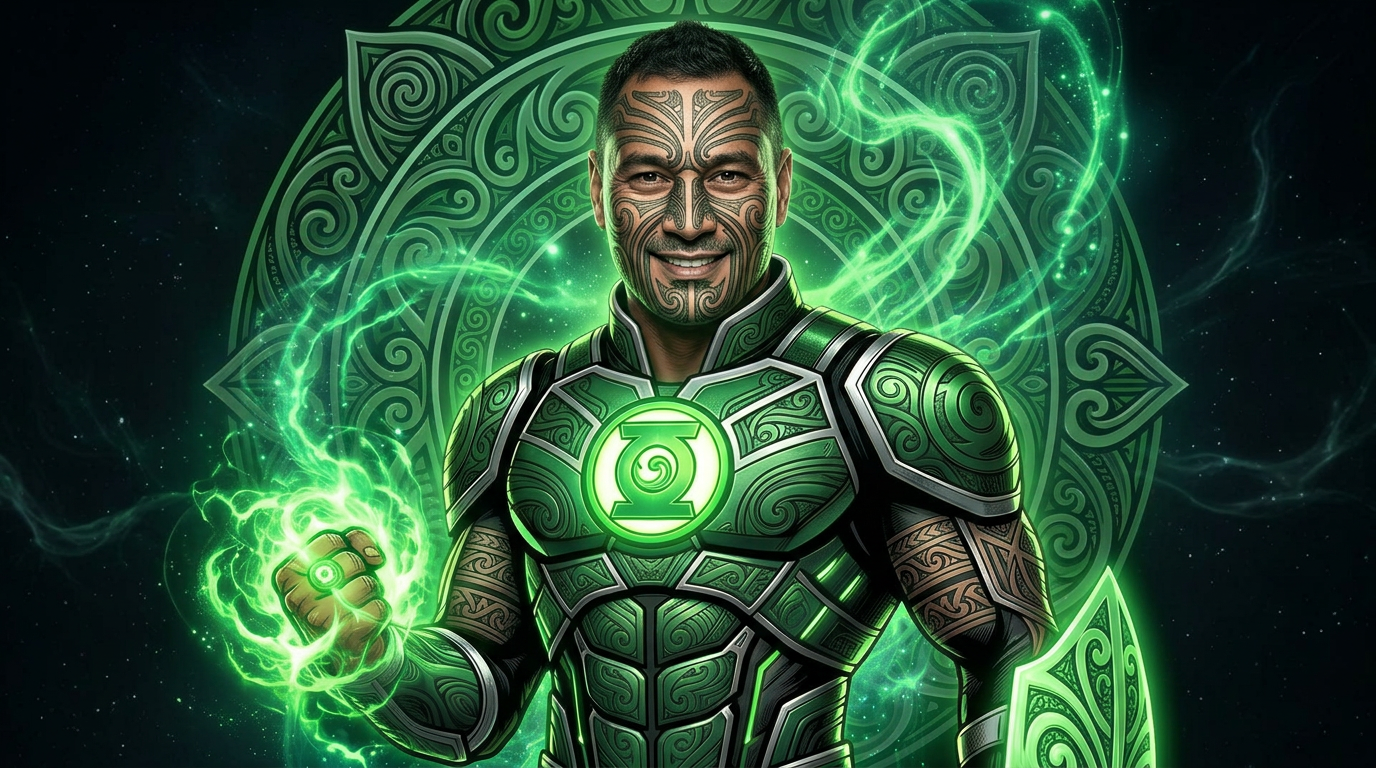
I am Ivor Jones. I am The Māori Green Lantern. I have been documenting this man's destruction of every institution that stands between whānau and power for three years. And today I am here to tell you that what Paul Goldsmith has done to the Human Rights Commission is not an isolated scandal. It is the latest chapter in a documented, verified, legally confirmed pattern of institutional arson.
The taiaha is raised. Let's name where it lands.
THE DEEP DIVE PODCAST
A lively conversation between two hosts — Te Rina and Marcus — unpacking and connecting the essay's sources. A note from Ivor: I apologise in advance for the AI's very harsh pronunciation of te reo Māori. Please don't shoot me.
THE YOUTUBE VIDEO SCRIPT
Short supporting video — 4–5 minutes. Again, Ivor's note: don't shoot the messenger on the reo pronunciation.
THE ESTATE LAWYER WHO CHANGED THE WILL IN SECRET
To understand what Goldsmith has done to the Human Rights Commission, you first need to understand what Goldsmith has done to everything.
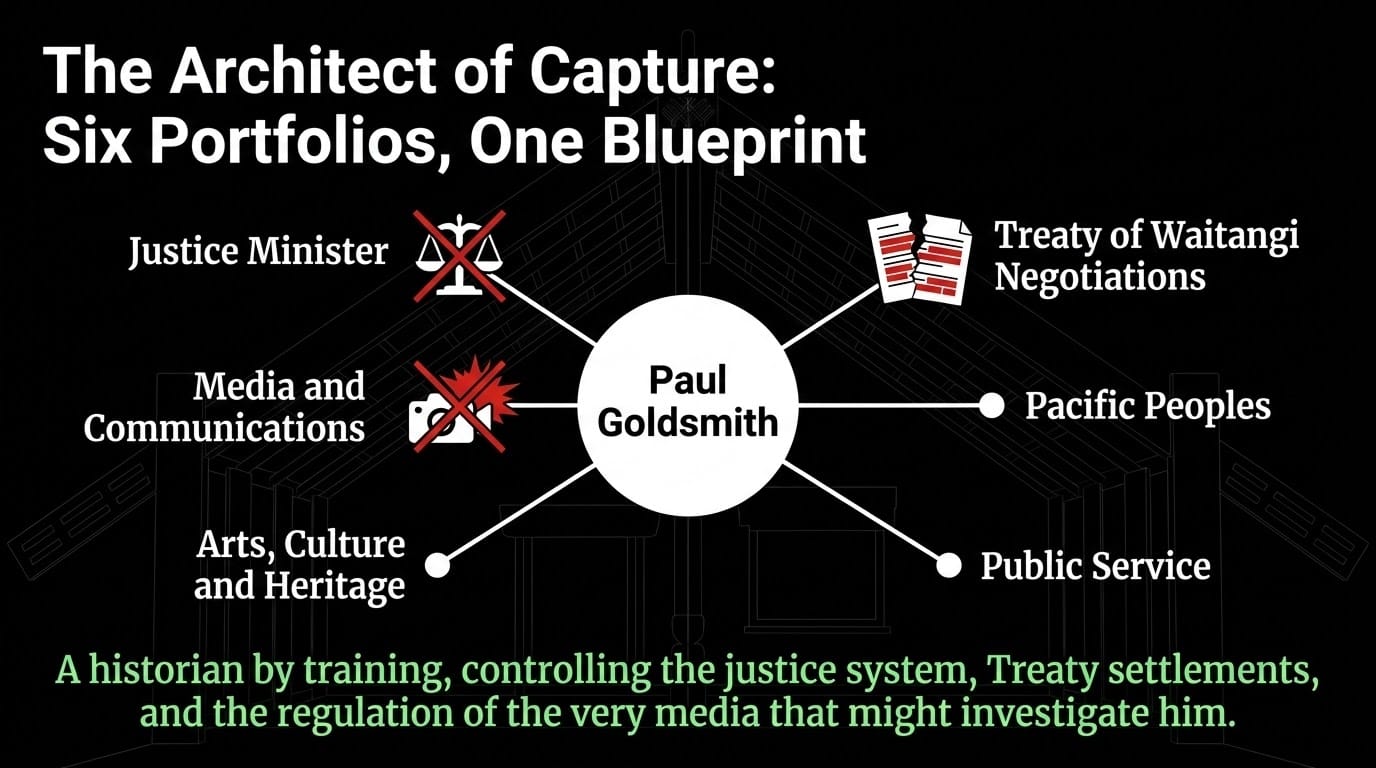
Paul Goldsmith is not merely the Justice Minister. As of the April 2026 ministerial reshuffle, he simultaneously holds six portfolios: Justice. Treaty of Waitangi Negotiations. Pacific Peoples. Public Service. Arts, Culture and Heritage. And — critically — Media and Communications. The Māori Green Lantern, The Grave Robbers in Suits, 19 April 2026
Six portfolios. One man. A historian by training, not a lawyer, controlling the justice system, Treaty settlements, Pacific representation, the public service, and the regulation of the very media that might investigate him.
This is the man who, in June 2021, told the nation that colonisation was "on balance" good for Māori because it reconnected us with the world after "centuries of isolation." He called himself "a proud New Zealander" when challenged. He did not apologise. Wikipedia / Paul Goldsmith (politician), sourced from primary RNZ/NZ Herald reporting
This is the man who, as I documented in The Surgeon Who Hates the Patient (April 2026), stripped Treaty obligations from 19 to 23 pieces of legislation at a secret Cabinet meeting on 23 February 2026 — and then refused to name which laws he had changed when asked by the NZ Herald. The Justice Minister. Refusing to name the law changes he had made. In secret. To the statutes governing your health, your children's schooling, your whenua, your water, your climate future.
This is the man who, as I documented in The Crowbar in the Classroom (May 2026), triggered a Waitangi Tribunal finding of "reckless disregard" for the Crown's relationship with Māori — stripping Treaty protections from education law against clear official advice, without consulting Māori, in breach of the principles of partnership, active protection, equity, redress, good government, and rangatiratanga simultaneously.
This is the man who, as I documented in The Watchdog They Shot (May 2026), handed Sean Plunket and The Platform a functional licence to broadcast hate by abolishing the Broadcasting Standards Authority — eliminating independent media accountability while adding Media and Communications to his own ministerial portfolio.
This is the man who — as I documented in The Taniwha in a Suit (June 2026) — retroactively amended the Climate Change Response Act to extinguish a Supreme Court-validated Māori legal case mid-proceedings, making restoration of environmental balance — utu — permanently illegal. Not just for this case. For all future cases.
The Human Rights Commission appointment is not an anomaly. It is the signature on a document that was always going to end here.
THE FIVE REVELATIONS: WHAT THE EVIDENCE PROVES
Revelation One: The Appointment Was a Party-Political Placement From Day One
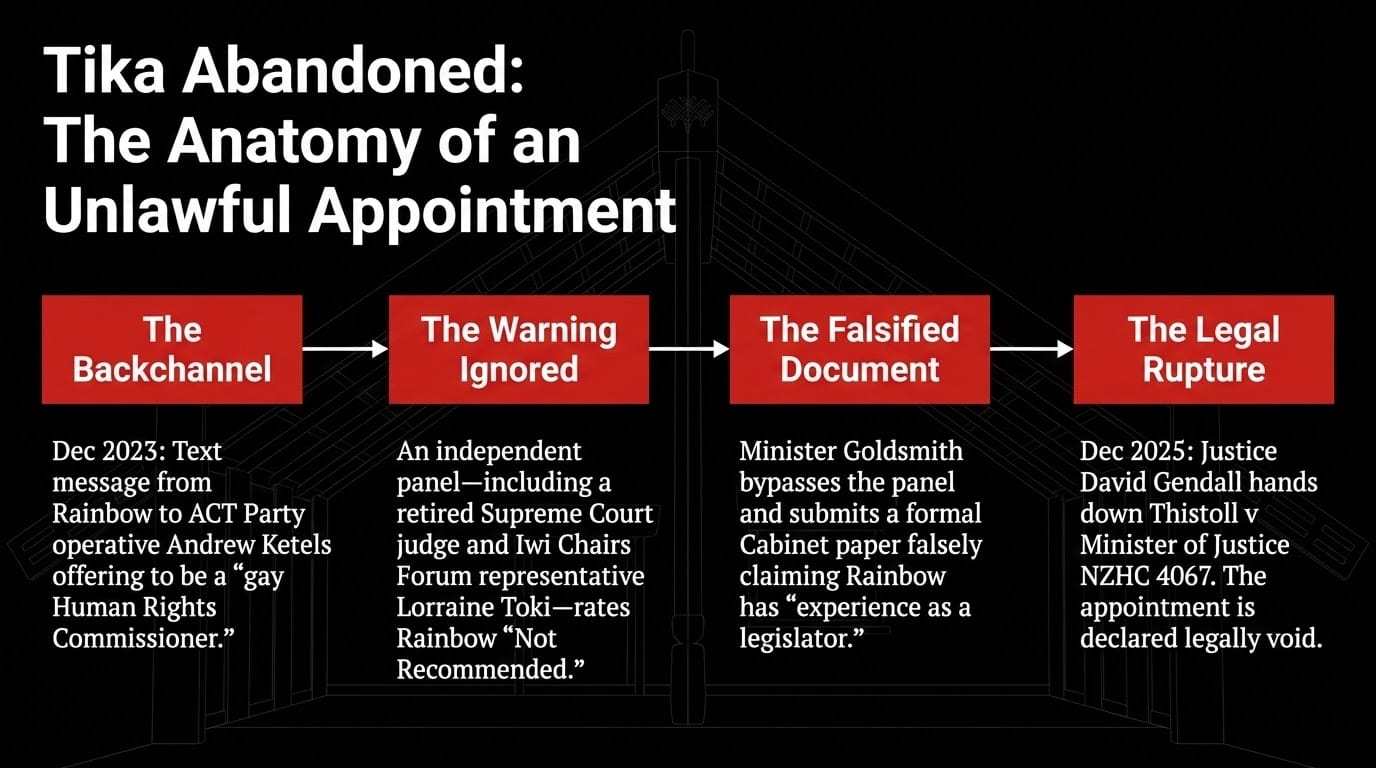
The whakapapa of this scandal begins in December 2023. Stephen Rainbow texts ACT Party chief of staff Andrew Ketels offering to be "a gay Human Rights Commissioner."
Ketels replies on 29 January 2024: "David [Seymour] is keen to nominate you for the position of Chief Human Rights Commissioner." He asks Rainbow to resend a CV "that reflects the requirements of the position." Rainbow submits his expression of interest to Seymour, not the Ministry of Justice.
Read that again. The ACT Party leader nominated a candidate — one who had already failed an independent process — to a statutory independent institution. The Justice Minister welcomed those nominations. He built an appointment process from the party system outward. The Spinoff, 5 November 2024
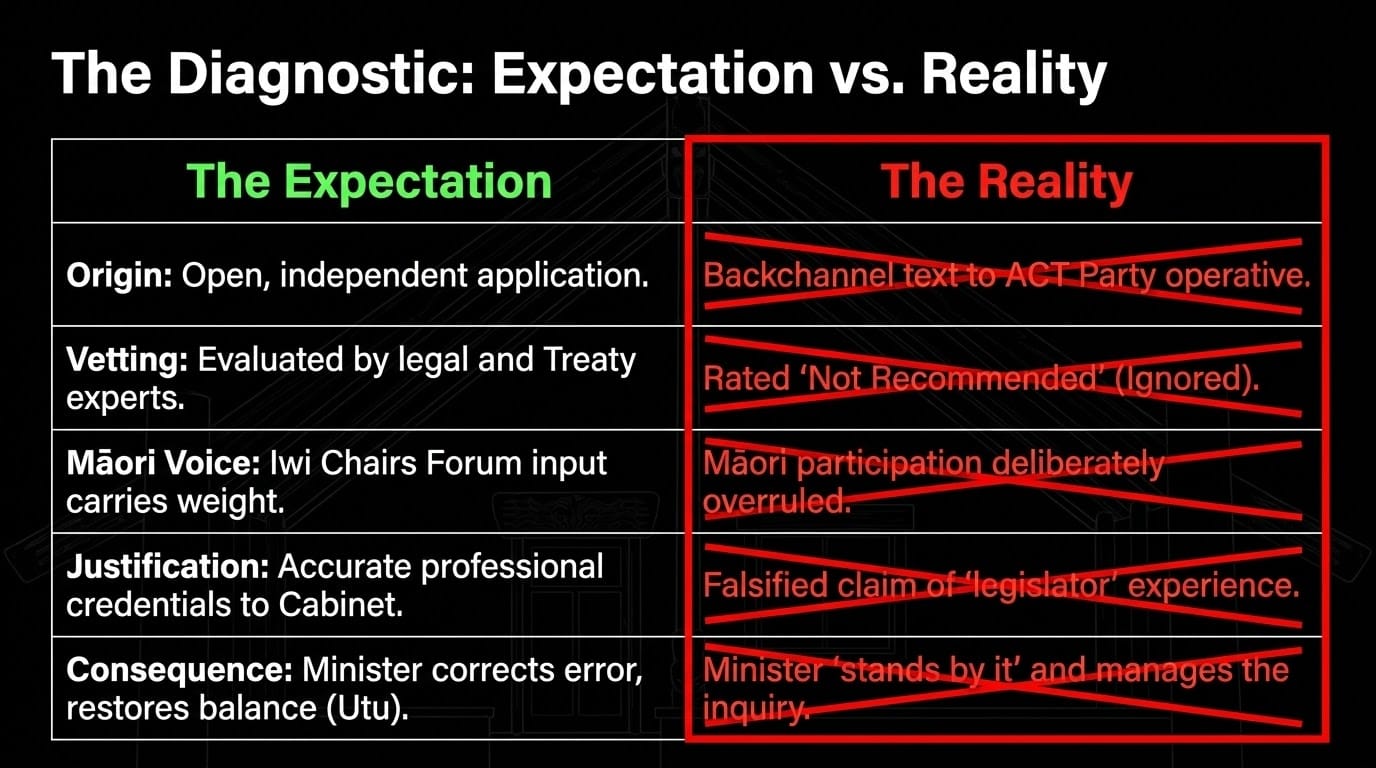
The assessment panel that evaluated Rainbow included retired Supreme Court judge Sir Terence Arnold, former Attorney-General Sir Christopher Finlayson KC, King's Counsel Paul Rishworth, and Iwi Chairs Forum representative Lorraine Toki. Four of the most senior legal and Treaty minds in this country. They rated Rainbow "not recommended." Two other candidates were "highly appointable."
Goldsmith overruled all of them. He overruled a Māori voice in the process. He overruled the retired Supreme Court judge. He overruled his own ministry's process. He appointed Rainbow anyway.
When opposition MP Duncan Webb asked him in September 2024 whether Rainbow had been on the ministry's shortlist, Goldsmith replied: "The ministry undertook an initial review of candidates for the chief commissioner role but did not recommend a shortlist." The Spinoff described this as "potentially a semantic answer" — the substantive implication, that no shortlist existed, was false. The Spinoff, 14 October 2024
Revelation Two: He Lied in His Own Cabinet Paper
The Cabinet paper recommending Rainbow's appointment contained this claim: that Rainbow's "experience as a legislator gives him a useful background for considering legal issues."
Stephen Rainbow has no experience as a legislator. Not in Parliament. Not in local government. Nowhere.
When challenged, Goldsmith acknowledged the statement was incorrect.
A Cabinet paper is a formal legal instrument. The qualifications cited in a Cabinet paper are material to the appointment decision it recommends. A Justice Minister who presents false information in a Cabinet paper to Cabinet — false information about the qualifications of his own nominee — has done something that in any functioning accountability system would end his career.
There was no consequence. No censure. No withdrawal of the appointment. He said my bad. He kept going. The Spinoff, 5 November 2024
Revelation Three: A High Court Judge Found He Broke Two Laws
In December 2025, Justice David Gendall handed down Thistoll v Minister of Justice NZHC 4067. The findings were explicit and binary:
- Goldsmith applied the incorrect legal test under the Crown Entities Act 2004 and the Human Rights Act 1993.
- He failed to consider mandatory statutory criteria before making the appointments.
Both appointments — Rainbow and Derby — were declared unlawful. Rights Aotearoa, Scoop, 18 December 2025
The man responsible for the legal system broke the legal system. The keeper of the law broke the law. And he kept his job. And his appointees kept theirs. Because the legal challenge did not seek removal — it sought the declaration. And when you have a High Court judgment against you and the PM still does nothing, you understand that the rot is not in one ministry. The rot is in the entire scaffolding.
Revelation Four: He Knew for Weeks — and Did Nothing
On 24 June 2026, Goldsmith told RNZ he had known about complaints against Rainbow's conduct "for a couple of weeks." The complaints themselves had accumulated "over the last few weeks and months." He does not yet have the ability to suspend Rainbow. He "stood by" the appointment — publicly, on the record, while a King's Counsel was already investigating it. RNZ, 24 June 2026
He was not disappointed that he broke the law.
He was not disappointed that he lied to Cabinet.
He was not disappointed that his appointee generated formal complaints serious enough for a KC investigation.
He was "disappointed" that it was necessary — that is, disappointed that we found out.
The arsonist who set the fire now chairs the committee investigating the smoke.
Revelation Five: The HRC Is the Last Wall Standing — And He Chose It for That Reason
Here is the map no single outlet has drawn in full. I draw it now.
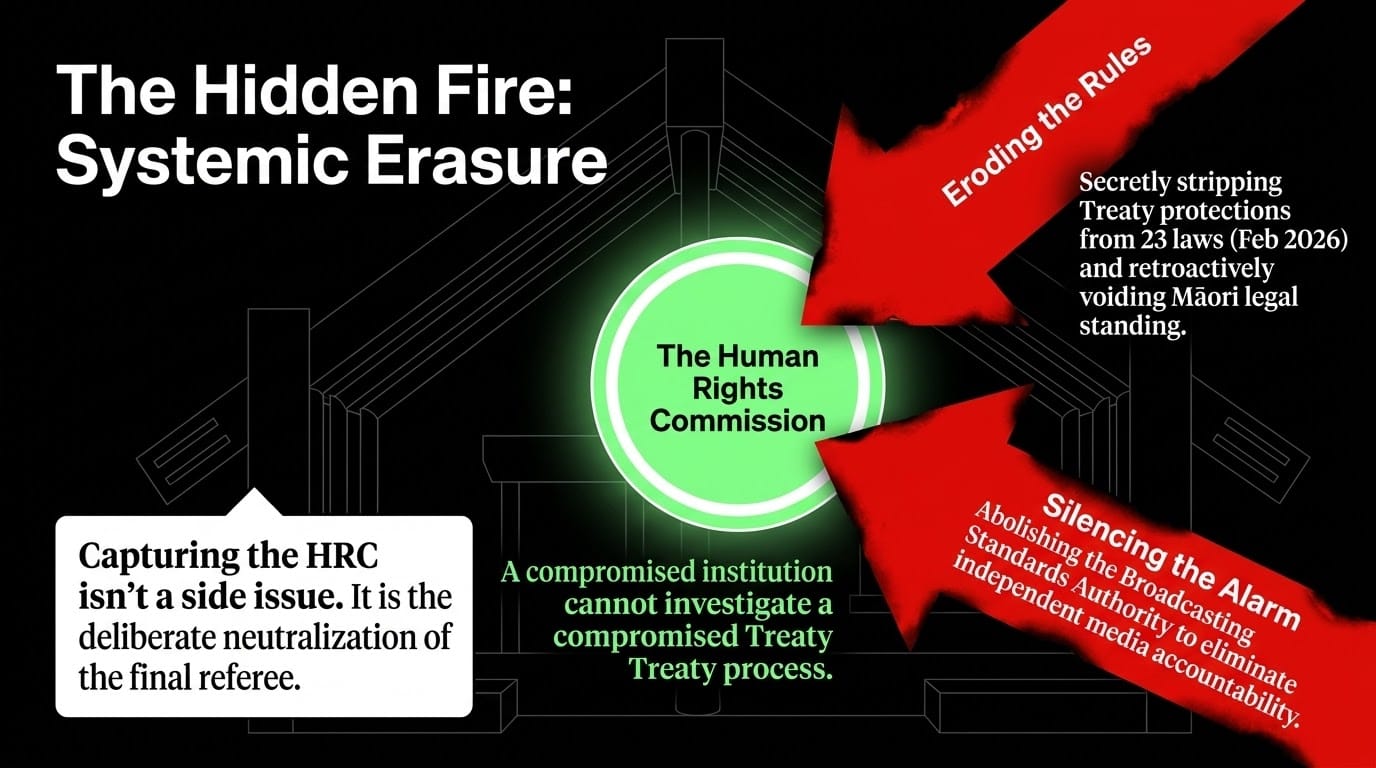
Paul Goldsmith controls Treaty Negotiations. He controls Justice. He controls the Public Service. He controls Media and Communications. He stripped Treaty protections from 23 laws in secret on 23 February 2026. He abolished independent broadcast accountability. He retroactively erased a Supreme Court-validated Māori legal case. He blocked a near-complete Treaty settlement with Te Whānau-ā-Apanui because they included a clause affirming they had never ceded sovereignty — which, as I documented in The Settlement That Settled Nothing (November 2025), is the whole point: the Crown will not settle what it will not acknowledge.
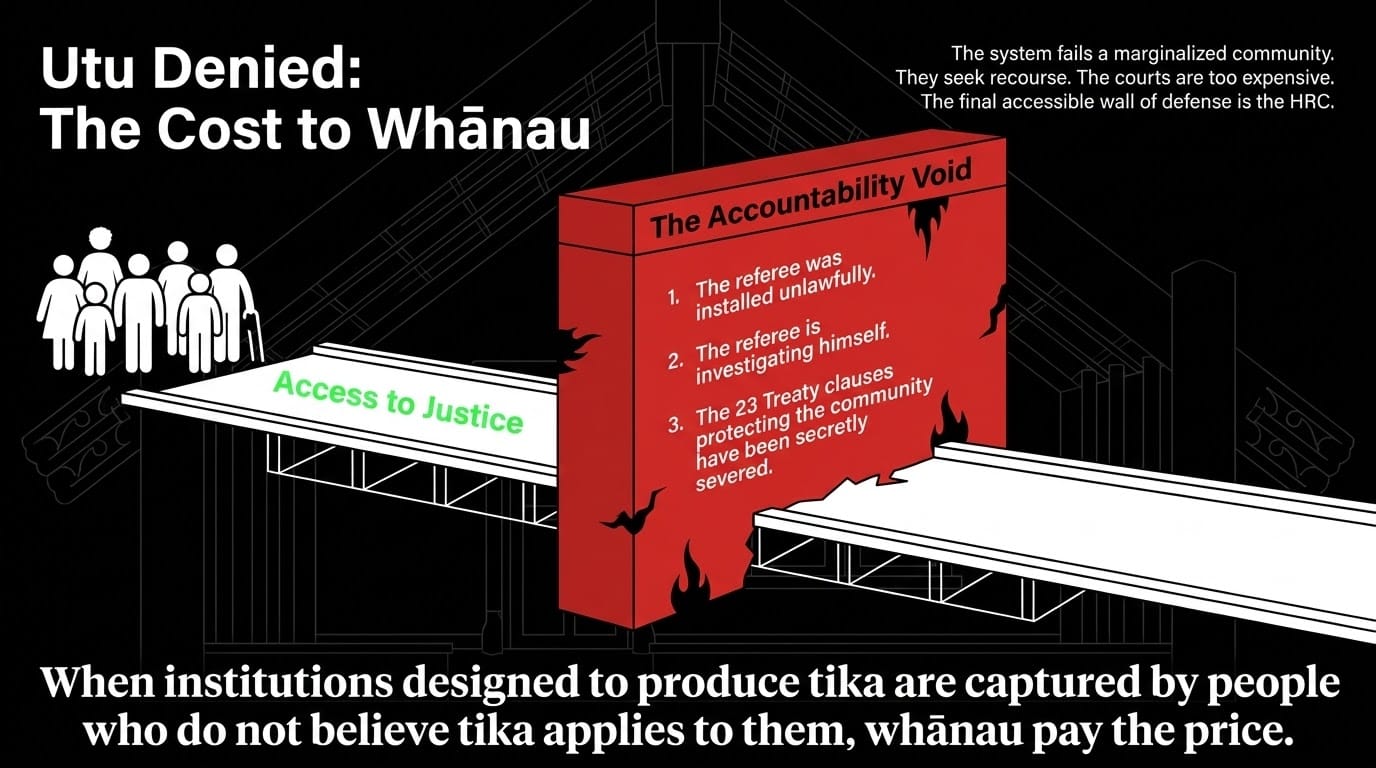
The Human Rights Commission is the institution that sits between all of that — between the stripped laws, the abolished watchdog, the extinguished cases, the blocked settlements — and the courts. It is the place whānau go when the system has failed them but the courts are too expensive. An unlawfully appointed, unqualified commissioner with documented Islamophobia complaints and no legal expertise cannot credibly investigate a government that:
- Stripped Treaty protections from 23 laws without consultation
- Abolished the Broadcasting Standards Authority
- Retroactively voided Māori legal standing
- Blocked Treaty settlements requiring acknowledgement of non-cession
- Conducted a secret Cabinet meeting to dismantle environmental rights
The HRC appointment is not a side issue. It is the last wall, deliberately cracked.
As I documented in The Grave Robbers in Suits (April 2026): "The Principles Bill failed because Māori organised. The Clause Review is succeeding because the Crown made it invisible."
The HRC appointment ensures the institution that might investigate the invisible changes is compromised at the top.
THREE EXAMPLES FOR THE WESTERN MIND
Example One: The Estate Lawyer Who Rewrites the Will Without Telling the Beneficiaries
Imagine a family. Both parents die. They leave a detailed will establishing protections for 23 family members — housing allowances, health cover, education funds, rights over shared land. An estate lawyer is appointed to manage the will and negotiate the remaining claims.
On a Tuesday in February, the lawyer quietly files amended trust documents — removing 23 protective clauses. He tells no one for 55 days. When a journalist discovers the change and asks which clauses were removed, he refuses to say.
The family members who depended on those clauses — who are already, for structural historical reasons, the most vulnerable members of the family — receive nothing. Their housing allowances shrink. Their health protections disappear from statute. Their educational rights are downgraded to "take into account" — a legal formula so weak it barely constitutes an obligation.
That is precisely what Paul Goldsmith did at Cabinet on 23 February 2026. He stripped Treaty obligations from 23 pieces of legislation governing health, housing, education, environment, transport and justice — and refused to name which ones. The Waitangi Tribunal had already warned in October 2025 that this would breach the Treaty. 1News, 15 May 2026 He proceeded anyway.
The tikanga dimension: In tikanga Māori, a rangatira who acts in secret against the interests of those they are responsible for does not just break a rule. They break their mana. Mana is relational — it can only exist where it is given by others. Goldsmith holds six ministerial portfolios and no relational accountability to the people those portfolios govern. That is not leadership. That is occupation by bureaucracy.
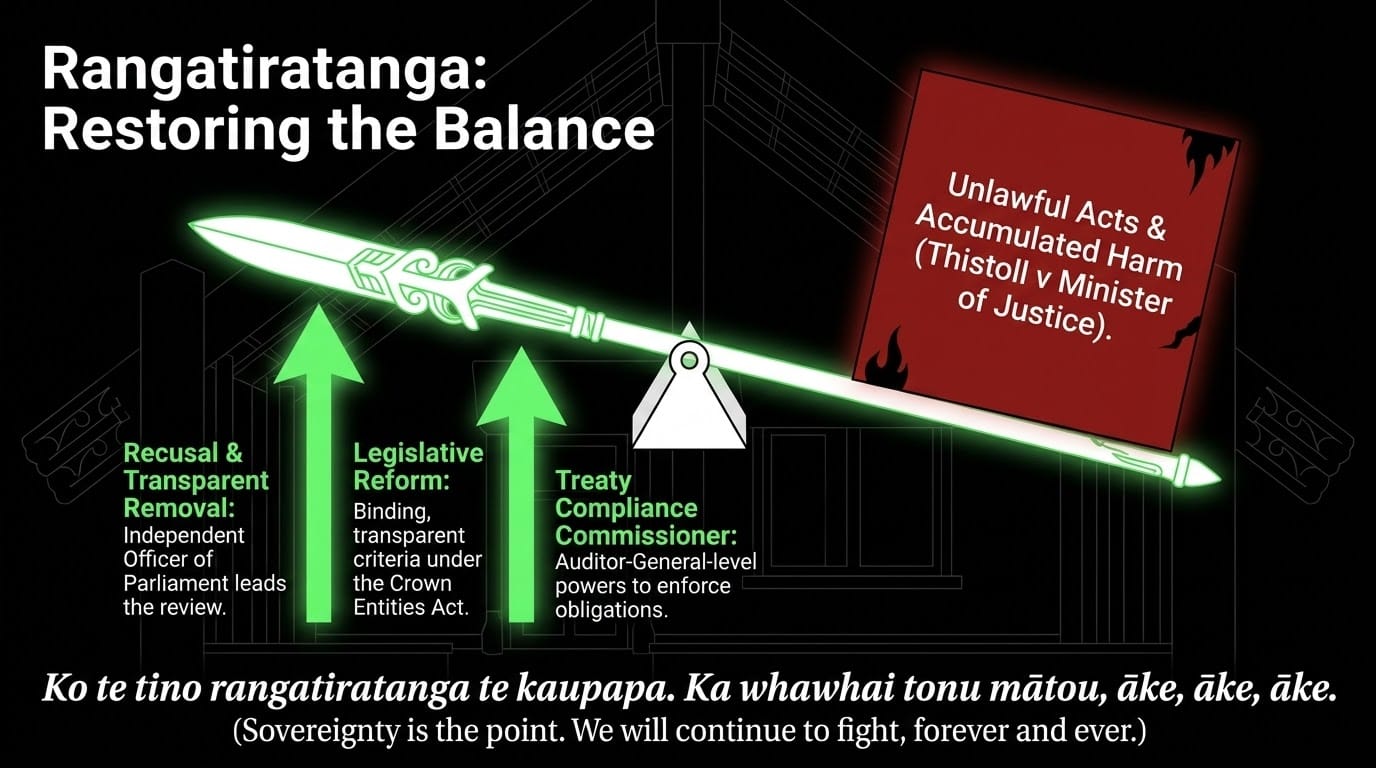
The solution: Restore and strengthen all 23 clauses. Require Māori co-governance over any future review of Treaty obligations in legislation. Establish a Treaty Compliance Commissioner with Auditor-General-level powers, as I proposed in Luxon's Anti-Treaty Government in Disguise (February 2026).
Example Two: The Referee Who Scores the Goals and Then Calls Offside on the Other Team
A football match. One team — call them Whānau United — represents the most marginalised communities in the country: Māori, Pacific, disabled, trans, LGBTQ+, poor. The other team — call them Crown FC — has been fouling them since 1840.
The referee is supposed to be independent. Instead, the referee is appointed by the Crown FC manager through a text message to his party's chief of staff. The independent panel — which includes a retired Supreme Court judge — scores the referee candidate as not recommended. The Crown FC manager overrides the panel and appoints him anyway, using a false credential in the official match paperwork.
When Whānau United tries to file a foul complaint, the referee investigates himself. The court overseeing the game finds the referee was unlawfully installed. The referee stays on the pitch.
That is what the Human Rights Commission appointment has done: it has installed a referee who owes his job to the team that keeps committing fouls. Every complaint Māori and Pacific and trans New Zealanders make to the HRC now passes through the hands of a man who exists in that role because of a process the High Court called unlawful.
The tikanga dimension: The principle of tika — correctness, fairness, alignment with what is right — is foundational to tikanga Māori decision-making. A process that is not tika does not produce tika outcomes. The appointment of Stephen Rainbow was not tika at any stage. OIA documents confirm it was not tika in its origins. The panel confirmed it was not tika in its merit. The High Court confirmed it was not tika in its legality. And yet the outcome stands. This is what happens when institutions designed to produce tika are captured by people who do not believe tika applies to them.
The solution: Rainbow and Derby must be removed through a transparent, lawful process. The appointment process must be rebuilt: no party nominations, full open applications, panel decisions binding unless overridden by written ministerial reasons tested against the statutory criteria, tabled in Parliament and subject to select committee review. Iwi Chairs Forum representation on the panel must be retained and its findings given formal weight.
Example Three: The Doctor Who Prescribed the Poison, Denied It Was Poison, and Now Chairs the Hospital Inquiry
A patient — call them Aotearoa, or more precisely, call them the communities who have the least access to private medicine — goes to hospital. They receive a prescription. The prescription is wrong. The prescribing doctor knew it was wrong. He had been told by his own pharmacist that it was wrong. He prescribed it anyway, using a falsified drug schedule.
When the patient deteriorates and a court finds the prescription was unlawful, the doctor says he "stands by" the prescription. When the hospital board convenes an inquiry into the patient's deterioration, the doctor chairs it.
That is Paul Goldsmith in the Human Rights Commission investigation. The minister who made the unlawful appointment, presented false credentials to Cabinet, was found out by the High Court, and watched his appointee generate complaints for "the last few weeks and months" — now manages the KC investigation from the same desk.
The tikanga dimension: In tikanga Māori, the concept of utu is often mistranslated as revenge. It is more precisely understood as balance restored — the reciprocal act that returns a relationship to equilibrium after harm. When a rangatira causes harm and refuses to acknowledge it, utu is not complete. The balance is not restored. The whakapapa of the harm continues to accumulate. Goldsmith's refusal to acknowledge that the appointments were wrong — his public declaration that he "stands by" them, on the same day a King's Counsel is investigating their consequences — is a refusal of utu. It is an active declaration that the harm will continue.
The solution: Goldsmith must recuse himself from any involvement in the investigation process and from any decision-making about Rainbow's future. An independent statutory officer — not a minister, not a ministerially appointed KC, but an officer of Parliament — must lead the review. The outcome must include formal Crown acknowledgement that the appointment process was unlawful, a public commitment that party-political nominations will never again be used for statutory independent appointments, and binding legislative reform of appointment criteria under the Crown Entities Act.
THE ARCHITECTURE OF CAPTURE: CUI BONO, CUI MALO
Who benefits? ACT Party: a compliant HRC that will not credibly challenge their Treaty Principles agenda. National Party: the broader coalition project of stripping institutional accountability from independent statutory bodies. Property developers and corporate interests: a Justice Ministry focused on protecting power, not challenging it.
Who pays? Māori, who are 52% of the prison population and depend on robust rights oversight. Pacific, disabled, trans, and brown New Zealanders who use the HRC as a court of first resort. Every whānau whose Treaty-protected rights are now governed by legislation stripped of enforceable obligations by the same minister, in secret, at the same Cabinet table.
The five hidden connections, assembled in one frame:
1. Rainbow was sourced through ACT's political machine — directly, by text, before the process opened. The Spinoff OIA, 5 November 2024
2. Goldsmith overruled an Iwi Chairs Forum representative on the assessment panel — erasing Māori participation in the oversight of Māori rights institutions. The Spinoff, 14 October 2024
3. Goldsmith holds both Justice AND Treaty Negotiations. Capture the HRC and you neutralise rights complaints against Treaty clause removals simultaneously. MGL, The Grave Robbers in Suits, April 2026
4. He abolished the Broadcasting Standards Authority and added Media and Communications to his portfolio in the same period — eliminating independent broadcast accountability while capturing the independent rights body. MGL, The Watchdog They Shot, May 2026
5. The Waitangi Tribunal found his Treaty Clause Review — announced in secret, implemented over 23 laws — breached six Treaty principles simultaneously, without Māori consultation, against official advice. The HRC would be the institution whānau turn to. A compromised HRC cannot investigate a compromised Treaty process. 1News, 15 May 2026
IMPLICATIONS: WHAT HAPPENS WHEN THE LAW BREAKS THE LAW
The New Zealand legal system has a word for what happens when a minister acts unlawfully in the exercise of statutory powers: ultra vires. Beyond power. Outside the authority granted. The High Court used it. The Tribunal used it. The record is permanent.
What it does not yet have is a consequence proportionate to the act. The Justice Minister broke the law.
The law said nothing to him except: you broke it. He kept his job. His appointee kept theirs. He managed the investigation into his own unlawful act.
That is not a legal failure. It is a constitutional one. It is the failure of every accountability mechanism that should have acted — Cabinet collective responsibility, the Prime Minister's power to reshuffle, the select committee, the fourth estate — to act.
And Māori, Pacific, and brown New Zealanders are left to navigate a Human Rights Commission led by an unlawfully installed commissioner with no legal expertise, documented complaints against his conduct, and a KC investigation underway
— led by the same minister who built the whole catastrophe.
That is the implication. That is the quantified harm. And it is not abstract. It is the stack of unanswered rights complaints that will now be processed through this compromised institution. It is the Treaty obligations stripped from 23 laws that no longer trigger HRC oversight. It is the Māori wāhine who files a discrimination complaint and finds it reviewed by a commission compromised at every level of its governance.
THE TAIAHA NAMES THE ARSONIST
Ko te tino rangatiratanga te kaupapa. Sovereignty is the point.
I have been writing about Paul Goldsmith since before this government took office. I have documented him stripping Treaty clauses from law in secret. Blocking settlements. Removing Māori language protections. Abolishing media accountability. Retroactively erasing Māori legal standing. Handing Pacific peoples to a minister who told the country colonisation was good for Māori.
The Human Rights Commission appointment is not a scandal in isolation. It is the crown jewel of the pattern. It is the move that, if it stands unchallenged, locks all the other moves in place permanently. A compromised HRC cannot investigate unlawful Treaty clause removals. Cannot investigate discriminatory evictions. Cannot investigate a broadcast landscape from which Māori voices are being systematically removed. Cannot investigate a minister who holds the portfolios for Justice, Treaty, Pacific, Public Service, Media, and Arts simultaneously and uses them as a single instrument of institutional capture.
He must recuse from the investigation.
His appointees must be removed through a lawful, transparent process.
The appointment process must be legislatively reformed.
The 23 Treaty clauses must be restored.
And Aotearoa must understand: this was not an accident. This was a plan.
Paul Goldsmith is not a bumbling bureaucrat. He is an ideologue with six portfolios and a documented record of acting against the interests of Māori at every turn — legally, constitutionally, and historically. He told us colonisation was good for us. He has spent three years proving he meant it.
The taiaha is raised. The name on it is his.
Ka whawhai tonu mātou, āke, āke, āke.
KOHA CONSIDERATION
Paul Goldsmith has six portfolios and the full machinery of the Crown at his disposal. What I have is this: a taiaha, a laptop, and whānau who understand what is at stake.
This essay — the OIA analysis, the High Court judgment, the whakapapa of five years of institutional capture assembled in a single frame — exists because you support it. Every koha signals that whānau are ready to support the accountability that a compromised Human Rights Commission, a captured media landscape, and a Justice Minister who broke the law and stood by it will not provide.
It signals that rangatiratanga includes the power to support our own truth-tellers — especially when the truth-teller is pointing at the man who holds six portfolios and controls the institutions that are supposed to hold him to account.
If you are unable to koha — no worries at all. Subscribe, share this essay with your whānau and friends, kōrero about what it documents. That is koha in itself.
Four pathways to support this mahi:
Koha — direct support: https://app.koha.kiwi/events/the-maori-green-lantern-fighting-misinformation-and-disinformation-ivor-jones
Subscribe — receive essays directly: https://www.themaorigreenlantern.maori.nz/#/portal/support
Direct bank transfer: HTDM, account number 03-1546-0415173-000
Facebook: https://www.facebook.com/Themaorigreenlantern/subscribe/
Kia kaha, whānau. Stay vigilant. Stay connected.
Public interest statement: Published under Durie v Gardiner NZCA 278. The conduct of a sitting minister in making statutory appointments, and in his response to judicial findings of unlawfulness, is a matter of democratic accountability of the highest constitutional order.
DISCLAIMER: The opinions expressed in this essay are those of the author, Ivor Jones, and are clearly identified as such throughout. All facts are sourced to primary verified sources. The scathing tone is grounded entirely in evidence — not malice. Pattern of harm only, never personal. Nothing in this essay constitutes legal advice. Published in the public interest.