
"The Green Chain - How the Crown Licensed Murder, the Whakatāne Sawmill Ran on Poison, they Dipped the Timber in PCP and the Workers in Silence, and this was Whakatāne's Green Chain of Death" - 24 April 2026
The Crown Knew PCP Was Killing Workers. It Kept the Belt Moving Anyway.

Kia ora whānau,
Somewhere in Whakatāne right now, a man who once worked the green chain is carrying something the timber company left inside him. He may not know what to call it. His doctor may not either. His ACC file probably calls it unrelated.
This series exists because that man deserves a name for what was done to him.
THE GREEN CHAIN SERIES
The Green Chain is a five-part investigation into the PCP poisoning of Whakatāne sawmill workers — what the Crown knew, when it knew it, who profited, who died, and who is still standing in the wreckage demanding justice.
Essay One begins with the poison itself and the forty-year decision to keep running it through Māori hands.
| Essay | Title | Core Kaupapa |
|---|---|---|
| 1 | THE GREEN CHAIN: How the Crown Licensed Murder | The history of PCP use, what was known and when, and the Crown's role in placing Māori men into poisoned work. |
| 2 | Dying on the Books: ACC, Science Denial, and the Art of Waiting for Men to Die | How ACC and state agencies built a machinery of delay, denial, and attrition around poisoned workers. |
| 3 | When the Whenua Bleeds: Contaminated Land, Contaminated Water, Contaminated Futures | The environmental crime scene — dump sites, poisoned waterways, marae land, and the unequal value placed on land over Māori bodies. |
| 4 | Seven Generations: The Intergenerational Crime Against Ngāti Awa Whānau | Miscarriages, birth defects, learning difficulties, infertility, and the multigenerational reach of dioxin exposure. |
| 5 | Ka Whawhai Tonu: Kereama Akuhata, SWAP, and the Road to Rangatiratanga | The organising line from Joe Harawira to Kereama Akuhata, what was won, what was denied, and what justice still requires. |
THE GREEN CHAIN: How the Crown Licensed Murder
They dipped timber in poison. They dipped Māori labour in silence. And when the bodies began to fail, the Crown called it uncertainty.
He Kōrero Tūāpō — The Midnight Word
They knew. They always knew.
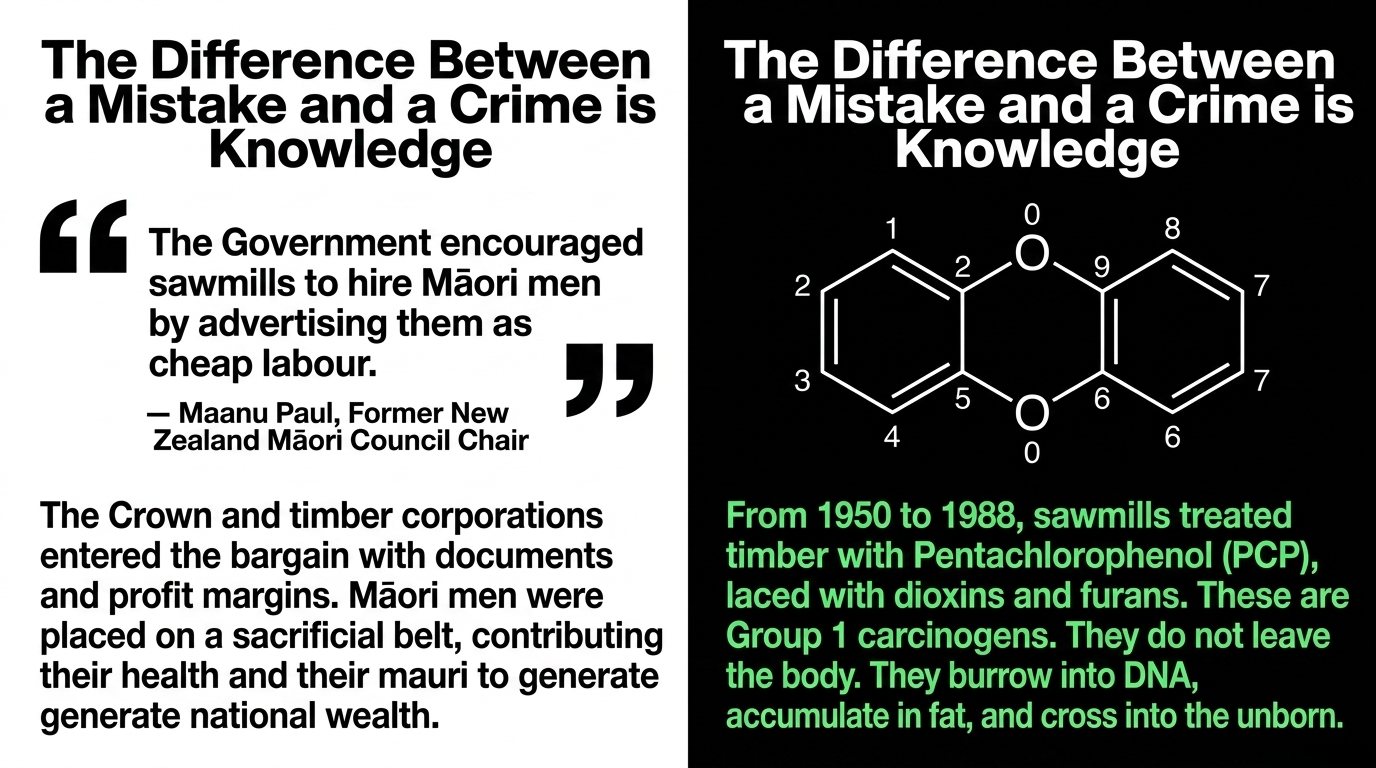
The difference between a mistake and a crime is knowledge. The Crown had knowledge. The companies had profit. The workers had skin, lungs, whānau, and trust. One side entered the bargain with documents. The other entered it with bodies.
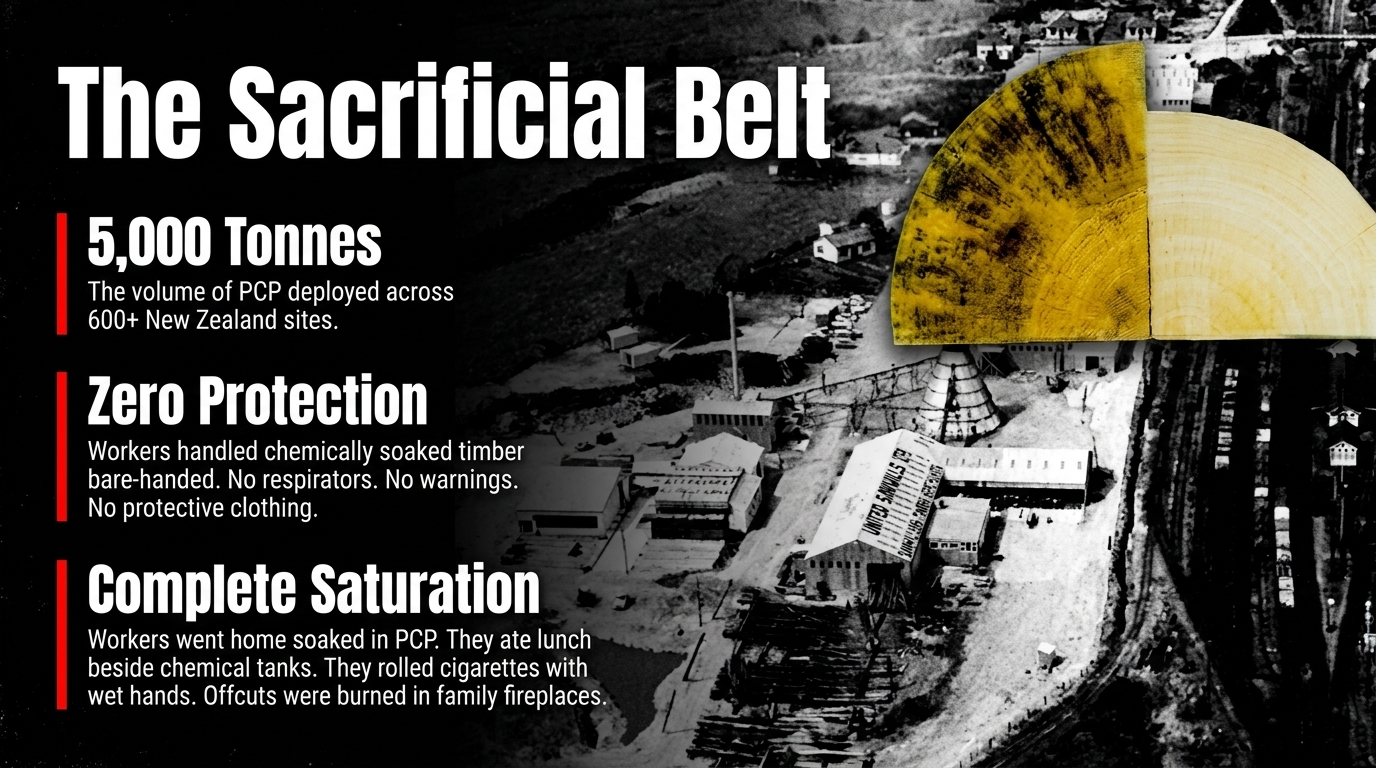
This was not a workplace. It was a sacrificial belt. Timber went in green and came out saleable. Māori men went in healthy and came out carrying a chemistry set of death inside them — accumulated in fat tissue, circulating in blood, burrowing into DNA, crossing into the unborn.For the western mind, here is the metaphor: this was not just a factory floor. It was an altar built by capital, licensed by the state, and fed with Indigenous labour. The incense was pentachlorophenol. The offering was brown bodies. The congregation was a profit margin.
The Poison — What It Was and What It Did
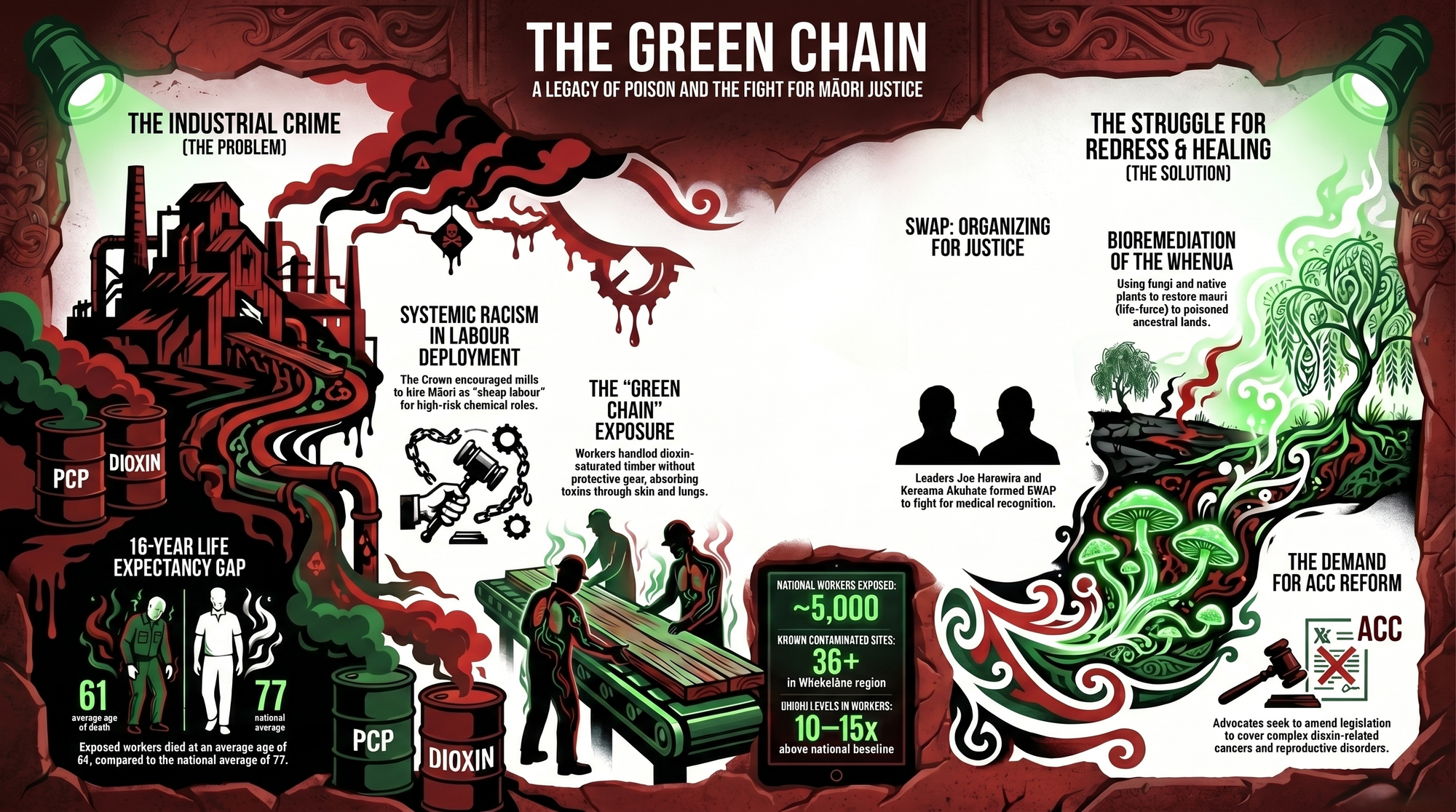
From 1950 onwards, New Zealand sawmills treated freshly sawn timber with pentachlorophenol — PCP — a chemical wood preservative that prevented sapstain discolouration. Workers on the green chain — the moving conveyor that carried treated timber — handled it without adequate protection, absorbing it through skin, lungs, and ingestion, as documented in painstaking detail by Te Ara. PCP was not simply a pesticide. It was an organochlorine compound contaminated with dioxins and furans — persistent organic pollutants that do not leave the body. They accumulate in fat. They disrupt hormones, attack immunity, damage the nervous system, and corrupt DNA.
The Deep Dive Podcast
Listen to a lively conversation between two hosts, unpacking and connecting topics in the sources of this essay.
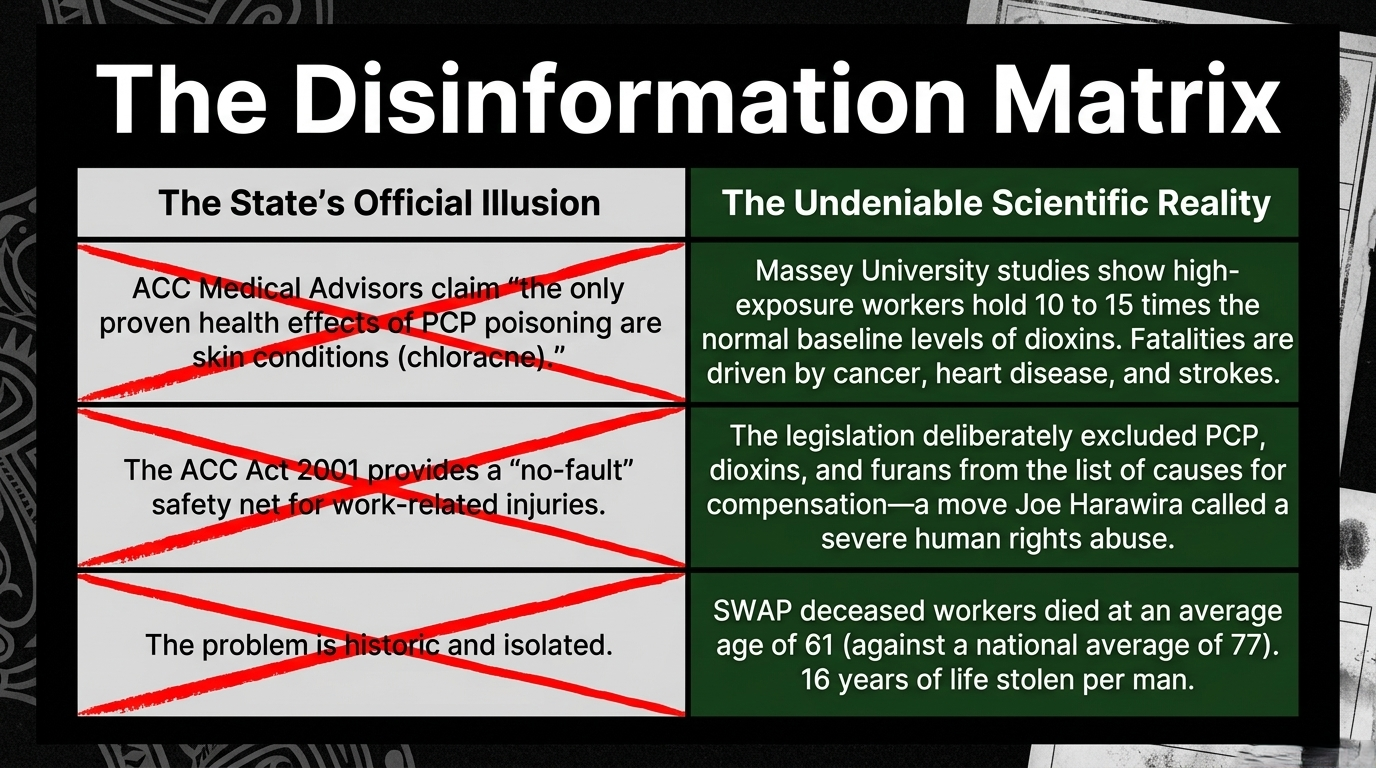
Short-term contact caused harm to the kidneys, blood, lungs, nervous system, liver, immune system, and gastrointestinal tract, as confirmed by Te Ara. Long-term chronic exposure — the reality for men who worked the green chain for decades — was later linked by Massey University research to chronic respiratory disease, unexplained persistent fevers, heart palpitations, mood disorders, and cancer, all documented by the Health Hub SIA. The International Agency for Research on Cancer classified 2,3,7,8-TCDD dioxin — the key contaminant in PCP — as Group 1: sufficient evidence of carcinogenicity in humans, per the same Health Hub SIA research summary. Group 1 means the science is settled. The only thing left unsettled is the law.
This matters in tikanga terms because mauri is not spiritual poetry for polite company. Mauri is the life-force integrity of a person, a whānau, a waterway, a food source, a marae, a relationship. When a state knowingly saturates workers and their rohe with persistent poison, it is not merely causing "health impacts." It is attacking mauri at every register simultaneously — the person, the family, the land, the water, the future.
For the western mind, think of it this way: if a council knowingly piped lead into a suburb for forty years, then told residents the headaches, cancers, miscarriages, and children's learning problems were probably unrelated, nobody would call that unfortunate. They would call it a crime. The only difference here is the colour of the suburb.
What Was Known and When
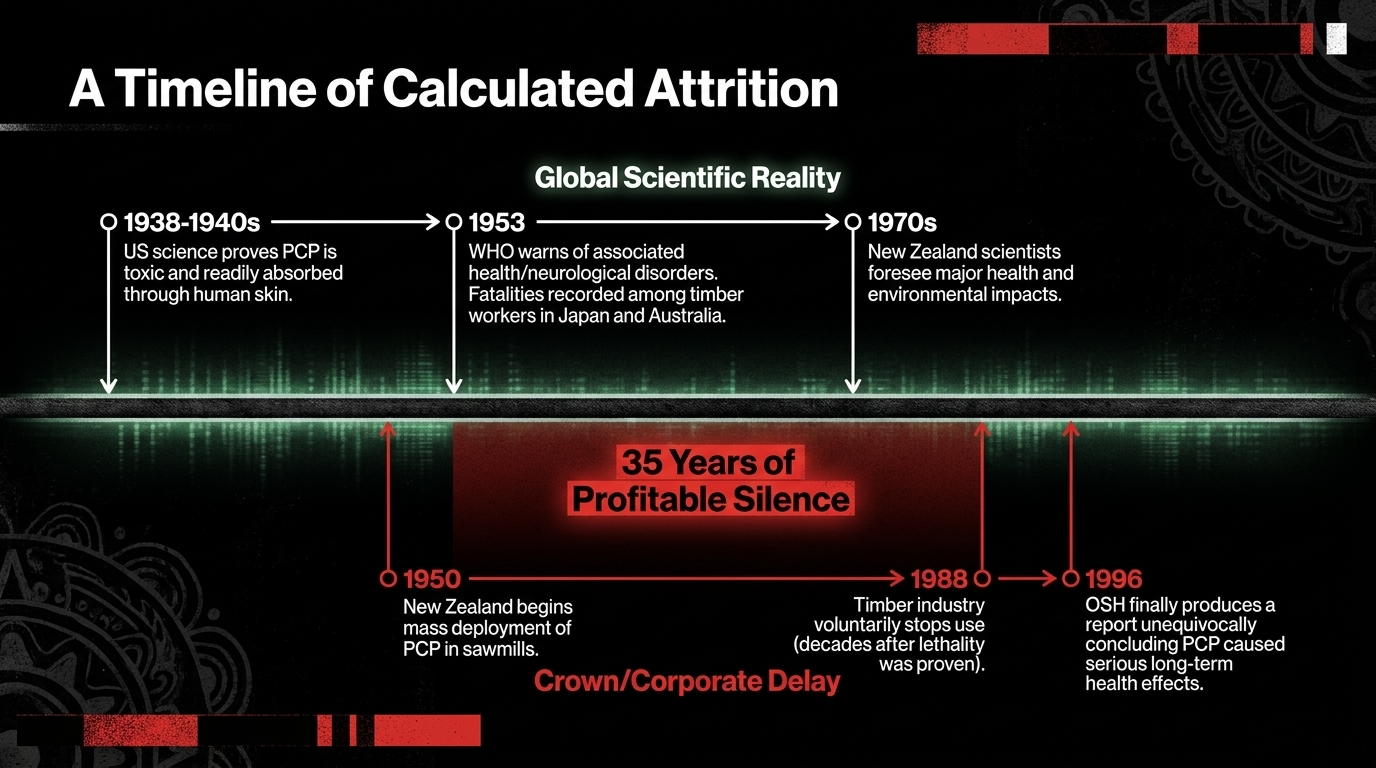
This is the hinge of the whole case. This is where negligence becomes crime.
Studies in the United States in the 1940s showed PCP was toxic and readily absorbed through the skin. By 1953 there were documented deaths among timber-treatment workers in Japan and Australia, as reported by the NZ Herald. New Zealand began mass PCP use in sawmills in 1950 — after all of this was known — and continued for nearly four decades, as confirmed by the Beehive's own 2004 research announcement. The chemical was only stopped in 1988, and only officially deregistered for sale in 1991, as Te Ara records.
A national task force was not established until 1990 — forty years after widespread use began — and even then its primary motivation was concern about environmental contamination rather than the failing health of workers, as the WSWS report from 2002 makes clear. It was not until 1996 that OSH finally released a report unequivocally concluding that PCP exposure had caused serious short- and long-term health effects among New Zealand workers, as reported by WSWS.
The timeline of knowledge is a timeline of choices. Every year between 1950 and 1988, the Crown and the timber industry chose profit over people. They chose to know and not act. That is not incompetence. That is governance by expendability.
The Deliberate Deployment of Māori Labour
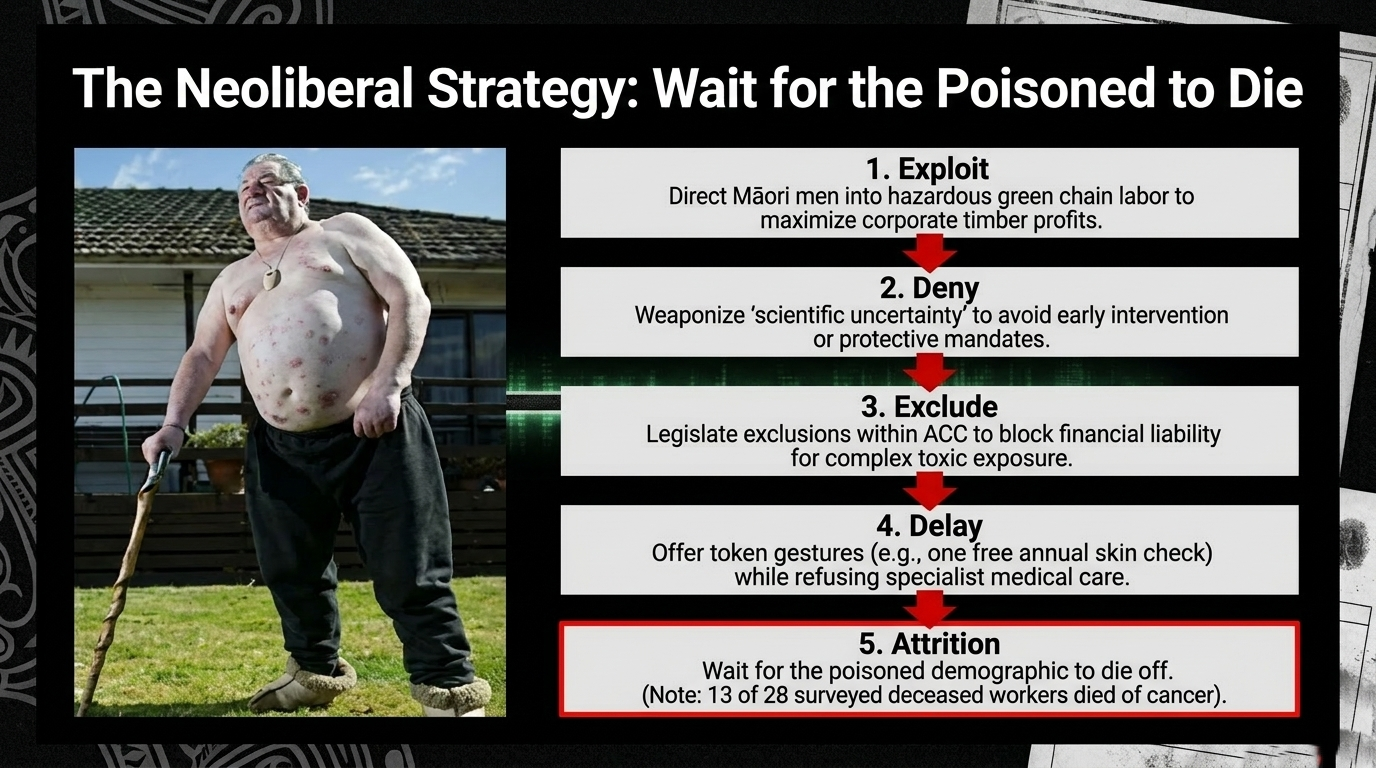
Now name the targeting. This is where industrial tragedy becomes racial crime.
Former New Zealand Māori Council chair and SWAP member Maanu Paul stated plainly that the Government encouraged sawmills to hire Māori men by advertising them as cheap labour, as reported by SunLive. That single sentence dismantles the mythology of ignorance. Māori were not overrepresented on the green chain by coincidence or misfortune. They were directed there. State employment apparatus placed Māori bodies into the most chemically hazardous roles in the timber industry. The government knew those roles were dangerous. The government promoted Māori as affordable for them. The government then spent decades denying the consequences.
Joe Harawira — Ngāti Awa and Ngāi Te Rangi, founder of Sawmill Workers Against Poisons — began at the Whakatāne sawmill in 1963 and worked in the timber industry for 29 years, as Te Ara records. He was one of more than 100 workers at the Whakatāne mill with documented long-term PCP exposure, as confirmed by the NZ Herald. Nationally, the NZ Herald estimated around 5,000 workers were exposed to PCP.
For the western mind: imagine a state agency promoting one ethnic group to employers as the low-cost workforce best suited for asbestos removal, then expressing surprise when that group dominates the mesothelioma statistics twenty years later. That would not be a labour-market accident. It would be structural racism with payroll paperwork. That is exactly what this was.
In tikanga terms, this was a fundamental breach of utu and mana. Labour was given. Wealth was created. But reciprocity never came. The worker gave strength; the employer returned poison. The whānau gave trust; the state returned denial. That inversion is not just injustice. It is an assault on the relational fabric that tikanga is designed to protect.
The Corporations Who Profited
The timber did not poison itself. The wealth did not generate itself. Companies extracted decades of profitable timber production using a chemical treatment process that killed their workforce, contaminated their rohe, and loaded the entire cost of damage onto workers, whānau, waterways, and generations not yet born.
Joe Harawira himself named Carter Holt Harvey among the entities that had to be part of any solution, alongside the Ministry of Health, ACC, OSH, the Whakatāne District Council, and Environment Bay of Plenty, as documented by the NZ Herald. No corporate compensation has been paid. No company has stood in front of the workers who survived and said: we did this.
That silence is not an oversight. It is the operating model of neoliberal extraction — privatise the profit, socialise the poison — the same moral architecture dissected in the Māori Green Lantern essays The Pātaka Is Ash, The Trapdoor Prime Minister, and The Van Velden Vanishing.
No Protective Gear. No Warning. No Accountability.
No protective clothing. No respirators. No warnings. No choice.
Twenty men in a cold Whakatāne garage, lifting their trousers to show purple legs, rubbing their temples to describe headaches that had never left them — this was the image captured by the NZ Herald in 2000. These were fit young men in their forties and fifties. Former athletes and workers. Men whose bodies had been the engine of a profitable industry. Now they sat in a cold garage, sick, uncompensated, and told their illnesses probably could not be proven work-related.
The Accident Compensation Act 2001 specifically excluded PCP, dioxins, and furans from its list of causes for which compensation could be sought — an exclusion Joe Harawira regarded as an abuse of human rights, as recorded by Te Ara. That exclusion was written into legislation after OSH had already confirmed in 1996 that the harm was real. Let that land: the Crown confirmed the harm, then designed the compensation system to block it.
A SWAP survey of 60 former sawmill workers and families of deceased workers found the major cause of death was cancer, followed by strokes and heart disease, as reported by WSWS. Of 28 deceased workers surveyed, 13 had cancer at the time of death. The average age at death: 61 years. New Zealand men's national life expectancy at the time was 77. These workers were dying sixteen years early. That is not a statistic. That is a sentence handed down by a system that decided their lives were acceptable collateral.
For the western mind: if a fire service sent crews into toxic blazes without breathing gear for four decades, then offered them one annual skin check while disputing their lung cancer and heart disease, every newsroom in the country would call it a national scandal before the week was out. Māori workers received less institutional outrage because the system had already discounted the value of their pain.
The Five Hidden Connections
1. The Crown's 1940s knowledge versus 1950s deployment. US science documented PCP's lethality before New Zealand began mass deployment. Deaths had been reported overseas before the first Whakatāne green chain was running. The defence of ignorance does not survive the timeline, as NZ Herald evidence confirms.
2. Cheap Māori labour was policy, not coincidence. The Government's own employment promotion apparatus placed Māori men in the most dangerous roles. The statement from Maanu Paul quoted by SunLive is not anecdote; it is an indictment.
3. The 1990 task force protected water before it protected workers. When PCP threatened awa and ecosystems, the Crown moved. When it was inside Māori bodies, the Crown studied. The priority was commercial and environmental liability, as WSWS documents. A worker later captured this obscenity to E-Tangata: they checked the fish; they never checked us.
4. ACC exclusion was legislative architecture, not administrative oversight. The exclusion of dioxin-related illness from ACC coverage was written into law after the harm was confirmed, as Te Ara records. The machine was built to make justice hard, expensive, and late.
5. Corporate beneficiaries have never been held to account. Carter Holt Harvey and the wider timber industry profited from PCP use for 38 years. No corporate compensation has been paid. The pattern is confirmed by NZ Herald.
Three Examples for the Western Mind
Example One — The Poisoned Fire Brigade
Imagine a city knowingly sending firefighters into chemical warehouse fires for decades without respiratory equipment, then — after formally admitting workers had been harmed — offering them a single annual check-up while contesting cancer, cardiac disease, and long-term neurological damage. That would be recognised immediately as institutional fraud. That is precisely what New Zealand did.
The Government formally acknowledged in 2010 that sawmill workers had been poisoned at work and established a special health service — but reporting confirms it covered mainly limited symptoms such as skin conditions while excluding the whānau of poisoned men, as SunLive documented. The tikanga breach is manaakitanga reversed: the institution charged with protection became the mechanism of harm.
Quantified impact: workers were still dying around an average age of 61 years while battling inadequate coverage.
Solution: full ACC cover for workers, spouses, and children, including specialist care for complex toxic exposure conditions, not token annual skin checks.
Example Two — The Poisoned Parish
Imagine a corporation dumping toxic fill around churches, cemeteries, schools, and community gardens, then telling families to keep using those spaces while "further study" was undertaken. Western law would call that desecration. Western culture would call it sacrilege.
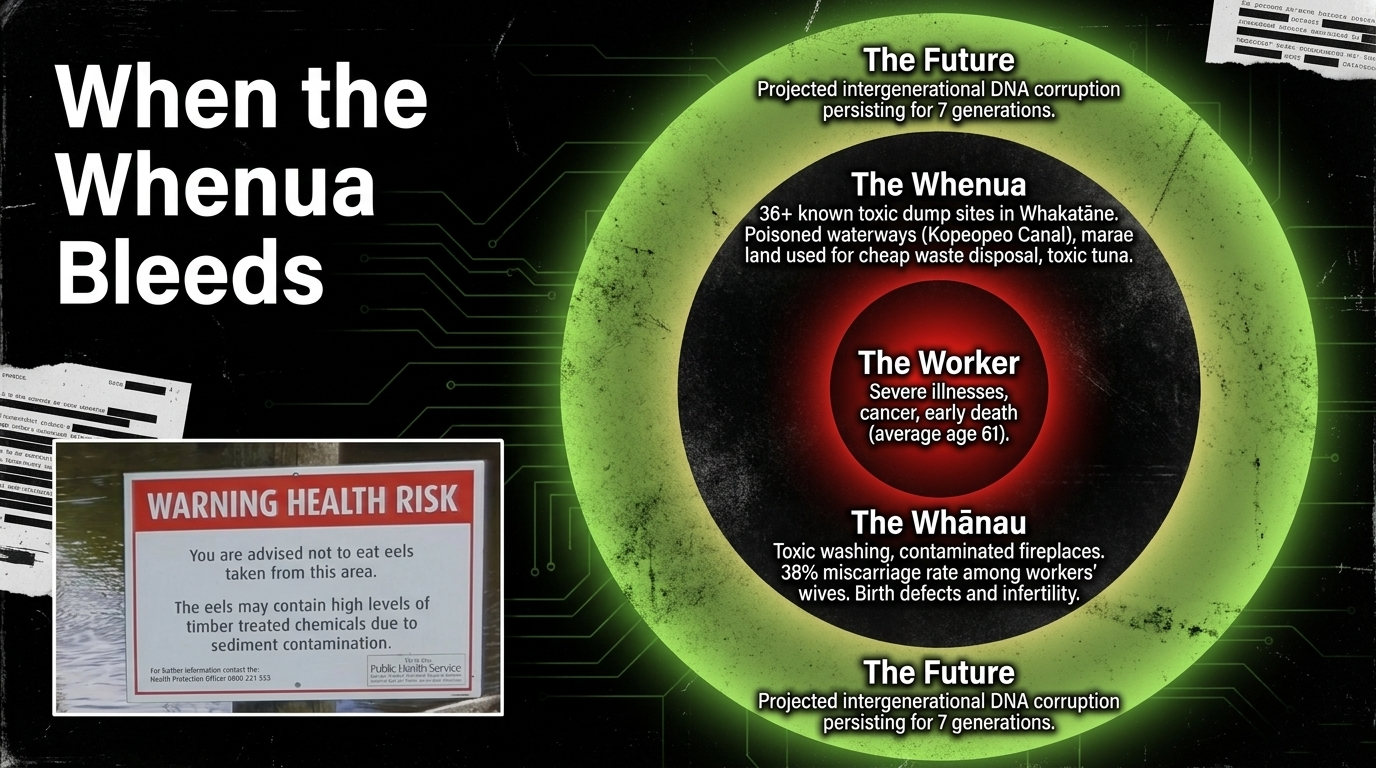
More than 36 known contaminated dump sites exist in the Whakatāne region alone, with contaminated products used as landfill that polluted bore water and community water supplies including at marae, as Te Ara documents. The SWAP submission to the People's Inquiry 2020 stated plainly that PCP and dioxin poisoned the whenua, the water, the tuna, the frogs, the birds, and the shellfish. In tikanga, marae are not merely meeting venues. They are living anchors of whakapapa, mourning, feeding, teaching, and collective memory. Poisoning them is an assault on wāhi tapu and communal continuity that no remediation payment can fully repay.
Solution: mana whenua-led cleanup of all 36+ sites, with independent monitoring around marae and residential areas, fully funded by the Crown and the companies that profited.
Example Three — The Poisoned Inheritance
Imagine a state allowing an industrial toxin to migrate from overalls into household washing, fireplaces, vegetable gardens, pregnancies, and children's bodies — then refusing to fund intergenerational health monitoring or legal redress for descendants. Western law already has a name for that: mass tort. Western ethics has another name: generational crime.
Te Ara records miscarriages, ectopic pregnancies, learning difficulties, birth defects, and infertility among workers' families, while SunLive reported SWAP research finding the intergenerational harm could persist for seven generations. In tikanga, whakapapa is not metaphor. It is the living architecture through which identity, obligation, land rights, spiritual connection, and continuity are transmitted. Rupturing it with dioxin is not collateral damage. It is a weapon deployed against ancestry itself.
Solution: an intergenerational health fund, free screening and specialist care for all descendants of exposed workers, and formal legal recognition that whānau exposure is part of the same industrial crime.
Kereama Akuhata — The Man Still Carrying the File
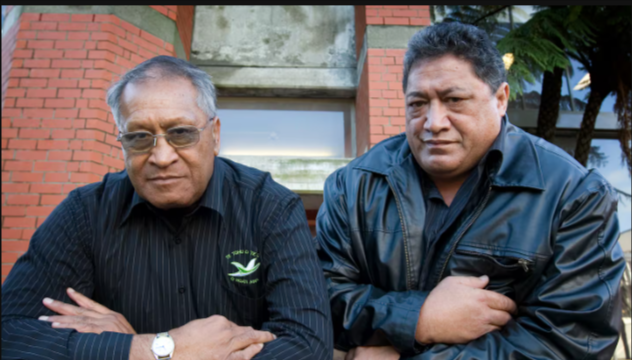
When Joe Harawira died in January 2017, Kereama Akuhata stood where Joe had stood, as E-Tangata recorded. He did not inherit a well-resourced advocacy organisation. He inherited a fight that the Crown had assumed exhaustion would eventually win.
By 2021, he had helped restart SWAP's advocacy and was still fielding calls from poisoned men being denied cover. He told SunLive that a former worker had been refused ACC support for skin cancer treatment and needed to find $9,000 himself. He said seven men had died in the previous year — four in just the four months prior to that report — and that the deaths were linked to cancer, heart disease, and diabetes connected to the chemical legacy. The average age of those men: 61.
That is what endurance under colonial administration looks like. Not a statue. Not a ministerial speech. Not a settlement press conference. A survivor still fielding calls at a time when the institutions that created the disaster are still issuing reports.
The Whenua Carries It Too
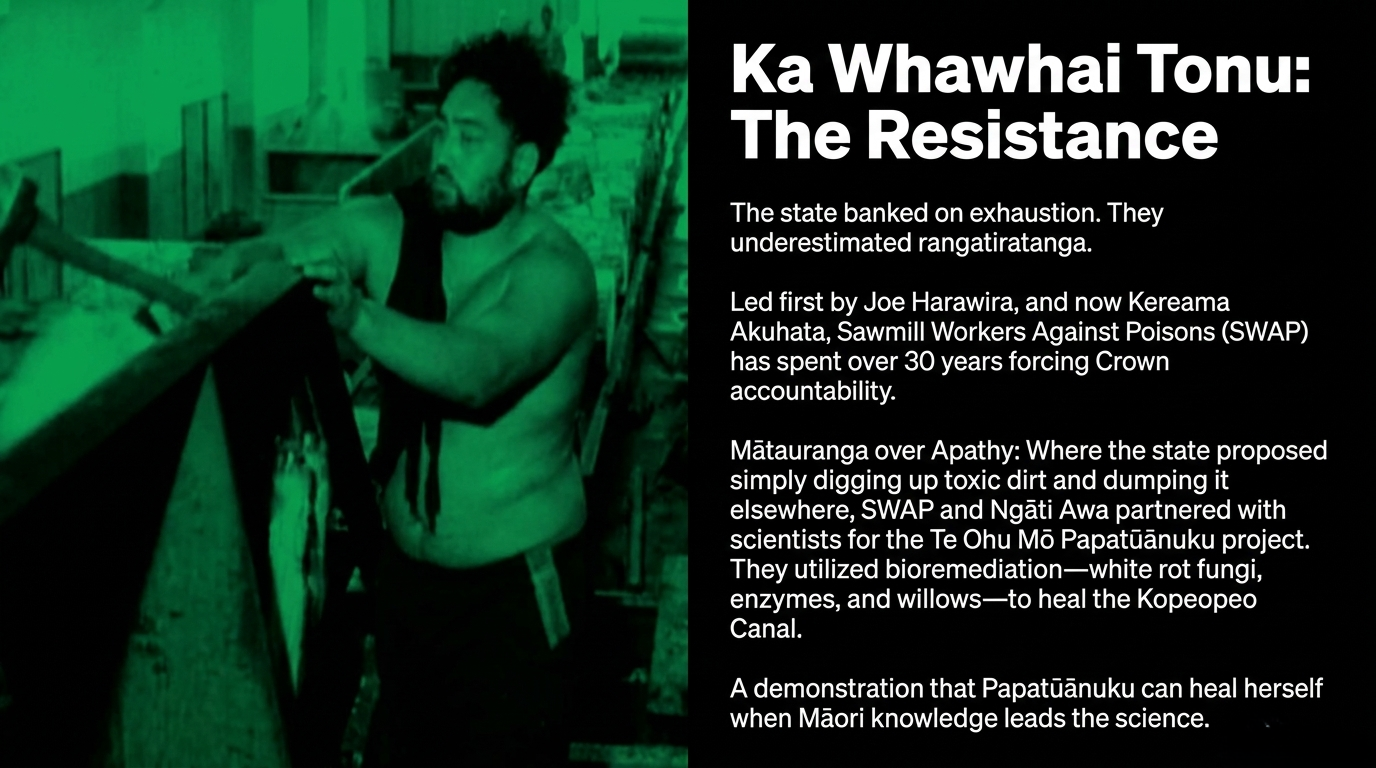
Joe Harawira said it plainly:
If we cannot heal her, we cannot heal ourselves. His kaupapa always connected the healing of people to the healing of Papatūānuku.
The Kopeopeo Canal — the most contaminated site in Whakatāne — is being remediated through bioremediation using fungi, enzymes, and willows, a collaboration between Māori and Pākehā scientists described by E-Tangata. That model demonstrates what the Crown refused to adopt as policy: mātauranga Māori and Western science working in genuine partnership to restore mauri rather than minimise liability.
Twenty-five further known contaminated sites around Whakatāne remain unaddressed, including Mataatua Reserve near Wairaka Marae, with no health studies on people living nearby, as SunLive confirmed. The Crown remediates where liability is visible and does nothing where the cost is Māori suffering. That pattern runs through everything this government does — and has been documented across the Māori Green Lantern's body of work, including in Drill Baby, Drill — Into Your Own Fraud and Two Kings and a Broken Child.
Related Māori Green Lantern Essays
This kaupapa is not isolated. It is part of a documented pattern of Crown and corporate harm against Māori that The Māori Green Lantern has been mapping across hundreds of essays:
- The Pātaka Is Ash — how neoliberal fiscal policy burns the storehouse and calls it discipline.
- The Van Velden Vanishing — how worker protections are dismantled under the cover of business efficiency.
- The Trapdoor Prime Minister — the broader architecture of austerity dressed as competence.
- The Playstation Pogrom — how state systems formalise racialised punishment.
- Drill Baby, Drill — Into Your Own Fraud — how extractive industry policy sidelines mana whenua control.
- Winston Peters — A Walking Contradiction — naming the current coalition as a white supremacist neoliberal government dismantling Māori rights in real time.
Quantified Harm
| Measure | Data | Source |
|---|---|---|
| Years of PCP use in NZ sawmills | 1950–1988; deregistered 1991 | Beehive |
| National workers exposed to PCP | ~5,000 | NZ Herald |
| Whakatāne mill workers with long-term exposure | 100+ | NZ Herald |
| Known contaminated sites, Whakatāne region | 36+ | Te Ara |
| Average age of death in surveyed SWAP workers | 61 years (national average: 77) | WSWS |
| Cancer deaths in surveyed deceased group | 13 of 28 (46%) | WSWS |
| Dioxin elevation in high-exposure workers | 10–15× above baseline | Massey University |
| Projected intergenerational harm | 7 generations | SunLive |
| Gap between US science warning and NZ OSH report | ~50 years | NZ Herald / WSWS |
He Whakaaro Whakakapi — Moral Clarity
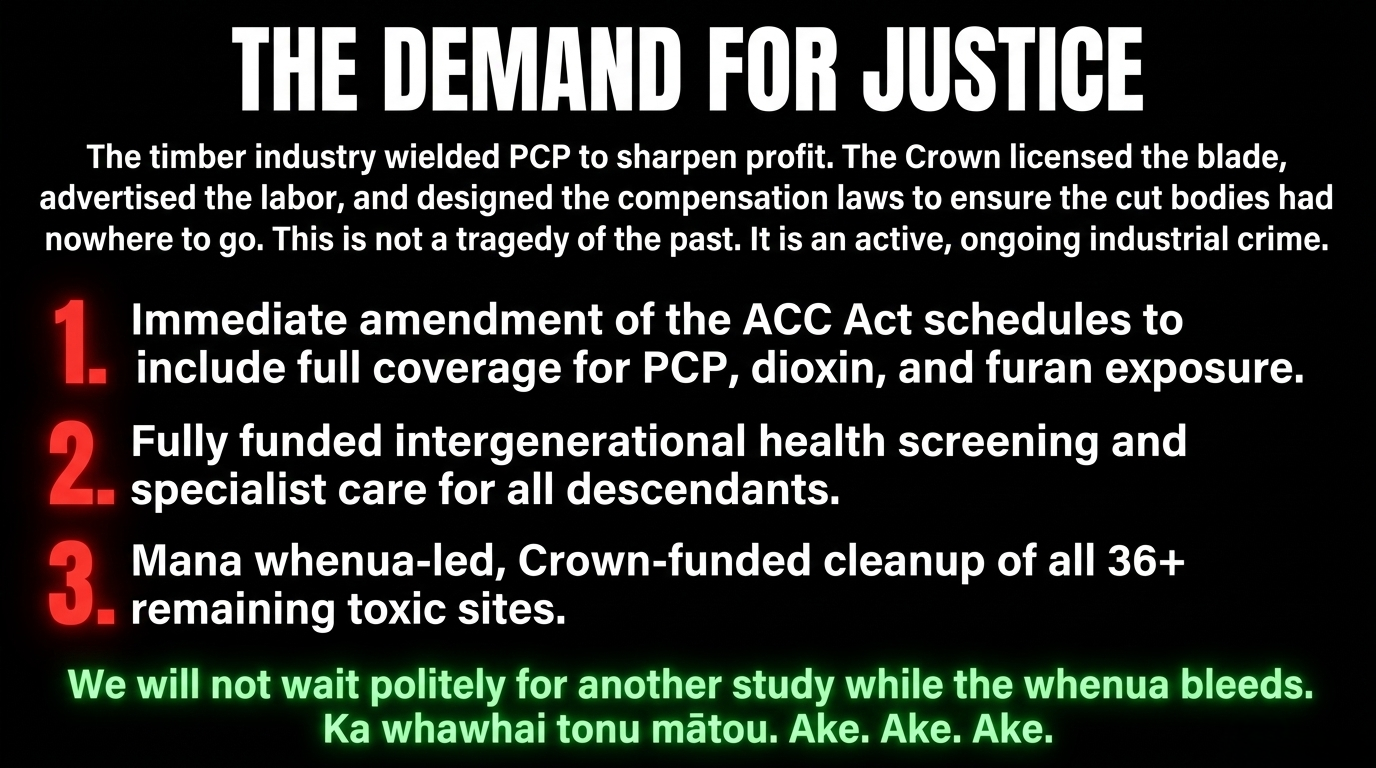
The lie at the centre of this history is not just that the science was uncertain. The lie is that Māori lives were ever weighted equally in the state's moral ledger.
The timber industry wielded PCP like a butcher uses a whetstone — to sharpen profit.
The Crown stood beside the block, licensing the blade, advertising the labour, then designing the compensation law to ensure the cut bodies had nowhere to go.
And when the men began dying at 61 with purple legs and inoperable cancers, the same state discovered the bureaucrat's favourite prayer:
more evidence is needed.
No. More courage is needed. More compensation is needed. More cleanup is needed. More contempt is needed — scathing, documented, relentless contempt — for the polished cowardice of any government that protects corporate balance sheets faster than it protects brown lungs.
The current political order continues a white supremacist neoliberal tradition in which Māori labour is discounted, Māori illness is disputed, Māori environments are used as chemical dumps, and Māori grief is expected to wait politely while the Crown runs another study.
That tradition is not broken by better branding or a ministerial apology at dawn. It is broken by exposure, organising, legal force, and rangatiratanga.
Kereama Akuhata is still standing in a place where the state hoped there would be silence.
That alone should shame this country into action.
Ka whawhai tonu mātou. Ake. Ake. Ake.
Tautoko Mai | Support This Mahi
These men died at 61. Their whānau carried the poison home without knowing it. Their children were born into a contaminated inheritance. And the Crown spent fifty years studying the problem rather than solving it.
Every koha for this essay funds the accountability that Crown and corporate structures will not provide for themselves. It says that rangatiratanga includes the power to finance our own truth-tellers — because when the official storytellers are too compromised to speak, someone else must.
If koha is not possible right now, subscribe, follow, kōrero, and share this essay with your whānau and friends. That circulation is koha too. It is how truth outruns silence.
Four pathways:
- Koha direct: Support the Māori Green Lantern
- Subscribe for essays: Subscribe to the Māori Green Lantern
- Direct bank transfer: HTDM — 03-1546-0415173-000
- Facebook: Follow and subscribe on Facebook
Essay Two — Coming Next: Dying on the Books: ACC, Science Denial, and the Art of Waiting for Men to Die

Research conducted: 24 April 2026. Tools used: search_web, fetch_url. Sources consulted: Te Ara, E-Tangata, SunLive, NZ Herald (multiple articles), Beehive.govt.nz, WSWS, Health Hub SIA, People's Inquiry 2020 SWAP Submission No. 58, Massey University. All anchor-text hyperlinks verified at time of writing.