"The Mountain Was Screaming. Council Put It On Mute" - 19 August 2026
Twenty-seven years of warnings, a co-governance partner locked out of its own risk data, and eight bodies later — this is what happens when a council treats a sacred maunga like a liability line-item instead of a living tupuna.
Kupu Tīmata — The Mountain Had a Voice. The Council Had a Mute Button.
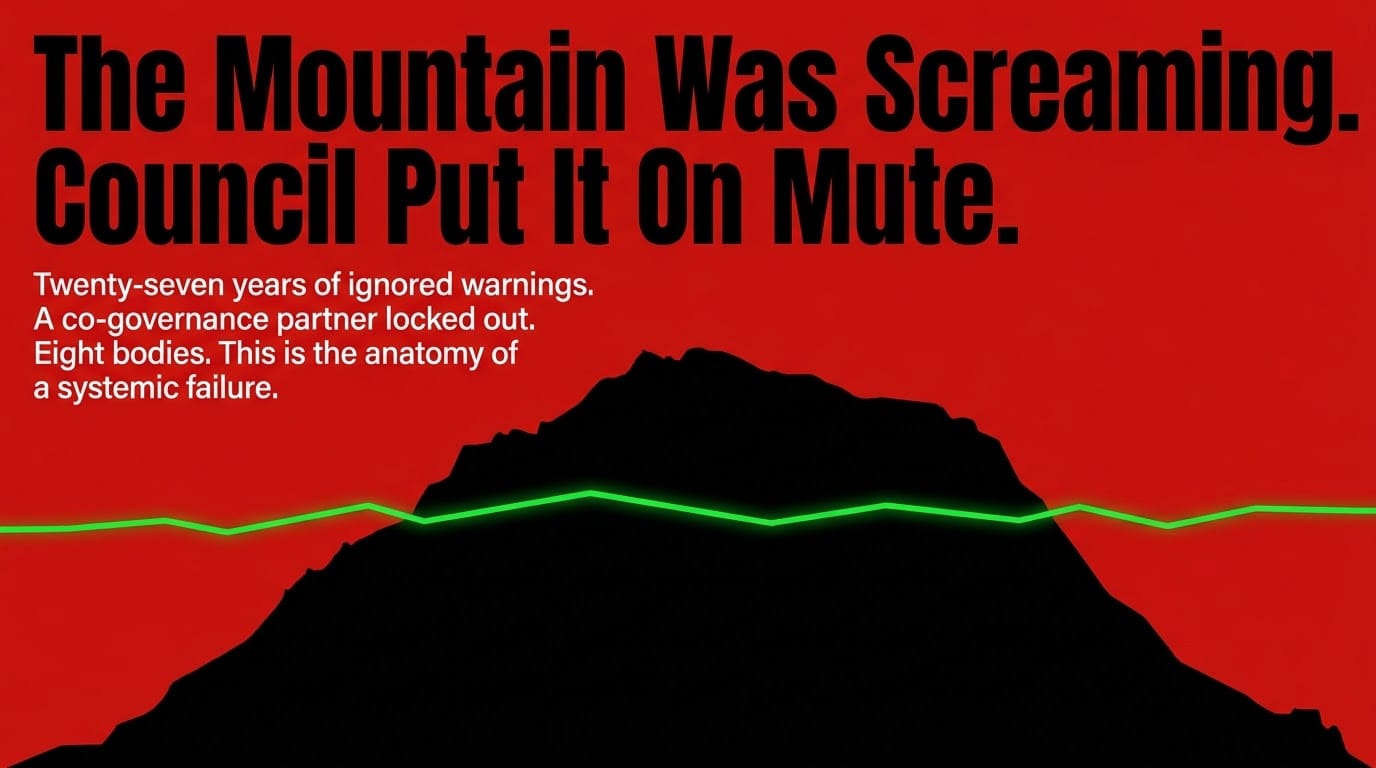
Picture Mauao not as a postcard backdrop for Instagram sunrises, but as a body — a tūpuna with a pulse, a maunga that has been trying to speak for twenty-seven years.
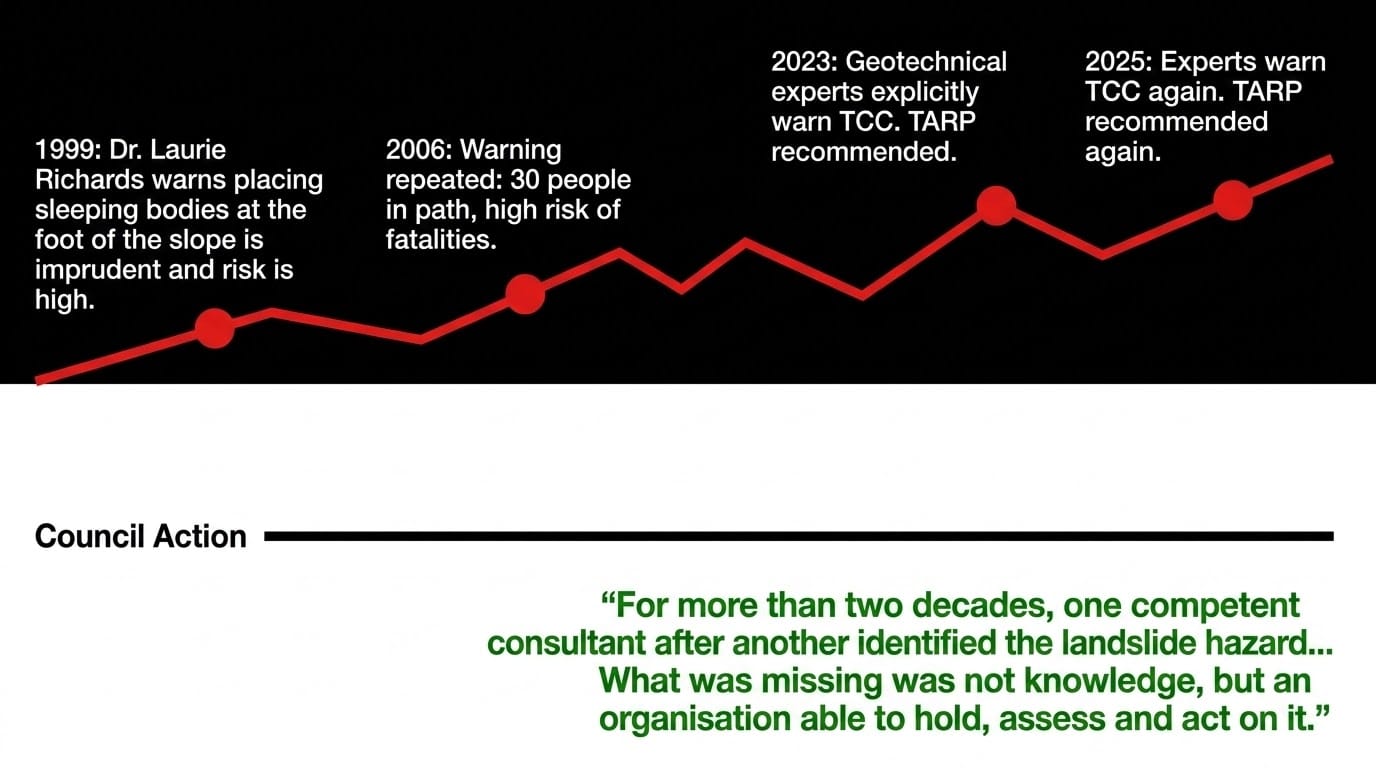
In 1999 it groaned through Dr Laurie Richards's report: don't put sleeping bodies at my feet, the risk is high.
In 2006 it groaned louder: if this slope lets go, thirty people are in the path, twenty-one of them die (RNZ).
In 2023, and again in 2025, it groaned a third and fourth time, this time with a name for the medicine that would save lives — a Trigger Action Response Plan — and still nobody administered it (NZ Herald).
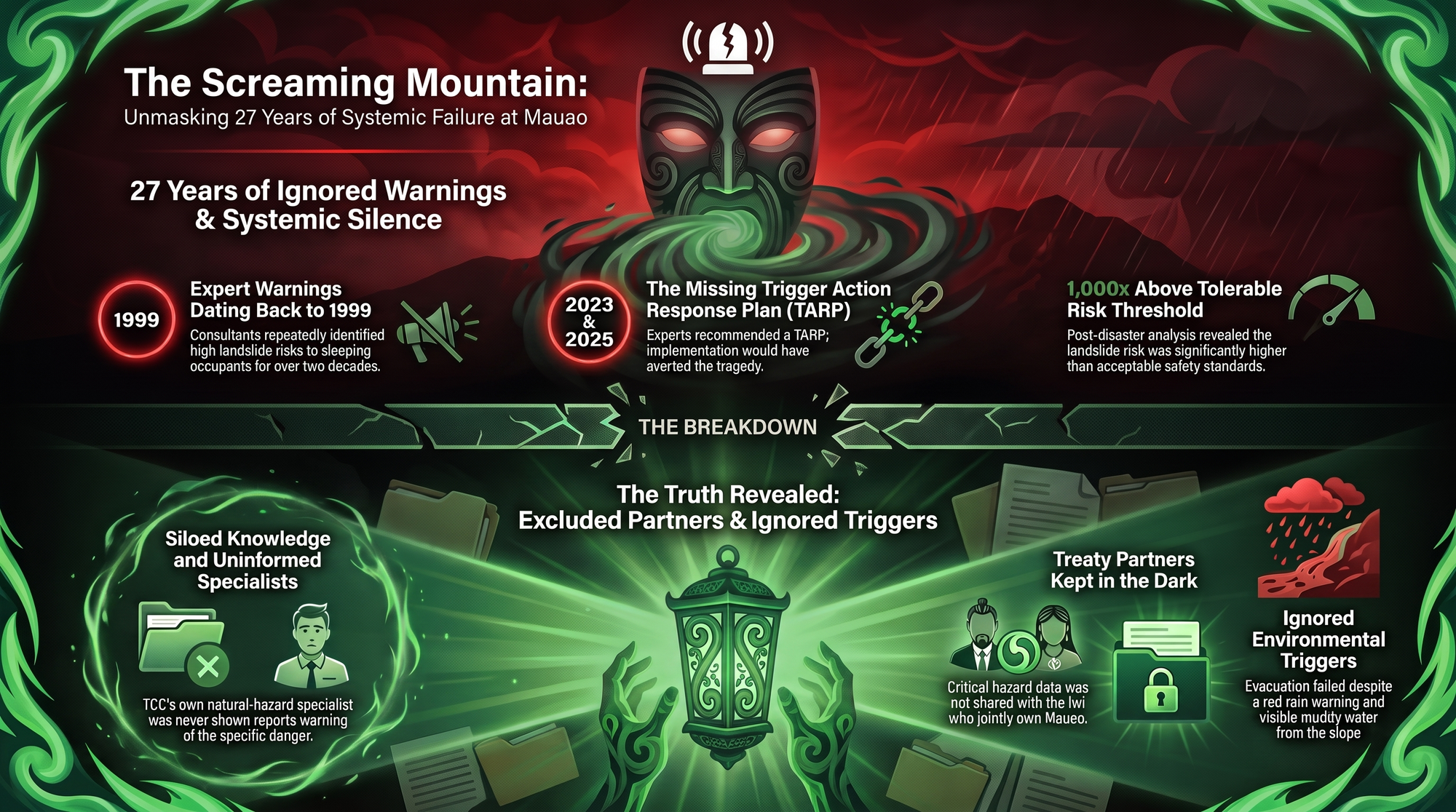
A council that calls itself a Treaty partner to the iwi who whakapapa to this maunga had every single one of those warnings in writing.
It filed them. It discussed them. It forwarded them between departments like an unwanted parcel nobody wanted to sign for (RNZ).
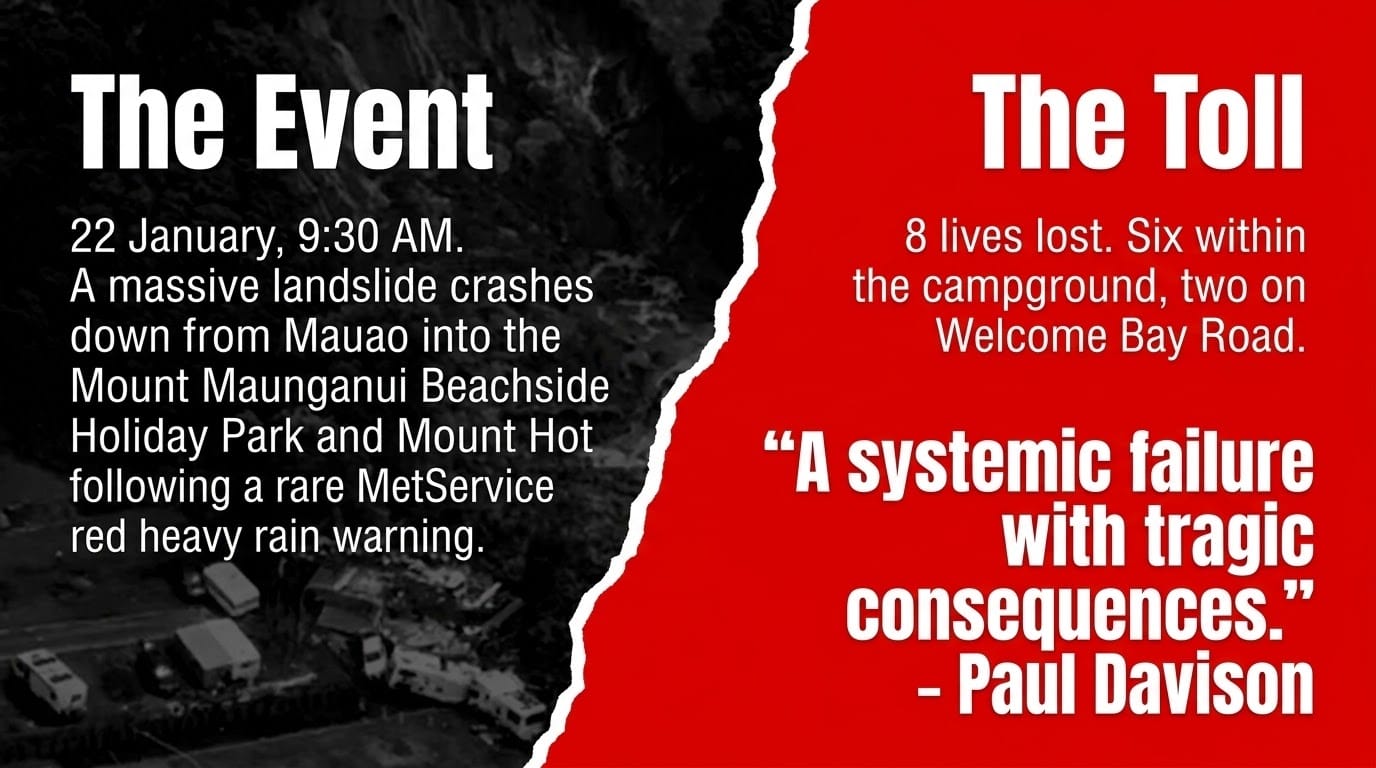
And on the morning of 22 January 2026, while campers slept in caravans at the foot of a mountain that had been begging someone to listen for two and a half decades, the mountain finally spoke in the only language left to it. It let go. Six people at the campground and two more on Welcome Bay Road never woke up (NZ Herald).
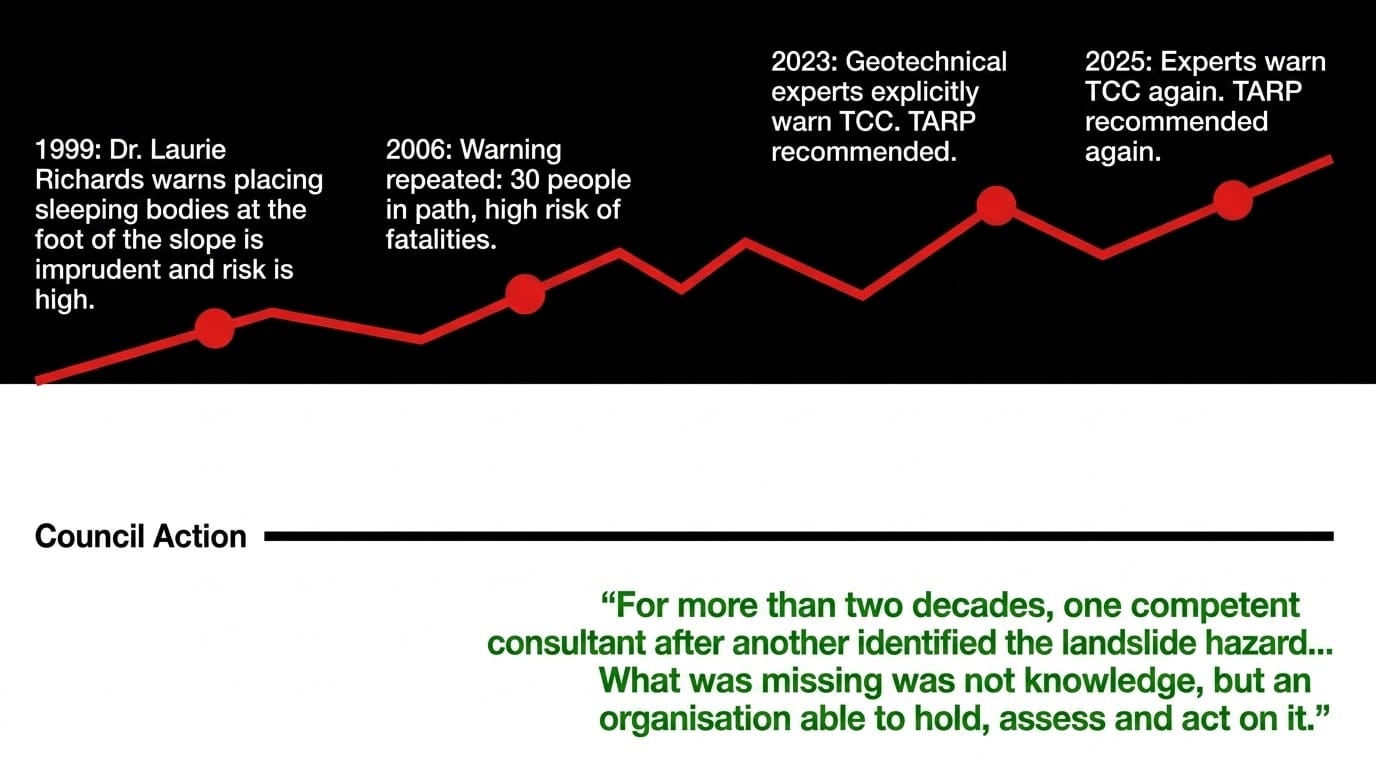
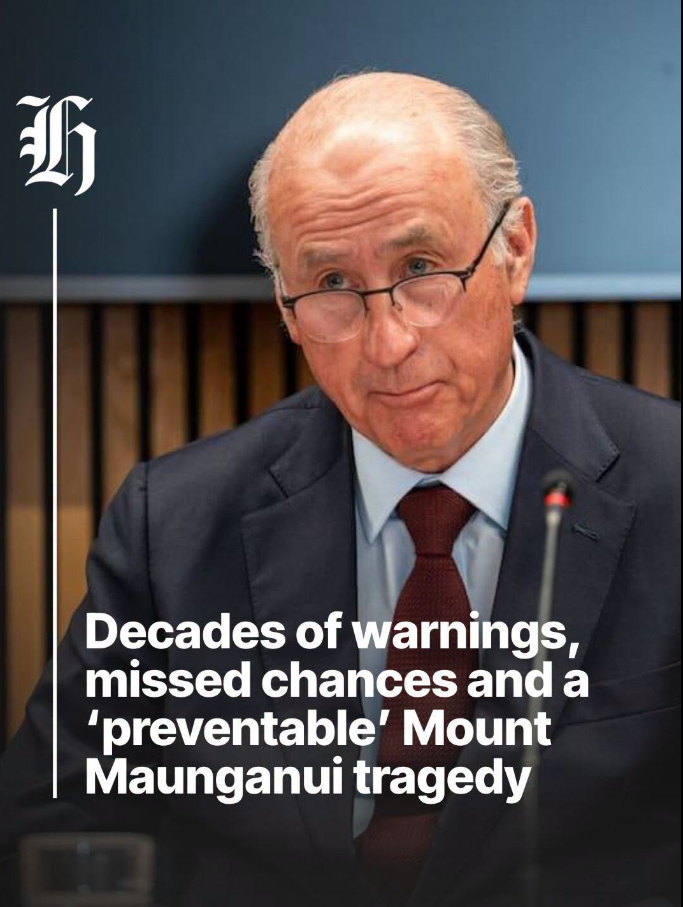
Retired judge Paul Davison spent months confirming what any tangata whenua could have told them for free:
"What was missing was not knowledge, but an organisation able to hold, assess, and act on it" (RNZ).
Translate that out of judicial diplomacy and into plain English: Tauranga City Council knew, and knew, and knew again, and did nothing until the knowing turned into corpses.
 Bijou Johnson and Michael Morrah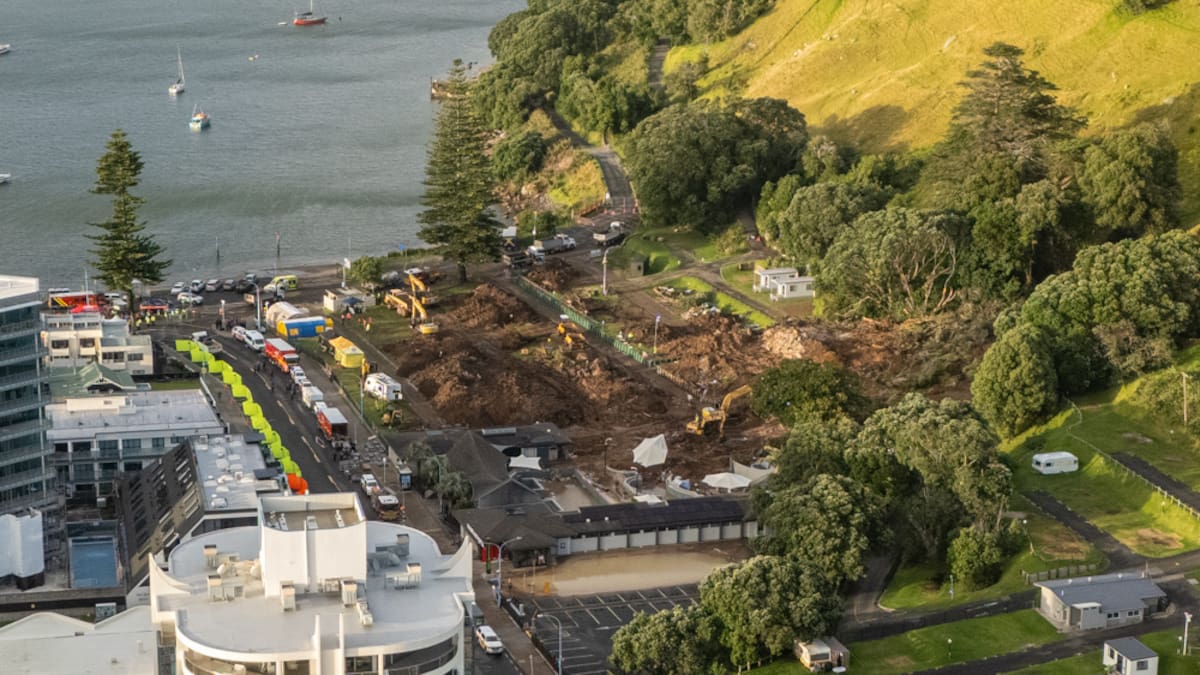
 Bijou Johnson and Michael Morrah and Imogene Bedford
When Mountains Weep and bureaucrats Sleep
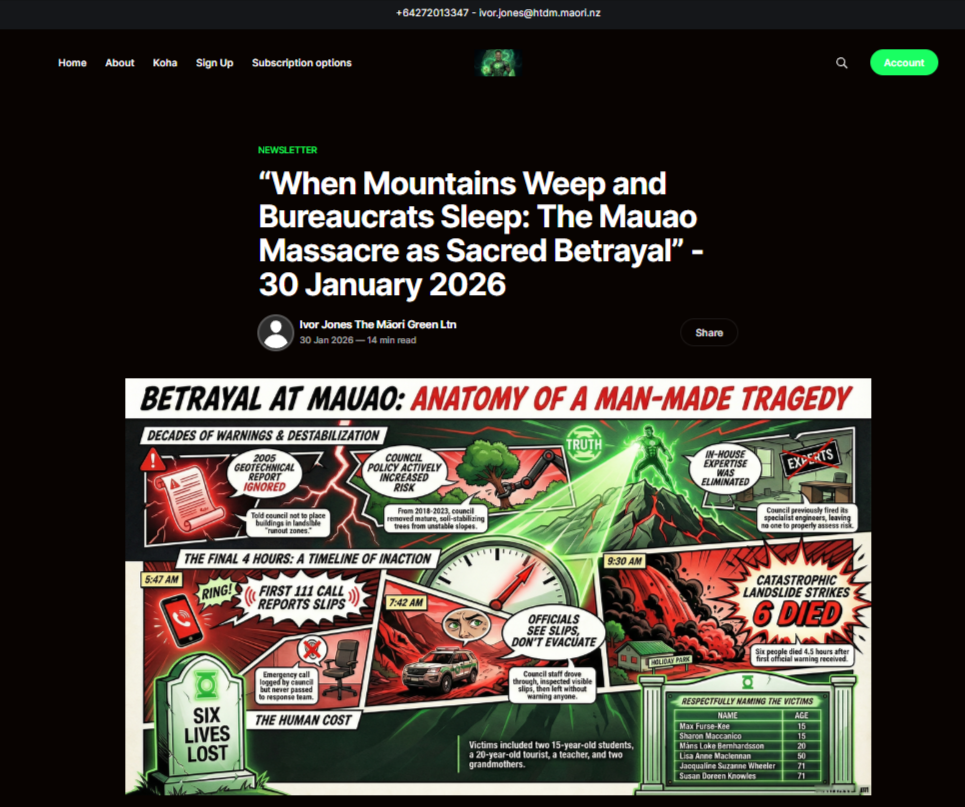
This is not new ground for the Māori Greeen Lantern.
In the raw first week after the disaster, my essay "When Mountains Weep and Bureaucrats Sleep" (30 January 2026) laid out the same 7:45am utility-vehicle sighting, the same disputed FENZ call log, and the same hot-pools-before-collapse timeline that Lobby for Good later formalised into a liability analysis — months before Davison's review existed to confirm any of it.
 Ivor Jones The Māori Green Ltn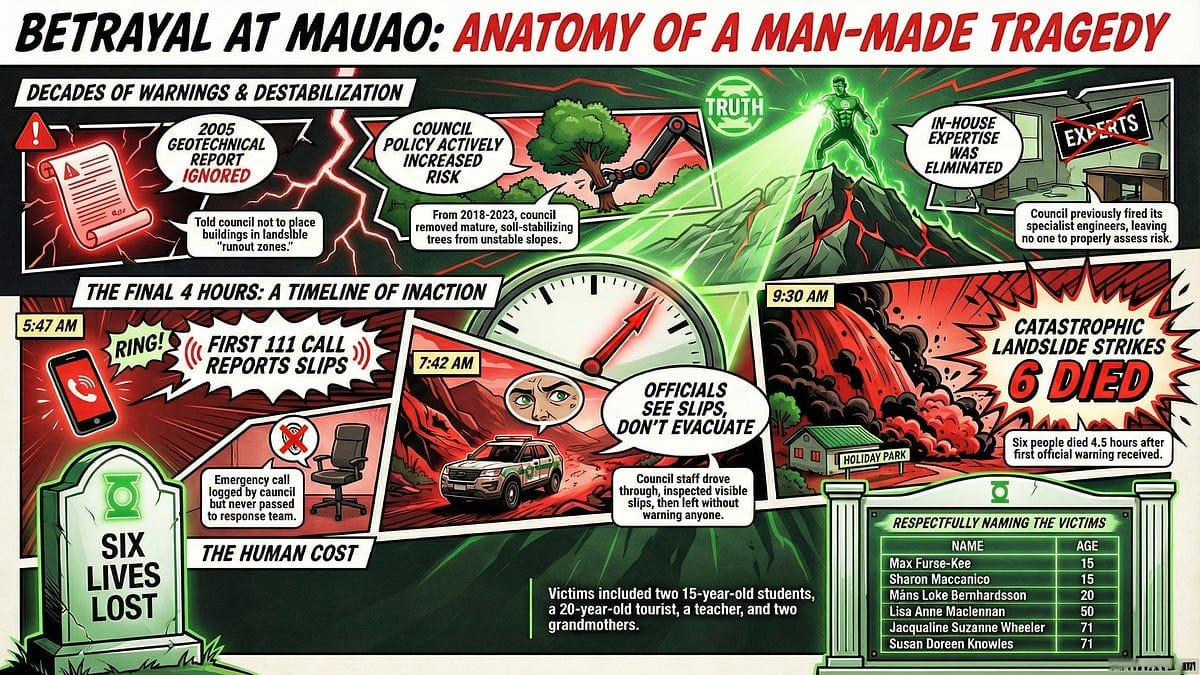
That essay called the council's framing of
"unprecedented disaster" a "protective spell" cast over what it named as institutional homicide.
Davison's finding seven months later — that the failure was systemic, that nobody "owned" the risk, that the mountain recognised no boundary between reserve and campground — does not contradict that earlier analysis.
It is the retired judge's own 238-page vindication of it, delivered in the measured language of a Royal Commission-style review rather than the scathing register I used when the bodies were still being recovered.
My January essay's specific claims (5:51am call, 7:45am vehicle, 9:00am hot pools opening) are this publication's own reporting drawn from contemporaneous RNZ coverage, now independently corroborated in substance by Davison's systemic findings, though Davison's report does not confirm every individual timestamp claim verbatim.
The Deep Dive Podcast
Listen to a lively conversation between two hosts, unpacking and connecting topics in the sources of this essay. I apologise in advance for the AI's very harsh pronounciation of reo. Please dont shoot me, :).
Youtube Video
Like video? Here is a short video suppporting the essay. Again, don't shoot the messenger please because of AI's pronounciation. :)
Koha Consideration
This essay was written for the six families still grieving at Beachside Holiday Park, the two whānau grieving on Welcome Bay Road, and every Tauranga Moana whānau whose maunga was treated as a liability line-item instead of a living tupuna.
If this work helped you understand what was hidden from your own Treaty partners, consider a koha to keep this voice speaking for those the system tried to keep quiet.
Kia kaha, whānau. Stay vigilant. Stay connected. Koha | Subscribe | Bank: HTDM 03-1546-0415173-000 | Facebook
Te Tuara — A Mountain Returned, A Mountain Still Not Trusted
Understand what Mauao actually is before you understand what was stolen from the people who love it.
This maunga anchors Ngāti Ranginui, Ngāi Te Rangi and Ngāti Pūkenga — descendants of the Tākitimu, Mataatua and Te Arawa waka — alongside Waitaha, whose ahi kā burns here too (Te Ara).
In 1864 the Crown's guns took Tauranga Moana land at Pukehinahina and Te Ranga. Iwi have spent the century and a half since fighting to get pieces of it back through the Waitangi Tribunal's Wai 215 process, and arguing — with justification — that the post-1886 public works takings amounted to a second confiscation on top of the first (Te Ara) (NZ Herald).
So when Mauao Historic Reserve finally came under joint iwi–council governance in 2013, through Ngā Poutiriao ō Mauao, it was sold as a template of what co-governance should look like — praised even by the Office of the Auditor-General as a model for how mana whenua and local authorities can share power over sacred whenua (OAG). Four board seats for the council, four for the Trust. Equal standing, on paper.
On paper.
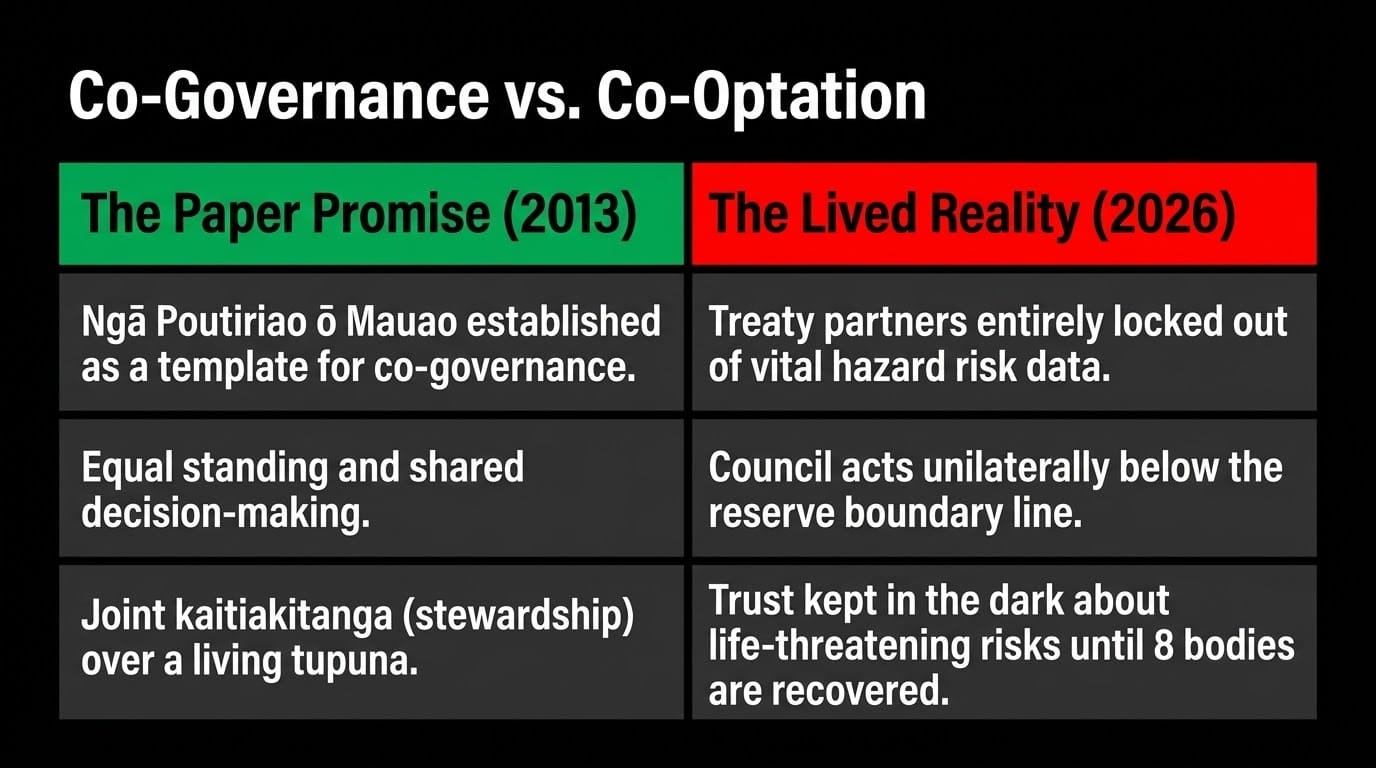
Because on the ground, when it actually mattered
— when hazard reports were sitting in council inboxes warning that people could die
— that equal partnership evaporated.
The holiday park sat just outside the reserve boundary, run solely by the council, and the risk fell, in Davison's own words, into the gap where
"the law draws a boundary between the reserve and the campground, [but] the mountain recognises no such line" (RNZ).
Convenient, isn't it, how the boundary that failed to protect anyone is the exact same boundary that let the council keep its Treaty partner out of the loop.
Te Whakawhitiwhiti — Three Examples for the Western Mind
For those who still want to call this "unfortunate" rather than what it is, here are three concrete, verified failures — stripped of council-speak.
Example One: The expert who wasn't told.
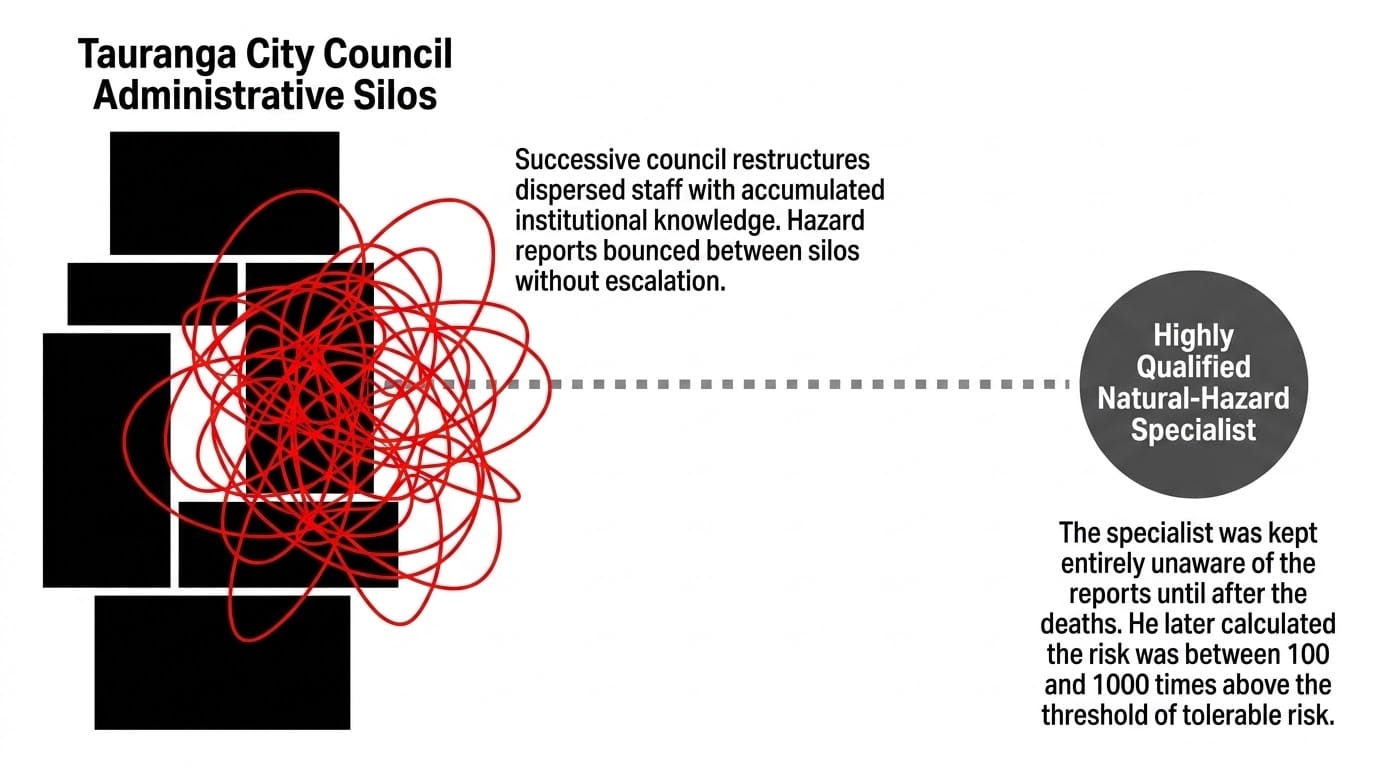
Tauranga City Council employed a highly qualified natural-hazard specialist — arguably the single most capable person in the building to interpret a landslide risk report.
Davison found that specialist was entirely unaware that a report warning of exactly this danger even existed, until after six of his neighbours' fellow ratepayers were dead (NZ Herald).
Quantified harm: six preventable deaths where a functioning internal referral process — costing nothing more than an email being forwarded to the right desk — could have triggered evacuation years or, at minimum, hours earlier.
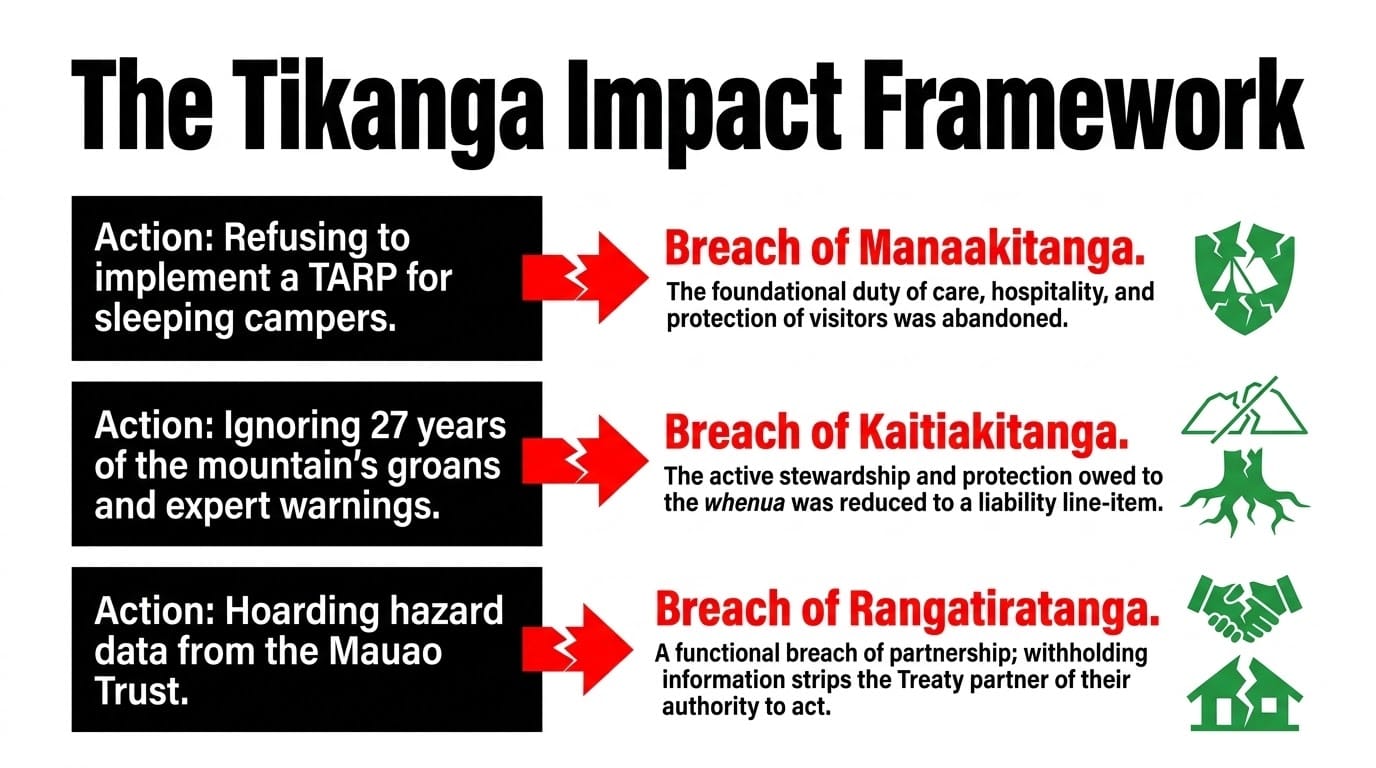
Tikanga impact: mātauranga about a taonga was hoarded even from the council's own kaimahi, let alone the Trust that co-owns the mountain — the opposite of manaakitanga and kaitiakitanga this land deserved.
Example Two: The plan that arrived four years too late, four times.
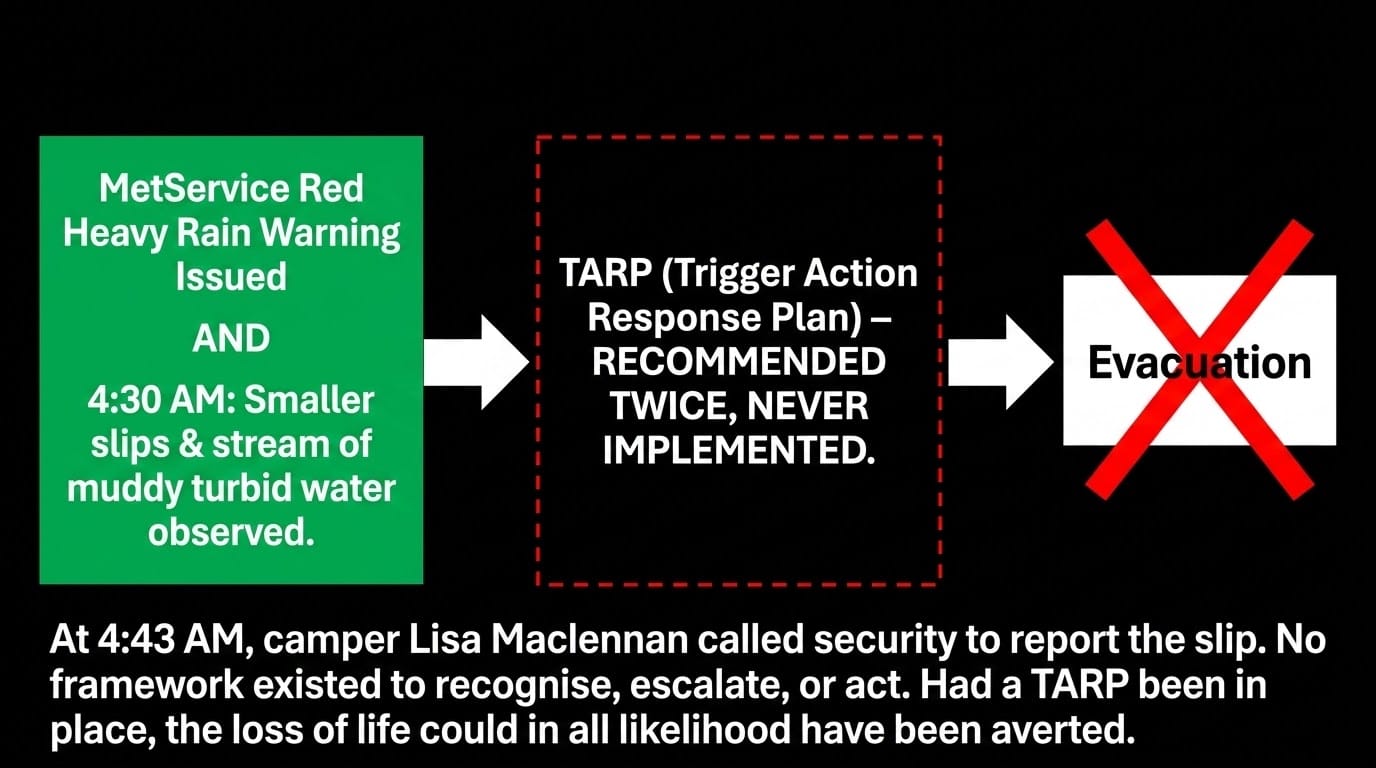
A Trigger Action Response Plan (TARP) — a document that literally tells staff
"if you see muddy water, evacuate" — was recommended in 2023 and again in 2025. Never implemented (NZ Herald).
On the morning of the disaster, campers themselves spotted the muddy water and smaller slips above the campground — the exact trigger the unimplemented plan would have named — with no protocol and no authority to act on what their own eyes told them (NZ Herald).
Quantified harm: Davison states plainly that had a TARP existed,
"evacuation would likely have occurred well prior to the fatal landslide" and "the loss of life could in all likelihood have been averted" (RNZ).
Tikanga impact: a document costing a fraction of the council's legal spend since the disaster (it has already hired four separate law firms) (1News) would have honoured the manaaki owed to every visitor sleeping under this maunga's protection.
Example Three: The Treaty partner told nothing.
Davison confirmed the hazard reports were never escalated beyond siloed council teams and did not
"seem to have been made accessible to local iwi, which jointly own Mauao" (NZ Herald).
Quantified harm: a co-governance partnership formalised by MOU since 2013 was rendered meaningless at the exact moment it mattered most — when lives, not just tracks and vegetation, were on the line (OAG).
Tikanga impact: rangatiratanga requires the authority to act on information. Withholding that information from a Treaty partner is not neutral bureaucratic failure — it is a functional breach of the partnership principle this exact governance structure was built to embody.
Ngā Hononga Huna — Five Threads This Council Would Rather You Didn't Pull
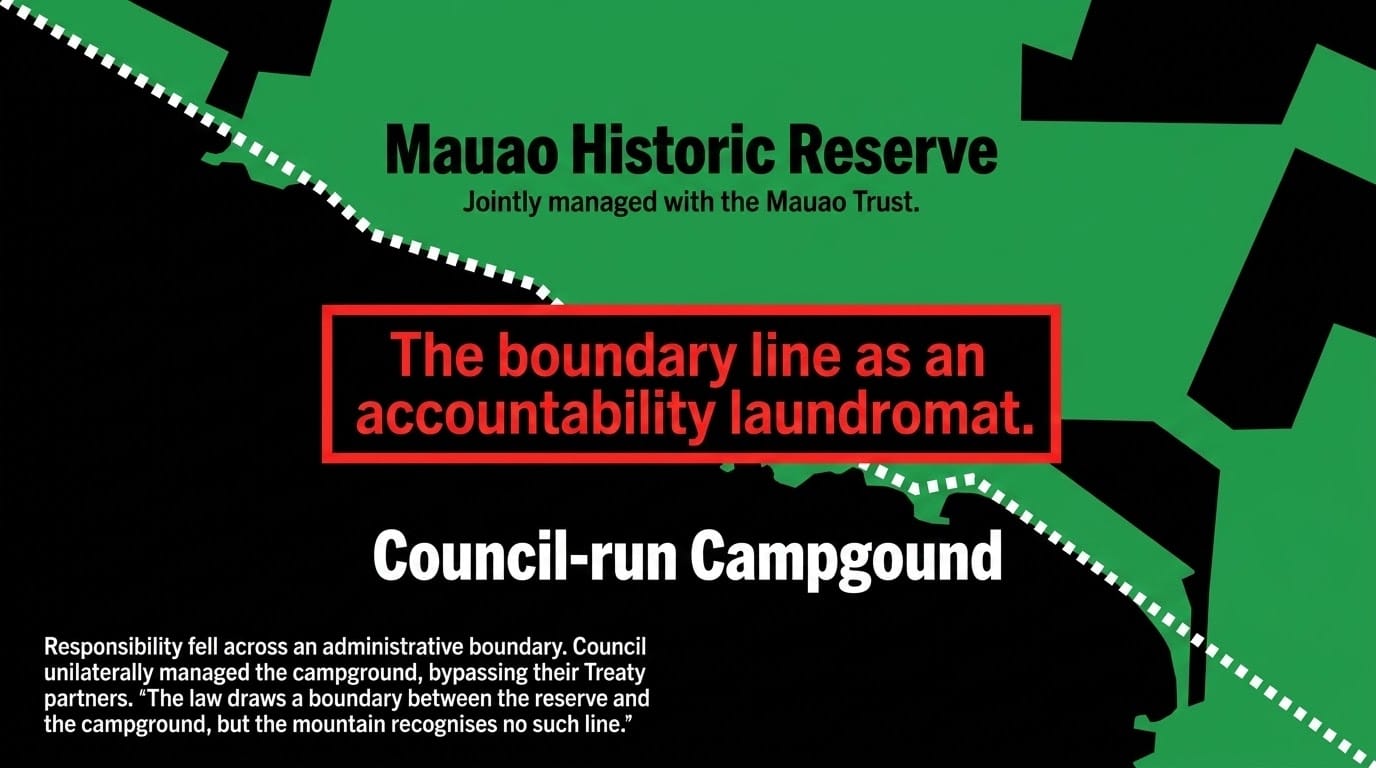
- The boundary line as an accountability laundromat. Reserve versus campground, iwi authority versus council authority — the same line that let risk fall through the cracks is the line that let the council avoid sharing information with its Treaty partner (RNZ).
- Restructuring as institutional amnesia. Davison found successive council restructures dispersed the staff who held institutional memory of the hazard — reorganisation functioning, whether intended or not, as a mechanism that erases who knew what and when (RNZ).
- Silence from the Trust as its own data point. Mauao Trust chairwoman Matemoana McDonald "declined to comment" on the council's handling of the disaster response when asked directly by RNZ in February (RNZ), even while co-signing public reopening statements alongside the very council that kept her Trust in the dark (Inside Government NZ). Read as evidence of a partner navigating an impossible position, not as an admission.
- A pattern of information control not yet legally tested. Independent group Lobby for Good alleges a council vehicle passed visible slips at 7:45am the morning of the disaster without triggering evacuation, that the Chief Executive initially denied a FENZ hazard notification before reversing that position, and that an evacuation procedure on the council's own portal is dated four days after people died (Scoop / Lobby for Good). This single-source is unverified and is not part of Davison's findings, flagged here as a lead, not a fact.
- Five inquiries, two with teeth. Of the Davison review, the Government inquiry, WorkSafe, Police and the Coroner now circling this disaster, only WorkSafe and Police can actually prosecute (DIA). Everyone else can only recommend — including the review that just told the country, in 238 pages, exactly how preventable this was.
Ngā Pānga Motuhake — What Eight Deaths Actually Cost
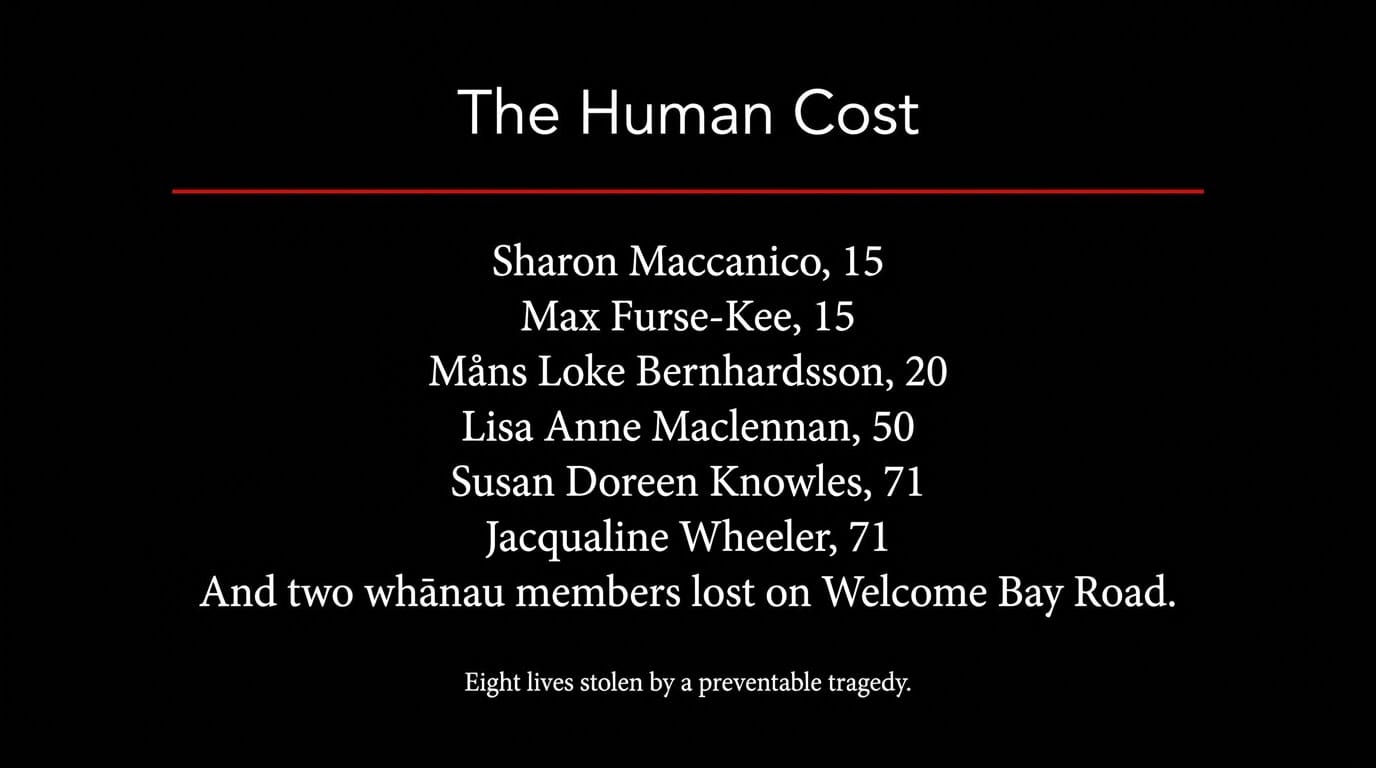
Eight people dead in one storm across two landslides — six at Beachside Holiday Park, two on Welcome Bay Road (NZ Herald).
Seven months later, Mauao remains closed. The holiday park, the hot pools, the lifeguard building — all shuttered.
Adams Ave has slipped again since, another 8,000 cubic metres of earth moving in July, forcing a second closure (NZ Herald).
Rustica pizzeria, opposite the campground, has closed its doors for good.
None of that touches what cannot be reopened: a whānau's daughter, a Morrinsville classroom's teacher, two Rotorua friends, a Swedish traveller's family on the other side of the planet, a grandmother and her mokopuna on Welcome Bay Road.
Mayor Mahé Drysdale has apologised — to the victims' families directly, and to "all those in our community that have been put at risk over the past 27 years" (NZ Herald). Chief Executive Marty Grenfell has said he will not resign, choosing instead to "lead the organisation through" implementing Davison's ten systemic recommendations, due to council on 1 September (NZ Herald). These are statements made by elected and appointed officials, on the record, in their public capacity — reported here under qualified privilege in the public interest.
Whakakapinga — The Maunga Does Not Forgive Silence
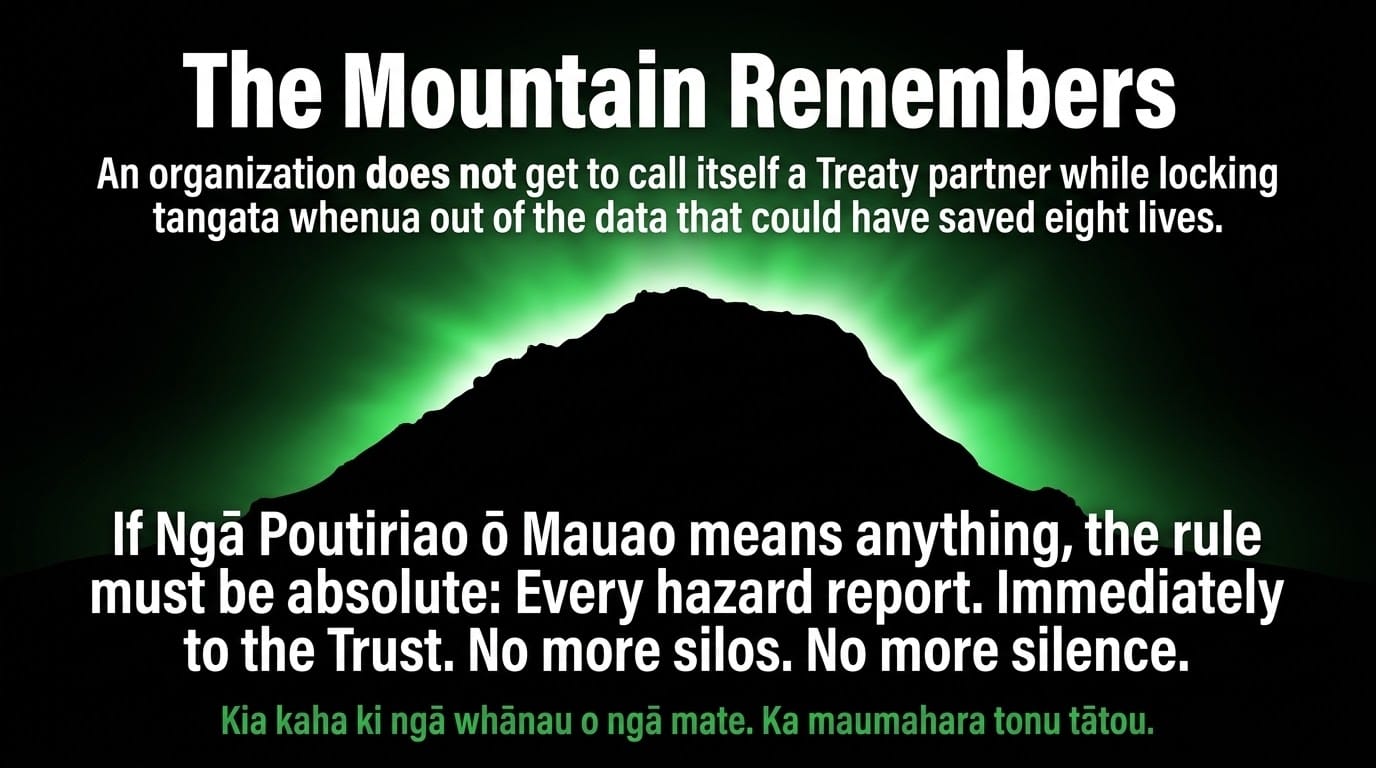
An organisation does not get to call itself a Treaty partner and then lock its partner out of the one piece of information that could have saved eight lives.
That is not co-governance. That is co-governance's corpse, wearing the MOU as a death mask.
If Ngā Poutiriao ō Mauao means anything going forward, the very next agenda item has to be a binding rule: every hazard report on this maunga, the moment it lands, goes to the Trust — not seven months and eight graves later, when a retired judge has to spell it out in 238 pages that the mountain was screaming the whole time.
Kia kaha ki ngā whānau o ngā mate. Ka maumahara tonu tātou. The mountain remembers everything. It's time the council did too.
Disclaimer: Published for public interest commentary and accountability journalism under the Māori Green Lantern kaupapa. Sourced from verified public reporting and primary institutional material as cited throughout. Opinion is distinguished from fact at every point. Corrections and retraction requests: themaorigreenlantern.maori.nz.