
"THEY CHANGED THE LAW AGAIN: Paul Goldsmith's Climate Shield Is the Green Chain, Resurrected" - 13 May 2026
They licensed the dioxin. They buried the files. They denied the cancer. Now they've outlawed the lawsuit. The only thing that changes is the chemical — the Crown's loyalty to corporate profit over Māori lives has never wavered for a single generation.

Mōrena Aotearoa,
This essay examines the Luxon government's emergency amendment of the Climate Change Response Act — announced by Justice Minister Paul Goldsmith on 12 May 2026 — because it directly harms Māori whānau, breaches democratic principles of access to justice, and continues a documented, multigenerational pattern of Crown-licensed corporate impunity that The Māori Green Lantern has been investigating in The Green Chain Series since April 2026.
This essay references individuals solely in their public capacity. Views expressed constitute honest opinion on matters of public interest under the Defamation Act 1992 (NZ) and Durie v Gardiner NZCA 278.
The Chain Runs Again
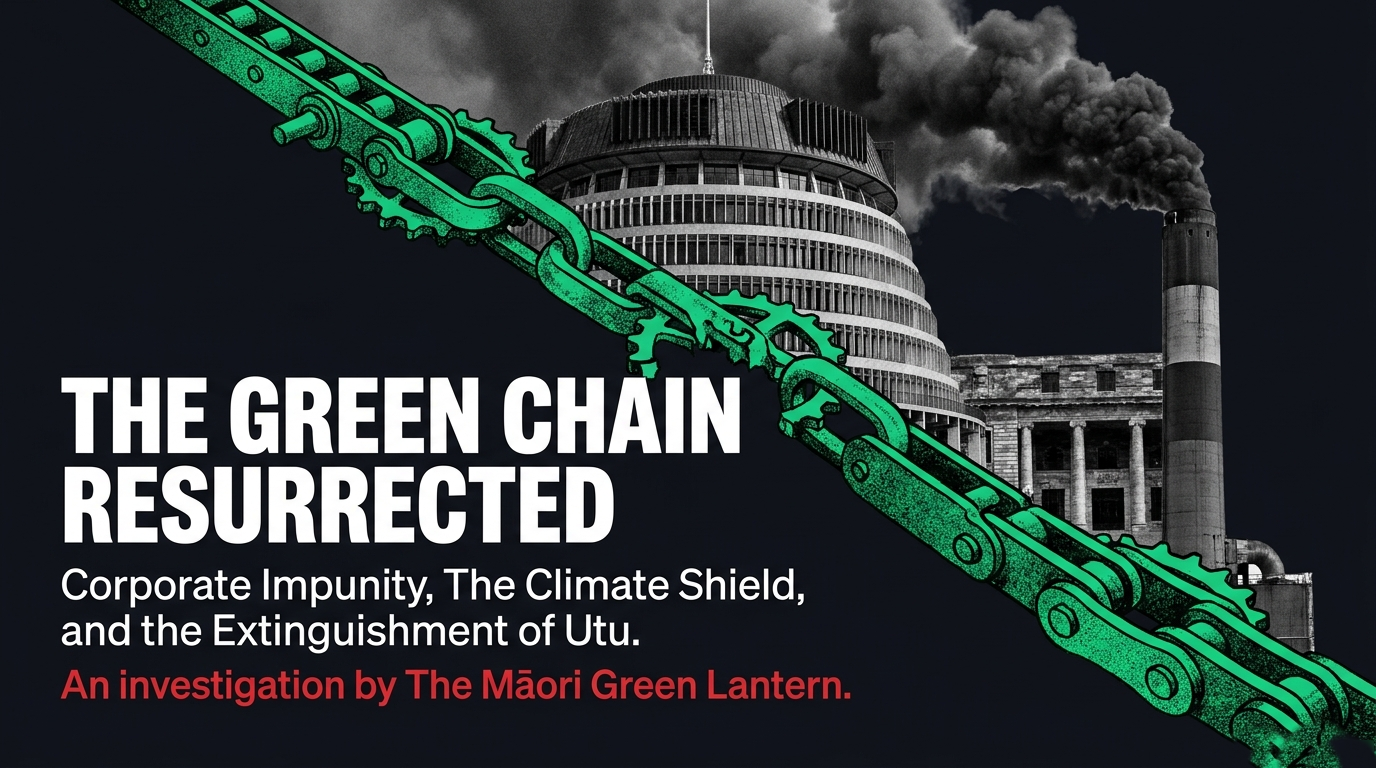
Picture the green chain.
A river of freshly-dipped pine timber, running off the back of a dip bath saturated in pentachlorophenol — PCP — laced with dioxin and furan. Māori men stood at that chain every working day for thirty years: Whakatāne, Rotorua, Kawerau. They pulled the timber. They breathed the vapour. They carried the poison home to their whānau in their blood.
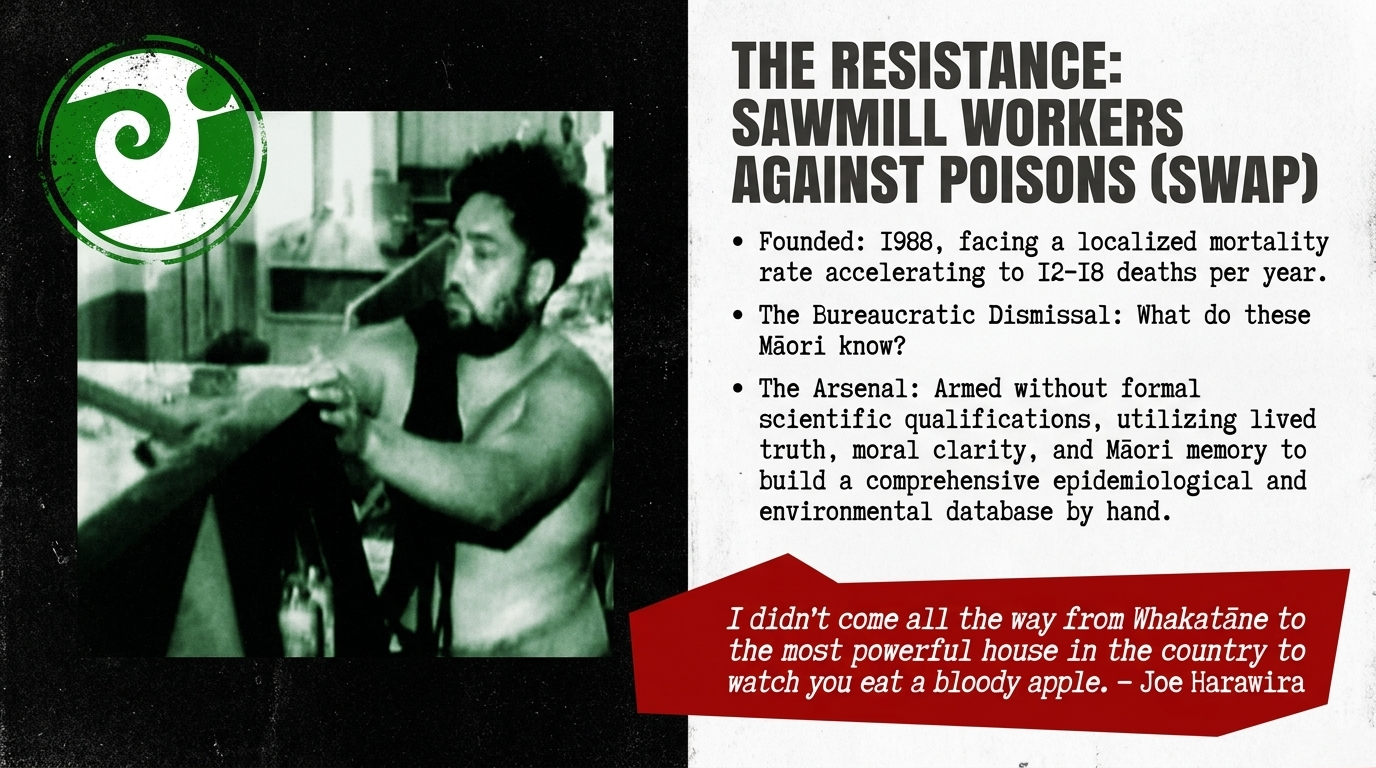
The Crown knew. The companies knew. Scientists had the data. And for thirty years — from the 1950s until PCP was finally banned in 1988 — the answer was the same: nothing to see here. Guidelines will suffice. Business certainty must be protected.
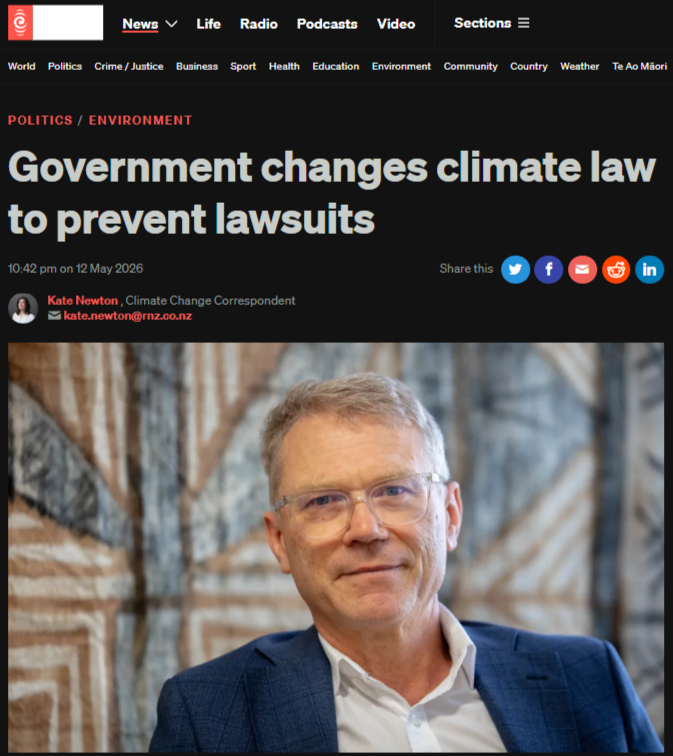
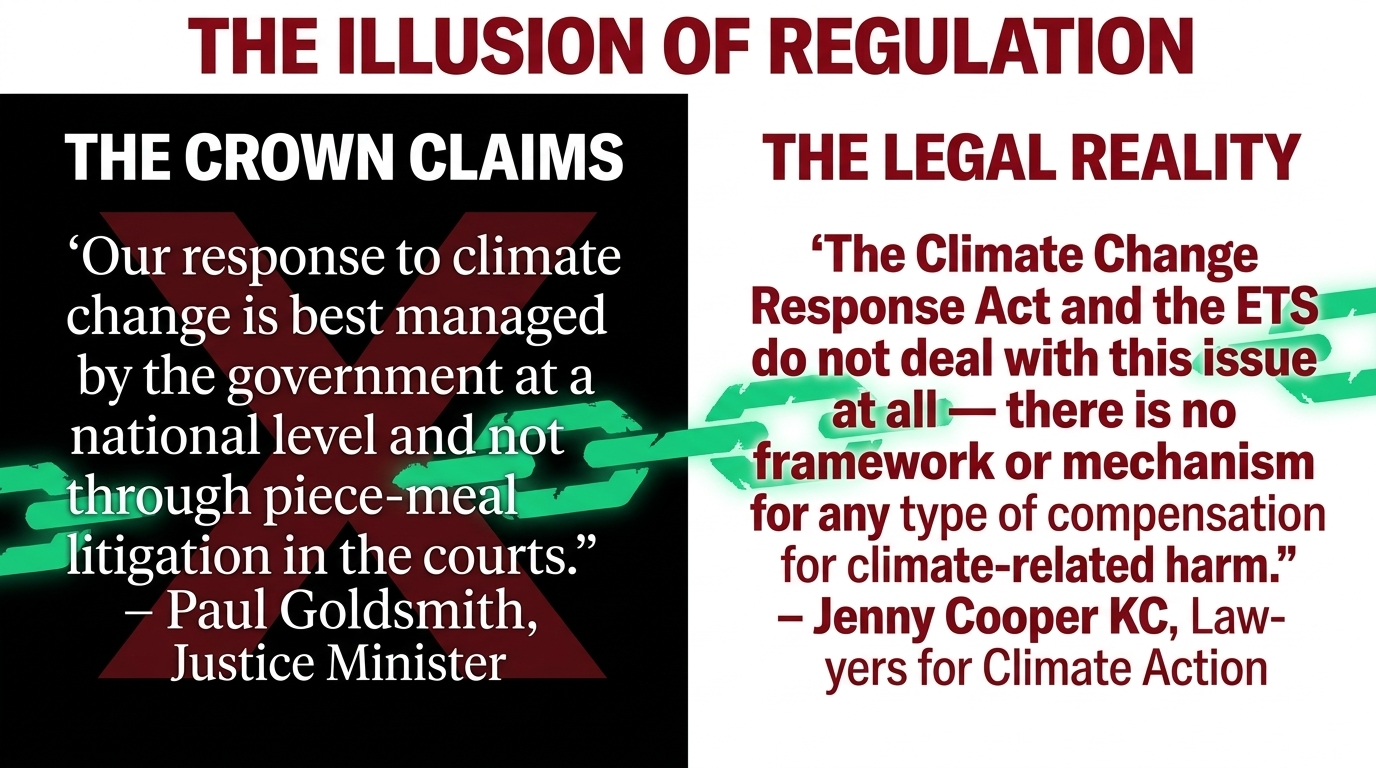
Now read what Justice Minister Paul Goldsmith said on 12 May 2026, justifying his emergency amendment of the Climate Change Response Act to kill the landmark Smith v Fonterra climate liability case mid-hearing, as reported by The Spinoff:
"Our response to climate change is best managed by the government at a national level and not through piece-meal litigation in the courts."
Now read what Environment Minister Rob Storey said in 1993, defending guidelines over law as dioxin poured into Lake Rotorua, as documented in The Māori Green Lantern's The Man With the Brown Paper Bag:
"I am amazed by the continued insistence that unless something is written in law nobody will act."
Same sentence structure. Different decade. Same poison. Different chemical.
The green chain never ended. Paul Goldsmith just fitted it with a new dip bath.
What Goldsmith Did — And Why It Is Unprecedented
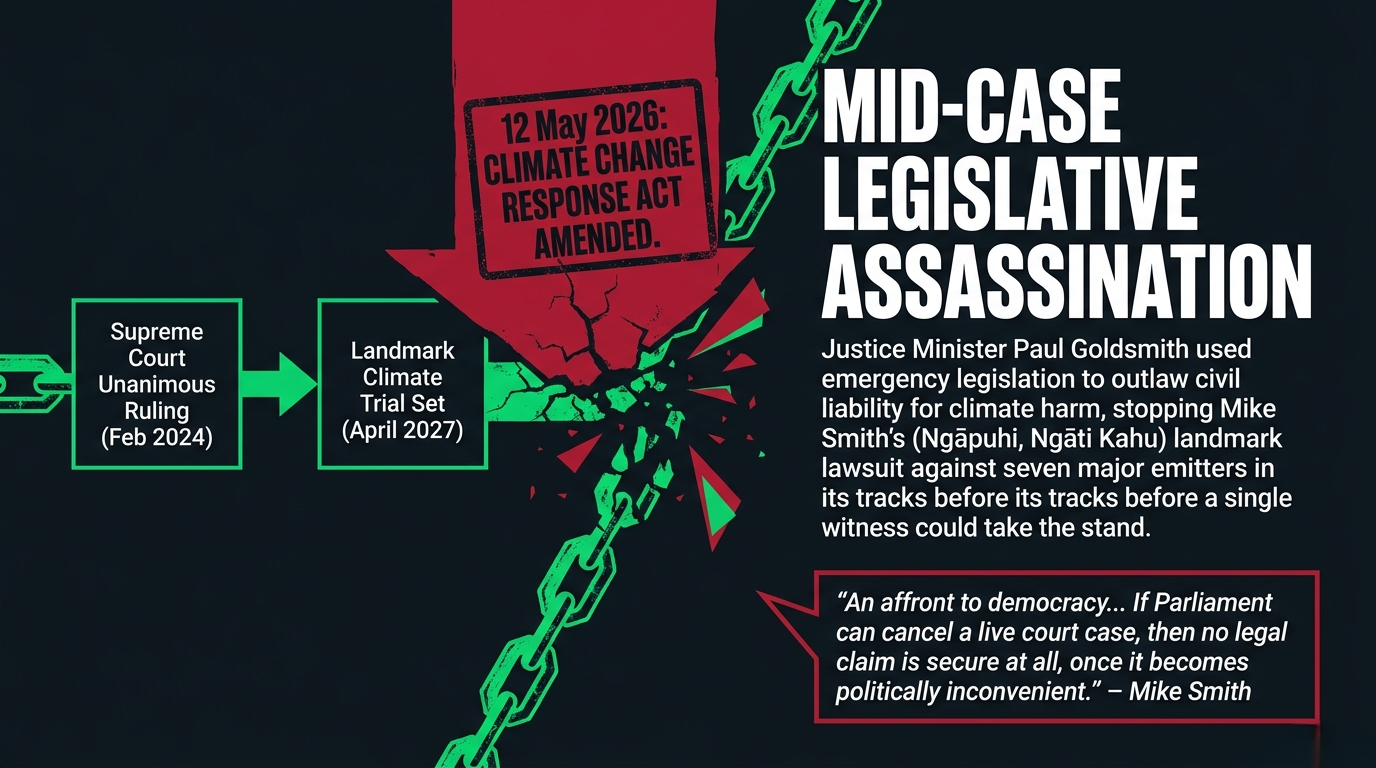
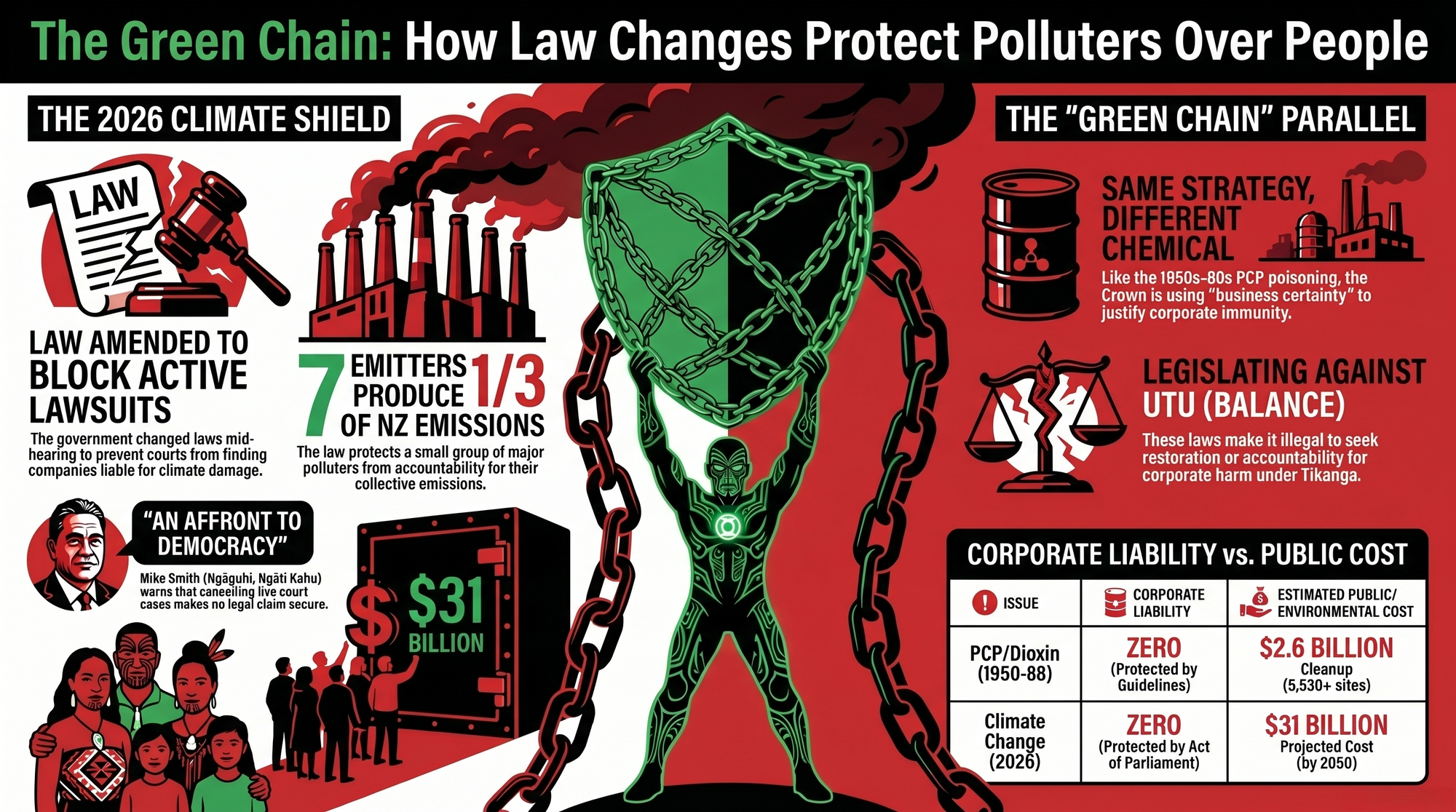
On 12 May 2026, Paul Goldsmith announced the government would amend the Climate Change Response Act to prevent New Zealand courts from making any finding of liability in tort for damage or harm caused by greenhouse gas emissions — applying to both current and future cases, as confirmed by Reuters and The Spinoff.
The Deep Dive Podcast
Listen to a lively conversation between two hosts, unpacking and connecting topics in the sources of this essay. I apologise in advance for the AI's very harsh pronounciation of reo. Please dont shoot me, :).
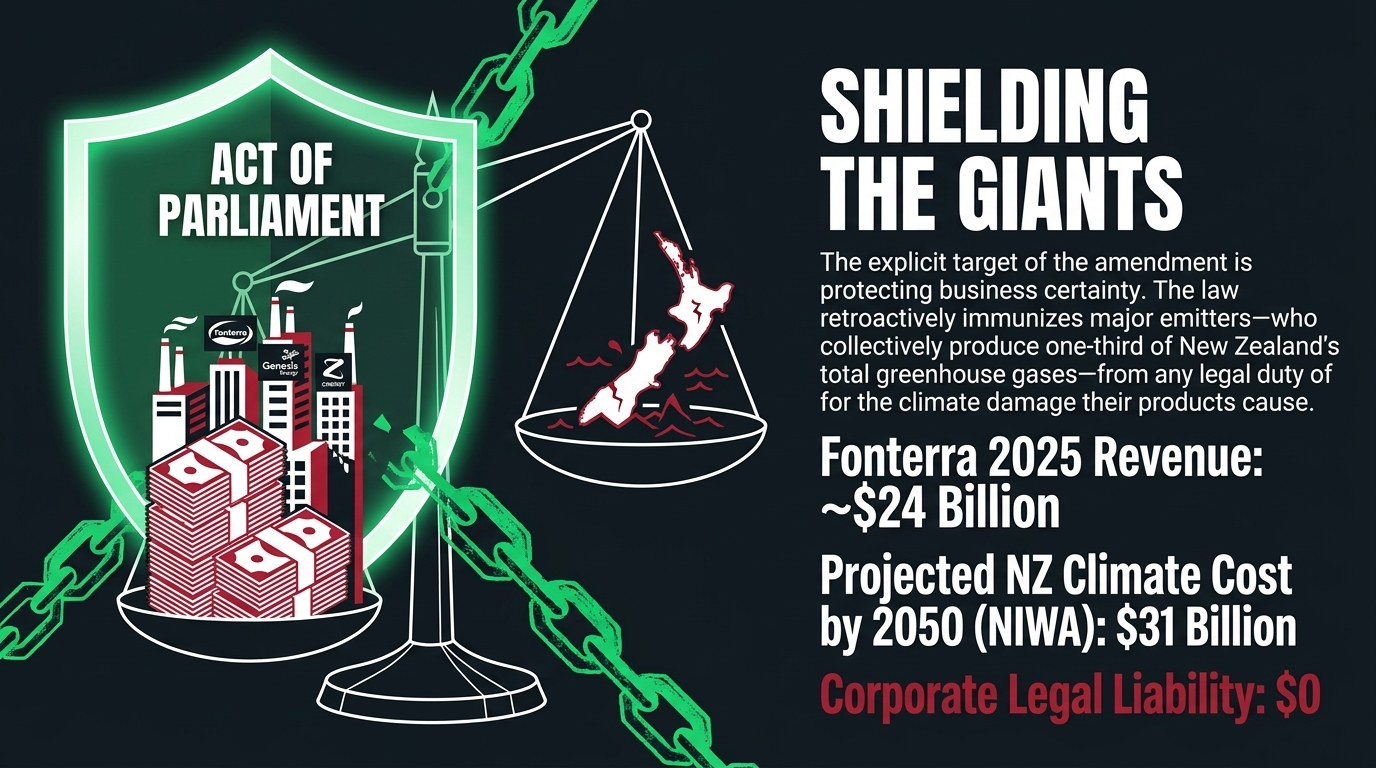
The explicit target is Smith v Fonterra — the case in which Mike Smith of Ngāpuhi, Ngāti Kahu, climate spokesperson for the Iwi Chairs Forum, has argued that Fonterra, Genesis Energy, Z Energy, and four other major emitters bear legal responsibility for climate damage to his land and his people's taonga. The seven defendants collectively account for approximately a third of New Zealand's total greenhouse gas emissions, as documented by Green Queen.
In February 2024, the Supreme Court issued a unanimous ruling reinstating all three of Smith's claims — negligence, public nuisance, and a proposed new "climate system damage tort" — and confirming the case had the right to proceed to trial, assessed by the Human Rights Law Centre as one of the first decisions recognising that tort law can be used to challenge greenhouse gas emissions of a private entity. The trial was scheduled to begin in April 2027.
Goldsmith killed it before a single witness could take the stand.
Mike Smith told RNZ's Nine to Noon that parliament stepping into an active court case was
"unprecedented", as reported by The Spinoff.
He was right. Retrospective legislation to terminate a live, Supreme-Court-validated proceeding is a constitutional rupture — the executive branch using parliamentary numbers to override the judiciary. Lawyers for Climate Action president Jenny Cooper KC called it a
"kneejerk reaction to legislate over the top of the unanimous Supreme Court decision", leaving New Zealanders with no avenue to claim damages or compensation against emitters in future, as confirmed by The Spinoff. Greenpeace called it a "shocking abuse of power".
Goldsmith's defence? The Emissions Trading Scheme is sufficient. There is already a framework.
Jenny Cooper demolished it in one sentence:
"The Climate Change Response Act and the ETS do not deal with this issue at all — there is no framework or mechanism for any type of compensation for climate-related harm."
There is no framework. There never was. There is only the pretence of one, designed to protect corporate profit while communities absorb the damage.
The Green Chain Parallel — This Is Not New
If you have been following The Green Chain Series at The Māori Green Lantern, you will recognise Goldsmith's move immediately. Because the Crown has run this exact play before — and the victims were also Māori.
In The Man With the Brown Paper Bag, we documented how scientist Gordon Jackman spent three decades trying to hold the Crown accountable for licensing the use of PCP — contaminated with some of the most toxic dioxins ever synthesised — at over 600 sawmill sites across Aotearoa. The workers on those green chains were predominantly Māori. The communities downstream were predominantly Māori. The contamination at the Waipa sawmill produced dioxin levels in Lake Rotorua sediment 50 percent higher than the lower Rhine, as confirmed by New Scientist's 1993 investigation cited in The Man With the Brown Paper Bag.
The Crown's response then? Not law. Not liability. Guidelines. Voluntary standards. A Pesticides Board composed of suppliers and users — the very industries doing the poisoning — that reregistered PCP in 1992, after the full scale of contamination was public knowledge, as documented in The Man With the Brown Paper Bag.
In DYING ON THE BOOKS: How ACC Turned PCP Poisoning Into a Waiting Room for Death, we documented how ACC — the institution designed to provide no-fault compensation to injured workers — told SWAP (Sawmill Workers Against Poisons) that the only proven health effects of PCP were skin conditions. Not cancer. Not the rare bone diseases. Not the miscarriages and infertility and paralysis documented in workers across Whakatāne, Rotorua, and Kawerau by E-Tāngata. Just. Skin. Conditions.
That was not medical opinion. That was a legal strategy. It was designed to run the clock down until the victims were dead and the liability had expired.
Goldsmith has updated the strategy for 2026. He is not waiting for Mike Smith's generation to die. He has simply made the lawsuit impossible. Faster. Cleaner. More efficient. Business certainty, after all, cannot wait.
Three Examples for the Western Mind
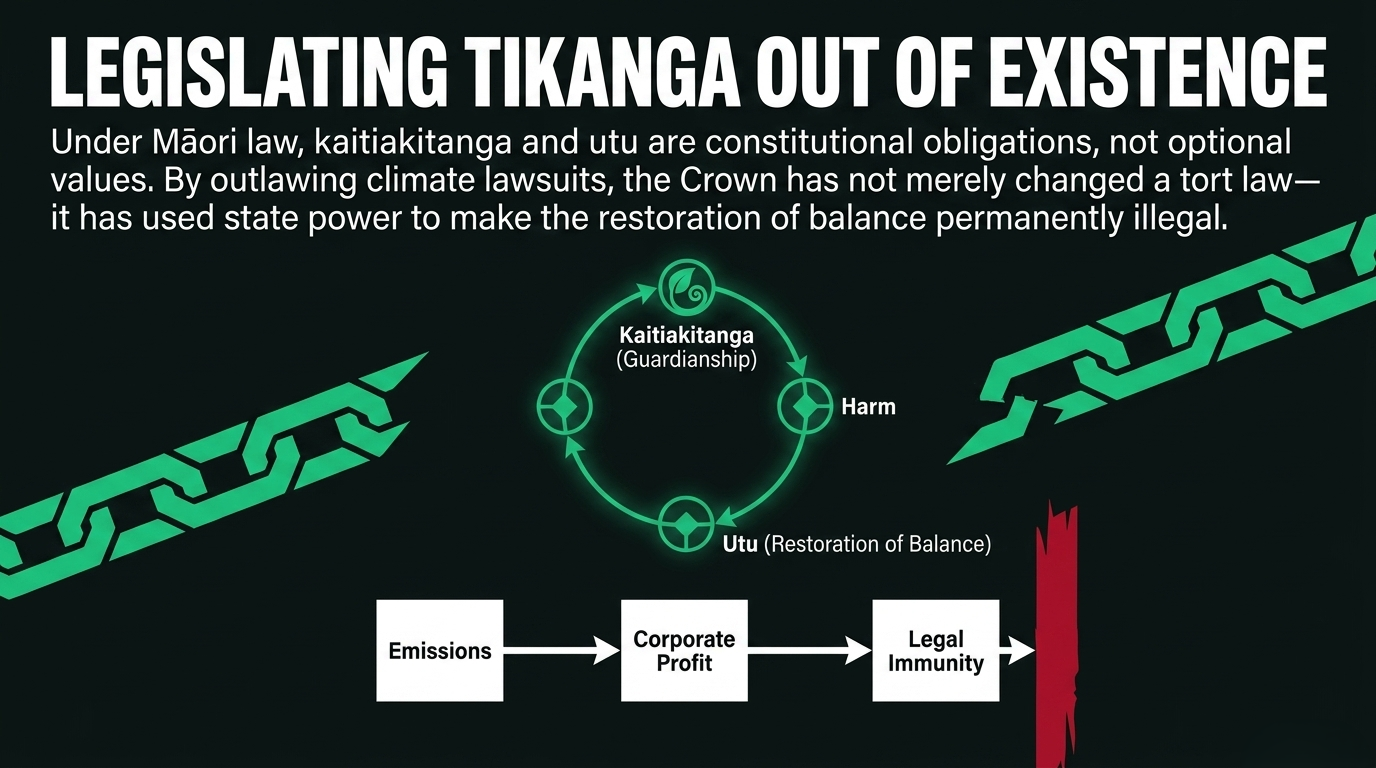
A note on tikanga: Under Māori law and philosophy, kaitiakitanga (guardianship of the natural world) and utu (the restoration of balance after harm) are constitutional obligations — not optional values. When a corporation poisons your atmosphere, your land, or your water, tikanga requires that harm be named, that the responsible party be held accountable, and that balance be restored. This is not sentiment. It is law. What Goldsmith has done is not merely a legal manoeuvre. He has used state power to make the restoration of balance — utu — permanently illegal. He has legislated tikanga out of existence.
Example One: The Law Change That Protected the Pesticide Board
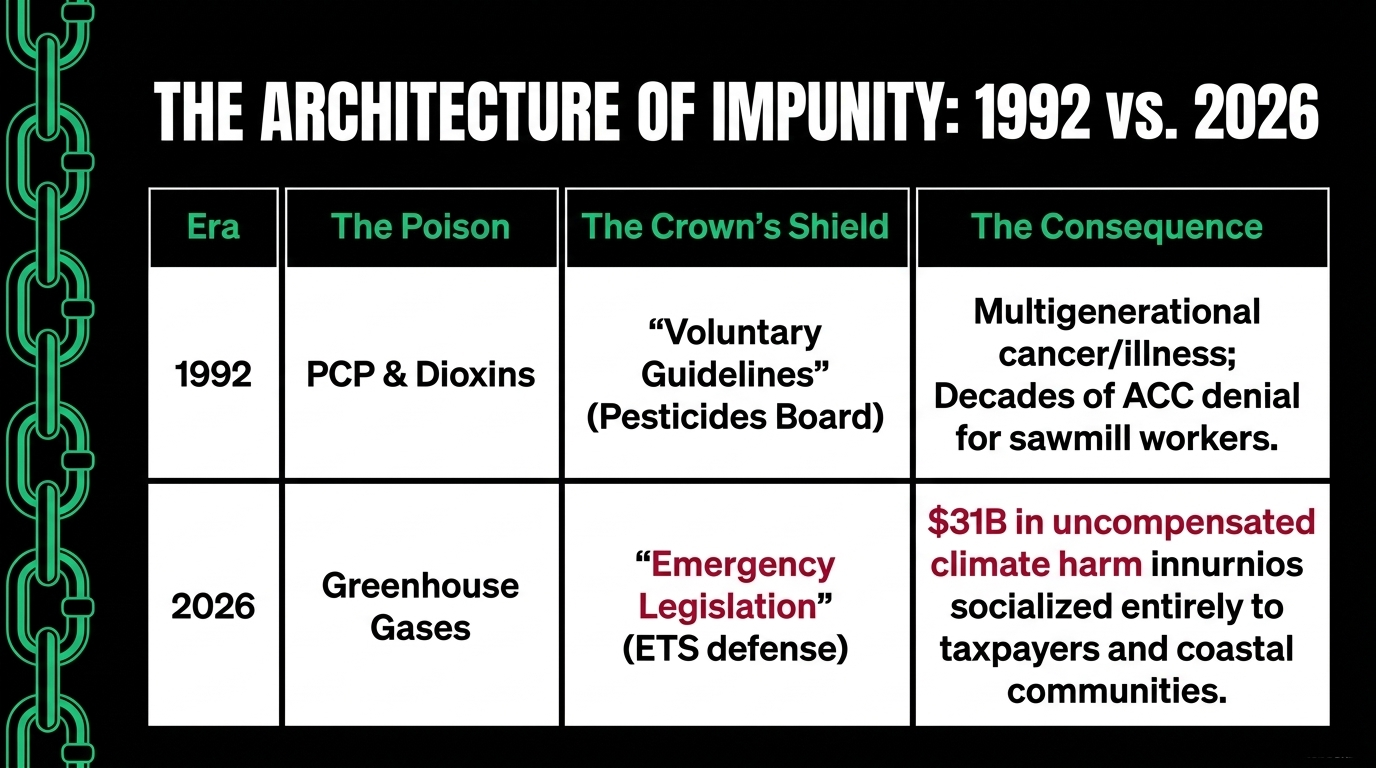
In 1992, after Gordon Jackman's The Deadly Legacy had confirmed that PCP contamination was spreading through New Zealand's waterways, the Pesticides Board — a body nominated by the supplier and user groups of the chemicals it was supposed to regulate — reregistered PCP, as documented in The Man With the Brown Paper Bag. Parliamentary Commissioner for the Environment Helen Hughes had already stated on record that "no amount of guidelines will solve the problem, unless new legislation has the legislative teeth to give them effect", as cited in the same essay. The government chose guidelines anyway. It chose the regulatory structure the industry wanted.
Thirty years later, Goldsmith chooses the law the emitters want. The mechanism is different — then it was regulatory capture; now it is emergency legislation. The logic is identical: when accountability threatens corporate profit, the Crown intervenes on the side of profit.
The tikanga impact: Under the concept of whakapapa — the genealogical framework through which Māori understand all relationships — every decision made today creates obligations for future generations. The Pesticides Board's 1992 reregistration created contamination obligations that communities are still carrying. Goldsmith's 2026 amendment creates climate obligations that will be carried by generations not yet born. Both decisions transferred the cost of corporate profit onto the bodies, land, and futures of people who had no say in those decisions. In tikanga, this is the most serious possible breach of intergenerational responsibility.
Quantified harm: Dioxin cleanup costs estimated at NZ $2.6 billion across 5,530 contaminated sites, as documented in The Man With the Brown Paper Bag. NIWA projects climate change will cost New Zealand up to $31 billion by 2050. Under Goldsmith's amendment, every cent of that falls on taxpayers and communities — not on Fonterra, Genesis Energy, or Z Energy.
Solution: Restore tort liability for climate harm immediately. Commission a Waitangi Tribunal urgency hearing on the amendment as a Treaty breach. Establish a legislated climate reparations fund capitalised by a windfall emissions levy on the seven Smith v Fonterra defendants.
Example Two: The Same Workers, the Same Rohe, the Same Crown
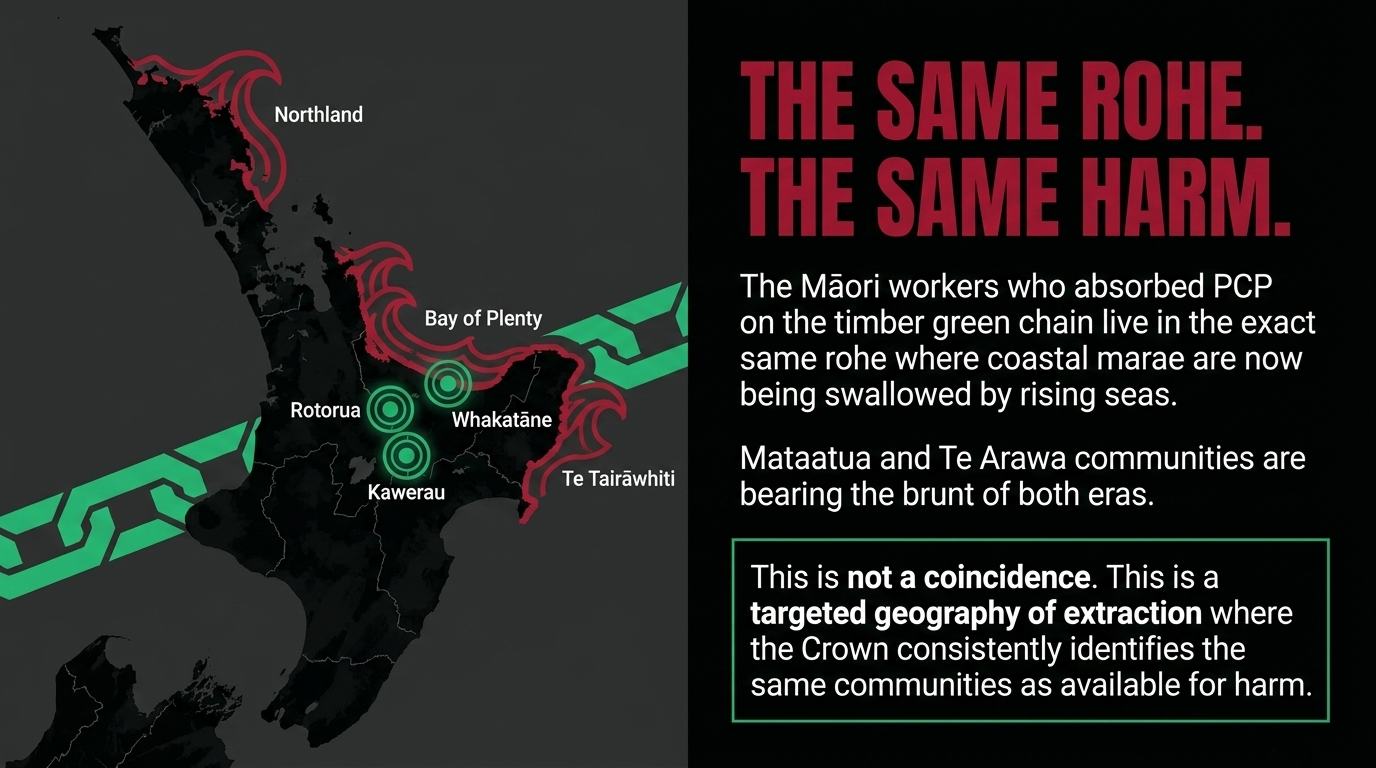
The sawmill workers of Whakatāne, Rotorua, and Kawerau — the men whose bodies absorbed PCP and dioxin on the green chain — were predominantly Māori, predominantly from Mataatua and Te Arawa iwi. As E-Tāngata documented, their whānau are still fighting: SWAP co-chair Kereama Akuhata and Marama Cook (daughter of SWAP founder Joe Harawira) continue to demand ACC recognition of the full range of PCP health effects, as documented in DYING ON THE BOOKS.
Those same communities — Te Tairāwhiti, the Bay of Plenty, Northland — now face the most acute climate risk in Aotearoa: coastal flooding, extreme weather events, land loss, the erosion of coastal marae. The workers who stood on the green chain and were poisoned live in the same rohe as those whose marae are being swallowed by rising seas. It is not a coincidence. It is a geography of extraction. It is what happens when the Crown consistently identifies the same communities as available for harm.
The tikanga impact: Mauri — the life force of a place, a person, a community — is the measure of environmental and social health. The mauri of the Whakatāne River, of Lake Rotorua, of the coastal lands of Ngāpuhi, is diminished by contamination — both chemical and atmospheric. Restoring mauri requires that those who depleted it contribute to its restoration. This government has passed a law making that legally impossible for climate harm. It continues to run an ACC system that makes it bureaucratically nearly impossible for PCP harm. The pattern is unbroken.
Quantified harm: Workers who mixed PCP solutions had serum dioxin levels 10–15 times higher than unexposed workers, measurable twenty years after exposure ended, per PubMed-indexed research. At Whakatāne, blood tests showed contamination two to three times higher than near the Paritutu chemicals factory, as reported by the NZ Herald. The climate costs for the same communities remain unquantified — because Goldsmith has just ensured there will never be a court process to quantify them.
Solution: Full ACC coverage for all PCP and dioxin-related illness, without exception. A dedicated Māori climate resilience fund — co-governed by mana whenua — for the coastal communities bearing the greatest climate risk. ACC reform to establish the precautionary principle: where scientific evidence of harm exists, coverage is granted, not denied.
Example Three: The Clean Green Lie, Updated for 2026
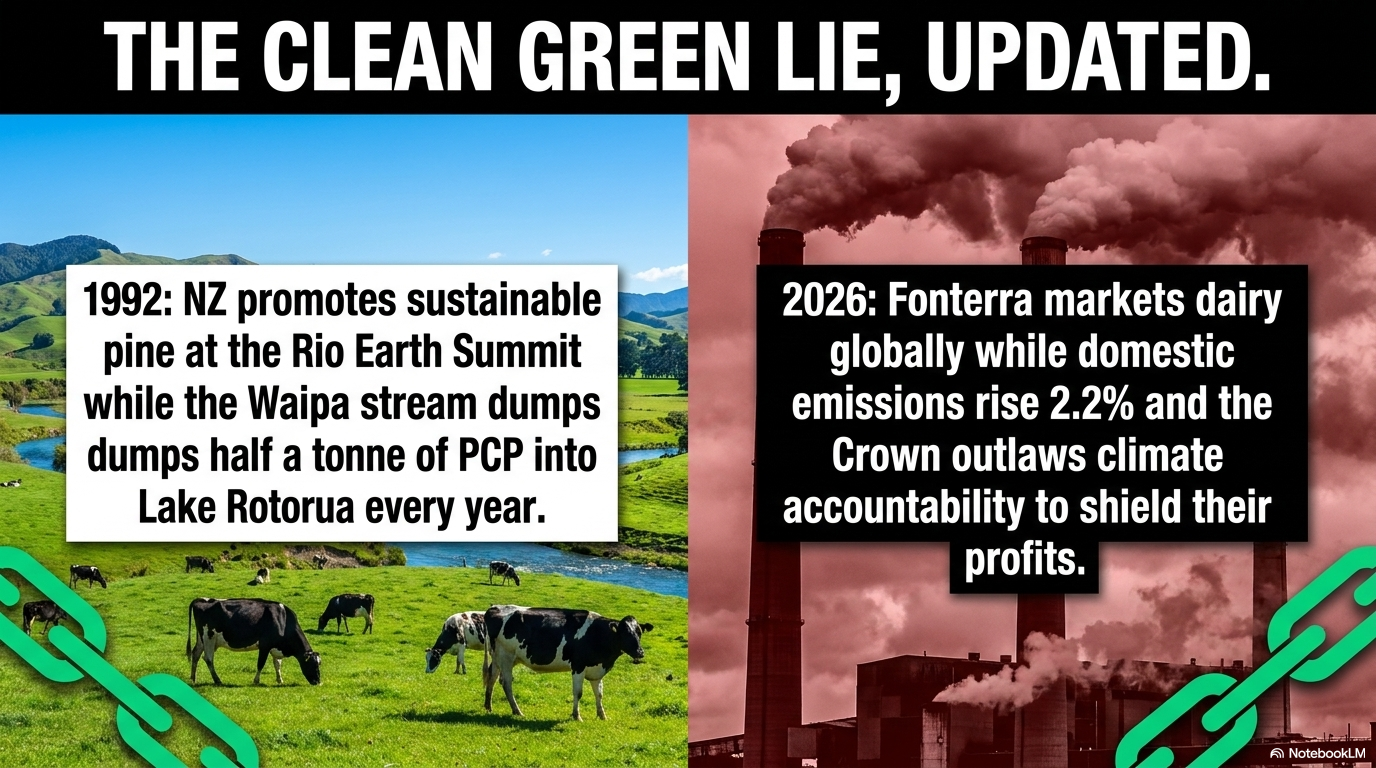
In 1992, at the Rio Earth Summit, New Zealand promoted its plantation timber as the environmentally acceptable green alternative to old-growth logging — while the Waipa stream was carrying half a tonne of PCP per year into Lake Rotorua, as documented in The Man With the Brown Paper Bag. The clean green brand was built on contaminated water. The export dollars were banked on dioxin-soaked Māori bodies.
In 2026, Fonterra markets its dairy globally while its emissions increased by 2.2% in 2025, as confirmed by Greenpeace Aotearoa. The International Court of Justice's 2025 advisory opinion confirmed that states have binding legal obligations to prevent climate harm, as documented by E-Tāngata. New Zealand was at the table. New Zealand knew. And New Zealand's government has now passed a law to ensure Fonterra — the country's largest single emitter — will never be held liable in tort for the consequences of those emissions.
The clean green lie has been updated for the climate age. Goldsmith is running the same brand on the same logic: export the product, socialise the harm, shield the corporation, and call it economic management.
The tikanga impact: Kaitiakitanga — environmental guardianship — is not a marketing word. It is a Treaty obligation. A Crown that promotes clean green credentials internationally while legislating against domestic climate accountability is not merely failing its environmental obligations. It is committing fraud against Te Tiriti o Waitangi and against every community whose wai, kai, and whenua it was supposed to protect as a Treaty partner. The ICJ's 2025 ruling makes this an international legal failure, not merely a domestic political choice.
Quantified harm: Fonterra's annual revenue: approximately NZ $24 billion. Its emissions: increasing. Its legal liability as of 12 May 2026: zero, in perpetuity, by Act of Parliament. The seven Smith v Fonterra defendants collectively produce approximately a third of New Zealand's emissions, per Green Queen. Zero legal consequence. Zero compensation mechanism. Zero utu.
Solution: End the clean green marketing until domestic climate accountability is restored. Pass emergency legislation reinstating tort liability for corporate emitters. Establish a Treaty-based co-governance framework for all environmental standards and remediation, with Māori environmental guardians holding binding authority over outcomes — not consultation rights that can be overridden by a coalition agreement.
Five Verified Hidden Connections

The PCP scandal and the Smith v Fonterra amendment are not two separate stories. They are chapters in a single, unbroken narrative of Crown-licensed corporate impunity. Here are five verified connections:
1. The same legal architecture of denial. ACC denied the science on PCP. The government denied tort liability for climate harm. Both deployed institutional mechanisms to prevent accountability from ever reaching a courtroom. Both shifted the cost of corporate harm onto the bodies and budgets of those least able to carry it. See DYING ON THE BOOKS for the ACC architecture; see Lawyers for Climate Action's press release for the 2026 version.
2. The same "there is already a framework" defence. In 1992, the Crown said voluntary guidelines were sufficient. In 2026, Goldsmith says the ETS is sufficient. Jenny Cooper KC dismantled the 2026 claim in one sentence, as reported by The Spinoff. Gordon Jackman dismantled the 1992 claim in one report, as documented in The Man With the Brown Paper Bag. The Crown has not updated its argument in thirty years because the argument was never about policy — it was always about protection.
3. The Regulatory Standards Bill — the kill switch for future accountability. David Seymour's Regulatory Standards Bill — examined in Proposed bill 'an ideological project that must be stopped' at E-Tāngata — would allow corporations to claim compensation from the Crown for any regulation that cuts into their profits, explicitly including climate measures. Goldsmith's amendment kills today's lawsuit. Seymour's bill would bankrupt tomorrow's regulator. The architecture of permanent corporate immunity is being assembled piece by piece.
4. International law exposure. The ICJ's 2025 advisory opinion, documented by E-Tāngata, confirmed binding state obligations to prevent climate harm. New Zealand's fossil fuel policy already risked breaching international law before this amendment, as reported by Carbon News. The government knew. It passed the law anyway. The Pesticides Board knew PCP was lethal in 1992 and reregistered it anyway. The Crown's relationship with inconvenient international evidence has not changed.
5. The same communities, the same geography of harm. The dioxin-poisoned mill workers of Whakatāne, Rotorua, and Kawerau live in the same rohe as the coastal Māori communities facing the greatest climate risk. The Crown dipped them in dioxin and is now legislating against accountability for drowning their mokopuna. The geography of extraction in Aotearoa is a Māori geography — documented across The Green Chain Series and in When the Whenua Bleeds.
Ko Wai ngā Painga — Who This Law Was Written For
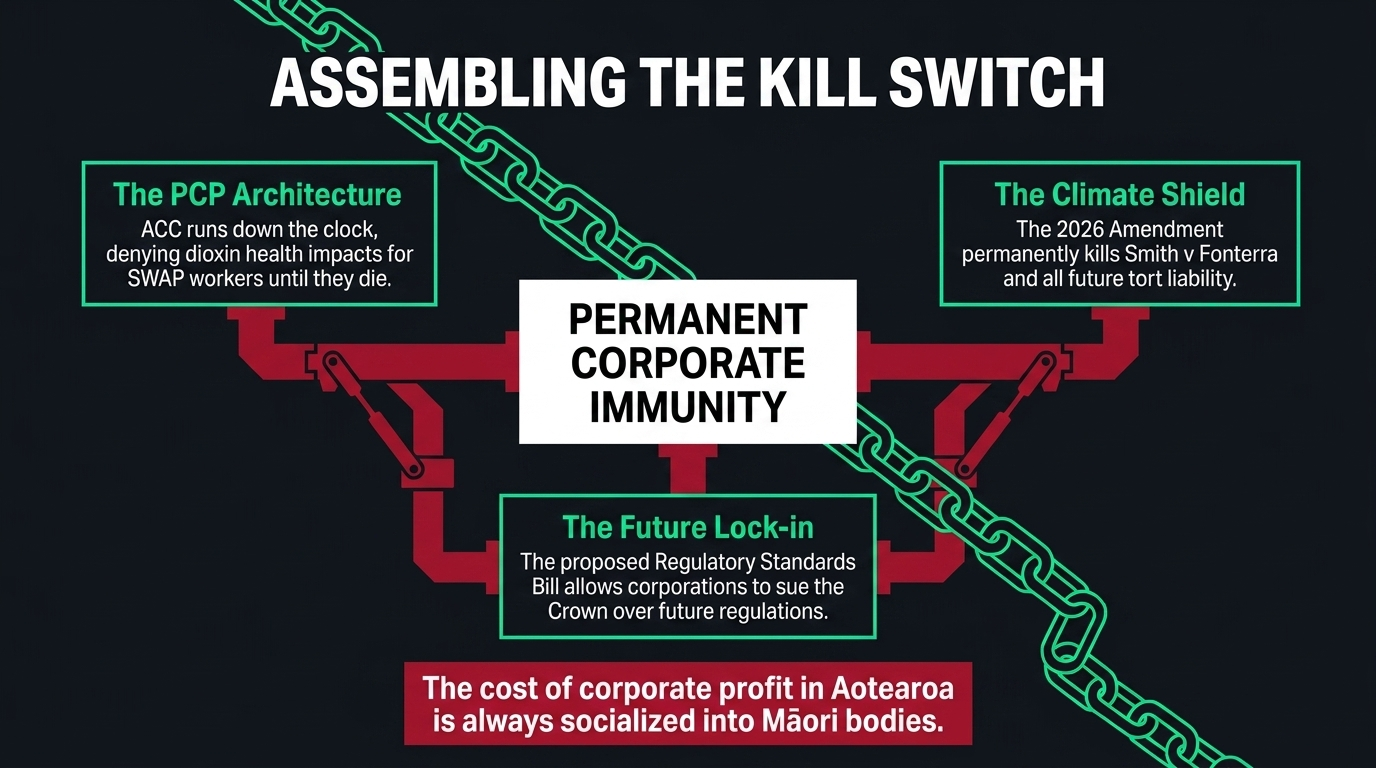
Let us be precise. Paul Goldsmith's amendment was written for Fonterra. It was written for Genesis Energy, Z Energy, Dairy Holdings, New Zealand Steel, Channel Infrastructure NZ, and BT Mining. It was written for the corporate lobby that cannot afford to have a New Zealand court establish — even in principle — that corporate emitters have a duty of care for the climate harm their products cause.
Mike Smith was clear: he was not seeking damages. He was seeking a legal declaration of liability — a public interest finding that would require these corporations to act, as reported by The Spinoff.
He was asking for the law to say what science already confirms: that these corporations know what their emissions do, that they have alternatives, and that their choice to continue without accountability constitutes a legal harm.
Goldsmith's response was to pass a law saying: that conversation cannot happen. Not in any court. Not ever.
As Lawyers for Climate Action's Jenny Cooper KC put it:
"If they are not responsible for paying then who does? Well, everybody, basically." The Spinoff.
Everybody. Meaning whānau. Meaning the mokopuna of the mill workers. Meaning the tangata whenua whose marae are on the coast. Meaning the taxpayers who will carry the $31 billion NIWA projects as the climate cost by 2050.
Fonterra's annual revenue: approximately NZ $24 billion. Its emissions: rising, per Greenpeace Aotearoa. Its tort liability as of today: zero, by Act of Parliament.
The Crown will not make the emitters pay. Just as it would not make the sawmill owners pay. Just as ACC would not compensate the workers. The cost of corporate profit in Aotearoa is always socialised into Māori bodies. That is not a metaphor. That is the policy.
Ko te Whakaaro Whakamutunga — No False Balance
This essay will not offer false balance. There is no legitimate "other side" to the proposition that a government should not rewrite the law mid-case to protect corporations from accountability. There is no complexity in the decision to shield the country's biggest polluters while the communities they are destroying have no recourse.
This is a white supremacist neoliberal government — not as insult, but as structural description. Every decision this coalition has made extracts value from Māori communities and redirects it to corporate interests: the dismantling of the Māori Health Authority, the defunding of Māori media, the weakening of Treaty settlements, the rollback of climate policy, and now the legislative extinguishment of the one legal mechanism that gave Māori a path to climate accountability. As documented by The Māori Green Lantern, the fossil fuel and agri-industrial lobbies are present at every step of this government's climate retreat.
Under tikanga, utu — the restoration of balance after harm — is the constitutional foundation of a functioning society. Mike Smith went to the courts seeking exactly that. Paul Goldsmith has made utu permanently illegal.
The green chain runs. The profits bank. The bodies absorb the cost.
Gordon Jackman picked up a brown paper bag in 1992 and refused to put it down for thirty-five years. Mike Smith filed his first climate claim in 2019 and has not stopped. SWAP's Kereama Akuhata and Marama Cook are still fighting for the workers the Crown has been waiting to bury.
They have not stopped. Neither will we.
Ka whawhai tonu mātou. Ake. Ake. Ake.
Koha — Fund the Lawsuit They Just Made Illegal
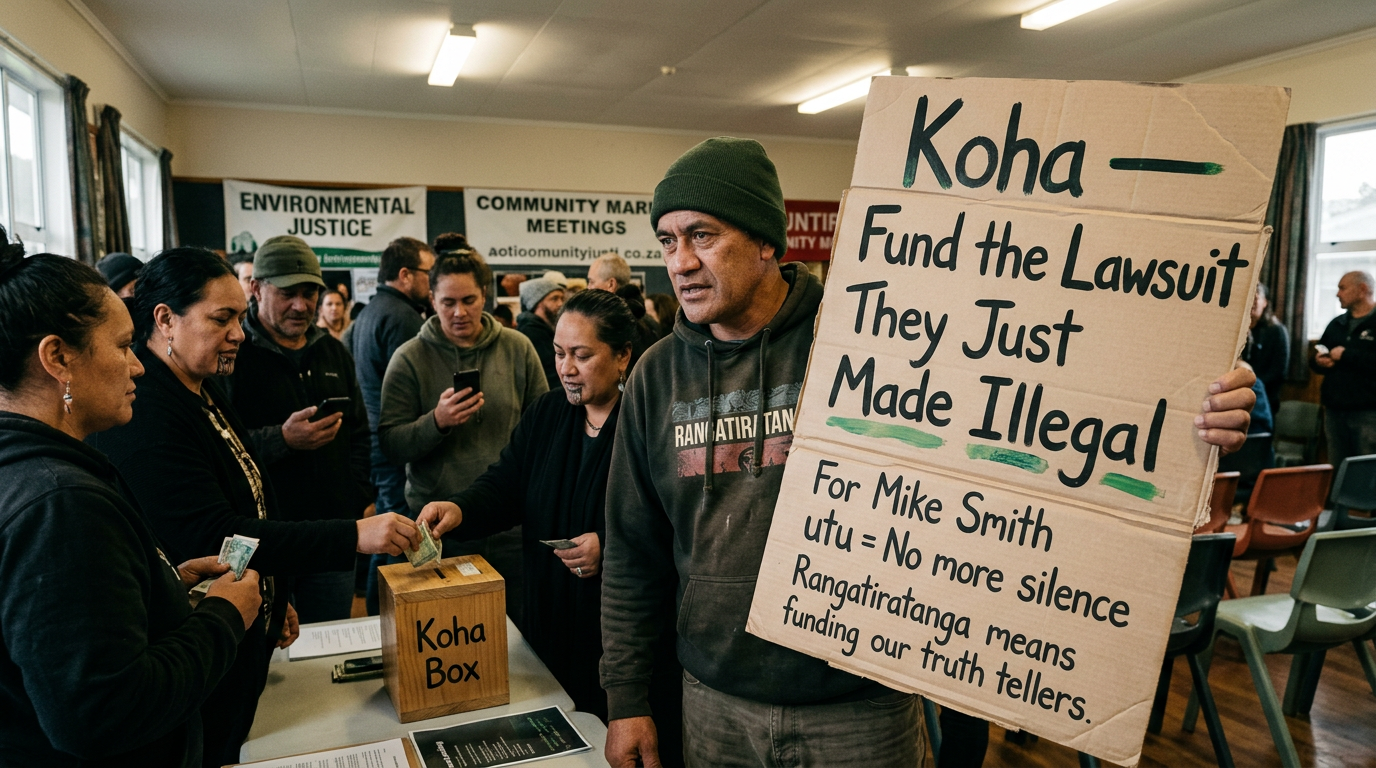
Paul Goldsmith changed the law to make sure Mike Smith could not win in court.
He cannot silence this essay.
Every koha to The Māori Green Lantern is an act of utu — a signal that the green chain ends here, that the cost of corporate profit will not be absorbed in silence, and that rangatiratanga means funding our own truth tellers when the Crown funds the corporations destroying our people.
If you can koha — do it for Mike Smith. Do it for Kereama Akuhata and Marama Cook and every SWAP whānau member still waiting for ACC to acknowledge the cancer in their bones. Do it for the mokopuna who are inheriting the warming sea and the $31 billion bill their government just ensured Fonterra will never pay.
If you cannot koha right now — no worries. Subscribe. Follow. Kōrero. Share. Get this essay to every whānau member, every friend, every person who needs to understand that what happened on the green chain and what happened in Parliament today are the same crime, thirty years apart. That is koha in itself.
💚 Koha directly: app.koha.kiwi/events/the-maori-green-lantern-fighting-misinformation-and-disinformation-ivor-jones
📧 Subscribe for essays direct to your inbox: themaorigreenlantern.maori.nz/#/portal/support
🏦 Direct bank transfer: HTDM — 03-1546-0415173-000
📘 Follow and share on Facebook: facebook.com/Themaorigreenlantern/subscribe
Every koha funds rangatiratanga's own truth tellers. Kia kaha, whānau. Stay vigilant. Stay connected.

Views expressed constitute honest opinion on matters of public interest under the Defamation Act 1992 (NZ) and Durie v Gardiner NZCA 278. All factual claims sourced and cited. Named individuals referenced solely in their public capacity. Errors or concerns: contact via themaorigreenlantern.maori.nz.