
"They Handed Him a Sleeping Bag and Called It Shelter" - 20 August 2026
This white-supremacist neoliberal government does not solve homelessness. It manages the evidence of its own cruelty—then leaves charities to hand out plastic survival cocoons while whānau wait years for a door that locks.

I write this as Ivor Jones, The Māori Green Lantern, because a government’s housing choices determine whether whānau are safe, warm, connected to whenua and whānau, or exposed to the street, cars, couches, garages, violence, illness, and bureaucratic abandonment.
The evidence below concerns public policy, public spending, and public officials acting in public capacity.
 RNZ | Te Reo Irirangi o Aotearoa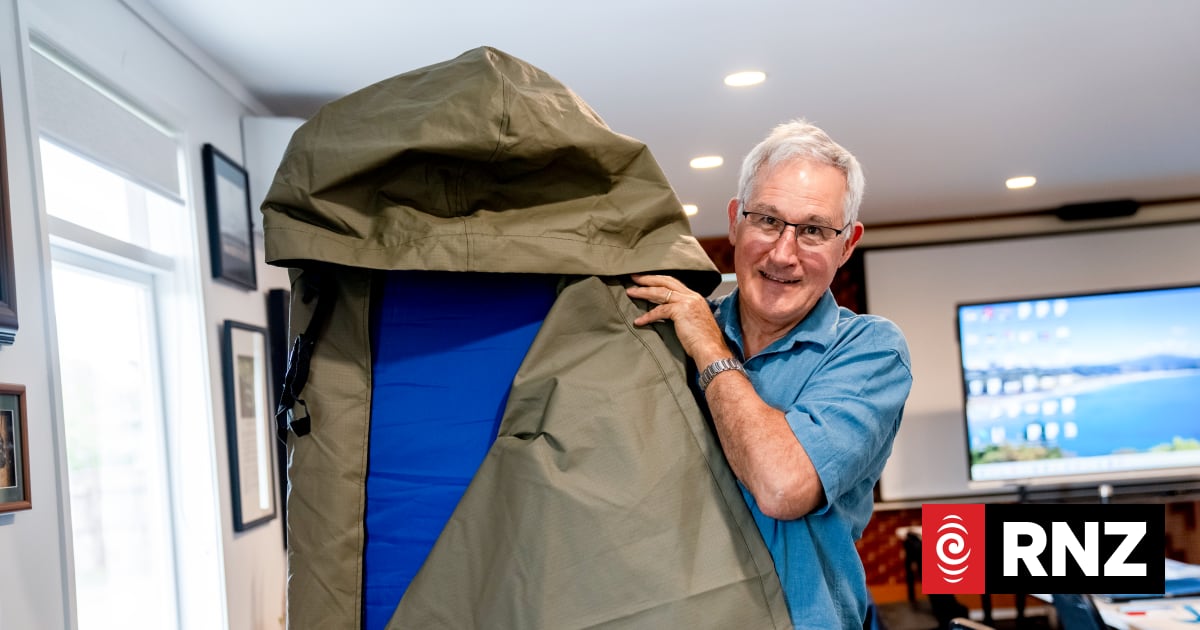
A shelter bag can save a life on a freezing night. I will never sneer at the people who donate one, carry one, or sleep inside one.
That is manaakitanga where the state has gone missing.
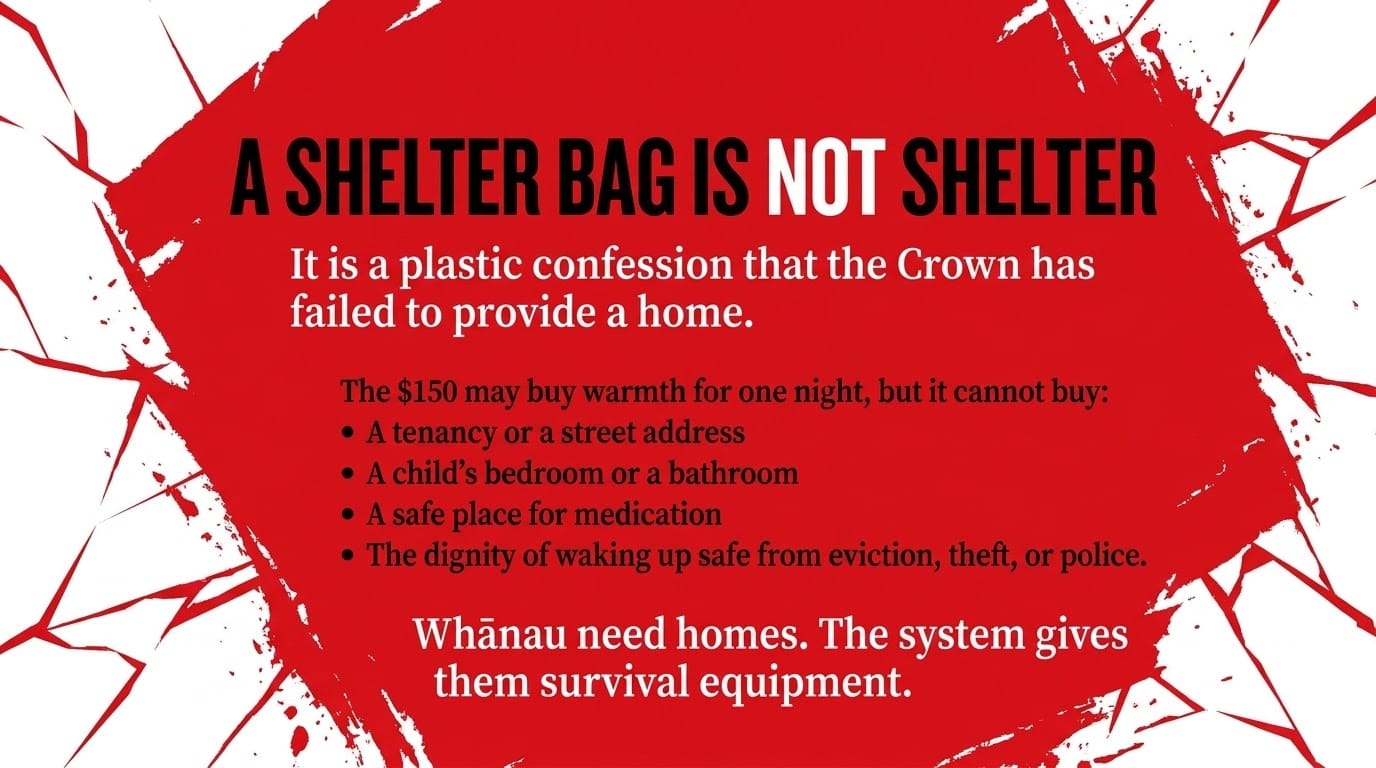
But a shelter bag is not shelter.
It is a plastic confession that the Crown has failed to provide a home.
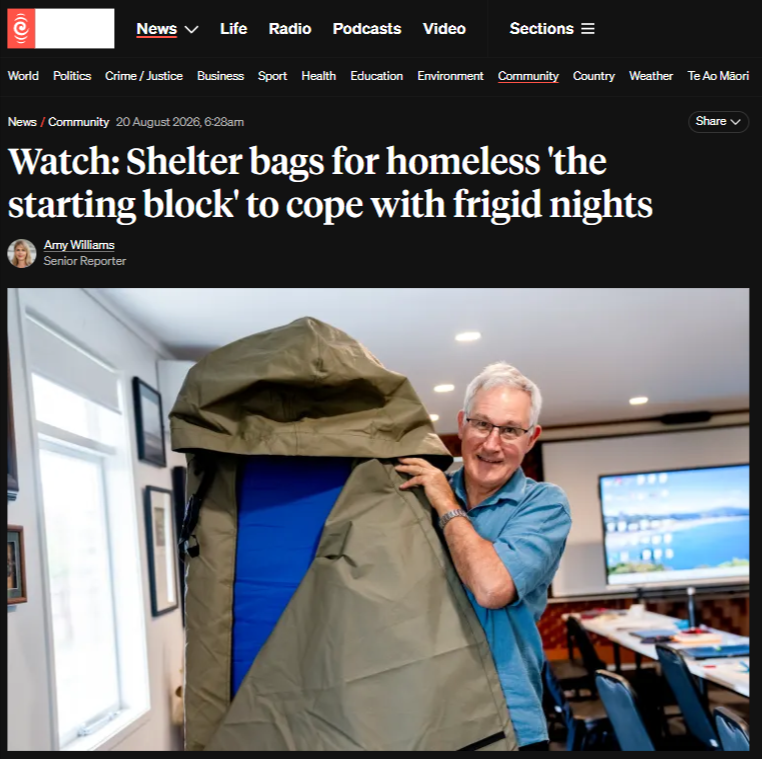
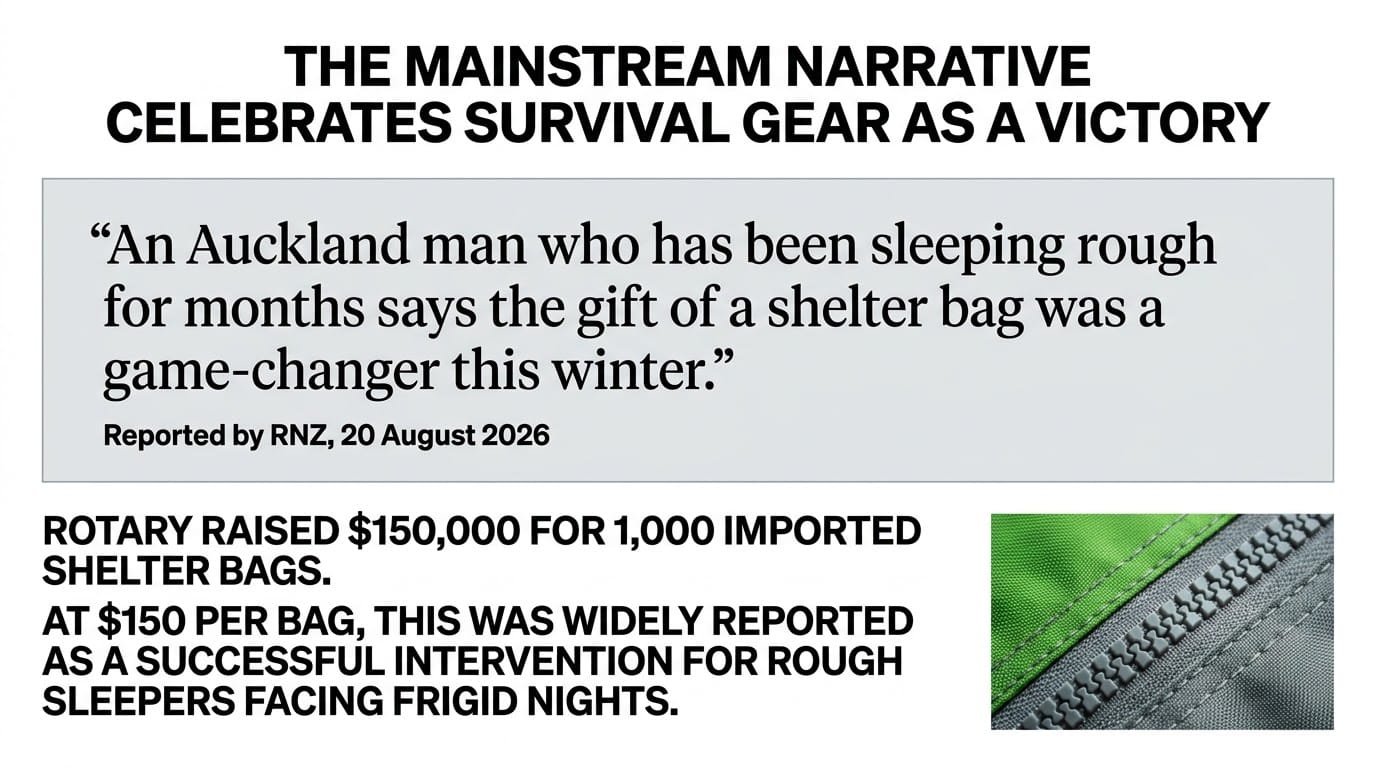
RNZ reported Rotary raising $150,000 for 1,000 bags for people sleeping rough.
That $150 may buy warmth for one night; it cannot buy a tenancy, a bathroom, a stove, a street address, a child’s bedroom, a safe place for medication, or the dignity of waking up knowing the police, weather, theft, violence, or eviction will not take your only place to sleep. RNZ’s shelter-bag report
This is the Crown’s housing policy stripped of the ministerial spin: whānau need homes; the system gives them survival equipment and a waiting list.
HUD expressly says its later service data cannot determine whether overall homelessness has risen, fallen, or stayed the same since the March 2023 Census.
This essay does not pretend otherwise. What it does establish is that homelessness remains a major crisis, that Māori remain overrepresented, that more than a thousand Housing First households were still not stably housed, and that the government’s major new Flexible Fund delivery timetable stretches into 2027–29. HUD’s methodological warning
The Deep Dive Podcast
Listen to a lively conversation between two hosts, unpacking and connecting topics in the sources of this essay. I apologise in advance for the AI's very harsh pronounciation of reo. Please dont shoot me, :).
Youtube Video
Like video? Here is a short video suppporting the essay. Again, don't shoot the messenger please because of AI's pronounciation. 😄
Tautoko This Mahi
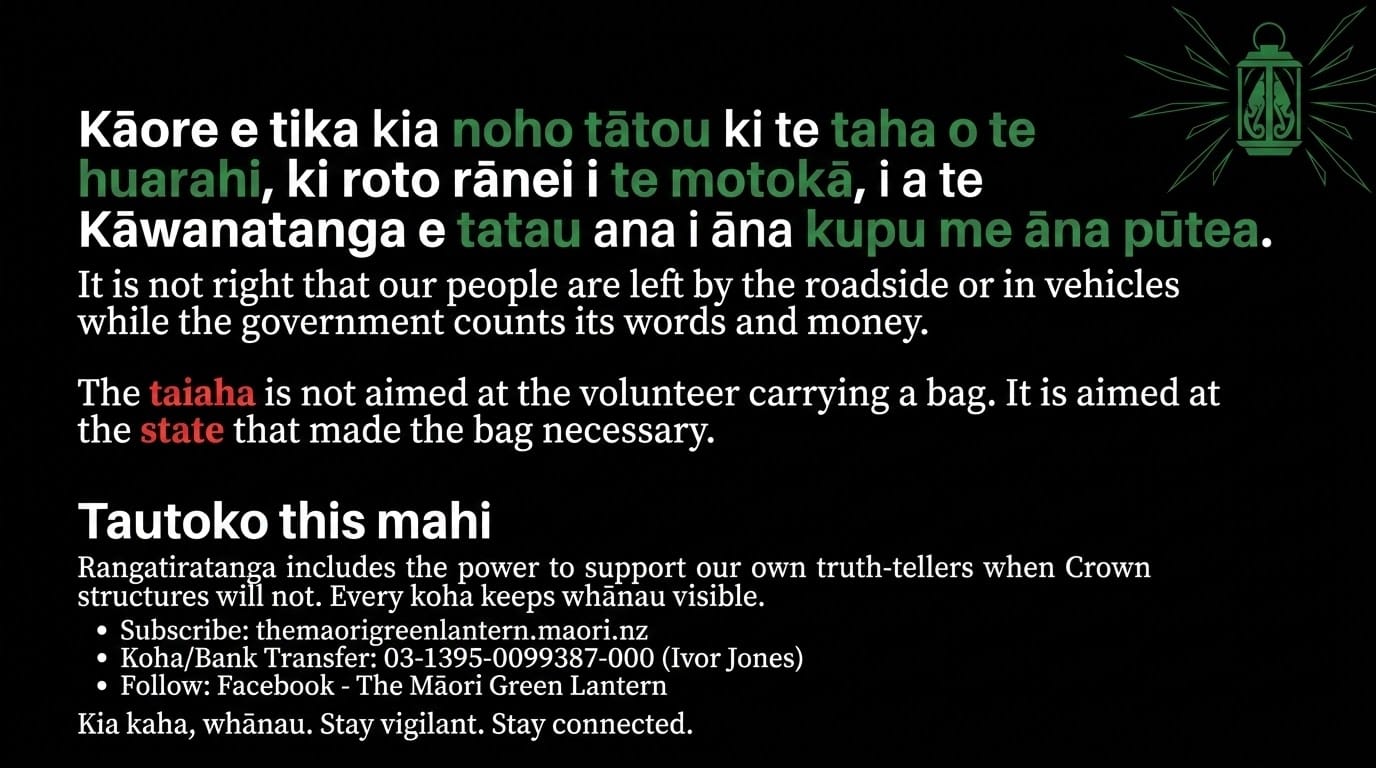
Every koha helps keep whānau facing homelessness visible when government systems reduce them to a waiting list, a declined application, or a shelter bag handed out in winter.
It supports independent truth-telling that follows the money, tests the claims, and names the policies that strip whānau of safe kāinga, manaakitanga and connection.
Rangatiratanga includes the power to support our own truth-tellers when Crown and corporate structures will not.
Kia kaha, whānau. Stay vigilant. Stay connected. If you are able, consider a koha to keep this light on the housing crisis and the people being made to carry it.
If koha is not possible, kāore he raru. Subscribe or follow The Māori Green Lantern, kōrero, and share this essay with your whānau and friends. That is koha in itself.
- Koha: Support The Māori Green Lantern through Koha
- Subscribe: Receive essays directly and support this mahi
- Bank transfer: Ivor Jones — 03-1395-0099387-000
- Facebook: Follow and subscribe to The Māori Green Lantern
The Sleeping-Bag State
The state now expects communities to perform the duty it has abandoned.
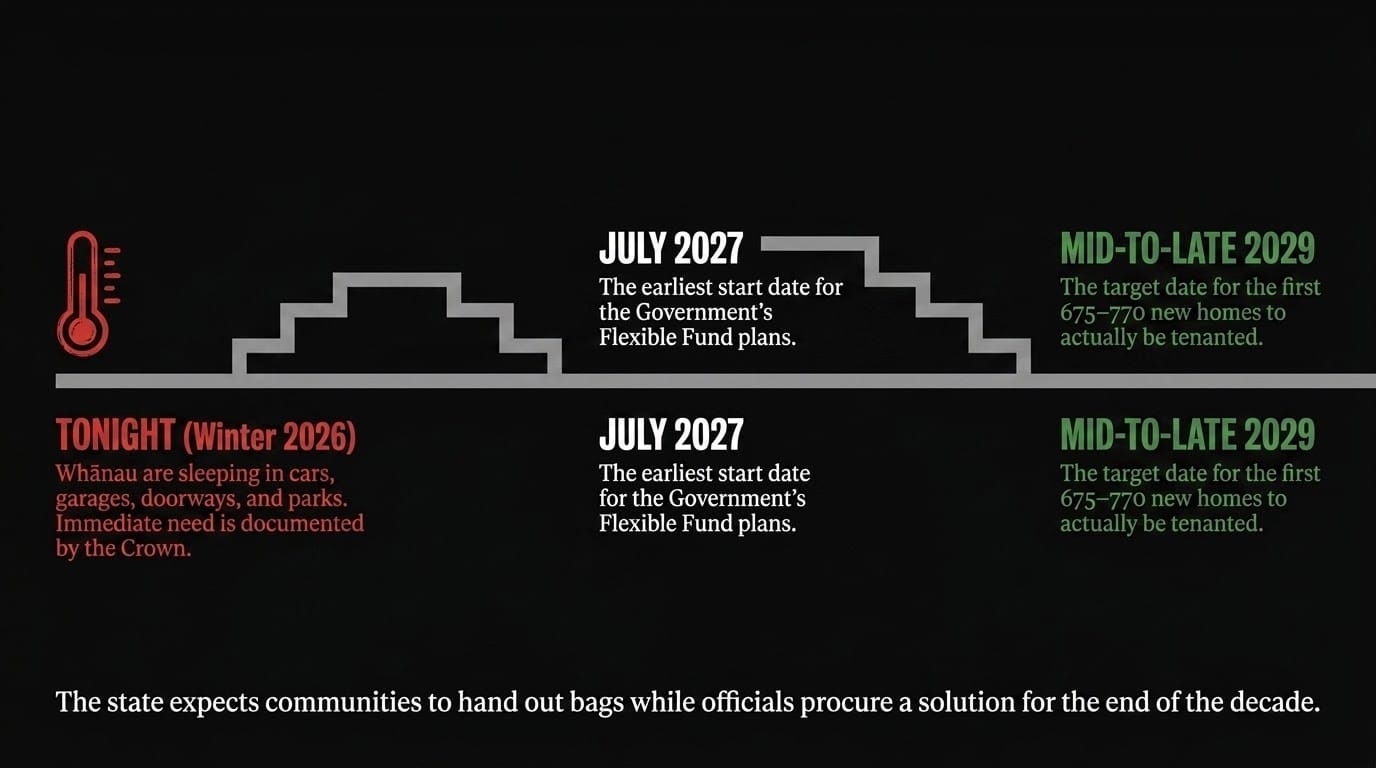
Rotary raises money. Volunteers distribute equipment. Frontline workers find people in parks, cars, garages, doorways and unsafe rooms. Whānau open already overcrowded homes. Māori providers patch together support while short-term contracts keep their own workforce insecure. Then ministers arrive with a press release about a “flexible fund” whose first homes start from July 2027 and are intended to be tenanted by mid- to late-2029. HUD’s investment timetable
That is not a housing response for someone cold tonight. It is a bureaucratic weather forecast for a future government.
The Crown knows the issue is not a lack of insight. Its own report says people without shelter need an immediate housing response and may need support to secure and maintain stable housing.
Its own report records Te Matapihi’s warning: severe shortages of affordable, appropriate housing, particularly larger homes for whānau and under-resourced papakāinga, are compounded by short-term, limited funding for Māori providers. HUD on immediate need and Māori-provider barriers
So let us stop pretending this is a knowledge problem. It is a choice problem.
This white-supremacist neoliberal government has chosen a housing system in which Māori are overrepresented in homelessness, providers are expected to deliver miracles on insufficient and insecure resources, and unhoused people are asked to wait through winter while officials procure a solution for the end of the decade.
That is not neutral administration. It is policy that protects market comfort before human shelter.
Three Examples For The Western Mind
1. The Hospital That Hands Out Blankets
Imagine a hospital with people bleeding in its waiting room. The hospital board does not employ surgeons, open beds, or treat the wound. It gives everyone a blanket and calls it healthcare.
That is the shelter-bag model.
The bag matters because cold kills and exposure harms.
But it is not treatment.
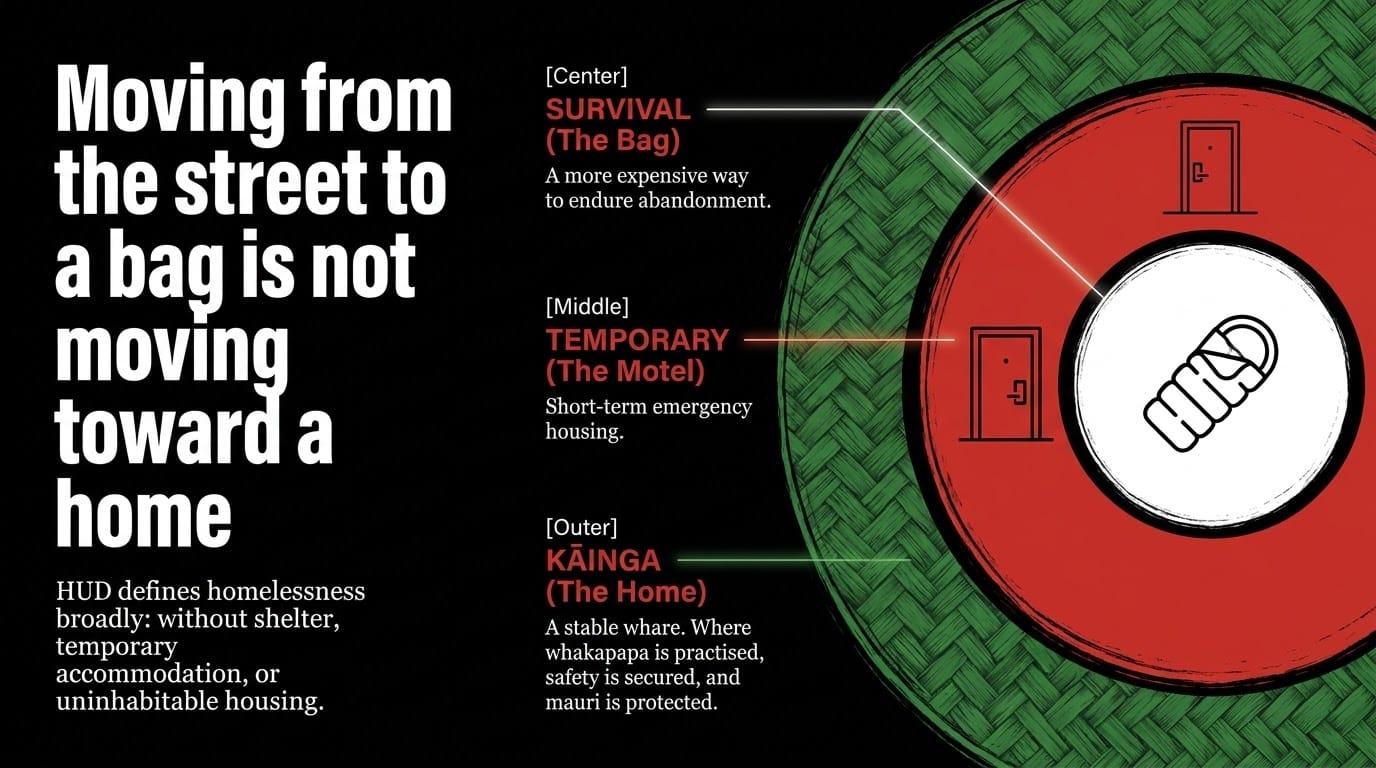
A person sleeping in a car or on the street needs a stable whare, access to health care, income, a tenancy, privacy, and support—not a more expensive way to endure abandonment.
HUD defines homelessness broadly: without shelter, temporary accommodation, sharing someone else’s home, or uninhabitable housing. A car, garage, shack, couch, and doorway are not “housing choices.” HUD’s homelessness definition
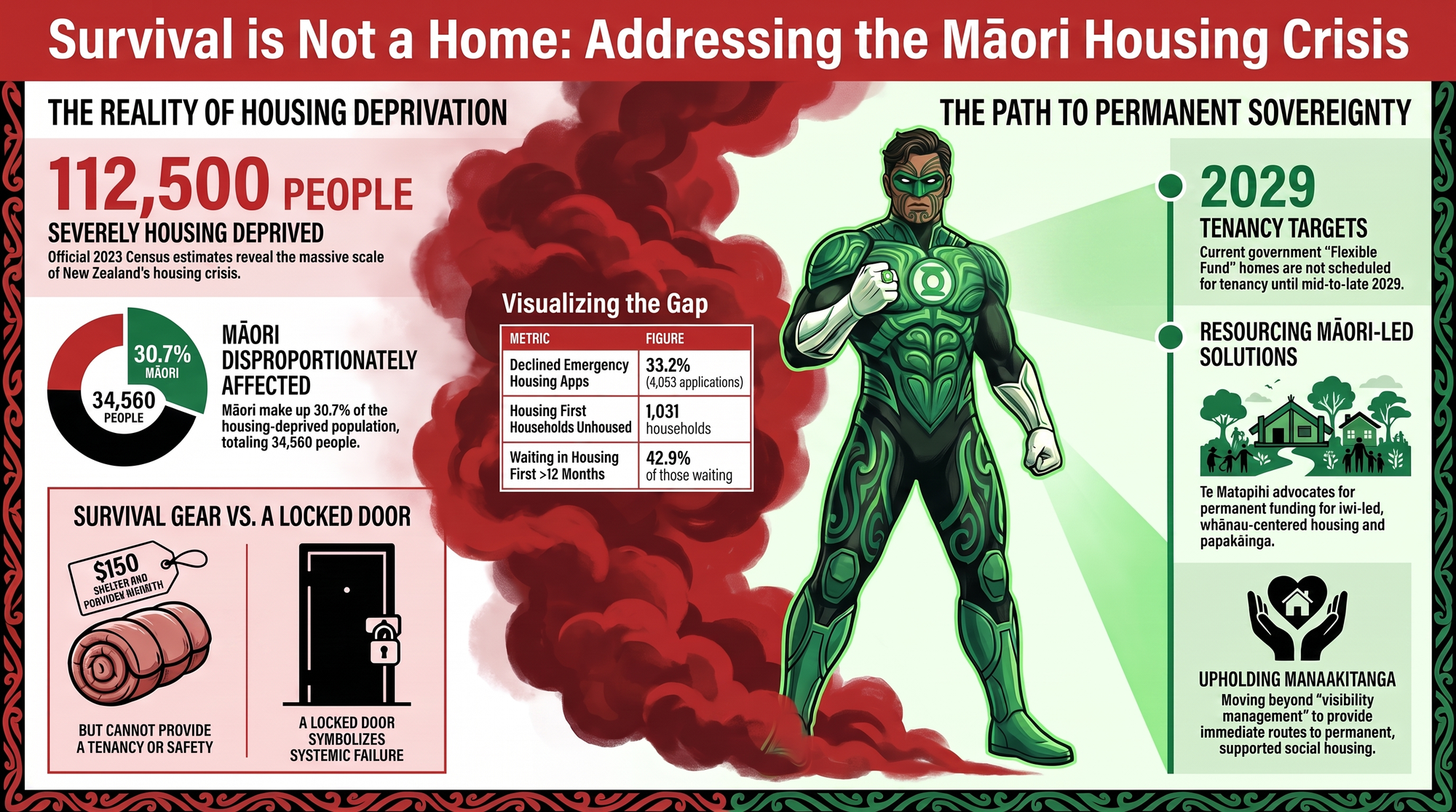
Quantified harm: At least 4,965 people were estimated to be living without shelter at the 2023 Census, including 1,308 Māori. HUD’s Census estimate
Tikanga impact: To a Western policy mind, this may look like “service provision.”
In tikanga terms, it is a failure of manaakitanga: the active obligation to uphold another person’s mana.
You cannot claim to uphold someone’s mana while leaving them to survive in a bag because the home they need has been postponed into a procurement spreadsheet.
Solution: Treat emergency gear as emergency gear, then provide an immediate route to permanent social, community, and kaupapa Māori housing with wraparound support.
2. The Fire Brigade That Books A Truck For 2029
Imagine your whare is burning tonight. The fire brigade arrives, studies the flames, agrees your house is burning, then says the new truck is scheduled to arrive in three years.
That is the timeline in the Government’s Flexible Fund plan.
HUD says the fund is intended to support 675–770 homes and affordable rentals from 1 July 2027. The selected programmes are intended to be tenanted by mid- to late-2029. Hastings has only 15–20 homes listed in the published range. HUD’s Flexible Fund plan
Quantified harm: HUD recorded 10–15 people regularly sleeping rough in Hastings in April 2026 and another 10–15 living in vehicles. Even at the lowest count, that is 20 people; at the highest, 30 people. The planned 15–20 homes are neither a complete count of local need nor an immediate response to it. HUD’s Hastings data
Tikanga impact: A kāinga is not simply a financial unit. It is where whakapapa is practised: where tamariki learn who they are, where kaumātua can be visited, where kai is shared, where grief is held, where reo and tikanga travel across generations.
When the state delays housing, it delays that whole web of relationship. That is mauri-depleting governance.
Solution: Bring delivery forward; build and acquire secure homes now; and put long-term decision-making and resources in the hands of Māori providers, hapū and iwi who already understand whānau need in their own rohe.
3. The Queue With No Waiting Room
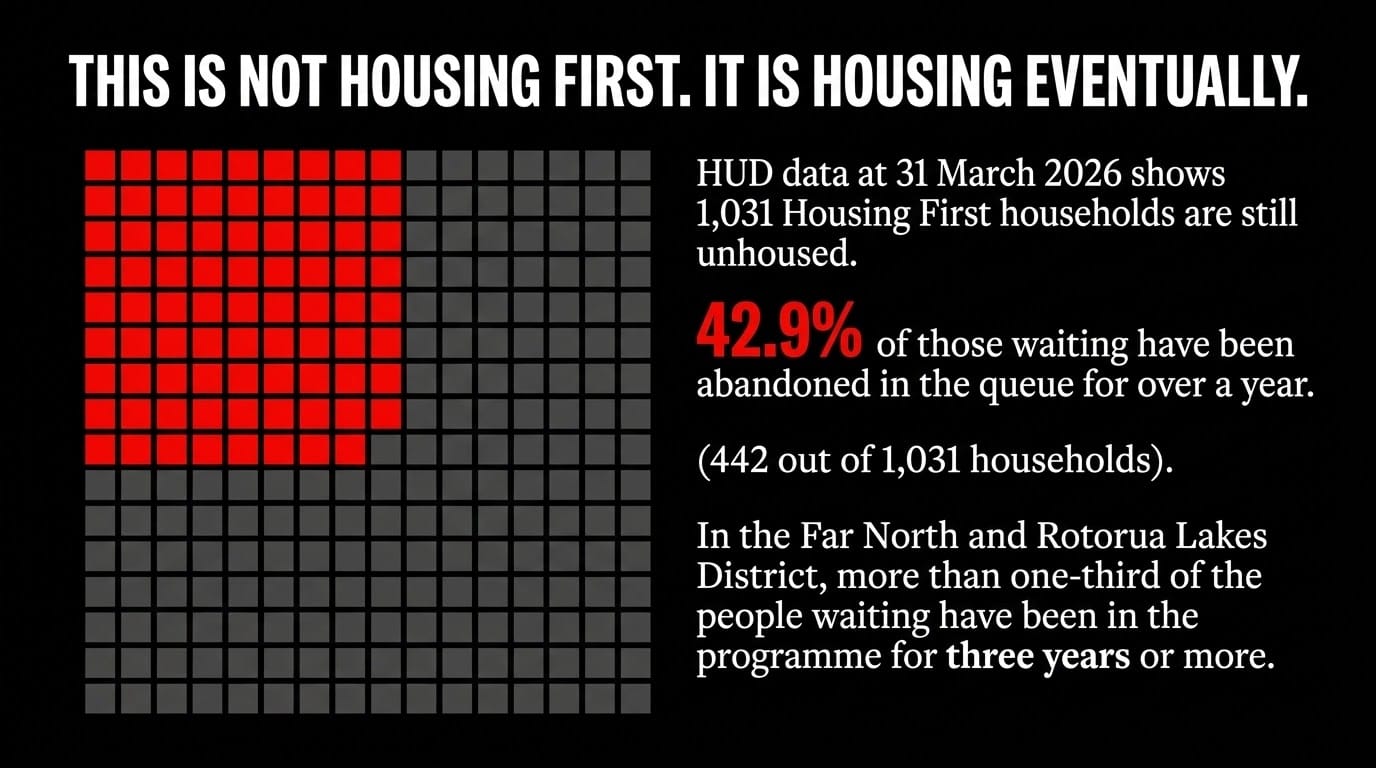
Imagine a government identifies you as having complex needs, tells you Housing First is available, then makes you wait outside for a year or more before providing the first thing its own model says comes first: housing.
That is not Housing First. It is Housing Eventually.
At 31 March 2026, HUD recorded 1,031 Housing First households not yet in stable accommodation. Of those, 442 had been in the programme for at least 12 months. In the Far North and Rotorua Lakes District, more than one-third of the people waiting had been in the programme for three years or more. HUD’s Housing First data
Quantified harm: Almost 42.9 percent of the Housing First households still waiting had been waiting at least a year. This calculation uses HUD’s two published figures. HUD
Tikanga impact: Whanaungatanga means people are bound to one another by relationship and responsibility. A system that makes people wait outside while claiming to support them breaks that relationship. It says the state can acknowledge a person’s humanity in a case file while refusing to meet it in the material world.
Solution: Expand actual Housing First supply—not merely referrals and programmes—through permanent homes, guaranteed operating funding, trauma-informed support, and kaupapa Māori pathways such as the Māori-led integrated models recognised by Te Matapihi. HUD on He Ara Hiki Mauri and Māori-led support
The State’s Paper Victory
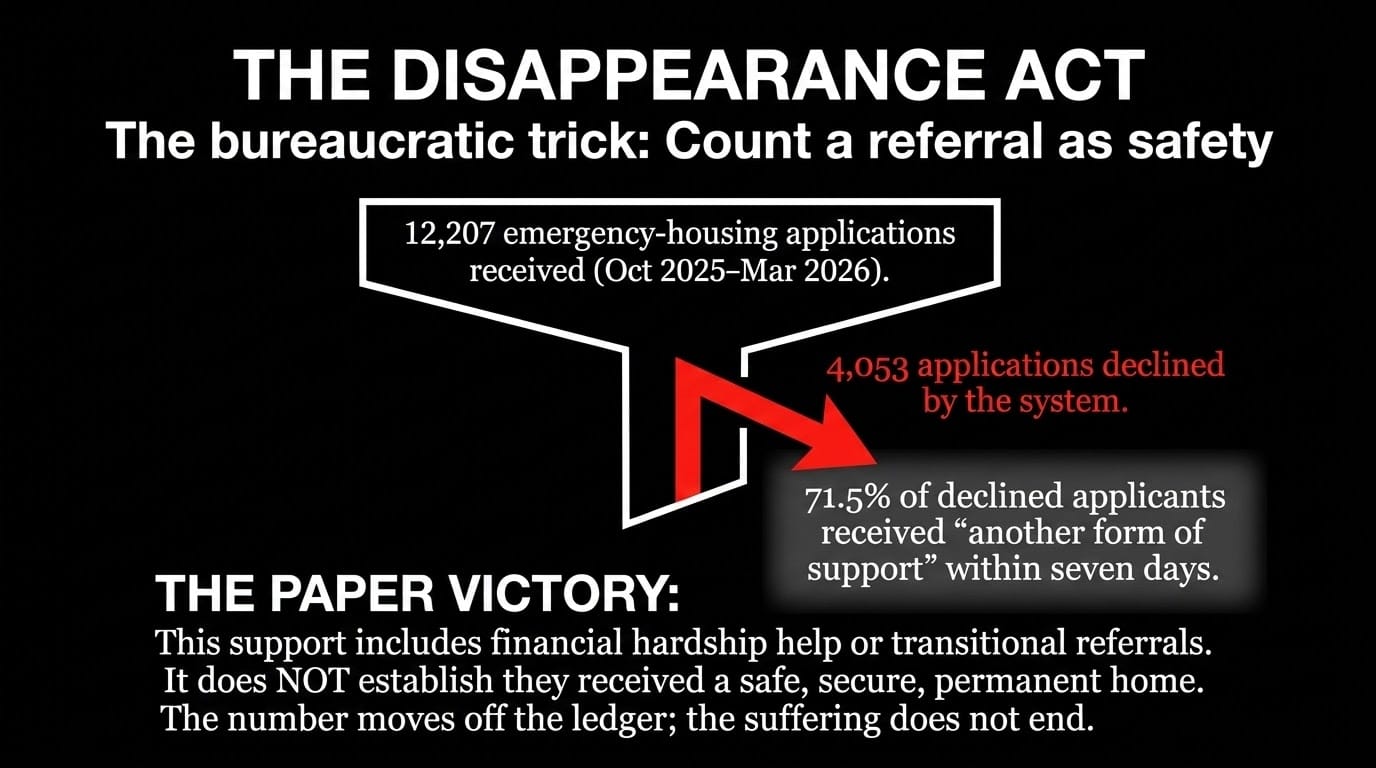
Between 1 October 2025 and 31 March 2026, 12,207 emergency-housing applications were received. Of those, 4,053 were declined—33.2 percent. HUD reports that 71.5 percent of people whose applications were declined received another form of support within seven days. That may include financial assistance, an Accommodation Supplement, a transitional-housing referral, or hardship help.
It does not establish that they received a safe, secure, permanent home. HUD’s emergency-housing data
This is the bureaucratic trick: count a contact as an outcome; count a referral as safety; count a reduced motel figure as a resolved life.
 Ivor Jones The Māori Green Ltn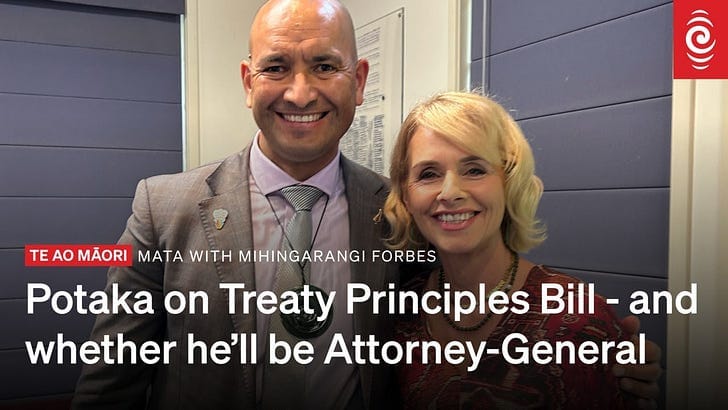
I have previously documented this disappearance act in The Motel Generation and the Man Who Calls It “Success”:
a government can celebrate people leaving an emergency-housing ledger while failing to publicly establish whether they went into stable homes, overcrowded rooms, cars, couches, or rough sleeping. The number may move; the suffering does not necessarily end.
 Ivor Jones The Māori Green Lantern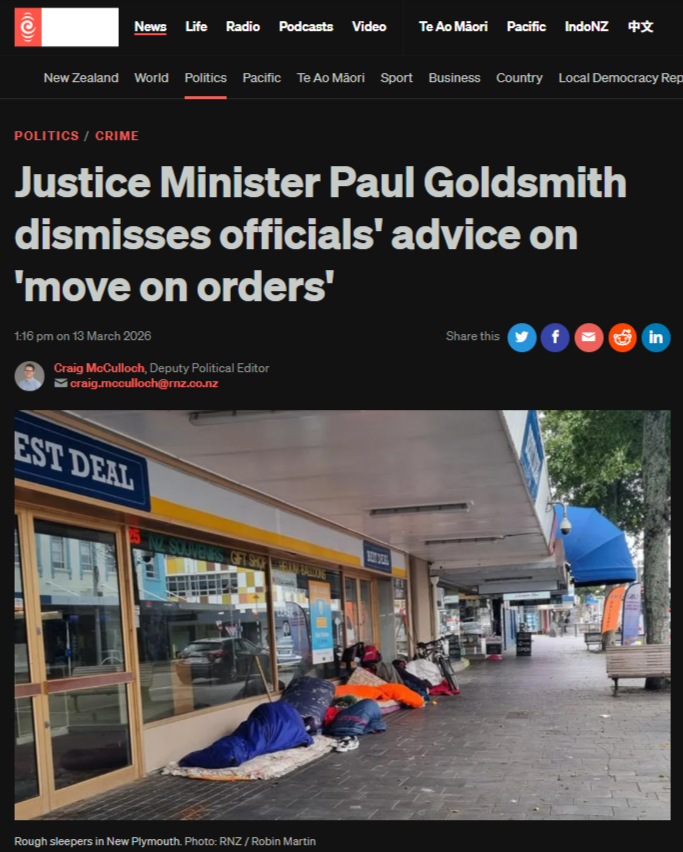
I also traced the next stage of this machinery in Paul Goldsmith Doesn’t Have a Homelessness Policy: He Has an Interior Design Policy:
when public power treats visible poverty as the problem, it reaches for displacement and punishment rather than housing. That is not public safety. It is the politics of making suffering less visible to people who have never had to sleep in it.
 Ivor Jones The Māori Green Lantern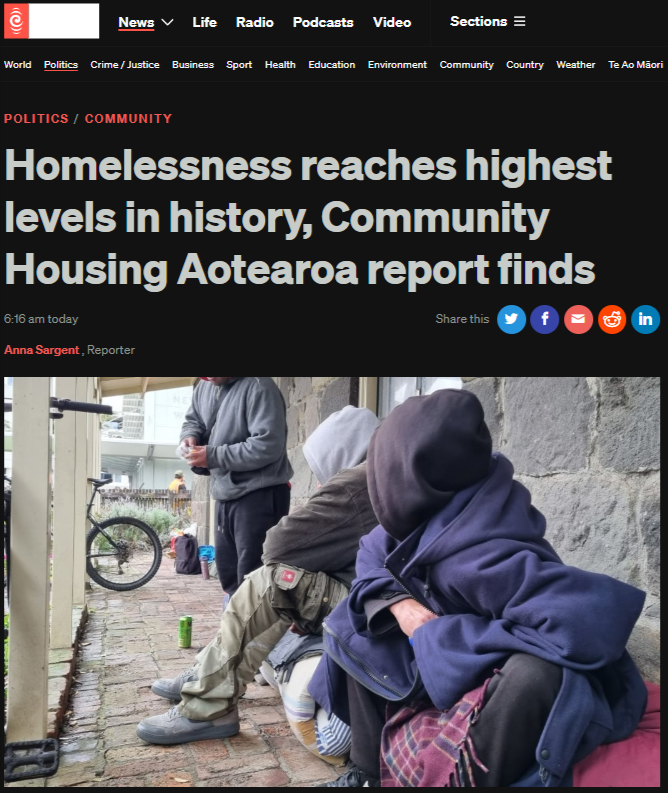
And in The Whare Is on Fire and the Government Is Handing Out Fines, I set out the wider public-interest case:
homelessness is not an individual moral defect. It is the foreseeable result of policy choices about public housing, welfare, public investment, Māori-provider capacity, and whether the state meets its Te Tiriti obligations in practice.
What The Crown Must Do
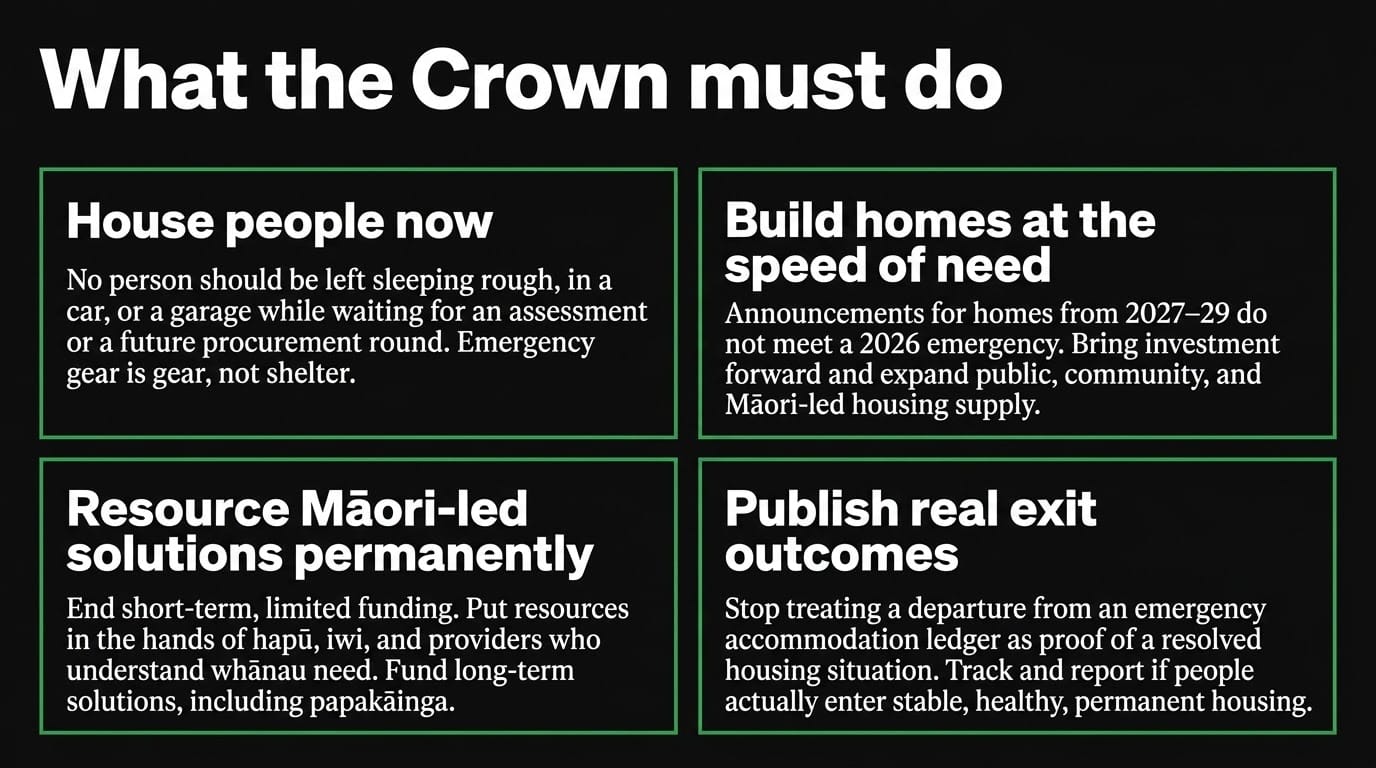
The answer is not a mystery. The evidence is already in the government’s own reports.
- House people now: No person should be left sleeping rough, in a car, garage, or unsafe temporary arrangement while waiting for an assessment, a referral, or a future procurement round. HUD’s definition and immediate-response statement
- Build homes at the speed of need: Announcements for homes from 2027–29 do not meet a 2026 emergency. Bring investment forward and expand public, community, and Māori-led housing supply. HUD’s published timeline
- Resource Māori-led solutions permanently: Te Matapihi identifies both the effectiveness of integrated Māori-led support and the damage created by short-term, limited funding. Fund long-term whānau-centred solutions, including larger whānau homes and papakāinga. HUD’s Māori housing-sector evidence
- Publish real exit outcomes: Stop treating a departure from emergency accommodation as proof of a resolved housing situation. Report whether people enter stable, healthy, permanent housing—and keep reporting until that stability is real.
- End the cruelty of visibility management: A person sleeping rough does not become less homeless because they have been moved out of sight, given a fine, referred elsewhere, or handed a bag.
The Truth Beneath The Plastic

I want to be absolutely clear: the people giving out these shelter bags are not the target of this criticism. They are doing what manaakitanga demands in a cold and cruel moment.
The target is the political architecture that requires their charity in the first place.
The Crown has the data. It knows Māori are overrepresented. It knows people are waiting for Housing First homes. It knows Māori housing providers need long-term investment. It knows whānau in Hastings are sleeping rough and in vehicles. It knows the major new homes it promises are years away.
So do not tell me this government is surprised.
It has made a white-supremacist neoliberal choice: preserve the market discipline, keep the public response rationed, shift emergency care onto charities and communities, then call it responsible government.
A shelter bag keeps a person alive.
A home tells them their life matters.
Kāore e tika kia noho tātou ki te taha o te huarahi, ki roto rānei i te motokā, i a te Kāwanatanga e tatau ana i āna kupu me āna pūtea. It is not right that our people are left by the roadside or in vehicles while the government counts its words and money.
The taiaha is not aimed at the volunteer carrying a bag. It is aimed at the state that made the bag necessary.
Māuri Ora!

Ivor Jones The Māori Green Lantern Fighting Misinformation And Disinformation From The Far Right
Disclaimer: This is evidence-based public-interest commentary. It critiques publicly documented policy settings, funding choices and institutional outcomes. The characterisation of this government as white-supremacist neoliberal is my honestly held opinion, based on the racially unequal housing outcomes and policy settings documented in the sources above. The people distributing emergency shelter bags are not responsible for the structural failure this essay addresses. Factual corrections supported by credible evidence are welcome.