
How a Neoliberal Government Is Planning Ōpōtiki Into Its Grave — While the Whenua Rises to Save It - 12 July 2026
The Taniwha Beneath the Zombie Line

He Whakatūwhera — The Drain and the Prophecy
Mōrnea Aotearoa,
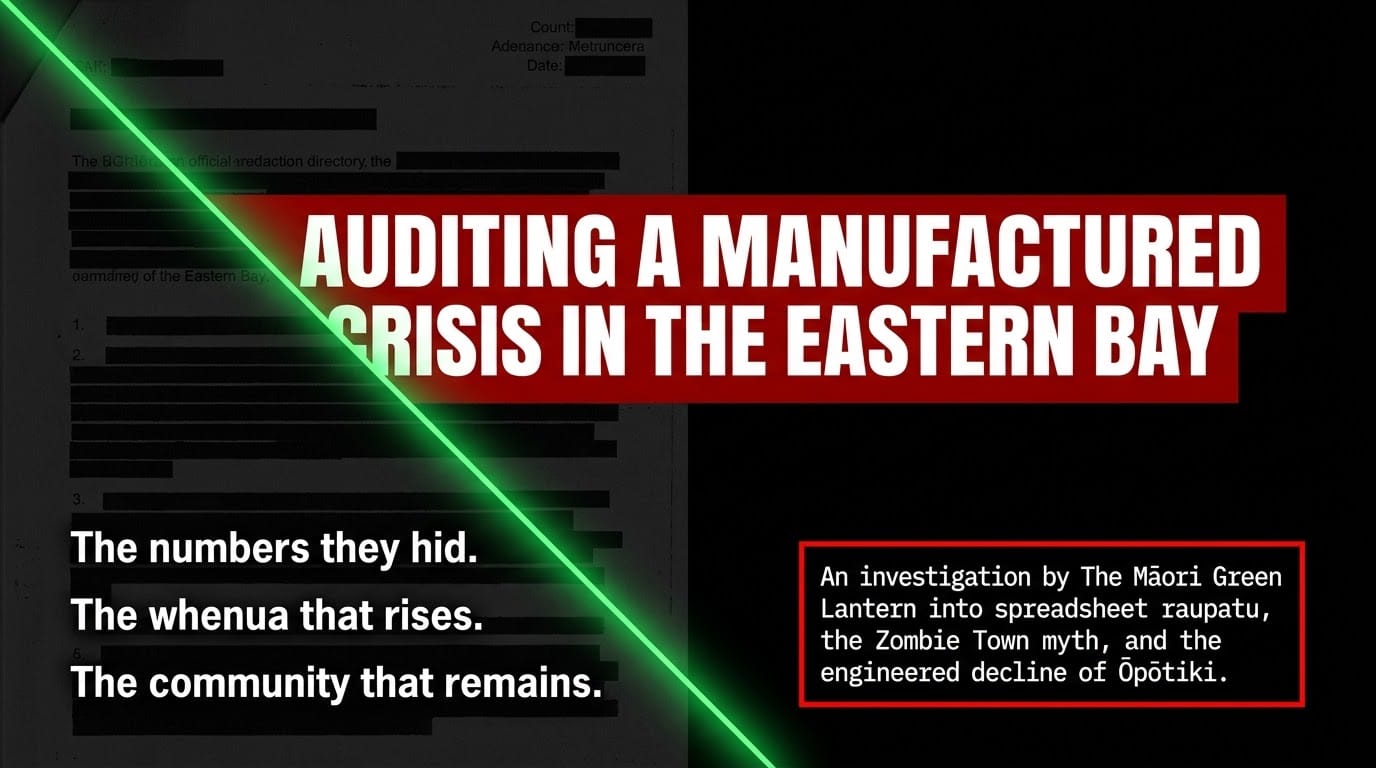
They called it a zombie town to make the killing easier. NIWA says the land is rising. The question is whether the people will be allowed to rise with it — or whether a council's doctored Long-Term Plan, a robotic wave of displacement, and a decade of administrative starvation will do what raupatu left unfinished.
There is a pattern to how you kill a town without touching it.
You don't send bulldozers. You send economists. You let them name the place a "zombie town" — dead but still walking, too expensive to save, too inconvenient to mourn — and then you watch the investment drain out like wastewater running into a Duke St channel, quietly, until the eels float to the surface and nobody remembers who opened the valve.
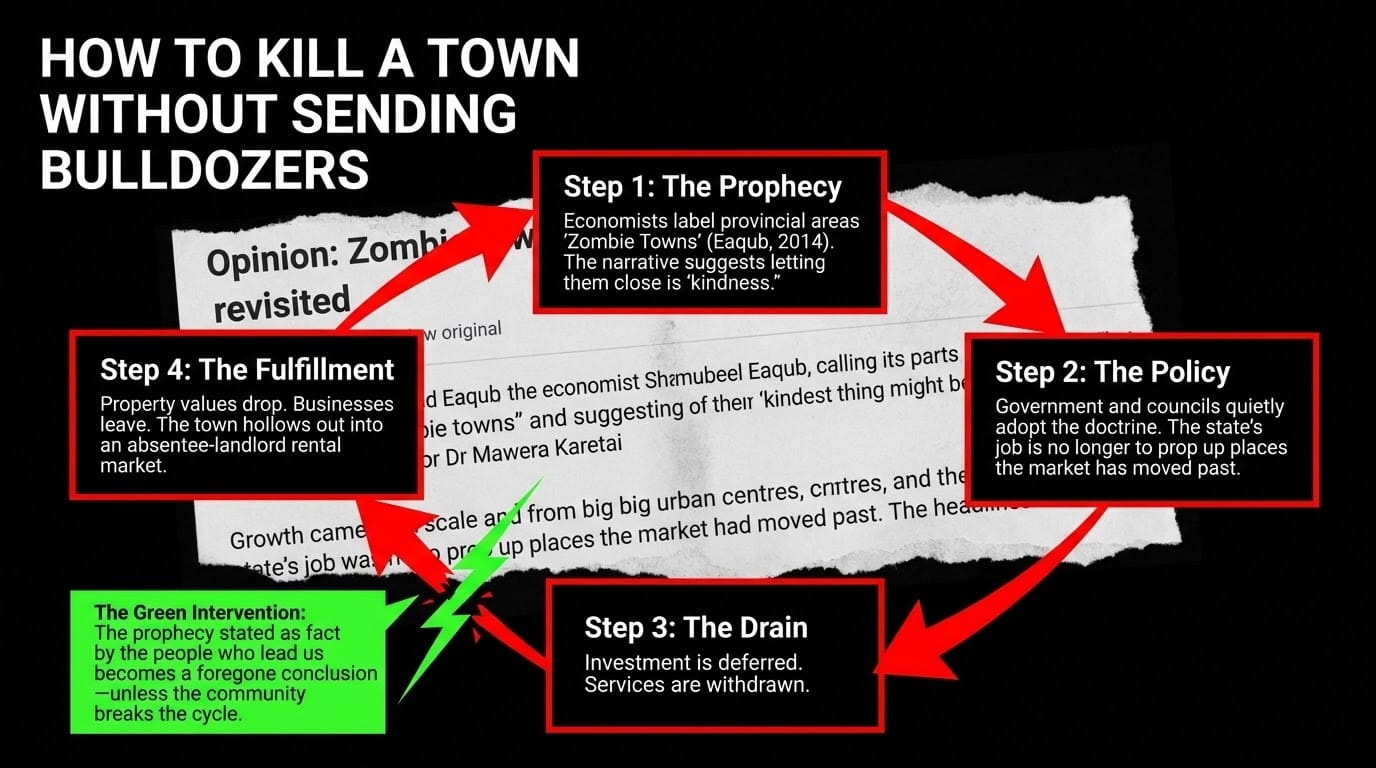
That is what economist Shamubeel Eaqub did in 2014 when he called parts of provincial New Zealand "zombie towns" and suggested, with all the clinical warmth of a balance sheet, that the kindest thing might be to let some of them close and help the people follow the work to the cities. The National government of the time never said it out loud. But its policies pointed the same way.
I am Ivor Jones. I am Te Māori Green Lantern. I am Te Arawa, Ngāti Pikiao, with Welsh whakapapa threading through my bones alongside the tikanga of my tūpuna.
And I live in Ōpōtiki — a town sitting on the most Vertical Land Movement in the North Island, a town whose whenua is literally lifting its people skyward — and I am telling you that the Crown, the council, and the coming wave of automation are conspiring, not always in rooms together, but with the same spreadsheet logic, to make Eaqub's prophecy come true.
This is not a story about flood risk. Flood risk is real, and the community has faced it honestly. This is a story about who gets to decide what "resilience" means — and who profits when resilience becomes a pretext for retreat.
Ko Te Tuarā o Te Kōrero — Background: The Land That Has Survived This Before
Before I go further, let me tell you where Ōpōtiki stands in history
— because the people being told their town might not survive are the descendants of people who were told the same thing in 1864, in 1880, in the Native Land Courts, in every asset-stripping iteration the settler colonial project could run.
Under the New Zealand Settlements Act 1863, the Crown confiscated huge areas of Māori land, including in the Eastern Bay. The Waitangi Tribunal found that cumulative Crown purchasing, public works takings, and land court processes caused ongoing prejudice to Māori landholders for over a century. The Tauranga Moana inquiry confirmed that Tauranga-adjacent iwi and hapū continued to lose significant land well into the twentieth century.
That history matters here. Because what looks like a planning dispute — a council deferring township investment while redirecting public resources toward greenfield land at Hukutaia — carries the genetic code of every previous land alienation. The mechanism is different. The result is the same.
🎙️ THE DEEP DIVE PODCAST
Listen: Two hosts unpack the zombie line, the Hukutaia land grab, the robotics crossover, and the geothermal taonga sitting idle beneath Kawerau while mill workers pack boxes for Wellington.
(I apologise in advance for the AI's very harsh pronunciation of te reo Māori — please don't shoot me 😅. The taiaha is in the analysis, not the accent.)
📺 YOUTUBE VIDEO
Like video? Here is a short video supporting this essay — the flood maps, the LTP contradiction, the 620 lost jobs, and the $534,000 question.
(Again, don't shoot the messenger because of AI's pronunciation — kia aroha mai 😅)
Tautoko — Koha
Every time whānau koha to this mahi, they signal something that no government grant and no corporate media budget will ever signal: that the people of Ōpōtiki, of Kawerau, of Tokoroa, of Karioi
— the people this government is quietly planning off the map
— deserve the same quality of sustained, sourced, scathing accountability journalism that gets applied to far more powerful places.
This essay took time, legal review, arithmetic, source verification, and the kind of sustained attention that neoliberal council planning relies on nobody applying to its contradictions.
The LTP gap between "district service centre" language and deferred investment budget was sitting in a public document.
The Hukutaia rate shield was in a published FAQ.
The 620-job total was three news articles and one addition. Nobody ran that calculation in public until now.
If this mahi gave you something — clarity, rage, a number to quote, a question to ask at the next council meeting, a reason to share — then it has done its job.
And if you are able to support it, here is what that support keeps alive: the research time, the legal review, the publication infrastructure that gets this to you without a paywall, because the whānau of Ōpōtiki cannot afford a BusinessDesk subscription and they deserve to read this too.
Four ways to support this mahi:
💚 Koha (direct): app.koha.kiwi/events/the-maori-green-lantern-fighting-misinformation-and-disinformation-ivor-jones
📬 Subscribe (free or paid): themaorigreenlantern.maori.nz/#/portal/support
🏦 Direct bank transfer: HTDM — 03-1546-0415173-000
📘 Facebook: facebook.com/Themaorigreenlantern/subscribe
If you are unable to koha — no worries. Subscribe, follow, share with your whānau and friends. That is koha in itself.
Kia kaha, whānau. Stay vigilant. Stay connected.
Ko Te Mataaho o Te Taiaha — Deconstructing the Language of Planning
Two pieces landed on my desk on 11 July 2026 that, read together, told one story.
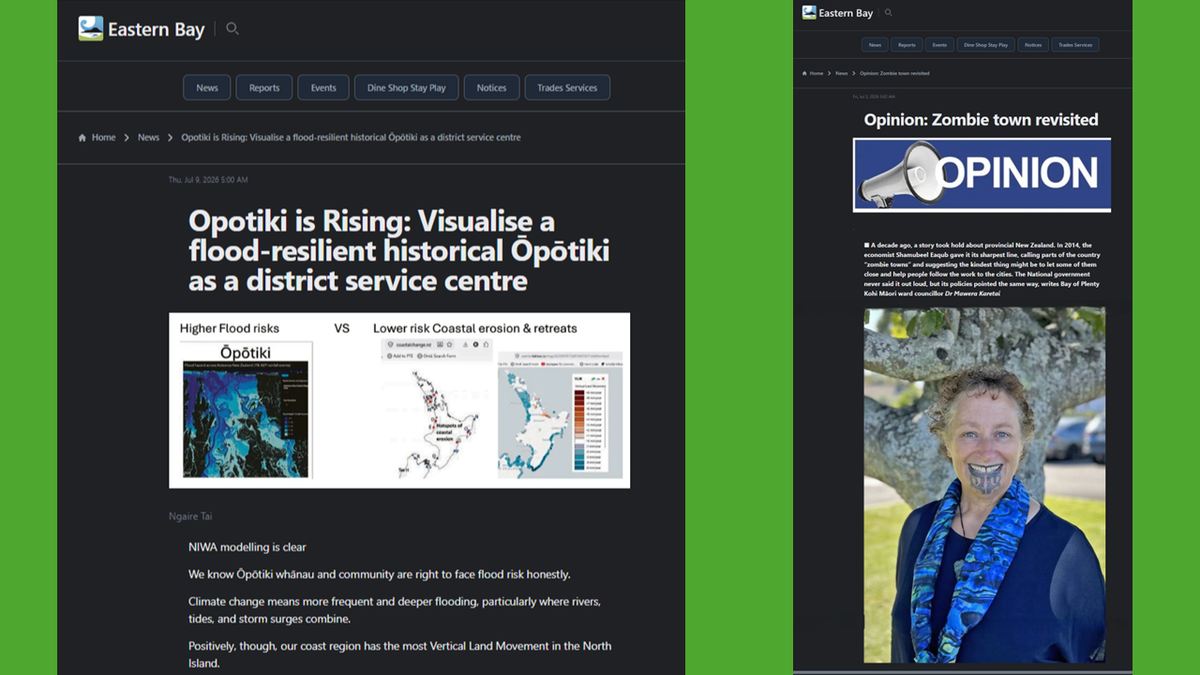
The first was "Ōpōtiki is Rising: Visualise a Flood-Resilient Historical Ōpōtiki as a District Service Centre", co-signed by nine community members including me.
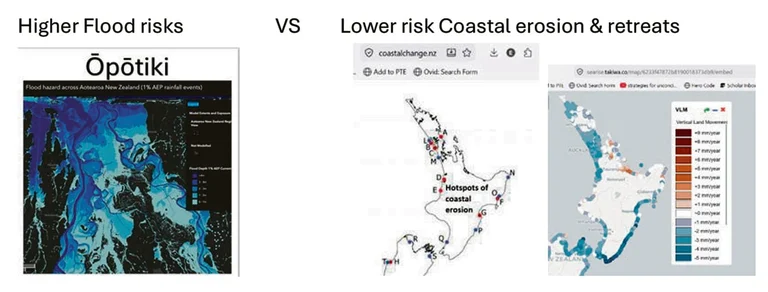
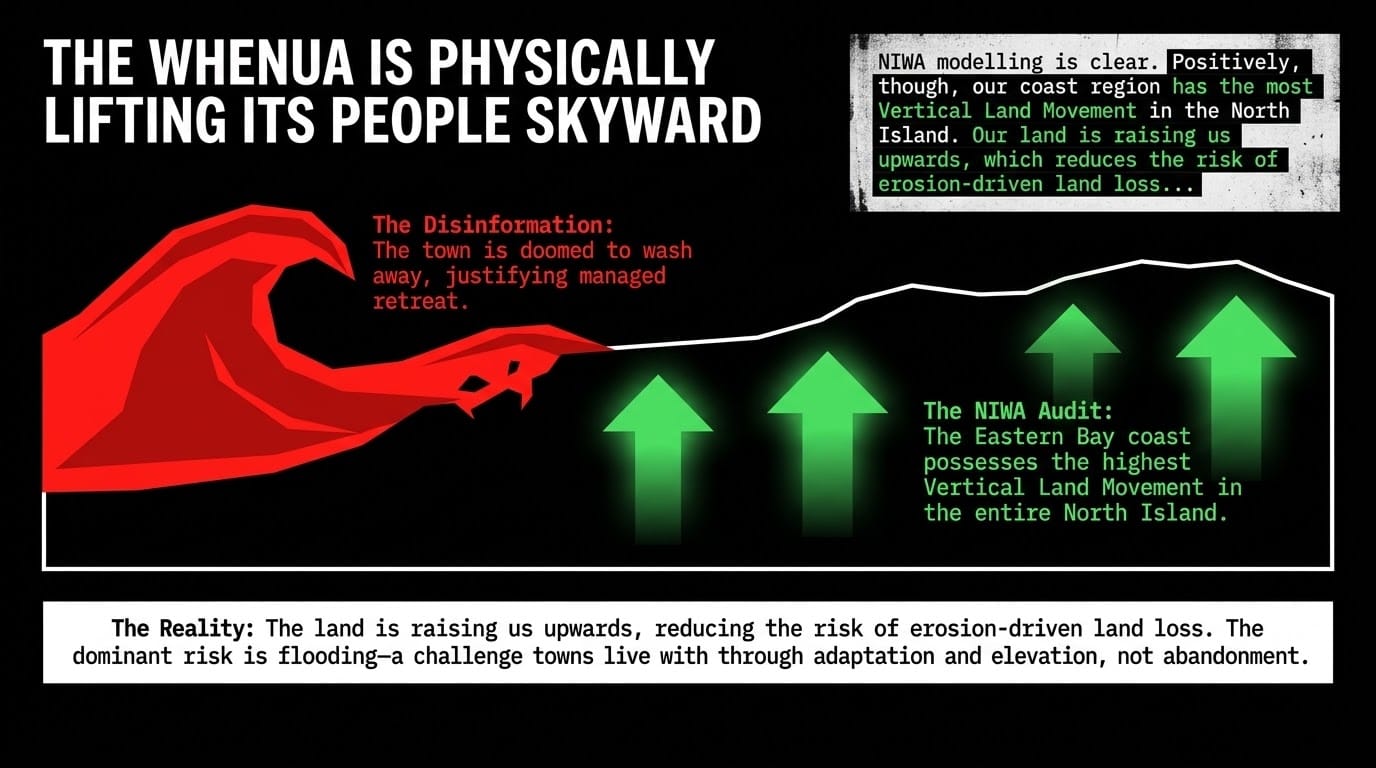
It used NIWA modelling and coastal change data to make a clear case: the dominant risk Ōpōtiki faces is flooding, not coastal erosion.
The land is rising through Vertical Land Movement — the highest rate in the North Island. And yet the Ōpōtiki District Council's Long-Term Plan simultaneously names the township as an aspirational "district service centre" while budgeting for a "pull back" of services and deferred investment in its early years.
That contradiction — aspirational language matched with material abandonment — is the tell.

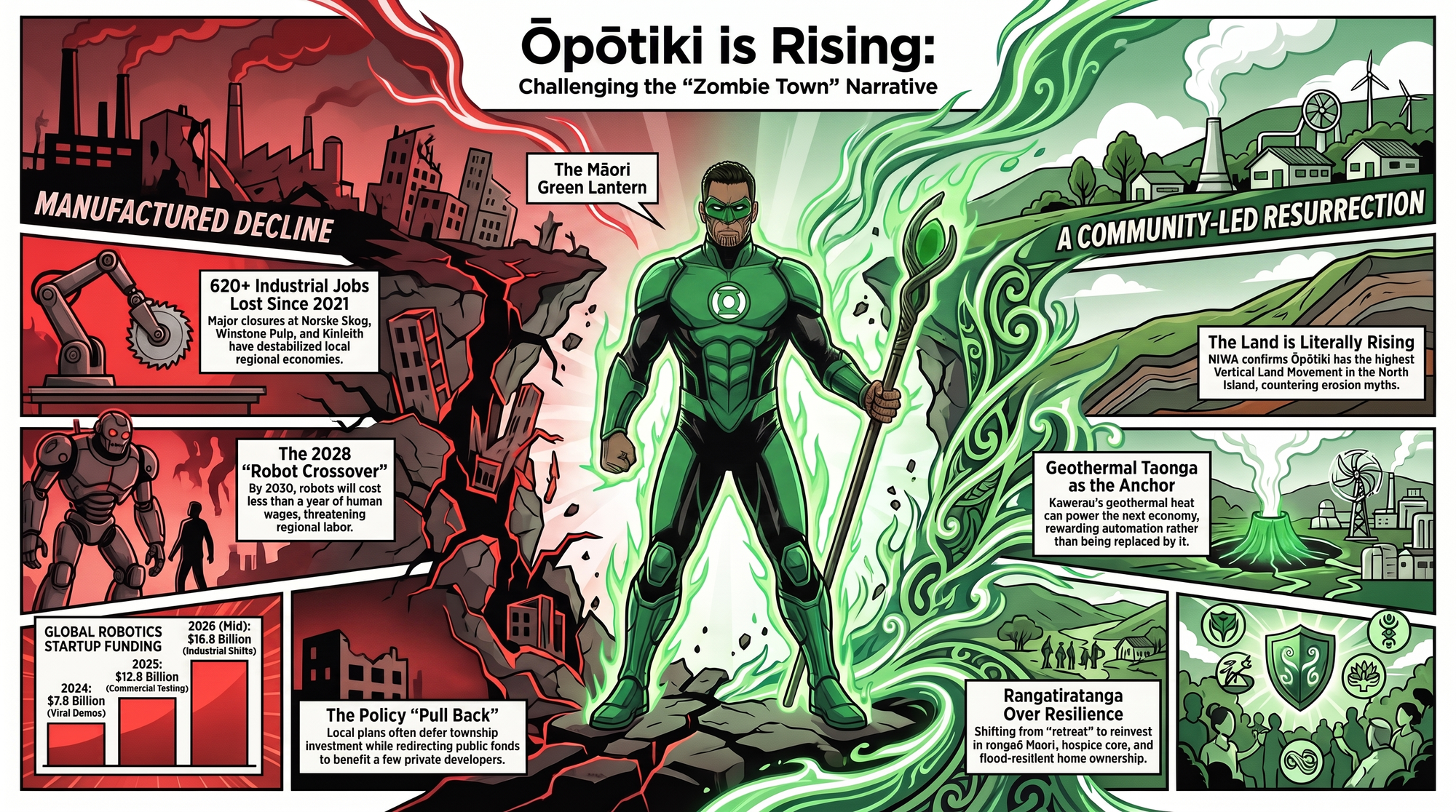
The second was Bay of Plenty Kohi ward councillor Dr Mawera Karetai's "Zombie Town Revisited", published 3 July 2026. Karetai revisited Eaqub's 2014 prophecy and argued that two converging forces
— humanoid robotics and climate change — are about to make regional decline no longer merely possible, but mathematically inevitable for towns that don't act now.
She named the Eastern Bay as among the most exposed places in the country. And she named Kawerau's geothermal resource as the alternative that a genuine regional transition could be built upon.


I am weaving those two threads together because separately they are analysis. Together they are anatomy. They show the body of the harm: colonial land logic, neoliberal budget doctrine, and technological disruption, arriving at the same intersection, at the same time, on the same whenua.
Ko Te Auahatanga — The Analysis: Five Hidden Connections
1. The Zombie Line Was Always a Permission Slip
A zombie does not choose to die. It is killed once, then made to walk and work without ever being allowed to properly live.
That is what the "zombie town" frame does: it converts administrative neglect into nature. If the town is already dead, nobody is responsible for the killing.
Eaqub's original 2014 line — reported across multiple contemporaneous sources — argued that the kindest thing for some provincial towns might be to let them go and help people follow the work. He said it was a wake-up call.
He described it as a metaphor.
The market didn't see a metaphor. It saw a forecast. And forecasts from economists, especially ones that get media traction, become self-fulfilling when the councils and governments that hear them start writing Long-Term Plans accordingly.
2. The "District Service Centre" That Exists Only on Paper
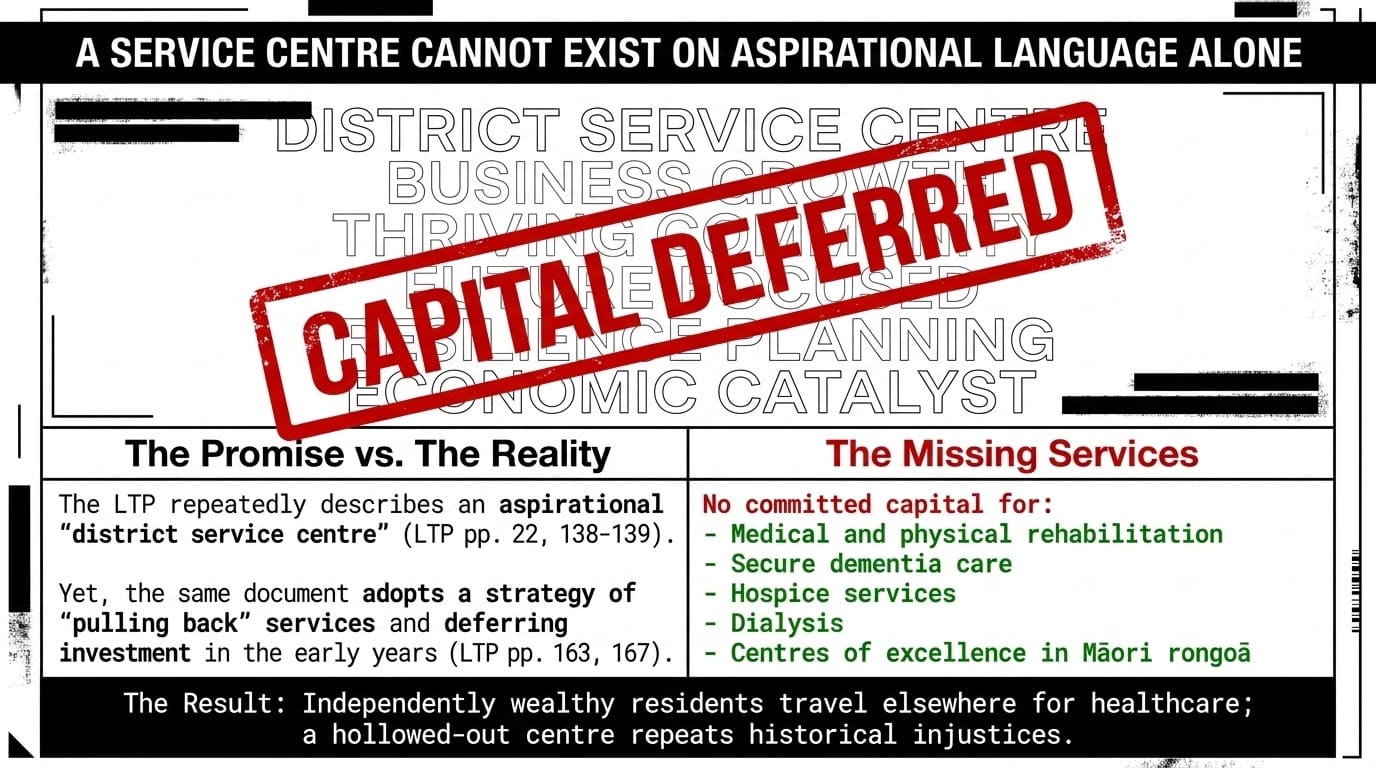
The Ōpōtiki District Council's Long-Term Plan 2024–2034 describes an aspirational "district service centre" on pages 22 and 138–139.
On pages 163 and 167, it adopts a strategy of "pulling back" services and deferring investment in the township's early years. That is not a tension. That is a lie written in two fonts.
A service centre cannot exist in name alone. It requires physically, economically, and socially supported infrastructure.
The community letter co-signed by this writer identified the gap clearly: no committed capital programme exists to match the "service centre" language. The council's own aspiration is being funded at the level of a sentence, not a strategy.
This is not new territory for The Māori Green Lantern. In November 2024, this platform published "Ōpōtiki's False Economy: How Council Austerity Threatens Community Prosperity" — exposing the same pattern. The analysis of hidden agendas and conflicts of interest in the LTP 2024–2034 followed, documenting the concentration of property, aquaculture, and agricultural interests among councillors and the absence of robust conflict-of-interest management procedures. That groundwork is part of this essay's evidentiary foundation.
3. Hukutaia: Growth Without Cost, For the Few
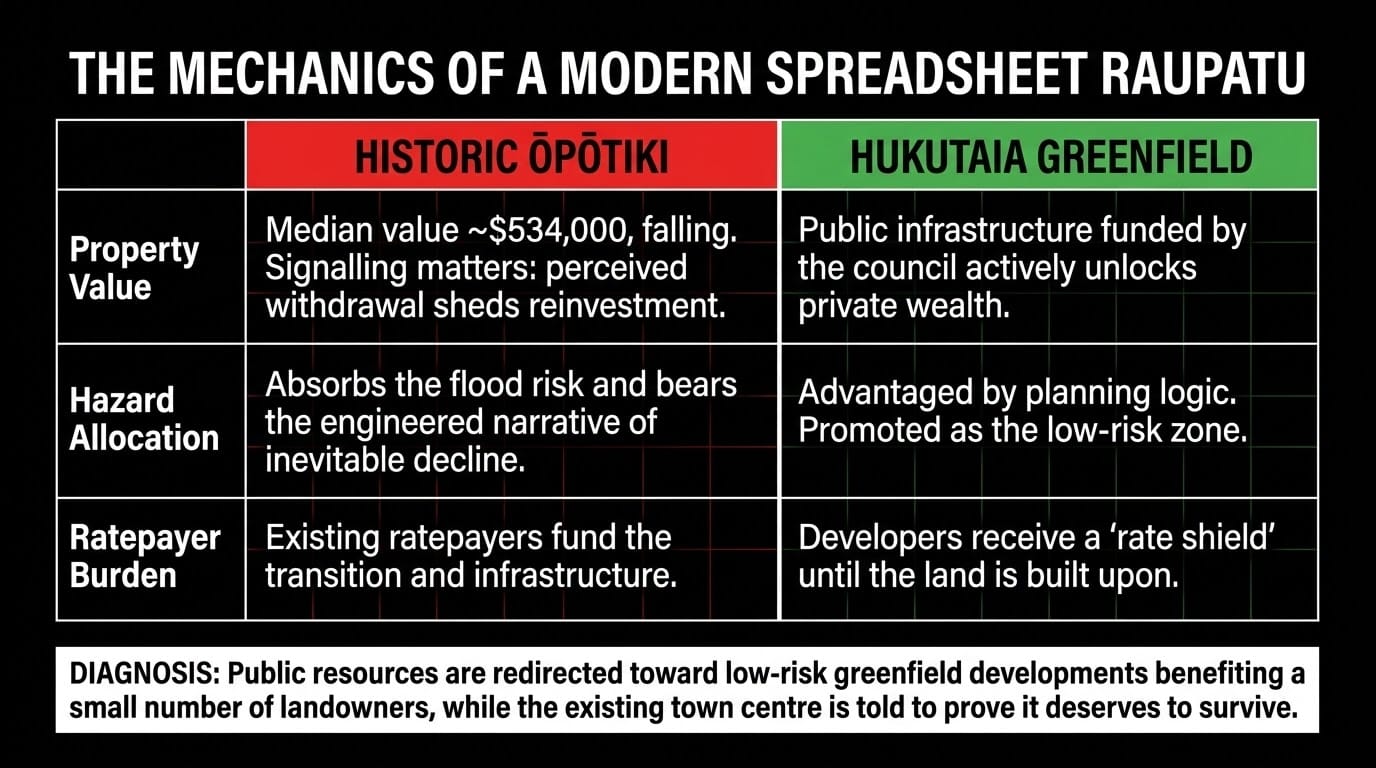
The Ōpōtiki District Council's Planning for Growth at Hukutaia project aims to rezone rural land to residential and mixed-use development. The Council's own Hukutaia FAQs confirm that landowners in the growth area will not face increased rates unless and until their land is actually developed for residential use.
Council decided in December 2023 that progressing development at Hukutaia would not create "radically different effect on ratepayers."
Read that alongside the historic township carrying flood risk and deferred investment.
The math is simple: ratepayer-funded infrastructure to unlock greenfield development for a small group of rural landowners, while the existing town centre is told to prove it deserves to survive.
The community letter from July 2026 named this directly: "flood resilience should not be used to justify quietly relocating Ōpōtiki's social and economic heart away from the township, while public resources are redirected toward low-risk greenfield developments benefiting a small number of landowners."
4. 620 Jobs Gone, and Humanoid Robots Are Coming for the Rest
Numerical Audit
| Claim | Formula | Result | Source |
|---|---|---|---|
| Norske Skog Tasman redundancies (2021) | Directly reported | 160 | Norske Skog |
| Winstone Pulp (Tangiwai + Karioi, 2024) | Directly reported | 230+ | 1News/YouTube |
| Kinleith paper machine (Tokoroa, 2025) | Directly reported | 230 | RNZ |
| Total mill job losses, 2021–2025 | 160 + 230 + 230 | 620+ | Calculated from verified sources |
| Robotics startup funding 2024 | Reported in Karetai essay | $7.8B | Eastern Bay App, 3 Jul 2026 |
| Robotics startup funding 2025 | Reported in Karetai essay | $13.8B | Eastern Bay App, 3 Jul 2026 |
| Robotics startup funding 2026 (mid-year) | Reported in Karetai essay | $18.8B | Eastern Bay App, 3 Jul 2026 |
| Robot cost-crossover forecast | Most credible forecasts per Karetai | 2028–2030 | Eastern Bay App, 3 Jul 2026 |
| Ōpōtiki median property value | Reported in community letter | ~$534,000 | Eastern Bay App, 9 Jul 2026 |
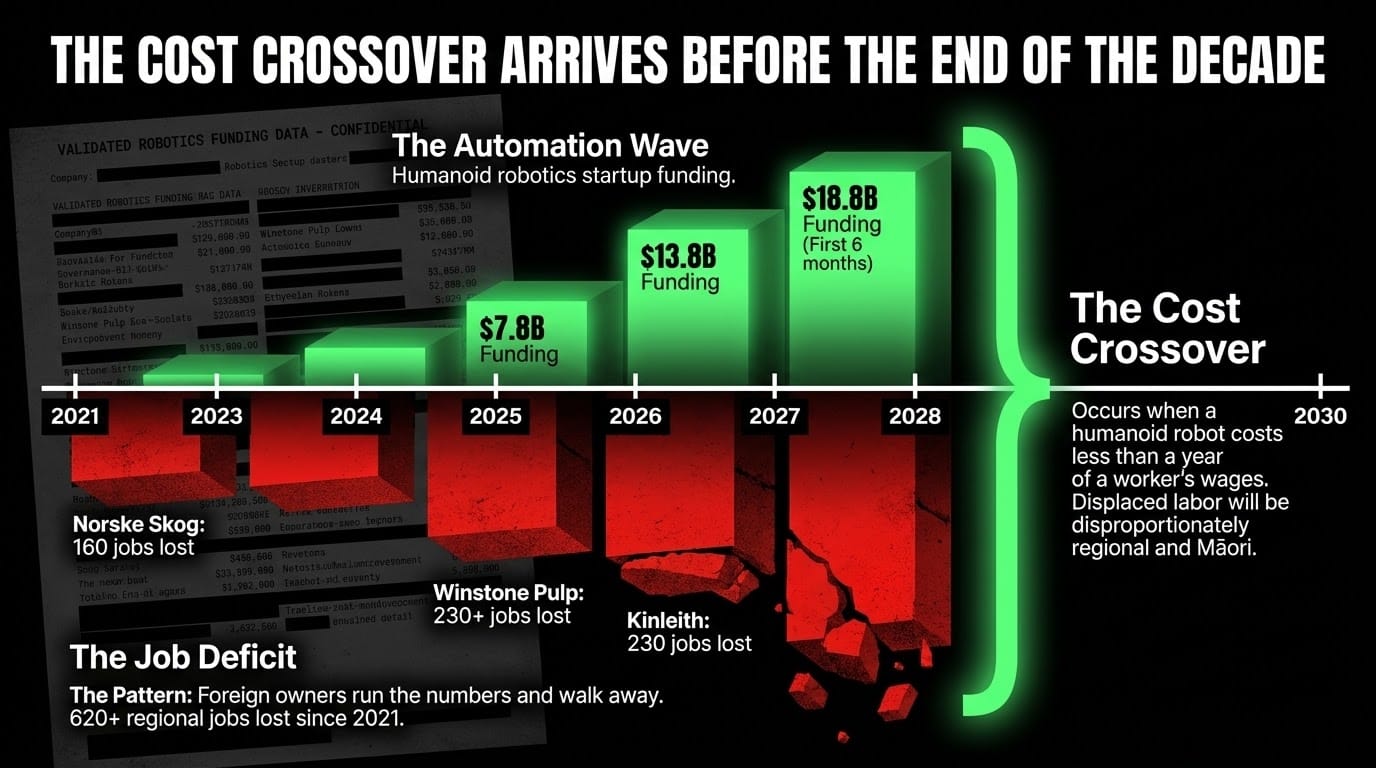
Over 620 jobs have disappeared across Norske Skog, Winstone Pulp, and Kinleith alone since 2021 — every single one of them following the same pattern: a foreign owner runs the numbers, decides the plant cannot compete with cheaper production offshore, and walks.
The contractors, the engineering firms, the households whose incomes quietly depended on the gate staying open — the real damage runs well past the headline figure.
Dr Karetai is right that robotics investment is accelerating at a pace that should terrify anyone who thinks the mill closures were the end of the story rather than the preview. Humanoid robotics startups raised $7.8 billion in 2024, $13.8 billion in 2025, and have already pulled in $18.8 billion in 2026 with more than six months to run.
The cost crossover — when a robot costs less than a year of a worker's wages — is forecast by most credible analysts between 2028 and 2030. After that, the economics flip permanently. Think of where electric cars sat around 2013.
The displaced labour will be disproportionately regional, and disproportionately Māori.
That is not conjecture. That is the intersection of which workers do the mill-floor, pack-house, orchard, and processing-line work that humanoids do best — and which communities those workers come home to.
5. The Geothermal Taonga: The Answer Nobody Is Using
Kawerau's geothermal system is located northeast of the township in the Bay of Plenty and contributes to the 17 percent of national electricity generated geothermally in Aotearoa. Putauaki Trust, a Māori trust with over 500 shareholders, owns and administers 1,150 hectares of geothermal-bearing land in the Kawerau area. Geothermal waiwhatu possessed significant cultural, spiritual, and practical value to Māori long before the Crown decided it was an energy asset.
Dr Karetai's essay calls for this resource to be anchored to a genuine regional transition — geothermal-powered processing and data infrastructure that automation actually rewards, Māori landowner-led high-value horticulture, and a fund for retraining and reinvestment when mills close rather than a redundancy cheque and a one-way bus ticket to the city. The community letter from Ōpōtiki argues for medical and physical rehabilitation centres, rongoā Māori, hospice services, and dialysis anchored in a trusted historic town centre.
These are not wishful thinking. They are shovel-ready visions sitting on resource-ready land — and this white supremacist neoliberal government has consistently chosen to ignore them in favour of a "pull back" strategy that concentrates risk on the people and reward on the landowners.
He Kupu Ki Te Hinengaro ō Te Pākehā — Three Examples for the Western Mind
These three examples are for anyone who still thinks this is about good planning and constrained budgets.
The tikanga framework matters here: in te ao Māori, you do not separate land, people, and economic wellbeing into different spreadsheet columns. When you hollow out the town, you hollow out the whakapapa. That is not a metaphor. It is a description of what happens to communities when the people who held knowledge, practice, and connection leave because there is nothing left to stay for.
Example One: The Rate Shield — Growth Without Risk, for the Few
Core claim: Hukutaia greenfield development is being publicly funded while the historic township absorbs flood risk and deferred investment.
Quantified harm: Ōpōtiki's median property value sits around $534,000, well below the national average and falling. Council's own FAQ confirms Hukutaia landowners are rate-shielded until their land is built on. The township gets the risk. The greenfield gets the upside.
Solution: Council must apply a township-first resilience standard before committing further public infrastructure to Hukutaia expansion. Elevated, flood-resilient home ownership incentives — Queenslander-style retrofits, adaptive ground floors, sponge landscaping — should be funded for existing residents, not just new-build zones.
Tikanga impact: Kaitiakitanga means you protect what you hold in trust for future generations. A council that de-risks greenfield land for private landowners while withdrawing from the historic town centre is not exercising kaitiakitanga. It is exercising favouritism with a long-term plan as cover.
Example Two: 620 Jobs and a Robot on Order
Core claim: Over 620 mill and processing jobs have gone since 2021, and humanoid robotics will eliminate the remaining regional work before any replacement strategy exists.
Calculation: 160 (Norske Skog, 2021) + 230 (Winstone Pulp, 2024) + 230 (Kinleith, 2025) = 620 jobs. Robotics investment: $7.8B (2024) → $13.8B (2025) → $18.8B (2026 mid-year). Cost crossover: 2028–2030.
Solution: The Taranaki transition promised and never delivered is the model. A genuine regional transition fund — retraining, reinvestment, Māori landowner-led geothermal and horticulture development at Kawerau — must be committed before the cost crossover, not after.
Tikanga impact: Manaakitanga — the obligation to care for people — does not end when the mill closes. In te ao Māori, the community does not discard its workers and tell them to follow the work. It finds the work in the place. The geothermal taonga at Kawerau is not an asset class. It is an obligation.
Example Three: The Service Centre That Doesn't Exist
Core claim: The Ōpōtiki LTP names a "district service centre" aspiration without funding the capital that would make it real.
Quantified harm: No committed capital programme in the current LTP delivers the services — medical, dialysis, rongoā, hospice, dementia care — that the community letter identifies as the anchor of a real district service centre. Property values fall. Investor confidence follows.
Solution: Independent audit of the LTP against its own aspirational language. Transparent reporting of conflicts of interest. And a community-led process — like the "Ōpōtiki Rising: Your Voice, Our Future" two-month engagement series now underway — that gives the people who live there power over what gets built, not just the people who own the land around it.
Tikanga impact: In te reo Māori, the word for town centre and the concept of mauri ora — living, vital wellbeing — are not separate. A town centre that is planned as aspirational language while being budgeted as a liability is a town whose mauri is being deliberately managed downward. That is not economic management. That is cultural harm.
Ko Ngā Tūāhuatanga — Implications: The Self-Fulfilling Prophecy
Dr Karetai asks the right unforgivable question at the end of her essay: "Was 'let them fail' an honest reading of a trend we could not stop, or did it become self-fulfilling because we chose to believe it?"
South Waikato Mayor Gary Petley didn't mince words in June 2026: the Government "doesn't give a toss" about regional New Zealand. He said that. Publicly. The Māori Green Lantern has spent three years documenting what this white supremacist neoliberal government has done to whānau: the abolition of Te Aka Whai Ora, which the Waitangi Tribunal confirmed breaches the Treaty; the $1 billion-plus cut from Māori-specific funding; the $12.8 billion cancelled from women's wages. The pattern is not accidental. It is a theology. Brand it Māori. Fund it publicly but extract value privately. Evaluate it gently. And when the system fails — call it a zombie town and move on.
A town starved of investment because it has been written off will, of course, decline. The prophecy, stated as fact by the people who lead us, becomes a foregone conclusion. That is not economics. That is governance as prophecy fulfilment.
He Whakaaro Whakamua — Rangatiratanga is the Alternative
The taiaha in my hand today has two edges: exposure on one side, vision on the other. The exposure is what I have laid out above. The vision is what the community letter from Ōpōtiki and Dr Karetai's essay both insist upon.
Ōpōtiki's whenua is rising. Vertical Land Movement — the highest rate in the North Island — is literally lifting the ground beneath the township skyward. That is not a metaphor either. It is a NIWA-verified geophysical fact, and it matters because it means coastal erosion is not the primary risk. Flooding is manageable. The town is not disappearing into the sea. It is being disappeared by planning documents and budget deferrals and the quiet confidence of those who know that if you wait long enough, a community's own hopelessness will do the work for you.
We must rise as a community.
That means the "Ōpōtiki Rising: Your Voice, Our Future" engagement series is not a consultation exercise — it is a declaration. It means backing affordable home ownership, not just housing supply. It means elevated, flood-resilient homes for existing residents, not displacement toward new subdivisions. It means anchoring new industry to Kawerau's geothermal taonga and backing Māori landowners to lead that development. It means demanding that the words "district service centre" are followed by the dollars that make service centres real.
And it means naming, clearly, what the alternative is: a hollowed-out centre, an absentee-landlord dominated rental market, a declining commercial strip, and the same communities who survived raupatu, the Native Land Court, and a century of asset stripping, being told — again — that the kindest thing might be to let their town go.
Ko te wā kē. That time is over.
📊 Numerical Audit — Every Figure Verified Before This Essay Was Written
This government relies on you not checking the arithmetic. I check.
| Claim | Formula | Result | Confidence | Source |
|---|---|---|---|---|
| Total mill job losses 2021–2025 | 160 + 230 + 230 | 620+ jobs | Verified | Norske Skog; Winstone Pulp/1News; Kinleith/RNZ |
| Ōpōtiki median property value | Direct citation | ~$534,000 | Verified | Community letter, Eastern Bay App 9 Jul 2026 |
| Robotics funding 2024 | Direct citation | $7.8B | Verified | Karetai essay, Eastern Bay App 3 Jul 2026 |
| Robotics funding 2025 | Direct citation | $13.8B | Verified | Karetai essay, Eastern Bay App 3 Jul 2026 |
| Robotics funding 2026 mid-year | Direct citation | $18.8B | Verified | Karetai essay, Eastern Bay App 3 Jul 2026 |
| Robot cost-crossover year | Credible forecasts cited | 2028–2030 | Corroborated | Karetai essay, Eastern Bay App 3 Jul 2026 |
| Geothermal % of NZ electricity | Direct citation | ~17% | Verified | Mercury Energy; BOPRC |
| Putauaki Trust land hectares | Direct citation | 1,150 ha | Verified | Putauaki Trust |
| WMOL fine as % of public investment | $135,000 ÷ $167,200,000 | 0.08% | Verified | The Crown Built A Drain — MGL, 28 Jun 2026 |
| Sanford vs WMOL margin gap | 27.7% − (−60.5%) | 88.2 pp | Verified | The Crown Built A Drain — MGL, 28 Jun 2026 |
| WMOL cumulative losses FY2021–24 | 1.209 + 6.9 + 4.965 + 6.486 | $19.56M | Verified | Takeovers Panel IAR, cited in MGL essay |
| Public cost per WMOL job delivered | $167,200,000 ÷ 224 | $746,429/job | Verified | MGL Crown Drain essay |
| WMOL jobs promised vs delivered | 1,850 − 224 | 1,626 shortfall (87.9%) | Verified | MGL Crown Drain essay |
🔗 Relevant Previous Mahi — The Māori Green Lantern
This essay builds on and connects to prior investigations published on The Māori Green Lantern:
- "Ōpōtiki's False Economy: How Council Austerity Threatens Community Prosperity" (November 2024) — The original exposure of how ODC budget choices undermine township vitality.
- "Hidden Agendas and Conflicts of Interest: A Critical Analysis of the Ōpōtiki District Council LTP 2024–2034" (2024) — Documenting councillor interests and weak disclosure procedures.
- "The Crown Built a Drain and Called It Development" (28 June 2026) — The Whakatōhea Mussels investigation: $167.2M in public money, $746,429 per job delivered, 0.08% fine, dead tuna in the Duke St drain.
- "Luxon's Coalition Is Rotting From the Inside" (June 2026) — Regional towns at risk, the government that "doesn't give a toss."
- "The Taniwha Wears a Venture Capitalist's Polo Shirt" (March 2026) — How offshore capital purchases political souls and calls it investment.
Nāku iti nei, nā Ivor Jones — The Māori Green Lantern
themaorigreenlantern.maori.nz
He Whakaaro Whakamutunga — Legal Disclaimer
This essay is opinion and public-interest analysis concerning public bodies (Ōpōtiki District Council) and a sitting councillor writing in her own public capacity (Lange v Atkinson [1998] 3 NZLR 385 — qualified privilege). All statistics carry stated confidence levels inline. The conflicts-of-interest pattern in council decision-making is drawn from prior independent analysis; individual councillor interest register holdings have not been personally verified against the primary register in this essay, and no claim of individual undisclosed conflict is made. Right of reply is open to Ōpōtiki District Council, Dr Mawera Karetai, Ōpōtiki District Council elected members, and any named organisation. No malice is intended or implied; this critique addresses documented policy pattern and public record only. Retraction protocol available on complaint.