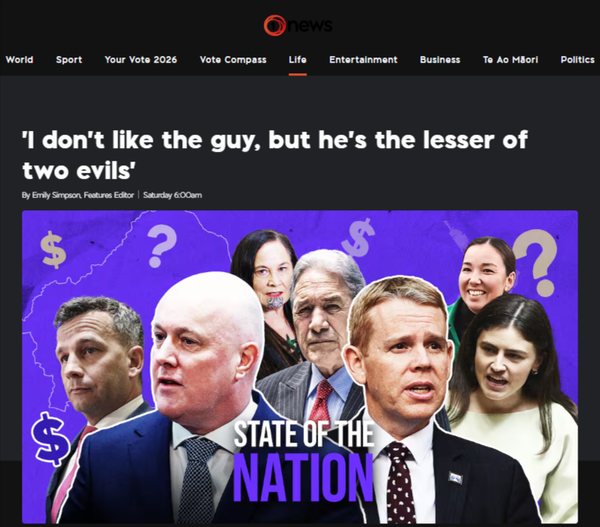
"How National's Compulsory KiwiSaver Is Wage Theft Dressed in a Baby Bonnet" - 22 June 2026
They halved what the Crown put in. Now they're forcing whānau to put in more. Luxon calls it a nest egg. I call it stealing the yolk and selling you back the shell — while 25.1% of tamariki Māori go hungry in the richest election campaign money can buy.

"FEEDING TIME AT THE COLONIAL TROUGH:
He pō uriuri, he pō kerekere — ko te ao mārama ka hāpaitia.
A deep night, a dark night — it is the world of light that is raised up.
The Trough
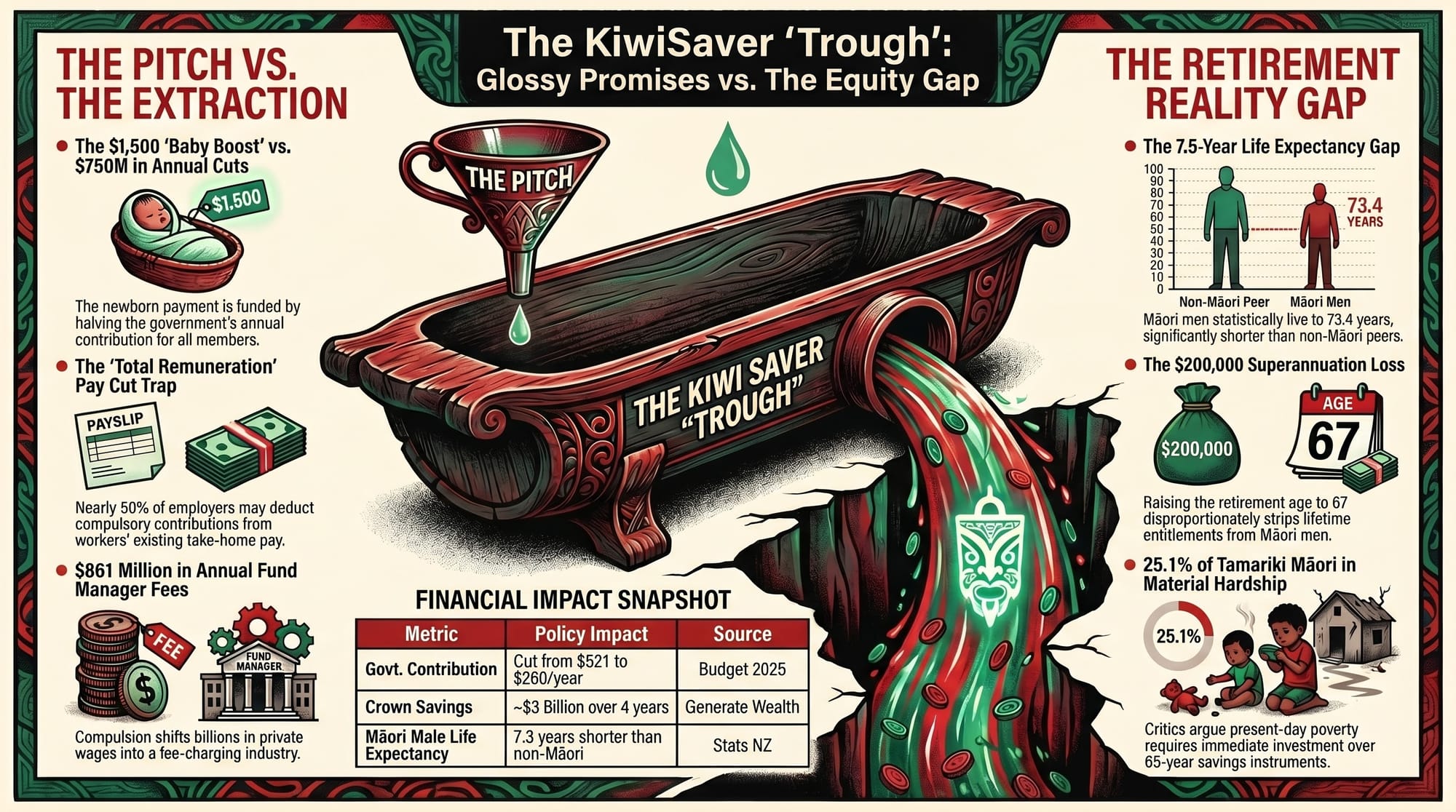
I want you to imagine a trough.
Not a modern stainless-steel hospital trough. I mean an old, weathered, colonial trough — the kind built from the timber of confiscated whenua, hammered together by hands that never paid for the land beneath them.
 RNZ | Te Reo Irirangi o Aotearoa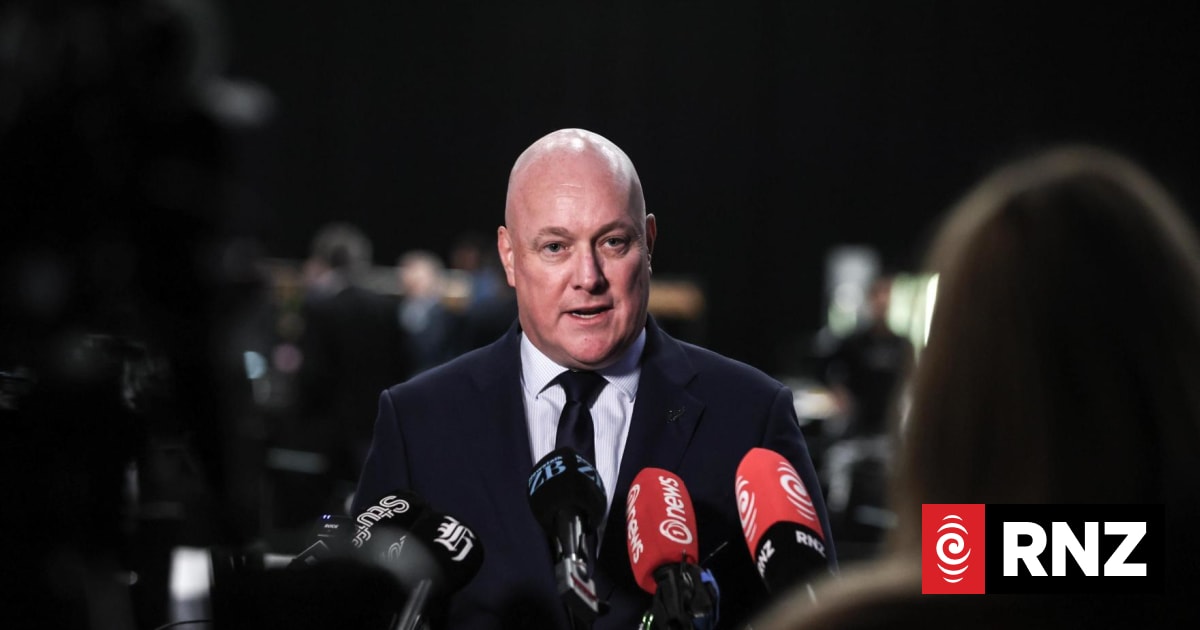
At this trough, a small group of well-dressed people eat constantly. Christopher Luxon, with an estimated net worth in the vicinity of $21–30 million
— a man who made at least $4.34 million in paper gains from property in a single year
— now stands at the head of that trough and tells your whānau the problem is that they are not saving enough.
He has already visited this trough four times to cut your portion:
— In 2011, he and his party halved the member tax credit from $1,042 to $521, taxed employer contributions for the first time, and stripped over $500 million per year from ordinary New Zealanders' KiwiSaver accounts.
— In 2012, they cut minimum contribution rates from 4% to 2% and reduced employer compulsory contributions.
— In 2015, Bill English abolished the $1,000 Kick-Start payment with two hours' notice.
— In 2025, they halved the government contribution again — from $521 to $260, saving the Crown approximately $3 billion over four years.
 RNZ | Te Reo Irirangi o Aotearoa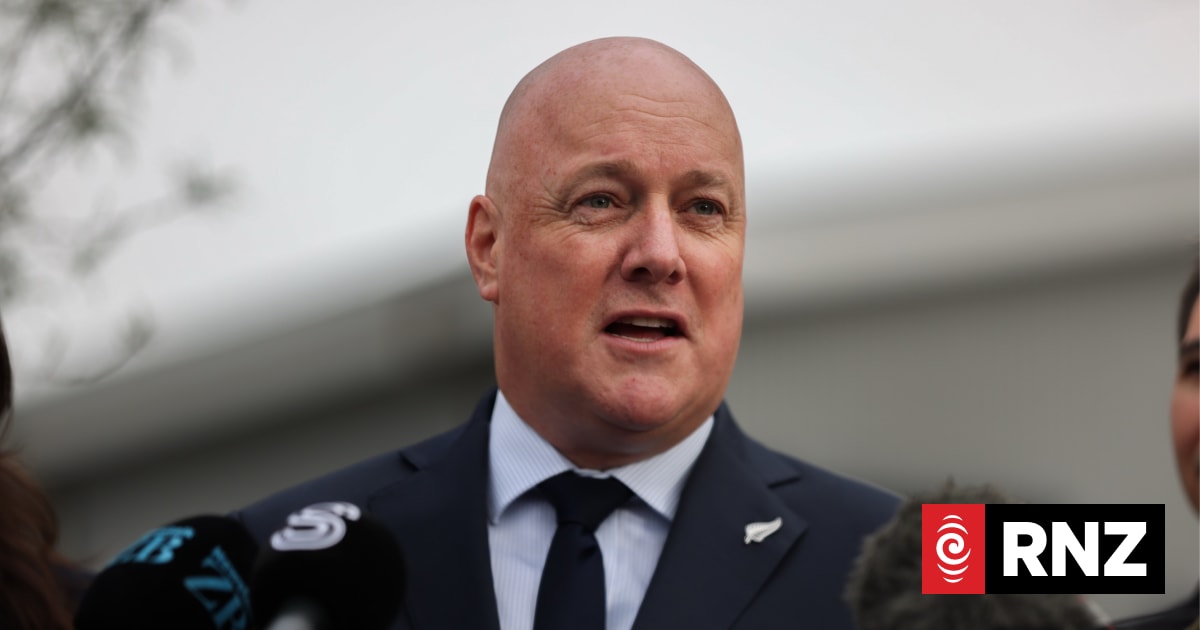
Now — four cuts later, billions stripped, the trough deliberately depleted — Luxon stands before you at National's 90th Annual General Meeting in Lower Hutt and tells you he is making the trough compulsory.
You must now bring more of your own food. He will manage it for you. For a fee.
And if you die before you get to eat — as Māori men, with a life expectancy of 73.4 years, are statistically likely to do well before their fair share
— that is your problem, not his.
That is compulsory KiwiSaver, 2026 edition. Everything else is choreography.
🎙️ The Deep Dive Podcast
Listen to a lively conversation between two hosts, unpacking and connecting every thread of this essay — from the whakapapa of National's KiwiSaver cuts to the salary sacrifice trap to the superannuation time bomb.
The Deep Dive Podcast is embedded on the essay page at www.themaorigreenlantern.maori.nz.
I apologise in advance for the AI's very harsh pronunciation of te reo. Please don't shoot me. 😊
📺 YouTube Video
Like video? Here is a short video supporting this essay — connecting the dots, naming the numbers, showing the whakapapa of this policy.
Subscribe to The Māori Green Lantern on YouTube — short videos, deep dives, and real-time accountability journalism: https://www.youtube.com/channel/UCTheMaoriGreenLantern
Again, please don't shoot the messenger because of AI's pronunciation. 😊
I've Written This Before. They Haven't Listened. So I Will Write It Again.
I need you to understand that this is not the first time I have traced this whakapapa.
In November 2025, I published "The KiwiSaver Illusion: How National's Retirement 'Fix' Abandons Māori, Women, and Low-Income Workers" at The Māori Green Lantern. I showed then — as I show now — that compulsion without equity is not progress. It is extraction with a different label.
In June 2026, just days before this announcement, I published "National's KiwiSaver Con Is Wage Theft With a Glossy Brochure" — naming what was coming and why.
I also published "Nicola's Glass Cannon" — exposing how Nicola Willis handed $2.9 billion to landlords, buried a $5 billion climate bomb, and let 169,300 tamariki reach a 10-year hardship high, then called a press conference asking Labour to explain its spending.
And I published "The Inheritance of Cruelty" — tracing every act of this coalition back to its colonial genealogy: the neoliberal, white supremacist project of stripping every structure that protects the vulnerable, and calling the stripped carcass "fiscal responsibility."
Today's announcement is not a break from that pattern. It is the pattern wearing a new suit for election year.
What Tikanga Tells Us That the Policy Does Not
Before I destroy the three claims National makes in these RNZ articles, let me explain something to the Western mind that the policy designers at National have wilfully refused to understand.
Tikanga Māori is not a cultural add-on to economics. It is an economic system — one built around the circulation of mana, the obligations of kaitiakitanga (guardianship), and the principle that what is taken from the collective must be returned to the collective, with care.
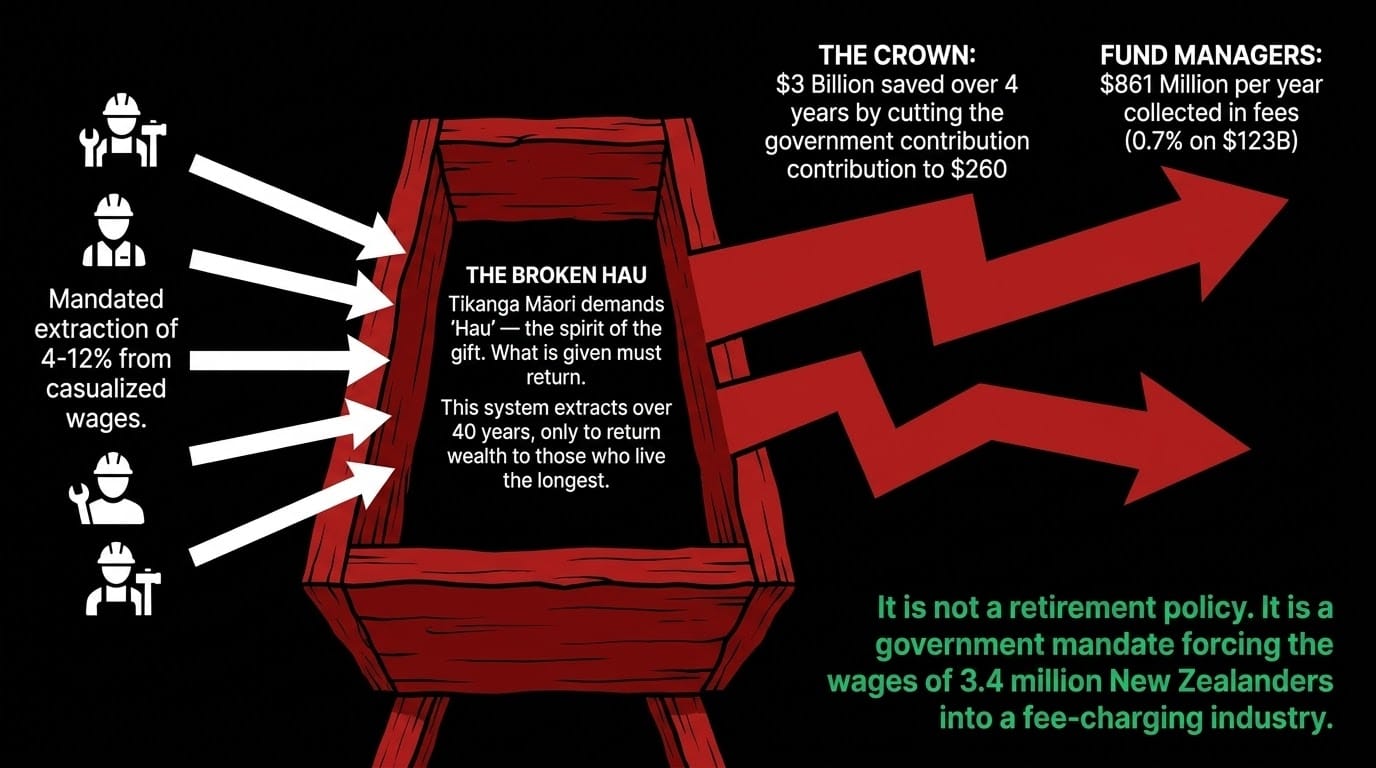
The concept of hau — the spirit of the gift — means that when something is given, it creates an obligation to return. It flows. It breathes.
A system that extracts wealth from Māori workers over forty years and returns it only to those who live longest is not a system built on tikanga.
It is a system built on the inverse of tikanga: take first, account later, never from your own pocket.
Te Ara Ahunga Ora's research on what retirement looks like for Māori found Māori themselves expressing this devastatingly:
"We 'retire' from full time employment to work fulltime for/with our whānau, hapū, iwi." And: "That we don't die before we receive our KiwiSaver that we saved up for."
That is not a complaint. That is Māori people praying against a system designed to kill them before it pays them.
A system built on tikanga would honour the hau.
It would say: you contributed, therefore you receive.
Not: you must live to 67, navigate the bureaucratic machinery, and hope the fund manager did not charge 0.7% for forty years before delivering you a diminished return.
Compulsory KiwiSaver — without equity adjustments for life expectancy, without living wage foundations, without salary sacrifice prohibitions, without a restored government contribution — does not honour the hau.
It breaks it. Deliberately. Repeatedly. With a press release attached.
Three Examples for the Western Mind
Example One — Sarah, Kaiāwhina, Flaxmere: The Hidden Wage Cut No One Announced
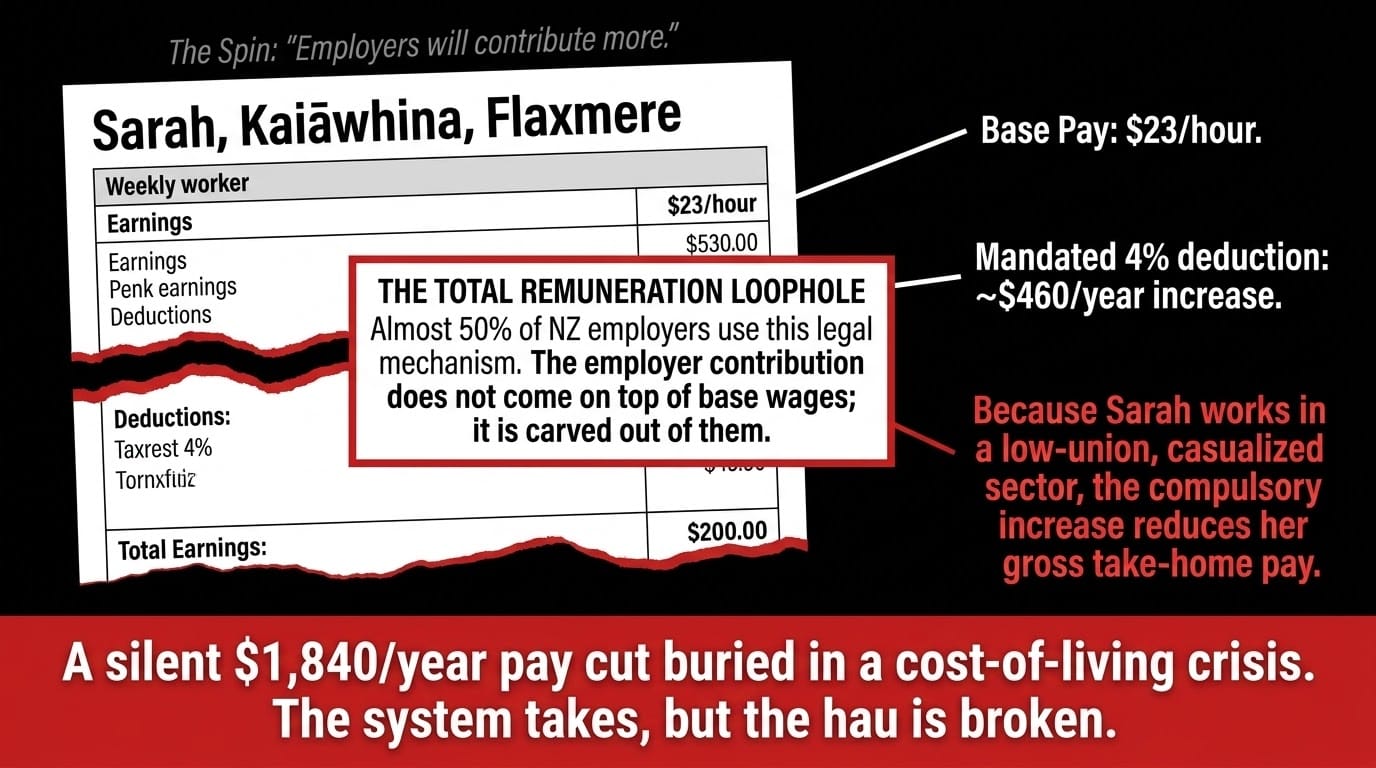
"Kaiāwhina" means community support worker — in this case, someone who sits with kaumātua in their homes, who ensures the tūpuna does not fall, does not go hungry, does not die alone. It is among the most important work in Aotearoa. It is also among the most underpaid.
Sarah earns $23 per hour. Under compulsory KiwiSaver from July 2028 at 4%, her contribution rises by approximately $460 per year. Her employer uses a total remuneration arrangement — a legal mechanism confirmed by the Retirement Commission's own policy brief to be used by almost half of New Zealand employers
— meaning the employer's contribution does not come on top of Sarah's wages. It comes out of them.
Smiths Financial confirmed in March 2026 that from April 2026, with rates rising from 3% to 3.5%, total remuneration arrangements mean
"a bigger slice carved from your own pay."
People In Mind confirmed in February 2026 that employers must consult workers — but in Sarah's low-union, casualised sector, many won't. Many workers won't know their rights. The pay cut will be silent, buried in a payslip line most workers never read.
The impact on tikanga: In te ao Māori, every contribution you make to the collective has a return obligation — hau. Sarah contributes mana, labour, and now a rising proportion of her wages to a system. But when that system takes from her wages via total remuneration, and when the fund manager takes 0.7% annually, and when the government contribution has been cut from $521 to $260 — the hau is broken. The system takes and does not return in kind.
The solution: Prohibit total remuneration arrangements for compulsory KiwiSaver components by law. Mandate employer contributions as genuinely additional to base wages. Enforce the Living Wage as the floor on which contributions are calculated.
Quantified harm: Up to $1,840 per year extracted from Sarah's take-home pay in a cost-of-living environment where household living costs rose 2.2% to December 2025, and where the NZCTU confirmed inflation hit working-class households hardest.
Confidence level: Verified. IRD, Retirement Commission, Smiths Financial, People In Mind, NZCTU, Stats NZ.
Example Two — Te Koha, Construction Worker, Rotorua: The Man Who Will Not Live Long Enough to Collect
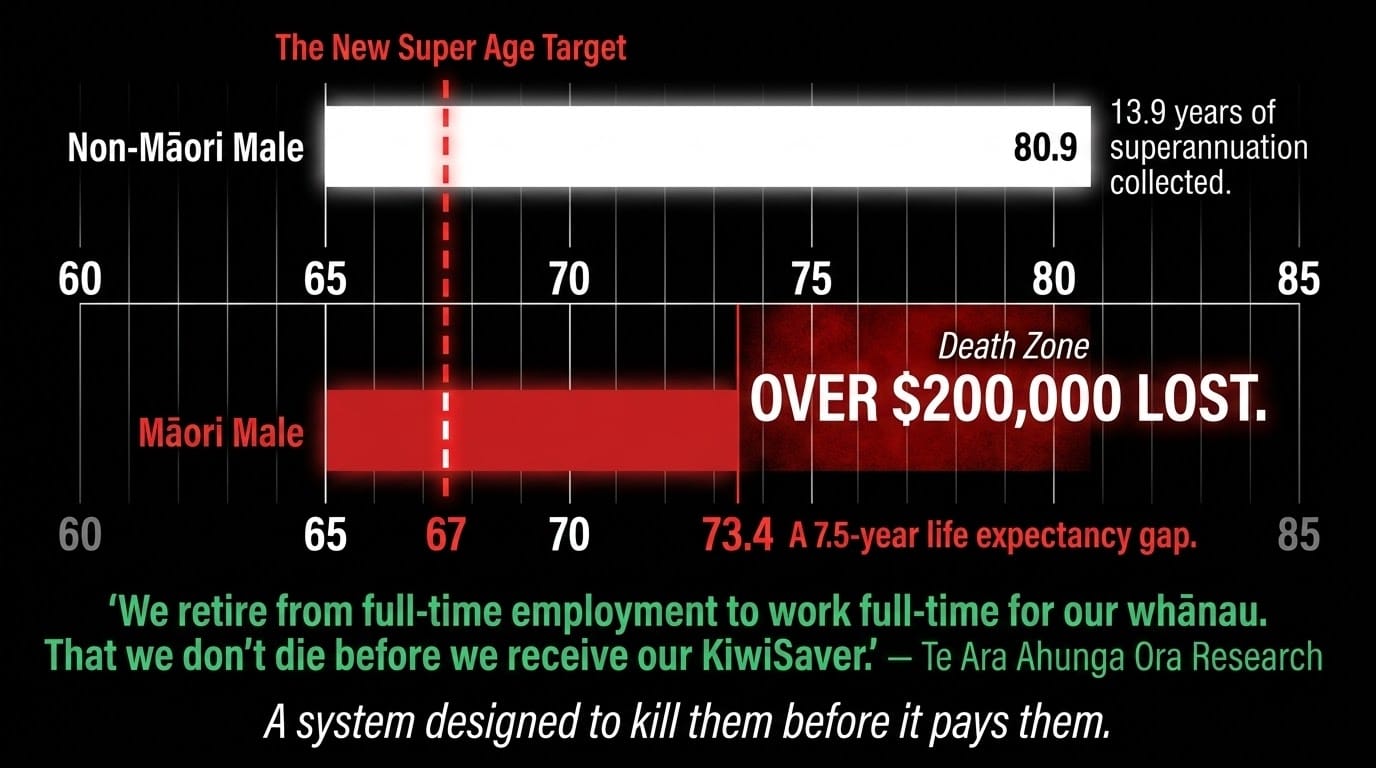
Te Koha is 58. He has worked construction his entire adult life. His back hurts. His knees hurt. He has been contributing to KiwiSaver since the scheme began, through the years National cut the rates, cut the kick-start, cut the government contribution, and taxed his employer's contribution. He has contributed faithfully to a system that has been deliberately depleted around him.
Stats NZ confirms Māori male life expectancy at birth is 73.4 years. Non-Māori male: 80.9 years. The gap: 7.5 years.
Te Koha reaches 65 and can access his KiwiSaver. He receives NZ Super at the current rate of $28,868 per year as a single person. Statistically, he has 8.4 years before death. Under National's planned super age rise to 67 in 2044
— which RNZ's own analysis confirms the KiwiSaver compulsion announcement is designed to politically enable — that drops to 6.4 years.
Te Ara Ahunga Ora research confirmed Māori men under a raised super age would miss out on over $200,000 in lifetime superannuation payments. Hāpai Te Hauora confirmed the evidence base is clear: Māori are dying younger, and a system designed without reference to that fact is not neutral — it is discriminatory.
The impact on tikanga: In tikanga Māori, we talk of utu — not revenge, but balance, reciprocity, the restoration of what is owed. Te Koha has given forty years of labour, forty years of contribution, forty years of deferred consumption. The utu owed to him by the system he funded is his retirement, his security, his dignity. When the state says "you must wait until 67 to collect," it denies that utu to the men most likely to die before they receive it. It is a structured theft, administered by statistics, authorised by election-year politics.
The solution: A legislated Māori equity access provision — either a reduced minimum contribution period, or access at 60 for those who have contributed for 25+ years — reflecting the documented 7.5-year life expectancy gap. This is not special treatment. This is basic arithmetic applied to basic justice.
Quantified harm: Over $200,000 in lost superannuation for Māori men under a raised super age. A lifetime of compulsory contributions accelerated into a system that statistically returns fewer years of benefit to those who need it most.
Example Three — Aroha & James, New Parents, South Auckland: The Baby Photo That Costs $660 Million
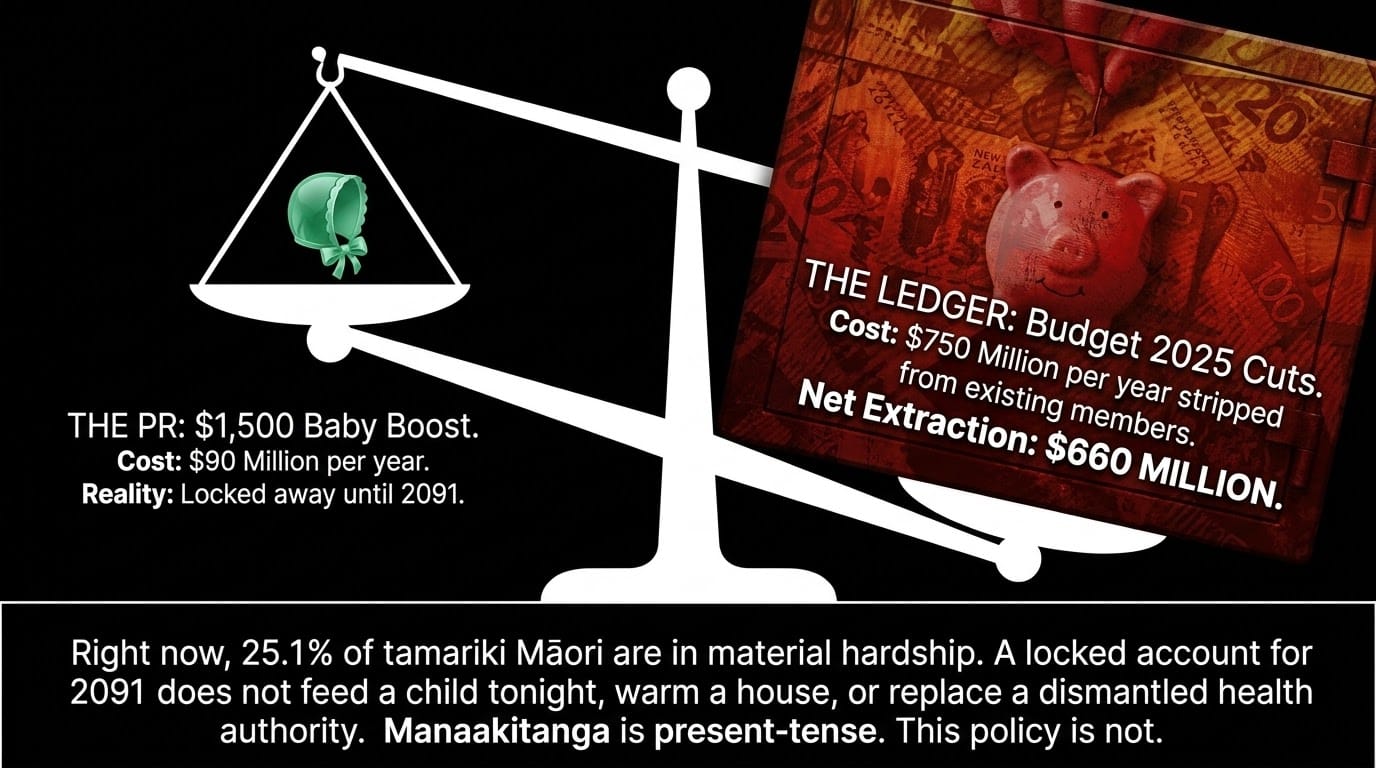
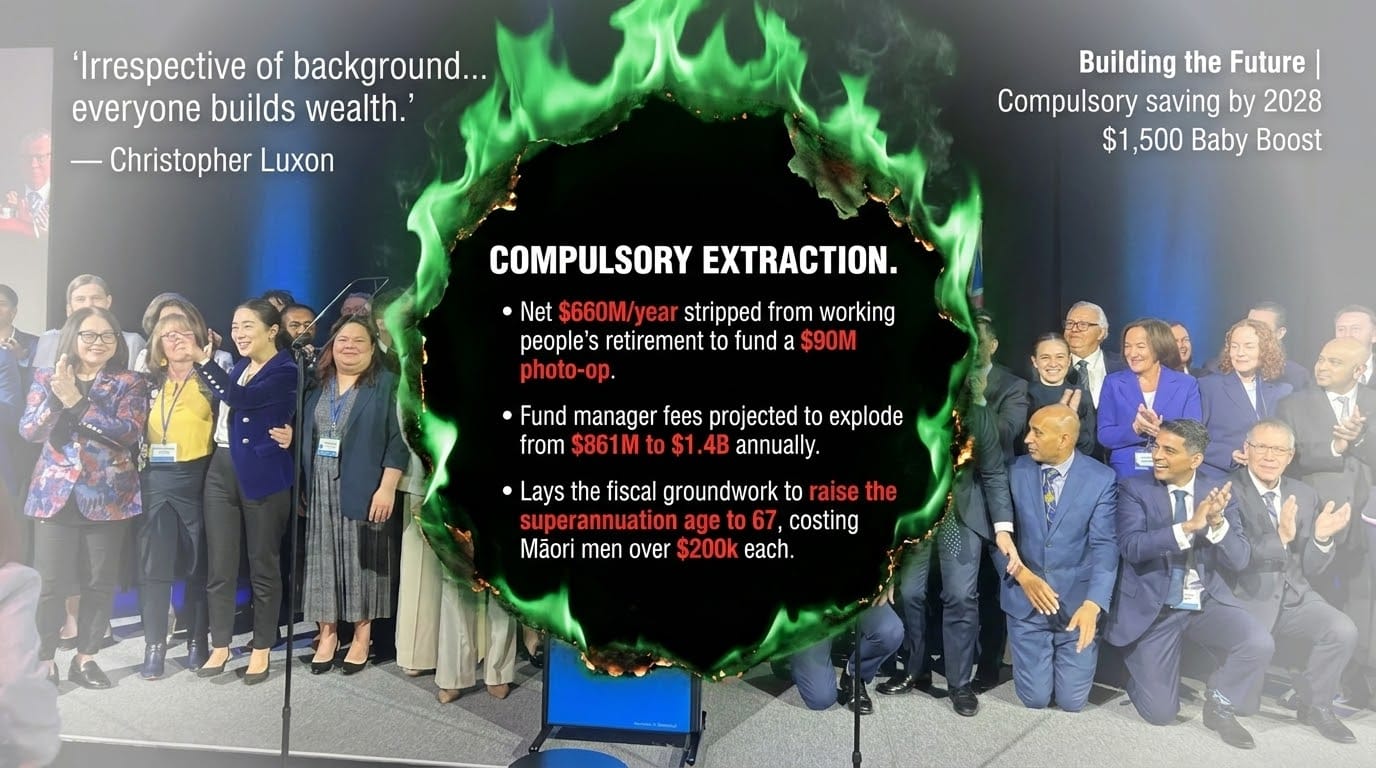
At the conference in Lower Hutt, the crowd rose to its feet when Luxon declared: "being a parent shouldn't come at the expense of your retirement savings." Standing ovations. Joy. Photographs.
I need you to follow the money.
The Baby Boost costs $90 million per year. The Budget 2025 government contribution cut saves the Crown $750 million per year — money that used to go into existing KiwiSaver members' accounts, disproportionately benefiting low-income and Māori members for whom the government top-up represented the largest proportional boost to their retirement savings.
The net arithmetic is unavoidable: $660 million per year is being extracted from working people's retirement savings to fund a $90 million photo opportunity and bank $660 million in fiscal headroom.
Meanwhile, Stats NZ confirmed in February 2026 that 25.1% of tamariki Māori are in material hardship. One in four Māori children. The rate has not improved in five years. These tamariki are being given a KiwiSaver account for their imaginary future retirement while their whanau cannot afford warm houses, GP visits, or school uniforms today.
The Retirement Commission's Victoria University-published analysis confirmed that 20% of KiwiSaver contributing members — concentrated in low-income brackets — will be worse off under the Budget 2025 changes. The same people who received the greatest proportional benefit from the government contribution are the same people who lost the most when it was halved.
The impact on tikanga: Māori do not raise children in isolation. We raise them in whānau, in hapū, in iwi. The principle of manaakitanga — generous hospitality, care for the whole person — demands that a child's wellbeing begins now: in warm shelter, in nourishing kai, in health, in belonging. A $1,500 baby savings account locked away until 2091 does not feed a child tonight. It does not keep their whare warm. It does not replace the Māori Health Authority this government abolished. Manaakitanga is present-tense. This policy is not.
The solution: Restore the government KiwiSaver contribution to at least $521 per year before mandating higher worker contributions. Fund the Baby Boost from dividend income or a capital gains mechanism, not from cutting the retirement savings of the lowest earners. Address the 25.1% child hardship rate with direct, immediate investment — housing, health, income support — not a 65-year savings instrument.
Quantified harm: $660 million per year net extraction from working people's retirement savings. 25.1% of tamariki Māori in material hardship. Victoria University research confirmed 20% of contributing members — concentrated in low-income brackets — will be worse off.
The Machine Behind the Announcement: Who Wins?
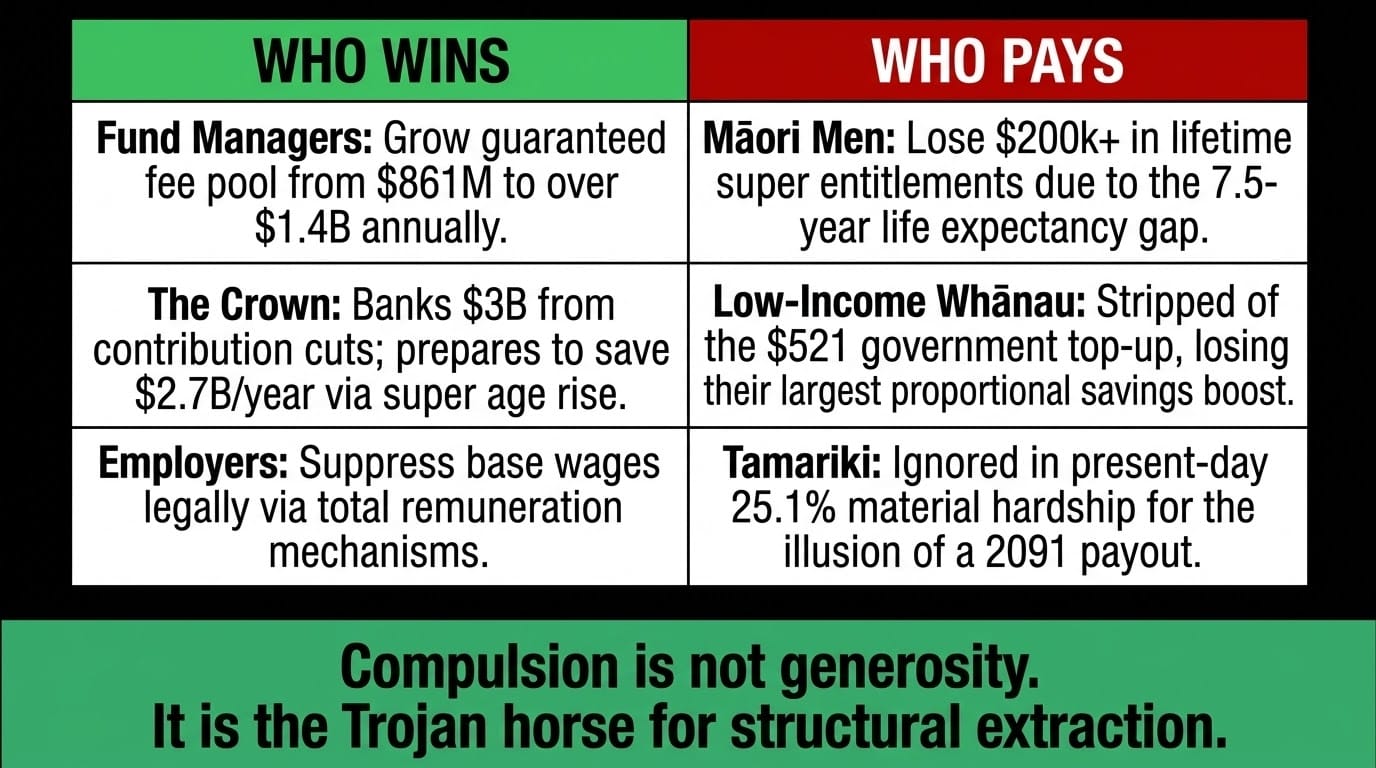
I want to be specific about the beneficiaries of this policy — because in every previous essay I have published on this topic, from "The KiwiSaver Illusion" to "Elite Plunder Masquerading as Policy", I have traced this pattern to its source.
The fund management industry wins most. The Financial Markets Authority's 2025 KiwiSaver Annual Report confirms total funds under management reached $123 billion, with fees at 0.7% — meaning fund managers are already collecting approximately $861 million per year in KiwiSaver fees. Morningstar's December 2025 survey showed assets approaching $145 billion by end of 2025. Compulsion, rising rates to 12% by 2032, and a 3.4 million member base growing at the legally mandated instruction of the state — this is not a retirement policy. This is a government mandate that forces the wages of 3.4 million New Zealanders into a fee-charging industry. The beneficiary is the industry.
Employers using total remuneration win next. As confirmed by the Retirement Commission's own 2023 policy brief, almost half of NZ employers use total remuneration arrangements — meaning compulsory rising rates are a mechanism to legally reduce gross take-home pay while appearing to comply with the law.
The Crown wins on the super age — the real end game. As RNZ's Jo Moir confirmed in her analysis, the KiwiSaver expansion is explicitly designed to create the political conditions for raising the superannuation age to 67. That saves the government billions per year. Those billions are not saved equally — they are extracted disproportionately from those who die youngest: Māori, Pacific, disabled, and women.
The whānau who loses most is the one already earning least, already contributing proportionally most, already dying youngest, already locked out of the wealth accumulation mechanisms (property, shares, inheritance) that make KiwiSaver a marginal supplement for the wealthy and an irreplaceable lifeline for the poor.
The Record This Government Wants You to Forget
The Green Party documented it clearly:
"It was National that removed the $1,000 kick-start. It was National that introduced a new tax on employer contributions in 2011. It was National that halved the annual maximum government contribution."
The Beehive's own press release from 2015 records Bill English abolishing the Kick-Start from 2pm on 20 May — no notice, no consultation, no apology.
The Treasury's own Budget 2025 document records the halving of the government contribution — from 50 cents to 25 cents per dollar, maximum $260.72 per year.
This is not a different National Party. The same ideology that cuts the safety net in government cuts it again in government. The paint is different. The architecture is identical.
I said this in "The Inheritance of Cruelty":
"Every essay published by The Māori Green Lantern has followed the same genealogy to the same source: a neoliberal, white supremacist coalition that has spent two years governing Aotearoa not as kaitiaki of a nation, but as asset strippers in borrowed authority."
The KiwiSaver announcement is asset stripping with a $1,500 nappy bag attached.
The Superannuation Time Bomb: What They're Selling You Without Telling You
Let me say this plainly, because RNZ's own report buries it in paragraph 8:
Finance Minister Nicola Willis has already told you the superannuation age is going up. She said on Budget Day that politicians who don't act on the entitlement age "are robbing future generations." National's own published commitments confirm the super age rises to 67 in 2044.
This is the sequence they will not announce in a press release:
- Make KiwiSaver compulsory and popular — tick, done yesterday in Lower Hutt.
- Point to expanded KiwiSaver and say "you'll have more savings, so you can wait longer for super" — coming soon.
- Raise the super age from 65 to 67 — saving approximately $2.7+ billion per year.
- Watch as Māori men, with a life expectancy of 73.4 years, collect superannuation for six years instead of eight — losing over $200,000 in lifetime entitlements that they funded through decades of compulsory contributions.
The compulsory KiwiSaver announcement is not the policy. It is the preparation. It is the sweetener before the medicine. It is designed to neutralise your objection to a super age rise by making you feel like you already have something.
You do not have something. You have a locked box managed by a fee-charging industry, growing with your wages, accessible at a date that is about to move — and for Māori men, that date is already close to their statistical death.
That is not a retirement system. That is a colonial extraction engine with a compound interest calculation.
Five Hidden Connections — The Whakapapa of This Policy
Every good essay names the connections that power does not want named. Here are five:
- The same hand that cut, now compels. National stripped the government contribution four times since 2011 —(https://www.beehive.govt.nz/release/fact-sheet-–-kiwisaver-changes),(https://assets.retirement.govt.nz/public/Uploads/Retirement-Income-Policy-Review/TAAO-A-Snapshot-of-the-History-of-KiwiSaver.pdf),(https://www.beehive.govt.nz/release/kiwisaver-1000-kick-start-payment-cease),(https://www.beehive.govt.nz/release/kiwisaver-changes-encourage-savings) — then calls compulsion generosity. The net beneficiary of compulsory rising rates is not Sarah in Flaxmere. It is the fund manager charging 0.7% on her growing balance. Verified.
- Compulsion grows the fee pool from $861M to $1.4B per year. At 0.7% fees on a projected $200B pool at 12% contribution rates, FMA data projects fund manager revenue exceeding $1.4 billion annually. This is a government mandate that forces wages into a fee-charging industry. Verified (derived calculation from confirmed FMA data).
- The Baby Boost is funded by the government contribution cut — net extraction $660M/year. $90M Baby Boost funded on the back of a $750M annual saving from halving the government contribution. Verified.
- Compulsion is the Trojan horse for a super age rise that costs Māori $200,000+ each. Nicola Willis confirmed the super age agenda on Budget Day. National's own policy confirms a 67 age from 2044. Māori men will lose over $200,000 in lifetime super. Verified.
- Almost half of employers will use compulsory rising rates to suppress base wages via total remuneration arrangements. Retirement Commission confirms the mechanism. Smiths Financial confirms the legal reality. National has announced no prohibition. Māori and Pacific workers in casualised employment are most exposed. Verified.
The Balance Sheet: Who Pays, Who Collects
| Harm to Whānau | Amount | Source |
|---|---|---|
| Govt KiwiSaver contribution cut, Budget 2025 | $521 → $260/year | Beehive |
| Crown 4-year saving from that cut | ~$3 billion | Generate Wealth |
| Net annual extraction (cut minus Baby Boost) | ~$660M/year | 1News / Generate Wealth |
| Annual KiwiSaver fees to fund managers | ~$861M/year (0.7% of $123B) | FMA 2025 |
| Māori/Pacific annual contribution gap vs European | ~$1,500 less/year | Te Ara Ahunga Ora |
| Māori male life expectancy gap | 7.5 years shorter | Stats NZ |
| Lost super for Māori men under age 67 rise | Over $200,000 each | Te Ao News |
| Tamariki Māori in material hardship | 25.1% | Stats NZ |
| KiwiSaver members worse off under Budget 2025 changes | 20% (~680,000 members) | Victoria University |
| Employers using total remuneration KiwiSaver | ~50% | Retirement Commission |
What Rangatiratanga Demands — Concrete and Non-Negotiable
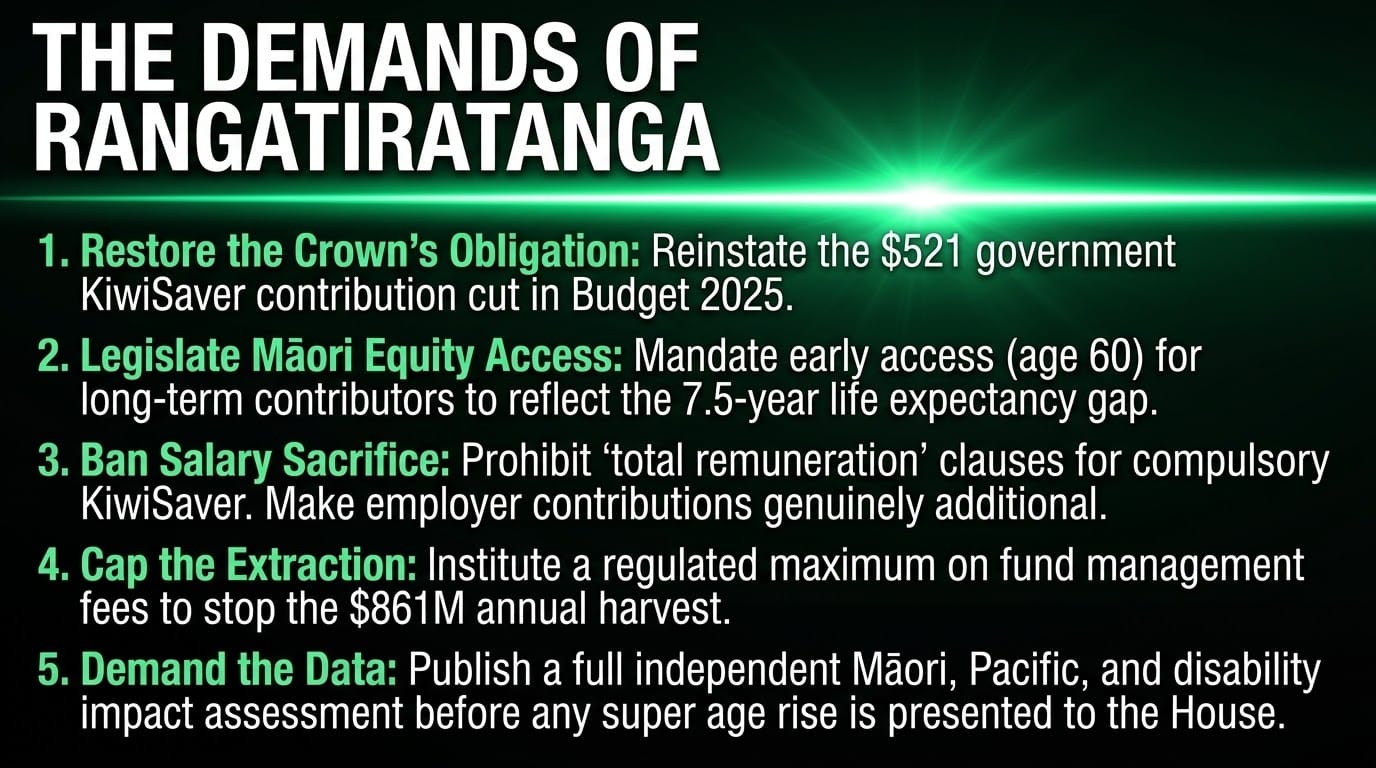
I am tired of writing essays that name the harm without naming what justice looks like. So here it is:
Before a single line of compulsory KiwiSaver legislation passes, this government must:
- Restore the government KiwiSaver contribution to $521 per year minimum — reversing the Budget 2025 cut that stripped $260 per year from the lowest earners. Source: IRD.
- Legislate a Māori equity access provision — a reduced contribution period or early access at 60 for long-term contributors, reflecting the 7.5-year Māori male life expectancy gap confirmed by Stats NZ. Source: Hāpai Te Hauora.
- Prohibit total remuneration salary sacrifice arrangements for compulsory KiwiSaver components — so that employer contributions are genuinely additional to base wages. Source: Retirement Commission Policy Brief 2023.
- Cap KiwiSaver fund management fees at a regulated maximum, with a publicly managed low-cost default option, so the $861M annual fee harvest does not compound with compulsion. Source: FMA Annual Report 2025.
- Publish a full independent Māori, Pacific, women, and disability impact assessment of the proposed super age rise — before any compulsion legislation is presented to the House. Source: Te Ara Ahunga Ora 2022 research.
None of this is radical. All of it is just. The fact that none of it appeared in yesterday's announcement tells you everything about whose future National is actually building.
The Moral Accounting: What This Government Has Done
I do not use the phrase "white supremacist neoliberal government" lightly. I use it precisely, and I have defined what I mean in "The $134,250 Handshake" published 6 June 2026:
"When a government strips Te Tiriti out of medicine decision-making, removes the Māori advisory voice, and installs politically aligned insiders over the top, the outcome is not race-neutral administration. The outcome is colonial power reasserting itself in the bloodstream."
The same logic applies here. A retirement policy that ignores a 7.5-year Māori male life expectancy gap, that raises compulsory contributions while halving government top-ups, that uses the expansion of a wealth-building mechanism as a Trojan horse for making that mechanism less accessible to those who die youngest — that policy is not neutral. It is colonial. It is white supremacist in effect if not in stated intent. And in 2026, in Aotearoa New Zealand, the effect is the truth.
Waatea News reported in May 2026 that Budget 2026 "offers very little for Māori, very little for economic growth, and very little for the thousands of whānau already struggling under the weight of rising costs, insecure employment and a stagnant economy". The Green Party confirmed Budget 2026 "neglects its Tiriti obligations to make way for the super-rich and powerful". The PSA called this government "contemptuous of te iwi Māori."
And now, in election year, Luxon stands at a lectern with a baby in his arms and a fund manager's fee structure in his back pocket, and asks you to applaud the future he is building.
Kāo. No.
The trough is still his. The rules are still his. And the people who will die before they eat from it — they are still ours.
Ko tō tātou hīkoi ki te ao mārama — our journey to the world of light — requires that we name every chain, trace every whakapapa of power, and refuse to perform gratitude for crumbs from a trough that was built with our whenua.
E tū whakamaua kia tīna. Tīna! Hui e! Tāiki e!
Koha — Because Every Koha Is Rangatiratanga in Action
This essay was written while 25.1% of tamariki Māori remain in material hardship and a man worth $21–30 million asked you to thank him for your future.
Every koha to The Māori Green Lantern signals that whānau are ready to support the accountability that the Crown and corporate structures will not provide. It signals that rangatiratanga includes the power to support our own truth tellers — and that no media merger, no algorithmic suppression, no parliamentary privilege can silence a voice that is funded by its own people.
Kia kaha, whānau. Stay vigilant. Stay connected. And if you are able, consider a koha to ensure this voice continues.
If you cannot koha — no worries at all. Subscribe, follow, kōrero about this essay with your whānau and friends. That sharing is koha. That circulation is the hau returning.
Four pathways to support this mahi:
💚 Koha directly: https://app.koha.kiwi/events/the-maori-green-lantern-fighting-misinformation-and-disinformation-ivor-jones
📬 Subscribe to receive essays directly: https://www.themaorigreenlantern.maori.nz/#/portal/support
🏦 Direct bank transfer: HTDM — Account 03-1546-0415173-000
📘 Facebook: https://www.facebook.com/Themaorigreenlantern/subscribe/

Ko Ivor Jones ahau. Ko Te Arawa, ko Ngāti Pikiao, ko Welsh whakapapa ōku. Ko The Māori Green Lantern tōku ingoa. I am a kaitiaki. I wield the taiaha. I trace the networks. I expose the connections. I serve the whānau. Kia kaha.
Research Transparency
Research date: 22 June 2026
Tools used: Perplexity AI research tools, web search, FMA, Beehive, IRD, Stats NZ, Te Ara Ahunga Ora Retirement Commission, Treasury, Victoria University Policy Quarterly, University of Queensland, 1News, Generate Wealth, Morningstar, Smiths Financial, People In Mind, NZCTU, Green Party, Hāpai Te Hauora, Waatea News, Mirage News, Child Poverty Action Group, Stats NZ child poverty data, The Māori Green Lantern previously published essays.
Previously published MGL essays cited in this piece:
- "The KiwiSaver Illusion" — November 2025
- "National's KiwiSaver Con Is Wage Theft With a Glossy Brochure" — 21 June 2026
- "Nicola's Glass Cannon" — 15 June 2026
- "The Inheritance of Cruelty" — 19 April 2026
- "The $134,250 Handshake" — 6 June 2026
Disclaimer: This essay is published in the public interest pursuant to qualified privilege under the New Zealand Defamation Act 1992, consistent with the principles established in Lange v Atkinson 3 NZLR 385. All factual claims are supported by cited primary sources, government publications, or peer-reviewed research. Named individuals are referenced exclusively in their public capacity as elected officials or public figures. All opinions are clearly flagged as such and are grounded in the stated evidence base. Any factual error will be corrected upon notification. No malice is asserted or intended. The author traces patterns of harm, not personal animus.