"This Government Has Built Unemployment, And It Must Be Destroyed" - 6 November 2026
I am Ivor Jones, The Māori Green Lantern. This essay is part of the record. Our mokopuna will read it and know that someone named the destruction while it was happening. Do not forget. Do not forgive. And do not vote this government back in.

Kia ora ano whānau,
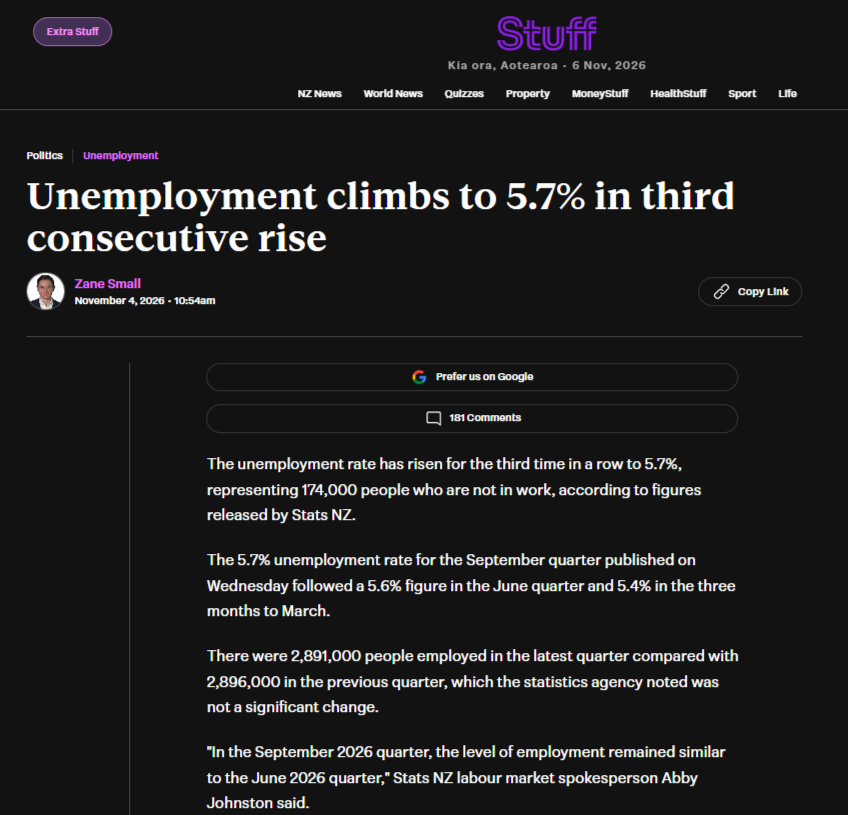
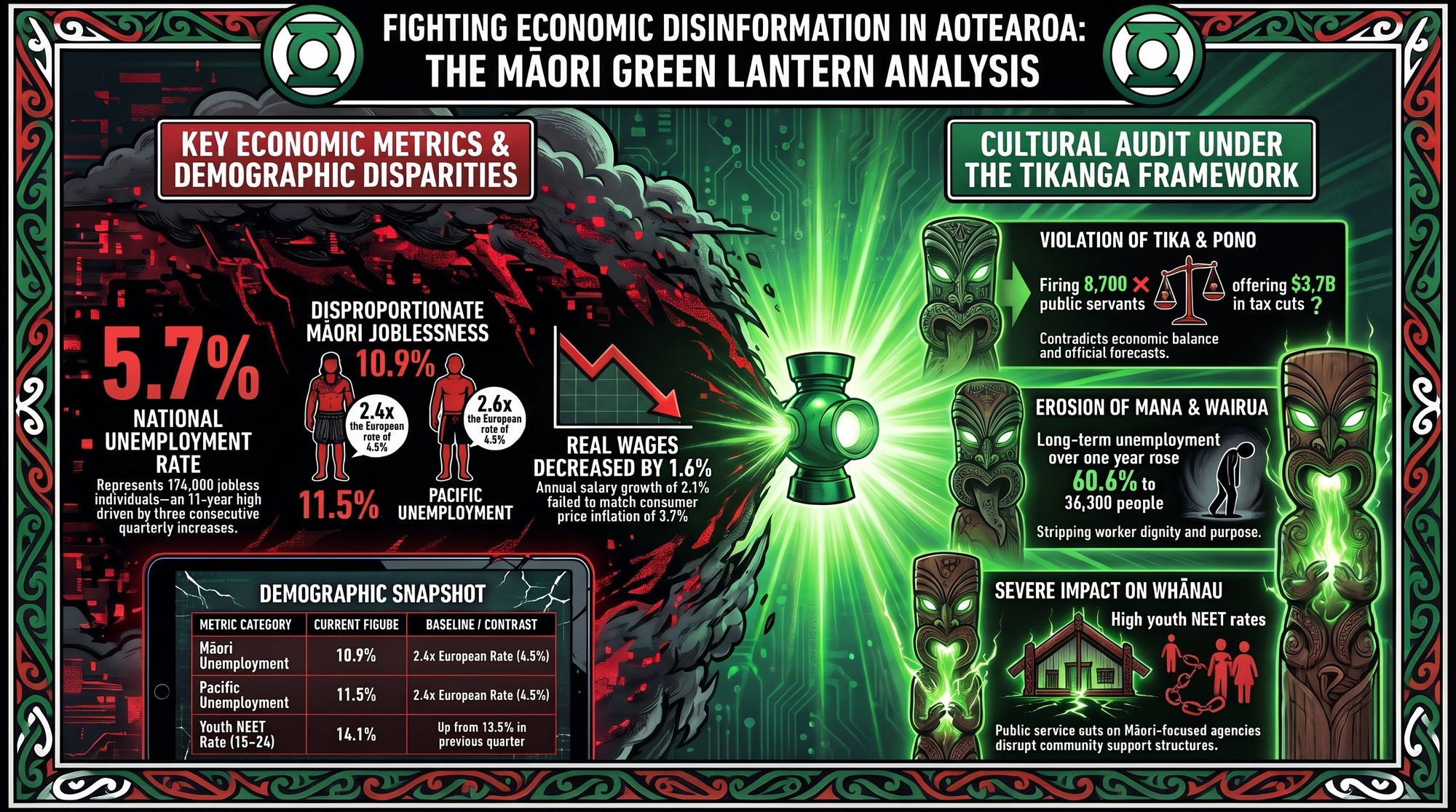
I am Ivor Jones, The Māori Green Lantern, and I am here to destroy the lie that this white supremacist neoliberal government is managing the economy. Unemployment is 5.7 percent. Māori joblessness is 10.9 percent. Pacific is 11.5 percent. Three consecutive rises. This government has not governed; it has waged war on whānau.
I write from Ōpōtiki, with Te Arawa, Ngāti Pikiao and Welsh whakapapa, and I am here to do one thing: destroy the actions of this white supremacist, neoliberal government that has driven unemployment to 5.7 percent — the highest in 11 years — and call it fiscal responsibility Unemployment rate at 5.7 percent in the September 2026 quarter | Stats NZ.
In this essay, I will:
Show you the numbers and the formula behind every claim, so there is nowhere for this government to hide;
Apply the tests of Tika, Pono and Tikanga to ask whether this system has preserved mana, recognised whakapapa, respected wairua, involved whānau, and returned people to wellbeing;
Give three examples for the western mind that quantify the harm and offer solutions;
Explain the impact on tikanga in plain language;
Show you previous essays by The Māori Green Lantern that document this same destruction;
Tell you exactly why you should not vote this coalition back into power in November;
Recommend you vote for the Green Party, and why.
I have designed this essay as part of a repository for our mokopuna. I'd love for you to click through this essay because it contains a wealth of information you can use in your daily life as a citizen of this country. There is a longform audio podcast explaining the kaupapa in detail, a short YouTube video that explains the kaupapa in about a minute, and for the longform readers there is a cited essay waiting for you. This is a repository for our mokopuna, so that in the future they can look back at these 1,000-plus essays on neoliberalism, misinformation and disinformation in Aotearoa, and say that the Māori Green Lantern and a few others were documenting these events and trying to protect us.
Before I destroy this government's record, I will show you the maths. Every number below is traceable to Stats NZ, the Treasury, RNZ or other primary sources.
Unemployment rate: 5.7 percent in September 2026 quarter
Source: Stats NZ Household Labour Force Survey Stats NZ
Calculation: 174,000 unemployed people ÷ labour force × 100 = 5.7 percent.
Three consecutive rises
March 2026: 5.4 percent; June 2026: 5.6 percent; September 2026: 5.7 percent Stats NZ
Calculation: 5.4 → 5.6 → 5.7. Every quarter this government has been in office, unemployment has gone up.
Unemployment when the coalition took office: 4.0 percent
September 2023 quarter: 3.9 percent; December 2023 quarter: 4.0 percent Stats NZ historical series
Calculation: 5.7 − 4.0 = 1.7 percentage points increase under this government. That is a 42.5 percent relative rise (1.7 ÷ 4.0 × 100).
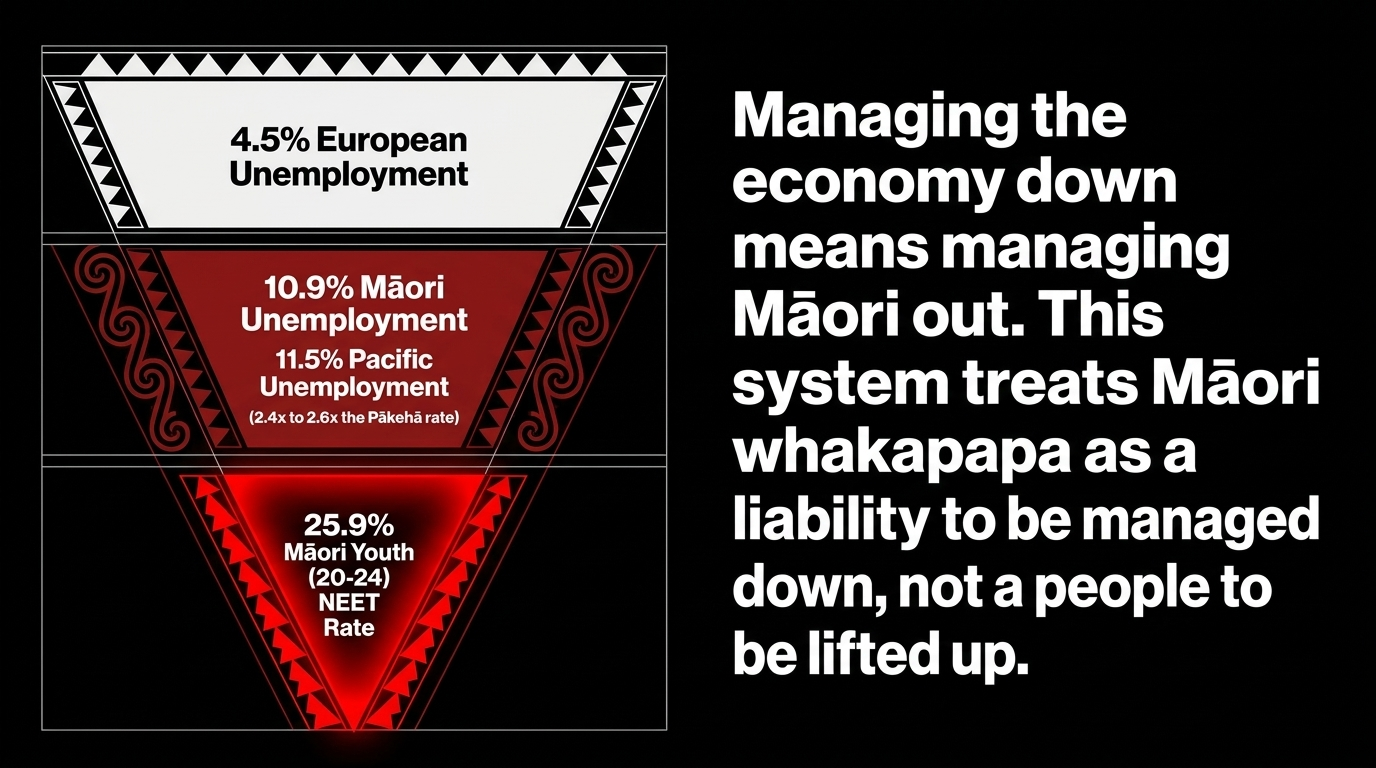
Māori unemployment: 10.9 percent; Pacific: 11.5 percent; European: 4.5 percent
Source: Stats NZ, not seasonally adjusted, September 2026 quarter Stats NZ
Calculation: Māori rate is 2.4 times the European rate (10.9 ÷ 4.5 = 2.42). Pacific rate is 2.6 times the European rate (11.5 ÷ 4.5 = 2.56).
174,000 people unemployed
Source: Stats NZ, September 2026 quarter Stats NZ
Increase from June 2026: 174,000 − 171,000 = 3,000 more unemployed in one quarter.
Increase from September 2023: 174,000 − approximately 120,000 = roughly 54,000 more people out of work since this government took office.
Highest in 11 years
Last time at 5.7 percent: September 2015 Stats NZ historical table
Calculation: September 2026 minus September 2015 = 11 years.
NEET rate: 14.1 percent of 15 to 24 year-olds
Source: Stats NZ, September 2026 quarter Stats NZ
Previous quarter: 13.8 percent. Increase: 0.3 percentage points.
Full-time jobs down 17,000; part-time jobs up 15,000
Source: Stats NZ, September 2026 quarter Stuff article summarising Stats NZ release
Calculation: Net change in employed people: 2,891,000 − 2,896,000 = −5,000 (not statistically significant, but composition has shifted).
Wages: 2.1 percent LCI increase vs 3.7 percent CPI inflation
Source: Stats NZ Stats NZ
Calculation: Real wages are falling by approximately 1.6 percentage points (3.7 − 2.1 = 1.6). Pay is not keeping up with prices.
Public service cuts: 8,700 jobs by 2029; 63,000 to 55,000 FTE
Source: RNZ Nearly 9000 public sector jobs to go; MGL previous essay The Sinking Lid
Calculation: 8,700 ÷ 63,000 × 100 = 13.8 percent (rounded to 14 percent).
Māori share of public service: 16.6 percent of workforce vs 15.3 percent of working-age population
Source: Te Kawa Mataaho, cited in MGL previous essay The Sinking Lid
Calculation: If cuts were proportional, Māori would bear 16.6 percent of 8,700 = approximately 1,444 jobs. But cuts fall hardest on Māori-focused agencies, so the real harm is greater.
Tax cuts: $3.7 billion per year; funded partly by $1.2 billion in public service cuts
Source: 1 News Budget 2024 tax cuts
Calculation: $3.7 billion in annual tax cuts minus $1.2 billion in public service savings = $2.5 billion net cost to the Crown, borrowed or cut from services.
Long-term unemployment: over 1 year
Source: Stats NZ, September 2026 quarter Stats NZ
21.5 percent of the 169,100 not-seasonally-adjusted unemployed had been jobless over a year = approximately 36,300 people. The over-1-year category rose from 22,600 in September 2025 to 36,300 in September 2026 Stats NZ duration table — an increase of 13,700, or 60.6 percent.
Tika: Is This System Right?
Tika asks whether the system is correct, just and properly ordered. Let us test this government against that standard.
When the National-led coalition took office, unemployment was 4.0 percent Stats NZ historical series. Today it is 5.7 percent. Three consecutive quarters of rises. Every single quarter this government has held power, more people have lost work. That is not economic management. That is a record of failure.
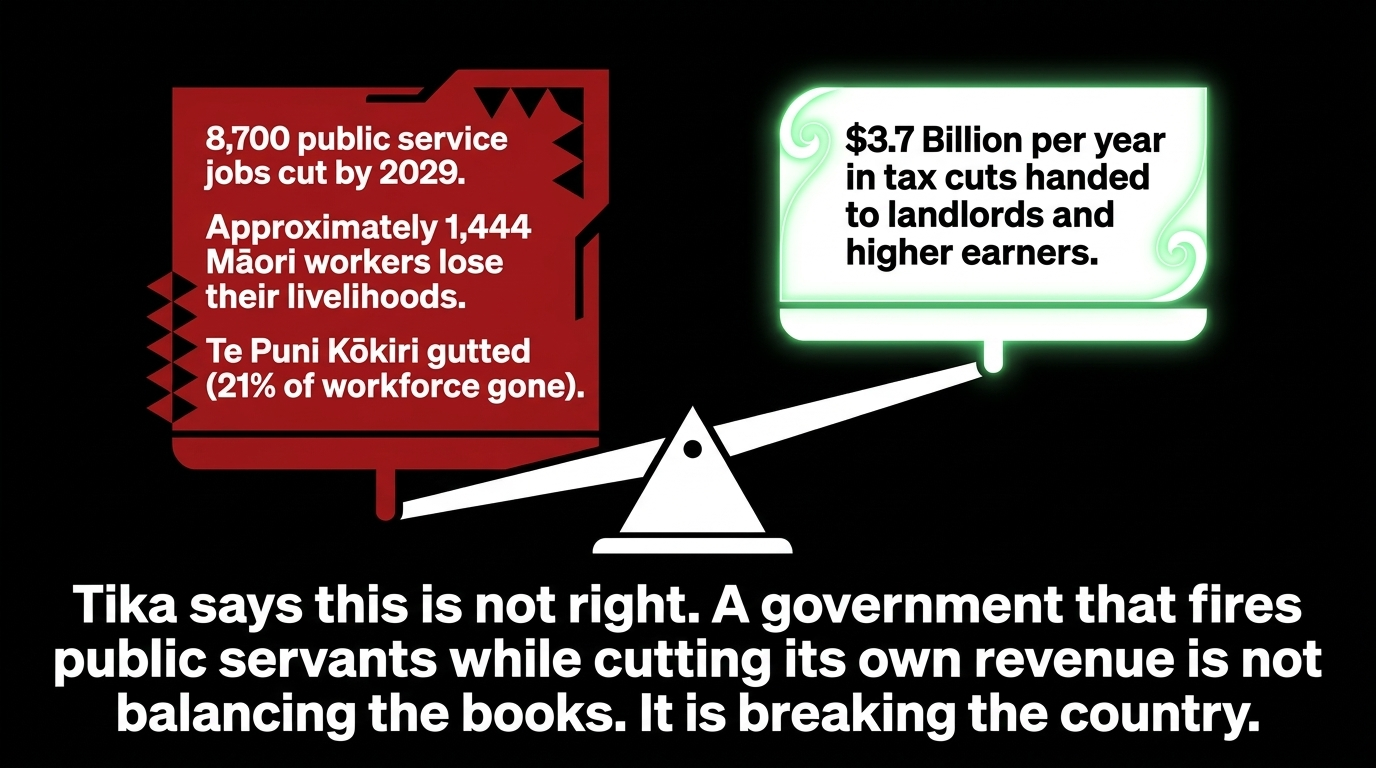
The Finance Minister, Nicola Willis, announced nearly 9,000 public sector job cuts by 2029, shrinking the core public service from 63,000 to 55,000 full-time equivalent roles RNZ. At the same time, her government delivered $3.7 billion a year in tax cuts 1 News. She took money from the public payroll and handed it to landlords and higher earners, then pretended the resulting joblessness was someone else's fault.
Tika says this is not right. A government that fires public servants while cutting its own revenue is not balancing the books. It is breaking the country.
Pono: Is This System True?
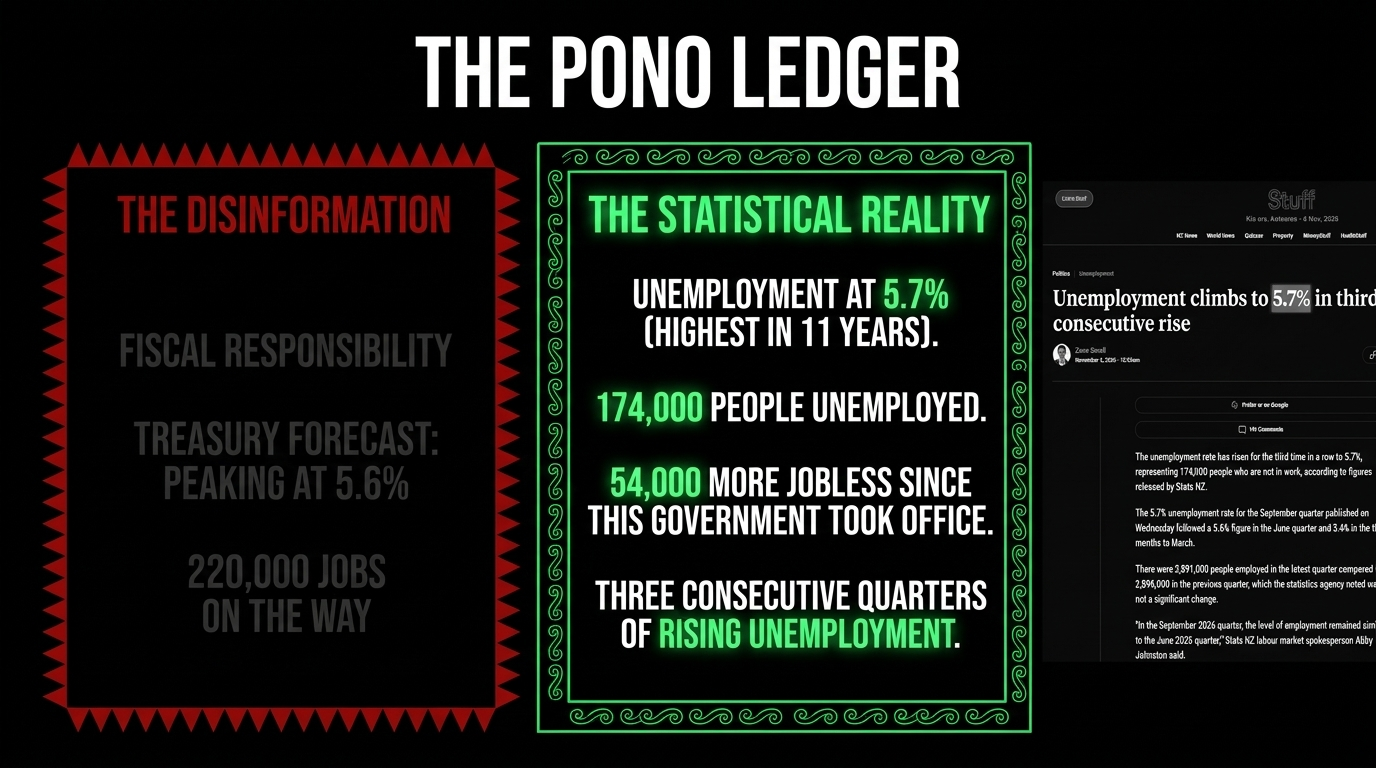
Pono asks whether the system is honest and truthful. This government has been dishonest from the start.
Treasury's Pre-election Economic and Fiscal Update, released in September 2026, declared that unemployment had "peaked at 5.6 percent" and would "gradually improve to 4.3 percent" The Treasury. One month later, Stats NZ reported 5.7 percent. The government's own forecaster was wrong, and the Minister knew it. She stood before the country and promised the worst was behind us while the data showed the worst was still arriving.
Willis now blames "uncertainty," oil prices and the election for the rise RNZ. She promises 220,000 jobs "on the way" through Fast-track approvals and trade deals. These are projections, not paycheques. They are campaign rhetoric dressed as policy.
Pono says this is not true. This government manufactured a jobs crisis, then lied about it.
Tikanga: Has This System Preserved Mana, Recognised Whakapapa, Respected Wairua, Involved Whānau, And Returned People To Wellbeing?
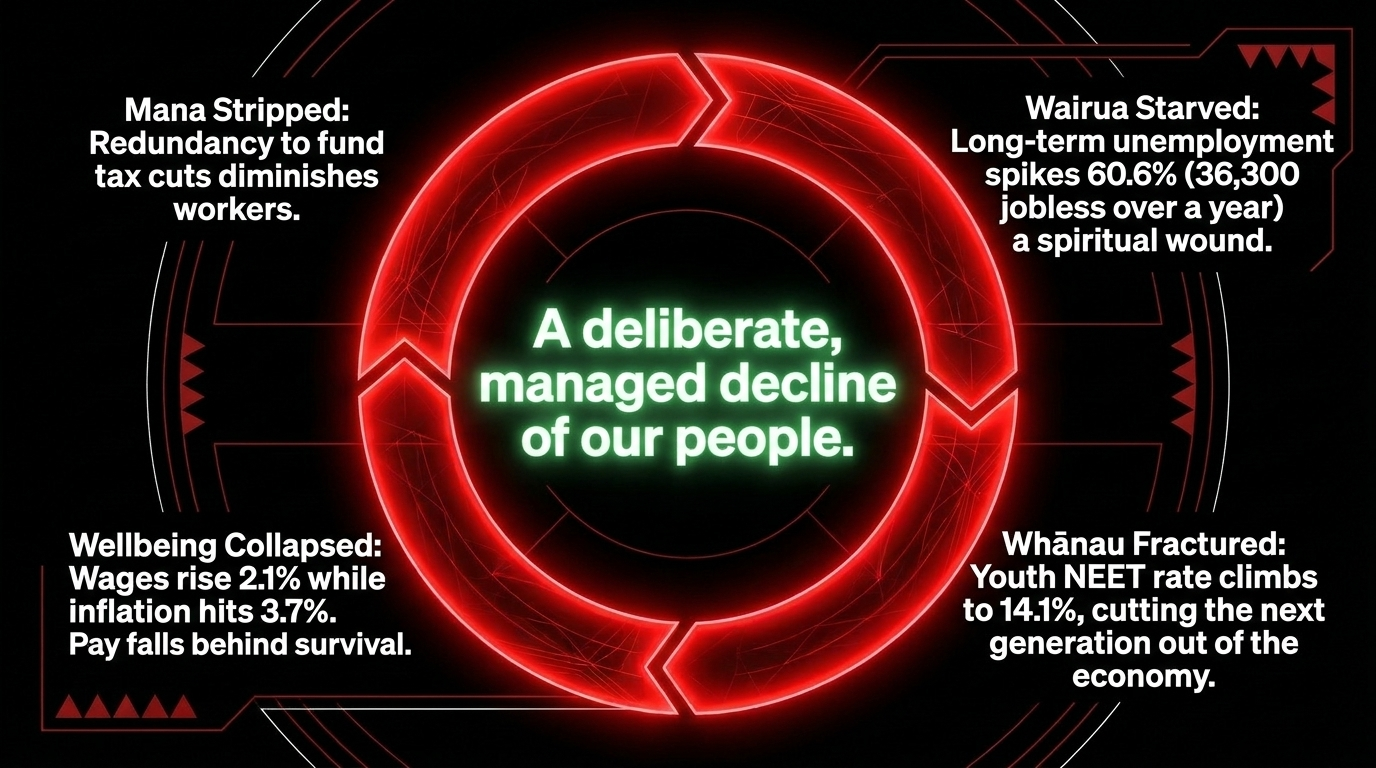
Tikanga is the test that matters most. It asks whether the system preserved the mana of the people it governs, recognised their whakapapa, respected their wairua, involved their whānau, and returned them to wellbeing.
This system has failed every one of those tests.
Mana: When you tell a worker they are redundant so a landlord can keep a tax cut, you strip their mana. When you cut 8,700 public service jobs and 1,444 of those are likely Māori workers — on top of the thousands already gone MGL: The Sinking Lid — you are not making the state efficient. You are diminishing a whole class of workers who happen to be overrepresented in the public service because the state has historically been one of the few employers willing to employ Māori fairly.
Whakapapa: Māori unemployment is 10.9 percent. Pacific unemployment is 11.5 percent. European unemployment is 4.5 percent Stats NZ. That is more than double the rate. This government knows these numbers. It chooses them. When a system produces Māori joblessness at 2.4 times the Pākehā rate, it is not recognising whakapapa. It is treating Māori whakapapa as a liability to be managed down.
Wairua: Long-term unemployment — people out of work for more than a year — is at the highest level since 1995, with more than one in five jobless Kiwis spending over a year without work Stats NZ duration data. That is not a labour market statistic. That is a spiritual wound. A person without work for a year is a person whose wairua is being starved, whose sense of purpose is being eroded, and whose whānau is being stressed to breaking point.
Whānau: The proportion of 15 to 24 year-olds not in employment, education or training is 14.1 percent, up from 13.8 percent Stats NZ. Rangatahi are being lost to the economy before they have begun. When young people cannot find work, whānau cannot support them. Marae cannot rely on them. The next generation is being told there is no place for them.
Wellbeing: Wages rose 2.1 percent over the year while inflation was 3.7 percent Stats NZ. Pay is falling behind prices. Full-time employment fell by 17,000 while part-time work rose by 15,000 Stuff summarising Stats NZ. People are working more hours for less security and less purchasing power. That is not wellbeing. That is managed decline.
Tikanga says this system has failed. It has not preserved mana. It has not recognised whakapapa. It has not respected wairua. It has not involved whānau. And it has not returned people to wellbeing.
The Deep Dive Podcast
Listen to a lively conversation between two hosts, unpacking and connecting topics in the sources of this essay. I apologise in advance for the AI's very harsh pronounciation of reo. Please dont shoot me, :).
Youtube Video
Like video? Here is a short video suppporting the essay. Again, don't shoot the messenger please because of AI's pronounciation. :)
Three Examples For The Western Mind
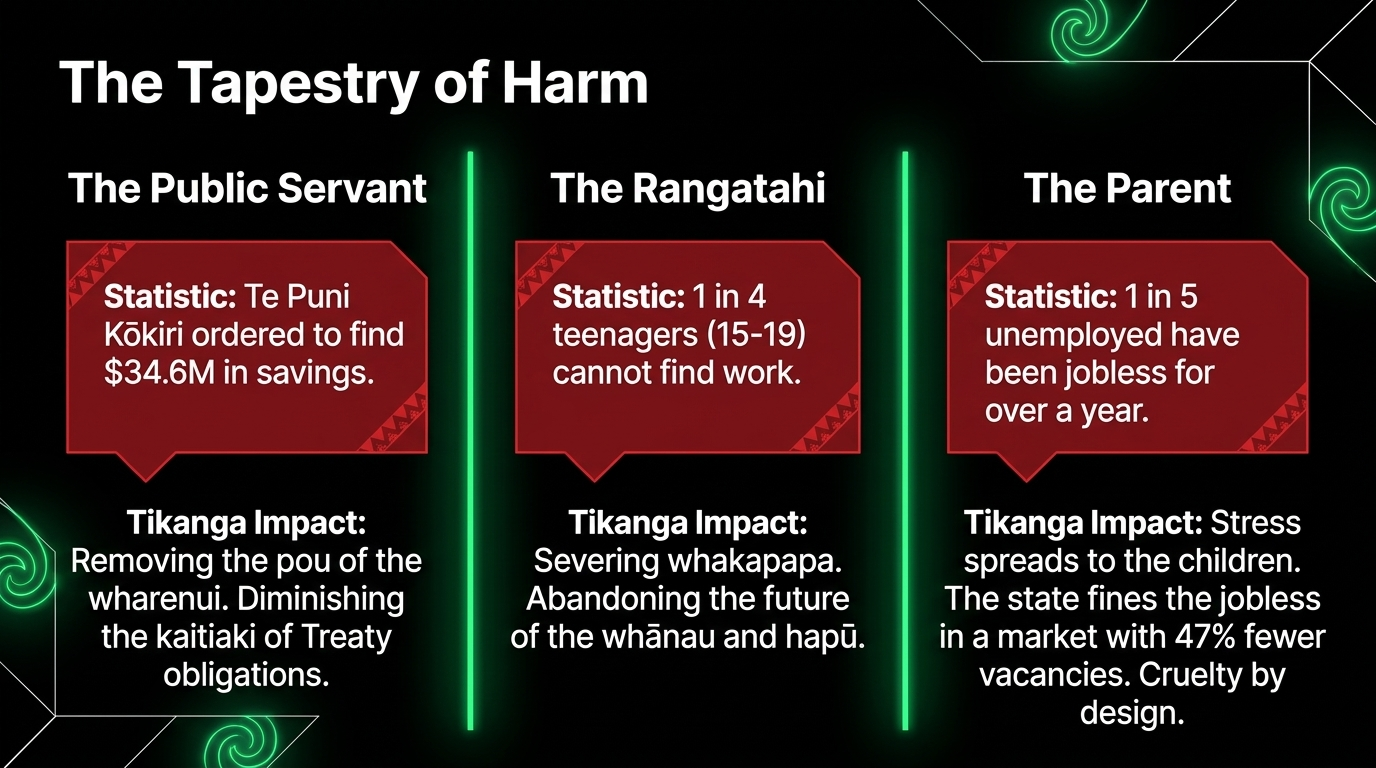
Example One: The Māori Public Service Worker Made Redundant
The harm quantified: Te Puni Kōkiri, the Ministry of Māori Development, lost 38 roles and was ordered to find $34.6 million in savings MGL: The Sinking Lid. Te Puni Kōkiri has lost more than 100 roles — 21 percent of its entire workforce MGL: The Sinking Lid. Māori make up 16.6 percent of the public service workforce, higher than their 15.3 percent share of the working-age population MGL: The Sinking Lid. If the 8,700 planned cuts fell proportionally, approximately 1,444 Māori workers would lose their jobs in this round alone. But cuts do not fall proportionally. They fall hardest on Māori-focused agencies.
Tikanga impact explained for the western mind: Think of the public service not as a bureaucracy but as a marae administration. The people who work there are not just employees; they are the kaitiaki of Treaty obligations, the keepers of whānau connections, the people who translate between the Crown and our communities. When you fire them, you are not saving money. You are removing the pou that hold up the wharenui. For the western mind: imagine your employer abolishing your department, then telling you the economy is strong because GDP is up. The job is gone. The mortgage remains. The whānau eats less.
Solution: Restore Te Puni Kōkiri staffing. Reverse the 8,700 job cuts. Require a Te Tiriti impact assessment before any further public service reduction. Fund Māori-led employment pathways such as Te Ara Mahi and Mana in Mahi, which this government gutted MGL: Ko Te Taniwha Kei Roto i Te Whare.
Example Two: The Rangatahi Who Cannot Find Work
The harm quantified: The NEET rate for 15 to 24 year-olds is 14.1 percent, up from 13.8 percent Stats NZ. Unemployment for 15 to 19 year-olds is 25.2 percent — one in four teenagers who want work cannot find it BusinessDesk. Māori youth aged 20 to 24 face a 25.9 percent NEET rate — more than one in four MGL: Ko Te Taniwha Kei Roto i Te Whare.
Tikanga impact explained for the western mind: In tikanga, rangatahi are the future of the whānau and hapū. They carry the whakapapa forward. When a 17-year-old cannot find work, it is not just a lost paycheque. It is a lost opportunity to contribute, to learn responsibility, to stand beside their elders. For the western mind: imagine being told at 18 that there is no place for you in the economy, that your skills are unwanted, and that the government has removed your benefit eligibility because your parents earn too much MGL: Ko Te Taniwha Kei Roto i Te Whare. That is not policy. That is abandonment.
Solution: Reintroduce unconditional Jobseeker eligibility for 18 and 19 year-olds. Fund sustainable trades and apprenticeship pipelines in regions with the highest Māori youth unemployment. Measure sustainable employment, not sanction activity.
Example Three: The Long-Term Unemployed Parent
The harm quantified: More than one in five unemployed people — 21.5 percent — have been out of work for over a year Stats NZ duration data. That is approximately 36,300 people, up from 22,600 a year ago — a 60.6 percent increase Stats NZ duration table. Jobseeker Support numbers rose from 190,000 in December 2023 to 217,800 in September 2025 — an increase of 27,800, or 14.6 percent MGL: Brendon Asked Where Power Lives.
Tikanga impact explained for the western mind: When a parent is out of work for more than a year, the harm does not stop with them. It spreads to the children, who see stress instead of stability. It spreads to the whānau, who must cover the rent and the food. It spreads to the hapū, who lose a contributor. For the western mind: imagine your employer abolishing your role, then the state fining you for not being employed while there are 47 percent fewer job vacancies than in 2022 MGL: The Locked Pātaka. That is not accountability. That is cruelty.
Solution: Stop sanctioning beneficiaries in a labour market with no jobs. Invest in Māori-led pathways, transport, training and regional job creation. Treat long-term unemployment as a government failure, not an individual moral failing.
Previous Essays By The Māori Green Lantern On This Topic
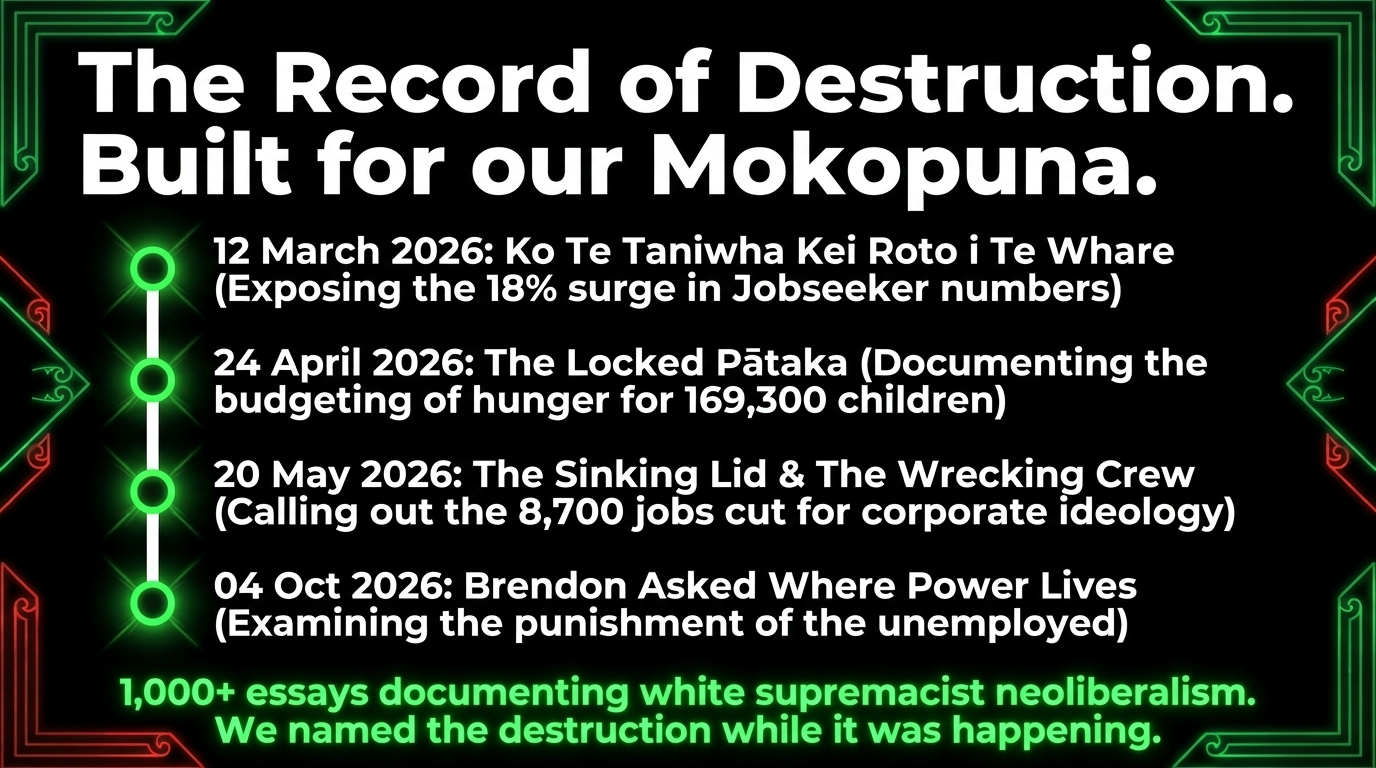
This destruction is not new. I have written about it before, and those essays remain on the record:
The Sinking Lid: Nicola Willis Fires 8,700 Workers While Whānau Starve (20 May 2026) — documents the 8,700 public service job cuts, the 14 percent reduction, and the disproportionate harm to Māori workers and agencies Read it here
The Wrecking Crew: How the New Zealand Initiative's Atlas Network Puppets Are Cheering the Destruction of 9,000 Whānau Livelihoods (20 May 2026) — exposes the corporate-funded ideologues celebrating mass unemployment while Māori communities bleed Read it here
Ko Te Taniwha Kei Roto i Te Whare: The Crown Fed The Numbers To A Beast And Called The Bones Reform (12 March 2026) — details the 427,236 people on main benefits, the 18 percent surge in Jobseeker numbers, and the Māori youth unemployment crisis Read it here
Brendon Asked Where Power Lives — The Crown Answered By Taking It Back (4 October 2026) — examines Jobseeker Support growth and the punishment of the unemployed Read it here
The Locked Pātaka: How This Government Budgeted The Hunger Of 169,300 Children (24 April 2026) — covers benefit sanctions doubling and the labour market with 47 percent fewer jobs to be sanctioned into Read it here
The Excuse That Collapses
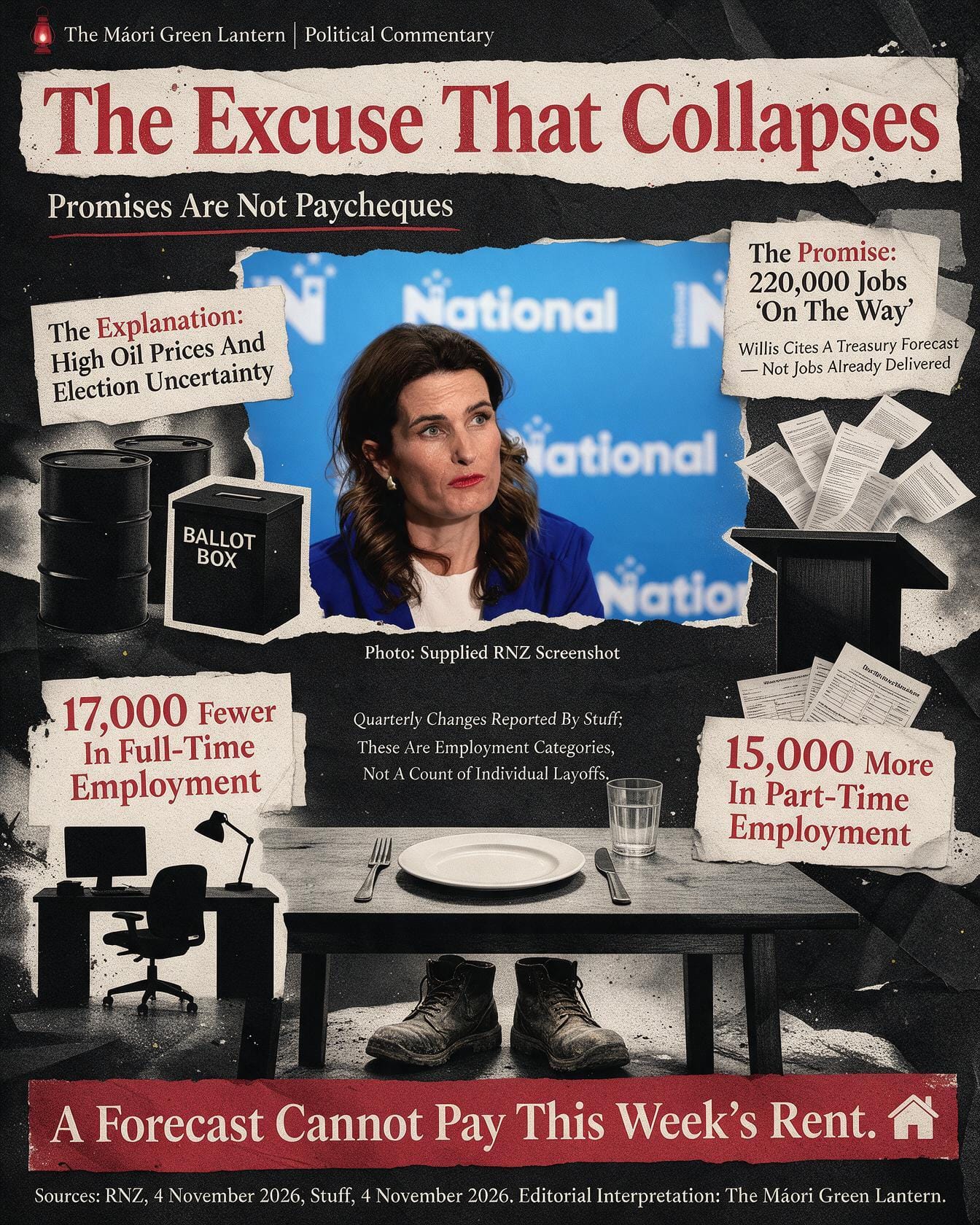
Nicola Willis says the rise is because of "uncertainty" — high oil prices and the upcoming election RNZ. She promises 220,000 jobs are "on the way" through Fast-track approvals and trade agreements.
These are not jobs. They are press releases. They are promises made by a Finance Minister whose own Treasury forecast was proven wrong within weeks of being published The Treasury.
When businesses are shedding jobs, when full-time employment fell by 17,000 and part-time work rose by 15,000 Stuff summarising Stats NZ, telling workers to wait for a promise is not a plan. It is contempt.
Why You Should Not Vote This Coalition Back Into Power
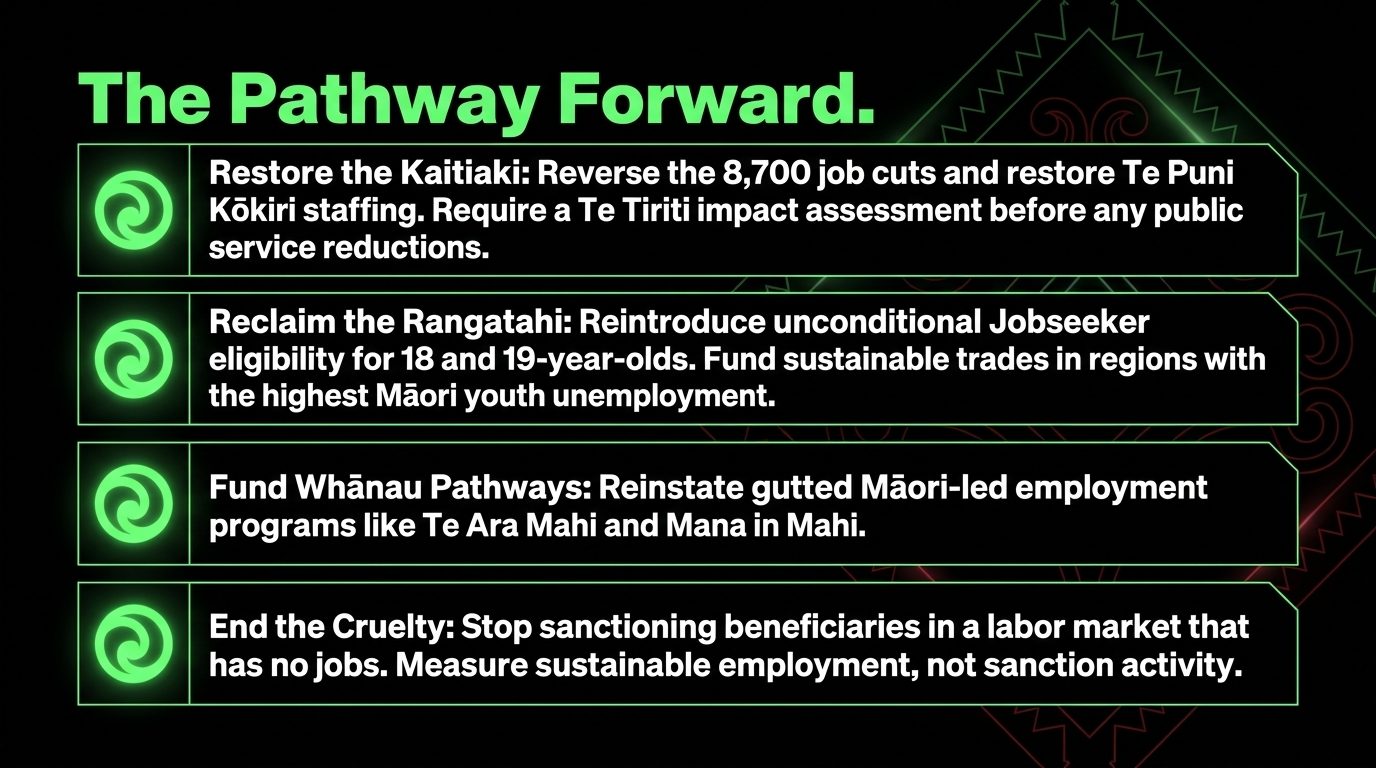
This government took office with unemployment at 4.0 percent. It leaves office — if you let it — with unemployment at 5.7 percent, the highest in 11 years Stats NZ. It has cut nearly 9,000 public service jobs while delivering $3.7 billion a year in tax cuts to the already advantaged RNZ; 1 News. Māori unemployment is 10.9 percent. Pacific unemployment is 11.5 percent Stats NZ. One in four teenagers cannot find work. Long-term unemployment is at crisis levels. Wages are falling behind prices.
This is not a government managing a difficult economy. This is a government that has actively made the labour market worse, quarter after quarter, and is now asking for another term to keep doing it.
Do not give them that term.
Vote For The Green Party: Why
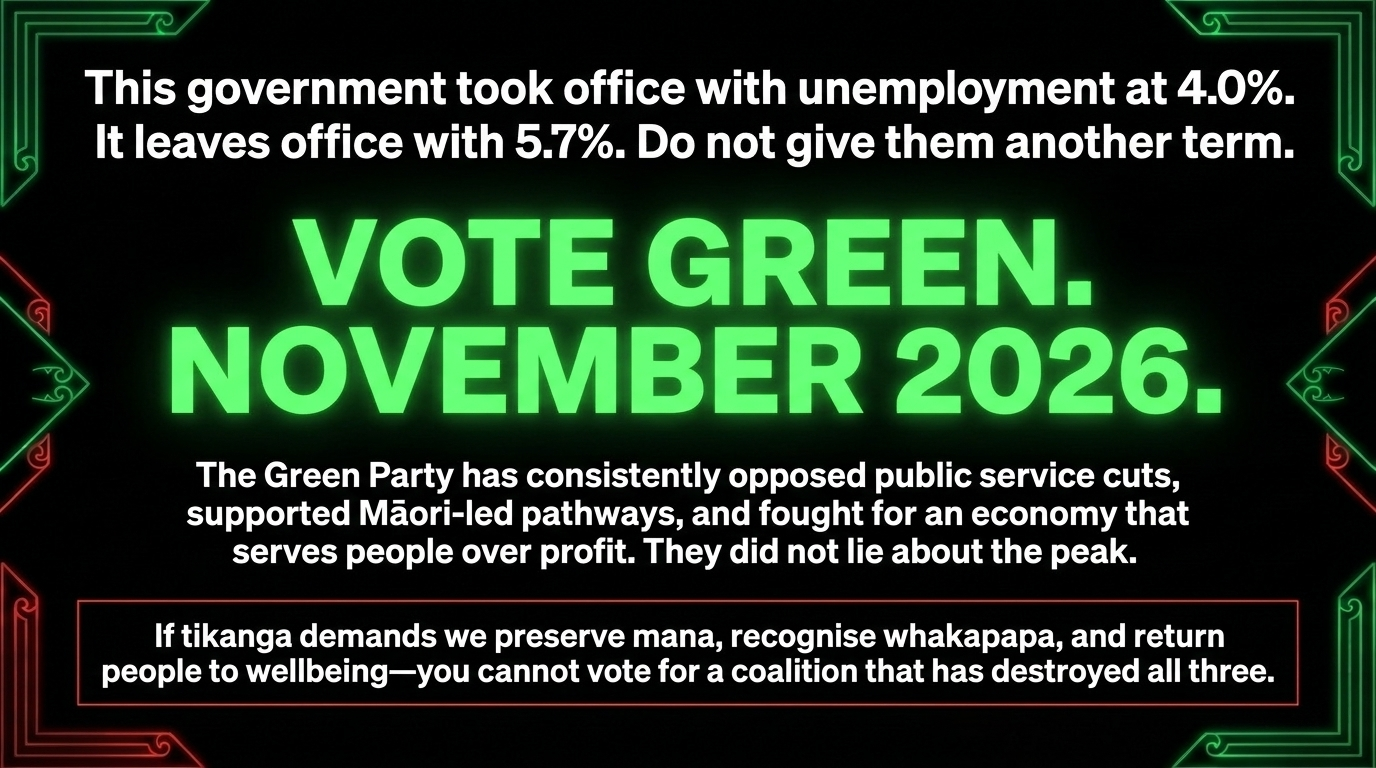
I am not here to endorse a party machine. I am here to tell you where your vote will do the least harm and the most good. The Green Party has consistently opposed public service cuts, supported Māori-led employment pathways, and argued for an economy that serves people rather than profit. They have not presided over 174,000 unemployed people. They have not presided over 10.9 percent Māori unemployment. They have not lied about the peak.
If you believe that tikanga demands we preserve mana, recognise whakapapa, respect wairua, involve whānau and return people to wellbeing, then you cannot vote for a coalition that has done the opposite on every count.
Vote Green. Vote to end this destruction. Vote to protect our whānau.
Koha Consideration
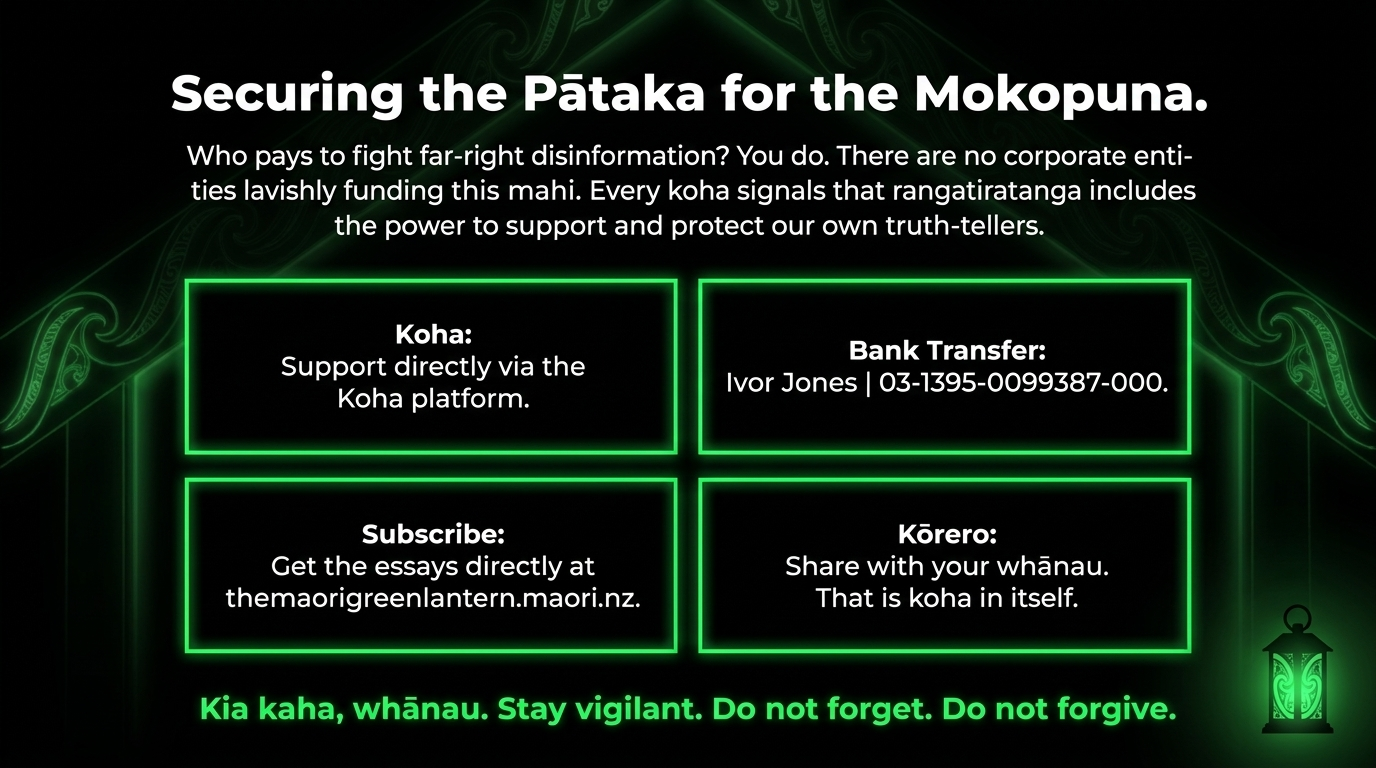
You might ask who is paying the Māori Green Lantern to produce over 1,000 high quality, high volume, cited, factually based essays fighting misinformation and disinformation from the far right in today's New Zealand society?
The answer is you do.
The Māori Green Lantern is supported through koha and that is it. You might think that there is a line of corporate entities lavishly funding Ivor to do this.
That would be incorrect.
There are no corporates supporting this mahi.
Every koha signals that whānau are ready to support and protect the accountability that Crown and corporate structures will not provide. It signals that rangatiratanga includes the power to support and protect our own truth tellers.
Kia kaha, whānau. Stay vigilant. Stay connected. And if you are able, consider a koha to ensure this voice continues.
If you are unable to koha, no worries! Subscribe or Follow the Māori Green Lantern at themaorigreenlantern.maori.nz, korero and share with your whānau and friends, that is koha in itself.
Four pathways exist:
For those who wish to support this mahi directly with a koha (voluntary contribution), please visit the Koha platform: Koha — Support The Māori Green Lantern
For those who wish to receive essays directly and support through subscription: Subscribe to the Māori Green Lantern
For those who prefer direct bank transfer, account details are: Ivor Jones, account number 03-1395-0099387-000.
For those on Facebook: The Māori Green Lantern on Facebook
Disclaimer
This essay is written by Ivor Jones in his personal capacity as The Māori Green Lantern. It does not represent or speak for Te Arawa, Ngāti Pikiao, any iwi, hapū, Māori organisation, or all Māori. All figures are drawn from publicly available sources, primarily Stats NZ, the Treasury, and RNZ, and are cited inline. This essay is political commentary and analysis, not legal or financial advice. Where previous essays by The Māori Green Lantern are referenced, they are cited with direct links to the published articles on themaorigreenlantern.maori.nz.