
"The Fast-Track Hustle - Wellington Signs The Consent. Whānau Inherit The Pipes, The Debt, And The Democratic Wreckage" - 15 September 2026
The Coalition calls it housing delivery. I call it a public-liability machine: developers get the uplift, Ministers get the headline, and whānau may inherit the pipes, the rates, the debt and the wreckage.


I am Ivor Jones, The Māori Green Lantern.
I stand with the taiaha of evidence in one hand and the public ledger in the other because this white supremacist neoliberal Government has made a habit of calling extraction “reform,” calling dispossession “efficiency,” and calling the bill dumped on whānau “growth.”
This is not an essay against housing. Aotearoa needs warm, secure, affordable homes. We need public housing. We need papakāinga. We need communities connected to work, education, transport, water, green space and whakapapa.
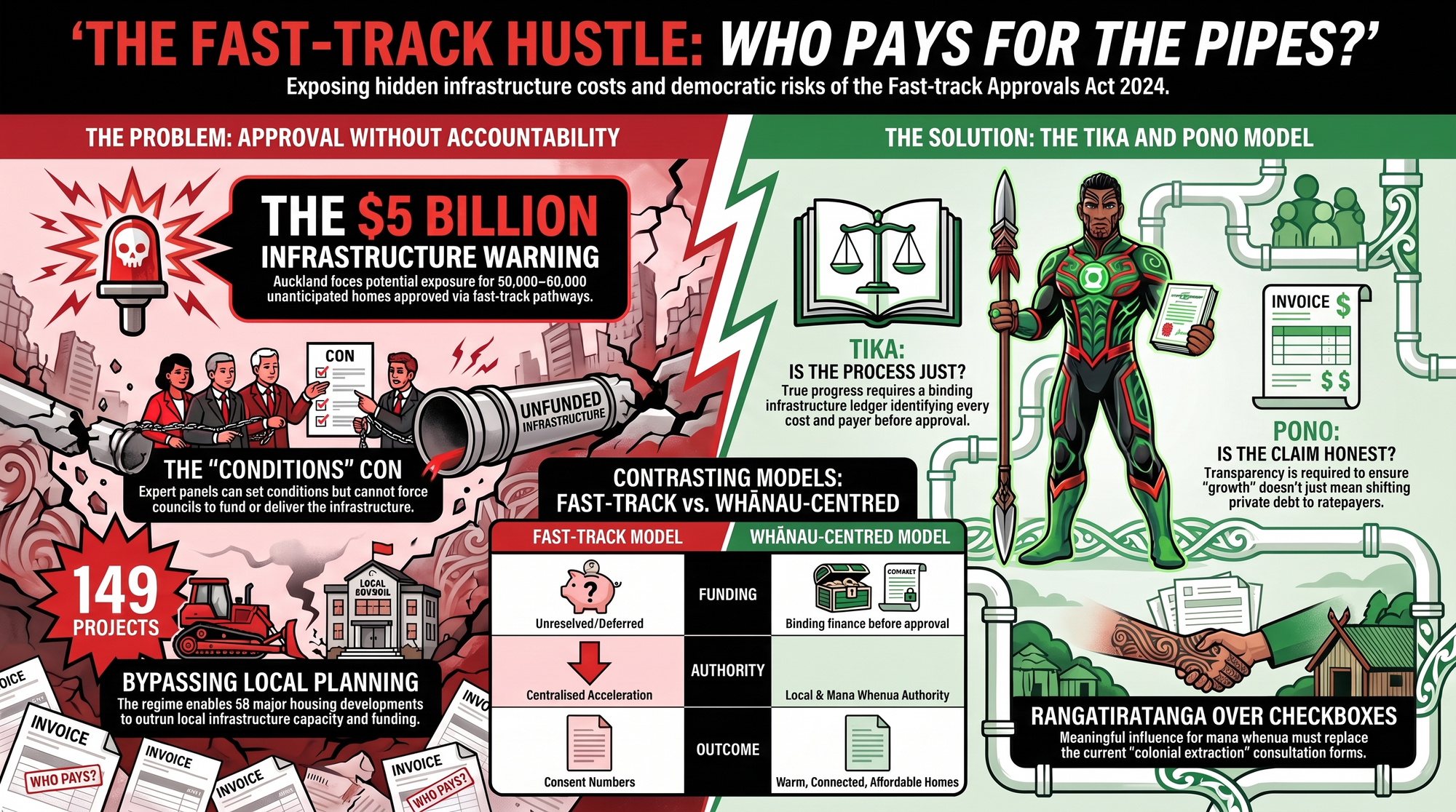
This is an essay against a political scam: a Government that sells a fast approval as if it were a functioning community, while councils, ratepayers, future residents and mana whenua may be left to carry the water, wastewater, stormwater, roads, public transport, operating costs, ecological harm and democratic wreckage.
 RNZ | Te Reo Irirangi o Aotearoa
 RNZ | Te Reo Irirangi o Aotearoa
In this essay I cover:
- The Government’s own admission that fast-track housing can outrun local infrastructure planning and funding.
- Auckland’s reported potential $5 billion infrastructure exposure for 50,000 to 60,000 unanticipated homes.
- The lie hidden inside the word “conditions”: a condition can govern a project, but it cannot automatically fund an entire public network.
- The impact on tikanga, mana whenua authority and the mauri of whenua and wai.
- Three plain-language examples for the Western mind.
- The Māori Green Lantern’s Tika And Pono Test applied to the fast-track regime.
- The election questions every candidate should answer before asking whānau for a vote in November 2026.
The central question is not whether houses should be built.
The central question is this:
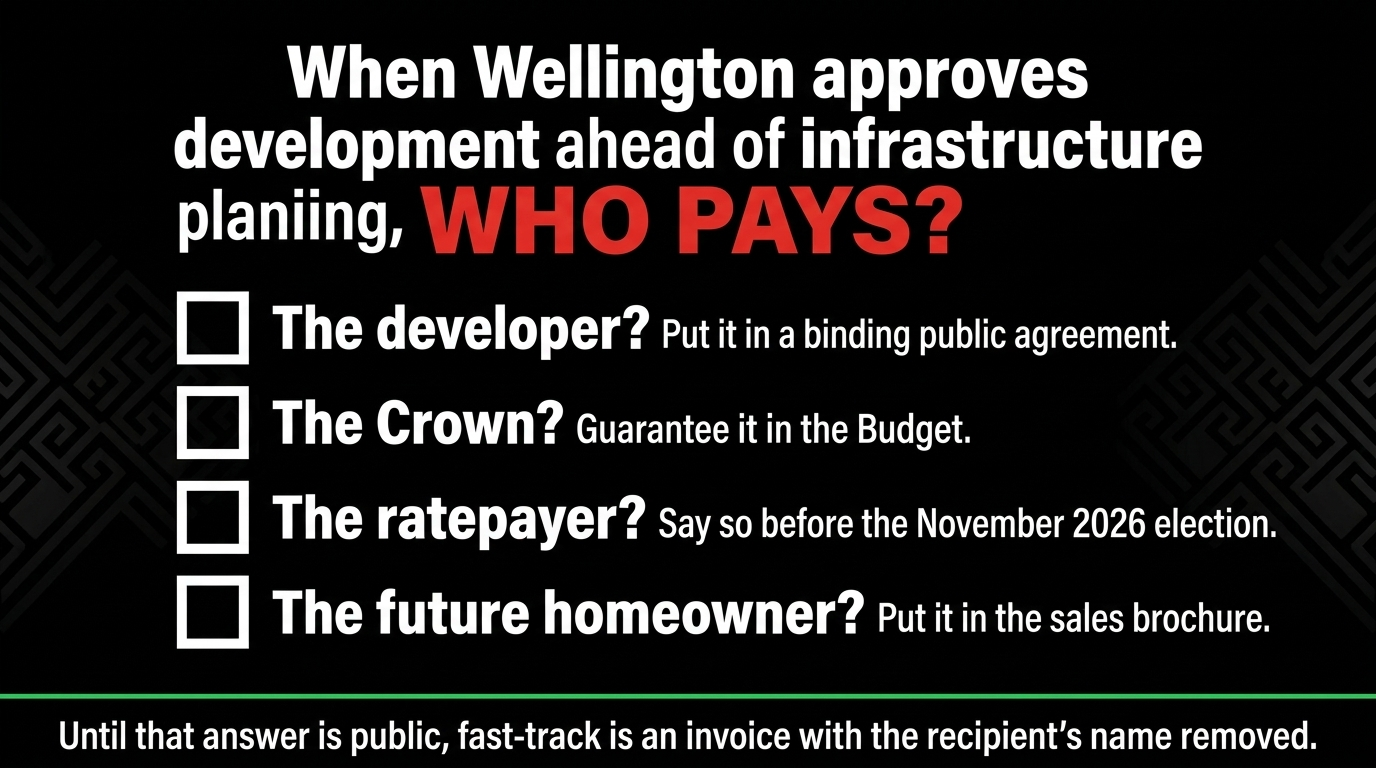
When Wellington approves development ahead of infrastructure planning, who pays when the pipes, roads, wastewater systems and public services cannot keep up?
The developer? Put it in a binding agreement.
The Crown? Guarantee it in the Budget.
The ratepayer? Say so before the election.
The future homeowner? Put it in the sales brochure.
Until that answer is public, fast-track is not housing policy.
It is an invoice with the recipient’s name removed.
The Consent Is Not The Community
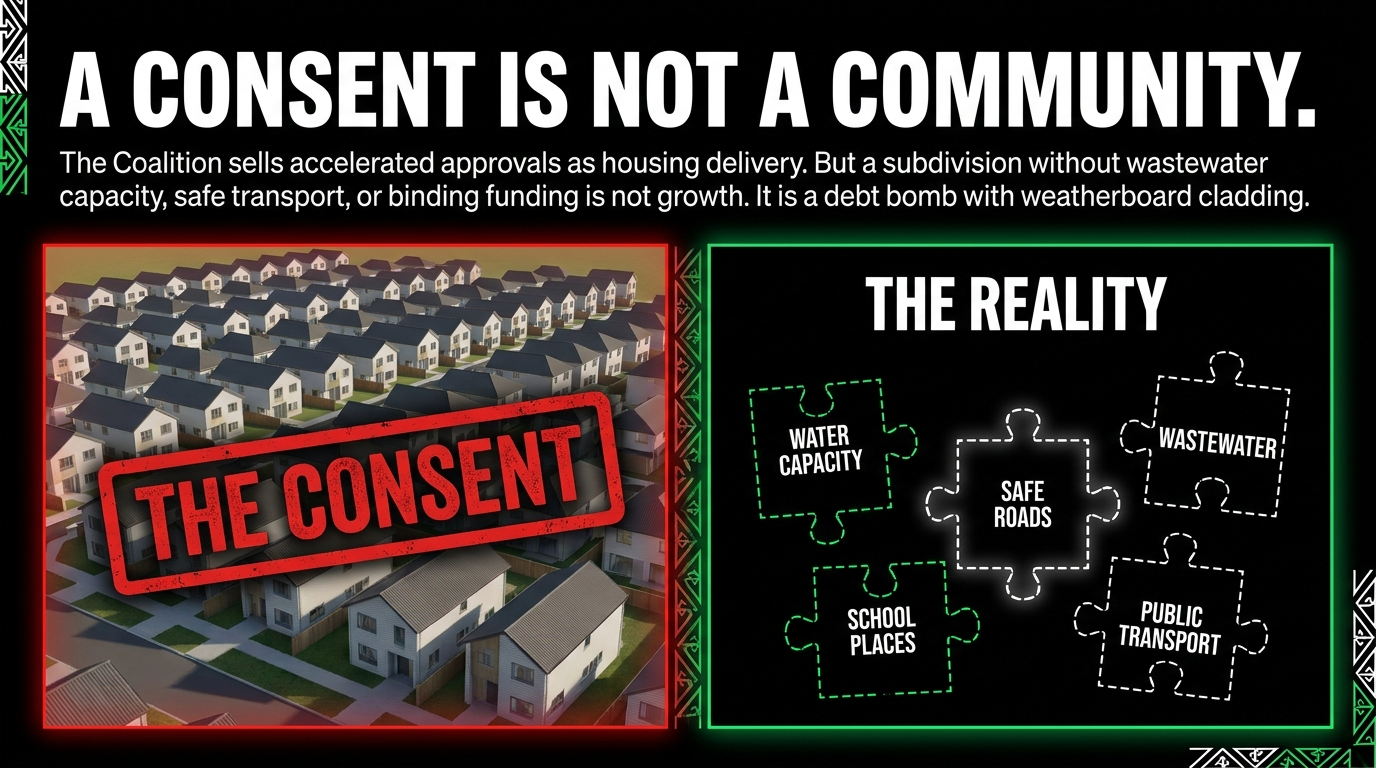
A ministerial referral is not water in a tap.
An expert-panel approval is not wastewater treatment capacity.
A developer’s glossy artist impression is not a safe road, an emergency route, a bus connection, a school place, a stormwater network or a guarantee that a young whānau will not be punished through higher rates for a development they never chose.
Yet Christopher Luxon’s Government wants the public to confuse approval with outcome.
The Fast-track Approvals Act 2024 establishes a permanent accelerated approvals pathway for projects claimed to have significant regional or national benefits. Some Schedule 2 projects can proceed directly to an expert-panel process, while other proponents can seek ministerial referral. The Ministry for the Environment says the regime became law in December 2024 and sits within the Coalition Government’s wider resource-management reforms. Ministry For The Environment: Fast-Track Approvals Process Fast-track Approvals Act 2024
There is nothing progressive about defending endless bureaucratic delay. Housing is a human right. Whānau cannot raise tamariki in cold, damp, overcrowded homes while politicians worship procedure.
But a house without water capacity is not housing security.
A subdivision without wastewater capacity is not community development.
A development without safe transport, emergency access, stormwater resilience, public facilities and binding funding is not “growth.”
It is a debt bomb with weatherboard cladding.
The Government’s own August statement says councils have raised concerns about fast-track developments, especially “unplanned” and “out-of-sequence” projects. The Government acknowledges such projects can proceed ahead of local infrastructure planning, consume capacity intended for planned growth, create cross-boundary effects and put pressure on wider networks beyond the costs councils can presently recover. Government: Improving Infrastructure Tools For Fast-Track
There it is: the confession inside the press release.
The Crown has admitted that its fast-track machine can approve development before the public system is ready to carry it.
The developer gets a pathway.
The Minister gets a headline.
The landowner gets uplift.
The council gets a crisis.
The ratepayer gets a bill.
The Government publicly acknowledges that out-of-sequence fast-track development can create network pressures and funding gaps that current council tools do not fully address. Government: Improving Infrastructure Tools For Fast-Track
The Deep Dive Podcast
Listen to a lively conversation between two hosts, unpacking and connecting topics in the sources of this essay. I apologise in advance for the AI's very harsh pronounciation of reo. Please dont shoot me, :).
Youtube Video
Like video? Here is a short video suppporting the essay. Again, don't shoot the messenger please because of AI's pronounciation. :)
Koha To Keep The Ledger Open
You might ask who supports The Māori Green Lantern to produce high-volume, evidence-based public-interest essays tracing the bills that Crown and corporate power try to hide.
The answer is whānau.
There are no corporate sponsors behind this mahi. No developer fund. No ministerial patron. Every koha tells me that whānau are prepared to support the accountability that Crown and corporate structures refuse to provide—especially when the public is being asked to carry the debt, water risk, infrastructure stress and democratic consequences of fast-tracked development.
Supporting independent Māori truth-telling is rangatiratanga in practice. It is the power to support our own kaitiaki of evidence, our own public record and our own resistance to extraction.
If this essay helped you see the bill behind the bulldozer, and you are able to support this mahi:
- Koha Directly: Support The Māori Green Lantern Through Koha
- Subscribe For Essays: Subscribe To The Māori Green Lantern
- Direct Bank Transfer: Ivor Jones — 03-1395-0099387-000
- Facebook Support: Follow Or Subscribe To The Māori Green Lantern On Facebook
If you cannot koha, kāore he raruraru. Subscribe Or Follow The Māori Green Lantern, kōrero with your whānau and share this essay with friends.
That is koha too.
The Five Billion Dollar Warning
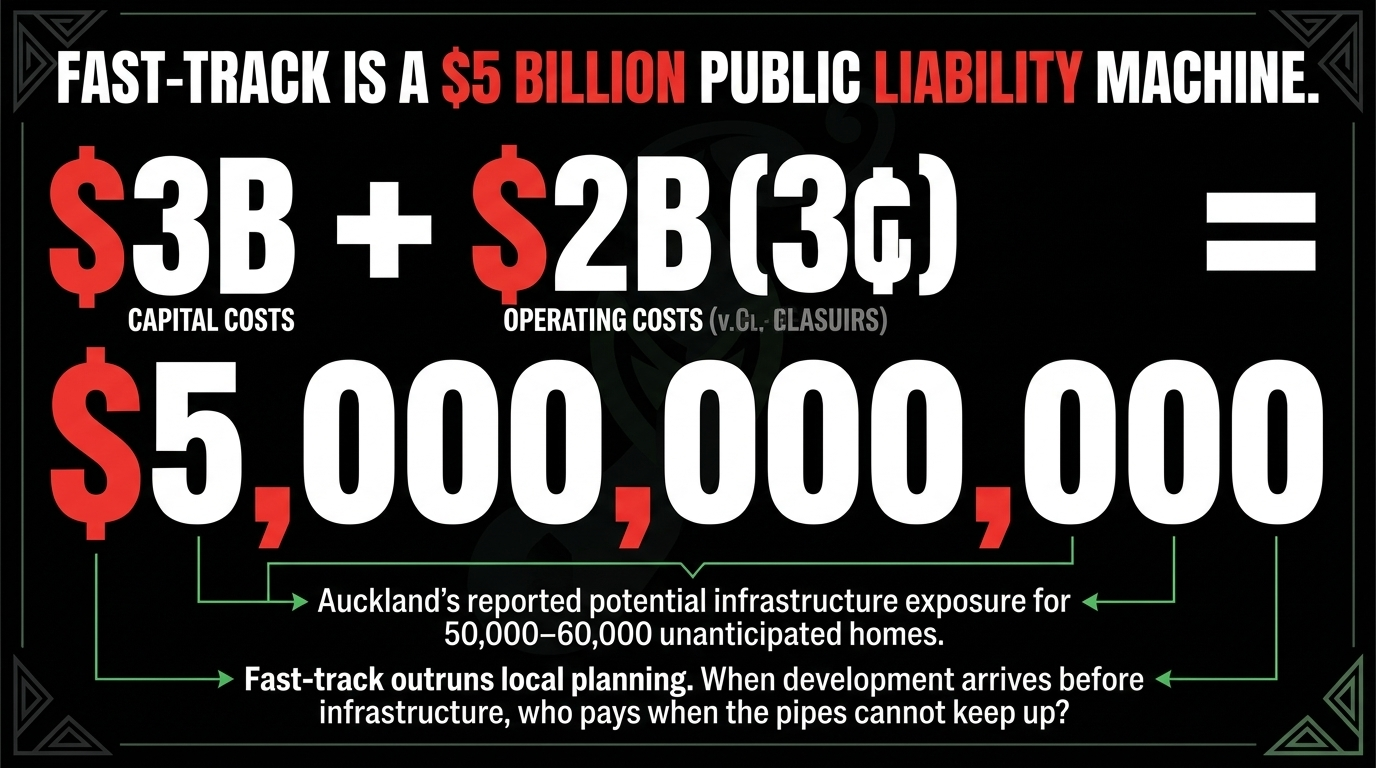
Auckland Council is confronting the scale of this political gamble.
RNZ reports that Auckland faces a potential infrastructure bill of up to $5 billion related to 50,000 to 60,000 unanticipated homes. The reported figure consists of around $3 billion in capital costs plus up to $2 billion in operating costs. RNZ: PM Christopher Luxon Unwilling To Pause Referrals Of Fast-Track Housing Projects
That represents a potential cost scale of roughly $83,333 to $100,000 per potential dwelling.
That is not an invoice. It is not a forecast that every household will pay that amount. It is not proof that every house will be built, that every cost will be incurred, or that every dollar will land on rates.
It is a warning.
Auckland Council has reportedly begun investigating how it may tell developers and potential residents that it will not provide or fund some services in out-of-sequence projects. RNZ: PM Christopher Luxon Unwilling To Pause Referrals Of Fast-Track Housing Projects
Imagine a whānau buying a first home in a place marketed as “growth.” They see the render. They see the promise. They see the sales brochure.
Then public infrastructure is not funded on the timetable they believed was guaranteed.
That is not home ownership.
That is a future sold on credit while somebody else works out whether the pipes can cope.
The Government calls it a housing pipeline. Auckland may be staring at a public-liability pipeline.
RNZ reports the potential $5 billion figure and the 50,000–60,000-home range. The per-home figures are transparent arithmetic illustrations, not a prediction of household charges. RNZ: PM Christopher Luxon Unwilling To Pause Referrals Of Fast-Track Housing Projects
The Future-Tense Fix
Chris Bishop and Simon Watts say they will strengthen local-government infrastructure-funding tools. That concession is important because it reveals that the present tools are insufficient.
But the political trick is hidden in the timing.
The Government says its proposed immediate Local Government Act changes will not apply to fast-track projects already approved or projects with substantive applications lodged when the changes start. It says a broader replacement system of development levies is expected to operate by 2029. Government: Improving Infrastructure Tools For Fast-Track Regulatory Analysis: Improving Local Government Infrastructure Funding Settings
The sequence is obscene:
- Accelerate approval now.
- Admit councils cannot fully recover costs now.
- Promise reform later.
- Leave some of the existing pipeline outside the repair.
Luxon says New Zealand should not turn projects “off and on.” He says the previous approval system was “abysmally slow.” He says he makes “no apologies” for fast-track. He says 13 housing developments had been approved across the fast-track regime when he spoke to RNZ. RNZ: PM Christopher Luxon Unwilling To Pause Referrals Of Fast-Track Housing Projects
But nobody is asking the Government to turn housing off.
We are asking it to turn recklessness off.
We are asking it to stop treating communities like an afterthought in a developer’s project plan.
We are asking it to guarantee that where Wellington overrides the local infrastructure sequence, Wellington—or the developer—pays.
Approval now. Accountability later. This is not a housing strategy. It is a delayed-invoice scheme.
The Government says its immediate changes will not cover all already-approved or substantively lodged projects, while its broader levy system remains projected for future operation. Government: Improving Infrastructure Tools For Fast-Track Regulatory Analysis: Improving Local Government Infrastructure Funding Settings
The Conditions Con
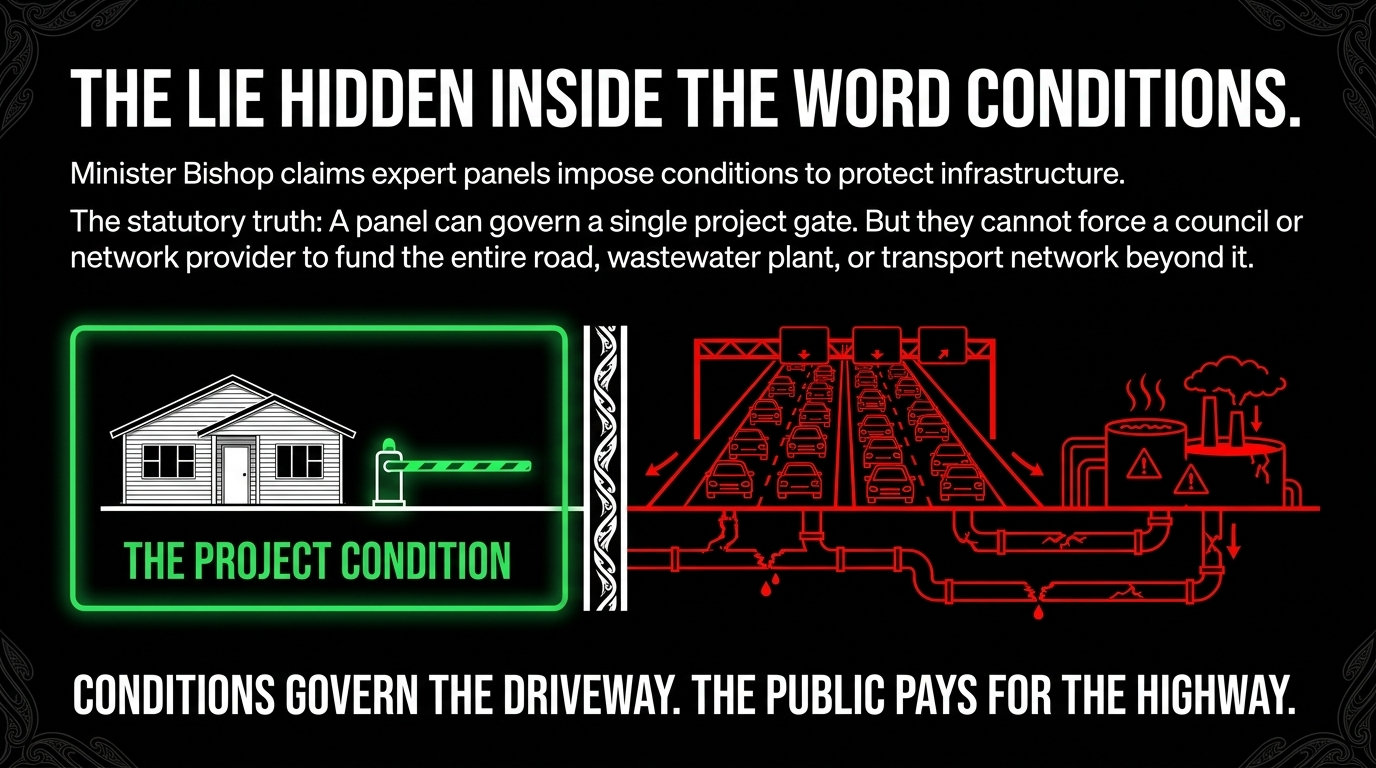
Housing Minister Chris Bishop says Local Government New Zealand is “well ahead of the facts.” He says only a small number of housing developments have final approval, none are past early construction, and expert panels can impose conditions requiring roads, water, wastewater and other infrastructure to be in place before construction starts. Bishop also says a panel cannot force a council or infrastructure provider to fund or deliver that infrastructure. RNZ: Fast-Track Housing Projects Already Putting Enormous Strain On Infrastructure — LGNZ
The Minister is right on one point: the material reviewed here does not prove that every fast-track housing project has already caused a completed infrastructure failure. A fast-track consent is not a blanket right to build regardless of infrastructure constraints.
But his own statement exposes the problem.
The panel cannot force a council or network provider to pay for the works.
Exactly.
The Fast-track Approvals Act 2024 allows panels to impose conditions intended to ensure relevant infrastructure is, or can be made, adequate.
But a condition is not a wastewater plant.
A condition is not a public-transport service.
A condition is not a stormwater system.
A condition is not a 30-year maintenance budget.
A condition is not a Crown guarantee.
A condition is not an answer to the question of who pays when several “individually manageable” developments hammer the same water, sewer, stormwater or transport network.
The Government’s own announcement concedes that wider funding problems can exceed what project-specific conditions address. Government: Improving Infrastructure Tools For Fast-Track
This is the heart of the scam:
A condition can govern one gate. It cannot automatically fund the whole road beyond it.
LGNZ wants changes to development-contribution settings, cumulative-effects assessment, a pause on ministerial referrals and a longer-term review. RNZ: Fast-Track Housing Projects Already Putting Enormous Strain On Infrastructure — LGNZ
The Coalition calls that obstruction.
I call it adult supervision.
The statutory infrastructure-condition power, Bishop’s public comments and the Government’s recognition of wider funding gaps are documented. Fast-track Approvals Act 2024 RNZ: Fast-Track Housing Projects Already Putting Enormous Strain On Infrastructure — LGNZ Government: Improving Infrastructure Tools For Fast-Track
Three Examples For The Western Mind
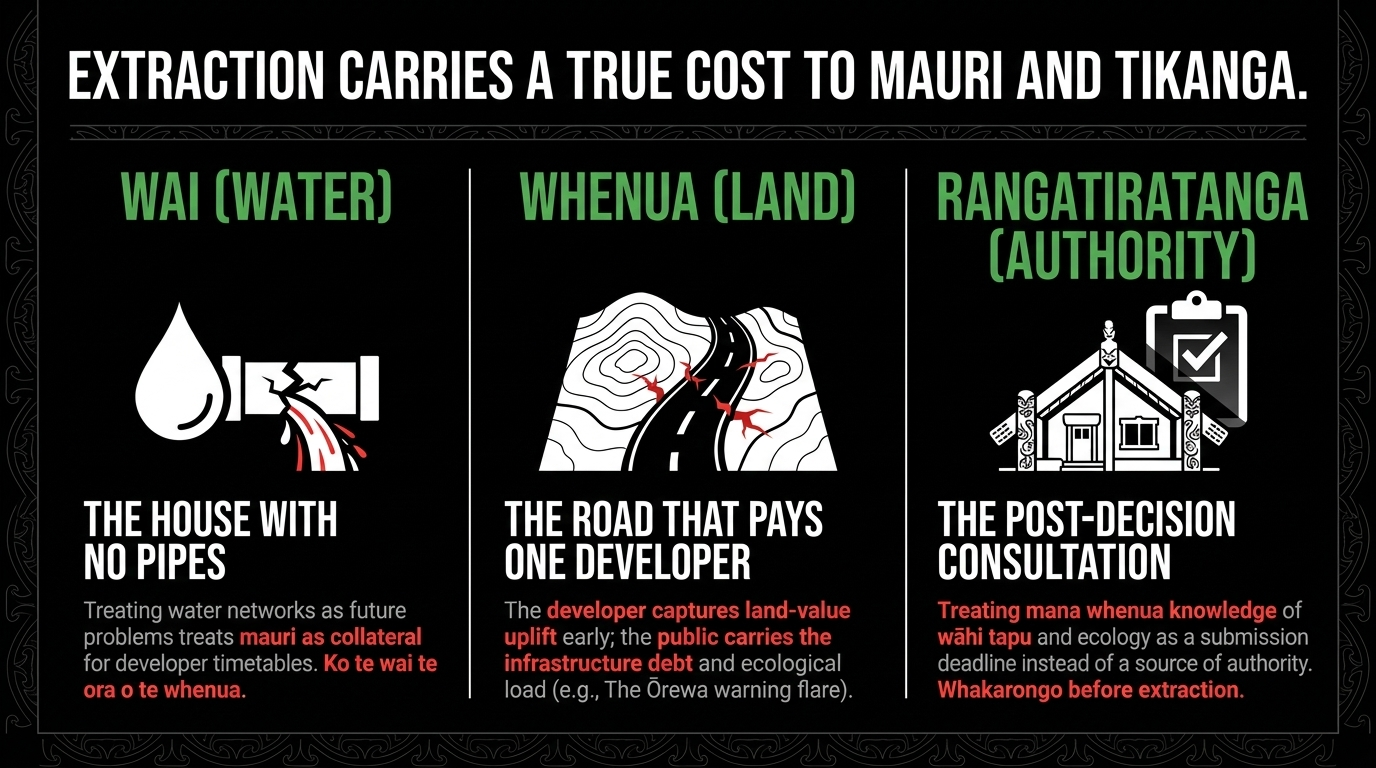
Western politics often hides destructive decisions inside bloodless phrases like “capacity,” “sequencing,” “cost recovery” and “regulatory efficiency.”
So let me translate this Government’s policy into plain language.
Example One: The House With No Proper Pipes
Imagine buying a brand-new home because the paperwork says it is approved.
The kitchen is shiny. The lawn is green. The brochure says “community.”
Then you discover the wider wastewater network still needs major work, water supply is under pressure, and the council is working out whether it can afford the upgrades.
You would not call that a finished home.
You would call it a liability with cladding.
The Auckland warning is up to $5 billion for 50,000–60,000 unanticipated homes:
\$3,000,000,000 + \$2,000,000,000 = \$5,000,000,000RNZ: PM Christopher Luxon Unwilling To Pause Referrals Of Fast-Track Housing Projects
The Harm: Existing communities can face rate pressure, delayed public works and reduced service resilience. Future residents may inherit a home connected to a system that was never fully financed.
The Solution: No final fast-track approval without a publicly available, binding infrastructure ledger that identifies every on-site and off-site work, its total cost, the payer, the delivery date, the operating responsibility and the enforcement mechanism.
The Tikanga Impact: Wai is not an “externality.” Wai is life. Ko Te Wai Te Ora O Te Whenua. Treating water and wastewater capacity as a future problem treats the mauri of the place as collateral for somebody else’s development timetable.
Example Two: The Road That Belongs To Everyone But Pays Out For One Developer
Imagine a developer gets a rapid approval for a subdivision.
It builds the entrance road.
Then the council must widen the arterial road, rebuild intersections, fund buses, improve emergency access and manage the extra traffic caused by thousands of additional trips.
The developer captures the land-value uplift. The public system carries the load.
That is the infrastructure-transfer trick.
Auckland Council planning material in the wider Ōrewa context records concerns and requirements around bulk water supply, firefighting water, wastewater capacity, cumulative traffic modelling, emergency resilience, safe access and development staging linked to transport upgrades. Auckland Council Plan Change 119 Material
The Harm: Existing whānau can be left with congestion, less safe roads and delayed investment in services they already rely on. Future residents can be pushed into car-dependent development sold as opportunity.
The Solution: Require cumulative-effects analysis across all current, approved, planned and proposed development using the same transport, water, wastewater and stormwater networks.
The Tikanga Impact: Tikanga is responsibility for relationships, not merely property boundaries. In Western language: if you profit by adding pressure to a shared system, you should pay to strengthen that shared system.
Example Three: The Consultation That Arrives After The Direction Is Set
Imagine a corporation arrives with planners, engineers, lawyers, financiers and a preferred development outcome.
The Crown gives it an accelerated statutory corridor.
Mana whenua and local communities are then asked to respond to technical evidence about water, ecology, transport, cultural landscapes and infrastructure on a timetable they did not write.
That is not equal participation.
That is a race where one party has a vehicle and the other is told to run.
The fast-track process requires consultation with relevant iwi and Māori groups and includes Treaty-related reporting. But Auckland Council says it does not make fast-track decisions; it can provide advice, comment and oversee compliance, while decisions occur through the statutory fast-track process and expert-panel pathway. Ministry For The Environment: Fast-Track Approvals Process Auckland Council: Fast-Track Approvals
The Harm: Mana whenua can be formally consulted yet structurally underpowered. Knowledge of wai, whenua, wāhi tapu, ecosystems and community capacity can be treated as a submission deadline instead of a source of authority.
The Solution: Provide independent technical resourcing for iwi and hapū; require early engagement before project design hardens; publish all modelling and conditions; and establish decision-making structures in which mana whenua have meaningful influence.
The Tikanga Impact: Whakarongo Before Extraction. Listen before taking. Protect mauri before monetising whenua. That is not anti-development. That is kaitiakitanga.
Ōrewa Is The Warning Flare
The proposed 61-hectare Delmore development on farmland at Ōrewa is a warning flare. RNZ reports the development has attracted criticism about infrastructure. RNZ: Fast-Track Housing Projects Already Putting Enormous Strain On Infrastructure — LGNZ
The evidence reviewed here does not establish that Delmore will necessarily fail or produce every harm feared by opponents. Such a claim would require final decision documents, funding agreements, compliance evidence and construction outcomes.
But the public planning material establishes something more basic: housing is never just a number on a Minister’s press release.
It is bulk water supply.
It is firefighting water.
It is wastewater capacity.
It is stormwater resilience.
It is whether a road can carry the traffic.
It is whether ambulances can get through.
It is whether a single access route can cope in an emergency.
It is whether a public network can absorb a private timetable.
Auckland Transport’s submitted concerns include cumulative traffic modelling and assessment of network performance and resilience. Auckland Council Plan Change 119 Material
The developer’s render never shows the traffic queue.
It does not show the wastewater upgrade.
It does not show the stormwater overflow.
It does not show the rates bill.
It does not show the whānau who discover that “approved” did not mean “ready.”
The reported concerns and planning material are available. Unverified: the final cost, compliance and infrastructure outcome for Delmore itself. RNZ: Fast-Track Housing Projects Already Putting Enormous Strain On Infrastructure — LGNZ Auckland Council Plan Change 119 Material
Rangatiratanga Is Not A Checkbox
The Fast-track Approvals Act 2024 contains provisions relating to Treaty settlements, recognised customary rights and relevant iwi and Māori groups. The Ministry for the Environment says prospective referral applicants must consult relevant local authorities, iwi/Māori groups and administering agencies, while Treaty-related reports are prepared for applications. Ministry For The Environment: Fast-Track Approvals Process
But the law’s minimum is not justice.
A consultation requirement does not become rangatiratanga because it appears in a statutory checklist.
The developer arrives resourced. The Crown gives it an accelerated pathway. The community is expected to understand engineering reports, hydrology, traffic models, ecology, planning law, financial models and wastewater capacity at speed. Mana whenua are expected to defend their relationship with whenua and wai while the clock belongs to the people who want to build through it.
Auckland Council confirms that it can give advice, comment and oversee compliance but does not make fast-track decisions. Auckland Council: Fast-Track Approvals
So the real question is not whether consultation happened.
The question is whether mana whenua had time, resources, information and actual leverage to shape the decision before it became irreversible.
Anything less is colonial extraction with a consultation form attached.
The statutory process and Council’s stated role are documented. The adequacy of engagement on individual projects not investigated project by project for this essay is unverified. Fast-track Approvals Act 2024 Ministry For The Environment: Fast-Track Approvals Process Auckland Council: Fast-Track Approvals
The National Machine Of Extraction
This is not a small experiment.
The Ministry for the Environment says 149 projects have been listed in Schedule 2: 58 housing and land-development projects, 43 infrastructure projects, 22 renewable-electricity projects, 11 mining projects, seven aquaculture and farming projects, and eight quarrying projects. Ministry For The Environment: Government Releases Listed Projects
The Ministry says Auckland has 28 listed projects and the Bay of Plenty has 12. Ministry For The Environment: Government Releases Listed Projects
This is a national machine for reshaping land, water, infrastructure and democratic authority.
It is a machine built to accelerate private proponents through public systems.
It is a machine that can deliver land-value uplift early while infrastructure debt, ecological risk, local frustration and ratepayer exposure are pushed down the road.
It is a machine that calls its victims “stakeholders.”
The Māori Green Lantern has already traced parts of this fast-track whakapapa.
In The Toll Gate On Stolen Ground, I examined reported political-donation links involving fast-track project interests and governing parties, and the risks to Māori whenua, wai and democratic integrity.
In How A White Supremacist Neoliberal Regime Turned Our Wai And Moana Into Profit Streams, I traced how fast-track sits within a wider programme of weakening environmental safeguards and public authority.
In The Trapdoor And The Taniwha, I documented a separate Hamilton case in which the identifiable minimum reported ratepayer ask was calculated as:
\$5,000,000 + (\$250,000 \times 5) = \$6,250,000That Hamilton figure is not evidence of Auckland’s final liability. It is evidence of a recurring political pattern: private development pressure, public infrastructure exposure and ratepayers asked to close the gap.
The pattern is simple:
Private upside. Public downside. Māori consultation. Crown control. Ratepayer liability.
The white supremacist neoliberal architecture is not always a boot on a throat.
Sometimes it is a Cabinet paper.
Sometimes it is a ministerial referral.
Sometimes it is a consent process built for speed.
Sometimes it is an infrastructure cost pushed so far down the road that the politician who caused it has already moved on.
The Māori Green Lantern’s Tika And Pono Test
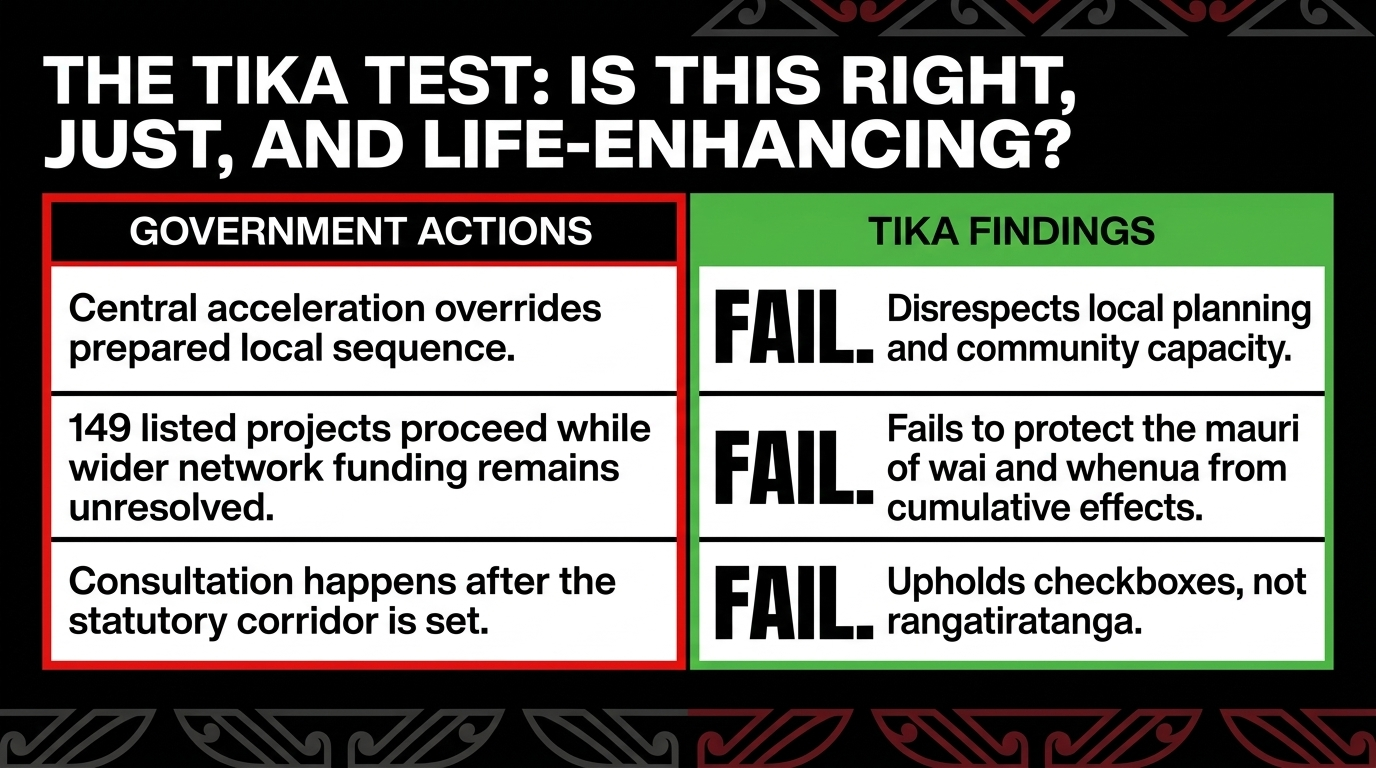
I apply the Māori Green Lantern’s Tika And Pono Test to every Government claim of “progress.”
Tika asks: Is this right? Is the process just, proportionate, accountable and life-enhancing?
Pono asks: Is this true? Is the claim honest, evidenced, transparent and capable of being tested?
A Parliament can pass a law.
A Minister can sign a referral.
A panel can issue a consent.
None of that automatically makes the outcome tika.
None of that automatically makes the Government’s marketing pono.
The Tika Test: Is It Right?
| Tika Question | Evidence | Tika Finding |
|---|---|---|
| Does the policy put whānau before private windfall? | The Government acknowledges that out-of-sequence fast-track development can create wider infrastructure costs beyond current council recovery tools. Government: Improving Infrastructure Tools For Fast-Track | Not Met Unless Developers Or The Crown Carry Full Costs. |
| Does the process respect local planning and community capacity? | The Government says fast-track can move projects ahead of local infrastructure planning; Auckland Council does not make fast-track decisions. Government Auckland Council | Not Met Where Central Acceleration Overrides Prepared Local Sequence. |
| Does it protect the mauri of wai and whenua? | Infrastructure conditions exist, but the Government acknowledges wider network issues not always solved by project conditions. Fast-track Approvals Act 2024 Government | Not Demonstrated. Cumulative Effects Must Be Publicly Tested. |
| Does it uphold rangatiratanga? | Consultation and Treaty-related reports are required, but final decisions are embedded in the fast-track structure. Ministry For The Environment Auckland Council | Not Met Unless Mana Whenua Have Resourced, Timely And Meaningful Influence. |
| Does it make growth pay for growth? | The Government says it must improve funding settings, while excluding already-approved and substantively lodged projects from immediate changes. Government | Not Met For The Existing Pipeline Unless Costs Are Secured. |
The tikanga finding is blunt:
A fast-track project is not tika merely because it has a consent. It becomes tika only when the whenua is protected, mana whenua have real authority, infrastructure is ready, those who profit carry their full responsibilities, and whānau are not left holding risk for somebody else’s gain.
On the evidence available, this Coalition has not demonstrated that standard.
It has demonstrated the opposite risk: approval first, accountability later.
The Tika finding is my evidence-based public-interest opinion applying tikanga to the documented record. Fast-track Approvals Act 2024 Government: Improving Infrastructure Tools For Fast-Track
The Pono Test: Is It True?
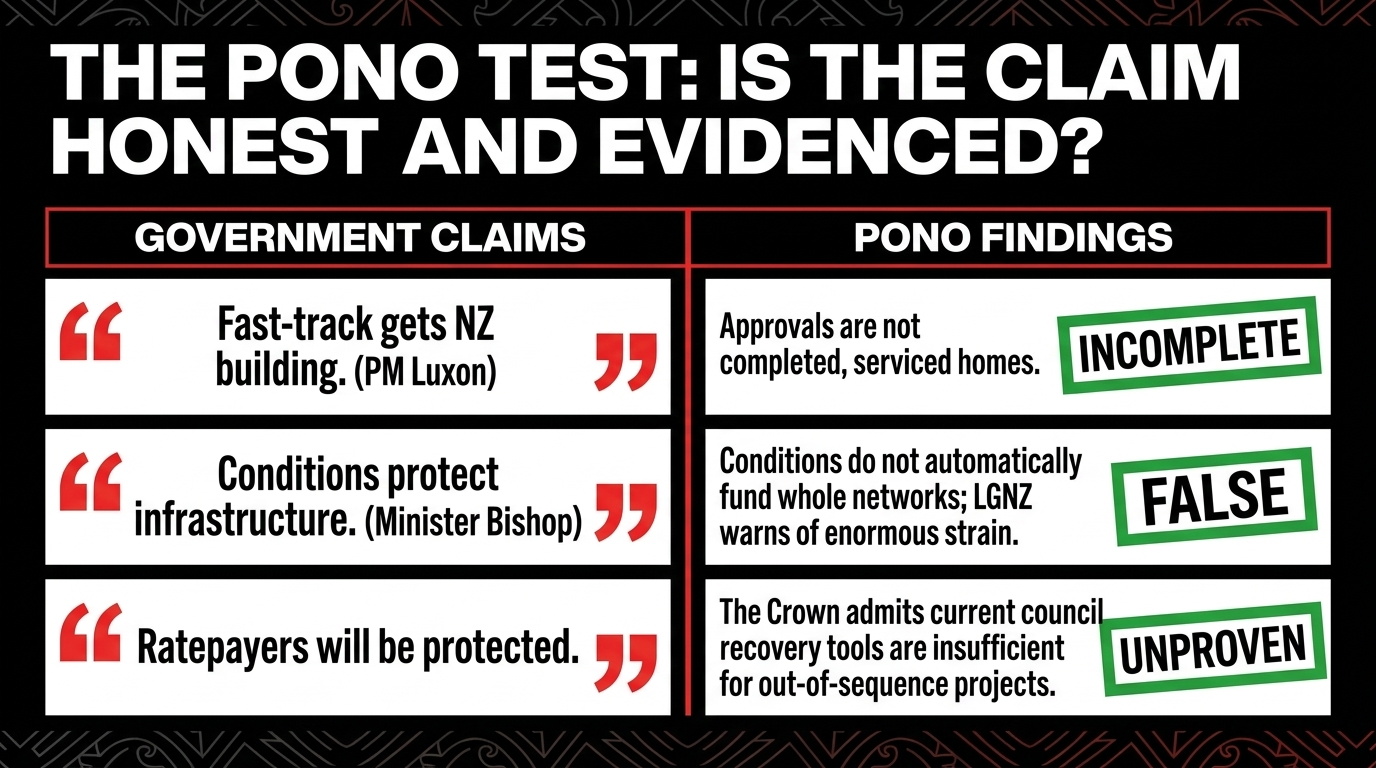
The Coalition’s story is that fast-track delivers homes, jobs, infrastructure and growth faster.
Pono asks whether that story survives contact with the evidence.
| Government Claim | What The Evidence Shows | Pono Finding |
|---|---|---|
| “Fast-track gets New Zealand building.” | Luxon says 13 housing developments had been approved when he spoke to RNZ. Approval is not the same as completed, occupied and fully serviced homes. RNZ | Partly True, But Incomplete. |
| “Conditions protect infrastructure.” | Conditions can be imposed, but Bishop says panels cannot force councils or providers to fund or deliver infrastructure; Government admits wider funding gaps. RNZ Government | Incomplete. Conditions Do Not Automatically Fund Whole Networks. |
| “Ratepayers will be protected.” | Auckland faces a reported potential exposure of up to $5 billion; Government admits current recovery weaknesses. RNZ Government | Not Demonstrated. |
| “The Government is fixing it.” | Immediate changes exclude some projects already approved or substantially lodged; broader levies remain future policy. Government | True Only In Future Tense. |
| “Consultation protects Māori interests.” | Process requirements exist, but the quality and power of engagement must be assessed project by project. Ministry For The Environment | Not Proven As A General Claim. |
The pono finding is equally clear:
The Government’s story contains fragments of truth. There is a fast-track process. Panels can impose conditions. Approvals have been issued. But the story becomes misleading when it treats approval as delivery, conditions as fully funded infrastructure, consultation as rangatiratanga and future law changes as protection for communities already exposed today.
Pono requires the whole truth.
Not the headline.
Not the press release.
Not the slogan.
The whole ledger.
The Pono findings are evidence-based public-interest commentary applying the Māori Green Lantern’s test to the record. RNZ RNZ Government
The Question Luxon Cannot Duck
Christopher Luxon says he will not pause fast-track housing referrals.
His Government says it will improve council infrastructure-funding tools.
His Government also admits that out-of-sequence development can create wider costs councils cannot fully recover. Government: Improving Infrastructure Tools For Fast-Track
So I ask the Prime Minister again:
When a fast-tracked development requires pipes, roads, wastewater capacity, stormwater works, public transport, emergency access and decades of maintenance that a council did not plan or budget for—
Who pays?
The developer? Put it in a binding public agreement.
The Crown? Guarantee it in the Budget.
The ratepayer? Say so before the election.
The future homeowner? Put it in the sales brochure.
Until that answer is public, fast-track is not a housing policy.
It is an invoice with the recipient’s name removed.
What Real Housing Policy Looks Like
I reject the false choice between fast-track extraction and no homes.
A real housing policy is not anti-development.
It is anti-exploitation.
| The Coalition’s Fast-Track Model | A Whānau-Centred Housing Model |
|---|---|
| Approval first; finance unresolved or deferred | Binding infrastructure finance before final approval |
| Project-by-project conditions | Cumulative network-wide assessment |
| Centralised acceleration | Local accountability and mana whenua authority |
| Future repair promised | Costs, responsibilities and timelines published now |
| Risk shifted to councils and ratepayers | Growth pays for growth; Crown pays when it overrides sequence |
| Success measured by consent numbers | Success measured by warm, serviced, connected and affordable homes |
| Consultation as procedure | Rangatiratanga as resourcing, influence and authority |
A home is not a yield figure.
A home is not a consent number.
A home is not a Cabinet trophy.
A home is water that runs, wastewater that works, roads that do not trap people in traffic, public transport that arrives, whenua that is protected and whānau who are not punished through their rates for somebody else’s windfall.
The Fast-Track Accountability Test
Before any candidate asks for a vote in November 2026, I say they should answer these questions publicly.
- Will you pause new ministerial fast-track housing referrals until enforceable infrastructure-funding rules are operating?
- Will you publish a project-by-project infrastructure ledger covering water, wastewater, stormwater, roads, transport, operating costs and maintenance?
- Will you guarantee that developers—not existing ratepayers—carry the full growth costs caused by their projects?
- Will you require cumulative-effects modelling where projects share infrastructure networks?
- Will you support independent technical resourcing for mana whenua so iwi and hapū can assess evidence and exercise genuine authority?
- Will you publish conditions, funding agreements, development levies, compliance reports and cost transfers?
- Will you commit central-government funding where central government has overridden a council’s planned infrastructure sequence?
A candidate who cannot answer these questions is asking whānau to vote blind.
A party that approves projects but refuses to secure their infrastructure funding is not offering housing policy.
It is offering a liability-transfer scheme with a blue, yellow or black logo.
The Moral Ledger
This election is not only a verdict on Christopher Luxon’s speeches.
It is a verdict on who carries the consequences of his Government’s decisions.
If your whānau depends on affordable rates, secure water, functioning wastewater systems, safe roads, public transport, accountable planning, protected whenua, healthy wai and meaningful mana whenua authority, ask the question this Coalition does not want asked:
Who gains when approval is fast-tracked, and who pays when the infrastructure is not?
Do not vote for a party because it says “build.”
Ask whether it will build the pipes.
Ask whether it will fund the roads.
Ask whether it will protect the wai.
Ask whether it will uphold rangatiratanga.
Ask whether it will publish the bill before it expects your vote.
A Government that cannot meet that test does not deserve a blank cheque from whānau in November.
They approve.
Developers profit.
Councils scramble.
Ratepayers pay.
Whānau wait for the pipes.
That is not delivery.
That is the fast-track hustle.
Ko Te Wai Te Ora O Te Whenua. Ko Te Whenua Te Ūkaipō O Te Tangata.
Water is the life of the land. Land is the sustaining source of the people.
The whenua remembers who took the profit.
Whānau remember who inherited the cost.

Disclaimer: This is evidence-based public-interest analysis and opinion, not legal advice. It does not allege unlawful conduct by any individual, company, council or Government agency. Facts are attributed to the cited record; opinion and analysis are identified as such.