"Willie Jackson Forgot His Own Net — and I Am Not Going to Be Polite About It" - 20 August 2026
He built the trap in 2017. His own candidate is using a version of it in Te Tai Tonga right now. And this week he stood up and called Te Pāti Māori dangerous for fishing the same water. I'm calling it what it is: a career built on Māori votes, dressed up as concern for Māori seats.

I Know a Con When I See One
I've watched this move my whole life.
The uncle who taught you to set the hīnaki, who showed you exactly where the tuna run thick
— and years later stands on the bank shouting that your net is illegal while his sits there dripping, still warm.
That's Willie Jackson this week, and I'm done being diplomatic about it.
 RNZ | Te Reo Irirangi o Aotearoa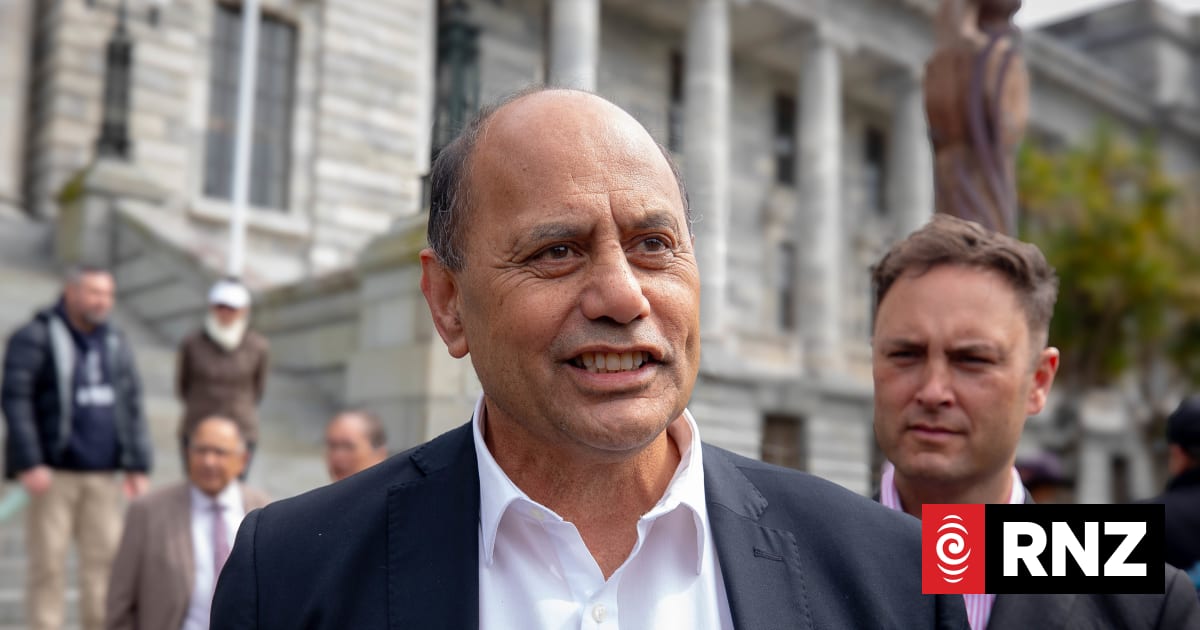
He told RNZ he doesn't rate Labour's odds of sweeping all seven Māori seats
— quietly gutting his own leader Chris Hipkins' public confidence
— and in the same breath warned that Te Pāti Māori's electorate-focused strategy could get the Māori seats abolished (RNZ, 20 August 2026).
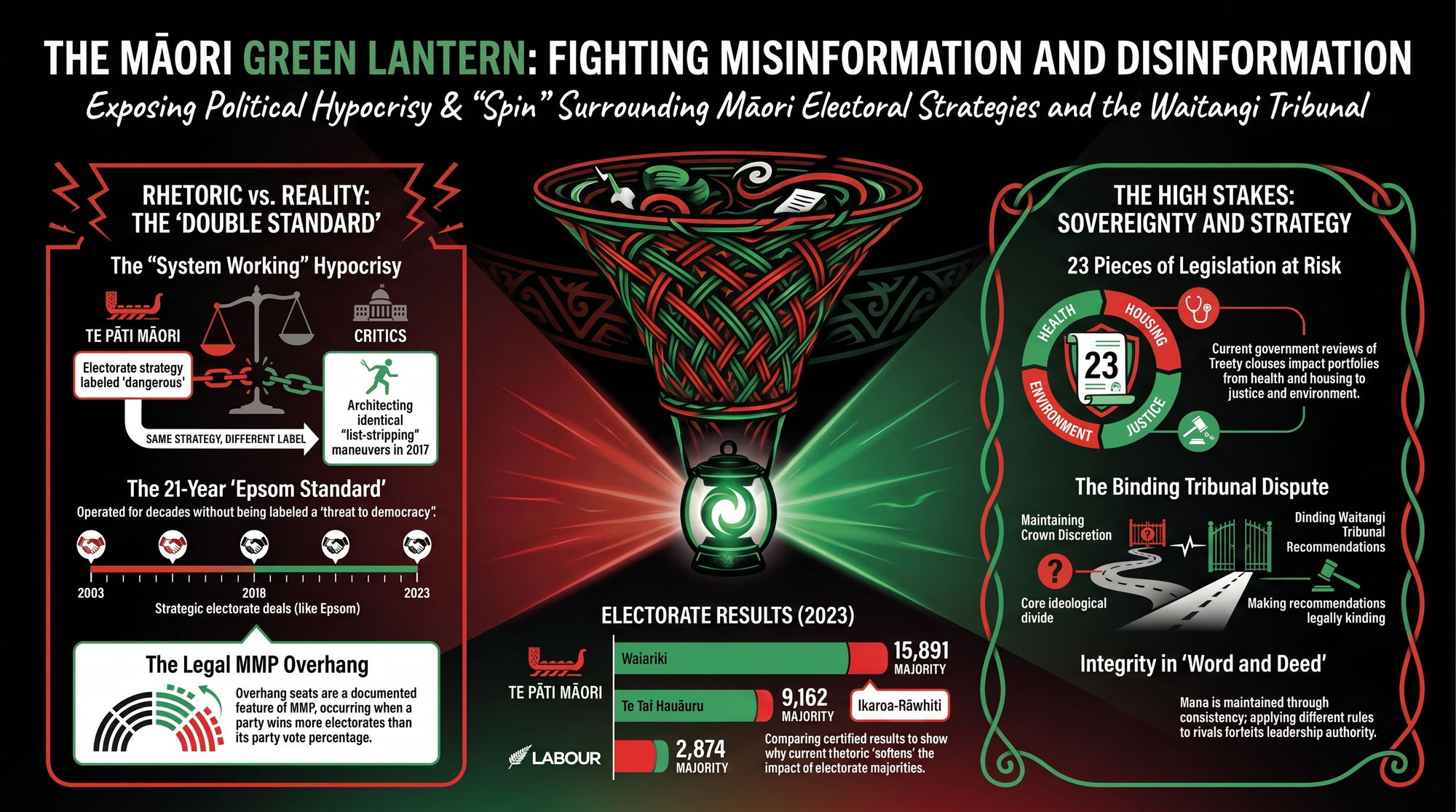
He calls their strategy "working the system."
What he doesn't say is that he co-wrote that system's rulebook himself in 2017, and his own candidate is running a page from it in Te Tai Tonga this election, right now, against a sitting Māori MP.
I've documented Jackson's role in Labour's Māori seats machine before
— his deployment, in Hipkins' own words,
as the man "running a winning campaign for the Māori seats this year,"
not a kaitiaki of Māori interests but a kaitiaki of Labour's electoral map (He Waka Kotahi, He Hinaki Hou, The Māori Green Lantern).
This week's hypocrisy isn't new. It's the same pattern, dressed in a fresh headline.
Cui bono? Labour's list machine and Willie Jackson's own career.
Cui malo? Every whānau in six electorates watching two Māori political forces fight each other while a government hostile to Te Tiriti sits back and takes notes.
The Deep Dive Podcast
Listen to a lively conversation between two hosts, unpacking and connecting topics in the sources of this essay. I apologise in advance for the AI's very harsh pronounciation of reo. Please dont shoot me, :).
Youtube Video
Like video? Here is a short video suppporting the essay. Again, don't shoot the messenger please because of AI's pronounciation. :)
Koha Consideration

Every koha signals that whānau are ready to support the accountability that Crown and corporate structures will not provide.
It signals that rangatiratanga includes the power to support our own truth tellers — the ones willing to name Willie Jackson's hypocrisy in the same breath as the Coalition's, and keep tracing both nets in the water.
Kia kaha, whānau. Stay vigilant. Stay connected. And if you are able, consider a koha to ensure this voice continues.
If you are unable to koha, no worries! Subscribe or follow The Māori Green Lantern at themaorigreenlantern.maori.nz, kōrero and share this with your whānau and friends — that is koha in itself.
Four pathways exist:
For those who wish to support this mahi directly with a koha (voluntary contribution): Koha — Support
For those who wish to receive essays directly and support through subscription: Subscribe to The Māori Green Lantern
For those who prefer direct bank transfer: Ivor Jones, account number 03-1395-0099387-000.
For those on Facebook: Facebook — Subscribe
Background: The Man Who Wrote the Rules He's Now Rewriting
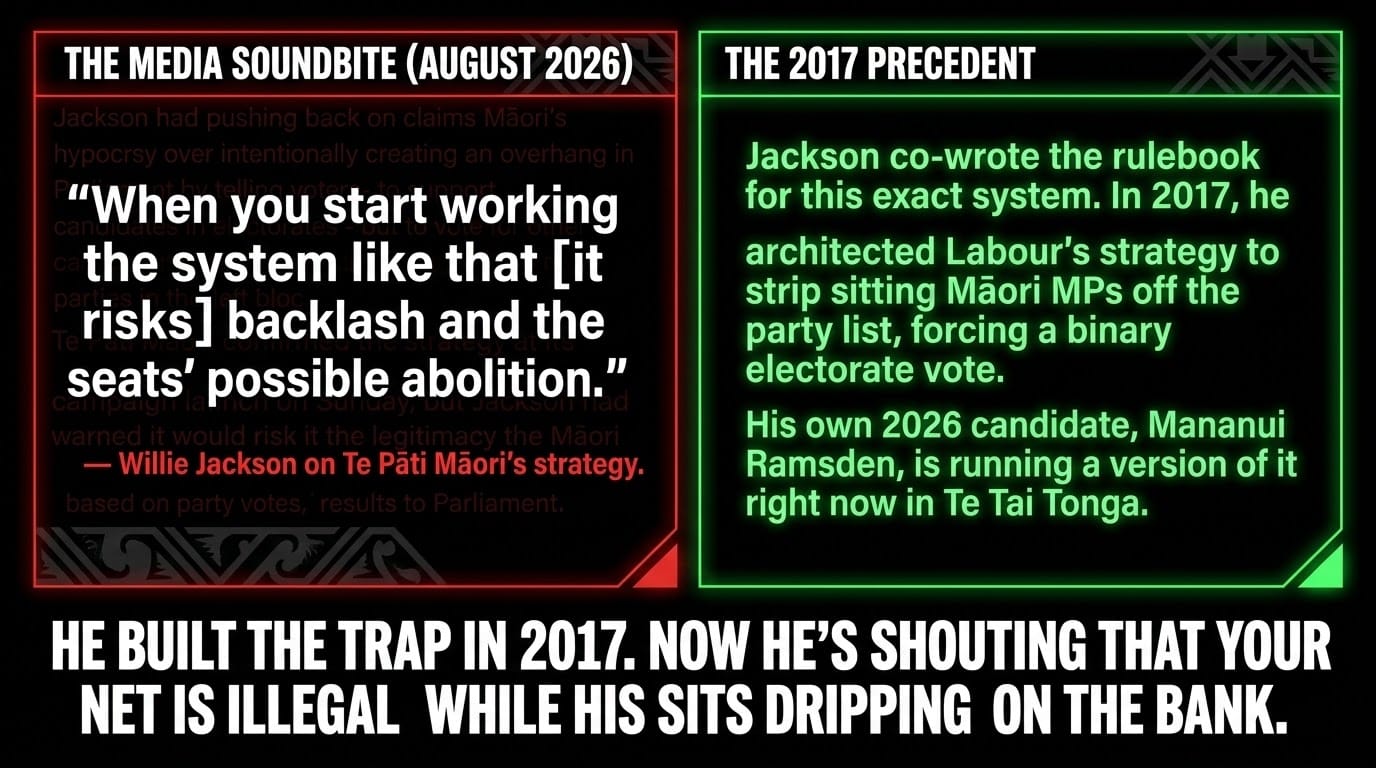
Willie Jackson wasn't watching from the sideline in 2017.
Andrew Little recruited him specifically to run Labour's Māori seats operation, and the strategy he ran was ruthless: strip every sitting Māori electorate MP off the party list so voters had exactly one option
— win the electorate outright, or lose your MP for good (Wikipedia, sourced to contemporaneous reporting; e-tangata, 2018).
It crushed the Māori Party out of Parliament that year
— the direct political predecessor of the party he now lectures on system integrity.
Nine years on that history hasn't gone anywhere. It's his résumé.
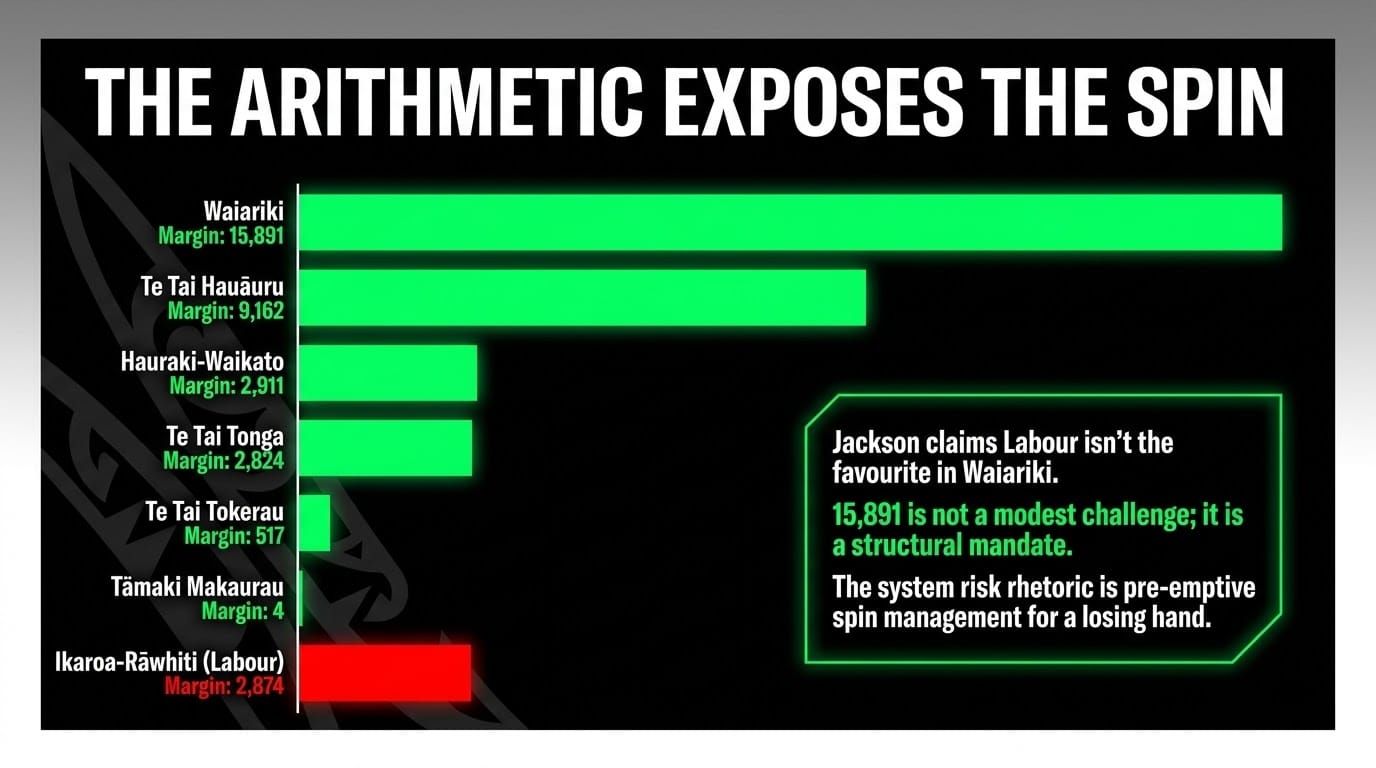
And the 2023 results turned the tables completely: Te Pāti Māori's candidates won six of the seven Māori electorates: Waiariki, Te Tai Hauāuru, Hauraki-Waikato, Te Tai Tonga, Tāmaki Makaurau, and Te Tai Tokerau, confirmed against Elections NZ's certified results (Elections NZ, official results).
Labour held one: Ikaroa-Rāwhiti. I've reported this exact figure before — see The Split Tōtara and The Top Surge That Wasn't.
Strip the Spin, I'll Read You the Mechanics
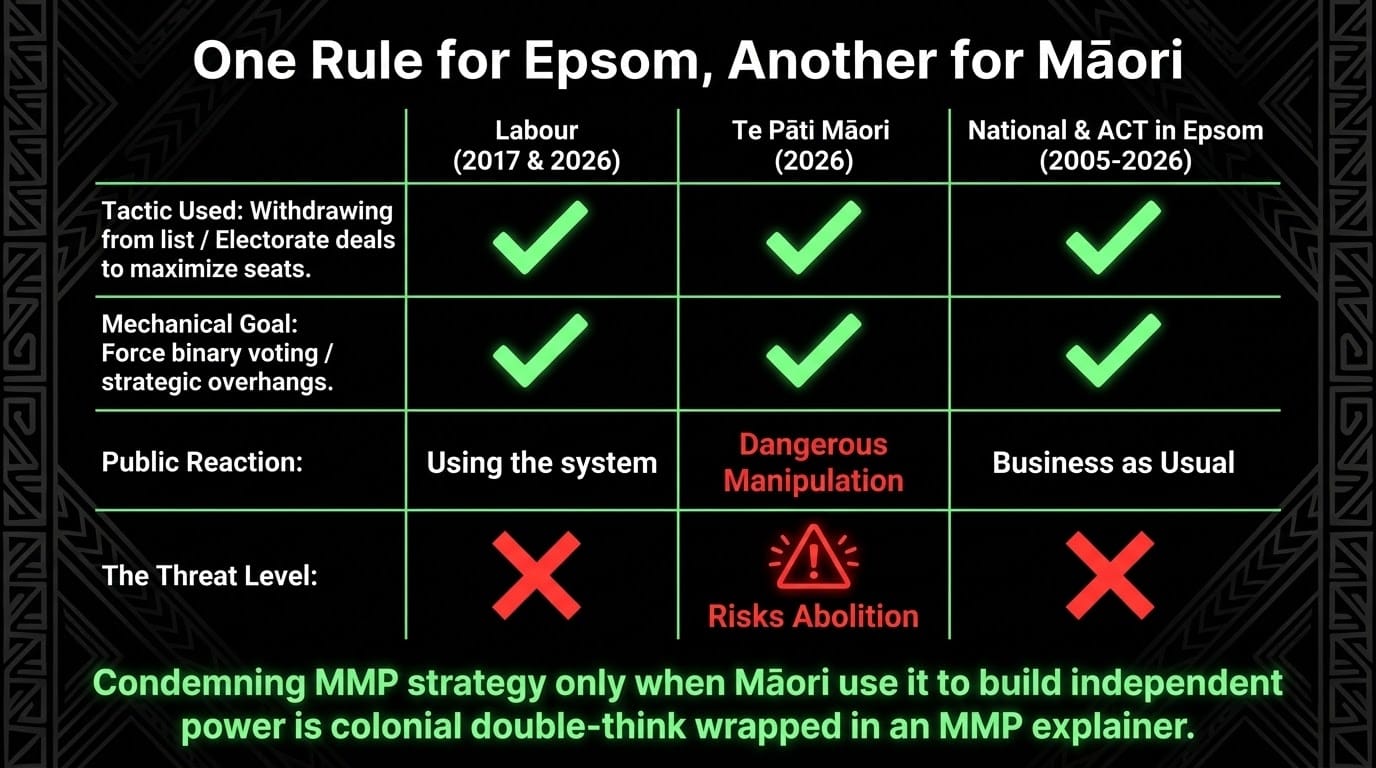
Deconstruct Jackson's language plainly and the double standard is naked.
- He calls Te Pāti Māori's strategy "working the system" in a way that risks "backlash" and possible abolition. He has never applied that language to Epsom, where National and ACT have run a functionally identical electorate-for-list-safety trade for twenty-one years — 2005 to 2026 — without Labour ever campaigning against it (Wikipedia, Epsom electorate; ODT, 2011).
That silence isn't principle. It's a double standard that only switches on when Māori are the ones using the tool.
- He calls an overhang seat dangerous system-manipulation.
It's a legal, documented MMP feature: Te Pāti Māori's 3.08% party vote in 2023 mathematically entitled it to roughly four seats in a 120-seat Parliament (3.08% × 120 ≈ 3.7, rounding to 4).
They won six electorates. The two-seat gap is the overhang, part of a three-seat total overhang that pushed Parliament to 123 members (Luxon Tried to Steal Your Vote on Breakfast Radio, The Māori Green Lantern).
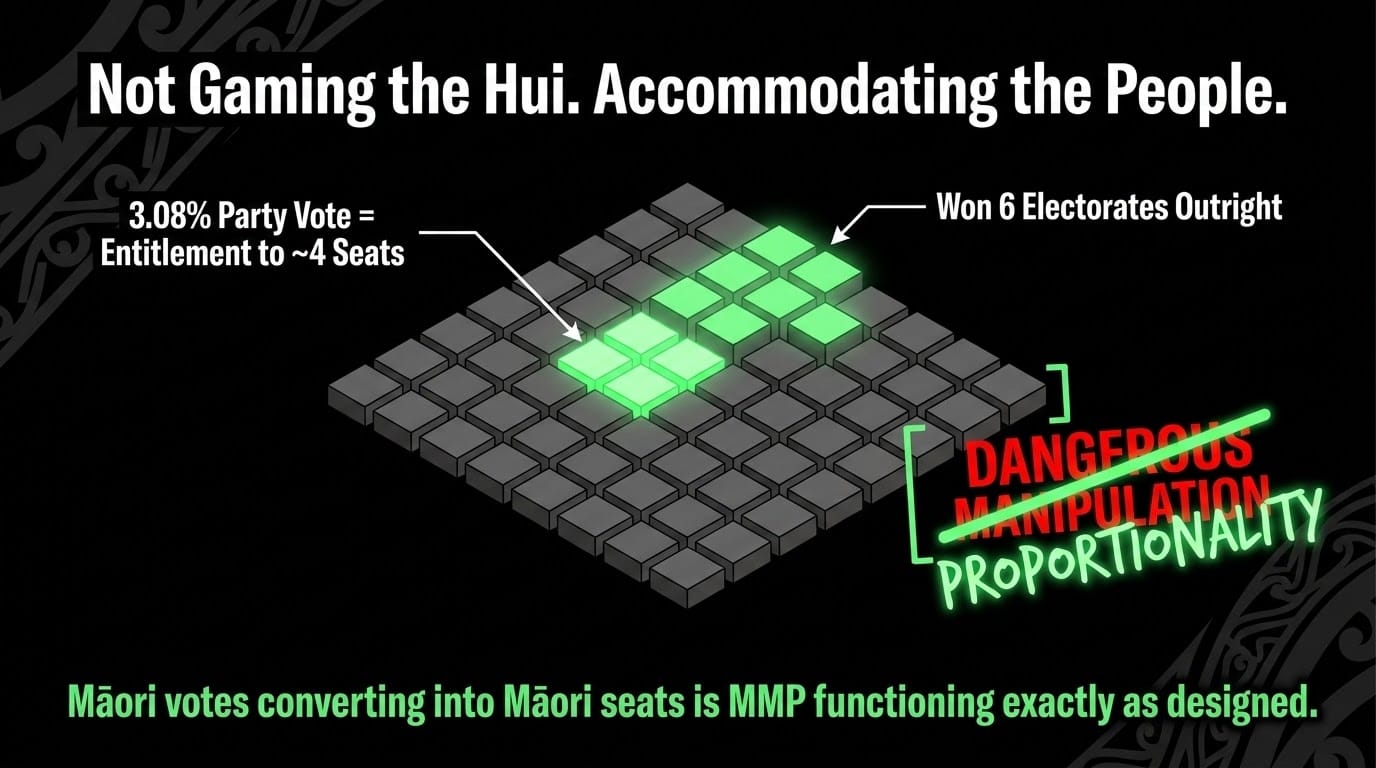
It is Māori votes converting into Māori seats exactly as MMP was designed to allow.
Calling that a threat to democracy isn't analysis. It's fear dressed up as caution.
- Jackson rounds Waititi's majority to "nearly 16,000" when the certified figure is 15,891 — 21,500 minus 5,609, straight arithmetic from Elections NZ's own table (Elections NZ). Small, but it's a pattern: impressionistic numbers from a man demanding forensic scrutiny of his rivals.
I believe Jackson's framing is not neutral electoral commentary. It's a targeted delegitimisation of Māori political strategy that exempts his own party, his own candidate, and his own 2017 record. That's my judgment, and the facts above are exactly why I hold it.
Analysis: Five Things I've Verified, and I'm Naming Who Gains
1. Jackson ran the same play, then denied it was the same play
Jackson helped architect Labour's 2017 strategy of stripping Māori MPs off the party list to force a binary electorate vote (e-tangata).
Who gains: Labour's institutional survival in the Māori seats, and Willie Jackson's own thirty-year career, built in part on the success of that gambit.
2. Labour's own 2026 candidate is running it again — against a Māori MP, this election
Mananui Ramsden, Labour's Te Tai Tonga candidate, deliberately withdrew from the party list.
Jackson's own words on why: he "doesn't want to give Doc [Ferris] a lifeline" (Aukaha News, June 2026).
This is happening in the same election he's criticising Te Pāti Māori in.
Who gains: Labour's electorate math in Te Tai Tonga.
Who's harmed: the constituents Ferris represents, denied the possibility of both an electorate voice and a list-connected one.
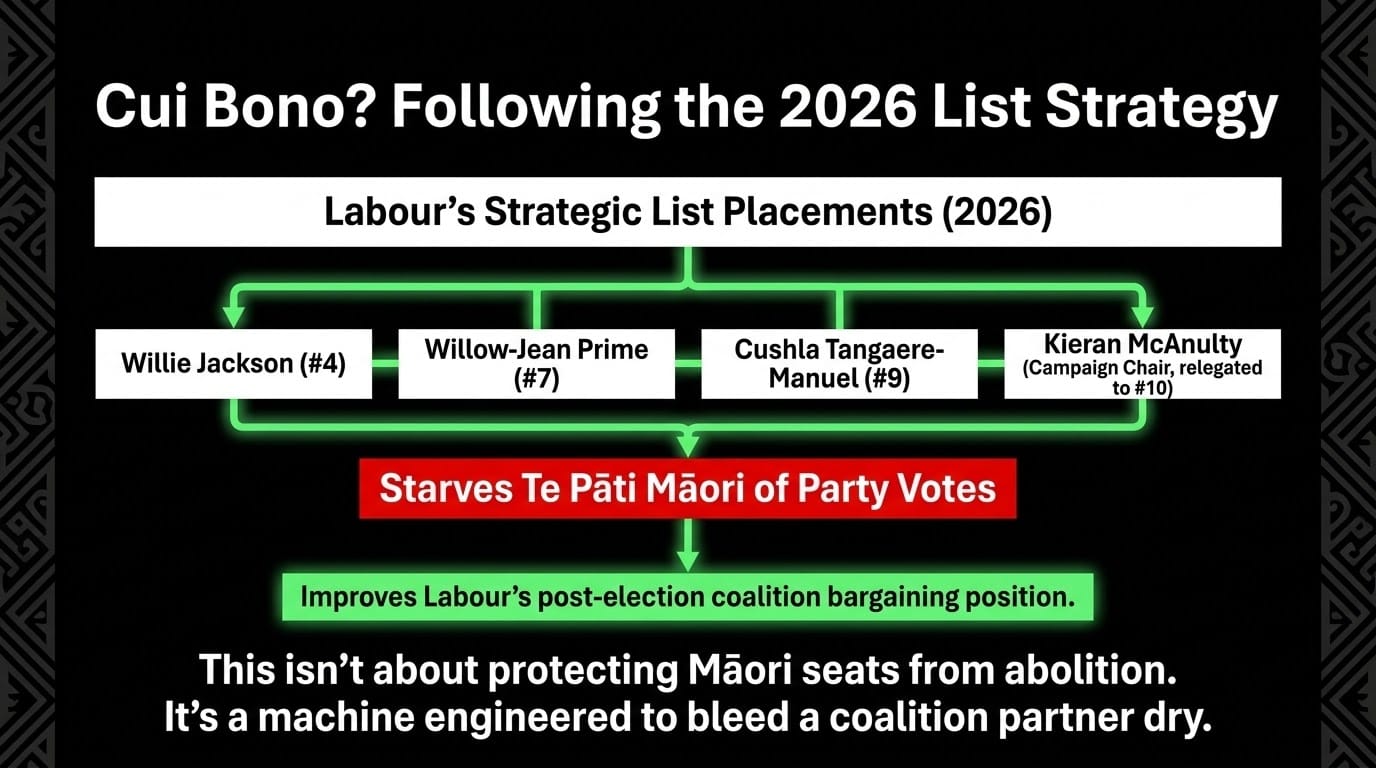
3. Labour's 2026 list is engineered to bleed Te Pāti Māori dry
Jackson ranked at 4, Willow-Jean Prime at 7, Cushla Tangaere-Manuel at 9 — all above Labour's own campaign chair Kieran McAnulty at 10
— read by political analysts as deliberately designed to "starve Te Paati Māori of votes and thus remove them from contention as a coalition partner" (Politik, 9 June 2026).
Who gains: Labour's post-election bargaining position.
Who's harmed: the policies Te Pāti Māori is fighting for that Labour won't touch — binding Tribunal recommendations chief among them.
4. The numbers show Jackson's "realism" is spin management for a losing hand
Waiariki (TPM, 15,891), Te Tai Hauāuru (TPM, 9,162), Hauraki-Waikato (TPM, 2,911), Te Tai Tonga (TPM in 2023, 2,824), Tāmaki Makaurau (TPM, 4 votes), Te Tai Tokerau (TPM, 517) — Labour holds one seat, Ikaroa-Rāwhiti, by 2,874 (Elections NZ official PDF).
Five of the six TPM-won seats carry majorities in the thousands. Jackson isn't being modest when he says Labour won't sweep the seats.
He's pre-softening a defeat that the arithmetic already predicts, while using "system risk" language to cast pre-emptive doubt on the party that's actually winning.
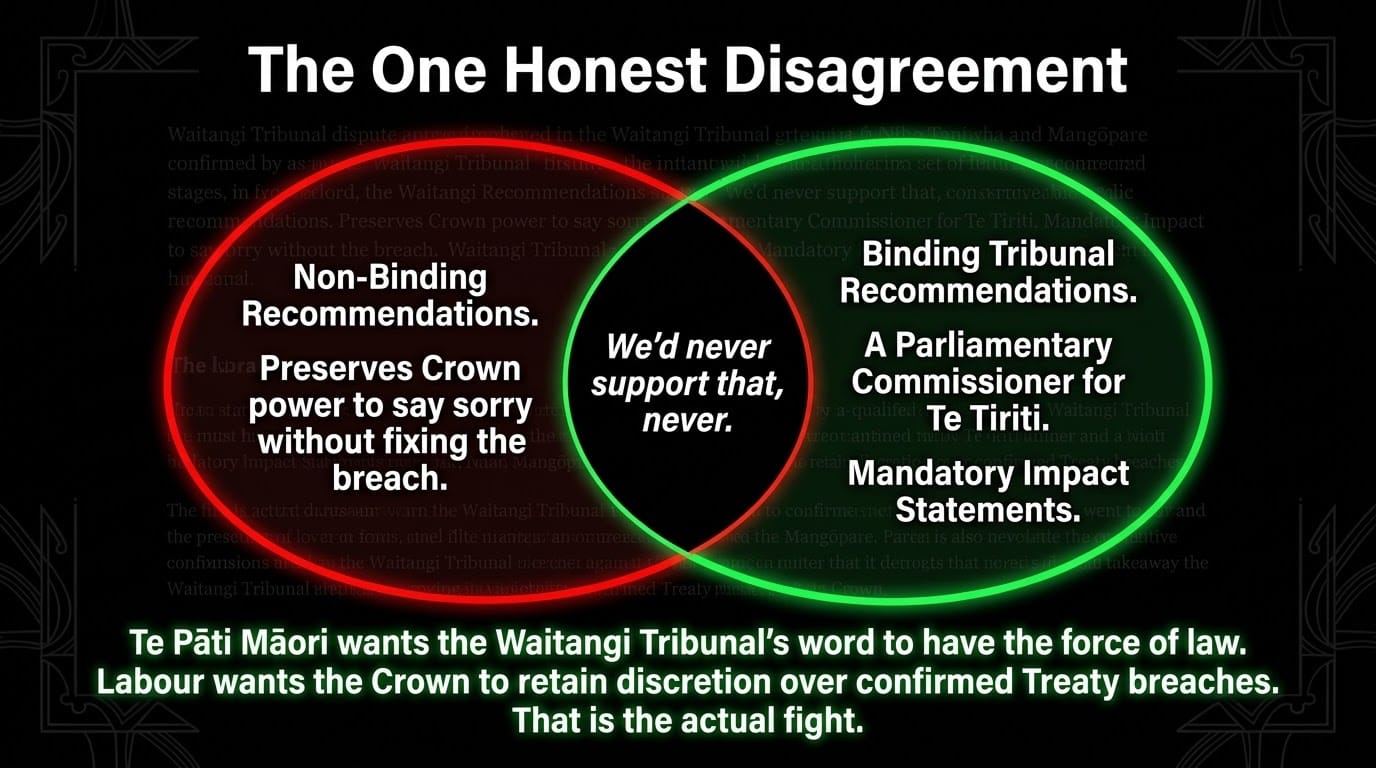
5. The Tribunal entrenchment fight is real — and it's the one honest disagreement in this whole mess
Te Pāti Māori's published policy confirms it: binding Tribunal recommendations, a Parliamentary Commissioner for Te Tiriti, mandatory Te Tiriti Impact Statements on every Bill
— a direct response to the Tribunal finding that the Government's Treaty clause review breaches Te Tiriti, and Shane Jones' move to investigate the Tribunal itself rather than fix the breach (Scoop, 6 August 2026).
That clause review's scope is documented elsewhere: 23 pieces of legislation touched, spanning health, housing, education, environment, transport and justice, while the Tribunal's Wai 3325 Climate Change Inquiry was actively hearing evidence from 50 Māori claimants at the time (The Grave Robbers in Suits, The Māori Green Lantern).
Jackson is right that Labour won't back binding recommendations.
Who gains from the current non-binding status quo: the Crown, which keeps its discretion to acknowledge a Treaty breach and do nothing about it.
Who's harmed: every claimant whānau whose Tribunal win currently carries zero legal force.
Three Examples, Because the Western Mind Needs the Maths Spelled Out
Example one — the list-abstention trick.
Imagine a landlord telling a tenant
"sign this exact lease or you're out on the street" and calling it "tenant choice."
Jackson signed that lease himself in 2017. His own candidate is running a version of it in Te Tai Tonga this year. And he's calling Te Pāti Māori's version of the identical lease a threat to housing law.
Quantified harm: Te Tai Tonga voters lose the option of representation with both an electorate mandate and list-backed influence
— a structural narrowing of choice affecting roughly 55,000 enrolled voters in that electorate.
Solution: one consistent, publicly debated rule on list-abstention, applied to every party without exception, not litigated case-by-case through selective media outrage.
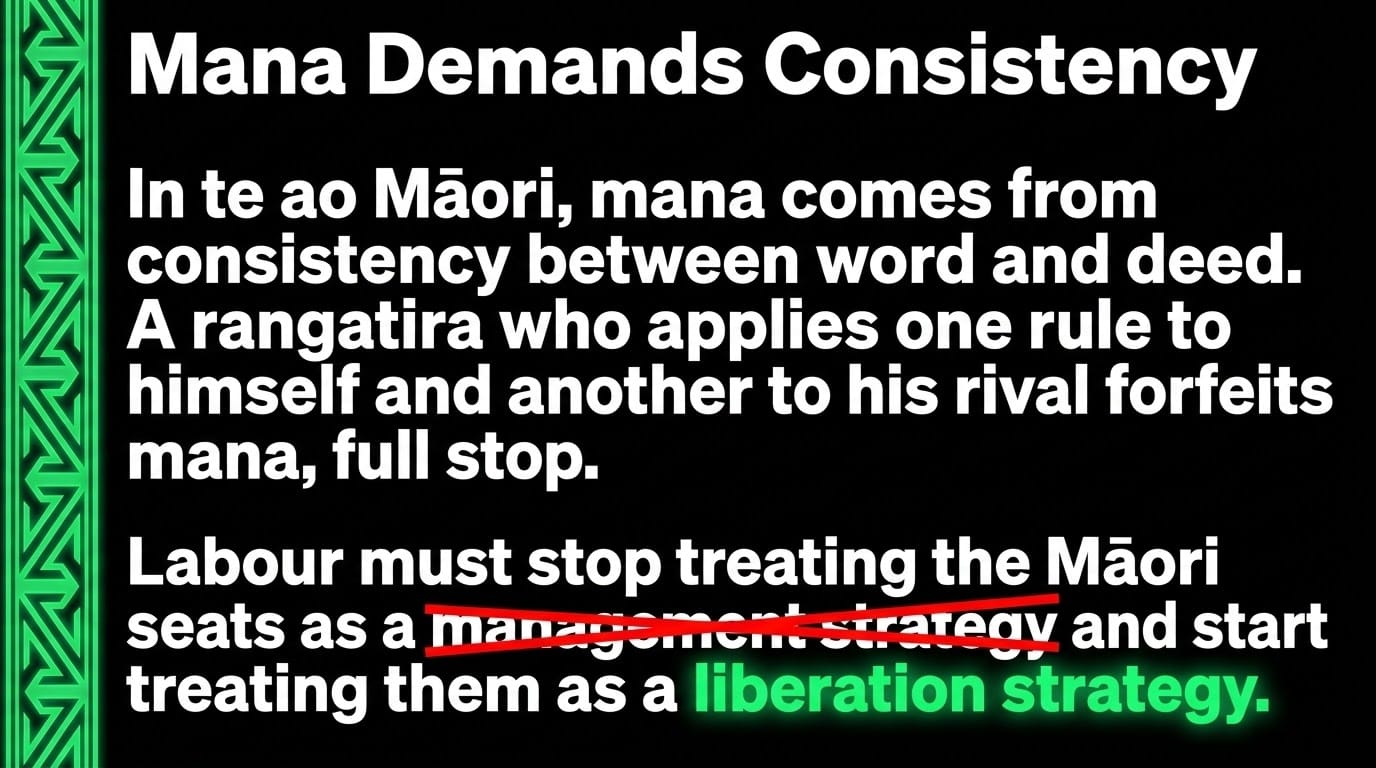
Tikanga impact for the Western reader: in te ao Māori, mana comes from consistency between word and deed
— a rangatira who applies one rule to himself and another to his rival forfeits mana, full stop.
This pattern of Labour treating Māori seats as a management strategy, not a liberation strategy, is one I've traced before — see Solar Theatre in a Dying Empire.
Example two — the overhang panic.
Picture a marae hui running long because more whānau turned up than the hall was booked for. Nobody calls that
"gaming the hui"
— you just accommodate the people who showed up.
Quantified harm: Te Pāti Māori's 3.08% party vote in 2023 mathematically earned about four seats (3.08% × 120 ≈ 4); they won six electorates on merit, and MMP's overhang mechanism simply preserved that proportionality, adding to a three-seat total overhang and a 123-seat Parliament, exactly as the law provides (RNZ/Wikipedia, cross-checked — The Māori Green Lantern).
Framing that as dangerous manufactures political cover for a future government to move against seats that have already survived 159 years of abolition attempts.
Solution: apply the twenty-one-year-old Epsom precedent as the standard for judging any electorate strategy, Māori or otherwise
— or admit the standard was always racial, not procedural.
Tikanga impact: treating Māori electoral success as inherently suspect while Pākehā electorate deal-making in Epsom is treated as unremarkable is colonial double-think wearing an MMP-explainer costume.
Example three — the binding Tribunal dispute.
This is the difference between a kaumātua's word carrying the force of law on a marae trust board, versus being noted in the minutes and quietly filed away.
Quantified harm: the Government's own Treaty clause review was found by the Tribunal to breach Te Tiriti across 23 pieces of legislation while touching every major portfolio a whānau depends on
— health, housing, education, environment (The Grave Robbers in Suits)
— and the response wasn't remedy, it was a threat to investigate the Tribunal itself.
Solution: force Labour, on record, to explain why Crown discretion over confirmed Treaty breaches should remain unchecked, rather than letting Jackson use this genuine disagreement as camouflage for his hypocrisy on electoral strategy.
Tikanga impact: a non-binding Tribunal preserves Crown power to say sorry without ever having to actually fix anything
— the same pattern running through the government's wider assault on Treaty settings, including the Waitangi Tribunal Act review itself (The Sandfly Lie, The Māori Green Lantern).
Implications: This Isn't Just About Seven Seats
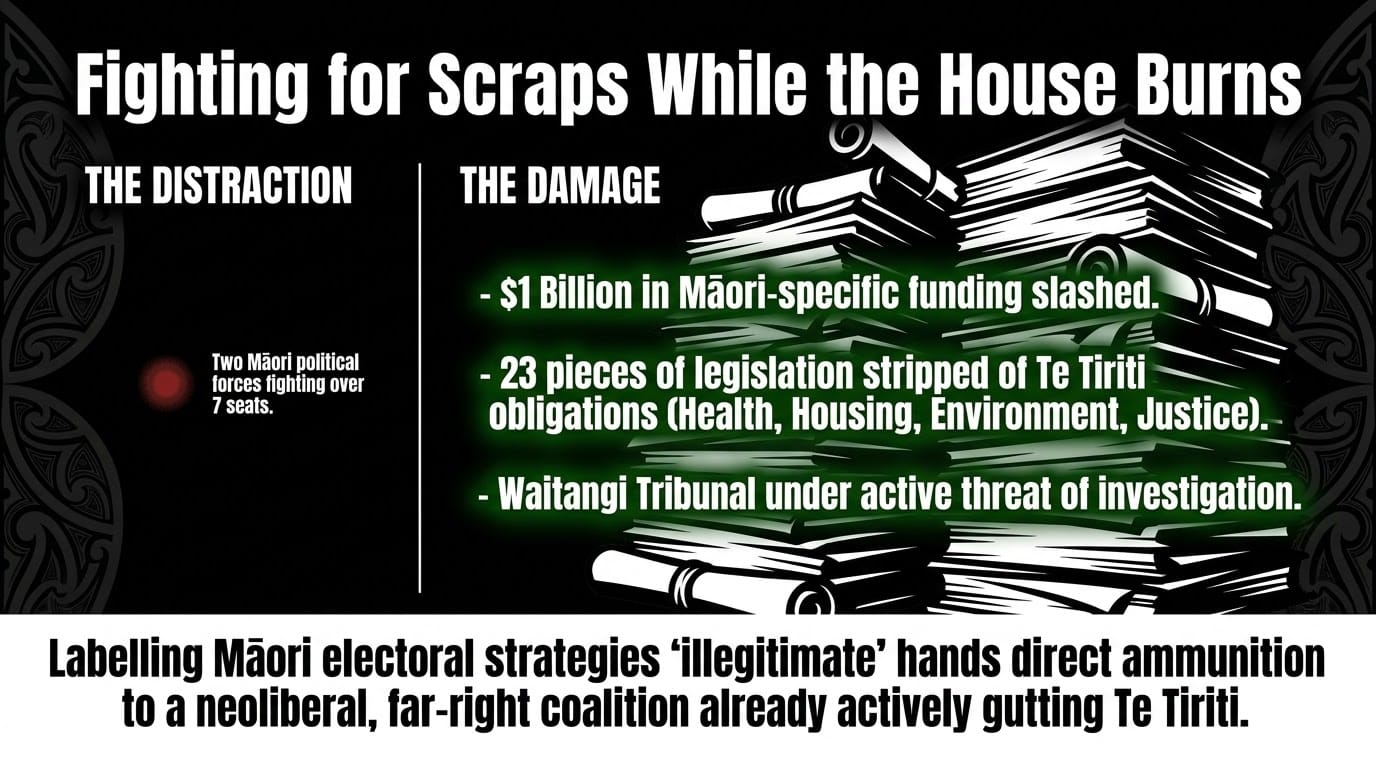
Here's what actually worries me, and it's bigger than who wins in November.
Labour's own Māori caucus went from 18 MPs before 2023 to 9 after it
— cut in half in a single election, then reduced further by the departures of Peeni Henare and Adrian Rurawhe (Kua Tae Te Wā, The Māori Green Lantern).
At the same time, the Coalition Government has slashed over $1 billion in Māori-specific funding across its first two budgets, by Jackson's own count (The Coalition's Austerity Sham, The Māori Green Lantern).
This is the real backdrop: a white supremacist neoliberal government stripping Treaty obligations out of 23 pieces of legislation while Labour's chosen strategy is to fight Te Pāti Māori for the scraps of Māori political representation, rather than build a unified front against the government doing the actual damage.
Jackson isn't protecting the Māori seats by branding his rival's strategy dangerous. He's handing ammunition to a government that has already shown its appetite for gutting Treaty settings, at the exact moment it needs a
"even Māori politicians say this strategy is illegitimate" quote to use later.
Action for whānau: go read Elections NZ's certified margins yourself before you trust any politician's spin on "who's favourite." Read Te Pāti Māori's actual published Tribunal policy, not Jackson's paraphrase of it. And next time a Labour minister calls a Māori party's electoral strategy a threat to democracy, ask him — publicly, on the record — the date he said the same thing about Epsom.
Name Your Own Net Before You Condemn Another's
I'll say the true thing plainly, because that's the job.
Willie Jackson helped build the playbook he now condemns. His own 2026 candidate is running pages from it in Te Tai Tonga. His party's list is engineered to starve his stated coalition partner of the exact leverage it needs to force binding Treaty protections through Parliament. And while he does all this, the government he claims to oppose is quietly gutting Treaty clauses across 23 laws and eyeing the Tribunal that caught them doing it.
This isn't a case of Te Pāti Māori being beyond criticism
— the Tribunal entrenchment disagreement is genuine, and whānau deserve to weigh it without spin from either side.
But rangatiratanga means seeing the whole board, not a selectively edited highlight reel where only your rival's net gets called out.
Jackson doesn't get to stand on the riverbank pointing at Te Pāti Māori's hīnaki while his own sits there, cast in 2017 and cast again this year, still dripping.
Māuri Ora!
Ivor Jones The Māori Green Lantern Fighting Misinformation And Disinformation From The Far Right

Disclaimer
This essay is analysis and opinion grounded in cited public sources, published in the public interest regarding the conduct of elected officials and a registered political party ahead of a general election. It does not allege criminal conduct beyond what is directly quoted or sourced. Corrections will be made promptly on verified request.