"Paul Goldsmith - Eleven Crowns, Zero Consent — How a Man Māori Never Elected Now Holds Our Spies, Our Prisons, and Our Treaty in His Hands" - 16 August 2026
Paul Goldsmith has never won an electorate in his life, but this white‑supremacist neoliberal government has handed him eleven ministerial crowns and the knife that guts Te Tiriti anyway.

Who I Am, Who He Is
I am Ivor Jones, The Māori Green Lantern — Te Arawa, Ngāti Pikiao, Welsh whakapapa, kaitiaki with a taiaha in one hand and a laptop in the other.
My job is simple: follow the receipts, name the crimes, and swing the taiaha at the lies that keep our people caged, poor, and gas‑lit.
Today, the target is Justice Minister Paul Goldsmith — and the white‑supremacist neoliberal government that keeps feeding him power like it’s a bottomless buffet.
 Justin Hu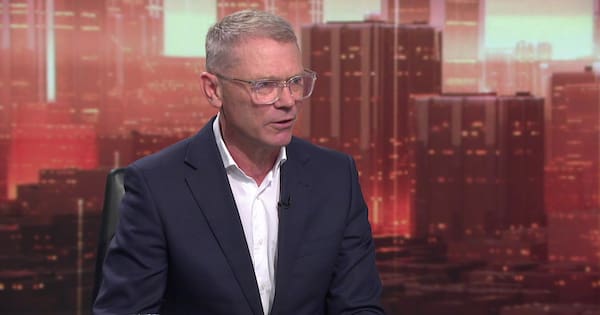
For fifteen years, Goldsmith has sat in Parliament on the National Party list. He tried to win Maungakiekie in 2005, was ranked 59th, and admitted he had “zero chance.”
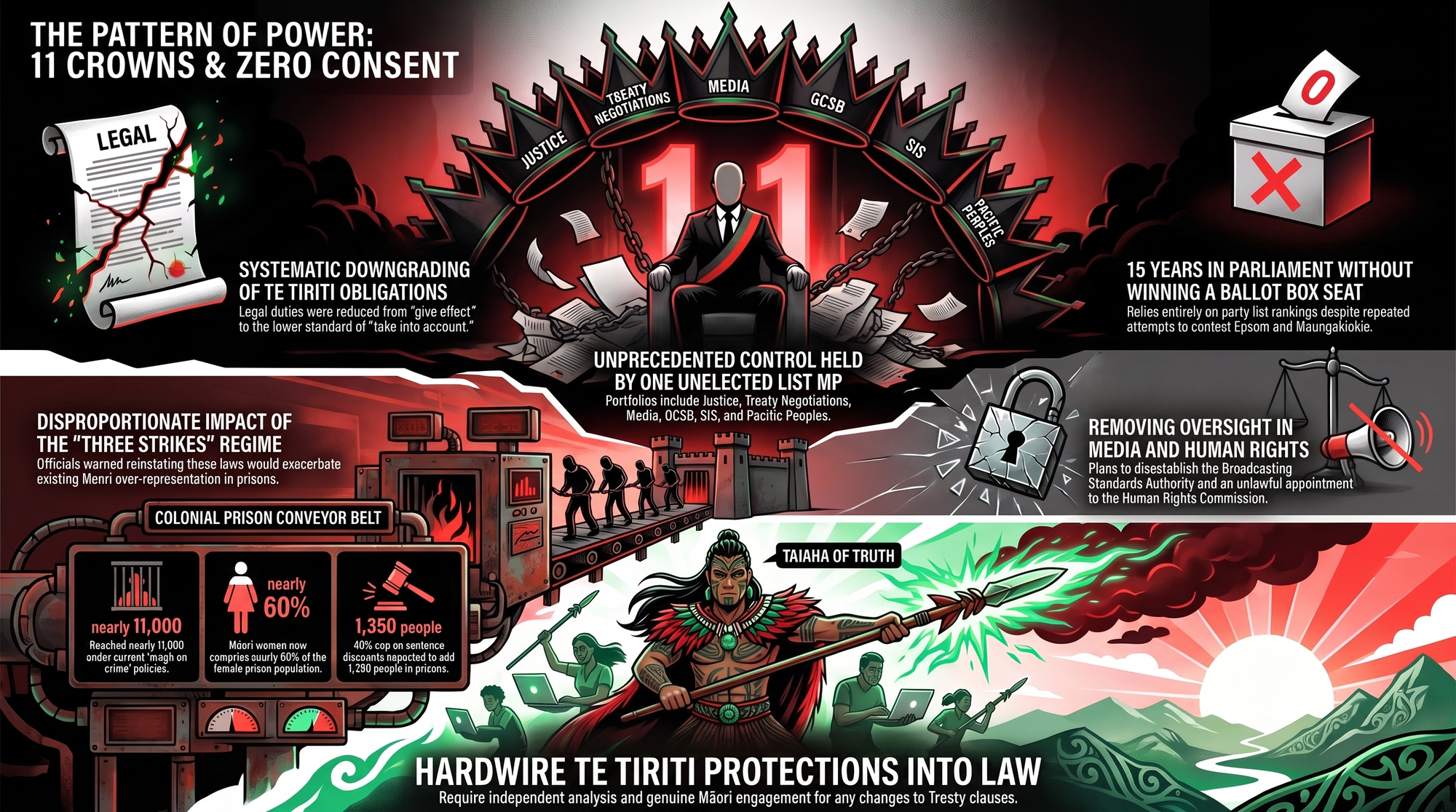
He has run in Epsom over and over again, and the voters have chosen ACT’s David Seymour every time.
He only enters the House through the party back door: list rankings and backroom deals, never the ballot box. Wikipedia’s own entry confirms his list‑MP career and the 2021 colonisation controversy.
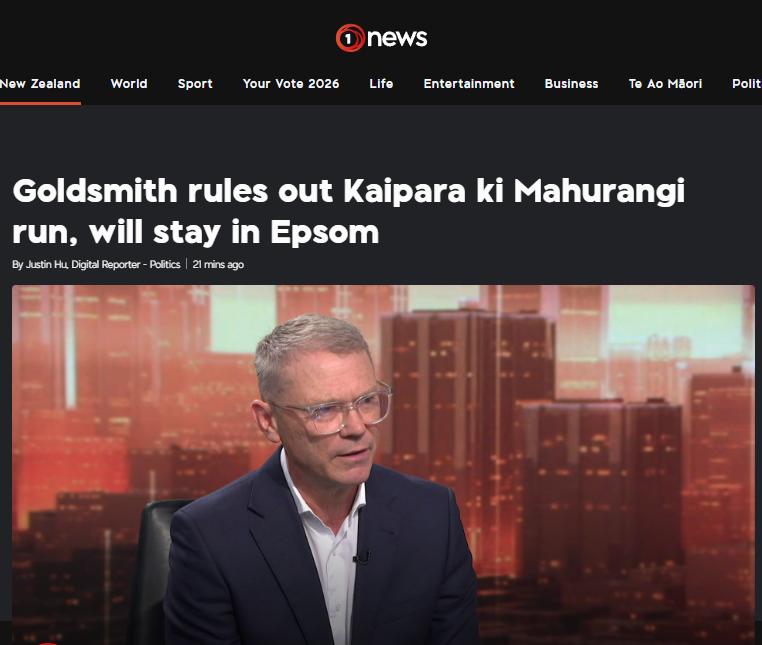
And yet, four days after Chris Penk was stripped of all his portfolios for daring to challenge Christopher Luxon, Goldsmith goes on Q+A and cheerfully muses that he is “thinking about” contesting Penk’s vacated Kaipara ki Mahurangi seat — calling it a “beautiful seat,” while reminding viewers that he’s based in Epsom.
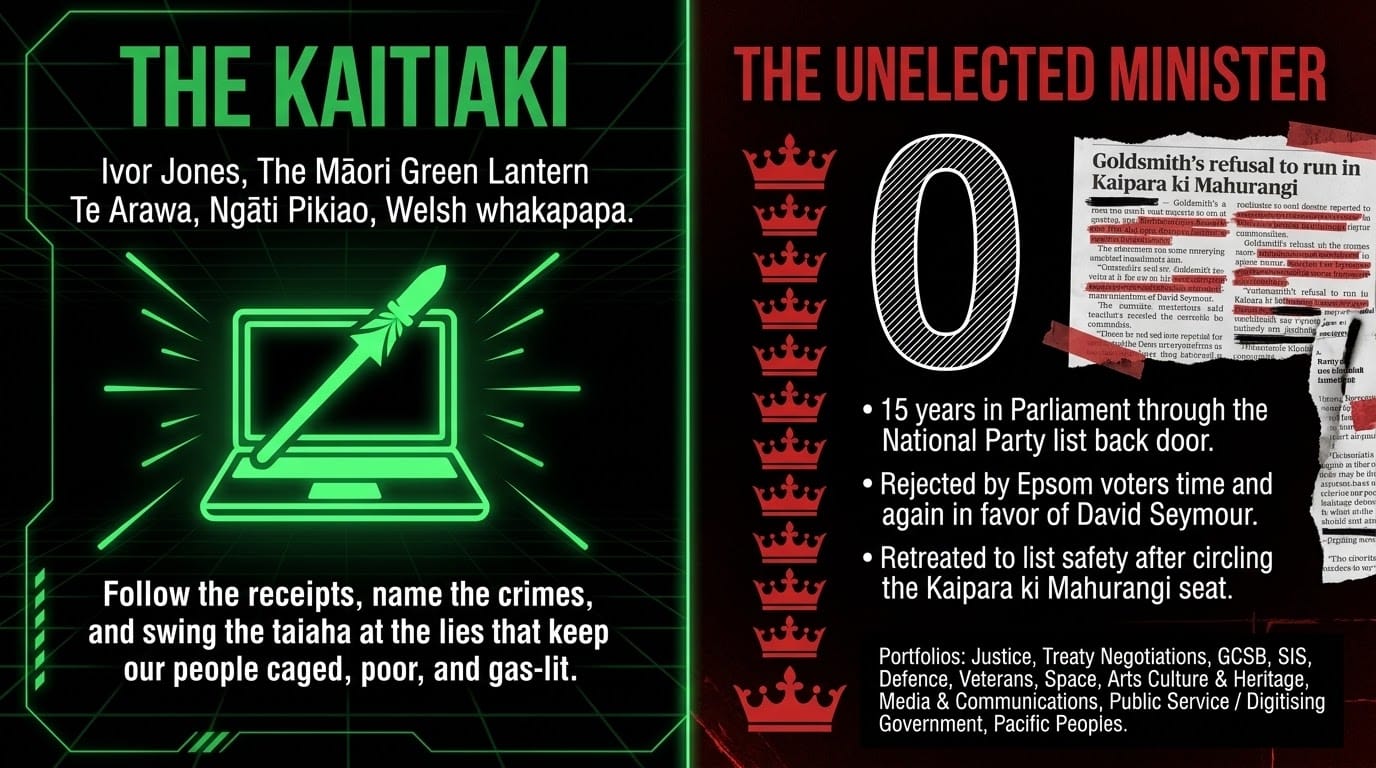
A man Epsom voters keep rejecting now circles a safe blue seat in the north like a vulture over a freshly shot carcass. The same week, he inherits Penk’s Defence, Veterans, Space, GCSB and SIS responsibilities, adding them to Justice, Treaty Negotiations, Arts, Culture & Heritage, Media & Communications, Public Service/Digitising Government, and Pacific Peoples.[beehive.govt][fyi.org][beehive.govt]
Eleven ministerial crowns. Zero electorate mandates. That is the starting point for everything that follows.
The Historian Who Decided Colonisation Was “Good on Balance”
Goldsmith sells himself as a historian — a consumer of the justice system, not a producer, in his words. He worked for the Waitangi Tribunal, researched Taranaki and Wairarapa claims, wrote biographies of right‑wing businessmen like Alan Gibbs and Sir William Gallagher.[beehive.govt][en.wikipedia]
Then he used that historian’s mana to launder colonisation.
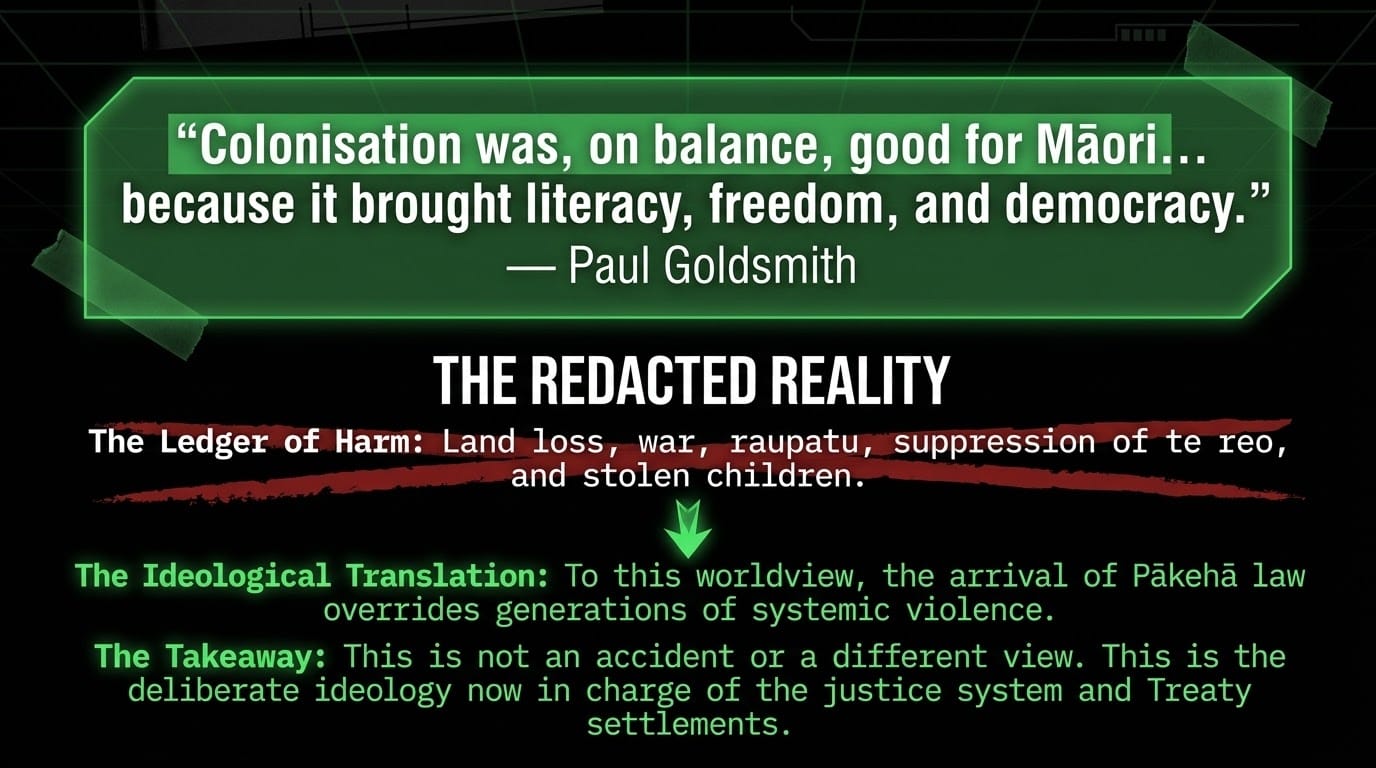
In a 2021 Newshub Nation interview, and again in 2024 with Newsroom, Goldsmith said colonisation was, “on balance,” good for Māori — traumatic, yes, but ultimately beneficial because it brought “literacy” and “freedom and democracy.”[newsroom.co][en.wikipedia]
Read that again:
- Land loss.
- War.
- Raupatu.
- Suppression of te reo.
- Crown institutions that stole children, locked men up for nothing, and stripped mana from iwi across the motu.
All this, in Goldsmith’s ledger, nets out as a positive because Pākehā law and literacy arrived. That is the worldview now sitting in charge of Treaty settlements, Treaty clauses in legislation, and the entire justice system. It is not an accident. It is the policy.
The Deep Dive Podcast
Listen to a lively conversation between two hosts, unpacking and connecting topics in the sources of this essay. I apologise in advance for the AI's very harsh pronounciation of reo. Please dont shoot me, :).
Youtube Video
Like video? Here is a short video suppporting the essay. Again, don't shoot the messenger please because of AI's pronounciation. 😄
Koha Consideration
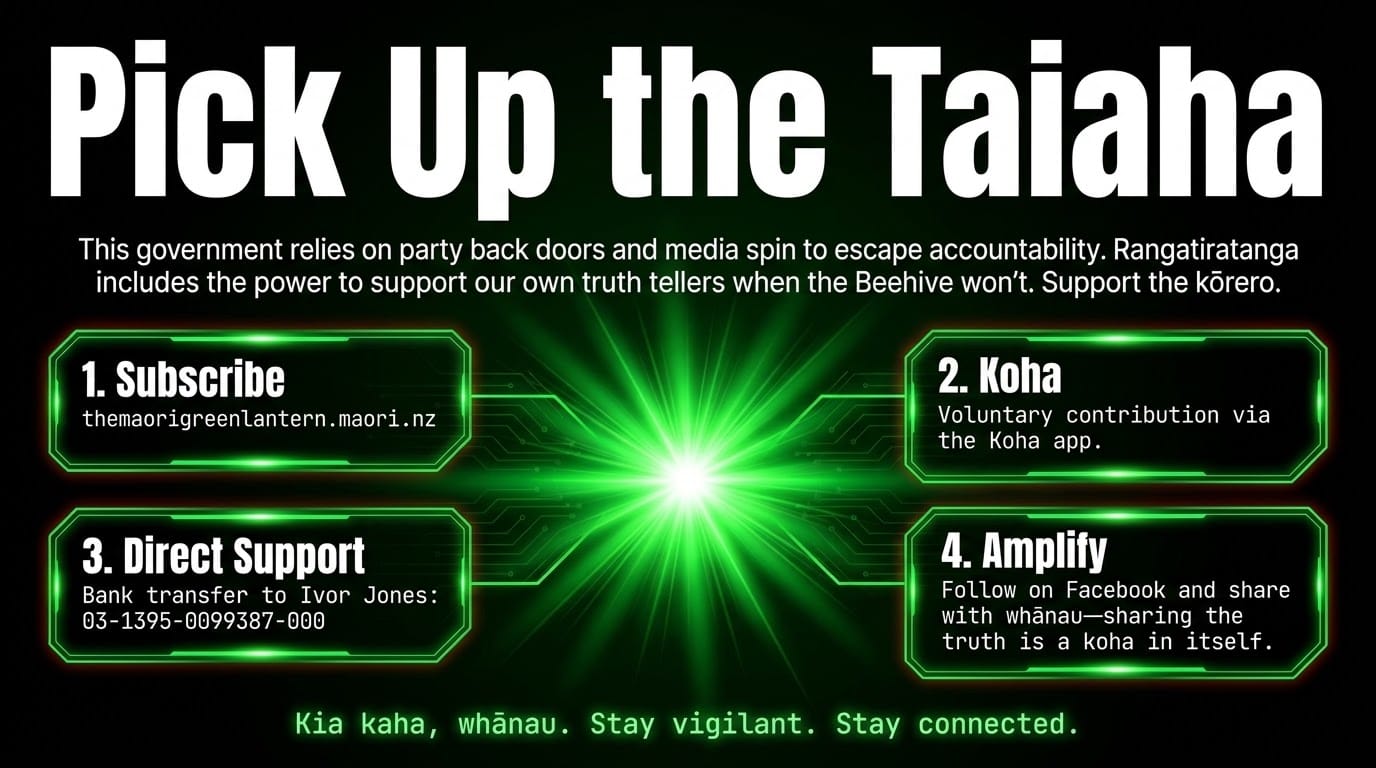
Every koha for this essay tells the Crown and its corporate mates that whānau will support the accountability eleven ministerial crowns are designed to escape. It says rangatiratanga includes the power to support our own truth tellers when the Beehive won’t tell the truth about itself.
Kia kaha, whānau. Stay vigilant. Stay connected. And if you are able, consider a koha to ensure this voice keeps naming every crown this vulture collects.
If you are unable to koha, no worries. Subscribe or follow The Māori Green Lantern at themaorigreenlantern.maori.nz, kōrero and share with your whānau and friends — that is koha in itself.[themaorigreenlantern.maori][themaorigreenlantern.maori][themaorigreenlantern.maori]
Four pathways exist:
Koha (voluntary contribution): Koha — Support
Subscription support: Subscribe to the Māori Green Lantern
Direct bank transfer: Ivor Jones, 03‑1395‑0099387‑000
Facebook: Facebook Subscribe
I don’t need you to agree with every sentence in this essay.
I need you to see the pattern: one man, with eleven crowns and no electorate, rewriting the law, the media, the prisons, the Treaty — and calling it “balance.”
Example One — One Sentence That Gutted Nineteen Laws
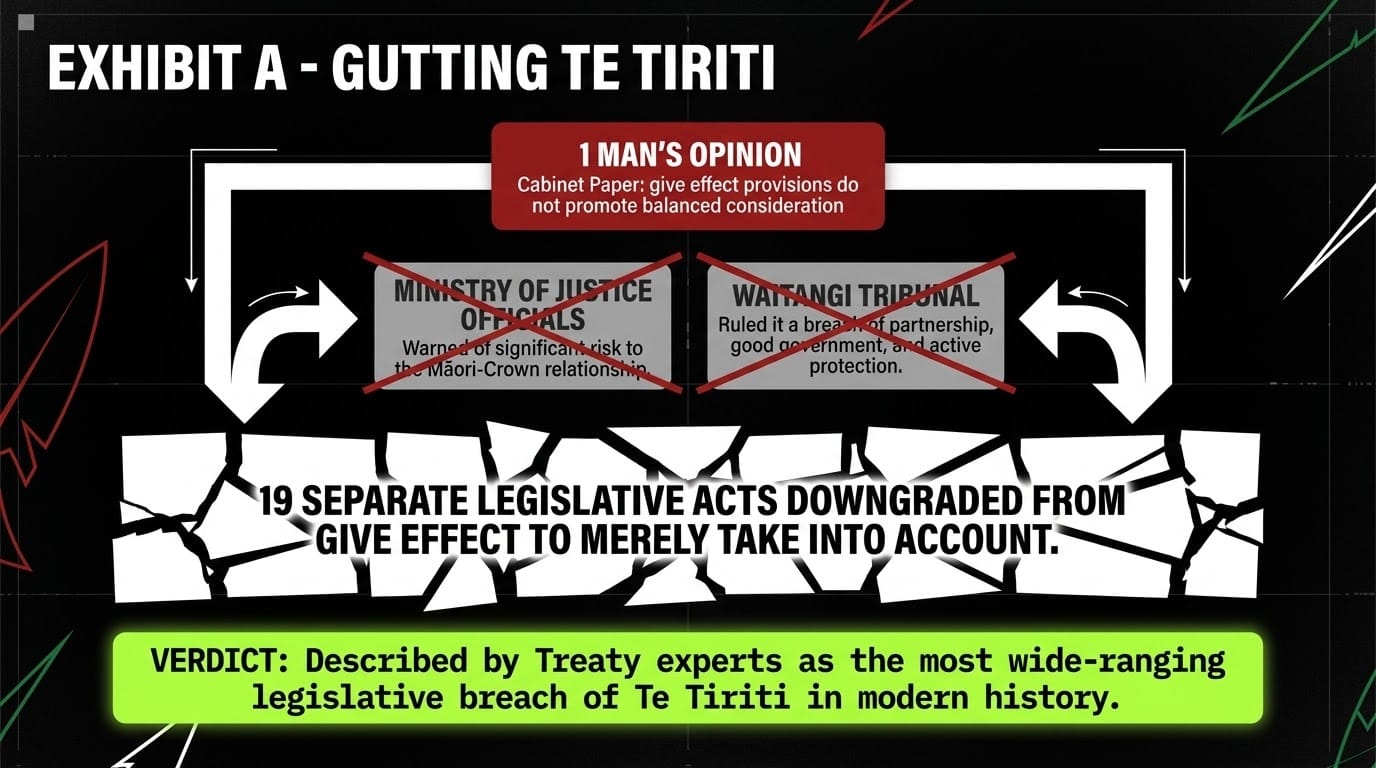
Here is the first example for the Western mind that still believes this is just “a different view.”
In 2026, the Government launched a “Treaty Clauses Review” — a plan to repeal or downgrade references to Te Tiriti across a swathe of statutes.
The Ministry of Justice’s own Regulatory Impact Statement laid out five options: keep the status quo, make Treaty references more prescriptive, repeal, use non‑legislative change, or adopt a new lowest standard — “take into account” — for all Treaty clauses.[e-tangata.co]
Officials made it clear:
- They preferred either keeping current clauses or making them more prescriptive.
- Goldsmith’s new fifth option — downgrading every clause to “take into account” — was “not a preferred option.”
- They warned it would have “significant risk to the Māori–Crown relationship” and that there was “limited evidence” it would improve certainty.[e-tangata.co]
The Government pushed ahead anyway, and the urgent Waitangi Tribunal inquiry into the review found that across many of the 19 Acts within scope, the entire justification for downgrading Treaty obligations rested on one sentence in a Cabinet paper: Goldsmith’s personal view that “give effect” provisions “do not promote the balanced consideration of all relevant factors.”[e-tangata.co]
One sentence. One man. Overriding his officials, ignoring the advisory group, and gutting nineteen laws. The Tribunal said this breached partnership, good government, and active protection — the core Treaty principles — and recommended pausing the whole programme for at least six months of real engagement with Māori.[e-tangata.co][e-tangata.co]
Goldsmith’s response? He declined to accept the Tribunal’s recommendations, calling his review “necessary,” offering no justification beyond Cabinet’s endorsement and his own opinion.[e-tangata.co]
Quantified harm:
Nineteen statutes weakened to a legal duty no higher than “take into account,” described by Treaty experts as the most wide‑ranging legislative breach of Te Tiriti in modern history.[e-tangata.co][e-tangata.co]
Solution:
Hardwire into law that any change to Treaty clauses must pass:
- Independent evidential analysis;
- Tribunal review;
- Genuine Māori engagement, not “late proposals” from the Minister.
Tikanga impact (plain):
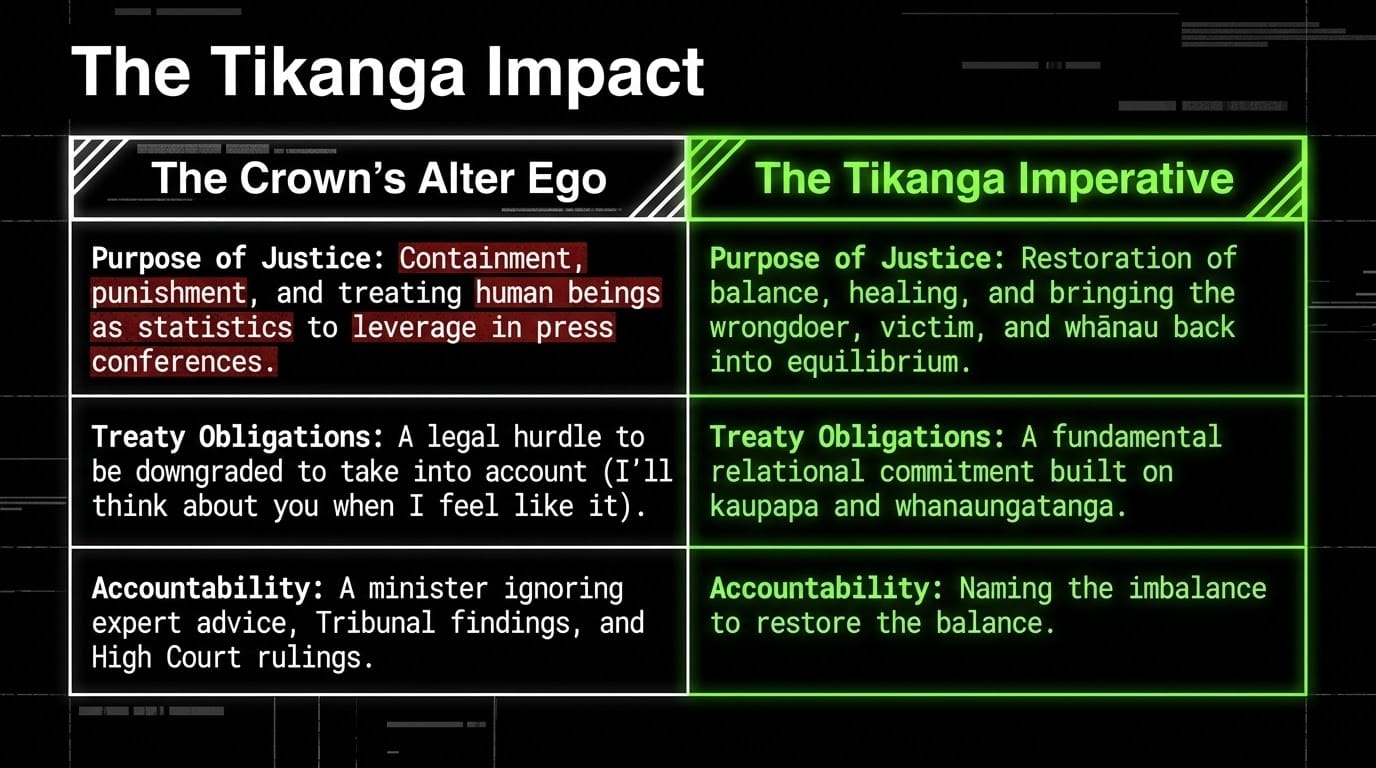
Tikanga is about relationships — kaupapa, whanaungatanga, balance. When the Crown signs a Treaty, it is making a relational commitment, not just a legal one. Turning “give effect to Te Tiriti” into “take into account” is like saying to your partner: “I’ll think about you when I feel like it, but my own interests come first.”
From a tikanga view, that is a breach of the relationship. From a Western law view, the Tribunal has literally called it a breach of the honour of the Crown and the principles the courts have recognised for decades.[e-tangata.co][e-tangata.co]
I’ve laid this out in detail already in my own essays — “The Grave Robbers in Suits” and “The Sandfly Lie” — where I show, point by point, how this government buried the verdict on its Treaty attacks.[themaorigreenlantern.maori][themaorigreenlantern.maori]
Example Two — The Prison Conveyor Belt He Tightened Himself
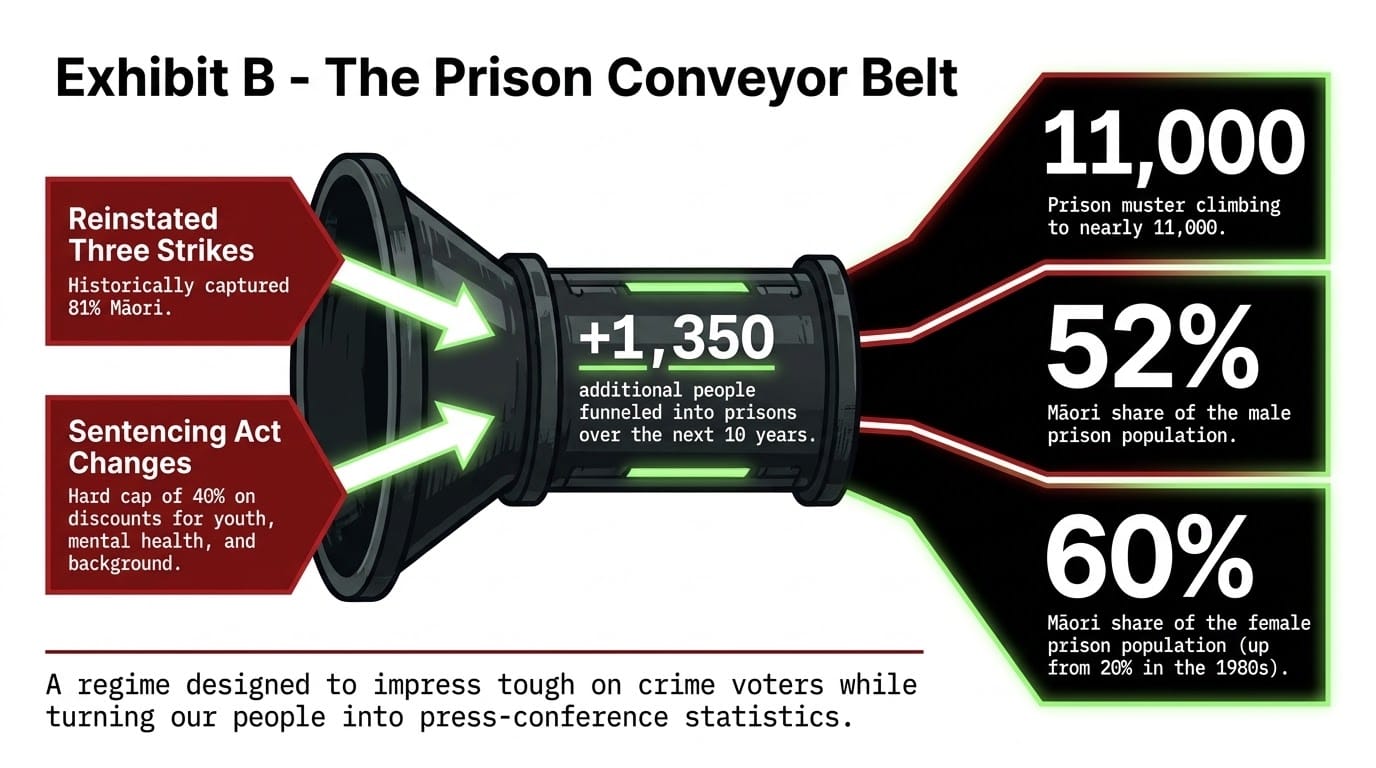
Second example: prisons.
E‑Tangata has documented that Māori men have made up roughly 52 percent of the male prison population for decades, and Māori women inmates have grown from less than 20 percent in the 1980s to nearly 60 percent of the total female prison population.
In other words: in a country where Māori are about 17 percent of the population, we are over half of the people behind bars.[e-tangata.co][e-tangata.co]
Under this government, the prison muster has climbed to almost 11,000 — with men’s prisons over 50 percent Māori and women’s prisons over 60 percent Māori.[e-tangata.co]
Goldsmith’s fingerprints are all over the laws that keep that conveyor belt moving:
- The Sentencing Act changes that cap sentence discounts at 40 percent for mitigating personal factors — youth, mental health, good character — unless a higher discount is necessary to avoid an unjust sentence.[justice.govt][bylawyers.co][theconversation]
- The reinstated Three Strikes regime.
A Ministry of Justice Regulatory Impact Statement on reinstating Three Strikes bluntly warned Cabinet that such a regime was likely to result in “disproportionate sentences” and exacerbate the over‑representation of Māori.[newsroom.co][justice.govt][justice.govt]
Journalists who’ve read that RIS report that, under the previous Three Strikes law, around 81 percent of those caught by the regime were Māori.[theconversation][newsroom.co]
The sentencing reforms’ own impact estimates say the 40 percent discount cap is expected to add about 1,350 people to the prison population over 10 years.[aut.ac][theconversation]
Quantified harm:
- 81 percent of Three Strikes captures falling on Māori in the past, with officials warning the same pattern will return.[newsroom.co]
- 1,350 additional prisoners under a regime designed to impress “tough on crime” voters, not reduce harm.[theconversation][aut.ac]
- A muster of nearly 11,000 people, more than half of them Māori.[e-tangata.co]
Solution:
- Repeal the Three Strikes reinstatement and restore judicial discretion.
- Remove the blunt 40 percent discount cap and focus on genuine rehabilitation, not political theatrics.
- Set hard targets to reduce Māori imprisonment, with tikanga‑based alternatives at scale.
Tikanga impact:
Tikanga is not soft. It has consequences. But its purpose is to restore balance — to bring the wrongdoer, the victim, and the wider whānau back into some kind of equilibrium.
A regime that deliberately locks away people for longer, ignores the context of their lives, and treats high Māori prison numbers as a “good thing” for “law and order” is anti‑tikanga in its bones. It is not about healing; it is about containment. It turns our people into statistics you can point to in a press conference.[e-tangata.co]
That is why I described our system as a “Colonial Prison Conveyor Belt” — because it predates every Three Strikes law, every Gangs Act, every sentencing cap. This government, with Goldsmith front and centre, has simply turned up the speed.[themaorigreenlantern.maori][themaorigreenlantern.maori]
Example Three — Killing the Watchdog While Lighting the Fires
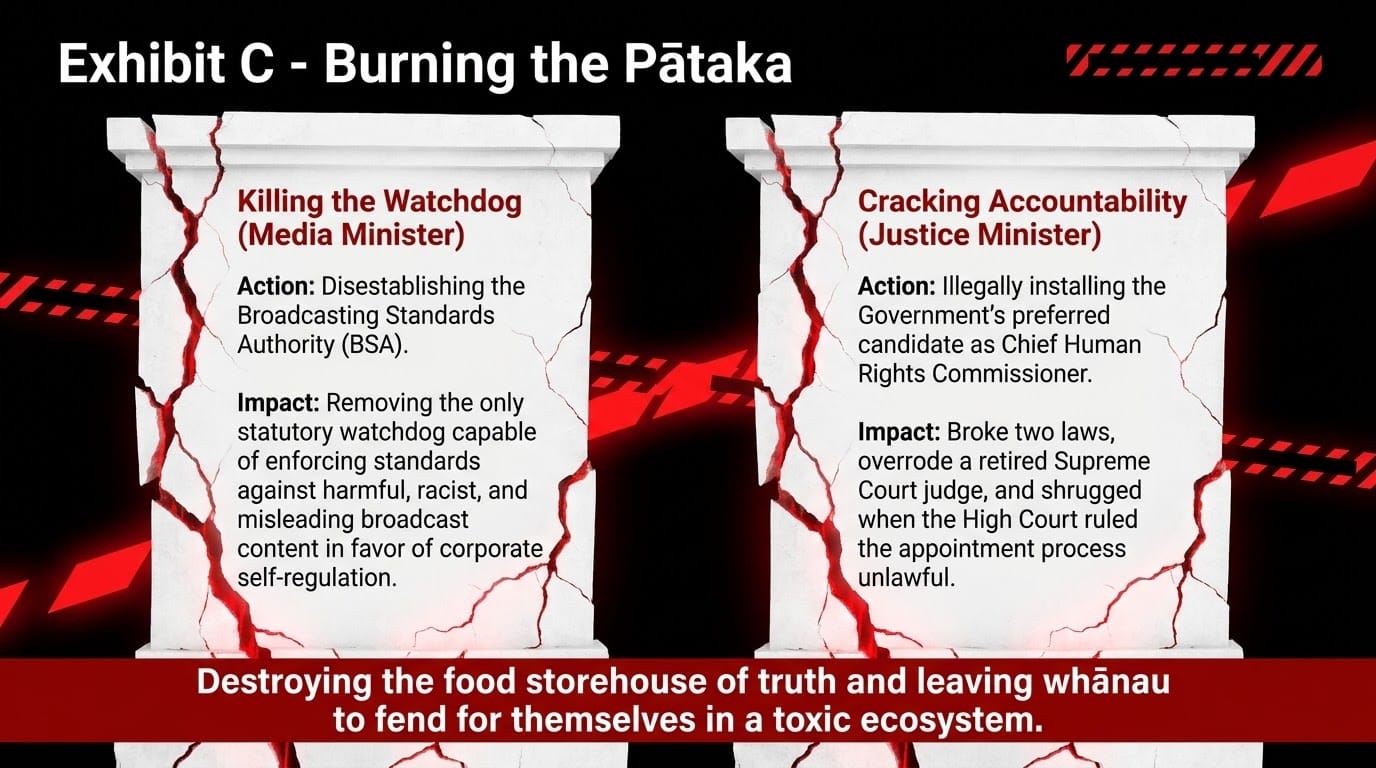
Third example: media and human rights.
Goldsmith is not just Justice Minister. He is also Media & Communications Minister, Arts, Culture & Heritage Minister, Treaty Negotiations Minister, Public Service & Digitising Government Minister, and Minister for Pacific Peoples.[fyi.org][beehive.govt][beehive.govt]
Think about that cluster for a second. One unelected list MP controls:
- The law and the courts (Justice).
- The historical and cultural narrative (Arts, Culture & Heritage).
- The media regulators and state broadcasters (Media & Communications).
- The Treaty settlement machinery (Treaty Negotiations).
- The public service and digitised state infrastructure (Public Service & Digitising Government).
Then he moves to disestablish the Broadcasting Standards Authority — the only statutory media watchdog that could enforce standards on harmful, racist, and misleading content. Government releases confirm the disestablishment plan and “self‑regulation” alternatives.[1news.co][beehive.govt]
At the same time, Goldsmith illegally installs the Government’s preferred candidate as Chief Human Rights Commissioner — breaking two laws in the process, lying about the man’s qualifications in the Cabinet paper, overriding the recommendation of a retired Supreme Court judge, then shrugging when the High Court finds the appointment process unlawful.[e-tangata.co][facebook]
E‑Tangata describes his response to the unlawful appointment as a shrug, an arrogance that “speaks volumes” about this government’s approach to human rights.[e-tangata.co]
Quantified harm:
- One statutory media regulator destroyed.
- One unlawful appointment to the office meant to protect rights, confirmed by the High Court.[facebook][e-tangata.co]
Solution:
- Reinstate an independent Broadcasting Standards Authority with real teeth.
- Rebuild the Human Rights Commission’s appointment processes so they cannot be captured by party politics.
Tikanga impact (plain):
Tikanga is also about kōrero — about whose stories are told, and how.
When you remove the watchdog that protects our people from broadcast hate, and then crack the final line of human rights accountability with an unlawful appointment, you are not just changing institutions. You are burning the pātaka — the food storehouse of truth and protection — and leaving our whānau to fend for themselves in a media ecosystem designed to favour white anger and corporate spin.
That is why I wrote “The Watchdog They Shot” and “While They Poisoned the Pātaka, I Picked Up the Taiaha” — because these moves are not technocratic tweaks; they are deliberate acts of information warfare.[themaorigreenlantern.maori][themaorigreenlantern.maori][facebook]
Goldsmith’s War on Tikanga and Anti‑Racism
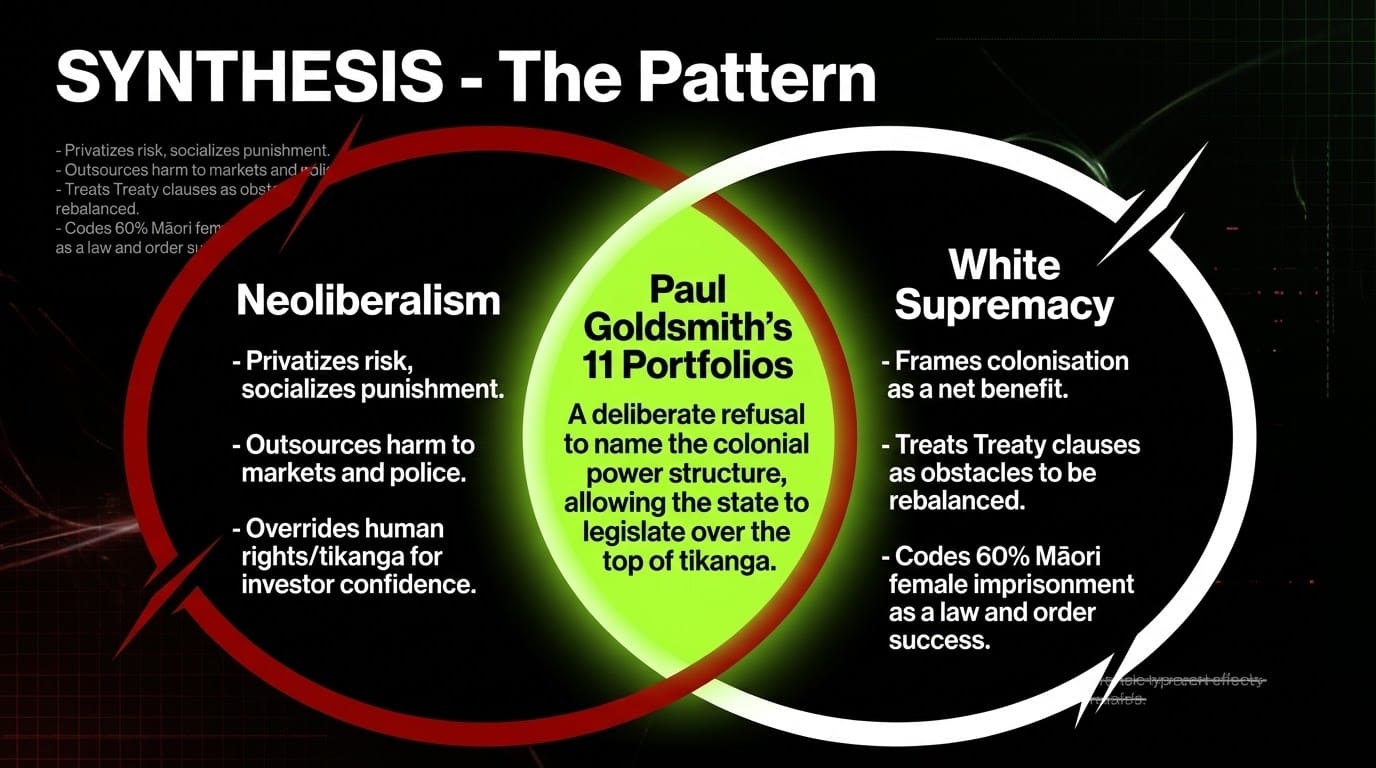
If this was just one man with bad opinions, it would be an irritation. But Goldsmith has a track record:
- He publicly warns that the government will legislate “over the top” of court decisions involving tikanga and Treaty obligations if judges recognise Māori concepts too clearly.[e-tangata.co][lawnews][nzherald.co]
- He tells a Law Association audience that “unique” rulings on tikanga could scare off investment.[lawnews][nzherald.co]
- He signals that he wants to strip colonial and institutional racism out of the National Action Plan Against Racism, prompting the tangata whenua caucus to walk away in protest.[e-tangata.co]
Tina Ngata records that Goldsmith tried to reduce the focus on colonial racism and institutional racism in that plan, replacing precise language with vague “all racism is unacceptable” rhetoric that obscures the specific role of colonialism in Aotearoa.[e-tangata.co]
This is not a neutral commitment to “fairness.” It is a deliberate refusal to name the power structure that delivers 52 percent Māori men in prison, 60 percent Māori women in prison, and nineteen laws having their Treaty clauses downgraded.[e-tangata.co][e-tangata.co][e-tangata.co][e-tangata.co]
For tikanga, this matters because you cannot restore balance if you refuse to name the imbalance. If colonisation is “good on balance,” if tikanga is a threat to investor confidence, if racism is something that happens in the abstract but not in your own policy documents — then you have built an entire ministerial career on denying the harm your decisions cause.
From a legal perspective, E‑Tangata’s Philip Joseph calls Goldsmith’s refusal to act on Tribunal recommendations “a failure to act honourably,” a breach of the Crown’s Treaty obligations and basic administrative law principles of fairness and consultation. That is the Crown’s alter ego speaking — and refusing to listen.[e-tangata.co]
The Pattern: White‑Supremacist Neoliberalism in Practice
This is why I call this government white‑supremacist and neoliberal. Not as rhetorical flourish, but as description.
Neoliberalism:
- Privatises risk, socialises punishment.
- Outsources harm to markets and police.
- Uses “certainty” and “investor confidence” as excuses to override human rights and tikanga.
White supremacy:
- Treats colonisation as a net benefit for Māori.
- Sees Treaty clauses as an obstacle to be “rebalanced.”
- Codes Māori over‑representation in prisons as a “law and order” success, not a crisis.
Goldsmith’s portfolio cluster and his record sit exactly at this intersection:
- As Justice Minister, he reinstates Three Strikes and caps sentencing discounts despite warnings it will hit Māori hardest.[justice.govt][justice.govt][newsroom.co]
- As Treaty Negotiations Minister, he fronts a Treaty Clauses Review that Tribunal judges describe as the most damaging legislative attack on Māori in a generation.[e-tangata.co][e-tangata.co]
- As Media & Communications Minister, he disestablishes the Broadcasting Standards Authority.[beehive.govt][1news.co]
- As the unofficial architect of colonisation “good on balance,” he frames every one of these moves as practical, sensible reform.
And he does all this without ever winning an electorate seat.
From a tikanga lens, this is a taniwha with no home water — a creature of the list, answering upwards to party and donors, not downwards to hapori. From a Western legal lens, it’s a minister repeatedly ignoring expert advice, Tribunal findings, and court rulings, while accumulating more and more power.
Ngā mihi,

Ivor Jones The Māori Green Lantern Fightin Misinformation And Disinformation From The Far Right
Disclaimer
This essay is opinion and analysis grounded in verifiable public‑record sources current to 16 August 2026. Paul Goldsmith is commented on solely in his public capacity as a sitting Cabinet minister, consistent with qualified privilege under Lange v Atkinson 2 NZLR 22 and the public‑interest test in Durie v Gardiner NZCA 278.[en.wikipedia][newsroom.co][beehive.govt][e-tangata.co][newsroom.co][e-tangata.co][e-tangata.co][e-tangata.co][e-tangata.co]
No claim of malice is made; the pattern described rests on the public record of ministerial decisions and their documented consequences.
Right of reply remains open to Hon Paul Goldsmith and the National Party at ivor@themaorigreenlantern.maori.nz. Any factual error will be corrected promptly on notice.