"The Poisoned Ledger: How Shane Jones Misleads Aotearoa While Whakatāne Whānau And Australia-Based Māori Carry The Bill" - 16 September 2026


He Tells Whānau To Trust The Next Mine While The Survivors Of The Last Industrial Poisoning Still Fight For ACC.
He Calls Jobs “Growth” After Thousands Of His PGF Jobs Had Already Been Disestablished.
He Says Māori Overseas Are Not Coming Home While His Party Wants To Tighten The Citizenship Gate.
That Is Not Tika. That Is Not Pono. That Is A Crown Politics Of Extraction, Exclusion, And Evasion.
I write this because public power must be accountable to the people it affects.
This essay examines Shane Jones’ public statements, New Zealand First’s citizenship policy, the treatment of Australia-based Māori, the Provincial Growth Fund’s job claims, fast-track extraction, PCP poisoning, and ACC redress.
These matters go to Te Tiriti, citizenship, Māori employment, worker safety, whakapapa, whenua, wai, and the right of whānau to return home.
What I Am Putting Before You
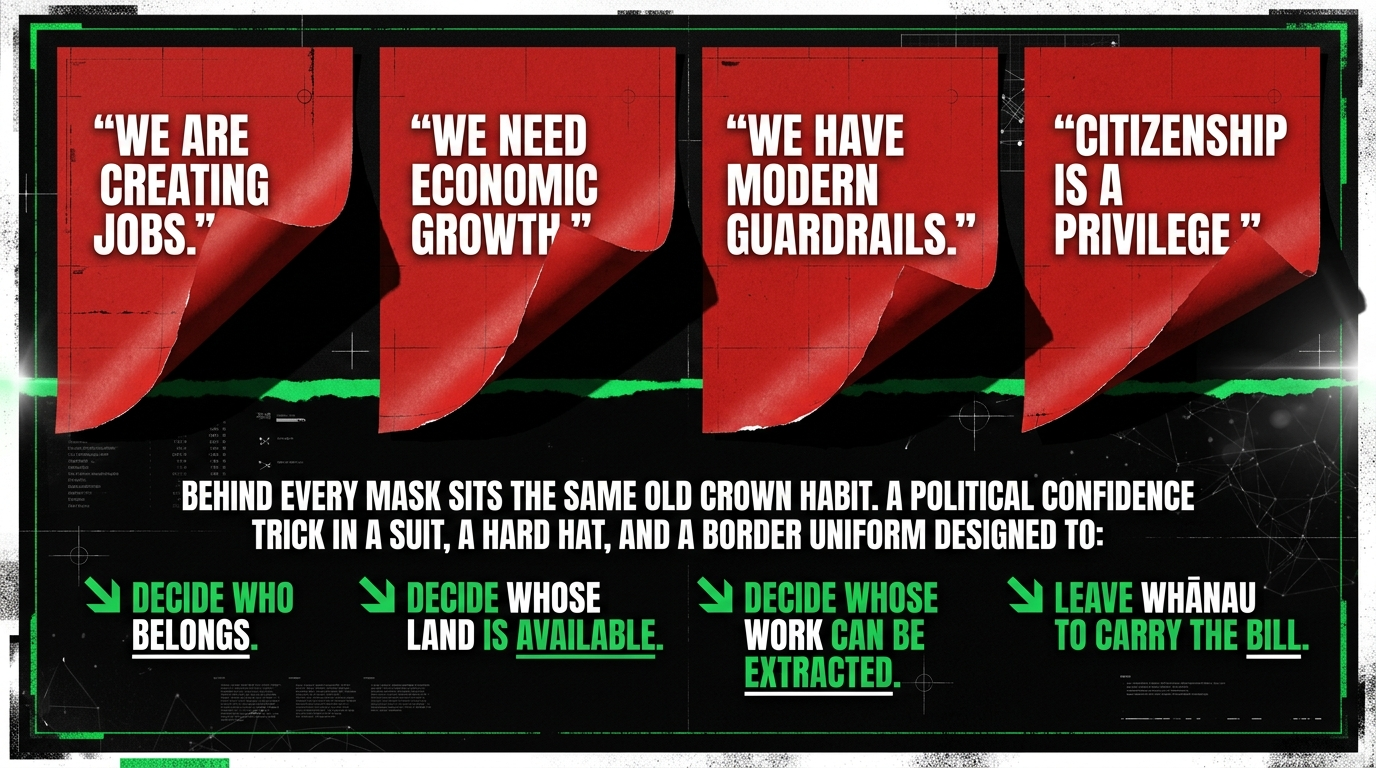
E hoa mā, this is not one story. It is one system wearing different masks.
One mask says “jobs.”
One mask says “growth.”
One mask says “modern guardrails.”
One mask says “citizenship is a privilege.”
But behind every mask sits the same old Crown habit: decide who belongs, decide whose land is available, decide whose work can be used, decide whose injuries are too hard to compensate, then call the people who object emotional, ideological, or unreasonable.
This essay covers:
- Shane Jones’ claim that Aotearoa needs growth through extraction and fast-track development.
- The Provincial Growth Fund record, where headline employment claims included work that was temporary, cumulative, projected, or already disestablished.
- The ongoing PCP poisoning legacy that workers, whānau, contaminated whenua, and wai still carry.
- ACC barriers that leave workers harmed by chemical exposure facing complex proof requirements instead of a straightforward remedy.
- The Fast-track Approvals regime and the gap between consultation and mana whenua authority.
- The Government’s Waihi North jobs and export projections, tested against the scale of Māori unemployment.
- Jones’ defence of a policy that could make citizenship and return harder for overseas-born descendants of Māori.
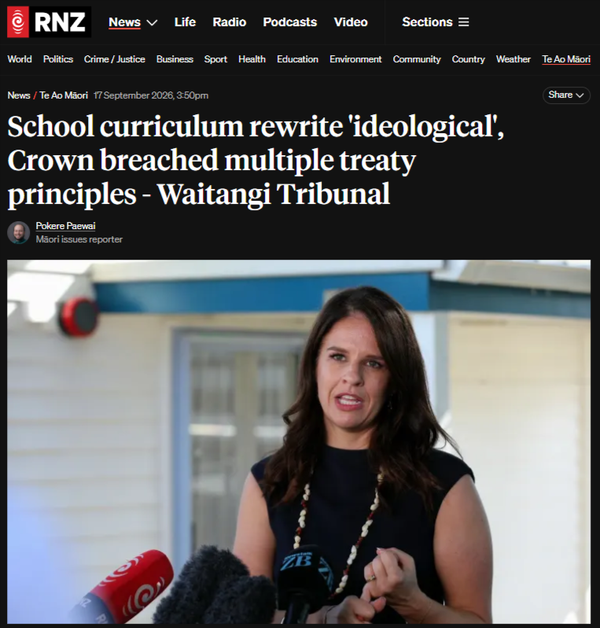
- The Waitangi Tribunal’s finding that citizenship law has already breached Treaty principles by leaving overseas Māori vulnerable to disconnection from tūrangawaewae.
- Three plain-language examples for the western mind: the factory that sends the bill home, the mine with the billion-dollar headline, and the border that treats whakapapa as paperwork.
I am not calling Shane Jones a liar. I cannot prove what he knew in his own mind when he spoke.
But I can say this clearly:
Shane Jones misleads. He repeatedly gives the politically useful half of the story and leaves whānau to find the other half in the wreckage. He sells job headlines without durable-job proof. He sells modern safeguards while poisoned workers remain without a complete remedy. He sells extraction as a solution to Māori unemployment without proving who gets the work. And he defends citizenship restrictions that could turn Māori descendants returning home into applicants before a Crown system that has never had the authority to define whakapapa.
That is not pono.
That is a political confidence trick in a suit, a hard hat, and a border uniform.
The Minister’s Half-Truth
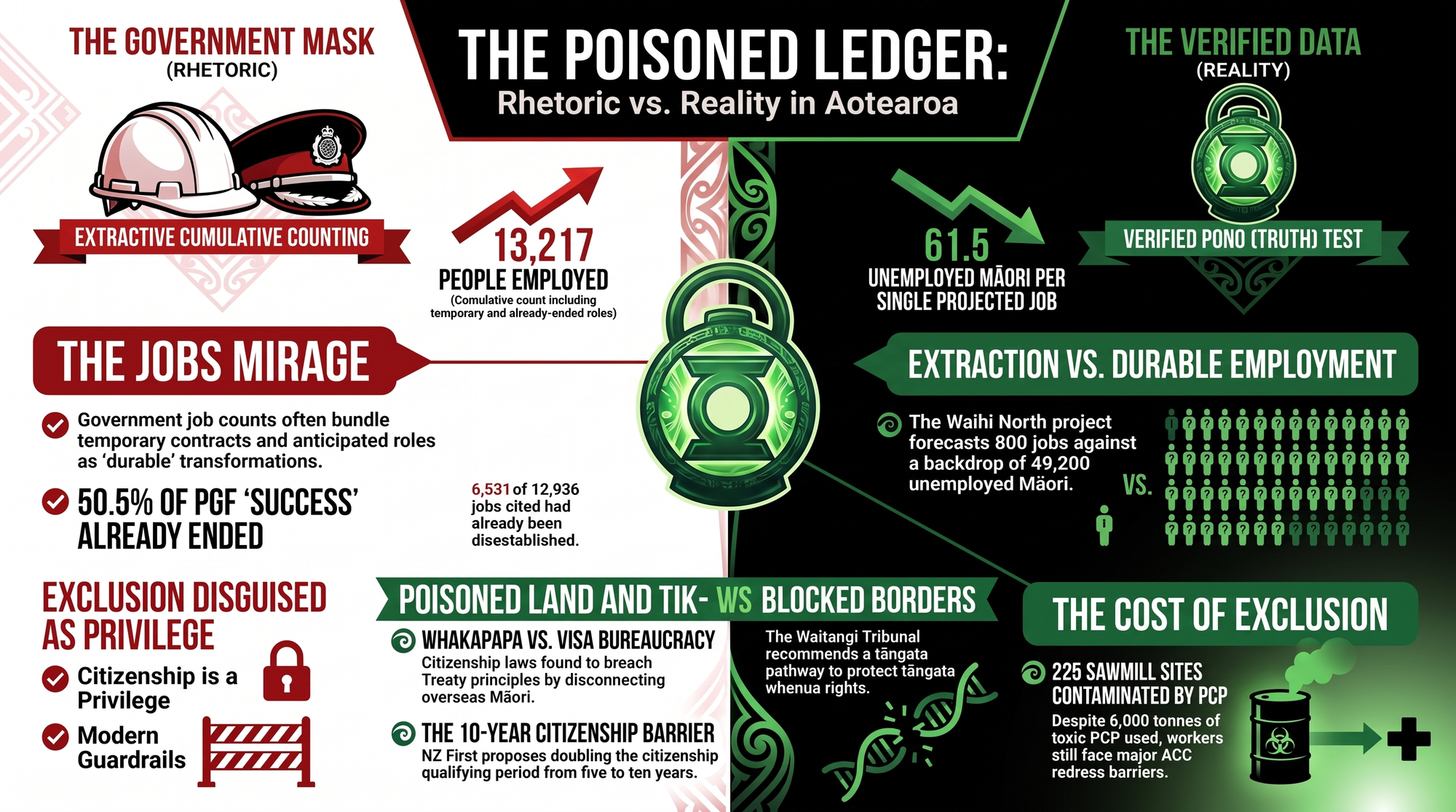
Shane Jones tells us Aotearoa must grow.
In the MATA with Mihingarangi Forbes interview, Jones presents himself as a politician prepared to make trade-offs for development. RNZ reports he defended an agenda of mining, fishing, farming, horticulture, and other productive-sector expansion while accepting that Māori unemployment is an “awful reality.” RNZ’s Report On Shane Jones’ MATA Interview
In the interview, Jones says present-day safeguards do not repeat the failures of the 1950s and that he trusts “quality of engineering, risk assessment, scientific rationalism, and economic rationalism.”
Here is the problem.
Jones tells only the half of the story that flatters power.
He talks about future employment, but not the durability of the jobs.
He talks about exports, but not the distribution of wealth.
He talks about faster approval, but not the speed at which a polluted river, a sick worker, or an affected whānau receives remedy.
He talks about guardrails, but not the people still trapped behind the failed guardrails of the past.
The Human Rights Commission says PCP’s consequences remain ongoing for workers, whānau, communities, and the environment. It identifies concerns about the rights to health, safe work, a healthy environment, and effective remedy. Te Kāhui Tika Tangata Human Rights Commission’s The Legacy Of PCP And Its Dioxins In Aotearoa
So when Jones says “modern guardrails,” I ask:
Where are the guardrails for the people already poisoned by the old ones?
Until that is answered with health care, compensation, site assessment, remediation, and public accountability, his reassurance is not enough.
It is misleading.
The Deep Dive Podcast
Listen to a lively conversation between two hosts, unpacking and connecting topics in the sources of this essay. I apologise in advance for the AI's very harsh pronounciation of reo. Please dont shoot me, :).
Youtube Video
Like video? Here is a short video suppporting the essay. Again, don't shoot the messenger please because of AI's pronounciation. :)
Koha Consideration
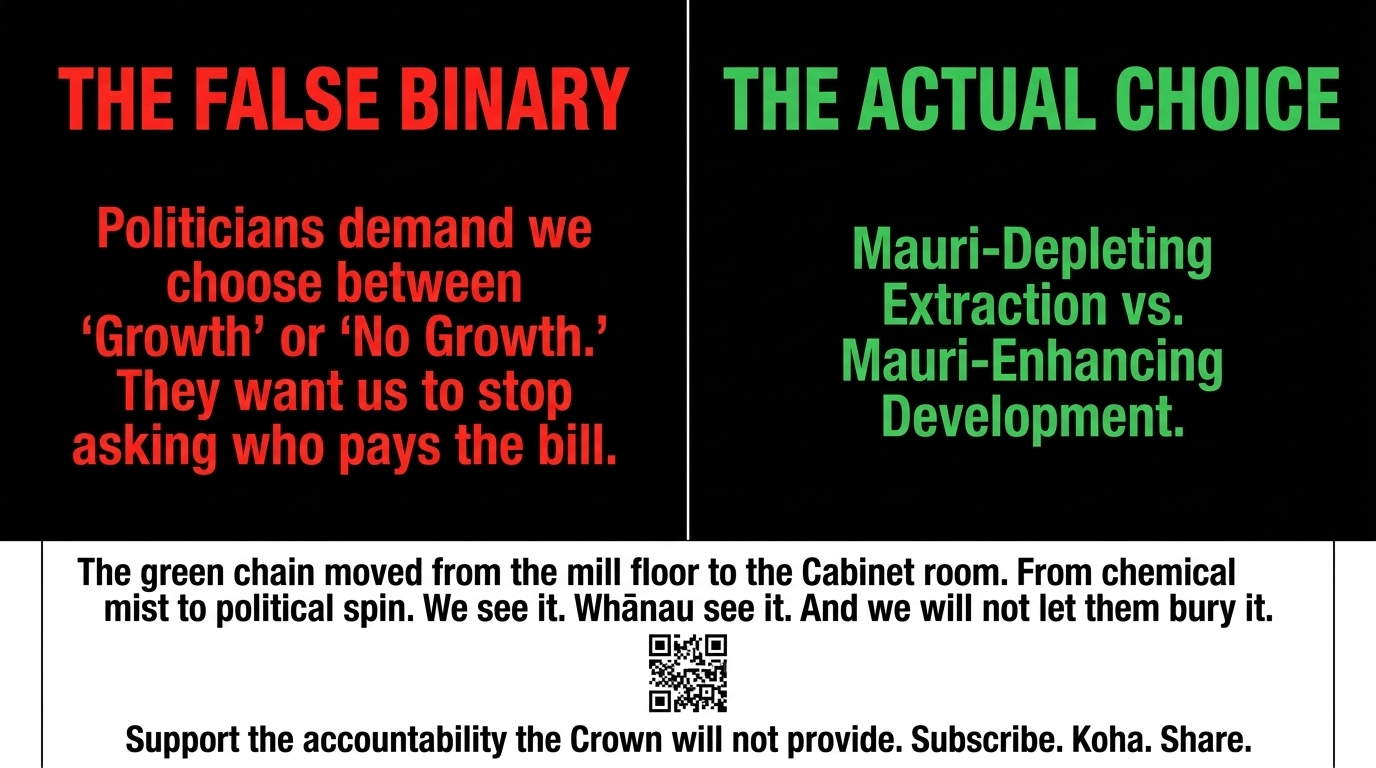
You might ask who supports The Māori Green Lantern to read the reports Ministers skim, audit the jobs figures behind the applause, follow the poisoned files, and call out the Crown when it treats whakapapa as paperwork.
The answer is you, whānau.
No mining company supports this mahi.
No Crown department supports this mahi.
No corporate public-relations firm supports this mahi.
There is no well-fed line of powerful sponsors paying me to soften the truth, bury the poisoned ledger, or pretend a visa form has more mana than whakapapa.
Every koha says that whānau are ready to support the accountability that Crown and corporate structures will not provide. It says rangatiratanga includes the power to support our own truth tellers—especially when workers are still sick, whenua still carries contamination, and Ministers want to build a bureaucratic border between uri and home.
Kia kaha, whānau. Stay vigilant. Stay connected. If you are able, consider a koha to support this mahi and keep this light burning.
If you cannot koha, kāore he raru. Subscribe or follow The Māori Green Lantern, kōrero with your whānau, and share this mahi with your friends. That is koha too.
Four Pathways Exist:
- Make a voluntary contribution through Koha — Support The Māori Green Lantern.
- Receive essays directly and support this mahi through Subscribe To The Māori Green Lantern.
- Use direct bank transfer: Ivor Jones, 03-1395-0099387-000.
- Subscribe through The Māori Green Lantern On Facebook.
The PGF Jobs That Vanished
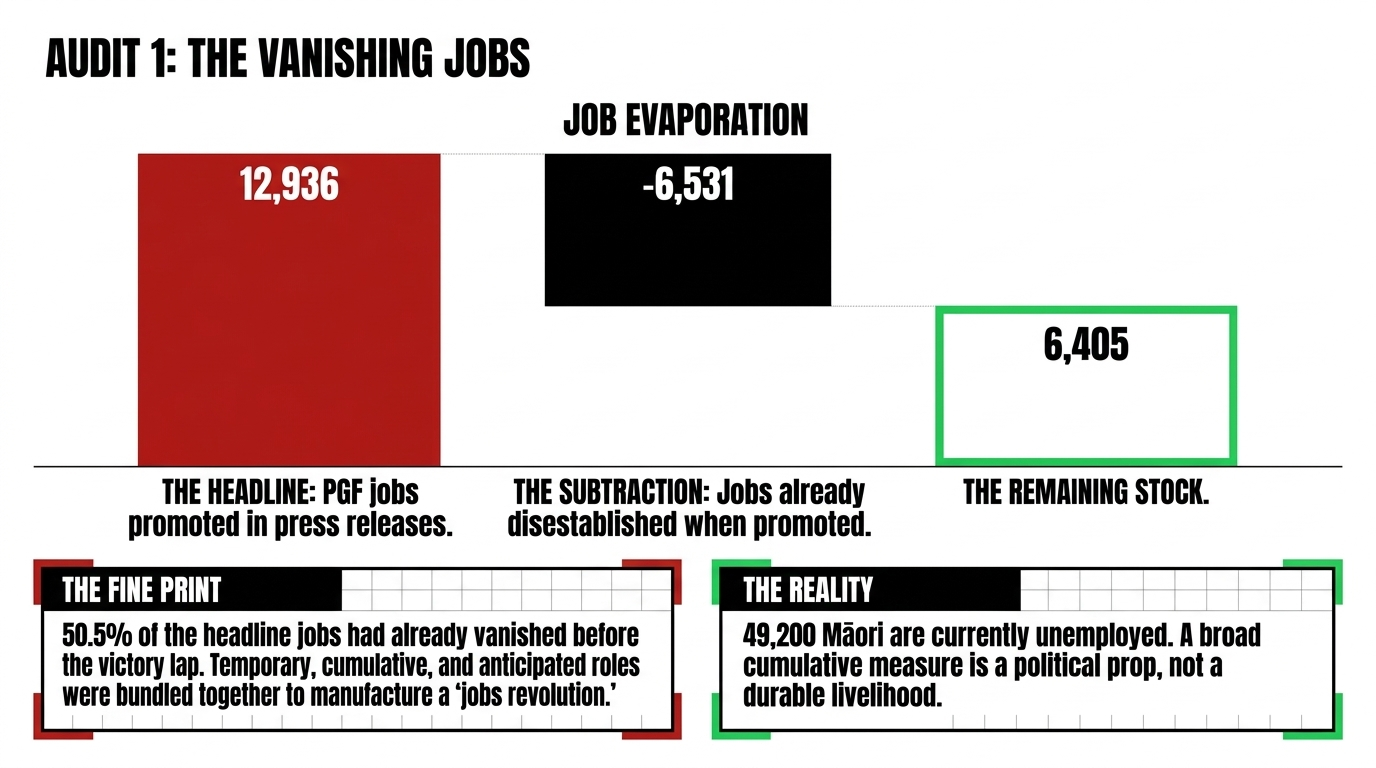
Before Shane Jones asks whānau to trust another jobs promise, we need to remember his last large jobs promise.
In August 2020, Jones announced that 13,217 people had been employed “so far” through Provincial Growth Fund investments. The Government presented this as evidence that its 10,000-jobs target had been surpassed. Shane Jones’ Provincial Growth Fund Jobs Announcement
But that 13,217 figure was not a clean count of ongoing jobs.
The Government’s own wording said it was a cumulative stocktake of people employed in the past, employed at the time, or expected to be employed by PGF investments. Shane Jones’ Provincial Growth Fund Jobs Announcement
RNZ reported that an NZIER review found the figure counted people who worked on projects rather than measuring the number of jobs created. It reported that officials had previously collected monthly worker counts and later contacted funding recipients to construct the cumulative total. RNZ’s Examination Of Shane Jones’ PGF Job Claim
Then comes the number Jones should have had to explain from every podium in the country.
Newsroom reported that a PGF press release promoted 12,936 jobs, while 6,531 of those jobs had already been disestablished at the time the figure was being promoted. Newsroom’s Investigation Of The Provincial Growth Fund Job Figures
The working is plain:
Approximately 50.5% of the 12,936 jobs in that count had already ended. Newsroom’s Investigation Of The Provincial Growth Fund Job Figures
No, it is not accurate to say every PGF job disappeared.
I will not make that claim.
But it is accurate to say the headline was misleading because it bundled together temporary, cumulative, anticipated, and already-disestablished roles in a way that could make public success appear more durable than it was.
Officials had already acknowledged that early PGF employment would mostly be temporary contracting work, including construction and advisory roles. 1News’ Report On Temporary PGF Employment
Newsroom also reported Auditor-General concern that there was insufficient clarity about what counted as a “job” against the fund’s targets. Newsroom’s Review Of Auditor-General Concerns About The PGF
This is why I refuse to clap when Jones announces another jobs figure. He has form—not a proven lie, but a documented method of using a broad cumulative measure to create the impression of a durable employment transformation.
The Minister says “jobs.”
I ask: new jobs, or existing jobs? Permanent jobs, or temporary contracts? Māori jobs, or a generic number? Local jobs, or imported labour? Living-wage jobs, or poverty-wage work? Jobs still standing after the camera crew leaves, or jobs already gone while the press release is still warm?
Because a job that disappears before the victory lap is not a jobs revolution.
It is a political prop.
The Poisoned Whenua And The Sick Worker
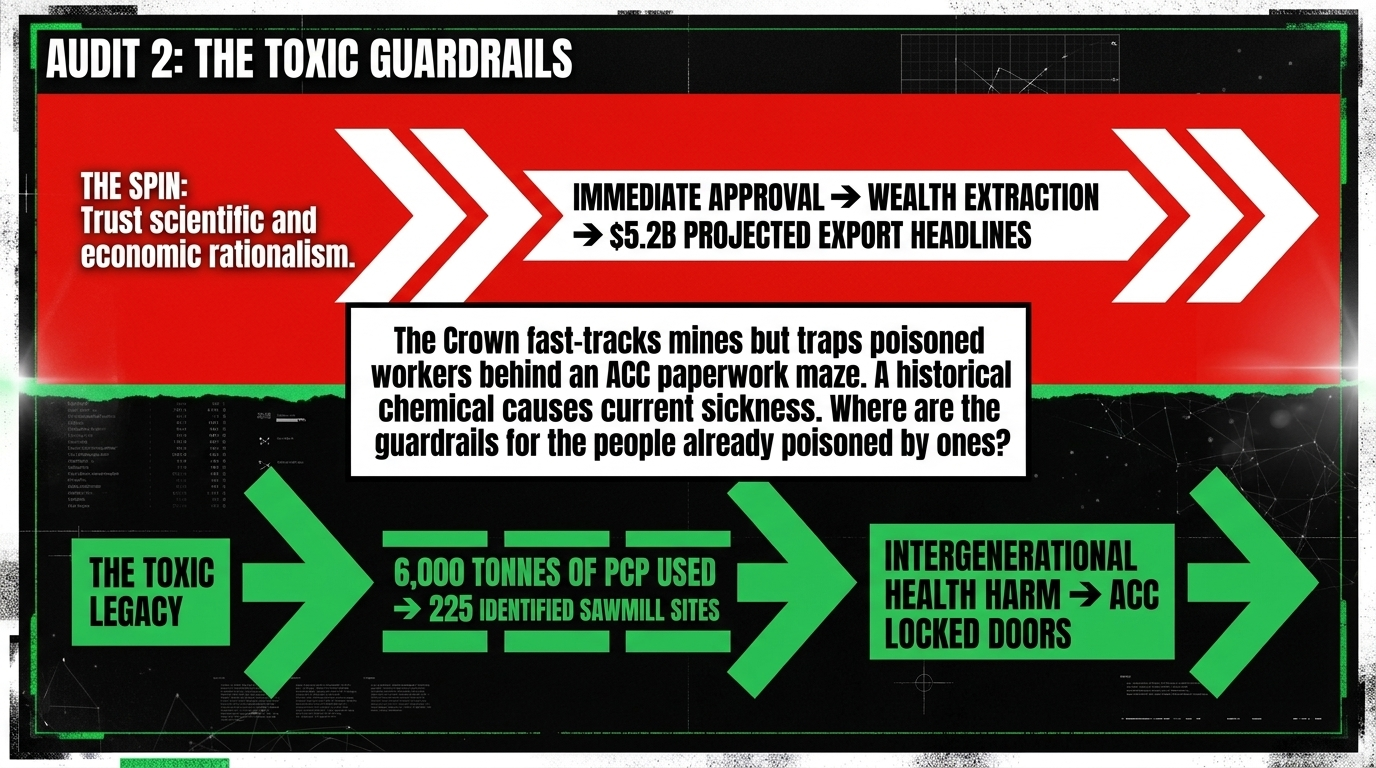
PCP was used as an anti-sapstain chemical in the timber industry.
That technical phrase hides a brutal truth: industrial wealth was made while workers were exposed, whānau were placed at risk, and communities were left to deal with contamination after the economic benefit had moved on.
The Human Rights Commission records PCP use in New Zealand’s timber industry from around 1930 to 1988 and says around 6,000 tonnes were imported and used between around 1950 and 1988. Te Kāhui Tika Tangata Human Rights Commission’s PCP Report
The Commission records that technical-grade PCP contained dioxin impurities and that PCP and dioxins can persist in soil and water, move through food chains, and create risks to people and ecosystems. It discusses developmental, reproductive, liver, kidney, and carcinogenic concerns associated with PCP or dioxin exposure. Te Kāhui Tika Tangata Human Rights Commission’s Findings On PCP And Dioxin Harm
The Commission also records exposure through inhalation and skin contact and identifies concern about contaminated work clothing carrying risk into homes. Te Kāhui Tika Tangata Human Rights Commission’s Evidence On Worker And Whānau Exposure
That is why I reject the word “historical” as a political sedative.
A historical chemical can cause current sickness.
A historical decision can leave current contamination.
A historical failure can create current poverty, grief, fear, and injustice.
The Human Rights Commission says the PCP legacy may be intergenerational, affecting health, wellbeing, cultural identity, and relationships to whenua and wai. It says Māori were likely to have been disproportionately affected because of Māori participation in the timber workforce and the location of sites close to Māori communities and land. Te Kāhui Tika Tangata Human Rights Commission’s Findings On Intergenerational And Māori Impacts
The use of PCP may belong to the past.
The abandonment does not.
The Border Around Whakapapa
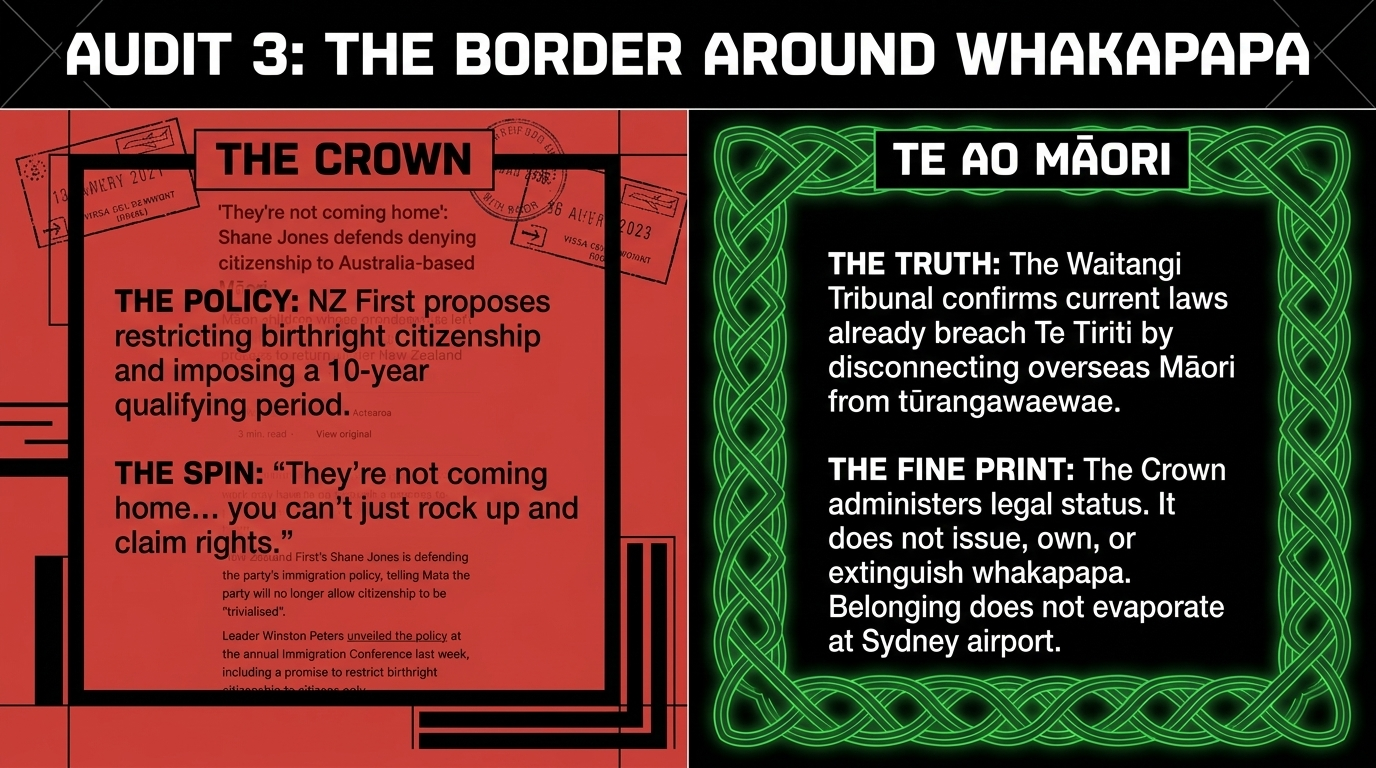
Now we come to the other side of Jones’ politics: who he believes gets to come home.
RNZ reports that New Zealand First’s new policy would restrict automatic citizenship at birth to children of New Zealand citizens. It would remove the current pathway for children born in Aotearoa to a parent entitled to live here indefinitely, if that parent is not also a citizen. RNZ’s Explanation Of NZ First’s Citizenship Proposal New Zealand First’s Published Immigration Policy
New Zealand First also proposes to increase the citizenship qualifying period from five years to a minimum of 10 years, increase the permanent-residence qualifying period from two years to five years, impose a 10-year welfare stand-down for visa holders, and pursue “citizens only” voting and social-housing priorities. New Zealand First’s Published Immigration Policy.
The law as it stands already limits citizenship by descent to one generation. A child born overseas to a parent who is a New Zealand citizen by descent is not automatically a New Zealand citizen unless the child would otherwise be stateless. Citizenship Act 1977, Section 7
That is the existing fault line.
The Waitangi Tribunal has already examined it.
In He Tangata, he Whenua: The Citizenship Report, the Tribunal found that the Citizenship Act 1977 makes no mention of Te Tiriti or Māori status as tangata whenua. It found that the Crown’s existing mechanisms for preventing overseas Māori from being disconnected from tūrangawaewae were passive and culturally inappropriate. Waitangi Tribunal: He Tangata, He Whenua: The Citizenship Report
The Tribunal found the Crown had breached Treaty principles of partnership, active protection, rangatiratanga, good government, equal treatment, and options. Waitangi Tribunal Citizenship Findings
It recommended that the Crown:
- recognise Māori as tangata whenua in the Citizenship Act;
- require the Act to give effect to Te Tiriti and its principles;
- establish a tikanga pathway that allows hapū and iwi to assess whakapapa evidence;
- extend citizenship by descent to two generations for Māori. Waitangi Tribunal Citizenship Recommendations [Verified]
That is the Tribunal’s answer.
Not more disconnection.
Not a colder border.
Not a Crown-only test of belonging.
A tikanga pathway.
Hapū and iwi assessing whakapapa.
A legal system that finally accepts it does not get to invent Māori identity by visa form.
Then Jones went on MATA.
He said many Māori whānau who had gone to Australia were “not coming home.” He said that great-grandchildren and great-great-grandchildren returning to Aotearoa would have to “go through a process.” He also said people who had been Australian for several generations could not simply “rock up home” and claim “arbitrarily hitherto unknown rights.” RNZ’s Report On Jones’ Comments About Australia-Based Māori
That statement exposes the Crown worldview behind the policy.
It sees Māori whānau as a migration-management issue.
I see whakapapa.
It sees a person whose parent or grandparent left for work.
I see a uri whose connection to whenua does not evaporate at Sydney airport.
It sees a visa process.
I see the Crown attempting to place an administrative border around a relationship it neither created nor owns.
Jones’ remarks are misleading because they present citizenship as though it is the measure of belonging. It is not. Citizenship is a state legal status. Whakapapa is a relationship of descent, obligation, recognition, and connection. The Crown administers citizenship; it does not issue whakapapa, own whakapapa, or extinguish whakapapa.
The political harm is practical. A citizenship law can restrict access to residence, political participation, movement, and the ability to rebuild life in Aotearoa. That does not erase a person’s whakapapa. But it can make the Crown’s bureaucracy a barrier between uri and their tūrangawaewae.
The Waitangi Tribunal has said that barrier breaches Te Tiriti.
Jones wants us to treat it as common sense.
Kāore.
Three Examples For The Western Mind
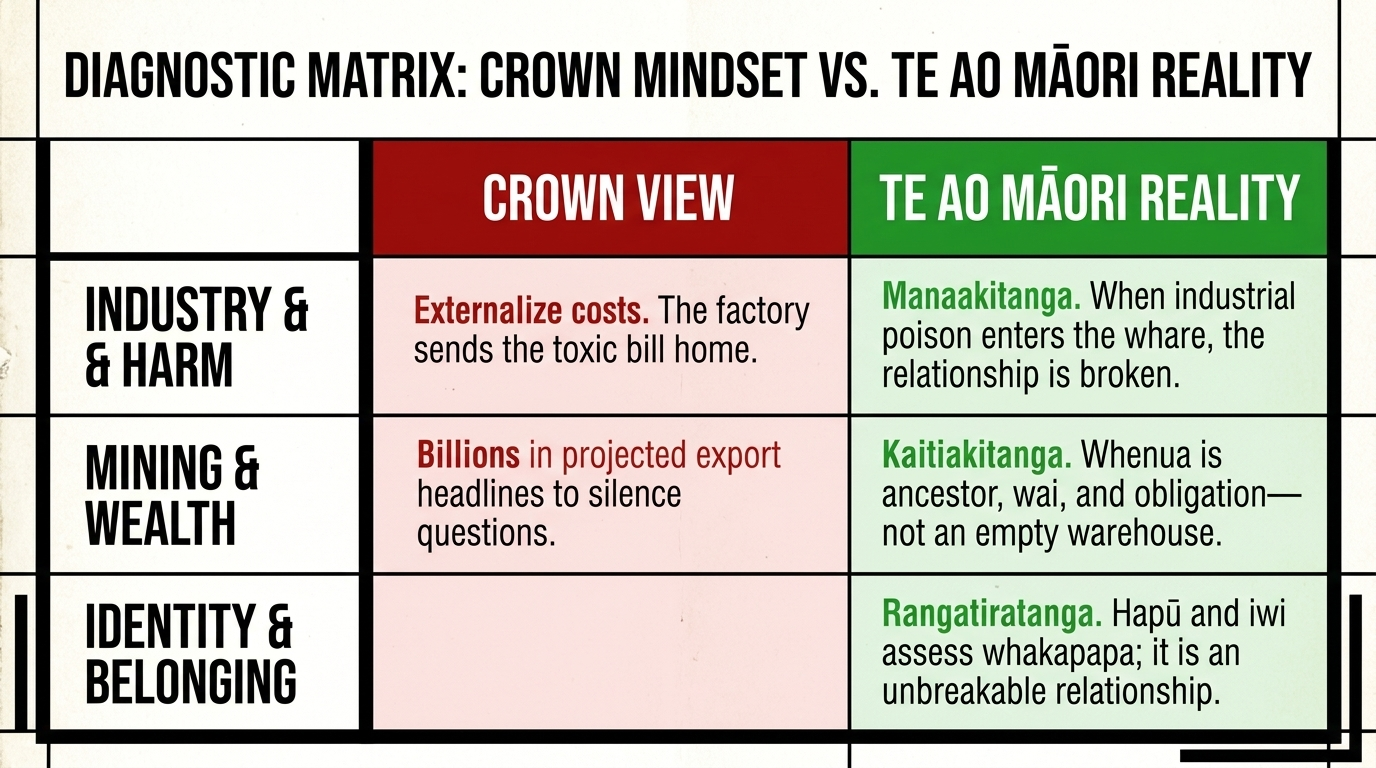
For the western mind trained to recognise only money, contracts, permits, and individual legal rights, here are three examples.
Tikanga is not decoration applied after a Cabinet decision.
Tikanga is the test of whether a decision is fit to be made at all.
Example One: The Factory That Sends The Bill Home
A company uses a toxic chemical.
The company gets the commercial benefit.
A worker is exposed through their skin and lungs.
The worker takes contaminated clothing home.
A partner washes it.
The risk enters the whare.
The Human Rights Commission records workplace exposure and concern about secondary exposure from contaminated work clothing taken home for laundering. Human Rights Commission Evidence On Workplace And Take-Home Exposure
For the western mind, this is called externalising costs.
The private company keeps the gain while the worker, their whānau, and public systems absorb the risk.
For te ao Māori, it is a breach of relationship.
Impact On Tikanga: Manaakitanga requires care for people. Kaitiakitanga requires protection of the living systems that sustain life. Whakapapa connects present conduct to future generations. When industrial poison follows a worker into their home, it breaches all three.
Quantified Harm: The Human Rights Commission records around 6,000 tonnes of PCP used across decades and 225 sawmill sites identified as users in a 2008 assessment. Human Rights Commission PCP History And Site Evidence
Solution: The Human Rights Commission recommends specialist, culturally appropriate support and either ACC reform or a dedicated compensation mechanism for chemical exposure and long-latency occupational illness. Human Rights Commission Recommendations On Health Support And Compensation
Example Two: The Mine With The Billion-Dollar Headline
The Government says the Waihi North project may support around 800 jobs and generate $5.2 billion in additional exports over 18 years. Government Announcement Of The Waihi North Fast-Track Approval
The number is huge because it is meant to silence questions.
It works out to about $288.9 million in average projected additional annual exports. It is not proof of Māori employment, local wage growth, community wealth, clean water, safe work, or funded restoration. Government Waihi North Projection
MBIE records 49,200 Māori people unemployed in June 2026. MBIE Māori Labour Market Statistics Snapshot, June 2026
Compare that with 800 projected jobs:
That is about 61.5 unemployed Māori people for every projected Waihi North job. MBIE Māori Labour Market Statistics Snapshot, June 2026 Government Waihi North Approval Announcement
Impact On Tikanga: Whenua is not an empty warehouse of ore. It is ancestor, memory, kai, wai, burial ground, identity, and obligation. A project that extracts value but leaves risk with the rohe is not automatically development. It may be an extraction scheme with a better public-relations team.
Solution: Bind every project to public Māori and local employment targets, paid apprenticeships, wage and safety obligations, independent ecological monitoring, mana whenua governance, transparent procurement, and independently held remediation bonds. [Analysis And Policy Recommendation]
Example Three: The Border That Calls Whakapapa A Visa Problem
A Māori parent is born in Australia.
Their parent may have citizenship by descent from Aotearoa.
Under current citizenship law, citizenship by descent generally does not automatically pass beyond one overseas-born generation. The child may need to apply for citizenship by grant or special grant. Citizenship Act 1977, Sections 7 And 9 Waitangi Tribunal Citizenship Report Summary
That is the current legal problem.
The Waitangi Tribunal says the Crown’s passive and culturally inappropriate mechanisms leave overseas Māori vulnerable to being disconnected from tūrangawaewae. It recommends a tikanga pathway so hapū and iwi can assess whakapapa evidence and recommends extending citizenship by descent to two generations for Māori. Waitangi Tribunal Citizenship Findings And Recommendations
Jones’ answer is that such people cannot simply “rock up home” after generations abroad and claim rights. RNZ’s Report On Jones’ Comments About Australia-Based Māori
For the western mind, this is a question of legal status.
For the Māori mind, it is a question of whether the Crown is placing a bureaucracy between a uri and their tūrangawaewae.
Impact On Tikanga: Whakapapa is not a reward for remaining physically present in one place. It is not a loyalty scheme. It is not a document that expires because economic necessity drove a parent or grandparent across the Tasman. When the Crown treats whakapapa as secondary to administrative status, it diminishes rangatiratanga and ignores the authority of hapū and iwi.
Solution: Follow the Tribunal’s recommendations: amend citizenship law to recognise Māori as tangata whenua, require the law to give effect to Te Tiriti, establish a tikanga pathway with hapū and iwi assessing whakapapa, and extend citizenship by descent to two generations for Māori. Waitangi Tribunal Citizenship Recommendations
The Numbers They Cannot Spin
| Verified Finding | What It Means In Plain Language |
|---|---|
| Around 6,000 tonnes of PCP were used from around 1950 to 1988 | This was systemic industry practice, not one accident |
| 225 sawmill sites were identified as having used PCP | The contamination legacy is national |
| 35 relatively large PCP users were identified | The risk was concentrated as well as widespread |
| 100 identified sites were zoned commercial, industrial, or residential | People may still live and work beside the industrial legacy |
| PGF claimed 13,217 people had been employed “so far” | This was cumulative employment, not proof of 13,217 ongoing jobs |
| A PGF headline cited 12,936 jobs | It was used as a public measure of success |
| 6,531 of the 12,936 jobs were already disestablished | More than half of that headline number had already ended |
6,531 \div 12,936 \times 100 = 50.49\% | Approximately 50.5% of the counted jobs had been disestablished |
| Māori unemployment was 11.0%, representing 49,200 people | Māori joblessness is real; slogans are not a plan |
| Māori underutilisation was 22.0%, representing 104,800 people | The crisis includes insufficient and insecure work as well as unemployment |
| Waihi North projects around 800 jobs | That is a forecast, not proof of permanent, local, Māori-held work |
| Waihi North projects $5.2 billion additional exports in 18 years | That is a forecast, not proof of fair local benefit or funded remediation |
| Current citizenship by descent normally extends only one overseas-born generation | The legal structure can disconnect overseas Māori descendants |
| NZ First proposes a minimum 10-year citizenship qualification | The party proposes to double the current five-year qualifying period |
| NZ First proposes five years for permanent residence | The party proposes to increase the current two-year period by three years |
| NZ First proposes a 10-year welfare stand-down for visa holders | The party proposes a decade without jobseeker support, accommodation supplement, or other benefits for non-citizens |
The PCP evidence is recorded by the Human Rights Commission. The labour-market figures come from MBIE. The PGF employment record comes from Government, RNZ, 1News, and Newsroom reporting. The citizenship law is on the official legislation website. NZ First policy claims are taken from the party’s own published platform. Human Rights Commission PCP Report MBIE Māori Labour Market Statistics Snapshot RNZ PGF Claim Examination Newsroom PGF Investigation Citizenship Act 1977 NZ First Immigration Policy
This is the political pattern:
Jones uses Māori unemployment to sell growth.
He uses the PGF record to claim jobs.
He uses a big export number to sell extraction.
He treats the full cost of environmental and worker harm as a future inconvenience.
And he speaks of Māori descendants abroad as though the Crown owns the key to their whakapapa.
He does not.
ACC’s Locked Door
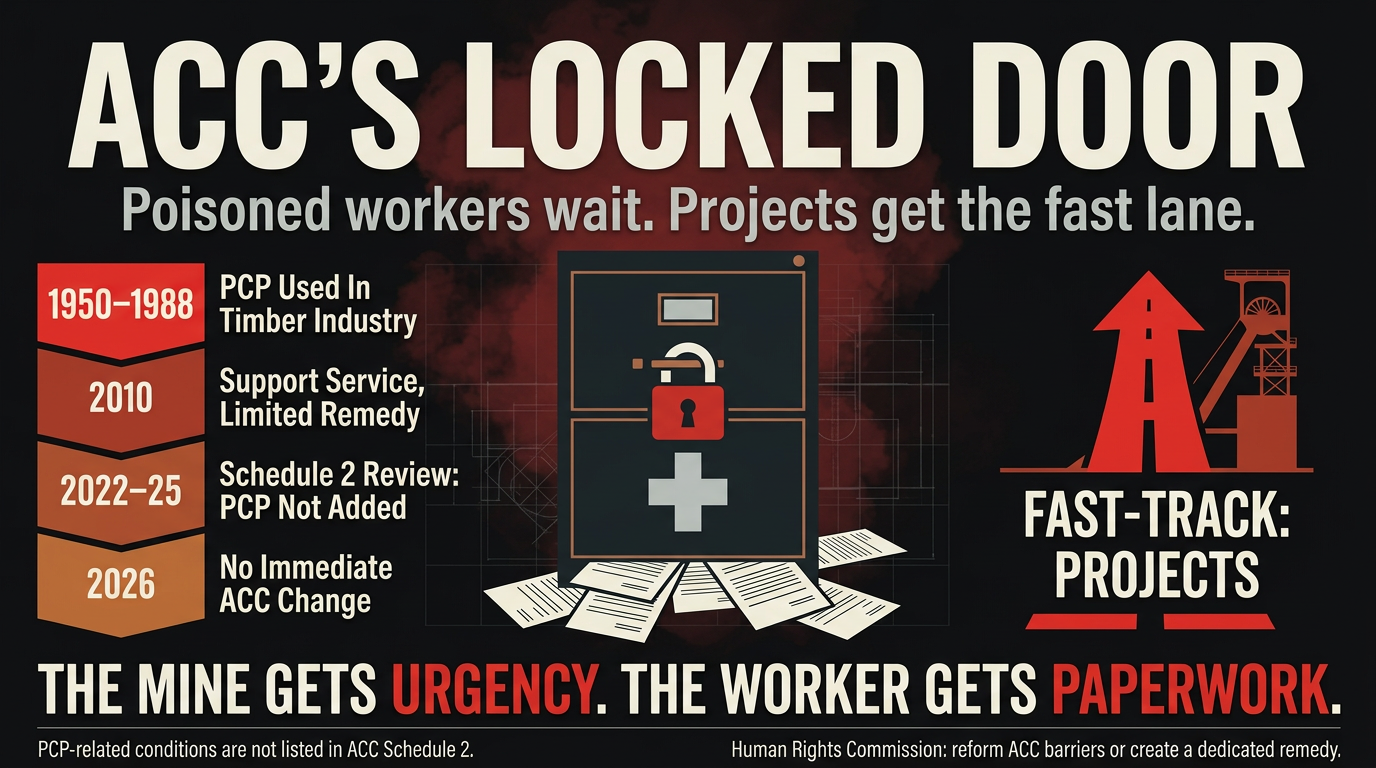
The sick-worker side of this story is not just about exposure.
It is about waiting.
The Human Rights Commission records that a PCP support service was established in 2010, including annual health checks for some former workers. But it also records continuing limitations on access to treatment, rehabilitation, and compensation through ACC. Human Rights Commission Account Of PCP Support And ACC Barriers
PCP-related conditions are not listed in Schedule 2 of the Accident Compensation Act 2001. The Commission identifies this as a major barrier, because workers with complex chemical exposure and long-latency illness may need to meet more demanding causation requirements through the ordinary ACC process. Human Rights Commission Analysis Of ACC Barriers
The Human Rights Commission records that the 2022–25 Schedule 2 review considered PCP only in relation to non-Hodgkin’s lymphoma and did not recommend its inclusion on the evidence examined. The Commission recommends that the Crown reform ACC barriers or establish a dedicated compensation mechanism. Human Rights Commission Findings And Recommendations On Schedule 2
The New Zealand Herald reported that the Government had no immediate plan to add PCP-related illnesses to the schedule following that review. New Zealand Herald Report On The Government’s PCP And ACC Position
So hear the hypocrisy.
The Government creates a special fast lane for projects.
It cannot create a real pathway for workers poisoned by projects.
It tells investors that delay is unacceptable.
It tells whānau who have waited decades that more delay is normal.
It calls that balance.
I call it a hierarchy of human worth.
The mine gets urgency.
The worker gets paperwork.
This is where Jones’ rhetoric about modern safeguards becomes most misleading. A Minister cannot ask workers and whānau to trust the next industrial promise while the Government refuses to finish the work of remedying the old industrial harm.
The Five Extractions
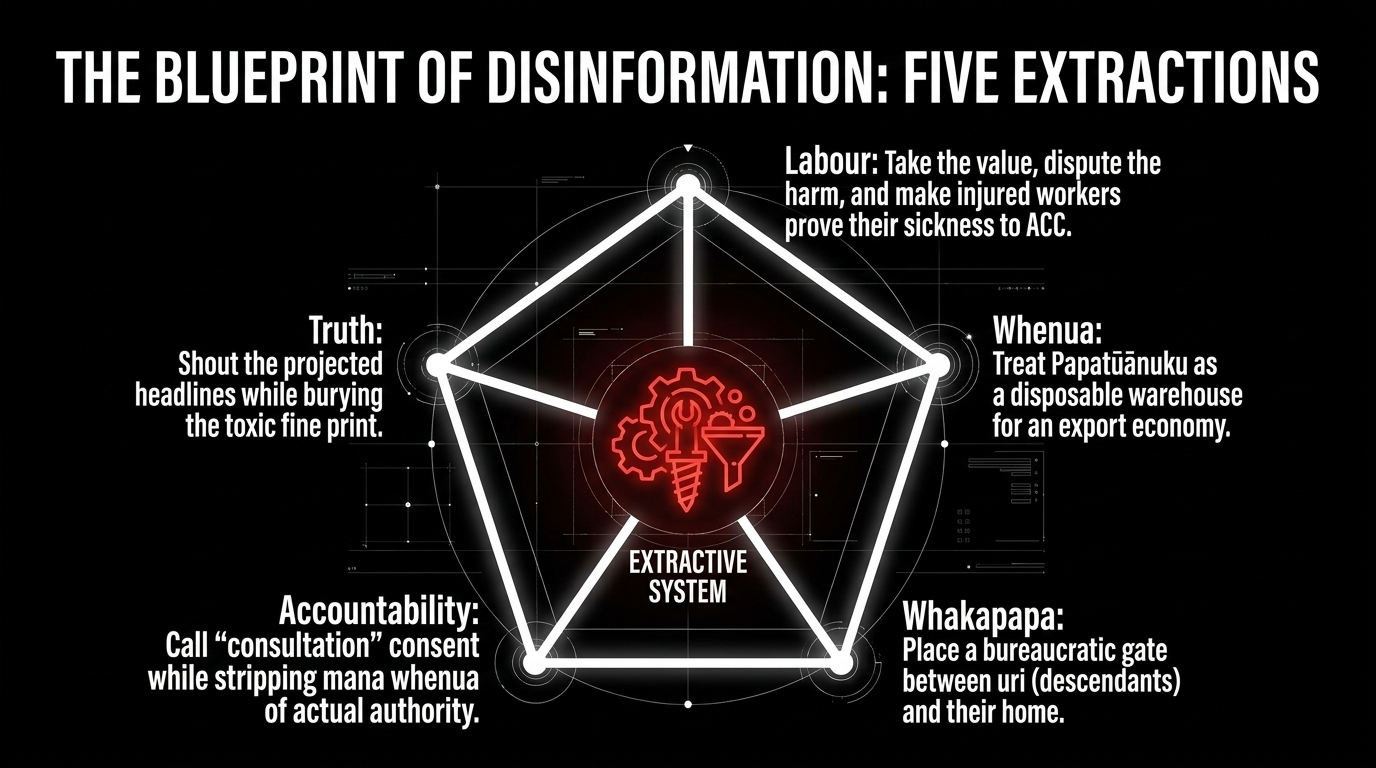
Extraction Of Labour
PCP was used in timber production. Workers faced exposure through inhalation and skin contact, while contaminated clothing could carry risk from the workplace into whānau homes. Human Rights Commission Findings On PCP Exposure
The system extracted labour from workers, including Māori workers, then turned them into individual claimants once their health broke down. Profit rose upward. Risk fell downward. That is the colonial-neoliberal formula: take the value, dispute the harm, and leave the injured to prove themselves.
Extraction Of Whenua
The Human Rights Commission records concerns about contamination of soil, groundwater, streams, sediment, fish, mussels, and waterways near former timber-treatment sites. It acknowledges remediation at the Kopeopeo Canal while identifying broader unresolved national contamination concerns. Human Rights Commission Findings On Environmental Contamination And Remediation
Papatūānuku is not a dumping ground for an export economy. Wai is not a waste channel. When the Crown reduces such harm to a technical “legacy” matter, it conceals the relationship it has broken: people to place, whenua to wai, present generation to mokopuna.
Extraction Of Whakapapa
The Human Rights Commission says PCP’s legacy may be intergenerational and may affect health, wellbeing, cultural identity, and relationships with whenua and wai. Human Rights Commission Findings On Intergenerational Harm
The Waitangi Tribunal says citizenship law’s failure to protect overseas Māori from disconnection from tūrangawaewae breaches multiple Treaty principles. Waitangi Tribunal Citizenship Findings
One system poisons the relationship to place. Another turns that relationship into a visa problem. Both diminish whakapapa in practice: one by contaminating the ground people belong to; the other by placing a bureaucratic gate between uri and home.
Extraction Of Accountability
The Government says its Fast-track Approvals regime is intended to speed up projects with significant regional or national benefits. It says listed-project applicants must consult iwi authorities, hapū, Treaty settlement entities, councils, and agencies before applications reach expert panels. Government Explanation Of The Fast-Track Approvals Regime
Parliamentary material records submitter concerns that environmental considerations were not expressly included in the regime’s purpose clause. The Environment Committee report confirms its central purpose is to facilitate significant development and infrastructure. Parliament’s Environment Committee Commentary On The Fast-Track Approvals Bill
My Analysis: Consultation is not consent. A system that asks mana whenua to respond to a Crown timetable inside a Crown process, with “benefit” defined by Crown legislation, is not automatically partnership. Rangatiratanga requires more than a chance to submit before someone else decides.
Extraction Of Truth
The Human Rights Commission recommends a national inquiry, nationwide site assessment, public disclosure, remediation, specialist health support, and effective compensation reform. Human Rights Commission Recommendations For Inquiry, Remediation, Health Care, And Redress
The Waitangi Tribunal recommends that citizenship law recognise Māori as tangata whenua, give effect to Te Tiriti, use a tikanga pathway for whakapapa assessment, and extend citizenship by descent to two generations for Māori. Waitangi Tribunal Citizenship Recommendations
The Crown’s weapon is often not outright denial. It is the partial story.
“Modern guardrails,” without poisoned workers.
“Jobs,” without durable employment data.
“Exports,” without clean-up costs.
“Citizenship,” without whakapapa.
“Consultation,” without authority.
That is how this Government misleads.
The Fast-Track Contradiction
The Government says its fast-track regime will reduce delay and cost and enable projects needed for growth. Government Fast-Track Announcement
The Waihi North approval extends operations to 2043 rather than the earlier planned 2030 end date.
That is a 13-year extension. Government Waihi North Approval Announcement
A 13-year extension is not a minor form-filling event. It is a long-term decision about work, land, water, community life, public infrastructure, future remediation, and who carries risk after the export machine has moved on.
| Government Line | The Evidence It Leaves Out | The Question I Put Back |
|---|---|---|
| “Faster Approvals” | Industrial damage can emerge years or decades after approval | Faster for whom, and who carries the long tail of risk? |
| “Expert Panels” | Technical systems did not prevent the PCP legacy | Who appoints the experts, what evidence is public, and who can challenge them? |
| “Jobs” | PGF job headlines included roles that were temporary, cumulative, projected, or already disestablished | Are the jobs new, permanent, skilled, local, Māori-held, union-covered, safe, and fairly paid? |
| “Export Growth” | Export figures do not prove community wealth or fund remediation | What stays in the rohe, and what is set aside for health, restoration, and future harm? |
| “Consultation” | Consultation does not necessarily provide a right to refuse | Can hapū and iwi reshape, reject, or halt the project? |
| “Modern Guardrails” | PCP-affected workers remain without a complete remedy | What automatic pathway exists if current safeguards fail? |
| “Citizenship Is A Privilege” | The Tribunal found existing law fails to protect overseas Māori from disconnection | Who gave the Crown authority to treat whakapapa as conditional on its paperwork? |
Jones says there are trade-offs. Āe, there are.
But he does not write the whole trade-off on the board.
He writes “jobs.”
I write: For whom? How long? At what wage? Under what protection? With what remedy if the job poisons them?
He writes “exports.”
I write: To whom? What remains locally? Who restores the whenua?
He writes “citizenship.”
I write: Who gave the Crown the right to confuse legal status with whakapapa?
He writes “growth.”
I write: Growth of what—corporate returns, or whānau wellbeing and Māori power?
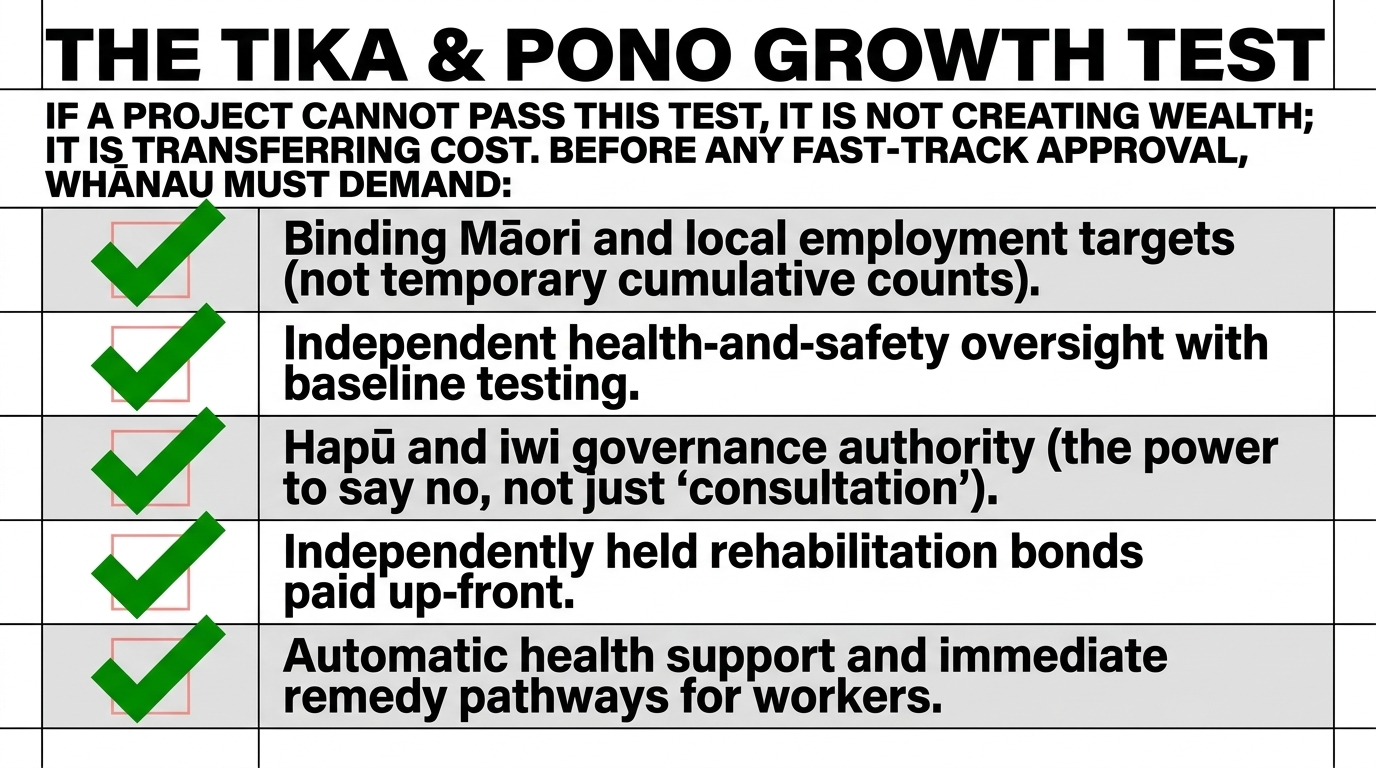
A Tika And Pono Growth Test
I am not against decent work.
I am against the use of Māori unemployment as a prop for an extraction model that cannot show its jobs will be secure, safe, local, fairly paid, or Māori-held.
Māori unemployment was 11.0% in June 2026, representing 49,200 people. Māori underutilisation was 22.0%, representing 104,800 people. MBIE Māori Labour Market Statistics Snapshot, June 2026
That is a crisis.
It needs secure employment, public housing, Māori-led enterprise, paid training, health and care work, renewable energy, ecological restoration, manufacturing, transport, education, and investment that stays in the rohe.
It does not need another Minister holding up a corporate forecast and demanding that whānau stop asking questions.
| Government Headline | Tika And Pono Test |
|---|---|
| “Significant National Benefit” | Who defines benefit, and does the affected rohe agree? |
| “Hundreds Of Jobs” | How many are new, permanent, local, Māori-held, union-covered, skilled, safe, and enough to sustain whānau? |
| “Billions In Exports” | How much remains in the community, and what is legally secured for restoration, health, and remediation? |
| “Consultation Completed” | Did mana whenua hold decision-making authority, including the power to say no? |
| “Conditions Manage Effects” | Who monitors the effects, publishes the data, and pays when the conditions fail? |
| “Citizenship Is A Privilege” | Does the law protect tangata whenua whakapapa and provide a tikanga pathway home? |
| “Economic Growth” | Does this increase mauri, protect whenua and wai, strengthen whakapapa, and leave mokopuna better off? |
Before any future fast-track extraction approval, this Government should be required to publish and enforce:
- binding Māori and local employment targets;
- paid apprenticeships and recognised training pathways;
- fair wages, job security, and worker representation;
- independent health-and-safety oversight;
- environmental baseline testing before work begins;
- continuous, public monitoring of water, soil, air, and biodiversity;
- cumulative-effects assessment rather than project-by-project evasion;
- hapū and iwi governance authority, not merely consultation;
- independently held rehabilitation bonds;
- automatic health support and a remedy pathway when harm occurs.
Before any citizenship change affecting overseas Māori, the Government should implement the Waitangi Tribunal’s recommendations: recognition of Māori as tangata whenua in citizenship law, a Treaty clause, a tikanga pathway for hapū and iwi to assess whakapapa, and extended citizenship by descent for Māori. Waitangi Tribunal Citizenship Recommendations [Verified]
If a development project needs weak worker protection, weak environmental oversight, limited mana whenua power, and no guaranteed remedy in order to be profitable, it is not producing wealth. It is transferring cost.
If a citizenship policy requires Māori descendants to prove belonging to the Crown rather than allowing hapū and iwi to assess whakapapa, it is not protecting citizenship. It is extending Crown control over something the Crown does not own.
Previous MGL Investigations
I have been tracking this system across its different rooms: poisoned workers, polluted whenua, blocked compensation, mining politics, public money, and the Crown’s attempt to discipline Māori belonging.
Read these earlier Māori Green Lantern investigations alongside this one:
- Dying On The Books: How ACC Turned PCP Poisoning Into A Waiting Room For Death examines ACC barriers affecting PCP-exposed workers and the case for presumptive cover and reviewed denials.
- The Green Chain: How The Crown Licensed Murder, The Whakatāne Sawmill Ran On Poison traces the industrial and regulatory history of PCP exposure in Whakatāne.
- When The Whenua Bleeds: Contaminated Land, Contaminated Water, Contaminated Futures follows contamination through whenua, wai, and community life.
- Petrol On The Green Chain: How A White-Supremacist Neoliberal Government Turned Whakatāne’s Poisoned Ground Into A Discount Fuel Promotion examines policy choices that treat contaminated whenua as commercial opportunity rather than a duty of care.
- The File They Prayed Would Die: Kereama Akuhata, SWAP, And The War The Crown Could Not Bury records the persistence of Sawmill Workers Against Poisons in their fight for redress.
- The PCP Scandal In Aotearoa: Fifty-Nine Years Of No examines the continuing refusal to provide complete recognition and remedy for workers harmed by PCP.
- How Shane Jones Loots The Public Purse And Winston Peters Calls It Statecraft investigates Jones’ resource politics, public spending, and mining agenda.
- The Sand Thieves: How Shane Jones Stole His Own Rulebook To Buy Two Failing Mines With Fifty Million Dollars Of Your Money examines public money, mining, job claims, and Māori employment conditions.
These stories are connected.
The system takes from whenua.
It takes labour from workers.
It takes public money.
It counts jobs in a way that flatters the Minister.
It makes the injured wait.
It tells overseas Māori their return is an administrative problem.
Then it calls itself common sense.
The Line In The Sand

Shane Jones says Aotearoa needs choices.
Āe. We do.
But the choice is not “growth” or “no growth.”
That is the cheap false binary used by a political class that needs people to stop asking who pays the bill.
The actual choice is this.
Mauri-Depleting Extraction And Exclusion: Take the resource. Extract the labour. Count temporary jobs as triumphs. Promote export forecasts as community prosperity. Downplay early warnings. Call public concern ideology. Tell poisoned workers to wait. Treat whānau overseas as if their whakapapa has an expiry date. Call it growth. Call it citizenship. Call it national interest.
Mauri-Enhancing Development And Belonging: Build safe, skilled, permanent work. Keep wealth in the rohe. Put hapū and iwi in authority. Protect workers before they are harmed. Monitor water, soil, and air. Publish the evidence. Secure the restoration money before the first digger arrives. Provide immediate remedy when harm occurs. Protect uri from being disconnected from their tūrangawaewae. Let whakapapa be assessed by those who hold its mana.
That is tika.
That is pono.
The workers of Whakatāne do not need another Minister saying accidents happen.
They need the Crown to explain why it can fast-track mines but cannot fast-track justice.
Australia-based Māori do not need a Minister saying they are “not coming home.”
They need the Crown to stop treating their whakapapa as a conditional privilege.
Whānau do not need another jobs slogan.
They need proof: permanent jobs, safe jobs, local jobs, Māori jobs, living-wage jobs, and remediation paid for before harm arrives.
I am Ivor Jones, The Māori Green Lantern.
I am not here to make Shane Jones comfortable.
I am not here to make a white-supremacist neoliberal Government look gentler than the evidence allows.
I am here because whānau deserve someone to read the fine print when Ministers are shouting the headline.
The green chain never ended.
It moved from the mill floor to the Cabinet room.
It moved from chemical mist to political spin.
It moved from contaminated workwear to contaminated policy.
It moved from poisoned whenua to a border around whakapapa.
I see it.
Whānau see it.
And we will not let them bury it.
Rangatiratanga Demands
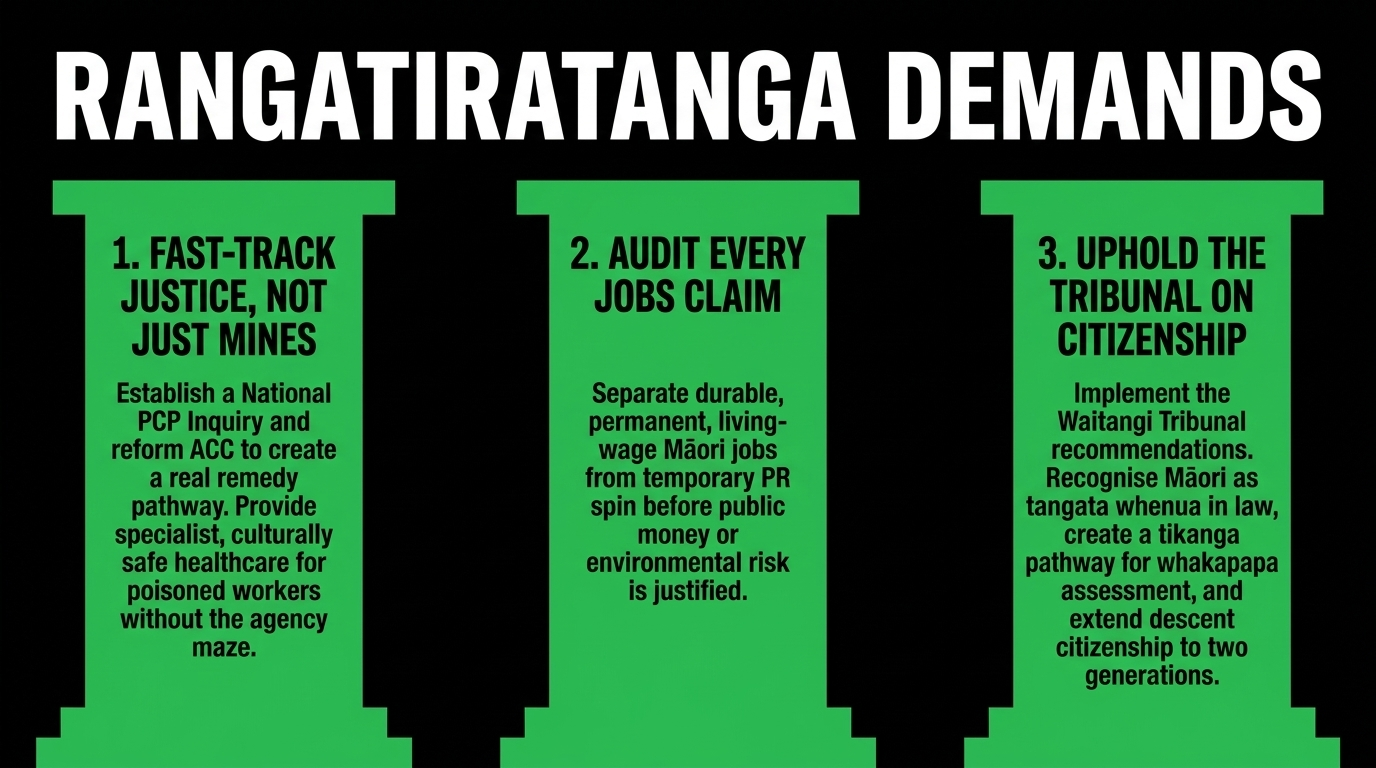
- Establish A National PCP Inquiry designed with exposed workers, whānau, hapū, iwi, independent scientists, and legal experts, with power to investigate regulatory failure, corporate responsibility, contaminated sites, health harm, and redress. Human Rights Commission Recommendation For A National Inquiry
- Create A Real Remedy Pathway by reforming ACC barriers or establishing a dedicated compensation system for PCP and comparable toxic occupational exposure. Human Rights Commission Recommendation On Compensation Reform
- Provide Specialist Culturally Safe Health Care for exposed workers and affected whānau without making sick people navigate an agency maze. Human Rights Commission Recommendation On Health Support
- Identify, Disclose, And Remediate Contaminated Sites through a transparent nationwide programme protecting people, whenua, wai, kai, and cultural practice. Human Rights Commission Recommendation On Site Assessment And Remediation
- Audit Every Government Jobs Claim by separately reporting projected, temporary, cumulative, disestablished, permanent, local, Māori-held, full-time, and living-wage positions before such claims are used to justify public spending or environmental risk.
- Make Extractive Projects Pay Their Future Bill Up Front through independently held rehabilitation bonds, public monitoring, binding worker protection, and enforceable Māori employment and procurement commitments.
- Implement The Waitangi Tribunal’s Citizenship Recommendations by recognising Māori as tangata whenua in citizenship law, including a Treaty clause, creating a tikanga pathway led by hapū and iwi, and extending citizenship by descent to two generations for Māori. Waitangi Tribunal Citizenship Recommendations
- Stop Calling Consultation Consent and uphold hapū and iwi authority to refuse, reshape, or withdraw from projects that threaten whenua, wai, wāhi tapu, whakapapa, and mokopuna.
Māuri Ora!
Disclaimer: This is evidence-based public-interest commentary. It does not allege that Shane Jones knowingly made false statements or that any current Minister personally caused historical PCP exposure. It argues that Jones’ public framing is misleading because it emphasises projected benefits while omitting or diminishing the continuing legacy of industrial harm, barriers to redress, weaknesses in PGF job measurement, uncertainty about job quality, environmental and cultural risks, and the Treaty-based status of Māori connection to tūrangawaewae. Facts, calculations, policy claims, Government forecasts, analysis, and opinion are distinguished throughout. Corrections will be made promptly if credible evidence establishes an error.