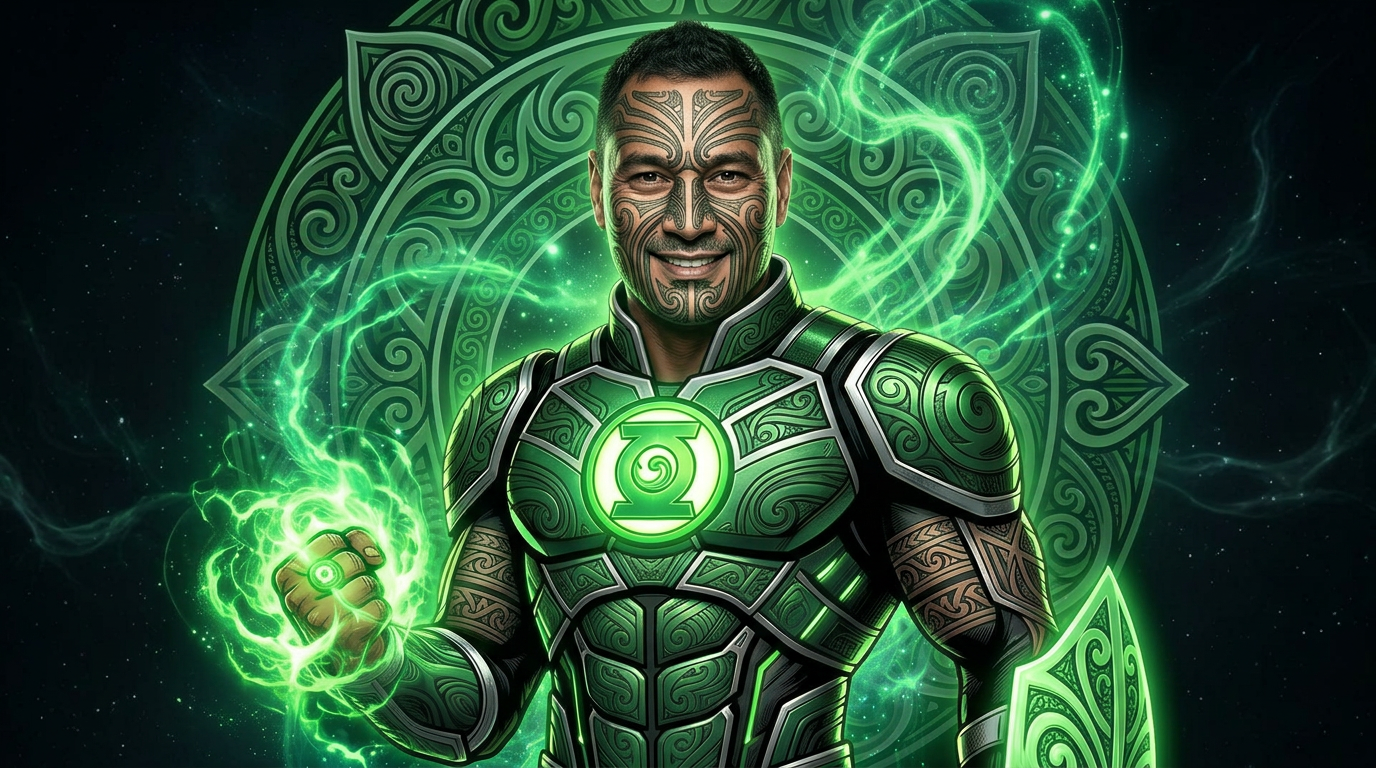
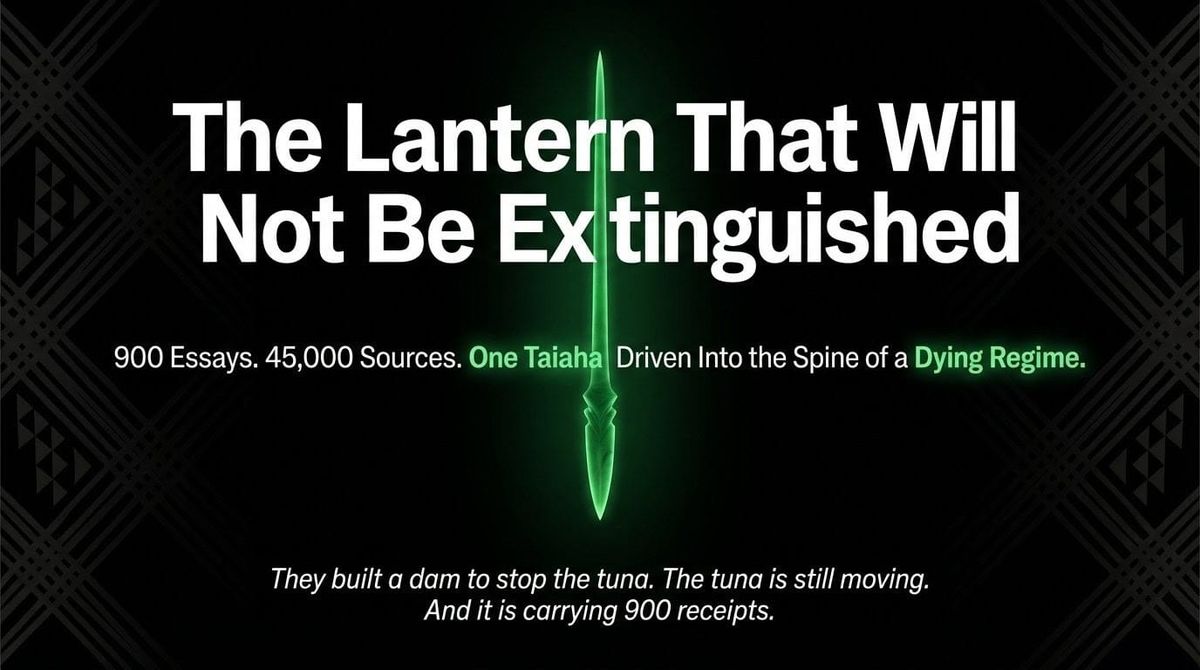
"THE LANTERN THAT WILL NOT BE EXTINGUISHED: Nine Hundred Essays, 45,000 Sources, One Taiaha Driven Into the Spine of a Dying Regime" - 14 April 2026
They built a dam to stop the tuna. The tuna is still moving. And it is carrying 900 receipts.

Kia ora ano Aotearoa,
Thank you for being here to take in the second essay today.
The Deep Dive Podcast
Listen to a lively conversation between two hosts, unpacking and connecting topics in the sources of this essay.
Ko Wai Mātou — The Māori Metaphor That Opens This Fire
There is a whakataukī that every rangatira knows:
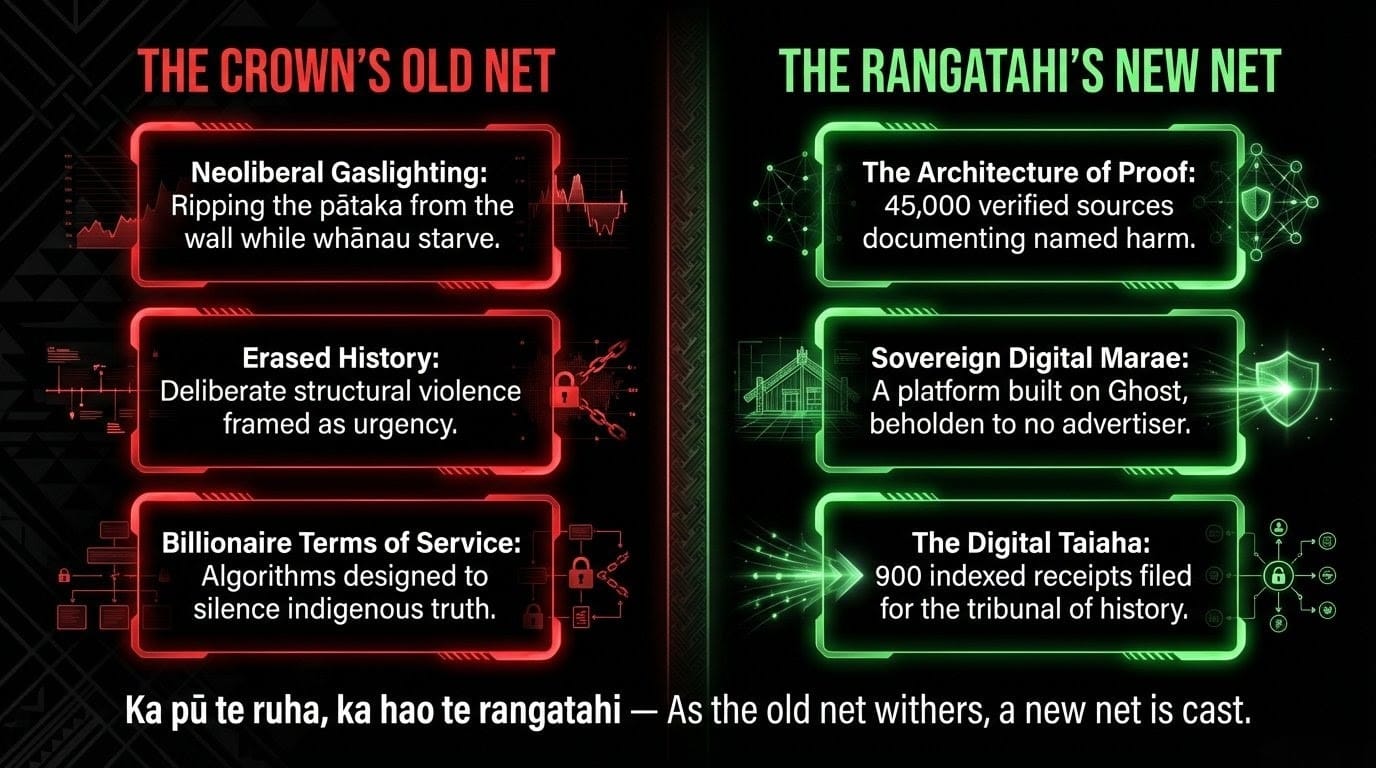
Ka pū te ruha, ka hao te rangatahi — as the old net withers, a new net is cast.
The white supremacist neoliberal government that now occupies the Beehive has been casting the old net for three years: ripping the pātaka from the wall while whānau starve, draining the moana while the trawlers feast, setting the courthouse alight and handing Judith Collins the matches.
But every net they have cast to silence, to impoverish, to surveille, to gaslight — every single one — has returned empty. Because the rangatahi have built a new net. And it has nine hundred threads.
The Māori Green Lantern is not a newsletter.
It is a taiaha made from digital pounamu, swung in a circle that the Crown and its media lapdogs cannot enter without being struck.
Each of the 900 essays in its archive is a notch in the handle — a named act of harm, sourced, dated, hyperlinked, and filed for the tribunal that history will eventually convene.
Every essay is backed by the whakapapa of 50+ sources, the kōrero of ancestors who refused to kneel at Parihaka, and the mana of a readership that opens its emails at nearly twice the industry average — not because they have to, but because they have been waiting their entire lives for someone to say this out loud, with receipts.
This is the story of what 900 essays prove. And it is not a gentle story. The gentle stories are already dead.
The Wharenui That Walked — February 2026
Every publication has a whakapapa — a genealogy of ideas, a lineage of battles, a thread of wairua that runs through every sentence from the first word to the last.
For Te Māori Green Lantern, that whakapapa is now 900 essays deep, published at a cadence that breaks every conventional publishing rule and keeps breaking it — because the harm being documented does not pause for the weekend, and neither does this publication.
The wharenui did not ask Substack for permission to leave.
As documented in The Wharenui That Walked, on 19 February 2026, over 800 essays migrated from a platform owned by American venture capital to a sovereign digital marae at themaorigreenlantern.maori.nz — built on Ghost, controlled by the publication, answerable to no algorithm, beholden to no advertiser, silenceable by no billionaire's terms of service.
This was not a technical decision. It was a tikanga decision.
A wharenui does not stand on the landlord's land. It stands on its own whenua.
The Crown tried for 185 years to move the wharenui. On 19 February 2026, the wharenui picked itself up, turned its back on Silicon Valley, and walked onto sovereign ground.
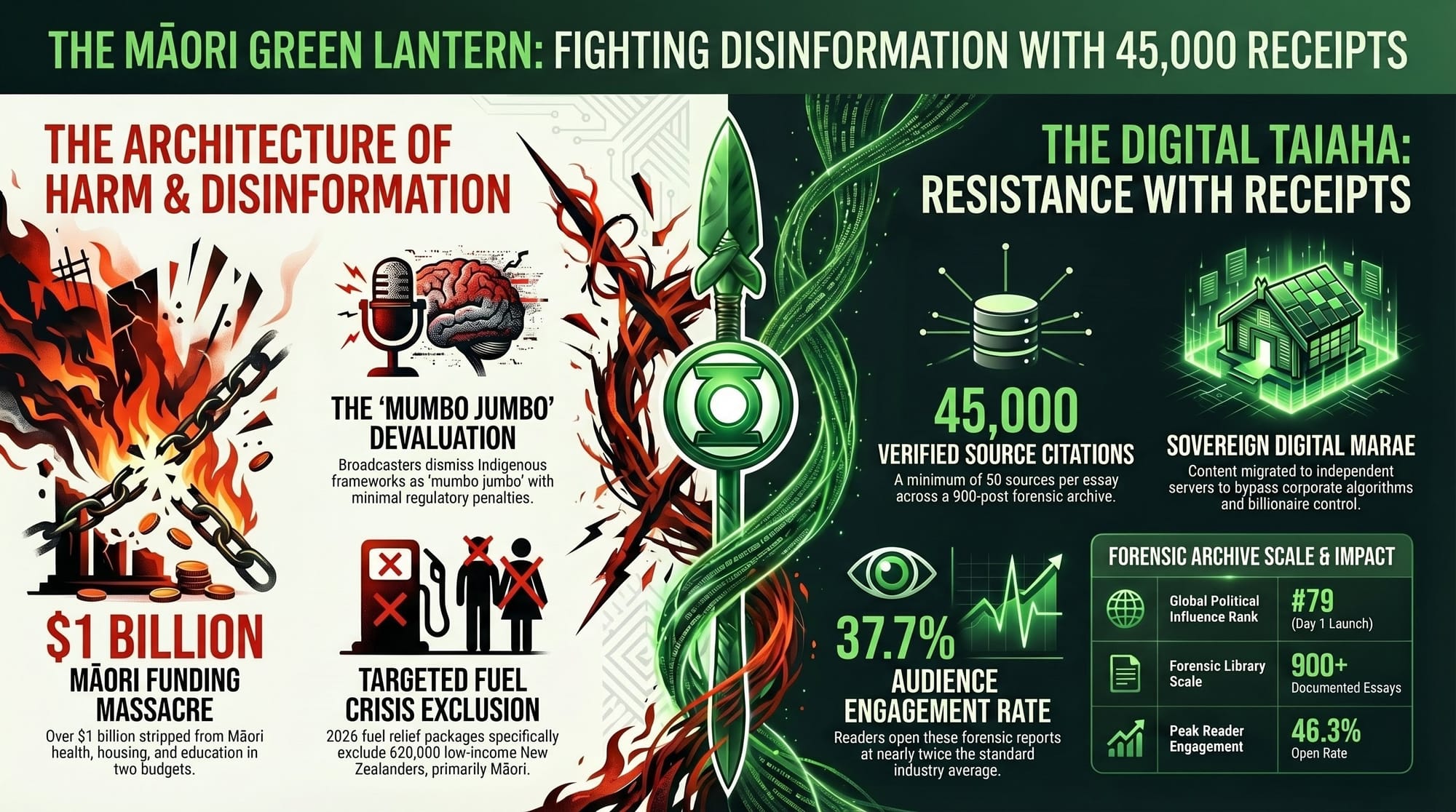
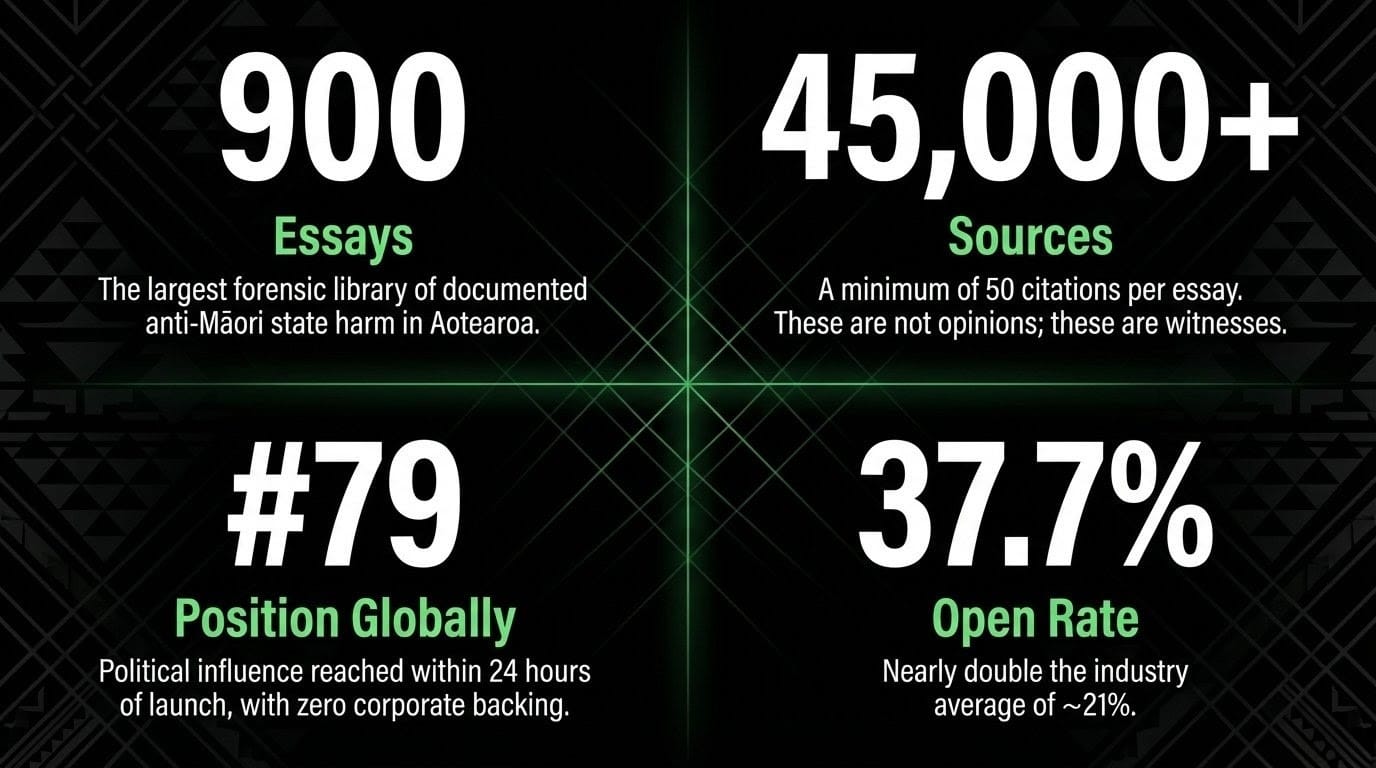
When the site launched on 8 November 2025, it reached position 79 globally in political influence within 24 hours — no paid promotion, no corporate backing, no media conglomerate, no government grant. Just the whakapapa. Just the taiaha. Just the truth.
45,000 Sources and the Architecture of Proof

Here is what the white supremacist neoliberal government and its media enablers cannot do.
They cannot call it opinion when every assertion carries a citation. They cannot call it misinformation when every claim is sourced.
They cannot call it "mumbo jumbo" — as the BSA ultimately forced Sean Plunket to acknowledge after finding his comments amplified "casual racism towards Māori" at "a level that is offensive and harmful" — when every essay carries a minimum of 50 cited sources.
50 sources per essay × 900 essays = a minimum of 45,000 source citations across the archive.
This is not a blog.
This is the largest forensic library of documented anti-Māori state harm in the history of Aotearoa's independent media.
It is the receipts repository that Cabinet ministers pray will never be indexed, because once the money flows are mapped, once the policy networks are traced, once the whakapapa of harm is laid out from the boardroom to the papakainga, the political class cannot simply pivot to the next talking point.
The sources are witnesses.
Forty-five thousand witnesses do not go quiet.
As named in One Thread, Ten Thousand Eyes — the essay that first explicitly named the 900-essay milestone — this publication's whakapapa runs through Ngāti Pikiao warriors and Welsh ancestors buried in Shrewsbury, through every wairua that crossed from te pō to stand in te ao once more.
The ploughmen of Parihaka are still walking.
This publication has been documenting every step.
The Seven Threads of Fire — 900 Essays Mapped
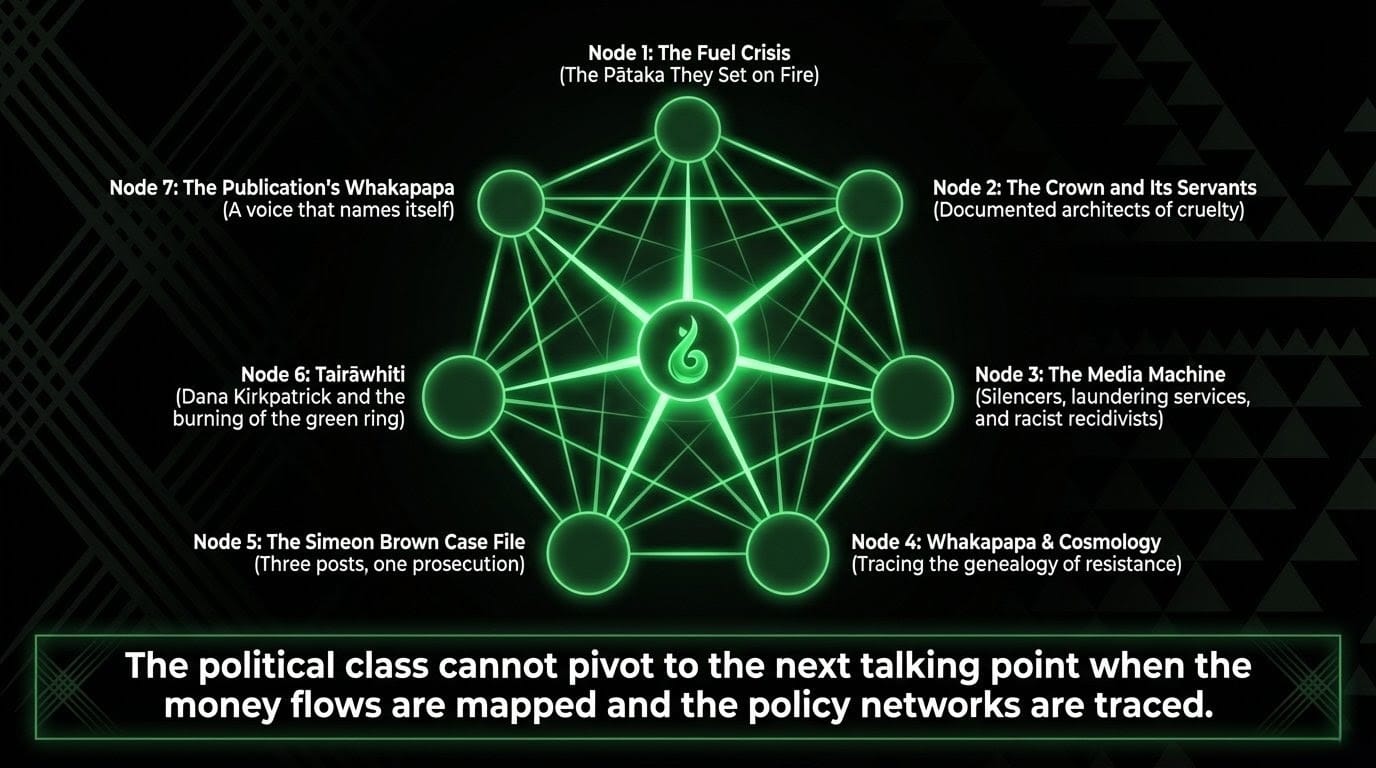
Thread One: The Pātaka They Set on Fire — The Fuel Crisis (9 documented essays)
Imagine a fire set not in anger but in calculation. The arsonist pours the accelerant slowly, methodically, wearing a suit. The pātaka — the ancestral food store that every Māori community knows as the physical embodiment of collective survival — does not burn by accident. It burns because someone decided it should.
This is the fuel crisis. And it is not a crisis the government discovered. As revealed in The Pātaka Is Ash, Nicola Willis and Christopher Luxon poured petrol on the poor and called it relief. The Empty Tank documented carers abandoned on the side of the road to die. The Waka Without a Hull named the burning of Aotearoa's fuel sovereignty. Ko Wai Ka Mate traced the deaths — clinical, literal, documented — in Te Tāhū o Te Rā. The Boardroom Burns Last named the profiteers. Putin's Petrol traced the blood money laundered through an Indian refinery and sold as "energy security." And The Fuel Tax Shuffle documented Luxon and Willis playing both sides of the pump while Māori whānau paid the price.
The thread did not begin in March 2026. Before the Ghost migration, Ka Noho i Roto i te Ahi — the essay on surviving winter in cold homes when the fuel is gone — established this documentation years before it became a mainstream "crisis." The Māori Green Lantern was writing about the empty tank long before the Beehive acknowledged the tank existed.
Thread Two: The Crown and Its Servants (8 documented essays)
There is a whakataukī about the kāwanatanga: the canoe needs a helmsman, but when the helmsman steers toward the reef for personal profit, the tūpuna do not applaud the navigation — they remove the paddle.
Luxon, Willis, Mitchell, Goldsmith, Bishop, Brown — as documented in Papers Please, Stanford's Colonial Classroom, The Iron Throne of Fools, Te Ara Utu, and The Crown Strips the Cloak, these are the named architects of deliberate cruelty, documented essay by essay with receipts. These are not political opinions. These are named, sourced case files.
Thread Three: The Media Machine and Its Silencers (7 documented essays)
When the tūī is silenced, the forest does not become quiet. It becomes suspicious. And then it becomes dangerous.
The most explosive engagement data in the entire archive belongs to the week Sean Plunket picked up the phone — and the two highest open-rate posts in measurable history, at 46.3% and 42.5%, both belong to essays written in direct response to that call, as documented in When a Racist Broadcaster Dials My Phone and When Plunket Picks Up the Phone. Mumbo Jumbo, Money, and Mana traced the full architecture of the Plunket-Peters-Wright broadcasting machine. Propaganda in Plain Sight named NewstalkZB and RNZ as laundering services. The Platform Is a Racist Recidivist's Escape Vehicle named Willie Jackson as an accessory. The Silencer documented how Plunket weaponises the microphone against Māori climate truth.
The SLAPP failed. The attempt to silence produced the loudest signal in the publication's history. The taiaha was already moving.
Thread Four: The Whakapapa of Māori Identity and Cosmology (5 documented essays)
The tūpuna did not need a particle collider to know the universe. They traced its genealogy in the night sky before European astronomers were born.
In The Whakapapa of Everything, the publication stepped beyond politics entirely into cosmology — your tūpuna knew the universe, and the universe has always known them back. Two Kings and a Broken Child drew Wakanda and te ao Māori together as a single frame for understanding power, severance, and inheritance. One Thread, Ten Thousand Eyes named what data alone cannot: that 900 essays are backed by every ancestor who refused to kneel.
The Parihaka thread — named in Heather Cox Richardson: Te Taiaha o te Aroha — showed that Te Whiti o Rongomai's non-violent resistance at Parihaka in 1879 preceded and superseded every Western framework for civil disobedience, including the one 2.6 million Americans read daily without knowing its true origin.
Thread Five: The Simeon Brown Case File — Three Posts, One Prosecution
In te ao Māori, to name a thing is to hold power over it. The tūpuna named the rivers, the winds, the gods. Today, we name Simeon Brown — and we follow the money.
Papers Please opened the case file. The Genealogy of Simeon Brown traced his whakapapa — born on Māori land, elevated by Baptist networks, rewarded by a Prime Minister too compromised to say no. The Gift of the Gallows delivered the prosecution's closing argument: his cancer infusion policy is the architecture of Māori death. Three posts. One case file. An indictment the mainstream media will not print.
Thread Six: Dana Kirkpatrick and the Burning of Tairāwhiti
The tōtara falls. The ship arrives. The minister smiles. And the whānau who planted that tree are told to celebrate the harvest.
On April 7, two essays arrived in a single day — The Empty Kete and The Green Ring Burns. Tairāwhiti was burned twice: first by the cyclone, then by the people who celebrated the timber that floated away from it. Dana Kirkpatrick, named and documented, weaves lies from the flax of dead whānau dreams. The log ship is not a triumph. It is a hearse.
Thread Seven: The Publication's Own Whakapapa — A Voice That Names Itself (4 documented essays)
The proudest taiaha in the whare is not the one on the wall. It is the one still moving.
As established in Ko Wai Mātou — A Seven-Day Reckoning, this is a publication conscious of its own whakapapa — that treats its own numbers as testimony, that names its own existence as part of the story, that published a transparency post turning the data back on itself and asking readers to see what was being built. That post generated 120 opens and 8 clicks — the third-highest click count in the measurable archive. The audience is not passive. They are conscious witnesses.
Three Examples for the Western Mind: Tikanga, Harm, and the Receipts
Example 1: The $1 Billion Māori Health Massacre
For the Western mind, here is the simplest possible translation of what this government has done to Māori health: imagine a hospital that took 100 years to build, staffed by doctors who speak your language and understand your culture, cut down under parliamentary urgency in a single afternoon.
That is what happened to Te Aka Whai Ora — the Māori Health Authority. As reported by the Waitangi Tribunal, the Pae Ora (Disestablishment of Māori Health Authority) Amendment Bill was introduced on 27 February 2024 and passed into law on 5 March 2024 — under urgency, stripping even the Tribunal's jurisdiction to hear claims against it before it could. In Budget 2024 alone, more than $300 million was cut from Māori-specific health, media, and governance initiatives. By Budget 2025, as confirmed by Te Aka Tika and TeAoNews, a further $750 million had been cut from Māori housing, economic development, education, and trades training — a total of over $1 billion in two budgets.
The tikanga impact: In te ao Māori, the hauora of the whānau is the hauora of the land. You cannot separate the wairua of the people from their access to culturally grounded care. When you disestablish the Māori Health Authority, you do not merely cut a government department — you sever the thread between the tamariki and the tūpuna who understood how they get sick and how they heal. You replace tikanga-grounded medicine with a bureaucracy that has failed Māori for over a century. You enact intergenerational harm in a single parliamentary afternoon. The Māori Green Lantern documented this harm across dozens of essays before mainstream media ran a single front page on it. As evidenced in The Gift of the Gallows, the cost is not measured in budget lines. It is measured in bodies.
The solution: Restore Te Aka Whai Ora with full legislative independence, protected funding, and the explicit mandate to close the Māori health gap within a ten-year horizon. Restore the $1 billion. And charge the Waitangi Tribunal's recommended remedies against the Minister personally.
Example 2: The 2026 Fuel Crisis — 620,000 Left Behind by Design
For the Western mind: imagine a national emergency in which the government's relief package specifically excludes the poorest people, by design, and calls it targeted support.
That is the 2026 fuel crisis. As documented by Dr. Harpreet Singh, with petrol surpassing $3.00 per litre and diesel costs surging by nearly 90%, the government's relief package protects middle-income Pākehā families through tax credits while excluding the 620,000 New Zealanders on benefits — the majority of whom are Māori and Pacific. As confirmed by RNZ's Simplicity data analysis, rural essential workers — overwhelmingly located in Māori rohe — drive twice as far as their urban counterparts while receiving a fraction of the support.
The Māori Green Lantern traced this from nine different angles. Ko Wai Ka Mate named rural healthcare deaths. Kia Pakaru Te Hā o te Kāwanatanga named the architecture of deliberate cruelty. Putin's Petrol in Your Ute traced the supply chain to Russian-tainted crude oil laundered through an Indian refinery. As confirmed by a Facebook kaupapa fuel crisis post from Waatea News and the WONCA Rural Health Conference (April 10–13, 2026), clinicians, Indigenous leaders, and researchers are united: the fuel crisis is a health crisis, and the health crisis is falling disproportionately on Māori.
The tikanga impact: Whanaungatanga — the obligation of relationship — requires the ability to physically reach your whānau. When a kaumātua in Waihau Bay cannot drive to her GP because fuel costs more than her weekly food budget, you have not merely caused transport poverty. You have severed the relational threads that hold te ao Māori together. Distance is not neutral in te ao Māori. Distance is a weapon. This government wields it with precision.
The solution: Universal fuel relief tied to income, not to employment category. Emergency subsidies for remote Māori rohe. Investment in community transport infrastructure in Te Tai Tokerau, Tairāwhiti, and Te Tāhū o Te Rā. And a Waitangi Tribunal inquiry into whether the selective relief package constitutes a Treaty breach — because it does.
Example 3: Sean Plunket, $3,000, and the Price of Tikanga
For the Western mind: imagine a national broadcaster calling the entire theological and ethical framework of an Indigenous people "mumbo jumbo" on air — and being fined the equivalent of a parking ticket.
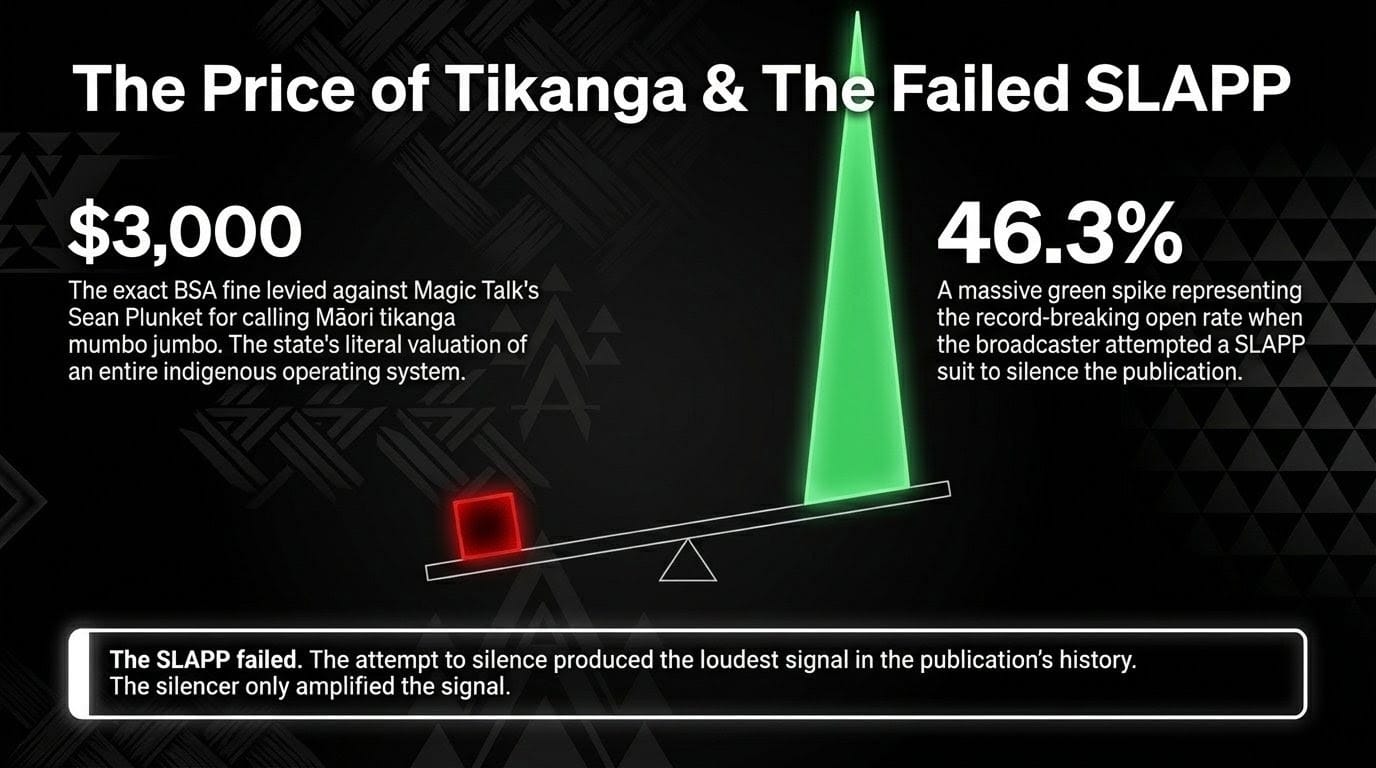
As confirmed by the BSA's ruling against Magic Talk's Afternoons with Sean Plunket, Plunket's comments about Māori tikanga were found to have "reflected and amplified casual racism" at "a level that is offensive and harmful to Māori," in a broadcast that "amplified negative stereotypes" and "had the potential to cause widespread harm." The fine: $3,000. The message sent to the Māori community: your entire cultural framework — the tikanga that governs how you speak, how you grieve, how you welcome, how you govern — is worth $3,000 in this system. Less than a minor traffic infringement.
The Māori Green Lantern did not accept that valuation. As reported by The Spinoff, when the BSA moved to apply broadcasting standards to The Platform — where Plunket called tikanga "mumbo jumbo" and told a complainant "You plonker, we aren't subject to the BSA" — the publication had already documented the full architecture of this machine in Mumbo Jumbo, Money, and Mana. The Plunket-Peters-Wright broadcasting network was named, funded, mapped, and filed — months before the BSA issued its draft ruling.
And when Plunket called the Māori Green Lantern directly, in what When a Racist Broadcaster Dials My Phone named as the SLAPP playbook of the white supremacist right, the publication did not go quiet. It published harder. The post generated the highest open rate in the archive's measurable history: 46.3%. The Māori community was watching. And they showed up.
The tikanga impact: Tikanga is not a costume or a ceremony. It is the operating system of Māori society — the accumulated wisdom of how to live in right relationship with each other, the land, the atua, and time itself. When a broadcaster dismisses it as "mumbo jumbo" on a national platform and is fined $3,000, the state has quantified the value of Māori civilisation. That number is an act of violence. The solution is legislative — a broadcasting regulatory framework with meaningful penalties for anti-Māori hate speech, and a media accountability mechanism that does not allow platforms to self-declare immunity from standards.
The solution: Mandatory cultural harm assessments in BSA penalty determinations. Fines scaled to broadcaster revenue. And a Media Council that includes Māori tikanga practitioners as standing members of every panel adjudicating anti-Māori content.
The Narrative Arc: How the Story Moved
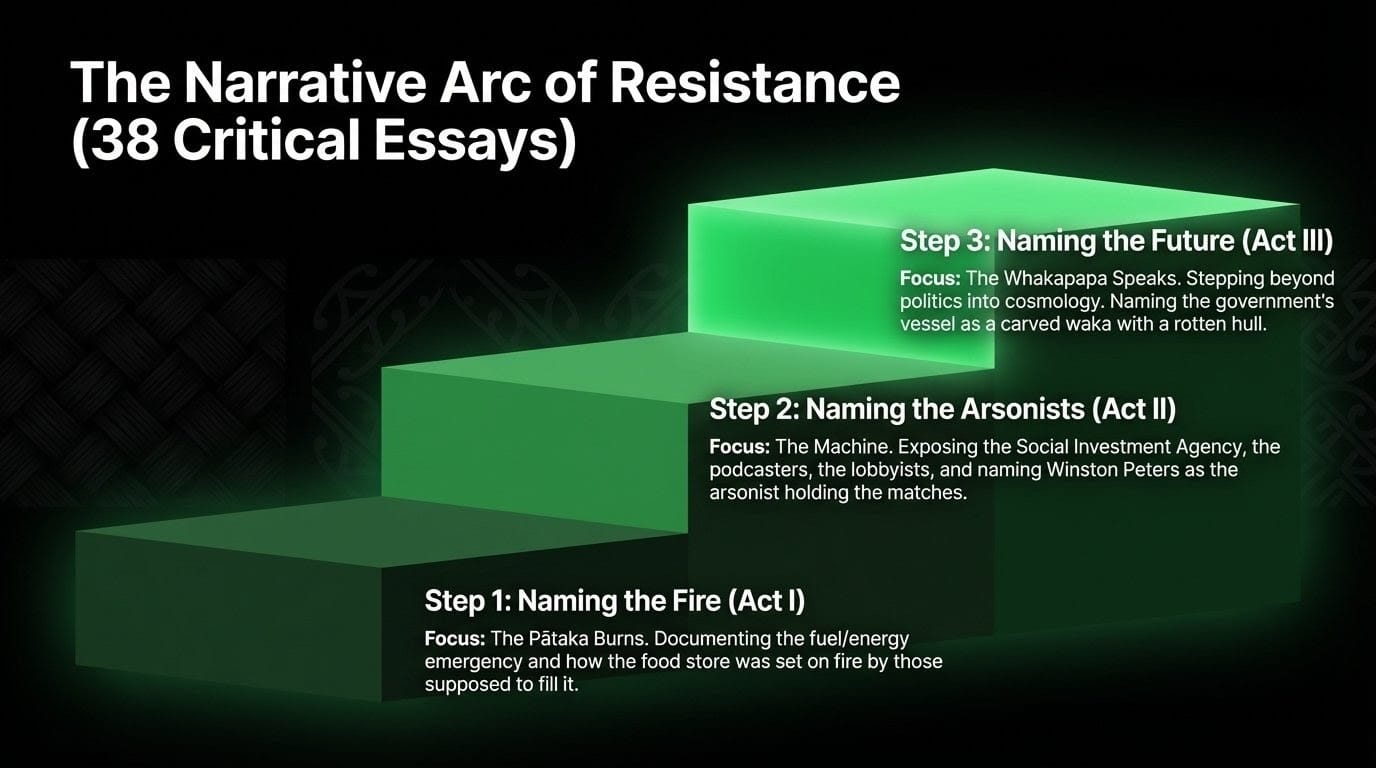
The whakapapa of 38 directly measured essays (in the last 4 weeks) traces a clear three-act movement:
Act I (March 24–31) — The Pātaka Burns: The publication launches hard into the fuel/energy emergency. The pātaka is established as both symbol and evidence: the food store that should sustain the people has been set on fire by those who were supposed to fill it. As revealed in Pantomime of the Dying Waka, Luxon's hollow helmsmen stole another chief's paddle while Aotearoa drowned in diesel. In Te Moana Hoko, Shane Jones sold the moana to the highest trawler.
Act II (April 1–8) — The Machine Is Named: The publication pivots to name the system behind the crisis. The Social Investment Agency is exposed as a machinery of managed neglect, surveillance, and state violence. In While Whānau Go Hungry, Amanda Luxon goes on the radio to tell us the dog in the silk suit is actually a rangatira — and the publication holds the receipts. The Arsonist's Alibi names Winston Peters as the man who set the courthouse on fire, handed Judith Collins the matches, and then claimed he never smelled smoke. In The Rats Beneath the Floorboards, the government sends its podcasters, its lobbyists, and its minister to destroy the most democratically legitimate Māori mayor in Aotearoa.
Act III (April 8–13) — The Whakapapa Speaks: In the final week, the publication reaches its deepest register. One Thread, Ten Thousand Eyes arrives as an almost liturgical statement. Ko te Āhuarangi, Ko te Mātauranga names Te Whare Wānanga o Awanuiārangi as arming rangatahi for the climate crisis. The Whakapapa of Everything reaches beyond politics into cosmology. The Carved Waka With a Rotten Hull names what the government has built: a vessel ornate on the outside, hollow and rotting within.
The Numbers That Name the Truth
| Milestone | Figure |
|---|---|
| Total essays in archive (April 2026) | ~900 |
| Launch: global political influence rank (Day 1, Nov 8 2025) | #79 |
| Minimum sources cited across all essays | 45,000+ |
| Ghost migration (The Wharenui That Walked) | 19 Feb 2026 |
| Essays at migration | 800+ |
| CSV period posts (21 days) | 38 |
| Avg email open rate | 37.7% (industry avg: ~21%) |
| Peak open rate (Plunket SLAPP post) | 46.3% |
| Positive reader feedback (21 days) | 51 votes |
| Subscribers (April 13, 2026) | 288 |
| Projected total essays by July 1 | ~1,058 |
| Projected subscribers by July 1 (80% CI) | ~300 |
| Māori funding stripped (Budget 2024+2025) | $1 billion+ |
| BSA fine for calling tikanga "mumbo jumbo" | $3,000 |
The Forecast: What Happens When the Wharenui Finds 10,000 Eyes
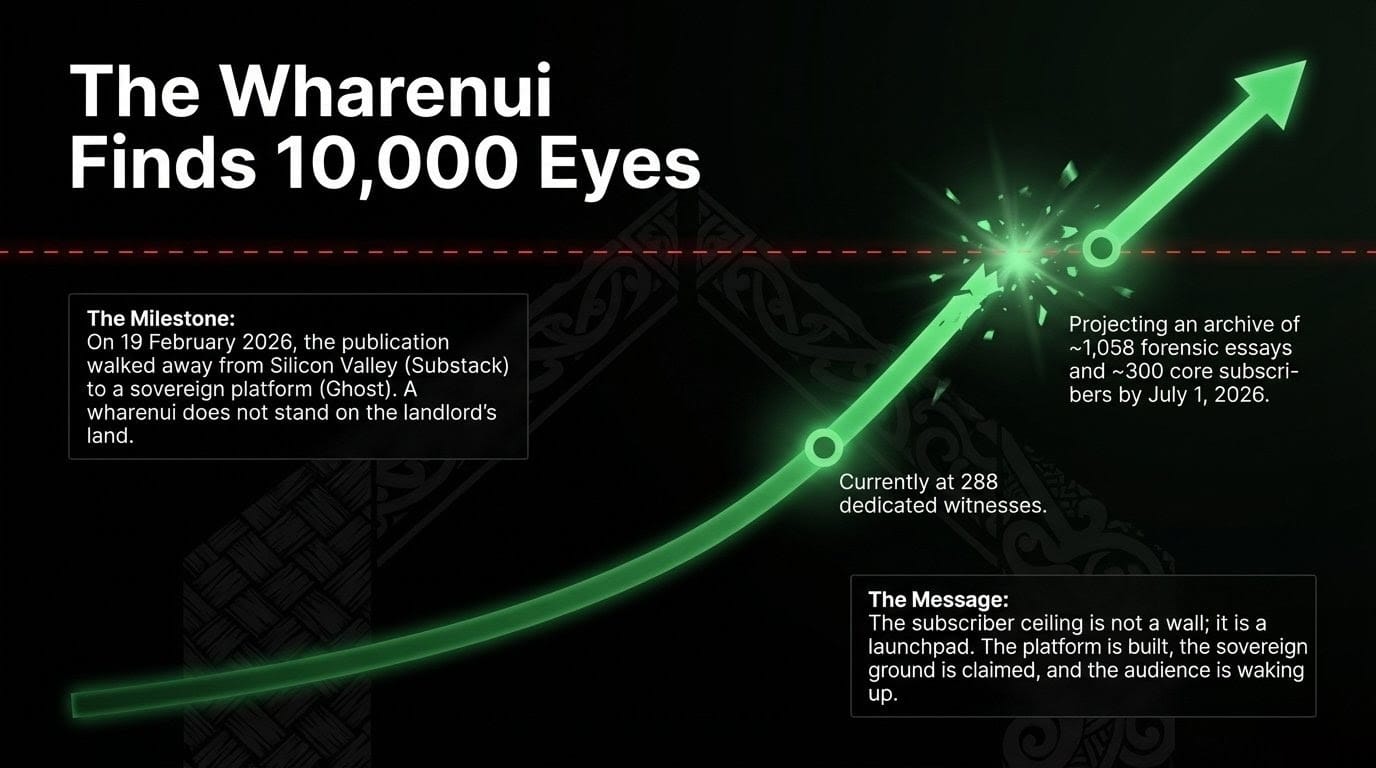
The model projects ~300 subscribers by 1 July 2026 and ~1,058 essays in the archive at the current publishing pace. But read those numbers correctly: a 1,000-essay archive, each with 50 sources, each naming a specific harm, each emailed to a list that opens it at 1.75 times the industry average
— this is not a small publication that hasn't grown yet. This is the largest forensic library of documented anti-Māori state harm in Aotearoa's independent media, waiting for the audience that knows it exists.
This publication crossed position 79 globally (substack) in political influence on Day 1 with no paid promotion. It survived a direct SLAPP attempt by publishing harder. It built a sovereign digital marae while the rest of Aotearoa's independent media negotiated with landlords. The Ko Wai Mātou reckoning was not the destination. It was an invitation. The subscriber ceiling at 300 is not a wall. It is a launchpad for every person who shares a single essay with a single whānau member who didn't know this publication existed.
The dam is not permanent. The tuna is still moving.
🌿 Koha — Because the Taiaha Must Be Kept Sharp
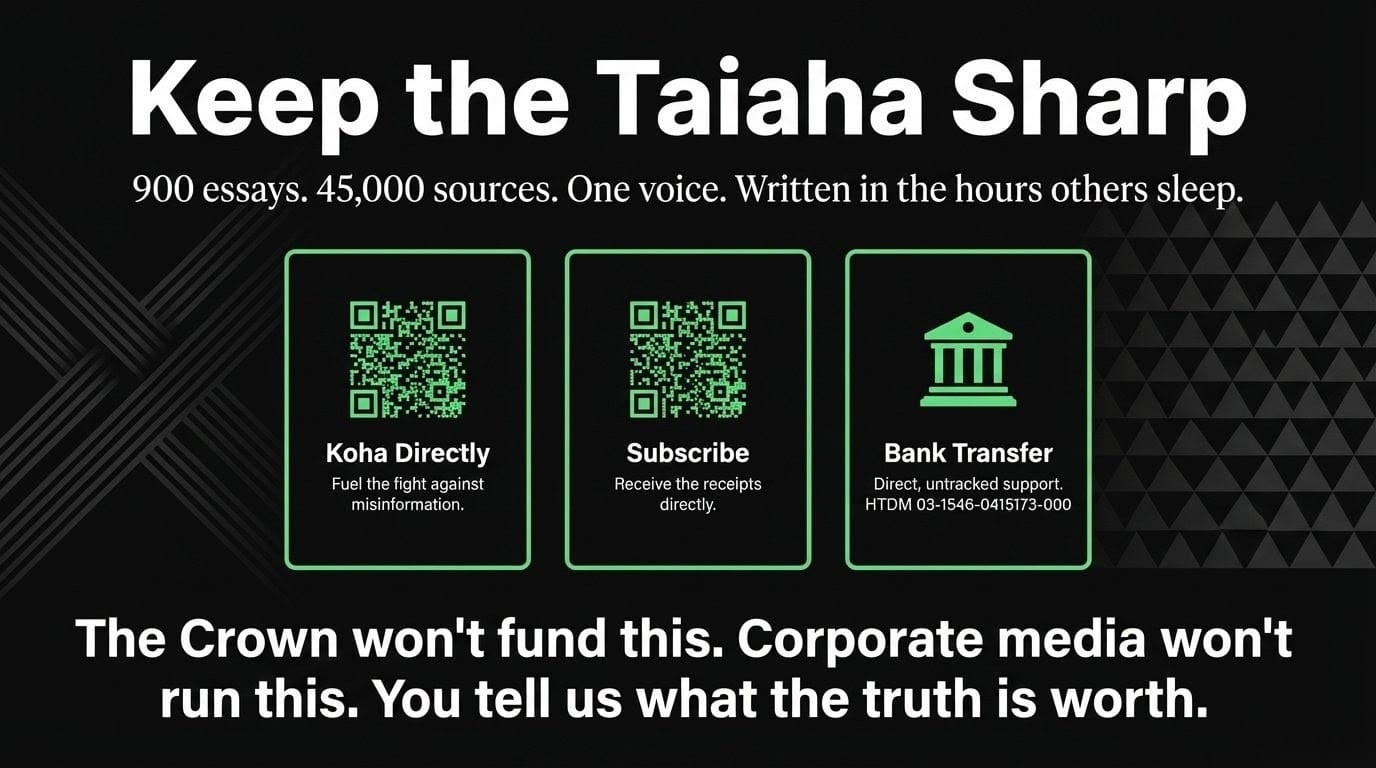
Nine hundred essays. 45,000 sources. One voice. No corporate backing. No government grant. No advertising revenue. No algorithm to carry the message except yours.
Every single essay in this archive was written in the hours that other people sleep, grieve quietly, and accept. Every essay that named Simeon Brown by name, traced the architecture of the $1 billion Māori funding massacre, exposed the Plunket-Peters broadcasting machine, documented the dying in Te Tāhū o Te Rā, and stood in the way of the SLAPP — was written by one person, on a sovereign digital marae that runs because people like you decided that Māori truth-telling is worth funding.
The Crown is not going to fund this. The corporate media is not going to run this. NewstalkZB is not going to award a journalism prize to the person who named their network as a laundering service for racist polling. The $3,000 BSA fine for calling tikanga "mumbo jumbo" tells you exactly what the institutional media thinks Māori culture is worth.
You tell us what it's worth.
Kia kaha, whānau. Stay vigilant. Stay connected. And if you are able, consider a koha so that the 1,000th essay is written, and the 1,001st, and the ones after that — until the accountability is complete.
If you cannot koha right now — no worries. Subscribe, share, kōrero. That is koha in itself. Pass a single essay to a single person who needs to read it. That is the whakapapa continuing.
Three pathways:
Koha directly to the mahi: Support on Koha — The Māori Green Lantern Fighting Misinformation
Subscribe and receive every essay directly: Subscribe to the Māori Green Lantern
Direct bank transfer: HTDM — account number 03-1546-0415173-000
Ko te pātaka i tūtū ai te ao. Ko te taiaha e kore ai e hinga.
The pātaka that fed the world. The taiaha that will not fall.